Associated Press
Tuesday, May 8, 2007 (Baghdad)
US troops are relying on the Mahdi Army to protect the mosque of Imam Kadhim, the most revered Shiite shrine in Baghdad, as it is a tempting target for Sunni insurgents.
The Mahdi Army is a Shiite militia that Washington considers a threat to Iraq's stability.
In Kazimiyah, a densely packed neighborhood of wooden shops and cheap hotels for Shiite pilgrims, the Americans and their Iraqi partners have opted for militia help to protect the shimmering, blue-domed shrine.
With tacit American approval, plainclothes militiamen loyal to anti-American cleric Muqtada al-Sadr set up impromptu checkpoints and patrol alleys near the mosque day and night.
This development cuts to the heart of a dilemma for the US military three months into the campaign to pacify Baghdad: whether to risk fierce battles by confronting Shiite militiamen blamed for massacring Sunnis or to deal with ''moderates'' in the Mahdi Army - which the US believes receives weapons and training from Iran.
The Americans believe that tolerating a discreet role for the Mahdi Army, which US officers refer to by its Arabic acronym JAM, is better than either picking a fight with the militia or taking the blame if Sunni extremists manage a repeat of the February 2006 bombing of another Shiite shrine in Samarra.
That attack, which the US blames on al-Qaida, unleashed a wave of sectarian bloodletting and reprisal attacks on mosques, plunging the country into civil conflict.
Security forces streched
Without the militia, US and Iraqi officers acknowledge that the 2,000 Iraqi security forces and 500 American soldiers based in the area would be hard-pressed to protect the neighborhood's 120,000 residents and the shrine, which houses the tombs of two eight century Shiite imams.
US commanders have chosen to use the Mahdi security network already in place rather than divert resources from other parts of the city where security is worse.
''There are a lot of people affiliated with JAM, and if we made them all enemies, we'd be in trouble. So we try to sort out who's extremist JAM and can't be reasoned with because of their ideology, and who we can live with as long as they're not killing US and Iraqi soldiers or civilians,'' said Lt Col Steve Miska who commands US troops in northwest Baghdad.
Miska's efforts suffered a setback last week when Iraq's parliament passed legislation banning US troops from within two-thirds of a mile of the shrine.
The measure, proposed by al-Sadr's representatives in parliament, was seen as largely symbolic and was approved the day after a gunbattle between US troops and Mahdi fighters.
During the two-hour fight, some Iraqi soldiers fought alongside Mahdi Army gunmen, according to the Iraqi officer in charge of security in the area.
He spoke on condition of anonymity out of fear for his life. But his account was corroborated by US officials, who said some Iraqi soldiers took off their uniforms and tossed weapons to militiamen.
US and Iraqi commanders hope that once tempers ease, the law will be changed or ignored.
In the meantime, both American and Iraqi officials must deal with reality: the militia is so deeply entrenched in Kazimiyah and other Shiite neighborhoods in Baghdad that it can be effective in maintaining security.
''Most people don't like JAM. But they enjoy the protection JAM gives them and the shrine,'' said Hassan, an Arab-American who serves as an interpreter and cultural adviser to Miska.
Al-Qaida threat
US officials fear an al-Qaida attack on the shrine is a real possibility.
In March 2004, three suicide bombers attacked the Kazimiyah shrine during a Shiite religious festival, killing 58 people and wounding 200.
After that, Shiite militiamen stepped up their presence around the shrine.
''If you look at al-Qaida and what they're capable of doing, I don't think it's paranoia here. They (the Mahdi Army) are trying to take prudent measures to protect an extremely sensitive religious site,'' said Miska.
Those measures involve inundating the streets around the shrine - a tightly woven web of mostly pedestrian thoroughfares - with mostly young men in their teens and early 20s who dress in civilian clothes and loiter on street corners.
Armed with cell phones, they become the eyes and ears of the Mahdi Army.
The militia ''dresses as civilians and they blend in,'' said Nabil Ali a Shiite who fled another Baghdad neighborhood after receiving a death threat from Sunni insurgents - a bullet in an envelope. ''It's a better way to protect the mosque.''
Political cover
Across Baghdad, the Mahdi Army has laid low in the past three months, as part of what is believed to be an informal deal with Prime Minister Nouri al-Maliki during the US-Iraqi security crackdown.
But in Kazimiyah, the number of fighters has spiked in recent months, US and Iraqi officials said.
With the approval of the Sunni-run Defense Ministry, the reinforcements include more than 300 men dispatched by Bahaa al-Araji, a member of al-Sadr's bloc in parliament.
The Iraqi government is still in the process of issuing them weapons, but the entire force is believed to have come from the Mahdi Army.
''You're looking at JAM with political cover all the way to the top here,'' Miska said.
In addition, militiamen are believed to have infiltrated most Iraqi army, National Police and local police units in Kazimiyah, US and Iraqi officials said.
The level of infiltration sometimes creates friction between US officers and the Iraqi security commanders with whom they work.
During a recent intelligence briefing at a US outpost in Kazimiyah, an Iraqi colonel shouted his objections to a US report that Iraqi soldiers were helping Shiites move into Sunni homes in one neighborhood.
Even so, Miska said, ''right now we just don't have a better alternative.''
That's just fine for many residents of Kazimiyah, who say they have little confidence in Iraqi soldiers and police, even though they are mostly fellow Shiites. Instead, residents believe the militia offers the best protection.
''I can go to and from my house late at night and I feel safe because JAM is in my neighbourhood. I might not like what some of them do to Sunnis or others who betray them. But for me, they protect my family. That is my concern,'' said Ziad Tariq al-Bendawi.
Showing posts with label Baghdad. Show all posts
Showing posts with label Baghdad. Show all posts
Tuesday, May 8, 2007


Friday, May 4, 2007
Baghdad wall has nothing to do with protecting Iraqis
In Focus:
More than a wall
When the Americans decided to build a wall around Al-Adhamiyah in Baghdad, they claimed that their main concern was to protect the inhabitants. Very noble of them, but was this the real reason? Are the Americans interested in protecting Al-Adhamiyah, or in protecting other areas from fighters based in Al-Adhamiyah? Before answering these questions, let's review a few developments that took place in Iraq of late.
The city of Kirkuk is being Kurdicised. Up until the occupation, ethnic Arabs mostly inhabited the city. Now the Kurds want to annex it to their province. Why is that? Because Kirkuk sits on a lake of oil, and the Kurds need to control the oil as part of their plan to secede from Iraq. The Kurdish scheme is so obvious that Turkey is already saying it cannot allow it to happen. The last thing the Erdogan government needs is a Kurdish state on its southern borders.
Meanwhile, plans are underway to declare a Basra Province in southern Iraq, although no attempts at secession have so far been made. The similarity between the situation in Kurdistan and Basra is worth examining. If things keep proceeding in this direction, Iraq would soon be partitioned into three mini-states. The "no fly" latitude lines the Clinton administration put in place several years ago would determine the borders of those mini-states. Kurdistan is already behaving as a semi-independent state. It is signing oil agreements with other countries, establishing political and economic ties with other nations, and generally ignoring the beleaguered government in Baghdad.
The Americans want to see Iraq divided; Kurdistan in the north, Basra in the south, and the Sunni triangle in the middle. But what does all this have to do with Al-Adhamiyah?
Well, let's not forget that the US administration is faced with a deepening crisis both at home and abroad. In Iraq, the US army is on the defensive. At home, the two houses of Congress, acting in defiance of President Bush, have made it clear that troops must be pulled out by September 2008 at the latest. Should the withdrawal take place -- and it most likely will -- then the whole Project for the New American Century would fall apart. All this planning, all these attempts to control oil resources, would come to nothing. It would be a disaster for the neo-cons. This is why the latter are determined to divide Iraq prior to withdrawal, the aim being to have two out of three mini-states under US control.
The Kurdish government would be pleased to forge a close alliance with the Americans. Such an alliance would offer the Kurds protection from the Turks, the Iranians and the pan-Arab government that may emerge in central Iraq. The southern province would also rush into US arms, for more or less the same reasons. Iraq would thus be reduced to the same status as any of the Gulf states, just another group of sheikhdoms reliant on oil and foreign backing.
This scenario wouldn't be easy to carry out so long as the resistance is going strong. So the fighters must be isolated in their strongholds: in Al-Anbar, Tel Afar, Al-Qaim and Al-Adhamiyah. Furthermore, some effort must be exerted for national unity, through the integration of former Baathists and army personnel into the system. The US administration is already moving in that direction. Also, the Americans claim to be succeeding in breaking the ranks of the Iraqi resistance. Still, why Al-Adhamiyah?
Let's go back to history. Founded at the time of Caliph Abu Jaafar Al-Mansour, Baghdad was built on the opposite banks of the Tigris. The west bank of the river was known as Al-Karkh, the east bank as Al-Rasafa. Until recently, the centre of the city was divided equally between the two banks. The mausoleum of Abu Hanifa was in Al-Rasafa, and that of Imam Al-Kazem was in Al-Karkh, with the Imamayn (two imams) Bridge connecting the two. Al-Adhamiyah took its name from the words "Al-Imam Al-Adham", or Abu Hanifa, a leading Sunni doctrinaire. During the Ottoman era, Al-Adhamiyah had a reputation for rebellion that continued even during the communist tide of the 1960s. Since the fall of Baghdad, Al-Adhamiyah has been active in resistance.
In the early days of the occupation, it was said that Iraq's political elite, Saddam's Hussein included, took refuge in Al-Adhamiyah. At one point, it was said that Saddam attended prayers at the mosque of Al-Imam Al-Adham. US forces reacted to the rumours by shelling the mosque. The main minaret of that mosque still bears the marks of shelling. For the past four years, Al-Adhamiyah has been a hotbed of resistance. The Americans repeatedly declared the area "liberated" from the resistance. But when the Americans tried to send the Iraqi army -- the new one they had created -- to its first real test in Al-Adhamiyah, dozens of Iraqi and US troops were killed. After this, the Americans tried to send troops in dinghies across the river, but suffered further losses.
Al-Adhamiyah is the link between the two banks of the Tigris and the gateway to Al-Waziriya, to the Ministry of Defence and the Green Zone. To isolate Al-Adhamiyah is to deprive the resistance of a vital asset. This is why the Americans built the wall. So there you have it. Al-Adhamiyah is part of the US drive to restrain, not protect, the Iraqis. This quest is likely to fail, as it did repeatedly in the past. The days of the occupation are numbered.
© Copyright Al-Ahram Weekly. All rights reserved
Al-Ahram Weekly Online
Beleaguered Iraqis now fear their own security forces more than the insurgents
By Patrick Cockburn in Baghdad
Published: 04 May 2007
"Be careful," warned a senior Iraqi government official living in the Green Zone in Baghdad, "be very careful and above all do not trust the police or the army."
He added that the level of insecurity in the Iraqi capital is as bad now as it was before the US drive to make the city safe came into operation in February.
The so-called "surge", the dispatch of 20,000 extra American troops to Iraq with the prime mission of getting control of Baghdad, is visibly failing.
There are army and police checkpoints everywhere but Iraqis are terrified because they do not know if the men in uniform they see there are, in reality, death squad members.
Omar, the 15-year-old brother-in-law of a friend, was driving with two other boys through al-Mansur in west Baghdad a fortnight ago. Their car was stopped at a police checkpoint. Most of the police in Baghdad are Shia. They took him away saying they suspected that his ID card was a fake. The real reason was probably that only Sunnis use the name Omar. Three days later he was found dead.
I was driving through central Baghdad yesterday. Our car was pulled over at an army checkpoint. I had hung my jacket from a hook above the window so nobody could easily see I was a foreigner. A soldier leaned in the window and asked who I was. We were lucky. He merely looked surprised when told I was a foreign journalist and said softly: "Keep well hidden."
The problem about the US security plan is that it does not provide security. It had some impact to begin with and the number of bodies found in the street went down. This was mainly because the Shia Mehdi Army was stood down by its leader, Muqtada al-Sadr.
But the Sunni insurgent groups increased the number of sectarian suicide bombings against Shia markets. The US was unable to stop this and now the sectarian body count is on the rise again. Some 30 bodies, each shot in the head, were found on Wednesday alone.
The main new American tactic is proving counter-productive. This is the sealing-off of entire neighbourhoods, either by concrete walls or barriers of rubbish, so there is only a single entrance and exit.
Speaking of Sunni districts such as al-Adhamiyah, a government official said: "We are creating mini-Islamic republics."
This is born out by anecdotal evidence. The uncle of a friend called Mohammed (nobody wants their full name published) died of natural causes. The family, all Sunni, wanted to bury him but were unable to reach the nearest cemetery in Abu Ghraib. Instead they went to one in Adhamiyah. As they entered the cemetery an armed civilian group, whom they took to be al-Qa'ida from their way of speaking, asked directly: "Are any of you Shia?" Only when reassured that they were all Sunni were they allowed to bury their relative.
The failure of the "surge" comes because it is not accompanied by any political reconciliation. On the contrary the government is factionalised. The two vice-presidents, Tariq al- Hashimi, a Sunni, and Adel Abdel Mehdi, a Shia, may make conciliatory statements, but one Iraqi observer noted: "Tariq only employs Sunni and Adel only Shia."
The Sunni feel they are fighting for their lives. Their last redoubts in east Baghdad (aside from Adhamiyah) are being overrun by the Mehdi Army. The Sunni insurgent groups, notably al-Qa'ida, are on the offensive in west Baghdad, where they are strongest. When the Americans succeed in driving away Shia militia their place is taken, not by government forces, but by Sunni militia.
People in Baghdad are terrified of being killed by a bomb or bundled into the boot of a car and murdered. Less dramatic, but equally significant in forcing people to flee Iraq for Jordan or Syria is the sheer difficulty of maintaining a normal life. Much of the trade in the city used to take place in open-air markets. But because of repeated bombs attacks only one is now open. This is in Karada, but many people no longer go there because it has come under repeated attack.
So many areas are now sealed off in Baghdad that there are continuous traffic jams. This presents a problem for drivers. If they to avoid the traffic jams by driving off the main road they may enter an area where militiamen rule whomay kill them.
One friend who had just returned from a trip to Syria found that, because of an attack on a government patrol, his neighbourhood had been closed to traffic. "I had to walk for 40 minutes with my heavy suitcase," he lamented.
Even in dangerous neighbourhoods such as Beitawin, off Saadoun Street in central Baghdad, notorious for its criminal gangs even in Saddam Hussein's time, people were queuing for petrol for hours yesterday evening because they have no choiceif they want to fill their tanks.
A bizarre flavour has been given to Saadoun Street because the government has encouraged artists to paint the giant concrete blast barriers with uplifting, if unlikely, scenes of mountain torrents, meadows in spring and lakeside scenes. Many of the pictures, all in garish greens, blues and yellows, look more like Switzerland than Iraq.
Muqtada al-Sadr, for his part, is encouraging artists to paint the blast barriers with scenes illustrating the anguish that has been inflicted on the Iraqi people by the US occupation.
The only "gated community" that functions successfully in Baghdad is the Green Zone itself, the four square miles on the right bank of the Tigris that is home to the government and the US embassy. It is sealed off from the rest of Iraq by multiple security barriers and fortifications.
Entering the zone recently I was questioned and searched, at different stages, by Kurds, Georgians, Peruvians and Nepalese.
No country in the world has such rigorous frontier procedures as what one American called "this little chunk of Texas". Living cut off in the zone it is impossible for the ruling elite of Iraq to understand the terrible suffering and terror beyond the compound's gates.
Published: 04 May 2007
"Be careful," warned a senior Iraqi government official living in the Green Zone in Baghdad, "be very careful and above all do not trust the police or the army."
He added that the level of insecurity in the Iraqi capital is as bad now as it was before the US drive to make the city safe came into operation in February.
The so-called "surge", the dispatch of 20,000 extra American troops to Iraq with the prime mission of getting control of Baghdad, is visibly failing.
There are army and police checkpoints everywhere but Iraqis are terrified because they do not know if the men in uniform they see there are, in reality, death squad members.
Omar, the 15-year-old brother-in-law of a friend, was driving with two other boys through al-Mansur in west Baghdad a fortnight ago. Their car was stopped at a police checkpoint. Most of the police in Baghdad are Shia. They took him away saying they suspected that his ID card was a fake. The real reason was probably that only Sunnis use the name Omar. Three days later he was found dead.
I was driving through central Baghdad yesterday. Our car was pulled over at an army checkpoint. I had hung my jacket from a hook above the window so nobody could easily see I was a foreigner. A soldier leaned in the window and asked who I was. We were lucky. He merely looked surprised when told I was a foreign journalist and said softly: "Keep well hidden."
The problem about the US security plan is that it does not provide security. It had some impact to begin with and the number of bodies found in the street went down. This was mainly because the Shia Mehdi Army was stood down by its leader, Muqtada al-Sadr.
But the Sunni insurgent groups increased the number of sectarian suicide bombings against Shia markets. The US was unable to stop this and now the sectarian body count is on the rise again. Some 30 bodies, each shot in the head, were found on Wednesday alone.
The main new American tactic is proving counter-productive. This is the sealing-off of entire neighbourhoods, either by concrete walls or barriers of rubbish, so there is only a single entrance and exit.
Speaking of Sunni districts such as al-Adhamiyah, a government official said: "We are creating mini-Islamic republics."
This is born out by anecdotal evidence. The uncle of a friend called Mohammed (nobody wants their full name published) died of natural causes. The family, all Sunni, wanted to bury him but were unable to reach the nearest cemetery in Abu Ghraib. Instead they went to one in Adhamiyah. As they entered the cemetery an armed civilian group, whom they took to be al-Qa'ida from their way of speaking, asked directly: "Are any of you Shia?" Only when reassured that they were all Sunni were they allowed to bury their relative.
The failure of the "surge" comes because it is not accompanied by any political reconciliation. On the contrary the government is factionalised. The two vice-presidents, Tariq al- Hashimi, a Sunni, and Adel Abdel Mehdi, a Shia, may make conciliatory statements, but one Iraqi observer noted: "Tariq only employs Sunni and Adel only Shia."
The Sunni feel they are fighting for their lives. Their last redoubts in east Baghdad (aside from Adhamiyah) are being overrun by the Mehdi Army. The Sunni insurgent groups, notably al-Qa'ida, are on the offensive in west Baghdad, where they are strongest. When the Americans succeed in driving away Shia militia their place is taken, not by government forces, but by Sunni militia.
People in Baghdad are terrified of being killed by a bomb or bundled into the boot of a car and murdered. Less dramatic, but equally significant in forcing people to flee Iraq for Jordan or Syria is the sheer difficulty of maintaining a normal life. Much of the trade in the city used to take place in open-air markets. But because of repeated bombs attacks only one is now open. This is in Karada, but many people no longer go there because it has come under repeated attack.
So many areas are now sealed off in Baghdad that there are continuous traffic jams. This presents a problem for drivers. If they to avoid the traffic jams by driving off the main road they may enter an area where militiamen rule whomay kill them.
One friend who had just returned from a trip to Syria found that, because of an attack on a government patrol, his neighbourhood had been closed to traffic. "I had to walk for 40 minutes with my heavy suitcase," he lamented.
Even in dangerous neighbourhoods such as Beitawin, off Saadoun Street in central Baghdad, notorious for its criminal gangs even in Saddam Hussein's time, people were queuing for petrol for hours yesterday evening because they have no choiceif they want to fill their tanks.
A bizarre flavour has been given to Saadoun Street because the government has encouraged artists to paint the giant concrete blast barriers with uplifting, if unlikely, scenes of mountain torrents, meadows in spring and lakeside scenes. Many of the pictures, all in garish greens, blues and yellows, look more like Switzerland than Iraq.
Muqtada al-Sadr, for his part, is encouraging artists to paint the blast barriers with scenes illustrating the anguish that has been inflicted on the Iraqi people by the US occupation.
The only "gated community" that functions successfully in Baghdad is the Green Zone itself, the four square miles on the right bank of the Tigris that is home to the government and the US embassy. It is sealed off from the rest of Iraq by multiple security barriers and fortifications.
Entering the zone recently I was questioned and searched, at different stages, by Kurds, Georgians, Peruvians and Nepalese.
No country in the world has such rigorous frontier procedures as what one American called "this little chunk of Texas". Living cut off in the zone it is impossible for the ruling elite of Iraq to understand the terrible suffering and terror beyond the compound's gates.
Tuesday, May 1, 2007
Bush's Texas Chainsaw Massacre
Tomgram: Tick... Tick... Tick... in Washington and Baghdad
[Note for Tomdispatch readers: On this fourth anniversary of the President's "Mission Accomplished" moment, I urge you to consider ordering yourself a copy of Mission Unaccomplished: Tomdispatch Interviews with American Iconoclasts and Dissenters (Nation Books). James Carroll, Chalmers Johnson, Katrina van den Heuvel, Howard Zinn, Juan Cole, Mike Davis, Barbara Ehrenreich, Mark Danner, and other interviewees provide the best guide possible to the years we've just lived through. It's empire-on-the-run and great reading -- and, of course, I'll be appreciative to each of you forever and ever... Tom]
…Or The Clock Ticks for Thee (in Baghdad and Washington)
By Tom Engelhardt
It had taken much thought and planning that wartime May Day four years ago when George W. Bush co-piloted an S-3B Viking sub reconnaissance Naval jet onto the deck of the USS Abraham Lincoln. Scott Sforza, a former ABC producer, had "embedded" himself on that aircraft carrier days before the President landed. Along with Bob DeServi, a former NBC cameraman and lighting specialist, and Greg Jenkins, a former Fox News television producer, he had planned out every detail of the President's arrival -- as Elisabeth Bumiller of the New York Times put it then -- "even down to the members of the Lincoln crew arrayed in coordinated shirt colors over Mr. Bush's right shoulder and the ‘Mission Accomplished' banner placed to perfectly capture the president and the celebratory two words in a single shot. The speech was specifically timed for what image makers call ‘magic hour light,' which cast a golden glow on Mr. Bush."
Before the President could descend jauntily from that plane into the perfect light of a late spring afternoon, and onto what was essentially a movie set, the Abraham Lincoln, which had only recently hit Iraq with 1.6 million pounds of ordnance, had to be stopped just miles short of its home base in San Diego. No one wanted George W. Bush simply to clamber aboard.
Who could forget his Tom-Cruise-style "Top Gun swagger" across that deck -- so much commented on in the media in the following days -- to the carefully positioned podium where he gave his speech? It was to be the exclamation point on his invasion of choice and provide the first fabulous photos for his presidential campaign to come. Only two things about that moment, that speech, are remembered today -- that White House-produced "Mission Accomplished" banner behind him and his announcement, with a flourish, that "major combat operations in Iraq have ended."

If his landing and speech are today remembered as a woeful moment, an embarrassment, if those fabulous photos never made it into campaign 2004, that was, in part, because of another event -- a minor headline -- that very same May day: Halfway around the world, soldiers from the 82nd Airborne Division, occupying an elementary school in Fallujah, fired on a crowd of angry Iraqi demonstrators. Perhaps 15 Iraqis died and more were wounded. Two days later, in a second clash, two more Iraqis would die.
On CNN's website the day after the President's landing, the main headline read: "Bush calls end to ‘major combat.'" But there was that smaller, secondary headline as well: "U.S. Central Command: Seven hurt in Fallujah grenade attack." Two grenades had been tossed into a U.S. military compound, leaving seven American soldiers slightly injured.
In the months to follow, those two headlines would jostle for dominance, a struggle now long over. Before May 1, 2004 ever rolled around, "mission accomplished" would be a scarlet phrase of shame, useful only to critics of the administration. By that one-year anniversary, Fallujah had morphed into a resistant city that had withstood an assault by the Marines. In November 2004, it would be largely destroyed by American firepower without ever being subdued. Now, the already failed American method of turning largely destroyed Fallujah into a giant "gated" prison camp for its residents is being applied to the Iraqi capital, Baghdad, where huge walls are slated to rise around 10 or more recalcitrant neighborhoods as part of the President's Baghdad Security Plan, or "surge."
Four years later, casualty figures are so terrible in Iraq that the government, locked inside the Green Zone in the capital, has, for the first time, refused to reveal the monthly figures to the United Nations, though figures do show a continuing epidemic of assassinations of Iraqi academics and of torture of prisoners, a steep rise in deaths among policemen, and a rise in "honor killings" of women by their own families. Four years later, those few "slightly injured" men of the 82nd Airborne Division have morphed into last week's 9 dead and 20 wounded from a double-truck-bomb suicide attack on one of that division's outposts in Diyala Province; over 100 Americans were killed in the month of April alone; 3,350 Americans in all (not including hundreds of "private security contractors").
Four years later, the American military has claimed dramatic success in reducing a wave of sectarian killings in the capital -- but only by leaving out of its count the dead from Sunni car/truck/motorcycle-bomb and other suicide-bomb attacks; with over 100 car bombings last month, and similar figures for this one, Sunni militants are outsurging the U.S. surge in Baghdad, making "a mockery of the US and Iraqi security plan," according to BBC reporter Andrew North.
Four years later, not only has the Bush administration's "reconstruction" of the country been a record of endless uncompleted or ill-completed projects and massive overpayments, not to speak of financial thievery, but even the projects once proclaimed "successes" turn out, according to inspectors from the Office of the Special Inspector General for Iraq Reconstruction, to be disasters "no longer operating as planned"; the biggest business boom in a country in which unemployment is sky-high may be "a run on concrete barriers" for security, which are so in demand that sometimes they "are not fully dry when military engineering units pick them up"; electricity availability and potable water supplies are worse than ever; childhood malnutrition is on the rise; no one even mentions Iraqi oil production which remains well below the worst days of Saddam Hussein and billions of dollars of which are being siphoned off onto the black market.
Four years later, U.S. prisons, one of the few reconstruction success stories in Iraq, are chock-a-block full, holding 18,000 or more Iraqis in what are essentially terrorist-producing factories; Iraq has the worst refugee problem (internal and external) on the planet with perhaps 4 million people in a population of 25 million already displaced from their homes (202 of whom were admitted to the United States in 2006); the Iraqi government inside the Green Zone does not fully control a single province of the country, while its legislators are planning to take a two-month summer "vacation"; a State Department report on terrorism just released shows a rise of 25% in terrorist attacks globally, and 45% of these attacks were in Iraq; 80% of Iraqis oppose the U.S. presence in their country; 64% of Americans now want a timetable for a 2008 withdrawal; and the President's approval rating fell to its lowest point, 28%, in the most recent Harris poll, which had the Vice President at a similarly record-setting 25%.
During this grueling, destructive downward spiral through the very gates of hell, whose end is not faintly in sight, the administration's war words and imagery have, unsurprisingly, undergone continual change as well. In the course of these last years, the "turning points," "tipping points," "milestones," and "landmarks" on the road to Iraqi democracy and freedom have turned into modest marks on surveyor's yardsticks ("benchmarks"), not one of which can be met by the woeful Iraqi government of Prime Minister Nouri al-Maliki. The "magic hour light" of May 2003 has disappeared, along with those glorious photos from the deck of the carrier. The sort of descriptions you see today, as in a recent David Ignatius column in the Washington Post, sound more like this: "Republicans voice the bitterness and frustration of people chained to the hull of a sinking ship." (The USS George W. Bush, undoubtedly.) Oh, and the President and what's left of his tattered administration have stopped filming on a Top Gun-style movie set and seem now to be intent on remaking The Texas Chainsaw Massacre.
This White House has plunged Iraq and the world into the geopolitical equivalent of a blood-and-gore exploitation film that simply won't end. Call that "Mission Accomplished"!
The Mission Continues (2003)
Just the other day, with the fourth anniversary of the Top Gun speech looming, Deputy White House Press Secretary Dana Perino was questioned at a press briefing yet again about that infamous banner and "major combat operations" being at an end. Here is part of the exchange:
"MS. PERINO: …I think that if you only take the one line, that the end of combat operations -- major combat operations, that's true, but the President also --"Q: Yes, but the banner is [a] consideration, as well.
"MS. PERINO: Okay, well… And we have explained it many times. And you know what? I have a feeling I'm just on the losing end of this battle because the left has decided to believe what they want to believe, which is that the President was saying that the war was over and the troops were coming home. That's not what he said, and I just told you specifically what he said, and I encourage people to read the whole speech. And that ship… USS America [sic] Lincoln had been deployed for well over its stated period… they were coming home. And it was the ship that -- that['s] mission was accomplished. And the President never said, ‘mission accomplished' in the speech…"
Actually, Perino isn't wrong on "mission accomplished" -- and not just in the literal sense either. It's well worth taking up her suggestion, in fact, and rereading that speech, though in order to do so you have to travel a vast distance, as if through some Star-Trekian wormhole into an alternate universe.
You have to reach across the chasm of Bush administration disasters -- from Kabul and Baghdad to New Orleans and Walter Read Medical Center -- to another moment, another mood in the United States. If you do, perhaps the first thing you'll note about that magic-hour speech is its globally messianic and militarized nature. The President, for instance, congratulated the returning sailors and airmen in this over-the-top way: "All of you -- all in this generation of our military -- have taken up the highest calling of history." It's the sort of line that brings to mind one of the President's favorite hymns, "A Charge to Keep": "To serve the present age,/ My calling to fulfill:/ O may it all my powers engage/ To do my master's will!" It also brings to mind Bush's post-9/11 slip of the tongue when he spoke of his beloved "war" as: "this crusade, this war on terrorism."
And what exactly was that calling, the highest in history, for which they were fighting? A President, just off the plane ride of his dreams, was perfectly willing to spell it out. It was nothing less -- he announced from the deck of a ship whose planes had just pummeled Saddam Hussein's Iraq -- than "the peace of the world." And the "peace" the President had in mind wouldn't be some namby-pamby cooperative endeavor. It would be an armed demand of the rest of the world. After all, the invasion Bush had launched just weeks before, hadn't been an ordinary military operation, a simple superpower "cakewalk" over a pathetic force hollowed out by years of war and fierce economic sanctions. Operation Iraqi Freedom, as it was called, was something "the world had not seen before." Talk about awesome! "You have shown the world," the President assured the Abraham Lincoln crew, "the skill and the might of the American Armed Forces" -- the likes of which, the power of which, it was clear, had never been witnessed on the face of this planet in all of history from all the empires that ever were.
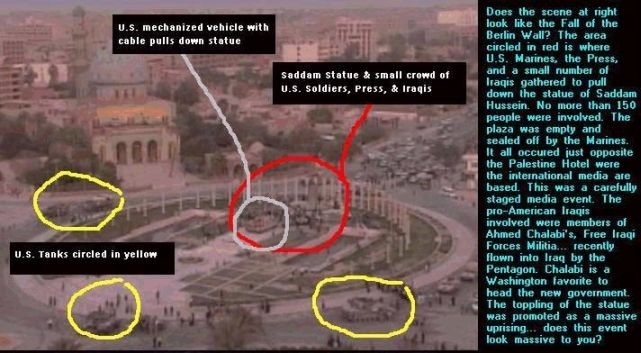
Invoking the American-manufactured image of Saddam's falling statue in Baghdad's Firdos Square, Bush waxed enthusiastic, perhaps imagining Biblical idols dropping before the one true God: "In the images of falling statues, we have witnessed the arrival of a new era." A new era! You can feel that messianic exclamation point embedded in the spirit of the claim. And it wouldn't for a second be an era in which the lion lay down with the lamb; it would be a U.S. military-enforced era of "freedom." In the American military's ability to crush enemies without harming civilians, the kind of war being fought, he swore, was nothing less than "a great moral advance."
The highest calling in history! The peace of the world! Something the world had not seen before! A new era! A great moral advance!
Given all this, Perino was absolutely on the mark. The President didn't consider his mission accomplished -- not by a long shot. That's why he never used the two words together in a speech otherwise filled to the brim with "victory," flushed with success, high on winning. Yes, "major combat" was over in Iraq, but that represented only "one victory in a war on terror." The "mission" -- and it was indeed a mission he was talking about -- was nothing as small as a world historic success against one brutal dictator. No indeed.
True, the regime of the monster in Baghdad had been felled or, as the term of tradecraft of that moment went, "decapitated"; Saddam's program of weapons of mass destruction had been thwarted ("We've begun the search for hidden chemical and biological weapons and already know of hundreds of sites that will be investigated…"); and Saddam's (implied) links to al-Qaeda and the 9/11 attacks handsomely repaid. Naturally, as well, American military personnel wanted to return home after such a successful venture, but that was not yet possible.
The planet must first be set right and the President's speech that May Day four years ago was nothing less than a trumpet call to the troops -- and a warning to planet Earth. "[A]ll can know," the President intoned, "friend and foe alike, that our nation has a mission: We will answer threats to our security, and we will defend the peace… We do not know the day of final victory, but we have seen the turning of the tide." The mission, despite that fatal banner, was not "accomplished." Not in the least. As the President said ringingly, quoting the Bible and thanking God, "Our mission continues."
Looking back across the vast expanse of disaster that is Bush policy in Afghanistan, Iraq, "the Greater Middle East" (aka the oil heartlands of the planet), and elsewhere (including our own country), his was, in fact, a particularly chilling speech -- a ringing reaffirmation that one war was so many too few; a resounding endorsement of what would later be dubbed by Centcom Commander John Abizaid, "The Long War." Our President was already imagining an Orwellian future in which military power beyond compare was to actively remake the planet, cruise missile by cruise missile, under the banner of "peace." Above all else, his speech was a reaffirmation of an American "mission" in which time, maybe even all eternity, was on our side.
As it happens, those Pax Americana pipedreams would never make it out of Iraq. That speech, suffused with George W. Bush's personal sense of pleasure, satisfaction, and all-American war play ("When I look at the members of the United States military, I see the best of our country, and I'm honored to be your Commander-in-Chief…"), would be destroyed by "all the citizens of Iraq who welcomed our troops and joined in the liberation of their own country." Put more precisely, it would be done in by a ragtag minority Sunni insurgency and a ragtag Shiite government that shared hardly a shred of his particular vision. Perhaps the moral here, if there is one, might be: Beware the man who praises himself and his nation too highly.
Tick…Tick…Tick (2007)
"No man is an island, entire of itself," wrote John Donne. "...[A]ny man's death diminishes me, because I am involved in mankind; and therefore never send to know for whom the bell tolls; it tolls for thee."
Unfortunately, our President was, four years ago, already a man on an island, or the deck of an aircraft carrier doubling as a movie set, separated from the mainland of this world. He already had his military outfits to dress up in and his cowboy language ("bring ‘em on") straight from the films of his childhood to wield. Back in those days, he was already favoring appearing in specially tailored military jackets in front of military crowds that would hoo-ah him enthusiastically -- and his handlers and enablers were already making ever so sure that no challenging human ever made it onto that island of his.
When he moved globally, he did so only on his bubble-island, surrounded by specially flown-in protection and entourage. To offer but a partial list from one such trip: armored escort vehicles, the presidential car (known to insiders as "the beast"), 200 Secret Service agents, 15 sniffer dogs, a Blackhawk helicopter, 5 cooks, and 50 White House aides. From London to Manila, his arrival automatically emptied whole central cities of life.
Not surprisingly, then, when the bell first began to toll for him, when those first signs of trouble began to appear in Iraq, he and his aides, officials, and advisors simply dismissed reality. As former CIA Director George Tenet's new memoir evidently makes clear, the island looked so much more appealing. According to New York Times book reviewer Michiko Kakutani, for instance: "Mr. Tenet writes that the C.I.A.'s senior officer in Iraq was dismissed as a ‘defeatist' for warning in 2003 of the dangers of a growing Iraqi insurgency, though it was already clear then that United States political and economic strategies were failing. Although the trends were clear, he adds, those in charge of policy ‘operated within a closed loop.' In that atmosphere, he says, bad news was ignored: the agency's subsequent reporting, which would prove ‘spot-on,' was dismissed."
As a senior advisor to the President told journalist Ron Suskind back in 2002:
"[G]uys like me were ‘in what we call the reality-based community,' which he defined as people who ‘believe that solutions emerge from your judicious study of discernible reality... That's not the way the world really works anymore,' he continued. ‘We're an empire now, and when we act, we create our own reality... We're history's actors... and you, all of you, will be left to just study what we do.'"
Four years after the President's smooth landing, it's hard even to express just how unaccomplished their non-reality-based "mission" remains. New Centcom Commander Adm. William J. Fallon is complaining about the use of "the Long War" ("unhelpful") to describe our world and even the President seems less focused on planting the stars and stripes on the heights of eternity. In fact, when it comes to Iraq, administration officials are now reportedly trying to "scale back talk of Iraq progress" -- talk that could not be scaled back much further without ceasing to exist.
No longer is there a landscape of freedom with its milestones and turning points; no longer is the timescale in generations. Now, administration officials are begging, wheedling, or bullying for months, thinking in weeks, worrying in days. They no longer demand several lifetimes' worth of time, but plead for just a little extra bit of it -- a modest suspension of disbelief until September -- to give the President's "new" plan a "chance."
Today, only one image seems to be on official lips in Washington and Baghdad and it's an ominous one: the ticking clock. It combines a complaint, a whine, a weapon against the war's critics, an explanation, a plea, and a mantra of sorts (all we are saying, is give time a chance). It is also a covert acknowledgement of the pressure reality turns out to be all-too-capable of exerting on the non-reality-based community. Time, it says, is no longer on our side; the sand in the proverbial hourglass may be running out. In its present incarnation, the image has been most vigorously championed by Gen. David Petraeus, the man chosen to lead the President's surge in Baghdad. Certainly, in recent weeks, both in Baghdad and Washington, he's been wielding a two-clocks-ticking image for all it's been worth, saying things like:
"…[T]he Washington clock is moving more rapidly than the Baghdad clock, so we're obviously trying to speed up the Baghdad clock a bit and to produce some progress on the ground that can perhaps give hope to those in the coalition countries, in Washington, and perhaps put a little more time on the Washington clock."
Dana Perino seconded him last week:
"Granted… this is very tough going; it is slow going. But we have to have slow, focused, persistent work, and encouraging patience on behalf of the American people. As you said, there's a -- there's this talk about an American clock versus an Iraqi clock, and sometimes the two don't tick at the same time."
As if to speed up the pace of time, she even threw in this twist:
"Q: ...What is a reasonable period of time for the American people to expect the Iraqi government to work out these critical measures of political accomplishment?"MS. PERINO: I'm not going to start the stop watch on the Iraqi government.."
And the two of them have had plenty of company. Navy Rear Adm. Mark Fox, communications director for the Multinational Force Iraq, upped the number of ticking clocks to three: "It's clear that the Washington clock and the London clock [are] ticking faster than the Baghdad clock."
White House Press Spokesman Tony Snow, on the other hand, reduced the clocks to one, but it was clearly the clock of clocks he was talking about: "The other thing the President wants to make clear is, right now what Democrats are doing is they're wasting time at a time when the clock is ticking."
Vice President Cheney, as he is wont to do, spelled the image out in extreme terms, making a single clock stand in as a symbol of surrender, not to say the ultimate victory of terrorism: "When members of Congress pursue an anti-war strategy that's been called ‘slow bleed,' they're not supporting the troops, they're undermining them. And when members of Congress speak not of victory but of time limits, deadlines or other arbitrary measures, they're telling the enemy simply to run out the clock and wait us out."
But no one has evidently heard the clock ticking louder than the President himself. Everywhere he went, he seemed to mention it:
March 28th: "Yet Congress continues to pursue these bills, and as they do, the clock is ticking for our troops in the field."
April 4th: "In the meantime, the clock is ticking for our military."
April 7th: "For our troops, the clock is ticking. If the Democrats continue to insist on making a political statement, they should send me their bill as soon as possible."
April 10th: "Now, the Democrats who pass these bills know that I'll veto them, and they know that this veto will be sustained. Yet they continue to pursue the legislation. And as they do, the clock is ticking for our troops in the field."
April 16: "As Congress delays, the clock is ticking for our troops."
Who knows, of course, what a man who cannot admit to, or perhaps even conceive of, doubt or error, or imagine "significant discussion," no less "serious debate," actually makes of all this. Is anyone there who could say to him: The clock ticks for thee? I doubt it. No man is an island; but, for our boy President, the alarm going off may always be for Groundhog Day.
Whether he knows whom the clock ticks for (other than the Democrats or the troops), we, at least, know that the clock is ticking down on his second term. Unfortunately, by my count, 31,536,000 ticks will only get us to this time next year. That's an awful lot of seconds to pass, given what we know we can expect from our President, Vice President, and their supporters -- more of the same. They've always had a knack, but only for destruction.
In Baghdad, can there be a question that any ticking clocks are attached to bombs? In Washington, they seem to be attached to mouths that never stop talking.
Thought of another way, from the moment those two towers came down on September 11, 2001, our President and Vice President have themselves been ticking clocks. Before their terms are done, before the clock runs out on them, they may turn out to be the true suicide bombers of this era. Already, they have managed to leave Iraq -- a modest-sized country with an immodest pool of oil underneath it -- in a state which we have no adequate word to describe, though when coined it will undoubtedly have a "-cide" at its end.
The clock continues to tick. By January 20, 2008, who knows what destruction they will have wrought; what chaos they will have brought to our world.
Tom Engelhardt, who runs the Nation Institute's Tomdispatch.com ("a regular antidote to the mainstream media"), is the co-founder of the American Empire Project and, most recently, the author of Mission Unaccomplished: Tomdispatch Interviews with American Iconoclasts and Dissenters (Nation Books), the first collection of Tomdispatch interviews.
ROVING IN THE RED ZONE: Baghdad up close and personal
ATol's "Roving Eye", Pepe Escobar, is back in Iraq and in the Red Zone - that is, outside "Fortress USA", the Green Zone. This is the first of his unembedded, non-Kevlar-protected, bodyguardless reports.
Baghdad up close and personal

Having dodged a bullet but not arrest by the Mehdi Army militia, Escobar witnesses the grand-scale mayhem and the minutiae of misery of Baghdad. In the deadly daily embrace of the Red Zone, the surreal overlaps Hollywood-style special effects while ethnic cleansing proceeds neighborhood by neighborhood and the bereaved are advised to visit the market to try to match the missing limbs of their dead. (May 1, '07)
Baghdad up close and personal
Having dodged a bullet but not arrest by the Mehdi Army militia, Escobar witnesses the grand-scale mayhem and the minutiae of misery of Baghdad. In the deadly daily embrace of the Red Zone, the surreal overlaps Hollywood-style special effects while ethnic cleansing proceeds neighborhood by neighborhood and the bereaved are advised to visit the market to try to match the missing limbs of their dead. (May 1, '07)
Sunday, April 29, 2007
U.S. fires artillery on southern Baghdad
By THOMAS WAGNER, Associated Press Writer 1 hour, 5 minutes ago
U.S. forces fired an artillery barrage in southern Baghdad Sunday morning, rocking the capital with loud explosions, while the death toll from a suicide car bomb attack in the Shiite holy city of Karbala rose to 68.
The blasts in Baghdad came a day after the U.S. military announced the deaths of nine American troops, including four killed in separate roadside bombings south of Baghdad and five in fighting in Anbar province, a Sunni insurgent stronghold west of the capital.
The size and the pattern of the explosions, which began after 9 a.m. and lasted for at least 15 minutes, suggested they were directed at Sunni militant neighborhoods along the city's southern rim. Such blasts have been heard in the evenings but are rare at that time of day.
In a brief statement to The Associated Press, the U.S. military said it fired the artillery from a forward operating base near Iraq's Rasheed military base southeast of Baghdad, but provided no other details.
Iraqis in the southern region of the city said American and Iraqi forces had stepped up their operations in the Dora area of southern Baghdad starting Saturday night.
Meanwhile, Iranian President Mahmoud Ahmadinejad confirmed Sunday that his government will attend a major regional conference on Iraq set for this week in Egypt, the Iraqi prime minister's office said.
A statement from Prime Minister Nouri al-Maliki's office said Ahmadinejad telephoned the Iraqi leader and told him Tehran would participate in the meeting Thursday and Friday in the resort of Sharm El-Sheik.
The call was made as top Iranian envoy Ali Larijani flew to Baghdad for talks with Iraqi leaders.
In Tehran, Foreign Ministry spokesman Mohammad Ali Hosseini said Larijani would discuss the conference with Iraqi government officials as Iran has "some questions and ambiguities about the agenda."
Authorities in northern Iraq imposed an indefinite curfew in the Sunni stronghold of Samarra after leaflets signed by rival insurgent groups threatened policemen if they did not quit their jobs and promised to target any oil company that wants to explore in the area.
The warnings to the policemen were signed by al-Qaida in Iraq and threatened to destroy their houses if they didn't comply.
Leaflets signed by a separate insurgent umbrella group calling itself the Mujahedeen of Samarra warned against oil exploration in the area and were posted on the walls of mosques in central Samarra, 60 miles north of Baghdad.
The blast in Karbala, 50 miles south of Baghdad, took place about 7 p.m. Saturday in a crowded commercial area about 200 yards from the shrines of Imam Abbas and Imam Hussein, major Shiite saints. The shrines, some of the country's most sacred, were not damaged, police said.
Police first thought the explosion was caused by a parked car bomb, but Ghalib al-Daami, a Karbala provincial council member, said Sunday it was a suicide car bomber in the busy commercial center.
Residents on Sunday gathered around the large crater left in the road by the bomb, and pools of water left by firefighters fighting the blaze were still tinged red with blood.
Salim Kazim, the spokesman for Karbala health directorate, said the casualty figures had risen to 68 dead after some of the wounded died and more bodies were found on the roofs of buildings or in the rubble, and 178 were wounded.
As police maintained a vehicle ban in the city, 50 miles south of Baghdad, people began digging through the rubble of damaged shops.
"The explosion was so powerful that it threw me up into the air," said Haidar Ismail, one of the many patients lying in overcrowded rooms at Imam Hussein Hospital with bandages covering their wounds and burns.
Saturday's attack was the second car bomb to strike the city's central area in two weeks. On April 14, 47 people were killed and 224 were wounded in a car bombing in the same area.
Ghalib al-Daami, a provincial council member who oversees security matters, said the bomber detonated his payload about 200 yards from the Imam Abbas shrine, which with the others draws thousands of Shiite pilgrims from Iran and other countries. That suggested the attack was aimed at killing as many Shiite worshippers as possible.
"I did not expect this explosion because I thought the place was well protected by the police," said Qassim Hassan, a clothing merchant who was injured. "I demand a trial for the people in charge of the security in Karbala."
Speaking from a hospital bed, Hassan said his brother and a cousin were still missing. "I regret that I voted for those traitors who only care about their posts, not the people who voted for them," he said.
The U.S. military has warned that such bombings were intended to provoke retaliatory violence by Shiite militias, whose members have largely complied with political pressure to avoid confrontations with Americans during the U.S. troop buildup.
In other developments Sunday:
• Two roadside bombs exploded in separate areas in a predominantly Shiite area in southeastern Baghdad, killing three civilians and wounding nine, police said.
• Gunmen seriously wounded Amal al-Moudares, one of Iraq's best known radio and television journalists, in an attack near her home in Baghdad, police said.
• The Islamic State of Iraq, an umbrella group of Sunni militants that includes al-Qaida in Iraq, claimed responsibility for a suicide truck bombing Friday in the western city of Hit, saying it was targeting the police chief. The attack killed nine Iraqi security forces and six civilians, although police chief Hamid Ibrahim al-Numrawi and his family were unharmed.
• In a statement posted on a militant web site, al-Qaida in Iraq claimed responsibility for a suicide car bomb Thursday that killed 10 Iraqi soldiers at a checkpoint in Khalis, a longtime flashpoint city 50 miles northeast of Baghdad.
Wednesday, April 25, 2007
Ghettoizing Baghdad
April 25, 2007
By Felicity Arbuthnot
The world has seen America's little President declaring 'Mission accomplished' staged on a warship, geared up in a dinky flying suit (which did some strange things to his lower organs) 'milestones', the 'surge' and now the ghettoization of Baghdad. As the Nazis in Warsaw, the US in Vietnam, the Israelis in Palestine. America also plans a wall between itself and Mexico and Iraq and Saudi Arabia, reportedly to be built by the Israeli company, Zeef Belinsky, who have pioneered the new Berlin Wall between Israel and Palestine. Falluja of course was the first US experiment at 'gating' and having 'gated' this ancient city, they slaughtered the encircled with impunity. The Baghdad plan is reportedly the newest brainchild of former CIA darling Ahmed Chalabi (www.uruknet.info?p=32367) the man who also told the US administration that the invaders would be greeted with sweets and flowers.
Baghdad's turbulent history has dealt it many tragedies and mischiefs, but it has been Mesopotamia's heart since its founding in 762, after Caliph Abu al Mansur slept at the site of this former Persian village and declared that he had spent 'the sweetest, gentlest night on earth' there 'and decided to build a great city, laying the first brick himself "in the name of God" '.It became known as Dar Es Salaam - City of Peace. It has survived twenty one bloody invasions. Each time it has rebuilt itself and the people have started their lives over again.
But never has it been ghettoized. It has taken the residents of a fledgling country and history to built blast walls, encase, enclose and rape this city which, when celebrated in song and poetry, is frequently compared to a beautiful woman. Wondrous sculptures and monuments which dotted its streets and squares have been erased, even that of Mansur himself . Is Mohammed Ghani's flying carpet still there, soaring skyward, based on One Thousand and One Nights? Sheherazade and the haunting, shimmering Ali Baba statue, depicting the thieves getting their come-uppance in boiling oil - but the dispenser of the oil is a woman as glorious as pre-invasion Baghdad itself, standing atop the forty urns - and the oil is a superb, sparkling fountain, which cascaded, constantly, in glistening perfection.
Mohammed Ghani, creator of these and many wonders is the first Muslim sculptor to be commissioned by the Vatican. He made two huge doors depicting the stations of the cross for the largest Catholic church in Baghdad. He was working on them during the 1991 Gulf war, when the electricity was bombed. When it got dark, he used to take them outside his studio and in to the street and everyone in the neighborhood came and held candles and lamps for him to work by: 'I tell people that we are not just a country of tents and camels. We have a civilization that goes back thousands of years. Culture is in our blood, in our veins.' Ghani's works are also on display in Rome, Paris, Sicily and Lebanon.
'Iraqis need to move away from zero sum thinking', said the mortifyingly patronizing new US Ambassador, Ryan Crocker on April 23rd., cowering in the Green Zone, which Iraqis have renamed 'The Texas Bubble.' (Oil, Bush, Texas, get it?) Perhaps Crocker should pay a visit to Mohammed Ghani's studio, where Beethoven, Chopin and Mozart play as creation is born. If the invasion has not killed him, Baghdad's 'exuberant sculptor.' Ghani would remind Crocker that for the first five centuries of its existence, it was the most famous place of learning in the world, with books translated from Chinese, Indian, Greek and Latin and where scholars from afar studied at the Bayt al Hikma (House of Wisdom.) The first paper arrived in Iraq in the eighth century, probably from China and shortly afterwards a paper mill was established. Iraqis need no lessons on how to think.
'The width of the Tigris in Baghdad is about four hundred yards, a noble stream. It is ..the sweet, fresh thoroughfare of the town - not clear water, but lion colored ... ... Its broad flowing surface is dyed by the same earth of which the houses and minarets on its banks are built, so that all is one, in tawny harmony. Its low winter mists in the early morning ... its many craft, evolved through centuries ... all this, a perpetual joy.' (Freya Stark, Baghdad Sketches, 1932.)* Now this 'perpetual joy', this historic jewel in humanity's history, wreckers are to destroy to ghettoize maybe thirty districts, according to Brigadier General John Campbell, who says: 'barrier walls will outline selected neighborhoods around Baghdad in an attempt to help protect the Iraqi population from terrorists.' Crocker adds the lie that 'terrorists' have stalked Iraq 'for at least four decades.' Unless anyone messed with the regime, it was a place of remarkable safety. 'Terrorism' came in on and in the wake of one of the stupidest and most criminal invasions in history. Incidentally, early in the invasion, US tanks had writing on them declaring the troops conquerors and kings of the 'tigress'. They could not even spell this Biblical 'noble stream'. 'He builds palaces, whilst his people starve', was a broken record bleat of the US and UK government, as they hijacked the United Nations and starved Iraq under the thirteen year (1990-2003) embargo. (The UN, in fact recorded that free monthly food distribution on a crippled budget, since Iraq could not trade, was the most efficient they had ever witnessed.) Now the invaders squat illegally, in those very palaces and vandals from the 407th Brigade Support Battalion of the 82nd Airborne, build walls, whilst an average of one hundred people a day die violently under their watch, unemployment is perhaps seventy percent and more die than even under the embargo, not alone of the violence but in hospitals starved of equipment and medications by the 'liberators'.
That it is incumbent for each leader to leave something more magnificent than the previous one, is a belief followed since the Caliphs. It says all that the legacy of Iraq's current puppet, quisling government, it seems, will be destruction, death - and hideous barrier walls. Lady Baghdad has become a pearl cast before swine. Time, however would seem to be running out for this US/UK folly, as their troops die in ever greater numbers. Baghdad's streets are up in arms and if anything will unite its residents as before the invasion, it is the opposition to the gated ghettos. Further, a massive demonstration last week, mostly missed by the western media, saw Iraqis carrying coffins. On them were written 'the security surge' and 'the Maliki government'. The last (British) imposed Prime Minister was, ironically, like Maliki, called Nuri. He came to a very unpleasant end. History repeats itself uncannily in Iraq.
*Historic details: Van der Gaag and Arbuthnot, 'Great Cities: Baghdad' World Almanac Books 2006. Mohammed Ghani: authors' interviews.
---
To be ignorant of the past is to remain a child.
paraphrase from an observation by Cicero
By Felicity Arbuthnot
The world has seen America's little President declaring 'Mission accomplished' staged on a warship, geared up in a dinky flying suit (which did some strange things to his lower organs) 'milestones', the 'surge' and now the ghettoization of Baghdad. As the Nazis in Warsaw, the US in Vietnam, the Israelis in Palestine. America also plans a wall between itself and Mexico and Iraq and Saudi Arabia, reportedly to be built by the Israeli company, Zeef Belinsky, who have pioneered the new Berlin Wall between Israel and Palestine. Falluja of course was the first US experiment at 'gating' and having 'gated' this ancient city, they slaughtered the encircled with impunity. The Baghdad plan is reportedly the newest brainchild of former CIA darling Ahmed Chalabi (www.uruknet.info?p=32367) the man who also told the US administration that the invaders would be greeted with sweets and flowers.
Baghdad's turbulent history has dealt it many tragedies and mischiefs, but it has been Mesopotamia's heart since its founding in 762, after Caliph Abu al Mansur slept at the site of this former Persian village and declared that he had spent 'the sweetest, gentlest night on earth' there 'and decided to build a great city, laying the first brick himself "in the name of God" '.It became known as Dar Es Salaam - City of Peace. It has survived twenty one bloody invasions. Each time it has rebuilt itself and the people have started their lives over again.
But never has it been ghettoized. It has taken the residents of a fledgling country and history to built blast walls, encase, enclose and rape this city which, when celebrated in song and poetry, is frequently compared to a beautiful woman. Wondrous sculptures and monuments which dotted its streets and squares have been erased, even that of Mansur himself . Is Mohammed Ghani's flying carpet still there, soaring skyward, based on One Thousand and One Nights? Sheherazade and the haunting, shimmering Ali Baba statue, depicting the thieves getting their come-uppance in boiling oil - but the dispenser of the oil is a woman as glorious as pre-invasion Baghdad itself, standing atop the forty urns - and the oil is a superb, sparkling fountain, which cascaded, constantly, in glistening perfection.
Mohammed Ghani, creator of these and many wonders is the first Muslim sculptor to be commissioned by the Vatican. He made two huge doors depicting the stations of the cross for the largest Catholic church in Baghdad. He was working on them during the 1991 Gulf war, when the electricity was bombed. When it got dark, he used to take them outside his studio and in to the street and everyone in the neighborhood came and held candles and lamps for him to work by: 'I tell people that we are not just a country of tents and camels. We have a civilization that goes back thousands of years. Culture is in our blood, in our veins.' Ghani's works are also on display in Rome, Paris, Sicily and Lebanon.
'Iraqis need to move away from zero sum thinking', said the mortifyingly patronizing new US Ambassador, Ryan Crocker on April 23rd., cowering in the Green Zone, which Iraqis have renamed 'The Texas Bubble.' (Oil, Bush, Texas, get it?) Perhaps Crocker should pay a visit to Mohammed Ghani's studio, where Beethoven, Chopin and Mozart play as creation is born. If the invasion has not killed him, Baghdad's 'exuberant sculptor.' Ghani would remind Crocker that for the first five centuries of its existence, it was the most famous place of learning in the world, with books translated from Chinese, Indian, Greek and Latin and where scholars from afar studied at the Bayt al Hikma (House of Wisdom.) The first paper arrived in Iraq in the eighth century, probably from China and shortly afterwards a paper mill was established. Iraqis need no lessons on how to think.
'The width of the Tigris in Baghdad is about four hundred yards, a noble stream. It is ..the sweet, fresh thoroughfare of the town - not clear water, but lion colored ... ... Its broad flowing surface is dyed by the same earth of which the houses and minarets on its banks are built, so that all is one, in tawny harmony. Its low winter mists in the early morning ... its many craft, evolved through centuries ... all this, a perpetual joy.' (Freya Stark, Baghdad Sketches, 1932.)* Now this 'perpetual joy', this historic jewel in humanity's history, wreckers are to destroy to ghettoize maybe thirty districts, according to Brigadier General John Campbell, who says: 'barrier walls will outline selected neighborhoods around Baghdad in an attempt to help protect the Iraqi population from terrorists.' Crocker adds the lie that 'terrorists' have stalked Iraq 'for at least four decades.' Unless anyone messed with the regime, it was a place of remarkable safety. 'Terrorism' came in on and in the wake of one of the stupidest and most criminal invasions in history. Incidentally, early in the invasion, US tanks had writing on them declaring the troops conquerors and kings of the 'tigress'. They could not even spell this Biblical 'noble stream'. 'He builds palaces, whilst his people starve', was a broken record bleat of the US and UK government, as they hijacked the United Nations and starved Iraq under the thirteen year (1990-2003) embargo. (The UN, in fact recorded that free monthly food distribution on a crippled budget, since Iraq could not trade, was the most efficient they had ever witnessed.) Now the invaders squat illegally, in those very palaces and vandals from the 407th Brigade Support Battalion of the 82nd Airborne, build walls, whilst an average of one hundred people a day die violently under their watch, unemployment is perhaps seventy percent and more die than even under the embargo, not alone of the violence but in hospitals starved of equipment and medications by the 'liberators'.
That it is incumbent for each leader to leave something more magnificent than the previous one, is a belief followed since the Caliphs. It says all that the legacy of Iraq's current puppet, quisling government, it seems, will be destruction, death - and hideous barrier walls. Lady Baghdad has become a pearl cast before swine. Time, however would seem to be running out for this US/UK folly, as their troops die in ever greater numbers. Baghdad's streets are up in arms and if anything will unite its residents as before the invasion, it is the opposition to the gated ghettos. Further, a massive demonstration last week, mostly missed by the western media, saw Iraqis carrying coffins. On them were written 'the security surge' and 'the Maliki government'. The last (British) imposed Prime Minister was, ironically, like Maliki, called Nuri. He came to a very unpleasant end. History repeats itself uncannily in Iraq.
*Historic details: Van der Gaag and Arbuthnot, 'Great Cities: Baghdad' World Almanac Books 2006. Mohammed Ghani: authors' interviews.
---
To be ignorant of the past is to remain a child.
paraphrase from an observation by Cicero
Baghdad: The Adhamiya Wall and the "political process"
Related
What the separation-walls mean---
Tuesday, April 24, 2007
One man's view
Haroun Muhammad writes in an Al-Quds al-Arabi op-ed:
So his first point is that this isn't just a random neighborhood. This was picked because it is known both for its steadfastness in resisting the occupation, and something of parallel importance, its cultural weight in Iraq.
The writer then adds:
Pointing to the symbolic significance of Adhamiya as starting point for this strategy in Baghdad doesn't mean there haven't been instances of the walling-off strategy elsewhere in Iraq.
And here is where the writer gets down to his main point about the relationship of all of this to the "political process".
In particular, the writer says, there have been reports of this isolation strategy in
His conclusion:
When the American invaders and their agents ...decided on Adhamiya city to build their separation wall to surround it and to impose [all forms of] compulsion on the million Iraqi persons who live there, this was not some random choice. Rather, there was a prior plan aiming at the collective punishment of its people, because it is a city that is known historically and politically as a proud Arab stronghold, home to the forces of nationalism, that has played an unforgettable role in the resistance to the occupation, and in standing up to its policies and its methods and its governmental structures, and they have written splendid pages in [the history of] the fight...in spite of all that they have faced and still face by way of military sieges and oppressive break-ins and security-raids over the course of the past four years.
And Adhamiya is also an outstanding cultural landmark in Iraq, and was for many years the beating heart of Baghdad, when it extended from Adham Gate [and he names the neighborhoods, each with its cultural resonance]...
So his first point is that this isn't just a random neighborhood. This was picked because it is known both for its steadfastness in resisting the occupation, and something of parallel importance, its cultural weight in Iraq.
The writer then adds:
So it is clear that the American occupiers, with their well-known stupidity and their swagger, were responding to the instigations of their own agents, the sectarians, and began to build this wall to separate Adhamiya from Baghdad, as a message to the Sunni Arabs that Adhamiya is just the beginning...And the reason the Americans didn't believe Maliki when he told them to stop construction of the wall, this writer says, is that Maliki's own appointees in the Iraqi military are dead set against backing down in the execution of this plan.
Pointing to the symbolic significance of Adhamiya as starting point for this strategy in Baghdad doesn't mean there haven't been instances of the walling-off strategy elsewhere in Iraq.
And here is where the writer gets down to his main point about the relationship of all of this to the "political process".
In particular, the writer says, there have been reports of this isolation strategy in
several cities in the provinces of Anbar, Mosul, Diyala, Kirkuk and Salahaddin, including Haditha, Hit, Falluja, Tal Afar, Samarra [and others], that have been surrounded by earthen berms of various heights, with the cutting-off of food supplies, electricity, drinking water, even the distribution of the food-rations... in collective punishment, without the slightest response from even one single individual from among the participants in the so-called political process, and especially the Islamic Party...And there is a reason why the writer picks on the Islamic Party in particular.
The latest news about the Islamic Party is that they have become evangelists for the occupation, going around sending messages to tribal leaders and other personalities in the Sunni Arab provinces, inviting them to work with the Americans and cut their ties to the resistance, telling them that the Americans are prepared to end their connections with the Shiite organizations and substitute for them an alliance with the Arab Sunna, if only they will cease their resistance, and pacify their areas.In other words, the leaders of the resistance are being invited, by people in the Islamic Party among others, to raise the white flag, in the hopes that eventually the Americans will deign to name one of them as the new representative of the occupation.
His conclusion:
The geographical and sectarian isolation strategies ...have failure pre-written upon them, because they rely on the brute force of the foreigners and the coertion of power. The brave persons who have blown up their tanks and their vehicles protected by armored steel, are capable of blowing up the Adhamiya wall or any other wall, or concrete or cement dividers, and proud Adhamiya will remain, protected by its people, dead-set against the occupation and the miserable mercenaries who are its agents, a thorn in the side of the invaders, and in the chest of the Shuubiin and the Safavids.
Why Walls 'Don't Work' in Baghdad
If you've been following this blog, you know the walls are still being built. Maliki has taken back his demand to halt construction. This article exposes in part who benefits from the walls - some of the insurgent groups. Surprised? Don't be. The neocons win too. You have to figure out why for yourself(I expect my readers to be thinkers not consumers). No sense in asking Fred Kagan, the 'surge' planner, though. He'll just lie to you.
Related
Regional players don't want the US to depart Iraq
Maliki withdraws statement, wall construction continues
Work on Baghdad wall continues
Israelis with Ahmed Chalabi are building the walls in Iraq
Time: Is the Surge Backfiring?
Iraq: Walls Will Increase Violence, Specialists Say
Surge 'Has Failed' Says UN Assistance Mission for Iraq
---

Related
Regional players don't want the US to depart Iraq
Maliki withdraws statement, wall construction continues
Work on Baghdad wall continues
Israelis with Ahmed Chalabi are building the walls in Iraq
Time: Is the Surge Backfiring?
Iraq: Walls Will Increase Violence, Specialists Say
Surge 'Has Failed' Says UN Assistance Mission for Iraq
---
Tuesday, Apr. 24, 2007
Why Walls Don't Work in Baghdad
The walls the American military planned to erect in Baghdad seemed like a simple solution to a deadly problem: Sunni and Shi'ite enclaves would be physically separated, preventing each side's fighters from attacking the other's civilians. But simple solutions tend to fall apart when confronted with Iraq's complicated reality.
Walls, if they worked, might serve the overriding American interest of halting Baghdad's sectarian war long enough for the U.S. to declare victory and bring home its troops. But neither the Sunnis nor the Shi'ites want to halt the war — they want to win it. Barriers designed to lock in the status quo were bound to provoke opposition in both communities.
The Iraqi Islamic Party, a Sunni political organization, condemned the plan Sunday. Anti-American cleric Moqtada Sadr, whose militia is heavily implicated in attacks on Sunni civilians, denounced the idea too. Iraq's Shi'ite Prime Minister, Nouri al Maliki, followed suit Sunday and called for a halt to the construction of the barrier in the Adhamiya district, one of the last remaining Sunni enclaves in Shi'ite east Baghdad.
Sunnis have the more obvious cause for alarm. The Sunni residents of Adhamiya are already prisoners in their own neighborhood. Leaving the neighborhood necessitates traveling through Shi'ite territory, so few take the risk. Meanwhile access to basic goods and services is slowly being choked off as the area comes under frequent mortar attack. With this ancient Sunni community slowly being strangled to death, its residents were unlikely to rejoice at the prospect of being surrounded, "for their protection," by a 15-foot high barrier of gray concrete slabs.
A wall is only as effective as the guards manning its gates, and Sunnis have every reason to mistrust the men who would hold the keys to their neighborhood. Several months ago, in the west Baghdad neighborhood of Ghazaliya, a series of smaller concrete barriers was supposed to separate Shi'ite militiamen in the north from Sunni insurgents in the south. But the access points were manned by unreliable members of the Shi'ite-dominated Iraqi security forces. They allowed militiamen to pass through, attack Sunnis, and then flee north again. The checkpoints were mostly useful as a way to slow the pursuit of Sunni gunmen and guarantee Shi'ite killers a safe exit. When the Americans pulled Iraqi soldiers off the checkpoints, the attacks actually declined.
With examples like this in mind, it's no wonder that Sunnis are wary of a city-wide plan to isolate their communities behind walls erected by their enemies
But what's bad for the Sunnis isn't necessarily good for the Shi'ites, who have no interest in being constrained by arbitrary barriers erected by the Americans. They have the upper hand in Baghdad. They outnumber Sunnis and control the national government. They have a de-facto ally in the United States, which has little choice but to support the "Iraqi Security Forces" even though those forces are often little more than Shi'ite militiamen in government uniforms.
The Americans claim that any security walls would be temporary, but Iraqis know that temporary walls have a way of becoming permanent. The analogy that springs to Iraqi minds is the Israeli barrier in the West Bank — justified as a security measure but viewed by Iraqis and other Arabs as a permanent seizure of territory. As the Shi'ite advance in Baghdad continues — slowed substantially but not halted by the American troop surge — the walled away Sunni neighborhoods could just as well become U.S.-protected bastions, carved out of what, in Shi'a eyes, should be Shi'ite territory.
As Sadr pointed out, barriers can be used against Shi'ite neighborhoods as easily as Sunni ones. The Americans have persistently, if sometimes obliquely, laid the blame for sectarian violence at Sadr's doorstep. If the Americans begin unilaterally throwing up walls across Baghdad, Sadr will have to fear that sooner or later those walls will start closing in on him and his militia.
Shi'ites are unlikely to buy the American claim that these walls will make it harder for Sunni terrorists to continue their recent wave of car bombings. America lost its credibility on the security issue years ago, and no new strategy will reverse that. As a practical matter, too, it's hard to imagine a few walls would seriously hinder a bombing campaign as deadly as any seen in the city since 2004. Some car bombs are constructed inside Baghdad, but many more are made outside the city in Sunni areas where the Americans have only a small presence. It's simply not possible to protect all large Shi'ite population centers from all directions without draconian measures like daytime curfews and bans on all vehicle traffic.
Right now the fate of the walls is uncertain — U.S. Ambassador Ryan Crocker said Monday the U.S. would respect the wishes of Maliki and the Iraqi government, but stopped short of saying the plan would be scrapped. It's difficult to imagine, though, that the plan could proceed as intended without the support of Shi'ites or Sunnis. If these walls are erected in some form it will likely be the product of a disingenuous compromise, and they will stand as monuments to the Americans' inability to impose their will on Baghdad.Monday, April 23, 2007
What the separation-walls mean
Sunday, April 22, 2007
Al-Hayat brings together some comments on the Great Wall of Adhamiya:
A lot of the "progressive" American criticism of the war is based on the contrary idea, namely that the Bush administration lacks a coherent plan, that they are buffoons, that they are already way past plan B, and absurdly up to the letter F or G. That they are continually being outwitted by the mercurial action-hero Sadr. And so on and so forth. This is the view that sees the Bush administration as the short guy in the old tall-guy/short-guy vaudeville routine, a sad story, supposedly, that will lead to inevitable defeat and withdrawal. The point here is that a discussion that stays within that framework is missing the other side of the story, namely that there really is a proactive American strategy, and that they are not really there as peacekeepers.
Let's give credit where credit is due. The building of isolation-walls around troublesome residential areas in Iraq was part of a series of war-winning ideas published over four months ago by the neo-con Nibras Kazimi, former Chalabi employee and De-Baathification implementer, now at the Hudson Institute (see his personnel blurb there), in a December 1 2006 post that included this:
So while we are being told that the US recognizes the damage caused by the initial de-Baathification excesses, and is supposedly pressing the Maliki administration to do more by way of national reconciliation, the Israeli-wall strategy points in the other direction, toward an intensified exploitation of the sectarian issue, hand in hand with an intensification and militarization of de-Baathification.
A member of parliament for the Islamic Party said resort to this policy reinforces the tendency to sectarianism among the population, in fact this decision relies on [or sanctions] the sectarian factor in isolating the area, pointing out that "this is an index of the fact that this government has not yet grasped that while military effort is needed, it is not he solution of every problem."...The journalist balances this with explanations by government people, and a mocking comment by the Islamic State of Iraq. But the gist of the above-noted comments, representing Sunni political opposition, Shiite political opposition and the views of residents, is that this wall isn't just a random bad idea. On the contrary, the idea here is that the wall embodies and symbolizes the fact that "Iraqi forces have submitted to the occupation"; that the Maliki government and the Americans are relying on and sanctioning the principle of sectarian separation; and that the occupation appears to be taking the partition/federalism scheme right into the heart of Baghdad. In a word: The wall embodies and symbolizes the fact that the Americans are not merely responding to violence to try and minimize it. Rather, they are implementing by force a proactive strategy that exploits the sectarian problems in the interests of partition and further weakening of the country; and the Iraqi forces are going along with that.
The official spokesman for the Sadrist trend told Al-Hayat "A policy of enclosing neighborhoods is not going to make the Baghdad security plan succeed. Adopting this approach is a result of the fact that the Iraqi military forces have voluntarily submitted to the American occupation". ...
A resident by the name of Ali Ibrahim said "it appears that federalism, with its desire to partition Iraq, will also include Baghdad in its partitioning. People here are talking about a decision by the government to issue special identity [cards or badges] to the residents of Sunni neighborhoods."...
Computer programmer Mustafa, age 25, stressed "uneasiness with the thrust behind the wall [policy] because it will turn Adhamiya into a giant prison."
A lot of the "progressive" American criticism of the war is based on the contrary idea, namely that the Bush administration lacks a coherent plan, that they are buffoons, that they are already way past plan B, and absurdly up to the letter F or G. That they are continually being outwitted by the mercurial action-hero Sadr. And so on and so forth. This is the view that sees the Bush administration as the short guy in the old tall-guy/short-guy vaudeville routine, a sad story, supposedly, that will lead to inevitable defeat and withdrawal. The point here is that a discussion that stays within that framework is missing the other side of the story, namely that there really is a proactive American strategy, and that they are not really there as peacekeepers.
Let's give credit where credit is due. The building of isolation-walls around troublesome residential areas in Iraq was part of a series of war-winning ideas published over four months ago by the neo-con Nibras Kazimi, former Chalabi employee and De-Baathification implementer, now at the Hudson Institute (see his personnel blurb there), in a December 1 2006 post that included this:
I propose a ‘closed canton’ method for Baghdad’s Sunni-heavy suburbs of Hai al-Jami’a, ‘Amiriya, Jihad, Ghazaliya, Yarmouk, Dora, Khadra’ and ‘Adhamiya, closing each off unto itself. A similar fix should be extended to the rural Sunni satellite towns (the housing clusters) to the north, west and south of Baghdad: Mushahdeh, Khan Dhari, Mahmoudiya, Yusufiya, and ‘Arab Jbour.Israeli separation walls for Iraq seemed a bizarre figment of the neocon imagination at the time, but now that it appears to be US policy, it's worth taking a look at the politics of this. Kazimi called for high-profile development projects to be undertaken in the walled-off areas, and also this: "...a systematic effort to match the Saddam regime's personnel archives to the current addresses of these ex-officers from the military and intelligence services should be undertaken. Most of these officers were given state-sponsored housing in the above mentioned neighborhoods during the Saddam era..." In other words, if we take Kazimi as an index of the neo-con approach, it would appear a major political aim of this walling-off strategy has to do with more-efficient hunting down of ex-Baathists, contrary to the supposed US strategy, which is to ease de-Baathification and try and negotiate with the domestic (non-AlQaeda/ISI) resistance.
This should be done using the Israeli method: fence them with concrete and technology. The Israelis have been building a separating wall between them and the Palestinians over the past two years....
So while we are being told that the US recognizes the damage caused by the initial de-Baathification excesses, and is supposedly pressing the Maliki administration to do more by way of national reconciliation, the Israeli-wall strategy points in the other direction, toward an intensified exploitation of the sectarian issue, hand in hand with an intensification and militarization of de-Baathification.
U.S. to 'Respect' Iraqi Wishes for Wall
Monday April 23, 2007 3:16 PM
By LAUREN FRAYER
Associated Press Writer
BAGHDAD (AP) - The American ambassador said Monday the U.S. would ``respect the wishes'' of the Iraqi government after the prime minister ordered a halt to construction of a three-mile wall separating a Sunni enclave from surrounding Shiite areas in Baghdad.
Meanwhile, bombings killed at least 46 people and wounded nearly 90, authorities said, including a suicide attack that killed at least 19 in a restaurant near Ramadi, 70 miles west of the capital. A parked car bomb also exploded outside the Iranian Embassy in Baghdad, killing one civilian, and a drive-by shooting wounded two guards at Tunisia's Embassy, police said.
Any plan to build ``gated communities'' to protect Baghdad neighborhoods from sectarian attacks was in doubt after Prime Minister Nouri al-Maliki said during a visit to Sunni-led Arab countries that he did not want the 12-foot high wall in Azamiyah to be seen as dividing the capital's sects.
However, confusion persisted about whether the plan would continue in some form: The chief Iraqi military spokesman said Monday the prime minister was responding to exaggerated reports about the barrier.
``We will continue to construct the security barriers in the Azamiyah neighborhood. This is a technical issue,'' Brig. Gen. Qassim al-Moussawi said. ``Setting up barriers is one thing and building barriers is another. These are moveable barriers than can be removed.''
Al-Moussawi noted similar walls were in place elsewhere in the capital - including in other residential neighborhoods - as part of a nearly 10-week-old security operation. But hundreds of protesters took to the streets of Azamiyah to oppose what they called ``a big prison.''
``The main aim of these barriers is to protect civilians and to guarantee that security forces are in control and prevent terrorists from moving between areas,'' al-Moussawi said.
The U.S. military announced last week that it was building a three-mile long concrete wall in Azamiyah, a Sunni stronghold whose residents have often been the victims of retaliatory mortar attacks by Shiite militants following bombings usually blamed on Sunni insurgents.
But al-Maliki ordered construction halted on Sunday and U.S. officials said that the plans could change.
``Obviously we will respect the wishes of the government and the prime minister,'' U.S. Ambassador Ryan Crocker said Monday.
He said the barrier was aimed at protecting Azamiyah, not segregating it. Sunni leaders and residents of the neighborhood, however, complain that it is a form of discrimination that would isolate the community.
``There are other methods to protect neighborhoods,'' al-Maliki said Sunday in his first public comments on the issue, ``but I should point out that the goal was not to separate, but to protect.''
``This wall reminds us of other walls that we reject, so I've ordered it to stop and to find other means of protection for the neighborhoods,'' he added during a televised live news conference during a state visit to Cairo, Egypt.
Lt. Col. Christopher Garver, a U.S. military spokesman, indicated that there may have been a miscommunication.
``Discussions on a local level may not have been conveyed to the highest levels of the Iraqi government,'' Garver said.
Al-Maliki is seeking to drum up support for his Shiite-led government among mostly Sunni Arab nations and his comments may have been aimed at appeasing them.
``Whether the prime minister saw this plan or not, I don't know. With him in Cairo, it complicates things,'' Garver said.
Hundreds of demonstrators in Azamiyah shouted slogans and carried posters saying the concrete barrier would make them prisoners of their own neighborhoods and an easier target for terrorists.
Protesters carried banners with slogans such as the ``separation wall is a big prison for Azamiyah citizens'' and ``Azamiyah children want to see Baghdad without walls.'' No violence was reported.
Dawood al-Azami, deputy director of the Azamiyah city council, said a questionnaire that was handed out in the area on Sunday indicated that 90 percent of the respondents strongly oppose the barrier.
Crocker, who replaced Zalmay Khalilzad as U.S. ambassador, urged Iraqi legislators to pass key legislation that it is hoped will help bring minority Sunnis into the political process, saying ``these months ahead are going to be critical.''
He said the security plan was important but its main purpose was to ``buy time for what ultimately has to be a set of political understandings among Iraqis.
Crocker said the intention of the barrier in Azamiyah as well as those constructed around markets in the capital is ``to try and identify where the fault lines are and where avenues of attack lie and set up the barriers literally to prevent those attacks.''
``It is in no one's intention or thinking that this is going to be a permanent state of affairs,'' he added.
We build walls, not nations
The 5-kilometer-long, 3.7-meter-high concrete wall being built to contain the Sunni neighborhood of Adhamiyah in Baghdad will fail, even if Prime Minister Nuri al-Maliki doesn't manage to get it stopped. The US cannot cut off the head of the resistance in Iraq - simply because there is no head. Talking to the nine recently united leading Sunni Arab resistance groups would be a better idea.
Middle East
Apr 24, 2007
THE ROVING EYE
By Pepe Escobar
DAMASCUS - No British soccer players, Czech supermodels or Chinese infotainment moguls have been lining up to get a piece of the new exclusive gated territory in the global market - courtesy of Pentagon real-estate developers and lavishly promoted as The Great Wall of Adhamiyah.
But then, who wants to live behind a 5-kilometer-long, 3.7-meter-high concrete wall, being erected in haste by the 407th Brigade
support battalion of the famed 82nd Airborne Division, currently based in sprawling Camp Taji, north of Baghdad.
It's being built, Dubai-style, by semi-slave labor - underpaid Iraqi crews, although the engineers and the cranes are all-American. And when it's ready, by the end of April, what's inside - the Sunni neighborhood of Adhamiyah - will look exactly its same sorry self: no cappuccino al fresco Starbucks style, no Versace outlets, no fit blondes on in-line skates.
No wonder Pentagon "engineers" - imperiously impervious to irony - have been mumbling about how the local population will react to their new development.
Prime Minister Nuri al-Maliki has already expressed his concern, calling on Sunday for construction to be halted. The US military did not say whether it would comply.
Call it the first instalment of The Baghdad gulag (Asia Times Online, April 14), apartheid in Mesopotamia, or Balkanization with Arabic subtitles.
"Suicide bombers" and/or "death squads" - whose life, according to the Pentagon, will be "more difficult" with the arrival of the gated community, have already celebrated by lobbying a few Katyusha rockets inside the walled-off area. Similarities with the wall of shame being built by Israel in the Palestinian West Bank are also to the point: no concrete wall peppered with checkpoints will be able to block the main fact that every hour in Iraq, day in, day out, there are at least seven or eight bloody bombings or attacks, 75% of them against the US occupation, 17% of them against the so-called Iraqi security forces.
The US cannot cut off the head of the (resistance) snake in Iraq - simply because there is no head: a Buddhist monk would say the snake now is one with the river itself, and it flows non-stop. Walls are irrelevant - either to the resistance or to the militias or death squads.
The surge promoted by US President George W Bush is no more - its metaphorical wall already smashed by almost 100 car and truck bombings since February, perpetrated either by strands of the Sunni Arab resistance, some more nationalistic, some more Islamic, or by al-Qaeda in the Land of the Two Rivers.
If walls were such a brilliant idea - as Pentagon "engineers" don't seem to remember one in Berlin - then why don't neo-cons of the French presidential candidate Nicolas Sarkozy variety propose walling inner Paris from the suburban Islamic throngs that invade it every weekend? Oops, maybe because recent Europol research on Islamic terrorism in the European Union detected only one Islamic terror attack in the EU in 2006 among 498 incidents.
I want my nation back
Nine leading Sunni Arab resistance groups, including the Jaysh Ansar al-Sunna, the 1920 Revolution Brigades and the Islamic Front for the Iraqi Resistance - all with no "foreign" connections, meaning basically al-Qaeda - have recently united all their know-how against very clear enemies: the US occupiers, the inefficient, corrupt Maliki government and al-Qaeda.
According to all recent polls, 80% of Iraqis are against the occupation: this includes virtually all the Sunnis - including those in the Adhamiyah gated area - and more than 70% of Shi'ites. Sixty percent of all Iraqis think the US controls everything in Iraq - no wonder, when gated areas are erected without consulting the local population, or when the key security agency - the dreaded Iraqi National Intelligence Service - is basically a phenomenally expensive Central Intelligence Agency asset (US$3 billion already consumed in less than three years).
Instead of building gated areas, the leading Sunni Arab resistance groups want to talk real business. They have laid out their conditions for - among other things - not bombing any future Pentagon real-estate projects
They want direct negotiations with General David Petraeus, the Pentagon supremo in Iraq, and the US Embassy in the (walled, but breachable) Green Zone. They want Washington to drop the Maliki government (that's more or less on the way). And they want two things they know they will never get: financial compensation for all the horrors inflicted on Iraq since the 2003 invasion (maybe they should request a meeting with Iraq liberator-in-chief Paul Wolfowitz at the World Bank); and the smashing of all L Paul Bremer's neo-liberal laws, especially making sure that Iraq's oil wealth will not be sold out to Anglo-American Big Oil.
The Bush administration will obviously say no to most, if not all, of these conditions. What's left couldn't be anything other than building exclusive gated areas.
Pepe Escobar is the author of Globalistan: How the Globalized World is Dissolving into Liquid War (Nimble Books, 2007). He may be reached at pepeasia@yahoo.com.
Copyright 2007 Asia Times Online Ltd.
Middle East
Apr 24, 2007
THE ROVING EYE
By Pepe Escobar
DAMASCUS - No British soccer players, Czech supermodels or Chinese infotainment moguls have been lining up to get a piece of the new exclusive gated territory in the global market - courtesy of Pentagon real-estate developers and lavishly promoted as The Great Wall of Adhamiyah.
But then, who wants to live behind a 5-kilometer-long, 3.7-meter-high concrete wall, being erected in haste by the 407th Brigade
support battalion of the famed 82nd Airborne Division, currently based in sprawling Camp Taji, north of Baghdad.
It's being built, Dubai-style, by semi-slave labor - underpaid Iraqi crews, although the engineers and the cranes are all-American. And when it's ready, by the end of April, what's inside - the Sunni neighborhood of Adhamiyah - will look exactly its same sorry self: no cappuccino al fresco Starbucks style, no Versace outlets, no fit blondes on in-line skates.
No wonder Pentagon "engineers" - imperiously impervious to irony - have been mumbling about how the local population will react to their new development.
Prime Minister Nuri al-Maliki has already expressed his concern, calling on Sunday for construction to be halted. The US military did not say whether it would comply.
Call it the first instalment of The Baghdad gulag (Asia Times Online, April 14), apartheid in Mesopotamia, or Balkanization with Arabic subtitles.
"Suicide bombers" and/or "death squads" - whose life, according to the Pentagon, will be "more difficult" with the arrival of the gated community, have already celebrated by lobbying a few Katyusha rockets inside the walled-off area. Similarities with the wall of shame being built by Israel in the Palestinian West Bank are also to the point: no concrete wall peppered with checkpoints will be able to block the main fact that every hour in Iraq, day in, day out, there are at least seven or eight bloody bombings or attacks, 75% of them against the US occupation, 17% of them against the so-called Iraqi security forces.
The US cannot cut off the head of the (resistance) snake in Iraq - simply because there is no head: a Buddhist monk would say the snake now is one with the river itself, and it flows non-stop. Walls are irrelevant - either to the resistance or to the militias or death squads.
The surge promoted by US President George W Bush is no more - its metaphorical wall already smashed by almost 100 car and truck bombings since February, perpetrated either by strands of the Sunni Arab resistance, some more nationalistic, some more Islamic, or by al-Qaeda in the Land of the Two Rivers.
If walls were such a brilliant idea - as Pentagon "engineers" don't seem to remember one in Berlin - then why don't neo-cons of the French presidential candidate Nicolas Sarkozy variety propose walling inner Paris from the suburban Islamic throngs that invade it every weekend? Oops, maybe because recent Europol research on Islamic terrorism in the European Union detected only one Islamic terror attack in the EU in 2006 among 498 incidents.
I want my nation back
Nine leading Sunni Arab resistance groups, including the Jaysh Ansar al-Sunna, the 1920 Revolution Brigades and the Islamic Front for the Iraqi Resistance - all with no "foreign" connections, meaning basically al-Qaeda - have recently united all their know-how against very clear enemies: the US occupiers, the inefficient, corrupt Maliki government and al-Qaeda.
According to all recent polls, 80% of Iraqis are against the occupation: this includes virtually all the Sunnis - including those in the Adhamiyah gated area - and more than 70% of Shi'ites. Sixty percent of all Iraqis think the US controls everything in Iraq - no wonder, when gated areas are erected without consulting the local population, or when the key security agency - the dreaded Iraqi National Intelligence Service - is basically a phenomenally expensive Central Intelligence Agency asset (US$3 billion already consumed in less than three years).
Instead of building gated areas, the leading Sunni Arab resistance groups want to talk real business. They have laid out their conditions for - among other things - not bombing any future Pentagon real-estate projects
They want direct negotiations with General David Petraeus, the Pentagon supremo in Iraq, and the US Embassy in the (walled, but breachable) Green Zone. They want Washington to drop the Maliki government (that's more or less on the way). And they want two things they know they will never get: financial compensation for all the horrors inflicted on Iraq since the 2003 invasion (maybe they should request a meeting with Iraq liberator-in-chief Paul Wolfowitz at the World Bank); and the smashing of all L Paul Bremer's neo-liberal laws, especially making sure that Iraq's oil wealth will not be sold out to Anglo-American Big Oil.
The Bush administration will obviously say no to most, if not all, of these conditions. What's left couldn't be anything other than building exclusive gated areas.
Pepe Escobar is the author of Globalistan: How the Globalized World is Dissolving into Liquid War (Nimble Books, 2007). He may be reached at pepeasia@yahoo.com.
Copyright 2007 Asia Times Online Ltd.
Thursday, April 19, 2007
Maliki Orders Arrest of Colonel in Charge of Baghdad
Iraqi prime minister orders the arrest of an Iraqi army colonel
April 18, 2007 16:27 EDT
BAGHDAD (AP) -- Iraq's prime minister has ordered the arrest of the Iraqi army colonel in charge of security in the area around a Baghdad market that was hard-hit today by a deadly car bombing.
At least 127 people died in the blast and scores more were wounded. It was the second massive blast at the market since February.
The attack was one of four bombings that rocked the capital today, killing 183 people and making it the bloodiest day since a U-S troop surge began nine weeks ago.
The other attacks today involved a suicide car blast at a checkpoint, a parked car bomb near a hospital and a device on a minibus.
Defense Secretary Robert Gates called the bombings "horrifying" and accused al-Qaida of being behind them.
Nationwide, the number of people killed or found dead today was 233, which equaled the highest daily death toll since The Associated Press began keeping records in May 2005.
April 18, 2007 16:27 EDT
BAGHDAD (AP) -- Iraq's prime minister has ordered the arrest of the Iraqi army colonel in charge of security in the area around a Baghdad market that was hard-hit today by a deadly car bombing.
At least 127 people died in the blast and scores more were wounded. It was the second massive blast at the market since February.
The attack was one of four bombings that rocked the capital today, killing 183 people and making it the bloodiest day since a U-S troop surge began nine weeks ago.
The other attacks today involved a suicide car blast at a checkpoint, a parked car bomb near a hospital and a device on a minibus.
Defense Secretary Robert Gates called the bombings "horrifying" and accused al-Qaida of being behind them.
Nationwide, the number of people killed or found dead today was 233, which equaled the highest daily death toll since The Associated Press began keeping records in May 2005.
Subscribe to:
Posts (Atom)