Showing posts with label Bush. Show all posts

Tuesday, May 8, 2007

Rehabilitating US Imperialism

Review of Zbigniew Brzezinski’s Second Chance: Three Presidents and the Crisis of American Superpower

After the collapse of the Soviet Union in 1991, the US stood triumphant as the lone superpower with no peer rivals and in a unique position to reshape the international system in its interests.

However, as Brzezinski notes in his new book, Second Chance, “barely fifteen years after the wall came down, the once proud and globally admired America was widely viewed around the world with intense hostility, its legitimacy and credibility in tatters, its military bogged down…, its formerly devoted allies distancing themselves, and world-wide public opinion polls documenting widespread hostility toward the United States.”

While Brzezinski excoriates the Bush Administration for what he calls its “catastrophic leadership,” he does not put the current imperial crisis merely at the feet of the toxic Texan. Instead, he argues that the last three Presidents have failed to craft a new grand strategy for the US and each in turn contributed to the current crisis.

As the former National Security Advisor to the Carter Administration, Brzezinski is no leftist. He is perhaps the most insightful imperialist thinker produced by Cold War liberalism and the most important one to confront America’s imperial crisis and propose a strategy to rehabilitate it.

Brzezinski reviews the records of the last three presidents attempt to shape the emerging new world system. To lead the world he argues a new grand strategy would have to take shape around are three priorities: (1) shaping the power relationships toward a more cooperative global system; (2) containing civil wars, preventing terrorism and halting the proliferation of weapons of mass destruction; and (3) ameliorating rising global inequality and spreading ecological crisis.

According to Brzezinski, the first Bush Administration did not develop a new grand strategy to address these priorities, relying on a vague slogan that the US was committed to a “New World Order.”

Amidst the dramatic transformations brought about the collapse of the Russian Empire, Bush I scrambled to keep up and essentially relied on conventional great power diplomacy to maintain the status quo among great and lesser powers, not lead their transformation.

Brzezinski singles out Bush’s failure to capitalize on its military victory in the Gulf War as his presidency’s “original sin.” He did not turn military success into a political victory to address the regions problems especially the conflict between Israel and Palestine. Instead Bush maintained the regional status quo.

Even worse he established military bases in Saudi Arabia and maintained sanctions against Iraq. All of these failures would provoke Arab anger and provide fertile grounds for the appeals of Al Qaeda against the US.

Brzezinski is no less scathing toward the Clinton Administration for failing to come up with a grand strategy. Clinton instead hoped that economic globalization would of its own accord erode conflicts between nations in the world system.

Brzezinksi argues that this naïve economic determinism led the Clinton administration to inadequately attend to statecraft among great and regional powers. Moreover, Clinton’s trumpeting of globalization left the US vulnerable to criticism and resistance from victims of multinationals, IMF/World Bank structural adjustment programs, and the Asian economic crisis.

Globalization’s inequalities both eroded US legitimacy and sparked what Brzezinski calls a populist movement dramatically expressed through the Seattle protest in 1999 that shut down the World Trade Organization meeting.

Brzezinski attacks the Clinton Administration for encouraging America’s elites to indulge in “social hedonism.” He argues that the ruling class’ unwilling to pay taxes or subordinate itself to international treaties and rules provoked denunciations of the US as a callous hyper-power. Its behavior risked fraying the strategic alliance with other global leaders, especially Europe.

George Bush’s foreign policy turned a problematic position into a catastrophe. Neoconservative advisers shaped his administration’s strategy in the wake of 9/11. In place of fostering alliances engaged in deterrence Bush announced his doctrine of preemptive war carried through by the US, whether other powers came along or not, telling other regimes “you’re either with us or against.”

Brzezinski argues that the neocons have foolishly narrowed US policy to the Middle East ignoring other strategic interests. Moreover, they demonized Moslems and Arabs and turned the US into an open partisan of Israel compromising any semblance of neutrality in negotiations over the Palestinian crisis.

As a result of Bush’s policies and wars, Brzezinski concludes that the regime has done “calamitous damage to America’s global standing,” caused a “geopolitical disaster” of broken alliances, destabilized Central Asia and the Middle East, increased the stimulus for terrorist counter-attacks, and encouraged rather than deterred the spread of weapons of mass destruction as all those under threat from the US race to build a bomb out of self-protection.

Most troubling for Brzezinski is how Bush has encouraged Russia, China and “rogue states” like Iran to begin forming a potential rival alliance that could threaten the primacy of American leadership of Europe in shaping the world system.

In a startling passage, he summarizes the consequences of Bush’s “suicidal statecraft”: “Europe is now increasingly alienated. Russia and China are both more assertive and more in step. Asia is turning away and organizing itself while Japan is quietly considering how to make itself more secure. Latin American democracy is becoming populist and anti-American. The Middle East is fragmenting and on the brink of explosion. The world of Islam is inflamed by rising religious passion and anti-imperialist nationalisms. Throughout the world, public opinion polls show that U.S. policy is widely feared and even despised.”

Brzezinski concludes that the US must conduct a regime change, replacing the Bush administration and its neocon policy advisers with foreign policy realists and chart a new grand strategy capable of repairing the damage done by the last three Presidents. The 2008 election is America’s second chance and, given the dire predicament of its current imperial crisis, he says there will not be a third.

Brzezinski proposes that the US take up Human Rights as the guiding principle of a new grand strategy. By focusing on human rights, the US can undue its lost legitimacy, win over its alienated allies, and rehabilitate itself in the eyes of those suffering in poverty and aspiring to fulfill the nationalist aspirations.

To carry this through, the US must rebuild its alliance with Europe and incorporate China, Japan, and Russia into formations like NATO and a rehabilitated WTO, thereby preventing the development of imperial rivals.

The US must conceive of its project as promoting national interests that are also in the interests of the global community. It must impose self-restraint on the social hedonism of the ruling class in order to spend money and build international formation that implement global policies to further the world’s common interests.

The price of failing to implement this strategy is two fold. First, the US will spur Russia and China among others to form a rival axis of power that could tip the world toward larger imperial wars. Second, it will antagonize the emerging populist rebellion against global inequality.

This widening inequality is producing “revolutionaries-in-waiting … the equivalent of the militant proletariat of the nineteenth and twentieth centuries …. [The] political awakening is now global in geographic scope, comprehensive in social scale …, strikingly youthful in demographic profile and thus receptive to rapid political mobilization, and transnational in sources of inspiration because of the cumulative impact of literacy and mass communications. As a result, modern populist passions can be aroused even against a distant target, despite the absence of a unifying doctrine such as Marxism …. Only by identifying itself with the idea of universal human dignity—with its basic requirement of respect for culturally diverse political, social, and religious emanations—can America overcome the risk that the global political awakening will turn against it.”

Brzezinski’s book is a liberal manifesto for rehabilitating imperialism. But it relies on a fundamental, faulty assumption that the world’s nations, both great powers and war torn nations, can be led by the US as a global commonweal.

While it is true that Bush’s incompetent and reckless strategy exacerbated conflicts between rival powers, it did not create them. As Lenin argued in Imperialism, capitalism compels great powers to compete with one another generating all sorts of conflicts and inevitably military conflagrations. Only this competitive dynamic can in the final instance explain the increasing antagonisms between China, Russia and the US in particular that have developed in the wake of the Cold War.

Moreover, while Brzezinski’s program of social reform to address global inequality and climate change might produce at best more aid, a revitalized peace core, and implementation of the Kyoto Protocols, it will not address the systemic causes of the world’s growing problems.

The period of our rulers providing guns and butter is long gone. The competitive pressures of the capitalist race to the bottom preclude fundamental social reforms because of the vicious competition built into the system and dramatically increased since the 1970s.

Brzezinski’s grand strategy of human rights may position the US better to win its way in the system than the previous three failed ones, but it will not overcome the imperialist and exploitative pressure built into capitalism.

The alternative to these lies in precisely what he most fears, what he calls rising populism or at other moments the tyranny of the majority. Only such a mass movement from below can win social reforms.

And for that new rebellion against social inequality to win and replace capitalist imperialism and class exploitation with genuine democratic control of society by the majority, it will need both Marxism and revolutionary parties. That which Brzezinski wants to preempt is the only solution—worker’s revolution.


Ashley Smith is a writer and activist in Burlington, Vermont.

Impeach Bush Vol. 3 - War Profiteers and Democrat Pussies


Music by Eminem, Song: Business. WA... Music by Eminem, Song: Business. WARNING - This video contains graphic war photos, expletive language, and violent content which some may find gruesome and offensive.

Condoleeza Rice's transformational diplomacy doctrine is nothing more than an excuse for us to go to war with every country on the planet and pour billions of dollars into the pockets of the financiers that put Bush into office: specifically, the war profiteers such as Halliburton and Blackwater and the major oil companies who want to take the oil from the country once its invaded. The Bush administration personally has no financial incentive whatsoever to impose any diplomatic doctrines.

Sending our soldiers to fight an engineered war for oil company and defense contractors to make money is pure treason, abuse of power, crime against humanity and is rock solid ground for impeachment. It is the reason that the impeachment process was put into place.

Meanwhile, the Democrats in office refuse to impeach Bush and Cheney because Nancy Pelosi won't put it on the table.

April 09, 2007

How much more of this lying can we take?

May 7, 2007

In the Bible there is a passage found in Acts 5 verses 1 to 11 that tells of a man named Ananias and his wife, Sapphira, who lied about a land transaction in which they purposely kept money that was not theirs. Then they both died immediately after they had lied to Jesus' disciple Peter about the transaction.

That was in Bible times. Today the American people hear so many lies, especially from our government officials in the Bush administration, that it becomes just another day in which we hear more lies. If every member of the Bush administration died suddenly right after telling a lie to the American people there might possibly be only a few people left standing.

Vice President Dick Cheney has lost all his credibility regarding his comments on the Iraq and Afghanistan wars. His statements almost always turn out to be untrue. Attorney General Alberto Gonzales recently used the words "I do not recall" approximately 71 times when testifying before Congress. The truth has and does not come forward from these officials' mouths. It has been reported by the press that Gonzales rehearsed his "I do not recall" for over 10 days before going before Congress to testify.

Military personnel under the Bush administration have lied about the Pat Tillman case. The first report said that he was killed by the enemy. They tried unsuccessfully to push that lie into reality, but the truth came out that he was killed by "friendly fire," which turned out to be from Tillman's fellow soldiers.

A soldier testified before a Congressional committee he was ordered not to reveal the truth about Tillman's death to his family. At the hearing, Tillman's brother Kevin criticized the government for "intentional falsehoods" and "deliberate and careful misrepresentations."

Jessica Lynch also testified before that same Congressional committee and told them that the story that was told about her heroics was all false. The military was trying to sell it to the public as a story that would help bolster the American citizens' patriotism.

These lies go even deeper. The Bush administration attempted to hire journalists who would lie about the war in Iraq and Afghanistan and tell nothing except how well everything was put in favor of the U.S.'s occupation.

Sen. John McCain (R-Ariz.) got caught up in a lie when he told Wolf Blitzer on CNN that Army Gen. David Petraeus, the top U.S. commander in Iraq, could walk the streets of Baghdad in Iraq without any protection such as a full "armored" Humvee, a bullet-proof vest or soldiers surrounding him for protection. Within 30 minutes of his statement, a well-known and respected reporter from CNN in Baghdad challenged McCain about his statement.

McCain, trying to save himself from the lie he told, went to Baghdad about a week later and tried to walk the streets of Baghdad himself. He found out that he needed a vest, about 100 soldiers, four full-armored Humvees surrounding him and two Apache helicopters flying overhead. This is the same protection that was afforded Gen. Petraeus when he walked the streets of Baghdad.

I am amazed the lengths that some politicians go through to continue their lies. McCain looked very uneasy as he was walking at an accelerated pace.

I do not believe that U.S. Rep. Dennis Kucinich's attempt to bring impeachment proceedings against Cheney is a very good idea. But I do understand the frustration he feels when Cheney continues to lie to the American people about the war in Iraq and Afghanistan. Kucinich wants the lying to end. Frustration about this war not only affects the American public, but the senators and representatives also.

The lies that were told to U.S. citizens by Bush as to why we needed to go into Iraq have cost the lives of over 3,300 American troops, and over 25,000 military personnel have been wounded.

The war is in its fifth year since those first lies were told, and there is no progress to report. The Maliki-led government of Iraq has not reached any of the goals set by the U.S. government.

Only with God's helping hand and Congress' strong will and perseverance will this war come to an end. Bush and his administration are determined to continue this war in Iraq and Afghanistan and will not agree to bring our troops home. It is imperative that Congress has to come up with a solution to finally end these wars in two countries.

All the slogans and insults that most Republicans have used or are still using are getting tiresome and very stale -- "We will not cut and run," "We will stay the course" and the latest one, "We will not set a date for surrender."

Have you noticed, it is the Republicans using the word "surrender"? The Democrats have not used that word. They are calling for an orderly deployment of our U.S. troops and an end to this unjust war started with lies.

It will be a sad day when U.S. citizens realize that the Bush administration and most Republicans are timing the end of this war to coincide with Election Day 2008. Meanwhile, the death toll rises, and the U.S. soldiers killed are shipped back to the United States in the dark of night so that no one can photograph or see the caskets being unloaded.

One parent of a dead soldier recently complained that this unloading of a casket delivered to the soldier's hometown should not be done by a forklift truck, but by American soldiers. It will now be done by American soldiers, with thanks to that parent who helped make a change for the dignity of our fallen troops.

"Support Our Troops" should also include the humane treatment for our wounded troops to go to a respectable hospital for their care rather than the decrepit Walter Reed Hospital.

It appears that the American people will have to sustain two more years of an arrogant and stubborn President Bush before this war comes to an end.

I pray for every man and woman who are serving their country in military service, and I pray for their quick return home.

Dean Koldenhoven is a former mayor of Palos Heights and a 2002 recipient of the John F. Kennedy Profile in Courage Award. His column periodically appears in the Daily Southtown.

Perils of an unchecked executive

Jonathan Hafetz
09:03 AM EDT on Tuesday, May 8, 2007
JONATHAN HAFETZ

NEW YORK -- REMARKABLY, President Bush has not learned any lessons from the excesses of his “war on terrorism,” now in its sixth year. Even though the president’s own secretaries of state and defense have warned that the prison at Guantánamo is undermining America’s credibility, the president continues to assert the powers of a king by detaining people without charge and without court review whenever he deems them “enemy combatants.” This strategy contradicts America’s core values and undermines the fight against terrorism.

In 2004, the Supreme Court sensibly defined the term “enemy combatant” as an enemy solider who engages in combat against American troops on an actual battlefield. The court also ruled that the United States must provide a legitimate process to make sure we are detaining the right people, not innocent tourists, embedded journalists, or local aid workers swept up amid the chaos of war where mistakes are easily made.

The administration, nevertheless, has ignored these limits in three important ways. First, it has defined “enemy combatant” in terms so sweeping that it would allow the president to lock up a little old lady in Switzerland who gives money to a charity which, unbeknown to her, is secretly funneling money to terrorist organizations.

Second, it has failed to follow the Geneva Conventions and the U.S. military’s own regulations which require a prompt hearing for detainees seized on the battlefield to separate innocent civilians from actual combatants. To make matters worse, only 5 percent of the detainees at Guantánamo were captured by U.S. forces; 86 percent were taken into custody by Pakistani or Afghan forces at a time when the U.S. was offering large financial bounties for the capture of any Arab terrorist.

And third, the administration has blocked review of its detention practices by denying habeas corpus, which requires a court to examine the factual and legal basis for a prisoner’s confinement. As a result, the administration has prevented any judge from determining whether the individuals it has jailed are actually terrorists — a position that speaks volumes about the government’s lack of confidence in its evidence.

Regrettably, last fall Congress increased, rather than curbed, the president’s power grab by passing the Military Commissions Act. This act not only weakens longstanding rules against illegal detention and torture, but also prevents the federal courts from enforcing those rules by eliminating habeas corpus.

Unchecked executive detention has created a prison beyond the law at Guantánamo, where nearly four hundred individuals remain detained without charge or due process. Though labeled as the “worst of the worst,” according to the government’s own data, only 18 percent of the detainees at Guantánamo have any definitive affiliation with al-Qaida or the Taliban. But since the government never has to present its evidence in a court of law, errors go uncorrected.

The president’s quest for ever greater power is not limited to Guantánamo, but extends to the United States. Mr. Bush maintains that he can jail without charge an individual living in this country, whether an American citizen or not. As a result, a college student whose former roommate later joins the Taliban, a chief executive who donates money to an organization he believes is helping to build hospitals in the Middle East or a person who teaches English to the child of an al-Qaida member, all may be permanently imprisoned as “enemy combatants” without any proof of guilt.

To be sure, it is difficult to imagine any judge tolerating this state of affairs. But the problem is that without habeas corpus no judge can ever review the government’s evidence, leaving detainees to languish in prison based solely on executive say-so.

The issue is not whether the president acts in good-faith when he deprives people of their liberty. The genius of our Constitution is that it does not entrust any president with that awesome power but instead sets up a system of checks and balances that prevents any person from placing himself above the law.

The president’s “trust-me” approach to civil liberties does not just defy America’s best traditions. It robs the fight against terrorism of the legitimacy and credibility it needs to succeed.

Over the last five years, Guantánamo has become a lightning rod for criticism and short-hand for the abuse of power. Our closest allies have denounced Guantánamo as a “shocking affront to the principles of democracy,” while Secretary of Defense Robert Gates recently called for the prison’s closure.

Guantánamo makes it more difficult for America to demand that other countries obey the rules by showing we do not follow those rules ourselves. The same goes for the practice of “extraordinary rendition” in which the United States hands individuals over to countries like Syria and Egypt for torture. Like the detentions at Guantánamo, such practices put Americans at risk by encouraging other nations to treat our citizens as we have treated theirs.

The damage wrought by the administration’s wrong-headed policies cannot be remedied overnight but will require a concerted effort to develop a rights-respecting approach to counter-terrorism. The first step is an easy and obvious one: Restore habeas corpus, the greatest safeguard of individual liberty and check upon arbitrary executive power.

Restoring habeas will demonstrate that America gives all prisoners a meaningful chance to prove their innocence. Nothing less can suffice in a country committed to due process and the rule of law.

Jonathan Hafetz directs litigation for the Liberty and National Security Project of the Brennan Center for Justice at New York University Law School, is counsel to several detainees and is writing a book on post-9/11 detentions to be published by NYU Press.

THEY KNEW: Tenet's Book Reveals 9-11 Perjury

by leveymg

Mon May 07, 2007

George Tenet's new book, At the Center of the Storm, reveals something extremely important about events in the final weeks before 9/11. For the first time, the former CIA Director admits he flew to Crawford in late August, just weeks before the attack by al-Qaeda cells known to be in the U.S., and briefed President George W. Bush personally about the threat.

This briefing followed a CIA PDB read to the President on August 6 in a meeting with Harriet Miers, then the President's lawyer, and an emergency meeting between Tenet and Condi Rice on July 10 on the same subject.

It also reveals that in order to cover up the last meeting, Tenet committed perjury before the 9/11 Commission when he denied meeting with Bush in the month before the attack. According to the White House website, Bush met in Crawford with Secretary of Defense Rumsfeld, National Security Advisor Condi Rice, and the present and former Chairmen of the Joint Chiefs of Staff, Generals Meyers and Pace, on August 24, 2001.

Actually, this is not the first time Tenet has referenced that meeting. During April 2003 testimony before the Commission, Tenet "misspoke" and let it slip that he had met with the President in the weeks leading up to 9/11.

At the time, three years ago, the corporate media virtually ignored a pair of wire service reports about Tenet's revelation, and practically no one followed-up on it, except two bloggers, one of whom was me.

****

Here's the relevant extract from Tenet's book: http://www.consortiumnews.com/...

"A few weeks after the Aug. 6 PDB was delivered, I followed it to Crawford to make sure the President stayed current on events," Tenet wrote in his memoir, At the Center of the Storm. "This was my first visit to the ranch. I remember the President graciously driving me around the spread in his pickup and my trying to make small talk about the flora and the fauna, none of which were native to Queens,"

And, here's the article that I published nearly three years ago: http://www.scoop.co.nz/...

UQ Wire: Tenet Lied Under Oath To 9/11 Commission
Wednesday, 9 June 2004, 1:37 pm

TENET LIED UNDER OATH TO 9/11 COMMISSION ABOUT 8/24/2001 MEETING WITH PRESIDENT - AGENCY COMPOUNDS MISREPRESENTATION

  • CIA Statement Omits Key Date From List of Bush-DCI Meetings in Weeks Before 9/11
  • What Did Bush, Tenet, Rumsfeld and Gen. Myers Talk About in Crawford, TX Three Weeks Before the Attacks - One Day After the Flt. 77 Hijackers Were Watchlisted by the CIA?

From Mark G. Levey

Washington, DC, June 7, 2004 - Former CIA Director George Tenet committed perjury in his April 14 testimony before the 9/11 Commission when he claimed he had not met with President Bush in the month before the attacks on the World Trade Center and Pentagon. That misrepresentation in Tenet's testimony was noted within hours by Agence France-Presse, below.

The following day, AP reported the CIA issued what was described as a correction after the Director "misspoke." The Agency asserted that its records showed Tenet meeting with Bush on August 17 and 31, and then on at least six occasions in September prior to Tuesday, the 11th, below.

However, that CIA announcement omits mention of the visit that then DCI Tenet apparently made to the President's Crawford, Texas ranch on August 24. The White House website on August 25 quotes a remark made by George W. Bush that he met with Tenet the previous day.

In a verbatim transcript, the President is quoted during an impromptu walking tour of Bush's Crawford, TX ranch that he had met the day before with CIA Director and newly appointed members of the Joint Chiefs of Staff. Defense Secretary Rumsfeld and National Security Advisor Rice were also present at a Presidential press conference in Crawford on the 24th, according to the White House press notice issued that day. In the August 25 transcript, the President Bush states to reporters and visitors:

THE PRESIDENT: " . . . Yesterday, we spent -- well, they arrived at 10:00 a.m. It took a while to get the press conference. We got back here at about 11:30 a.m. and met until 5:15 p.m. I think they left. That's the longest meeting I've had in a long time, on a very important subject . . .

Q When you have those business meetings, like the Joint Chiefs briefing, do you like to keep it separate from the living quarters on the ranch?

THE PRESIDENT: Actually, you know, what we call the governor's house, the place where you all came out during the -- that's where we went. Condi and Karen Hughes stayed there. And right across the street from that is a -- it's a nice looking government doublewide. (Laughter.) And that's where the mil aide, the nurse, the WHCA head, the doc, they stay.

The CIA briefings, I have on our porch, the end of our porch looking out over the lake. When Tenet came up, that's where we visited, out there.

You know, everybody wants to see the ranch, which I'm proud to show it off. So George Tenet and I -- yesterday, we piled in the new nominees for the Chairman of the Joint Chiefs, the Vice Chairman and their wives and went right up the canyon. " Available at: http://www.whitehouse.gov/...

The "very important subject" discussed for almost six hours by Bush with his core national security team would likely have been the CIA's action the day before placing four wanted Al-Qaeda terrorists on the "watchlist" of persons to be detained if located in the US. On August 23 the Agency sent "cables to the State Department, the FBI, and the Immigration and Naturalization Service, requesting that 'four bin Laden related individuals' including Almidhar and Alhazmi, be placed on the watchlist." (Washington Post, A8, September 21, 2002) Two of those - Khalid Almidhar and Nawaf Alhazmi - subsequently led the hijacking of American Airlines Flight 77 that slammed into the Pentagon.

The pair had been the subject of CIA-directed surveillance since at least late 1999, when they were followed by the CIA to an Al-Qaeda planning session in Kuala Lumpur, at which they were observed meeting with a ranking terrorist operations director and Mohamed Atta's roommate, Ramzi Binalshibh, who subsequently wired money to them from Germany. Binalshibh also sent funds to Zacarias Moussaoui, who in October 2000 stayed at the same Al-Qaeda safehouse in Malaysia while on his way to the United States. On August 15, Moussaoui was arrested by the FBI at a Minnesota flight school.

If Tenet did not take the opportunity to discuss these events with the President, he committed one of the worst acts of derelection of duty in CIA history. Former DCI George Tenet is generally held to be a thorough and responsible intelligence executive. It is simply implausible that Tenet and Bush did not discuss the 9/11 hijackers when they met in Crawford on August 24.

A special prosecutor needs to be appointed to investigate CIA Director Tenet's apparent perjury on April 14 and the Agency's material misrepresentation of fact in its statement the next day. The former CIA Director and the President need to reveal publicly, and under oath, what was discussed at their numerous meetings in the weeks before 9/11, and why this has been concealed.

ATTACHMENTS

  1. Agence France-Presse report reprint (April 15, 2004)

CIA says Tenet did meet with Bush in August 2001

WASHINGTON, April 15 (AFP) The CIA today said that its director, George Tenet, personally briefed President George W. Bush in August 2001, countering a statement Tenet made to the commission investigating the September 11 attacks. "We looked at his schedule," a CIA spokeswoman told AFP. "Mr. Tenet did fly down to Texas and briefed the president on August 17." He also briefed Bush on August 31 in Washington, she added. Tenet briefed Bush at least six times in the first eight days of September 2001, as well, the spokeswoman said. And "the whole time that President Bush was in Texas," vacationing on his ranch, he had a senior CIA analyst with him and received a daily report from the CIA, she said. Tenet yesterday told the commission he did not meet with Bush in August 2001. "I didn't see the president. I was not in briefings with him during this time. He was on vacation; I was here" in Washington, he said. "In this time period, I'm not talking to him," Tenet added, noting that they had not even spoken by phone at the time. The month before the attacks has come under particular scrutiny after the inquiry discovered that Bush received a briefing on August 6, 2001 about al-Qaeda activities in the United States.

  1. AP Wire Reprint (April 15, 2004)

KHOU.com Houston, TX

Tenet misspoke about not meeting Bush in August 2001

Associated Press

WASHINGTON, D.C. - CIA Director George Tenet misspoke Wednesday when he told a federal panel reviewing the Sept. 11 attacks that he did not meet with President Bush in August 2001. Under questioning by commissioner Tim Roemer, Tenet said he never spoke with Bush during the month before the attacks, a period marked by concern over possible terrorist strike. "He was on vacation and I was here," Tenet said, although he added that he could have picked up the phone and called the president at any time if he had felt the need to communicate with him. In fact, Tenet flew to Texas to brief Bush on Aug. 17, 2001, and briefed the president again on Aug. 31 when Bush returned to Washington, a spokesman for Tenet said later in the day. During the first eight days of September, Tenet briefed Bush at least six times, the spokesman said.

Further Sources:

For more information, go to: http://www.scoop.co.nz/...
Part 4 of a four-part series, "The Crimes of 9/11"

For a more general introduction: http://www.democraticunderground.com... (Two-part series, "How US Counterterrorism Failed on 9/11, and Why the Bush Administration Cannot Fix It"

Oh, yes, one last thing. Everyone else who has omitted under oath to mention the 8/24/2001 Crawford meeting with Bush, also committed perjury. And, you can take that one to the bank.

___________________________

  1. Mark G. Levey

Friday, May 4, 2007

Bush appoints incompetent for Medicare chief

A debate prepper. Period.
---
Bush taps Weems for Medicare chief

WASHINGTON (AP) — Kerry N. Weems, a longtime federal health official, is President Bush's choice to oversee the Medicare and Medicaid programs.

If confirmed by the Senate, Weems would succeed Mark McClellan, who resigned in October. Weems is deputy chief of staff to Health and Human Services Secretary Mike Leavitt. He also has served as an acting assistant secretary overseeing budget and technology issues.

The Centers for Medicare and Medicaid Services is the agency that oversees federal health programs for the elderly, disabled and the poor. It accounts for about a fifth of all federal spending.

The president also is nominating Tevi David Troy to be deputy secretary at HHS. Troy is the deputy assistant to the president for domestic policy.

"Both bring a broad array of knowledge, management experience and expertise that will enhance our ability to advance effective policies to improve Americans' health," Leavitt said Thursday.

Medicaid provides health coverage and services to nearly 53 million low-income people. The government spends about $200 billion on the program. States provide abut 43% of the money for the program.

Medicare provides coverage for about 43 million elderly and disabled people. The Medicare program's expenses totaled about $408 billion in 2006; costs are expected to rise rapidly in coming years.

Weems has been one of Leavitt's most trusted advisers on budget issues as the administration tries to restrain the pace of federal health spending.

Troy had primary responsibility for debate preparation in President Bush's re-election campaign. He also has served as the president's liaison to the Jewish community. He began working in the Bush administration at the Labor Department.

McClellan joined a center for regulatory studies run by two think tanks in Washington, the Brookings Institution and the American Enterprise Institute. An economist and physician, McClellan helped put in place the Medicare prescription drug benefit.

Copyright 2007 The Associated Press. All rights reserved.

Deputy national security adviser resigns

WASHINGTON (AP) — Public support in the U.S. for the Iraq war is wavering. Lawmakers are battling the White House over money to fund the combat. Suicide bombings continue in Baghdad.

Despite it all, J.D. Crouch, who is stepping down from his national security post at the White House, is confident history will prove that invading Iraq was the right thing to do.

Crouch, who has been President George W. Bush's deputy national security adviser for more than two years, said the president never will be swayed by opposition to the war. Instead, Crouch said, Bush will use his resolve to help convince a broad section of Americans that it is important to be in Iraq.

"I think it was really the right thing to do, and I think history will bear that out," Crouch said in an interview Thursday.

Crouch, 48, said he has been thinking for months about leaving his job as deputy to the president's national security adviser, Stephen Hadley. The White House was to announce Crouch's resignation on Friday.

With two big projects off his desk — one on Iraq and the other on detainees — Crouch said he thought it was time, for both him and his family, to leave the government and take a position in the private sector or academia.

Hadley said he'll miss Crouch's self-deprecating humor and the way his work discourages leaks.

"He was able to force people to step up to difficult issues, but do it in a way that everybody felt that they had a hearing and that the process was fair," Hadley said. "And that's one of the reasons why I think there has been very little leaking of squabbles of State versus Defense, which you've seen from time to time."

For several months last year, Crouch's cramped office in the West Wing, which he will vacate early next month, was the nerve center for the Bush administration's top-to-bottom review of war strategy that culminated with the president's decision in January to send more troops to Iraq.

"It's going to still be tough and there's still going to be a lot of bad days out there, but definitely, we're already beginning to see some of the positive benefits," Crouch said, while acknowledging that even though Shiite-Sunni violence has ebbed, terrorist attacks have not.

In his remaining time in office, Crouch says Bush hopes to see a stable Iraq and keep pressuring Iran not to develop a nuclear weapon.

Bush also wants to direct attention to his agenda of helping people around the world gain greater political freedom and economic prosperity.

"These are not things that can be solved by military solutions," Crouch said.

Copyright 2007 The Associated Press. All rights reserved.

Top Bush Adviser An Atheist

Are You There, God? It's Me, Hitchens.
...
Has anyone in the Bush administration confided in you about being an atheist?
Well, I don’t talk that much to them—maybe people think I do. I know something which is known to few but is not a secret. Karl Rove is not a believer, and he doesn’t shout it from the rooftops, but when asked, he answers quite honestly. I think the way he puts it is, "I’m not fortunate enough to be a person of faith."

Wednesday, May 2, 2007

Renzi Breaks Silence: Bush Administration Tried To Rig My Election And ‘Needs To Be Investigated’

Late last month, the FBI raided the home of Rep. Rick Renzi (R-AZ) as part of its “two-track investigation” into the congressman “regarding a land deal, as well as a piece of legislation he helped steer that may have improperly benefited a major campaign contributor.” The House Ethics Committee has signaled that it too may now investigate Renzi.

Renzi’s case was opened by former U.S. Attorney Paul Charlton, who was fired as part of the Bush administration’s purge. In Oct. 2006, word leaked to the media about the investigation. Renzi’s top aide, Brian Murray, then called Charlton’s spokesman Wyn Hornbuckle to inquire about the investigation. Such calls are highly improper and potentially illegal.

Yesterday in an interview with Phoenix’s KPNX, Renzi spoke for the first time since the FBI raid and said that he believes he is being smeared by the Justice Department. He refused to take any responsibility for the land deal, instead charging — without any evidence — that the leaks on the investigation were “lies.” He added that “to make that up and put that out means the Department of Justice was engaged in electioneering and that needs to be investigated.”

Renzi also defended Murray’s phone call to Charlton’s office, even though calls from lawmakers and their staffs to U.S. attorneys about ongoing investigations are potentially illegal. “All he’s doing is calling the public relations department and saying what is this? What’s going on here? He left a message on a telephone machine,” he stated. Two other ousted U.S. attorneys — John McKay and David Iglesias — also received phone calls from federal lawmakers pressuring them on investigations.

He added that for “anyone to conjure up that this somehow affected Mr. Charlton being fired, is just political theater.”

Transcript: expand post »

Posted by Amanda at 5:14 pm

In The Philippines Bush's War On Terror Has Become A War Of Terror

May 1, 2006

By Brian Mcafee

In the Philippines Bush's War On Terror has become a War Of Terror. Last week Elias Mabundas, 25, and Auling Bugahod, 50, both left wing activists were gunned down by the philippine military as they were driving down a freeway. On Wednesday, April 18, Carmelo Palacios, 41, became the 51st journalist to be killed since Gloria Macapagal Arroyo came to power in 2001. Two days prior to the Palacios killing Willie Jerus, 43, a member of the National Peasant Movement (KMP) and a local organizer was gunned down in front of his wife by an unidentified gunman. He was the 843rd leftist to be killed, usually by the same proverbial unidentified gunman/gunmen since Arroyo came to power. In addition to those known killed an additional 210 are reported as missing. Most on the left place full responsibility for the killings and disappearances on the military, the Arroyo government And the Bush administration because of its close ties to Arroyo and the Philippine military.

Rebuked by the UN and the Permanent Peoples Tribunal over human rights abuses and the ongoing killings Arroyo and the U.S. have begun to be held to account. Those murdered have been from every region of the Philippine archipelago and represent a cross section of society. They include priests, journalists, farmers, human rights workers, union leaders and those in the health field among others. Two weeks prior to the for mentioned killings two other KMP activists were found shot, stabbed and placed in garbage bags. Arthur Orpilla and Dionisio Baltad were found 240 miles north of Manila near a military base. The list of deaths has been compiled by Karapatan, the Philippines most prominent human rights organization.

Among those killed about ten percent have been women and a large number of the disappeared have been women.

On March 31, Grecil Gelacio, nine years old, was gunned down by members of the Philippine Army's 101st Infantry Brigade. The Armed Forces of the Philippines (AFP) as a whole, the Arroyo administration and the U.S. government needs to be held accountable for the deaths of hundreds of innocent people across the Philippines that have occurred over the past 6 years.

The U.S. Military has had a long time training program with the Philippine Military and Philippine National Police. The U.S. Embassy in Manila provides information on the most pertinent joint training program between the U.S. Military and the Philippines, an except from this program description reads- "The International Military Education and Training (IMET) program is an important component of U.S. efforts to professionalize the AFP. The IMET program strives to strengthen the AFP's professionalism, commitment to human rights, discipline and technical expertise. IMET graduates populate top AFP ranks and actively promote close and professional U.S. and Philippine military-to-military relationships." Philippine Military assistance from the U.S. went from $14.6 million in 2001 to $86.5 million a year in 2005. The U.S./Philippine joint military training includes small unit and sniper training. The only suspension that occurred of this joint training was when a rift developed between the two countries when a U.S. Marine was tried and convicted of raping a Philippine national. The U.S. government upset that their rapist was put in a Philippine jail suspended the joint exercises
until he was transfered to the U.S. Embassy. Raul Gonzalez, Arroyo's justice secretary was pivotal in making sure the U.S. was accommodated in this case and generally seems side with the U.S. government over the well being of his own people.

The War Of Terror the U.S. is inflicting on the Philippine people through its blanket support for Arroyo and the Philippine Military and National Police is also a War On The Poor as the targets are generally those concerned with the poverty issue and the beneficiaries of the killings would seem to be those that don't want change, the rich and foreign capital or corporate interests.

Bush Is Over

House fails to override Bush on Iraq

By CHARLES BABINGTON, Associated Press Writer 3 minutes ago

The Democratic-controlled House failed Wednesday to override President Bush's veto of an Iraqi war spending bill with timetables for troop withdrawals.

The 222-203 vote, far short of the two-thirds majority needed for a veto override, occurred just ahead of a White House meeting that Bush called to begin compromise talks with congressional leaders of both parties on new legislation to finance the war, now in its fifth year.

"The president has turned a tin ear to the wishes of the American people," Speaker Nancy Pelosi (news, bio, voting record), D-Calif., said during the hour-long debate before the vote. "The president wants a blank check. The Congress will not give it to him."

But Rep. Jerry Lewis (news, bio, voting record), R-Calif., urged his colleagues to sustain the veto, saying politicians should not make military decisions.

"Now is not the time for the United States to back down in its war on terror," Lewis said.

Negotiations for a new spending bill could prove difficult. Both parties agree it should include benchmarks for progress in Iraq, but many Democrats insist they be tied to timelines for U.S. troop withdrawals if they are unmet. Bush and his congressional allies say such links are unacceptable.

Hours before the House vote sustained the veto, which Bush had issued Tuesday, the president showed little appetite for compromise.

"I am confident that with goodwill on both sides that we can move beyond political statements and agree on a bill that gives our troops the funds and flexibility to do the job that we asked them to do," he said in a speech in Washington before The Associated General Contractors of America.

Of the original bill pushed through Congress by Democrats, Bush said: "It didn't make any sense to impose the will of politicians over the recommendations of our military commanders in the field."

Pelosi had told reporters Wednesday: "Benchmarks are important, but they have to have teeth in order to be effective."

House Majority Leader Steny Hoyer (news, bio, voting record) said before the vote that he hopes to have a new bill passed in the House in two weeks, with a final measure sent to the president before Memorial Day. "We're not going to leave our troops in harms way . . . without the resources they need," said Hoyer, D-Md.

Hoyer would not speculate on exactly what the bill might look like, but said he anticipates a minimum-wage increase will be part of it. He said the bill should fund combat through Sept. 30 as Bush has requested, casting doubt that Democratic leaders will adopt a proposal by Rep. John Murtha (news, bio, voting record), D-Pa., to fund the war two or three months at a time.

As for bipartisan cooperation in Congress, neither side seemed in much of a hurry Wednesday. "There have been discussions about talking," Hoyer said.

Republican leader John Boehner (news, bio, voting record) of Ohio said Republicans weren't taking any options off the table. But "what I want is a clean bill" without a timetable on the war, he said

The situation has Democratic lawmakers in a difficult position. Because they control the House and Senate, the pressure is mainly on them to craft a bill that Bush will sign, and thus avoid accusations that they failed to finance troops in a time of war.

The party's most liberal members, especially in the House, say they will vote against money for continuing the war if there's no binding language on troop drawdowns. The bill Bush rejected would require the first U.S. combat troops to be withdrawn by Oct. 1 with a goal of a complete pullout six months later.

"I think the Democrats are in a box," Rep. Eric Cantor (news, bio, voting record), R-Va., said in an interview. "We're pretty resolute on our side. We are not going to tie this funding to any type of withdrawal deadline or any type of redeployment deadline."

Some Democrats believe the GOP solidarity will crack over time, noting that polls show heavy public support for a withdrawal plan.

Numerous possible compromises are being floated on Capitol Hill, all involving some combination of benchmarks. Some would require Bush to certify monthly that the Iraqi government is fully cooperating with U.S. efforts in several areas, such as giving troops the authority to pursue extremists.

The key impasse in Congress is whether to require redeployments of U.S. troops if the benchmarks are not met.

Under one proposal being floated, unmet benchmarks would cause some U.S. troops to be removed from especially violent regions such as Baghdad. They would redeploy to places in Iraq where they presumably could fight terrorists but avoid the worst centers of Sunni-Shia conflict.

A new spending bill "has got to be tied to redeployment," said Rep. Rahm Emanuel (news, bio, voting record), D-Ill., the House's fourth-ranking Democratic leader. He conceded, however, that Democrats have yet to figure out where they will find the votes.

"Our members will not accept restraints on the military," House Minority Whip Roy Blunt (news, bio, voting record) of Missouri said. He suggested tying benchmarks to continued U.S. nonmilitary aid to Iraq, an idea that many Democrats consider too weak.

Democrats won control of the House and Senate in elections that largely focused on Iraq. They showed impressive solidarity in passing the bill that Bush vetoed Tuesday, losing only 14 House Democrats while holding 216.

But top Democrats say they have no hope of replicating that showing once they begin making even modest concessions to Bush. That makes them dependent on Republican help.

Mike Gravel: Impeachment 'will come, in due course'

Democratic senator: Impeachment 'sucks all of the oxygen out of the air'

05/02/2007 @ 1:45 pm

Filed by Miriam Raftery

Gravel: Impeachment 'will come, in due course'

At last week’s debate, Democratic Presidential candidates were asked to raise their hands if they would support impeachment. Other than Rep. Dennis Kucinich (who introduced impeachment papers against Cheney), not a single candidate raised their hand. So RAW STORY decided to find out why.

At the California Democratic Convention in San Diego over the weekend, RAW STORY obtained responses directly from Senator Christopher Dodd (D-CONN), and 2008 candidates New Mexico Governor Bill Richardson and former Alaskan Senator Mike Gravel, then elicited help from a blogger present to pose the question to Senators Hillary Clinton (D-NY) and former North Carolina Senator John Edwards. Senator Barack Obama (D-IL) did not host a press conference and was not available to the media. The question was posed slightly differently for various candidates, depending on availability.

The most detailed response came from Gravel during a press conference. RAW STORY listed several potential grounds for impeachment, including starting a war on apparently false premises, issuing signing statements that ignore the will of Congress, abolishing habeus corpus, and declaring the "right" to spy on Americans’ e-mails even as the White House itself "loses" thousands of e-mails now requested by Congress.

“Don’t worry about impeachment,” Gravel said in a reassuring tone, adding that he has held discussions with House Judiciary Chair John Conyers (D-MI). “That will come, in due course.”

Gravel plan could land Bush 'behind bars'

Gravel criticized the President as a “lousy and immoral” commander in chief, but also levied criticism at Democrats for only passing a non-binding resolution to end the war. Nor does the former senator believe simply cutting off funds would work. “I filibustered to end funding in the Vietnam War, but it was not successful,” he recalled.

Instead, Gravel revealed a novel plan to bring about an end to the Iraq War, impeachment, or possibly both—and perhaps even land the President 'behind bars.'

“I have drafted a law that says we must get troops out of Iraq in 60 days,” he said. “Leave all the equipment behind…The President must certify that he took troops out. If he violates this law he should go to jail for five years with no parole, and pay a $1 million fine. It says so right in the law.”

He believes he could muster enough support in the House to pass the bill. If the Senate filibusters, he would urge Reid to call for a cloture vote daily. “The media will feed on this like maggots,” said Gravel, who predicts the measure would pass and that a veto could ultimately be overridden. If the President and Vice President then refuse to enact the law, he concluded, “once you have them breaking the law, now you impeach.”

Dodd: 'I've been down that road'

RAW STORY caught up with Dodd at a dinner honoring House Speaker Nancy Pelosi. We asked what kind of example it sets for kids across America if Congress fails to impeach the President and Vice President for lying about the justification for war, violating the Constitution, and issuing signing statements declaring the right to ignore laws passed by Congress.

“I’ve been down that road,” said Dodd, who shook his head and recalled the impeachment trial of President Bill Clinton as he hastened away. “It sucks all of the oxygen out of the air.”

In a hallway after a press conference, we asked Richardson what message it sends to kids regarding accountability if Congress fails to hold the President and Vice President accountable for their actions.

“We should enforce our laws,” said Richardson, but stopped short of supporting impeachment. “This is why I’m for the deauthorization,” he added in an apparent reference to deauthorizing the President’s use of military force in Iraq.

Our blogger ally prodded a delegate at a packed meet-and-greet with supporters to pose the question to John Edwards. The blogger phrased the question this way: “If Congress can’t get votes to override the President’s veto, is impeachment a viable alternative to ending this war?”

According to the blogger, Edwards replied, “No, just keep sending him the bill.”

No candidate understands the ramifications of impeachment more fully than former First Lady Hillary Clinton. The New York senator's husband was impeached for 'obstruction of justice' and 'perjury' after denying to a grand jury that he had "sexual relations" with a White House intern, but the Senate acquitted him in 1999. Asked by a bystander to support impeachment of Bush, the former first lady replied, “I understand the sentiment,” then jested, “We will impeach him in November 2008,” according to our blogger source.

Tuesday, May 1, 2007

Bush's Texas Chainsaw Massacre

Tomgram: Tick... Tick... Tick... in Washington and Baghdad

[Note for Tomdispatch readers: On this fourth anniversary of the President's "Mission Accomplished" moment, I urge you to consider ordering yourself a copy of Mission Unaccomplished: Tomdispatch Interviews with American Iconoclasts and Dissenters (Nation Books). James Carroll, Chalmers Johnson, Katrina van den Heuvel, Howard Zinn, Juan Cole, Mike Davis, Barbara Ehrenreich, Mark Danner, and other interviewees provide the best guide possible to the years we've just lived through. It's empire-on-the-run and great reading -- and, of course, I'll be appreciative to each of you forever and ever... Tom]

…Or The Clock Ticks for Thee (in Baghdad and Washington)
By Tom Engelhardt

It had taken much thought and planning that wartime May Day four years ago when George W. Bush co-piloted an S-3B Viking sub reconnaissance Naval jet onto the deck of the USS Abraham Lincoln. Scott Sforza, a former ABC producer, had "embedded" himself on that aircraft carrier days before the President landed. Along with Bob DeServi, a former NBC cameraman and lighting specialist, and Greg Jenkins, a former Fox News television producer, he had planned out every detail of the President's arrival -- as Elisabeth Bumiller of the New York Times put it then -- "even down to the members of the Lincoln crew arrayed in coordinated shirt colors over Mr. Bush's right shoulder and the ‘Mission Accomplished' banner placed to perfectly capture the president and the celebratory two words in a single shot. The speech was specifically timed for what image makers call ‘magic hour light,' which cast a golden glow on Mr. Bush."

Before the President could descend jauntily from that plane into the perfect light of a late spring afternoon, and onto what was essentially a movie set, the Abraham Lincoln, which had only recently hit Iraq with 1.6 million pounds of ordnance, had to be stopped just miles short of its home base in San Diego. No one wanted George W. Bush simply to clamber aboard.

Who could forget his Tom-Cruise-style "Top Gun swagger" across that deck -- so much commented on in the media in the following days -- to the carefully positioned podium where he gave his speech? It was to be the exclamation point on his invasion of choice and provide the first fabulous photos for his presidential campaign to come. Only two things about that moment, that speech, are remembered today -- that White House-produced "Mission Accomplished" banner behind him and his announcement, with a flourish, that "major combat operations in Iraq have ended."

If his landing and speech are today remembered as a woeful moment, an embarrassment, if those fabulous photos never made it into campaign 2004, that was, in part, because of another event -- a minor headline -- that very same May day: Halfway around the world, soldiers from the 82nd Airborne Division, occupying an elementary school in Fallujah, fired on a crowd of angry Iraqi demonstrators. Perhaps 15 Iraqis died and more were wounded. Two days later, in a second clash, two more Iraqis would die.

On CNN's website the day after the President's landing, the main headline read: "Bush calls end to ‘major combat.'" But there was that smaller, secondary headline as well: "U.S. Central Command: Seven hurt in Fallujah grenade attack." Two grenades had been tossed into a U.S. military compound, leaving seven American soldiers slightly injured.

In the months to follow, those two headlines would jostle for dominance, a struggle now long over. Before May 1, 2004 ever rolled around, "mission accomplished" would be a scarlet phrase of shame, useful only to critics of the administration. By that one-year anniversary, Fallujah had morphed into a resistant city that had withstood an assault by the Marines. In November 2004, it would be largely destroyed by American firepower without ever being subdued. Now, the already failed American method of turning largely destroyed Fallujah into a giant "gated" prison camp for its residents is being applied to the Iraqi capital, Baghdad, where huge walls are slated to rise around 10 or more recalcitrant neighborhoods as part of the President's Baghdad Security Plan, or "surge."

Four years later, casualty figures are so terrible in Iraq that the government, locked inside the Green Zone in the capital, has, for the first time, refused to reveal the monthly figures to the United Nations, though figures do show a continuing epidemic of assassinations of Iraqi academics and of torture of prisoners, a steep rise in deaths among policemen, and a rise in "honor killings" of women by their own families. Four years later, those few "slightly injured" men of the 82nd Airborne Division have morphed into last week's 9 dead and 20 wounded from a double-truck-bomb suicide attack on one of that division's outposts in Diyala Province; over 100 Americans were killed in the month of April alone; 3,350 Americans in all (not including hundreds of "private security contractors").

Four years later, the American military has claimed dramatic success in reducing a wave of sectarian killings in the capital -- but only by leaving out of its count the dead from Sunni car/truck/motorcycle-bomb and other suicide-bomb attacks; with over 100 car bombings last month, and similar figures for this one, Sunni militants are outsurging the U.S. surge in Baghdad, making "a mockery of the US and Iraqi security plan," according to BBC reporter Andrew North.

Four years later, not only has the Bush administration's "reconstruction" of the country been a record of endless uncompleted or ill-completed projects and massive overpayments, not to speak of financial thievery, but even the projects once proclaimed "successes" turn out, according to inspectors from the Office of the Special Inspector General for Iraq Reconstruction, to be disasters "no longer operating as planned"; the biggest business boom in a country in which unemployment is sky-high may be "a run on concrete barriers" for security, which are so in demand that sometimes they "are not fully dry when military engineering units pick them up"; electricity availability and potable water supplies are worse than ever; childhood malnutrition is on the rise; no one even mentions Iraqi oil production which remains well below the worst days of Saddam Hussein and billions of dollars of which are being siphoned off onto the black market.

Four years later, U.S. prisons, one of the few reconstruction success stories in Iraq, are chock-a-block full, holding 18,000 or more Iraqis in what are essentially terrorist-producing factories; Iraq has the worst refugee problem (internal and external) on the planet with perhaps 4 million people in a population of 25 million already displaced from their homes (202 of whom were admitted to the United States in 2006); the Iraqi government inside the Green Zone does not fully control a single province of the country, while its legislators are planning to take a two-month summer "vacation"; a State Department report on terrorism just released shows a rise of 25% in terrorist attacks globally, and 45% of these attacks were in Iraq; 80% of Iraqis oppose the U.S. presence in their country; 64% of Americans now want a timetable for a 2008 withdrawal; and the President's approval rating fell to its lowest point, 28%, in the most recent Harris poll, which had the Vice President at a similarly record-setting 25%.

During this grueling, destructive downward spiral through the very gates of hell, whose end is not faintly in sight, the administration's war words and imagery have, unsurprisingly, undergone continual change as well. In the course of these last years, the "turning points," "tipping points," "milestones," and "landmarks" on the road to Iraqi democracy and freedom have turned into modest marks on surveyor's yardsticks ("benchmarks"), not one of which can be met by the woeful Iraqi government of Prime Minister Nouri al-Maliki. The "magic hour light" of May 2003 has disappeared, along with those glorious photos from the deck of the carrier. The sort of descriptions you see today, as in a recent David Ignatius column in the Washington Post, sound more like this: "Republicans voice the bitterness and frustration of people chained to the hull of a sinking ship." (The USS George W. Bush, undoubtedly.) Oh, and the President and what's left of his tattered administration have stopped filming on a Top Gun-style movie set and seem now to be intent on remaking The Texas Chainsaw Massacre.

This White House has plunged Iraq and the world into the geopolitical equivalent of a blood-and-gore exploitation film that simply won't end. Call that "Mission Accomplished"!

The Mission Continues (2003)

Just the other day, with the fourth anniversary of the Top Gun speech looming, Deputy White House Press Secretary Dana Perino was questioned at a press briefing yet again about that infamous banner and "major combat operations" being at an end. Here is part of the exchange:

"MS. PERINO: …I think that if you only take the one line, that the end of combat operations -- major combat operations, that's true, but the President also --

"Q: Yes, but the banner is [a] consideration, as well.

"MS. PERINO: Okay, well… And we have explained it many times. And you know what? I have a feeling I'm just on the losing end of this battle because the left has decided to believe what they want to believe, which is that the President was saying that the war was over and the troops were coming home. That's not what he said, and I just told you specifically what he said, and I encourage people to read the whole speech. And that ship… USS America [sic] Lincoln had been deployed for well over its stated period… they were coming home. And it was the ship that -- that['s] mission was accomplished. And the President never said, ‘mission accomplished' in the speech…"

Actually, Perino isn't wrong on "mission accomplished" -- and not just in the literal sense either. It's well worth taking up her suggestion, in fact, and rereading that speech, though in order to do so you have to travel a vast distance, as if through some Star-Trekian wormhole into an alternate universe.

You have to reach across the chasm of Bush administration disasters -- from Kabul and Baghdad to New Orleans and Walter Read Medical Center -- to another moment, another mood in the United States. If you do, perhaps the first thing you'll note about that magic-hour speech is its globally messianic and militarized nature. The President, for instance, congratulated the returning sailors and airmen in this over-the-top way: "All of you -- all in this generation of our military -- have taken up the highest calling of history." It's the sort of line that brings to mind one of the President's favorite hymns, "A Charge to Keep": "To serve the present age,/ My calling to fulfill:/ O may it all my powers engage/ To do my master's will!" It also brings to mind Bush's post-9/11 slip of the tongue when he spoke of his beloved "war" as: "this crusade, this war on terrorism."

And what exactly was that calling, the highest in history, for which they were fighting? A President, just off the plane ride of his dreams, was perfectly willing to spell it out. It was nothing less -- he announced from the deck of a ship whose planes had just pummeled Saddam Hussein's Iraq -- than "the peace of the world." And the "peace" the President had in mind wouldn't be some namby-pamby cooperative endeavor. It would be an armed demand of the rest of the world. After all, the invasion Bush had launched just weeks before, hadn't been an ordinary military operation, a simple superpower "cakewalk" over a pathetic force hollowed out by years of war and fierce economic sanctions. Operation Iraqi Freedom, as it was called, was something "the world had not seen before." Talk about awesome! "You have shown the world," the President assured the Abraham Lincoln crew, "the skill and the might of the American Armed Forces" -- the likes of which, the power of which, it was clear, had never been witnessed on the face of this planet in all of history from all the empires that ever were.

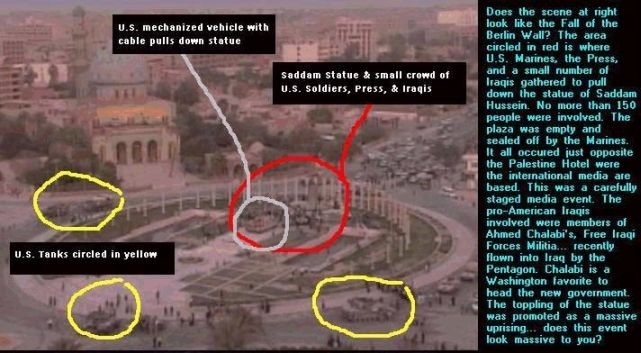
Invoking the American-manufactured image of Saddam's falling statue in Baghdad's Firdos Square, Bush waxed enthusiastic, perhaps imagining Biblical idols dropping before the one true God: "In the images of falling statues, we have witnessed the arrival of a new era." A new era! You can feel that messianic exclamation point embedded in the spirit of the claim. And it wouldn't for a second be an era in which the lion lay down with the lamb; it would be a U.S. military-enforced era of "freedom." In the American military's ability to crush enemies without harming civilians, the kind of war being fought, he swore, was nothing less than "a great moral advance."

The highest calling in history! The peace of the world! Something the world had not seen before! A new era! A great moral advance!

Given all this, Perino was absolutely on the mark. The President didn't consider his mission accomplished -- not by a long shot. That's why he never used the two words together in a speech otherwise filled to the brim with "victory," flushed with success, high on winning. Yes, "major combat" was over in Iraq, but that represented only "one victory in a war on terror." The "mission" -- and it was indeed a mission he was talking about -- was nothing as small as a world historic success against one brutal dictator. No indeed.

True, the regime of the monster in Baghdad had been felled or, as the term of tradecraft of that moment went, "decapitated"; Saddam's program of weapons of mass destruction had been thwarted ("We've begun the search for hidden chemical and biological weapons and already know of hundreds of sites that will be investigated…"); and Saddam's (implied) links to al-Qaeda and the 9/11 attacks handsomely repaid. Naturally, as well, American military personnel wanted to return home after such a successful venture, but that was not yet possible.

The planet must first be set right and the President's speech that May Day four years ago was nothing less than a trumpet call to the troops -- and a warning to planet Earth. "[A]ll can know," the President intoned, "friend and foe alike, that our nation has a mission: We will answer threats to our security, and we will defend the peace… We do not know the day of final victory, but we have seen the turning of the tide." The mission, despite that fatal banner, was not "accomplished." Not in the least. As the President said ringingly, quoting the Bible and thanking God, "Our mission continues."

Looking back across the vast expanse of disaster that is Bush policy in Afghanistan, Iraq, "the Greater Middle East" (aka the oil heartlands of the planet), and elsewhere (including our own country), his was, in fact, a particularly chilling speech -- a ringing reaffirmation that one war was so many too few; a resounding endorsement of what would later be dubbed by Centcom Commander John Abizaid, "The Long War." Our President was already imagining an Orwellian future in which military power beyond compare was to actively remake the planet, cruise missile by cruise missile, under the banner of "peace." Above all else, his speech was a reaffirmation of an American "mission" in which time, maybe even all eternity, was on our side.

As it happens, those Pax Americana pipedreams would never make it out of Iraq. That speech, suffused with George W. Bush's personal sense of pleasure, satisfaction, and all-American war play ("When I look at the members of the United States military, I see the best of our country, and I'm honored to be your Commander-in-Chief…"), would be destroyed by "all the citizens of Iraq who welcomed our troops and joined in the liberation of their own country." Put more precisely, it would be done in by a ragtag minority Sunni insurgency and a ragtag Shiite government that shared hardly a shred of his particular vision. Perhaps the moral here, if there is one, might be: Beware the man who praises himself and his nation too highly.

Tick…Tick…Tick (2007)

"No man is an island, entire of itself," wrote John Donne. "...[A]ny man's death diminishes me, because I am involved in mankind; and therefore never send to know for whom the bell tolls; it tolls for thee."

Unfortunately, our President was, four years ago, already a man on an island, or the deck of an aircraft carrier doubling as a movie set, separated from the mainland of this world. He already had his military outfits to dress up in and his cowboy language ("bring ‘em on") straight from the films of his childhood to wield. Back in those days, he was already favoring appearing in specially tailored military jackets in front of military crowds that would hoo-ah him enthusiastically -- and his handlers and enablers were already making ever so sure that no challenging human ever made it onto that island of his.

When he moved globally, he did so only on his bubble-island, surrounded by specially flown-in protection and entourage. To offer but a partial list from one such trip: armored escort vehicles, the presidential car (known to insiders as "the beast"), 200 Secret Service agents, 15 sniffer dogs, a Blackhawk helicopter, 5 cooks, and 50 White House aides. From London to Manila, his arrival automatically emptied whole central cities of life.

Not surprisingly, then, when the bell first began to toll for him, when those first signs of trouble began to appear in Iraq, he and his aides, officials, and advisors simply dismissed reality. As former CIA Director George Tenet's new memoir evidently makes clear, the island looked so much more appealing. According to New York Times book reviewer Michiko Kakutani, for instance: "Mr. Tenet writes that the C.I.A.'s senior officer in Iraq was dismissed as a ‘defeatist' for warning in 2003 of the dangers of a growing Iraqi insurgency, though it was already clear then that United States political and economic strategies were failing. Although the trends were clear, he adds, those in charge of policy ‘operated within a closed loop.' In that atmosphere, he says, bad news was ignored: the agency's subsequent reporting, which would prove ‘spot-on,' was dismissed."

As a senior advisor to the President told journalist Ron Suskind back in 2002:

"[G]uys like me were ‘in what we call the reality-based community,' which he defined as people who ‘believe that solutions emerge from your judicious study of discernible reality... That's not the way the world really works anymore,' he continued. ‘We're an empire now, and when we act, we create our own reality... We're history's actors... and you, all of you, will be left to just study what we do.'"

Four years after the President's smooth landing, it's hard even to express just how unaccomplished their non-reality-based "mission" remains. New Centcom Commander Adm. William J. Fallon is complaining about the use of "the Long War" ("unhelpful") to describe our world and even the President seems less focused on planting the stars and stripes on the heights of eternity. In fact, when it comes to Iraq, administration officials are now reportedly trying to "scale back talk of Iraq progress" -- talk that could not be scaled back much further without ceasing to exist.

No longer is there a landscape of freedom with its milestones and turning points; no longer is the timescale in generations. Now, administration officials are begging, wheedling, or bullying for months, thinking in weeks, worrying in days. They no longer demand several lifetimes' worth of time, but plead for just a little extra bit of it -- a modest suspension of disbelief until September -- to give the President's "new" plan a "chance."

Today, only one image seems to be on official lips in Washington and Baghdad and it's an ominous one: the ticking clock. It combines a complaint, a whine, a weapon against the war's critics, an explanation, a plea, and a mantra of sorts (all we are saying, is give time a chance). It is also a covert acknowledgement of the pressure reality turns out to be all-too-capable of exerting on the non-reality-based community. Time, it says, is no longer on our side; the sand in the proverbial hourglass may be running out. In its present incarnation, the image has been most vigorously championed by Gen. David Petraeus, the man chosen to lead the President's surge in Baghdad. Certainly, in recent weeks, both in Baghdad and Washington, he's been wielding a two-clocks-ticking image for all it's been worth, saying things like:

"…[T]he Washington clock is moving more rapidly than the Baghdad clock, so we're obviously trying to speed up the Baghdad clock a bit and to produce some progress on the ground that can perhaps give hope to those in the coalition countries, in Washington, and perhaps put a little more time on the Washington clock."

Dana Perino seconded him last week:

"Granted… this is very tough going; it is slow going. But we have to have slow, focused, persistent work, and encouraging patience on behalf of the American people. As you said, there's a -- there's this talk about an American clock versus an Iraqi clock, and sometimes the two don't tick at the same time."

As if to speed up the pace of time, she even threw in this twist:

"Q: ...What is a reasonable period of time for the American people to expect the Iraqi government to work out these critical measures of political accomplishment?

"MS. PERINO: I'm not going to start the stop watch on the Iraqi government.."

And the two of them have had plenty of company. Navy Rear Adm. Mark Fox, communications director for the Multinational Force Iraq, upped the number of ticking clocks to three: "It's clear that the Washington clock and the London clock [are] ticking faster than the Baghdad clock."

White House Press Spokesman Tony Snow, on the other hand, reduced the clocks to one, but it was clearly the clock of clocks he was talking about: "The other thing the President wants to make clear is, right now what Democrats are doing is they're wasting time at a time when the clock is ticking."

Vice President Cheney, as he is wont to do, spelled the image out in extreme terms, making a single clock stand in as a symbol of surrender, not to say the ultimate victory of terrorism: "When members of Congress pursue an anti-war strategy that's been called ‘slow bleed,' they're not supporting the troops, they're undermining them. And when members of Congress speak not of victory but of time limits, deadlines or other arbitrary measures, they're telling the enemy simply to run out the clock and wait us out."

But no one has evidently heard the clock ticking louder than the President himself. Everywhere he went, he seemed to mention it:

March 28th: "Yet Congress continues to pursue these bills, and as they do, the clock is ticking for our troops in the field."

April 4th: "In the meantime, the clock is ticking for our military."

April 7th: "For our troops, the clock is ticking. If the Democrats continue to insist on making a political statement, they should send me their bill as soon as possible."

April 10th: "Now, the Democrats who pass these bills know that I'll veto them, and they know that this veto will be sustained. Yet they continue to pursue the legislation. And as they do, the clock is ticking for our troops in the field."

April 16: "As Congress delays, the clock is ticking for our troops."

Who knows, of course, what a man who cannot admit to, or perhaps even conceive of, doubt or error, or imagine "significant discussion," no less "serious debate," actually makes of all this. Is anyone there who could say to him: The clock ticks for thee? I doubt it. No man is an island; but, for our boy President, the alarm going off may always be for Groundhog Day.

Whether he knows whom the clock ticks for (other than the Democrats or the troops), we, at least, know that the clock is ticking down on his second term. Unfortunately, by my count, 31,536,000 ticks will only get us to this time next year. That's an awful lot of seconds to pass, given what we know we can expect from our President, Vice President, and their supporters -- more of the same. They've always had a knack, but only for destruction.

In Baghdad, can there be a question that any ticking clocks are attached to bombs? In Washington, they seem to be attached to mouths that never stop talking.

Thought of another way, from the moment those two towers came down on September 11, 2001, our President and Vice President have themselves been ticking clocks. Before their terms are done, before the clock runs out on them, they may turn out to be the true suicide bombers of this era. Already, they have managed to leave Iraq -- a modest-sized country with an immodest pool of oil underneath it -- in a state which we have no adequate word to describe, though when coined it will undoubtedly have a "-cide" at its end.

The clock continues to tick. By January 20, 2008, who knows what destruction they will have wrought; what chaos they will have brought to our world.

Tom Engelhardt, who runs the Nation Institute's Tomdispatch.com ("a regular antidote to the mainstream media"), is the co-founder of the American Empire Project and, most recently, the author of Mission Unaccomplished: Tomdispatch Interviews with American Iconoclasts and Dissenters (Nation Books), the first collection of Tomdispatch interviews.

Copyright 2007 Tom Engelhardt

BUSH BAILOUT PAL DROOLING FOR IRAQI OIL

Abboud and “Toxic Bob” Waiting for the New Oil Law to Pass

By Nick Mottern, Director, ConsumersforPeace.org

While blood is flowing freely in Iraq’s streets, A. Robert Abboud, a man who helped bail George W. Bush out of his Harken Energy fiasco, is angling for a contract that will give his firm, Ivanhoe Energy Inc., access to a major oil field in north central Iraq.

Mr. Abboud, who runs his own investment company and who has been president of Occidental Petroleum (1980-84), chairman of the First National Bank of Chicago (1975-80) and chairman and CEO of First City Bancorporation of Texas (1988-91), is co-chairman at Ivanhoe Energy and appears to be acting as the firm’s diplomatic frontman in going after the Iraqi oil.

He has experience in Iraq, working in concert with the administration of Bush senior to promote trade with Iraq under Saddam Hussein, acting in the 1980s as chairman of the United States-Iraqi Business Forum. In this role he worked with Henry Kissinger’s consulting firm and major U.S. companies that were clients of the Kissinger firm, according to a fascinating statement presented to Congress in 1991 by Cong. Henry Gonzalez D-TX, who said Mr. Abboud, because of his executive experience, “was well-wired into the U.S. business community.”

With respect to trade promotion to Iraq in the 1980s, Congressman Gonzales said:

“A foreign policy (toward Iraq) based on commercial trade had the advantage of providing Iraq with high quality food and United States technology to upgrade its military capability in order to defeat Iran…

“In order for this trade based-foreign policy to work, the United States had to ignore a few Iraqi bad habits including massive human rights abuses, the imprisonment, torture and execution of political prisoners, an almost complete lack of democracy, the use of poison gas against Iraq’s own Kurds, the use of poison gas against the Iranians, state-sponsored terrorism, making refugees out of over 100,000 Kurds, the execution of a foreign journalist, continual debt service problems, rampant fraud in the CCC (U.S. loans to buy food) program, and the diversion of United States technology to improve Iraqi nuclear, chemical and biological weapons capability…”

(www.globalsecurity.org)

Speaking to investors and the business press in an Ivanhoe conference call on April 20, 2007, Mr. Abboud reassured his listeners that he had experience in violent situations like Iraq. He referred to what he said was the success of Occidental in entering Colombia at a time when guerrilla warfare and drug trading created dangerous conditions. He neglected to add that Occidental, according to the website World War 4, lobbied the U.S. “to expand its role in Colombia, allowing military aid to be used for pipeline protection. This year (2002) President (George W.) Bush’s administration has complied, proposing $98 million to protect the duct.”

He did not note either that, according to the U.S. General Accountability Office (www.gao.gov/new.items/d05971.pdf) , the new U.S. military aid, which as of 2005 included 10 helicopters, logistics support and U.S. Special Forces training of Colombian troops, had not fully suppressed attacks on the major Cano Limon pipeline, with “insurgents” changing their tactics to include sabotage of the electical grid for the Cano Limon oil field. The GAO report recommended that the U.S. develop “a plan for transitioning the pipeline security program to Colombia” and also that there be established “an expected completion date for U.S. involvement.”

The GAO report noted that Occidental has given money to the Colombian military “for housing, food, land and air transportation, communication equipment, gasoline, and medical equipment” as well as building barracks for soldiers on an army base. Occidental has been charged with assisting the Colombian air force in a 1998 cluster bomb attack that killed 17 civilians near Cano Limon, including 7 children, in a federal lawsuit on behalf of a man whose mother, sister and cousin died in the attack and others. The case was dismissed two years ago based on the argument of the U.S. State Department that the suit interfered with U.S.-Colombia relations. The case is being appealed in the 9th Circuit Court of Appeals.

Human Rights Watch reports that in 1996 Occidental “formalized a voluntary assistance arrangement in which it has previously engaged with the Colombian military” to provide $2 million one-year inkind and cash payments to the military, with cash to be used for, among other things, a “network of informants.” The report said that guerrilla attacks had “driven the (oil) companies into the arms of the Colombian military, one of the few in the hemisphere still engaged in a pattern of gross violations of human rights.” (www.hrw.org/advocacy/corporations/colombia.Oilpat.htm)

Nor did Mr. Abboud mention that, after his tenure as Occidental’s president, the company met opposition from Colombia’s Uwa indigenous people who fought the company from 1992 to 2002 and in 1995 threatened mass suicide by jumping off a 1,400 foot cliff in the Andes if the company didn’t leave their region. In 2000, three Uwa children were killed when Occidental called on the military to clear an Uwa blockade to a drill site, reported WW4, which said Occidental eventually left the region,”citing technical and economic reasons” and denying that the protests had any effect.

The Occidental agreements with the Colombian military and the struggle with the Uwa occurred in part during the period when Ivanhoe Energy’s other co-chair, David R. Martin, was president and CEO of Occidental Oil and Gas Corporation, Occidental Petroleum’s exploration and development subsidiary working in Colombia. Mr. Martin joined Occidental in 1962, and according to a company press release, he became president of its international oil and gas unit in 1983. In 1986, he was appointed Executive Vice President of the parent corporation and in 1993 he became president and CEO of the oil and gas unit in 1993 and was named to the board of Occidental in 1996, the same year he retired from his operational and board positions. ( An internet search did not reveal whether or to what degree Mr. Martin was involved in the issues raised above. An Ivanhoe spokesperson said she could not comment on actions taken by Occidental and that she would ask Mr. Martin if he wished to comment when he returns next week from a trip.)

Mr. Abboud, in joining Ivanhoe Energy for an annual $250,000 salary and about $1.4 million in stock and stock options, is working with Robert Friedland, Ivanhoe’s largest stockholder, nicknamed “Toxic Bob.” Mr. Friedland is reported by SourceWatch to be worth $1.2 billion, and the website says his “colorful corporate career has included wild speculations on mining futures, spectacular pollution scandals” and willingness to work with the notoriously repressive government of Myanmar (formerly Burma) in a joint venture to develop an extremely profitable copper mine.

Mr. Friedland became known as “Toxic Bob” , according to SourceWatch, after a
“spectacular” 1993 cyanide spill at his gold mine in Summitville, Colorado, reputed to be the largest such disaster in U.S. history. The New Internationalist reports that he “avoided legal responsibility by making a timely resignation.” In addition, SourceWatch reports, Mr. Friedland was CEO of Omai gold in Guyana in 1995 when a tailings pond collapsed, killing life in two rivers. Citing the New Internationalist, Source Watch says: “No reparations at all have been paid here. An ‘independent’ report on the disaster denied any damage, despite news photographs and eyewitness accounts of dead fish, pigs and crocodiles. The mine was a joint venture of the World Bank, the Guyana Government and Freidland’s South American Goldfields. Once again, a timely resignation saved him from legal responsibility.”

Ivanhoe, a relatively small oil development company with a patented process for thinning out thick oil so it can flow easily through pipelines, is facing two hurdles to tapping into Iraq oil wealth.

First, the Iraq Parliament must pass the new, pending oil law, that will open its oil fields to private firms like Ivanhoe, ExxonMobil, Shell, BP and Chevron on extremely favorable terms to the oil companies. Ivanhoe “will closely monitor” the development of the new law, Mr. Abboud said on the conference call. The United States is pushing hard for the immediate passage of this law, and its passage is one of the benchmarks that will be used to determine whether the U.S. will continue to keep troops in Iraq. The oil law is opposed by Iraqi oil union workers and many others.

The second hurdle, once the oil law is passed, is the selection of Ivanhoe by Iraqi officials to develop the field. Mr. Abboud said on the conference call that, in a recent trip to the Persian Gulf, he spoke with Iraqi officials about the oil venture and that he thought that the relationships that Ivanhoe officials have developed with Iraqis would be fruitful. It’s important to remember, he said, that: “It’s their oil. They’re going to be in charge.”

Speaking on the conference call of the oil field in question, the Ivanhoe leaders would not reveal its exact location or size. Leon Daniel, of Ivanhoe, said the field has “huge quantities” of oil, but asked for more specifics, he would only acknowledge that most fields in Iraq are at least a billion barrels in size. It is a “challenging environment”, Mr. Daniel said, “where the prize is big.”

In answer to investor questions about security, he said the field is “far removed from Baghdad” and not in a troubled area; the challenge is “not like securing Baghdad.” He said there are “competent security forces” in the area, with clear lines of sight, and “we can make the work site secure.” He said that the thinned-out oil could be moved from the site in pipelines either south or north through Turkey, a path that would likely be more secure.

Ivanhoe drew attention to the project with an April 19 press release announcing that the Japanese oil and gas firm Inpex Corp. had invested $9 million in it for a 45% share in the proceeds; Ivanhoe will get 55%. The announcement resulted in a jump in the Ivanhoe stock price from a close of $2.32 on April 18 to $2.65 on the 19th. The stock has since settled to $2.21 as of April 25, 2007.

The October 9, 2002 Wall Street Journal (WSJ) reporting on the role of Harvard University in the bailout of Harken Energy, notes that one of the key steps in preventing the failure of Harken was a 1990 agreement by First City Bancorporation of Texas, then headed by Mr. Abboud, to take over Bank of Boston loans to Harken that were technically in default. Mr. Abboud is a graduate of Harvard College, Harvard Law and Business Schools.

“At the time,” the WSJ reports, “one of the Harvard endowment’s most influential board members (identified in the article as oil man Robert Stone Jr.) was a political supporter of then-President George H.W. Bush, the current president’s father. One result of the deal: The current president avoided damaging his credibility as a businessman.”

Leading up to this time, in 1986 Harken Energy agreed to buy failing Spectrum 7 Energy where George W. Bush was chairman. George W. became a board member of Harken, a $100,000 consultant to the company and a member of Harken’s audit board. The WSJ said that right after George W. joined the Harken board, Harvard’s endowment fund began backing Harken, buying its stock. In May, 1990, the WSJ said, Harken officials warned that the company was “about to run out of cash.” In June, 1990, according to an article by Stephen Minkin on CommonDreams.org, George W. sold 200,000 shares of Harken stock “before the price plummeted and while outside investors were unaware of the company’s desperate situation.”

The Common Dreams article goes on to say:

“Mr. Bush later blamed his lawyers and the ‘loss of documents’ by the Securities and Exchange Commission when it was discovered that he failed to disclose the $845,560 sale within the time required by law.”

In August, 1990, First City Bankcorp agreed to take over the Bank of Boston loans.

“At the time,” the WSJ reports, “First City was controlled by Robert Abboud, …(a) supporter of the senior Mr. Bush who attended a White House event 10 days before that bailout’s (First City’s) approval. In an interview, Mr. Abboud said Harvard’s backing was a key factor in First City’s decision to approve the Harken bailout and that it wasn’t influenced by his relationship with the then-president.”

The First City money was not enough to save Harken, so a Harvard partnership assumed $20 million in Harken debt, according to the WSJ, and eliminated another $16 million by transferring Harken assets to Harvard. This move, says the article was “much like the controversial investments that Enron Corp. set up before it filed for bankruptcy-court protection.” In 1991 Harken stock began to recover, and Harvard sold its shares for a profit.

Mr. Bush remained on Harken’s board until 1993 and was paid between $80,000 and $120,000 a year as a consultant from 1986 to 1993, according to thetruthaboutgeorge.com.