McCain 2008 Ad on Kos
by atticus
Apr 26, 2007
MCCain 2008? Surrender is not an option ? WTF
Get that crap advertisment off of here does daily kos really need that kind of money?
Permalink | 54 comments
---
Related
Showing posts with label McCain. Show all posts
Showing posts with label McCain. Show all posts
Thursday, April 26, 2007


McCain 2008 Ad on Daily Kos: "Surrender is not an option"
McCain 2008 Ad on Kos
by atticus
Apr 26, 2007
MCCain 2008? Surrender is not an option ? WTF
Get that crap advertisment off of here does daily kos really need that kind of money?
Permalink | 54 comments
---
Related
Frameshop: MCCAIN IS NOT AN OPTION (sign the petition today)
by atticus
Apr 26, 2007
MCCain 2008? Surrender is not an option ? WTF
Get that crap advertisment off of here does daily kos really need that kind of money?
Permalink | 54 comments
---
Related
Frameshop: MCCAIN IS NOT AN OPTION (sign the petition today)
Wednesday, April 25, 2007


Monday, April 23, 2007
The Fall of John McCain
Posted Monday, April 23 2007 12:04:00 am
John McCain is no Brian Wilson, and his recent take on the song “Barbara Ann” (which Wilson and the rest of the Beach Boys made famous) highlighted not so much his singing ability, but rather the fact that his best days are as far behind him as those of the 1960s rock band.
At a campaign stop in South Carolina on Wednesday, the Senator answered a question about potential military action by singing “bomb Iran” to the tune of the Beach Boys song. McCain stood alone on the stage, pulling a handkerchief from his pocket and fidgeting with his hands as a man in the audience stood and addressed the room. He softly answered the man’s question, attempting to make a joke but ultimately sounding awkward and unsure. The remark has been fodder for liberals and the media, and for good reason. It is only the latest in a series of missteps that mark the decline of John McCain.
The Senator is scheduled to officially kick off his presidential campaign on Tuesday, but it may already be dead in the water. McCain’s Beach Boy impression follows a string of similar incidents. After an April 1 trip to an outdoor marketplace in Iraq, McCain told reporters of the improving security conditions in the country, and that the area he visited was safe for Americans to travel in. The market was attacked by an ambush of gunfire the next day and 21 people were killed.
That comment came one month after another equally controversial one. On the "Late Show with David Letterman," McCain described the lives of Americans killed in Iraq as “wasted,” even though his support of the war has been steadfast and stubborn. This is yet another example of McCain skimping on the “straight” part of his “straight talk express.”
At some point, the “I misspoke” defense loses its viability and a candidate’s comments become part of a pattern that must be taken at face value. John McCain is at that point. Even worse, his verbal slips have accompanied weak, politically motivated actions, like his Iraq trip and delivering the 2006 commencement address at Reverend Jerry Falwell’s Liberty University.
In the past year, McCain has gone from Republican frontrunner in 2008 to likely also-ran. He has also chosen to wager his entire presidential campaign on an increasingly disastrous and unpopular war. The transformation he has made since his 2000 campaign is remarkable. McCain has gone from a charismatic maverick, a war hero with appeal to members of all parties, to just another politician doing anything he can to get elected. He is not alone in this; all candidates (or at least good ones) put forth their strongest effort to win the office they seek, but rarely do they do it with the insincerity and disregard shown by John McCain.
The 70-year-old Arizona senator has managed to commit the cardinal sin of a candidate: he has made himself appear unfit to lead. For the first time, McCain has shown his wear. He has lost the vibrancy and energy that he possessed when emerging on the national stage seven years ago. He has often said he would rather lose an election than a war, and he is on the verge of realizing the former part of that proclamation.
On some level, McCain’s collapse is a sad after-effect of what should have been: a victory in the 2000 Republican primary. But now, realizing he may be approaching the end of the line, McCain has chosen politics over substance. It may be too late to reverse this trend, as voters watch a once promising candidate fall from grace.
Friday, April 20, 2007
61% say NOT accurate to compare withdrawal with surrender
One Senator[McCain] recently claimed that setting a date for a U.S. withdrawal from Iraq is more accurately described as a date for surrender — do you think it is accurate to compare withdrawal with surrender?
Yes: 33 percent
No: 61 percent
FOX POLL, APRIL 19, 2007 - PDF
Yes: 33 percent
No: 61 percent
FOX POLL, APRIL 19, 2007 - PDF
Thursday, April 19, 2007
McCain: “Bomb bomb bomb, bomb bomb Iran"
McCain visits Murrells Inlet
By Scott Harper, sharper@gtowntimes.com April 19, 2007
Even though he was nursing a cold, Republican Presidential candidate Sen. John McCain spent nearly 90 minutes talking to nearly 500 people who crammed into the Murrells Inlet VFW Hall Wednesday morning.
The “Straight Talk” tour, as it’s called, included stops in Summerville and Charleston.
Many of the supporters of the Arizona senator were standing outside the VFW as McCain’s bus pulled into the parking lot right on time for the 9 a.m. start of the rally.
After being greeted by VFW member Lyn Dimery and his wife Cathy, McCain made his way inside the building where he was greeted with thunderous applause from the hundreds who had been waiting.
Before taking questions, McCain — who trails former New York mayor Rudy Giuliani by three points in the latest CNN poll — spent a few minutes talking about some of the issues facing the country. Most of his comments were about the war in Iraq.
“Many people in this room know the face of war,” McCain said to the mainly-veteran crowd.
He said he knows the war had been “badly mishandled” but “we are where we are now.”
He also acknowledged that his support of President George Bush’s plan to increase the number of troops has cost him some political points.
“We are seeing some small signs of success. I am not saying ‘mission accomplished.’ Am I guaranteeing there will be success? No. I am saying this plan gives us the best chance of success.”
He also repeated his denouncement of any bill that would set a date for military departure from Iraq, saying if such a bill were to pass it would be “disastrous.”
He also chastised Democratic Senator Harry Reed.
“He was on the Senate floor and said we will pick up senate seats because of this war. Is this war about winning seats? These are the most partisan and unpleasant times I have seen since the Vietnam war,” he said.
McCain said we will know the war has been successful when the people in that country have a secure environment where they have an efficient government and live normal lives.
When responding to a question, McCain spoke about the highly publicized conditions at the Walter Reed Medical Center. The facility has been under fire recently for poor treatment of injured soldiers.
“I am ashamed of Walter Reed. I apologize for not knowing about the conditions of the building,” he said.
When young people see the difficulty veterans have with getting proper medical treatment when it’s needed, it makes it hard to recruit, McCain said.
Another man — wondering if an attack on Iran is in the works — wanted to know when America is going to “send an air mail message to Tehran.”
McCain began his answer by changing the words to a popular Beach Boys song.
“Bomb bomb bomb, bomb bomb Iran,” he sang to the tune of Barbara Ann. “Iran is dedicated to the destruction of Israel. That alone should concern us but now they are trying for nuclear capabilities. I totally support the President when he says we will not allow Iran to destroy Israel.”
He stopped short of answering the actual question and did not say if he supports an invasion of Iran.
A woman in the audience said she has been disappointed President Bush has not spent more time addressing the American people about the issues. She asked McCain if he would be more accessible.
“If I am elected I will go on TV every two weeks, even if it’s only carried by C-SPAN, and detail what is going on in Iraq and with other issues,” he said.
One man then asked if McCain is elected, will he try to get Don Imus back on the radio.
“I knew I should have ended this before now,” McCain joked.
He never said if he felt CBS Radio did the right thing by firing the talk show host for making racist and sexist remarks about the Rutgers women’s basketball team. After the controversy erupted McCain had said he would still be a guest on the show if invited.
“What he did was unacceptable and despicable but I believe in redemption,” he said.
McCain has yet to officially announce his bid for the presidency. He made an unofficial announcement on the Late Show with David Letterman in February. He told Letterman he would make an official announcement in April.
He has scheduled a two-day “announcement tour” for April 25 -26 which will include stops in New Hampshire, South Carolina, Iowa and Arizona.
Tuesday, April 10, 2007
An Orwellian PR stunt
Rocky Mountain News
Campos
April 10, 2007
Last week, Sen. John McCain staged a truly Orwellian publicity stunt in a Baghdad market. In a desperate attempt to give some sliver of credence to claims that the dreaded "liberal media" are failing to report on all the wonderful things happening in Iraq, McCain took a brief walk outside the American-maintained fortress that is Baghdad's green zone.
Afterward, McCain declared his walk through the Shurja market was a sign that security had improved significantly in the Iraqi capital, and the administration's current troop escalation is working. What he didn't mention was that, during his short stroll, he was accompanied by dozens of heavily armed U.S. troops and several armored vehicles, while a couple of attack helicopters hovered overhead.
McCain's photo op (which included the spectacle of the elderly senator wearing a flak jacket) was ludicrous on so many levels that even the normally docile national press, which has always treated McCain with kid gloves, pointed out he was making a fool of himself. Chastened, McCain issued a half-hearted apology a few days later, saying he "mis- spoke" when he pointed to his little walk under the protection of several platoons from the world's most powerful military as evidence of Baghdad's excellent shopping opportunities.
The most interesting question raised by McCain's pathetic stunt is why this genuine war hero - who after all knows far better than most politicians the difference between real courage and the made-for-TV kind - thought he could get away with it.
The answer can be found by taking a random stroll through the archives of the very media McCain was trying to manipulate. From the first days of the Iraq war, it has been an article of dogmatic faith among the movement conservatives McCain is trying to woo that the liberal media have given Americans a far too bleak picture of what's happening in Iraq.
Here are just a few examples out of literally hundreds: In September of 2003, former Clinton adviser-turned-right-wing media pundit Dick Morris declared that the "incredibly biased" liberal media were claiming "that Iraq is a 'quagmire' and that there 'aren't any weapons of mass destruction,' and that 'Bush lied' - and all the while, thanks to Fox News are seeing with their own eyes how much this is crazy spin."
A year later syndicated columnist and Bush administration stenographer Mark Steyn announced that the "liberal media" were doing their best to hide the fact that "the glass in Iraq is about two-thirds full. The bulk of the violence is confined to one province and parts of Baghdad . . . There is no 'civil war.' "
And last April, President Bush himself took the media to task: "The kind of progress that we and the Iraqi people are making in places like Tal Afar is not easy to capture in a short clip on the evening news," he said. "Footage of children playing, or shops opening, and people resuming their normal lives will never be as dramatic as the footage of an IED explosion, or the destruction of a mosque, or soldiers and civilians being killed or injured." (Two weeks ago, almost exactly a year to the day after Bush uttered these words, Tal Afar was the site of a particularly horrible massacre, in which 70 men and boys were lynched. Some of the murderers were members of the town's police force.)
Over the past four years it's become clear that, when it comes to Iraq, perhaps a quarter of Americans are equipped with skulls that can successfully deflect almost all unpleasant facts. These people will account for the majority of the votes cast in next year's Republican primaries - hence McCain's extraordinarily well-armed stroll.
Here's another unpleasant fact: The day after McCain's photo op, 21 people from that same market were kidnapped, taken north of the city, and murdered.
Paul Campos is a professor of law at the University of Colorado. He can be reached at paul.campos@colorado.edu.
Copyright 2007, Rocky Mountain News. All Rights Reserved.
Campos
April 10, 2007
Last week, Sen. John McCain staged a truly Orwellian publicity stunt in a Baghdad market. In a desperate attempt to give some sliver of credence to claims that the dreaded "liberal media" are failing to report on all the wonderful things happening in Iraq, McCain took a brief walk outside the American-maintained fortress that is Baghdad's green zone.
Afterward, McCain declared his walk through the Shurja market was a sign that security had improved significantly in the Iraqi capital, and the administration's current troop escalation is working. What he didn't mention was that, during his short stroll, he was accompanied by dozens of heavily armed U.S. troops and several armored vehicles, while a couple of attack helicopters hovered overhead.
McCain's photo op (which included the spectacle of the elderly senator wearing a flak jacket) was ludicrous on so many levels that even the normally docile national press, which has always treated McCain with kid gloves, pointed out he was making a fool of himself. Chastened, McCain issued a half-hearted apology a few days later, saying he "mis- spoke" when he pointed to his little walk under the protection of several platoons from the world's most powerful military as evidence of Baghdad's excellent shopping opportunities.
The most interesting question raised by McCain's pathetic stunt is why this genuine war hero - who after all knows far better than most politicians the difference between real courage and the made-for-TV kind - thought he could get away with it.
The answer can be found by taking a random stroll through the archives of the very media McCain was trying to manipulate. From the first days of the Iraq war, it has been an article of dogmatic faith among the movement conservatives McCain is trying to woo that the liberal media have given Americans a far too bleak picture of what's happening in Iraq.
Here are just a few examples out of literally hundreds: In September of 2003, former Clinton adviser-turned-right-wing media pundit Dick Morris declared that the "incredibly biased" liberal media were claiming "that Iraq is a 'quagmire' and that there 'aren't any weapons of mass destruction,' and that 'Bush lied' - and all the while, thanks to Fox News are seeing with their own eyes how much this is crazy spin."
A year later syndicated columnist and Bush administration stenographer Mark Steyn announced that the "liberal media" were doing their best to hide the fact that "the glass in Iraq is about two-thirds full. The bulk of the violence is confined to one province and parts of Baghdad . . . There is no 'civil war.' "
And last April, President Bush himself took the media to task: "The kind of progress that we and the Iraqi people are making in places like Tal Afar is not easy to capture in a short clip on the evening news," he said. "Footage of children playing, or shops opening, and people resuming their normal lives will never be as dramatic as the footage of an IED explosion, or the destruction of a mosque, or soldiers and civilians being killed or injured." (Two weeks ago, almost exactly a year to the day after Bush uttered these words, Tal Afar was the site of a particularly horrible massacre, in which 70 men and boys were lynched. Some of the murderers were members of the town's police force.)
Over the past four years it's become clear that, when it comes to Iraq, perhaps a quarter of Americans are equipped with skulls that can successfully deflect almost all unpleasant facts. These people will account for the majority of the votes cast in next year's Republican primaries - hence McCain's extraordinarily well-armed stroll.
Here's another unpleasant fact: The day after McCain's photo op, 21 people from that same market were kidnapped, taken north of the city, and murdered.
Paul Campos is a professor of law at the University of Colorado. He can be reached at paul.campos@colorado.edu.
Copyright 2007, Rocky Mountain News. All Rights Reserved.
Sunday, April 8, 2007
Sunday in the Market With McCain: FRANK RICH - COMPLETE WITH ALL HYPERLINKS
THE COMPLETE ARTICLE WITH ALL HYPERLINKS
THE NEW YORK TIMES
OP-ED COLUMNIST
THE NEW YORK TIMES
OP-ED COLUMNIST
Sunday in the Market With McCain
By FRANK RICHPublished: April 8, 2007
If defending the indefensible can reduce even a politician of John McCain’s heroic stature to that of Dukakis-in-the-tank, the Iraq war die-hards have nowhere to go but down.
John McCain's April Fools' Day stroll through Baghdad's Shorja market last weekend was instantly acclaimed as a classic political pratfall. Protected by more than a hundred American soldiers, three Black Hawk helicopters, two Apache gunships and a bulletproof vest, the senator extolled the "progress" and "good news" in Iraq. Befitting this loopy brand of comedy - reminiscent of "Wedding Crashers," in which Mr. McCain gamely made a cameo appearance - the star had a crackerjack cast of supporting buffoons: Senator Lindsey Graham of South Carolina, who told reporters "I bought five rugs for five bucks!," and Representative Mike Pence of Indiana, who likened the scene to "a normal outdoor market in Indiana in the summertime."
Five rugs for five bucks: boy, we've really got that Iraq economy up and running now! No wonder the McCain show was quickly dubbed "McCain's Mission Accomplished" and "McCain's Dukakis-in-the-Tank Photo Op." But at a certain point the laughter curdled. Reporters rudely pointed out there were 60-plus casualties in this market from one February attack alone and that six Americans were killed in the Baghdad environs on the day of his visit. "Your heart goes out to just the typical Iraqi because they can't have that kind of entourage," said Kyra Phillips of CNN. The day after Mr. McCain's stroll, The Times of London reported that 21 of the Shorja market's merchants and workers were ambushed and murdered.
The political press has stepped up its sotto voce deathwatch on the McCain presidential campaign ever since, a drumbeat enhanced by last week's announcement of Mr. McCain's third-place finish in the Republican field's fund-raising sweepstakes. (He is scheduled to restate his commitment to the race on "60 Minutes" tonight.) But his campaign was sagging well before he went to Baghdad. In retrospect, his disastrous trip may be less significant as yet another downturn in a faltering presidential candidacy than as a turning point in hastening the inevitable American exit from Iraq.
Saturday, April 7, 2007
Baghdad in the Midwest cornfields
What an outing to a market in Indiana would look like if a congressman's observations were correct.
By John KenneyJOHN KENNEY is a writer in Brooklyn, N.Y.
April 7, 2007
The delegation arrived at the market [in Baghdad], which is called Shorja, on Sunday with more than 100 soldiers in armored Humvees … and attack helicopters…. Sharpshooters were posted on the roofs. The congressmen wore bulletproof vests…. At a news conference shortly after their outing, Mr. McCain … and his three congressional colleagues described Shorja as a safe, bustling place full of hopeful and warmly welcoming Iraqis — "like a normal outdoor market in Indiana in the summertime," offered Mike Pence, an Indiana Republican. — New York Times
---
MY WIFE came into the living room wearing a Kevlar vest, helmet and night-vision goggles.
"What are you doing?" I asked.
"Have you completely forgotten, silly head? We're going to the market."
I placed my hand at my head. I'd been so caught up in stitching a minor wound I'd received earlier in the day after going to an outdoor fruit stand that I had completely forgotten.
"I'm a dope, aren't I?" I said, chuckling, slowly shaking my head back and forth. She chuckled too, also shaking her head. We both chuckled. Then I winced from where a stitch popped.
Carol helped the boys get ready, putting on their sneakers and body armor. I phoned the Indiana National Guard so that they could radio the 434th Special Air Wing at Grissom Air Force Base, which in turn scrambled two F-14 Tomcats. Then we hopped in the wagon.
Carol and I moved to Muncie from Detroit. Frankly, we were tired of the noise, the dirt and the crime. Here, you feel so safe, as long as you move very quickly through the market, keep your head down and have appropriate air cover.
Carol handed each of the boys — 8 and 5, and a handful, let me tell you — a juice box, a Xanax and personalized Navy SEAL-issue GPS systems.
"Dad?" said Kevin, our 8-year-old, from the back seat.
"Yes, Kev," I said.
"Can we go to that cotton candy stand again?"
The F-14s flew by low. Each of us activated our earpieces and hand-held mini walkie-talkies, agreed on a frequency, and I slowed the car to 15 mph as Carol and the boys opened the doors and rolled out, taking cover under shrubbery near the Bibb lettuce stand (the boys love salad!).
So far, so good.
I hit the gas and spun the car and parked in a ditch that had once been a Tasty Donut before a tactical nuclear weapon had decimated it. Great parking space, though.
I saw my neighbor, Larry, under his car, from the looks of it a spanking-new Bradley fighting vehicle. "Snipers today," Larry said with a smile.
"Nice ride, Larry," I said as I dove under the car, a sniper's bullet exploding inches away from my foot. "Looks solid."
"The hull is constructed of welded aluminum and spaced laminate armor," he said, burying his head in the dirt as another round came in. "The Israelis use them. I had an Explorer, but it was blown to bits last time I went out for garbage bags."
"Roomy?"
"Ton of room. Carries three crew, commander, gunner and driver, plus six fully equipped infantrymen. Mileage is awful, but with all the space in the back, it's great for the market."
I borrowed his high-power binoculars to check on the family's progress.
Kevin and his little brother had successfully bought lettuce, fruit and homemade jams before a particularly well-placed rocket-propelled grenade destroyed the stand (the owner managed to avoid the hit and began rebuilding immediately, as weekends are, obviously, his busiest time).
Carol, I noticed, had found cover behind the wall of a largely destroyed warehouse. A sniper had a bead on the glint from her eyeglasses, which the afternoon sunshine had caught (Indiana is known for its beautiful summers).
Larry asked me to cover him, and he rolled out from under the BFV and hopped in. I activated heavy smoke bombs, and his car tore out of the field. I made it back to my car as Larry's choppers came in low over the market, taking heavy fire and destroying the sniper's den (about time, thank you very much) as well as a Toys R Us that was closed for renovation.
I could see the smoke in the rear-view mirror when Carol dove onto the hood, managing to hold onto the bundles (that woman never ceases to amaze me). I hit the brakes and she got in quickly.
"You put on face paint," I said, giving her a quick kiss.
"You wouldn't believe how crowded it was," she said, panting. "I saw Margie Hynes. Boy, has she put on weight."
A CBU-52B cluster bomb exploded to our left, and I hit the gas. We could see the boys ahead, waving flares in the dense smoke. I didn't stop the car completely. Kevin threw Chip in first, then jumped in himself.
Both immediately vomited from the smoke.
"You kids have fun?" Carol asked.
"Yeah!" said Chip.
"He was holding a loaf of bread and it got blown out of his hand!"
"It was so awesome, Mum."
We all laughed. Really hard. That's how shopping is in Indiana in the summer. It's just fun. It's fun and safe and hopeful and full of warm and welcoming Indianans and insurgents and snipers and bombs.
"Oh darn," Carol said.
"What is it, honey?"
"We forgot milk."
Thursday, April 5, 2007
McCain's new fundraiser "counted Jews" and grilled a dog
April 5, 2007
By D. M. Silev
dmsilev@uchicago.edu
File this one under "You couldn't make this up if you tried".
By D. M. Silev
dmsilev@uchicago.edu
File this one under "You couldn't make this up if you tried".
Courtesy of Think Progress, we learn some details of just who Straight Talk has brought in to fix his anemic fundraising machine.
McCain recently brought in as a high-level fundraiser a guy named Fred Malek.
So, who is he? Well, like so many GOP types these days, he's a Nixon leftover. Specifically, he "counted Jews" for Nixon:
Nixon summoned the White House personnel chief, Fred Malek, to his office to discuss a “Jewish cabal” in the Bureau of Labor Statistics. The “cabal,” Nixon said, was tilting economic figures to make his Administration look bad. How many Jews were there in the bureau? he wanted to know. Malek reported back on the number, and told the President that the bureau’s methods of weighing statistics were normal procedure that had been in use for years.
More disturbingly, he was arrested as a young man for
On a Friday in August 1959, five men in their twenties were arrested about 2 a.m...
After checking the blood-spattered pants of one of the men at the state crime laboratory in Springfield, it was determined that the stains were animal and not human blood. [Sherriff Harry] Backes said the men then changed their story and said they had "caught a dog and were barbecuing it."Police then found the skinned animal on a spit in the park. The insides of the dog had been removed, and a bottle of liquor was found on a nearby park table. Backes said the men told him they had been drinking earlier in the evening at a West Bluff tavern.
One of the men arrested in the incident, in which a dog was killed, skinned, gutted and barbecued on a spit, was Frederick V. Malek, 22, of Berwyn, Ill.
What is it with GOP presidential candidates and cruelty to animals? Bill "cat killer" Frist, Rudy's wife apparently worked for a company that killed dogs as part of a sales pitch, and now McCain's big-time cash-raiser.
Oh, and as far as money is concerned, there's a minor matter of an SEC action (from the same WaPo article as above):
The SEC instituted administrative and cease-and-desist proceedings against Malek, his company, Thayer Capital Partners, and two Thayer affiliates, TS Equity Partners IV L.L.C, and TC Management Partners IV L.L.C. The SEC charged that in 1998 the Connecticut treasurer, Paul J. Silvester, used state pension investments in Malek's company to reward a friend and political supporter, William DiBella, former majority leader of the Connecticut Senate.
McCain’s Potemkin Village
Related
McCain Photo Op Kills 21 - UPDATED
---
By Joe Conason
Date: 4/9/2007
McCain Photo Op Kills 21 - UPDATED
---
By Joe Conason
Date: 4/9/2007
Both Iraqis and Americans alike were stunned by the audacity of Senator John McCain’s heavily publicized (and heavily armed) excursion through Baghdad’s Shorja market last weekend. There was the leading proponent of the war on Capitol Hill, setting out to confirm his recent claim that the escalation of U.S. forces is greatly improving conditions on the ground, accompanied by a handful of Congressional colleagues. He seemed to think nobody would notice that their little shopping trip also included a platoon of soldiers, three Black Hawk choppers and two Apache gunships. Neither the Iraqi merchants used as props in this strange exercise nor the American voters who were its intended targets could possibly have been deceived by such a charade. So the question that inevitably arises is whether Mr. McCain and company are still attempting to dupe us—or whether they have finally duped themselves. Consider the happy talk from Representative Mike Pence, an ultraconservative Indiana Republican who has visited Iraq on several occasions. At the press conference that inevitably followed the Shorja photo op, Mr. Pence said he had been inspired by the opportunity to “mix and mingle unfettered among ordinary Iraqis,” drinking tea and haggling over carpets. To him, the Baghdad shops were “like a normal outdoor market in Indiana in the summer time.” Senator Lindsey Graham, the McCain sidekick and Republican of South Carolina, boasted of buying “five rugs for five bucks,” marveling that “just a few weeks ago, hundreds of people, dozens of people were killed in the same place.” Then they climbed back into one of the armored vehicles that served as their tourist buses and returned to the Green Zone with Mr. McCain and Gen. David Petraeus, the commander of American forces in Iraq. Aside from the theatrics of the Shorja excursion, however, the message delivered by Messrs. McCain, Graham and Pence was scarcely different from what each of them usually says after visiting Iraq. In February 2005, for instance, when Senator McCain made his famous trip with Senator Hillary Clinton, he claimed to believe that “the dynamic [of the war] has changed from Iraqi insurgents versus the U.S. and its—and our troops to Iraqi insurgents versus the Iraqi government.” Back then, he declared himself “far more optimistic” than he had previously felt, adding: “I think we have an opportunity to succeed.” According to Mr. McCain, there is always an opportunity to succeed, provided that we are willing to sacrifice thousands more young Americans and hundreds of billions more dollars. But then again, this is a man who thinks we didn’t expend enough lives and dollars in Vietnam—although he would be hard-pressed to explain why the world would be better today if 100,000 Americans and another million Vietnamese had died in that war. As for Mr. Pence, the only conceivable purpose of his latest trip was to pick up those rugs. His sunny comments were as predictable this time as when he visited Iraq in September 2005, when he told The Indianapolis Star that spending two days there had convinced him the United States was “winning the war.” Gen. John Abizaid, then the commander of U.S. forces, had assured him there was a viable plan and that the plan was working, all of which Mr. Pence dutifully repeated to the folks back home. On this trip, as Mr. Pence climbed back into the armored Humvee that had safely carried him and the two Senators to the marketplace, none of these jolly politicians mentioned the rise in killings across Iraq during the past month. None of them even seemed aware that the temporary reduction of violence in Baghdad appears to have driven even greater carnage outside the capital—such as the bombing in Kirkuk that slaughtered a group of schoolgirls the same day that Messrs. Graham and Pence got their bargain carpets. Even if the “surge” succeeds in suppressing violence in Baghdad for a few weeks or months by pouring in tens of thousands of American troops, what would that mean? Do Mr. McCain and his colleagues actually believe that we can somehow provide enough soldiers and Marines to achieve the pacification of every city and town in Iraq? If so, how long would our troops be expected to police the terrorist incidents and revenge attacks that now occur every day in this civil war? Congressional hawks like Mr. McCain echo President Bush’s complaint that the Democrats are undermining the war by seeking to set a date for an American withdrawal. They insist that the war’s critics should simply shut up and send more money and more soldiers, while we see whether this “plan” works better than the previously discarded plans. But the truth is that the President and his echoes are merely playing for time with American lives. They have no plan, because there is no military solution to this war. The war propaganda doesn’t work any better than the war plan—which is why the Democrats have been emboldened, and why Mr. McCain’s Presidential prospects are rapidly declining.
Wednesday, April 4, 2007
McCain Photo Op Kills 21 - UPDATED
April 3, 2007
Lorry bomb kills children in school
Lorry bomb kills children in school
A newborn baby was one of at least 14 children and adults killed when a suicide bomber detonated a lorry laden with explosives close to a primary school in the northern Iraqi city of Kirkuk yesterday.
The latest massacre of Iraqi children came as 21 Shia market workers were ambushed, bound and shot dead north of the capital. The victims came from the Baghdad market visited the previous day by John McCain, the US presidential candidate, who said that an American security plan in the capital was starting to show signs of progress.
The Kirkuk bloodshed erupted when a bomber driving a truck full of explosives hidden by sacks of flour targeted an Iraqi police station that US soldiers were visiting. The full force of the blast hit a nearby primary school.
Buthayna Mahmud, 10, was horrified to see the bodies of her classmates strewn on the ground in flames. “Everyone I saw was wearing the blue school uniform drenched with blood. Some of their dresses were torn. I only saw fire. I heard teachers and students shouting,” she said. “When we rushed out of the school, we saw pupils on the ground, some of them burning.”
“We were at the last lesson and we heard the explosion. I saw two of my classmates sitting near the window. They fell on the floor, drenched in blood,” said Naz Omar, a girl in the fifth form. “They could not speak. I was terrified. I said, ‘God is Great. I need my mother. I need my father’.”
Terrified children fled the carnage in the ethnically mixed city of Kurds, Turkomans and Arabs, many of whom were settled there by Saddam Hussein in an attempt to “Arabicise” Kirkuk and “ethnically cleanse” it of Kurds. Local observers said that the death toll among the school children would have been worse if most of the pupils had not been inside when the bomber struck.
Terrorists in Iraq have frequently killed large groups of children, either while aiming at nearby American or Iraqi security forces or as an end in itself. US forces said last month that two children had been used by terrorists to sneak a car bomb through a checkpoint and it had been detonated while they were still inside.
As well as the killings of the children and the Shia market vendors, four people were blown up by another suicide bomber at a police checkpoint in Baghdad, while a roadside bomb killed four civilians in a Shia town just north of Baghdad. Yet another roadside bomb killed an Iraqi soldier and wounded seven others near the Iranian border. The US announced the deaths of six of its soldiers at the weekend.
More than 600 Iraqis have been killed in the past week despite a US-Iraqi security plan to quell violence in the capital. Most of the killings have been the result of truck bombs outside Baghdad.
Mr McCain said that the situation was showing signs of improvement and blamed waning support in the United States for the war on the media, which were portraying an overly negative image of the crisis.
Kirkuk is seen as a potentially explosive fault line between various ethnic and religious groups because it sits on a vast reserve of crude oil and is claimed by the Kurds as part of their autonomous northern region. Their claims have elicited fears from Sunni Arabs that the Kurds and the Shia, who control the oil-rich south, are trying to cut the once-powerful Sunni minority out of the country’s mineral wealth.
In another brutal attack, suspected militants massacred a group of 21 Shia workers overnight after laying an ambush north of Baghdad.Travelling in three minibuses, the workers were abducted on the main road out of Baghdad to neighbouring Diyala. The 21 Shias, together with six Kurdish colleagues still missing, worked in Shorja market of Baghdad.
Blunder: McCain Trip B Roll For "60 Minutes" Profile?
---
UPDATE
The idea is to send a message
If you get seen with Americans you will be killed. It doesn't matter why you were with them. Being seen is enough. The goal is to isolate the Americans, leaving them with no supporters among the population.
It's a brutal, inhuman policy, but there is some logic to it for people who are fighting against an occupation.
Blunder: McCain Trip B Roll For "60 Minutes" Profile?
MediaWatch:TV
McCain: "The American People Are Not Getting the Full Picture Here"
John McCain has given exclusive rights to the video of his trip to CBS's 60 Minutes, Slogger has learned. Although the presidential candidate has provided interviews and a press conferences while in Baghdad, McCain is apparently saving the good stuff for this Sunday. 
ONE MONTH AGO:
The delegation has engendered a hostile and bitter reception from the foreign and U.S. media. The general tone of the U.S.-based coverage has been dismissive to insulted. Video tape of the press conference shows an incredulous and perhaps even insulted press corp. After visiting Tikrit and Ramadi, McCain met with press and came under intense scrutiny by Baghdad-based media. Sounding weary and tired McCain and his entourage tried to paint a picture of Baghdad being safer than "before". The charade could only last so long. The American military decided to cut off transmission of a press conference when it appeared that McCain's "good news" nemesis Michael Ware raised his hand to ask a question.
TWO MONTHS AGO:
)
,Wathiq Khuzaie/Getty Images
Shorja Market, February 13, 2007
ONE MONTH AGO:
)
Chris Hondros/Getty Images
Shorja Market, March 3, 2007
YESTERDAY:
Sorry, you will have to watch 60 Minutes) this Sunday.
It was clear to all assembled that the trip to Thieves Market in Shorja yesterday was a carefully orchestrated event by the U.S. military and Senator John McCain but many did not know it was specifically for CBS's 60 Minutes. Kirk Semple of the The New York Times went back a day later to discover that it was all a sham.
“They paralyzed the market when they came,” Mr. Faiyad said during an interview in his shop on Monday. “This was only for the media.”
Unlike the Utopian scene designed for the media, many of the merchants wanted to express their need for more security. As expected, the area the group visited was locked down, traffic diverted and access restricted. The NYTimes follow up correctly points out that the market has been bombed at least half a dozen times and residents do not feel the benefits of the surge.
"In recent weeks, snipers hidden in Shorja’s bazaar have killed several people, merchants and the police say, and gunfights have erupted between militants and the Iraqi security forces in the area."
The junket wore body armor and was surrounded by over 100 members of the armed forces. Sniper patrols bristled from surrounding rooftops, six helicopters flew overhead and the " diamond" instead of being 4 people was 30 deep. In a classic psyops move, the entrourage was told to take their helmets off and even General Petraeus put on a forage cap.
A very tired McCain stayed on message and other junket members were there to back him up. What the American public did not know is that McCain's primary purpose is to get location and interview footage for a 60 Minutes segment with Scott Pelley to be broadcast this Sunday.
Many reporters in Baghdad will admit that the surge is working...somewhat. There are fewer explosions, less shooting, but none have agreed with McCain's rosy assessment. Many like Ware, who were openly hostile to McCain's statements on CNN and other Baghdad based journos are writing scathing rebuttals to the Presidential candidate's optimistic viewpoint.
So whose version of Baghdad will win? The pessimistic cynical view of a hardened Baghdad press corps, or the "real picture" presented by John McCain to the American public on Sunday?
Monday, April 2, 2007
Snipers back at Baghdad market after McCain visit
Have you thought of the US soldiers who had to sweep out the market area yesterday, endangering their lives just so that sumbitch McCain could get a photo op?
---
Mon Apr 2, 2007 12:18PM EDT
By Mussab Al-Khairalla
BAGHDAD (Reuters) - The crack of shots fired by unseen snipers echoed on Monday through Baghdad's wholesale Shorja market, a day after U.S. Senator John McCain held up his visit there as one sign of improving security in Baghdad.
The Republican presidential hopeful said his hour-long tour of the sprawling market, where 71 people were killed by a huge car bomb in February, would have been unthinkable before the seven-week-old U.S.-Iraqi crackdown in the capital.
Shoppers and merchants agreed on Monday that security had improved since the start of the operation, when the market was blocked off to prevent further such bombings, but took issue with what they considered an overly upbeat assessment by McCain.
Many still do not dare venture into the northern half of the long street, beyond a overhead pedestrian bridge, and enter what is dubbed "The sniper zone", where people are picked off by gunmen on nearby rooftops.
Merchants said the snipers, whom they claim came from the neighboring Sunni Fadhl neighborhood, killed at least one person a day on average.
Despite the sniper threat, shoppers and merchants seemed unfazed when several shots rang out, as a Reuters reporter was interviewing them.
"Who said there was security?" asked carpet salesman Abu Ammar, 55, who said he sold McCain a $60 Turkish rug.
"I told him there were snipers who were really harming us," he said, sitting behind his large office desk. "I told him the plan had improved security but Shorja still wasn't fully safe."
McCain, a strong backer of the Baghdad crackdown, was part of a congressional delegation that was heavily protected by U.S. soldiers and helicopters during its visit to Shorja on Sunday. They drove in armored vehicles and wore body armor.
Afterwards McCain told reporters: "The American people are not getting the picture of all that is happening here. Things are better ... but I am not saying mission accomplished."
GREATER SAFETY
On Monday, the market was filled with young men pushing goods on wooden carts and merchants buying wholesale products. Near the exotic animal section of the market, Firas Mohammed, 27, was buying clothes for his nearby store.
"I feel more confident coming here now because I see a lot of people are still shopping here, but I only shop in the areas outside the sniper zone," he said, carrying a large plastic bag.
Another shopper, Najah Abdullah, said he had never been deterred from buying goods at the market despite the violence.
"I do feel a lot safer since the security plan was enforced but it's a shame these steps weren't taken earlier," he said as he loaded boxes of chocolate on to his moped.
The Baghdad security plan, dubbed Operation Imposing Law, has succeeded in reducing the murder rate, although car bombs continue to plague the capital and violence has surged in areas outside the city untouched by the crackdown.
McCain, who is seeking the Republican presidential nomination for 2008, said on Sunday he believed the new U.S. strategy in Iraq was making progress. He has been a vocal critic of President George W. Bush's handling of the war in the past.
Shorja market merchant Abu Samir, 31, said McCain bought an Egyptian rug from him and told him through an interpreter: "I want to run for president. And, don't worry, because I'll handle the war better than Bush."
(Additional reporting by Wathiq Ibrahim)
---
Mon Apr 2, 2007 12:18PM EDT
By Mussab Al-Khairalla
BAGHDAD (Reuters) - The crack of shots fired by unseen snipers echoed on Monday through Baghdad's wholesale Shorja market, a day after U.S. Senator John McCain held up his visit there as one sign of improving security in Baghdad.
The Republican presidential hopeful said his hour-long tour of the sprawling market, where 71 people were killed by a huge car bomb in February, would have been unthinkable before the seven-week-old U.S.-Iraqi crackdown in the capital.
Shoppers and merchants agreed on Monday that security had improved since the start of the operation, when the market was blocked off to prevent further such bombings, but took issue with what they considered an overly upbeat assessment by McCain.
Many still do not dare venture into the northern half of the long street, beyond a overhead pedestrian bridge, and enter what is dubbed "The sniper zone", where people are picked off by gunmen on nearby rooftops.
Merchants said the snipers, whom they claim came from the neighboring Sunni Fadhl neighborhood, killed at least one person a day on average.
Despite the sniper threat, shoppers and merchants seemed unfazed when several shots rang out, as a Reuters reporter was interviewing them.
"Who said there was security?" asked carpet salesman Abu Ammar, 55, who said he sold McCain a $60 Turkish rug.
"I told him there were snipers who were really harming us," he said, sitting behind his large office desk. "I told him the plan had improved security but Shorja still wasn't fully safe."
McCain, a strong backer of the Baghdad crackdown, was part of a congressional delegation that was heavily protected by U.S. soldiers and helicopters during its visit to Shorja on Sunday. They drove in armored vehicles and wore body armor.
Afterwards McCain told reporters: "The American people are not getting the picture of all that is happening here. Things are better ... but I am not saying mission accomplished."
GREATER SAFETY
On Monday, the market was filled with young men pushing goods on wooden carts and merchants buying wholesale products. Near the exotic animal section of the market, Firas Mohammed, 27, was buying clothes for his nearby store.
"I feel more confident coming here now because I see a lot of people are still shopping here, but I only shop in the areas outside the sniper zone," he said, carrying a large plastic bag.
Another shopper, Najah Abdullah, said he had never been deterred from buying goods at the market despite the violence.
"I do feel a lot safer since the security plan was enforced but it's a shame these steps weren't taken earlier," he said as he loaded boxes of chocolate on to his moped.
The Baghdad security plan, dubbed Operation Imposing Law, has succeeded in reducing the murder rate, although car bombs continue to plague the capital and violence has surged in areas outside the city untouched by the crackdown.
McCain, who is seeking the Republican presidential nomination for 2008, said on Sunday he believed the new U.S. strategy in Iraq was making progress. He has been a vocal critic of President George W. Bush's handling of the war in the past.
Shorja market merchant Abu Samir, 31, said McCain bought an Egyptian rug from him and told him through an interpreter: "I want to run for president. And, don't worry, because I'll handle the war better than Bush."
(Additional reporting by Wathiq Ibrahim)
McCain, Obama, and genocide
More than a half-million Iraqis have died because of the U.S. invasion in March, 2003; another million or so died in the decade before that thanks the U.S./U.K. ("U.N.") sanctions. And in the light of all that, we can still, in this Alice-through the-looking-glass-world we live in, hear this from John McCain: "Failure is genocide." And when asked by Wolf Blitzer to respond to that statement, here's the stone-racist response from Barack Obama:
BLITZER: What if he's right? What if he's right, and what you're proposing and a lot of Democrats are proposing results in genocide in Iraq?That's what Barack Obama thinks has been lost in Iraq - hundreds of billions of dollars, and 3,200 lives. The actual genocide that's taken place in the last 15 years? Sorry, neither he nor McCain nor Wolf Blitzer even acknowledges that that has taken place. The idea simply does not compute in their "the U.S. is a force for good in the world" brains.
OBAMA: Well, look, what you have right now is chaos in Iraq. After having spent hundreds of billions of dollars, after seeing close to 3,200 lives lost, what you now see is chaos.
McCain Strolls Through Baghdad Market, Accompanied By 100 Soldiers, 3 Blackhawks, 2 Apache Gunships
Sen. John McCain strolled briefly through an open-air market in Baghdad today in an effort to prove that Americans are “not getting the full picture” of what’s going on in Iraq. 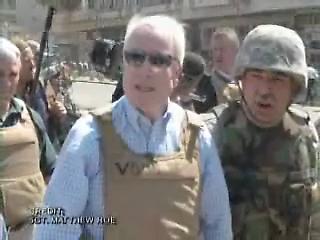
NBC’s Nightly News provided further details about McCain’s one-hour guided tour. He was accompanied by “100 American soldiers, with three Blackhawk helicopters, and two Apache gunships overhead.” Still photographs provided by the military to NBC News seemed to show McCain wearing a bulletproof vest during his visit. Watch it:
McCain recently claimed that there “are neighborhoods in Baghdad where you and I could walk through those neighborhoods, today.” In a press conference after his Baghdad tour, McCain told a reporter that his visit to the market today was proof that you could indeed “walk freely” in some areas of Baghdad.
Filed under: Iraq
Posted by Faiz April 1, 2007 7:35 pm
Sunday, March 18, 2007
The Ides of March 2003: FRANK RICH - The March to War
THE COMPLETE ARTICLE WITH ALL HYPERLINKS
THE NEW YORK TIMES
OP-ED COLUMNIST
THE NEW YORK TIMES
OP-ED COLUMNIST
The Ides of March 2003
By FRANK RICHPublished: March 18, 2007
A chronology of some of the high and low points in the days leading up to the national train wreck whose anniversary we mourn this week.
TOMORROW night is the fourth anniversary of President Bush’s prime-time address declaring the start of Operation Iraqi Freedom. In the broad sweep of history, four years is a nanosecond, but in America, where memories are congenitally short, it’s an eternity. That’s why a revisionist history of the White House’s rush to war, much of it written by its initial cheerleaders, has already taken hold. In this exonerating fictionalization of the story, nearly every politician and pundit in Washington was duped by the same “bad intelligence” before the war, and few imagined that the administration would so botch the invasion’s aftermath or that the occupation would go on so long. “If only I had known then what I know now ...” has been the persistent refrain of the war supporters who subsequently disowned the fiasco. But the embarrassing reality is that much of the damning truth about the administration’s case for war and its hubristic expectations for a cakewalk were publicly available before the war, hiding in plain sight, to be seen by anyone who wanted to look.
By the time the ides of March arrived in March 2003, these warning signs were visible on a nearly daily basis. So were the signs that Americans were completely ill prepared for the costs ahead. Iraq was largely anticipated as a distant, mildly disruptive geopolitical video game that would be over in a flash.
Now many of the same leaders who sold the war argue that escalation should be given a chance. This time they’re peddling the new doomsday scenario that any withdrawal timetable will lead to the next 9/11. The question we must ask is: Has history taught us anything in four years?
Sunday, February 25, 2007
A Cat Without Whiskers: MAUREEN DOWD - On John McCain
REPOSTED
THE COMPLETE ARTICLE
THE NEW YORK TIMES
OP-ED COLUMNIST
THE NEW YORK TIMES
OP-ED COLUMNIST
A Cat Without Whiskers
By MAUREEN DOWDPublished: February 24, 2007
There’s one huge group that John McCain is not pandering to: Americans.
SEATTLE
So some guy stands up after John McCain’s luncheon speech here yesterday to a group of business types and asks him a question.
“I’ve seen in the press where in your run for the presidency, you’ve been sucking up to the religious right,” the man said, adding: “I was just wondering how soon do you predict a Republican candidate for president will start sucking up to the old Rockefeller wing of the Republican Party?”
Mr. McCain listened with his eyes downcast, then looked the man in the eye, smiled and replied: “I’m probably going to get in trouble, but what’s wrong with sucking up to everybody?” It was a flash of the old McCain, and the audience laughed.
Certainly, the senator has tried to worm his way into the affections of W. and the religious right: the Discovery Institute, a group that tries to derail Darwinism and promote the teaching of Intelligent Design, helped present the lunch, dismaying liberal bloggers who have tracked Mr. McCain’s devolution on evolution.
--MORE--
Monday, February 19, 2007
Wrong Is Right: PAUL KRUGMAN - Admit Errors
OP-ED COLUMNIST
Wrong Is Right
By PAUL KRUGMANPublished: February 19, 2007
The Democratic base wants someone who doesn’t suffer from an infallibility complex, who can admit mistakes and learn from them.
Many people are perplexed by the uproar over Senator Hillary Clinton’s refusal to say, as former Senator John Edwards has, that she was wrong to vote for the Iraq war resolution. Why is it so important to admit past error? And yes, it was an error — she may not have intended to cast a vote for war, but the fact is the resolution did lead to war; she may not have believed that President Bush would abuse the power he was granted, but the fact is he did.
The answer can be summed up in two words: heckuva job. Or, if you want a longer version: Medals of Freedom to George Tenet, who said Saddam had W.M.D., Tommy Franks, who failed to secure Iraq, and Paul Bremer, who botched the occupation.
For the last six years we have been ruled by men who are pathologically incapable of owning up to mistakes. And this pathology has had real, disastrous consequences.
RELATED
Monday, February 12, 2007
'Wash Post': McCain Uses Tactics, Seeks Cash He Once Denounced
McCain Taps Cash He Sought To Limit
Onetime Reformer Calls on Big Donors
Onetime Reformer Calls on Big Donors
By John Solomon
Washington Post Staff Writer
Sunday, February 11, 2007; A01
Just about a year and a half ago, Sen. John McCain went to court to try to curtail the influence of a group to which A. Jerrold Perenchio gave $9 million, saying it was trying to "evade and violate" new campaign laws with voter ads ahead of the midterm elections.
As McCain launches his own presidential campaign, however, he is counting on Perenchio, the founder of the Univision Spanish-language media empire, to raise millions of dollars as co-chairman of the Arizona Republican's national finance committee.
In his early efforts to secure the support of the Republican establishment he has frequently bucked, McCain has embraced some of the same political-money figures, forces and tactics he pilloried during a 15-year crusade to reduce the influence of big donors, fundraisers and lobbyists in elections. That includes enlisting the support of Washington lobbyists as well as key players in the fundraising machine that helped President Bush defeat McCain in the 2000 Republican primaries.
After enduring his own brush with scandal in the early 1990s, when he and four Senate colleagues pressured regulators on behalf of Charles Keating, chairman of a failed savings and loan association, while collecting donations and favors from him, McCain became a leader in the effort to eliminate "soft money" in elections -- large donations from corporations, labor unions and wealthy individuals. In 2002, McCain joined forces with Sen. Russell Feingold (D-Wis.) to finally push through legislation ending soft money and placing strict limits on donations.
But now the contrast between McCain the presidential candidate and McCain the reformer can be jarring. McCain's campaign says that he is still studying whether to forgo the public financing and spending limits he has long supported, but that he will not be handicapped by restrictions his competitors will not face in 2008.
McCain the reformer worked unsuccessfully through Congress and the courts to try to stop nonprofit political groups known as 527s from using unlimited donations to run political ads and fund other activities aimed at influencing voters in the run-up to elections. He reintroduced legislation last week to end 527 donations, but there appears to be little appetite in Congress to pass it.
McCain the candidate now expects Republicans to use the same big-money 527 groups in the 2008 elections to beat Democrats, if the groups remain legal. "The senator believes that both parties should be subjected to an even playing field. If Democratic organizations are allowed to take advantage of 527s, Republican organizations will, too," said Mark Salter, a senior McCain adviser. The senator declined to be interviewed.
McCain the reformer relentlessly argued that six- and seven-figure "soft money" checks that corporations, wealthy individuals and unions were giving to political parties to influence elections were corrupting American politics. "The voices of average Americans have been drowned out by the deafening racket of campaign cash," he warned just a few years ago.
McCain the candidate has enlisted some of the same GOP fundraising giants who created and flourished in the soft-money system, including Bush's fundraising "Pioneers" and "Rangers," who earned their designations by raising at least $100,000 or $200,000 for his campaigns.
At least six of McCain's first eight national finance co-chairmen have given or raised large donations for political parties or 527 groups, campaign and IRS records show. In all, the finance co-chairs have given at least $13.5 million in soft money and 527 donations since the 1998 election.
They include former Bush moneymen such as lobbyist Thomas G. Loeffler and financier Donald Bren, whose personal and corporate donations total in the hundreds of thousands of dollars each in recent elections.
In key states, McCain has enlisted the likes of New York financier Henry Kravis, one of the GOP's largest donors over the past two decades, and Texas energy executive Robert A. Mosbacher, the architect of the Republicans' "Team 100" fundraising machine that helped make soft money a staple of politics by raising $20 million in large donations to help Bush's father win the presidency in 1988.
The big moneymen gravitating to McCain are politically pragmatic. They may not always agree with him, but they say they admire the Arizona senator for his work on campaign finance reform, his Vietnam War record, his support of Bush on Iraq and his recent campaigning for GOP candidates.
"He did things for our country that very few people I know would have had the courage to do," said Brian Ballard, a Florida lobbyist and longtime fundraiser for former Florida governor Jeb Bush who signed on this month to raise money for McCain.
Ballard said most of the big-money players he knows are not fazed by McCain's attacks on the political-money and lobbying systems, calling it more of an issue for consultants who make their living off big donations.
"I myself don't mind him calling out lobbyists when they've done something bad," Ballard said.
Lobbyists have been a favorite target of McCain the reformer, who proposed legislation requiring so-called grass-roots groups that organize average citizens into lobbying forces to disclose their financial backers.
But McCain the candidate switched positions and last month voted against that disclosure requirement after influential GOP groups such as Focus on the Family and National Right to Life strongly opposed the idea. McCain also hired as his campaign manager one of the grass-roots-lobbying industry's key consultants, Bush strategist Terry Nelson.
"When the senator heard from legitimate public-interest organizations in January of last year that a provision in the legislation would unfairly penalize them for Jack Abramoff's behavior, he agreed and withdrew his support for the provision at that time," Salter explained, referring to the lobbyist in prison for fraud, tax evasion and conspiracy.
In December, Sen. Trent Lott (Miss.), a darling of GOP conservatives and lobbyists, acted as a surrogate for McCain at a fundraising meeting with a group of lobbyists at a Capitol Hill hotel. McCain's political action committee has collected donations -- capped at $5,000 -- from several big-name lobbyists, including Loeffler and fellow Bush fundraiser Wayne Berman, whose blue-chip clients frequently have issues pending before Congress and the White House.
"Both Wayne Berman and Tom Loeffler are longtime supporters of the Republican Party, President Bush and Senator McCain," Salter said. "Senator McCain is pleased to have their support."
Ed Rogers, one of Washington's most influential GOP lobbyists and strategists, said the embrace of McCain is not surprising. "Lobbyists are the ultimate pragmatists, and they deal with the world as is," said Rogers, who last year gave $5,000 to McCain's political action committee, though he says he has not yet endorsed a candidate.
Perenchio, now a member of McCain's finance committee, funneled more than $1.4 million in soft money to Republican causes in the 1998, 2000 and 2002 election campaigns, often in amounts McCain used to criticize. For one GOP fundraising dinner in the spring of 2001, for example, he donated $250,000. Perenchio has also been a major donor to the 527 groups formed to exploit a loophole in the legislation sponsored by McCain and Feingold.
Taking their name from a little-known provision of the IRS tax code, the groups began raising large donations -- some in the millions of dollars -- and running ads and funding other activities designed to influence the 2004 presidential election. Federal election regulators have refused to rein in the groups and their donations in the past two elections.
Perenchio gave $4 million to a pro-Republican 527 group called Progress for America, which helped Bush in the 2004 campaign. In the 2006 congressional races, Perenchio gave $5 million more to the same group.
In the summer of 2005, McCain's allies in the reform movement went to court seeking to force the Federal Election Commission to regulate the 527 groups and make them abide by the same donation limits as other political committees.
In a friend-of-the-court brief, McCain and Feingold specifically cited Progress for America as an example of what was wrong with 527 groups. The court filing cited one of the group's pro-Bush commercials -- which starred a 16-year-old whose mother was killed in the Sept. 11 attacks -- to illustrate the impact large donations had on the election. Perenchio was not mentioned.
"The deployment of section 527 groups as the new vehicle for using soft money to conduct political activities to influence federal elections is simply the latest chapter in a long history of efforts to evade and violate the federal campaign finance laws," the McCain court filing stated. "Sadly, it is another chapter in the FEC's failure to enforce the campaign finance laws."
Perenchio declined to be interviewed. Salter said Perenchio's support of McCain "pre-dates the existence of 527s. Perenchio served on Senator McCain's fundraising committee in 2000, and the senator is pleased to have his continued support."
That support has come in a number of ways. Tax records show that Perenchio's Chartwell Foundation donated $100,000 on March 1, 2002, to the Reform Institute, a nonprofit foundation of which McCain was co-chairman and which was advocating the end of big political donations.
At the time, McCain was chairman of the Senate Commerce Committee, which oversees the broadcast industry, and Univision had numerous issues pending before the government. Cablevision, another broadcaster, also donated $200,000 to the McCain foundation around the same time the senator took action in Congress favorable to that company.
McCain's allies in the campaign finance reform movement seem resigned to the fact that he will not abide by many of the principles he advocated for a decade as a reformer, including public financing and its associated spending and fundraising limits.
"Certainly we are disappointed that he has decided not to take the lead in fixing the presidential-financing system he is competing in," said Mary Boyle of Common Cause, the ethics watchdog that cheered McCain's reform efforts for years. "But it is understandable he is opting out.
"It is apparent to us that to run a competitive presidential campaign inside a system that is still broken, that is what he has to do," she said.
Subscribe to:
Posts (Atom)