PDF
A shorthand sketch of constitutional hardball is this: It consists of political claims and practices -- legislative and executive initiatives -- that are without much question within the bounds of existing constitutional doctrine and practice but that are nonetheless in some tension with existing pre-constitutional understandings.3 It is hardball because its practitioners see themselves as playing for keeps in a special kind of way; they believe the stakes of the political controversy their actions provoke are quite high, and that their defeat and their opponents' victory would be a serious, perhaps permanent setback to the political positions they hold.
Monday, April 9, 2007


Chairman Waxman Reiterates Request for Testimony from Secretary Rice
Monday, April 09, 2007
Administration Oversight, Iraq Intelligence and Nuclear Evidence
Administration Oversight, Iraq Intelligence and Nuclear Evidence
After receiving an insufficient response from the State Department's Legislative Affairs office, Chairman Waxman reiterates his request for Secretary Rice to testify on April 18 regarding President Bush's claims that Iraq attempted to procure uranium from Niger and other subjects.
Houston Freeway Protest Against Israel
April 8, 2007
This blurb comes from a relative in the Houston area about a small bunch of people protesting the Palestinian occupation and any attack on Iran on a bridge. This is just for people in the Houston area to join in if you are against these actions.
This blurb comes from a relative in the Houston area about a small bunch of people protesting the Palestinian occupation and any attack on Iran on a bridge. This is just for people in the Houston area to join in if you are against these actions.
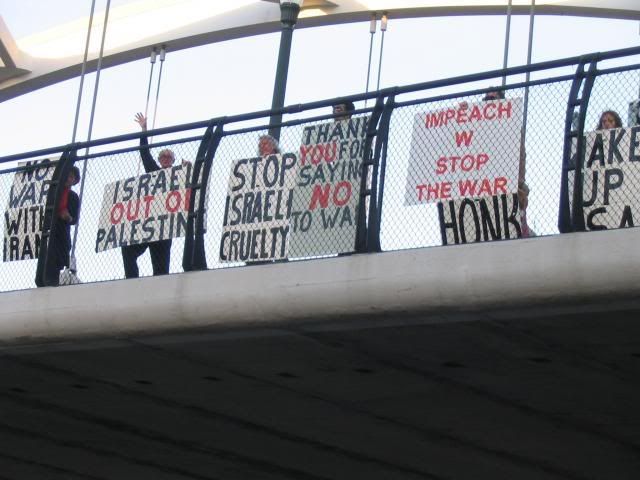
D I S T R I B U T E W I D E L Y , the announcement goes about a Planned Houston Freeway Protest Against Israel. The pictures show past protests.
FREEWAY BLOGGING (PROTESTS WITH SIGNS) IN HOUSTON, TEXAS ON MANDELL BRIDGE (NOT WOODHEAD) OVER HWY. 59 (SOUTHWEST FREEWAY) ALL INVITED. Photos of previous Wednesday protests show the site.
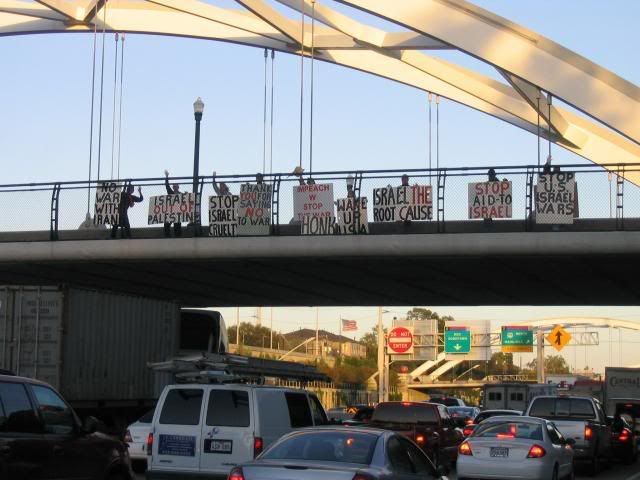
WHEN: Every Wednesday until further notice (starting Wed. 4-04-07)
TIME: 5:00 to 6:15pm
THEME: ISRAEL OUT OF PALESTINE--STOP ISRAELI CRUELTY--NO WAR WITH IRAN.
THE RESPONSES TO OUR SIGNS FROM THE CARS ON THE FREEWAY HAVE ALWAYS BEEN OVERWHELMINGLY POSITIVE AND GROWING, BUT WITH PATIENCE, IT WILL TAKE TIME TO PUT A DENT IN THE 4 DECADES OF SKEWED PRO-ISRAELI MEDIA COVERAGE OF THE ISRAEL/PALESTINE CONFLICT WHERE A MINIMUM OF 3 PALESTINIANS HAVE BEEN KILLED TO 1 ISRAELI, BUT IN TIME,THE PALESTINIANS WILL BE FREE SOMEDAY.
The SIGNS:
STOP U.S./ISRAEL WARS
STOP ISRAELI CRUELTY
PALESTINE SUFFERS
FREE PALESTINE
ISRAEL OUT OF PALESTINE
U.S. STOP FUNDING ISRAEL
THANK YOU FOR SAYING NO TO WAR
NO WAR WITH IRAN
READ CARTER'S BOOK ON PALESTINE
HANDS OFF THE PEOPLE OF IRAN
It reads on....
Why are we on the bridge protesting the U. S. unconditional political and economic support (approx. 10 million per day) to the Israeli Government when they continue the oppression, war crimes, and atrocities against the Palestinian people?
The average American doesn't know the extent of the suffering of the Palestinians and that this oppression is a predominant cause of radical Muslim terrorists, anti-Semitism, and anti-Americanism. When our government and Congressmen are unwilling to tell the truth about this conflict, and with the corporate media, which is highly biased in favor of Israel, this gross injustice is effectively kept under cover to "protect and defend" our twin brother, Israel. Even KPFT cooperates in this cover-up, inadvertently or intentionally, by canceling Flashpoints, which boldly attacks injustice where it exists, in Haiti, Darfur, or in Palestine. With our (US) phony "defense and protection" policies for our friend Israel, rather than defending and protecting, would not it be ironic if we contribute to its demise.
Injustices cannot last forever. History and inviolate laws inform us that the oppressor may become the oppressed. The Palestinian people are not going away.
Our efforts on the bridge may be slight but with malice toward none we would attempt to strike at the root of evil rather than hack at the branches and create a dialog for honest discussion to balance biased media coverage.
So if you’re in the Huston area, drop over on Wednesday afternoons and join in.

BUSH SPREADS GUANTANAMO GANGRENE AROUND WORLD; TENS OF THOUSANDS HELD
April 9, 2007
By Sherwood Ross
Jumah Al Dossari has been rotting in Guatanamo for five years now without ever having been charged of an offense. The prisoner believes “he has been condemned to live forever on an island where there is no law,” his lawyer says, adding, “He may well be right.”
Al Dossari is forced to spend virtually the entire day in solid-wall solitary under conditions that make Devil’s Island look like a health spa on the Riviera. He was kidnapped illegally, transported halfway around the world, torn from his family and other living beings, denied sunlight, short-shackled, beaten, and told by his sadistic tormentors he will never get out. On three occasions he has attempted suicide, according to his lawyer Joshua Colangelo-Bryan, who told his story in the April 5 Miami Herald.
Al Dossari cannot believe a human being can be flung in prison with no evidence, but what does he know of how President Bush and Congress have torched our Constitution? Al Dossari’s fate differs little from 400 other Guantanamo captives and of tens of thousands of luckless U.S. prisoners around the world, the bitter harvest of illegal wars by an illegitimate regime.
In a report published April 5th, Amnesty International called for the Guantanamo detainees either to be released from their “super max” high security cells or allowed to stand trial, a modest request under the circumstances. Amnesty said Guantanamo prisoners exist for 22 hours a day in windowless cells never seeing daylight; that they are allowed to exercise only at night; that they suffer from extreme “sensory deprivation”; that they are denied proper access to human rights groups and independent medical doctors. Amnesty’s Kate Kelly branded Guantanamo “a travesty of justice,” substantiating the charges leveled by Colangelo-Bryan and others with first-hand knowledge of this horrific mortuary.
The miseries of Guantanamo are being multiplied by the “compassionate conservative” in the White House. According to the British “Observer” newspaper, the U.S. operates an “invisible” (and hence illegal) network of prisons stretching from Diego Garcia to Iraq to Thailand, and including prison ships on the Indian Ocean. The Washington Post reported that six days after 9/11, Bush gave the CIA “broad authorization to disrupt terrorist activity, including permission to kill, capture and detain members of al Qaeda anywhere in the world.” This order, of course, appropriate for a Roman Emperor, has not the merest shred of legality. By the time of his 2003 State of the Union, though, Bush could crow more than 3,000 suspected terrorists “have been arrested in many countries.”
Soon, tens of thousands of men, mostly from Iraq and Afghanistan, were being detained. The ensuing brutalities and murders at Abu Ghraib, just west of Baghdad, have been well documented. Likewise Bagram prison, north of Kabul, Afghanistan, where prisoners were chained to ceilings for days and repeatedly beaten; where they have been put in cold rooms so long their hands and feet became swollen, inflicting excruciating pain and death. As at Abu Ghraib, some Bagram captives were just beaten to death. John Sifton of Human Rights Watch, reported Iraq detainees were routinely beaten. Torture was “condoned and commonly used,” he said. The U.S., of course, prefers to commit such crimes in secret. Reminiscent of the odious practices of Stalin and Hitler, the CIA illegally denies Red Cross access to its compound in Kabul, known as “The Pit,” and prisoners are illegally kept “off the books,” also illegal. An official of the Afghan Independent Human Rights Commission, Shamsullah Ahmadzai, told The New York Times that the Afghan police, courts, and prosecutors are all limited by law in how long they can hold criminal suspects, “The Americans are detaining people without any legal procedures. Prisoners do not have the opportunity to demonstrate their innocence.”
In Morocco, the “Observer” says, the government has obligingly locked U.S. captives in the Al-Tamara interrogation center near Rabat. In Syria, the U.S. consigns detainees for torture in Damascus. Egypt also gets a flow of alleged militants to be tortured. The U.S. also houses prisoners in Baku, Azerbaijan, at a U.S. airbase in Qatar, and as far away as Thailand. Still other prisoners are alleged to be held in Poland, and some are known to have been tortured in Saudi Arabia and Aman, Jordan.
Many suspects are seized in Europe. Italy has arrest warrants out for a score of CIA agents for nabbing a suspect off the streets in Milan. On January 23 of last year, the Council of Europe put the number of illegally seized men on that continent at about 100. Swiss Senator Dick Marty told the Council: “I believe it is absolutely demonstrated that alleged terrorists or terrorist sympathizers were kidnapped, transported against their will across Europe, detained outside any jurisdiction, deprived of all rights, and sent to countries that, notably, offer no guarantees at all of the respect for fundamental rights.”
Amnesty has denounced the U.S. for its “two-faced strategy to torture,” that is, to deny it in public, as President Bush does, and practice it in secret, all the while seeking ways for the torture goons to elude criminal liability. Amnesty also criticizes the U.S. for its silence “on human rights abuses committed by many of its new-found friends.” Last January, Amnesty cited the case of Baloch National Movement political leader Akhtar Mengel, held incommunicado in solitary confinement in Karachi “without access to needed medical care” and hit America’s failure “to take any effective public action.”
Yet, why should it? The rights of opposition political leaders in his ally Pakistan mean nothing to George Bush. His indifference to their plight, like that of Jumah Al Dossari, is just another aspect of his contempt for human life and law. After all, he is the man who scrapped nuclear and germ warfare treaties, violated the Geneva and Hague Conventions and the Nuremberg Principles, trampled the Charter of the United Nations, ringed the world with military bases, sold billions worth of arms to dictators, killed hundreds of thousands of Iraq civilians, bombarded the Middle East with illegal cluster bombs and uranium shells, threatened a small nation with the “nuclear option,” created a gigantic war machine bent on militarizing space to dominate every crevice of the Earth, and is spending his taxpayers into bankruptcy while offering thousands of their youth as human sacrifices on the altar of his wars of aggression. And that’s just for starters. Nowhere, though, does Mr. Bush reveal the depth of his degenerate character more clearly than by ordering the arbitrary arrest and torture of human beings. Victims should not look for mercy from this man.
Sherwood Ross is a Miami-based columnist. Reach him at sherwoodr1@yahoo.com
By Sherwood Ross
Jumah Al Dossari has been rotting in Guatanamo for five years now without ever having been charged of an offense. The prisoner believes “he has been condemned to live forever on an island where there is no law,” his lawyer says, adding, “He may well be right.”
Al Dossari is forced to spend virtually the entire day in solid-wall solitary under conditions that make Devil’s Island look like a health spa on the Riviera. He was kidnapped illegally, transported halfway around the world, torn from his family and other living beings, denied sunlight, short-shackled, beaten, and told by his sadistic tormentors he will never get out. On three occasions he has attempted suicide, according to his lawyer Joshua Colangelo-Bryan, who told his story in the April 5 Miami Herald.
Al Dossari cannot believe a human being can be flung in prison with no evidence, but what does he know of how President Bush and Congress have torched our Constitution? Al Dossari’s fate differs little from 400 other Guantanamo captives and of tens of thousands of luckless U.S. prisoners around the world, the bitter harvest of illegal wars by an illegitimate regime.
In a report published April 5th, Amnesty International called for the Guantanamo detainees either to be released from their “super max” high security cells or allowed to stand trial, a modest request under the circumstances. Amnesty said Guantanamo prisoners exist for 22 hours a day in windowless cells never seeing daylight; that they are allowed to exercise only at night; that they suffer from extreme “sensory deprivation”; that they are denied proper access to human rights groups and independent medical doctors. Amnesty’s Kate Kelly branded Guantanamo “a travesty of justice,” substantiating the charges leveled by Colangelo-Bryan and others with first-hand knowledge of this horrific mortuary.
The miseries of Guantanamo are being multiplied by the “compassionate conservative” in the White House. According to the British “Observer” newspaper, the U.S. operates an “invisible” (and hence illegal) network of prisons stretching from Diego Garcia to Iraq to Thailand, and including prison ships on the Indian Ocean. The Washington Post reported that six days after 9/11, Bush gave the CIA “broad authorization to disrupt terrorist activity, including permission to kill, capture and detain members of al Qaeda anywhere in the world.” This order, of course, appropriate for a Roman Emperor, has not the merest shred of legality. By the time of his 2003 State of the Union, though, Bush could crow more than 3,000 suspected terrorists “have been arrested in many countries.”
Soon, tens of thousands of men, mostly from Iraq and Afghanistan, were being detained. The ensuing brutalities and murders at Abu Ghraib, just west of Baghdad, have been well documented. Likewise Bagram prison, north of Kabul, Afghanistan, where prisoners were chained to ceilings for days and repeatedly beaten; where they have been put in cold rooms so long their hands and feet became swollen, inflicting excruciating pain and death. As at Abu Ghraib, some Bagram captives were just beaten to death. John Sifton of Human Rights Watch, reported Iraq detainees were routinely beaten. Torture was “condoned and commonly used,” he said. The U.S., of course, prefers to commit such crimes in secret. Reminiscent of the odious practices of Stalin and Hitler, the CIA illegally denies Red Cross access to its compound in Kabul, known as “The Pit,” and prisoners are illegally kept “off the books,” also illegal. An official of the Afghan Independent Human Rights Commission, Shamsullah Ahmadzai, told The New York Times that the Afghan police, courts, and prosecutors are all limited by law in how long they can hold criminal suspects, “The Americans are detaining people without any legal procedures. Prisoners do not have the opportunity to demonstrate their innocence.”
In Morocco, the “Observer” says, the government has obligingly locked U.S. captives in the Al-Tamara interrogation center near Rabat. In Syria, the U.S. consigns detainees for torture in Damascus. Egypt also gets a flow of alleged militants to be tortured. The U.S. also houses prisoners in Baku, Azerbaijan, at a U.S. airbase in Qatar, and as far away as Thailand. Still other prisoners are alleged to be held in Poland, and some are known to have been tortured in Saudi Arabia and Aman, Jordan.
Many suspects are seized in Europe. Italy has arrest warrants out for a score of CIA agents for nabbing a suspect off the streets in Milan. On January 23 of last year, the Council of Europe put the number of illegally seized men on that continent at about 100. Swiss Senator Dick Marty told the Council: “I believe it is absolutely demonstrated that alleged terrorists or terrorist sympathizers were kidnapped, transported against their will across Europe, detained outside any jurisdiction, deprived of all rights, and sent to countries that, notably, offer no guarantees at all of the respect for fundamental rights.”
Amnesty has denounced the U.S. for its “two-faced strategy to torture,” that is, to deny it in public, as President Bush does, and practice it in secret, all the while seeking ways for the torture goons to elude criminal liability. Amnesty also criticizes the U.S. for its silence “on human rights abuses committed by many of its new-found friends.” Last January, Amnesty cited the case of Baloch National Movement political leader Akhtar Mengel, held incommunicado in solitary confinement in Karachi “without access to needed medical care” and hit America’s failure “to take any effective public action.”
Yet, why should it? The rights of opposition political leaders in his ally Pakistan mean nothing to George Bush. His indifference to their plight, like that of Jumah Al Dossari, is just another aspect of his contempt for human life and law. After all, he is the man who scrapped nuclear and germ warfare treaties, violated the Geneva and Hague Conventions and the Nuremberg Principles, trampled the Charter of the United Nations, ringed the world with military bases, sold billions worth of arms to dictators, killed hundreds of thousands of Iraq civilians, bombarded the Middle East with illegal cluster bombs and uranium shells, threatened a small nation with the “nuclear option,” created a gigantic war machine bent on militarizing space to dominate every crevice of the Earth, and is spending his taxpayers into bankruptcy while offering thousands of their youth as human sacrifices on the altar of his wars of aggression. And that’s just for starters. Nowhere, though, does Mr. Bush reveal the depth of his degenerate character more clearly than by ordering the arbitrary arrest and torture of human beings. Victims should not look for mercy from this man.
Sherwood Ross is a Miami-based columnist. Reach him at sherwoodr1@yahoo.com
CCTV cameras that shout at you? All very well, but I have a much scarier idea. Trust me, you'll love it ...
I can see you, citizen
Charlie BrookerMonday April 9, 2007
The Guardian
In case you missed it, last week police in Middlesbrough unveiled a startling new weapon in the ongoing war against crime: CCTV cameras that shout at you whenever you do something wrong. Currently, they are chiefly used to warn drunken revellers hell-bent on stealing traffic cones, or to dish out virtual bollockings to litterbugs. "Respect tsar" Louise Casey says it "nips problems in the bud", while home secretary John Reid praised the scheme on the grounds that rather than being "secret surveillance", it was "very public", and most importantly, "interactive".
Of course, the word "interactive" is regularly wheeled out to make any old bullshit sound exciting and modern. Hey, it's not a humiliating infringement of civil liberties - it's interactive! You, know - a bit of democratic fun, just like The X Factor or MySpace! Woo hoo! Now put that in the bin or I'll blow your head off.
There are two major problems with justifying the bellowing CCTV cameras on the grounds that they're "interactive". Firstly, just because something's "interactive", that doesn't automatically make it right. Coprophilia is interactive, and that doesn't belong in the street either.
Secondly, they're not interactive at all. They're faceless electronic scrutinisers that scream when you break the rules. What John Reid has done here is confuse the word "interactive" with the word "nightmarish".
And wait, it gets worse. As if the scheme wasn't already unsettling enough, according to news reports, "children's voices are to be used initially to make the encounter less confrontational".
This would be a brilliantly disturbing twist in a dystopian sci-fi movie in which the traditional adult-child relationship has been thrown into reverse, and misbehaving grownups are publicly scolded by eerie, disembodied infant voices, but unfortunately it's not happening in a dystopian sci-fi movie at all, but in Middlesborough. And, later this year, in Southwark, Barking and Dagenham, Reading, Harlow, Norwich, Ipswich, Plymouth, Gloucester, Derby, Northampton, Mansfield, Nottingham, Coventry, Sandwell, Wirral, Blackpool, Salford, South Tyneside and Darlington.
Incidentally, it's not yet clear whether the children's voices will address miscreants using formal language ("Attention, citizen: you are committing a felony; you have 20 seconds to desist") or in "kid speak" ("You're a bad man and I'm telling on you and my dad's going to tear your head off"). Perhaps they could also allow kids to control the cameras and decide what constitutes a crime. And, rather than mounting the cameras on poles, why not make them mobile and more kid-friendly by placing them inside full-size, remote-controlled Daleks, which can patrol the streets dishing out near-fatal electric shocks to those who disobey?
Actually, using the Daleks would be a masterstroke. Everyone loves Doctor Who - who wouldn't be thrilled by the sight of a real-life Dalek squadron rolling down the high street, glinting in the sun? The sheer excitement would genuinely make the accompanying loss of liberty seem worthwhile.
To liven things up even more, our rasping pepperpot overlords could be colour-coded. Blue Daleks would deal with minor infractions, and would spend most of their time issuing warnings and administering minor shocks - but they'd also be chummy and approachable, and willing to pose for photographs with your nephew. Red Daleks, on the other hand, would be emotionless killing machines.
Imagine the atmosphere outside a pub on a hot summer's day: a Red Dalek trundles past, and the convivial hubbub suddenly fades to a whisper. Everyone stiffens. And then he turns the corner and a communal sigh of relief goes up, and the drinking continues and the jukebox plays louder and louder ... community spirit lives again. Admit it: it'd be fantastic.
Of course, to maximise the psychological impact of the Red Daleks, they'd have to be fewer in number than the Blues. Ten per citizen, tops.
If anyone from the Home Office is reading this, incidentally, it's absolutely imperative that you license the actual, 100% official, BBC Daleks, as seen on TV. Don't just try to create some sort of rip-off close-as-dammit lookalike and hope we'll start calling them "Daleks". We're not idiots. And if you draw a blank with Terry Nation's estate, don't bother negotiating for the rights to the Cybermen instead. It won't be the same. Daleks or nothing. Pull that off and I guarantee we'll willingly accept it. Even Shami Chakrabarti, denouncing the plan on Question Time, would have to start her complaint by saying, "Obviously I love the idea of Daleks as much as anyone, but ..."
So come on, Reid. Stop pissing about with twittering cameras on sticks. The technology for an army of wirelessly controlled mobile CCTV spybots already exists - and it's interactive. There's nothing stopping you. Show some balls for once in your poxy life. Give us the Daleks.
News media plans escape from Baghdad
AJR Features
From AJR, April/May 2007
Obstructed View
Extreme danger and sky-high security costs have diminished the press corps in Iraq and severely limited access to a deepening morass. The result is a clouded picture of perhaps today’s most important news story.
By Sherry Ricchiardi
Sherry Ricchiardi (sricchia@iupui.edu) is an AJR senior contributing writer.
Before Rick Jervis heads out into the streets of Baghdad, he makes an important telephone call. Not to his editor back in USA Today's newsroom, but to his security consultant, a pipeline to the murky world of kidnappers, militias and other indiscriminate killers. If there is a rise in car bombings or assaults on foreigners, the reporter wants to know which routes to avoid before he takes off with a driver and bodyguard. He doesn't wear a flak jacket because that would draw too much attention.
The relentless violence in Iraq has seriously compromised coverage of arguably the most important story in the world today. Certain facets of the conflict remain exasperatingly elusive or, at best, thinly reported. The media's vital role as eyewitness has been severely limited; the intimate narrative of victims, survivors and their persecutors is sorely lacking in places like Anbar Province, where the insurgency continues to inflict havoc.
Few journalists have penetrated the clandestine network of resistance fighters and jihadists. CNN's Michael Ware is one of the only correspondents to sit face-to-face with al-Qaeda operatives on their own turf and survive to tell about it. The New York Times' Dexter Filkins used an inside source to set up meetings with local insurgents caught in a power struggle with al-Qaeda outsiders. But such breakthroughs have been rare. When it comes to factions in the fighting, there are more questions than answers.
And the roster of correspondents seems far too small for the daunting task. Escalating threats to foreigners and astronomical security costs have led media companies to scale back their staffs.
Though journalists struggle mightily to cut through the fog and spin, Americans are left without a complete account of a prolonged, bloody war that is devouring billions of taxpayers' dollars. Correspondents are hamstrung when it comes to independently verifying information from military press briefings or rhetoric from the Pentagon. Without risking their lives, they can't go into the festering city of Fallujah or certain Baghdad neighborhoods to conduct their own investigations (see "Out of Reach," April/May 2006). Embedding is an alternative, but it offers a limited view under scrutiny of the military.
"The whole thing seems so confusing," says Getty Images photographer Chris Hondros a few hours before heading back to Baghdad. He described this scenario: "A bomb blows up an American convoy. Who did that? The Sunni insurgents or the Shia or some other player? We have no idea and no way to figure it out... This is a profoundly different war."
No one sees the situation improving. Many news organizations have escape plans should American and Iraqi forces completely lose control of Baghdad, a squalid city brimming with weapons and sectarian animosity. For the media, security concerns have become an obsession.
Before they go out on assignments, correspondents work through a litany of questions: Where is it? What time is it? How can I get there? How can I get back? Who can I talk to? Who controls the neighborhood? Who guards the checkpoints? Is there enough fuel in the car and plenty of air in the tires? Is this story worth the risk?
To blend in, female journalists often don an abaya, a long robe worn by Muslim women, and a head scarf. Some male reporters with dark features grow moustaches and beards and try to emulate the attire of Iraqi men. Some blondes dye their hair black. Many operate on the 15-minute rule: They never stay longer in any one place for fear that someone with a cell phone will alert killers that a soft target is in play. Sometimes the smallest things can expose them. Wearing a seatbelt in a car is a clear giveaway: Iraqis rarely use them.
The high-pitched paranoia is justified. During the past four years, members of the press corps have been beheaded, gunned down at close range, blown apart by car bombs and IEDs (improvised explosive devices), targeted for assassination and kidnapped for ransom. Some have been wounded or died alongside coalition troops during combat missions. Sometimes they have shown up in grainy videos, flanked by masked executioners, tearfully begging for their lives.
On several occasions, suicide bombers have hit the heavily guarded hotels journalists live in, including the one where Jervis has set up USA Today's operation. Some media organizations like the New York Times and CNN have spent millions to build fortresses and maintain a private army of hired guns. Embedding with the U.S. military offers a modicum of protection; it also puts correspondents at risk for ambushes, IEDs and rocket attacks, common tactics used against the occupying forces.
The heavily protected Green Zone, the core of U.S. operations where journalists routinely go for briefings and to obtain press credentials, has become a favorite target. In his first-person account "Life in Hell: A Baghdad Diary," Time correspondent Aparisim Ghosh described an attack just 100 yards from the main entrance where twin blasts--one a car bomb, the other a suicide bomber--killed 16 people. It happened near small shops where journalists emerging from the Green Zone on hot afternoons stop to buy cold sodas.
For the fourth consecutive year, Iraq in 2006 ranked as the world's deadliest spot for the media, according to the Committee to Protect Journalists. Since the invasion, 133 journalists and media support workers have been killed; 83 percent were locals, many with ties to Western media outlets. The Associated Press lost two Iraqi staffers in December and January. CPJ reports that for the first time, murder has overtaken crossfire as the leading cause of deaths.
On March 6, CPJ announced two more murders: Mohan Hussein al-Dhahir, editor of the widely read al-Mashreq newspaper, was gunned down near his home in western Baghdad on March 4. Jamal al-Zubaidi, economics editor for two Baghdad-based dailies, disappeared after he left the office on February 24. His family found his body at the morgue a few days later.
Peter Osnos, who covered the war in Vietnam for the Washington Post, says Iraq is far riskier. "American journalists have never seen a war like this before--the extraordinary danger, the vast expense and the extraordinary set of circumstances. Every inch of terrain is a potential battlefield," says Osnos, now a senior fellow for media at the Century Foundation as well as founder and editor at large of PublicAffairs Books. "People underestimate how dangerous it is."
To be killed or injured, "All you have to do is make a wrong decision," says Richard Engel, NBC's Middle East correspondent, who has survived attempts on his life and seen friends kidnapped and killed during his four years in Iraq. Testimony from other journalists bears him out.
"You cannot move; you cannot go anywhere on your own," says Detroit Free Press photojournalist David Gilkey, who returned from his eighth trip to Iraq in January. Deadly strikes, he says, can come from any direction--an IED planted underground, a sniper on the roof of an apartment building, a gunman hiding in the trunk of a car, a teenager strapped with explosives, a car bomb set off by remote control as the killers sip tea nearby.
"Every time you get out of the vehicle, you are almost paralyzed, with your eyes darting around looking for where the shot might come from. Every time you are riding around it's all you can do to keep from plugging your ears, waiting for the blast to happen," says Gilkey, who survived an IED explosion on his last trip.
Photographer Samantha Appleton has been to Iraq five times for Time and The New Yorker. In 2003, she roamed freely with minor concerns about security. A year later, when foreigners became favorite targets, she began wearing an abaya, hoping to deflect attention as she documented the lives of Iraqi civilians, mostly in the Baghdad slum Sadr City. She now finds it impossible to travel by road anywhere outside of Baghdad. "Iraq is a country that hears and sees everything. A foreigner cannot blend in," Appleton wrote in an e-mail. She says it is common to travel with a minimum of two cars and three to five gunmen. "Few wars have required that," she says.
Besides being the most dangerous war for journalists, this also has become the most costly. Foreign editors for good reason are reluctant to discuss the specifics of their security strategies or what they pay to protect their staffs. It is no secret that companies like AKE Group Ltd. or Backwater USA charge around $1,500 a day for each member of a personal security detail. Armored vehicles can cost $100,000 or more, depending on the level of protection.
All but a handful of media organizations have been driven out by the high cost and risks. The New York Times, the Washington Post, the Los Angeles Times, the AP, and the broadcast and cable news networks are among the stalwarts. Even for those willing to bleed dollars for top-line security, newsgathering remains a struggle. The networks, whose crews are highly visible when they are covering a story, participate in a weekly conference call to share the latest intelligence reports. Competition goes out the window when safety is involved, says John Stack, Fox News Channel's vice president for newsgathering.
"What makes this war different," Stack says, "is that at least in certain cycles, journalists themselves were the targets, and that hadn't been the case in previous conflicts."
The heady days of "shock and awe" gave little hint of the angst to come. Operation Iraqi Freedom began as the best-covered war in American history, with television news crews transmitting unprecedented real-time images of U.S. armored divisions thundering through the desert. (See "Close to the Action," May 2003.) During the invasion, nearly 700 embedded journalists traveled alongside the troops. Hundreds more entered the war zone independently from Kuwait and other bordering nations. Today, it is a much lonelier media scene.
In October, the AP reported that only 11 journalists were embedded and there had been no more than 25 embeds during the months before. When Tribune Media Services military columnist Joseph L. Galloway contacted the Combined Information Press Center in Baghdad in early January, he was told there were only nine embeds. (CPIC, located in the Green Zone, monitors embed requests.)
"That is absolutely nothing for a story this big," says Galloway, who prowled the jungles of Vietnam for United Press International and reported from Iraq as senior military correspondent for the now-defunct Knight Ridder. "There's no substitute for getting out and spending time with a unit in a combat situation."
No one knows for certain how many journalists are in Iraq at any given time. The best guess from those on the ground is 50 to 60 on a consistent basis. Predictably, the number rises when major news breaks, such as the execution of Saddam Hussein. In mid-February, the number of embeds jumped to 52 as the U.S. military implemented a plan to secure Baghdad.
New York Times correspondent Dexter Filkins offers another measure. He recalls that in the early days, several hundred journalists packed into an auditorium in the Green Zone to attend press conferences. When he left in September, about a half dozen were showing up. "It was a big story then and now, just a lot fewer people are covering it, for all the obvious reasons," says Filkins, who spent three-and-a-half years in Iraq after covering the war in Afghanistan for a year.
Compared with Iraq, "Afghanistan was a tea party," says the correspondent, who is taking a break from combat as a Nieman Fellow at Harvard University. "The people there are working incredibly hard and are working heroically, taking increasing risks to stitch [the story] together and get as much as they can. But there's still an awful lot we don't know."
Over the past four years, three types of media operations have evolved in Iraq. The top tier, such as the New York Times and Fox News Channel, has invested millions in armed encampments. (The Times has the most correspondents--generally five or six are in the country--as well as dozens of Iraqis working as office support staff and filing information from dangerous places.) Other news organizations, like USA Today and U.S. News & World Report, maintain a slim presence, with one correspondent and a stable of Iraqi stringers, usually operating out of a hotel or a shared house. Regional newspapers such as the San Antonio Express-News and Arkansas Democrat-Gazette parachute reporters in for stories with strong local ties.
National Public Radio, which generally has four correspondents and a producer in the country as well as a dozen Iraqis on the payroll, has moved its headquarters four times since the war started, says Senior Foreign Editor Loren Jenkins, who visits the Baghdad bureau two or three times a year to oversee security issues. Jenkins understands why many media companies stay out. "It's hair-raising to try and run an operation there. Every day you're saying, 'Oh, God, I hope nothing happens to our people,'" says the editor, who did stints in Vietnam for Newsweek. "It's a constant, gnawing fear."
NPR first set up shop in a flophouse, as Jenkins describes it, a risky venture since there was little security. The editor counted on operating under the radar with his low-profile staff. When conditions deteriorated in 2004, he rented a house and sought professional security advice. Then came a string of kidnappings. ABC News had a heavily fortified compound with extra room, so NPR moved in. "They had greater protection than we could ever have afforded," says Jenkins.
That neighborhood became more radicalized as Muqtada al-Sadr's militia began taking control of the streets. It was time to move again. In November, NPR rented a house with Fox and CNN for neighbors. ABC News has since moved in, and the Iraq Foreign Ministry, with its army of guards, is a few blocks down the street. Once again, Jenkins piggybacked on security provided by more affluent players. He calls the safety situation in Baghdad "a constantly changing crapshoot."
NPR has invested in a second armored vehicle, but correspondents do not travel with armed guards. "If the only way you can get to a place is with a bunch of mercenaries with guns sticking out of the car or surrounding you wherever you go, that is not the journalism I want to practice," says Jenkins. "I'd rather not cover the story than go there with an intimidating presence." The bottom line: "They're always going to have more guns than you do," he says.
The Los Angeles Times rents an entire floor of a hotel outside the Green Zone, which beefed up security after a suicide bomber attacked in November 2005. Bureau Chief Borzou Daragahi had the drab walls painted white, hung pictures by local artists, replaced wall-to-wall carpeting and had the harsh fluorescent lights softened in an effort to boost morale, especially for the large Iraqi staff of translators, office managers, drivers, a cook, bodyguards and stringers.
"It's really hard given that these folks are watching their country collapse," says Daragahi. The Times keeps three Western correspondents in Baghdad.
USA Today operates out of the same hotel in a two-room suite that doubles as office and sleeping space for Rick Jervis. He rents separate space for the four-person Iraqi staff, including a bodyguard. "We are operating, as you could call it, on the lower end of the spectrum," says Jervis, who became USA Today's full-time correspondent in April 2005. He pays $5,000 a month for hotel space and services, such as laundry and food, and another $5,000 to the Iraqis who work for him.
Jervis hired a security contractor who delivers operational briefings a couple times a week, sends e-mail alerts and does general consulting before Jervis goes out on assignments. The correspondent is on a six-week-in, three-week-out-rotation--USA Today sends in reporters with foreign experience to fill in for him. When Jervis returns from a break, the first thing he does is get a risk assessment.
Regional news organizations covering stories on a spot basis make do with far less protection than the regulars. Senior military reporter Sig Christenson and photographer Nicole Fruge of the San Antonio Express-News landed at Baghdad International Airport in August to do a story on a Texas legislator serving as a Marine reserve colonel in Ramadi. There was no high-priced security detail waiting to sweep them to safety in a bombproof car.
Instead, they hitched a ride in an armored vehicle with "burly mercenary types," as Fruge describes them, to get from the military side of the airport to the civilian side, a short but perilous drive. Once on the outside, they smoldered in 120-degree heat, waiting for a ride Christenson had arranged with a colleague in Baghdad. Fruge, on her second trip to Iraq, wondered if it was a bad idea to be so exposed.
Christenson, who rode across the desert with invading troops and has frequented the war zone, reassured her it was fine. "I was thinking to myself, 'You are the biggest bullshitter that ever lived.' I knew we were sitting ducks," says Christenson, a founder and former president of the group Military Reporters and Editors.
In early March, the two returned for a fourth anniversary story about how soldiers from Fort Hood, Texas, feel about the war and how it is affecting them. As always, they embedded, but they know traveling with the military offers no guarantees.
Last May, CBS correspondent Kimberly Dozier was doing a Memorial Day story on what life was like for American troops in Baghdad when a car laden with explosives ignited, spewing razor-sharp shrapnel in her direction. CBS cameraman Paul Douglas and soundman James Brolan died at the scene. A U.S. Army captain and his Iraqi translator also were killed.
The network reported that Dozier, 39, arrived in Germany from Iraq on a ventilator and underwent surgery on her head and legs. In August, she left a Maryland hospital facing months of rehabilitation for her fractured limbs.
On December 4, Detroit Free Press reporter Joe Swickard, on his first trip to Iraq, was riding in a Humvee alongside Marines patrolling volatile Fallujah. His coworker, photographer David Gilkey, was in the lead vehicle. A commander was pointing out to Swickard that it would be the perfect spot for an ambush when, suddenly, the road in front of them exploded.
Swickard watched in horror as flames shot through a massive gray cloud of dust and the Humvee carrying Gilkey came crashing down out of the air. Swickard's first thought was, "Oh shit, they're dead. How will I cover this?"
When the Humvee came to rest, the two right-hand doors were sprung open. Suddenly, two sets of legs poked out of the wreckage. Gilkey and a Marine emerged, and "I just started breathing again," Swickard recalls. Then came the second shock. A hail of gunfire sent the survivors scrambling for cover.
Gilkey suffered only a temporary hearing loss. None of the Marines was seriously injured. During an earlier trip, the photographer had worked on a story about soldiers who had lost limbs. One them described how, after a blast, he looked down to find his severed leg lying in his lap. Gilkey remembers sighing with relief when he realized his own arms and legs were intact.
Many journalists who have covered the carnage describe their Iraq experience as life-altering. The L.A. Times' Daragahi noted that he was coming to the end of his stint as Baghdad bureau chief this spring. "Thank God! Quite frankly, I am burned out, and I see that I'm not having the ideas I used to have. I am a lot more tired of the rituals and rhythms of being in Baghdad. It's taken a toll on my personal life," says Daragahi, whose wife works for the French newspaper Le Figaro in Tehran.
They put off having children because "she did not want to be pregnant while I was in Iraq. Too much anxiety," he says. After Daragahi is relieved of bureau duties, he will be based in Beirut to cover the region, including Iraq and Iran.
Earlier this year, NBC's Engel sent a memo to his bosses telling them that as Iraq changed, he had changed. He had no semblance of a personal life, and the war had cost him his marriage. "Violence and cruelty now seem, to me, to come easily to mankind; a new belief that disturbs me," he wrote. Engel is based in Beirut but continues to cover Iraq.
As difficult as it is for American journalists, it often is worse for Iraqis. Bassam Sebti, who has reported for the Washington Post, wrote a personal account for CPJ in May 2006. He described how stress had become an unforgiving companion; body parts scattered in the street and children weeping over dead parents had become routine. Working for Americans could get him killed, so he convinced neighbors he ran an Internet café. Sleep is elusive, and nightmares have haunted him for months.
How does the human psyche cope with the magnitude of violence that journalists have experienced in Iraq? Dr. Frank Ochberg, a founder of the Dart Center for Journalism and Trauma, points out a distinct difference between those who cope well and those who don't. Those who do best under extreme duress tend to maintain ties with significant others, don't allow themselves to become walled off and find ways to share their frustrations and worries.
Journalists in Iraq face the additional pressure of being limited by the danger and kept from working the story to the fullest. "Professionals can tolerate a hell of a lot when they're on the job and getting gratification from doing what they know they were put on earth to do," Ochberg says. "You don't really think twice; you don't feel all that courageous. You're doing what you've been trained to do. It's hard when on top of everything else you can't do your job. Then it becomes crushing."
His advice: Establish a daily rhythm, find sources of rest and relaxation, stay connected to other people, do physical exercise and lay off alcohol and other drugs.
Engel pounds a punching bag. Daragahi walks on a treadmill 30 minutes every day or two. Christenson carries an Army-issue Bible and finds respite reading the Old Testament "because so much of it happened around here." Unlike wartime Saigon's freewheeling party atmosphere, Baghdad mostly is a forbidden zone. Main sources of entertainment include satellite TV and DVDs. The press corps maintains a strong camaraderie via e-mail.
"This is a different war in a different time covered by journalists with different values from past conflicts," says Daragahi. "To relax, we're much more likely to be meditating using aroma therapy oils or working up a sweat on exercise equipment than smoking hashish and getting soused in the hotel bar. A number of Baghdad correspondents I know regularly do yoga."
There's also an emotional fallout when journalists take extraordinary risks and their material is not used or is underplayed. Lara Logan, CBS' chief foreign correspondent, caused a ruckus when she sent an e-mail appealing to friends and colleagues to intervene after a producer for the "CBS Evening News with Katie Couric" chose not to air her report "The Battle for Haifa Street." Instead, it was posted on the network's Web site.
Logan underscored the danger in her message, which quickly showed up on the Internet: "Our crew had to be pulled out because we got a call saying they were about to be killed, and on their way out, a civilian man was shot dead in front of them as they ran," she wrote. The story, she said, "is not too gruesome to air, but rather too important to ignore."
The network's foreign editor declined to comment, referring instead to a statement by CBS spokeswoman Sandy Genelius: "The executive director of the 'Evening News' thought some of the images in it were a bit strong plus on that day the program was already packed with other Iraq news."
Marcus Wilford, ABC's director of news coverage for Europe, the Middle East and Africa, has lobbied for Iraq stories to be given better play. Is he satisfied with how the material is used? "It's OK, and I think it's gotten better, but it could be better still. Frankly, I have been frustrated at the number of times a reporter has clearly done something very risky and not gotten anything on... I feel there has been a tendency for broadcast to get weary of the story unless it's absolutely sensational. It's difficult, no doubt, after four years."
The future of the American journalistic presence in Iraq remains a large question mark. Not a single foreign editor or correspondent interviewed for this story felt conditions would get better. Most made bleak predictions of worse to come and talked about contingency plans for their staffs if conditions deteriorate even further. Some already have arranged for housing inside the heavily fortified Green Zone as a safety net.
One news operation plans to flee to safer areas inside Kurdistan, a way of staying in Iraq but farther from the killing zones. Those with bureaus in other parts of the Middle East will go there to retrench. On the eve of the fifth anniversary of Operation Iraqi Freedom, no one was talking about shutting down, at least not yet. "We agonize over this, and we have discussions about at what point we would not cover it," says NPR's Jenkins.
What would it take for NPR to pull out? There was a long pause and a deep sigh on the other end of the telephone. "No one believes there's a victory at the end of this tunnel; it's how long you hold on and pretend. At some point, [the government] is going to have to pull the plug. Until then, we are in for the long haul."
From AJR, April/May 2007
Obstructed View
Extreme danger and sky-high security costs have diminished the press corps in Iraq and severely limited access to a deepening morass. The result is a clouded picture of perhaps today’s most important news story.
By Sherry Ricchiardi
Sherry Ricchiardi (sricchia@iupui.edu) is an AJR senior contributing writer.
Before Rick Jervis heads out into the streets of Baghdad, he makes an important telephone call. Not to his editor back in USA Today's newsroom, but to his security consultant, a pipeline to the murky world of kidnappers, militias and other indiscriminate killers. If there is a rise in car bombings or assaults on foreigners, the reporter wants to know which routes to avoid before he takes off with a driver and bodyguard. He doesn't wear a flak jacket because that would draw too much attention.
The relentless violence in Iraq has seriously compromised coverage of arguably the most important story in the world today. Certain facets of the conflict remain exasperatingly elusive or, at best, thinly reported. The media's vital role as eyewitness has been severely limited; the intimate narrative of victims, survivors and their persecutors is sorely lacking in places like Anbar Province, where the insurgency continues to inflict havoc.
Few journalists have penetrated the clandestine network of resistance fighters and jihadists. CNN's Michael Ware is one of the only correspondents to sit face-to-face with al-Qaeda operatives on their own turf and survive to tell about it. The New York Times' Dexter Filkins used an inside source to set up meetings with local insurgents caught in a power struggle with al-Qaeda outsiders. But such breakthroughs have been rare. When it comes to factions in the fighting, there are more questions than answers.
And the roster of correspondents seems far too small for the daunting task. Escalating threats to foreigners and astronomical security costs have led media companies to scale back their staffs.
Though journalists struggle mightily to cut through the fog and spin, Americans are left without a complete account of a prolonged, bloody war that is devouring billions of taxpayers' dollars. Correspondents are hamstrung when it comes to independently verifying information from military press briefings or rhetoric from the Pentagon. Without risking their lives, they can't go into the festering city of Fallujah or certain Baghdad neighborhoods to conduct their own investigations (see "Out of Reach," April/May 2006). Embedding is an alternative, but it offers a limited view under scrutiny of the military.
"The whole thing seems so confusing," says Getty Images photographer Chris Hondros a few hours before heading back to Baghdad. He described this scenario: "A bomb blows up an American convoy. Who did that? The Sunni insurgents or the Shia or some other player? We have no idea and no way to figure it out... This is a profoundly different war."
No one sees the situation improving. Many news organizations have escape plans should American and Iraqi forces completely lose control of Baghdad, a squalid city brimming with weapons and sectarian animosity. For the media, security concerns have become an obsession.
Before they go out on assignments, correspondents work through a litany of questions: Where is it? What time is it? How can I get there? How can I get back? Who can I talk to? Who controls the neighborhood? Who guards the checkpoints? Is there enough fuel in the car and plenty of air in the tires? Is this story worth the risk?
To blend in, female journalists often don an abaya, a long robe worn by Muslim women, and a head scarf. Some male reporters with dark features grow moustaches and beards and try to emulate the attire of Iraqi men. Some blondes dye their hair black. Many operate on the 15-minute rule: They never stay longer in any one place for fear that someone with a cell phone will alert killers that a soft target is in play. Sometimes the smallest things can expose them. Wearing a seatbelt in a car is a clear giveaway: Iraqis rarely use them.
The high-pitched paranoia is justified. During the past four years, members of the press corps have been beheaded, gunned down at close range, blown apart by car bombs and IEDs (improvised explosive devices), targeted for assassination and kidnapped for ransom. Some have been wounded or died alongside coalition troops during combat missions. Sometimes they have shown up in grainy videos, flanked by masked executioners, tearfully begging for their lives.
On several occasions, suicide bombers have hit the heavily guarded hotels journalists live in, including the one where Jervis has set up USA Today's operation. Some media organizations like the New York Times and CNN have spent millions to build fortresses and maintain a private army of hired guns. Embedding with the U.S. military offers a modicum of protection; it also puts correspondents at risk for ambushes, IEDs and rocket attacks, common tactics used against the occupying forces.
The heavily protected Green Zone, the core of U.S. operations where journalists routinely go for briefings and to obtain press credentials, has become a favorite target. In his first-person account "Life in Hell: A Baghdad Diary," Time correspondent Aparisim Ghosh described an attack just 100 yards from the main entrance where twin blasts--one a car bomb, the other a suicide bomber--killed 16 people. It happened near small shops where journalists emerging from the Green Zone on hot afternoons stop to buy cold sodas.
For the fourth consecutive year, Iraq in 2006 ranked as the world's deadliest spot for the media, according to the Committee to Protect Journalists. Since the invasion, 133 journalists and media support workers have been killed; 83 percent were locals, many with ties to Western media outlets. The Associated Press lost two Iraqi staffers in December and January. CPJ reports that for the first time, murder has overtaken crossfire as the leading cause of deaths.
On March 6, CPJ announced two more murders: Mohan Hussein al-Dhahir, editor of the widely read al-Mashreq newspaper, was gunned down near his home in western Baghdad on March 4. Jamal al-Zubaidi, economics editor for two Baghdad-based dailies, disappeared after he left the office on February 24. His family found his body at the morgue a few days later.
Peter Osnos, who covered the war in Vietnam for the Washington Post, says Iraq is far riskier. "American journalists have never seen a war like this before--the extraordinary danger, the vast expense and the extraordinary set of circumstances. Every inch of terrain is a potential battlefield," says Osnos, now a senior fellow for media at the Century Foundation as well as founder and editor at large of PublicAffairs Books. "People underestimate how dangerous it is."
To be killed or injured, "All you have to do is make a wrong decision," says Richard Engel, NBC's Middle East correspondent, who has survived attempts on his life and seen friends kidnapped and killed during his four years in Iraq. Testimony from other journalists bears him out.
"You cannot move; you cannot go anywhere on your own," says Detroit Free Press photojournalist David Gilkey, who returned from his eighth trip to Iraq in January. Deadly strikes, he says, can come from any direction--an IED planted underground, a sniper on the roof of an apartment building, a gunman hiding in the trunk of a car, a teenager strapped with explosives, a car bomb set off by remote control as the killers sip tea nearby.
"Every time you get out of the vehicle, you are almost paralyzed, with your eyes darting around looking for where the shot might come from. Every time you are riding around it's all you can do to keep from plugging your ears, waiting for the blast to happen," says Gilkey, who survived an IED explosion on his last trip.
Photographer Samantha Appleton has been to Iraq five times for Time and The New Yorker. In 2003, she roamed freely with minor concerns about security. A year later, when foreigners became favorite targets, she began wearing an abaya, hoping to deflect attention as she documented the lives of Iraqi civilians, mostly in the Baghdad slum Sadr City. She now finds it impossible to travel by road anywhere outside of Baghdad. "Iraq is a country that hears and sees everything. A foreigner cannot blend in," Appleton wrote in an e-mail. She says it is common to travel with a minimum of two cars and three to five gunmen. "Few wars have required that," she says.
Besides being the most dangerous war for journalists, this also has become the most costly. Foreign editors for good reason are reluctant to discuss the specifics of their security strategies or what they pay to protect their staffs. It is no secret that companies like AKE Group Ltd. or Backwater USA charge around $1,500 a day for each member of a personal security detail. Armored vehicles can cost $100,000 or more, depending on the level of protection.
All but a handful of media organizations have been driven out by the high cost and risks. The New York Times, the Washington Post, the Los Angeles Times, the AP, and the broadcast and cable news networks are among the stalwarts. Even for those willing to bleed dollars for top-line security, newsgathering remains a struggle. The networks, whose crews are highly visible when they are covering a story, participate in a weekly conference call to share the latest intelligence reports. Competition goes out the window when safety is involved, says John Stack, Fox News Channel's vice president for newsgathering.
"What makes this war different," Stack says, "is that at least in certain cycles, journalists themselves were the targets, and that hadn't been the case in previous conflicts."
The heady days of "shock and awe" gave little hint of the angst to come. Operation Iraqi Freedom began as the best-covered war in American history, with television news crews transmitting unprecedented real-time images of U.S. armored divisions thundering through the desert. (See "Close to the Action," May 2003.) During the invasion, nearly 700 embedded journalists traveled alongside the troops. Hundreds more entered the war zone independently from Kuwait and other bordering nations. Today, it is a much lonelier media scene.
In October, the AP reported that only 11 journalists were embedded and there had been no more than 25 embeds during the months before. When Tribune Media Services military columnist Joseph L. Galloway contacted the Combined Information Press Center in Baghdad in early January, he was told there were only nine embeds. (CPIC, located in the Green Zone, monitors embed requests.)
"That is absolutely nothing for a story this big," says Galloway, who prowled the jungles of Vietnam for United Press International and reported from Iraq as senior military correspondent for the now-defunct Knight Ridder. "There's no substitute for getting out and spending time with a unit in a combat situation."
No one knows for certain how many journalists are in Iraq at any given time. The best guess from those on the ground is 50 to 60 on a consistent basis. Predictably, the number rises when major news breaks, such as the execution of Saddam Hussein. In mid-February, the number of embeds jumped to 52 as the U.S. military implemented a plan to secure Baghdad.
New York Times correspondent Dexter Filkins offers another measure. He recalls that in the early days, several hundred journalists packed into an auditorium in the Green Zone to attend press conferences. When he left in September, about a half dozen were showing up. "It was a big story then and now, just a lot fewer people are covering it, for all the obvious reasons," says Filkins, who spent three-and-a-half years in Iraq after covering the war in Afghanistan for a year.
Compared with Iraq, "Afghanistan was a tea party," says the correspondent, who is taking a break from combat as a Nieman Fellow at Harvard University. "The people there are working incredibly hard and are working heroically, taking increasing risks to stitch [the story] together and get as much as they can. But there's still an awful lot we don't know."
Over the past four years, three types of media operations have evolved in Iraq. The top tier, such as the New York Times and Fox News Channel, has invested millions in armed encampments. (The Times has the most correspondents--generally five or six are in the country--as well as dozens of Iraqis working as office support staff and filing information from dangerous places.) Other news organizations, like USA Today and U.S. News & World Report, maintain a slim presence, with one correspondent and a stable of Iraqi stringers, usually operating out of a hotel or a shared house. Regional newspapers such as the San Antonio Express-News and Arkansas Democrat-Gazette parachute reporters in for stories with strong local ties.
National Public Radio, which generally has four correspondents and a producer in the country as well as a dozen Iraqis on the payroll, has moved its headquarters four times since the war started, says Senior Foreign Editor Loren Jenkins, who visits the Baghdad bureau two or three times a year to oversee security issues. Jenkins understands why many media companies stay out. "It's hair-raising to try and run an operation there. Every day you're saying, 'Oh, God, I hope nothing happens to our people,'" says the editor, who did stints in Vietnam for Newsweek. "It's a constant, gnawing fear."
NPR first set up shop in a flophouse, as Jenkins describes it, a risky venture since there was little security. The editor counted on operating under the radar with his low-profile staff. When conditions deteriorated in 2004, he rented a house and sought professional security advice. Then came a string of kidnappings. ABC News had a heavily fortified compound with extra room, so NPR moved in. "They had greater protection than we could ever have afforded," says Jenkins.
That neighborhood became more radicalized as Muqtada al-Sadr's militia began taking control of the streets. It was time to move again. In November, NPR rented a house with Fox and CNN for neighbors. ABC News has since moved in, and the Iraq Foreign Ministry, with its army of guards, is a few blocks down the street. Once again, Jenkins piggybacked on security provided by more affluent players. He calls the safety situation in Baghdad "a constantly changing crapshoot."
NPR has invested in a second armored vehicle, but correspondents do not travel with armed guards. "If the only way you can get to a place is with a bunch of mercenaries with guns sticking out of the car or surrounding you wherever you go, that is not the journalism I want to practice," says Jenkins. "I'd rather not cover the story than go there with an intimidating presence." The bottom line: "They're always going to have more guns than you do," he says.
The Los Angeles Times rents an entire floor of a hotel outside the Green Zone, which beefed up security after a suicide bomber attacked in November 2005. Bureau Chief Borzou Daragahi had the drab walls painted white, hung pictures by local artists, replaced wall-to-wall carpeting and had the harsh fluorescent lights softened in an effort to boost morale, especially for the large Iraqi staff of translators, office managers, drivers, a cook, bodyguards and stringers.
"It's really hard given that these folks are watching their country collapse," says Daragahi. The Times keeps three Western correspondents in Baghdad.
USA Today operates out of the same hotel in a two-room suite that doubles as office and sleeping space for Rick Jervis. He rents separate space for the four-person Iraqi staff, including a bodyguard. "We are operating, as you could call it, on the lower end of the spectrum," says Jervis, who became USA Today's full-time correspondent in April 2005. He pays $5,000 a month for hotel space and services, such as laundry and food, and another $5,000 to the Iraqis who work for him.
Jervis hired a security contractor who delivers operational briefings a couple times a week, sends e-mail alerts and does general consulting before Jervis goes out on assignments. The correspondent is on a six-week-in, three-week-out-rotation--USA Today sends in reporters with foreign experience to fill in for him. When Jervis returns from a break, the first thing he does is get a risk assessment.
Regional news organizations covering stories on a spot basis make do with far less protection than the regulars. Senior military reporter Sig Christenson and photographer Nicole Fruge of the San Antonio Express-News landed at Baghdad International Airport in August to do a story on a Texas legislator serving as a Marine reserve colonel in Ramadi. There was no high-priced security detail waiting to sweep them to safety in a bombproof car.
Instead, they hitched a ride in an armored vehicle with "burly mercenary types," as Fruge describes them, to get from the military side of the airport to the civilian side, a short but perilous drive. Once on the outside, they smoldered in 120-degree heat, waiting for a ride Christenson had arranged with a colleague in Baghdad. Fruge, on her second trip to Iraq, wondered if it was a bad idea to be so exposed.
Christenson, who rode across the desert with invading troops and has frequented the war zone, reassured her it was fine. "I was thinking to myself, 'You are the biggest bullshitter that ever lived.' I knew we were sitting ducks," says Christenson, a founder and former president of the group Military Reporters and Editors.
In early March, the two returned for a fourth anniversary story about how soldiers from Fort Hood, Texas, feel about the war and how it is affecting them. As always, they embedded, but they know traveling with the military offers no guarantees.
Last May, CBS correspondent Kimberly Dozier was doing a Memorial Day story on what life was like for American troops in Baghdad when a car laden with explosives ignited, spewing razor-sharp shrapnel in her direction. CBS cameraman Paul Douglas and soundman James Brolan died at the scene. A U.S. Army captain and his Iraqi translator also were killed.
The network reported that Dozier, 39, arrived in Germany from Iraq on a ventilator and underwent surgery on her head and legs. In August, she left a Maryland hospital facing months of rehabilitation for her fractured limbs.
On December 4, Detroit Free Press reporter Joe Swickard, on his first trip to Iraq, was riding in a Humvee alongside Marines patrolling volatile Fallujah. His coworker, photographer David Gilkey, was in the lead vehicle. A commander was pointing out to Swickard that it would be the perfect spot for an ambush when, suddenly, the road in front of them exploded.
Swickard watched in horror as flames shot through a massive gray cloud of dust and the Humvee carrying Gilkey came crashing down out of the air. Swickard's first thought was, "Oh shit, they're dead. How will I cover this?"
When the Humvee came to rest, the two right-hand doors were sprung open. Suddenly, two sets of legs poked out of the wreckage. Gilkey and a Marine emerged, and "I just started breathing again," Swickard recalls. Then came the second shock. A hail of gunfire sent the survivors scrambling for cover.
Gilkey suffered only a temporary hearing loss. None of the Marines was seriously injured. During an earlier trip, the photographer had worked on a story about soldiers who had lost limbs. One them described how, after a blast, he looked down to find his severed leg lying in his lap. Gilkey remembers sighing with relief when he realized his own arms and legs were intact.
Many journalists who have covered the carnage describe their Iraq experience as life-altering. The L.A. Times' Daragahi noted that he was coming to the end of his stint as Baghdad bureau chief this spring. "Thank God! Quite frankly, I am burned out, and I see that I'm not having the ideas I used to have. I am a lot more tired of the rituals and rhythms of being in Baghdad. It's taken a toll on my personal life," says Daragahi, whose wife works for the French newspaper Le Figaro in Tehran.
They put off having children because "she did not want to be pregnant while I was in Iraq. Too much anxiety," he says. After Daragahi is relieved of bureau duties, he will be based in Beirut to cover the region, including Iraq and Iran.
Earlier this year, NBC's Engel sent a memo to his bosses telling them that as Iraq changed, he had changed. He had no semblance of a personal life, and the war had cost him his marriage. "Violence and cruelty now seem, to me, to come easily to mankind; a new belief that disturbs me," he wrote. Engel is based in Beirut but continues to cover Iraq.
As difficult as it is for American journalists, it often is worse for Iraqis. Bassam Sebti, who has reported for the Washington Post, wrote a personal account for CPJ in May 2006. He described how stress had become an unforgiving companion; body parts scattered in the street and children weeping over dead parents had become routine. Working for Americans could get him killed, so he convinced neighbors he ran an Internet café. Sleep is elusive, and nightmares have haunted him for months.
How does the human psyche cope with the magnitude of violence that journalists have experienced in Iraq? Dr. Frank Ochberg, a founder of the Dart Center for Journalism and Trauma, points out a distinct difference between those who cope well and those who don't. Those who do best under extreme duress tend to maintain ties with significant others, don't allow themselves to become walled off and find ways to share their frustrations and worries.
Journalists in Iraq face the additional pressure of being limited by the danger and kept from working the story to the fullest. "Professionals can tolerate a hell of a lot when they're on the job and getting gratification from doing what they know they were put on earth to do," Ochberg says. "You don't really think twice; you don't feel all that courageous. You're doing what you've been trained to do. It's hard when on top of everything else you can't do your job. Then it becomes crushing."
His advice: Establish a daily rhythm, find sources of rest and relaxation, stay connected to other people, do physical exercise and lay off alcohol and other drugs.
Engel pounds a punching bag. Daragahi walks on a treadmill 30 minutes every day or two. Christenson carries an Army-issue Bible and finds respite reading the Old Testament "because so much of it happened around here." Unlike wartime Saigon's freewheeling party atmosphere, Baghdad mostly is a forbidden zone. Main sources of entertainment include satellite TV and DVDs. The press corps maintains a strong camaraderie via e-mail.
"This is a different war in a different time covered by journalists with different values from past conflicts," says Daragahi. "To relax, we're much more likely to be meditating using aroma therapy oils or working up a sweat on exercise equipment than smoking hashish and getting soused in the hotel bar. A number of Baghdad correspondents I know regularly do yoga."
There's also an emotional fallout when journalists take extraordinary risks and their material is not used or is underplayed. Lara Logan, CBS' chief foreign correspondent, caused a ruckus when she sent an e-mail appealing to friends and colleagues to intervene after a producer for the "CBS Evening News with Katie Couric" chose not to air her report "The Battle for Haifa Street." Instead, it was posted on the network's Web site.
Logan underscored the danger in her message, which quickly showed up on the Internet: "Our crew had to be pulled out because we got a call saying they were about to be killed, and on their way out, a civilian man was shot dead in front of them as they ran," she wrote. The story, she said, "is not too gruesome to air, but rather too important to ignore."
The network's foreign editor declined to comment, referring instead to a statement by CBS spokeswoman Sandy Genelius: "The executive director of the 'Evening News' thought some of the images in it were a bit strong plus on that day the program was already packed with other Iraq news."
Marcus Wilford, ABC's director of news coverage for Europe, the Middle East and Africa, has lobbied for Iraq stories to be given better play. Is he satisfied with how the material is used? "It's OK, and I think it's gotten better, but it could be better still. Frankly, I have been frustrated at the number of times a reporter has clearly done something very risky and not gotten anything on... I feel there has been a tendency for broadcast to get weary of the story unless it's absolutely sensational. It's difficult, no doubt, after four years."
The future of the American journalistic presence in Iraq remains a large question mark. Not a single foreign editor or correspondent interviewed for this story felt conditions would get better. Most made bleak predictions of worse to come and talked about contingency plans for their staffs if conditions deteriorate even further. Some already have arranged for housing inside the heavily fortified Green Zone as a safety net.
One news operation plans to flee to safer areas inside Kurdistan, a way of staying in Iraq but farther from the killing zones. Those with bureaus in other parts of the Middle East will go there to retrench. On the eve of the fifth anniversary of Operation Iraqi Freedom, no one was talking about shutting down, at least not yet. "We agonize over this, and we have discussions about at what point we would not cover it," says NPR's Jenkins.
What would it take for NPR to pull out? There was a long pause and a deep sigh on the other end of the telephone. "No one believes there's a victory at the end of this tunnel; it's how long you hold on and pretend. At some point, [the government] is going to have to pull the plug. Until then, we are in for the long haul."
A grim vision of the future: MoD predicts a world of revolution, neutron weapons and brain chips
Revolution, flashmobs, and brain chips. A grim vision of the future Richard Norton-Taylor
Monday April 9, 2007
The Guardian

The MoD predicts more use of chemical weapons. Photograph: Paul J Richards/EPA
Monday April 9, 2007
The Guardian
The MoD predicts more use of chemical weapons. Photograph: Paul J Richards/EPA
Information chips implanted in the brain. Electromagnetic pulse weapons. The middle classes becoming revolutionary, taking on the role of Marx's proletariat. The population of countries in the Middle East increasing by 132%, while Europe's drops as fertility falls. "Flashmobs" - groups rapidly mobilised by criminal gangs or terrorists groups.
This is the world in 30 years' time envisaged by a Ministry of Defence team responsible for painting a picture of the "future strategic context" likely to face Britain's armed forces. It includes an "analysis of the key risks and shocks". Rear Admiral Chris Parry, head of the MoD's Development, Concepts & Doctrine Centre which drew up the report, describes the assessments as "probability-based, rather than predictive".
The 90-page report comments on widely discussed issues such as the growing economic importance of India and China, the militarisation of space, and even what it calls "declining news quality" with the rise of "internet-enabled, citizen-journalists" and pressure to release stories "at the expense of facts". It includes other, some frightening, some reassuring, potential developments that are not so often discussed.
New weapons
An electromagnetic pulse will probably become operational by 2035 able to destroy all communications systems in a selected area or be used against a "world city" such as an international business service hub. The development of neutron weapons which destroy living organs but not buildings "might make a weapon of choice for extreme ethnic cleansing in an increasingly populated world". The use of unmanned weapons platforms would enable the "application of lethal force without human intervention, raising consequential legal and ethical issues". The "explicit use" of chemical, biological, radiological, and nuclear weapons and devices delivered by unmanned vehicles or missiles.
Technology
By 2035, an implantable "information chip" could be wired directly to the brain. A growing pervasiveness of information communications technology will enable states, terrorists or criminals, to mobilise "flashmobs", challenging security forces to match this potential agility coupled with an ability to concentrate forces quickly in a small area.
Marxism
"The middle classes could become a revolutionary class, taking the role envisaged for the proletariat by Marx," says the report. The thesis is based on a growing gap between the middle classes and the super-rich on one hand and an urban under-class threatening social order: "The world's middle classes might unite, using access to knowledge, resources and skills to shape transnational processes in their own class interest". Marxism could also be revived, it says, because of global inequality. An increased trend towards moral relativism and pragmatic values will encourage people to seek the "sanctuary provided by more rigid belief systems, including religious orthodoxy and doctrinaire political ideologies, such as popularism and Marxism".
Pressures leading to social unrest
By 2010 more than 50% of the world's population will be living in urban rather than rural environments, leading to social deprivation and "new instability risks", and the growth of shanty towns. By 2035, that figure will rise to 60%. Migration will increase. Globalisation may lead to levels of international integration that effectively bring inter-state warfare to an end. But it may lead to "inter-communal conflict" - communities with shared interests transcending national boundaries and resorting to the use of violence.
Population and Resources
The global population is likely to grow to 8.5bn in 2035, with less developed countries accounting for 98% of that. Some 87% of people under the age of 25 live in the developing world. Demographic trends, which will exacerbate economic and social tensions, have serious implications for the environment - including the provision of clean water and other resources - and for international relations. The population of sub-Saharan Africa will increase over the period by 81%, and that of Middle Eastern countries by 132%.
The Middle East
The massive population growth will mean the Middle East, and to a lesser extent north Africa, will remain highly unstable, says the report. It singles out Saudi Arabia, the most lucrative market for British arms, with unemployment levels of 20% and a "youth bulge" in a state whose population has risen from 7 million to 27 million since 1980. "The expectations of growing numbers of young people [in the whole region] many of whom will be confronted by the prospect of endemic unemployment ... are unlikely to be met," says the report.
Islamic militancy
Resentment among young people in the face of unrepresentative regimes "will find outlets in political militancy, including radical political Islam whose concept of Umma, the global Islamic community, and resistance to capitalism may lie uneasily in an international system based on nation-states and global market forces", the report warns. The effects of such resentment will be expressed through the migration of youth populations and global communications, encouraging contacts between diaspora communities and their countries of origin.
Tension between the Islamic world and the west will remain, and may increasingly be targeted at China "whose new-found materialism, economic vibrancy, and institutionalised atheism, will be an anathema to orthodox Islam".
Iran
Iran will steadily grow in economic and demographic strength and its energy reserves and geographic location will give it substantial strategic leverage. However, its government could be transformed. "From the middle of the period," says the report, "the country, especially its high proportion of younger people, will want to benefit from increased access to globalisation and diversity, and it may be that Iran progressively, but unevenly, transforms...into a vibrant democracy."
Terrorism
Casualties and the amount of damage inflicted by terrorism will stay low compared to other forms of coercion and conflict. But acts of extreme violence, supported by elements within Islamist states, with media exploitation to maximise the impact of the "theatre of violence" will persist. A "terrorist coalition", the report says, including a wide range of reactionary and revolutionary rejectionists such as ultra-nationalists, religious groupings and even extreme environmentalists, might conduct a global campaign of greater intensity".
Climate change
There is "compelling evidence" to indicate that climate change is occurring and that the atmosphere will continue to warm at an unprecedented rate throughout the 21st century. It could lead to a reduction in north Atlantic salinity by increasing the freshwater runoff from the Arctic. This could affect the natural circulation of the north Atlantic by diminishing the warming effect of ocean currents on western Europe. "The drop in temperature might exceed that of the miniature ice age of the 17th and 18th centuries."
Death threat's close news website
From Al-Jazeerah.info Editor to Readers
Dear Readers,
Al-Jazeerah.info has been a US independent forum promoting peace between the US and the Arab and Muslim worlds and between Israelis and Palestinians, for the last five years.
Some people apparently neither like peace nor tolerate the First Amendment to the US Constitution. They have not stopped attacks on Al-Jazeerah, its editor, its contributors, and authors.
What's new this time is that those who oppose Al-Jazeerah.info have been orchestrating a campaign* against its Editor, personally.
A letter-writing campaign has been going on since March 22, 2007 targeting officials of the institution he works with, in addition to a continuous smearing internet and media campaign against him, personally.
I have concluded that it's not safe for me any more to continue editing Al-Jazeerah.info in this atmosphere of intimidation, which abridges freedom of speech and freedom of the press. I believed that, as an American citizen, I have these sacred rights as a given. I acknowledge now that I was wrong.
Until I'm assured of these Constitutional freedoms and rights, I'll stop editing news reports and opinion editorials about US wars and the Israeli occupation of Palestine, hoping that the campaign against my employer stops.
Readers and contributors, however, are welcome to continue submitting other topics. Let's be creative and try to find other subjects that promote peace in the world and serve humanity.
I promise to resume publication as soon as conditions change to a more peaceful and tolerant discourse.
I'm proud that Al-Jazeerah forum has enabled thousands of Americans to express themselves, warning against wars and promoting peace in their country and the world.
There's every reason for the US and Israel to adopt peaceful resolutions to international conflicts. Wars and excessive military spending have caused the US to sink into an unprecedented national debt of $9 trillion, which will eat up the economic achievements of the American people if it is not addressed as soon as possible.
The Israelis have been living in a continuous state of war for about 60 years, for denying Palestinians their human rights, including their right for self determination and having a state of their own. Military force does not solve problems. Occupation of Arab territories does not give security. Peace does. And this has been the message of Al-Jazeerah.info from Day One.
Peace!
Hassan El-Najjar
Al-Jazeerah Editor
Iran shuns meeting with US at Iraq conference
Related
Half of Americans Expect Conflict with Iran in Next Year
Russian General Says U.S. Continues Preparations for Iran Strike
Ahmadinejad: Iran Expanding Nuclear Process
---
Sunday, April 08, 2007
Iran's foreign ministry spokesman has said that Iran has no plans to meet with US officials on the sidelines of the forthcoming conference on Iraq.
Mohammad Ali Hosseini has told Iran's state news agency that talks with the US are not on the agenda.
Yesterday Iraq announced that ministers from Iraq's neighbouring countries, the five permanent members of the UN Security Council and industrialised nations will hold a meeting in Egypt early next month to discuss the situation in Iraq.
The forthcoming Iraq conference, which was originally planned to take place in Turkey, follows a similar one held in Baghdad last month in which envoys from Iran and the US spoke directly to one another for the first time in years.
However, envoys from the two countries did not meet outside the group meeting, and each blamed the other for Iraq's security crisis.
The US has accused Iran of providing money and weapons to Shiite militias in Iraq, while Iran has argued that the presence of US troops is destabilising the country.
US officials have not commented on potential contact with Iran at the forthcoming conference.
Half of Americans Expect Conflict with Iran in Next Year
Russian General Says U.S. Continues Preparations for Iran Strike
Ahmadinejad: Iran Expanding Nuclear Process
---
Sunday, April 08, 2007
Iran's foreign ministry spokesman has said that Iran has no plans to meet with US officials on the sidelines of the forthcoming conference on Iraq.
Mohammad Ali Hosseini has told Iran's state news agency that talks with the US are not on the agenda.
Yesterday Iraq announced that ministers from Iraq's neighbouring countries, the five permanent members of the UN Security Council and industrialised nations will hold a meeting in Egypt early next month to discuss the situation in Iraq.
The forthcoming Iraq conference, which was originally planned to take place in Turkey, follows a similar one held in Baghdad last month in which envoys from Iran and the US spoke directly to one another for the first time in years.
However, envoys from the two countries did not meet outside the group meeting, and each blamed the other for Iraq's security crisis.
The US has accused Iran of providing money and weapons to Shiite militias in Iraq, while Iran has argued that the presence of US troops is destabilising the country.
US officials have not commented on potential contact with Iran at the forthcoming conference.
US accused of using neutron bombs
The former commander of Iraq's Republican Guard has accused the US of using non-conventional weapons in its war against the Middle East country.
Saifeddin Fulayh Hassan Taha al-Rawi told Al Jazeera that US forces used neutron and phosphorus bombs during their assault on Baghdad airport before the April 9 capture of the Iraqi capital.
Al-Rawi is one of the most wanted associates of Saddam Hussein, the deposed Iraqi leader, still on the run.
"The enemy used neutron and phosphorus weapons against Baghdad airport... there were bodies burnt to their bones," he said.
The bombs annihilated soldiers but left the buildings and infrastructure at the airport intact, he added.
A neutron bomb is a thermonuclear weapon that produces minimal blast and heat but releases large amounts of lethal radiation that can penetrate armour and is especially destructive to human tissue.
About 2,000 elite Republican Guard troops "fought until they were martyred", according to al-Rawi.
He said the Iraqi military command was surprised by the speed of the US land offensive, expecting air bombardment to last much longer.
"We had not expected the enemy to launch its land offensive from the very first or second day.
We expected the air raids to last at least a month," he said.
"The land offensive came at the same time as the air offensive. That was a situation we did not expect," he told Al Jazeera.
Al-Rawi, who carries a $1m US bounty on his head, was also the jack of clubs on the deck of cards of 55 most wanted Iraqis distributed by the Pentagon before the invasion in 2003.
Saifeddin Fulayh Hassan Taha al-Rawi told Al Jazeera that US forces used neutron and phosphorus bombs during their assault on Baghdad airport before the April 9 capture of the Iraqi capital.
Al-Rawi is one of the most wanted associates of Saddam Hussein, the deposed Iraqi leader, still on the run.
"The enemy used neutron and phosphorus weapons against Baghdad airport... there were bodies burnt to their bones," he said.
The bombs annihilated soldiers but left the buildings and infrastructure at the airport intact, he added.
A neutron bomb is a thermonuclear weapon that produces minimal blast and heat but releases large amounts of lethal radiation that can penetrate armour and is especially destructive to human tissue.
About 2,000 elite Republican Guard troops "fought until they were martyred", according to al-Rawi.
He said the Iraqi military command was surprised by the speed of the US land offensive, expecting air bombardment to last much longer.
"We had not expected the enemy to launch its land offensive from the very first or second day.
We expected the air raids to last at least a month," he said.
"The land offensive came at the same time as the air offensive. That was a situation we did not expect," he told Al Jazeera.
Al-Rawi, who carries a $1m US bounty on his head, was also the jack of clubs on the deck of cards of 55 most wanted Iraqis distributed by the Pentagon before the invasion in 2003.
First Amendment Defense Is Pursued in Hezbollah TV Case
BY JOSEPH GOLDSTEIN - Staff Reporter of the Sun
April 9, 2007
Two men charged with attempting to broadcast Hezbollah television say the First Amendment protects them from being prosecuted for supporting terrorism.
Whether the case against Javed Iqbal of Staten Island and Saleh Elahwal of New Jersey will grow into a major confrontation over the First Amendment is far from certain.
So far, the federal government is building its case around the alleged economic ties the men have with executives at Al Manar, the television station Hezbollah broadcasts out of Lebanon that the federal government has designated to be a foreign terrorist organization. The indictment focuses on tens of thousands of dollars Al Manar allegedly paid the two for working toward making the television station available to North American viewers via satellite.
The charges sidestep any discussion of whether the men actually succeeded in making the station available to viewers who subscribed to a satellite service they sold.
In a legal brief filed Friday, lawyers for the men filed motions seeking the dismissal of the charges. The most serious charge the men face is conspiring to provide material support to terrorists.
"The Indictment seeks to punish Mr. Iqbal and Dr. Elahwal for exercise of their First Amendment rights: facilitating the broadcast of Al Manar," according to a brief filed by lawyers for the two men, Joshua Dratel and Edward Sapone. "The content of Hizballah's message cannot serve as a justification for repressing it, and/or for prosecuting Mr. Iqbal and Dr. Elahwal for communicating it," the brief said.
Besides the First Amendment defense, the two men allege they are being targeted for selective prosecution because of either their Muslim heritage or their Middle Eastern or South Asian ethnicity. The defense lawyers argue that even though several American corporations have provided advertising revenue to Al Manar, their clients are the only two persons to be prosecuted for assisting the television station.
Law enforcement notes made public with the brief also provide a fuller picture of Mr. Iqbal's business activities. His company sold satellite subscriptions for three separate television genres: pornography, church programming, and Arabic-language television, Mr. Iqbal told investigators at the time of his arrest.
April 9, 2007
Two men charged with attempting to broadcast Hezbollah television say the First Amendment protects them from being prosecuted for supporting terrorism.
Whether the case against Javed Iqbal of Staten Island and Saleh Elahwal of New Jersey will grow into a major confrontation over the First Amendment is far from certain.
So far, the federal government is building its case around the alleged economic ties the men have with executives at Al Manar, the television station Hezbollah broadcasts out of Lebanon that the federal government has designated to be a foreign terrorist organization. The indictment focuses on tens of thousands of dollars Al Manar allegedly paid the two for working toward making the television station available to North American viewers via satellite.
The charges sidestep any discussion of whether the men actually succeeded in making the station available to viewers who subscribed to a satellite service they sold.
In a legal brief filed Friday, lawyers for the men filed motions seeking the dismissal of the charges. The most serious charge the men face is conspiring to provide material support to terrorists.
"The Indictment seeks to punish Mr. Iqbal and Dr. Elahwal for exercise of their First Amendment rights: facilitating the broadcast of Al Manar," according to a brief filed by lawyers for the two men, Joshua Dratel and Edward Sapone. "The content of Hizballah's message cannot serve as a justification for repressing it, and/or for prosecuting Mr. Iqbal and Dr. Elahwal for communicating it," the brief said.
Besides the First Amendment defense, the two men allege they are being targeted for selective prosecution because of either their Muslim heritage or their Middle Eastern or South Asian ethnicity. The defense lawyers argue that even though several American corporations have provided advertising revenue to Al Manar, their clients are the only two persons to be prosecuted for assisting the television station.
Law enforcement notes made public with the brief also provide a fuller picture of Mr. Iqbal's business activities. His company sold satellite subscriptions for three separate television genres: pornography, church programming, and Arabic-language television, Mr. Iqbal told investigators at the time of his arrest.
Self-styled hippie grandmother reporting in Iraq for Central Texas paper
 Click-2-Listen
Sunday, April 08, 2007
By Cindy V. Culp
Tribune-Herald staff writer
The bread in Iraq is heavenly, but the country really needs to work on its dating infrastructure. Or at least, that’s how citizen journalist Jane Stillwater sees it.
Those observations are among many the 64-year-old self-described hippie grandmother has made during her trip to the Middle East. She’s reporting them back via her Internet blog, but they also are being printed by the Lone Star Iconoclast, a weekly newspaper based in Crawford.
Stillwater’s collaboration with the newspaper was born of military regulation and political passion. In order for her to be eligible for an embedded assignment with U.S. troops, she had to be sponsored by a media organization.
A resident of Berkeley, Calif., Stillwater probably could have found a newspaper somewhere in the Golden State that would sign the paperwork. But she opted instead to go through the Iconoclast, which is located in President Bush’s adopted hometown.
The choice was no doubt meant to send a message. The introduction to Stillwater’s blog says her “goal in life (for now) is to send George Bush to jail & support honest politicians.” Similar ideas permeate her writings.
The Iconoclast also is a logical choice because it frequently publishes articles and opinion pieces critical of Bush. Its reputation is such that the only place in Crawford that carries it is the left-leaning Crawford Peace House, said editor-in-chief, W. Leon Smith.
Plus, the Iconoclast has published some of Stillwater’s work in the past, Smith said. So when she e-mailed about a month ago asking if the newspaper would give her media credentials to go to Iraq, Smith didn’t hesitate.
The paper is not paying Stillwater or even defraying the expense of her trip, Smith said. All it had to do was fill out the necessary paperwork for the Army. In return, it is getting the perspective of someone not beholden to a mainstream news outlet or the military, he said.
“It was just a win-win situation for us,” Smith said. “I wish I could go over there.”
Stillwater left for the trip March 28. She flew into Kuwait first and then to Baghdad. She is set to return April 17.
In an interview with the San Francisco Chronicle before her trip, Stillwater said she wanted to go to Iraq so she could size up the situation for herself. She was tired of getting news about the war from television journalists who flew there first-class and then produced reports that seemed more like photo-ops than truth, the article says.
Stillwater was able to snag a round-trip ticket for $1,072, an amount she saved up for by living the same thrifty lifestyle she always has, the newspaper reported. Although she has lived in subsidized housing for 27 years, she has always been able to squirrel away money for adventures by doing things like eating only peanut butter sandwiches and wearing clothes she finds discarded on the street or buys second-hand.
“I don’t go to movies, I don’t do anything,” Stillwater told the Chronicle. “You can save a lot of money that way.”
So far, Stillwater has not yet been embedded with a unit, according to her blog. But she is staying at a military base camp in Iraq, which has given her some perspective on Army operations and the situation in Iraq.
Her dispatches focus partly on politics, partly on trivia. Many times the two collide, tied together by humor.
In one post, for example, Stillwater comments on how well stocked the chow hall is, offering everything from chicken and salad to coffee and cheesecake. But her observations don’t end there.
“I was about to give this place a whole bunch of Michelin stars for sure, but when I finally sat down at my tastefully decorated table and started to eat, I discovered that every wall in the chow hall had at least two giant plasma TVs nailed up next to the air conditioners and every single one of them was turned to Fox News! Eeuuww. Watching Bill O’Reilly interviewing some lady from the Heritage Foundation while eating? That’s just gross. Two thumbs down.”
In another post, Stillwater says that after a week in Iraq, she has determined there is no way to salvage the country as it is now. Her suggestion on what to do?
“I’d get Exxon or Bush or whoever owns Iraq’s oil money now to give every man, woman and child in Iraq $15,000 and a passport and tell them to get the hell out. I’d send them off to the country of their choice. Tahiti, Iceland, Venezuela, wherever — even America! And I’d make sure they also got $15,000 a year for the rest of their lives. Let them open bakeries in Cleveland! Everyone would be happy. The Iraqis would be happy. The American troops would be happy. Even Exxon would be pleased. And then we could start all over again in Iraq with all new people.”
Anyone wanting to keep up with Stillwater’s trip can read her reports online, either on the Iconoclast’s site at www.lonestaricon.com or on her blog at www.jpstillwater.blogspot.com.
cculp@wacotrib.com
URGENT national ACTION needed for Hawaii SCR 83 requesting impeachment
Submitted by Matthew Lopresti on April 6, 2007 - 6:10pm.
Aloha everyone,
Aloha everyone,
I live way out in Honolulu and I have been fortunate enough to suggest and help draft for the Hawaii State Senate, Senate Concurrent Resolution 83, requesting Congress to commence impeachment proceedings against the President and the Vice President of the United States.
The deadline for this resolution to make it through the Hawaii State Judiciary and Labor Committee is Friday the 13th. Senator Clayton Hee is the chair and he decides whether or not it will be heard. He has waffled a bit on this and is very clearly seeking a great deal of attention to be paid to this if he is going to hear it. Hence my desperately late letter to you to ask people on your list serve to sign a petition, call, or write letters to Senator Hee, the Vice-Chair Senator Kokubun and the other committee members before this thing dies in committee! It might actually work here in one of the most liberal states in the Union, but its got to get through this committee first!
It does not matter that you and those you might be able to get to help call or write are not Hawaii residents, this Senator (and frankly this issue) needs national attention for action to take place.
Below is a proposed draft letter. PLEASE send this to Sen. Hee at senhee@Capitol.hawaii.gov or call his office at 808-586-7330 and say something in favor of him hearing this resolution. The local media wants to do a story on it too, but only if Sen. Hee agrees to hear the resolution. But unless people know about the resolution, they wont contact him to ask him to hear it...
Dear Senator Hee,
If a state legislature forwards a bill or a resolution on impeachment to the Congress of the United States, then the Congress must act. I urge you to hear Senate Concurrent Resolution 83 before the JDL committee. This resolution reflects the sentiment of a growing number of people in the State of Hawaii and in the nation at large, and the people and the sentiment of the people should be heard.
Considering this resolution before your committee can only strengthen our democracy by fostering a much broader national debate on the importance of holding he executive branch of our federal government accountable for its actions and will send a strong message to future Presidents and Vice-Presidents of the United States that they are not above the law. Please do not shy away from making the State of Hawaii politically relevant on the national level and hear SCR 83 before your committee before it’s too late!
Matthew Lopresti
How the Bush Administration Destabilized the "Arc of Instability"
Tomgram: The Theater of the Imperially Absurd
[Tomdispatch recommendations: International human rights lawyer Scott Horton has long had a remarkably informative private newsletter, "No Comment," which is now lodged at the Harper's Magazine website where anyone can read it. It's an invaluable resource. On the subject of invaluable resources, don't miss my daily web-stop, Juan Cole's indispensible Informed Comment. Jonathan Schwarz, who has written for Tomdispatch, recently created a five-minute "Bush intervention" video which amused me greatly. Tom]
Six Crises in Search of an Author
How the Bush Administration Destabilized the "Arc of Instability"By Tom Engelhardt
One night when I was in my teens, I found myself at a production of Pirandello's Six Characters in Search of an Author. I had never heard of the playwright or the play, nor had I seen a play performed in the round. The actors were dramatically entering and exiting in the aisles when, suddenly, a man stood up in the audience, proclaimed himself a seventh character in search of an author, and demanded the same attention as the other six. At the time, I assumed the unruly "seventh character" was just part of the play, even after he was summarily ejected from the theater.
Now, bear with me a moment here. Back in 2002-2003, officials in the Bush administration and their neocon supporters, retro-think-tank admirers, and allied media pundits, basking in all their Global War on Terror glory, were eager to talk about the region extending from North Africa through the Middle East, Iran, Afghanistan, Pakistan, and the former SSRs of Central Asia right up to the Chinese border as an "arc of instability." That arc coincided with the energy heartlands of the planet and what was needed to "stabilize" it, to keep those energy supplies flowing freely (and in the right directions), was clear enough to them. The "last superpower," the greatest military force in history, would simply have to put its foot down and so bring to heel the "rogue" powers of the region. The geopolitical nerve would have to be mustered to stamp a massive "footprint" -- to use a Pentagon term of the time -- in the middle of that vast, valuable region. (Such a print was to be measured by military bases established.) Also needed was the nerve not just to lob a few cruise missiles in the direction of Baghdad, but to offer such an imposing demonstration of American shock-and-awe power that those "rogues" -- Iraq, Syria, Iran (Hezbollah, Hamas) -- would be cowed into submission, along with uppity U.S. allies like oil-rich Saudi Arabia.
It would, in fact, be necessary -- in another of those bluntly descriptive words of the era -- to "decapitate" resistant regimes. This would be the first order of business for the planet's lone "hyperpower," now that it had been psychologically mobilized by the attacks of September 11, 2001. After all, what other power on Earth was capable of keeping the uncivilized parts of the planet from descending into failed-state, all-against-all warfare and dragging us (and our energy supplies) down with them?
Mind you, on September 11, 2001, as those towers went down, that arc of instability wasn't exactly a paragon of… well, instability. Yes, on one end was Somalia, a failed state, and on the other, impoverished, rubble-strewn Afghanistan, largely Taliban-ruled (and al-Qaeda encamped); while in-between Saddam Hussein's Iraq was a severely weakened nation with a suffering populace, but the "arc" was wracked by no great wars, no huge surges of refugees, no striking levels of destruction. Not particularly pleasant autocracies, some of a fundamentalist religious nature, were the rule of the day. Oil flowed (at about $23 a barrel); the Israeli-Palestinian conflict simmered uncomfortably; and, all in all, it wasn't a pretty picture, nor a particularly democratic one, nor one in which, if you were an inhabitant of most of these lands, you could expect a fair share of justice or a stunningly good life.
Still, the arc of instability, as a name, was then more prediction than reality. And it was a prediction -- soon enough to become a self-fulfilling prophesy -- on which George Bush, Dick Cheney, Donald Rumsfeld, and all those neocons in the Pentagon readily staked careers and reputations. As a crew, already dazzled by American military power and its potential uses, such a bet undoubtedly looked like a sure winner, like betting with the house in a three-card monte scheme. They would just give the arc what it needed -- a few intense doses of cruise-missile and B-1 bomber medicine, add in some high-tech military boots-on-the-ground, some night-vision goggled eyes in the desert, some Hellfire-missile-armed Predator drones overhead, and some "regime-change"-style injections of further instability. It was to be, as Andrew Bacevich has written, "an experiment in creative destruction."
First Afghanistan, then Iraq. Both pushovers. How could the mightiest force on the planet lose to such puny powers? As a start, you would wage a swift air-war/proxy-war/Special-Forces war/dollar-war -- CIA agents would arrive in friendly areas of Northern Afghanistan in late 2001 carrying suitcases stuffed with money -- in one of the most backward places on the planet. Your campaign would be against an ill-organized, ill-armed, ragtag enemy. You would follow that by thrusting into the soft, military underbelly of the Middle East and taking out the hollow armed forces of Saddam Hussein in a "cakewalk."
Next, with your bases set up in Afghanistan and Iraq on either side of Iran -- and Pakistan, also bordering Iran, in hand -- what would it take to run the increasingly unpopular mullahs who governed that land out of Tehran? Meanwhile, Syria, another weakened, wobbly state divided against itself, now hemmed in not only by militarily powerful Israel but American-occupied Iraq on the other would be a pushover. In each of these lands, you would soon enough end up with an American-friendly government, run by some figure like the Pentagon's favorite Iraqi exile Ahmed Chalabi; and, voilà! (okay, they wouldn't have used French), you would have a Middle East made safe for Israel and for American domination. You would, in short, have your allies in Europe and Japan as well as your possible future enemies, Russia and China, by the throat in an increasingly energy-starved world.
Certainly, many of the top officials of the Bush administration and their neocons allies, dreaming of just such an orderly, American-dominated "Greater Middle East," were ready to settle for a little chaos in the process. If a weakened Iraq broke into several parts; or, say, the oil-rich Shiite areas of Saudi Arabia happened to fall off that country, well, too bad. They'd deal.
Little did they know.
The Tin Touch
Here's the remarkable thing, when you think about it: All the Bush administration had to do was meddle in any country in that arc of instability (and which one didn't it meddle in?), for actual instability, often chaos, sometimes outright disaster to set in. It's been quite a record, the very opposite of an imperial golden touch.
And, on any given day, you can see the evidence of this on a case by case basis in your local paper or on the TV news. You can check out the Iraqi, or Somali, or Lebanese, or Iranian, or Pakistani disasters, or impending disasters. But what you never see is all those crises and potential crises discussed in one place -- without which the magnitude of the present disaster and the dangers in our future are hard to grasp.
Few in the mainstream world have even tried to put them all together since the Bush administration rolled back the media, essentially demobilizing it in 2001-2002, at which point its journalists and pundits simply stopped connecting the dots. Give the Bush administration credit: Its top officials took in the world as a whole and at an imperial glance. They regularly connected the dots as they saw them. The post-9/11 strike at Afghanistan was never simply a strike at al-Qaeda (or the Taliban who hosted them). It was always a prelude to war against Saddam Hussein's Iraq. And the invasion of Iraq was never meant to end in Baghdad (as indicated in the neocon pre-war quip, "Everyone wants to go to Baghdad. Real men want to go to Tehran"). Nor was Tehran to be the end of the line.
Under the rubric of the "Global War on Terror," they were considering literally dozens of countries as potential future targets. Dick Cheney put the matter bluntly back in August 2002 as the public drumbeat for an invasion of Iraq was just revving up:
"The war in Afghanistan is only the beginning of a lengthy campaign, Cheney noted. 'Were we to stop now, any sense of security we might have would be false and temporary,' he said. 'There is a terrorist underworld out there spread among more than 60 countries.'"
Almost immediately after the 9/11 attacks, they began stitching together the arc of instability in their minds with an eye not so much to Arabs, or South Asians, or even Israelis, but to playing their version of what the British imperialists used to call "the Great Game." They had the full-scale rollback of energy-giant Russia in mind as well as the containment or rollback of potential future imperial power, China, already visibly desperate for Iraqi, Iranian, and other energy supplies. In the year before the invasion of Iraq, they were remarkably blunt about this. They proudly published that seminal document of the Bush era, the National Security Strategy of the United States of America, 2002, which called for the U.S. to "build and maintain" its military power on the planet "beyond challenge."
Think about that for a moment. A single power on Earth "beyond challenge." This was a dream of planetary dominion that once would have been left to madmen. But in what looked like a world with only one Great Power, it was easy enough to imagine a Great Game with only one great player, an arms race with only one swift runner.
The Bush administration was essentially calling for a world in which no superpower, or bloc of powers, would ever be allowed to challenge this country's supremacy. As the President put it in an address at West Point in 2002, "America has, and intends to keep, military strengths beyond challenge, thereby making the destabilizing arms races of other eras pointless, and limiting rivalries to trade and other pursuits of peace." The National Security Strategy put the same thought this way: "Our forces will be strong enough to dissuade potential adversaries from pursuing a military build-up in hopes of surpassing, or equaling, the power of the United States." That's anywhere on the planet. Ever. And the President and his followers promptly began to hike the Pentagon budget to suit their oversized, military fantasies of what an American "footprint" should be.
With this in mind, the arc of instability, which, in energy-flow terms, was quite literally the planet's heartland, seemed the place to control. And yet -- look hard as you will -– you're unlikely to find a single piece in your daily paper that takes in that arc; that, say, includes Somalia and Pakistan in the same piece, even though Bush administration policy has effectively tied them together in disaster. To take another example, the rise of Iran (and a possible "Shiite crescent"), Iran's influence or interference in Iraq, Iran's nuclear program, and Iran's off-the-wall president have been near obsessions in the U.S. media; and yet, you would be hard-pressed to find a piece even pointing out that the Bush administration's two invasions and occupations -- Iraq and Afghanistan -- which left both those countries bristling with vast American bases and sprawling American-controlled prison systems, took place on either side of Iran. Add in the fact that the Bush administration, probably through the CIA, is essentially running terror raids into Iran through Pakistan and you have a remarkably different vision of Iran's geostrategic situation than even an informed American media consumer would normally see.
After September 11, 2001, but based on the sort of pre-2001 thinking you could find well represented at the neocon website Project for the New American Century, the Bush administration's top officials wrote their own drama for the arc of instability. They were, of course, the main characters in it, along with the U.S. military, some Afghan and Iraqi exiles who would play their necessary roles in the "liberation" of their countries, and a few evil ogres like Saddam Hussein.
Today, not six years after they raised the curtain on what was to be their grand imperial drama, they find themselves in a dark theater with at least six crises in search of an author, all clamoring for attention – and every possibility that a seventh (not to say a seventeenth) "character" in that rowdy, still gathering, audience may soon rise to insist on a part in the horrific farce that has actually taken place.
Six Crises in Search of an Author
Sweeping across the region from East to West, let's briefly note the six festering or clamoring crisis spots, any one of which could end up with the play's major role before George W. Bush slips out of office.
Pakistan: The Pakistani government was America's main partner, along with the Saudis, in funding, arming, and running the anti-Soviet struggle of the mujahedeen, including Osama bin Laden, in Afghanistan back in the 1980s; and Pakistan's intelligence agency, the ISI, was the godfather of the Taliban (and remains, it seems, a supporter to this day). In September 2001, the Bush administration gave the country's coup-installed military ruler, General Pervez Musharraf, the basic you're-either-with-us-or-against-us choice. He chose the "with" and in the course of these last years, under constant American pressure, has lost almost complete control over Pakistan's tribal regions along the Afghan border to various tribal groups, the Taliban, al-Qaeda, and other foreign jihadis, who have established bases there. Now, significant parts of the country are experiencing unrest in what looks increasingly like a countdown to chaos in a nuclear-armed nation.
Afghanistan: In the meantime, from those Pakistani base areas, the revived and rearmed Taliban (and their al-Qaeda partners) are preparing to launch a major spring offensive in Afghanistan, using tactics from the Iraq War (suicide bombers or "Mullah Omar's Missiles," as they call them, and the roadside bomb or IED). They are already capable of taking over southern Afghan districts for periods of time. The Bush administration used the Northern Alliance -- that is, proxy Afghan forces -- to take Kabul in November 2001. It then set up its bases and prisons and established President Hamid Karzai as the "mayor of Kabul," only to abandon the task of providing real security and beginning the genuine reconstruction of the country in order to invade Iraq. The rest of this particular horror story is, by now, reasonably well known. The country beyond booming Kabul remains impoverished and significantly in ruins; the population evidently ever more dissatisfied; the American and NATO air war ever more indiscriminate; and it is again the planet's largest producer of opium poppies and, as such, supplier of heroin. Over five years after its "liberation" from the Taliban, Afghanistan is a failed state, home to a successful guerrilla war by one of the most primitively fundamentalist movements on the planet, and a thriving narco-kingdom. It is only likely to get worse. For the first time, the possibility that, like the Russians before them, the Americans (and their NATO allies) could actually suffer defeat in that rugged land seems imaginable.
Iran: The country is a rising regional power, with enormous energy resources, and Shiite allies and allied movements of various sorts throughout the region, including in southern Iraq. But it also has an embattled, divided, fundamentalist government capable of rallying its disgruntled populace only with nationalism (call it, playing the American card). Energy-rich as it is, Iran also has a fractured, weakened economy, threatened with sanctions; and its major enemy, the Bush administration, is running a series of terror operations against it, while trying to cause dissension in its oil-rich minority regions. It is also deploying an unprecedented show of naval and air strength in the Persian Gulf. (An aircraft-carrier, the USS Nimitz, with its strike group, is now on its way to join the two carrier task forces already in place there.) In addition, the administration has threatened to launch a massive air assault on Iran's nuclear and other facilities. Though Iraq runs it a close race, Iran may be the single potentially most explosive hot spot in the arc of instability. In a nanosecond, it would be capable, under U.S. attack, or even some set of miscalculations on all sides, both of suffering grievous harm and of imposing enormous damage not just on American troops in Iraq, or on the oil economy of the region, but on the global economy as well.
Iraq: Do I need to say a word? Iraq is the poster-boy for the Bush administration's ability to turn whatever it touches into hell on Earth. In Iraq, the vaunted American military has been stopped in its tracks by a minority Sunni insurgency. (In recent weeks, however, the war there is threatening to turn into something larger, as the American military launches attacks on radical Shiite cleric Moqtada al-Sadr's Mahdi Army militia.) Iraq now is the site of a religio-ethnic civil war of striking brutality, loosing waves of refugees within the country and on neighboring states; neighborhoods are being ethnically cleansed and deaths have reached into the hundreds of thousands. Amid all this, the occupying U.S. military fully controls only Baghdad's fortified citadel within a city, the Green Zone (and even there dangers are mounting) as well as a series of enormous, multibillion-dollar bases it has built around the country. Iraq is now essentially a failed state and the situation continues to devolve under the pressure of the President's latest "surge" plan. If that plan were to succeed, the citadel-state of the Green Zone would, at best, be turned into the city-state of Baghdad in a sea of chaos. Like Iran, Iraq has the potential to draw other states in the region into a widening civil-cum-religious-cum-terrorist war.
Israel/Palestine/Lebanon: From an early green light for Prime Minister Ariel Sharon to join the Global War on Terror (against the Palestinians) to a green light for Prime Minister Ehud Olmert to launch and continue a war against Hezbollah in Lebanon last summer, the Bush administration has largely green-lighted Israel these last years. It has also ignored or, in the case of the Lebanon War, purposely held back any possibility of serious peace talks. The provisional results are in. In Lebanon, the heavily populated areas of the Shiite south were strewn with Israeli cluster bombs, making some areas nearly uninhabitable; up to a quarter of the population was, for a time, turned into refugees; parts of Lebanese cities including Beirut were flattened by the Israeli air force; and yet Hezbollah was strengthened, the U.S.-backed Siniora government radically weakened, and the country drawn closer to a possible civil war. In the Palestinian areas, Bush administration democracy-promotion efforts ended with a Hamas electoral victory. Starved of foreign aid and having suffered further Israeli military assaults, the Palestinian population is ever more immiserated; Hamas and Fatah are at each other's throats; and the U.S.-backed President of the Palestinian National Authority, Mahmoud Abbas, is in a weakened position. In the wake of a disastrous war, Israel, with a government whose head has a 3% approval rate, is hardly the triumphant, dominant power in the Middle East that various Bush administration figures imagined once upon a time. This looks like another deteriorating situation with no end in sight.
Somalia (or Blackhawk Down, Round 2): In 2006, Director Porter Goss's CIA bet on a group of discredited Somali warlords, threw money and support behind them, and -- typically -- lost out to an Islamist militia that took most of the country and imposed relative peace on it for the first time in years. The ever proactive Bush administration then turned to the autocratic Ethiopian regime and its military (advised and armed by the U.S. with a helping hand from the North Koreans) to open "a new front" in the Global War on Terror. The Ethiopians promptly launched their own "preventive" invasion of Somalia (with modest U.S. air support), installed a government in the capital, Mogadishu, proclaimed victory over the Islamists, and -- giant surprise --promptly found themselves mired in an inter-clan civil war with Iraqi overtones. Today, Somalia, long a failed state and then, for a few months, almost a peaceful land (even if ruled by Islamists fundamentalists), is experiencing the worst fighting and death levels in 15 years. The new government in Mogadishu is shaky; their Ethiopian military supporters bloodied; over 1,000 civilians in the capital are dead or wounded, and tens of thousands of refugees are fleeing Mogadishu and crossing borders in a state of need. Rate it: a developing disaster -- with worse to come.
In short, from Somalia to Pakistan, the region is today a genuine arc of instability. It is filled with ever more failed states (Somalia, Iraq, Afghanistan, and Palestine, which never even made it to statehood before collapse), possible future failed states (Lebanon, Pakistan), ever shakier autocracies (Saudi Arabia, Egypt, Pakistan); and huge floods of refugees, internal and external (Somalia, Iraq, Lebanon, Afghanistan) as well as massively damaged areas (Afghanistan, Iraq, Gaza, Lebanon). It is also witnessing the growth of extremist and terrorist organizations and sentiments.
A Rube Goldberg Machine
At any moment, somewhere in the now-destabilized "arc of instability," that seventh character could indeed rise, demand attention, and refuse to be ejected from the premises. There are many possible candidates. Here are just a few:
Al-Qaeda, an organization dispersed but never fully dismantled by the Bush administration, has now, according to Mark Mazzetti of the New York Times, rebuilt itself in the Pakistani borderlands with new training camps, new base areas, and a new generation of leaders in their thirties, all still evidently serving under Osama bin Laden. (In the future, Mazzetti suggests even younger leaders are likely to come from the hardened veterans of campaigns in Bush's Iraq). Al-Qaeda is a wild card throughout the region.
Iraqi Kurdistan is now a relatively peaceful area, but from the disputed, oil-rich city of Kirkuk to its Turkish and Iranian borders it is also a potential future powder keg and the focus for interventions of all sorts.
Oil pipelines, which, from the Black Sea to the Persian Gulf, crisscross the region, are almost impossible to defend effectively. At any moment, some group or groups, copying the tactics of the Sunni insurgents in Iraq, could decide to begin a sabotage campaign against them (or the other oil facilities in the region).
Saudi Arabia, an increasingly ossified religious autocracy, faces opponents ready to practice terrorism against its oil infrastructure and rising unrest in its oil-rich Shiite areas as well as an ascendant Iran.
Syria, a rickety minority regime, under internal pressure, now faces the launching of a renewed Bush administration campaign to further undermine its power. Though we have no way of knowing the scope of this campaign, it seems the President and his top officials have learned absolutely nothing about what their meddling is likely to accomplish.
Outside the "arc of instability," but deeply affected by what goes on there, let's not forget:
The U.S. Army: 13,000 National Guardsmen have just been notified of a coming call-up, long before they were due for another tour of duty in Iraq. The Army, like the Marine Corps, finds itself under near-unbearable pressure from the Iraq and Afghan Wars and, as a result, is sending less than fully trained troops, recruited under ever lower standards, with worn equipment, into battle. The Army, for instance, is having trouble holding on to its best soldiers. Beyond their minimum five years of service, to take an example, "just 62% of West Pointers re-upped, about 25 percentage points lower than at the other service academies." And the public grumbling of the top brass is on the increase. Who knows what this means for the future?
The American People -- Oh yes, them. They haven't really hit the streets yet, but they've hit the opinion polls hard and last November some of them hit the polling booths -- decisively. Who knows when they will "stand up" and insist on being counted. Perhaps in 2008.
In other words, in addition to the normal cast of characters dreamt up by the Bush administration in its fantasy production in the global round, a whole set of unexpected characters are already moving up and down the aisles, demanding attention, and at any moment, that seventh character -- whether state, ethnic group, terrorist cadre, or some unknown crew in search of an author is likely to make its presence felt.
And let's not forget that there is one more obvious "character" out there in search of an author; that there is one more Bush-destabilized place on the planet not yet mentioned, even though it may be the most important of all. I'm talking, of course, about Washington D.C.; I'm talking about the Bush administration itself.
Consider the process by which it turned Washington into a mini-arc of instability: First, it fantasized about the "arc of instability," then stitched it together into a genuine Rube Goldberg instability machine, one where any group, across thousands of miles, might pull some switch that would set chaos rolling, the flames licking across the oil heartlands of the planet. Then, remarkably enough, the administration itself and all its dreams -- both of a Pax Americana globe and a Pax Republicana United States -- began to disintegrate. The whole edifice, from Rumsfeld's high-tech military to Karl Rove's political machine, became destabilized under its own tin touch. The putative playwright became just another desperate character.
It's no longer far-fetched to say that, with the President's polling figures in the low 30s, resistance to his war still growing, a Democratic Congress beginning to feel its strength, the Republican Party shaking and its presidential candidates preparing to head for the hills, corruption and political scandals popping up everywhere, and high military figures implicitly reading the riot act to their political leaders, the already listing Bush imperial ship of state seems to be making directly for the next floating iceberg.
Imagine then, George W. Bush and Dick Cheney still clinging tenaciously to what's left of their dreams and delusions amid the ruins of their plans -- as the USS Nimitz sails toward the Persian Gulf; as American agents of various sorts "advise" and, however indirectly, shuffle aid to extremist groups eager to fell the Iranian regime; as a new campaign against the Syrian regime is launched; as stolen Iraqi oil money is shuttled to the Siniora government in Lebanon (and then, according to Seymour Hersh, to Sunni jihadi groups in Lebanon and the Muslim Brotherhood in Syria); and as American agents continue to "interrogate" suspected jihadis in their latest borrowed secret prisons in Ethiopia, while American-backed Ethiopian troops only find themselves more embroiled in Somalia. Imagine all that, and then ask yourself, what levers on that Rube Goldberg machine they've done so much to create are they still capable of pulling?
Tom Engelhardt, who runs the Nation Institute's Tomdispatch.com ("a regular antidote to the mainstream media"), is the co-founder of the American Empire Project and, most recently, the author of Mission Unaccomplished: Tomdispatch Interviews with American Iconoclasts and Dissenters (Nation Books), the first collection of Tomdispatch interviews.
Subscribe to:
Posts (Atom)