Showing posts with label Big Oil. Show all posts

Wednesday, May 2, 2007

Giuliani Tied To Firm That Pushed Bush Admin To Roll Back Clean Air Act, Major Defender Of Oil And Gas Industries

May 2, 2007

Giuliani’s Tie to Texas Law Firm May Pose Risk

For a native New Yorker mounting a first bid for national office, Rudolph W. Giuliani has shown an impressive ability to raise money in Texas, where his Republican presidential campaign collected $2.2 million in the first quarter of the year, far more than any other candidate.

Mr. Giuliani has drawn support from Texans who were notable donors to President Bush, including a former Enron president, Richard D. Kinder, and business executives who direct many of the nation’s oil, gas and energy producers.

And a good part of this success, analysts say, stems from his affiliation with a well-established and politically connected law firm that is based in Houston and bears his name, Bracewell & Giuliani.

--MORE--

Tuesday, April 10, 2007

The Ethanol Hoax

by NICHOLAS VON HOFFMAN

[posted online on April 9, 2007]

The other day the French, who we Americans know cannot do anything right, sent one of their trains hurtling down a railroad track at 357 miles per hour. France has more than 1,000 miles of high-speed railroad track. The United States does not have one inch.

The United States sticks with its climate-warming, congested and inefficient Eisenhower-era transportation system. It was back then that the modern federal highway was begun and it was decided--perhaps by default--that cars and airplanes would be the nation's people carriers and choo-choos would chug off to the nearest transportation museum.

Americans, who seem to spend an ever greater percentage of their waking hours bragging about how much better they are than everybody else, have not noticed they are falling behind. It is, for example, the French, the Japanese and the Germans who are competing to sell a high-speed railroad system to the Chinese. Visiting American tourists will enjoy the ride.

Fewer of them are enjoying domestic air flight. Air travel in the United States has become a slow, exasperating, sometimes humiliating, sometimes painful and always uncomfortable experience. Even Attorney General Alberto Gonzales would classify what the airlines put children and older people through as torture.

Personal miseries aside, consider the contribution our transportation chaos makes to global warming. Actually, it is something we try not to consider or act on at all. Here we are after thirty years of warnings about what carbon dioxide is doing to life on the planet and the United States has no plan or program for curtailing its own magnificent donation to what Al Gore calls earth's "fever."

Hey, no Al Gore, please. Do not listen to that man. He's a politician. He's doing it to get elected even if he is not saying so. Listen to George Bush, who has gotten himself elected and is running the country on the premise that carbon dioxide is nothing but the bubbles in the beer he no longer drinks.

The Bush position is: Why should we do something if the Chinese are not doing anything? As long as they are ruining the earth, we must do it first and bigger. Bush is hardly by himself on this one. It seems almost every major industrial group in the country is as committed to inaction as he.

The global-warming naysayers would have us believe there is a one-shot, magic cure that will preserve the earth in a coolly livable form without our having to do anything or change our ways or spend any money. For the time being the magic cure is ethanol. Ethanol will stop global warming, and as an added plus, it will make the agribusiness interests richer and insure that the GOP carries the corn-growing states of the Midwest. Talk about living happily ever after!

In a few years the articles and books about the ethanol hoax will begin to appear, and we will learn who got rich while the earth got warmer and almost nobody--at least nobody important, nobody with influence and power--took note. The effects of global warming are all around us. Anybody with a backyard garden knows about them, but the garden lobby does not swing a heavy club.

So here we are, like the polar bear marooned on his little melting iceberg, snuffling here and there, looking out across the warming sea, hoping to God somebody throws him a fish. Well, bless us all, but are we truly too dumb and too selfish to save ourselves and our children?

Gas Prices Are Going to be Painful .... AGAIN

April 10, 2007

By Bonddad

bonddad@prodigey.net

From CBS:

The average cost of self-serve regular gasoline rose about 18 cents per gallon nationwide over the past two weeks, according to a survey released Sunday.

That translated to an average price of $2.78 a gallon, according to the latest Lundberg Survey of 7,000 gas stations across the country.

On April 6, a gallon of midgrade gasoline averaged about $2.89, and premium was nearly $3.

I've been closely following gas prices for the last 5-6 weeks for several reasons.

1.) They are a big component of inflationary pressures. As it appears a bit more likely that we may have a recession, it's a good idea to know what the possibilities of a Federal Reserve rate cut are. In his latest Congressional testimony, Bernanke stated declining oil prices were the primary reason for a decreasing inflationary pressures:

Core inflation, which is a better measure of the underlying inflation trend than overall inflation, seems likely to moderate gradually over time. Despite recent increases in the price of crude oil, energy prices are below last year’s peak. If energy prices remain near current levels, greater stability in the costs of producing non-energy goods and services will reduce pressure on core inflation over time. Of course, the prices of oil and other commodities are very difficult to predict, and they remain a source of considerable uncertainty in the inflation outlook.

....

To date, the incoming data have supported the view that the current stance of policy is likely to foster sustainable economic growth and a gradual ebbing in core inflation. Because core inflation is above the levels most conducive to the achievement of sustainable growth and price stability, the Committee indicated in the statement following its recent meeting that its predominant policy concern remains the risk that inflation will fail to moderate as expected.

The problem here is gas prices were about 15 cents/gallon lower than present prices when Bernanke made that speech. That means from Bernanke's perspective, inflationary pressures are increasing and barring a complete move into recession a rate cut is not going to happen.

2.) Consumer spending is the only thing holding the economy above recession -- at least according to the Dallas Fed. In a recent analysis of the US economy, they noted that although residential and business investment is down, consumer spending remains high. The Dallas Fed was essentially summarizing the latest GDP report from the BEA. So what the economy needs right now is for the consumer to keep spending to keep us out of a recession. The problem is increasing gas prices make the likelihood of a consumer pullback a bit higher.

So, where are gas prices right now?

According to the Department of Energy:

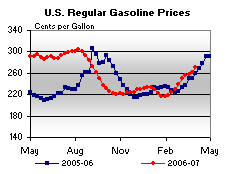
Gasoline prices saw another significant increase for the week of April 2, 2007, jumping 9.7 cents to 270.7 cents per gallon. This is the ninth consecutive week of increases; prices are now 11.9 cents per gallon higher than at this time last year. All regions reported higher prices. East Coast prices were up 9.6 cents to 267.1 cents per gallon, while Midwest prices rose 9.6 cents to 261.4 cents per gallon. The Gulf Coast saw the largest regional increase, with prices up 12.3 cents to 256.5 cents per gallon. In the Rocky Mountains, prices increased 8.1 cents to 261.9 cents per gallon. West Coast prices were up 8.0 cents to 309.6 cents per gallon, with the average price for regular grade in California up 7.6 cents to 322.8 cents per gallon, 48.5 cents per gallon above last year's price.

Here's a chart from the same report. The red line -- which is higher -- represents this years prices.

Photo Sharing and Video Hosting at Photobucket

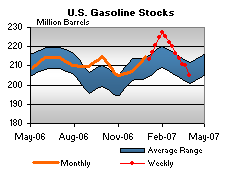
One of the primary reasons for the decease is a declining inventory of gasoline. Here is a chart of gasoline stockpiles represented by the orange line.

Photo Sharing and Video Hosting at Photobucket

So, what does all this mean?

We're probably going to have higher gas prices as the summer progresses. And the higher those prices go, the more likely consumers will pull back on their spending. Considering they are the only economic sector increasing their economic input, their cut backs would not be welcome.

For economic commentary and analysis, go to the Bonddad Blog.

Tuesday, April 3, 2007

Index on Afghanistan: March 2007

Monday, April 02, 2007

by Sarah Meyer

Kandahar Airfield 2002

Civilian murders define this month’s obscenities in Afghanistan but – as in Iraq - the war-mongers insist that ‘progress’ is being made. The Americans do not care about civilians dying either in Iraq or in Afghanistan. From the US perspective, perhaps every civilian killed is a future ‘terrorist.’

Canadian torture and losing prisoners in Afghanistan was under the spotlight this month. A further obscenity was the announcement of NATO racist policies in Kandahar Airbase toilets . Not surprising that Afghans, like Iraqis, don’t want occupation forces in their country?


1. Oil and Gas (Pakistan/Iran /India & Iraq)
2. Strategic Imperatives (Afghanistan, Pakistan, US, Media & Videos)
3. Contracts
4. Contractors
5. Investment and Aid
6. US/NATO (General; missile shield)
7. NATO Participating Countries (Australia, Bulgaria, Canada, Czech Republic, Estonia, Germany, Italy, New Zealand, Poland, South Africa, Sweden, UK
8. Opium
9. Human Rights (‘rendition; torture; Canadian misdemeanors; racism; Rumsfeld in German court case.)
10. Some Deaths (catalogue of civilian deaths; Pat Tillman)
11. Future Deaths
12. Meanwhile, in Iran
13. Meanwhile, in New Orleans

Index Research

--MORE--

Friday, March 30, 2007

George Bush’s Land Mine

March 30, 2007

If the Iraqi People Get Revenue Sharing, They Lose Their Oil to Exxon

by Richard Behan

George Bush has a land mine planted in the supplemental appropriation legislation working its way through Congress.

The Iraq Accountability Act passed by the House and the companion bill passed in the Senate contain deadlines for withdrawing our troops from Iraq, in open defiance of the President’s repeated objections.

He threatens a veto, but he might well be bluffing. Buried deep in the legislation and intentionally obscured is a near-guarantee of success for the Bush Administration’s true objective of the war-capturing Iraq’s oil-and George Bush will not casually forego that.

This bizarre circumstance is the end-game of the brilliant, ever-deceitful maneuvering by the Bush Administration in conducting the entire scenario of the “global war on terror.”

The supplemental appropriation package requires the Iraqi government to meet a series of “benchmarks” President Bush established in his speech to the nation on January 10 (in which he made his case for the “surge”). Most of Mr. Bush’s benchmarks are designed to blame the victim, forcing the Iraqis to solve the problems George Bush himself created.

One of the President’s benchmarks, however, stands apart. This is how the President described it: “To give every Iraqi citizen a stake in the country’s economy, Iraq will pass legislation to share oil revenues among all Iraqis.” A seemingly decent, even noble concession. That’s all Mr. Bush said about that benchmark, but his brevity was gravely misleading, and it had to be intentional.

The Iraqi Parliament has before it today, in fact, a bill called the hydrocarbon law, and it does call for revenue sharing among Sunnis, Shiites, and Kurds. For President Bush, this is a must-have law, and it is the only “benchmark” that truly matters to his Administration.

Yes, revenue sharing is there-essentially in fine print, essentially trivial. The bill is long and complex, it has been years in the making, and its primary purpose is transformational in scope: a radical and wholesale reconstruction-virtual privatization-of the currently nationalized Iraqi oil industry.

If passed, the law will make available to Exxon/Mobil, Chevron/Texaco, BP/Amoco, and Royal Dutch/Shell about 4/5’s of the stupendous petroleum reserves in Iraq. That is the wretched goal of the Bush Administration, and in his speech setting the revenue-sharing “benchmark” Mr. Bush consciously avoided any hint of it.

The legislation pending now in Washington requires the President to certify to Congress by next October that the benchmarks have been met-specifically that the Iraqi hydrocarbon law has been passed. That’s the land mine: he will certify the American and British oil companies have access to Iraqi oil. This is not likely what Congress intended, but it is precisely what Mr. Bush has sought for the better part of six years.

It is why we went to war.

For years President Bush has cloaked his intentions behind the fabricated “Global War on Terrorism.” It has long been suspected that oil drove the wars, but dozens of skilled and determined writers have documented it. It is no longer a matter of suspicion, nor is it speculation now: it is sordid fact. (See a brief summary of the story at http://www.alternet.org/waroniraq/47489/ . )

Planning for the two wars was underway almost immediately upon the Bush Administration taking office–at least six months before September 11, 2001. The wars had nothing to do with terrorism. Terrorism was initially rejected by the new Administration as unworthy of national concern and public policy, but 9/11 gave them a conveniently timed and spectacular alibi to undertake the wars. Quickly inventing a catchy “global war on terror” theme, the Administration disguised the true nature of the wars very cleverly, and with enduring success.

The “global war on terror” is bogus. The prime terrorist in Afghanistan and the architect of 9/11, Osama bin Laden, was never apprehended, and the President’s subsequent indifference is a matter of record. And Iraq harbored no terrorists at all. But both countries were invaded, both countries suffer military occupation today, both are dotted with permanent U.S. military bases protecting the hydrocarbon assets, and both have been provided with puppet governments.

And a billion dollar embassy in Baghdad is under construction now. It will be the largest U.S. embassy in the world by a factor of ten. (To see it, go to http://www.globalresearch.ca/index.php?context=viewArticle&code=20070124&articleId=4579 .) It consists of 21 buildings on 104 acres, six times larger than the United Nations compound in New York city, larger than Vatican City. It will house a delegation of more than five thousand people. It will have its own water, electric, and sewage systems, and it is surrounded by a fortress wall of concrete fifteen feet thick. For an Administration committed to fighting terrorism with armies and bombs, that’s far more anti-terror diplomacy than a tiny country needs. There must be another purpose for it.

In the first two months of the Bush Administration two significant events took place that preordained the Iraqi war. Vice President Cheney’s Energy Task Force was created, composed of federal officials and oil industry people. By March of 2001, half a year before 9/11, the Task Force was poring secretly over maps of the Iraqi oil fields, pipe lines, and tanker terminals. It studied a listing of foreign oil company “suitors” for exploration and development contracts, to be executed with Saddam Hussein’s oil ministry. There was not a single American or British oil company included, and to Mr. Cheney and his cohorts that was intolerable. The final report of the Task Force was candid: “… Middle East oil producers will remain central to world security. The Gulf will be a primary focus of U.S. international energy policy.” The detailed meaning of “focus” was left blank.

The other event was the first meeting of President Bush’s National Security Council, and it filled in the blank. The Council abandoned abruptly the decades-long attempt to resolve the Israeli-Palestinian conflict, and set a new priority for Middle East foreign policy instead: the invasion of Iraq. This, too, was six months before 9/11. “Focus” would mean war.

By the fall of 2002, the White House Iraq Group-a collection not of foreign policy experts but of media and public relations people-was cranking up the marketing campaign for the war. A contract was signed with the Halliburton Corporation-even before military force in Iraq had been authorized by Congress-to organize the suppression of oil well fires, should Saddam torch the fields as he had done in the first Gulf War. Little was left to chance.

The oil industry is the primary client and top-ranked beneficiary of the Bush Administration. There can be no question the Administration intended to secure for American oil corporations the rich petroleum resources of Iraq: 115 billion barrels of proven reserves, twice that in probable and possible resources, potentially far more than Saudi Arabia. The Energy Task Force spoke to this and the National Security Council answered.

A secret NSC memorandum in 2001 spoke candidly of “actions regarding the capture of new and existing oil and gas fields” in Iraq. In 2002 Paul Wolfowitz suggested simply seizing the oil fields. These words and suggestions were draconian, overt, and reprehensible-morally, historically, politically and diplomatically. The seizure of the oil would have to be oblique and far more sophisticated.

A year before the war the State Department undertook the “Future of Iraq” project, expressly to design the institutional contours of the postwar country. The ­­­­­­­­­­­­­­­­­­­­­­­­­­­­­­­­­­­­­­­­­­­­­­­­­­­­­­­­­­­­­­­­­­­­­­­­­­­­­­­­­­­­­­­­­­­­­­­­­­­­­”Oil and Energy Working Group” looked with dismay at the National Iraqi Oil Company, the government agency that owned and operated the Iraqi oil fields and marketed the products. 100% of the revenues went directly to the central government, and constituted about 90% of its income. Saddam Hussein benefited, certainly-his lavish palaces-but the Iraqi people did so to a far greater extent, in terms of the nation’s public services and physical infrastructure. For this reason nationalized oil industries are the norm throughout the world.

The Oil and Energy Working Group designed a scheme that was oblique and sophisticated, indeed. The oil seizure would be less than total. It would be obscured in complexity. The apparent responsibility for it would be shifted, and it would be disguised as benefiting, even necessary to Iraq’s well being. Their work was supremely ingenious, undeniably brilliant.

The plan would keep the National Iraqi Oil Company in place, to continue overseeing the currently producing fields. But those fields represent only 19% of Iraq’s petroleum reserves. The other 81% would be flung open to “investment” by foreign oil interests, and the companies in favored positions today-because of the war and their political connections-are Exxon/Mobil, Chevron/Texaco, BP/Amoco, and Royal Dutch/Shell.

The nationalized industry would be 80% privatized.

The investment vehicle would be the “production sharing agreement,” a long-term contract-up to 40 years-that grants to the company a share of the oil produced; in exchange, the company underwrites the development costs and oilfield infrastructure. Such “investment” is touted by the Bush Administration and its puppets in Iraq as necessary to the country’s recovery, and a huge benefit, accordingly. But it is not unusual for these contracts to grant the companies more than half the profits for the first 15-30 years, and to deny the host country any revenue at all until the investment costs have been recovered.

The Iraqi oil industry does very much need a great deal of investment capital, to repair, replace, and upgrade its infrastructure. But it does not need Exxon/Mobil or any other foreign company to provide it. At a reduced level, Iraq is still producing oil and hence revenue, and no country in the world, perhaps, has better collateral against which to float bond issues for public investment. Privatization of any sort and in any degree is utterly unnecessary in Iraq today.

The features of the State Department plan were inserted by Paul Bremer’s Provisional Coalition Authority into the developing structures of Iraqi governance. American oil companies were omnipresent in Baghdad then and have been since, shaping and shepherding the plan through the several iterations of puppet governments-the “democracy” said to be taking hold in Iraq.

The package today is in the form of draft legislation, the hydrocarbon law. Only a handful of Iraqi officials know its details. Virtually none of them had a hand in its construction. (It was first written in English.) And its exclusive beneficiaries are the American and British oil companies, whose profits will come directly from the pockets of the Iraqi people.

The Iraqi people do, however, benefit to some degree. The seizure is not total. The hydrocarbon law specifies the oil revenues-the residue accruing to Iraq-will be shared equally among the Sunni, Shiite, and Kurdish regions, on a basis of population. This is the feature President Bush relies upon exclusively to justify, to insist on the passage of the hydrocarbon law. His real reasons are Exxon/Mobil, Chevron/Texaco, BP/Amoco, and Royal Dutch/Shell.

No one can say at the moment how much the hydrocarbon law will cost the Iraqi people, but it will be in the hundreds of billions. The circumstances of its passage are mired in the country’s chaos, and its final details are not yet settled. If and when it passes, however, Iraq will orchestrate the foreign capture of its own oil. The ingenious, brilliant seizure of Iraqi oil will be assured.

That outcome has been on the Bush Administration’s agenda since early in 2001, long before terrorism struck in New York and Washington. The Iraqi war has never been about terrorism.

It is blood for oil.

The blood has been spilled already, hugely, criminally. More than 3,200 American military men and women have died in Iraq. 26,500 more have been wounded. But the oil remains in play.

The game will end if the revenue-sharing “benchmark” is fully enforced. The land mine will detonate.

Mission almost accomplished, Mr. President.


Author’s endnote:

This article was written assuming the members of Congress were ignorant, when they passed the supplemental appropriation bills, of the clever origin, the details, and the true beneficiaries of the Iraqi hydrocarbon law. It was written assuming they did not know President Bush’s stated “benchmark” of revenue-sharing was fraudulently incomplete, intentionally obscuring the fully intended seizure, by military force, of Iraqi oil assets.

The Bush Administration made every effort to mislead deliberately both the Congress and the American people. Ignorance of the circumstances was imposed.

If any members of Congress acted with full and complete knowledge, however, then they have become complicit in a criminal war.


Richard W. Behan lives and writes on Lopez Island, off the northwest coast of Washington state. He is working on his next book, To Provide Against Invasions: Corporate Dominion and America’s Derelict Democracy. He can be reached at rwbehan@rockisland.com (This essay
is deliberately not copyrighted: it may be reproduced without restriction.)

George Bush’s Land Mine

March 30, 2007

If the Iraqi People Get Revenue Sharing, They Lose Their Oil to Exxon

by Richard Behan

George Bush has a land mine planted in the supplemental appropriation legislation working its way through Congress.

The Iraq Accountability Act passed by the House and the companion bill passed in the Senate contain deadlines for withdrawing our troops from Iraq, in open defiance of the President’s repeated objections.

He threatens a veto, but he might well be bluffing. Buried deep in the legislation and intentionally obscured is a near-guarantee of success for the Bush Administration’s true objective of the war-capturing Iraq’s oil-and George Bush will not casually forego that.

This bizarre circumstance is the end-game of the brilliant, ever-deceitful maneuvering by the Bush Administration in conducting the entire scenario of the “global war on terror.”

The supplemental appropriation package requires the Iraqi government to meet a series of “benchmarks” President Bush established in his speech to the nation on January 10 (in which he made his case for the “surge”). Most of Mr. Bush’s benchmarks are designed to blame the victim, forcing the Iraqis to solve the problems George Bush himself created.

One of the President’s benchmarks, however, stands apart. This is how the President described it: “To give every Iraqi citizen a stake in the country’s economy, Iraq will pass legislation to share oil revenues among all Iraqis.” A seemingly decent, even noble concession. That’s all Mr. Bush said about that benchmark, but his brevity was gravely misleading, and it had to be intentional.

The Iraqi Parliament has before it today, in fact, a bill called the hydrocarbon law, and it does call for revenue sharing among Sunnis, Shiites, and Kurds. For President Bush, this is a must-have law, and it is the only “benchmark” that truly matters to his Administration.

Yes, revenue sharing is there-essentially in fine print, essentially trivial. The bill is long and complex, it has been years in the making, and its primary purpose is transformational in scope: a radical and wholesale reconstruction-virtual privatization-of the currently nationalized Iraqi oil industry.

If passed, the law will make available to Exxon/Mobil, Chevron/Texaco, BP/Amoco, and Royal Dutch/Shell about 4/5’s of the stupendous petroleum reserves in Iraq. That is the wretched goal of the Bush Administration, and in his speech setting the revenue-sharing “benchmark” Mr. Bush consciously avoided any hint of it.

The legislation pending now in Washington requires the President to certify to Congress by next October that the benchmarks have been met-specifically that the Iraqi hydrocarbon law has been passed. That’s the land mine: he will certify the American and British oil companies have access to Iraqi oil. This is not likely what Congress intended, but it is precisely what Mr. Bush has sought for the better part of six years.

It is why we went to war.

For years President Bush has cloaked his intentions behind the fabricated “Global War on Terrorism.” It has long been suspected that oil drove the wars, but dozens of skilled and determined writers have documented it. It is no longer a matter of suspicion, nor is it speculation now: it is sordid fact. (See a brief summary of the story at http://www.alternet.org/waroniraq/47489/ . )

Planning for the two wars was underway almost immediately upon the Bush Administration taking office–at least six months before September 11, 2001. The wars had nothing to do with terrorism. Terrorism was initially rejected by the new Administration as unworthy of national concern and public policy, but 9/11 gave them a conveniently timed and spectacular alibi to undertake the wars. Quickly inventing a catchy “global war on terror” theme, the Administration disguised the true nature of the wars very cleverly, and with enduring success.

The “global war on terror” is bogus. The prime terrorist in Afghanistan and the architect of 9/11, Osama bin Laden, was never apprehended, and the President’s subsequent indifference is a matter of record. And Iraq harbored no terrorists at all. But both countries were invaded, both countries suffer military occupation today, both are dotted with permanent U.S. military bases protecting the hydrocarbon assets, and both have been provided with puppet governments.

And a billion dollar embassy in Baghdad is under construction now. It will be the largest U.S. embassy in the world by a factor of ten. (To see it, go to http://www.globalresearch.ca/index.php?context=viewArticle&code=20070124&articleId=4579 .) It consists of 21 buildings on 104 acres, six times larger than the United Nations compound in New York city, larger than Vatican City. It will house a delegation of more than five thousand people. It will have its own water, electric, and sewage systems, and it is surrounded by a fortress wall of concrete fifteen feet thick. For an Administration committed to fighting terrorism with armies and bombs, that’s far more anti-terror diplomacy than a tiny country needs. There must be another purpose for it.

In the first two months of the Bush Administration two significant events took place that preordained the Iraqi war. Vice President Cheney’s Energy Task Force was created, composed of federal officials and oil industry people. By March of 2001, half a year before 9/11, the Task Force was poring secretly over maps of the Iraqi oil fields, pipe lines, and tanker terminals. It studied a listing of foreign oil company “suitors” for exploration and development contracts, to be executed with Saddam Hussein’s oil ministry. There was not a single American or British oil company included, and to Mr. Cheney and his cohorts that was intolerable. The final report of the Task Force was candid: “… Middle East oil producers will remain central to world security. The Gulf will be a primary focus of U.S. international energy policy.” The detailed meaning of “focus” was left blank.

The other event was the first meeting of President Bush’s National Security Council, and it filled in the blank. The Council abandoned abruptly the decades-long attempt to resolve the Israeli-Palestinian conflict, and set a new priority for Middle East foreign policy instead: the invasion of Iraq. This, too, was six months before 9/11. “Focus” would mean war.

By the fall of 2002, the White House Iraq Group-a collection not of foreign policy experts but of media and public relations people-was cranking up the marketing campaign for the war. A contract was signed with the Halliburton Corporation-even before military force in Iraq had been authorized by Congress-to organize the suppression of oil well fires, should Saddam torch the fields as he had done in the first Gulf War. Little was left to chance.

The oil industry is the primary client and top-ranked beneficiary of the Bush Administration. There can be no question the Administration intended to secure for American oil corporations the rich petroleum resources of Iraq: 115 billion barrels of proven reserves, twice that in probable and possible resources, potentially far more than Saudi Arabia. The Energy Task Force spoke to this and the National Security Council answered.

A secret NSC memorandum in 2001 spoke candidly of “actions regarding the capture of new and existing oil and gas fields” in Iraq. In 2002 Paul Wolfowitz suggested simply seizing the oil fields. These words and suggestions were draconian, overt, and reprehensible-morally, historically, politically and diplomatically. The seizure of the oil would have to be oblique and far more sophisticated.

A year before the war the State Department undertook the “Future of Iraq” project, expressly to design the institutional contours of the postwar country. The ­­­­­­­­­­­­­­­­­­­­­­­­­­­­­­­­­­­­­­­­­­­­­­­­­­­­­­­­­­­­­­­­­­­­­­­­­­­­­­­­­­­­­­­­­­­­­­­­­­­­­”Oil and Energy Working Group” looked with dismay at the National Iraqi Oil Company, the government agency that owned and operated the Iraqi oil fields and marketed the products. 100% of the revenues went directly to the central government, and constituted about 90% of its income. Saddam Hussein benefited, certainly-his lavish palaces-but the Iraqi people did so to a far greater extent, in terms of the nation’s public services and physical infrastructure. For this reason nationalized oil industries are the norm throughout the world.

The Oil and Energy Working Group designed a scheme that was oblique and sophisticated, indeed. The oil seizure would be less than total. It would be obscured in complexity. The apparent responsibility for it would be shifted, and it would be disguised as benefiting, even necessary to Iraq’s well being. Their work was supremely ingenious, undeniably brilliant.

The plan would keep the National Iraqi Oil Company in place, to continue overseeing the currently producing fields. But those fields represent only 19% of Iraq’s petroleum reserves. The other 81% would be flung open to “investment” by foreign oil interests, and the companies in favored positions today-because of the war and their political connections-are Exxon/Mobil, Chevron/Texaco, BP/Amoco, and Royal Dutch/Shell.

The nationalized industry would be 80% privatized.

The investment vehicle would be the “production sharing agreement,” a long-term contract-up to 40 years-that grants to the company a share of the oil produced; in exchange, the company underwrites the development costs and oilfield infrastructure. Such “investment” is touted by the Bush Administration and its puppets in Iraq as necessary to the country’s recovery, and a huge benefit, accordingly. But it is not unusual for these contracts to grant the companies more than half the profits for the first 15-30 years, and to deny the host country any revenue at all until the investment costs have been recovered.

The Iraqi oil industry does very much need a great deal of investment capital, to repair, replace, and upgrade its infrastructure. But it does not need Exxon/Mobil or any other foreign company to provide it. At a reduced level, Iraq is still producing oil and hence revenue, and no country in the world, perhaps, has better collateral against which to float bond issues for public investment. Privatization of any sort and in any degree is utterly unnecessary in Iraq today.

The features of the State Department plan were inserted by Paul Bremer’s Provisional Coalition Authority into the developing structures of Iraqi governance. American oil companies were omnipresent in Baghdad then and have been since, shaping and shepherding the plan through the several iterations of puppet governments-the “democracy” said to be taking hold in Iraq.

The package today is in the form of draft legislation, the hydrocarbon law. Only a handful of Iraqi officials know its details. Virtually none of them had a hand in its construction. (It was first written in English.) And its exclusive beneficiaries are the American and British oil companies, whose profits will come directly from the pockets of the Iraqi people.

The Iraqi people do, however, benefit to some degree. The seizure is not total. The hydrocarbon law specifies the oil revenues-the residue accruing to Iraq-will be shared equally among the Sunni, Shiite, and Kurdish regions, on a basis of population. This is the feature President Bush relies upon exclusively to justify, to insist on the passage of the hydrocarbon law. His real reasons are Exxon/Mobil, Chevron/Texaco, BP/Amoco, and Royal Dutch/Shell.

No one can say at the moment how much the hydrocarbon law will cost the Iraqi people, but it will be in the hundreds of billions. The circumstances of its passage are mired in the country’s chaos, and its final details are not yet settled. If and when it passes, however, Iraq will orchestrate the foreign capture of its own oil. The ingenious, brilliant seizure of Iraqi oil will be assured.

That outcome has been on the Bush Administration’s agenda since early in 2001, long before terrorism struck in New York and Washington. The Iraqi war has never been about terrorism.

It is blood for oil.

The blood has been spilled already, hugely, criminally. More than 3,200 American military men and women have died in Iraq. 26,500 more have been wounded. But the oil remains in play.

The game will end if the revenue-sharing “benchmark” is fully enforced. The land mine will detonate.

Mission almost accomplished, Mr. President.


Author’s endnote:

This article was written assuming the members of Congress were ignorant, when they passed the supplemental appropriation bills, of the clever origin, the details, and the true beneficiaries of the Iraqi hydrocarbon law. It was written assuming they did not know President Bush’s stated “benchmark” of revenue-sharing was fraudulently incomplete, intentionally obscuring the fully intended seizure, by military force, of Iraqi oil assets.

The Bush Administration made every effort to mislead deliberately both the Congress and the American people. Ignorance of the circumstances was imposed.

If any members of Congress acted with full and complete knowledge, however, then they have become complicit in a criminal war.


Richard W. Behan lives and writes on Lopez Island, off the northwest coast of Washington state. He is working on his next book, To Provide Against Invasions: Corporate Dominion and America’s Derelict Democracy. He can be reached at rwbehan@rockisland.com (This essay
is deliberately not copyrighted: it may be reproduced without restriction.)

Wednesday, March 28, 2007

Big powers jockey for oil in Central Asia

The US, Russia, China, and others have a military or business presence.

The Christian Science Monitor

Here at Dushanbe airport, French Air Force planes sit on the tarmac, their blue, white, and red roundels looking a bit incongruous against the backdrop of the soaring, snowy Pamir Mountains.

A dozen miles away, Indian engineers are quietly reconstructing a former Soviet airfield. In central Tajikistan, Russia maintains a motorized infantry division of 10,000 men at a sprawling outpost, while the US is reportedly training Tajik forces in counterterrorism techniques.

They're all piling into a modern replay of the 19th-century "Great Game," in which the contending Russian and British Empires vied for land and influence amid these same Central Asian desert wastes and towering mountain peaks.

In this round, the main prize is control over pipelines that will deliver an estimated 5 percent of the world's dwindling energy reserves to market. And the players are far more diverse: In addition to the US, China, France, and India, the region's five post-Soviet states are getting into the game, giving the local hazards that stalk them – including faltering authoritarian governments, rising Islamic militancy, and a wave of drug trafficking that originates in the poppy fields of Afghanistan – a new international dimension.

"The game in Central Asia is very much about competition between the powers," says Dmitri Suslov, an expert with the independent Council on Foreign and Defense Policy in Moscow. "But this time the countries of the region are players themselves, using the contradictions between Russia, the US, the European Union, and China for their own benefit. It's becoming very complicated."

It's not only Tajikistan where world powers have taken to flying their flags, especially since the 9/11 attacks focused attention on the dangers of state failure in this volatile region.

In neighboring Kyrgyzstan, gleaming rows of US Air Force KC-135 midair refueling tankers line the airstrip at Manas International Airport; Russia flies Sukhoi-27 fighters from its base at nearby Kant. China is said to be eyeing its own Kyrgyz military presence. And Germany stations 300 troops with helicopters at Termez, in next-door Uzbekistan.

West seeks Russia-free energy

On Tuesday and Wednesday this week, a delegation of European Union officials, led by German Foreign Minister Frank-Walter Steinmeier, is meeting with foreign ministers of five Central Asian states in the Kazakh capital, Astana, to discuss deepening ties. The EU has declared an "Energy Dialogue" with Central Asia a key foreign policy goal, as part of a general effort to wean Europe from a perceived overdependence on Russian supplies. That coincides with US purposes in the region and, experts say, this is the main play to watch as the game develops.

"The Central Asian countries are still very much locked into the Russian pipelines and infrastructure and must sell their oil and gas to world markets on Russian terms," says Ivan Saffranchuk, Moscow director of the independent World Security Institute. "The Western idea is that these countries will have real sovereignty only when they are able to independently sell their resources."

The US strongly backed the recently opened $4 billion Baku-Ceyhan pipeline, which carries Caspian oil to the West without Russian participation. Mr. Suslov says that Washington is urging hydrocarbon-rich Kazakhstan to break free from Russia's grip and build links to the Baku- Ceyhan network. China has recently managed to buy a key Kazakh oil company and in 2005 a 1,000-mile pipeline began carrying Kazakh crude to China. It reportedly has plans to extend the pipeline westward by 2011 to funnel Caspian oil eastward.

Fears of instability, Islamist influence

Two years ago this week a lightning revolution overthrew Kyrgyz President Askar Akayev, and the little mountain state has been mired in unrest ever since. A few weeks later a putative Islamist uprising at Andijon, Uzbekistan, was brutally put down by forces loyal to Uzbek strongman Islam Karimov. That rang alarm bells about the dangers of regionwide destabilization.

"These are very weak states that cannot provide social services or justice to their populations," says Irina Zvigelskaya, a regional expert at the official Institute of Oriental Studies in Moscow. "The Islamists are moving into this vacuum, and creating a real long-term challenge to stability in Central Asia."

Thousands of alleged members of the banned Islamist organization Hizb ut-Tahrir have been arrested in several regional countries in the past two years. Experts say the group, which calls for a single Muslim Caliphate, is increasingly active – particularly in the multiethnic and impoverished Fergana Valley, which spills across the borders of Uzbekistan, Tajikistan, and Kyrgyzstan.

"Hizb ut-Tahrir is a very radical movement, which many people believe has taken root in Uzbekistan and is spreading around the region from there," says Parviz Mullojanov, director of the Public Committee for Democratic Process, a Tajik NGO. He says a combination of poverty, weak government, and huge numbers of young, jobless males in the Fergana have created a perfect storm for Islamist movements. "If economic conditions worsen, this could become the problem of our future," he adds.

Ms. Zvigelskaya cites unofficial studies that indicate drug money could make up a third of local economies. Some experts say there's a danger that drug lords and Muslim militants, who share hostility to state authority, will make common cause to undermine local governments.

"Islamists and drug traffickers are interested in each other's support," says Nur Omarov, a political expert at Bishkek's Slavic University. "Both find it perfectly acceptable to use drugs as a weapon of jihad against the West."

Others blame the West for stimulating Islamic reaction through military operations in Afghanistan and Iraq. "People for whom Islam is the main source of identity find themselves fighting foreign invaders, and of course that strengthens their beliefs and encourages sympathy for them," says Saimodin Dustov, director of the independent Information for Democracy and National Progress Center in Dushanbe.

Russia, leader of the Collective Security Treaty Organization, which includes three regional states, often appears to chafe at the US military presence on former Soviet turf. In July 2005, after the US condemned Uzbekistan's response to the uprising, the Shanghai Cooperation Organization, a six-member group run by Russia and China, issued a declaration that implicitly called for the US to close its Central Asian bases. American forces subsequently were compelled to vacate a sprawling airbase at Karshi-Khanabad in Uzbekistan.

US relations become more complex

Kyrgyzstan, however, is resisting Russian pressure to evict the US from Manas air base, in what experts say is a growing tendency of Central Asian leaders to play the big powers off against each other. "Our president thought about removing [the US base] but gradually realized that its existence is not only in American interests, but in ours too," says Orozbek Moldaliyev, director of the independent Center for Politics, Religion and Security Research in Bishkek, the capital.

The Bush Administration, which may have driven some of the region's authoritarian rulers into Moscow's arms by trumpeting US support for democratization, has lately adopted a more pragmatic stance. Last May, on a trip to Kazakhstan, US Vice President Dick Cheney raised eyebrows in the human rights community by embracing Kazakh strongman Nursultan Nazarbayev – who's been accused of banning opposition parties, fixing elections, and shutting down independent media – calling him "a good friend" and expressing "admiration for all that's been accomplished here in Kazakhstan."

Russian experts say that that, plus warmer ties with Tajik leader Imomali Rakhmon (he recently changed his name from the Russified "Rakhmonov") and optimistic US statements about the prospects for democratic thaw in authoritarian Turkmenistan, make Washington a sharper opponent.

"The region's main threats are state failure and rising Islamism, and both of these demand democratization in the long run," says Suslov. "But as soon as you push for that, you spoil relations with the regional lords and lose leverage. The Americans appear to have taken that on board now, and the game is becoming more sophisticated."

Fred Weir | Correspondent

Monday, March 26, 2007

UN Security Or United Rape?

Related
UNSC: Sanctioning the next war of aggression
Security Council resolution on Iran a grave threat to international peace and security
---
March 26, 2007

By Soraya Sepahpour-Ulrich

We must defend justice with our lives lest we need justice to defend our lives


As I watched Iran being hauled in front of the United Nations ‘Security’ Council, a vivid picture conjured up in my mind – my native country Iran, a vulnerable and defenseless beauty being prepared for violation by brutal savages. As she struggles to defend her honor, no one is prepared to come to her aid, save a few. Even her own children, those raised on her soil hope she will be brutally raped. With lust-filled eyes, they hope to fulfill their ambitions on her ravaged ruins, her broken pride.

Who are these beasts, and what has transformed this United body to such a menace?

The most uninformed among us knows that the United States is dictating the rules at the ‘Security’ Council. The driving force behind the American policy makers’ actions is Israel represented by AIPAC and other Israeli representatives in the United States. However, while Zionism gives motivation to the neo-conservatives in Washington to rape and ravage the Middle-East, Washington stands to benefit from AIPAC’s/Israel’s commands.

Theodor Herzl, witnessing discrimination against Jews in Europe, was convinced that sovereign control over territory would guarantee Jews against discrimination. The location was not important. He sought the support of Europe’s wealthiest Jews to colonize territory. Max Nordau, a close friend of Herzl’s, stated that “we are going to Palestine to extend the moral boundaries of Europe as far as the Euphrates”. Chaim Weizmann’s analogy for the comparison of Arab to Jew was “the desert against civilization”. The attraction of Palestine was its appeal to the colonial powers, specifically Great Britain and the imposition of imperial control such as the British and Dutch East India Companies.

Today, the United States is the colonial power and the major investor in the region. Furthermore, as The Center for Public Integrity has demonstrated, The Carlyle Group profits from government and conflict ; a company that employed some of Washington’s most powerful figures, including former Secretary of State James Baker, former President George H.W. Bush, former Secretary of Defense Frank Carlucci and former FCC Chairman William Kennard, as well as former British Prime Minister John Major – not foregoing the Ladin and Saudi ties. Israel is no longer a nascent state, but en par with the world’s only super power – for not only does it have an arsenal of illegal nuclear warheads and one of the strongest conventional armies, but it has influence over US Congress, and many believe, the White House. Both Israel and the US need stretching room for expansion and more profit. Iran is key, it would appear.

One must surely question why Iran would be shunned by all the ‘Security’ council members. India’s case has demonstrated that non-permanent members are subject to coercion, but what of the permanent members?

France - If Iran’s legitimate rights are recognized, Iran would have to have her wealth returned to her; to the dismay of the Europeans. In 1973 France, Belgium, Spain, and Sweden, formed the joint stock company EURODIF. Sweden withdrew from the project in 1974. In 1975 Sweden’s 10 per cent share in EURODIF went to Iran as a result of an arrangement between France and Iran. The French government subsidiary company Cogema and the Iranian Government established the Sofidif (Société franco–iranienne pour l’enrichissement de l’uranium par diffusion gazeuse) enterprise with 60 per cent and 40 per cent shares, respectively. In turn, Sofidif acquired a 25 per cent share in EURODIF, which gave Iran its 10 per cent share of EURODIFI. In 1974, the Shah lent 1 billion dollars (and another 180 million dollars in 1977) for the construction of the factory, to have the right to buy 10% of the production. Iran remains a shareholder of Eurodif via Sofidif, a Franco-Iranian consortium shareholder which owns 25 % of Eurodif. According to The Wall Street Journal of Dec. 5, 2006, the price of enriched uranium has increased by 800 percent since 2001, and given the recent growing interest in nuclear fuel, and the commitment of suppliers, Eurodif would likely prefer to have Iran sanctioned than recognize her legitimate right. Especially if as before, they are not the ones who have to send soldiers to battlefields.

Bulletin 26 – Dual Use: Avoiding The Nuclear Precipice of the International Network of Engineers and Scientists Against Proliferation not only confirms Iran’s share in Eurodif, but lends legitimacy to her wishes to exercise her inalienable right under Article IV of the NPT to enrich uranium indigenously versus the Russian import due to her past experience with foreign dealings [ ].

It must also be noted that Iran has a stake in the world's biggest open-pit uranium mine in the African state of Namibia where the United States buys its uranium for its nuclear power plants . Much like the 1953 era when the Americans and the British had their eyes on Iran’s precious resources, it would seem that uranium is one more incentive for the violation of Iran.

Russia – John D. Grace describes Russia as an "ally and opponent" of OPEC (the Organization of Petroleum Exporting Countries) and the same for oil consumers -- in other words, it is a "fulcrum." In spite of Grace’s generous description of Russia, it has raised a few eyebrows in Europe when it has cut off energy supplies at will and as a political tool. 6% of the total known oil reserves are in the former Soviet Union . However, as the world’s biggest supplier of natural gas and one of the largest suppliers of oil, it will greatly benefit from high oil prices due to sanctions and unrest in the Persian Gulf. This money-strapped nation was willing to supply Iran not only with enriched uranium, but with surface-to-air missiles. It has decided to halt its cooperation because it understands that conflicts in the Persian Gulf region will double the price of oil – much to its benefit; while at the same time to other Arab countries, much like the US is doing. Additionally, it also realizes that a ‘nuclear accident anywhere is a nuclear accident anywhere’. It could be that Russia has it on good authority that this irrational Administration means to bomb Bushehr . Having weighed the danger of contamination and their surplus profit from an attack on Iran, they opted to vote for the latter.

China - It would seem that with China’s growing appetite for oil, their vote would be illogical. However, China has been making remarkable discoveries of her own. Not only has she found oil deposits in Bohai Bay near Dalian (source – China Newnet), but after two years of exploration, it was publicly reported on March 24th that off the coast of Taiwan huge deposits of natural gas, known as the ‘ice that burns’ and labeled as the energy of the energy source of the future had been discovered. If Taiwan had been an ‘old war relic’ in the past, it makes her a prize worth fighting for. Would this make China sway her vote? Additionally, according to the BBC, China and Venezuela are working on making oil deals that will be mutually beneficial.

And finally, Great Britain. She was the instigator in the 1953 coup against the democratically elected Prime Minister Mossadeq. In a role reversal, it would seem that today, GB is the one who is helping incite war. No doubt with her poor economy, as with the Iraq war, she would be happy with the crumbs off the US table.

What is important to remember is the following:

- It was the United Nations that established the State of Israel in 1948.
- It was the United Nations ‘Security’ Council that stood by idly as Iraq used chemical weapons against Iran for 3 years in violation of the Geneva Conventions.
- It was the United Nations ‘Security’ Council that watched Israel destroy Iraq’s peaceful nuclear technology, passed a resolution, but remained idle as Isarel continued with its path of destruction.
- It was the United Nations ‘Security’ Council that stood by while 500,000 children in Iraq were subjected to malnutrition and death.
- It was the United Nations ‘Security’ Council that stood by and watched America illegally invade Iraq without passing a resolution.
- It was the United Nations ‘Security’ Council that watched the Israelis destroy Lebanon for 33 days with American ammunition. One man at the UN ‘Security’ Council, John Bolton, ruled over the lives and deaths of the Lebanese.
- It was the United Nations ‘Security’ Council that watched Israel raze Palestinian homes over and over again.
- It is the United Nations ‘Security’ Council that is witnessing the starvation of Palestinians people, women and children alike.

And it is the United Nations ‘Security’ Council that is ordering the savage and cruel gang rape of Iran. They have passed resolution to take her defenses away. Under the pretext of her nuclear program, her inalienable right to enrich uranium for energy –Article IV of the NPT, they have passed a resolution that Iran must not have conventional weapons to defend herself when they come to attack her – to ravage her, to take all that is hers and her children’s.

Regardless of race, color, or religion, we are all equal under the law. To repeat a cliché, we are only as strong as the weakest link in the chain – this is humanity’s bond – a bind that if broken with indifference, will cause the demise of civilization as we know it. We must not remain complacent in the face of the insecurity that is about to take place – the UNSC’s violation of Iran. This is not a call for justice for Iran, nor for the children of Iran, but a call to disallow oppression. We must defend justice with our lives, lest one day we be in need of justice to defend our lives.

Four Years of US-Led Occupation of Iraq: Playing the Shi'i-Sunni Divide

March 24, 2007

By K Gajendra Singh


"We could expect an epic battle between Shi'ite extremists backed by Iran, and Sunni extremists aided by al-Qaeda and supporters of the old regime. A contagion of violence could spill out across the country [Iraq] - and in time the entire region could be drawn into the conflict." President George Bush in his State of union address

" Mr Bush looks increasingly like a general who has run out of ideas, troops and hope ." Commented 'The Guardian '


"From inside Pakistan's border to the Mediterranean, almost every land (Muslim ) is in crisis. Suddenly, all the Western talk of a Sunni-Shi'i war looks troublingly real "(one of the many options now on the table. )

US led western talk of a Shi'i-Sunni war looks troublingly real , although the option is now on slow backburner. The policy of divide and rule is as old as the Roman empire – a constant guide to the Christian West and implemented ruthlessly during its colonial onslaught on the rest of the world. Evolution of Western nationalism based on a narrow definition of shared religion , ethnicity , language , culture or history after centuries of religious and ethnic wars was then employed to divide multi religious and pluralistic empires and kingdoms in the East and South during its crusade of colonial wars and expansion, masked as 'civilizing mission ' or 'white man's burden' 'or 'saving the soul' by converting natives to Christianity .Europe and Orthodox Russia became self proclaimed 'Guardians of Christians' or nationalities like Serbs ,Bulgarians, Greeks , Armenians and others to divide and break up the far flung Ottoman empire which had reached right up to the gates of Vienna. Religious 'millets' had full freedom of faith and Christians and Jews dominated trade and industry in the Ottoman empire.

By now it is crystal clear that the George Bush administration and Tony Blair government invaded Iraq on false claims and sheer lies, which now stand totally exposed .The main objective was to capture and exploit Iraqi oil resources , second only to Saudi Arabia and control the energy resources not only in the Middle East but even of the Caspian basin .Middle East history challenged Neo- Cons and other policy planners perhaps believed that a grateful 60% Shi'i majority of Iraq ruled by 25% Sunni elite would be so grateful for 'liberating' them that US corporate interests will have a run of the place .

So from the very beginning as Scott Ritter , a former UN Chief Weapons Inspector for Iraq, revealed after occupying Baghdad and Iraq (Kurdistan in any case has been a US protectorate since the end of 1991 Gulf War), US and allied special forces provided information on dethroned ruling Sunni elite for taking revenge to the Iraqi exiles ,like Ahmet Chelebi, a convicted embezzler , Iyad Allawi , both intelligence assets of CIA , MIV and others , Shi'i outfits like SCIRI and Badr corps nurtured , nursed and financed by Iran ,opportunists ,carpetbaggers and others who rode into Baghdad on US tanks ,helicopters and F-16s. Scott Ritter also revealed that the Ba'athist regime under President Saddam Hussein was quite realistic about West's objectives and had planned Iraqi resistance much before the invasion.

Later ,Washington , London and Tel Aviv also looked at the option of dividing Iraq into Iraqi Kurdistan , with almost half of Iraqi oil wealth ,which being weak would remain subservient to the West. Its oil can be easily sent to the Mediterranean via the Kirkuk Ceyhan pipe line. Perhaps even a defence alliance could be signed with the Kurds. Washington had in fact planned to have an air base in north Iraq on the pretext of saving Kurds from Saddam's forces in 1991, so an anxious Ankara offered its Incirlik airbase for US-UK jets to patrol over Iraq and bomb it at will.

Of course the grateful Shi'is of South Iraq masters of the remaining oil wealth would fall in line .The disenfranchised Sunni rump without any oil as yet, could stew in its own anger . It was most surprising that, Defence Secretary Donald Rumsfeld and others were surprised by the Iraqi resistance , which they first tried to wish away as composed of dead enders ,disgruntled remnants of the old regime and in its last throes in Dick Cheney's famous words. Only if they had read long Iraqi resistance to the British colonial rule in 1920s and 30s who finally got rid of the British and killed the Hashemite ruler foisted on Iraq.

The whole process shows total bankruptcy of those who muscled themselves into White House in 2000 fraudily won elections.They would not even make good corporate takeover artists unless it was by force .They could learn a lesson or two in takeovers from the new boys on the block say India's Laxmi Mittal. How he overcame European prejudices and courted the share holders to emerge as the biggest steel producer in the world .Or the House of Tatas , who took over steel conglomerate Corus.

Kemal Ataturk , who forged a modern Turkish state from the ruins of the Ottoman Empire ,had talked of Turks , Kurds and others in his new Republic but then declared Kurds non-persons perhaps to counteract British machinations and inspired Kurdish rebellions .The British led Allies had imposed the Sevres Treaty on a supine Caliph ( like imposing the Constitution in Iraq and the effort to pass the new oil law to deprive Iraqis of their national wealth ) Ataturk expelled the Greek invaders and other allied occupation forces trashing the Sevres treaty .He then adopted the western model of secular and unitary Turkish nation state.

The continued divisions in and exploitation of the Arabs and Kurdish problems in the region are the consequences of British policy of divide and rule after the First world war , now being pursued by USA. Like the British then ,now George Bush never tires of bringing liberty and democracy to the Arabs .Pentagon even called US led illegal naked 'shock and awe ' invasion of Iraq as 'Operation Iraqi Freedom '- some cheek .Whose intelligence are they insulting ?Their own as no one believed them except the info-challenged Americans .And even they have wised up.

Established to cut into the profitable East Indies trade on silk rotes controlled by Arabs and Turks ,the British East India company ( and others in Europe ) ,having explored new sea routes , first nibbled at the decrepit Moghul empire piece meal and after the Indian war of independence against the English company forces in 1957, most of the Moghul empire passed on to the British crown . In the wake of the rebellion and resistance the citizens of Delhi , specially Muslims ,were treated like those of Fallujah , Tel Afar and Haditha, as in Iraq now. It must be remembered that Marathas , Rajputs, Jats and other Hindu kings , who ruled almost independent fiefs accepted the Moghul emperor in Delhi as their sovereign, before he was exiled by the British.

British historians and colonial rulers then successfully sold the theory to Brahmin and other upper castes Hindus that all their problems could be traced to the rule of Muslims .At least like Hindu Aryans and others from central Asia earlier , Muslims from Turkestan and elsewhere made Hindustan their home. When the European traders arrived in the subcontinent, Hindustan's share in world manufacturing was 24.5 percent (in 1750) and after the British had done with India, the sub-continent's share had fallen to 1.7 percent (in 1900) and that of Britain had increased from 1.9 percent (in 1750) to 22.9 percent (in 1880) - Rise and fall of Big Powers by Professor Paul Kennedy) In these bald figures lie buried multiple famines and deaths of tens of millions of impoverished Indians , when the British exported the food even in times of scarcity. It left the people of Hindustan degraded with deficit not only in calories but proteins and physically dwarfed .After 60 years of freedom and no famines Indians have partially recovered their physical well being and are surging ahead economically and intellectually.( How they dominate the Silicon valley in USA)

After the second world war, the British realized that there was no option but to quit the subcontinent .But India being a vital strategic asset,– "a base for Britain to continue their domination of the Indian Ocean and the oil-rich Persian Gulf with its wells of power," it was partitioned ,as Mahatma Gandhi opposed to violence and war in principle and Jawaharlal Nehru with his idealism and vision of spreading friendship and understanding among colonized and exploited people of Asia , Africa , Middle east and elsewhere , would not join Western military pacts . The aim was to retain parts in the North and West of India, "for defensive and offensive action against the USSR in any future dispensation in the sub-continent".

A retired Indian diplomat has brought to light these British machinations, based on records in London in his book , 'The Shadow of the Great Game: The Untold Story of India's Partition.' The author also traces the roots of the present Kashmir imbroglio and how the matter was distorted in the UN to help Western ally Pakistan.( Like UN resolutions now against Iran for its enrichment of nuclear power fuel ) But Pakistan President Gen Pervez Musharraf and Islamabad now hover between the deep sea and the devil ie threat to be bombed back to stone age or a civil war between its troops and Pushtoons and other fierce tribes in its north west region and Afghanistan ,if they do not obey US dictates.

Following the second world war President Marshal Joseph Tito created a composite secular and socialist state of southern Slavs and others in Yugoslavia , with natural affinity to Orthodox Russian Slavs , but after his death and the collapse of the Soviet Union , the multi-religious, multi-ethnic and multilingual state was broken apart by West Europe and USA, by sheer aggression .The last word in this bloody dissolution is yet to be written , now centred in Kosovo ,where north European diplomats have ruled as in old colonial era .

When the fulcrum of imperialism shifted from London to Washington and New York after the second world war , exploitation of the East and South was continued through IMF , IBRD and now after the fall of the Berlin Wall by Globalisation and WTO , with struggle over control over energy pipelines instead of over sea trade routes earlier. Western troops would now guard the energy pipelines , like the Baku-Tbilisi- Ceyhan one.

Four years of US led occupation of Iraq;

'After centuries of vibrant interaction, of marrying, sharing and selling across sects and classes, Baghdad has become a capital of corrosive, violent borderlines. Streets never crossed. Conversations never broached. Doors never entered.

"Sunnis and Shiites in many professions now interact almost exclusively with colleagues of the same sect. Sunnis say they are afraid to visit hospitals because Shiites loyal to the cleric Moktada al-Sadr run the Health Ministry, while Shiite laborers who used to climb into the back of pickup trucks for work across the Tigris River in Sunni western Baghdad now take jobs only near home. Baghdad is increasingly looking like Sarajevo in the 1990s", said Damien Cave in International Herald Tribune in early March.

Real violence and fear has led to internal migrations .Displaced Sunnis push out Shias, who in turn push out the Sunnis in their areas. While three million have been internally displaced ,almost 2 million have left Iraq to live in Syria, Jordan and elsewhere, USA the creator of the biggest refugee crisis in the middle East since the creation of Israel , has accepted few. The displacement is carried out by attacking a mosque or a grenade is thrown at a house, men kidnapped and killed, a few houses burnt - the message is clear - get out. Then there are instances of rapes of women of one community by another .It is the same pattern of killings and migration as after India's partition in 1947 or break up of Yugoslavia in early 1990s. The Kangroo Court trial of President Saddam Hussein and other Baathist leaders against international law and outcry from the world and his lynching under US occupation and watch clearly are intended to inflame Shia-Sunni hatred and conflagration .

Who is responsible for this civil war and Shia and Sunni conflict. If you watch CNN or other US Channels and even BBC or glance through western media , the emphasis is on Iraqis on Iraqis. They do not deserve democracy .Just more lies and spins

Those who believe so might ponder that if some rampaging and barbaric 'extra-territorials '(ETs) were to invade America and by their superior destructive power nuke a major city , threaten others and then enforce ' equity and justice' and weighted elections and more rights to the Blacks and Hispanics to compensate for their past inhuman treatment and exploitation .What would be the reaction of these anger seething communities against Jewish and white Anglo-Saxon Protestant (Wasp) ruling oligarchy . After all, are not US allies only doing something like that for the historically oppressed Shia and Kurdish populations of Iraq. But producing terrible results .Even those Iraqis who were misguided into believing Western propaganda and US promises in 2003 now say that they were much better off under Saddam Hussein, even those who were jailed and their family members killed or even tortured.

Middle East Quagmire !


No wonder Patrick Cockburn said in Counterpunch last month , "The U.S. has a very weird policy--the Shia and Iran are the enemy, suddenly. But the government of Iraq is Shia--it's led by the Shia and the Kurds. Bush seems to be trying to create a common front of Sunni states--Egypt, Saudi Arabia, Jordan--against the Shia and Iran."

A fascinating revelation concerns the 'disappearance' of billions of US dollars in Iraq to create "pots of black money" for covert purposes - with echoes of the Iran-Contra scandal of the Reagan presidency in the 1980s. And even help Fuad Siniora's beleaguered pro-western government in Beirut "to enhance the Sunni capability to resist Shia (Hezbollah and Amal ) influence" by funding Sunni radical groups with ideological ties to al-Qaeda. Walid Jumblatt, the anti-Hezbollah Lebanese Druze leader, was quoted telling Cheney to support the banned Syrian Muslim Brotherhood and undermine the Bashar Assad regime in Damascus.

Seymour Hersh revealed last month that US military and special operations teams have escalated activities in Iran, entering from Iraq to gather intelligence etc, confirming allegations made by Tehran. Iran has accused the US, Britain and Israel of fomenting separatist attacks in Arab-majority Khuzestan in the south-west of Iran, in Baluchi province bordering Pakistan and in Azeri and Kurdish border regions.

In Riyadh, the emergence of a "Shia crescent" from Tehran to Damascus and Hezbollah in Lebanon ( and Hamas in Palestine) raises the nightmare of a shift in the balance of power not only in the Arab world but also in the Middle East and beyond "That Iran should control Lebanon through Hezbollah is a red line that Arabia cannot accept," say Saudi officials .This was also echoed by Hashemite King Abdullah II of Jordan and President Hosni Mubarak of Egypt at the time of the Israeli/Hezbollah war last year .Hezbollah's victory and crescendo of popularity for Hezbollah leader Hasan Nasrallah and Mahmud Ahmedineijad caused fears of Arab street turning against the conservative and unpopular Sunni rulers in the region .

The warm reception and contracts for economic and even defence cooperation during Russian President Vladimir Putin's visit to Riyadh ( and Doha and Amman) last month is another card Riyadh with its cheque book diplomacy would play .Tehran needs Russian support and good will for its nuclear power plants and the Uranium fuel enrichment issue in UN and arms supply , specially missiles to defend itself .To begin with Moscow might use it to expedite payments for the nuclear power plant under construction and making itself indispensable to the US led West in the UN Secrity Council . As usual the notorious New York Times tried misinformation ie that Moscow is with Washington on the enrichment issue. Russia denied these reports .China is deeply interested in Iran's stability and development for its energy needs .

In the Shia-Sunni stand off being promoted by the West , aging King Abdullah is cautious but younger princes are pushing him to adopt "a more aggressive posture." All are agreed that Iran's influence will increase while over time the American presence and 'protection' will diminish. The King sent his hot headed nephew Prince Bandar to Tehran many times in recent months for discussions with his counterpart ,Iran's National Security Adviser Ali Larijani before Ahmadinejad visited Riyadh. "We know about your clandestine activities in Iraq; it's time to put an end to them," the Saudis tell Iran, "otherwise, we'll react" by helping Sunni groups confront the "Shia death squads". This was made public last November in the Washington Post oped , by Nawaf Obaid, who then was dismissed from his post of advisor at the Saudi Embassy in Washington. Saudis tell the Americans "Don't leave Iraq; we'll suffer the consequences." The Saud dynasty is worried .

There is little doubt that Saudis , certainly the rich ones are privately financing armed Iraqi groups. But if Iraq falls apart, anything is possible. One "worst case scenario": is Shia region in the south ( rich in oil ) tries for autonomy with Iran's help; al-Qaeda and the Sunnis join in , and the civil war becomes an all-out conflagration. And what about repressed and restive Shias in adjoining oil rich areas of Saudi Arabia itself .Then "the Saudi government would have a hard time convincing the Sunni tribes in the North - which stretch into Iraq - to not go to the armed defense of their cousins on the other side of the border," acknowledges a European diplomat in Saudi Arabia, who adds: "The greatest danger to the Saudis is to see certain Iraqi Sunni tribes at their borders rally to the cause of al-Qaeda," which has been responsible for numerous attacks in the Kingdom itself.

Some in Riyadh suggest inviting Grand Ayatollah Ali Sistani, the top Iraqi cleric and make some concessions ( financial) to Iraq and overtures to Tehran. Inviting Ahmadinejad was one such step. But say the Saudi hardliners "What good is it to negotiate with Ahmadinejad, when the real power in Tehran is in the hands of the Guide and the pasdarans."

Iran- Saudi Summit in Riyadh

It was to bridge the Shia-Sunni confrontation that the first official visit to Riyadh of Iranian President Ahmadinejad came about after months of diplomatic efforts to ease the political standoff in Lebanon between Hezbollah, backed by Iran and Syria, and the government of Fouad Siniora, supported by the United States, France and Saudi Arabia and other Sunni regimes.

Earlier, to counter Tehran's growing influence in the region, Riyadh hosted the warring Palestinian factions, Hamas and Fateh, in Mecca to resolve their differences and to reach an agreement on the formation of a government of national unity ,which has since been done.

Both sides want to calm the sectarian violence in Iraq .Riyadh certainly does .But did they discuss frankly US efforts to exploit the Shia-Sunni divide.

Skeptics point out the absence of any tangible resolutions or initiatives after the visit. But at least the ice was broken. "The two parties have agreed to stop any attempt aimed at spreading sectarian strife in the region," Saudi Foreign Minister Prince Saud al- Faisal, told Reuters.

"Both Iran and Saudi Arabia are aware of the enemies' conspiracies," Ahmadinejad put it more colorfully . "We decided to take measures to confront such plots, and hopefully this will strengthen Muslim countries against oppressive pressures by the Imperialist front."

Saudis did not comment on this, instead official Saudi Press Agency claimed that Iran expressed support for the Saudi proposal based on land-for-peace which would lead to Arab states recognizing Israel in return for a Palestinian state in the lands occupied by Israel since 1967.Tehran even denied that the proposal was even discussed.

The Sunni-Shi'i Divide;

It is necessary to look at the historic Shi'i-Sunni divide in depth to comprehend the problem and the inherent dangers .Not only Christians , even many Sunnis know little about Shi'is and their history.

The fissures in Islam are almost as old as the faith itself. In the Muslim community (Ummah) of over a billion faithfuls spread almost all around the world nearly 12 % are Shias. Majority of Shias are Twelvers – believers in 12 Imams (as in Iran, in a majority ), but there are others too, like the Ismailis (of Agha Khans, Mohammed Ali Jinnah), from whom emerged the "Assassins" in early 2 nd millennium, Alevis in Turkey (around 15%), ruling Alawite elite ( 12%) in Syria, Hezbollah and Amal in Lebanon( over 40%), and Bahrain ( perhaps a majority), Kuwait , UAE, Saudi Arabia , Pakistan . In Iraq nearly 60% of its population are Shias, the rest are mostly Sunnis.There are some very extremist groups too , spread all over the Islamic world.

India has a large Shia population of about 25 million in a total Muslim population of 130 million, making it perhaps the 2 nd largest Shia community in the world after Iran. After the US attacks in Najaf in 2004, Muslims of Lucknow ( India ) , a big Shia centre ,had declared that Americans were not welcome there.

Tangled Sunni-Shi'i history ;

The Shias emerged out of seeds of disunity in the embryonic Muslim Ummah , sown as soon as Prophet Mohammed lay dead in Medina. While his cousin and son in law Ali and the family were preparing the body for the burial, another clan of the Quraysh tribe elected Abu Bakr as the first Caliph ie Prophet's deputy, countering also the claims of Ansars of Medina, who had welcomed the Prophet (in Hijra) .Abu Bakr's supporters claimed that he was closer to Mohammed, one of the very first converts to Islam and was from Mecca's Quraysh tribe. His daughter A'isha was wedded to the Prophet.

According to Shias, Prophet Mohammed had given enough indications for Ali to be his successor and cite many hadiths in support of this claim. The Prophet had lived with his uncle Abu Talib, Ali's father and Mohammed's only child Fatimah was married to Ali .Ali also became Muslim before Abu Bakr and had decoyed for the Prophet when he escaped from Mecca .Ali was perhaps his most trusted and the closest companion, even though he was much younger than the Prophet.

Ali's election as the Caliph would have denied a chance to the older generation of power brokers, so they played politics and got their way. Ali was overlooked twice with Omar and Uthman succeeding Abu Bakr in cleverly manipulated successions to keep Ali out. As a result Ali mostly kept to himself and stayed aloof.

Following the murder of Uthman, Ali was invited by the Muslims of Medina to accept the Caliphate; reluctantly, he agreed but only after long hesitation. His brief reign was marked by problems of inheriting a corrupt state, as the Quran and the traditions of Mohammed had been neglected .Ali based his rule on the Islamic ideals of social justice and equality which clashed with the interests of the Quraysh aristocracy of Mecca grown rich through the Muslim conquests. A rebellion was instigated against him .Ali was victorious in many wars, but was trapped into an arbitration. He was assassinated by a Kharijite and Mu'awiya of the Umayyads established the dynasty at Damascus.

Ali was a devout Muslim with an outstanding reputation for justice, unlike Uthman or the Umayyad dynasty that followed him, mired in nepotism with worldly and autocratic ways. Many Muslims feel this way about the Umayyad Caliphs except for Omar II. To many it was a betrayal of the Quran, which enjoins creation of a just and equal society as the first duty of Muslims.

Those opposed to Umayyads called themselves the Shia't-Ali (partisans of Ali) and developed a doctrine of piety and protest, refusing to accept the Umayyad Caliphs, and regarded Ali's descendants as the true leaders of the Muslim community. This schism became an unbridgeable chasm and remains so, when in 680, Shias of Kufa called for the rule by Ali's second son Hussein and invited him. Hussein set out for Iraq with a small band of relatives and followers (72 armed men and women and children) in the belief that the spectacle of the Prophet's family, marching to confront the Caliph, would remind the regime of its social responsibility.

But Umayyad Caliph Yazid dispatched his army, which slaughtered Hussein and most of his followers on the plain of Karbala with Imam Hussein being the last to die, holding his infant son in his arms. This event is now commemorated as Muharram. Both Karbala and Najaf, where Imam Ali is buried are very holy places specially for Shias.

For Shias, the Karbala tragedy symbolizes the chronic injustice that pervades human life. Shia Islam provides spiritual solace and shelter for the poorest and the deprived among the Muslims, as in as- Sadr city in Baghdad and elsewhere in the Muslim world. In almost all Sunni majority countries Shias are ill treated and persecuted.

Imagery and this Shia passion informed Khomeini's Iranian revolution, which many experienced as a re-enactment of Karbala - with the Shah Reza Pehlavi cast as a latter day Yazid.

There is no agreement among Muslims on the Caliphs. Shias do not recognise the first three and in many places curse them. For them Ali is the first rightful Caliph and the Imam. For Sunnis, Imam is only a prayer leader and could be any one. But for Shias, he is a spiritual leader with the divine spark and juris-consult (Vilayet-el-Faqih) .The sacred Islamic law Sharia enacted under different situations and times has many schools among Sunnis, who unlike the Shias have closed ijtihad, independent reasoning in Islamic Law to meet new situations .The Shia Iranians (Aryans) perhaps created the office of Imam (like Shankaracharya among Indo –Aryan Brahmins) as only an Arab from the Quraysh tribe could become a Caliph. Later the Turks, who came as slaves or warriors to the Arab lands, captured power by the sword and raised the minor office of the Sultan to a powerful one, by now protector of a hapless Caliph. Then Turkish Ottoman Sultans in Istanbul appropriated the title of Caliph for themselves.

After the first dynastic Umayyad Caliphate based in Damascus ended, another branch of Quraysh tribe, Abbasids took over and shifted to Iraq in 750, but after having made false promises of installing the Prophet's family as the Caliph. Muslim Ummah's unity under the Sunni Caliph was finally broken when Fatimids anointed their own Caliph first in Tunisia, then in Egypt in 10 th century. So an Umayyad prince in Cordoba too declared himself the third Caliph.

Evolution of Shiism:

There are two things to note. First, political Shi'ism indicates a belief that members of the Hashim clan in the Quraysh tribe are the people most worthy of holding political authority in the Islamic community, but has no belief in any particular religious position for the family. As for religious Shi'ism, it is about the belief that some particular members of the house of Hashim were in receipt of divine inspiration and are thus the channel of God's guidance to men whether or not they hold any defacto political authority. This view was augmented by the Iranians who believe in the tradition that the mother of fourth Imam Zaynul- Abdin was Shahrbanu, the daughter of Yazdigird, the last Sasanian King of Iran.

From the very beginning all the Shia Imams, descendants of Ali, every single one was imprisoned, exiled or executed or poisoned by the Caliphs, who could not tolerate an alternative centre to their rule. So by 8 th century, most Shias held aloof from politics and concentrated on the mystical interpretation of the scriptures. Says scholar Karen Armstrong " Long before western philosophers called for the separation of church and state, Shias had privatised faith, convinced that it was impossible to integrate the religious imperative with the grim world of politics that seemed murderously antagonistic to it. --

"The separation of religion and politics remains deeply embedded in the Shia psyche. It springs not simply from malaise, but from a divine discontent with the state of the Muslim community. Even in Iran, which became a Shia country in the early 16th century, the ulema (the religious scholars) refused public office, adopted an oppositional stance to the state, and formed an alternative establishment that - implicitly or explicitly - challenged the Shahs on behalf of the people."

The picture of early Shi'ism was created (as not much is available from records) from the point of view of Twelver Shias, ignoring the Ismailis, Mutazilites or orthodox Sunnis. Modern scholars believe that this picture was retrospectively imposed over the facts by historians of 3 rd and 4th Islamic century for doctrinal reasons.

It is only after 6th Imam Jafar as-Sadiq (died 765) that there is any firm evidence that any kind of religious leadership was being claimed for Twelver Imams. He was a well-known and influential figure in the Islamic world. Several of his students later became prominent jurists and traditionalists even among non-Shia Muslims. Jafar a s-Sadiq did not make an open claim to religious leadership, but his circle of students evidently looked to him as Imam, including some leading figures such as Abu'l-Khattab, who held beliefs of a ghuluww (extremist) nature regarding him, indicating that as-Sadiq was a focus of religious speculation and leadership in his own time.

Emergence of Islamic Schools of Thought, Like Shia and Others:

The number of ghulat groups, increased dramatically especially in Kufa during as-Sadiq's lifetime. It is therefore useful to consider the origin of the ghulat. When the Arabs arrived in the Fertile Crescent, they encountered ancient civilisations with sophisticated religious systems. Iraq was already the centre of intense religious ferment with the ancient Babylonian religious systems, Zoroastrianism, Mazdaism, Manichaeism, Judaism and various forms of Christianity contributing to a kaleidoscope of religious view points, debates and speculation. Islam by comparison was as yet simple and undeveloped. And with the Prophet already dead, there was no one to whom the Muslims could turn for an authoritative ruling on sophisticated religious speculations being posed by the ancient civilisations. There arose a ferment of discussion around some of the concepts introduced by these older religions and philosophical systems.

In the initial years the Arabs lived in their military camp cities and avoided intermingling with the native populations and their disturbing religious speculations but as more of the native populations embraced Islam, such discussions increased. In this spiritual and religious ferment ideas were injected into the Muslim community and intensively discussed by people interested in such matters which could be considered by the majority of Muslims heterodox concepts and called ghulat or extremists.

Among the ideas injected were such concepts as tanasukh (transmigration of souls), ghayba (occultation), raj'a (return), hulul (descent of the Spirit of God into man), imama (Imamate, divinely-inspired leadership and guidance), tashbih (anthropomorphism with respect to God), tafwid (delegation of God's powers to other than God), and bada (alteration in God's will). But the ghulat needed a priest- god figure onto which to project their ideas of hulul, ghayba , etc., a role admirably suited to the persona of' Ali.

While the ghulat adopted Ali and his family as the embodiment of their religious speculation the Shias of' Ali always looked on the ghulat with a certain amount of suspicion. However, the martyrdom of Hussein and the pathos of this event gave the family of Ali a cultic significance. It bestowed on Shias, earlier primarily a political party, a thrust into a religious orientation directing it firmly towards the ghulat, and giving the ghulat milieu a hero-martyr and a priestly family with which they could associate much of their speculations.

Can OIC counter the Western game!

Muslims now gather under the umbrella of Organisation of Islamic Conferences (OIC), Munazamat al-Mutamir al-Islami, to give its full Arabic name, which was institutionalized in 1971 by the Saudis, following the summits of Muslim heads of state and government in 1969, after the fire in the al-Aqsa mosque in Jerusalem, the third most revered Islamic site after Mecca and Medina.

The OIC aims to promote Islamic solidarity by coordinating social, economic, scientific and cultural activities. It is also pledged to eliminate racial segregation and discrimination. Unfortunately, it has not evolved into a responsible and creative body. A main reason for the failure is the location of OIC offices in Jeddah, with Saudi Arabia mostly funding it, and in league with conservative Wahabi elements finances madrassas (religious schools) and fundamentalist organizations not only in non-Muslim but even in Muslim countries.

Many countries like Egypt, Algeria and many in Central Asia and elsewhere are victims of fundamentalist violence incubated and unleashed from the Afghanistan-Pakistan region, a monster financially supported and created in the 1980s by Kingdoms and Sheikhdoms in the Persian Gulf, with full financial and other support from US led West and even China ,until September 11, when the majority of the hijackers turned out to be of Saudi origin.

The OIC has had little autonomy as the secretary generals were more or less paid employees of Saudi Arabia. Some of them were obscure and not well regarded scholars, which greatly diminished the OIC's objectivity and credibility. Any debate on matters of substance is almost impossible at OIC meetings. Member countries bring chits of paper with grouses against non- Muslims, mostly neighbors, which without any discussion, as is the practice back home, are then put together as final resolutions. Unfortunately, many in the leadership use OIC meetings to let off steam against non-Muslims, which serves like a group therapy session. It brings a sense of wellbeing to many beleaguered regimes; venal, brutal and exploitative back home. The leaders go back flourishing a resolution or two to show to their oppressed masses, hoping that the real problems will be forgotten.

Many members have been accused of conspiring against each other and fought wars with each other. Many OIC members and diplomats from secular countries like Turkey, Syria, Algeria and others feel uncomfortable in the company of delegates from obscurantist regimes. The OIC also speaks on behalf of large Muslim populations in Russia and China, and many other millions in Germany, France, the United Kingdom and the US, which has 3 to 5 million Muslims but says little about the conditions of Muslims in these countries. Saudi Arabia used OIC for maintaining its influence by promoting fundamentalism in other countries and generally keeping the Muslims conservative and backward.

Very little is naturally said in OIC resolutions about Turkey , where democracy is shored up by its secular military, which has dismissed Islamist-led coalition governments, closed Islamic parties and even jailed its leadership, till Islamic oriented AKP won two-third seats in the parliament in 2002 albeit with only 36% votes . There has been discrimination and persecution of Kurds in Turkey, Over 37,000 people, including 5,000 soldiers, have been killed in a rebellion by Kurdish Labour Party (PKK). Until a few decades ago the Kurds had to be called mountain Turks, and could not use Kurdish for education or in the media. From time to time, Turkey's Shia Alevis have to be protected against persecution and pogroms by the Sunni establishment by the secular armed forces and the judiciary.

The OIC should set its house in order and look at the grievances of Kurds in Turkey , Mohajirs , Shias and others in Pakistan, Christians in Lebanon or South Sudan or the perpetually persecuted Copts of Egypt, or suppressed Shia community in Saudi Arabia , to be taken seriously.

In Cyprus, 18 percent Turkish Cypriot Muslims, recognized as an independent state only by Turkey, has occupied nearly 40 percent of its territory under Turkish guns since 1974. They cannot live with Christian Greek Cypriots, and want a separate state, while almost 50 percent Christian Lebanese who wish forr a state of their own are denied one. There are innumerable such examples all over the Islamic world. Throughout history, Christian and other minorities in Islamic states have been generally oppressed, persecuted and eliminated, beginning with the Jews of Medina in the 7th century.

But then how can any one in OIC anything against USA, which in return for exploitation of Arab oil wealth for decades protects the Saudi dynasty , which itself has a nexus with Wahabbi form of austere and early form of Islam.

OIC has failed to live up to its potential. It is not even all inclusive; it has given Observer status to Russia with 15 millions of Muslims but not to 130 Million Muslims of India, on whose behalf it has the temerity to speak .In spite of Gujarat and Babri Masjid riots ,as a minority ,Muslims exercise real democratic power in Indian democracy , leading to the shrinking role of the rightist Hindutva party. Sectarian or other minorities do not enjoy empowerment in most Muslim countries .In many ways OIC has became a tool for Pakistani propaganda against India , creating a schism between Muslims and Hindus ,a combined population of over two billion , still exploited by the West. Some of the OIC members should look themselves in the mirror before criticising the treatment of Muslims in the West and elsewhere.

Conclusions;


The latest poll on Iraq , rightly finds Iraqis pessimistic at what is being done to them under US led barbaric occupation .It might indicate that they feel that the country is not in a civil war and would remain united after having been a nation for 8 decades .In early 1990s most Yugoslav diplomats said that the country will remain united , mentioning inter ethnic and religious marriages .Many Hindus and Muslims in Hindustan who had lived as neighbours since centuries insisted on staying put after the announcement of the partition , but had to flee when the communal carnage
started. US-led West having failed in its objective of colonizing the proud Iraqi people has done all it could to ignite the historic Shia Sunni schism represented by the political centres of Riyadh and Tehran.

Only the hubris laden arrogance of military power US which spends as much as the rest of the world put together on defence , now mostly financed by trade deficit , made the crazy Neo-cons and former scheming and manipulative CEOs like Dick Cheney and Donald Rumsfeld believe in being received with flowers in Baghdad. What does Washington mean when it demands that Tehran and Damascus must help stabilize Iraq ie get US out of Iraqi quagmire , so that US can then bring about regime changes there!

I wrote in my article " Occupation case studies: Algeria and Turkey' of 7 January , 2004, that "while formulating foreign policy options, political leaders also look to history for guidance. Unfortunately, the United State's history is only two centuries old, and to meet the challenge of terrorism, Frankenstein monsters partly of its own creation, the mujahideen, jihadis, the Taliban and al-Qaeda , the US can only recall a long genocidal war against its native Americans.

"Those who resisted were called "terrorists" for defending their native land and way of life against foreign invaders. There are Hollywood films galore that depict the "American Indians" as savages to be hunted down by the US cavalry. The same cavalry units now force Iraqis daily to lie face down in the land of their ancestors and describe those fighting to free their country from the occupying forces as "terrorists". The Iraqis, other Arabs and Iranians are the new "American Indians", and those who collaborate with the Bush administration are like the good Indians who helped the Americans fight and defeat bad Indians
."
In my article of 15 July, 2003 "Iraq's history already written " I said " US chief administrator L Paul Bremer unveiled Iraq's 25-member governing council in Baghdad on Sunday. It now looks like the beginnings of the rule by the British Governor Sir Percy Cox in the 1920s, after the British had carved out three
provinces of the Ottoman empire after its collapse in World War I. After a long national resistance, King Faisal II - of a British-appointed dynasty - and his prime minister, Nuri Al-Said, were overthrown and killed in a 1958 military takeover "


When George Bush along with old chieftains from his father's era and the Neo-cons were beginning to beat the war drums, my article of 27 August, 2002 "
The Bush family's phony wars ' was introduced by Asia Times Editor " An entire region from Jordan to Iran is on the brink of catastrophe as it awaits one man's
decision on how he will pursue his family' vendetta .India's former Ambassador to Jordan looks inside the Pandora's box which George Bush holds in his hands '


Another article of 14 February , 2003 ,' Iraq ;the Middle East kaleidoscope', had warned that Iraq must be handled carefully, -- When a post-Saddam Iraq is discussed in the US, generally not enough thought is given to the ethnic, religious and other differences of the constituents and their tortuous history that make the country the delicate kaleidoscope that it is."

Ambassador Peter Galbraith revealed that in January 2003, two months before the invasion of Iraq, Bush had not yet heard of the Sunni-Shia divide within Islam.

"Today the world faces a single man armed with weapons of mass destruction, manifesting an aggressive, bullying attitude, who may well plunge the world into chaos and bloodshed if he miscalculates. This person, belligerent, arrogant, and sure of himself, truly is the most dangerous person on Earth. The problem is that his name is George W. Bush, and he is our president: " said Yale Law Prof Jack M. Balkin, on September 22, 2002.

There were many learned men and objective experts and analysts in USA, with understanding of history including of the Middle East and ramifications of a real war, in many of its universities , even in the State Department , but they were never consulted by the White House or asked for comments by corporate news networks like CNN and others .The rot in US polity has gone too deep down and become too pervasive .Only a massive restructuring of its polity can save it from a deadly fall as the decline is irreversible. The malaise covers the whole gamut of US way of life, irreverence for its Constitution, electoral law ,its Judiciary, total and absolute domination of money power of military –industry , energy and other corporate interests , which are responsible for this sorry state of affairs. There are many excellent books exposing this malaise which has brought USA to this sorry state in at home and in Iraq . Say .' Iraq, inc-a profitable occupation' written by Pratap Chatterjee in 2004 or "Imperial Life in the Emerald City," by Rajiv Chandrasekaran of Washington Post recently.


K Gajendra Singh, Indian ambassador (retired), served as ambassador to Turkey and Azerbaijan from August 1992 to April 1996. Prior to that, he served terms as ambassador to Jordan, Romania and Senegal. He is currently chairman of the Foundation for Indo-Turkic Studies. Copy right with the author. E-mail: Gajendrak@hotmail.com