Showing posts with label economy. Show all posts

Tuesday, May 8, 2007

Is this the end of American economic supremacy?

04.05.2007

The Economist published a piece entitled “Come in number one, your time is up” about America’s declining global status. The scale of decline is already significant.

American economy: no longer number one

America used to be the world’s biggest exporter but The Economist points out that China’s merchandise exports exceeded America’s in the second half of last year and even more amazingly, China produced more cars than the United States. Very recently it has been reported that Toyota now produce more cars than General Motors, which gives a hollow ring to the old saying “What’s good for General Motors is good for America”.

More surprisingly, but understandable considering its perilous state, the dollar, although preferred by Central Banks as a reserve currency, is no longer the favourite cash for households and firms. There are now more euro notes and coins in circulation than there are dollars.

In the international bond market, the euro, according to the Economist, has displaced the dollar as the main currency.

The Financial Times have separately calculated that the Wall Street stock market capitalisation has now been eclipsed by Europe if you include Russia.

Tongue-in-cheek, the Economist points out that America hasn’t lost first place in everything. By a long way it’s the world’s biggest debtor nation, it uses the most energy and has the biggest prison population!

American economy: losing out to China

It’s fairly evident that the American empire is in inevitable decline, like all empires that have gone before it. As we said in the previous issue, the current rate of China’s economic growth, if maintained, will cause it to double in size about every eight years whereas the developed world is not likely to double in size quicker than every 25 years. Just draw the graph and see the exponential difference if over the next 25 years China doubles, redoubles and redoubles again whilst America doubles only once. Think about the Chindia middle class, growing in size and their standards of living equalising globally as the developed world’s standard of living probably declines to allow the unstoppable developing world’s to improve.

Interestingly, Woody Brock’s most recent published series of essays started with an essay entitled “YEAR 2006 – A GLOBAL TIPPING POINT” – annus horribilis for the USA – we would not wish to steal any of Woody’s thunder by reporting in the newsletter what he may well be addressing in his talk on 25th June, but we can repeat his executive summary on this chapter:

“This past year proved to be a significant tipping point in the global balance of power. More specifically, it is the year in which it became clear that politically, militarily and economically the relative power of the United States has begun significantly to decline. This reverses the 25-year trend towards US ascendancy that emerged from the nadir of post-war US power in 1980. In analyzing the “relative power” of the US, we avoid ambiguity by utilizing the formal definition of relative power based upon the work of Messrs. John Nash and John Harsanyi in game theory.

Among other findings, we note that 2006 was the year when, not only did the US show many signs of weakness – increased risk aversion most notably – but also Russia and China each evidenced far more signs of strength than most observers expected."

By John Robson & Andrew Selsby at RH Asset Management Limited, as published in the Onassis Newsletter, a fortnightly newsletter that gives insight into the investment markets.

For more from RHAM, visit http://www.rhasset.co.uk/

Friday, May 4, 2007

Fast, Loose Credit Scares Even the Buyout Gurus

Mark Gilbert

By Mark Gilbert

May 3 (Bloomberg) -- Central bankers aren't the only people distressed by lax lending standards. Even the dealmakers who depend on cheap finance with few strings attached are complaining that finance is too cheap and there aren't enough strings.

``There's too much liquidity in the system,'' Philip Yea, chief executive officer of 3i Group Plc, Europe's largest publicly traded venture-capital and buyout firm, said last month. ``There's too much debt available.''

Too much debt available? That's tantamount to Kate Moss complaining that her photo is in too many magazines, Steve Jobs moaning about iPod ubiquity or Madonna criticizing African nations for not having more stringent child-adoption policies.

So what's going on here? Why, in the fastest, loosest credit markets seen since a tulip bulb was worth as much as a house, are the supposed beneficiaries of loan largess bleating about easy money and the boom in global liquidity from Texas to Tokyo?

Is it because cut-price loans are propping open the mergers- and-acquisitions door for interlopers? Are existing leveraged- buyout specialists concerned about new entrants pushing up prices, and exacerbating the risk that a big deal will sour and attract the unwelcome attention of regulators?

Steve Rattner, co-founder of buyout firm Quadrangle Group LLC, told Bloomberg reporter Edward Evans in January that ``the world isn't pricing risk appropriately. Investors are simply not being paid for the risks they're taking.''

Ninja Loans

You might have expected renewed caution among lenders after the willingness of some U.S. mortgage companies to grant so- called Ninja loans -- No Income, No Job or Assets -- triggered the collapse of the U.S. subprime mortgage market and helped sink an armada of companies.

Larry Fink, CEO of BlackRock Inc., says the subprime debacle has had a domino effect on the rest of the credit market -- just not the one you might have expected.

``We're seeing fewer investments in subprime, but that money needs to be put to work so they're going into other credit markets,'' Fink said in an interview published by the Financial Times newspaper last week. ``Historically, when we've seen one problem, we've seen an adjustment throughout the marketplace. We've seen no indication of that yet. We've seen the actual opposite.''

While liquidity is notoriously hard to define, the Bank of England took a stab at quantifying it last month in its Financial Stability Report. The central bank combined some key market measures -- the gaps between bid and offer prices on bonds, currencies and stocks, the ratio of market returns to trading volumes, and spreads in the credit market -- to produce an index showing that financial-market liquidity is at its highest level since at least 1992, and has doubled in the past four years.

Loaded With Debt

``Markets are currently very liquid and have been so over the past few years,'' the central bank wrote in the report. ``Maximum debt levels for European LBOs are now consistently above seven or eight times earnings, whereas the maximum was around six times earnings a year ago.''

While that extra leverage makes deals more risky, it isn't deterring newcomers from getting in on the action. ``There's a lot of money in the Middle East that the private-equity companies can now access,'' said Colin McKay, the New York-based head of PricewaterhouseCoopers LLP's private-equity division in March. ``The force that hasn't even entered yet into the private-equity market to any degree is the trade surplus in China and where that's going to be invested.''

`Capital Everywhere'

Investment banks used to be content to take a fee for advising on takeovers; now they can demand equity participation, boosting the pool of capital available to get deals done.

``There's capital everywhere,'' buyout doyen Henry Kravis of Kohlberg, Kravis, Roberts & Co. said at a New York conference last week. ``It's very smart of these firms to be in it. I just wish they wouldn't compete with us, but they do.''

In the U.S., the California Public Employees' Retirement System, the nation's biggest public pension fund, is allocating more money to private-equity firms. In Canada, the Canada Pension Plan Investment Board, the Public Sector Pension Investment Board and the Ontario Teachers Pension Plan have all said they might bid for BCE Inc., the country's biggest telephone services provider. In the U.K., the Wellcome Trust Ltd. charity is part of a group trying to buy drugstore company Alliance Boots Plc.

As more buyers enter the fray, prices for doing deals rise, eroding the internal rate of return on transactions. In a low- yield environment, however, even a slowing bandwagon can be an attractive investment vehicle for latecomers.

Settling for Less

``Inevitably, returns can't be as good as they've been,'' David Rubenstein, co-founder of Carlyle Group, said last week. ``The returns that people will be able to get are better than anything else they can do with their money, at least that's legal.''

The biggest worry that the LBO community has, though, is that an overpriced, overleveraged deal will collapse. ``Some of these deals will go bad,'' Quadrangle's Rattner said in January.

When you borrowed from a bank, there was room to negotiate a rescue when the business plan melted. When your lender is a hedge fund trying to deliver monthly returns, the ear may not be anywhere near as sympathetic.

(Mark Gilbert is a Bloomberg News columnist. The opinions expressed are his own.)

To contact the writer of this column: Mark Gilbert in London at magilbert@bloomberg.net

Last Updated: May 2, 2007 19:16 EDT

Monday, April 30, 2007

Behind the scenes of the economy

Willem Middelkoop on the economy - April 18th, 2007

A series of conversations between economics reporter Willem Middelkoop and Daan de Wit on current economic affairs.

--MORE--

Fact and Fantasy

Comstock Partners, Inc.

April 26, 2007

While the market mindlessly climbs as it feeds on its own momentum, let’s take a look at the facts.

1) Global short rates have been rising for some time, and, according to ISI, there is a 62% correlation between that and a weak economy.

2) The yield curve has been inverted for the last few months. This condition has almost always been followed by recessions.

3) Year-over-year housing starts and permits are down by percentages always associated with recessions

4) The Conference Board Index of Leading Indicators is down 0.8% year-over-year. With one exception such negative readings on this indicator have consistantly been followed by recessions

5) Non-farm payroll employment is up only 1.4% over a year earlier. Over the last 50 years whenever this has happened, the reading has always dropped to negative territory, and has been followed by recession

6) The NAHB seasonally adjusted housing index dropped to its lowest level ever for the month of April—and all three components of the index were similarly at their all-time April lows. Significantly, this index is compiled by the home builders.

7) March new home sales were down 23% year-over-year, and the first quarter was down an annualized 45%. The absolute level of sales was the lowest since the 2nd quarter of 2002. Available inventories are equal to an uncomfortable 7.8 months, and even this is understated since order cancellations are not reflected. The median number of months for newly completed houses on the market is 5.6 compared to 3.6-to-3.9 for much of last year.

8) Existing home sales were down 8% in March, the slowest since 2003, with single family homes down 9.5%, the largest decline since January 1989.

9) The Case-Shiller home price index dropped 1.5% year-over-year, the lowest since October 1993. The firm stated that "the declines in home prices are showing no signs of a turnaround."

10) Countrywide financial said that tighter banking regulation may push more homeowners into foreclosure by making it harder to finance sub-prime mortgages. Moody’s stated that losses on subprime home loans will be more than they expected. Mortgage delinquency and default rates are soaring.

11) Contrary to consensus views, the housing woes are already spreading, as the following items will indicate. Mortgage Equity Withdrawals (MEW) has declined 54%. A recent study by Greenspan and James Kennedy, issued by the Federal Reserve Board, estimated that home equity financed almost 4% of consumer expenditures from 2001 through 2005. That impetus is no longer there, while the household savings rate has been negative for almost two years.

12) General Motors said the mortgage meltdown would be worse than previously forecast and would have a serious impact on auto sales. Ward’s is forecasting a sharp decline in April light vehicle sales.

13) The four-week average of new unemployment claims is trending higher, and has been doing so since early 2006. Continuing claims are at the highest level since early 2006 with the exception of one reading in February. Surveys show that the jobs harder to get number is rising while the jobs plentiful figure is declining.

14) UPS said the softening economy hurt its package delivery volume in the first quarter.

15) Non-defense durable goods orders ex-transportation, a good indicator of capital goods expenditures, was down an annualized 15% in the 1st quarter, after a drop of 4% in the 4th quarter.

16) Industrial production has been flat since last August.

17) Year-over-year retail sales growth is less than half of what it was this time last year, and yearly growth of core retail sales is the lowest since May 2003.

The above-mentioned indicators of a weakening economy occurred before the newly issued tighter mortgage regulations were put into effect. The new rules will eliminate most of the non-traditional mortgages including no documentation, no interest, no down payment and waver of payments. This will drive housing demand down even more and spread to the rest of the economy. Even in more normal times, the housing industry was the main conduit through which credit tightening or easing was transmitted to the economy at large. Following this historic boom, the impact of housing is likely to be even greater than usual. In our view the probability of a hard landing is extremely high.

The current upward momentum in the stock market reminds us a lot about the situation near the market peak in March 2000 when we also bucked the consensus. At that time we had just started writing these commentaries, and began with a series of articles with titles such as "Bad Ending Likely"; "Stretched to the Breaking Point"; "A Game the Market Cannot Win"; Traditional Rules Still Apply"; and "Rally Not Soundly Based". Perhaps this time we’ll be wrong, but as we see it, the probabilities strongly favor a hard landing.

All the World's a Bubble

Follow the Money

Jeremy Grantham: All the World's a Bubble

By Brett Arends
Mutual Funds Columnist
4/27/2007 10:07 AM EDT

How high will the Dow go? 15,000? 20,000?

How about 36,000?

While euphoria sweeps stock markets here and worldwide, there are at least a few voices of dissent.

One, unsurprisingly, is legendary value investor Jeremy Grantham -- the man Dick Cheney, plus a lot of other rich people, trusts with his money. Grantham, chairman of Boston firm Grantham Mayo Van Otterloo, has been a voice of caution for years. But he has upped his concerns in his latest letter to shareholders. Grantham says we are now seeing the first worldwide bubble in history covering all asset classes.

Everything is in bubble territory, he says.

Everything.

"From Indian antiquities to modern Chinese art," he wrote in a letter to clients this week following a six-week world tour, "from land in Panama to Mayfair; from forestry, infrastructure and the junkiest bonds to mundane blue chips; it's bubble time!"

"Everyone, everywhere is reinforcing one another," he wrote. "Wherever you travel you will hear it confirmed that 'they don't make any more land,' and that 'with these growth rates and low interest rates, equity markets must keep rising,' and 'private equity will continue to drive the markets.' "

As Grantham points out, a bubble needs two things: excellent fundamentals and easy money.

"The mechanism is surprisingly simple," he wrote. "Perfect conditions create very strong 'animal spirits,' reflected statistically in a low risk premium. Widely available cheap credit offers investors the opportunity to act on their optimism."

And it becomes self-sustaining. "The more leverage you take, the better you do; the better you do, the more leverage you take. A critical part of a bubble is the reinforcement you get for your very optimistic view from those around you."

It's something to think about the next time you hear someone tell you that the stock market will keep rising simply because the world economy is doing so well. That would make sense only if we were paying a constant price for each unit of world GDP, instead of higher and higher prices for one slice of that GDP -- equity.

Grantham concludes that every asset class is expensive today compared with historic averages and compared with the cost of replacing it. By his calculations, the only assets likely to beat inflation by any significant margin if you hold them for the next seven years are managed timber, "high-quality" U.S. stocks, and bonds.

As noted in this column several weeks ago, Grantham's U.S. "high-quality" stocks include Home Depot (HD) , Merck (MRK) , Wal-Mart (WMT) , AT&T (T) , Pfizer (PFE) , Johnson & Johnson (JNJ) , Exxon Mobil (XOM) , UnitedHealth (UNH) , Verizon (VZ) and Lowe's (LOW) .

"The bursting of [this] bubble will be across all countries and all assets, with the probable exception of high-grade bonds," Grantham warned. "Since no similar global event has occurred before, the stresses to the system are likely to be unexpected. All of this is likely to depress confidence and lower economic activity."

Ouch.

Grantham sees two big potential catalysts that might turn this bull market into a bear: a surge in inflation, leading to higher interest rates, and a squeeze on profit margins, which are currently running way above long-term averages.

As for timing, he concedes that's impossible to predict. But here's the kicker: Even Grantham thinks you probably need to be bullish right now. The reason? Most bubbles, he notes, go through a short but dramatic "exponential phase" just before they burst. Like Japan in 1989 or the Internet in early 2000.

"My colleagues," wrote Grantham, "suggest that this global bubble has not yet had this phase and perhaps they are right. ... In which case, pessimists or conservatives will take considerably more pain."

How much further do the bulls have to run on Wall Street?

By Stephen Foley in New York

Published: 27 April 2007

Hang out the bunting, prepare the sandwiches and the fizzy pop, get ready for a street party. A Wall Street party. The US stock market is very, very close to reaching an all-time high, and it could break the record at any moment.
Publish
But hang on, regular readers will be saying, didn't the Dow Jones Industrial Average power into virgin territory last autumn? Indeed, didn't it just shoot through the 13,000 barrier for the first time on Wednesday?

Yes and yes. The Dow is the most visible measure of the US stock market and has served well as a yardstick for 111 years, but it measures just 30 stocks. The much wider S&P 500 has claim to be the best measure of US equities, and it remains a tad over 2 per cent below its dotcom-era peak. It is this index that Wall Streeters measure their performance against, and it is a record on this index that will trigger the big party.

Either way, though, we are definitely into party season. The stock market is surging, whichever way you measure it. Company profits are growing faster than anyone dared hope. Their profit margins are at 50-year highs. The US economy continues to grow, too, albeit at a slower pace this past year, confounding the sceptics. Corporate executives are confident enough in the outlook to embark on brave merger-and-acquisition deals that boost the share prices of companies likely to be taken over. Lenders are confident, too, and are advancing plenty of money to companies to finance such deals and to hedge-fund investors to play the stock market. Wall Street banks are raking in more money than they ever have before.

And the best thing about this party is that there are so many party-poopers about.

David Tice, investment adviser to Prudent Bear mutual funds, is one. Share prices and other assets have been driven high because of "global liquidity and massive credit that comes from ignoring risks. Credit lending is going to be more restrained in the future. This market is going to go down".

Richard Bernstein, chief investment strategist at Merrill Lynch, often sounds like another. "Valuations are fair, but nothing more. Investors who claim that stocks are immensely undervalued probably are not aware that S&P 500 earnings are the most cyclical in history. Low price/earnings ratios might simply reflect peak earnings rather than value. This was certainly true for the housing stocks during the past year or so."

There are so many warning voices, and they have a coherent case. They argue that the US consumer economy is teetering. House prices in many parts of the country have taken a dive and sales of existing homes fell at their sharpest rate in 18 years last month. Mortgage arrears and now repossessions have been rising steadily, and in the riskiest parts of the mortgage market - the so-called sub-prime market - defaults by the poorest homeowners are running so high that several lenders have gone bust.

Investment strategists at Citigroup, the US investment bank, have an intriguing tool for judging these things, an amalgamation of different measures of investor sentiment which it calls its "panic/euphoria model". It says the tool is very useful in predicting the future direction of the market and guiding what an investor should do: buy when it shows people are panicking about the economic and investment outlook, sell when there is euphoria. It has only recently crept back into neutral territory, after being in "panic" for most of the past six years.

Tobias Levkovich, the bullish chief investment strategist at Citigroup, came back from a tour of European investors this month, with a new list of their worries. "The primary investment concern relating to equities remains the direction of earnings, given that US corporate margins sit at 50-year highs. Investors often cite worries about geopolitics, oil prices, sub-prime credit contagion, housing, twin deficits, negative savings rates, protectionism, terrorism, inflation, jobs and the weak dollar as reasons for holding back from buying stocks, but these catalysts are not the issue by themselves - the issue at hand is that they all have earnings ramifications."

At the start of last month, it was the fear of "contagion" from the sub-prime market meltdown, the fear that major financial institutions would suffer destabilising losses from their dealing with sub-prime lenders, which contributed to the stock market's wobble.

Since then, though, giant banks have promised that their exposure is limited, that their own levels of bad loans are not growing as fast as investors had feared. As in the financial sector, so it is across the rest of corporate America. Most of the country's biggest companies have now reported their profits for the first three months of the year, and they have averaged growth of 11 per cent, exactly the same as in the fourth quarter of 2006. Analysts had predicted a growth rate of barely half that.

In short, the stock market's revival from its wobble in March, the Dow's 126-day progress from 12,000 to 13,000, and its 80 per cent surge since the bear market nadir in 2002 - all has been largely justified by improvements in corporate earnings.

The average S&P 500 stock is valued at a little below 16 times its reported earnings of last year, and at a little over 16 times the consensus estimate of the coming year's earnings. This does not take the market into territory that would be called irrational exuberance.

And the confidence that those estimates of future earnings are sound, if not even conservative, are based on a view of the Federal Reserve's ability to keep the economy on an even keel. A Treasury bond auction yesterday was priced with a yield lower than expected, another example of the market's belief in interest rate cuts soon to prop up a slightly weaker economy.

Even admitting clouds over the US economy, bulls argue that the addition of China, India and other emerging markets to the super-league of economic nations means that global growth can continue without it. More than half of the earnings of the Dow's 30 industrial giants come from overseas, so they are fatter in dollar terms and they are able to offset any US slowdown.

Richard Jeffrey, chief economist at Ingenious Securities in London, said: "Stock markets around the world are telling us two things. First, they are telling us that there is a high degree of confidence that the world's central banks will be able to successfully manage their way through the various issues they face without causing undue turbulence, without inflation becoming a problem or the US economy going into a recession. Second, there is also a recognition that the global economy is no longer so dependent on the US. The American economy is no longer the sole locus of growth, so the impact of a slowdown in the US is not as large as it once was."

There are other factors to be pulled into the mix to explain the outsize performance of the US stock market. The phenomenon of "de-equitisation" is one, which is adding a little scarcity value to equities. Massive share buy-back programmes by cash-rich companies are boosting earnings per share and returns on equity, and as a result reducing their number of shares in issue. And all the while, private equity funds are snapping up bigger and bigger chunks of corporate America. The past year has seen the 17-year-old record for the biggest ever private equity buy-out finally surpassed not once but several times.

Lest we contribute any temptation to euphoria, the final word should go to Merrill Lynch's Mr Bernstein, who adds a bum note related to the weakening US currency. "The dollar is falling, and much of the stock market's rally is simply 'money illusion' - that is, it takes more less-valuable dollars to buy the same asset. In euros, the Dow has been flat for six months. In a global sense, the US stock market's rally is not a growth story."

MARKET'S RISE TIED TO DOLLAR'S DIVE

HOLY DOW! MARKET'S RISE TIED TO DOLLAR'S DIVE

By TERRY KEENAN

April 29, 2007 -- THIS week the Dow Jones in dustrial average hit 13,000 for the first time ever, and the U.S. dollar fell to new record lows against the euro and the pound.

The former milestone was greeted with media fanfare and scores of headlines, while the latter garnered little attention at all.

But the two are closely connected - an anemic dollar means a lot more than pricey cappuccinos and hotel rooms for American travelers to Europe; it's also translating into powerful earnings for the very companies that make up the Dow - big blue-chip multinationals who get a large chunk of their profits from overseas.

It's also why Wall Street has clocked nearly 40 record closing highs in the last six months, despite sobering news from the housing market and a big deceleration in the domestic economy. The wall of worry that Wall Street has been climbing is the same one the dollar has been descending.

Stocks such as IBM tell the story. While Big Blue saw domestic sales rise a mere 1 percent last quarter, sales in Europe, Asia and the Middle East soared by more than 12 percent.

In fact, the incredible shrinking dollar is packing a powerful two-pronged boost for the Dow. Not only do the Dow 30 companies now derive a record 48 percent of their sales from overseas, the rest of the world is growing much faster than the U.S. In other words, it's a good time to be an exporter with a weak currency.

And the latest numbers bear that out: Of the 20 Dow stocks reporting for the first three months of the year, 17 noted the positive currency effects of the weaker greenback. It's the key reason S&P profits look to come in with gains of better than 7 percent - more than twice initial expectations.

But if the dollar becomes too cheap, our foreign friends could get uneasy and decide to park their money elsewhere, sending stocks into a swoon.

Wall Street loves a weak dollar, unless it becomes too weak, then it becomes a "dollar crisis."

Even with the once-almighty greenback at new lows, we're not there yet. But don't forget the dollar the next time you're checking out the Dow.

TERRY KEENAN is anchor of Cashin' In, an investing program that appears on Fox News Channel on Saturdays at 11:30 a.m. E-mail terry.keenan@foxnews.com.


Why Housing Is So Important To the US Economy

April 30, 2007

By Bonddad

One of the main reasons I have focused a great deal of attention on housing is its primary role in the current US expansion. From jobs to consumer spending money, housing have been the driver. Below I will explain how this works.

These paragraphs are from an interview in Barron's with Bennett Goodspeed of Inferential Focus (subscription required):

We've been talking about housing for 2½ years. The anomaly of the 2001-2002 recession following the dot-com blowup was that consumer spending never slowed down and personal debt never slowed down. At the same time, real incomes were not increasing. It was the first time in decades where there were five years straight in which real incomes did not increase. Cash-out refinancing and home equity loans filled the gap. This is the first time in the postwar period that the housing market has fueled the economy. It has regularly gone through the cycles with the economy, but it hasn't ever fueled the economy and supported consumer spending. A lot can ripple out from the housing market. We're seeing the first wave. We are suggesting to clients that corporate reactions to protecting earnings might be a hidden factor that could lead to other shock waves involving housing.

Corporate managements have been so well-trained to cut back on expenses to protect earnings that it might be the catalyst that trips the next wave. There's been a huge increase in housing supply on the market, turnover is way down, but prices have plateaued after going down a slight amount. That's because we haven't had any forced sales. If there are corporate layoffs, there will be forced sales. There has been a lot of leverage created in the housing market and it could lead to a significant decline. About 40% of the new jobs in the last four years are housing-related. Housing is 23% of the overall economy. While there are offsets -- commercial real estate is doing well and the government is hiring -- this has the potential to tip the scales. It could lead to the Fed lowering rates, and if we've got to lower interest rates to stimulate the economy, it takes the incentive out of owning dollars. That becomes tricky when you consider it's important for the Chinese to help support our economy by continuing to buy dollars.

In the first paragraph Goodspeed is talking about the relation between incomes, consumer spending and household debt. What he's basically saying is incomes didn't increase for a few years but consumer spending continued to increase. That means the money for consumer spending had to come from somewhere, and housing provided the funds in the form of home equity withdrawal (HEW).

Let's coordinate several pieces of data to see what Goodspeed in talking about. (This information is from the Bureau of Labor Statistics). In November 2001, the average hourly earnings of production workers was $14.74. This number was $17.22 in March 2006 for an increase of 16.82%. Over the same time, the inflation gauge increased from 177.4 to 205.352 for an increase of 15.756%. That means for the duration of this expansion, wages have increased 1.06%.

At the same same time consumer spending has continued unabated. Personal consumption expenditures were $7.188 trillion in the fourth quarter of 2001 and $9.589 trillion in the first quarter of 2007 for an increase of 33.4%. Using the inflation number from above (15.75%) we get an increase of 17.65% in consumer spending. Yet, wages only increased 1.06%. Where did the extra money come from?

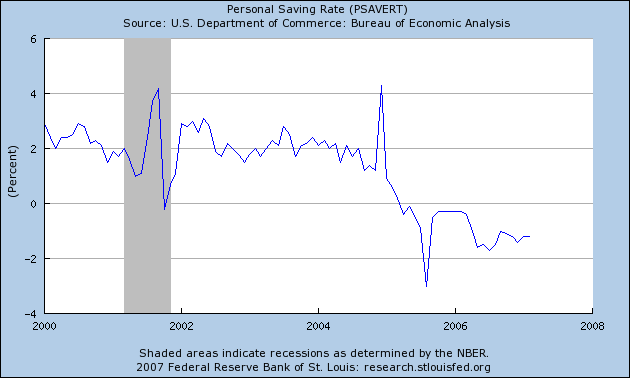
It wasn't from savings. The US savings rate was about 2% of disposable income in November 2001 and has been negative for the last 8 quarters. That means consumers have been dipping into savings to pay for their expenditures. However, the decrease in savings isn't enough to make-up for the increase in consumer spending. Here's a chart.

Photo Sharing and Video Hosting at Photobucket

So let's review. Wages haven't increased much beyond inflation for the duration of this expansion. Yet consumer spending has increased. But consumers aren't dipping into their savings. Where is this extra-money for consumption coming from?

Debt. According to the Federal Reserve's Flow of Funds Report household debt (mortgage + credit card debt) has increased in a big way during this expansion. In 2000, household debt was 97% of disposable income; at the end of 2006 it was over 130%. over the same period, household debt increased from 74% of GDP to over 90% of GDP.

Let's look at jobs.

According to the Bureau of Labor Statistics, there total private employment was 130,883,000 in November 2001 and 137,622,000 in the latest survey. That's a total gain of 6,739,000. over the same period, construction employment was increased from 6,784,000 to 7,713,000 for a gain of 929,000. The BLS classifies real estate jobs under financial services, which increased from 7,845,000 to 8,451,000 over the same period. About 20% of these jobs are real estate related, or 121,000. In addition, over the same period professional services increased from 16,094,000 to 17,829,000 or a gain of 1,735,000. Let's assume that 20% of these are in some way related to real estate (appraisers, architects, lawyers etc..), which is 279,400 jobs. Adding these rough estimates, we get 1,329,000 jobs, or about 20% of the total jobs created. It's important to remember that Goodspeed has a group of talented number-crunchers on his staff who have access to far more detailed information. In other words, comparing his methods to my rough guestimates, I'd be inclined to take his analysis over mine. However, regardless of who's right, even 20% of total jobs is a ton of jobs created by a single industry. The point of all of this is simple: housing has created a ton of jobs in this economy.

SO, as a source of funds to fuel spending and as a driver of employment gains, housing is very important. So far we've seen the housing slowdown hit GDP for 4 quarters in a row. There hasn't been a big hit to employment yet. But with the slowdown in home construction, I wouldn't count on that lasting.

For economic commentary and analysis, go to the Bonddad Blog

Another Economic Disconnect: PAUL KRUGMAN - Profit Gusher

THE COMPLETE ARTICLE
THE NEW YORK TIMES

OP-ED COLUMNIST

Another Economic Disconnect

By PAUL KRUGMAN
Published: April 30, 2007

In the Bush years high profits haven’t led to high investment, and rising productivity hasn’t led to rising wages.


Last fall Edward Lazear, the Bush administration’s top economist, explained that what’s good for corporations is good for America. “Profits,” he declared, “provide the incentive for physical capital investment, and physical capital growth contributes to productivity growth. Thus profits are important not only for investors but also for the workers who benefit from the growth in productivity.”

In other words, ask not for whom the closing bell tolls; it tolls for thee.

Unfortunately, these days none of what Mr. Lazear said seems to be true. In the Bush years high profits haven’t led to high investment, and rising productivity hasn’t led to rising wages.

--MORE--

Saturday, April 28, 2007

Slower Growth and Higher Inflation Suggest 'a Hint of Stagflation-Lite'

Commerce Report Raises Eyebrows

By Nell Henderson and Howard Schneider
Washington Post Staff Writers
Saturday, April 28, 2007; D01

The U.S. economy slowed sharply while inflation quickened in the first three months of the year, the government reported yesterday, rekindling concerns that the nation might be sliding into a more serious downturn.

Strong consumer spending was largely offset by plunging home construction, falling exports and tepid business investment from January through March, the Commerce Department reported.

Add it up, and the nation's gross domestic product, a broad measure of economic output, rose at a sluggish 1.3 percent annual rate -- a significant loss of momentum from the moderate 2.5 percent annual rate of expansion in the previous quarter, and the brisk 3.3 percent growth recorded for all of 2006.

Many analysts, including those at the Federal Reserve, forecast the economy to perk up enough to grow at a modest pace through the rest of the year without tipping into a recession. But at the same time, they see rising risks that the economy will deteriorate further, perhaps into a prolonged period of high inflation and weak growth.

"It was a quarter that was beset by the worst of both worlds, more inflation and less economic growth," said Stuart G. Hoffman, chief economist at PNC Financial Services, who called the combination "a hint of stagflation-lite."

Janet L. Yellen, president of the Federal Reserve Bank of San Francisco, said in a speech Thursday night that "economic growth has unexpectedly slowed from 'middling' to a crawl," developments that have "significantly increased the risks to the outlook, both for growth and inflation."

Her comments and the economic data strengthened investors' expectations that the Fed will hold short-term interest rates steady at its next policymaking meeting May 9. Many investors are betting the economy will weaken enough that the Fed will cut rates later this year.

The stock market, which rallied earlier in the week on a series of strong corporate profit reports, showed little reaction yesterday to the economic figures. The Dow Jones industrial average has added more than 800 points in the past month, rebounding from a steep sell-off in February to close yesterday at a record 13,120.94, an increase of 15.44 points over Thursday. But the market's enthusiasm could ebb if economic growth remains modest and earnings weaken.

Analysts worry most about the strength of consumer spending, which accounts for 70 percent of the economy and which kept the economy afloat by rising at a robust 3.8 percent annual rate in the first quarter.

Forecasters expect unemployment to edge higher this year from its very low 4.4 percent rate in March. Analysts also note that American households are coping with heavy debt service, softening home values and rising gasoline prices. If consumer spending falters, the economy could stall or even contract, some observers said.

"If energy and food prices continue on their recent upward path, then it is very likely that the economy will be facing a recession before the end of the year," said Dean Baker, co-director of the Center for Economic and Policy Research in Washington.

Others countered that consumer spending was fueled by a strong 4.5 percent annualized increase in after-tax personal income in the first quarter. Recent job losses related to housing and manufacturing have been more than offset by rising employment in health care, education, finance, tourism and other services.

"The consumer has not been spooked by either the meltdown in housing or the recent rise in gasoline prices," said Nariman Behravesh, chief economist at Global Insight. He said consumer spending would probably slow, but not enough to tip the economy into recession.

Housing, however, remains a drag on the economy. Spending on residential construction fell at a 17 percent annualized rate in the January through March period, the sixth consecutive quarterly decline.

Data show the housing slump is continuing, exacerbated by rising foreclosures that have added to the supply of unsold homes and caused lenders to tighten credit for some buyers. Sales of previously owned homes, which account for about 85 percent of the market, plunged in March by the largest amount in nearly two decades.

The Commerce Department also estimated that U.S. exports, which rose strongly and boosted economic growth last year, fell at a 1.2 percent annual rate in the first three months of this year.

Another soft spot was business spending on buildings, equipment and software, which rose at a 2 percent annual rate in the first quarter -- a modest gain, but an improvement after a worrisome 3.1 percent decline in the fourth quarter of 2006.

Meanwhile, consumer prices jumped at a rapid 3.4 percent annual rate in the first quarter, after falling in the last quarter of 2006, following the path of energy costs. After excluding volatile food and energy prices, consumer prices rose by 2.2 percent, compared with a 1.8 percent rise in the previous three-month period.

Crude oil prices surged yesterday to $66.46 a barrel on the New York Mercantile Exchange, the highest level in almost eight months.

The Commerce Department's report provides a first estimate of GDP growth. The figures will be revised in coming months as more data become available.

Friday, April 27, 2007

Gilded Once More: PAUL KRUGMAN

THE COMPLETE ARTICLE
THE NEW YORK TIMES

OP-ED COLUMNIST

Gilded Once More

By PAUL KRUGMAN
Published: April 27, 2007

We’ve gone back to levels of inequality not seen since the 1920s.


One of the distinctive features of the modern American right has been nostalgia for the late 19th century, with its minimal taxation, absence of regulation and reliance on faith-based charity rather than government social programs. Conservatives from Milton Friedman to Grover Norquist have portrayed the Gilded Age as a golden age, dismissing talk of the era’s injustice and cruelty as a left-wing myth.

Well, in at least one respect, everything old is new again. Income inequality — which began rising at the same time that modern conservatism began gaining political power — is now fully back to Gilded Age levels.

Consider a head-to-head comparison. We know what John D. Rockefeller, the richest man in Gilded Age America, made in 1894, because in 1895 he had to pay income taxes. (The next year, the Supreme Court declared the income tax unconstitutional.) His return declared an income of $1.25 million, almost 7,000 times the average per capita income in the United States at the time.

But that makes him a mere piker by modern standards. Last year, according to Institutional Investor’s Alpha magazine, James Simons, a hedge fund manager, took home $1.7 billion, more than 38,000 times the average income. Two other hedge fund managers also made more than $1 billion, and the top 25 combined made $14 billion.

How much is $14 billion? It’s more than it would cost to provide health care for a year to eight million children — the number of children in America who, unlike children in any other advanced country, don’t have health insurance.

The hedge fund billionaires are simply extreme examples of a much bigger phenomenon: every available measure of income concentration shows that we’ve gone back to levels of inequality not seen since the 1920s.

--MORE--

Thursday, April 26, 2007

Dow at 13,000. How to account for the disconnect?

Wednesday, April 25, 2007

Call us skeptical by gimleteye

You read and hear the same news we do. Yesterday, on a day the Dow Jones Industrial Average closed above 13,000 for the first time, a new Wall Street Journal/NBC News poll disclosed that only 22 percent believe the nation is headed in the right direction.

How to account for the disconnect?

Wall Street apparently believes that the consumer economy is strong. But is consumer confidence really so different from what people feel about the war in Iraq and the collapse of the housing markets and sharply tightening credit across the nation?

It is true that Wall Street has always tended to view gridlock in Washington as good for business, and business is generally good in a time of war.

We look, though, at the disparity in wages, between the economic elite and the mass of Americans ("Income inequality grew significantly in 2005, with the top 1 percent of Americans--those with incomes that year of more than $348,000--receiving their largest share of national income since 1928, analysis of newly released tax data shows." NY Times, March 29, 2007) and believe that something else is going on.

The earth has been "flattened" by globalization. Americans have benefited from high quality goods manufactured in low wage nations, but those benefits are diminishing. People are very anxious, and with good reason.

A dollar of US labor no longer towers over our neighbors or trading partners. We are not educating and training American workers fast enough to compete for higher paying jobs in the new global economy. Hungrier workers are getting those jobs.

It doesn't mean we aren't working hard. We are. In urban areas where housing costs have skyrocketed, two wage-earner families are on a fast treadmill just to keep pace with a single wage earner family, a few decades ago. And businesses are finding out that the last dollar of productivity squeezed by technological efficiencies is not necessarily protecting the higher paying jobs that remain.

The stock market is agnostic to the difficulties ordinary Americans are experiencing. The stock market likes what globalization is doing for large multinational corporations, whose executives are part of a new economic elite, defined by the highest wage differential with ordinary workers since the Great Depression.

The markets are glad. Americans are sad and increasingly irrelevant to the operation of the world economy.

In Nation this week, William Greider interviews economist Ralph Gomory who explains, "America... becomes increasingly dependent, buying from abroad more and more of what its citizens consume and producing relatively less at home. US incomes stagnate as the high-wage jobs disappear and US exports become a smaller share of the world total."

Greider writes, "The conventional win-win assurances... are facile generalizations ... some nations, in other words, do indeed become 'losers'."

What seems to be driving both foreign and domestic policy in the United States is the urgency of 'winners' to separate themselves from the afflicted losers of the global economy. It is not just the issue of wage disparity: that the "the top 1 percent (of income earners) recieved 21.8 percent of all reported income in 2005, up significantly from the 19.8 percent the year before and more than double their share of income in 1980. The peak was in 1928, when the top 1 percent reported 23.9 percent of all income." We all know what happened in 1928.

No, there are more subtle effects, like the fact that so many Americans are driving gas-guzzling SUV's while Exxon coasts from one record profit to the next, a promise sold to consumers by a domestic auto industry that claimed it could not afford high gas mileage standards, leaving Toyota to dismantle US jobs on the basis of better engineered and more fuel efficient products that US auto suppliers couldn't build then but apparently will have to build now, now that they have lost that war, and, American jobs.

We could be wrong. Every government bean counter and statistician for the government wants to find good news in the numbers and even will 'cook the books' (ie. how inflation is measured) when reality cuts too close to the bone.

We noted, yesterday, how the good news on manufacturing and exports highlighted the contribution of a single company, Boeing Aircraft.

It seems inevitable to us that the collapse of housing markets will drag the economy downward. We look at the cranes busily moving over the Miami skyline, hurrying massive condominiums toward certificates of occupancy, we watch our local county commission doing back flips to satisfy the greed of the development lobby, built on the back of liar loans, mortgage fraud, and incestuous relationships between builders and lenders, and shake our heads.

But we may not be wrong. We may just be early.

Interest rates 'could reach 7.5pc'

Interest rates 'could reach 7.5pc'
Evans-Pritchard, The Telegraph
A group of Britain's leading monetarists have launched a harsh attack on the Bank of England's Monetary Policy Committee, warning that inflation risks surging out of control in repeat of earlier boom-bust cycles.

Wednesday, April 25, 2007

The Upside of Recession?

Upside? Bobbie's been smoking some of "Greenie" Friedman's stuff, apparently.
---
The Upside of Recession?

By Robert J. Samuelson
Wednesday, April 25, 2007; A17

It's increasingly clear that much of our standard economic vocabulary needs revising, supplementing or at least explaining. The customary words we use don't fully convey what's happening in the real world. Let me illustrate with two basic economic terms: inflation and recession. There are also larger lessons.

Start with inflation. You may have noticed that last week's release of the March consumer price index (CPI) -- the government's main inflation indicator -- inspired much optimism. "Inflation Fears Relax," headlined the Wall Street Journal. Stock prices jumped on the supposedly good news. But if you actually examined the CPI report, you found that prices in March rose at their highest rate since September 2005 and that, over the past three months, they've increased at a 4.7 percent annual rate. Doesn't sound like retreating inflation, does it?

What explains the discrepancy is "core inflation." That's the CPI minus food and energy prices. In March, core inflation did subside, prompting the upbeat spin. But you might wonder: We must pay for food, gasoline and electricity; why strip them out? The usual answer is: These prices jump around from month to month; they often reverse themselves (oil prices were high in the early 1980s, low in the late 1980s); core inflation better reflects the underlying trend. This is hardly wishful thinking. Since the early 1980s, the two indexes (the CPI and the core CPI) have recorded -- despite many monthly differences -- virtually identical increases.

But suppose that this relationship is breaking down. We all know about oil. Prices are about $60 a barrel. They seem unlikely to return to $28, the 2000 level. The real surprise involves food prices. In the past three months, they've risen at a 7 percent annual rate. We may be seeing the first adverse effects of the ethanol boom. Corn is a main feed grain for poultry, cattle and hogs. Corn is also the main raw material for ethanol, an alternate fuel for gasoline. Competition for grain has pushed up corn prices to about $3.50 or more a bushel, almost double a typical level. High feed prices have discouraged meat producers from expanding. The resulting tight meat supplies raise retail prices.

"Poultry is the best example," says economist Tom Jackson of Global Insight. "In the past 40 years, we almost never have year-to-year decreases in production. In the past few months, we've seen production go down." In March, the decline was 4 percent from a year earlier.

So the government's subsidies for corn-based ethanol are worsening inflation, perhaps permanently. Coupled with precarious global oil supplies -- posing a constant threat of higher energy prices -- that may make core inflation a less useful indicator. Ups and downs may no longer cancel each other. Inevitably, these developments also pose policy questions. Considering ethanol's tiny contribution to our motor fuel supply (about 4 percent), is the program worthwhile? Or is it a giveaway to corn farmers?

Now switch to recession. Since 1982, there have been only two (1990-91 and 2001). That's good. In the previous 13 years, there had been four (1969, 1973-75, 1980 and 1981-82). Almost everyone dreads another one. We've been conditioned to think of recessions as automatically undesirable. The labeling is simplistic.

Hardly anyone likes what happens in a recession. Unemployment rises, production falls, profits weaken, stocks retreat. But the obvious drawbacks blind us to collateral benefits. Downturns check inflation -- it's harder to increase wages and prices -- and low inflation has proved crucial to long-term prosperity. Downturns also punish and deter wasteful speculation. When people begin to believe that an economic boom won't ever end, they start to take foolish risks. Partly, that explains the high-tech and stock bubbles of the late 1990s and, possibly, the recent housing bubble.

Some sort of a recession might also reduce the gargantuan U.S. trade deficit, $836 billion in 2006 (just counting goods). Almost everyone believes that the U.S. and world economies would be healthier if Americans consumed less, imported less, saved more and exported more. The corollary is that Europe, Japan, China and the rest of Asia would rely more on domestic spending -- their own citizens buying more -- and less on exports.

Ideally, this massive switch would occur silently and smoothly. Realistically, the transition might not be so placid. A slowdown in Americans' appetite for imports would involve weaker overall consumer spending, about 70 percent of the U.S. economy. Such a slowdown might also be needed to persuade other countries to stimulate their domestic spending.

Almost no one wishes for a recession, but the consequences might not be all bad. The larger lessons here involve perceptions. Our regular vocabulary often fails to describe the complexities of a changing economy. We must be alert to new possibilities. Things are not always what they seem.

Housing Bubble Boondoggle: “Is it too late to get out”?

April 24, 2007

By Mike Whitney

Treasury Secretary Henry Paulson delivered an upbeat assessment of the slumping real estate market on Friday saying, "All the signs I look at" show "the housing market is at or near the bottom.”

Baloney.

Paulson added that the meltdown in subprime mortages was not a “serious problem. I think it’s going to be largely contained.”

Wrong again.

Paulson knows full well that the housing market is headed for a crash and probably won’t bounce back for the next 4 or 5 years. That’s why Congress is slapping together a bailout package that will keep struggling homeowners out of foreclosure. If defaults keep skyrocketing at the present rate they are liable to bring the whole economy down in a heap.


Last week, the Senate convened the Joint Economic Committee, chaired by Senator Charles Schumer. The committee’s job is to develop a strategy to keep delinquent subprime mortgage holders in their homes. It may look like the congress is looking out for the little guy, but that’s not the case. As Schumer noted, “The subprime mortgage meltdown has economic consequences that will ripple through our communities unless we act.”


Schumer’s right. The repercussions of millions of homeowners defaulting on their loans could be a major hit for Wall Street and the banking sector. That’s what Schumer is worried about---not the plight of over-leveraged homeowners.

Every day now, another major lending institution unveils its plan for bailing out the housing market. Citigroup and Bank of America have joined forces to create the Neighborhood Assistance Corporation of America which will provide $1 billion for the rescue of subprime loans. This will allow homeowners to refinance their mortgages and keep them out of foreclosure. The new “30- year loans will carry a fixed interest rate one point below the prime rate, putting it currently at 5.5 percent. There are no fees, and the banks pay all the closing costs.”

But why are the banks being so generous if, as Paulson says, “the housing market is at or near the bottom.” This proves that the Treasury Secretary is full of malarkey and that the problem is much bigger than he’s letting on.

Last week, Washington Mutual announced a $2 billion program to slow foreclosures (Washington Mutual's subprime segment lost $164 million in the first quarter) while Freddie Mac committed a whopping $20 billion to the same goal. In fact, Freddie Mac announced that it “would stretch the loan term to a maximum of 40 years from the current 30-year limit.”

40 years!?! How about a 60 or 80 year mortgage?

Can you sense the desperation? And yet, Paulson says he doesn’t see the subprime meltdown as a “serious problem”?!?

Paulson’s comments have had no effect on the Federal Reserve. The Fed has been frantically searching for a strategy that will deal with the rising foreclosures. On Wednesday, The Washington Post reported that “Federal bank regulators called on lenders to work with distressed borrowers unable to meet payments on high-risk mortgages to help them keep their homes”.

Huh?!?

When was the last time the feds ordered the privately-owned banks to rewrite loans?

Never—that’s when.

That gives us some idea of how bad things really are. The details of the meltdown are being downplayed in the media to prevent panic-selling among the public. But the Fed knows what’s going on. They know that “U.S. mortgage default rates hit an all-time high in the first quarter of 2007” and that “the percentage of mortgages in default rose to a record 2.87%”. In fact, the Federal Reserve and the five other federal agencies that regulate banks issued this statement just last week:


"Prudent workout arrangements that are consistent with safe and sound lending practices are generally in the long-term best interest of both the financial institution and the borrower…Institutions will not face regulatory penalties if they pursue reasonable workout arrangements with borrowers."

Translation: “Rewrite the loans! Promise them anything! Just make sure they remain shackled to their houses!”

Unfortunately, the problem won’t be “fixed” with a $30 or $40 billion bailout scheme. The problem is much bigger than that. There is an estimated $2.5 trillion in subprimes and Alt-A loans---20% of which are expected enter foreclosure in the next few years. Any up-tick in interest rates or unemployment will only aggravate the situation.


Kenneth Heebner, manager of CGM Realty Fund (Capital Growth Management), provided a realistic forecast of what we can expect in the near future as defaults increase.

Heebner: “The Greatest Price Decline in Housing since the Great Depression” (Bloomberg News interview)

“The real wave of pain and foreclosures is just beginning….subprimes and Alt-A are both in trouble. A lot of these will go into default. The reason is, that the people who took these out never really intended to fully service the mortgage---they were counting on rising home prices so they could sign on the dotted line without showing what their income was and then 2 years later flip into another junk mortgage and get a big profit out of the house with putting anything down…

“There’s a $1.5 trillion in subprimes and $1 trillion in Alt-A the catalyst will be declining house prices which is already underway. But as we get a large amount of these $2.5 trillion mortgages go into default, we’ll see foreclosed houses dumped on an already weak market where homebuilders are already struggling to sell there houses. The price declines which have started will continue and may even accelerate in some of the hotter markets. I would expect that housing prices in “2007 will decline 20% in a lot of markets”.

“What you are going to see is the greatest price decline in housing since the Great Depression…..The one thing that people should not do, is go near a CDO or a residential mortgage backed security rated Triple A by Moody’s and S&P because these are going to get down-graded by the hundreds of millions---because they are secured by subprime and Alt-A mortgages where there’ll be massive defaults”.

Question—Will the losses in the mortgage market exceed those in the S&L crisis?

Heebner: “They’re going to dwarf those losses because the losses could easily approach $1 trillion---that dwarfs anything that has ever happened. Enron was $100 billion---this will be far greater than that…..The good news is that most of these loans are owned by Hedge Funds…You hedge funds buying these subprime and Alt-A loans and leveraging them at 10 to 1. They buy a pool of mortgages at 8% and they borrow against it in yen for 3% and then lever it at 10 to 1so you have a lucrative profit And the hedge fund you are running, the manager is going to get 20% of the gain---so even if it’s a year before you go broke; you get rich until the fund is shut down”.

Heebner added this instructive comment: “The brokerage firms created “securitization” they know the products are toxic. I don’t think they are going to suffer losses; they simply passed them on to everyone else. The only impact this will have is the profits that flow from it will get less….But it is less than 3% of revenues in even the most exposed brokerage firm so THEY’RE NOT GOING TO GET CAUGHT.”

Although Heebner believes the brokerage houses will do fine; the same is not true for the small investor. Nearly 70% of subprimes have been securitized. That means that the vast number of shoddy “no down payment, no document, interest-only” loans (that are headed for default) have been transformed into securities and sold to hedge funds. As the housing market continues to falter, these funds will plummet at an inverse rate to the amount of leverage that has been applied. That may explain why, (according to Bloomberg Markets) the “wealthiest Americans have been bailing out” of hedge funds at an alarming rate. A report in last Thursday’s New York Times stated:

“Americans with a net worth of at least $25 million, excluding the value of their primary homes, reduced their exposure to hedge funds in 2006”-- The amount of money held by wealthy investors in hedge funds has dropped dramatically-- “The average balance, which was $2.8 million in 2005, was just $1.6 million last year, a 43 percent decline”.

So, what do America’s richest investors know that the rest of us don’t?

Could it be that the over-leveraged hedge funds industry is about to get hammered by the subprime implosion?

If so, it won’t be the brokerage houses or savvy insiders who get hurt. It’ll be the little guys and the pension funds that take a drubbing.

In Henry C K Liu’s “Why the Subprime Bust will Spread” (Asia Times) the author states that the bursting housing bubble will trigger a major pension crisis. After all, who are the “institutional investors? They are mostly pension funds that manage the money the US working public depends on for retirement. In other words, the aggregate retirement assets of the working public are exposed to the risk of the same working public defaulting on their house mortgages”. (Liu)

The origins of the housing bubble are complex, but they are worth understanding if we want to know how things will progress. The housing bubble is not merely the result of low interest rates and shabby lending practices. As Liu says, “the bubble was caused by creative housing finance made possible by the emergence of a deregulated global credit market through finance liberalization. The low cost of mortgages lifted all US house prices beyond levels sustainable by household income in otherwise disaggregated markets” The deregulated cross-border flow of funds (via the yen low interest “carry trade” or the $800 billion current account deficit) have played a major role in inflating the US real estate market.

Liu adds, “Since the money financing this housing bubble is sourced globally, a bursting of the US housing bubble will have dire consequences globally.” Since nearly 50% of “securitized” mortgage debt is owned by foreign investors; the subprime meltdown is bound send tremors through the entire global financial system.

The housing decline is further complicated by Wall Street innovations in derivatives trading which has generated trillions of dollars in “virtual” wealth and is affecting the Feds ability to control inflation through interest rate manipulation. As Kenneth Heebner said, “You have hedge funds buying these subprime and Alt-A loans and leveraging them at 10 to 1. They buy a pool of mortgages at 8% and they borrow against it in yen for 3% and then lever it at 10 to 1so you have a lucrative profit.”

In other words, low interest foreign capital has flooded US markets and contributed to distortions in housing prices.

In her recent article “War Drags the Dollar Down”, Ann Berg refers to Wall Street’s “swirling galaxy of exotic finance” which has “worked magic for the government and the elite”, but has yet to weather a severe downturn in the economy.

But how will market deal with sudden downturn in the hedge fund industry? Will the dodgy subprimes and shaky collateralized debt obligations (CDOs) trigger a crash or has the risk been wisely dispersed through derivatives trading?

No one really knows.

As Berg says, “Derivatives numbers are staggering. The Bank for International Settlements estimates that the notional amount of derivatives traded on regulated exchanges topped a quadrillion dollars last year and that the outstanding unregulated off-exchange (called over-the-counter – OTC) amount stood at $370 trillion in June 2006. Because the OTC market is composed of endless strings of bilateral transactions – the systemic risk is unknown.”

The comments of the President of the New York Fed, Timothy Geithner, help to clarify the abstruse activities of the modern market:

“Credit market innovations have transformed the financial system from one in which most credit risk is in the form of loans, held to maturity on the balance sheets of banks, to a system in which most credit risk now takes an incredibly diverse array of different forms, much of it held by nonbank financial institutions that mark to market and can take on substantial leverage.

Geither’s right. The markets now operate as unregulated banks generating mountains of credit through massively leveraged debt instruments---a monster credit bubble larger than anything in the history of capitalism.

So, where is all this headed?

No one really knows. But when the housing bubble crashes into Wall Street’s credit bubble,; we can expect the “big bang”. That may explain why America’s wealthiest investors are running for cover before the whole thing blows. (A number of investors have already cashed out and put there holdings into foreign funds and currencies)

One thing is certain ---time is running out. With $1 trillion in subprimes and Alt-A loans headed for default the system is facing its greatest challenge. US- GDP has been revised to a measly 1.8%, foreign investment is down, and the dollar is losing ground to the euro on an almost weekly basis.

Falling home prices have already precipitated a number of other problems. For example, Gene Sperling reports in “Housing Bust Meets the Equity Blues” that “The Fed data showed an amazing expansion (in Mortgage-Equity Withdrawal). In 1995, active MEW had been $37 billion. By the fourth quarter of 2005, it soared to $532 billion annualized, a 14-fold expansion”. These equity withdrawals have translated into consumer spending which accounts for at least 1 full percentage point of GDP. Declining house prices means that extra boast for the economy will now disappear.

Foreclosures are soaring and expected to get worse for the next two years at least. In California foreclosure filings jumped 79% in March alone. Other “hot markets” are reporting similar figures.

The glut of new homes for sale on the market has slammed sales of the nation's major builders; most are reporting profits are down by 40% or more.

The collapse of the subprime mortgage market is also pushing some big U.S. homebuilders toward Chapter 11. According to Bloomberg News, “Some builders are staying out of bankruptcy by relying on the profits they made when sales boomed” in 2004 and 2005. Starting next year they must begin to repay $3.6 billion in public debt in what will certainly be a falling market. The prospects don’t look good.

Also, Credit card debt is way up (nearly 7% in one year) and economists are predicting that the trajectory will continue now that home equity is vanishing. Americans savings rate is in negative numbers and the steep increase in credit card debt (with its high interest rates) only compounds the problem. The American consumer has now compiled more personal debt than anytime in history.

The Grim Reaper Meets the Housing Bubble

Those who follow developments in real estate have heard many of the wacky anecdotes related to the housing bubble. Stories abound of young people buying homes just to pay off tens of thousands of dollars of collage loans with their “presto”-equity ---or low paid construction laborers securing 105% loans without any proof of income and a poor credit history. One of the stories that got national attention was about Alberto and Rosa Ramirez, who worked as strawberry pickers in the fields around Watsonville each earning about $300 a week. They (somehow?) qualified for a loan of $720,000 which paid for a "new" four-bedroom, two-bath house in Hollister.

It’s sheer madness!

Obviously, those days are over. The speculative frenzy that was generated by the Fed’s low interest rates, the banks lax lending standards, and the deregulated global credit market is drawing to a close. The fallout from the collapse in subprime-loans will roil the stock market and hedge funds, but, as Heebner says, the investment banks and brokerage firms will escape without a bruise.

Where's the justice?

Despite Hank Paulson’s cheery predictions, we are no where “near the bottom”. In fact, a recent survey showed that only 1 in 7 Americans believe that house prices will go down. Even now, very few people grasp the underlying issues or the potential for disaster. We’re on a treadmill to oblivion and they think it’s a merry-go-round.


As housing prices tumble, more homeowners will experience “negative equity”, that is, when the current value of their home is less than the sum of their mortgage. This is the very definition of modern serfdom.

We can expect to see an erosion of confidence in the market, a rise in inventory, and a steady increase in defaults. More and more people will walk away from their homes rather than be hand-cuffed to an asset that loses value every day. This could transform a "housing correction" into a nation-wide financial calamity.

Many peoples’ futures are linked directly to the "anticipated" value of their homes. It is impossible to determine how shocked they’ll be when prices retreat and equity shrivels. The housing flame-out has all the makings of a national trauma—another violent jolt to the fragile American psyche.

So far, we're still in the first phase of a process that will probably play out for 10 years or more. (Judging by Japan’s decades-long decline) None of the bailout plans are large enough to make any quantifiable difference. The numbers are just too big.

Housing prices are coming down and the real estate market will return to fundamentals. That much is certain. The law of gravity can only be ignored for so long.

Just don’t count on a “soft landing”.


Special thanks to http://patrick.net/housing/crash.html (Housing Crash News)

See entire Heebner interview at http://patrick.net/housing/contrib/future.html )

Monday, April 23, 2007

U.S. economy poised for nose dive

By Jerome R. Corsi
© 2007 WorldNetDaily.com

Major recession feared when 'liquidity bubble' bursts

As the dollar sinks to near-record lows against the euro and the British pound, the stock market has returned to record highs, but investors are being advised to anticipate a worldwide downturn and the U.S. economy may have already entered a recession.

An explanation may be found in a private investment letter published by the Carlyle Group to its "professional investors."

WND has obtained a copy of a Jan. 31 letter by the Carlyle Group's founding partner and managing director, William E. Conway, Jr., to the firm's investment professionals worldwide.

In the letter, Conway attributes the continued rise of world stock markets to a glut of liquidity in the world financial system, which he describes as "the availability of enormous amounts of cheap debt.

Conway writes, "This cheap debt has been available for almost all maturities, most industries, infrastructure, real estate and at all levels of the capital structure."

He says there is so much liquidity in world financial systems that "lenders (even 'our' lenders) are making very risky credit decisions."

WND previously reported concern that the decision of the Federal Reserve to quit publishing a traditional index, "M3," a broad measure of the money supply, signaled a decision to pump the economy with excess liquidity.

Since the Fed quit publishing M3 data, economists who have attempted to re-create the index from other available data have estimated M3 data would today be reporting upwards of a 10-percent increase in the money supply, a high level by historical standards.

"Liquidity" is defined by economists as money available in all forms to be given out as debt, ranging from credit card debt to mortgage debt to large quantities of institutional debt typically used in complex financial transactions such as highly leveraged corporate acquisitions.

Excess liquidity, as reflected in the rise of highly leveraged hedge fund accounts, has been widely seen as a major factor in the rise of the stock market in the recovery since 9/11.

Conway cautions that "this liquidity environment cannot go on forever." He warns that "the longer it lasts, the worse it will be when it ends."

Looking on the bright side of what could be a major recession when the liquidity bubble bursts, Conway advises, "And of course when [the liquidity bubble] ends the buying opportunity will be once in a lifetime."

He adds, "But I do not know when it will end."

Bob Chapman, who publishes a bi-weekly Internet newsletter, The International Forecaster, has issued his reconstructed M3 estimate to100,000 subscribers.

"The world is awash in money and credit," Chapman said. "My numbers show M3 increasing at about a 10-percent rate right now."

Chapman has spent 45 years in the finance and investment business, including 28 years as a stockbroker specializing in gold and silver shares. He publishes his newsletter from an undisclosed address outside the U.S.

In his April 14 newsletter, Chapman wrote, "The effort to save the American economy, which began in 2001, has finally come full circle and the Ponzi scheme is coming unraveled. The overextension of credit, outrageously low interest rates and loans to the totally unqualified have finally come home to roost."

For months, Chapman has been warning that the U.S. economy entered a downturn in February 2006. Chapman expects it will develop into a prolonged recession caused largely by the bursting of the housing bubble and the weakness in the dollar attributable to the United States' large federal budget deficit and international trade imbalance.

At the same time, Chapman has been predicting for months that the dollar will challenge the technical support point of $USD 80 on the world currency markets.

On Thursday, the dollar index closed at $USD 81.64 in a steady decline that began at the end of February.

The euro late last week was trading as high as $1.3576, near its December 2004 record of $1.3539. At the same time, the pound rose to $1.9938, its highest point since September 1992. The pound last reached the $2 mark 14 years ago, when the UK was ousted from the European Exchange Rate Mechanism.

Chapman has argued the U.S. Treasury and Federal Reserve have been trying to manage a gradual devaluation of the U.S. dollar.

Chapman expects the dollar could lose as much as an additional 20 percent of its value this year alone. In the last five years, the dollar has lost 35 percent of its value against the euro.

Still, until debt defaults force a crisis in the world debt markets, Chapman agrees with the Carlyle Group that excess liquidity will continue to buoy the world stock markets, including the New York Stock Exchange, to new highs.

Chapman also agrees with Conway that when the liquidity bubble bursts, the decline in world stock markets could be sharp and severe, possibly even reaching crash magnitudes on the downside.

"Tens of billions of dollars have already been lost in the U.S. sub-prime lending market and the contagion is spreading as the media tries to cover-up what is really going on," Chapmen wrote in his March 28 newsletter. "We are watching the disintegration to an extent of the entire mortgage market, which encompasses 25 percent of all outstanding credit."

Chapman continued: "We predicted this three years ago and those who believe they are savvy discovered the problem a couple of months ago. This is a general meltdown and do not think it isn't, and it has several years to go until the real estate sector is purged."

The Carlyle Group, a large Washington, D.C., private equity firm headquartered founded in 1987, has close ties to the administration of President George H.W. Bush.

WND also reported the Carlyle Group has established a new team to invest in Mexico. The team includes Mark McLarty, president of Kissinger McLarty Associates and former chief of staff and special envoy to the Americas for President Bill Clinton.