Current and former employees of the White House Security Office have reported to Chairman Waxman that there was a systemic failure at the White House to follow procedures for protecting classified information. According to the security officers, the White House regularly ignored security breaches, prevented security inspections of the West Wing, and condoned mismanagement of the White House Security Office.
Showing posts with label Plame. Show all posts
Showing posts with label Plame. Show all posts
Monday, April 23, 2007
Saturday, April 14, 2007
Beating about the Bush
Simon Hoggart
Saturday April 14, 2007
The Guardian
Saturday April 14, 2007
The Guardian
American joke: "What's the difference between Iraq and Vietnam? George W Bush had an exit strategy for Vietnam." It's startling to see how much the American press has turned against the president. Partly it's because every new president starts with a very fair wind, so the disenchantment is greater.
And there is a view that, however much you might dislike the man, the office deserves a degree of respect. Even in the darkest days of the soon-to-end Carter presidency in 1980, when his attempt to rescue the hostages in Tehran failed catastrophically, you'd hear people apologise for being rude about him, because after all he was still the president and commander in chief. In Britain we tend to the view that all politicians are much the same, and while some may look more promising than others, in the end they'll let you down.
But the mood has turned completely against George W, even in rock solid Republican states. They don't really have chattering classes in the states, but they do have the pontificating classes, and they certainly know what they think now. Take Joe "Primary Colors" Klein, writing in Time magazine: "I've tried hard to be respectful to the man and his office, but the three defining sins of the Bush administration - arrogance, incompetence, cynicism - are congenital: it is increasingly difficult to imagine yet another two years of slow bleed with a leader so clearly unfit to lead."
· With that in mind I went to a talk by Joseph Wilson (I'm on my annual visit to the Conference on World Affairs - a splendid piss-up with speeches, held in Boulder, Colorado). Wilson is the career diplomat who served Bush's father in Baghdad during the first Gulf war. In 2002 he was sent to Niger to investigate claims by the British government that Saddam had bought 500 tons of "yellowcake" - uranium-bearing ore.
He quickly discovered there was no truth in the story, so was shocked to hear it delivered as fact by Bush Jr in his 2003 State of the Union speech. When he wrote an article pointing out this fib, the administration set out to discredit him and finally - treasonously, he says - named his wife as a covert CIA agent. The details are complicated, but it's why Lewis Libby, the former chief of staff of the vice-president, has been convicted of perjury and other offences, and might even end up in the slammer.
So Wilson is a hero to anyone who is anti-war, and his speech was interrupted by much loud cheering (in American terms, Boulder is pretty leftwing). "We spend 20 times as much on intelligence as the British, who have no presence in Niger, so does it make any sense to believe what your own intelligence service tells you is baseless?" he asked.
The invasion of Iraq, he said, was "a war not to defend our nation, but to validate an academic theory". It's generally assumed that Libby's lawyers will try to spin the appeal process out until after the 2008 election, when Bush will be able to pardon him. But as Jeffrey Toobin writes in another grand pontificating journal, the New Yorker, "George Bush should not be giving pardons; he should be begging the nation's".
Wednesday, March 28, 2007
Second Witness Reveals Much In Plame Leak Controversy
by Laura Heaton
UPI Intelligence Correspondent
Washington (UPI) March 26, 2007
Despite the hype surrounding the first public appearance by Valerie Plame Wilson last week, the testimony that was most indicting of the Bush administration's handling of the CIA leak controversy came not from the former CIA agent but from the second witness: a White House official responsible for carrying out internal White House investigations.
James Knodell, director of the Office of Security at the White House, testified that in the weeks following the leak of Plame's identity as a covert officer at the CIA, the White House never undertook an internal investigation to locate the loose cannon in its midst.
Knodell testified for the House Committee on Oversight and Government Reform that there was neither an internal White House report about the possible security breach, nor an investigation to identify the source of the leak of classified information, nor any sanctioning of White House staff to ensure that additional information wasn't leaked.
"There was already an outside investigation that was taking place, a criminal investigation," Knodell offered as an explanation.
But as members of the committee pointed out, there was a two and a half month gap between the time when journalist Robert Novak first revealed Plame's identity on July 14, 2003 and the start of a criminal investigation by the U.S. Department of Justice on Sept. 30 and subsequently by special prosecutor Patrick Fitzgerald.
"The investigation by Mr. Fitzgerald didn't take place for months ... after it was well-known that there had been a leak of the identity of a covert CIA agent," said Chairman Henry Waxman.
A series of executive orders signed in the mid-1990s established the procedure for handling and securing classified information within the Executive Office of the president, Knodell explained. If an employee of the EOP breaches these guidelines, a report must be filed with the Office of Security, and Knodell's office would determine whether to revoke the individual's security clearance.
"There's an obligation for the White House to conduct an immediate investigation to find out whether they needed to suspend security clearances of somebody who had leaked this information, to maybe take disciplinary action against an individual who might have been involved, and thirdly, to find out who divulged it," Waxman said.
Bill Leonard, director of the Information Security Oversight Office at the National Archives and Records Administration, also testified about the obligation to investigate.
"Whenever there is suspected unauthorized disclosure or compromise, there is an affirmative responsibility to do an inquiry. At the very least to ... implement corrective action, so that subsequent and additional and similar violations do not occur," Leonard said. The investigation is also aimed at assessing potential damage to national security that resulted from the leak, he added.
In the immediate aftermath of the CIA leak, President Bush acknowledged the need to find the source.
Speaking to reporters a day after the Department of Justice announced its investigation Bush said, "If there is a leak out of my administration, I want to know who it is. And if the person has violated law, the person will be taken care of. ... I welcome the investigation."
If the president claimed to support an investigation, why did the White House not conduct one as it is obligated to do by various executive orders protecting classified information? It's a simple question an even more obvious answer after hearing Knodell's testimony.
"The White House didn't engage in standard operating procedure because internally, everyone basically knew what had happened and knew that the involvement of Karl Rove and Scooter Libby and possibly others made this an insider's game," said Steve Clemons, a senior fellow at the New America Foundation.
Clemons said that while the leak of classified information is always a national security concern, this case is particularly insidious because of the way the Bush administration reacted.
"The president's huff and puff at the time of the outing of Valerie Plame was very good theater, but now if we go back and look at it, all of the key players inside who set the president up to make those comments were the ones very involved with making a campaign out of Valerie Plame's identity to get back at Joe Wilson," Clemons said.
Regardless of whether classified information was disclosed for malicious reasons or just as a careless slip by one of Bush's subordinates who didn't realize that Plame was covert, the obligation to investigate still stands.
The executive orders make no distinction about intent; but in this case, the motivation behind the controversy seems apparent.
So the follow-up question is naturally, what happens next?
The Oversight Committee sent a letter to Joshua Bolten, the White House Chief of Staff, which said that the hearing "raised new concerns about whether the security practices being followed by the White House are sufficient to protect our nation's most sensitive secrets."
The letter asked Bolten to provide an account of the steps taken to investigate how the leak occurred, review the security clearances of White House officials implicated in the leak, impose sanctions against officials involved in the leak, and revise security procedures to prevent future breaches.
The White House did not return calls inquiring about a response to the committee's letter.
Source: United Press International
UPI Intelligence Correspondent
Washington (UPI) March 26, 2007
Despite the hype surrounding the first public appearance by Valerie Plame Wilson last week, the testimony that was most indicting of the Bush administration's handling of the CIA leak controversy came not from the former CIA agent but from the second witness: a White House official responsible for carrying out internal White House investigations.
James Knodell, director of the Office of Security at the White House, testified that in the weeks following the leak of Plame's identity as a covert officer at the CIA, the White House never undertook an internal investigation to locate the loose cannon in its midst.
Knodell testified for the House Committee on Oversight and Government Reform that there was neither an internal White House report about the possible security breach, nor an investigation to identify the source of the leak of classified information, nor any sanctioning of White House staff to ensure that additional information wasn't leaked.
"There was already an outside investigation that was taking place, a criminal investigation," Knodell offered as an explanation.
But as members of the committee pointed out, there was a two and a half month gap between the time when journalist Robert Novak first revealed Plame's identity on July 14, 2003 and the start of a criminal investigation by the U.S. Department of Justice on Sept. 30 and subsequently by special prosecutor Patrick Fitzgerald.
"The investigation by Mr. Fitzgerald didn't take place for months ... after it was well-known that there had been a leak of the identity of a covert CIA agent," said Chairman Henry Waxman.
A series of executive orders signed in the mid-1990s established the procedure for handling and securing classified information within the Executive Office of the president, Knodell explained. If an employee of the EOP breaches these guidelines, a report must be filed with the Office of Security, and Knodell's office would determine whether to revoke the individual's security clearance.
"There's an obligation for the White House to conduct an immediate investigation to find out whether they needed to suspend security clearances of somebody who had leaked this information, to maybe take disciplinary action against an individual who might have been involved, and thirdly, to find out who divulged it," Waxman said.
Bill Leonard, director of the Information Security Oversight Office at the National Archives and Records Administration, also testified about the obligation to investigate.
"Whenever there is suspected unauthorized disclosure or compromise, there is an affirmative responsibility to do an inquiry. At the very least to ... implement corrective action, so that subsequent and additional and similar violations do not occur," Leonard said. The investigation is also aimed at assessing potential damage to national security that resulted from the leak, he added.
In the immediate aftermath of the CIA leak, President Bush acknowledged the need to find the source.
Speaking to reporters a day after the Department of Justice announced its investigation Bush said, "If there is a leak out of my administration, I want to know who it is. And if the person has violated law, the person will be taken care of. ... I welcome the investigation."
If the president claimed to support an investigation, why did the White House not conduct one as it is obligated to do by various executive orders protecting classified information? It's a simple question an even more obvious answer after hearing Knodell's testimony.
"The White House didn't engage in standard operating procedure because internally, everyone basically knew what had happened and knew that the involvement of Karl Rove and Scooter Libby and possibly others made this an insider's game," said Steve Clemons, a senior fellow at the New America Foundation.
Clemons said that while the leak of classified information is always a national security concern, this case is particularly insidious because of the way the Bush administration reacted.
"The president's huff and puff at the time of the outing of Valerie Plame was very good theater, but now if we go back and look at it, all of the key players inside who set the president up to make those comments were the ones very involved with making a campaign out of Valerie Plame's identity to get back at Joe Wilson," Clemons said.
Regardless of whether classified information was disclosed for malicious reasons or just as a careless slip by one of Bush's subordinates who didn't realize that Plame was covert, the obligation to investigate still stands.
The executive orders make no distinction about intent; but in this case, the motivation behind the controversy seems apparent.
So the follow-up question is naturally, what happens next?
The Oversight Committee sent a letter to Joshua Bolten, the White House Chief of Staff, which said that the hearing "raised new concerns about whether the security practices being followed by the White House are sufficient to protect our nation's most sensitive secrets."
The letter asked Bolten to provide an account of the steps taken to investigate how the leak occurred, review the security clearances of White House officials implicated in the leak, impose sanctions against officials involved in the leak, and revise security procedures to prevent future breaches.
The White House did not return calls inquiring about a response to the committee's letter.
Source: United Press International
Thursday, March 22, 2007
Cheney and Libby: Lying about Lying
News > March 21, 2007
By Marcy Wheeler

Here is the real news from the I. Lewis “Scooter” Libby trial: Evidence released during the case indicates that not only did Libby lie to the grand jury (the crime for which he was convicted) but that the Office of the Vice President (OVP)—specifically Vice President Dick Cheney, Libby and Cathie Martin, Cheney’s press secretary—tried to cover-up the Bush administration’s original lies to Congress and the American people about Iraqi weapons of mass destruction with more lies.
This second round of lies began after Joseph Wilson published a July 6, 2003 op-ed in the New York Times, in which he said that his 2002 fact-finding mission found no evidence that Saddam Hussein had bought yellowcake uranium from Niger. Recall that President George W. Bush in his 2003 State of the Union (SOTU) address used this story about Niger yellowcake as proof that Saddam was trying to develop a nuclear arsenal.
One piece of evidence introduced at the trial was a Jan. 24, 2003 CIA document—a document that Martin, in a note submitted at the trial, described as a “restatement” of the October 2002 National Intelligence Estimate (NIE) claim that Saddam was trying to acquire uranium. Faced in the summer of 2003 with accusations from Wilson and journalists that OVP had knowingly put erroneous uranium claims in President Bush’s 2003 SOTU address, OVP tried to declassify the NIE and the Jan. 24 restatement. By declassifying both, OVP hoped to prove that the CIA supported the Niger claim in October 2002—and still supported it in January 2003, when it formed the basis for the “16 words” Bush uttered in the SOTU.
This was patently untrue, but that didn’t stop Libby and Cheney from attempting to make this argument several times. The two men tried unsuccessfully to have the NIE restatement included in then-CIA director George Tenet’s July 11, 2003 public acknowledgement of responsibility for the false uranium claim in the SOTU. They included it in a talking points memo drafted in response to Tenet’s statement. And, using Paul Wolfowitz as the leak, they released it to the press.
On July 17, 2003, a Wall Street Journal editorial proclaimed: “Regarding the supposedly discredited Niger story, the NIE says that ‘a foreign government service reported that as of early 2001 Niger planned to send several tons of “pure uranium” (probably yellowcake) to Iraq.’ ” The Journal editorial then asserted that the same information was used—via the Jan. 24 document—in preparation for the State of the Union: “But we are told that language identical to what was in the NIE is what the CIA presented to the White House last January 24 in preparation for President Bush’s State of the Union address.”
This last bit is key: Every time OVP raised the Jan. 24 document in their talking points during that frantic week of damage control in July 2003, they claimed the document was used in preparation for the State of the Union. In fact, however, the document was submitted to the White House after the CIA had already removed references to Niger from the SOTU.
The Senate Select Committee on Intelligence Report on Iraq states that the NIE document was submitted to the White House to use in preparation of Colin Powell’s Feb. 5, 2003, speech to the United Nations, not the SOTU. The cover sheet on the document itself bears this out—it was faxed to the White House Situation Room for the Saturday work session on Powell’s speech, and it was faxed to (among others) Libby, who claims not to have worked on that part of the SOTU.
There’s one other detail revealed by the OVP talking points memo introduced at the trial. The OVP used the Jan. 24 document to counter a July 23 explanation by Tenet and Condoleezza Rice that Alan Foley, then-head of the CIA’s Weapons, Intelligence, Non-Proliferation and Arms Control Center, forced Bob Joseph, a staffer at the National Security Council, to remove some details from the SOTU. Foley testified before the Senate that one of those details was the word “Niger.”
But the OVP’s talking points memo reveals that Foley made Joseph remove the word Niger before the Jan. 24 document was created. The memo states:
Director Tenet’s statement cites an oral conversation between CIA [Foley] and NSC staffers [Joseph] shortly before the State of the Union, but not the equally or more authoritative Jan. 24 submission that was sent by the CIA officer responsible for the NIE, that reached some or all of these same NSC staffers within two days of the oral discussion and that reaffirmed the Intelligence Community’s conclusions in the NIE.
The conversation in which Foley instructed Joseph to remove the word Niger occurred two days before the Jan. 24 document was created! The CIA told Joseph not to include Niger in the SOTU, and a day or so later, someone at the White House requested—and Libby and Joseph received—that section of the NIE that supported the uranium claim.
Not only did OVP lie about what speech the Jan. 24 document pertained to—but that lie was made worse by the timing. The Niger reference had already been removed from the SOTU by the time this document was created.
In July 2003, when confronted with their lying, the administration acted indignant, responded with another lie and then tried—again—to cook the evidence.
Marcy Wheeler
Marcy Wheeler is the author of Anatomy of Deceit--a primer on the CIA leak and the dicey intelligence claims the administration used to justify the war. She was a key liveblogger of the Scooter Libby trial and blogs regularly at The Next Hurrah. She received a Ph.D. from the University of Michigan and works as an independent business consultant in Michigan.
More information about Marcy Wheeler
More information about Marcy Wheeler
Media Reviews Plame's Wardrobe -- But Not White House Coverup
In their rush to cover the long-awaited testimony of Valerie Plame, few reporters apparently bothered to stick around the Capitol Hill hearing room yesterday to witness the just as shocking testimony of a much less heralded (and not so attractive) insider named James Knodell.
By Greg Mitchell
(March 17, 2007) -- In their rush to cover the long-awaited testimony of Valerie Plame, few reporters apparently bothered to stick around the Capitol Hill hearing room yesterday to witness the equally shocking testimony of a much less heralded (and not so attractive) insider named James Knodell. This left E&P, covering the hearing via the Web, to provide the only in-depth “mainstream” coverage of Knodell's testimony.
But now there’s a chance for others to join in, as Rep. Henry A. Waxman, who called the hearings, has sent a letter to the White House demanding answers for why, despite President Bush’s vows, no one there seems to have conducted any sort of in-house investigation into the outing of a valued covert CIA operative four years ago.
Knodell, director of the Office of Security at the White House -- whose appearance was opposed by the Bush team until Waxman threatened a subpoena -- revealed that his records showed absolutely no interest or questioning about the leak after the outing occurred in July 2003, and none since (he became chief in August 2004).
Barely a word about this appeared in the media yesterday. The Washington Post, however, found space for a full review of Plame’s fashion sense and a Dana Milbank column in the form of a movie script (tweaking the sale of her story to the movies).
We did learn from Mary Ann Akers’ fashion piece, titled “Hearing Room Chic," that Plame wore Armani (“a fetching jacket and pants”). Also: Katie Holmes should be a frontrunner to play her in the movie because she, too, favors Armani.
Yet Amy Goldstein’s front page story on the Plame hearing today doesn’t even mention Knodell. Neither did The New York Times article, although it found space to quote Republican critics several times and declare that Plame’s appearance “seemed less a platform for legislation than for Democrats, who now control the committee, to criticize the Bush administration.” It ended with a nice line about the former spy slipping out the door. Apparently the reporters did the same.
The Boston Globe at least gave Knodell one paragraph.
The AP did not, and headlined its story, "Plame Sheds Little Light on Leak Case."
You would think that, on the contrary, the revelations surrounding Plame’s testimony would have promoted much more interest on the evidence of the coverup that emerged just a few minutes later in the same room. In fact, Knodell's words should have provided a sickening feeling in the guts of most reporters – especially when he admitted that the only way he knew anyone was concerned about the leak was not from the White House but from the press.
For years, conservatives have charged that Plame was not “covert” and not a valuable member of the intelligence community, and therefore pooh-poohed the 2003 outing. Yesterday, not only did Plame state, under oath, that she was indeed covert -- not to mention “undercover” and “classified” -- but her boss, Gen. Hayden, confirmed this in no uncertain terms.
Then she testified about the extreme damage done to her colleagues and their missions due to her exposure. The few Republicans who bothered to show up for the hearing – knowing they no longer had any case – were reduced to claiming absurdly that it was all the CIA’s fault for not circulating a list of covert agents so the poor fellows in the White House would only out those with unclassified jobs.
Yet the media found of no consequence that the president and his press spokesman both lied repeatedly in claiming that an in-house probe was conducted.
One commentator on Fox News, in responding to all of this, definitively answered the long-simmering question, "Does Brit Hume have no shame?" Hume, who has frequently claimed that Plame was hardly "covert" not only refused to admit he was wrong, he (of all people) attacked her "credibility." He suggested that Plame had lied -- under oath -- in denying that she had sent her husband on his Niger mission. The fact that she had undermined that stubborn rightwing charge in her testimony -- under oath -- did not make any impression on the slack-jawed Hume. Nor did he appear outraged about the harm inflicted on American interests that Plame had outlined.
So, as a public service, in case anyone is interested, here are excerpts from the Waxman letter last night to Josh Bolten, the president’s chief of staff.
*
Today, the House Committee on Oversight and Government Reform held a hearing to examine the disclosure by senior White House officials of the identity of covert CIA agent Valerie Plame Wilson. The hearing raised many new questions about the how the White House responded to an extraordinarily serious breach of national security. It also raised new concerns about whether the security practices being followed by the White House are sufficient to protect our nation's most sensitive secrets.
James Knodell, Director of the Office of Security at the White House, testified at the hearing about White House procedures for safeguarding classified information. During his testimony, Mr. Knodell made some remarkable statements about how his office handled the disclosure of Ms.'Wilson's covert status. Specifically, Mr. Knodell testified:
-- The Office of Security for the White House never conducted any investigation of the disclosure of Ms. Wilson's identity;
-- Under the applicable executive order and regulations, your senior political adviser, Karl Rove, and other senior White House officials were required to report what they knew about the disclosure of Ms. Wilson's identity, but they did not make any such report to the White House Office of Security; and
-- There has been no suspension of security clearances or any other administrative sanction for Mr. Rove and other White House officials involved in the disclosure&hellip.
The testimony of Mr. Knodell appears to describe White House decisions that were inconsistent with the directives of Executive Order 12958, which you signed in March 2003.
Under this executive order, the White House is required to "take appropriate and prompt corrective action" whenever there is a release of classified information. Yet Mr. Knodell could describe no such actions after the disclosure of Ms. Wilson's identity.
Taken as a whole, the testimony at today's hearing described breach after breach of national security requirements at the White House. The first breach was the disclosure of Ms. 'Wilson's identity. Other breaches included the failure of Mr. Rove and other officials to report their disclosures as required by law, the failure of the White House to initiate the prompt investigation required by the executive order, and the failure of the White House to suspend the security clearances of the implicated officials.
To assist the Committee in its investigation into these issues, I request that you provide the Committee with a complete account of the steps that the White House took following the disclosure of Ms. Wilson's identity (1) to investigate how the leak occurred; (2) to review the security clearances of the White House officials implicated in the leak; (3) to impose administrative or disciplinary sanctions on the officials involved in the leak; and (4) to review and revise existing White House security procedures to prevent future breaches of national security.
I look forward to your response and hope you will cooperate with the Committee's inquiry.
Henry A. Waxman
Chairman
CORRECTION: An earlier version of this column wrongly stated that the ranking Republican on the committee, Tom Davis, signed the letter with Rep. Waxman.
***
For E&P coverage of Knodell's testimony
Click here.
Greg Mitchell (gmitchell@editorandpublisher.com) is editor.
By Greg Mitchell
(March 17, 2007) -- In their rush to cover the long-awaited testimony of Valerie Plame, few reporters apparently bothered to stick around the Capitol Hill hearing room yesterday to witness the equally shocking testimony of a much less heralded (and not so attractive) insider named James Knodell. This left E&P, covering the hearing via the Web, to provide the only in-depth “mainstream” coverage of Knodell's testimony.
But now there’s a chance for others to join in, as Rep. Henry A. Waxman, who called the hearings, has sent a letter to the White House demanding answers for why, despite President Bush’s vows, no one there seems to have conducted any sort of in-house investigation into the outing of a valued covert CIA operative four years ago.
Knodell, director of the Office of Security at the White House -- whose appearance was opposed by the Bush team until Waxman threatened a subpoena -- revealed that his records showed absolutely no interest or questioning about the leak after the outing occurred in July 2003, and none since (he became chief in August 2004).
Barely a word about this appeared in the media yesterday. The Washington Post, however, found space for a full review of Plame’s fashion sense and a Dana Milbank column in the form of a movie script (tweaking the sale of her story to the movies).
We did learn from Mary Ann Akers’ fashion piece, titled “Hearing Room Chic," that Plame wore Armani (“a fetching jacket and pants”). Also: Katie Holmes should be a frontrunner to play her in the movie because she, too, favors Armani.
Yet Amy Goldstein’s front page story on the Plame hearing today doesn’t even mention Knodell. Neither did The New York Times article, although it found space to quote Republican critics several times and declare that Plame’s appearance “seemed less a platform for legislation than for Democrats, who now control the committee, to criticize the Bush administration.” It ended with a nice line about the former spy slipping out the door. Apparently the reporters did the same.
The Boston Globe at least gave Knodell one paragraph.
The AP did not, and headlined its story, "Plame Sheds Little Light on Leak Case."
You would think that, on the contrary, the revelations surrounding Plame’s testimony would have promoted much more interest on the evidence of the coverup that emerged just a few minutes later in the same room. In fact, Knodell's words should have provided a sickening feeling in the guts of most reporters – especially when he admitted that the only way he knew anyone was concerned about the leak was not from the White House but from the press.
For years, conservatives have charged that Plame was not “covert” and not a valuable member of the intelligence community, and therefore pooh-poohed the 2003 outing. Yesterday, not only did Plame state, under oath, that she was indeed covert -- not to mention “undercover” and “classified” -- but her boss, Gen. Hayden, confirmed this in no uncertain terms.
Then she testified about the extreme damage done to her colleagues and their missions due to her exposure. The few Republicans who bothered to show up for the hearing – knowing they no longer had any case – were reduced to claiming absurdly that it was all the CIA’s fault for not circulating a list of covert agents so the poor fellows in the White House would only out those with unclassified jobs.
Yet the media found of no consequence that the president and his press spokesman both lied repeatedly in claiming that an in-house probe was conducted.
One commentator on Fox News, in responding to all of this, definitively answered the long-simmering question, "Does Brit Hume have no shame?" Hume, who has frequently claimed that Plame was hardly "covert" not only refused to admit he was wrong, he (of all people) attacked her "credibility." He suggested that Plame had lied -- under oath -- in denying that she had sent her husband on his Niger mission. The fact that she had undermined that stubborn rightwing charge in her testimony -- under oath -- did not make any impression on the slack-jawed Hume. Nor did he appear outraged about the harm inflicted on American interests that Plame had outlined.
So, as a public service, in case anyone is interested, here are excerpts from the Waxman letter last night to Josh Bolten, the president’s chief of staff.
*
Today, the House Committee on Oversight and Government Reform held a hearing to examine the disclosure by senior White House officials of the identity of covert CIA agent Valerie Plame Wilson. The hearing raised many new questions about the how the White House responded to an extraordinarily serious breach of national security. It also raised new concerns about whether the security practices being followed by the White House are sufficient to protect our nation's most sensitive secrets.
James Knodell, Director of the Office of Security at the White House, testified at the hearing about White House procedures for safeguarding classified information. During his testimony, Mr. Knodell made some remarkable statements about how his office handled the disclosure of Ms.'Wilson's covert status. Specifically, Mr. Knodell testified:
-- The Office of Security for the White House never conducted any investigation of the disclosure of Ms. Wilson's identity;
-- Under the applicable executive order and regulations, your senior political adviser, Karl Rove, and other senior White House officials were required to report what they knew about the disclosure of Ms. Wilson's identity, but they did not make any such report to the White House Office of Security; and
-- There has been no suspension of security clearances or any other administrative sanction for Mr. Rove and other White House officials involved in the disclosure&hellip.
The testimony of Mr. Knodell appears to describe White House decisions that were inconsistent with the directives of Executive Order 12958, which you signed in March 2003.
Under this executive order, the White House is required to "take appropriate and prompt corrective action" whenever there is a release of classified information. Yet Mr. Knodell could describe no such actions after the disclosure of Ms. Wilson's identity.
Taken as a whole, the testimony at today's hearing described breach after breach of national security requirements at the White House. The first breach was the disclosure of Ms. 'Wilson's identity. Other breaches included the failure of Mr. Rove and other officials to report their disclosures as required by law, the failure of the White House to initiate the prompt investigation required by the executive order, and the failure of the White House to suspend the security clearances of the implicated officials.
To assist the Committee in its investigation into these issues, I request that you provide the Committee with a complete account of the steps that the White House took following the disclosure of Ms. Wilson's identity (1) to investigate how the leak occurred; (2) to review the security clearances of the White House officials implicated in the leak; (3) to impose administrative or disciplinary sanctions on the officials involved in the leak; and (4) to review and revise existing White House security procedures to prevent future breaches of national security.
I look forward to your response and hope you will cooperate with the Committee's inquiry.
Henry A. Waxman
Chairman
CORRECTION: An earlier version of this column wrongly stated that the ranking Republican on the committee, Tom Davis, signed the letter with Rep. Waxman.
***
For E&P coverage of Knodell's testimony
Click here.
Greg Mitchell (gmitchell@editorandpublisher.com) is editor.
Sunday, March 18, 2007
Keep Off The Hippies
Friday, March 16, 2007
by digby
Ron Brownstein and Matt Cooper were on Hardball today (a refreshingly excellent show when it's hosted by David Gregory instead of you-know-who) discussing the Plame hearing. Brownstein is a good reporter who usually gets it right, but today he betrayed a little bit of that beltway reflexive dismissiveness of anything "the left" finds important. He said that Waxman needed to pick his battles better because playing to the liberal blogosphere with hearings like this will create the same problems for Democrats that Republicans found themselves in when they went after Clinton. Setting aside the fact that the Republicans' "problems" resulted in them holding all three branches of government for six years, this sounds to me like one of those tired GOP talking points that reporters love to parrot because it distances them from the hippies.
It's especially ironic since we've just seen the mainstream press sporting dripping oozing egg yolk all over their faces over the US Attorney scandal, which they also dismissed as a figment of hippy conspiracy mongerer's imaginations. This knee jerk loathing of the left tends to lead them astray and they should check themselves before they do it.
Matt Cooper and David Gregory ably argued that the Democrats can hardly be called overly zealous since this is only the second hearing the congress ever held on the issue and Cooper pointed out that this is hardly a settled issue what with the possible pardon and all. Furthermore, the underlying "crime" that Waxman is getting at isn't the covert agent act which the lying Gorgon Toensing insists on arguing every five minutes. The crime was lying and misleading the United States of America into war, something that the congress damned well should be investigating. Valerie Plame's outing is a window into that crime and the Democrats are wise to explore her story to show just how far the administration was willing to go to cover their tracks. What a prosecutor cannot do --- prosecute a political crime --- the congress surely can.
There is a huge need for the Democrats to develop the record on this administration's many crimes. It's important for our future and it's important for history. What they have done should never, ever be repeated. You had the highest reaches of the white house casually revealing what was clearly "need to know" classified information (which they had no "need to know" in the first place) to reporters, for purely political purposes. The same people who did this later turned around and said that reporters for the Washington Post and NY Times should be investigated by the Justice Department for revealing classified information that was not released purely to punish a political enemy, but rather in true whistleblower fashion, to tell the nation what its government was illegally doing.
We now know that in the case of the NSA spying stories, the Attorney General personally intervened to stop an internal investigation of the program when it came too close to him, but allowed those who were investigating that alleged treason of the NY Times to carry on.
This is all part of a very large mosaic of government secrecy, political backstabbing and abuse of power. Those of us who were screaming about this until we are hoarse were dismissed out of hand when we argued that no administration should be allowed to seize such unchecked power and the assumption among the establishment was that it was just more of our "unhinged" hysteria.
It wasn't. This stuff happened and it's likely only the tip of the iceberg. If the press can get past their loathing of the dirty hippies for five minutes they will see that not only have we been right, we have been flogging some amazingly good stories for the past six years that had they bothered to report them would have been journalistic coups. We really aren't that nuts --- and the Bush administration really is that bad.
.
digby 3/16/2007 06:20:00 PM Comments (101) | Trackback (0)
Valerie Plame case The Valerie Plame case: My wife, the CIA agent, by Joe Wilson
Valerie Plame broke cover this week to give her side of a story that has engulfed the White House in scandal and led to the conviction of the Vice President's chief of staff for perjury. Here her husband, Joe Wilson, whose opposition to the Iraq war is thought to have provoked her 'outing', talks to Andrew Buncombe about their ordeal
Published: 18 March 2007
The removal men have been and gone, and the elegant house in Georgetown's Charleston Terrace, with its huge door knocker in the shape of a lion's head, stands empty. Its new occupants, a woman from Oman and her husband who works for the World Bank, are getting ready to move in.
For the best part of 10 years the house, with its expansive views of the Washington Monument, was home to former ambassador Joseph Wilson and his wife Valerie Plame. They signed their names to its deeds in May 1998 and moved in shortly afterwards. But two weeks ago the couple, who for almost four intense years have been at the centre of one of Washington's most closely followed stories, closed that heavy-set door one final time and headed west. Their destination was New Mexico and what they hope will be a new chapter in their lives.
"Santa Fe. We thought it would it would be a nice place to raise our kids," Mr Wilson, 57, tells The Independent on Sunday, referring to the couple's seven-year-old twins, Trevor and Samantha. "We are from the west. We have been going back and forth for a number of years. Santa Fe appeals to us. It's an international city, there's an opera. And Valerie has been going to [the US nuclear laboratory at] Los Alamos for years as part of her activities."
Put most simply, the reason they no longer have a reason to be in Washington is that Mr Wilson's wife no longer has a job here. In the summer of 2003, a conservative newspaper columnist revealed that, according to White House sources, Mr Wilson's wife was a covert CIA operative, working on weapons of mass destruction. Her outing set off a series of events that this month resulted in the conviction for perjury of Vice President Dick Cheney's chief of staff, Lewis "Scooter" Libby.
But her outing - widely believed to have been carried out by the highest levels of the Bush administration in an act of revenge against Mr Wilson after he showed President Bush's claims about Iraq's nuclear ambitions to be false - had more straightforward ramifications. As Ms Plame herself told a congressional committee last week during a rare public appearance, with her cover blown she was out of a job. "My name and identity were carelessly and recklessly abused by senior officials in the White House and State Department," she said. "I could no longer perform the work for which I had been highly trained."
Her appearance before a House committee was noteworthy less for what she said but because she was saying anything at all. For the past four years in which she and Mr Wilson have watched as federal investigators examined who was involved in the leaking of her identity, Ms Plame has kept largely quiet. While Mr Wilson has railed against the actions of the Bush administration, she has borne in mind her training as a covert operative and allowed her husband to take the spotlight.
That is not to say she has kept out of sight. Indeed, since 2003 Ms Plame, 43, and Mr Wilson have become something of a fixture on Washington's liberal cocktail circuit. They have attended parties, gone to openings and accepted invitations to all manner of events, especially those organised by Democrats. Recently they had dinner with leading Democratic presidential hopeful Senator Hillary Clinton. Last year, they even took up an invitation from ABC News to attend the White House Correspondents Association (WHCA) dinner, also attended by George and Laura Bush.
It is just that, at these events, the striking Ms Plame was careful not to stir controversy and said very little. Her behaviour at a small, invitation-only party held in the spring of 2004 to launch her husband's book The Politics of Truth was typical of the way Ms Plame behaved. The event was held in the Washington home of a former US ambassador to Portugal. Throughout the evening, at which the IoS was among the guests, Ms Plame remained in the background, content to talk quietly with friends. When her husband made a short speech in which he thanked her, she remained standing with her circle, unwilling to become the focus of people's attention.
Likewise, a report in The Washington Post about an October 2003 party at the home of former NBC White House correspondent Campbell Brown noted that Mr Wilson openly voiced his criticisms of the administration. "The buzz, though," said the Post, "focused on a shy and attractive blonde who sat nibbling finger sandwiches and discreetly introduced herself only as 'Valerie'."
The Wilsons' strategy has not been without its slips. For the January 2004 edition of Vanity Fair, for example, the couple posed for a now notorious photograph in Mr Wilson's open-top Jaguar, he with one arm hanging casually over the door and she wearing a head-scarf and dark-glasses. "The pictures should not be able to identify her, or are not supposed to," Mr Wilson later said. "She's still not going to answer any questions and there will not be any pictures that compromise her."
But given that Mr Wilson had until that point insisted his wife would rather "break her arm" than be photographed, even some of the couple's supporters began to wonder whether he had grown a little too fond of the attention he was getting.
Certainly, Mr Wilson has never shied away from publicity. He has appeared on television, given speeches and lectures, and is now co-operating with producers at Warner Bros on a film about the couple's lives. He has given his support to various Democratic candidates, including Senator John Kerry in his 2004 presidential campaign.
But the former Californian "surf dude", who as a US diplomat in Iraq once faced down Saddam Hussein, insists he is driven by principle rather than ego. "There are lots of good old sayings," he says, speaking by phone from Utah at the weekend. "Americans stand up and fight for our liberties against those that try to usurp our [rights]."
Ms Plame's preference for keeping a lower profile is apparently genuine. Friends of the couple say that she has always been a pleasant, easy-going woman whose prime concern has been the welfare of her children. They insist that when she told them she was an energy consultant for Brewster, Jennings and Associates (a fictitious front company invented by the CIA), they had no reason not to believe her. No one thought for a moment she was a spy.
"They are our dearest friends ... She is a nice, nice woman. As normal and as natural as possible," says David Tillotson, a neighbour of the Wilsons in Charleston Terrace. "We had no idea [of her real profession]. They have two seven-year-old twins. I have a lap pool ... with a wooden door to the outside, and very often during the summer they would come over and go swimming. Very often [it would be just] Valerie and the children. They would come and swim and we would sit and talk."
And when the news of Ms Plame's identity became public, the Tillotsons' relationship with the Wilsons changed very little. At the same time, Ms Plame talked very little about her "other" life. "Valerie is a very private person. She does not go in for that," says Mr Tillotson, a lawyer. "We know her at a different level."
Mr Wilson first met Ms Plame in 1997 at a party at the home of Turkey's ambassador to the US. In his memoir, he says when he saw her he was immediately smitten. "I looked up and saw across the room this willowy blonde, resembling a young Grace Kelly," he writes. It was on their third or fourth date during a "heavy make-out" session that she revealed to Mr Wilson, who as a former diplomat had classified clearance, the truth about herself.
That truth involved joining the CIA when she was just 22 and fresh out of college in Pennsylvania, a tough initiation at "the Farm", the agency's training facility at Camp Peary, Virginia, and then assignments in Athens and London, where she had posed as a student at the London School of Economics (LSE). Like Mr Wilson she had also been previously married, he twice. When they met, she was based in Brussels but that same year she moved back to Washington, reportedly because the CIA believed her name had been on a list handed to the Russians by the double agency Aldrich Ames in 1994 and that she may have been compromised.
The future for the Wilsons is somewhat unclear. The former diplomat has previously worked as a consultant to US businesses looking to invest in challenging overseas environments, and he says he has a number of projects that he intends to follow. For her part, Ms Plame is still awaiting clearance from the CIA for the publication of her own memoir, entitled Fair Game, a title based on President Bush's special adviser Karl Rove's description of her to a television journalist. The book reportedly earned her an advance of $2.5m. Then there is the little matter of who will play her in the movie.
In the meantime, the couple are busy setting up home in a three-bedroom adobe-style home complete with guest quarters. According to a report in the Albuquerque Journal, the property is set among piñon and aspen trees and has a patio that looks out over the nearby Jerez Mountains. Intriguingly, the property comes with 11 fireplaces. But, best of all given Ms Plame's previous life, the front door of their new home is fitted with a postigo, a small wooden shutter that allows the occupant to look and see just who is knocking.
Published: 18 March 2007
The removal men have been and gone, and the elegant house in Georgetown's Charleston Terrace, with its huge door knocker in the shape of a lion's head, stands empty. Its new occupants, a woman from Oman and her husband who works for the World Bank, are getting ready to move in.
For the best part of 10 years the house, with its expansive views of the Washington Monument, was home to former ambassador Joseph Wilson and his wife Valerie Plame. They signed their names to its deeds in May 1998 and moved in shortly afterwards. But two weeks ago the couple, who for almost four intense years have been at the centre of one of Washington's most closely followed stories, closed that heavy-set door one final time and headed west. Their destination was New Mexico and what they hope will be a new chapter in their lives.
"Santa Fe. We thought it would it would be a nice place to raise our kids," Mr Wilson, 57, tells The Independent on Sunday, referring to the couple's seven-year-old twins, Trevor and Samantha. "We are from the west. We have been going back and forth for a number of years. Santa Fe appeals to us. It's an international city, there's an opera. And Valerie has been going to [the US nuclear laboratory at] Los Alamos for years as part of her activities."
Put most simply, the reason they no longer have a reason to be in Washington is that Mr Wilson's wife no longer has a job here. In the summer of 2003, a conservative newspaper columnist revealed that, according to White House sources, Mr Wilson's wife was a covert CIA operative, working on weapons of mass destruction. Her outing set off a series of events that this month resulted in the conviction for perjury of Vice President Dick Cheney's chief of staff, Lewis "Scooter" Libby.
But her outing - widely believed to have been carried out by the highest levels of the Bush administration in an act of revenge against Mr Wilson after he showed President Bush's claims about Iraq's nuclear ambitions to be false - had more straightforward ramifications. As Ms Plame herself told a congressional committee last week during a rare public appearance, with her cover blown she was out of a job. "My name and identity were carelessly and recklessly abused by senior officials in the White House and State Department," she said. "I could no longer perform the work for which I had been highly trained."
Her appearance before a House committee was noteworthy less for what she said but because she was saying anything at all. For the past four years in which she and Mr Wilson have watched as federal investigators examined who was involved in the leaking of her identity, Ms Plame has kept largely quiet. While Mr Wilson has railed against the actions of the Bush administration, she has borne in mind her training as a covert operative and allowed her husband to take the spotlight.
That is not to say she has kept out of sight. Indeed, since 2003 Ms Plame, 43, and Mr Wilson have become something of a fixture on Washington's liberal cocktail circuit. They have attended parties, gone to openings and accepted invitations to all manner of events, especially those organised by Democrats. Recently they had dinner with leading Democratic presidential hopeful Senator Hillary Clinton. Last year, they even took up an invitation from ABC News to attend the White House Correspondents Association (WHCA) dinner, also attended by George and Laura Bush.
It is just that, at these events, the striking Ms Plame was careful not to stir controversy and said very little. Her behaviour at a small, invitation-only party held in the spring of 2004 to launch her husband's book The Politics of Truth was typical of the way Ms Plame behaved. The event was held in the Washington home of a former US ambassador to Portugal. Throughout the evening, at which the IoS was among the guests, Ms Plame remained in the background, content to talk quietly with friends. When her husband made a short speech in which he thanked her, she remained standing with her circle, unwilling to become the focus of people's attention.
Likewise, a report in The Washington Post about an October 2003 party at the home of former NBC White House correspondent Campbell Brown noted that Mr Wilson openly voiced his criticisms of the administration. "The buzz, though," said the Post, "focused on a shy and attractive blonde who sat nibbling finger sandwiches and discreetly introduced herself only as 'Valerie'."
The Wilsons' strategy has not been without its slips. For the January 2004 edition of Vanity Fair, for example, the couple posed for a now notorious photograph in Mr Wilson's open-top Jaguar, he with one arm hanging casually over the door and she wearing a head-scarf and dark-glasses. "The pictures should not be able to identify her, or are not supposed to," Mr Wilson later said. "She's still not going to answer any questions and there will not be any pictures that compromise her."
But given that Mr Wilson had until that point insisted his wife would rather "break her arm" than be photographed, even some of the couple's supporters began to wonder whether he had grown a little too fond of the attention he was getting.
Certainly, Mr Wilson has never shied away from publicity. He has appeared on television, given speeches and lectures, and is now co-operating with producers at Warner Bros on a film about the couple's lives. He has given his support to various Democratic candidates, including Senator John Kerry in his 2004 presidential campaign.
But the former Californian "surf dude", who as a US diplomat in Iraq once faced down Saddam Hussein, insists he is driven by principle rather than ego. "There are lots of good old sayings," he says, speaking by phone from Utah at the weekend. "Americans stand up and fight for our liberties against those that try to usurp our [rights]."
Ms Plame's preference for keeping a lower profile is apparently genuine. Friends of the couple say that she has always been a pleasant, easy-going woman whose prime concern has been the welfare of her children. They insist that when she told them she was an energy consultant for Brewster, Jennings and Associates (a fictitious front company invented by the CIA), they had no reason not to believe her. No one thought for a moment she was a spy.
"They are our dearest friends ... She is a nice, nice woman. As normal and as natural as possible," says David Tillotson, a neighbour of the Wilsons in Charleston Terrace. "We had no idea [of her real profession]. They have two seven-year-old twins. I have a lap pool ... with a wooden door to the outside, and very often during the summer they would come over and go swimming. Very often [it would be just] Valerie and the children. They would come and swim and we would sit and talk."
And when the news of Ms Plame's identity became public, the Tillotsons' relationship with the Wilsons changed very little. At the same time, Ms Plame talked very little about her "other" life. "Valerie is a very private person. She does not go in for that," says Mr Tillotson, a lawyer. "We know her at a different level."
Mr Wilson first met Ms Plame in 1997 at a party at the home of Turkey's ambassador to the US. In his memoir, he says when he saw her he was immediately smitten. "I looked up and saw across the room this willowy blonde, resembling a young Grace Kelly," he writes. It was on their third or fourth date during a "heavy make-out" session that she revealed to Mr Wilson, who as a former diplomat had classified clearance, the truth about herself.
That truth involved joining the CIA when she was just 22 and fresh out of college in Pennsylvania, a tough initiation at "the Farm", the agency's training facility at Camp Peary, Virginia, and then assignments in Athens and London, where she had posed as a student at the London School of Economics (LSE). Like Mr Wilson she had also been previously married, he twice. When they met, she was based in Brussels but that same year she moved back to Washington, reportedly because the CIA believed her name had been on a list handed to the Russians by the double agency Aldrich Ames in 1994 and that she may have been compromised.
The future for the Wilsons is somewhat unclear. The former diplomat has previously worked as a consultant to US businesses looking to invest in challenging overseas environments, and he says he has a number of projects that he intends to follow. For her part, Ms Plame is still awaiting clearance from the CIA for the publication of her own memoir, entitled Fair Game, a title based on President Bush's special adviser Karl Rove's description of her to a television journalist. The book reportedly earned her an advance of $2.5m. Then there is the little matter of who will play her in the movie.
In the meantime, the couple are busy setting up home in a three-bedroom adobe-style home complete with guest quarters. According to a report in the Albuquerque Journal, the property is set among piñon and aspen trees and has a patio that looks out over the nearby Jerez Mountains. Intriguingly, the property comes with 11 fireplaces. But, best of all given Ms Plame's previous life, the front door of their new home is fitted with a postigo, a small wooden shutter that allows the occupant to look and see just who is knocking.
Saturday, March 17, 2007
CIA Director Hayden: ‘Wilson Was Covert’
During House hearings today, Rep. Elijah Cummings (D-MD) announced that CIA Director Gen. Michael Hayden recently told Reps. Henry Waxman (D-CA) and Silvestre Reyes (D-TX) that there was no doubt Victoria Plame Wilson was covert. Cummings — relaying what Waxman had told him — said that Gen. Hayden expressed clearly and directly, “Ms. Wilson was covert.” 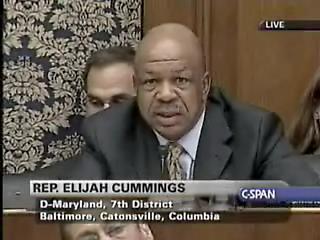
Cummings also asked Wilson to respond to the specific claim, made by Victoria Toensing and others, that Plame had lost her covert status because she “had not been stationed abroad within five years.” Cummings asked, “During the past five years, Ms. Plame, from today, did you conduct secret missions overseas?” She answered, “Yes I did, congressman.”
Watch it:
Transcript: expand post »
Filed under: Ethics, Administration
The Hearing's Revelations -- Why They Matter
UPDATE: Larry Johnson just told me that he will be a guest on Countdown with Keith Olbermann tonight to discuss the hearing. And, Howie In Seattle sent me a link to the video of the full session, at YouTube.
By SusanUnPC ... These are among the key revelations and facts that came out of today's hearing.
- General Michael Hayden, Director of the Central Intelligence Agency -- appointed twice to top positions by President George W. Bush -- stated for today's record that Valerie Plame Wilson's status as a CIA employee was "under cover" and that her employment was "classified information."
- Politics must not interfere with the vital business of intelligence agencies because the president must be able to make decisions about national security based on intelligence analysis that is unbiased.
- It is shocking that officials in the Bush administration carelessly batted about the name of a CIA employee without regard for her employment status or the confidentiality of her daily work.
- A long career was ruined in an instant after Bush administration officials calculatedly disclosed Valerie Plame Wilson's employment with the CIA in an attempt to discredit her husband's conclusions after his trip to Niger.
- The hearing provided further evidence that someone in Dick Cheney's office called a low-level CIA employee and put unprecedented pressure on him to get information about any Iraqi dealings with Niger, and it was that pressure that led to the CIA dispatching Ambassador Joseph Wilson to Niger. (Larry Johnson will have further insights on this point.)
1) General Michael Hayden, Director of the Central Intelligence Agency -- appointed twice to top positions by President George W. Bush -- stated for today's record that Valerie Plame Wilson's status as a CIA employee was "under cover" and that her employment was "classified information."
In his opening statement today, Rep. Henry Waxman (D-CA), Chairman of the House Oversight and Government Reform Committee, revealed that he had met personally with Gen. Hayden and discussed with Gen. Hayden what could and could not be revealed in the hearing. Rep. Waxman read this statement directly from Gen. Hayden:
During her employment at the CIA, Ms. Wilson was under cover.Her employment status with the CIA was classified information prohibited from disclosure under Executive Order 12958.
At the time of the publication of Robert Novak's column on July 14,2003, Ms. Wilson's CIA employment status was covert.
This was classified information.
Ms. Wilson served in senior management positions at the CIA, in which she oversaw the work of other CIA employees, and she attained the level of GS-14, step 6 under the federal pay scale.
Ms. Wilson worked on some of the most sensitive and highly secretive matters handled by the CIA.
Ms. Wilson served at various times overseas for the CIA.
Without discussing the specifics of Ms. W'ilson's classified work, it is accurate to say that she worked on the prevention of the development and use of weapons of mass destruction against the United States.
In her various positions at the CIA, Ms. Wilson faced significant risks to her personal safety and her life.
She took on serious risks on behalf of her country.
Ms. Wilson's work in many situations had consequences for the security of her colleagues, and maintaining her cover was critical to protecting the safety of both colleagues and others.
2) Politics must not interfere with the vital business of intelligence agencies because the president must be able to make decisions about national security based on intelligence analysis that is unbiased.
Valerie Plame Wilson, in her opening statement today, explained the essential need for intelligence analysis untainted by politics:
[T]estimony in the criminal trial of Vice President Cheney's former Chief of Staff, who has now been convicted of serious crimes, indicates that my exposure arose from purely political motives.Within the CIA, it is essential that all intelligence be evaluated on the basis of its merits and actual credibility. National security depends upon it. The tradecraft of intelligence is not a product of speculation. I feel passionately as an intelligence professional about the creeping, insidious politicizing of our intelligence process. All intelligence professionals are dedicated to the ideal that they would rather be fired on the spot than distort the facts to fit a political view. Any political view or any ideology.
As our intelligence agencies go through reorganizations and experience the painful aspects of change, and our country faces profound challenges, injecting partisanship or ideology into the equation makes effective and accurate intelligence that much more difficult to develop.
Politics and ideology must be stripped completely from our intelligence services or the consequences will be even more severe than they have been and our country placed in even greater danger.
It is imperative for any President to be able to make decisions based on intelligence that is unbiased. The Libby trial and the events leading to the Iraq War highlight the urgent need to restore the highest professional standards to intelligence collection and analysis and the protection of our officers and operations. The Congress has a Constitutional duty to defend our national security and that includes safeguarding our intelligence. That is why I am grateful for this opportunity to appear before this Committee today and to assist in its important work.
3) It is shocking that officials in the Bush administration carelessly batted about the name of a CIA employee without regard for her employment status or the confidentiality of her daily work.
Again, in her opening statement, Valerie Plame Wilson directly addressed the carelessness -- I would add the adjective venal to carelessness -- of members of the Bush administration -- all of whom had "signed oaths to protect national security secrets":
In the course of the trial of Vice President Cheney's former Chief of Staff, Scooter Libby, I was shocked at the evidence that emerged. My name and identity were carelessly and recklessly abused by senior government officials in both the White House and the State Department. All of them understood that I worked for the CIA, and having signed oaths to protect national security secrets, they should have been diligent in protecting me and every CIA officer. The CIA took great lengths to protect all of its employees, provided at significant taxpayer expense, painstakingly devised creative covers for its most sensitive staffers.The harm that is done when a CIA cover is blown is grave, but I can't provide details beyond that in this public hearing. But the concept is obvious. Not only have breaches of national security endangered CIA officers, it has jeopardized, even destroyed entire networks of foreign agents, who in turn risk their own lives and those of their families to provide the United States with needed intelligence. Lives are literally at stake. Every single one of my former CIA collegues, my fellow covert officers, to analysts to technical operations officers, even the secretaries, understand the vulnerabilities of our officers and recognize that the travesty of what happened to me could happen to them.
We in the CIA always know that we might be exposed and threatened by foreign enemies. It was a terrible irony that administration officials were the ones who destroyed my cover.
I would like to add this: We have a single instant case in which the identity of a CIA officer was outted by the administration. But what of the countless other CIA and other intelligence agency officers?
What concerns have all of those thousands of officers had -- since the day that Valerie Plame Wilson's cover was destroyed -- that they might meet the same fate if somehow they or one of their family members raised the ire of the Bush administration?
And what concerns have been raised for all of the thousands of contacts and "assets" of these intelligence officers, in all of the U.S. intelligence agencies? Are they nervous that their U.S. intelligence officer will have his or her work exposed for political reasons? Has this further chilled the vital dissemination of information heretofore exchanged under risky circumstances?
As Rep. Waxman said, based on his conference with Gen. Hayden:
Ms. Wilson's work in many situations had consequences for the security of her colleagues, and maintaining her cover was critical to protecting the safety of both colleagues and others.
That security is gone. That safety is gone. And who among the thousands of intelligence officers and their "assets" know who next might get the Bush administration "treatment" which destroys their security and their safety?
4) A long career was ruined in an instant after Bush administration officials calculatedly disclosed Valerie Plame Wilson's employment with the CIA in an attempt to discredit her husband's conclusions after his trip to Niger.
Valerie Plame Wilson no longer works for the Central Intelligence Agency. That fact tells the story. But her opening statement again reveals the loss to Mrs. Wilson of her career, and the loss to the American people of the product of her career work:
I worked on behalf of the national security of our country, on behalf of the people of the United States until my name and true affiliation were exposed in the national media on July 14, 2003, after a leak by administration officials. ...In the run-up to the war with Iraq, I worked in the Counter Proliferation Division of the CIA, still as a covert officer, whose affiliation with the CIA was classified. I raced to discover solid intelligence for senior policy makers on Iraq's presumed weapons of mass destruction programs. While I helped to manage and run secret worldwide operations against this WMD target from CIA headquarters in Washington, I also traveled to foreign countries on secret missions to find vital intelligence.
I love my career because I love my country. I was proud of the serious responsibilities entrusted to me as a CIA covert operations officer. ... [A]ll of my efforts on behalf of the national security of the United States, all of my training, all of the value of my years of service were abruptly ended when my name and identity were exposed irresponsibly.
Chairman Waxman went further:
The disclosure of Ms. Wilson's employment with the CLA had several serious effects.First, it terminated her covert job opportunities with CIA.
Second, it placed her professional contacts at greater risk.
And third, it undermined the trust and confidence with which future CIA employees and sources hold the United States.
This disclosure of Ms. Wilson's classified employment status with the CIA was so detrimental that the CIA filed a crimes report with the Department of Justice.
Before the Iraq War, I heard from former weapons inspector Scott Ritter and some far-left critics that Saddam Hussein had no WMDS (weapons of mass destruction). But I found it difficult to believe, back then, that Saddam Hussein had destroyed every remnant of his WMD programs -- that he, for instance, didn't at least have some aging chemical weapons lying around. It just didn't make sense, given what I knew of the Iraqi leader. (What I did know, back then, was that that even if he did have some WMDs, he wasn't an imminent threat to the United States, and that the U.S. should instead dedicate itself to eradicating the Al Qaeda terrorist network. And what I know now is that Saddam had a powerful reason for not revealing that he had no WMDs: He had to keep Iran, his fiercest regional enemy, in fear of his military might and future WMD attacks. The myth of his WMD program was Saddam's deterrent to attack from Iran.)
What I'm trying to say is this: I had no way, myself, of independently verifying the status of Saddam's WMD programs.
As an ordinary American citizen, I therefore relied -- and gave my confidence to -- the unknown-to-me intelligence officers who could concentrate full-time, with numerous secret assets, on determining the status of Saddam's WMD holdings.
Back then, I had no idea that there was a woman named Valerie Plame Wilson who was working constantly on ferreting out the facts about Saddam's WMD program -- facts that the president could assess rationally, beyond any political considerations.
I had no idea there was a woman named Valerie Plame Wilson who "helped to manage and run secret worldwide operations against this WMD target from CIA headquarters in Washington [and who] also traveled to foreign countries on secret missions to find vital intelligence."
But I assumed, as would any citizen, that there were intelligence officers hard at work on the issue.
I didn't need to know their names. I wouldn't want to know their names. But, if somehow I had learned their names and known what they did, I would have never -- ever -- revealed those identities to anyone. Why? Because it's old-fashioned "loose lips sink ships" common sense.
While it was an honor to hear her testimony today, I wish I had never heard of Valerie Plame Wilson. And I wish she were still doing her job. It sickens me that Bush administration officials, for the most base political reasons, destroyed the career of this woman who was doing the work I, and all of you, were counting on.
Each of us U.S. citizens pays these officers for that work. We entrust these officers to give our political leaders accurate information.
We further entrust our political leaders -- no matter their political party or particular ideological bents -- to assess intelligence data and analysis in an unbiased manner and to protect those intelligence officers and their assets who are devoting, and risking, their lives to provide and analyze raw data.
Otherwise, our nation would end up going to war for false reasons, and our military forces would die unnecessarily.
Otherwise, our standing among the nations of the world would be irrevocably threatened, and our nation, for the near and perhaps distant future, weakened and thereby endangered.
And we would be the "lonely America" -- with its weakened, politicized, watching-their-backs intelligence agencies and military forces -- plunged into a "spreading and deepening quagmire" that Zbigniew Brzezinski spoke of at a recent hearing of the Senate Foreign Relations Committee.
It mattered that Valerie Plame Wilson's identity was exposed for venal political purpose and her career destroyed.
It mattered for the sake of our national security.
Giving Aid and Comfort to the 'Enemy': the Plame Affair
Saturday, March 17, 2007
Giving Aid and Comfort to the Enemy: the Plame Affair
Valerie Plame Wilson, whose career Karl Rover and Vice President Dick Cheney wanted destroyed in a fit of pique, was finally allowed to testify before Congress on Friday. Some in the blogosphere are arguing that the outing of Plame Wilson was an impeachable offense.
Defenders of Rove and Cheney say that if they did not know that Valerie Plame Wilson was an undercover operative, then they did not break the law by trying to out her. But first of all, as high officials of the US government, they had a responsibility to excercise prudence in this regard. The "reasonably prudent person" is always invoked in tort trials, why not in national security affairs? Can anyone argue that Rove and Cheney were being prudent in their actions? Shouldn't they have to be to stay in office?
Moreover, they did know that Plame Wilson was involved in counter-proliferation efforts, including against Iran. By leaking her name with the intent that journalists such as Judy Miller publish it, they were conveying information about a CIA operation to Iran. That is high treason, even if they did not know she was covert. All they had to know is that she was trying to impede Iran's nuclear program, and that the Iranians did not know that that was what she was doing. You can't make her public without also letting the Iranians know. Here is what the Constitution says:
Article III, Section 3:
Treason against the United States, shall consist only in levying War against them, or in adhering to their Enemies, giving them Aid and Comfort. No person shall be convicted of Treason unless on the Testimony of two Witnesses to the same overt Act, or on Confession in open Court.
It aided and comforted Iran to know that Valerie Plame Wilson and her dummy CIA corporation, Brewster Jennings & Associates, had been engaged in counter-proliferation efforts against it. Bush put Iran in the Axis of Evil, thus declaring it an enemy of the US.
Therefore, Rove and Cheney (and maybe Bush himself) gave aid and comfort to an enemy of these United States by a deliberate act of outing a CIA operative who was not known to Iran and whose cover and activities had not been.
That's treason. That warrants impeachment.
Labels: Cheney, Impeachment, Plame, Rove
Friday, March 16, 2007
FULL TRANSCRIPT OF FIRST HALF OF CIA LEAK HEARING
Video: Valerie Plame's Before the Committee on Oversight and Government Reform
---
March 16, 2007
Before the Committee on Oversight and Government Reform:
REP. WAXMAN: (Sounds gavel.) The meeting of the committee will come to order.
Today the committee is holding a hearing to examine how the White House handles highly classified information. In June and July 2003, one of the nation's most carefully guarded secrets -- the identity of a covert CIA agent, Valerie Plame Wilson -- was repeatedly revealed by White House officials to members of the media. This was an extraordinarily serious breach of our national security. President George W. Bush's father, the former President Bush, said, and I quote, "I have nothing but contempt and anger for those who expose the names of our sources. They are, in my view, the most insidious of traitors," end quote.
Today we'll be asking three questions: One, how did such a serious violation of our national security occur?; two, did the White House take the appropriate investigative and disciplinary steps after the breach occurred?; and three, what changes in White House procedures are necessary to prevent future violations of national security from occurring?
For more than three years, a special prosecutor, Patrick Fitzgerald, has been investigating the leak for its criminal implications. By definition, Mr. Fitzgerald's investigation had an extremely narrow, criminal focus. It did not answer the broader policy questions raised by the release of Ms. Wilson's identity, nor did it seek to ascribe responsibility outside of the narrow confines of the criminal law.
As the chief investigative committee of the House of Representatives, our role is fundamentally different than Mr. Fitzgerald's. It's not our job to determine criminal culpability, but it is our job to understand what went wrong and to insist on accountability and to make recommendations for future -- to avoid future abuses. And we begin that process today.
This hearing is being conducted in open session. This is appropriate, but it is also challenging. Ms. Wilson was a covert employee of the CIA. We cannot discuss all of the details of her CIA employment in open session. I have met with -- personally with General Hayden, the head of the CIA, to discuss what I can and cannot say about Ms. Wilson's service. And I want to thank him for his cooperation and help in guiding us along these lines.
My staff has also worked with the agency to assure these remarks do not contain classified information. I have been advised by the CIA, and that even now -- after all that has happened -- I cannot disclose the full nature, scope and character of Ms. Wilson's service to our nation without causing serious damage to our national security interests. But General Hayden and the CIA have cleared these following comments for today's hearing.
During her employment at the CIA, Ms. Wilson was undercover. Her employment status with the CIA was classified information, prohibited from disclosure under Executive Order 12958. At the time of the publication of Robert Novak's column on July 14, 2003, Ms. Wilson's CIA employment status was covert. This was classified information. Ms. Wilson served in senior management positions at the CIA in which she oversaw the work for other CIA employees and she attained the level of GS-14 -- Step Six under the federal pay scale. Ms. Wilson worked on some of the most sensitive and highly secretive matters handled by the CIA. Ms. Wilson served at various times overseas for the CIA.
Without discussing the specifics of Ms. Wilson's classified work, it is accurate to say that she worked on the prevention of the development and use of weapons of mass destruction against the United States. In her various positions at the CIA, Ms. Wilson faced significant risks to her personal safety and her life. She took on serious risks on behalf of our country. Ms. Wilson's work in many situations had consequence for the security of her colleagues, and maintaining her cover was critical to protecting the safety of both colleagues and others.
The disclosure of Ms. Wilson's employment with the CIA had several serious affects. First, it terminated her covert job opportunities with the CIA. Second, it placed her professional contacts at greater risk. And third, it undermined the trust and confidence with which future CIA employees and sources hold the United States. This disclosure of Ms. Wilson's classified employment status with the CIA was so detrimental that the CIA filed a crimes report with the Department of Justice.
As I mentioned, Ms. Wilson's work was so sensitive that even now she is still prohibited from discussing many details of her work in public because of the continuing risks to CIA officials and assets in the field, and to the CIA's ongoing work. Some have suggested that Ms. Wilson did not have a sensitive position with the CIA or a position of unusual risk. As a CIA employee, Ms. Wilson has taken a lifelong oath to protect classified information, even after her CIA employment has ended. As a result, she cannot respond to most of the statements made about her.
I want to make clear, however, that any characterization that minimizes the personal risk of Ms. Wilson that she accepted in her assignments is flatly wrong. There should be no confusion on this point. Ms. Wilson has provided great service to our nation and has fulfilled her obligation to protect classified information admirably and we're confident she will uphold it again today.
Well, that concludes the characterizations that the CIA is permitting us to make today. But to these comments, I want to add a personal note. For many in politics, praising the troops and those who defend our freedom is second nature. Sometimes it's done in sincerity and sometimes it's done with cynicism, but almost always we don't really know who the people are. We don't know they're out -- we don't know who those people are that are out there. They are our abstract heroes whether they're serving in the armed services or whether they're serving in the CIA.
Two weeks ago this committee met some real heroes face to face when we went to visit Walter Reed. Every member was appalled at what we learned. Our treatment of the troops didn't match our rhetoric. Thankfully, Mrs. Wilson hasn't suffered physical harm and faces much more favorable circumstances now than some of the troops -- some of the soldiers that we met last week. But she too has been one of those people fighting to protect our freedom. And she, like thousands of others, were serving our country bravely and anonymously. She didn't ask that her identity be revealed, but it was, repeatedly, and that was an inexcusable breach of the responsibilities our country owes to her. Once again, our actions did not match our rhetoric.
I want to thank Mrs. Wilson for the tremendous service she gave to our country and recognize the remarkable personal sacrifices she and countless others have made to protect our national security. You and your colleagues perform truly heroic work and what happened to you not only should never have happened, but we should all work to make sure it never happens again. Thank you very much.
I want to yield to Mr. Davis, the ranking member of our committee. And in doing so, I want to thank him for his cooperation in this hearing. This has been a complicated hearing.
It's much more complicated than most of our hearings. We've had to decide what we could and what we couldn't say, what we could and couldn't ask, whether we're going to be an open session of closed session, et cetera and I want to thank Mr. Davis for the tremendous cooperation he's given us, and to recognize him at this time.
REP. TOM DAVIS (R-VA): Thank you, Chairman Waxman. I want to first start by congratulating you on the passage of important reform legislation this week. We adopted bipartisan bills crafted in this committee to strengthen the Freedom of Information Act, disclose donors to presidential libraries, expand access to presidential records and to fortify whistle-blower protections.
Given those accomplishments, it's ironic that we, on Sunshine Week -- the annual observance of open government -- with a more partisan hearing on how to best keep secrets. Let me state at the outset that the outing of Mrs. Wilson's identity was wrong, and we have every right to look at this and investigate it. But I have to confess I'm not sure what we're trying to accomplish today, given all the limitations that the chairman has just described that have put on us by the CIA. Ostensibly called to examine White House procedures for handling and protecting classified information, the hearing's lead witness never worked at the White House. If she knows about security practices there, she can't say much about them in a public forum. We do know that she worked at the CIA. That now-well-known fact raises some very different questions about how critical but difficult it is to protect the identity of individuals with covert status. But again, those are questions we probably can't say much about in a public forum without violating the very security safeguards the majority claims to be worried about at the White House.
Under these circumstances, perhaps, a hypothetical case is the best way to describe the futility of trying to enforce the Intelligence Identity Protection Act in this decidedly non-judicial venue. Let's say, for example, a member of a committee staff is told to identify a CIA witness for a hearing on security practices. He or she calls the agency and asks to speak with Official A. Official A's not in, so the call's routed to Official B, who identifies him or herself by name and title and answers the staffer's question. Thinking Official B would be a fine witness, the staff member then calls the Congressional Research Service or a friend at another committee to find out more about Official B. But Official B happens to be a covert agent. In passing the name, title and CIA affiliation around, has the staff member violated the law against disclosure? Probably not, but you'd have to be looking through a pretty thick political prism to see an unintentional unauthorized disclosure in that context.
And that happened. In the case of Mrs. Wilson, the majority stresses the fact the disclosure of her status triggered a crimes report by the CIA and the Justice Department. Allegations against White House officials and reporters were thoroughly vetted. But after spending six months and millions of dollars, the Special Council charged no one with the violations of the Intelligence Identities Protection Act. The lack of prosecution under the act shows those disclosures probably occurred in a similarly non-intentional context, lacking the requisite knowledge of covert status or the intention to disclose that status without authorization. No process can be adopted to protect classified information that no one knows is classified, just as no one can be prosecuted for unauthorized disclosure of information that no one ever said was protected.
So this looks to me more like a CIA problem than a White House problem. If the agency doesn't take sufficient precautions to protect the identity of those who engaged in covert work, no one else can do it for them. The same law meant to protect secret identities also requires an annual report to Congress on the steps taken to protect the highly sensitive information. But we're told few, if any, such reports exist from the CIA. Who knows what information needs to be protected and how they are told? Is there a list officials can check against? Do CIA briefers know when material given to executive branch officials references a covert agent, or are they cautioned not to repeat the name? How is it made known and to whom when the five-year protection period for a formerly covert agent has elapsed? Those are the questions that need to be asked about the safeguards on classified information. But we won't hear from the CIA today because this is an open forum.
Given all of that, I suspect we're going to probably waste some time talking about things we can't talk about, and that's unfortunate. Unfortunate an individual, possibly still under covert status, was publicly identified. Unfortunate executive branch officials got anywhere near this media maelstrom rather than focus on more serious problems. That's a disappointment to me. And unfortunate that this has become so politicized. On this side, we're not here to defend or attack anyone. In an open session, we hope to shed some sunshine on the workings of government. I have to say again I'm not sure that's going to happen today, but I thank our witnesses for trying.
Thank you.
REP. WAXMAN: Thank you very much, Mr. Davis.
Our first witness is Ms. Valerie Plame Wilson. She's a former covert CIA employee whose service to this country included work involving the prevention of the development and use of weapons of mass destruction against our nation. Her employment status was publicly disclosed in July 2003, effectively terminating her covert job opportunities within the CIA.
(The witness is sworn in.)
Before we begin the questioning period, I want to underscore to members of the committee that while it is important that Ms. Wilson have the opportunity to provide testimony that will help us understand the significance of the disclosure of her CIA employment status, we should not be seeking classified information from Ms. Wilson in this forum and we need to respect that she may, in some cases, have to decline to respond on the grounds that doing so would risk disclosure of sensitive information.
Ms. Wilson, we're pleased to have you here. Thank you very much for coming to our committee today, and I want to recognize you for an opening statement. There's a button on the base of the mike. Be sure to press it in and pull it closely enough to you so you can be heard.
MS. PLAME WILSON: Here we go.
REP. WAXMAN: Pull it a little closer.
MS. PLAME WILSON: Good morning, Mr. Chairman and members of the committee.
My name is Valerie Plame Wilson, and I am honored to have been invited to testify under oath before the Committee on Oversight and Government Reform on the critical issue of safeguarding classified information. I'm grateful for this opportunity to set the record straight.
I served the United States loyally and to the best of my ability as a covert operations officer for the Central Intelligence Agency. I worked on behalf of the national security of our country, on behalf of the people of the United States until my name and true affiliation were exposed in the national media on July 14th, 2003, after a leak by administration officials. Today I can tell this committee even more.
In the run-up to the war with Iraq, I worked in the Counterproliferation Division of the CIA, still as a covert officer whose affiliation with the CIA was classified. I raced to discover solid intelligence for senior policy makers on Iraq's presumed weapons of mass destruction program. While I helped to manage and run secret worldwide operations against this WMD target from CIA headquarters in Washington, I also traveled to foreign countries on secret missions to find vital intelligence. I loved my career because I love my country. I was proud of the serious responsibilities entrusted to me as a CIA covert operations officer, and I was dedicated to this work.
It was not common knowledge on the Georgetown cocktail circuit that everyone knew where I worked. But all of my efforts on behalf of the national security of the United States, all of my training, all of the value of my years of service were abruptly ended when my name and identity were exposed irresponsibly. In the course of the trial of Vice President Cheney's former chief of staff, Scooter Libby, I was shocked by the evidence that emerged. My name and identity were carelessly and recklessly abused by senior government officials in both the White House and the State Department. All of them understood that I worked for the CIA, and having signed oaths to protect national security secrets, they should have been diligent in protecting me and every CIA officer.
The CIA goes to great lengths to protect all of its employees, providing at significant taxpayers' expense painstakingly devised and creative covers for its most sensitive staffers. The harm that is done when a CIA cover is blown is grave, but I can't provide details beyond that in this public hearing. But the concept is obvious.
Not only have breaches of national security endangered CIA officers, it has jeopardized and even destroyed entire networks of foreign agents, who in turn risk their own lives and those of their families to provide the United States with needed intelligence. Lives are literally at stake.
Every single one of my former CIA colleagues -- from my fellow covert officers, to analysts, to technology operations officers, to even the secretaries -- understand the vulnerabilities of our officers, and recognize that the travesty of what happened to me could happen to them.
We in the CIA always know that we might be exposed and threatened by foreign enemies. It was a terrible irony that administration officials were the ones who destroyed my cover. Furthermore, testimony in the criminal trial of Vice President Cheney's former chief of staff, who has now been convicted of serious crimes, indicates that my exposure arose from purely political motives.
Within the CIA, it is essential that all intelligence be evaluated on the basis of its merits and actual credibility. National security depends upon it. The tradecraft of intelligence is not a product of speculation. I feel passionately, as an intelligence professional, about the creeping, insidious politicizing of our intelligence process. All intelligence professionals are dedicated to the idea that they would rather be fired on the spot than distort the facts to fit a political view -- any political view or any ideology.
As our intelligence agencies go through reorganizations and experience the painful aspects of change, and our country faces profound challenges, injecting partisanship or ideology into the equation makes effective and accurate intelligence that much more difficult to develop. Politics and ideology must be stripped completely from our intelligence services or the consequences will be even more severe than they have been, and our country placed in even greater danger.
It is imperative for any president to be able to make decisions based on intelligence that is unbiased. The Libby trial and the events leading to the Iraq war highlight the urgent need to restore the highest professional standards of intelligence collection and analysis, and the protection of our officers and operations. The Congress has a constitutional duty to defend our national security, and that includes safeguarding our intelligence.
That is why I'm grateful for this opportunity to appear before this committee today and to assist in its important work. Thank you. And I welcome any questions.
REP. WAXMAN: Thank you very much Ms. Wilson. We'll now proceed with 10 minutes on each side, managed by the chair and the ranking member of the committee. For our first round, I want to yield five minutes to the gentleman from Kentucky, Mr. Yarmuth, to begin the questioning.
REP. JOHN YARMUTH (D-KY): Thank you, Mr. Chairman. Thank you for being here today, Mrs. Wilson. Our country owes you a great debt of gratitude for your service, and I think you're continuing that service today by appearing.
I'd like to start by asking you about July 14, 2003, the day that Robert Novak wrote the column in the Chicago Sun Times identifying you as an agency operative on weapons of mass destruction. Quote -- but before I get to that, I want to ask you about the day before, July 13th, my understanding is that on that date, you were covert. Is that correct?
MS. PLAME WILSON: I was a covert officer, correct.
REP. YARMUTH: Without destroying - or disclosing classified information, what does covert mean?
MS. PLAME WILSON: I'm not a lawyer, but my understanding is that the CIA is taking affirmative steps to ensure that there is no links between the operations officer and the Central Intelligence Agency -- I mean, that's simple.
REP. YARMUTH: And you -- as you said -- and my understanding is that your work was classified for purposes of many of the regulations of the laws that we're talking about, your work was classified on that day, July 13th?
MS. PLAME WILSON: That's correct.
REP. YARMUTH: Did the July 14th column destroy your covert position and your classified status?
MS. PLAME WILSON: Yes it did. I could no longer perform the work for which I had been highly trained. I could no longer travel overseas or do the work for which -- my career, which I loved. It was done.
REP. YARMUTH: And my -- this may be a simplistic question, but the information that was disclosed in Robert Novak's column -- is it correct to say that that is information that you would not have disclosed yourself?
MS. PLAME WILSON: That is correct.
REP. YARMUTH: How did you react when you learned that your identity had been disclosed?
MS. PLAME WILSON: I found out very early in the morning when my husband came in and dropped the newspaper on the bed and said, "He did it." And I quickly turned and read the article and I felt like I had been hit in the gut. I -- it was over in an instant, and I immediately thought of my family's safety, the agents, the networks that I had worked with -- and everything goes through your mind in an instant.
REP. YARMUTH: What effect did the leak have on you professionally?
MS. PLAME WILSON: Professionally? Well, I could no longer do the work which I had been trained to do. There was -- after that, there was no way that you can serve overseas in a covert capacity, and so that career path was terminated.
REP. YARMUTH: Did the leak make you feel that your entire career had been thrown out the window, essentially -- to have been wasted at all?
MS. PLAME WILSON: Not wasted, but certainly terminated prematurely.
REP. YARMUTH: You've talked a little bit about your concern about the effect of the leak on your professional contacts. Did you have any contact with those people who were -- expressed their concern about the effect on their professional career?
MS. PLAME WILSON: No, I did not. But I do know the Agency did a damage assessment. They did not share it with me, but I know that certainly puts the people and the contacts I had all in jeopardy, even if they were completely innocent in nature.
REP. YARMUTH: And what effect do you think it had at the broadest level -- I'm talking about, you know, for future CIA employees and future sources?
MS. PLAME WILSON: I think it was -- it had a very negative effect. If our government cannot even protect my identity, future foreign agents who might consider working with the Central Intelligence Agency in providing needed intelligence would think twice, "Well, they can't even protect one of their own, how are they going to protect me?" As well as, the Agency is working very hard to attract highly talented young people into its ranks because we do have profound challenges facing our country today. And I can't think that that helped those efforts.
REP. YARMUTH: I can't see the clock, Mr. Chairman, I don't know whether my time is expired or not.
REP. WAXMAN: You have nine seconds.
REP. YARMUTH: Nine seconds. (Laughter.) Well, I'll yield back the balance of my seconds, Mr. Chairman, thank you. Thank you, Mrs. Wilson.
REP. WAXMAN: Thank you, Mr. Yarmuth. The chair would now like to yield time to Mr. Hodes, the gentleman from New Hampshire.
REP. PAUL HODES (D-N.H.): Thank you, Mr. Chairman. Mrs. Wilson, thank you for coming today.
What happened to you is deadly serious. You were the victim of a national security breach. If this was a law enforcement context, something I'm familiar with, it would be equivalent to disclosing the identity of an undercover police officer who has put his life on the line, and the lives of all those who help that officer.
Our job on this committee is to find out how the breach happened. Now, I'd like to show you a chart that we prepared on the committee -- you'll see it up on the screens, and we're putting it up here on paper. That chart is a graphic depiction of all the ways that your classified CIA employment was disclosed to White House officials and then to the press.
Every colored block on that chart is an individual, and every arrow shows a disclosure of classified information. That classified information was your CIA employment status. And the arrows are based on the testimony in Mr. Libby's criminal case and press reports. This chart shows over 20 different disclosures about your employment. Let me ask you, looking at this chart, are you surprised that so many people had access to the classified information about your CIA employment?
MS. PLAME WILSON: Yes, I am, Congressman. And I'm also surprised at how carelessly they used it.
REP. HODES: What was your expectation about how the government would handle the classified information about your work and status?
MS. PLAME WILSON: My expectation, Congressman, was that as of all CIA operations officers -- every officer serving undercover -- that senior government officials would protect our identity. We all take oaths to protect classified information and national security. So --
REP. HODES: Prior to the time that you learned that your status had been disclosed, you never authorized anyone to disclose your status, did you?
MS. PLAME WILSON: Absolutely not.
REP. HODES: And no one ever approached you and asked for permission to disclose any classified information about you.
MS. PLAME WILSON: No.
REP. HODES: Vice President Cheney never approached you and asked if he had your permission to disclose your status, did he?
MS. PLAME WILSON: No.
REP. HODES: Karl Rove never approached you and asked whether he had your permission to disclose your status, did he?
MS. PLAME WILSON: No.
REP. HODES: Now, this isn't even a complete picture because, as you can see on this chart, we don't know, for example, who told Karl Rove your status. There's a black box up there, and it says unknown. And there are two arrows from that, one pointing to Vice President Cheney and one pointing to Karl Rove. So, that's an unanswered question right now.
Now, I can imagine that you followed the proceedings in the press pretty closely over the past few years, have you not?
MS. PLAME WILSON: Yes.
REP. HODES: Do you have any theories about who told Karl Rove about your status?
MS. PLAME WILSON: No, I do not. There was much evidence introduced in the Libby trial that provides quite a bit, but I have no -- it would just be guesses.
REP. HODES: Well, that's what this committee's investigation is all about, following all the links in the chain from their sources to their destination. And it's been reported that Mr. Rove had a discussion with Chris Matthews about you, and the report was that Mr. Rove told Mr. Matthews, "Valerie Plame is fair game." Do you recall that?
MS. PLAME WILSON: Yes, I do.
REP. HODES: I'd like to ask you to forget for a moment that he was talking about you. Imagine that he was talking about another undercover agent working on sensitive issues. And that undercover agent's life was on the line. Do you have a reaction to that?
MS. PLAME WILSON: Absolutely. This happened to me, but I like to think I would feel just as passionately had it happened to any of my former colleagues of the CIA.
REP. HODES: One final question -- is there any circumstance that you can think of that would justify leaking the name of an undercover agent?
MS. PLAME WILSON: No, Congressman.
REP. HODES: Thank you very much. I yield back.
REP. WAXMAN: Thank you, Mr. Hodes.
Before we yield our time, we have a long list of people that seem to have either intentionally or inadvertently passed on your status and your name as a CIA agent, and that included the president, vice president, Scooter Libby, Karl Rove, Ari Fleischer just to name a few. Did any of those people -- the president, the vice president, Karl Rove, Scooter Libby, Ari Fleischer -- did any of them ever call you and apologize to you?
MS. PLAME WILSON: No, Chairman.
REP. WAXMAN: None of them ever called you to express regrets.
MS. PLAME WILSON: No.
REP. WAXMAN: Thank you.
Mr. Davis.
REP. DAVIS: Thank you.
Thank you, Mrs. Plame.
It's clear that the administration officials knew you worked for the CIA, but did they know that your status was that of a covert agent?
MS. PLAME WILSON: I have no way of knowing, but I can say I worked for the Counterproliferation Division of the Directorate of Operations. And while not all, many of the employees of that division are, in fact, in covert status.
REP. DAVIS: But you don't -- I mean, I think one of the issues here was not that you worked for the CIA, because that was obviously why they'd know you in the administration, but for the crime to have been committed, I understand they had to have known that you were covert. And you don't have any direct linkage that they knew that you were covert at that point.
MS. PLAME WILSON: Again, Congressman, I'm not a lawyer, but as I said at my --
REP. DAVIS: You don't have any direct knowledge that --
MS. PLAME WILSON: No.
REP. DAVIS: Okay.
MS. PLAME WILSON: But as I said in my opening comments, the fact that they knew that I worked for the CIA, that alone should have increased their level of diligence.
REP. DAVIS: I think -- look, we all agree that everybody needs to protect national security and protect the identities of undercover and covert agents. But should the CIA have done more to adequately protect people as well and say these are covert agents, shouldn't be outed? Does the CIA have a responsibility here as well?
MS. PLAME WILSON: I think that Congress might think about reviewing the Intelligence Identities Protection Act and seeing what went wrong and where it needs to be perhaps rewritten.
REP. DAVIS: I mean, it looked -- they're supposed to -- the CIA is supposed to report to Congress each year on the steps taken to protect this highly sensitive information. And I'm told few, if any, reports are even filed. So, I think there's a responsibility from the CIA. And I think what's missing, and I think -- at least from a criminal perspective -- not from a policy, but from a criminal perspective -- that the special prosecutor in this case looked at that and found that the people who may have been saying this didn't know that you were covert. And you don't have any evidence to the contrary.
MS. PLAME WILSON: That, I think, is a question better put to the special prosecutor, Congressman.
REP. DAVIS: Shouldn't the CIA have made sure that anyone who knew your name and your work be told of your status? Would that have been helpful in this case? That would have made it very clear if anybody leaked it at that point they were violating the law, at least.
MS. PLAME WILSON: The CIA does go to great lengths to create and protect all kinds of covers for its officers. There's a lot of money and a lot of time and a lot of energy that goes into that. And the onus also, the burden, falls on the officer himself or herself to live that cover, but it's not a perfect world.
REP. DAVIS: The Intelligence Identities Protection Act makes it a crime to knowingly disclose the identity of a covert agent, which has a specific definition under the act. Did anyone ever tell you that you were so designated?
MS. PLAME WILSON: I'm not a lawyer.
REP. DAVIS: That's why I asked if they told you. I'm not asking for your interpretation.
MS. PLAME WILSON: No, no. But I was covert. I did travel overseas on secret missions within the last five years.
REP. DAVIS: I'm not arguing with that. What I'm asking is, for purposes of the act -- and maybe this just never occurred to you or anybody else at the time -- but did anybody say that you were so designated under the act? Or was this just after it came to fact?
MS. PLAME WILSON: No, no one told me that. And that --
REP. DAVIS: How about after the disclosure?
MS. PLAME WILSON: Pardon me?
REP. DAVIS: How about after the disclosure, did anyone then say gee, you were designated under the act, this should not have happened? Did anybody in the CIA tell you at that point?
MS. PLAME WILSON: No.
REP. DAVIS: Okay. Since the disclosure of your identity, have you been offered other positions within the CIA?
MS. PLAME WILSON: Yes. I went on to other jobs with commensurate responsibility.
REP. DAVIS: No demotion or anything.
MS. PLAME WILSON: Pardon me?
REP. DAVIS: No, you didn't experience any demotion.
MS. PLAME WILSON: No.
REP. DAVIS: Did anyone at the CIA tell you your career path was damaged by the disclosure?
MS. PLAME WILSON: Yes.
REP. DAVIS: Now, you were a senior manager, GS-14 Step 6, eligible for GS-15 at the time. Did anyone ever tell you that you could not advance in a normal career path after this exposure?
MS. PLAME WILSON: It was very clear that I could not advance as a covert operations officer.
REP. DAVIS: And would that then -- your upward career path in terms of getting a GS-15 and then was impaired in your opinion?
MS. PLAME WILSON: No, but that was the career for which I had been trained, which I wanted to do.
My husband and I, after our children were born, discussed going overseas again when they were a little bit older. And all of that came to abrupt end, obviously.
REP. DAVIS: Do you know if any of the CIA colleagues -- like Robert Grenier, who testified at the Libby trial that he told administration officials that you were involved in sending your husband to Niger -- do you know if he ever told any of these officials you were undercover?
MS. PLAME WILSON: I have no idea, other than what he testified.
REP. DAVIS: Okay.
When you introduced yourself and your husband to the group of IC analysts at a February 19th, 2002 meeting at CIA headquarters, did you tell anybody present then you were undercover?
MS. PLAME WILSON: No, I did not. I was in CIA headquarters; I introduced them and left the meeting, Congressman.
REP. DAVIS: Okay.
Would they have known that you were -- would they have had any reason to know you were undercover, or --
MS. PLAME WILSON: I believe that they would have assumed as such.
REP. DAVIS: We're limited in what we can ask, so we're trying to stay within the confines that the CIA has --
MS. PLAME WILSON: I understand.
(Pause.)
REP. DAVIS: Let me just ask, try to put some -- some of the press speculation to rest and give you an opportunity to answer. In January 2004, Vanity Fair published an article -- not always known for great accuracy -- touching on your role in the Niger uranium affair. It said -- this was what they said -- "In early May, Wilson and Plame attended a conference sponsored by the Senate Democratic Policy Committee at which Wilson spoke about Iraq. One of the other panelists was New York Times journalist Nicholas Kristof. Over breakfast the next morning with Kristof and his wife, Wilson told about his trip to Niger and said Kristof could write about it but not name him." Is that account accurate?
MS. PLAME WILSON: I think it is. I had nothing -- I was not speaking to Mr. Kristof. And I think my husband did say that he had undertaken this trip, but not to be named as a source.
REP. DAVIS: Okay.
Just to be clear, when your -- the article says that -- says your husband "met for breakfast with Kristof and his wife." Just to be clear, were you at the breakfast?
MS. PLAME WILSON: Briefly, yes, Congressman.
REP. DAVIS: Okay.
On June 13th, Kristof wrote a column about the Niger uranium matter. He wrote that he was piecing the story together from two people directly involved and three others who were briefed on it. Do you know if you were one of those people he was referring to?
MS. PLAME WILSON: I can't imagine that I would be. I did not speak to him about it.
REP. DAVIS: Okay.
What about your husband? Would he have been one of the sources, probably?
MS. PLAME WILSON: I think he was speaking to Mr. Kristof at that point.
REP. DAVIS: Okay.
Was any of that information classified, to your knowledge?
MS. PLAME WILSON: Not that I'm aware of.
REP. DAVIS: I yield back at this point.
REP. WAXMAN: Thank you very much.
Mr. Cummings, for five minutes.
REP. ELIJAH E. CUMMINGS (D-MD): Thank you very much.
Ms. Wilson, first of all, thank you for your service.
Ms. Wilson, even today your work for the CIA is so highly classified that we're not permitted to discuss the details, but we can clarify one crucial point: whether you worked undercover for the CIA. You said that your position was covert, but I've heard others say that you were not covert. In fact, one of the witnesses who will testify a little bit later, Victoria Toensing, is making that same argument. In an op-ed that appeared in The Washington Post on February 18th, she says it quite bluntly. She says, quote, "Plame was not covert. She worked at CIA headquarters and had not been stationed abroad within five years." End of quote. I know there are restrictions on what you can say today, but is Ms. Toensing's statement correct?
MS. PLAME WILSON: Congressman, thank you for the opportunity. I know I'm here under oath and I'm here to say that I was a covert officer of the Central Intelligence Agency. Just like a general is a general whether he is in the field in Iraq or Afghanistan, when he comes back to the Pentagon, he's still a general. In the same way, covert operations officers who are serving in the field, when they rotate back for a temporary assignment in Washington, they, too, are still covert.
REP. CUMMINGS: Is it possible that Ms. Toensing had more information than you do about your work or had access to secret documents that you don't?
MS. PLAME WILSON: I would find that highly unlikely, Congressman, because much of that information about my career is still classified.
REP. CUMMINGS: On Wednesday night, I know that Mr. Waxman, our chair, and Congressman Reyes, the chairman of the House Intelligence Committee, spoke personally with General Hayden, the head of the CIA. And Chairman Waxman told me that General Hayden said clearly and directly, quote, "Ms. Wilson was covert," end of quote. There was no doubt about it. And by the way, the CIA has authorized us to be able to say that.
In addition, I understand that Chairman Waxman sent his opening statement over to the CIA to be cleared and to make sure that it was accurate. In it he said, quote, "Ms. Wilson was a covert employee of the CIA," end of quote. Quote, "Ms. Wilson was undercover," end of quote. The CIA cleared these statements. I emphasize all of this because I know that there are people who are still trying to suggest that -- that what seems absolutely clear isn't really true, and that you weren't covert. And I think one of the things we need to do in this hearing is make sure there isn't any ambiguity on this point.
Just three more questions. Do you hold this covert status at the time of the leak -- did you -- the covert status at the time of the leak?
MS. PLAME WILSON: Yes, I did, Congressman. Yes.
REP. CUMMINGS: Number two, the Identities Protection Act refers to travel outside the United States within the last five years. Let me ask you this question -- again, we don't want classified information, dates, locations or any other details -- during the past five years, Ms. Plame, from today, did you conduct secret missions overseas?
MS. PLAME WILSON: Yes, I did, Congressman.
REP. CUMMINGS: Finally, so as to be clear for the record, you were a covert CIA employee and within the past five years from today you went on secret missions outside the United States, is that correct?
MS. PLAME WILSON: That is correct, Congressman.
REP. CUMMINGS: I want to thank you, and I hope this committee now has cleared up the issue of covert -- of whether Ms. Plame was a covert agent, and I yield back.
REP. WAXMAN: Thank you very much, Mr. Cummings.
Dr. Westmoreland.
REP. LYNN A. WESTMORELAND (R-GA): Thank you, Mr. Chairman.
And I'm glad Mr. Cummings asked those questions because I was going to ask them too.
I've -- Ms. Wilson, I want to thank you for your service to our country. If I seem a little nervous, I've never questioned a spy before, and so I was going to ask you --
MS. PLAME WILSON: I've never testified -- (laughter) -- before.
REP. WESTMORELAND: I'm sorry?
MS. PLAME WILSON: I've never testified under oath before.
REP. WESTMORELAND: And I was here during the steroid hearings, too, and I don't think any of those baseball stars got this kind of media attention that you're getting today.
But when the chairman had his opening statements, he used three different terms -- "covert," "undercover" and "classified." Were you one of those in particular, or all of them? Or -- three different terms to categorize, I guess, your service to the country.
MS. PLAME WILSON: For those of us that were undercover in the CIA, we tended to use "covert" or "undercover" interchangeably. I'm not -- we typically would not say of ourselves we were in a "classified" position. You're kind of undercover or overt employees.
REP. WESTMORELAND: Now, did you just discuss this among yourself, if you were classified or covert? Because I'm assuming that you couldn't discuss it with anybody outside the agency, so was it kind of like you all sat around in a back room and said, "I'm covert," or "I'm classified," or if I was going to tell somebody what I would tell somebody?
MS. PLAME WILSON: Yes, within your colleagues, either in the field or at headquarters here in Washington, if you were working on a project, sometimes you did need to know, "Are you undercover or are you overt? Let me know so I --" and then you know how to treat them accordingly in the sense of how careful to be in your association and so forth.
REP. WESTMORELAND: Right. So your fellow CIA employees would have known that you were covert or classified or whatever?
MS. PLAME WILSON: Oh, absolutely. Absolutely.
REP. WESTMORELAND: Did you ever tell anyone that you worked for the CIA? Or was that commonly known that you worked for the CIA and -- or did you tell them that you were something else, or --
MS. PLAME WILSON: No.
Congressman, I could count on one hand the number of people who knew where my true employer was the day that I was -- my name was -- and true affiliation was exposed in July 2003.
REP. WESTMORELAND: Okay. And I'm assuming one of those was your husband.
MS. PLAME WILSON: That's -- yes. (Laughter.) He did know.
REP. WESTMORELAND: Did he know if you were covert or classified or --
MS. PLAME WILSON: He did understand. As a former ambassador and having held security clearances and worked with many agency employees, he understood that world to a certain point. And he certainly understood that I was undercover, and he protected that diligently.
REP. WESTMORELAND: Okay. If -- and this is the -- one last -- we're going to have another round of questions, Mr. Waxman, you think, or --
REP. WAXMAN: We do have some other panels. I guess if members wish them, we'll accommodate them.
REP. WESTMORELAND: Okay. I mean, do we have --
REP. WAXMAN: You have a minute and 48 seconds.
REP. WESTMORELAND: Okay. Ms. Plame, on October the 5th, 2003, while being interviewed on "Meet the Press," your husband stated that, "my wife will not allow ourselves to be photographed." In response to the picture you took for Vanity Fair, your husband was quoted in The Washington Post, "the pictures should not be able to identify her and are not supposed to. She is still employed by the CIA and has obligations to her employer. Was -- so I guess this was after the incident where everybody knew that you worked for the CIA that this was done?
MS. PLAME WILSON: Yes, Congressman. At the time that picture came out, I was -- my covert status was long gone. And I will say this: having lived most of my life very much under the radar, my learning curve was steep, and it was more trouble than it was worth.
REP. WESTMORELAND: But when the photograph was actually taken in Vanity Fair, nobody -- that was not -- that was not public knowledge? I mean, all of this was not out then? Or --
MS. PLAME WILSON: Oh -- Congressman, the picture came out in late 2003. My covert status was blown.
REP. WESTMORELAND: Okay. If your status was either covert or classified, and if you, in fact, meet with Senate Democratic Policy Committee, Mr. Kristoff, did you view it as part of your covert or classified work to meet with political groups and a columnist for The New York Times to discuss matters within your purview at the CIA? My -- you know, I don't know if you saw the list of things that we could or could not ask you. Did this Democratic Policy Committee and the columnist for The New York Times have these same rules that they could or could not ask you? Or did you volunteer other information?
MS. PLAME WILSON: Congressman, I attended that conference simply as a spouse of my husband who was invited to speak. He had been invited to speak because he had quite a bit of experience on Iraq, having served the first President Bush as the charge d'affair at our embassy in Baghdad during the first Gulf War, and negotiated the release of the hostages with Saddam Hussein and so forth.
And he was asked to attend in that capacity. I had no discussions other than purely social in nature.
REP. WAXMAN: Thank you, Mr. Westmoreland. Time has expired. Mr. Kucinich.
REP. DENIIS KUCINICH (D-OH): Thank you very much, Ms. Wilson, and thank you for your service to our country. Briefly, I want to pick up on my colleague, Mr. Hodes' questions. When you look at this chart, and you see the extraordinary efforts that were made to disclose your identity, when -- and most of this information came out of the Libby trial. What were you thinking when you saw the effort, this wasn't just a leak, was it? I mean, in your estimation. Was this just a simple leak of an ID?
MS. PLAME WILSON: Quite a bit of evidence came out in the course of the Libby trial, and I really was deeply dismayed. Because it just showed a recklessness and a political path that is very, very unfortunate.
REP. KUCINICH: In your judgment, when you look at the chart, does it show a fairly organized approach to disclose your identity?
MS. PLAME WILSON: Well, it's certainly wide-reaching.
REP. KUCINICH: Because Mr. Chairman, it's -- do leaks occur of agents' identity -- does it -- it does happen?
MS. PLAME WILSON: I'm sorry, Congressman.
REP. KUCINICH: Is it -- have there been in the past leaks of an agent's identity?
MS. PLAME WILSON: None that I'm aware of by their very own government.
REP. KUCINICH: And you have never, in your experience as an agent, seen this kind of a coordinated effort by one's own government, in this case our government, to disclose the identity of an agent.
MS. PLAME WILSON: No, Congressman, I'm not aware of any.
REP. KUCINICH: What -- to what extent does the agency go to, to protect the identities of its agents?
MS. PLAME WILSON: It's significant effort. And again, taxpayers' money, particularly in this day and age of Google and Internet, the efforts have to be even more vigilant and evermore creative, because it is extremely easy to find out a lot of information about someone if you really want to.
So, we are -- the CIA constantly needs to be one step ahead to protect their operations officers.
REP. KUCINICH: So, when there's an extraordinary effort made to disclose the identity of an agent, it is a -- it's destructive of the agency and it's destructive of the taxpayers' investment in the Central Intelligence Agency, is that not correct?
MS. PLAME WILSON: Absolutely.
REP. KUCINICH: And, one of the things that keeps running through my mind is why. Why did this happen to you? Was it an unintentional mistake? Or is it part of a larger pattern? In recent weeks, we've learned that U.S. attorneys in all parts of the country were fired, despite exemplary service. And several of these attorneys testified to Congress that they were being pressured to pursue cases against Democratic officials. Others believe that they were fired because they were pursuing cases against Republican officials.
Have you followed this issue?
MS. PLAME WILSON: Yes I have, Congressman.
REP. KUCINICH: And when I think about what happened to these attorneys, I can't help but think of your case, because these could be isolated instances, but they seem to be part of a larger pattern. Do you know what happened, for example, to the former Treasury Secretary, Mr. O'Neill, when he wrote his book, "The Price of Loyalty?"
MS. PLAME WILSON: Yes, I'm aware of that.
REP. KUCINICH: And after Secretary O'Neill that the Bush administration was planning to overthrow Saddam Hussein in a much earlier timeframe than anyone knew, Secretary O'Neill was falsely accused of leaking classified information. Did you know that Secretary O'Neill was investigated by the Treasury Department for a groundless accusation?
MS. PLAME WILSON: I believe I've read that, yes, sir.
REP. KUCINICH: Now, in another instance, General Shinseki warned that the United States would need several hundred thousand troops in Iraq. Ms. Wilson, do you remember what happened to General Shinseki?
MS. PLAME WILSON: Yes, I do, Congressman.
REP. KUCINICH: Well, he was dismissed.
MS. PLAME WILSON: He was asked --
REP. KUCINICH: I'm also reminded of the case of Richard Foster, the government's chief Medicare actuary. He was actually told he'd be fired if he told Congress the truth about how much the administration's proposed drug benefit would cost. Were you aware of that, Ms. Wilson?
MS. PLAME WILSON: Yes, I was.
REP. KUCINICH: Now, again, these could all be isolated instances, but they seem to be part of a larger pattern. And I'm struck by what your husband, Joe Wilson, was quoted as saying in the book, "Hubris." Now according to the book, here's a quote, "Joe Wilson was upset, and said he regarded the leak as a warning to others. Stories like this are not intended to intimate me, since I've already told my story. But it's pretty clearly intended to intimidate others who might come forward. You need only look at the stories of intelligent analysts who say they've been pressured. They may have kids in college. They may be vulnerable to these types of smears."
Is this what you think was going on here?
MS. PLAME WILSON: When you look at -- and I will speak only to the realm of intelligence and you have the politicizing of that. Certainly Vice President Cheney's unprecedented number of visits to CIA headquarters in the run up to the war might be one example.
REP. KUCINICH: That's exactly the point. What happens when someone's working at the agency level that people are working at when the vice president visits? The vice president of the United States comes over and starts looking over their shoulder. Is that intimidating?
MS. PLAME WILSON: Yes, it is.
REP. WAXMAN: Thank you, Mr. Kucinich. Your time has expired.
REP. KUCINICH: Thank you very much.
REP. WAXMAN: Ms. Watson.
REP. DIANE WATSON (D-CA): Mr. Chairman, I want to thank you for this hearing. It shows our determination to bring out in the open the malfeasance in office.
I am an ambassador. I've gone through the training. I've been blindfolded, put on a C-130, taken to a site, taken into a room with my colleagues -- just like "Galactica 3000" -- handed a red folder highly classified with a general standing over my shoulder. "Read it and give it back to me." Any information that came out of that folder and was made public had to come from two sources: The general or myself. I was the only woman in the room. The men, if their wives asked them, said, "I can tell you, but I have to kill you." So I'm very sensitive to how it works and I am furious that your classified information was -- and Robert Novak of all people!
Now, I'm going to ask you some questions. They might appear repetitive, but you're sworn and I want this for the record. Special Prosecutor Patrick Fitzgerald found that at the time of Robert Novak's July 14th, 2003 column, your employment status was classified and that your affiliation with the CIA was not common knowledge outside the intelligence community. The CIA has confirmed to this committee that at the time of Mr. Novak's article, your employment status was covert and that information was classified. But some people are still trying to minimize your service by suggesting you really weren't at risk and that your position was not classified because you worked at a desk job at the CIA headquarters at Langley, Virginia.
Let me give you an actual example: Representative Roy Blunt said on the television program "Face the Nation," "You know, this was a job that the ambassador's wife had that she went to every day. It was a desk job. I think many people in Washington understood that her employment was at the CIA and she went to that office every day."
Mrs. Wilson, is it fair to say that, based on your service for our government, you are well versed in the rules governing the handling of classified information?
MS. PLAME WILSON: Absolutely, Congresswoman. And I'd just like to add that when an operations officer -- whether they are posted in the field or back at headquarters -- we are given training to understand surveillance detection training so that we understand very carefully that we are not being followed and that we feel very comfortable that our status can be protected.
REP. WATSON: That is the reason why I started off with my own scenario.
Is it your understanding that the executive order governing the safeguarding of classified information prohibits the disclosure of classified information to persons who are not authorized to receive this information?
MS. PLAME WILSON: Yes.
REP. WATSON: Yes is the answer?
MS. PLAME WILSON: Yes. Yes, Congresswoman.
REP. WATSON: And is it your understanding that when an employee at the CIA is undercover, that individual's employment status at the CIA is considered classified information?
MS. PLAME WILSON: Yes, it is.
REP. WATSON: Are you aware of any "desk job" exception to the rules prohibiting the release of classified information on the employment status of a CIA employee?
MS. PLAME WILSON: No, Congresswoman.
REP. WATSON: All right. So I think your testimony underscores that efforts to minimize the significance of the disclosure of your employment status are in effect minimizing the importance of the classified information -- rules designed to protect our national security. And I am infuriated to continue to hear, "well, she just had a desk job," because I understand. I've been there, I've been -- I've had the training. And I want to thank you sincerely for the work that you have done in regards to the protection, homeland security and showing the love for this country.
Thank you very much.
MS. PLAME WILSON: Thank you, Congresswoman.
REP. WAXMAN: Thank you, Ms. Watson.
Mr. Lynch.
REP. STEPHEN LYNCH (D-MA): Thank you.
First of all, I want to thank you, Ms. Plame, for coming before this committee and helping us with our work and for your service to our country.
I have to say this hearing has been a long time in coming. The chairman and I and the members of this committee have signed five or six requests over the last four years to try to get you before us and to get to the bottom of this.
What has happened to you needs to be taken in a wider context, however. The two issues -- two of the major issues here: One, the process by which Congress receives information relative to national security. And as you know, your outing, if you will -- or the disclosure of your covert status -- was, I think, a deliberate attempt to discount the statements of your husband with respect to the supposed attempts by Saddam Hussein to purchase uranium or plutonium through Niger. And evidently from this chart, there were 20 occasions in which people deliberately, I think, attempted to destroy your credibility and also to destroy your effectiveness within the organization, within the CIA.
And I know you've been very careful with your words. Once or twice might be a careless disclosure. Five or six times might be reckless, but 20 times -- I'll say it -- 20 times is a deliberate attempt to destroy your status as a covert agent. And the only other major case in which we've had the outing of CIA agents -- the Supreme Court in Hague versus Agee said, "It is obvious and inarguable that no governmental interest is more compelling that the security of the nation."
And going to those couple of issues. First of all, the integrity of the process by which we get our information was affected greatly, I think, in terms of other agents may have been very disheartened and troubled by what happened to you. And in an effort to discount your husband's credibility, the question was raised -- and it's been continually raised -- of whether you were involved in the decision by the CIA to actually send your husband, Ambassador Joseph Wilson, to Niger in February of 2002 to obtain information on the allegations that Iraq sought uranium from Niger. They sort of said, "Oh, his wife sent him," like my wife sends me out to put out the trash. You know, try to discount the import of that -- at least I admit it.
Now, I want to ask you, the suggestion that you were involved in sending your husband seemed to drive the leaks in an effort to discount his credibility. I want to ask you now under oath: Did you make the decision to send Ambassador Wilson to Niger?
MS. PLAME WILSON: No. I did not recommend him, I did not suggest him, there was no nepotism involved -- I didn't have the authority. And Congressman, if you'll allow me briefly to just lay of the sequence of events -- (cross talk) --
REP. LYNCH: That was my next question, if you would. You know, I sort of doubted this. If I was going to send my wife somewhere, it wouldn't be Niger, but -- (laughter) -- nothing against Niger, but -- you know.
Please, if you could lay out -- walk us through everything you did that may have been related around the time of the decision to send Ambassador Wilson to Niger.
MS. PLAME WILSON: Thank you, Congressman. I'm delighted as well that I am under oath as I reply to you.
In February of 2002, a young junior officer who worked for me -- came to me very upset. She had just received a telephone call on her desk from someone -- I don't know who -- in the office of the vice- president asking about this report of this alleged sale of yellow cake uranium from Niger to Iraq. She came to me, and as she was telling me this -- what had just happened, someone passed by -- another officer heard this. He knew that Joe had already -- my husband -- had already gone on some CIA mission previously do deal with other nuclear matters. And he suggested, "Well why don't we send Joe?" He knew that Joe had many years of experience on the African continent. He also knew that he had served -- and served well and heroically in the Baghdad Embassy -- our embassy in Baghdad during the first Gulf War. And I will be honest. I had -- was somewhat ambivalent at the time. We had 2-year-old twins as home, and all I could envision was me by myself at bedtime with a couple of 2-year-olds. So I wasn't overjoyed with this idea. Nevertheless --
REP. LYNCH: I get it
MS. PLAME WILSON: We went to my branch chief, or supervisor. My colleague suggested this idea, and my supervisor turned to me and said, "Well, when you go home this evening, would you be willing to speak to your husband, ask him to come into headquarters next week and we'll discuss the options? See if this -- what we could do" Of course. And as I was leaving, he asked me to draft a quick e-mail to the chief of our Counterproliferation Division, letting him know that this was -- might happen. I said, "Of course," and it was that e- mail, Congressman, that was taken out of context and -- a portion of which you see in the Senate Select Committee on Intelligence Report of July 2004 that makes it seem as though I had suggested or recommended him.
REP. WAXMAN: Thank you, Mr. --
REP. LYNCH: Mr. Chairman, if I could just follow up, because -- it'll just -- 30 seconds.
REP. WAXMAN: Without objection.
REP. LYNCH: Thank you. And I want to go back to that Senate Intelligence Committee hearing. There were three Republican senators who included a more definitive statement which -- now this is a quote. It said, "The plan to send the former ambassador to Niger was suggested by the former ambassador's wife, a CIA employee." What is your reaction to that statement in the Senate report about the genesis of your husband's trip to Niger in 2002?
MS. PLAME WILSON: Congressman, it's incorrect. It's been borne out in the testimony during the Libby trial, and I can tell you that it just doesn't square with the facts.
REP. LYNCH: Okay.
MS. PLAME WILSON: Those additional views were written exclusively by three Republican senators.
REP. LYNCH: Thank you, Mr. Chairman. I yield back.
REP. WAXMAN: Thank you, Mr. Lynch.
Mr. Yarmuth.
REP. YARMUTH: Thank you. Mr. Chairman. I'm going to yield my time to Mr. Van Hollen.
REP. WAXMAN: Mr. Van Hollen's recognized for five minutes.
REP. CHRIS VAN HOLLEN (D-MD): Thank you very much, Mr. Yarmuth and Mr. Chairman.
Ms. Plame, thank you for your service to our country and for your testimony here today, and just to remind us all of the larger context in which this happened. In the lead-up to the war, we remember many statements from the president of the United States, the vice-president of the United States, Secretary of State Condoleezza Rice, others, about mushroom clouds, invoking the image that Saddam Hussein was going to be attaining nuclear weapons and using them in terrorist attacks. And so when Ambassador Wilson wrote his article in the New York Times that began with this statement, did the Bush administration manipulate intelligence about Saddam Hussein weapons programs to justify an invasion of Iraq and answered that question in the following sentence, "Based on my experience with the administration, the months leading up to the war, I have little choice but to conclude that some of the intelligence related to Iraq's nuclear weapons program was twisted to exaggerate the Iraqi threat."
That posed a direct threat to the administration's credibility, and clearly they understood the danger of that because it undercut one of the main underpinnings and justifications the administration gave for the war. And we see from the chart here that the White House did spring into action and begin to try and discredit your husband, and that is how you were drawn into this web. Mr. McClellan, the then- White House spokesman, said on behalf of the administration, behalf of the president, "If anyone in this administration was involved in it" -- meaning the leaks and the dissemination of information -- "they would no longer be in this administration." Do you believe there continue to be people -- individuals in this administration who were involved in leaking the information about you?
MS. PLAME WILSON: Yes, Congressman. As we know -- again, from the evidence that was introduced at the trial of the vice-president's former chief of staff -- for one, Karl Rove clearly was involved in the leaking of my name and he still carries a security clearance to this day despite the president's words to the contrary that he would immediately dismiss anyone who had anything to do with this.
---
March 16, 2007
Before the Committee on Oversight and Government Reform:
REP. WAXMAN: (Sounds gavel.) The meeting of the committee will come to order.
Today the committee is holding a hearing to examine how the White House handles highly classified information. In June and July 2003, one of the nation's most carefully guarded secrets -- the identity of a covert CIA agent, Valerie Plame Wilson -- was repeatedly revealed by White House officials to members of the media. This was an extraordinarily serious breach of our national security. President George W. Bush's father, the former President Bush, said, and I quote, "I have nothing but contempt and anger for those who expose the names of our sources. They are, in my view, the most insidious of traitors," end quote.
Today we'll be asking three questions: One, how did such a serious violation of our national security occur?; two, did the White House take the appropriate investigative and disciplinary steps after the breach occurred?; and three, what changes in White House procedures are necessary to prevent future violations of national security from occurring?
For more than three years, a special prosecutor, Patrick Fitzgerald, has been investigating the leak for its criminal implications. By definition, Mr. Fitzgerald's investigation had an extremely narrow, criminal focus. It did not answer the broader policy questions raised by the release of Ms. Wilson's identity, nor did it seek to ascribe responsibility outside of the narrow confines of the criminal law.
As the chief investigative committee of the House of Representatives, our role is fundamentally different than Mr. Fitzgerald's. It's not our job to determine criminal culpability, but it is our job to understand what went wrong and to insist on accountability and to make recommendations for future -- to avoid future abuses. And we begin that process today.
This hearing is being conducted in open session. This is appropriate, but it is also challenging. Ms. Wilson was a covert employee of the CIA. We cannot discuss all of the details of her CIA employment in open session. I have met with -- personally with General Hayden, the head of the CIA, to discuss what I can and cannot say about Ms. Wilson's service. And I want to thank him for his cooperation and help in guiding us along these lines.
My staff has also worked with the agency to assure these remarks do not contain classified information. I have been advised by the CIA, and that even now -- after all that has happened -- I cannot disclose the full nature, scope and character of Ms. Wilson's service to our nation without causing serious damage to our national security interests. But General Hayden and the CIA have cleared these following comments for today's hearing.
During her employment at the CIA, Ms. Wilson was undercover. Her employment status with the CIA was classified information, prohibited from disclosure under Executive Order 12958. At the time of the publication of Robert Novak's column on July 14, 2003, Ms. Wilson's CIA employment status was covert. This was classified information. Ms. Wilson served in senior management positions at the CIA in which she oversaw the work for other CIA employees and she attained the level of GS-14 -- Step Six under the federal pay scale. Ms. Wilson worked on some of the most sensitive and highly secretive matters handled by the CIA. Ms. Wilson served at various times overseas for the CIA.
Without discussing the specifics of Ms. Wilson's classified work, it is accurate to say that she worked on the prevention of the development and use of weapons of mass destruction against the United States. In her various positions at the CIA, Ms. Wilson faced significant risks to her personal safety and her life. She took on serious risks on behalf of our country. Ms. Wilson's work in many situations had consequence for the security of her colleagues, and maintaining her cover was critical to protecting the safety of both colleagues and others.
The disclosure of Ms. Wilson's employment with the CIA had several serious affects. First, it terminated her covert job opportunities with the CIA. Second, it placed her professional contacts at greater risk. And third, it undermined the trust and confidence with which future CIA employees and sources hold the United States. This disclosure of Ms. Wilson's classified employment status with the CIA was so detrimental that the CIA filed a crimes report with the Department of Justice.
As I mentioned, Ms. Wilson's work was so sensitive that even now she is still prohibited from discussing many details of her work in public because of the continuing risks to CIA officials and assets in the field, and to the CIA's ongoing work. Some have suggested that Ms. Wilson did not have a sensitive position with the CIA or a position of unusual risk. As a CIA employee, Ms. Wilson has taken a lifelong oath to protect classified information, even after her CIA employment has ended. As a result, she cannot respond to most of the statements made about her.
I want to make clear, however, that any characterization that minimizes the personal risk of Ms. Wilson that she accepted in her assignments is flatly wrong. There should be no confusion on this point. Ms. Wilson has provided great service to our nation and has fulfilled her obligation to protect classified information admirably and we're confident she will uphold it again today.
Well, that concludes the characterizations that the CIA is permitting us to make today. But to these comments, I want to add a personal note. For many in politics, praising the troops and those who defend our freedom is second nature. Sometimes it's done in sincerity and sometimes it's done with cynicism, but almost always we don't really know who the people are. We don't know they're out -- we don't know who those people are that are out there. They are our abstract heroes whether they're serving in the armed services or whether they're serving in the CIA.
Two weeks ago this committee met some real heroes face to face when we went to visit Walter Reed. Every member was appalled at what we learned. Our treatment of the troops didn't match our rhetoric. Thankfully, Mrs. Wilson hasn't suffered physical harm and faces much more favorable circumstances now than some of the troops -- some of the soldiers that we met last week. But she too has been one of those people fighting to protect our freedom. And she, like thousands of others, were serving our country bravely and anonymously. She didn't ask that her identity be revealed, but it was, repeatedly, and that was an inexcusable breach of the responsibilities our country owes to her. Once again, our actions did not match our rhetoric.
I want to thank Mrs. Wilson for the tremendous service she gave to our country and recognize the remarkable personal sacrifices she and countless others have made to protect our national security. You and your colleagues perform truly heroic work and what happened to you not only should never have happened, but we should all work to make sure it never happens again. Thank you very much.
I want to yield to Mr. Davis, the ranking member of our committee. And in doing so, I want to thank him for his cooperation in this hearing. This has been a complicated hearing.
It's much more complicated than most of our hearings. We've had to decide what we could and what we couldn't say, what we could and couldn't ask, whether we're going to be an open session of closed session, et cetera and I want to thank Mr. Davis for the tremendous cooperation he's given us, and to recognize him at this time.
REP. TOM DAVIS (R-VA): Thank you, Chairman Waxman. I want to first start by congratulating you on the passage of important reform legislation this week. We adopted bipartisan bills crafted in this committee to strengthen the Freedom of Information Act, disclose donors to presidential libraries, expand access to presidential records and to fortify whistle-blower protections.
Given those accomplishments, it's ironic that we, on Sunshine Week -- the annual observance of open government -- with a more partisan hearing on how to best keep secrets. Let me state at the outset that the outing of Mrs. Wilson's identity was wrong, and we have every right to look at this and investigate it. But I have to confess I'm not sure what we're trying to accomplish today, given all the limitations that the chairman has just described that have put on us by the CIA. Ostensibly called to examine White House procedures for handling and protecting classified information, the hearing's lead witness never worked at the White House. If she knows about security practices there, she can't say much about them in a public forum. We do know that she worked at the CIA. That now-well-known fact raises some very different questions about how critical but difficult it is to protect the identity of individuals with covert status. But again, those are questions we probably can't say much about in a public forum without violating the very security safeguards the majority claims to be worried about at the White House.
Under these circumstances, perhaps, a hypothetical case is the best way to describe the futility of trying to enforce the Intelligence Identity Protection Act in this decidedly non-judicial venue. Let's say, for example, a member of a committee staff is told to identify a CIA witness for a hearing on security practices. He or she calls the agency and asks to speak with Official A. Official A's not in, so the call's routed to Official B, who identifies him or herself by name and title and answers the staffer's question. Thinking Official B would be a fine witness, the staff member then calls the Congressional Research Service or a friend at another committee to find out more about Official B. But Official B happens to be a covert agent. In passing the name, title and CIA affiliation around, has the staff member violated the law against disclosure? Probably not, but you'd have to be looking through a pretty thick political prism to see an unintentional unauthorized disclosure in that context.
And that happened. In the case of Mrs. Wilson, the majority stresses the fact the disclosure of her status triggered a crimes report by the CIA and the Justice Department. Allegations against White House officials and reporters were thoroughly vetted. But after spending six months and millions of dollars, the Special Council charged no one with the violations of the Intelligence Identities Protection Act. The lack of prosecution under the act shows those disclosures probably occurred in a similarly non-intentional context, lacking the requisite knowledge of covert status or the intention to disclose that status without authorization. No process can be adopted to protect classified information that no one knows is classified, just as no one can be prosecuted for unauthorized disclosure of information that no one ever said was protected.
So this looks to me more like a CIA problem than a White House problem. If the agency doesn't take sufficient precautions to protect the identity of those who engaged in covert work, no one else can do it for them. The same law meant to protect secret identities also requires an annual report to Congress on the steps taken to protect the highly sensitive information. But we're told few, if any, such reports exist from the CIA. Who knows what information needs to be protected and how they are told? Is there a list officials can check against? Do CIA briefers know when material given to executive branch officials references a covert agent, or are they cautioned not to repeat the name? How is it made known and to whom when the five-year protection period for a formerly covert agent has elapsed? Those are the questions that need to be asked about the safeguards on classified information. But we won't hear from the CIA today because this is an open forum.
Given all of that, I suspect we're going to probably waste some time talking about things we can't talk about, and that's unfortunate. Unfortunate an individual, possibly still under covert status, was publicly identified. Unfortunate executive branch officials got anywhere near this media maelstrom rather than focus on more serious problems. That's a disappointment to me. And unfortunate that this has become so politicized. On this side, we're not here to defend or attack anyone. In an open session, we hope to shed some sunshine on the workings of government. I have to say again I'm not sure that's going to happen today, but I thank our witnesses for trying.
Thank you.
REP. WAXMAN: Thank you very much, Mr. Davis.
Our first witness is Ms. Valerie Plame Wilson. She's a former covert CIA employee whose service to this country included work involving the prevention of the development and use of weapons of mass destruction against our nation. Her employment status was publicly disclosed in July 2003, effectively terminating her covert job opportunities within the CIA.
(The witness is sworn in.)
Before we begin the questioning period, I want to underscore to members of the committee that while it is important that Ms. Wilson have the opportunity to provide testimony that will help us understand the significance of the disclosure of her CIA employment status, we should not be seeking classified information from Ms. Wilson in this forum and we need to respect that she may, in some cases, have to decline to respond on the grounds that doing so would risk disclosure of sensitive information.
Ms. Wilson, we're pleased to have you here. Thank you very much for coming to our committee today, and I want to recognize you for an opening statement. There's a button on the base of the mike. Be sure to press it in and pull it closely enough to you so you can be heard.
MS. PLAME WILSON: Here we go.
REP. WAXMAN: Pull it a little closer.
MS. PLAME WILSON: Good morning, Mr. Chairman and members of the committee.
My name is Valerie Plame Wilson, and I am honored to have been invited to testify under oath before the Committee on Oversight and Government Reform on the critical issue of safeguarding classified information. I'm grateful for this opportunity to set the record straight.
I served the United States loyally and to the best of my ability as a covert operations officer for the Central Intelligence Agency. I worked on behalf of the national security of our country, on behalf of the people of the United States until my name and true affiliation were exposed in the national media on July 14th, 2003, after a leak by administration officials. Today I can tell this committee even more.
In the run-up to the war with Iraq, I worked in the Counterproliferation Division of the CIA, still as a covert officer whose affiliation with the CIA was classified. I raced to discover solid intelligence for senior policy makers on Iraq's presumed weapons of mass destruction program. While I helped to manage and run secret worldwide operations against this WMD target from CIA headquarters in Washington, I also traveled to foreign countries on secret missions to find vital intelligence. I loved my career because I love my country. I was proud of the serious responsibilities entrusted to me as a CIA covert operations officer, and I was dedicated to this work.
It was not common knowledge on the Georgetown cocktail circuit that everyone knew where I worked. But all of my efforts on behalf of the national security of the United States, all of my training, all of the value of my years of service were abruptly ended when my name and identity were exposed irresponsibly. In the course of the trial of Vice President Cheney's former chief of staff, Scooter Libby, I was shocked by the evidence that emerged. My name and identity were carelessly and recklessly abused by senior government officials in both the White House and the State Department. All of them understood that I worked for the CIA, and having signed oaths to protect national security secrets, they should have been diligent in protecting me and every CIA officer.
The CIA goes to great lengths to protect all of its employees, providing at significant taxpayers' expense painstakingly devised and creative covers for its most sensitive staffers. The harm that is done when a CIA cover is blown is grave, but I can't provide details beyond that in this public hearing. But the concept is obvious.
Not only have breaches of national security endangered CIA officers, it has jeopardized and even destroyed entire networks of foreign agents, who in turn risk their own lives and those of their families to provide the United States with needed intelligence. Lives are literally at stake.
Every single one of my former CIA colleagues -- from my fellow covert officers, to analysts, to technology operations officers, to even the secretaries -- understand the vulnerabilities of our officers, and recognize that the travesty of what happened to me could happen to them.
We in the CIA always know that we might be exposed and threatened by foreign enemies. It was a terrible irony that administration officials were the ones who destroyed my cover. Furthermore, testimony in the criminal trial of Vice President Cheney's former chief of staff, who has now been convicted of serious crimes, indicates that my exposure arose from purely political motives.
Within the CIA, it is essential that all intelligence be evaluated on the basis of its merits and actual credibility. National security depends upon it. The tradecraft of intelligence is not a product of speculation. I feel passionately, as an intelligence professional, about the creeping, insidious politicizing of our intelligence process. All intelligence professionals are dedicated to the idea that they would rather be fired on the spot than distort the facts to fit a political view -- any political view or any ideology.
As our intelligence agencies go through reorganizations and experience the painful aspects of change, and our country faces profound challenges, injecting partisanship or ideology into the equation makes effective and accurate intelligence that much more difficult to develop. Politics and ideology must be stripped completely from our intelligence services or the consequences will be even more severe than they have been, and our country placed in even greater danger.
It is imperative for any president to be able to make decisions based on intelligence that is unbiased. The Libby trial and the events leading to the Iraq war highlight the urgent need to restore the highest professional standards of intelligence collection and analysis, and the protection of our officers and operations. The Congress has a constitutional duty to defend our national security, and that includes safeguarding our intelligence.
That is why I'm grateful for this opportunity to appear before this committee today and to assist in its important work. Thank you. And I welcome any questions.
REP. WAXMAN: Thank you very much Ms. Wilson. We'll now proceed with 10 minutes on each side, managed by the chair and the ranking member of the committee. For our first round, I want to yield five minutes to the gentleman from Kentucky, Mr. Yarmuth, to begin the questioning.
REP. JOHN YARMUTH (D-KY): Thank you, Mr. Chairman. Thank you for being here today, Mrs. Wilson. Our country owes you a great debt of gratitude for your service, and I think you're continuing that service today by appearing.
I'd like to start by asking you about July 14, 2003, the day that Robert Novak wrote the column in the Chicago Sun Times identifying you as an agency operative on weapons of mass destruction. Quote -- but before I get to that, I want to ask you about the day before, July 13th, my understanding is that on that date, you were covert. Is that correct?
MS. PLAME WILSON: I was a covert officer, correct.
REP. YARMUTH: Without destroying - or disclosing classified information, what does covert mean?
MS. PLAME WILSON: I'm not a lawyer, but my understanding is that the CIA is taking affirmative steps to ensure that there is no links between the operations officer and the Central Intelligence Agency -- I mean, that's simple.
REP. YARMUTH: And you -- as you said -- and my understanding is that your work was classified for purposes of many of the regulations of the laws that we're talking about, your work was classified on that day, July 13th?
MS. PLAME WILSON: That's correct.
REP. YARMUTH: Did the July 14th column destroy your covert position and your classified status?
MS. PLAME WILSON: Yes it did. I could no longer perform the work for which I had been highly trained. I could no longer travel overseas or do the work for which -- my career, which I loved. It was done.
REP. YARMUTH: And my -- this may be a simplistic question, but the information that was disclosed in Robert Novak's column -- is it correct to say that that is information that you would not have disclosed yourself?
MS. PLAME WILSON: That is correct.
REP. YARMUTH: How did you react when you learned that your identity had been disclosed?
MS. PLAME WILSON: I found out very early in the morning when my husband came in and dropped the newspaper on the bed and said, "He did it." And I quickly turned and read the article and I felt like I had been hit in the gut. I -- it was over in an instant, and I immediately thought of my family's safety, the agents, the networks that I had worked with -- and everything goes through your mind in an instant.
REP. YARMUTH: What effect did the leak have on you professionally?
MS. PLAME WILSON: Professionally? Well, I could no longer do the work which I had been trained to do. There was -- after that, there was no way that you can serve overseas in a covert capacity, and so that career path was terminated.
REP. YARMUTH: Did the leak make you feel that your entire career had been thrown out the window, essentially -- to have been wasted at all?
MS. PLAME WILSON: Not wasted, but certainly terminated prematurely.
REP. YARMUTH: You've talked a little bit about your concern about the effect of the leak on your professional contacts. Did you have any contact with those people who were -- expressed their concern about the effect on their professional career?
MS. PLAME WILSON: No, I did not. But I do know the Agency did a damage assessment. They did not share it with me, but I know that certainly puts the people and the contacts I had all in jeopardy, even if they were completely innocent in nature.
REP. YARMUTH: And what effect do you think it had at the broadest level -- I'm talking about, you know, for future CIA employees and future sources?
MS. PLAME WILSON: I think it was -- it had a very negative effect. If our government cannot even protect my identity, future foreign agents who might consider working with the Central Intelligence Agency in providing needed intelligence would think twice, "Well, they can't even protect one of their own, how are they going to protect me?" As well as, the Agency is working very hard to attract highly talented young people into its ranks because we do have profound challenges facing our country today. And I can't think that that helped those efforts.
REP. YARMUTH: I can't see the clock, Mr. Chairman, I don't know whether my time is expired or not.
REP. WAXMAN: You have nine seconds.
REP. YARMUTH: Nine seconds. (Laughter.) Well, I'll yield back the balance of my seconds, Mr. Chairman, thank you. Thank you, Mrs. Wilson.
REP. WAXMAN: Thank you, Mr. Yarmuth. The chair would now like to yield time to Mr. Hodes, the gentleman from New Hampshire.
REP. PAUL HODES (D-N.H.): Thank you, Mr. Chairman. Mrs. Wilson, thank you for coming today.
What happened to you is deadly serious. You were the victim of a national security breach. If this was a law enforcement context, something I'm familiar with, it would be equivalent to disclosing the identity of an undercover police officer who has put his life on the line, and the lives of all those who help that officer.
Our job on this committee is to find out how the breach happened. Now, I'd like to show you a chart that we prepared on the committee -- you'll see it up on the screens, and we're putting it up here on paper. That chart is a graphic depiction of all the ways that your classified CIA employment was disclosed to White House officials and then to the press.
Every colored block on that chart is an individual, and every arrow shows a disclosure of classified information. That classified information was your CIA employment status. And the arrows are based on the testimony in Mr. Libby's criminal case and press reports. This chart shows over 20 different disclosures about your employment. Let me ask you, looking at this chart, are you surprised that so many people had access to the classified information about your CIA employment?
MS. PLAME WILSON: Yes, I am, Congressman. And I'm also surprised at how carelessly they used it.
REP. HODES: What was your expectation about how the government would handle the classified information about your work and status?
MS. PLAME WILSON: My expectation, Congressman, was that as of all CIA operations officers -- every officer serving undercover -- that senior government officials would protect our identity. We all take oaths to protect classified information and national security. So --
REP. HODES: Prior to the time that you learned that your status had been disclosed, you never authorized anyone to disclose your status, did you?
MS. PLAME WILSON: Absolutely not.
REP. HODES: And no one ever approached you and asked for permission to disclose any classified information about you.
MS. PLAME WILSON: No.
REP. HODES: Vice President Cheney never approached you and asked if he had your permission to disclose your status, did he?
MS. PLAME WILSON: No.
REP. HODES: Karl Rove never approached you and asked whether he had your permission to disclose your status, did he?
MS. PLAME WILSON: No.
REP. HODES: Now, this isn't even a complete picture because, as you can see on this chart, we don't know, for example, who told Karl Rove your status. There's a black box up there, and it says unknown. And there are two arrows from that, one pointing to Vice President Cheney and one pointing to Karl Rove. So, that's an unanswered question right now.
Now, I can imagine that you followed the proceedings in the press pretty closely over the past few years, have you not?
MS. PLAME WILSON: Yes.
REP. HODES: Do you have any theories about who told Karl Rove about your status?
MS. PLAME WILSON: No, I do not. There was much evidence introduced in the Libby trial that provides quite a bit, but I have no -- it would just be guesses.
REP. HODES: Well, that's what this committee's investigation is all about, following all the links in the chain from their sources to their destination. And it's been reported that Mr. Rove had a discussion with Chris Matthews about you, and the report was that Mr. Rove told Mr. Matthews, "Valerie Plame is fair game." Do you recall that?
MS. PLAME WILSON: Yes, I do.
REP. HODES: I'd like to ask you to forget for a moment that he was talking about you. Imagine that he was talking about another undercover agent working on sensitive issues. And that undercover agent's life was on the line. Do you have a reaction to that?
MS. PLAME WILSON: Absolutely. This happened to me, but I like to think I would feel just as passionately had it happened to any of my former colleagues of the CIA.
REP. HODES: One final question -- is there any circumstance that you can think of that would justify leaking the name of an undercover agent?
MS. PLAME WILSON: No, Congressman.
REP. HODES: Thank you very much. I yield back.
REP. WAXMAN: Thank you, Mr. Hodes.
Before we yield our time, we have a long list of people that seem to have either intentionally or inadvertently passed on your status and your name as a CIA agent, and that included the president, vice president, Scooter Libby, Karl Rove, Ari Fleischer just to name a few. Did any of those people -- the president, the vice president, Karl Rove, Scooter Libby, Ari Fleischer -- did any of them ever call you and apologize to you?
MS. PLAME WILSON: No, Chairman.
REP. WAXMAN: None of them ever called you to express regrets.
MS. PLAME WILSON: No.
REP. WAXMAN: Thank you.
Mr. Davis.
REP. DAVIS: Thank you.
Thank you, Mrs. Plame.
It's clear that the administration officials knew you worked for the CIA, but did they know that your status was that of a covert agent?
MS. PLAME WILSON: I have no way of knowing, but I can say I worked for the Counterproliferation Division of the Directorate of Operations. And while not all, many of the employees of that division are, in fact, in covert status.
REP. DAVIS: But you don't -- I mean, I think one of the issues here was not that you worked for the CIA, because that was obviously why they'd know you in the administration, but for the crime to have been committed, I understand they had to have known that you were covert. And you don't have any direct linkage that they knew that you were covert at that point.
MS. PLAME WILSON: Again, Congressman, I'm not a lawyer, but as I said at my --
REP. DAVIS: You don't have any direct knowledge that --
MS. PLAME WILSON: No.
REP. DAVIS: Okay.
MS. PLAME WILSON: But as I said in my opening comments, the fact that they knew that I worked for the CIA, that alone should have increased their level of diligence.
REP. DAVIS: I think -- look, we all agree that everybody needs to protect national security and protect the identities of undercover and covert agents. But should the CIA have done more to adequately protect people as well and say these are covert agents, shouldn't be outed? Does the CIA have a responsibility here as well?
MS. PLAME WILSON: I think that Congress might think about reviewing the Intelligence Identities Protection Act and seeing what went wrong and where it needs to be perhaps rewritten.
REP. DAVIS: I mean, it looked -- they're supposed to -- the CIA is supposed to report to Congress each year on the steps taken to protect this highly sensitive information. And I'm told few, if any, reports are even filed. So, I think there's a responsibility from the CIA. And I think what's missing, and I think -- at least from a criminal perspective -- not from a policy, but from a criminal perspective -- that the special prosecutor in this case looked at that and found that the people who may have been saying this didn't know that you were covert. And you don't have any evidence to the contrary.
MS. PLAME WILSON: That, I think, is a question better put to the special prosecutor, Congressman.
REP. DAVIS: Shouldn't the CIA have made sure that anyone who knew your name and your work be told of your status? Would that have been helpful in this case? That would have made it very clear if anybody leaked it at that point they were violating the law, at least.
MS. PLAME WILSON: The CIA does go to great lengths to create and protect all kinds of covers for its officers. There's a lot of money and a lot of time and a lot of energy that goes into that. And the onus also, the burden, falls on the officer himself or herself to live that cover, but it's not a perfect world.
REP. DAVIS: The Intelligence Identities Protection Act makes it a crime to knowingly disclose the identity of a covert agent, which has a specific definition under the act. Did anyone ever tell you that you were so designated?
MS. PLAME WILSON: I'm not a lawyer.
REP. DAVIS: That's why I asked if they told you. I'm not asking for your interpretation.
MS. PLAME WILSON: No, no. But I was covert. I did travel overseas on secret missions within the last five years.
REP. DAVIS: I'm not arguing with that. What I'm asking is, for purposes of the act -- and maybe this just never occurred to you or anybody else at the time -- but did anybody say that you were so designated under the act? Or was this just after it came to fact?
MS. PLAME WILSON: No, no one told me that. And that --
REP. DAVIS: How about after the disclosure?
MS. PLAME WILSON: Pardon me?
REP. DAVIS: How about after the disclosure, did anyone then say gee, you were designated under the act, this should not have happened? Did anybody in the CIA tell you at that point?
MS. PLAME WILSON: No.
REP. DAVIS: Okay. Since the disclosure of your identity, have you been offered other positions within the CIA?
MS. PLAME WILSON: Yes. I went on to other jobs with commensurate responsibility.
REP. DAVIS: No demotion or anything.
MS. PLAME WILSON: Pardon me?
REP. DAVIS: No, you didn't experience any demotion.
MS. PLAME WILSON: No.
REP. DAVIS: Did anyone at the CIA tell you your career path was damaged by the disclosure?
MS. PLAME WILSON: Yes.
REP. DAVIS: Now, you were a senior manager, GS-14 Step 6, eligible for GS-15 at the time. Did anyone ever tell you that you could not advance in a normal career path after this exposure?
MS. PLAME WILSON: It was very clear that I could not advance as a covert operations officer.
REP. DAVIS: And would that then -- your upward career path in terms of getting a GS-15 and then was impaired in your opinion?
MS. PLAME WILSON: No, but that was the career for which I had been trained, which I wanted to do.
My husband and I, after our children were born, discussed going overseas again when they were a little bit older. And all of that came to abrupt end, obviously.
REP. DAVIS: Do you know if any of the CIA colleagues -- like Robert Grenier, who testified at the Libby trial that he told administration officials that you were involved in sending your husband to Niger -- do you know if he ever told any of these officials you were undercover?
MS. PLAME WILSON: I have no idea, other than what he testified.
REP. DAVIS: Okay.
When you introduced yourself and your husband to the group of IC analysts at a February 19th, 2002 meeting at CIA headquarters, did you tell anybody present then you were undercover?
MS. PLAME WILSON: No, I did not. I was in CIA headquarters; I introduced them and left the meeting, Congressman.
REP. DAVIS: Okay.
Would they have known that you were -- would they have had any reason to know you were undercover, or --
MS. PLAME WILSON: I believe that they would have assumed as such.
REP. DAVIS: We're limited in what we can ask, so we're trying to stay within the confines that the CIA has --
MS. PLAME WILSON: I understand.
(Pause.)
REP. DAVIS: Let me just ask, try to put some -- some of the press speculation to rest and give you an opportunity to answer. In January 2004, Vanity Fair published an article -- not always known for great accuracy -- touching on your role in the Niger uranium affair. It said -- this was what they said -- "In early May, Wilson and Plame attended a conference sponsored by the Senate Democratic Policy Committee at which Wilson spoke about Iraq. One of the other panelists was New York Times journalist Nicholas Kristof. Over breakfast the next morning with Kristof and his wife, Wilson told about his trip to Niger and said Kristof could write about it but not name him." Is that account accurate?
MS. PLAME WILSON: I think it is. I had nothing -- I was not speaking to Mr. Kristof. And I think my husband did say that he had undertaken this trip, but not to be named as a source.
REP. DAVIS: Okay.
Just to be clear, when your -- the article says that -- says your husband "met for breakfast with Kristof and his wife." Just to be clear, were you at the breakfast?
MS. PLAME WILSON: Briefly, yes, Congressman.
REP. DAVIS: Okay.
On June 13th, Kristof wrote a column about the Niger uranium matter. He wrote that he was piecing the story together from two people directly involved and three others who were briefed on it. Do you know if you were one of those people he was referring to?
MS. PLAME WILSON: I can't imagine that I would be. I did not speak to him about it.
REP. DAVIS: Okay.
What about your husband? Would he have been one of the sources, probably?
MS. PLAME WILSON: I think he was speaking to Mr. Kristof at that point.
REP. DAVIS: Okay.
Was any of that information classified, to your knowledge?
MS. PLAME WILSON: Not that I'm aware of.
REP. DAVIS: I yield back at this point.
REP. WAXMAN: Thank you very much.
Mr. Cummings, for five minutes.
REP. ELIJAH E. CUMMINGS (D-MD): Thank you very much.
Ms. Wilson, first of all, thank you for your service.
Ms. Wilson, even today your work for the CIA is so highly classified that we're not permitted to discuss the details, but we can clarify one crucial point: whether you worked undercover for the CIA. You said that your position was covert, but I've heard others say that you were not covert. In fact, one of the witnesses who will testify a little bit later, Victoria Toensing, is making that same argument. In an op-ed that appeared in The Washington Post on February 18th, she says it quite bluntly. She says, quote, "Plame was not covert. She worked at CIA headquarters and had not been stationed abroad within five years." End of quote. I know there are restrictions on what you can say today, but is Ms. Toensing's statement correct?
MS. PLAME WILSON: Congressman, thank you for the opportunity. I know I'm here under oath and I'm here to say that I was a covert officer of the Central Intelligence Agency. Just like a general is a general whether he is in the field in Iraq or Afghanistan, when he comes back to the Pentagon, he's still a general. In the same way, covert operations officers who are serving in the field, when they rotate back for a temporary assignment in Washington, they, too, are still covert.
REP. CUMMINGS: Is it possible that Ms. Toensing had more information than you do about your work or had access to secret documents that you don't?
MS. PLAME WILSON: I would find that highly unlikely, Congressman, because much of that information about my career is still classified.
REP. CUMMINGS: On Wednesday night, I know that Mr. Waxman, our chair, and Congressman Reyes, the chairman of the House Intelligence Committee, spoke personally with General Hayden, the head of the CIA. And Chairman Waxman told me that General Hayden said clearly and directly, quote, "Ms. Wilson was covert," end of quote. There was no doubt about it. And by the way, the CIA has authorized us to be able to say that.
In addition, I understand that Chairman Waxman sent his opening statement over to the CIA to be cleared and to make sure that it was accurate. In it he said, quote, "Ms. Wilson was a covert employee of the CIA," end of quote. Quote, "Ms. Wilson was undercover," end of quote. The CIA cleared these statements. I emphasize all of this because I know that there are people who are still trying to suggest that -- that what seems absolutely clear isn't really true, and that you weren't covert. And I think one of the things we need to do in this hearing is make sure there isn't any ambiguity on this point.
Just three more questions. Do you hold this covert status at the time of the leak -- did you -- the covert status at the time of the leak?
MS. PLAME WILSON: Yes, I did, Congressman. Yes.
REP. CUMMINGS: Number two, the Identities Protection Act refers to travel outside the United States within the last five years. Let me ask you this question -- again, we don't want classified information, dates, locations or any other details -- during the past five years, Ms. Plame, from today, did you conduct secret missions overseas?
MS. PLAME WILSON: Yes, I did, Congressman.
REP. CUMMINGS: Finally, so as to be clear for the record, you were a covert CIA employee and within the past five years from today you went on secret missions outside the United States, is that correct?
MS. PLAME WILSON: That is correct, Congressman.
REP. CUMMINGS: I want to thank you, and I hope this committee now has cleared up the issue of covert -- of whether Ms. Plame was a covert agent, and I yield back.
REP. WAXMAN: Thank you very much, Mr. Cummings.
Dr. Westmoreland.
REP. LYNN A. WESTMORELAND (R-GA): Thank you, Mr. Chairman.
And I'm glad Mr. Cummings asked those questions because I was going to ask them too.
I've -- Ms. Wilson, I want to thank you for your service to our country. If I seem a little nervous, I've never questioned a spy before, and so I was going to ask you --
MS. PLAME WILSON: I've never testified -- (laughter) -- before.
REP. WESTMORELAND: I'm sorry?
MS. PLAME WILSON: I've never testified under oath before.
REP. WESTMORELAND: And I was here during the steroid hearings, too, and I don't think any of those baseball stars got this kind of media attention that you're getting today.
But when the chairman had his opening statements, he used three different terms -- "covert," "undercover" and "classified." Were you one of those in particular, or all of them? Or -- three different terms to categorize, I guess, your service to the country.
MS. PLAME WILSON: For those of us that were undercover in the CIA, we tended to use "covert" or "undercover" interchangeably. I'm not -- we typically would not say of ourselves we were in a "classified" position. You're kind of undercover or overt employees.
REP. WESTMORELAND: Now, did you just discuss this among yourself, if you were classified or covert? Because I'm assuming that you couldn't discuss it with anybody outside the agency, so was it kind of like you all sat around in a back room and said, "I'm covert," or "I'm classified," or if I was going to tell somebody what I would tell somebody?
MS. PLAME WILSON: Yes, within your colleagues, either in the field or at headquarters here in Washington, if you were working on a project, sometimes you did need to know, "Are you undercover or are you overt? Let me know so I --" and then you know how to treat them accordingly in the sense of how careful to be in your association and so forth.
REP. WESTMORELAND: Right. So your fellow CIA employees would have known that you were covert or classified or whatever?
MS. PLAME WILSON: Oh, absolutely. Absolutely.
REP. WESTMORELAND: Did you ever tell anyone that you worked for the CIA? Or was that commonly known that you worked for the CIA and -- or did you tell them that you were something else, or --
MS. PLAME WILSON: No.
Congressman, I could count on one hand the number of people who knew where my true employer was the day that I was -- my name was -- and true affiliation was exposed in July 2003.
REP. WESTMORELAND: Okay. And I'm assuming one of those was your husband.
MS. PLAME WILSON: That's -- yes. (Laughter.) He did know.
REP. WESTMORELAND: Did he know if you were covert or classified or --
MS. PLAME WILSON: He did understand. As a former ambassador and having held security clearances and worked with many agency employees, he understood that world to a certain point. And he certainly understood that I was undercover, and he protected that diligently.
REP. WESTMORELAND: Okay. If -- and this is the -- one last -- we're going to have another round of questions, Mr. Waxman, you think, or --
REP. WAXMAN: We do have some other panels. I guess if members wish them, we'll accommodate them.
REP. WESTMORELAND: Okay. I mean, do we have --
REP. WAXMAN: You have a minute and 48 seconds.
REP. WESTMORELAND: Okay. Ms. Plame, on October the 5th, 2003, while being interviewed on "Meet the Press," your husband stated that, "my wife will not allow ourselves to be photographed." In response to the picture you took for Vanity Fair, your husband was quoted in The Washington Post, "the pictures should not be able to identify her and are not supposed to. She is still employed by the CIA and has obligations to her employer. Was -- so I guess this was after the incident where everybody knew that you worked for the CIA that this was done?
MS. PLAME WILSON: Yes, Congressman. At the time that picture came out, I was -- my covert status was long gone. And I will say this: having lived most of my life very much under the radar, my learning curve was steep, and it was more trouble than it was worth.
REP. WESTMORELAND: But when the photograph was actually taken in Vanity Fair, nobody -- that was not -- that was not public knowledge? I mean, all of this was not out then? Or --
MS. PLAME WILSON: Oh -- Congressman, the picture came out in late 2003. My covert status was blown.
REP. WESTMORELAND: Okay. If your status was either covert or classified, and if you, in fact, meet with Senate Democratic Policy Committee, Mr. Kristoff, did you view it as part of your covert or classified work to meet with political groups and a columnist for The New York Times to discuss matters within your purview at the CIA? My -- you know, I don't know if you saw the list of things that we could or could not ask you. Did this Democratic Policy Committee and the columnist for The New York Times have these same rules that they could or could not ask you? Or did you volunteer other information?
MS. PLAME WILSON: Congressman, I attended that conference simply as a spouse of my husband who was invited to speak. He had been invited to speak because he had quite a bit of experience on Iraq, having served the first President Bush as the charge d'affair at our embassy in Baghdad during the first Gulf War, and negotiated the release of the hostages with Saddam Hussein and so forth.
And he was asked to attend in that capacity. I had no discussions other than purely social in nature.
REP. WAXMAN: Thank you, Mr. Westmoreland. Time has expired. Mr. Kucinich.
REP. DENIIS KUCINICH (D-OH): Thank you very much, Ms. Wilson, and thank you for your service to our country. Briefly, I want to pick up on my colleague, Mr. Hodes' questions. When you look at this chart, and you see the extraordinary efforts that were made to disclose your identity, when -- and most of this information came out of the Libby trial. What were you thinking when you saw the effort, this wasn't just a leak, was it? I mean, in your estimation. Was this just a simple leak of an ID?
MS. PLAME WILSON: Quite a bit of evidence came out in the course of the Libby trial, and I really was deeply dismayed. Because it just showed a recklessness and a political path that is very, very unfortunate.
REP. KUCINICH: In your judgment, when you look at the chart, does it show a fairly organized approach to disclose your identity?
MS. PLAME WILSON: Well, it's certainly wide-reaching.
REP. KUCINICH: Because Mr. Chairman, it's -- do leaks occur of agents' identity -- does it -- it does happen?
MS. PLAME WILSON: I'm sorry, Congressman.
REP. KUCINICH: Is it -- have there been in the past leaks of an agent's identity?
MS. PLAME WILSON: None that I'm aware of by their very own government.
REP. KUCINICH: And you have never, in your experience as an agent, seen this kind of a coordinated effort by one's own government, in this case our government, to disclose the identity of an agent.
MS. PLAME WILSON: No, Congressman, I'm not aware of any.
REP. KUCINICH: What -- to what extent does the agency go to, to protect the identities of its agents?
MS. PLAME WILSON: It's significant effort. And again, taxpayers' money, particularly in this day and age of Google and Internet, the efforts have to be even more vigilant and evermore creative, because it is extremely easy to find out a lot of information about someone if you really want to.
So, we are -- the CIA constantly needs to be one step ahead to protect their operations officers.
REP. KUCINICH: So, when there's an extraordinary effort made to disclose the identity of an agent, it is a -- it's destructive of the agency and it's destructive of the taxpayers' investment in the Central Intelligence Agency, is that not correct?
MS. PLAME WILSON: Absolutely.
REP. KUCINICH: And, one of the things that keeps running through my mind is why. Why did this happen to you? Was it an unintentional mistake? Or is it part of a larger pattern? In recent weeks, we've learned that U.S. attorneys in all parts of the country were fired, despite exemplary service. And several of these attorneys testified to Congress that they were being pressured to pursue cases against Democratic officials. Others believe that they were fired because they were pursuing cases against Republican officials.
Have you followed this issue?
MS. PLAME WILSON: Yes I have, Congressman.
REP. KUCINICH: And when I think about what happened to these attorneys, I can't help but think of your case, because these could be isolated instances, but they seem to be part of a larger pattern. Do you know what happened, for example, to the former Treasury Secretary, Mr. O'Neill, when he wrote his book, "The Price of Loyalty?"
MS. PLAME WILSON: Yes, I'm aware of that.
REP. KUCINICH: And after Secretary O'Neill that the Bush administration was planning to overthrow Saddam Hussein in a much earlier timeframe than anyone knew, Secretary O'Neill was falsely accused of leaking classified information. Did you know that Secretary O'Neill was investigated by the Treasury Department for a groundless accusation?
MS. PLAME WILSON: I believe I've read that, yes, sir.
REP. KUCINICH: Now, in another instance, General Shinseki warned that the United States would need several hundred thousand troops in Iraq. Ms. Wilson, do you remember what happened to General Shinseki?
MS. PLAME WILSON: Yes, I do, Congressman.
REP. KUCINICH: Well, he was dismissed.
MS. PLAME WILSON: He was asked --
REP. KUCINICH: I'm also reminded of the case of Richard Foster, the government's chief Medicare actuary. He was actually told he'd be fired if he told Congress the truth about how much the administration's proposed drug benefit would cost. Were you aware of that, Ms. Wilson?
MS. PLAME WILSON: Yes, I was.
REP. KUCINICH: Now, again, these could all be isolated instances, but they seem to be part of a larger pattern. And I'm struck by what your husband, Joe Wilson, was quoted as saying in the book, "Hubris." Now according to the book, here's a quote, "Joe Wilson was upset, and said he regarded the leak as a warning to others. Stories like this are not intended to intimate me, since I've already told my story. But it's pretty clearly intended to intimidate others who might come forward. You need only look at the stories of intelligent analysts who say they've been pressured. They may have kids in college. They may be vulnerable to these types of smears."
Is this what you think was going on here?
MS. PLAME WILSON: When you look at -- and I will speak only to the realm of intelligence and you have the politicizing of that. Certainly Vice President Cheney's unprecedented number of visits to CIA headquarters in the run up to the war might be one example.
REP. KUCINICH: That's exactly the point. What happens when someone's working at the agency level that people are working at when the vice president visits? The vice president of the United States comes over and starts looking over their shoulder. Is that intimidating?
MS. PLAME WILSON: Yes, it is.
REP. WAXMAN: Thank you, Mr. Kucinich. Your time has expired.
REP. KUCINICH: Thank you very much.
REP. WAXMAN: Ms. Watson.
REP. DIANE WATSON (D-CA): Mr. Chairman, I want to thank you for this hearing. It shows our determination to bring out in the open the malfeasance in office.
I am an ambassador. I've gone through the training. I've been blindfolded, put on a C-130, taken to a site, taken into a room with my colleagues -- just like "Galactica 3000" -- handed a red folder highly classified with a general standing over my shoulder. "Read it and give it back to me." Any information that came out of that folder and was made public had to come from two sources: The general or myself. I was the only woman in the room. The men, if their wives asked them, said, "I can tell you, but I have to kill you." So I'm very sensitive to how it works and I am furious that your classified information was -- and Robert Novak of all people!
Now, I'm going to ask you some questions. They might appear repetitive, but you're sworn and I want this for the record. Special Prosecutor Patrick Fitzgerald found that at the time of Robert Novak's July 14th, 2003 column, your employment status was classified and that your affiliation with the CIA was not common knowledge outside the intelligence community. The CIA has confirmed to this committee that at the time of Mr. Novak's article, your employment status was covert and that information was classified. But some people are still trying to minimize your service by suggesting you really weren't at risk and that your position was not classified because you worked at a desk job at the CIA headquarters at Langley, Virginia.
Let me give you an actual example: Representative Roy Blunt said on the television program "Face the Nation," "You know, this was a job that the ambassador's wife had that she went to every day. It was a desk job. I think many people in Washington understood that her employment was at the CIA and she went to that office every day."
Mrs. Wilson, is it fair to say that, based on your service for our government, you are well versed in the rules governing the handling of classified information?
MS. PLAME WILSON: Absolutely, Congresswoman. And I'd just like to add that when an operations officer -- whether they are posted in the field or back at headquarters -- we are given training to understand surveillance detection training so that we understand very carefully that we are not being followed and that we feel very comfortable that our status can be protected.
REP. WATSON: That is the reason why I started off with my own scenario.
Is it your understanding that the executive order governing the safeguarding of classified information prohibits the disclosure of classified information to persons who are not authorized to receive this information?
MS. PLAME WILSON: Yes.
REP. WATSON: Yes is the answer?
MS. PLAME WILSON: Yes. Yes, Congresswoman.
REP. WATSON: And is it your understanding that when an employee at the CIA is undercover, that individual's employment status at the CIA is considered classified information?
MS. PLAME WILSON: Yes, it is.
REP. WATSON: Are you aware of any "desk job" exception to the rules prohibiting the release of classified information on the employment status of a CIA employee?
MS. PLAME WILSON: No, Congresswoman.
REP. WATSON: All right. So I think your testimony underscores that efforts to minimize the significance of the disclosure of your employment status are in effect minimizing the importance of the classified information -- rules designed to protect our national security. And I am infuriated to continue to hear, "well, she just had a desk job," because I understand. I've been there, I've been -- I've had the training. And I want to thank you sincerely for the work that you have done in regards to the protection, homeland security and showing the love for this country.
Thank you very much.
MS. PLAME WILSON: Thank you, Congresswoman.
REP. WAXMAN: Thank you, Ms. Watson.
Mr. Lynch.
REP. STEPHEN LYNCH (D-MA): Thank you.
First of all, I want to thank you, Ms. Plame, for coming before this committee and helping us with our work and for your service to our country.
I have to say this hearing has been a long time in coming. The chairman and I and the members of this committee have signed five or six requests over the last four years to try to get you before us and to get to the bottom of this.
What has happened to you needs to be taken in a wider context, however. The two issues -- two of the major issues here: One, the process by which Congress receives information relative to national security. And as you know, your outing, if you will -- or the disclosure of your covert status -- was, I think, a deliberate attempt to discount the statements of your husband with respect to the supposed attempts by Saddam Hussein to purchase uranium or plutonium through Niger. And evidently from this chart, there were 20 occasions in which people deliberately, I think, attempted to destroy your credibility and also to destroy your effectiveness within the organization, within the CIA.
And I know you've been very careful with your words. Once or twice might be a careless disclosure. Five or six times might be reckless, but 20 times -- I'll say it -- 20 times is a deliberate attempt to destroy your status as a covert agent. And the only other major case in which we've had the outing of CIA agents -- the Supreme Court in Hague versus Agee said, "It is obvious and inarguable that no governmental interest is more compelling that the security of the nation."
And going to those couple of issues. First of all, the integrity of the process by which we get our information was affected greatly, I think, in terms of other agents may have been very disheartened and troubled by what happened to you. And in an effort to discount your husband's credibility, the question was raised -- and it's been continually raised -- of whether you were involved in the decision by the CIA to actually send your husband, Ambassador Joseph Wilson, to Niger in February of 2002 to obtain information on the allegations that Iraq sought uranium from Niger. They sort of said, "Oh, his wife sent him," like my wife sends me out to put out the trash. You know, try to discount the import of that -- at least I admit it.
Now, I want to ask you, the suggestion that you were involved in sending your husband seemed to drive the leaks in an effort to discount his credibility. I want to ask you now under oath: Did you make the decision to send Ambassador Wilson to Niger?
MS. PLAME WILSON: No. I did not recommend him, I did not suggest him, there was no nepotism involved -- I didn't have the authority. And Congressman, if you'll allow me briefly to just lay of the sequence of events -- (cross talk) --
REP. LYNCH: That was my next question, if you would. You know, I sort of doubted this. If I was going to send my wife somewhere, it wouldn't be Niger, but -- (laughter) -- nothing against Niger, but -- you know.
Please, if you could lay out -- walk us through everything you did that may have been related around the time of the decision to send Ambassador Wilson to Niger.
MS. PLAME WILSON: Thank you, Congressman. I'm delighted as well that I am under oath as I reply to you.
In February of 2002, a young junior officer who worked for me -- came to me very upset. She had just received a telephone call on her desk from someone -- I don't know who -- in the office of the vice- president asking about this report of this alleged sale of yellow cake uranium from Niger to Iraq. She came to me, and as she was telling me this -- what had just happened, someone passed by -- another officer heard this. He knew that Joe had already -- my husband -- had already gone on some CIA mission previously do deal with other nuclear matters. And he suggested, "Well why don't we send Joe?" He knew that Joe had many years of experience on the African continent. He also knew that he had served -- and served well and heroically in the Baghdad Embassy -- our embassy in Baghdad during the first Gulf War. And I will be honest. I had -- was somewhat ambivalent at the time. We had 2-year-old twins as home, and all I could envision was me by myself at bedtime with a couple of 2-year-olds. So I wasn't overjoyed with this idea. Nevertheless --
REP. LYNCH: I get it
MS. PLAME WILSON: We went to my branch chief, or supervisor. My colleague suggested this idea, and my supervisor turned to me and said, "Well, when you go home this evening, would you be willing to speak to your husband, ask him to come into headquarters next week and we'll discuss the options? See if this -- what we could do" Of course. And as I was leaving, he asked me to draft a quick e-mail to the chief of our Counterproliferation Division, letting him know that this was -- might happen. I said, "Of course," and it was that e- mail, Congressman, that was taken out of context and -- a portion of which you see in the Senate Select Committee on Intelligence Report of July 2004 that makes it seem as though I had suggested or recommended him.
REP. WAXMAN: Thank you, Mr. --
REP. LYNCH: Mr. Chairman, if I could just follow up, because -- it'll just -- 30 seconds.
REP. WAXMAN: Without objection.
REP. LYNCH: Thank you. And I want to go back to that Senate Intelligence Committee hearing. There were three Republican senators who included a more definitive statement which -- now this is a quote. It said, "The plan to send the former ambassador to Niger was suggested by the former ambassador's wife, a CIA employee." What is your reaction to that statement in the Senate report about the genesis of your husband's trip to Niger in 2002?
MS. PLAME WILSON: Congressman, it's incorrect. It's been borne out in the testimony during the Libby trial, and I can tell you that it just doesn't square with the facts.
REP. LYNCH: Okay.
MS. PLAME WILSON: Those additional views were written exclusively by three Republican senators.
REP. LYNCH: Thank you, Mr. Chairman. I yield back.
REP. WAXMAN: Thank you, Mr. Lynch.
Mr. Yarmuth.
REP. YARMUTH: Thank you. Mr. Chairman. I'm going to yield my time to Mr. Van Hollen.
REP. WAXMAN: Mr. Van Hollen's recognized for five minutes.
REP. CHRIS VAN HOLLEN (D-MD): Thank you very much, Mr. Yarmuth and Mr. Chairman.
Ms. Plame, thank you for your service to our country and for your testimony here today, and just to remind us all of the larger context in which this happened. In the lead-up to the war, we remember many statements from the president of the United States, the vice-president of the United States, Secretary of State Condoleezza Rice, others, about mushroom clouds, invoking the image that Saddam Hussein was going to be attaining nuclear weapons and using them in terrorist attacks. And so when Ambassador Wilson wrote his article in the New York Times that began with this statement, did the Bush administration manipulate intelligence about Saddam Hussein weapons programs to justify an invasion of Iraq and answered that question in the following sentence, "Based on my experience with the administration, the months leading up to the war, I have little choice but to conclude that some of the intelligence related to Iraq's nuclear weapons program was twisted to exaggerate the Iraqi threat."
That posed a direct threat to the administration's credibility, and clearly they understood the danger of that because it undercut one of the main underpinnings and justifications the administration gave for the war. And we see from the chart here that the White House did spring into action and begin to try and discredit your husband, and that is how you were drawn into this web. Mr. McClellan, the then- White House spokesman, said on behalf of the administration, behalf of the president, "If anyone in this administration was involved in it" -- meaning the leaks and the dissemination of information -- "they would no longer be in this administration." Do you believe there continue to be people -- individuals in this administration who were involved in leaking the information about you?
MS. PLAME WILSON: Yes, Congressman. As we know -- again, from the evidence that was introduced at the trial of the vice-president's former chief of staff -- for one, Karl Rove clearly was involved in the leaking of my name and he still carries a security clearance to this day despite the president's words to the contrary that he would immediately dismiss anyone who had anything to do with this.


Subscribe to:
Posts (Atom)