Monday, April 9, 2007

Government Predicts 'Millions to Rebel' in Britain Over ID Cards

From
April 8, 2007

‘Millions to rebel’ over ID cards

The government is predicting that some 15m people will revolt against Tony Blair’s controversial ID card scheme by refusing to produce the new cards or provide personal data on demand.

The forecast is made in documents released by the Home Office under the Freedom of Information Act. The papers show ministers expect national protests similar to the poll tax rebellions of the Thatcher era, with millions prepared to risk criminal prosecution.

Opposition MPs said the new documents proved their case that the programme would never work. David Davis, the shadow home secretary, said: “This will cripple the system. Fifteen million is a massive number. What the Home Office is accepting in private, but refuses to accept in public, is that a massive number of ordinary law-abiding citizens simply will not go along with their scheme.”

Davis, whose party’s policy is to scrap the cards, added: “This will render it completely useless as a security or check mechanism of any sort.”

The documents, quietly released during parliament’s Easter break, also show that the government is planning to make ID cards compulsory in 2014, despite the expected revolt.

The first cards are due in 2009, alongside new passports. Labour has said it will make the scheme compulsory if it wins the next election.

EU: Shopping list could make you 'a terror suspect'

Related
27 April 2002: Eurofile: £33m budget passed for Euro-CIA
---
By Bruno Waterfield in Brussels

Last Updated: 1:10am BST 09/04/2007

The European Union's privacy watchdog has given warning that new access for Europol to personal data could lead to individuals being labelled as terror suspects based on hearsay or records of their shopping habits.

The warning, from the head of the European Data Protection supervisor, comes amid moves to allow the EU police agency to process so-called "soft data" in search of relevant information for its criminal investigations.

Peter Hustinx said that moves to give Europol the power to gather intelligence on "people who have not (yet) committed a crime" are without privacy safeguards.

He told The Daily Telegraph: "The proposal does not specify what data could be used in criminal investigations. It could be everything. It could be a vital detail such as an insurance company about a stolen car. But it could also be soft data, behavioural data."

The information could include statements of hearsay given to a local police force or data on personal shopping habits from a supermarket loyalty card, he said.

Under the new Europol rules, expected to be agreed by governments later this year, people will be unable to find out what information is held on them unless all 27 EU police forces unanimously grant permission.

Sayed Kamall, the Conservative Euro-MP, shares the watchdog's fears and is concerned that "behavioural data" will lead to ethnic profiling.

"For example, someone who purchases kosher meat and never shops on the sabbath, or who buys halal meat but not alcohol, can easily be

categorised and every purchase scrutinised, no matter how innocent it may be," he said.

Mr Hustinx, a Dutchman with decades of experience as a national privacy watchdog and data protection at the European level, is worried at the absence of proper safeguards to ensure the reliability of "soft data".

He said that individuals could easily be identified as suspects, giving the example of someone seen standing next to a terror suspect at a bus stop and becoming labelled "a facilitator for terrorism".

Max-Peter Ratzel, Europol's director, said that European law enforcers needed to update and extend the scope of intelligence gathering - which is unchanged since the EU police agency was set up in the early 1990s.

"Our databases are on organised or serious international crime so I would assume that ordinary citizens would not have any possibility of being there," he said.

Another Enemy of the People? : Prof who criticised Bush put on Terror Watch List

Related
Walter F. Murphy
---
Sunday, April 08, 2007

Another Enemy of the People?

Mark Graber

I am posting the below with the permission of Professor Walter F. Murphy, emeritus of Princeton University. For those who do not know, Professor Murphy is easily the most distinguished scholar of public law in political science. His works on both constitutional theory and judicial behavior are classics in the field. Bluntly, legal scholarship that does not engage many themes in his book, briefly noted below, Constitutional Democracy, may be legal, but cannot be said to be scholarship. As interesting, for present purposes, readers of the book will discover that Murphy is hardly a conventional political or legal liberal. While he holds some opinions, most notably on welfare, similar to opinions held on the political left, he is a sharp critic of ROE V. WADE, and supported the Alito nomination. Apparently these credentials and others noted below are no longer sufficient to prevent one from becoming an enemy of the people.

"On 1 March 07, I was scheduled to fly on American Airlines to Newark, NJ, to attend an academic conference at Princeton University, designed to focus on my latest scholarly book, Constitutional Democracy, published by Johns Hopkins University Press this past Thanksgiving."

"When I tried to use the curb-side check in at the Sunport, I was denied a boarding pass because I was on the Terrorist Watch list. I was instructed to go inside and talk to a clerk. At this point, I should note that I am not only the McCormick Professor of Jurisprudence (emeritus) but also a retired Marine colonel. I fought in the Korean War as a young lieutenant, was wounded, and decorated for heroism. I remained a professional soldier for more than five years and then accepted a commission as a reserve office, serving for an additional 19 years."

"I presented my credentials from the Marine Corps to a very polite clerk for American Airlines. One of the two people to whom I talked asked a question and offered a frightening comment: "Have you been in any peace marches? We ban a lot of people from flying because of that." I explained that I had not so marched but had, in September, 2006, given a lecture at Princeton, televised and put on the Web, highly critical of George Bush for his many violations of the Constitution. "That'll do it," the man said. "

"After carefully examining my credentials, the clerk asked if he could take them to TSA officials. I agreed. He returned about ten minutes later and said I could have a boarding pass, but added: "I must warn you, they=re going to ransack your luggage." On my return flight, I had no problem with obtaining a boarding pass, but my luggage was "lost." Airlines do lose a lot of luggage and this "loss" could have been a mere coincidence. In light of previous events, however, I'm a tad skeptical."

"I confess to having been furious that any American citizen would be singled out for governmental harassment because he or she criticized any elected official, Democrat or Republican. That harassment is, in and of itself, a flagrant violation not only of the First Amendment but also of our entire scheme of constitutional government. This effort to punish a critic states my lecture's argument far more eloquently and forcefully than I ever could. Further, that an administration headed by two men who had "had other priorities" than to risk their own lives when their turn to fight for their country came up, should brand as a threat to the United States a person who did not run away but stood up and fought for his country and was wounded in battle, goes beyond the outrageous. Although less lethal, it is of the same evil ilk as punishing Ambassador Joseph Wilson for criticizing Bush's false claims by "outing" his wife, Valerie Plaime, thereby putting at risk her life as well as the lives of many people with whom she had had contact as an agent of the CIA. ..."

"I have a personal stake here, but so do all Americans who take their political system seriously. Thus I hope you and your colleagues will take some positive action to bring the Administration's conduct to the attention of a far larger, and more influential, audience than I could hope to reach. "

Gonzales Crams for a Senate Grilling; Can't Keep His Story Straight

Gonzales Crams for a Senate Grilling
By Michael Isikoff
Newsweek

April 16, 2007 issue - Attorney General Alberto Gonzales has virtually wiped his public schedule clean to bone up for his long-awaited April 17 testimony before the Senate Judiciary Committee—a session widely seen as a crucial test as to whether he will survive the U.S. attorney mess. But even his own closest advisers are nervous about whether he is up to the task. At a recent "prep" for a prospective Sunday talk-show interview, Gonzales's performance was so poor that top aides scrapped any live appearances. During the March 23 session in the A.G.'s conference room, Gonzales was grilled by a team of top aides and advisers—including former Republican National Committee chair Ed Gillespie and former White House lawyer Tim Flanigan—about what he knew about the plan to fire seven U.S. attorneys last fall. But Gonzales kept contradicting himself and "getting his timeline confused," said one participant who asked not to be identified talking about a private meeting. His advisers finally got "exasperated" with him, the source added. "He's not ready," Tasia Scolinos, Gonzales's public-affairs chief, told the A.G.'s top aides after the session was over, said the source. Asked for comment, Scolinos told NEWSWEEK: "This was the first session of this kind that we'd done."

One problem is that Gonzales is increasingly isolated. Top DOJ lawyers have decreed he can't talk about the U.S. attorney firings with Deputy Attorney General Paul McNulty and his staff, who are key witnesses in an internal Justice inquiry into whether DOJ officials misled Congress. (Any consultation could be viewed as an attempt to "coordinate" their stories.) With his chief of staff, D. Kyle Sampson, forced to resign, Gonzales has no trusted aide who both knows the facts about the firings and has political skills, according to a top DOJ official who asked not to be named talking about internal matters. Courtney Elwood, a former deputy to Dick Cheney's chief counsel David Addington, who is now working for Gonzales, has taken on a bigger role, shutting down responses to most inquiries from Congress and the news media because she views the firings flap as a purely "legal" issue. "There's nobody quarterbacking this," said another frustrated administration official, who asked not to be identified for the same reasons. "The department is in a state of paralysis." But Gonzales remains determined to make his case. He is spending hours alone in his office, poring over documents and calling members of Congress; his staff is planning "murder board" sessions later this week where outsiders may be brought in to play the roles of Judiciary chair Sen. Patrick Leahy or Sen. Chuck Schumer. Gonzales is likely to start out next week's hearing with a more expansive mea culpa. "The attorney general definitely regrets how this situation has been handled," said Scolinos. "But he firmly believes that nothing improper was done."

Iraqi Gov Insider Blasts US Occupation As "Corroded, Inefficient, Incompetent And Corrupt"

[April 8, 2007, 10:00 pm]
"(AP) Iraqi Insider Details U.S. Mismanagement"

By CHARLES J. HANLEY
AP Special Correspondent
NEW YORK

In a rueful reflection on what might have been, an Iraqi government insider details in 500 pages the U.S. occupation's "shocking" mismanagement of his country _ a performance so bad, he writes, that by 2007 Iraqis had "turned their backs on their would-be liberators."

"The corroded and corrupt state of Saddam was replaced by the corroded, inefficient, incompetent and corrupt state of the new order," Ali A. Allawi concludes in "The Occupation of Iraq," newly published by Yale University Press.

Allawi writes with authority as a member of that "new order," having served as Iraq's trade, defense and finance minister at various times since 2003. As a former academic, at Oxford University before the U.S.-British invasion of Iraq, he also writes with unusual detachment.

The U.S.- and British-educated engineer and financier is the first senior Iraqi official to look back at book length on his country's four-year ordeal. It's an unsparing look at failures both American and Iraqi, an account in which the word "ignorance" crops up repeatedly.

First came the "monumental ignorance" of those inWashington pushing for war in 2002 without "the faintest idea" of Iraq's realities. "More perceptive people knew instinctively that the invasion of Iraq would open up the great fissures in Iraqi society," he writes.

What followed was the "rank amateurism and swaggering arrogance" of the occupation, under L. Paul Bremer's Coalition Provisional Authority (CPA), which took big steps with little consultation with Iraqis, steps Allawi and many others see as blunders:

_ The Americans disbanded Iraq's army, which Allawi said could have helped quell a rising insurgency in 2003. Instead, hundreds ofthousands of demobilized, angry men became a recruiting pool for the resistance.

_ Purging tens of thousands of members of toppled President Saddam Hussein's Baath party _ from government, school faculties and elsewhere _ left Iraq short on experienced hands at a crucial time.

_ An order consolidating decentralized bank accounts at the Finance Ministry bogged down operations of Iraq's many state-owned enterprises.

_ The CPA's focus on private enterprise allowed the "commercial gangs" of Saddam's day to monopolize business.

_ Its free-trade policy allowed looted Iraqi capitalequipment to be spirited away across borders.

_ The CPA perpetuated Saddam's fuel subsidies, selling gasoline at giveaway prices and draining the budget.

In his 2006 memoir of the occupation, Bremer wrote that senior U.S. generals wanted to recall elements of the old Iraqi army in 2003, but were rebuffed by the Bush administration. Bremer complained generally that his authority was undermined by Washington's "micromanagement."

Although Allawi, a cousin of Ayad Allawi, Iraq's prime minister in 2004, is a member of a secularist Shiite Muslim political grouping, his well-researched bookbetrays little partisanship.

On U.S. reconstruction failures _ in electricity, health care and other areas documented by Washington's own auditors _ Allawi writes that the Americans' "insipid retelling of `success' stories" merely hid "the huge black hole that lay underneath."

For their part, U.S. officials have often largely blamed Iraq's explosive violence for the failures of reconstruction and poor governance.

The author has been instrumental since 2005 in publicizing extensive corruption within Iraq's "new order," including an $800-million Defense Ministry scandal. Under Saddam,he writes, the secret police kept would-be plunderers in check better than the U.S. occupiers have done.

As 2007 began, Allawi concludes, "America's only allies in Iraq were those who sought to manipulate the great power to their narrow advantage. It might have been otherwise."

Copyright 2007 by the Associated Press. All Rights Reserved.

An Israeli Refusenik’s Good Fight

Features > April 6, 2007
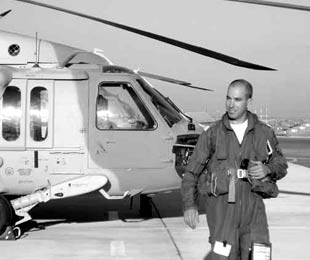
One of Shapira's last flights in the Air Force in September 2003.

In September 2003, in the midst of Israel’s campaign of targeted assassinations against Palestinian terrorists, a 31-year-old Black Hawk helicopter pilot named Yonatan Shapira terrorized Israel’s military high command without committing a single act of violence.

In the Pilots’ Letter of Refusal that he authored and 26 other pilots signed, these historic words were written: “We, who were raised to love the state of Israel and contribute to the Zionist enterprise, refuse to take part in Air Force attacks on civilian population centers. … These actions are illegal and immoral, and are a direct result of the ongoing occupation which is corrupting all of Israeli society.” Reading those words to an audience of progressive Jews, he added, “We will continue to serve the Israeli Defense Forces (IDF), but not the Israeli occupation forces.”

It wasn’t the first time Israeli soldiers refused to serve—dissident soldiers forged a movement called Yesh Gvul (There Is A Limit) during the first Lebanese war in the early ’80s. Shapira’s letter, however, did mark the first time that pilots, the elite of the military and the darlings of society, defied military orders for reasons of conscience. They were promptly dismissed from the Air Force.

Shapira, the son of an Israeli pilot from an Ashkenazi family, is currently living with his girlfriend in Brooklyn and finishing his thesis for the European Center For Peace and Conflict Studies in Austria. His subjects are the Israeli pilots with whom he conducted countless hours of interviews.

How did the Israeli public react to you and to the other pilot-refusers?

There was a big uproar in the entire country. We had many supporters, and many opponents, of course. Yedioth Aharonoth, the biggest newspaper in Israel, and Channel Two, the popular TV station, presented the statements, the interviews, the filming we prepared with them in advance. It was a scoop.

We had a lot of support within the Air Force. Many pilots who didn’t agree to sign gave us moral support. The opposition, including Zionist leftists, called us traitors. People condemned us, but we were convinced, and still are, that we did the right thing for the country.

And those who ruled the country?

We made them feel afraid, vulnerable and weak, because we broke ranks, because we touched the very nerve of the system. It can’t work without obedience. That’s why the support we got from many pilots disturbed the Air Force and the government.

Following your own refusal, you called upon other pilots to say no to being pilots of the occupation. Didn’t that put you at risk of doing major jail time?

I understood by then that they would not imprison us, or put us on trial, because that would serve our interests. We don’t shoot or attack anyone. Our ammunition is public attention. We would have welcomed being charged with acting against an illegal and immoral occupation.

Tell me about Combatants For Peace, the group of former Israeli and Palestinian fighters that you belong to.

Early in 2005, my brother Zohar made contact with Sulaiman Al Hamri, a former Fatah fighter, in Bethlehem. Some weeks later a meeting took place between Israeli refuseniks and Palestinian ex-prisoners and fighters. We were suspicious of each other at first, but by telling our stories, we created a bond. We agreed that we should meet, dialogue, struggle together against the occupation. One of our actions was to help rebuild a Palestinian house that was destroyed by the army. Last April, we had a public lunch in a schoolyard in Anata, which was cut in two by the wall—60 Israeli and 60 Palestinian former fighters. We were joined by members of the European Parliament, even by members of the Knesset. The army fired a shock grenade over our heads.

Many in the Israeli peace movement supported the war in Lebanon. Why did they support it and you did not?

I think what differentiated us from groups like Shalom Achshav [Peace Now] was that, unlike them, we spent a lot of time in the occupied territories with the Palestinians, and with their suffering. We lost faith in our government and in the army. Many of my friends are against the occupation, but they still have faith in the government. They allowed themselves to be manipulated by the government. What was involved was a combination of basic fears, because we were attacked, and their buying into the idea that we could destroy Hezbollah.

What do you think about Defense Minister Amir Peretz, the former Labor Party leader whose name will forever be linked with the war in Lebanon?

Amir Peretz was a very sad example of someone in whom we had great hope, because he was not from the typical Ashkenazi [European Jewish] leftist background. Unfortunately, he was easy for the army to manipulate. He made an impressive statement before the elections: “There is no difference between a child in Gaza and a child in Sderot.” He was a lefty leader who spoke of peace and social justice, and was one of those responsible for the absolutely crazy war in Gaza, and the war in Lebanon after that. I guess it was smart of Prime Minister Ehud Olmert to make him defense minister and ruin him completely.

What is known about the morale of Israeli soldiers who fought in Lebanon?

There was a lot of confusion in the way the war was conducted. Soldiers were fighting a guerrilla war that they were not prepared or trained for. Many had previously manned checkpoints or roadblocks in the occupied territories. Their experience was in policing the West Bank. Pilots complained that their targets were not well-chosen. Moshe Yaalon, the former chief of staff, has said that some of the operations, especially those at the end of the war, when many soldiers were brought in, were carried out to make it appear to the public that we had won a victory.

My brother Itamar was called up and refused to go to war. As a citizen, he felt the best way to protect his country was to try to prevent this war, to demonstrate against it, and to try to convince other soldiers not to go. He was jailed for eight days. Others were put in jail for four weeks. Some soldiers refused, but not publicly. I have a friend who called in to refuse. They told him, “OK, call us next week, and we may ask you to come in and talk with your commander.” He didn’t call, and nothing happened. But he was ready to go to jail.

What accounts for you and your brothers all being public dissidents?

We are just acting on the values we were raised with: democracy, equality, justice, caring about those who suffer. That’s what we were taught at home, that’s what we learned at school. Those values have been eroded by 40 years of occupation. But in the case of my brothers and I, and thousands of refusers and conscientious objectors, they are the values we live by.

Have you been threatened in Israel or the United States for speaking out?

I haven’t been seriously threatened in Israel and certainly not here.

Yes, I received threats in Israel. One veteran right wing pilot said that people like me who disobey orders in wartime should be “put against the wall.” But people these days are for the most part indifferent. And the foreign ministry said that our actions, and the fact that we weren’t punished, shows that Israel is a democracy. Politically, they made it work to their advantage.

What is your perspective on Israel since the war in Lebanon, which many believe Israel lost?

I had the feeling at the end of this war that something good may come out of this loss. We have been trained and educated to think that winning wars is always good, and that’s wrong. Having the strongest army, and being the most aggressive country, will not help us survive forever. To survive, we have to make peace with the Palestinians, with Syria, with Lebanon. I think this current generation of leaders will not lead us to that peace. That will happen only with massive international pressure, and when we have a new generation of leaders less controlled by fears and Holocaust syndromes. I see great potential in many of the young people now graduating high school, some of whom are going to jail instead of going into the army.

Also, you had reservists who came back from the war very disillusioned. They protested against Olmert, Peretz and IDF Chief of Staff Dan Halutz, demanding that they resign. But at the same time, Israel is becoming more and more nationalistic. A Nazi commander at the Nuremberg trials said, it’s not hard to get people to go to war, just tell them they are being attacked. That’s what happened here. Even the Labor Party, with its “peace agenda” agreed to remain in the government when Olmert made Avigdor Lieberman, the head of the extreme right wing Yisrael Beiteinu [Our Home], deputy prime minister.

What can be done here in the United States to pressure Israel to end the occupation?

First of all, the military aid to Israel has to stop. This coming year [2007??] it will amount to $2.4 billion. Products from the settlements, and official representatives of the Israeli government should be boycotted. AIPAC [American Israel Public Affairs Committee], which works against the interests of my country, should be replaced by more moderate Jewish organizations.

The majority of Jews in America must start to act and stop worshipping the State of Israel like it was God. Some people say it’s like the worship of the Golden Calf in the Bible. Idolatry.

By Robert Hirschfield

Robert Hirschfield is a New York-based writer who covers Israeli and Palestinian peace activists. He has written for The Progressive, The National Catholic Reporter and Sojourners.

Giuliani: More Trouble for Kerik

Newsweek

April 16, 2007 issue - Presidential hopeful Rudy Giuliani has issued apologies for recommending that the White House nominate Bernard Kerik as Homeland Security secretary. But the apologies have not staunched the flow of embarrassing revelations.

New questions have surfaced about why Kerik's nomination was withdrawn less than a week after it was announced. The White House said a "nanny problem" killed Kerik's nomination because Homeland Secretary is the nation's top immigration law enforcer. But nonpublic law-enforcement records obtained by NEWSWEEK suggest that Kerik was worried about other issues: around the time of his nomination, Kerik spoke by phone with two people with whom he had a potentially embarrassing history. According to the records, on Dec. 2, 2004, one day before President George W. Bush announced Kerik's nomination, three phone calls were logged between Kerik and New Jersey businessman Frank DiTommaso. A few weeks earlier, DiTommaso's construction firms had been described in court testimony as mob connected. (DiTommaso and his company have denied wrongdoing.)

Shortly after the nomination, Kerik exchanged several phone calls with Jeannette Pinero, a New York prison guard with whom he had an affair. "I don't know what they were discussing," says Pinero's lawyer, Andrew Laufer. "They were friends." At the time, both Kerik and Pinero were about to give depositions in a lawsuit which accused Kerik of retaliating, while serving as New York City prison chief, against a guard who crossed Pinero. Similar calls were made before the Dec. 10 announcement that Kerik's nomination would be canceled. Two days before the withdrawal, Kerik and DiTommaso exchanged three calls. On the day the nomination crashed, Kerik and Pinero exchanged three calls; the last one was about an hour before the White House pulled Kerik's nomination. The records also show more than a dozen calls between DiTommaso and Kerik after the withdrawn nomination.

Federal prosecutors in New York have informed Kerik that he is a "target" of a criminal investigation into possible tax problems, illegal wiretapping and making false statements in an FBI questionnaire connected to Kerik's nomination. Earlier this year, said two legal sources (who asked for anonymity due to the ongoing investigation), Kerik's lawyers agreed with prosecutors to extend the statute of limitations for the Kerik probe until next October. A lawyer for Kerik said he couldn't comment, a spokesperson for Giuliani had no comment and a lawyer for DiTommaso couldn't be reached for comment.

—Mark Hosenball