Showing posts with label ACADEMIA. Show all posts

Saturday, April 14, 2007

Robert Fisk: Fear and loathing on an American campus

Robert Fisk

I have a desire to take Norm, Chuck and Al and bang their bloody heads together

Published: 14 April 2007

On the night of 11 September 2001, Al Dershowitz of Harvard law school exploded in anger. Robert Fisk, he roared over Irish radio, was a dangerous man. I was "pro-terrorist". I was "anti-American" and that, Dershowitz announced to the people of County Mayo, "is the same as anti-Semitic".

Of course I had dared to ask the "Why" question; Why had 19 Arabs flown aircraft into the World Trade Center, the Pentagon and Pennsylvania? Take any crime on the streets of London and the first thing Scotland Yard does is look for a motive. But when we had international crimes against humanity on the scale of New York, Washington and Pennsylvania, the first thing we were not allowed to do was look for a motive. How very odd. The 19 murderers came from a place called the Middle East. Was there a problem out there?

But Al would have none of this. And I got the message. To ask the "Why" question made me a Nazi. Which is why I subsequently received a flood of mail, much of it from Denver - what has Denver got against me? - telling me that my mother was Adolf Eichmann's daughter. Thanks, Al. I'm sure you didn't dream of the hate mail your silly diatribe will inspire. I guess Irish radio host Eamon Dunphy did. He pulled the plug on Al.

I'm recalling all this nonsense because Al has been back at work attacking his old nemesis, Norm Finkelstein, who has just applied for tenure at DePaul University in the US where he is an assistant professor of politics. Norm's department has supported him but Al has bombarded faculty members with a blistering attack on Norm and all his works.

So let me just explain what these works are. Finkelstein, who is Jewish and the son of Holocaust survivors, has published a number of works highly critical of Israel's occupation of the Palestinian West Bank and the use Israeli supporters make of the Holocaust of six million Jews to suppress criticism of Israel's policies. He has accused Dershowitz of plagiarising portions of his 2003 book The Case for Israel. Finkelstein's book, The Holocaust Industry, earned Dershowitz's continued fury.

Now, I've known Norm for years and he is a tough, no-holds-barred polemicist, angry against all the traditional supporters of Israel, especially those who turn a blind eye to torture. Personally, I find Norm's arguments sometimes a little overwrought. In radio discussions, his voice will take on a slightly whingeing tone that must infuriate his antagonists.

But Al is clearly trying to destroy Norm's career, adding that the "dossier" he sent to DePaul academics - we remember that word "dossier" rather too well in Britain and, I should add, Al has absolutely no connection to DePaul University - contains details of "Norman Finkelstein's ... outright lies, misquotations and distortion".

It will be a disgrace, says Al, for DePaul to give tenure to Norm. "His scholarship is no more than ad hominem attacks on his ideological enemies." As if this is not enough, Al - who is also Jewish - takes a crack at philosopher and linguistic academic Noam Chomsky who has supported Norm and whom Al refers to as "the high priest of the radical anti-Israeli left".

Enough, I hear readers shout. I agree. But Norm's politics department give him top marks for scholarship and says he "offers a detailed argument that suggests that Dershowitz plagiarised or inappropriately appropriated large sections of others work in The Case for Israel". Norm has a "substantial and serious record of scholarly production and achievement" and has lectured at the University of Chicago, Harvard, Georgetown and Northwestern Universities.

So far so good. But now up pops "Chuck" Suchar, the dean of DePaul's College of Liberal (sic) Arts and Sciences, with an extraordinary recommendation that Norm should not be granted tenure. While acknowledging that "he is a skilled teacher" with "consistently high course evaluations," Chuck has decided "that a considerable amount of [his work] is inconsistent with DePaul's Vincentian values, most particularly our institutional commitment to respect the dignity of the individual and to respect the rights of others to hold an express different intellectual positions". Norm's books, according to Chuck, "border on character assassination and ... embody a strategy clearly aimed at destroying the reputation of many who oppose his views".

Now I have to say that scholars who read this column will be interested to know of Chuck's own work. I gather it has absolutely nothing to do with the Middle East, though I'm sure his study of Gentrification and Urban Change: Research in Urban Society (1992) had American readers queuing round the block of their major bookstores in search of first editions. All I do ask is how a college dean could involve himself in the same kind of ad hominem attacks against one of his own colleagues that he has accused that same colleague of being guilty of.

I loved too, that bit about "Vincentian values". That really does warrant a chortle or two. St Vincent de Paul - the real de Paul who lived from 1581 to 1660, not the de Paul of Chuck's soft imagination - was a no nonsense theologian who was captured by Muslim Turkish pirates and taken to Tunis as a slave. Here, however, he argued his religious values so well that he converted his owner to Christianity and earned his freedom. His charitable organisations - he also created a home for foundlings in Paris - became a legend which Chuck Suchar simply dishonours.

All over the United States, however, Norm's academic chums have been condemning Suchar's tomfoolery; even in Beirut, where Norm has lectured, academics of the American University have insisted that he be granted tenure in his department, Arabs supporting a Jewish professor and son of Holocaust survivors.

Of course, I grant that all this is a little heavy for the real world and I do have a secret desire to take Norm, Chuck and Al and bang their bloody heads together. But what is happening at DePaul University is a very serious matter in the anodyne, frightened academic world that now exists in the US. Norm's moment of truth comes up in May. As they say watch this space.

Related
Zionism vs. Anti-Zionism: Dershowitz Tries To Get Finklestein Fired

Friday, April 13, 2007

Texas A&M Fails to Report Stricken Student in Bioweapons Lab for 14 Months

April 13, 2007

TEXAS A&M FAILED TO REPORT STUDENT STRICKEN WITH BRUCELLA DURING BIOWEAPONS EXPERIMENT


By Sherwood Ross

Texas A&M University failed to report in a timely manner to Federal authorities that a biology student was stricken with the dangerous brucella pathogen in its College Station laboratory for bioweapons agent research on February 9th of 2006. The university made its disclosure this April 10th, 14 months later, and only after insistent prodding by the Sunshine Project, an Austin, Tex.-based arms control watchdog organization.

Under Federal law, such incidents are supposed to be reported within seven days to the Centers For Disease Control and Prevention.

The student was seriously ill for several months with brucellosis but recovered. The disease is believed to kill between two to three percent of those it infects. The student, whose name and gender has not been disclosed by Texas A&M to Sunshine, apparently came down with the disease, also known as undulant fever, attempting to clean what is called a Madison Aerosol Chamber(MAC) where mice had been exposed to aerosolized brucella particles.

The accident occurred under the supervision of Texas A&M professor David McMurray, inventor of the (MAC). According to Sunshine, the case of the stricken student is the third report of a serious illness in connection with the chamber’s use. On one occasion, a leaky aerosol chamber was responsible for three tuberculosis infections in a Seattle lab in 2004.

The MAC is used to infect animals with disease through their lungs. Cultures of the organisms causing tuberculosis, or the bioweapons agents brucella, anthrax, or Q fever, are placed in the MAC’s nebulizer, which mixes them with the air. The resulting aerosol is directed into a metal chamber in which animals placed on racks breathe in the agent.

The Texas A&M work is being funded by the Department of Homeland Security(DHS) and the National Institutes of Health(NIH).Texas A&M’s professor Thomas Ficht is the Principal Investigator.

E-mails that Texas A&M finally released to Sunshine late on Tuesday night (April 10) reveal the University broke federal law by not reporting the infection, Sunshine’s Edward Hammond said. The Select Agent Rule required A&M to report the infection immediately upon its discovery and for the school to file a formal report, called APHIS/CDC Form 3, within 7 days. Failure to do so means Texas A&M could face fines of up to $750,000 and lose Federal funding for its research.

Asked if the university had delayed reporting the accident, Ficht replied, “I’m not supposed to talk to anybody about that, not now,” and referred this reporter to a school public relations official. Ficht is well known in his field and holds both a 2000 Pfizer Research Award and a 2004 Sigma Xi Research Award.

In recent years, Texas A&M has received between $284,000 and $363,000 annually from the NIH just for brucella research, Hammond said, but the overall NIH funding is “much higher.” How much Texas A&M gets from DHS is not known.

“The evidence released to us indicates that Texas A&M officials discussed the federal requirement to report the incident, yet they did not do so,” Hammond said. “They chose to ignore the law, and that irresponsible decision to endanger public health and security should be swiftly and severely punished with maximum fines and loss of federal research funding.”

In refusing to provide information about the infection, Texas A&M officials also flouted the Texas Public Information Act, Hammond said. He said Sunshine is filing a complaint with Texas Attorney General Greg Abbott that may result in other fines and/or jail sentences if school officials are found guilty of hiding documents. Sunshine obtained its information from the school only after formally requesting records under the Texas Public Information Act.

In recent years, several Texas universities, including Texas A&M, have attempted to conceal their biological laboratory work from public scrutiny. According to Sunshine, the universities of Texas at Arlington and San Antonio and the University of Texas Southwestern at Dallas are obligated under NIH guidelines to have their internal oversight committees report on their biological lab work to NIH but declined to do so. And Texas A&M’s oversight committee did not report the brucella episode, Hammond said.

The work of the Texas universities, like that of approximately 400 other Federally-funded labs across the nation, may involve pathogens that could possibly be used for offensive germ warfare, banned by the 1972 Biological and Toxic Weapons Convention(BTWC), which the U.S. signed. It prohibits “development, production, stockpiling, and use of microbes or their poisonous byproducts except in amounts necessary for protective and peaceful research.”

According to Professor Francis A. Boyle, an international legal expert at the University of Illinois at Champaign, “Aerosolization and an aerosol chamber are a classic tip-off for the prohibited research, development and testing of an offensive biological weapon in violation of the (BTWC) and its U.S. domestic implementing legislation, the Biological Weapons Anti-Terrorism Act of 1989, which provides for life in prison.” Boyle wrote the 1989 Act, passed unanimously by both Houses of Congress. He is also author of “Biowarfare and Terrorism,” published by Clarity Press.

Since 9/11, the Bush Administration has spent tens of billions of dollars on bioweapons research. The sum may be $40-billion or higher, but an accurate figure is not available as much of the work is being conducted in secret.

Some universities have leaped at the opportunity for
Federal funding for such research from NIH and DHS. Hammond claims, “Government and academic labs are responding less to bona fide needs than the urge to build power and revenue centers for what they hope is a perpetual biodefense boom. This will result in a dangerous proliferation of bioweapons agents and the knowledge to use them.”

He noted the U.S. is facing a virulent new strain of drug-resistant gonorrhea. Unfortunately, he added, “the NIH has been extravagantly funding research into ‘threat’ diseases like glanders, which has not been seen in humans in the U.S. since the 1940s except, of course, lab-acquired infections in biodefense facilities. What a shame.”

The lack of transparency in U.S. federally-funded biological laboratories has been a growing cause for concern. Jackie Cabasso, of the Western States Legal Foundation of Oakland, Calif., said, “the U.S. is now massively expanding its biodefense program, mostly in secretive facilities. Other countries are going to be suspicious. This bodes badly for the future of biological weapons control.”

According to Jonathan King, professor of molecular biology at MIT, “the Bush administration launched a major (biological weapons) program which threatens to put the health of our people at far greater risk than the hazard to which they claimed to have been responding.” Bush’s policies, he continued, “do not increase the security of the American people. They bring new risk to our population of the most appalling kind.”


Sherwood Ross is a reporter who has worked for major dailies and wire services. Reach him at sherwoodr1@yahoo.com

Monday, April 9, 2007

Another Enemy of the People? : Prof who criticised Bush put on Terror Watch List

Related
Walter F. Murphy
---
Sunday, April 08, 2007

Another Enemy of the People?

Mark Graber

I am posting the below with the permission of Professor Walter F. Murphy, emeritus of Princeton University. For those who do not know, Professor Murphy is easily the most distinguished scholar of public law in political science. His works on both constitutional theory and judicial behavior are classics in the field. Bluntly, legal scholarship that does not engage many themes in his book, briefly noted below, Constitutional Democracy, may be legal, but cannot be said to be scholarship. As interesting, for present purposes, readers of the book will discover that Murphy is hardly a conventional political or legal liberal. While he holds some opinions, most notably on welfare, similar to opinions held on the political left, he is a sharp critic of ROE V. WADE, and supported the Alito nomination. Apparently these credentials and others noted below are no longer sufficient to prevent one from becoming an enemy of the people.

"On 1 March 07, I was scheduled to fly on American Airlines to Newark, NJ, to attend an academic conference at Princeton University, designed to focus on my latest scholarly book, Constitutional Democracy, published by Johns Hopkins University Press this past Thanksgiving."

"When I tried to use the curb-side check in at the Sunport, I was denied a boarding pass because I was on the Terrorist Watch list. I was instructed to go inside and talk to a clerk. At this point, I should note that I am not only the McCormick Professor of Jurisprudence (emeritus) but also a retired Marine colonel. I fought in the Korean War as a young lieutenant, was wounded, and decorated for heroism. I remained a professional soldier for more than five years and then accepted a commission as a reserve office, serving for an additional 19 years."

"I presented my credentials from the Marine Corps to a very polite clerk for American Airlines. One of the two people to whom I talked asked a question and offered a frightening comment: "Have you been in any peace marches? We ban a lot of people from flying because of that." I explained that I had not so marched but had, in September, 2006, given a lecture at Princeton, televised and put on the Web, highly critical of George Bush for his many violations of the Constitution. "That'll do it," the man said. "

"After carefully examining my credentials, the clerk asked if he could take them to TSA officials. I agreed. He returned about ten minutes later and said I could have a boarding pass, but added: "I must warn you, they=re going to ransack your luggage." On my return flight, I had no problem with obtaining a boarding pass, but my luggage was "lost." Airlines do lose a lot of luggage and this "loss" could have been a mere coincidence. In light of previous events, however, I'm a tad skeptical."

"I confess to having been furious that any American citizen would be singled out for governmental harassment because he or she criticized any elected official, Democrat or Republican. That harassment is, in and of itself, a flagrant violation not only of the First Amendment but also of our entire scheme of constitutional government. This effort to punish a critic states my lecture's argument far more eloquently and forcefully than I ever could. Further, that an administration headed by two men who had "had other priorities" than to risk their own lives when their turn to fight for their country came up, should brand as a threat to the United States a person who did not run away but stood up and fought for his country and was wounded in battle, goes beyond the outrageous. Although less lethal, it is of the same evil ilk as punishing Ambassador Joseph Wilson for criticizing Bush's false claims by "outing" his wife, Valerie Plaime, thereby putting at risk her life as well as the lives of many people with whom she had had contact as an agent of the CIA. ..."

"I have a personal stake here, but so do all Americans who take their political system seriously. Thus I hope you and your colleagues will take some positive action to bring the Administration's conduct to the attention of a far larger, and more influential, audience than I could hope to reach. "

FINKELSTEIN DENIED TENURE AT DEPAUL: FINKELSTEIN CONFIRMS

SPME LEARNS FINKELSTEIN DENIED TENURE AT DEPAUL: FINKELSTEIN CONFIRMS
By Allyson Taylor and John Wilson
Published in: www.collegefreedom.org April 1, 2007

( Allyson Taylor, formerly of American Jewish Congress and StandWithUs.com has sent SPME a copy of an email from Norman Finkelstein to her that this article by John Wilson "is correct." SPME is waiting for official confirmation.)

I've heard reports that DePaul assistant professor Norman Finkelstein has been recommended for denial of tenure by the dean of liberal arts and sciences. The Political Science department voted 9 to 3 in favor of granting tenure, with three members making a minority report. The five-person College Personnel Committee was unanimous in favour of granting tenure. It appears that the primary reason given for Finkelstein's denial of tenure was his meanness to his critics in the tone of his scholarship, which is a particularly disturbing attack on academic freedom. But the real reason for denying Finkelstein tenure is likely to be the campaign by conservatives, led by Alan Dershowitz. I have previously written about the Finkelstein/Dershowitz dispute .

It will be interesting to compare this case with that of Thomas Klocek, the adjunct professor at DePaul who was suspended
after getting in an argument with Palestinian students. Will the conservatives who rightly defended Klocek make a similar argument against denying Finkelstein tenure for the crime of being rude? Of course, as a tenure-track professor, Finkelstein has far greater protections, so perhaps he will prevail against the conservative forces who want to get rid of him. But the principle that politeness should not be imposed on campuses is at stake here.

Related
Zionism Vs Anti-Zionism: Dershowitz Tries To Get Finklestein Fired ...

Thursday, April 5, 2007

Professor Whose Works on Israel Stirred Controversy Is in Tenure Fight With DePaul U.

April 2, 2007

Reports are circulating that Norman G. Finkelstein, the author of controversial works on Israel, anti-Semitism, and what he has called “the Holocaust industry,” will be denied tenure at DePaul University despite strong departmental support. Mr. Finkelstein, an assistant professor of political science, told The Chronicle in an e-mail message that he had been the target of “external intrusion in the tenure process — including a relentless campaign of character assassination directed at the faculty and administration” by his critics.

He said that his department had voted 9-to-3 in his favor and that the College Personnel Committee had unanimously recommended tenure, but that the dean of the College of Arts and Sciences had overridden those recommendations. The dean, Charles S. Suchar, declined to comment on Mr. Finkelstein’s allegations. “The promotion and tenure review process is still under way and final decisions are not expected until mid- to late May,” he wrote in an e-mail message.

Michael L. Budde, chairman of the political-science department at DePaul, confirmed that Mr. Finkelstein’s colleagues had voted in favor of tenure. According to Mr. Budde, the case now will go to a universitywide promotion board, which will recommend a course of action to the provost and the president. That board is scheduled to meet on April 13. The university’s final decision is expected in mid-May.

Mr. Finkelstein has long been a controversial figure in academe. His most recent book, Beyond Chutzpah: On the Misuse of Anti-Semitism and the Abuse of History (University of California Press, 2005), stirred up pre-publication threats of legal action by one of its subjects, the Harvard Law School professor Alan M. Dershowitz. —Jennifer Howard

Posted on Monday April 2, 2007 | Permalink |

Wednesday, April 4, 2007

Furor Over Norm Finkelstein

Norman G. Finkelstein has been more controversial off his campus than on it. On his frequent speaking tours to colleges, where he typically discusses Israel in highly critical ways, Finkelstein draws protests and debates. When the University of California Press published Finkelstein’s critique of Alan Dershowitz and other defenders of Israel in 2005, a huge uproar ensued — with charges and countercharges about hypocrisy, tolerance, fairness and censorship. But at DePaul University, Finkelstein has taught political science largely without controversy, gaining a reputation as a popular teacher.

But the debate over Finkelstein is now hitting his home campus — and in a way sure to create more national controversy. Finkelstein is up for tenure. So far, his department has voted, 9-3, in favor of tenure and a collegewide faculty panel voted 5-0 to back the bid. But Finkelstein’s dean has just weighed in against Finkelstein.

In a memo leaked to some supporters of Finkelstein and obtained by Inside Higher Ed, Chuck Suchar writes that he finds “the personal attacks in many of Dr. Finkelstein’s published books to border on character assassination” and that Finkelstein’s tone and approach threaten “some basic tenets of discourse within an academic community.” Suchar says that Finkelstein’s record is “inconsistent with DePaul’s Vincentian values, most particularly our institutional commitment to respect the dignity of the individual and to respect the rights of others to hold and express different intellectual positions.”

While the leaked memo led to some false online reports that Finkelstein had been denied tenure, his case is very much alive and no final decision will be made until June, according to a university spokeswoman, who added that the dean’s memo was not meant for public consumption and that no administrators could comment.

Debates over scholars who take controversial views on the Middle East are, of course, nothing new to academe. But Finkelstein’s case may be in a category all its own. He portrays himself as a courageous scholar, bringing rationality to discussions of the Holocaust and Israel — all the more bold for being Jewish and doing so. While criticizing people who invoke the Holocaust to justify political positions, he constantly identifies his parents as Holocaust survivors.

His supporters tend to characterize Finkelstein as the victim of right-wing, pro-Israel forces — and there are plenty of conservative supporters of Israel who despise Finkelstein. But among the groups he’s currently sparring with is Progressive magazine, a decidedly left-of-center publication that regularly publishes pieces that are highly critical of Israel’s government. Finkelstein and his supporters also say that criticisms of his tone are an excuse for attacks on his political views — and that issue appears to be key to the DePaul dean’s review.

Much of the criticism from the dean focuses on Finkelstein’s book The Holocaust Industry. The book argues that supporters of Israel use the Holocaust unreasonably to justify Israel’s policies. While the book does not deny that the Holocaust took place, it labels leading Holocaust scholars “hoaxters and huxters.” A review of the book in The New York Times called it full of contradictions (at one point he rejects the idea that the United States abandoned Europe’s Jews and then he later praises a book for which that idea was the central thesis) and full of “seething hatred” as he implies that Jews needed the Holocaust to justify Israel. The reviewer, Brown University’s Omer Bartov, a leading scholar of the Holocaust, described the book as “a novel variation on the anti-Semitic forgery, ‘The Protocols of the Elders of Zion.’ “

Finkelstein said he could not comment on his tenure case in detail until later in the week, although he confirmed via e-mail that he had been approved at the departmental level and college levels, and that the dean was opposing his tenure. He also questioned the fairness of being judged by whether he adheres to Vincentian values. He said that the issue was never mentioned in his annual reviews and that he had always been told that his research would be judged by “the conventional academic requirements for scholarship.” It is wrong for DePaul to raise these issues now, he said. “You can’t spring new criteria at the second stage of the last year of a tenure-track position,” he said.

In Dean Suchar’s letter, he starts by noting that there has been no dispute at DePaul over the quality of Finkelstein’s teaching. He has received “consistently high” course evaluations, Suchar writes, and many students report that they have had “transformative” experiences in his classes.

The dispute over the tenure review focuses on research. The College Personnel Committee, a faculty-elected body that reviewed Finkelstein’s candidacy and unanimously endorsed it, raised concerns about the “tone” and “frequent personal attacks” in Finkelstein’s work, Suchar writes. That committee, however, concluded that “the scholarship was, on balance, sufficiently noteworthy and praiseworthy to merit their support for the application for promotion and tenure.”

Suchar disagrees. “I find this very characteristic aspect of his scholarship to compromise its value and find it to be reflective of an ideologue and polemicist who has a rather hurtful and mean-spirited sub-text to his critical scholarship — not only to prove his point and others wrong but, also in my opinion, in the process, to impugn their veracity, honor, motives, reputations and/or their dignity,” Suchar writes. “I see this as a very damaging threat to civil discourse in a university and in society in general.”

Finkelstein has also threatened to sue DePaul if he is denied tenure, Suchar writes, adding that this fits into the pattern. “Disagreements over the value of his work seem to prompt immediate threats and personal attacks. This does not augur well for a college and university that has a long-standing culture where respect for the dignity of all members of the community and where values of collegiality are paramount.”

Suchar’s memo was sent to a universitywide committee that will now review the case, which will then work its way to the president.

Supporters of Finkelstein take issue with the dean’s letter. “This is all because of Dershowitz wanting him to be fired. These people play rough,” said Peter N. Kirstein, a professor of history at Saint Xavier University who has blogged about the case and who is on the board of the Illinois conference of the American Association of University Professors. (Via e-mail, Dershowitz — who has previously battled with Finkelstein — said he had no information about the case.)

Kirstein questioned why the dean would mention Finkelstein’s threat of a lawsuit. “Doesn’t this country allow people to do things like suing?” he asked.

It would be appropriate for a dean to question the accuracy or significance of a professor’s work, but not to focus on its tone, Kirstein said.

On the question of the tone of one’s writing, Kirstein said he had plenty of experience. In 2002 he was suspended from his job after he sent an e-mail to a cadet at the U.S. Air Force Academy, calling the cadet “a disgrace to this country” and criticizing the “aggressive baby-killing tactics” of the military. Kirstein was reviled by many conservative groups and defended by many civil liberties groups.

“Tonality is usually a red herring to destroy controversial speech that elites don’t like,” Kirstein said.

Anne Clark Bartlett, a professor of English and president of the Faculty Council at DePaul, said that it is “not common” for deans to write letters disagreeing with the views of a department and collegewide panel reviewing a tenure candidate. But she also said that the faculty handbook did give deans that right.

Bartlett, who said she does not know Finkelstein, said that she has not taken a stand on his case and wants to see how the process plays out. She said that it was important that administrators respect that the university’s regulations “give the faculty primary responsibility over promotion and personnel matters” for professors.

Robert Kreiser, associate secretary of the American Association of University Professors, said that the national office of the group had recently received the dean’s memo and was paying close attention to the case, but had not been asked to play a formal role. He said that the dean’s involvement and raising the issue of tone were not — in and of themselves — cause for concern with regard to academic freedom. He said that any questions about academic freedom would focus on the fairness of the dean’s comments, the due process afforded to Finkelstein, and how those comments were viewed in the totality of the evidence about Finkelstein’s tenure bid.

However, Kreiser said that the AAUP believes that “ordinarily a dean would defer to the judgment of a faculty member’s peers.” AAUP policy calls for administrators to have “compelling reasons” that they can present before they overrule a faculty recommendation on tenure.

“The dean would have to provide compelling reasons,” Kreiser said. The question going forward will be: “Were the dean’s reasons compelling?”

Related stories

Scott Jaschik

Video: Students Pelt Karl Rove In Protest

nbc4.com

Video:
Students Pelt Karl Rove In Protest
Video: Watch The Report
Slideshow: Images From Scene

No Arrests Were Made

POSTED: 12:21 am EDT April 4, 2007
UPDATED: 8:29 am EDT April 4, 2007

WASHINGTON -- White House Advisor Karl Rove was the target of a protest on the American University campus Tuesday night, News4 reported.

Rove was on the campus to talk to the College Republicans, but when he got outside more than a dozen students began throwing things at him and at his car, an American University spokesperson said.

The students then got on the ground and laid down in front of his car as a protest.

The students said security officials picked them up and carried them away so Rove could leave.

Police said they have dealt with a lot of protests on campus and this one was handled peacefully.

No one was arrested.

Copyright 2007 by nbc4.com. All rights reserved.

Sunday, March 18, 2007

Here's how US political scientists are talking about Iraqi civilians

Sunday, March 18, 2007

Colin Kahl is the political scientist who wrote in the November/December issue of Foreign Affairs that "US compliance with noncombatant immunity in Iraq has been relatively high by historical standards, and it has been improving since the beginning of the war". By "historical standards" he was alluding to the fact counterinsurgencies in Philippines at the turn of the 19th century, and in South Vietnam more recently killed somewhere around 3% of the entire civilian populations in those countries, while the civilian death-toll in Iraq has been much lower on a dead-persons-per-capita basis. To understand what he means by "improvement since the beginning of the war", you would have to steel yourself, put on your white lab-coat and the read the whole article.

Today, thanks to the public-spiritedness of one of Kahl's scientific colleagues, we are offered some hints about the latest thinking about this. First of all, it seems the military-academic community has actually borrowed from the medical community the concept of "best practices", only in this case they are called "COIN [which means counterinsurgency] best practices", and this "COIN best practices" is something that is being implemented under the new leadership of Petraeus. So not only have efforts to "spare the civilian population" been improving, they are actually now part of an ideal approach: They represent "COIN best practices". There appear to be two main components of this: First of all, naturally you try not to do too much shelling of civilian neighborhoods; you try to minimize atrocities, and so on. Secondly, this appears to involve "spreading American troops out into smaller bases from which they can work with Iraqi forces to provide local security".

The next thing we learn is that there has recently been a "briefing", but the details of the briefing are kept out of sight, behind the three dots. All we can glean is that it appears US military authorities were doing the talking, and academics including Kahl were doing the listening and the nodding of the heads. Here's what Kahl says about the briefing:
. . .This shift [in COIN strategy] makes sense from the perspective of COIN best practices and the new COIN field manual. There are other successful approaches to COIN, including what the briefing calls "the Roman Strategy" ("make a desert and call it peace"), which was basically the approach Saddam used to prevent sustained insurgency in Iraq. But, as the briefing properly notes, adopting this approach (or even somewhat softer, but still highly coercive COIN practices, such as those used by the Americans effectively in the Philippines between 1899-1902), is incompatible with norms against targeting civilians embraced by the U.S. military and political leadership. So, with the Roman strategy off the table, that leaves the "clear, hold, and build" option. However, as the briefing makes clear, this strategic shift may simply be too little, too late. What the briefing doesn't say is that it is also unclear whether employing COIN best practices will work in the context of not only a raging insurgency (in Baghdad, Anbar, Diyala), but also a sectarian civil war (in Baghdad, Diyala, and increasingly Kirkuk), diffuse criminal anarchy and militia rivalry (in the South), and endemic separatist tendencies (in Kurdistan).
In other words, among the other successful approaches to counterintelligence is the "Roman strategy", or scorched-earth approach, where the occupying forces annihilate target civilian populations. Kahl doesn't say this (along with its "somewhat softer, but still highly coercive" variants) is recognized as a shameful crime by every decent human being, he merely says it is "incompatible with norms against targeting of civilians embraced by the US military and political leadership." That is the first point. We have his word for it that the "Roman strategy" was "taken off the table," but only because they are "incompatible with the norms..." of the Bush administration. Am I the only person who hears an echo of the verbiage that has been used in the discussions about torture?

The second point is Kahl's own contribution to this.
What the briefing doesn't say [he writes] is that it is also unclear whether employing COIN best practices will work in the context of not only a raging insurgency (in Baghdad, Anbar, Diyala), but also a sectarian civil war (in Baghdad, Diyala, and increasingly Kirkuk), diffuse criminal anarchy and militia rivalry (in the South), and endemic separatist tendencies (in Kurdistan).
If "COIN best practices" don't work, what then? Could the "norms" be relaxed and some of the "other successful approaches" be tried? Think of the language this administration has used in support of torture.

Kahl's little essay is something he sent to other experts who participate in a listserve, and he gave Juan Cole permission to publish it. Cole's own point in publishing it is no doubt that Iraq is on the brink, and this is no time to be thinking of toppling the SCIRI-led administration. But I think this tells us more than that.

Sunday, February 25, 2007

Brandeis Caves to Pipes, Donor Pressure

Columbia (Joseph Massad), Yale (Juan Cole) and Princeton (Rashid Kahlidi) have had the honor of their Mideast studies faculty (and faculty candidates) being subjected to a pro-Israel smear campaign. Now, it appears Brandeis is suffering the same fate. But instead of the David Project (behind the Columbia smear), Daniel Pipes is single-handedly taking on Brandeis with the help of some of its pro-Israel donors who've threatened a financial boycott.

It all started with Jimmy Carter (doesn't it always), who spoke on campus several weeks ago. The Pipes-Dershowitz crowd was in high moral dudgeon because Carter refused a one on one debate with Dershowitz. (Last I checked, Dershowitz hadn't invited Carter to debate him when the Big D's last book was published either.) University president Jehudah Reinharz was tarred and feathered. Jewish Week reported as much as $5 million in donations was being withdrawn.

The president was even quoted in the student newspaper as being opposed to either Pipes or Norman Finkelstein speaking on campus because of the "inflammatory nature" of their views, saying they were "weapons of mass destruction."

In its second report on the controversy, Jewish Week indicates that Reinharz has softened his views on at least one of the two speakers. I bet you can't guess which one…yes, it's Pipes. Instead of being described as the vapid ideologue he really is, Reinharz now lauds him as serious scholar. He even offers him the hospitality and imprimatur of the president's office:

You have been a guest on this campus on more than one occasion and, I believe, have always been treated with the utmost respect. I trust that the student groups who organize these events will manage your return visit in the spring with dispatch, and you will be recognized by Brandeis as the scholar you are. I, and my Executive Assistant, Dr. John Hose hope to attend your talk. If time allows, perhaps we can continue our conversation in my office.

Anything to cool down pro-Israel donors and demagogues on the warpath.

Reinharz offers the prestige of his office to someone who levels the most despicable calumnies (which unfortunately describes most of what he writes) against two members of his own faculty:

What, precisely, are those scholarly resources available at Brandeis? Might [University administrator John] Hose be referring to the University's leading specialist on "contemporary Islamic thought and practice"… Prof. Natana DeLong-Bas (NEJS), an apologist for Al-Qaeda whose depraved thinking was exposed in several recent articles (including "Natana DeLong-Bas: American Professor, Wahhabi Apologist" and "Sympathy for the Devil at Brandeis," from frontpagemag.com)? Or is he referring to Khalil Shikaki, a Crown Center fellow who has been credibly accused of terrorist links and has a second-to-none record in getting it wrong in his chosen field of Palestinian public opinion?

There are links in this passage to various Campus Watch and Frontpagemagazine articles which I don't have the heart to link to here. But you can find those links at Pipes' site.
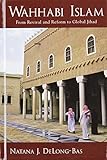
Wahhabi Islam: From Revival and Reform to Global Jihad
This is what Oxford University Press has to say about Prof. Delong-Bas in its profile accompanying her book, Wahabi Islam:

Natana J. DeLong-Bas is senior research assistant at the Center for Muslim-Christian Understanding at Georgetown University. She is the author of Notable Muslims: A Biographical Dictionary (2004) and co-author of Women in Muslim Family Law revised edition, with John L. Esposito (2001). She has served as editor for and contributor to The Oxford Dictionary of Islam (OUP, 2003), and contributor to The Encyclopaedia of the Qur'an (2004), and The Encyclopedia of the Islamic World (OUP, 2004). She is a frequent public speaker on Islam, Wahhabism, and Saudi Arabia.

In protesting the banning of her book on Wahabi Islam by Egyptian religious authorities (that's right, the book was banned by Islamists), the provost of the American University in Cairo said this:

"The book essentially argues that Wahhabism has been hijacked by the jihadists…"

Based on what I have read of her work, I wouldn't say I'd agree with all of her views on Wahabi Islam. But to call her an Al Qaeda symp is ridiculous. And talk about 'depraved,' what kind of depraved human being could call a fellow academic "depraved" based on the above biographical profile?

As for the Shikaki attack, it's beyond laughable. Shikaki is Palestine's leading demographer and pollster who holds a Columbia University PhD. He founded the Palestinian Center for Policy Survey Research. He regularly collaborates with Israeli pollsters to track Israeli and Palestinian attitudes toward the peace process. His research is avidly followed by researchers, journalists and political leaders in Israel and throughout the world. I regularly report on his polls here when Haaretz reports them. To accuse this man of "terrorist links" is far beyond the pale and only testifies to the desperation of Pipes' witch hunt against those he views as dangers to Israel.

Let's also keep in mind that Herr Pipes was the figure largely responsible for Tariq Ramadan being declared persona non grata by the Dept. of Homeland Security. Pipes accused Ramadan of supporting Islamic terror with equally flimsy evidence to that presented against the above Brandeis figures.

Returning to Reinharz' change of heart about Pipes. The latter had been scheduled to speak on campus this spring. Reinharz' first remarks on Pipes and Finkelstein seemed to indicate that the University would permit neither to speak though there has been a change of heart outlined above. As for Finkelstein, he doesn't seem to have the proper papers for a Brandeis engagement. He'll be sailing the waters outside of campus on the good ship St. Louis till Reinharz decides whether his kind may be permitted entry to Brandeis.

I should state here that I don't share Norman Finkelstein's views of Zionism. But if a creep like Daniel Pipes should deserve the honor of a Brandeis podium, Finkelstein deserves one no less. I'm with Prof. Gordon Fellman on this:

Fellman advocated following up Carter’s appearance by opening the school to a new range of speakers on the Middle East.

“We also need to hear Avigdor Lieberman” — an Israeli Knesset member who advocates stripping Israeli Arab citizens of their citizenship — said Fellman. “We also need to hear a right-wing Orthodox settler convinced that God commands Jews to live in the West Bank. We need to hear more from Israelis who reject the occupation and reject the violence. … We need to hear Palestinians who have lived under occupation tell their sides of the story. … We need to hear from the rejectionists on both sides, and we need to hear from the accommodationists on both sides.”

In contrast, I find this counter-view expressed by Brandeis American Jewish historian Jonathan Sarna to be profoundly infantilizing:

“We don’t want to be in the position that every crackpot can be given a forum,” he said.

“I think the faculty increasingly understands that just as we exercise a lot of quality control over faculty appointments, so, too, do we have an obligation to exercise quality control for speakers on campus,” explained Sarna. “Part of our job is to help students figure out what bad books are, and what good books are; what is a bad scholar, and what is a good scholar. … How we exercise that responsibility without in any way limiting free discourse is what this committee will tackle.”

Sarna strongly endorsed Pipes’ scholarly credentials and his qualifications to speak on campus but said he did not want to “prejudge” the case of Finkelstein.

It appears that Pipes is one of the "good scholars" and Finkelstein in all likelihood one of the "bad."

The types of speakers Fellman lists above represent legitimate loci of opinion within Israeli society. What is wrong with a serious academic institution hearing from all sides of the debate? You're not appointing these people to the faculty or offering honorary degrees. You're merely asking them to come and address students for an hour or two. What is Sarna afraid of here? I fear that what he's done is import to campus the mainstream Jewish community's absolute fear of real debate about the Israeli-Palestinian conflict. He seems to be saying we can only have a debate that is carefully managed. You've got to strain it like baby food for an infant. Take out the bad bits and leave in the good.

Sarna continues:

“There are members of the Brandeis community who truly want everyone to be able to speak, like Hyde Park. I think a university with limited funds, limited resources, limited rooms, and with extremists who require security each time, must use its funds in a responsible way.”

Cop out…big time. This from a supposedly distinguished academic historian? What lameness. Who does he think he's kidding?

Filed under Mideast Peace, Politics & Society, Jews & Judaism

daniel pipes speaks at brandeis norman finkelstein pipes encourage brandeis donor boycott reinharz invites pipes to campus stifling free speech

|

Saturday, February 3, 2007

An Apple too far from the Tree

Related

"And they complain about a boycott?"
---
Wednesday, January 31, 2007

An Apple too far from the Tree for Ben Gurion University?

WAS Professor Arens too far from tree, or is BGU too close to Israeli government; and NATO?

More on our item concerning Yigal Arens, the Israeli-born professor to whom organisers of a conference at the Ben Gurion University decided to rescind an invitation, in case his presence embarassed government officials attending.
("And they complain about a boycott", Saturday January 27
http://randompottins.blogspot.com/2007/01/and-they-complain-about-boycott.html

This is from the leading Israeli daily, Ha'Aretz:
http://www.haaretz.com/hasen/spages/819173.html

Ha'aretz, Mon., January 29
Arens and the tree

By Akiva Eldar

Professor Yigal Arens fell very far from the tree. The son of a former defense minister and head of the Likud, he went so far to the left that a respected university in Israel cancelled his participation in a scientific conference. Dr. Bracha Shapira of Ben-Gurion University of the Negev, one of the organizers of the conference, has stated that the organizers have chosen to remain silent.

Arens, who immigrated many years ago to California, heads two centers that deal with information systems on matters of intelligence, the war against terror and digital government. At the beginning of January a colleague, an American professor, invited him to participate in a working group that will convene this coming summer at Ben-Gurion University. The conference, which is funded by the North Atlantic Treaty Organization (NATO), will deal with the role played by the Internet in terror and its prevention.

The colleague said that the organizers, and among them Shapira, would be very glad if Arens accepted the invitation.Five days later, before Arens replied to the invitation, his American colleague informed him that he should forget the whole thing. He related that the Israeli organizers had told him that government personnel who had been invited to the meeting would not feel comfortable in his presence. Arens sent an e-mail to Shapira and asked that she explain the withdrawal of the invitation. She replied that his American colleague had "exceeded his authority in extending the invitation without full consultation with the conference organizers."

According to Arens, the organizers had been aware initially of his political background.(*) They learned about it from his American colleague who wanted to make certain, at Arens' request, that they would spare him any unpleasantness, which according to him had been his lot at previous conferences in Israel.

The organizers of a conference at an academic institution that benefits from public monies do not believe it is the public's right to know whether there is anything of substance in the grave suspicion that a scientists' political opinions disqualify him from entering their gates. Arens, in fact, concealed nothing. For many years he has supported two states for two peoples, but today he fears "that a two-state solution is no longer practically possible."

Arens believes that Israel should be a state for all its citizens, supports the right of return for Palestinian refugees and is opposed to any form of discrimination among citizens on the basis of their ethnic or religious background.

© Copyright 2007 Haaretz. All rights reserved§§§§§§§§§§

Yigal Arens comments on the differences between this report and the Hebrew original
http://www.haaretz.co.il/hasite/pages/ShArtPE.jhtml?itemNo=819318&contrassID=2&subContrassID=2&sbSubContrassID=0

The Hebrew version unnecessarily embellishes my resume a bit. That wasn't included in the English translation. I haven't written any books on the subject, although I participated in writing a study on a related topic (the use of IT in disaster management), and have co-authored a workshop report on responding to "unexpected events". There are other mostly minor differences between the English and Hebrew versions, the most significant being that the English one says I believe the organizers *were* originally aware of my politics, while the Hebrew one correctly states that I believe they were *not*.

Tuesday, January 30, 2007

Demagoguery Posing as Scholarship

January 29, 2007

Dinesh D’Souza, a fellow at the conservative Hoover Institution at Stanford University, has raised a ruckus in his new book The Enemy at Home. In the book, he contends that the 9/11 attackers were motivated by neither U.S. foreign policy abroad nor by a hatred of U.S. freedom, as President Bush has repeatedly argued. Instead, D’Souza declares that Osama bin Laden hates the liberal U.S. culture that promotes contraception, abortion, and homosexuality. In a recent op-ed piece in the Washington Post defending the book, D’Souza says that he doesn’t “hate America.” No, he just hates liberal America and is reprehensibly trying to use the horrible 9/11 attacks to score points against the Democrats of the left.

D’Souza is not the first person to try to turn the 9/11 attacks to his advantage. President Bush disingenuously tied them to Saddam Hussein and invaded Iraq. In fact, D’Souza is not even the first person on the right to try to pin the blame for 9/11 on the left. Jerry Falwell blamed gays, pagans, and the ACLU for the attacks. Although D’Souza seems horrified to have been compared with Falwell, they both end up at the same place. Falwell argued that God was punishing the United States for the activities of these liberal groups, and D’Souza argues that bin Laden has been enraged by American liberal groups’ overseas distribution of contraceptives and lobbying of non-Western countries to liberalize laws against homosexuality and abortion. Although Falwell’s explanation is religious and D’Souza’s is more secular, they both blame the left. Because D’Souza is a fellow at the Hoover Institution, however, he claims that he is not an “unqualified right-wing hack.”

But D’Souza’s qualifications for commenting on the causes of 9/11 are suspect. D’Souza’s biography on the Hoover Institution’s website indicates no scholarship expertise in fundamentalist Islam. In fact, D’Souza’s biography indicates no expertise on terrorism, foreign affairs, or national security policy. His Hoover Institution biography lists his expertise as follows: “Social and individual responsibility, civil rights and affirmative action, economics and society, higher education.” All previous books he has authored are on domestic subjects, and he was a senior domestic policy analyst at the White House during the Reagan administration. Academically, he earned a B.A. in English. After 9/11, everyone wants to be a foreign policy expert.

As a result of minimal credentials in the fields about which he is speaking, D’Souza, unsurprisingly, gets it wrong on the causes of 9/11. D’Souza writes in the Washington Post:

Contrary to the common liberal view, I don’t believe that the 9/11 attacks were payback for U.S. foreign policy. Bin Laden isn’t upset because there are U.S. troops in Mecca, as liberals are fond of saying. (There are no U.S. troops in Mecca.) He isn’t upset because Washington is allied with despotic regimes in the region. Israel aside, what other regimes are there in the Middle East? It isn’t all about Israel. (Why hasn’t al-Qaeda launched a single attack against Israel?) The thrust of the radical Muslim critique of America is that Islam is under attack from the global forces of atheism and immorality—and that the United States is leading that attack.

To evaluate D’Souza’s view, an examination is needed of bin Laden’s original motives for undertaking his war against the United States. Most terrorism experts—not just liberals—have concluded that bin Laden’s original motive for attacking the United States was seeing non-Muslim U.S. forces in the Islamic holy land of Saudi Arabia when he arrived back there after fighting the “infidel” Soviet occupiers in Afghanistan. In the Islamic world, it is the duty of every Muslim to do what he or she can to help evict non-Muslim occupiers from Muslim lands. This is what fuels Muslim resistance in Chechnya, Palestine, Afghanistan (both against Soviet and American occupiers), and Iraq. In fact, exhaustive empirical research on suicide terrorism by Robert Pape, a national security expert at the University of Chicago (hardly a bastion of liberalism), indicates that suicide terrorism has much less to do with religion than it does with the “nationalist” impulse to evict foreign occupiers from the homeland. Pape’s research shows that al Qaeda’s activities fall into this category because the group wants to evict the U.S. military presence from the Persian Gulf.

In addition, bin Laden’s other original motive for attacking the United States was its support for despotic, corrupt regimes in the Middle East. Just because there are many of them there doesn’t mean that this was not one of his prime motivators. His greatest hatred is for the autocratic government in his home country—Saudi Arabia. D’Souza, however, is right that bin Laden was not originally motivated to attack the United States because of its support for Israel. This justification was added later merely to gain more support for bin Laden’s cause in the Arab world.

In addition to most expert opinion, based on bin Laden’s original writings, and Pape’s empirical research, repeated public opinion polls in the Arab/Islamic world discredit D’Souza’s unsubstantiated musings. Those polls indicate that people in Islamic countries like U.S. technology, political and economic freedom, and even culture (which polls high even in Iran). The numbers start going south only when U.S. foreign policy toward the Islamic world is mentioned. As D’Souza even admits, the opinions of the Islamic mainstream are important because it has been the traditional recruiting pool for Muslim extremists.

Since D’Souza has few qualifications in the field and has little empirical data or expert opinion on his side, one has to conclude that he is, in fact, a political hack in scholar’s clothing, who is exploiting 9/11 merely to pillory his political opponents. His demagogic bloviation, like that of Falwell and Bush, is dangerous because it obfuscates the demonstrated link between interventionist U.S. foreign policy and blowback terrorism and lets politicians and pundits avoid the most obvious solution: a more humble U.S. foreign policy.


Ivan Eland
Send email

Ivan Eland is Director of the Center on Peace & Liberty at The Independent Institute and Assistant Editor of The Independent Review. Dr. Eland is a graduate of Iowa State University and received an M.B.A. in applied economics and Ph.D. in national security policy from George Washington University. He has been Director of Defense Policy Studies at the Cato Institute, Principal Defense Analyst at the Congressional Budget Office, Evaluator-in-Charge (national security and intelligence) for the U.S. General Accounting Office, and Investigator for the House Foreign Affairs Committee.
Full Biography and Recent Publications

Friday, January 19, 2007

Torture and the Future

University of California, Santa Barbara

Perspectives from the Humanities

Critical Issues in America, January 2007 - June 2007

This series of events addresses the critical issues surrounding the use of torture by the most powerful democracy in the world. The series will focus on four areas: the devastating effects of torture conducted by democratic societies on the concept and practice of democracy; the consequences of state-sanctioned torture on the principles and practices of scholarship and education; the role of mass media in the increasing acceptability of the use of torture; and the relationship between torture used in US-run prisons abroad, and human rights violations on American soil. The series features scholars whose work on torture and human rights effectively crosses the disciplinary gap between the humanities and social sciences, as well as artists, activists and lawyers whose work is committed to an ethics and politics of response and resistance.

View Press Release

Main Page | Project Description | Events/Lectures | Coordinators | Links | Giving | Contact

Wednesday, January 10, 2007

Walt and Mearsheimer Rebut (and Humble) Their Critics

Editor's note: Both blogs are acting up. I may have to move to the other one shortly.
---
the new york observer

I've just gotten a copy of a 79-page paper called "Setting the Record Straight: A Response to Critics of 'The Israel Lobby'" by John Mearsheimer and Stephen Walt. The scholars began circulating the rebuttal privately in December but have not published it on-line, I gather, because they are working on a book about the lobby and are trying to keep some of their powder dry till publication. Nonetheless, the paper is getting around. I find it exciting, and will be referring to it in days to come.

On first reading, my chief response is (surprise) positive: the paper humanizes Walt and Mearsheimer, the voice is warmer and more intimate than their stunning original of last March. You have the feeling here of two minds struggling through a difficult subject. For instance, the authors say that it was former Harvard Dean Walt's decision—not Harvard's—to remove the Harvard logo from the on-line Kennedy School version of the original after newspapers began referring to the paper as "the Harvard study," but that given the great symbolism attached to this gesture, it was a mistake, and illustrates the saying, no good deed goes unpunished.

The sense of intellectual engagement here is thrilling. The tone is, Here is what our critics have said, here's our response. W&M itemize a wide range of critical arguments, and detail them, including the Forward's assertion, "In Dark Times, Blame the Jews." And while they don't give an inch, really, the respectful debate they are pursuing ennobles them and honors the contributions of Benny Morris and even Alan Dershowitz—far more than Dershowitz, who slimed these guys, deserves. For instance, there is a shocking quote in here from Dershowitz on MS/NBC, saying that W&M "copied" their words from neo-Nazi websites. Thus vilified, some people would threaten to sue. These scholars take the argument on calmly. God bless America.

Something else that humanizes the document is the section at the end titled, "Our Mistakes." O.K., a number of these are penny-ante, still the tone is humbling. "...there are places where our choice of words could have been clearer or more nuanced... although we went to some lengths to demonstrate that we harbor no animus towards Israel or its more ardent defenders in America, it is possible that some of our discussion did not make this point as forcefully as would have liked. First and foremost, we regret having capitalized the word 'Lobby' in our original article..." Etc.

The paper concludes with a moving statement about the controversy. The ferocity of the attacks "offers additional evidence of he lobby's efforts to create a climate that discourages questioning of its actions, Israeli policies, or the U.S.-Israeli relationship. This situation is not healthy for American democracy." Hear, hear.

But now the anger over their publication seems to be dissipating, and what they had hoped for is coming to pass: a discussion of the ideas on their merits. Myself, the March day that a friend first emailed me W&M's paper and I read it through at my desk with my eyelids glued open was a great day. I had long felt constrained by the lobby, it had limited my work and freedom. W&M had a liberating effect.

FILE UNDER: Journalism, Politics, Culture, U.S. Policy in the Mideast

Posted by Phil Weiss on January 9, 2007 12:13 PM |

Tuesday, January 9, 2007

Zionist Vs. Zionist

Controversy breaks out within the Israel on Campus Coalition.


Web Exclusive: 01.04.07

A national pro-Israel campus group took a risk when several of its chapters brought former Israeli soldiers to their campuses to expose their country's military practices in the West Bank and Gaza Strip. Now, it might be paying the price.

The Union of Progressive Zionists, some of whose chapters and affiliates brought the "Breaking the Silence" tour to places like the University of Wisconsin-Madison and the University of Maryland, is a part of the Israel on Campus Coalition. This December, the 30,000-member Zionist Organization of America (an ICC member) sent a letter to the ICC demanding that the UPZ be removed from the coalition because of this tour. Other ICC members include the fraternity Alpha Epsilon Pi, the Anti-Defamation League, and the American-Israel Public Affairs Committee (AIPAC). UPZ is an affiliate member.

The speaking tour, which was covered in the mainstream media, featured former Israeli soldiers who served in the occupied Palestinian territories. The project has also interviewed former combat soldiers and has drafted testimonials of what goes on in the occupied territories. During the tour, participants also showed photos of what they considered excessive force and unethical military behavior.

This is a big problem for Morton Klein, the president of the ZOA. In reference to "Breaking the Silence," Klein maintains that when Israeli soldiers talk about the brutal things their military does to innocent Palestinians, they are only reporting isolated incidents and are painting an inaccurate, unfair picture. "Israel has the most humane army on earth," he says.

Klein's objections are strategic as well as substantive. The ICC, which is partnered with Hillel, aims to increase advocacy of Israel on American college campuses. It was launched in 2002, two years after the first intifada in Palestine broke out, when college groups critical of the Israel occupation started to become more vocal and better organized. To have events like this that align with some of the rhetoric in pro-Palestine groups, Klein warns, is a conflict. "This is not the mission of the ICC," he says.

The D.C.-based ICC is conducting an investigation and the leadership may hand down a decision regarding the UPZ's status at its meeting later this month. The ZOA will drop their demand that the UPZ be expelled from the ICC if their chapters cease bringing "Breaking the Silence" to campuses. And if UPZ is kicked out of the ICC, it will continue to operate as an independent organization.

Klein says his organization is dedicated to fighting what it calls anti-Israel biases in schools and in the media. He refers to the West Bank by the Biblical names, "Judea and Samaria," and doesn't consider them or Gaza to be places occupied by Israel, because they weren't an independent country before 1967.

Tammy Shapiro, the director of UPZ, thinks the ZOA has misinterpreted the message of "Breaking the Silence" and why UPZ chapters and affiliates brought it to their campuses. "We think that there is definitely a plurality of views in the coalition," Shapiro says. "Our students are doing this out of love for Israel." Zionism historically has been made up of a variety of ideologies, some religious and some secular, and the politics of Zionism run the gamut from left to right.

Shapiro believes that the ICC is supportive of her organization's cause, and is optimistic about its pending decision. "It doesn't look good for them to oust Zionist students," Shapiro says.

Pro-Israel groups have often been accused of chilling speech concerning the Middle East conflict. "My own experience of American Zionist organizations is that they are becoming increasingly intolerant and bullying," Juan Cole, a professor of Middle Eastern history at the University of Michigan and author of the blog Informed Comment, writes in an email. "So the UPZ is just being treated as everyone else is that does not toe the ZOA party line, which is: no criticism of Israel is allowed by anyone, ever, and where someone dares engage in it, they should be relentlessly marginalized and punished."

Shapiro values UPZ's affiliation with the ICC, even though it could operate independently. She believes the UPZ is the only Zionist campus group that can reach Arab students, because of things like "Breaking the Silence." She thinks the pro-Israel community needs that, as without them, Arab students would only interact with anti-Zionist groups. A group like the UPZ in the coalition enables dialogue between pro-Israel and pro-Palestine communities on campuses around the country, she argues, helping to achieve the goals and vision that the UPZ shares with the other members. If the ZOA has its way, it will have a chilling effect on speech and activity within the pro-Israel community. This case may be a big test for campus Zionism's dedication to real debate.

"As long as we believe in support for a Jewish and democratic Israel," Shapiro says, "we will not be outside the big tent they are trying to create."

By Ari Paul

Ari Paul writes frequently about politics and religion. His articles have appeared in In These Times, Z Magazine, and openDemocracy.net.


Wednesday, January 3, 2007

Why an academic boycott of Israel is necessary

Lawrence Davidson, The Electronic Intifada, 3 January 2007

Amnesty International's secretary-general, Irene Khan, visits the gate of Ras Atja in Israel's separation fence in the West Bank near Qalqilia, December 10, 2006. (MaanImages/Magnus Johansson)

Let me begin by stating that any successful academic boycott imposed upon Israeli institutions of higher education will assuredly have an impact on the academic freedom of Israeli scholars and teachers, at least in terms of its expression beyond their national borders. Is this acceptable? After all, other teachers and scholars who obviously have a stake in academic freedom, will have to cooperate with the boycott if it is to have an impact. As one of those academics, my answer to this question is that it is not only acceptable but absolutely necessary -- and for the following reasons:

1. Academic freedom is an ideal, and ideals if they are to be responsibly adhered to, must be judged against their consequences in real life situations. One of the major real life situations we are dealing with here is the fact that Israeli academic institutions and personnel have been intimately involved for nearly 40 years in their country's systematic destruction of Palestinian educational endeavors (and thus Palestinian academic freedom) within the Occupied Territories. And even longer, if less dramatically, as regards the Arab-Israeli community within Israel proper. The vast majority of Israel academics have either been silent, or active participants in this process.

The passive aspect of this complicity with the occupation has been commented upon by Tanya Reinhart, formerly a professor of Linguistics at Tel Aviv University. She tells us that "Never in its history did the senate of a any Israeli university pass a resolution protesting the frequent closure of Palestinian universities, let alone voice protest over the devastation sowed there [in the OT]....It is not that a motion in that direction failed to gather a majority, there was no such motion anywhere in Israeli academia." And then there is Professor Ilan Pappe of Haifa University, who estimates that the number of Israeli academics who have "raised their voices against occupation" is "roughly 100 out of 9000." And many of these, like Pappe himself, are subject to harassment by university administrators and social ostracization by their peers.

In terms of active collaboration with the occupation the Palestinian Campaign for the Academic and Cultural Boycott of Israel has noted that "Israeli research institutes, think tanks and academic departments have historically granted legitimacy to the work of academics who advocate ethnic cleansing, apartheid, denial of refugee rights, and other discriminatory policies....Collaboration and cooperation with the intelligence services, the army, and other agencies of the occupation regime is part of the routine work of the Israeli academy."

Thus, with the passive or active assistance of the vast majority of Israeli professorate, Palestinian education at all levels in the Occupied Territory is often brought to a near standstill by closures and roadblocks while its teachers, students, and physical structures suffer repeated assaults by Israeli military and settler paramilitary forces. All of this is documented at, among other places, Birzeit University's Right2Education website.

Given this context, there is no evidence that the "free flow of ideas" enjoyed by Israeli academia over the last 40 years has ameliorated the systematic attack on their Palestinian peers in any way. Indeed, as we will see, it may in fact have helped abet that attack. Many Israeli scholars and teachers have spent a lot of this time trying very hard to deny what is going on in Palestine by questioning the existence of the Palestinians as a national group while simultaneously helping to create the justifications for a process of dispossession that has solidified Palestinian national consciousness and driven some Palestinians to radical violence. Only in the recent past has the Palestinian side of this tragedy been made available in any widespread fashion to the outside world.

Yet to a great extent the damage has been done. The decades long Zionist monopoly on the flow of information on the Israeli-Palestinian tragedy allowed the Israelis to build solid support among Americans and others based on the racist stereotyping of Arabs generally and the Palestinians in particular. Thus, not only has academic freedom and other forms of free exchange not humanized the Israelis, it has led to the corruption of a good number of people in the West, particularly American politicians.

Now, after 40 years, a growing number of academics are reacting to this inhumane state of affairs. We are insisting that the situation we are in now, as regards academic freedom, is a perverse one. Essentially, in order to maintain the academic freedom of Israeli scholars and teachers we are asked to acquiesce in their direct or indirect abetting of the destruction of, among other aspects of Palestinian life, Palestinian academic freedom. We will not do this. I suggest to you that the only way to avoid this predicament (which essentially turns the ideal of academic freedom against itself) is to qualify this principle, and make it a corollary of academic freedom that it can not apply to those who systematically and consistently deny it to others. In order to do this in as fair and consistent a way as possible, the present academic boycott movement is aimed at halting all cooperation with Israeli academic and research institutions rather than any particular list of individuals.

2. A precedent for the acceptance of such an academic boycott was established when just such an effort was made as part of the overall, worldwide boycott of Apartheid South Africa. Israel's own apartheid policies have been noted by such reputable observers as Jimmy Carter and Desmond Tutu, and documented by such organizations as Amnesty International, Israel's own human rights organization, B'Tselem, and even, on occasion, the U.S. State Department. Analysis of Israeli state actions, policies, and cultural imperatives as they operate on both sides of the Green Line, but especially in the Occupied Territories, reflects a purposeful and systematic violation of the International Convention on the Suppression and Punishment of Apartheid (approved by the UN General Assembly in 1973 and coming into force in 1976). It is therefore reasonable that a tactic that may well have hastened the demise of one apartheid state be applied against another apartheid state.

3. The fact that Zionist influence spreads far beyond Israel's area of dominion and now influences many of the policy making institutions of western governments, and particularly that of the United States, makes it imperative that Israel's oppressive behavior be singled out as a high priority case from among the many other oppressive regimes that may be candidates for boycott. In other words, unlike the Chinese, the Russians and other such governments, the Israelis and their supporters directly influence the policy makers of our own countries and this often makes our governments accomplices in Israel's abusive policies. This being so, prioritizing Israel for boycott (academic and otherwise) is not hypocrisy, but rather necessity.

In conclusion, Israel's academic community cannot be allowed to proceed as if it has nothing to do with the destruction of Palestinian society, including its academy and academic freedom. Given their direct and indirect complicity in this criminal process, the placing of temporary limits on the freedom of 9000 Israeli academics is a necessary price that must be paid in the struggle to restore the fundamental rights of millions of Palestinians.


Lawrence Davidson is Professor of Middle East History at West Chester University in West Chester Pennsylvania. This is the text of a talk delivered at the Annual Meeting of the Middle East Studies Association (MESA) in Boston on November 19, 2006. The talk is reprinted with permission of the author.


Related Links
  • BY TOPIC: Boycott, Divestment, Sanctions
  • Wednesday, December 20, 2006

    Dragon-Slayers

    LRB | Vol. 29 No. 1 dated 4 January 2007 | Corey Robin

    Corey Robin

    Why Arendt Matters by Elisabeth Young-Bruehl · Yale, 232 pp, £14.99

    Hannah Arendt: The Jewish Writings ed. Jerome Kohn and Ron Feldman · Schocken, 640 pp, $35.00

    Eichmann in Jerusalem: A Report on the Banality of Evil by Hannah Arendt · Penguin, 336 pp, £10.99

    Last year marked the centenary of Hannah Arendt’s birth. From Slovenia to Waco, conferences, readings and exhibitions were convened in her honour. This month, Schocken Books is issuing a new collection of her writings, its fifth publication of her work in four years. Penguin has reissued On Revolution, Eichmann in Jerusalem and Between Past and Future. And Yale has inaugurated a new series, ‘Why X Matters’, with Elisabeth Young-Bruehl’s Why Arendt Matters.

    Arendt would undoubtedly have been pleased by all this. She didn’t like attention, but she did love birthdays. Birth meant the arrival of a new being who would, or could, say and do things no one had said or done before. The appearance of such a being, she thought, might move others to speak and act in new ways as well. There was always a certain pathos to this notion. Whatever its promise, birth is a fact of nature. And nature, Arendt insisted, is the sphere not of novelty or freedom but of repetition and routine.

    Perhaps it was inevitable, then, that the centenary of Arendt’s birth should have devolved into a recitation of the familiar. Once a week, it seems, some pundit will trot out her theory of totalitarianism, dutifully extending it, as her followers did during the Cold War, to America’s enemies: al-Qaida, Saddam, Iran. Arendt’s academic chorus continues to swell, sounding the most elusive notes of her least political texts while ignoring her prescient remarks about Zionism and imperialism. Academic careers are built on interpretations of her work, and careerism, as Arendt noted in her book on Eichmann, is seldom conducive to thinking.

    The lodestone of the Arendt industry is The Origins of Totalitarianism, published in 1951 and reissued by Schocken in 2004 with an introduction by Samantha Power. Divided into three parts – ‘Anti-Semitism’, ‘Imperialism’ and ‘Totalitarianism’ – the book was composed at two different times and evinces two conflicting impulses. Arendt wrote the first two sections in the early to mid-1940s, when Fascism was her fear and a federated, social democratic Europe her hope. She considered calling the book ‘Imperialism’ and the title of her intended conclusion, on the Nazi genocide, ‘Race-Imperialism.’

    By the late 1940s, however, Arendt’s hope for postwar Europe had waned – it was a victim, as she had predicted in 1945, of the anti-Communist drive for collective security, which she compared to Metternich’s Holy Alliance – and the Soviet Union was her preoccupation. She wrote the last third of the book in 1948 and 1949, in the early years of the Cold War. Racism merged with Marxism, Auschwitz with the Gulag, and Fascism morphed into Communism.

    This last section is the least representative – and, as historians of Nazism and Stalinism have pointed out, least instructive – part of the book. But it has always attracted the most attention. Young-Bruehl claims that the section on imperialism is of ‘equal importance’ to the one on totalitarianism, yet she devotes a mere seven scattered paragraphs to it. Samantha Power uses the last section to examine recent genocides, despite Arendt’s insistence that totalitarianism seeks not the elimination of a people but the liquidation of the person. And when Power tries to explain al-Qaida or Hamas, she also looks to the last section, even though Arendt’s analysis of imperialism would seem more pertinent.

    Arendt saw totalitarianism as the product of mass society, which arose from the breakdown of classes and nation-states. Neither a political grouping nor a social stratum, the mass denoted a pathological orientation of the self. Arendt claimed that its members had no interests, no concern for their ‘wellbeing’ or survival, no beliefs, community or identity. What they had was an anxiety brought on by loneliness, ‘the experience of not belonging to the world’, and a desire to subsume themselves in any organisation that would extinguish their ‘individual identity permanently’. With their insistence on absolute loyalty and unconditional obedience, totalitarian movements filled this need: they fastened mass man with a ‘band of iron’, providing him and his fellows with a sense of structure and belonging.

    Ideology and terror reinforced this grip. Racism and Marxism confined their adherents in a ‘straitjacket of logic’, lending the world a spurious consistency and relieving people of ‘the freedom inherent in man’s capacity to think’. By reducing men and women to the barest animal life, terror ensured that no one would resist ideology’s law of nature, in the case of Nazism, or history, in the case of Stalinism. Because ideology ‘may decide that those who today eliminate races’ – or classes – ‘are tomorrow those who must be sacrificed’, terror must ‘fit each of them equally well for the role of executioner and the role of victim’. The purpose of totalitarianism, in short, was not political: it did not fulfil the requirements of rule; it served no constituency or belief; it had no utility. Its sole function was to create a fictitious world where anxious men could feel at home, even at the cost of their own lives.

    Arendt’s account dissolves conflicts of power, interest and ideas in a bath of psychological analysis, allowing her readers to evade difficult questions of politics and economics. We need not probe the content of a particular ideology – what matters is not what it says but what it does – or the interests it serves (they do not exist). We can ignore the distribution of power: in mass society, there is only a desert of anomie. We can disregard statements of grievance: they only conceal a deeper vein of psychic discontent. Strangest of all, we needn’t worry about moral responsibility: terror makes everyone – from Hitler to the Jews, Stalin to the kulaks – an automaton, incapable of judgment or being judged.

    During the Cold War, Arendt’s text allowed intellectuals and officials to avoid any reckoning with the politics of Communism and its appeal. Today, it offers a similar detour. ‘If one could pierce the cloak of mystery that shrouds al-Qaida, Hamas or Islamic Jihad,’ Power writes in her introduction,

    one might well find some of the qualities Arendt associated with totalitarian movements: ‘supreme disregard for immediate consequences rather than ruthlessness; rootlessness and neglect of national interests rather than nationalism; contempt for utilitarian motives rather than unconsidered pursuit of self-interest; “idealism”, i.e. their unwavering faith in an ideological fictitious world, rather than lust for power’.

    Power makes the occasional nod to American policies in the Middle East and to terrorism’s local causes, but she cannot resist the psychological thrust of Arendt’s analysis: ‘Arendt wrote of German and Soviet selfless devotion to the idealised collective, but what greater testament to such selflessness can there be than martyrdom of the kind that thousands of young Muslim men and women are queuing up to undertake today?’

    Young-Bruehl also believes that the anti-political ‘elements of totalitarianism have continued to be with us’. Unlike Power, she finds these elements on both sides of the war on terror: in militant Islam and neo-conservatism; in 9/11 and Shock and Awe; in the ‘supranationalism’ of bin Laden and Bush; in the Republican and Islamist push to submit the private sphere to public scrutiny.

    But as virtually every intelligence analysis has shown, Islamist radicals are driven by hostility to the state of Israel and repressive Arab regimes, US patronage of Israel and those regimes, and, in Europe, discrimination against Muslims and support for US policies in the Middle East. Eliza Manningham-Buller, the head of MI5, recently said that British suicide bombers ‘are motivated by perceived worldwide and long-standing injustices against Muslims; an extreme and minority interpretation of Islam promoted by some preachers and people of influence; and their interpretation as anti-Muslim of UK foreign policy, in particular the UK’s involvement in Iraq and Afghanistan’. The Islamists’ grievances are local and specific. They are not the flotsam and jetsam of mass society or a globalised world; they come from and return to mosques, schools, parties and close-knit neighbourhoods. Suicide bombing is primarily a response to foreign occupation, and terrorism is, as it always has been, the weapon of choice for people with little power or no mass base.

    The Bush administration is committed to the interests of its main constituencies: corporations, evangelicals, the military and big oil. It has revived the most toxic elements of American nationalism – not supranationalism – and though neo-conservatives may savour war for its own sake, Bush has folded their ethos into the rhetoric of national security and human rights. His party’s intrusions into the family and sexuality don’t reflect a general desire to dissolve the public and the private – Republicans happily respect the freedoms of employers – but are rather an effort to shore up the power of husbands and fathers. Whatever one may think of these warring antagonists, it is difficult to see how their aims are anything but political, their weapons anything but strategic and rational.

    By the Cold War’s end, Arendt’s account of totalitarianism had been so trashed by historians that Irving Howe was forced to defend her as essentially a writer of fiction, whose gifts for ‘metaphysical insight’ enabled her to see the truth that lay beneath or beyond the verifiable facts. ‘To grasp the inner meaning of totalitarianism,’ Howe wrote in 1991, ‘you must yield, yourself, a little imaginatively.’ That fiction is again in vogue, but where once it was passed back and forth between intellectuals and officials, today it appeals primarily to the belligerati, who ignore the more informed analyses of Manningham-Buller or the former CIA officer Robert Baer.

    If Arendt matters today, it is because of her writings on imperialism, Zionism and careerism. Composed during the 1940s and early 1960s, they not only challenge facile and fashionable applications of the totalitarianism thesis; they also eerily describe the dangers that the world now faces. By refusing to reckon with these writings, the journalists, intellectuals and academics who make up the Arendt industry betray her on two counts: they ignore an entire area of her work and fail to engage with the unsettling realities of their own time. The latter would not have surprised Arendt: empires tend to have selective memories. The history of ‘imperialist rule’, she wrote at the height of the Vietnam War, ‘seems half-forgotten’, even though ‘its relevance for contemporary events has become rather obvious in recent years.’ America was so transfixed by ‘analogies with Munich’ and the idea of totalitarianism that it did not realise ‘that we are back, on an enormously enlarged scale . . . in the imperialist era.’

    In the second section of The Origins of Totalitarianism, Arendt argues that imperialism’s animating impulse is expansion for expansion’s sake. Against the claims of some Marxists, she insists that capitalism provides a model, not a motive, for the imperialist, who patterns the acquisition of power on the accumulation of capital. The capitalist sees money as a means to more money. The imperialist sees every conquest as a way station to the next. Cromer looked at Egypt and saw India, Rhodes looked at South Africa and saw the world. ‘I would annex the planets if I could,’ he said. So it is today: Afghanistan leads to Iraq leads to Iran leads to who knows where? ‘The famous domino-theory’, Arendt wrote, is ‘a new version of the old “Great Game”’. As Kipling said, the Great Game finishes only ‘when everyone is dead’.

    Despite its claims during the Cold War, Arendt argued, the United States was never threatened by Communism. World War Two had made the US ‘the greatest world power and it was this world power, rather than national existence, that was challenged by the revolutionary power of Moscow-directed Communism.’ I wonder what Arendt would have said about Islamist terrorism, which poses even less of a threat to America’s survival.

    She was also sceptical of imperial professions of benevolence, and during the Cold War mocked both superpowers’ ‘hollow assurances of good intentions’. And though she had much to say about the threat to human rights from an international system that prized sovereignty above all else (a point Power discusses at length), she had little patience for great powers insisting on limiting the sovereignty of weak states while refusing to accept any comparable limitation on their own (a point Power never mentions). Few developments bred more cynicism and contempt for human rights than this double standard.

    More important, the language of moral responsibility and humanitarian concern in the 20th century reminded Arendt of the racism that was ‘the main ideological weapon of imperialistic politics’ during the 19th. The British Empire achieved the most successful combination of racism and responsibility and thus served as an instructive example for the American. Arendt identified Burke, arguably Britain’s greatest critic of imperialism, as one of the empire’s subterranean inspirations. Against the Jacobins, Burke insisted that there were no Rights of Man, only the rights of Englishmen. That union of inheritance and freedom, Arendt believed, turned Britain into a ‘kind of nobility among nations’ and was ‘the ideological basis from which English nationalism received its curious touch of race-feeling’.

    In the 19th century, Burke’s successors turned his criticism of messianic liberalism into a charter for racist imperialism. With their notion of a ‘national mission’, which had ‘a peculiarly close affinity to race-thinking’, British imperialists sought to export the rights of Englishmen to the rest of the world. Imagining themselves as ‘dragon-slayers who went enthusiastically into far and curious lands to strange and naive peoples to slay the numerous dragons that had plagued them for centuries’, colonial administrators and secret agents – the empire’s emblematic figures – took on ‘a responsibility that no man can bear for his fellow-man and no people for another people’: to protect those who are ‘hopelessly one’s inferiors’.

    For a while, it seemed as if today’s rhetoricians of empire had dropped racism from the language of responsibility. But the quagmire in Iraq has reversed that. ‘Arab societies can’t support democracy as we know it,’ says Ralph Peters, a retired US army officer and prominent columnist. Rather than build a liberal society, the Iraqis ‘preferred to indulge in old hatreds, confessional violence, ethnic bigotry and a culture of corruption’. According to the New York Times columnist David Brooks, after the fall of Saddam the Iraqis succumbed to their native ‘demons: greed, blood lust and a mind-boggling unwillingness to compromise . . . even in the face of self-immolation’. Liberal hawks such as Leon Wieseltier believe much the same thing:

    The security situation is at bottom the social-cultural situation. It seems increasingly clear to me that the blame for the violence in Iraq, and for its frenzied recoil from what Fouad Ajami hopefully called ‘the foreigner’s gift’, belongs to the Iraqis. Gifts must not be only given, they must also be received . . . For three and a half years, the Iraqis have been a free people. What have they done with their freedom? . . . After we invaded Iraq, Iraq invaded itself.

    Looking back on 12 years of Nazi waste and ruin, Arendt wrote in 1951: ‘There is hardly an aspect of contemporary history more irritating and mystifying than the fact that of all the great unsolved political questions of our century, it should have been this seemingly small and unimportant Jewish problem that had the dubious honour of setting the whole infernal machine in motion.’ There was something outlandish about the discrepancy between the size and significance of European Jewry and the war that resulted from the animus against it. Yet this would not be the last time that the world’s oldest pariah would be the focus of international attention.

    Though Arendt had a long, often sympathetic involvement in Zionist politics, she was wary of the project almost from the start. ‘I find this territorial experiment increasingly problematic,’ she wrote in a 1940 letter, just one of the fascinating documents gathered by Jerome Kohn and Ron Feldman in their splendid collection of Arendt’s Jewish writings, many of which have been translated for the first time. In 1948, she confessed to her complete ‘opposition to present Zionist politics’. Her opposition was rooted in three concerns: the correspondence she saw between Zionism and Fascism, the Zionists’ dependence on imperialism, and her growing awareness of what she called ‘the Arab question’.

    Of all the co-optations of Arendt for contemporary political purposes, none is more outrageous than the parallel, drawn by Power and others, between Palestinian militants and the Nazis. Arendt firmly rejected that analogy (in a 1948 letter to the Jewish Frontier), and few of the protagonists in the struggle over Palestine so reminded her of the Nazis as the Zionists themselves, particularly those of the Revisionist tendency, whose influence Arendt was among the first to notice.

    From its inception, Arendt argued, Zionism had exhibited some of the nastier features of European nationalism. Drawing ‘from German sources’, she wrote in 1946, Herzl presumed that the Jews constituted neither a religion nor a people but an ‘organic national body’ or race that could one day be housed ‘inside the closed walls of a biological entity’ or state. With its insistence on the eternal struggle between the Jews and their enemies, she wrote in the 1930s, the Zionist worldview seemed ‘to conform perfectly’ to that of ‘the National Socialists’. Both ideas, she added in 1944, ‘had a definite tendency towards what later were known as Revisionist attitudes’.

    Initially a minor current, according to Arendt, Revisionism poured into the Zionist mainstream in the 1940s. The Revisionists knew what they wanted and used guns to get it. Far from denying them legitimacy, their violent audacity provoked only token disapproval from mainstream Zionists, who secretly or unwittingly supported their initiative. Revisionist violence spoke to a new dispensation among the Jews, which Arendt described in ‘The Jewish State’. After centuries of settling for ‘survival at any price’, the Jews now insisted on ‘dignity at any price’. Though Arendt appreciated the shift, she also detected a secret death wish in the spirit of machismo: ‘Behind this spurious optimism lurks a despair of everything and a genuine readiness for suicide.’ Many Zionists, she claimed two years later, would rather go down with the ship than compromise, fearing that compromise would send them back to the humiliating days of silent suffering in Europe.

    In 1948, the leader of Herut, Israel’s Revisionist party, travelled to America. Arendt drafted a letter of protest to the New York Times, which was signed by Einstein, Sidney Hook and others. Herut was ‘no ordinary political party’, she wrote. It was ‘closely akin in its organisation, methods, political philosophy and social appeal to the Nazi and Fascist parties’. It used ‘terrorism’, and its goal was a ‘Führer state’ based on ‘ultra-nationalism, religious mysticism and racial superiority’. The letter also decried those ‘Americans of national repute’ who ‘have lent their names to welcome’ the Herut leader, giving ‘the impression that a large segment of America supports Fascist elements in Israel’. The leader of Herut was Menachem Begin.

    The second failing of Zionism, according to Arendt, was that its leaders looked to the ‘great powers’ for support rather than to their future neighbours. Her disagreement here was both moral – ‘by taking advantage of imperialistic interests’, she wrote in 1944, the Zionists had collaborated ‘with the most evil forces of our time’ – and strategic. At the very moment that imperialism was being challenged throughout the world, Zionism had attached itself to a universally maligned form. ‘Only folly could dictate a policy that trusts distant imperial power for protection, while alienating the goodwill of neighbours,’ she wrote. In a 1950 essay, she declared that Zionists simply ignored or failed to understand ‘the awakening of colonial peoples and the new nationalist solidarity in the Arab world from Iraq to French Morocco’. Self-styled realists, they were profoundly unrealistic. They ‘mistook decisions of great powers for the ultimate realities’, she wrote in 1948, when ‘the only permanent reality in the whole constellation was the presence of Arabs in Palestine.’

    Arendt did allow for one imperial future, however. ‘The significance of the Near East for Britain and America,’ Arendt wrote in a 1944 article entitled ‘USA – Oil – Palestine’, ‘can be expressed nowadays in a single word: oil.’ With America’s reserves dwindling, control over the world’s oil supply would ‘become one of the most important factors in postwar politics’. After the war, America would control roughly half the world’s shipping, and ‘that fact alone will force American foreign policy to secure its own oil hubs.’ Because of Europe’s reliance on Arab oil, she added, ‘America’s future influence on intra-European matters will depend to a large extent’ on its control over an intended pipeline in the Middle East. Though she hoped that America would not pursue an imperial policy, she had no doubt that oil would be a key factor in its deliberations. And with Israel responsible for the ‘caretaking of American interests’ in the Middle East, she wrote in ‘Zionism Reconsidered’, ‘the famous dictum of Justice Brandeis would indeed come true: you would have to be a Zionist in order to be a perfect American patriot.’

    While Arendt had worried about Zionism’s darker tendencies and imperial dalliances from the beginning, her awareness of the Arab question came slowly. By 1944, however, she had come to see it as the ‘most important’ challenge. Without ‘Arab-Jewish co-operation,’ she wrote in 1948, ‘the whole Jewish venture in Palestine is doomed.’ Zionism left the Palestinians with no options other than emigration or ‘transfer’, which could be accomplished only using Fascist methods, or second-class status in the land of their birth. This last option, she remarked in 1943, assumed ‘that tomorrow’s majority will concede minority rights to today’s majority, which indeed would be something brand new in the history of nation-states’. In the mid-1940s, she warned that the Arabs would soon ‘turn against the Jews as the Slovaks turned against the Czechs in Czechoslovakia, and the Croats against the Serbs in Yugoslavia’. ‘In the long run,’ she added, ‘there is hardly any course imaginable that would be more dangerous.’

    Many people believe that great crimes come from terrible ideas: Marxism, racism and Islamic fundamentalism gave us the Gulag, Auschwitz and 9/11. It was the singular achievement of Eichmann in Jerusalem, however, to remind us that the worst atrocities often arise from the simplest of vices. And few vices, in Arendt’s mind, were more vicious than careerism. ‘The East is a career,’ Disraeli wrote. And so was the Holocaust, according to Arendt. ‘What for Eichmann was a job, with its daily routine, its ups and downs, was for the Jews quite literally the end of the world.’ Genocide, she insisted, is work. If it is to be done, people must be hired and paid; if it is to be done well, they must be supervised and promoted.

    Eichmann was a careerist of the first order. He had ‘no motives at all’, Arendt insisted, ‘except for an extraordinary diligence in looking out for his personal advancement’. He joined the Nazis because he saw in them an opportunity to ‘start from scratch and still make a career’, and ‘what he fervently believed in up to the end was success.’ Late in the war, as Nazi leaders brooded in Berlin over their impending fate and that of Germany, Eichmann was fretting over superiors’ refusing to invite him to lunch. Years later, he had no memory of the Wannsee Conference, but clearly remembered bowling with senior officials in Slovakia.

    This aspect of Arendt’s treatment of Eichmann is often overlooked in favour of her account of the bureaucrat, the thoughtless follower of rules who could cite the letter of Kant’s categorical imperative without apprehending its spirit. The bureaucrat is a passive instrument, the careerist an architect of his own advance. The first loses himself in paper, the second hoists himself up a ladder. The first was how Eichmann saw himself; the second is how Arendt insisted he be seen.

    Most modern theorists, from Montesquieu to the American Framers to Hayek, have considered ambition and careerism to be checks against, rather than conduits of, oppression and tyranny. Arendt’s account of totalitarianism, too, makes it difficult to see how a careerist could survive or prosper among Nazis and Stalinists. Totalitarianism, she argued, appeals to people who no longer care about their lives, much less their careers, and destroys individuals who do. It preys on the dissolution of class structures and established hierarchies – or dissolves those that remain – and replaces them with a shapeless mass movement and a bureaucracy that resembles an onion more than a pyramid.

    The main reason for the contemporary evasion of Arendt’s critique of careerism, however, is that addressing it would force a confrontation with the dominant ethos of our time. In an era when capitalism is assumed to be not only efficient but also a source of freedom, the careerist seems like the agent of an easy-going tolerance and pluralism. Unlike the ideologue, whose great sin is to think too much and want too much from politics, the careerist is a genial caretaker of himself. He prefers the marketplace to the corridors of state power. He is realistic and pragmatic, not utopian or fanatic. That careerism may be as lethal as idealism, that ambition is an adjunct of barbarism, that some of the worst crimes are the result of ordinary vices rather than extraordinary ideas: these are the implications of Eichmann in Jerusalem that neo-cons and neoliberals alike find too troubling to acknowledge.

    Corey Robin teaches political science at Brooklyn College and the Graduate Center of the City University of New York. He is the author of Fear: The History of a Political Idea.