Thursday, April 26, 2007

Peace is blocked by the Three Nos of Jerusalem

By Henry Siegman

Published: April 18 2007 18:11 | Last updated: April 18 2007 18:11

The Arab League meeting in Cairo yesterday was unprecedented in its overture to Israel, offering to meet Israeli representatives to clarify the peace initiative that the League re-endorsed at its meeting in Riyadh on March 28. The two events underscore the complete reversal of the paradigm that for so long has defined the Israeli-Arab conflict.

Since the creation of the state of Israel in 1948 and the effort by armies of several Arab countries to abort its birth, until well past the war of 1967 which left Israel in control of all of Palestine, Israel was seen by much of the world as both victim and peace- seeker. Arab countries were seen as warmongers and rejectionists. The paradigm was reinforced by the “Three Nos of Khartoum” when, in 1967, Arab countries pledged there would be no peace, no negotiations and no recog­nition of the Jewish state.

This image of the Arab worldâos total rejection of Israel persisted into the 1980s, even after it became clear that the prime minister, Golda Meir, had ignored peace initiatives by the Egyptian president Anwar Sadat, for which Israel paid dearly in the October war of 1973. Nor did a change in Arab attitudes to the Jewish state implicit in the Saudi Fahd plan, adopted by the Arab League in 1981, prompt any rethinking of that image in Israel or in the west.

Since then, particularly in the aftermath of the Oslo accords in 1993 and the MENA Economic Summits hosted by various Arab countries, Arab rejection of Israel's legitimacy has largely dissipated. Well before the Saudi initiative of 2002 senior Arab officials sought to persuade Yasser Arafat, former Palestine Liberation Organisation leader, to accept peace terms offered by Ehud Barak, Israelâos former prime minister, at Camp David in 2000.

Then came the Saudi initiative, in which the most conservative of Arab countries and the most conservative of Saudi princes, Crown Prince Abdullah, declared that Saudi Arabia would fully normalise its relations with Israel and welcome its embassy and flag in its capital as soon as Israel ended its conflict with the Palestinians, an offer endorsed by every Arab country.

The Israeli response to this tectonic change in Arab psychology and politics was worse than rejection: it was complete indifference, as if this 180-degree turnround in Arab thinking had no meaning for Israel and its future in the region.

Ehud Olmert, prime minister, and his government have reflexively rejected every Arab peace offer, whether from Saudi Arabia, Syria, the Arab League or Mahmoud Abbas, the Palestinian president. Ariel Sharonâos and Mr Olmertâos policies these past seven years have shaped a new paradigm in which Israel is the rejectionist party. The Three Nos of Khartoum have been replaced by the Three Nos of Jerusalem: no negotiations with Syria, no acceptance of the Arab initiative and, above all, no peace talks with the Palestinians.

Mr Olmert and his associates devote their diplomatic skills to finding ever more tortured pretexts for blocking every opportunity for peacemaking, while posturing as peace-lovers in search of âoreasonableâo Arabs who qualify as partners for peace. Their goal remains to prevent a peace process that would require them to halt Israel's expansion of its settlements and its effort to cut off East Jerusalem from its Palestinian hinterland.

This deception worked well for a while and perhaps still convinces president George W. Bush and those he relies on to understand the Middle East, the folks who gave us the Iraq war, but has worn thin with much of the rest of the world, including many Americans. Several US columnists who bought into the old paradigm, or avoided the subject for fear of be-ing labelled anti-Israel, now reject it.

Israel has lost the high moral ground. It will not regain it until its citizens elect a government that understands that the price of peace, whose outline was agreed to by both sides in the Taba talks after the failed Camp David negotiations, is far less than the cost of its current rejectionism.

To be sure, the moral high ground does not necessarily provide security. But for a western country, located in the heart of the Arab and Islamic world, that has been the beneficiary of vastly disproportionate US and western support because it has been seen as a moral avatar, the loss of that high ground could not be more devastating to its long-term security.


Henry Siegman is director of the US/Middle East Project and research professor at the Sir Joseph Hotung Middle East Program at the School of Oriental and African Studies, University of London.

A Weapon that Doesn’t Work for a Threat that Doesn’t Exist

Related
Complex 2030: The Costs and Consequences of the Plan to Build a New Generation of Nuclear Weapons, a World Policy Special Report by William D. Hartung and Frida Berrigan, April 2007 (PDF)
---
April 25, 2007

Anti-Missile Missiles in Europe

By William D. Hartung


As Sen. Jess Trussme (a mythical political leader played by our good friend Ira Shorr) is wont to say, the beauty of missile defense is that it is “a weapon that doesn’t work for a threat that doesn’t exist.” This is doubly true for the Bush administration’s plan to put missile interceptors in Poland and anti-missile radars in the Czech Republic.By optimistic projections, the system would cost $3.5 billion and would be ready to go by 2013. U.S. officials involved with the project argue that this is early enough to deal with the highly touted Iranian threat, since they believe that Tehran will not be able to develop a nuclear weapon and mount it on a ballistic missile until at least 2015. If this is so, there is much more time available to negotiate a cap on Iran’s nuclear program than Bush administration officials have officially acknowledged. Negotiations would not only be more effective, but they wouldn’t waste billions of dollars that could be used for far better purposes.

And what kind of system would exist by 2013, if - in a first for the missile defense program - it was actually developed on schedule? Most likely one that is no more effective than current missile interceptors, which have given no evidence that they can stop an incoming warhead under realistic conditions.

If the proposed system only wasted money, that would be outrageous enough. But it is also provoking a three-way political crisis among Europe, Russia, and the United States. One common objection has been raised by Foreign Minister Jean Asselborn of Luxembourg: “We don’t want to be a political football between Russia and the United States. We want the United States, Russia, and Europe to play together in a common defence project.” (Kristin Roberts, “Russian Official Dismisses U.S. Shield Cooperation,” Reuters, April 24, 2007).

While the Czech and Polish governments seem to be prepared to go along with the U.S. plans, nobody has asked the Czech and Polish people. A full 57% of Czechs oppose having U.S. anti-missile radars on their soil, versus 25% in favor. In Poland, the numbers are 68% against U.S. missile interceptors, versus 26% in favor.

As for the Russians, they are having none of US Secretary of Defense Robert Gates’ arguments that they can “share” the project with Washington. From Moscow’s perspective, a system of ten missiles now could be expanded in the future in an effort to blunt their nuclear deterrent vis-à-vis the United States.

Given the obscene nuclear overkill possessed by both countries, the threat of US missile defenses may not be all it is cracked up to be.
But Russian leaders see it in the context of other provocative moves by the United States, from expanding NATO right up to their borders, to building military relationships with former Soviet Republics (and bordering states) from the Ukraine to Georgia to Kazakhstan, to seeking military bases in Rumania and Bulgaria. As the Washington Post put it, “it’s hard to think of a better way to revive the Cold War” than getting the U.S. and Russia into a tangle over the administration’s proposed missile deployments in Europe (”Missile Fantasies,” Washington Post, February 25, 2007).

The real danger of the whole missile defense effort is that it serves as a rationale for maintaining large, ongoing nuclear arsenals. As long as the illusion of a “technical fix” to the nuclear threat is kept alive, the urgency for reducing nuclear stockpiles is diminished.

Combined with the Bush administration’s “Complex 2030″ plan, which calls for building a new generation of nuclear weapons, missile defense represents a threat to peace, and ultimately a threat to all human life. The truth is that the only way to be truly safe from nuclear weapons is to get rid of them - all of them. This is no easy task, but if the U.S. government expended a small portion of the energy it is throwing into its misguided missile defense program into promoting nuclear disarmament, substantial progress could be made in relatively short order.

The Bill Moyers documentary on our failed and barren press

Related
When Journalism Became Transcription and Reporting Disappeared
---
Thursday April 26, 2007 09:26 EST

Glenn Greenwald

(updated below - updated again)

If you didn't watch Bill Moyers' documentary last night regarding the joint, coordinated behavior of our government and its media in the run-up to the invasion of Iraq, I can't recommend it highly enough. You can watch it here.

For those who have been following these issues, there was no single, specific blockbuster revelation that was not previously known, although Moyers' focus on the superb (and largely ignored) pre-war work of Real Journalists at Knight-Ridder (now at McClatchy) does cast a new light on the profound malfeasance of our most influential media outlets. Most of all, the documentary very powerfully compiles some of the most incriminating facts, and it unapologetically identifies many of the guiltiest and most destructive wrongdoers in our government and in the press.

For that reason, the documentary is -- in one sense -- a very valuable historical account of the corrupt behavior by our dominant political and media institutions which deceived the country into the invasion of Iraq. But on another, more significant level, it illustrates the corruption that continues to propel our political and media culture.

One of the most important points came at the end. The institutional decay which Moyers chronicles is not merely a matter of historical interest. Instead, it continues to shape our mainstream political dialogue every bit as much as it did back in 2002 and 2003. The people who committed the journalistic crimes Moyers so potently documents do not think they are guilty of anything -- ask them and they will tell you -- and as a result, they have not changed their behavior in the slightest.

Just consider that, as Moyers notes, there has been no examination by any television news network of the role played by the American media in enabling the Bush administration and its warmonger propagandists to disseminate pure falsehoods to the American public. People like Eric Boehlert have written books about it, and Moyers has now produced a comprehensive PBS program documenting it. But the national media outlets themselves have virtually ignored this entire story -- arguably the most significant political story of the last decade -- because they do not think there is any story here at all.

The fraud that was manufactured by our government officials and endorsed by our media establishment is one of the great political crimes of the last many decades. Yet those who are responsible for it have not been held accountable in the slightest. Quite the contrary, their media prominence -- as Moyers demonstrates -- has only increased, as culpable propagandists and warmongers such as Charles Krauthammer (now of Time and The Washington Post), Bill Kristol (now of Time), Jonah Goldberg (now of The Los Angeles Times, Peter Beinert (now of Time and The Washington Post), and Tom Friedman (revered by media stars everywhere) have all seen their profiles enhanced greatly in our national media.

And while Judy Miller became the scapegoat for the media's failures, most of the media stars responsible for the worst journalistic abuses -- from Michael Gordon to Tim Russert to Fred Hiatt to most of The Washington Post, to say nothing of the Fox stars and cogs of the right-wing noise machine -- continue merrily along as before, with virtually no recognition of fault and no reduction in their platforms.

Moyers did a superb job of questioning both Tim Russert and Peter Beinart, and both were -- appropriately and enjoyably -- extremely defensive about their behavior. Beinart, along with his good friend and mirror image Jonah Goldberg, participated in one of the most vile -- though not all that unusual -- smear campaigns against a war opponent, Scott Ritter. The smear campaign was necessary precisely because Ritter was one of the very few individuals in this country who (completely unlike Goldberg, Beinart and all of the other faux warrior-experts parading across television screens loyally reciting the Bush line) actually knew what he was talking about when it came to the Iraqi weapons program and its "relationship" to Al Qaeda, and continuously warned (to little effect) about all of the warmongers' false claims about those topics.

But credit is at least due to both Russert and Beinart for appearing on Moyers' program and facing his appropriately confrontational questions. Their willingness to account for their conduct stands in stark contrast to the long list of cowards who still constantly strut around self-lovingly touting their own courage, resolve, Churchillian backbone, and all of their other little self-glorifying platitudes, yet were too afraid to face questioning from a real journalist about all of the fact-free, false propaganda they spewed for years (and continue to spew).

That disgraceful, dishonorable roster of Great Warriors hiding under their beds from Bill Moyers includes Fox's Krauthammer, Fox's Kristol, Fox's Roger Ailes, Bill Safire and Judith Miller. As The Washington Post's own Tom Shales put it:

Among those who declined -- and thus became a part of the story more than they already were -- are Judith Miller of the New York Times, a reporter who became a relentless drumbeater for war; Times pundit William Safire, who'd predicted that Iraqis would welcome Americans as liberators when they marched into Baghdad; columnist Charles Krauthammer, another hawkish columnist who's usually anything but camera-shy; and Fox boss Roger Ailes.

William Kristol, a conservative columnist who, Moyers says, "led the march to Baghdad behind a battery of Washington microphones . . . has not responded to any of our requests for an interview, but he still shows up on TV as an expert, most often on Fox News."

People like Bill Kristol and Krauthammer will only go and sit with the likes of Brit Hume and speak only to Fox audiences, so they are never reminded of the literally countless falsehoods they churned out not only to justify the invasion but to profoundly mislead Americans for years about the ongoing occupation. And they both continue to issue one-way decrees from the pages of Time and The Washington Post, where they are never held to account for what they have done.

Moyers' documentary is a superb piece of journalism and makes inescapably clear how profoundly corrupt our dominant political and media institutions were prior to the invasion. But most national "journalists" will simply ignore the whole program (as Digby notes, The New York Times, one of the principal culprits, did not even review it).

They will almost certainly dismiss Moyers as a liberal partisan, not a real journalist, and continue to insist that they are doing a superb and even-handed job. They will continue to revere the most guilty parties responsible for the deceit and destruction of the last six years.

And, worst of all, the sicknesses documented so potently by Moyers will continue to pervade our dominant media and political institutions. Comparing 2002 and now, however, there is a significant difference: as Moyers' documentary illustrates, as does the emergence of political blogs, more and more people are increasingly recognizing how pervasive those deficiencies are, and consequently, are developing multiple alternatives to the rancid governing Beltway system.

UPDATE: Tom Tomorrow is one of those radical, unserious, untrustworthy extremist commentators who saw exactly what was going on back in 2002 and was right about virtually everything. As a result, Fred Hiatt and Richard Stengel will never invite him onto the Op-Ed pages of The Washington Post or Time alongside our Brilliant Foreign Policy Luminaries like Charles Kruathammer, Joe Lieberman and Robert Kagan, but -- to celebrate the four-year anniversary of our Glorious War -- he does have a small though rich sampling over at the Huffington Post of the great wisdom showered on us by Bill Kristol, Charles Krauthammer and many of their other media and neoconservative friends.

UPDATE II: CBS White House Correspondent Mark Knoller watched Moyers' documentary and he is absolutely befuddled that anyone could possibly suggest that our White House Press Corps was insufficiently skeptical of the White House's pre-war claims or that they were too deferential to the Leader:

To hear Bill Moyers tell it last evening on his PBS program "Buying The War," the White House press corps was a willing participant in its own deception about the President's case for war in Iraq.

He portrays us as easily-manipulated stooges on bended-knee to the President and his top aides.

Now, I'm the first to concede there are plenty of good reasons to criticize the White House Press. We're an irascible and unlikable bunch. I'm one of us and I don't like us very much. But the point made by Bill Moyers at the start of his program last night is just off base. . . . Now, I can understand if Moyers didn't like the President's answers. Fair enough. But to portray reporters as mindless conduits of White House policies is unfounded.

Really, what can one even say about this? Like most of his colleagues, he is drowning in total self-delusion. Note how he pretends to criticize White House journalists for being "irrascible and unlikable" -- the implication being that they are a really tough, ornery and contentious bunch of hard-core reporters who may not be likable or agreeable, but boy, they sure are feisty.

After describing (though understandably not quoting) several of the oh-so-super-tough questions he claims were asked at the pre-war Press Conference -- the one where reporters pretended to raise their hands in the hopes of being called upon, even though they knew Bush had a pre-scripted list of which reporters would be allowed to ask questions and they were only doing that to create a false perception of a free-wheeling press conference -- Knoller ends with these paragraphs:

Did we report what the President said about his case for war? Of course we did. That's our job. Did we also report that his views were challenged or disputed by others? Absolutely. Were questions raised about the veracity of the president's arguments? Certainly.

Did reporters stop the U.S. from going to war in Iraq? No. Could reporters have done a better job? Always.

But to charge that the White House press was "compliant" and cheered the President's arguments for war plainly misrepresents the facts.

I wonder if Knoller is aware that seven out of 10 Americans believed even six months after the invasion of Iraq that Saddam Hussein personally planned the 9/11 attacks. But Knoller just cannot believe that anyone would suggest that the national press corps was too compliant.

This is the point I have realized only recently which I cannot stress enough. They really do not think they did anything wrong. They think that their pre-war "journalism" (which, they will admit with great humility, could "of course" -- like everything in the world -- have been better) was perfectly excellent journalism, and anyone who suggests otherwise simply does not understand the elevated role of journalists, and is probably just a lowly partisan hysteric.

That's how they think. Just go read Knoller's response to the Moyers' documentary. Our government deceived the entire country into a war based on a whole set of blatantly false claims -- all of which were shoveled into the public's minds by our nation's media outlets -- and they continue to say what a great job they did.

-- Glenn Greenwald

When Journalism Became Transcription and Reporting Disappeared

Related
BUYING THE WAR: Watch the Show
---
Bill Moyers’ PBS special last night on the media’s complicity in pushing America to war was so powerfully upsetting that I am forced to resort to using mid-1990s NBA metaphors to describe it, if only because describing it without a metaphoric buffer is just too depressing. This production was the documentary equivalent of Tom Chambers famously jumping over a screaming Mark Jackson and hammering down one of the greatest, most in-your-face slam dunks in history.

To call the media’s complicity in the Iraq War a conspiracy is an insult to conspiracies, because it wasn’t hidden - as Moyers shows, it was all out there for everyone to see. The problem was, Beltway reporters didn’t want to see it. As New York Times White House correspondent Elisabeth Bumiller admitted, in the lead up to war most self-respecting Washington journalists who wanted to stay on the White House Christmas card list refused to ask tough questions because “no one wanted to get into an argument with the president.”

What’s really disturbing, however, is not even what this documentary says about the past - but what it says about the state of journalism today. In interview after interview after interview, we hear top journalists and opinionmakers declare that they believe journalism is no longer about basic, hard-scrabble reporting or getting scoops. As the Washington Post’s Walter Pincus says, most reporters today actually try to avoid getting scoops because they “worry about sort of getting out ahead of something” and - gasp! - making their friends inside Official Washington mad at them. So rather than, say, do the real work of reporting news, journalism has become a profession that is almost entirely about PR, transcription and packaging Establishment spin for news copy. This is why, for example, many of the highest-profile political “journalists” like Joe Klein and David Broder never bother to actually report anything anymore - but instead spend most of their time pontificating on horse race polls and campaign gossip, expecting us to believe that’s real “news.”

This kind of attitude, as Moyers shows, goes straight to the top. Take, for instance, NBC’s Tim Russert - the Washington Bureau Chief of NBC NEWS. I stress the word “news” because, remember, “news” is supposed to be reported in the trenches, not transcribed in a television studio. Russert loves to brag about coming from Buffalo (often ending his shows with some irritating quip about the Buffalo Bills) because he believes it gives him some sort of working-class cred and more importantly distracts viewer attention from the fact that he is a longtime Washington insider and multi-million-dollar journalist. And at one point, he brags to Moyers that “I’m a blue-collar guy from Buffalo - I know who my sources are [and] I work ‘em very hard.” But then when Moyers asks him why he gave Vice President Cheney such a free pass to come on Meet the Press and spew blatant lies about Iraq’s WMD - lies that news organizations like Knight Ridder were exposing but people like Russert were ignoring - we get this gem from Russert:

“There were concerns expressed by other government officials. And to this day, I wish my phone had rung, or I had access to them.”

Moyers quickly noted that at least some reporters “didn’t wait for the phone to ring,” and that CBS’s Bob Simon said that sources debunking the WMD case “would have been available to any reporter who called.” And that makes Russert’s entire sob story fall apart like a house of cards. Russert wants us to believe that he’s just “a blue-collar guy from Buffalo” who works sources very hard. Yet, apparently, “working sources very hard” means not even picking up the phone to make a call, but instead sitting in a comfortable Washington office waiting for people to call him, and in the meantime giving Cheney as much airtime as he wanted to spew lies.

Then there is the interchange with The New Republic’s Peter Beinart, who since cheerleading for the war and berating war critics, has been rewarded with a Time Magazine column and a post as a foreign policy expert at the Council on Foreign Relations. Moyers asks Beinart “what made you present yourself as a Middle East expert” in the lead up to war? Beinart admits that despite his preening around as an expert, he’d never actually been to Iraq, but nonetheless insists that he is “a political journalist.” So Moyers naturally asks that as a “political journalist” what kind of reporting did he do to make sure his prewar cheerleading was substantively sound. Here’s Beinart’s answer:

“Well, I was doing mostly, for a large part it was reading, reading the statements and the things that people said. I was not a beat reporter. I was editing a magazine and writing a column. So I was not doing a lot of primary reporting. But what I was doing was a lot of reading of other people’s reporting and reading of what officials were saying.”

So here we have one of the Iraq War’s leading cheerleaders actually telling us that his entire method of backing up his case was all about amplifying official Washington through brazen transcription. He actually sits there and tells Moyers that as a self-described “political journalist” his primary method of reporting on the issues he presented himself as an expert on was by not reporting at all.

This is what journalism has become today - and the worst part of it is that people who follow this Russert-Beinart method of sitting in comfortable Washington offices not picking up the phone or doing primary research is actually being rewarded as we speak. Moyers, channeling a fantastic piece by Jebediah Reed in Radar Magazine, notes that most of the people who regurgitated the Washington Establishment’s debunked case for war have actually been rewarded with even more prominent positions in the media. And while these desperate-for-attention media icons like Bill Kristol and Tom Friedman are happy to throw themselves in front of cameras for almost any opportunity to promote themselves, they categorically refused to talk to Moyers for his PBS special.

I went to journalism school because I thought journalism was about sifting through the B.S. in order to challenge power and hold the Establishment accountable. Bill Moyers and the folks I’ve gotten to know at McClatchy Newspapers who Moyers highlights show that that long tradition still exists. But the fact that they are such rare exceptions to the rule also show that the incentive system in journalism today is to reward not the people who challenge power, but the people who worship it. And though Tim Russert and Peter Beinart and Bill Kristol and Tom Friedman can kick back in Washington with their six figure salaries and tell themselves that they are really Important People, what we have seen is that they are part of a new journalistic culture that is threatening to destroy what once was a truly noble profession and undermine our democracy.

COMMENTS: Go to Sirota's Working Assets site to comment on this entry

Nobel Prize winner shot by Israeli Army writes from Palestine

Related
Israeli troops shoot Nobel Peace Prize winner
---
Palestine: IDF Shoots Irish Peace Prize Winner With Rubber Bullets

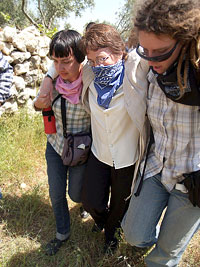
In a Gandhi-like protest, a completely unarmed peaceful gathering of peace activists walked to the Bil'in Wall, were tear-gassed and then shot with rubber bullets, were brought to ambulances for treatment and then returned to the non-violent demonstration. Among them was Nobel Peace Prize Laureate, Mairead Corrigan Maguire.
featured image
Mairead Corrigan Maguire taken away after being shot with rubber bullets by Israeli soldiers.
from a photo series
by the ISM's Martinez

In a Gandhi-like protest, a completely unarmed and peaceful gathering of peace activists who were walking to the Bil'in Wall were tear-gassed and then shot with rubber bullets. After being brought to ambulances for treatment they returned to the non-violent demonstration. Among them was Nobel Peace Prize Laureate Mairead Corrigan Maguire.

Nobel Peace Laureate Mairead Corrigan Maguire writes from Palestine...

'...When the walkers got half way down the road, the Israeli soldiers started firing nerve gas, and plastic bullets directly at us. At another point they used water cannons. We were a completely unarmed peaceful gathering and this vicious attack from the Israeli soldiers was totally unprovoked attack upon civilians. The soldiers block the upper part of the road, thus preventing Dr. Barghouti and some of the Palestinians joining the main vigillers. We were then tear gassed and as I helped a French woman retreat I was shot in the leg with a rubber bullet. Two young women, one from USA and one from New Zealand, helped me towards an ambulance. I saw an elderly Palestinian mother carried on a stretcher into the ambulance, as she was shot in the back with a plastic bullet. I saw a man whose face was covered in blood and a Palestinian youth overcome with the gas. About 20 people were injured. Ann and myself went back to the protest where the people were being viciously attacked with nerve gas and plastic bullets. I was overcome with gas and took a nose bleed which resulted in being carried to ambulance for treatment....'

Related Links: Peace People / Nobel Prize - 1976 / NobelWomensInitiative.org
PalSolidarity.org: All we had for breakfast was tear gas / on December 2006 she was Arrested at Faslane, Scotland


The Nobel Peace Laureate Mairead Maguire was among a number of people shot with a plastic bullet on Friday at a weekly protest in Palestine. Ms Maguire had been invited to open an international conference in the village and this ended with a press conference at which hundreds of international journalists were present.

Afterwards, with Ann Patterson also from Belfast, she joined the weekly non-violent demonstration and walk to the Apartheid Wall. Israeli soldiers fired first tear gas and later rubber-coated steel bullets into the crowd. One man was hit in the head, a Palestinian mother hit in the back, a woman journalist hit in the leg, as was Ms Maguire. She was treated in an ambulance and rejoined the walk again but suffered nose bleed from tear gas inhalation and had to be treated again.

One hour before this she had told the conference: ?Thanks to the media here for telling the truth?Bring this truth to whatever country you come from!? . She had called for an end to the occupation of Palestine, international recognition of the Palestinian Government, an end to the building of the Apartheid Wall and restoration of economic and political rights. She also called for the release of the BBC journalist Alan Johnson

In a joint e-mail from Palestine to this writer last night (Sunday) Mairead and Ann say they are both well.

Full report by Inrternational Solidarity Movement reporters at: http://www.palsolidarity.org/main/2007/04/21/april-20-b...test/

REPORT FROM MAIREAD AND ANN PATTERSON BELOW

"On Friday 20th April, 2007, Ann Patterson and I joined the Bil?in Peoples Committee, (outside Ramallah) on their weekly nonviolent protest march to the Apartheid Wall , together with Israeli peace activists and Internationalists from over 20 countries. The Internationals came from France, (over 200) America, Puerto Rico, Spain, Switzerland, Ireland, Belgium, Britain, Germany, Italy, New Zealand, Canada, and India.

Before the peace vigil, I participated in a Press Conference with the Palestinian Minister for Information, Mustafa Barghouti, in front of the World Press. Minister Barghouti praised the nonviolent vigil of the Bil?in people and the nonviolent resistance of many people around Palestine,says Bil?in is a model and example to all. He called to stop the building of the wall, and for the upholding of Palestinian Rights under International Law.

I supported his call and thanked the people of Bil?in offering my support for the nonviolent resistance to the Wall as it contravenes International Law, including the International Court of Justice decision in the Hague. I also called for an end to Palestinian occupation, which will be 40 years soon, and recognition by the International Community of the Palestinian Government, together with restoration of economic, political rights of the people.

Both Dr. Barghouti and I called for the release of the BBC Journalist Alan Johnston. I also called for the protection of Journalists all over the world, whose ability to cover the truth, is being infringed.

During Conference the Israeli military drove through the Gate onto Palestinian Land, with many foot soldiers. They surrounded World Media and in Hebrew warned us that if we did not disperse they would attack in five minutes. Myself and Dr. Barghouti, condemned this as abuse of freedom of press, speech, and people's right to peaceful protest and speech.

During press conference a man from San Paulo, climbed to the top of the Surveillance Mask and released a Palestinian Flag. He planned to stay there for 2 days.

We returned to the Village and joined the Peace Vigil moving down the road towards the wall. Several hundred people participated, the Palestinian men, women, and many young Palestinian males leading the march. Very courageous as young Palestinian males when arrested often get beaten. I walked with my Palestinian interpreter who told me his home was on the other side of the wall. His 12 acre land was confiscated by Israeli Authorities and his 400 year old olive trees uprooted, taken to Jerusalem and planted in new Israeli settlements.

When the walkers got half way down the road, the Israeli soldiers started firing nerve gas, and plastic bullets directly at us. At another point they used water cannons. We were a completely unarmed peaceful gathering and this vicious attack from the Israeli soldiers was totally unprovoked attack upon civilians. The soldiers block the upper part of the road, thus preventing Dr. Barghouti and some of the Palestinians joining the main vigillers. We were then tear gassed and as I helped a French woman retreat I was shot in the leg with a rubber bullet. Two young women, one from USA and one from New Zealand, helped me towards an ambulance. I saw an elderly Palestinian mother carried on a stretcher into the ambulance, as she was shot in the back with a plastic bullet. I saw a man whose face was covered in blood and a Palestinian youth overcome with the gas. About 20 people were injured. Ann and myself went back to the protest where the people were being viciously attacked with nerve gas and plastic bullets. I was overcome with gas and took a nose bleed which resulted in being carried to ambulance for treatment.

We were advised by medical staff not to return to vigil and obliged to leave our friends several hours later still heroically trying to get near the wall. On the road towards the village we watched 2 children playing in their garden, oblivious to the nerve gas floating down on the wind towards their home. This permeates their clothes, their lungs and the question has to be asked, what the health of these children will be like in a few years time.

This is not only a question of abuse of human rights, international laws, by the Israeli government; it is a health and environment issue. We were all traumatized by our experience, and with the gas on the air, came the words flowing back to me of a Palestinian Doctor, who said ?the whole Palestinian people, after 40 years of occupation, the whole people of Palestine are traumatized, it is time the International Community acted to put a stop to this suffering and injustice of our people?. I agree enough is enough; it is time for action to force the Israeli Government to enter into unconditional talks to end this tragedy of tragedies of good and gentle Palestinian people.

Mairead Corrigan Maguire and Ann Patterson

Jerusalem

2lst April, 2007-04-21

www.peacepeople.com

Bank warns of increased risks to the UK's financial system

By Jane Padgham

Published: 26 April 2007

The Bank of England issued a stark warning today that the dangers surrounding the UK's financial system have risen over the past nine months. It said benign economic conditions had made banks complacent about risk-taking, some companies were loading themselves up with worryingly high levels of debt, complex credit derivatives were untested in times of turbulence and some debt-laden households were showing "signs of stress". It said the recent US sub-prime mortgage crisis was a salutary reminder of how credit risk assessment can go disastrously wrong, and how participants can be hit by sharp reductions in market liquidity.

In its twice-yearly Financial Stability Report, the Bank said the financial system remained "highly resilient". But it urged banks to be alert to the growing risks and take them into account. It singled out the corporate bond market and its associated derivatives market, which has exploded in size in recent years, as particularly vulnerable.

The six key danger areas identified by the report are: unusually low premia for bearing risk, especially in credit markets; high and rising leverage in parts of the corporate sector; rising systemic importance of large complex financial institutions, ie. the big investment banks and securities houses; dependence of UK financial institutions on market infrastructures and utilities, for example the smooth running of the London Stock Exchange and the BACS clearing system; large financial imbalances among the major economies; high UK household sector indebtedness.

Sir John Gieve, the Bank's deputy governor for financial stability, said: "Financial markets have continued to be vibrant, core institutions are highly profitable and the economic outlook is favourable. But risk-taking is increasing, including through higher leverage, lower margin requirements and relaxation of covenants. The rapid growth in credit risk transfer markets [such as collateralised debt obligations] is also making more participants dependent on continuous market liquidity and could amplify the impact of shocks like a sharp reversal in credit spreads from their current low levels."

Sir John, a member of the Bank's Monetary Policy Committee, said there were few signs that America's sub-prime mortgage crisis would cross the Atlantic. He also played down fears that rising insolvencies and home repossessions could spark a housing crash and undermine financial stability. "We watch the housing market at the MPC every month and there are some signs of easing off," he said. "I don't see this [rising household debt] as likely to precipitate a financial crisis."

Ethiopian tanks kill hundreds of civilians in Mogadishu

Thousands flee as shelling by Ethiopian tanks kills hundreds of civilians in Somali capital

· PM claims Islamists are routed, but attacks go on
· UN accuses all sides of committing war crimes


Chris McGreal, Africa correspondent
Thursday April 26, 2007
Guardian Unlimited


Two Islamist insurgents hide behind a wall in Fagah neighbourhood, north of Mogadishu, where Ethiopian troops and Islamists are fighting
Two Islamist insurgents hide behind a wall in Fagah neighbourhood, north of Mogadishu, where Ethiopian troops and Islamists are fighting. Photograph: AFP/Getty Images


The Somali capital Mogadishu suffered some of the heaviest bombardment in nine days of fighting today, as Ethiopian tanks supporting the interim government shelled new areas of the city despite a claim by the Somali prime minister to have routed Islamist insurgents.

The Ethiopian assault has killed several hundred people, many of them civilians harmed by indiscriminate shelling that has destroyed homes and shops, and forced tens of thousands to flee the city as it spread to previously relatively peaceful parts of Mogadishu. Corpses lay scattered on the streets because it is too dangerous to collect them.


More than 1,000 people were killed in an earlier round of fighting last month. More than a third of the civilian population — some 340,000 people — have fled in the past three months.

The UN humanitarian affairs chief, Sir John Holmes, today accused all those involved of war crimes.

"The rules of humanitarian law are being flouted by all sides ... all factions are equally guilty of indiscriminate violence in a civilian area," he said. "Civilians in Mogadishu are paying an intolerable price for the absence of political progress and dialogue and the failure of all parties to abide by the rules of warfare."

Refugees are camped on the outskirts of the city, with water, food and medicine growing scarcer. About 600 have died of cholera and other diseases.

"At least half the capital is deserted, slowly turning it into a ghost city," the UN refugee agency said.

The interim Somali government said the 20,000-strong Ethiopian force fighting on its behalf, with 5,000 Somali troops playing a lesser role, will keep up the offensive until fighters with the Council of Islamic Courts are defeated. The council ruled Mogadishu and much of southern Somalia for six months last year until overthrown by the Ethiopian army with US backing.

Somalia's prime minister, Ali Mohamed Gedi, today claimed to have defeated the Islamist forces. "We have won the fighting against the insurgents," he told Associated Press. "Most of the fighting in Mogadishu is now over. The government has captured a lot of territory where the insurgents were."

But critics say Somalia has become a battleground for Ethiopia's foreign agenda and Washington's "war on terror" that will do little to bring long term stability.

The Islamic Courts government was popular in Mogadishu after bringing relative order and driving out clan warlords responsible for 16 years of death and mayhem. But the US believed it looked too much like the Taliban, with its ban on music and dancing and the qat narcotic, and that it was sympathetic to al-Qaida.

Washington encouraged the Ethiopian military — at the "invitation" of Somalia's interim national government which was so unpopular it was unable to remain in Mogadishu — to invade and oust the Islamic Courts administration. The new Somali government includes some of the warlords who previously caused so much destruction.

A report by the Royal Institute of International Affairs said that US and Ethiopian strategic interests in supporting a weak and factionalised government that is far less popular than the Islamic Courts administration are an obstacle, not a contribution, to rebuilding Somalia.

"In an uncomfortably familiar pattern, genuine multilateral concern to support the reconstruction and rehabilitation of Somalia has been hijacked by unilateral actors — especially Ethiopia and the United States," it said.

As always in Somalia, the conflict is also being driven by money through weapons smuggling and business interests.

Ethiopian forces were to have been replaced by African Union peacekeepers, but only 1,200 of the AU's promised 8,000 troops have arrived in Somalia.