Showing posts with label Posada. Show all posts

Saturday, April 21, 2007

Hypocrisy: Thy Name Is Bush

Related
A terrorist walks
Luis Posada Carriles has boasted of bombing Havana hotels, yet American justice lets him go free.

LUIS POSADA CARRILES - THE DECLASSIFIED RECORD
---
consortiumnews.com

By Robert Parry (A Special Report)

George W. Bush likes to present the “war on terror” as a clear-cut moral crusade in which evildoers who kill innocent civilians must be brought harshly to justice, along with the leaders of countries that harbor terrorists. There are no grays, only blacks and whites.

But evenhanded justice is not the true core principle of the Bush Doctrine. The real consistency is hypocrisy: violence which Bush favors – no matter how wanton the slaughter of innocents – is justifiable, while violence that goes against Bush’s interests – even an insurgency against a foreign military occupation – must be punished without remorse as “terrorism.”

In other words, if Bush hates the perpetrators, they are locked up indefinitely without charge and, at his discretion, can be subjected to “alternative interrogation techniques,” what most of the world considers torture. The rule of law is out the window. Wild West hangin' justice is in. Even the ancient fair trial right of habeas corpus is discarded.

However, when the killers of civilians are on Bush’s side, they get the full panoply of legal protections – and every benefit of the doubt. Under this Bush double standard, therefore, right-wing Cuban terrorists Luis Posada Carriles and Orlando Bosch, though implicated in a string of murderous attacks on civilians, get the see-no-evil treatment.

On April 19, the 79-year-old Posada was released on bail from federal custody for an immigration violation and allowed to fly to Miami where he will live at home while his case winds its way through the U.S. courts. Bosch, too, has been allowed to live out his golden years in south Florida with the help and protection of the Bush family.

But the evidence in U.S. government files is overwhelming that Posada and Bosch were the architects of the 1976 mid-air bombing of a civilian Cubana airliner, killing 73 people, including young members of the Cuban national fencing team.

Since the conspiracy was hatched in Caracas, Venezuela, where Posada worked as a Venezuelan intelligence officer, the Venezuelan government has sought Posada’s extradition. However, when a Posada friend testified at Posada’s immigration hearing that Venezuela practices torture, Bush administration lawyers let the unverified claim go unchallenged, leading the judge to forbid Posada’s deportation there.

So, the Bush administration, which has subjected its own terrorism suspects to such practices as painful stress positions and simulated drowning by “water-boarding,” wasn’t willing to take the chance that Posada might be abused in Venezuela, even though there was no real evidence that he would be.

Justifying Terrorism

The Bush administration also took no note a year ago when Bosch publicly justified the 1976 mid-air bombing. The stunning TV interview of Bosch by reporter Juan Manuel Cao on Miami’s Channel 41 was cited in articles on the Internet by José Pertierra, a lawyer for the Venezuelan government. But Bosch’s comments caused him no further difficulty. [For Pertierra’s story, see Counterpunch, April 11, 2006]

“Did you down that plane in 1976?” Cao asked Bosch.

“If I tell you that I was involved, I will be inculpating myself,” Bosch answered, “and if I tell you that I did not participate in that action, you would say that I am lying. I am therefore not going to answer one thing or the other.”

But when Cao asked Bosch to comment on the civilians who died when the plane crashed off the coast of Barbados, Bosch responded, “In a war such as us Cubans who love liberty wage against the tyrant [Fidel Castro], you have to down planes, you have to sink ships, you have to be prepared to attack anything that is within your reach.”

“But don’t you feel a little bit for those who were killed there, for their families?” Cao asked.

“Who was on board that plane?” Bosch responded. “Four members of the Communist Party, five North Koreans, five Guyanese.” [Officials tallies actually put the Guyanese dead at 11.]

Bosch added, “Four members of the Communist Party, chico! Who was there? Our enemies…”

“And the fencers?” Cao asked about Cuba’s amateur fencing team that had just won gold, silver and bronze medals at a youth fencing competition in Caracas. “The young people on board?”

Bosch replied, “I was in Caracas. I saw the young girls on television. There were six of them. After the end of the competition, the leader of the six dedicated their triumph to the tyrant. … She gave a speech filled with praise for the tyrant.

“We had already agreed in Santo Domingo, that everyone who comes from Cuba to glorify the tyrant had to run the same risks as those men and women that fight alongside the tyranny.” [The comment about Santo Domingo was an apparent reference to a strategy meeting by a right-wing terrorist organization, CORU, which took place in the Dominican Republic in 1976.]

“If you ran into the family members who were killed in that plane, wouldn’t you think it difficult?” Cao asked.

“No, because in the end those who were there had to know that they were cooperating with the tyranny in Cuba,” Bosch answered.

In an article about Bosch’s remarks, lawyer Pertierra said the answers “give us a glimpse into the mind of the kind of terrorist that the United States government harbors and protects in Miami; terrorists that for the last 47 years have waged a bloody and ruthless war against the Cuban people.”

CIA Files

Beyond Bosch’s incriminating statements, the evidence of his and Posada’s guilt is overwhelming. Declassified U.S. documents show that soon after the Cubana Airlines plane was blown out of the sky on Oct. 6, 1976, the CIA, then under the direction of George H.W. Bush, identified Posada and Bosch as the masterminds of the bombing.

But in fall 1976, Bush’s boss, President Gerald Ford, was in a tight election battle with Democrat Jimmy Carter and the Ford administration wanted to keep intelligence scandals out of the newspapers. So Bush and other officials kept the lid on the investigations. [For details, see Robert Parry’s Secrecy & Privilege.]

Still, inside the U.S. government, the facts were known. According to a secret CIA cable dated Oct. 14, 1976, intelligence sources in Venezuela relayed information about the Cubana Airlines bombing that tied in anti-communist Cuban extremists Bosch, who had been visiting Venezuela, and Posada, who then served as a senior officer in Venezuela’s intelligence agency, DISIP.

The Oct. 14 cable said Bosch arrived in Venezuela in late September 1976 under the protection of Venezuelan President Carlos Andres Perez, a close Washington ally who assigned his intelligence adviser Orlando Garcia “to protect and assist Bosch during his stay in Venezuela.”

On his arrival, Bosch was met by Garcia and Posada, according to the report. Later, a fundraising dinner was held in Bosch’s honor during which Bosch requested cash from the Venezuelan government in exchange for assurances that Cuban exiles wouldn’t demonstrate during Andres Perez’s planned trip to the United Nations.

“A few days following the fund-raising dinner, Posada was overheard to say that, ‘we are going to hit a Cuban airplane,’ and that ‘Orlando has the details,’” the CIA report said.

“Following the 6 October Cubana Airline crash off the coast of Barbados, Bosch, Garcia and Posada agreed that it would be best for Bosch to leave Venezuela. Therefore, on 9 October, Posada and Garcia escorted Bosch to the Colombian border, where he crossed into Colombian territory.”

The CIA report was sent to CIA headquarters in Langley, Virginia, as well as to the FBI and other U.S. intelligence agencies, according to markings on the cable.

In South America, police began rounding up suspects. Two Cuban exiles, Hernan Ricardo and Freddy Lugo, who got off the Cubana plane in Barbados, confessed that they had planted the bomb. They named Bosch and Posada as the architects of the attack.

A search of Posada’s apartment in Venezuela turned up Cubana Airlines timetables and other incriminating documents.

Posada and Bosch were charged in Venezuela for the Cubana Airlines bombing, but the men denied the accusations. The case soon became a political tug-of-war, since the suspects were in possession of sensitive Venezuelan government secrets that could embarrass President Andres Perez.

Lost Interest

After the Reagan-Bush administration took power in Washington in 1981, the momentum for fully unraveling the mysteries of anti-communist terrorist plots dissipated. The Cold War trumped any concern about right-wing terrorism.

In 1985, Posada escaped from a Venezuelan prison, reportedly with the help of Cuban exiles. In his autobiography, Posada thanked Miami-based Cuban activist Jorge Mas Canosa for providing the $25,000 that was used to bribe guards who allowed Posada to walk out of prison.

Another Cuban exile who aided Posada was former CIA officer Felix Rodriguez, who was close to then-Vice President George H.W. Bush and who was overseeing secret supply shipments to the Nicaraguan contra rebels, a pet project of President Ronald Reagan.

After fleeing Venezuela, Posada joined Rodriguez in Central America and was assigned the job of paymaster for pilots in the White House-run contra-supply operation. When one of the contra-supply planes was shot down inside Nicaragua in October 1986, Posada was responsible for alerting U.S. officials to the crisis and then shutting down the operation’s safe houses in El Salvador.

Even after the exposure of Posada’s role in the contra-supply operation, the U.S. government made no effort to bring the accused terrorist to justice.

By the late 1980s, Orlando Bosch also was out of Venezuela’s jails and back in Miami. But Bosch, who had been implicated in about 30 violent attacks, was facing possible deportation by U.S. officials who warned that Washington couldn’t credibly lecture other countries about terrorism while protecting a terrorist like Bosch.

But Bosch got lucky. Jeb Bush, then an aspiring Florida politician, led a lobbying drive to prevent the U.S. Immigration and Naturalization Service from expelling Bosch. In 1990, the lobbying paid dividends when Jeb's dad, President George H.W. Bush, blocked proceedings against Bosch, letting the unapologetic terrorist stay in the United States.

In 1992, also during George H.W. Bush’s presidency, the FBI interviewed Posada about the Iran-Contra scandal for 6 ½ hours at the U.S. Embassy in Honduras.

Posada filled in some blanks about the role of Bush’s vice presidential office in the secret contra operation. According to a 31-page summary of the FBI interview, Posada said Bush’s national security adviser, Donald Gregg, was in frequent contact with Felix Rodriguez.

“Posada … recalls that Rodriguez was always calling Gregg,” the FBI summary said. “Posada knows this because he’s the one who paid Rodriguez’ phone bill.” After the interview, the FBI agents let Posada walk out of the embassy to freedom. [For details, see Parry’s Lost History: Contras, Cocaine, the Press & Project Truth.]

More Attacks

Posada soon returned to his anti-Castro plotting.

In 1994, Posada set out to kill Castro during a trip to Cartagena, Colombia. Posada and five cohorts reached Cartagena, but the plan flopped when security cordons prevented the would-be assassins from getting a clean shot at Castro, according to a Miami Herald account. [Miami Herald, June 7, 1998]

The Herald also described Posada’s role in a lethal 1997 bombing campaign against popular hotels and restaurants inside Cuba that killed an Italian tourist. The story cited documentary evidence that Posada arranged payments to conspirators from accounts in the United States.

“This afternoon you will receive via Western Union four transfers of $800 each … from New Jersey,” said one fax signed by SOLO, a Posada alias.

Posada landed back in jail in 2000 after Cuban intelligence uncovered a plot to assassinate Castro by planting a bomb at a meeting the Cuban leader planned with university students in Panama.

Panamanian authorities arrested Posada and other alleged co-conspirators in November 2000. In April 2004, they were sentenced to eight or nine years in prison for endangering public safety.

Four months after the sentencing, however, lame-duck Panamanian President Mireya Moscoso – who lives in Key Biscayne, Florida, and has close ties to the Cuban-American community and to George W. Bush’s administration – pardoned the convicts.

Despite press reports saying Moscoso had been in contact with U.S. officials about the pardons, the State Department denied that it pressured Moscoso to release the Cuban exiles. After the pardons and just two months before Election 2004, three of Posada’s co-conspirators – Guillermo Novo Sampol, Pedro Remon and Gaspar Jimenez – arrived in Miami to a hero’s welcome, flashing victory signs at their supporters.

While the terrorists celebrated, U.S. authorities watched the men – also implicated in bombings in New York, New Jersey and Florida – alight on U.S. soil. As Washington Post writer Marcela Sanchez noted in a September 2004 article about the Panamanian pardons, “there is something terribly wrong when the United States, after Sept. 11 (2001), fails to condemn the pardoning of terrorists and instead allows them to walk free on U.S. streets.” [Washington Post, Sept. 3, 2004]

Posada Arrives

Posada reportedly sneaked into the United States in early 2005 and his presence was an open secret in Miami for weeks before U.S. authorities did anything. The New York Times summed up Bush’s dilemma if Posada decided to seek U.S. asylum.

“A grant of asylum could invite charges that the Bush administration is compromising its principle that no nation should harbor suspected terrorists,” the Times wrote. “But to turn Mr. Posada away could provoke political wrath in the conservative Cuban-American communities of South Florida, deep sources of support and campaign money for President Bush and his brother, Jeb.” [NYT, May 9, 2005]

Only after Posada called a news conference to announce his presence was the Bush administration shamed into arresting him. But even then, the administration balked at sending Posada back to Venezuela where the government of Hugo Chavez – unlike some of its predecessors – was eager to prosecute.

At a U.S. immigration hearing in 2005, Posada’s defense attorney called as a witness a Posada friend who alleged that Venezuela’s government practices torture. Bush administration lawyers didn’t challenge the claim, leading the immigration judge to bar Posada’s deportation to Venezuela.

Venezuela’s Ambassador Bernardo Alvarez accused the Bush administration of applying “a cynical double standard” in the “war on terror.”

“The United States presents itself as a leader against terrorism, invades countries, restricts the civil rights of Americans in order to fight terrorism, but when it is about its own terrorists, it denies that they be tried,” Alvarez said.

As for the claim that Venezuela practices torture, Alvarez said, “There isn’t a shred of evidence that Posada would be tortured in Venezuela.” Alvarez added that the claim was particularly ironic given widespread press accounts that the Bush administration has abused prisoners at the U.S. military base in Guatanamo Bay, Cuba.

The Posada-Bosch cases point to one unavoidable and unpleasant conclusion: that the Bush family regards terrorism – defined as killing civilians for a political reason – as justified or at least tolerable in cases when their interests match those of the terrorists.

Terrorism is only a moral evil to the Bushes when the violence against civilians clashes with the Bush family’s interests.

This blatant hypocrisy often has been aided and abetted by the U.S. news media, which intuitively understands the double standard and acts accordingly. The U.S. press corps downplays or ignores cases in which terrorism has connections to U.S. government officials – and especially to the Bush family.

Robert Parry broke many of the Iran-Contra stories in the 1980s for the Associated Press and Newsweek. His latest book, Secrecy & Privilege: Rise of the Bush Dynasty from Watergate to Iraq, can be ordered at secrecyandprivilege.com.

Friday, April 20, 2007

Another Bush Releases Another Mass Murderer

Fri Apr 20th, 2007 at 04:02:12 AM EST

Terrorist Posada Arrives Home in Miami

by Meteor Blades
tleelange@hotmail.com

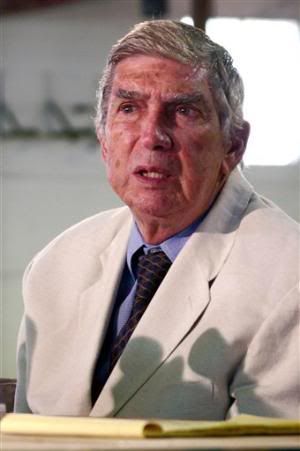
Looking fragile and tired in his off-white tropical suit, a grandfatherly Luis Posada Carriles was gently helped out of the car that delivered him to his wife's house in Miami Thursday as the sun went down. It will be the first time in 23 months that he has not spent the night in federal detention. So it was no surprise that, when asked how he felt, he replied, "Estoy muy contento," ("I'm very happy.") To the Cuban-American community he said, "I'm very grateful."

Happy and grateful and comfortably surrounded by his family, friends and fans while his victims spin in their graves. Except that many of his victims have no graves since they were killed by the bombing of Air Cubana Flight 455 in 1976 when it took off from Barbados. Not all the bodies could be recovered. Among those on board were many teenagers, members of the Cuban fencing team. Says Posada: "No one saw me make a bomb."


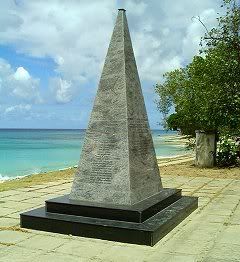
Barbados Monument to those killed in the 1976 bombing.

You may never have heard of Luis Posada Carriles. His is not exactly a household name even though he's a fugitive wanted in two countries for airline bombing and hotel bombing. Even though, before September 11, 2001, the downing of Flight 455 was the worst terrorist act in the Western Hemisphere. That's not all he did. Posada got around. He worked for the CIA, he worked for the Venezuelan secret police, he had ties to the Chilean secret police, he was connected to Operation Condor, he helped Oliver North distribute weapons to the terrorist contras of Nicaragua, weapons paid for by illegal sales of other weapons to America's very good friends, the Iranian ayatollahs. In the genocidal Guatemala of the 1980s, he worked as an "advisor" to counter-guerrilla operatives there.

Don't take my word for any of this (as if you would anyway). Read the declassified files on Posada held at the National Security Archives. Many files remain classified. A few critics claim other files have been destroyed, a charge impossible, of course, to prove.

No direct evidence exists, but there are suspicions Posada was assisted by high-level American officials in his escape from a Venezuelan jail in 1985. In 2001, he and others were convicted in connection with a bomb plot to kill Castro on the occasion of the old caudillo's visit to Panama. Posada and his fellow convicts served until 2004 when they were suddenly pardoned by Panamanian President Mireya Moscoso, who had close ties to the Bush Administration. She denied any political motivation. The Administration never condemned the plotters, even though innocents attending Castro's speech would certainly have been killed if Posada's terrorists had carried out their mission.

If the Administration had had its way, Posada would never have spent a day in the slammer. Indeed, he wasn't arrested until the afternoon of the day the Miami Herald published an interview with him that its reporters had undertaken through cloak-and-dagger means at a secret location. Moreover, if the Administration has its way, Posada will never pay for his crimes, never be brought to account, even though there is at least circumstantial evidence that one of his victims was an American citizen, Ronni Moffitt, murdered by a bomb along with the Allende-era Chilean diplomat, Orlando Letelier, in September 1976, on the streets of Washington, D.C.

Peter Kornbluth, director of the Cuba Documentation Project at the National Security Archive, said it best on All Things Considered:

His release sends a message to the world that the United States really is not serious in its war on terrorism. Here's a guy who has a lifelong résumé of violent acts, blowing up planes, bombing hotels, attempting to blow up ships, assassination efforts against Fidel Castro. ...

Here was a case where the Bush Administration could have employed the Patriot Act to hold Posada as a terrorist. All they had to do was certify that he was a terrorist or that his release would be detrimental to U.S. national security interests. And despite the fact that immigration and customs have said to him directly in letters your history of violence means you are a danger to the security of U.S. citizens, they have now let him go. ...

Luis Posada Carriles was a litmus test for the Bush Administration. ... Instead, they have let him return to his home in Miami where many of his supporters will gather and cheer.


Just about anyone who has lost kin or friends to acts of terror - whether by state-sponsored terror or the acts of free-lancers like Osama bin Laden - is well-acquainted with vengeful desires. For victims of such violence, nothing is too terrible a punishment for the perpetrators. But in a civilized society, that's what courts are for.

Or at least what courts were for before Mister Bush and his crew took over, came up with torture excuses, "enemy combatants," secret prisons and jurisdictional no-man's-lands like Guantánamo, the latter ironically based on the forcibly leased land of the longest surviving one-man dictatorship in the world.

A vengeful person would suggest that perhaps Señor Posada should spend an indefinite period of time there in a permanently lit cell, shackled to the floor, listening to high-decibel rap music instead of the boleros of his youth. Vengeance, however, isn't justice. And justice is what the old terrorist's victims cry out for. We are, in a sense, all of us his victims. Victims of a government that is itself above the law, that uses the "war on terror" as just more fuel for its spin machine, all but abandoning the hunt for some terrorists, while all but publicly embracing some others.

Given the number of people who cross the Mexican border illegally every year, it is ridiculous to be trying Luis Posada Carriles for illegally entering the United States. Especially since it's already been decided by the same federal judiciary that has released him on bail that he can't be deported either to Cuba or Venezuela - the two countries whose citizens suffered the most from his actions - because he might be tortured there. The ironies pile sky-high.

Another course of action remains. Release all the files on Posada and ship them and him to The Hague for trial under the crimes against humanity section of the Rome Statute of the International Criminal Court. That would be justice. And it will happen when pigs fly.

Most likely, Posada will settle down in Miami, with or without his electronic tracking bracelet, drinking piña coladas or peach daiquiris for the rest of his life. Perhaps he can drive over and play dominoes with his pal in Operation Condor, Orlando Bosch, the murderer and terrorist pardoned by George H.W. Bush in 1990.

Tuesday, April 10, 2007

Coddling of terrorists continues...in the United States

Tuesday, April 10, 2007


In the latest development in the case of Luis Posada Carriles, a judge has set bail to allow him to be freed in advance of his immigration trial in May. The U.S. continues to defy international law and various treaties it has signed, which obligate the U.S. to either extradite Posada to Venezuela, where he is wanted for the murder of 73 people in connection with the 1976 mid-air bombing of a Cubana airliner, or to try him themselves for that crime. It's worth remembering why they refuse to do so - because they claim Posada might be tortured in Venezuela. And why are they able to make that claim? Because at a preliminary hearing, Posada's lawyer and former partner (and fellow torturer) in the (old) Venezuelan secret police, Joaquin Chaffardet, testified that Posada might be tortured in Venezuela, and the U.S. government presented no testimony to counter that baseless claim, allowing it to stand unchallenged.

The news coverage of the latest development is infuriating. The Judge describes Posada as having ""a controversial past," and the Reuters reporter writes, "his past activities are viewed as terrorism by his opponents." Let's review, shall we? Posada is strongly implicated in the murder of 73 people in an airplane bombing. He admitted to a New York Times reporter that he was the mastermind behind a string of hotel bombings in Havana in the late 90's which killed one Italian tourist and injured many others. He was convicted of entering Panama in 2000 with 20 pounds of C-4 and a plan to blow up an auditorium where Fidel Castro was addressing hundreds of Panamanian students (and pardoned several months later by the outgoing Panamanian President who is now living, where else, in the United States). This is just part of the record of someone which Reuters thinks is "viewed as terrorism by his opponents," and the Judge thinks is "controversial." Do you really have to be an "opponent" of Luis Posada Carriles to think that blowing up an airplane in mid-flight is an act of terrorism? Is there really any "controversy" over how to characterize an attempt to blow up an auditorium full of people?

On May 11, Posada (if he hasn't fled the country by then or gone into hiding) will go on trial in El Paso. A demonstration demanding his extradition to stand trial in Venezuela will greet the trial - be there if you can.

Saturday, April 7, 2007

US Judge Orders Posada Released

US judge orders anti-Castro activist Posada released

Apr 6 04:31 PM US/Eastern

A federal judge Friday ordered that former CIA operative Luis Posada Carriles, wanted by Cuba and Venezuela for the deadly downing of a Cuban jet, be released pending a hearing on immigration fraud charges.

The ruling, made by a federal judge in Texas, does not necessarily mean Posada Carriles, 79, will leave jail immediately, since he could be arrested by immigration officials that have a deportation order for him.

The judge ordered the Cuban-born Venezuelan national released on a 350,000 dollars bail on condition that he remain confined to his Miami home and submit to "electronic monitoring," according to the text of the order by the federal court in El Paso, Texas.

Posada Carriles, a fierce opponent of Cuban President Fidel Castro, is accused of masterminding the downing of a Cuban jet off Barbados in 1976 in which 73 people were killed.

He was detained in Venezuela in 1976 and convicted in the case, but fled prison in 1985.

He was also sentenced to eight years' jail in Panama in a bomb plot to assassinate Castro during an Ibero-American summit there in 2000, but was pardoned by outgoing president Mireya Moscoso.

Posada Carriles was detained by US immigration officials in May 2005 for entering the United States illegally. He is currently held in a federal prison in the southwestern state of New Mexico.

US officials refuse to release Posada Carriles to Venezuela or Cuba, claiming he might be tortured. But they have also refused to free him, calling him a threat to national security.

Havana and Caracas accuse Washington of harboring a known terrorist.

US immigration authorities criticized the judge's release order, and said that Immigration and Customs Enforcement (ICE) officials would arrest Posada Carriles.

"We are disappointed with the ruling. We remind you there is an immigration detainer pending against Mr Posada," the ICE spokesman Michael Keegan told AFP.

"This detainer means Mr Posada will remain in federal custody although he will be transferred from the custody of the US marshals to that of" the ICE.

Declassified US documents show that Posada Carriles worked for the CIA from 1965 to June 1976. He reportedly helped the US government ferry supplies to the Contra rebels that waged a bloody campaign to topple the socialist Sandinistas in Nicaragua in the 1980s.

Friday, January 19, 2007

Terrorist arms cache uncovered in the U.S.

Related

Where Is the Consistency in the War on Terrorism?
---

Posada ally surrenders arms cache

A longtime Castro foe turned over a new cache of weapons in Miami in the hope of reducing his prison sentence and that of an exile colleague.

by Jay Weaver
Jan. 19, 2007
Reprinted from the Miami Herald

An ally of Cuban exile militant Luis Posada Carriles turned over a stockpile of illegal machine guns, dynamite and a grenade launcher to federal agents this week in a bid to reduce his prison sentence, several sources familiar with the arms surrender said.

Santiago Alvarez, a wealthy Miami developer convicted last fall on a weapons-conspiracy charge, arranged for the turnover of the new cache of firearms on Wednesday at his attorney's office in downtown Miami, sources said.

Alvarez and convicted co-defendant Osvaldo Mitat are seeking to reduce their respective four- and three-year prison sentences by one or more years. The unusual arms surrender has no connection to Posada's latest troubles with federal authorities.

The Alvarez stash consisted of dozens of machine guns, rifles, C-4 explosive, dynamite, detonators, a grenade launcher and ammunition, sources said. The cache was considerably larger than the nine illegal firearms seized by federal agents in late 2005 when Alvarez and Mitat were first indicted on weapons charges in Broward County.

Agents for the FBI and Alcohol, Tobacco, Firearms and Explosives collected the latest stash of weapons at the Miami law office of Silvia Piñera-Vazquez and Sofia Powell-Cosio. The lawyers were granted temporary immunity to surrender the firearms to federal authorities on behalf of their clients, Alvarez and Mitat. Piñera-Vazquez, who declined to comment for this article, personally delivered a letter to the U.S. attorney's office on Tuesday detailing the proposed weapons turnover.

The voluntary surrender was designed to take the firearms off the street and boost the defendants' chances of reducing their sentences.

Alvarez, 65, has been in federal custody since November 2005, as has Mitat, 64, a handyman who worked for him. To obtain reductions of their sentences, they must prove to prosecutors they have provided enough ''substantial assistance.'' Prosecutors would have to file the request in federal court.

Defense attorneys for Alvarez and Mitat have said their clients never had any designs to carry out an attack against the U.S. government. They say the men's goal was always to topple Cuban leader Fidel Castro.

PIPE BOMB FOUND

The weapons turnover occurred just days after an FBI informant -- who has informed on Posada, Alvarez and Mitat -- reported that he discovered a pipe bomb under his pickup truck in Hialeah on Sunday. Miami-Dade police officers detonated the device at the Hialeah police station. They found wires and gun shells among the bomb scraps. The FBI launched a probe but declined to comment.

Attorneys for Alvarez, Mitat and Posada said their clients -- all in federal custody in Texas -- were not involved in the pipe-bomb incident. They expressed serious doubts about the credibility of the informant, Gilberto Abascal, whom they have characterized as a ''double agent'' for the FBI and for Castro's government.

Lawyers for Alvarez and Mitat have been negotiating with the U.S. attorney's office since their sentencings in November to turn over the new weapons cache, sources familiar with the case told The Miami Herald.

COMMON THREADS

Intrigue surrounding the weapons surrender could not be greater. Last September, Abascal was the main federal witness who helped convict Alvarez and Mitat on weapons-conspiracy charges in South Florida. Abascal was also the primary witness in last week's federal indictment of former CIA operative Posada on fraud offenses.

A federal grand jury in El Paso, Texas, charged Posada, 78, with lying about how he sneaked into the United States in March 2005.

The same grand jury also charged Alvarez and Mitat with contempt of court for refusing to testify about Posada's entry into the country. Three other associates have been charged with contempt in the case.

Posada has long maintained that he entered the United States by crossing the Mexican border with the assistance of a migrant smuggler, not by sea -- as prosecutors now allege.

Abascal said Posada entered the country on a shrimping boat called Santrina, which was manned by Alvarez, Mitat and others, including the informant himself. Abascal said the Santrina crew picked up Posada on the Mexican island of Isla Mujeres and transported him to the United States.

By charging Posada, the Justice Department signaled its willingness to target a man who has been in investigators' cross hairs since 1997, when he first was suspected of masterminding a series of deadly tourist-site bombings in Cuba.

Federal agents began zeroing in on Alvarez in May 2005 when he helped Posada emerge from hiding before his arrest for entering the country illegally. That November, Alvarez and Mitat were charged with stashing machine guns, a silencer and a grenade launcher in a Lauderhill apartment complex that belonged to Alvarez.

The defendants' attorneys claimed Abascal, who called federal agents on the way from Broward County to Miami-Dade, set up his former friends.

Although prosecutors never accused the two men of planning to use those firearms in an attack against the Cuban government, they intended to introduce evidence at trial that showed Alvarez had financed a failed 2001 incursion against Castro, among other paramilitary activities. Plea deals came on the eve of trial.

Court records also show that federal and Bahamian authorities recovered a large cache of weapons and explosives hidden on Guinchos Cay in August 2005 -- ``an operation conducted after agents learned that Alvarez was storing and maintaining this arsenal.''

Related story: Witness against Posada reports a bomb under his pickup