Showing posts with label terrorism. Show all posts

Saturday, April 28, 2007

Cheney has it exactly backwards; Terror attacks up, Rice considered hiding the data

Related
Terror attacks up, Rice considered hiding the data
---

Saturday, April 28, 2007

Saudi Terror Plot Averted
State Dept.: Terrorism up 30%


Condi Rice wanted to delay the news, but it has broken on two fronts.

Warren Strobel and Jonathan S. Landay of McClatchy report that the annual State Department on terrorism will report a nearly 30% rise over the previous year, most of it accounted for by attacks in Iraq and Afghanistan.

In other words Cheney has it exactly backwards. The US military presence in Iraq and Afghanistan is feeding terrorism, not preventing or lessening it. "They" won't follow us home if we leave. But they might if we don't.

Thursday, April 26, 2007

Put Bush's 'puppy dog' terror theory to sleep

By RICHARD CLARKE

Posted Wednesday, April 25th 2007, 4:00 AM

Be Our Guest

Does the President think terrorists are puppy dogs? He keeps saying that terrorists will "follow us home" like lost dogs. This will only happen, however, he says, if we "lose" in Iraq.

The puppy dog theory is the corollary to earlier sloganeering that proved the President had never studied logic: "We are fighting terrorists in Iraq so that we will not have to face them and fight them in the streets of our own cities."

Remarkably, in his attempt to embrace the failed Iraqi adventure even more than the President, Sen. John McCain is now parroting the line. "We lose this war and come home, they'll follow us home," he says.

How is this odd terrorist puppy dog behavior supposed to work? The President must believe that terrorists are playing by some odd rules of chivalry. Would this be the "only one slaughter ground at a time" rule of terrorism?

Of course, nothing about our being "over there" in any way prevents terrorists from coming here. Quite the opposite, the evidence is overwhelming that our presence provides motivation for people throughout the Arab world to become anti-American terrorists.

Some 100,000 Iraqis, probably more, have been killed since our invasion. They have parents, children, cousins and fellow tribal clan members who have pledged revenge no matter how long it takes. For many, that revenge is focused on America.

At the same time, investing time, energy and resources in Iraq takes our eye off two far more urgent tasks at hand: one, guarding the homeland against terrorism much better than the pork-dispensing Department of Homeland Security currently does the job; and two, systematically dismantling Al Qaeda all over the world, from Canada to Asia to Africa. On both these fronts, the Bush administration's focus is sorely lacking.

Yet in the fantasyland of illogic in which the President dwells, shaped by slogans devised by spin doctors, America can "win" in Iraq. Then, we are to believe, the terrorists will be so demoralized that they will recant their beliefs and cease their terrorist ways.

In the real world, by choosing unnecessarily to go into Iraq, Bush not only diverted efforts from delivering a death blow to Al Qaeda, he gave that movement both a second chance and the best recruiting tool possible.

U.S. military raids in Iraq have uncovered evidence that Iraqis are planning attacks in America, perhaps to be carried out by terrorists with European Union passports that require no U.S. visas. But such attacks here over the next several years are likely now no matter what happens next in Iraq - and that is because of what Bush has already done, not because of any future course we choose in Iraq.

But we can be sure that when the next attacks come in the U.S., if Bush is down on the ranch cutting trees, he and whatever few followers he retains by then will blame his successor. You can almost hear them now: If only hissuccessor had left enough U.S. troops in the Iraqi shooting gallery to satisfy the blood lust of the enemy, as Bush did, then they wouldn't have come here.

The truth: If not for this administration's reckless steps to push America into war - and strategic blunder after strategic blunder that has satisfied the blood lust of the enemy - fewer evildoers would follow us home like the dogs that they are.


Clarke served as chief counterterrorism adviser on the U.S. National Security Council under Presidents Bill Clinton and George W. Bush. He is now chairman of Good Harbor Consulting.

Friday, April 20, 2007

Another Bush Releases Another Mass Murderer

Fri Apr 20th, 2007 at 04:02:12 AM EST

Terrorist Posada Arrives Home in Miami

by Meteor Blades
tleelange@hotmail.com

Looking fragile and tired in his off-white tropical suit, a grandfatherly Luis Posada Carriles was gently helped out of the car that delivered him to his wife's house in Miami Thursday as the sun went down. It will be the first time in 23 months that he has not spent the night in federal detention. So it was no surprise that, when asked how he felt, he replied, "Estoy muy contento," ("I'm very happy.") To the Cuban-American community he said, "I'm very grateful."

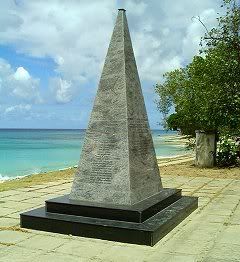
Happy and grateful and comfortably surrounded by his family, friends and fans while his victims spin in their graves. Except that many of his victims have no graves since they were killed by the bombing of Air Cubana Flight 455 in 1976 when it took off from Barbados. Not all the bodies could be recovered. Among those on board were many teenagers, members of the Cuban fencing team. Says Posada: "No one saw me make a bomb."


Barbados Monument to those killed in the 1976 bombing.

You may never have heard of Luis Posada Carriles. His is not exactly a household name even though he's a fugitive wanted in two countries for airline bombing and hotel bombing. Even though, before September 11, 2001, the downing of Flight 455 was the worst terrorist act in the Western Hemisphere. That's not all he did. Posada got around. He worked for the CIA, he worked for the Venezuelan secret police, he had ties to the Chilean secret police, he was connected to Operation Condor, he helped Oliver North distribute weapons to the terrorist contras of Nicaragua, weapons paid for by illegal sales of other weapons to America's very good friends, the Iranian ayatollahs. In the genocidal Guatemala of the 1980s, he worked as an "advisor" to counter-guerrilla operatives there.

Don't take my word for any of this (as if you would anyway). Read the declassified files on Posada held at the National Security Archives. Many files remain classified. A few critics claim other files have been destroyed, a charge impossible, of course, to prove.

No direct evidence exists, but there are suspicions Posada was assisted by high-level American officials in his escape from a Venezuelan jail in 1985. In 2001, he and others were convicted in connection with a bomb plot to kill Castro on the occasion of the old caudillo's visit to Panama. Posada and his fellow convicts served until 2004 when they were suddenly pardoned by Panamanian President Mireya Moscoso, who had close ties to the Bush Administration. She denied any political motivation. The Administration never condemned the plotters, even though innocents attending Castro's speech would certainly have been killed if Posada's terrorists had carried out their mission.

If the Administration had had its way, Posada would never have spent a day in the slammer. Indeed, he wasn't arrested until the afternoon of the day the Miami Herald published an interview with him that its reporters had undertaken through cloak-and-dagger means at a secret location. Moreover, if the Administration has its way, Posada will never pay for his crimes, never be brought to account, even though there is at least circumstantial evidence that one of his victims was an American citizen, Ronni Moffitt, murdered by a bomb along with the Allende-era Chilean diplomat, Orlando Letelier, in September 1976, on the streets of Washington, D.C.

Peter Kornbluth, director of the Cuba Documentation Project at the National Security Archive, said it best on All Things Considered:

His release sends a message to the world that the United States really is not serious in its war on terrorism. Here's a guy who has a lifelong résumé of violent acts, blowing up planes, bombing hotels, attempting to blow up ships, assassination efforts against Fidel Castro. ...

Here was a case where the Bush Administration could have employed the Patriot Act to hold Posada as a terrorist. All they had to do was certify that he was a terrorist or that his release would be detrimental to U.S. national security interests. And despite the fact that immigration and customs have said to him directly in letters your history of violence means you are a danger to the security of U.S. citizens, they have now let him go. ...

Luis Posada Carriles was a litmus test for the Bush Administration. ... Instead, they have let him return to his home in Miami where many of his supporters will gather and cheer.


Just about anyone who has lost kin or friends to acts of terror - whether by state-sponsored terror or the acts of free-lancers like Osama bin Laden - is well-acquainted with vengeful desires. For victims of such violence, nothing is too terrible a punishment for the perpetrators. But in a civilized society, that's what courts are for.

Or at least what courts were for before Mister Bush and his crew took over, came up with torture excuses, "enemy combatants," secret prisons and jurisdictional no-man's-lands like Guantánamo, the latter ironically based on the forcibly leased land of the longest surviving one-man dictatorship in the world.

A vengeful person would suggest that perhaps Señor Posada should spend an indefinite period of time there in a permanently lit cell, shackled to the floor, listening to high-decibel rap music instead of the boleros of his youth. Vengeance, however, isn't justice. And justice is what the old terrorist's victims cry out for. We are, in a sense, all of us his victims. Victims of a government that is itself above the law, that uses the "war on terror" as just more fuel for its spin machine, all but abandoning the hunt for some terrorists, while all but publicly embracing some others.

Given the number of people who cross the Mexican border illegally every year, it is ridiculous to be trying Luis Posada Carriles for illegally entering the United States. Especially since it's already been decided by the same federal judiciary that has released him on bail that he can't be deported either to Cuba or Venezuela - the two countries whose citizens suffered the most from his actions - because he might be tortured there. The ironies pile sky-high.

Another course of action remains. Release all the files on Posada and ship them and him to The Hague for trial under the crimes against humanity section of the Rome Statute of the International Criminal Court. That would be justice. And it will happen when pigs fly.

Most likely, Posada will settle down in Miami, with or without his electronic tracking bracelet, drinking piña coladas or peach daiquiris for the rest of his life. Perhaps he can drive over and play dominoes with his pal in Operation Condor, Orlando Bosch, the murderer and terrorist pardoned by George H.W. Bush in 1990.

Thursday, March 15, 2007

Step Away from the Banana: Chiquita to Pay $25M Fine in Terror Case

Chiquita to Pay $25M Fine in Terror Case

Thursday March 15, 2007 9:46 AM

By MATT APUZZO

Associated Press Writer

WASHINGTON (AP) - Banana company Chiquita Brands International said Wednesday it has agreed to a $25 million fine after admitting it paid terrorists for protection in a volatile farming region of Colombia.

The settlement resolves a lengthy Justice Department investigation into the company's financial dealings with right-wing paramilitaries and leftist rebels the U.S. government deems terrorist groups.

In court documents filed Wednesday, federal prosecutors said the Cincinnati-based company and several unnamed high-ranking corporate officers paid about $1.7 million between 1997 and 2004 to the United Self-Defense Forces of Colombia, known as AUC for its Spanish initials.

The AUC has been responsible for some of the worst massacres in Colombia's civil conflict and for a sizable percentage of the country's cocaine exports. The U.S. government designated the right-wing militia a terrorist organization in September 2001.

Prosecutors said the company made the payments in exchange for protection for its workers. In addition to paying the AUC, prosecutors said, Chiquita made payments to the National Liberation Army, or ELN, and the leftist Revolutionary Armed Forces of Colombia, or FARC, as control of the company's banana-growing area shifted.

Leftist rebels and far-right paramilitaries have fought viciously over Colombia's banana-growing region, though the victims are most often noncombatants. Most companies in the area have extensive security operations to protect employees.

In Colombia, authorities reported Wednesday that nine geologists searching for gold were captured by the FARC. In addition, the army confirmed that four contractors hired by Colombian oil giant Ecopetrol were missing near Colombia's border with Venezuela.

Colombia has one of the highest kidnappings rates in the world. Arrangements between companies and either guerrillas or paramilitaries are not uncommon, but it is impossible to know how much money is paid each year.

``The information filed today is part of a plea agreement, which we view as a reasoned solution to the dilemma the company faced several years ago,'' Chiquita's chief executive, Fernando Aguirre, said in a statement. ``The payments made by the company were always motivated by our good faith concern for the safety of our employees.''

Chiquita sold its Colombian banana operations in June 2004.

Details of the settlement were not included in court documents, but Aguirre said Chiquita would pay $25 million in fines, which it set aside this year. The company reported the deal to the Securities and Exchange Commission. A plea hearing was scheduled for Monday.

The payments were approved by senior executives at Chiquita, prosecutors wrote in court documents. Prosecutors said Chiquita began paying the right-wing AUC after a meeting in 1997 and disguised the payments in company books.

``No later than in or about September 2000, defendant Chiquita's senior executives knew that the corporation was paying AUC and that the AUC was a violent paramilitary organization,'' prosecutors wrote in Wednesday's court filing.

Company attorneys made it clear the payments were improper, prosecutors said.

``Bottom line: CANNOT MAKE THE PAYMENT,'' the company's outside counsel advised in February 2003, according to an excerpt of a memo included in court documents.

In April 2003, company officials and lawyers approached the Justice Department and told prosecutors they had been making the payments. According to court documents, the payments continued for months.

The document filed by federal prosecutors is known as an information. Unlike an indictment, it is normally worked out through discussions with prosecutors and is followed by a guilty plea.

---

Associated Press writer Toby Muse in Bogota, Colombia, contributed to this report.

---

On the Net:

Chiquita: http://www.chiquita.com

Thursday, March 1, 2007

Revealed: The Leading Cause of Terrorism is the 'War on Terror'

How the war on terror made the world a more terrifying place

New figures show dramatic rise in terror attacks worldwide since the invasion of Iraq

By Kim Sengupta and Patrick Cockburn

Published: 28 February 2007

Innocent people across the world are now paying the price of the "Iraq effect", with the loss of hundreds of lives directly linked to the invasion and occupation by American and British forces.

An authoritative US study of terrorist attacks after the invasion in 2003 contradicts the repeated denials of George Bush and Tony Blair that the war is not to blame for an upsurge in fundamentalist violence worldwide. The research is said to be the first to attempt to measure the "Iraq effect" on global terrorism. It found that the number killed in jihadist attacks around the world has risen dramatically since the Iraq war began in March 2003. The study compared the period between 11 September 2001 and the invasion of Iraq with the period since the invasion. The count - excluding the Arab-Israel conflict - shows the number of deaths due to terrorism rose from 729 to 5,420. As well as strikes in Europe, attacks have also increased in Chechnya and Kashmir since the invasion. The research was carried out by the Centre on Law and Security at the NYU Foundation for Mother Jones magazine.

Iraq was the catalyst for a ferocious fundamentalist backlash, according to the study, which says that the number of those killed by Islamists within Iraq rose from seven to 3,122. Afghanistan, invaded by US and British forces in direct response to the September 11 attacks, saw a rise from very few before 2003 to 802 since then. In the Chechen conflict, the toll rose from 234 to 497. In the Kashmir region, as well as India and Pakistan, the total rose from 182 to 489, and in Europe from none to 297.

Two years after declaring "mission accomplished" in Iraq President Bush insisted: "If we were not fighting and destroying the enemy in Iraq, they would not be idle. They would be plotting and killing Americans across the world and within our borders. By fighting these terrorists in Iraq, Americans in uniform are defeating a direct threat to the American people."

Mr Blair has also maintained that the Iraq war has not been responsible for Muslim fundamentalist attacks such as the 7/7 London bombings which killed 52 people. "Iraq, the region and the wider world is a safer place without Saddam [Hussein]," Mr Blair declared in July 2004. Announcing the deployment of 1,400 extra troops to Afghanistan earlier this week - raising the British force level in the country above that in Iraq - the Prime Minister steadfastly denied accusations by MPs that there was any link between the Iraq war an unravelling of security elsewhere.

Last month John Negroponte, the Director of National Intelligence in Washington, said he was "not certain" that the Iraq war had been a recruiting factor for al-Qa'ida and insisted: "I wouldn't say that there has been a widespread growth in Islamic extremism beyond Iraq, I really wouldn't."

Yet the report points out that the US administration's own National Intelligence Estimate on "Trends in Global Terrorism: Implications for the United States" - partially declassified last October - stated that " the Iraq war has become the 'cause célèbre' for jihadists ... and is shaping a new generation of terrorist leaders and operatives."

The new study, by Peter Bergen and Paul Cruickshank, argues that, on the contrary, "the Iraq conflict has greatly increased the spread of al-Qa'ida ideological virus, as shown by a rising number of terrorist attacks in the past three years from London to Kabul, and from Madrid to the Red Sea.

"Our study shows that the Iraq war has generated a stunning increase in the yearly rate of fatal jihadist attacks, amounting to literally hundreds of additional terrorist attacks and civilian lives lost. Even when terrorism in Iraq and Afghanistan is excluded, fatal attacks in the rest of the world have increased by more than one third."

In trying to gauge the "Iraq effect", the authors had focused on the rate of terrorist attacks in two periods - from September 2001 to 30 March 2003 (the day of the Iraq invasion) and 21 March 2003 to 30 September 2006. The research has been based on the MIPT-RAND Terrorism database.

The report's assertion that the Iraq invasion has had a far greater impact in radicalising Muslims is widely backed security personnel in the UK. Senior anti-terrorist officials told The Independent that the attack on Iraq, and the now-discredited claims by the US and British governments about Saddam Hussein's weapons of mass destruction, had led to far more young Muslims engaging in extremist activity than the invasion of Afghanistan two years previously.

Dame Eliza Manningham-Buller, head of the Secret Service (MI5) said recently: "In Iraq attacks are regularly videoed and the footage is downloaded into the internet.

"Chillingly, we see the results here. Young teenagers are being groomed to be suicide bombers. The threat is serious, is growing and will, I believe, be with us for a generation."

In Afghanistan the most active of the Taliban commanders, Mullah Dadullah, acknowledged how the Iraq war has influenced the struggle in Afghanistan.

"We give and take with the mujahedin in Afghanistan", he said. The most striking example of this has been the dramatic rise in suicide bombings in Afghanistan, a phenomenon not seen through the 10 years of war with the Russians in the 1980s.

The effect of Iraq on various jihadist conflicts has been influenced according to a number of factors, said the report. Countries with troops in Iraq, geographical proximity to the country, the empathy felt for the Iraqis and the exchange of information between Islamist groups. "This may explain why jihadist groups in Europe, Arab countries, and Afghanistan were more affected by the Iraq war than other regions", it said.

Russia, like the US, has used the language of the "war on terror" in its actions in Chechnya, and al-Qa'ida and their associates have entrenched themselves in the border areas of Pakistan from where they have mounted attacks in Kashmir, Pakistan and India.

Statistics for the Arab-Israel conflict also show an increase, but the methodology is disputed in the case of Palestinian attacks in the occupied territories and settler attacks on Palestinians.

* The US is joining the Iraqi government in a diplomatic initiative inviting Iran and Syria to a "neighbours meeting" on stabilising Iraq, the Secretary of State Condoleezza Rice said yesterday. The move reflects a change of approach by the Bush administration, which previously had resisted calls to include Iran and Syria in such talks.

Sunday, February 25, 2007

SEYMOUR HERSH: Is the Administration’s new policy benefitting our enemies in the war on terrorism? ; The Coming Wars; The Iran Plans

Related
by Seymour M. Hersh
---


THE REDIRECTION
by SEYMOUR M. HERSH
Is the Administration’s new policy benefitting our enemies in the war on terrorism?
Issue of 2007-03-05
Posted 2007-02-25

A STRATEGIC SHIFT


In the past few months, as the situation in Iraq has deteriorated, the Bush Administration, in both its public diplomacy and its covert operations, has significantly shifted its Middle East strategy. The “redirection,” as some inside the White House have called the new strategy, has brought the United States closer to an open confrontation with Iran and, in parts of the region, propelled it into a widening sectarian conflict between Shiite and Sunni Muslims.

To undermine Iran, which is predominantly Shiite, the Bush Administration has decided, in effect, to reconfigure its priorities in the Middle East. In Lebanon, the Administration has coöperated with Saudi Arabia’s government, which is Sunni, in clandestine operations that are intended to weaken Hezbollah, the Shiite organization that is backed by Iran. The U.S. has also taken part in clandestine operations aimed at Iran and its ally Syria. A by-product of these activities has been the bolstering of Sunni extremist groups that espouse a militant vision of Islam and are hostile to America and sympathetic to Al Qaeda.

One contradictory aspect of the new strategy is that, in Iraq, most of the insurgent violence directed at the American military has come from Sunni forces, and not from Shiites. But, from the Administration’s perspective, the most profound—and unintended—strategic consequence of the Iraq war is the empowerment of Iran. Its President, Mahmoud Ahmadinejad, has made defiant pronouncements about the destruction of Israel and his country’s right to pursue its nuclear program, and last week its supreme religious leader, Ayatollah Ali Khamenei, said on state television that “realities in the region show that the arrogant front, headed by the U.S. and its allies, will be the principal loser in the region.”

After the revolution of 1979 brought a religious government to power, the United States broke with Iran and cultivated closer relations with the leaders of Sunni Arab states such as Jordan, Egypt, and Saudi Arabia. That calculation became more complex after the September 11th attacks, especially with regard to the Saudis. Al Qaeda is Sunni, and many of its operatives came from extremist religious circles inside Saudi Arabia. Before the invasion of Iraq, in 2003, Administration officials, influenced by neoconservative ideologues, assumed that a Shiite government there could provide a pro-American balance to Sunni extremists, since Iraq’s Shiite majority had been oppressed under Saddam Hussein. They ignored warnings from the intelligence community about the ties between Iraqi Shiite leaders and Iran, where some had lived in exile for years. Now, to the distress of the White House, Iran has forged a close relationship with the Shiite-dominated government of Prime Minister Nuri al-Maliki.

The new American policy, in its broad outlines, has been discussed publicly. In testimony before the Senate Foreign Relations Committee in January, Secretary of State Condoleezza Rice said that there is “a new strategic alignment in the Middle East,” separating “reformers” and “extremists”; she pointed to the Sunni states as centers of moderation, and said that Iran, Syria, and Hezbollah were “on the other side of that divide.” (Syria’s Sunni majority is dominated by the Alawi sect.) Iran and Syria, she said, “have made their choice and their choice is to destabilize.”

Some of the core tactics of the redirection are not public, however. The clandestine operations have been kept secret, in some cases, by leaving the execution or the funding to the Saudis, or by finding other ways to work around the normal congressional appropriations process, current and former officials close to the Administration said.

A senior member of the House Appropriations Committee told me that he had heard about the new strategy, but felt that he and his colleagues had not been adequately briefed. “We haven’t got any of this,” he said. “We ask for anything going on, and they say there’s nothing. And when we ask specific questions they say, ‘We’re going to get back to you.’ It’s so frustrating.”

The key players behind the redirection are Vice-President Dick Cheney, the deputy national-security adviser Elliott Abrams, the departing Ambassador to Iraq (and nominee for United Nations Ambassador), Zalmay Khalilzad, and Prince Bandar bin Sultan, the Saudi national-security adviser. While Rice has been deeply involved in shaping the public policy, former and current officials said that the clandestine side has been guided by Cheney. (Cheney’s office and the White House declined to comment for this story; the Pentagon did not respond to specific queries but said, “The United States is not planning to go to war with Iran.”)

The policy shift has brought Saudi Arabia and Israel into a new strategic embrace, largely because both countries see Iran as an existential threat. They have been involved in direct talks, and the Saudis, who believe that greater stability in Israel and Palestine will give Iran less leverage in the region, have become more involved in Arab-Israeli negotiations.

The new strategy “is a major shift in American policy—it’s a sea change,” a U.S. government consultant with close ties to Israel said. The Sunni states “were petrified of a Shiite resurgence, and there was growing resentment with our gambling on the moderate Shiites in Iraq,” he said. “We cannot reverse the Shiite gain in Iraq, but we can contain it.”

“It seems there has been a debate inside the government over what’s the biggest danger—Iran or Sunni radicals,” Vali Nasr, a senior fellow at the Council on Foreign Relations, who has written widely on Shiites, Iran, and Iraq, told me. “The Saudis and some in the Administration have been arguing that the biggest threat is Iran and the Sunni radicals are the lesser enemies. This is a victory for the Saudi line.”

Martin Indyk, a senior State Department official in the Clinton Administration who also served as Ambassador to Israel, said that “the Middle East is heading into a serious Sunni-Shiite Cold War.” Indyk, who is the director of the Saban Center for Middle East Policy at the Brookings Institution, added that, in his opinion, it was not clear whether the White House was fully aware of the strategic implications of its new policy. “The White House is not just doubling the bet in Iraq,” he said. “It’s doubling the bet across the region. This could get very complicated. Everything is upside down.”


The Administration’s new policy for containing Iran seems to complicate its strategy for winning the war in Iraq. Patrick Clawson, an expert on Iran and the deputy director for research at the Washington Institute for Near East Policy, argued, however, that closer ties between the United States and moderate or even radical Sunnis could put “fear” into the government of Prime Minister Maliki and “make him worry that the Sunnis could actually win” the civil war there. Clawson said that this might give Maliki an incentive to coöperate with the United States in suppressing radical Shiite militias, such as Moqtada al-Sadr’s Mahdi Army.

Even so, for the moment, the U.S. remains dependent on the coöperation of Iraqi Shiite leaders. The Mahdi Army may be openly hostile to American interests, but other Shiite militias are counted as U.S. allies. Both Moqtada al-Sadr and the White House back Maliki. A memorandum written late last year by Stephen Hadley, the national-security adviser, suggested that the Administration try to separate Maliki from his more radical Shiite allies by building his base among moderate Sunnis and Kurds, but so far the trends have been in the opposite direction. As the Iraqi Army continues to founder in its confrontations with insurgents, the power of the Shiite militias has steadily increased.

Flynt Leverett, a former Bush Administration National Security Council official, told me that “there is nothing coincidental or ironic” about the new strategy with regard to Iraq. “The Administration is trying to make a case that Iran is more dangerous and more provocative than the Sunni insurgents to American interests in Iraq, when—if you look at the actual casualty numbers—the punishment inflicted on America by the Sunnis is greater by an order of magnitude,” Leverett said. “This is all part of the campaign of provocative steps to increase the pressure on Iran. The idea is that at some point the Iranians will respond and then the Administration will have an open door to strike at them.”

President George W. Bush, in a speech on January 10th, partially spelled out this approach. “These two regimes”—Iran and Syria—“are allowing terrorists and insurgents to use their territory to move in and out of Iraq,” Bush said. “Iran is providing material support for attacks on American troops. We will disrupt the attacks on our forces. We’ll interrupt the flow of support from Iran and Syria. And we will seek out and destroy the networks providing advanced weaponry and training to our enemies in Iraq.”

In the following weeks, there was a wave of allegations from the Administration about Iranian involvement in the Iraq war. On February 11th, reporters were shown sophisticated explosive devices, captured in Iraq, that the Administration claimed had come from Iran. The Administration’s message was, in essence, that the bleak situation in Iraq was the result not of its own failures of planning and execution but of Iran’s interference.

The U.S. military also has arrested and interrogated hundreds of Iranians in Iraq. “The word went out last August for the military to snatch as many Iranians in Iraq as they can,” a former senior intelligence official said. “They had five hundred locked up at one time. We’re working these guys and getting information from them. The White House goal is to build a case that the Iranians have been fomenting the insurgency and they’ve been doing it all along—that Iran is, in fact, supporting the killing of Americans.” The Pentagon consultant confirmed that hundreds of Iranians have been captured by American forces in recent months. But he told me that that total includes many Iranian humanitarian and aid workers who “get scooped up and released in a short time,” after they have been interrogated.

“We are not planning for a war with Iran,” Robert Gates, the new Defense Secretary, announced on February 2nd, and yet the atmosphere of confrontation has deepened. According to current and former American intelligence and military officials, secret operations in Lebanon have been accompanied by clandestine operations targeting Iran. American military and special-operations teams have escalated their activities in Iran to gather intelligence and, according to a Pentagon consultant on terrorism and the former senior intelligence official, have also crossed the border in pursuit of Iranian operatives from Iraq.

At Rice’s Senate appearance in January, Democratic Senator Joseph Biden, of Delaware, pointedly asked her whether the U.S. planned to cross the Iranian or the Syrian border in the course of a pursuit. “Obviously, the President isn’t going to rule anything out to protect our troops, but the plan is to take down these networks in Iraq,” Rice said, adding, “I do think that everyone will understand that—the American people and I assume the Congress expect the President to do what is necessary to protect our forces.”

The ambiguity of Rice’s reply prompted a response from Nebraska Senator Chuck Hagel, a Republican, who has been critical of the Administration:

Some of us remember 1970, Madam Secretary. And that was Cambodia. And when our government lied to the American people and said, “We didn’t cross the border going into Cambodia,” in fact we did.
I happen to know something about that, as do some on this committee. So, Madam Secretary, when you set in motion the kind of policy that the President is talking about here, it’s very, very dangerous.

The Administration’s concern about Iran’s role in Iraq is coupled with its long-standing alarm over Iran’s nuclear program. On Fox News on January 14th, Cheney warned of the possibility, in a few years, “of a nuclear-armed Iran, astride the world’s supply of oil, able to affect adversely the global economy, prepared to use terrorist organizations and/or their nuclear weapons to threaten their neighbors and others around the world.” He also said, “If you go and talk with the Gulf states or if you talk with the Saudis or if you talk with the Israelis or the Jordanians, the entire region is worried. . . . The threat Iran represents is growing.”

The Administration is now examining a wave of new intelligence on Iran’s weapons programs. Current and former American officials told me that the intelligence, which came from Israeli agents operating in Iran, includes a claim that Iran has developed a three-stage solid-fuelled intercontinental missile capable of delivering several small warheads—each with limited accuracy—inside Europe. The validity of this human intelligence is still being debated.

A similar argument about an imminent threat posed by weapons of mass destruction—and questions about the intelligence used to make that case—formed the prelude to the invasion of Iraq. Many in Congress have greeted the claims about Iran with wariness; in the Senate on February 14th, Hillary Clinton said, “We have all learned lessons from the conflict in Iraq, and we have to apply those lessons to any allegations that are being raised about Iran. Because, Mr. President, what we are hearing has too familiar a ring and we must be on guard that we never again make decisions on the basis of intelligence that turns out to be faulty.”

Still, the Pentagon is continuing intensive planning for a possible bombing attack on Iran, a process that began last year, at the direction of the President. In recent months, the former intelligence official told me, a special planning group has been established in the offices of the Joint Chiefs of Staff, charged with creating a contingency bombing plan for Iran that can be implemented, upon orders from the President, within twenty-four hours.

In the past month, I was told by an Air Force adviser on targeting and the Pentagon consultant on terrorism, the Iran planning group has been handed a new assignment: to identify targets in Iran that may be involved in supplying or aiding militants in Iraq. Previously, the focus had been on the destruction of Iran’s nuclear facilities and possible regime change.

Two carrier strike groups—the Eisenhower and the Stennis—are now in the Arabian Sea. One plan is for them to be relieved early in the spring, but there is worry within the military that they may be ordered to stay in the area after the new carriers arrive, according to several sources. (Among other concerns, war games have shown that the carriers could be vulnerable to swarming tactics involving large numbers of small boats, a technique that the Iranians have practiced in the past; carriers have limited maneuverability in the narrow Strait of Hormuz, off Iran’s southern coast.) The former senior intelligence official said that the current contingency plans allow for an attack order this spring. He added, however, that senior officers on the Joint Chiefs were counting on the White House’s not being “foolish enough to do this in the face of Iraq, and the problems it would give the Republicans in 2008.”

PRINCE BANDAR’S GAME


The Administration’s effort to diminish Iranian authority in the Middle East has relied heavily on Saudi Arabia and on Prince Bandar, the Saudi national-security adviser. Bandar served as the Ambassador to the United States for twenty-two years, until 2005, and has maintained a friendship with President Bush and Vice-President Cheney. In his new post, he continues to meet privately with them. Senior White House officials have made several visits to Saudi Arabia recently, some of them not disclosed.

Last November, Cheney flew to Saudi Arabia for a surprise meeting with King Abdullah and Bandar. The Times reported that the King warned Cheney that Saudi Arabia would back its fellow-Sunnis in Iraq if the United States were to withdraw. A European intelligence official told me that the meeting also focussed on more general Saudi fears about “the rise of the Shiites.” In response, “The Saudis are starting to use their leverage—money.”

In a royal family rife with competition, Bandar has, over the years, built a power base that relies largely on his close relationship with the U.S., which is crucial to the Saudis. Bandar was succeeded as Ambassador by Prince Turki al-Faisal; Turki resigned after eighteen months and was replaced by Adel A. al-Jubeir, a bureaucrat who has worked with Bandar. A former Saudi diplomat told me that during Turki’s tenure he became aware of private meetings involving Bandar and senior White House officials, including Cheney and Abrams. “I assume Turki was not happy with that,” the Saudi said. But, he added, “I don’t think that Bandar is going off on his own.” Although Turki dislikes Bandar, the Saudi said, he shared his goal of challenging the spread of Shiite power in the Middle East.

The split between Shiites and Sunnis goes back to a bitter divide, in the seventh century, over who should succeed the Prophet Muhammad. Sunnis dominated the medieval caliphate and the Ottoman Empire, and Shiites, traditionally, have been regarded more as outsiders. Worldwide, ninety per cent of Muslims are Sunni, but Shiites are a majority in Iran, Iraq, and Bahrain, and are the largest Muslim group in Lebanon. Their concentration in a volatile, oil-rich region has led to concern in the West and among Sunnis about the emergence of a “Shiite crescent”—especially given Iran’s increased geopolitical weight.

“The Saudis still see the world through the days of the Ottoman Empire, when Sunni Muslims ruled the roost and the Shiites were the lowest class,” Frederic Hof, a retired military officer who is an expert on the Middle East, told me. If Bandar was seen as bringing about a shift in U.S. policy in favor of the Sunnis, he added, it would greatly enhance his standing within the royal family.

The Saudis are driven by their fear that Iran could tilt the balance of power not only in the region but within their own country. Saudi Arabia has a significant Shiite minority in its Eastern Province, a region of major oil fields; sectarian tensions are high in the province. The royal family believes that Iranian operatives, working with local Shiites, have been behind many terrorist attacks inside the kingdom, according to Vali Nasr. “Today, the only army capable of containing Iran”—the Iraqi Army—“has been destroyed by the United States. You’re now dealing with an Iran that could be nuclear-capable and has a standing army of four hundred and fifty thousand soldiers.” (Saudi Arabia has seventy-five thousand troops in its standing army.)

Nasr went on, “The Saudis have considerable financial means, and have deep relations with the Muslim Brotherhood and the Salafis”—Sunni extremists who view Shiites as apostates. “The last time Iran was a threat, the Saudis were able to mobilize the worst kinds of Islamic radicals. Once you get them out of the box, you can’t put them back.”

The Saudi royal family has been, by turns, both a sponsor and a target of Sunni extremists, who object to the corruption and decadence among the family’s myriad princes. The princes are gambling that they will not be overthrown as long as they continue to support religious schools and charities linked to the extremists. The Administration’s new strategy is heavily dependent on this bargain.

Nasr compared the current situation to the period in which Al Qaeda first emerged. In the nineteen-eighties and the early nineties, the Saudi government offered to subsidize the covert American C.I.A. proxy war against the Soviet Union in Afghanistan. Hundreds of young Saudis were sent into the border areas of Pakistan, where they set up religious schools, training bases, and recruiting facilities. Then, as now, many of the operatives who were paid with Saudi money were Salafis. Among them, of course, were Osama bin Laden and his associates, who founded Al Qaeda, in 1988.

This time, the U.S. government consultant told me, Bandar and other Saudis have assured the White House that “they will keep a very close eye on the religious fundamentalists. Their message to us was ‘We’ve created this movement, and we can control it.’ It’s not that we don’t want the Salafis to throw bombs; it’s who they throw them at—Hezbollah, Moqtada al-Sadr, Iran, and at the Syrians, if they continue to work with Hezbollah and Iran.”

The Saudi said that, in his country’s view, it was taking a political risk by joining the U.S. in challenging Iran: Bandar is already seen in the Arab world as being too close to the Bush Administration. “We have two nightmares,” the former diplomat told me. “For Iran to acquire the bomb and for the United States to attack Iran. I’d rather the Israelis bomb the Iranians, so we can blame them. If America does it, we will be blamed.”


In the past year, the Saudis, the Israelis, and the Bush Administration have developed a series of informal understandings about their new strategic direction. At least four main elements were involved, the U.S. government consultant told me. First, Israel would be assured that its security was paramount and that Washington and Saudi Arabia and other Sunni states shared its concern about Iran.

Second, the Saudis would urge Hamas, the Islamist Palestinian party that has received support from Iran, to curtail its anti-Israeli aggression and to begin serious talks about sharing leadership with Fatah, the more secular Palestinian group. (In February, the Saudis brokered a deal at Mecca between the two factions. However, Israel and the U.S. have expressed dissatisfaction with the terms.)

The third component was that the Bush Administration would work directly with Sunni nations to counteract Shiite ascendance in the region.

Fourth, the Saudi government, with Washington’s approval, would provide funds and logistical aid to weaken the government of President Bashir Assad, of Syria. The Israelis believe that putting such pressure on the Assad government will make it more conciliatory and open to negotiations. Syria is a major conduit of arms to Hezbollah. The Saudi government is also at odds with the Syrians over the assassination of Rafik Hariri, the former Lebanese Prime Minister, in Beirut in 2005, for which it believes the Assad government was responsible. Hariri, a billionaire Sunni, was closely associated with the Saudi regime and with Prince Bandar. (A U.N. inquiry strongly suggested that the Syrians were involved, but offered no direct evidence; there are plans for another investigation, by an international tribunal.)

Patrick Clawson, of the Washington Institute for Near East Policy, depicted the Saudis’ coöperation with the White House as a significant breakthrough. “The Saudis understand that if they want the Administration to make a more generous political offer to the Palestinians they have to persuade the Arab states to make a more generous offer to the Israelis,” Clawson told me. The new diplomatic approach, he added, “shows a real degree of effort and sophistication as well as a deftness of touch not always associated with this Administration. Who’s running the greater risk—we or the Saudis? At a time when America’s standing in the Middle East is extremely low, the Saudis are actually embracing us. We should count our blessings.”

The Pentagon consultant had a different view. He said that the Administration had turned to Bandar as a “fallback,” because it had realized that the failing war in Iraq could leave the Middle East “up for grabs.”

JIHADIS IN LEBANON


The focus of the U.S.-Saudi relationship, after Iran, is Lebanon, where the Saudis have been deeply involved in efforts by the Administration to support the Lebanese government. Prime Minister Fouad Siniora is struggling to stay in power against a persistent opposition led by Hezbollah, the Shiite organization, and its leader, Sheikh Hassan Nasrallah. Hezbollah has an extensive infrastructure, an estimated two to three thousand active fighters, and thousands of additional members.

Hezbollah has been on the State Department’s terrorist list since 1997. The organization has been implicated in the 1983 bombing of a Marine barracks in Beirut that killed two hundred and forty-one military men. It has also been accused of complicity in the kidnapping of Americans, including the C.I.A. station chief in Lebanon, who died in captivity, and a Marine colonel serving on a U.N. peacekeeping mission, who was killed. (Nasrallah has denied that the group was involved in these incidents.) Nasrallah is seen by many as a staunch terrorist, who has said that he regards Israel as a state that has no right to exist. Many in the Arab world, however, especially Shiites, view him as a resistance leader who withstood Israel in last summer’s thirty-three-day war, and Siniora as a weak politician who relies on America’s support but was unable to persuade President Bush to call for an end to the Israeli bombing of Lebanon. (Photographs of Siniora kissing Condoleezza Rice on the cheek when she visited during the war were prominently displayed during street protests in Beirut.)

The Bush Administration has publicly pledged the Siniora government a billion dollars in aid since last summer. A donors’ conference in Paris, in January, which the U.S. helped organize, yielded pledges of almost eight billion more, including a promise of more than a billion from the Saudis. The American pledge includes more than two hundred million dollars in military aid, and forty million dollars for internal security.

The United States has also given clandestine support to the Siniora government, according to the former senior intelligence official and the U.S. government consultant. “We are in a program to enhance the Sunni capability to resist Shiite influence, and we’re spreading the money around as much as we can,” the former senior intelligence official said. The problem was that such money “always gets in more pockets than you think it will,” he said. “In this process, we’re financing a lot of bad guys with some serious potential unintended consequences. We don’t have the ability to determine and get pay vouchers signed by the people we like and avoid the people we don’t like. It’s a very high-risk venture.”

American, European, and Arab officials I spoke to told me that the Siniora government and its allies had allowed some aid to end up in the hands of emerging Sunni radical groups in northern Lebanon, the Bekaa Valley, and around Palestinian refugee camps in the south. These groups, though small, are seen as a buffer to Hezbollah; at the same time, their ideological ties are with Al Qaeda.

During a conversation with me, the former Saudi diplomat accused Nasrallah of attempting “to hijack the state,” but he also objected to the Lebanese and Saudi sponsorship of Sunni jihadists in Lebanon. “Salafis are sick and hateful, and I’m very much against the idea of flirting with them,” he said. “They hate the Shiites, but they hate Americans more. If you try to outsmart them, they will outsmart us. It will be ugly.”

Alastair Crooke, who spent nearly thirty years in MI6, the British intelligence service, and now works for Conflicts Forum, a think tank in Beirut, told me, “The Lebanese government is opening space for these people to come in. It could be very dangerous.” Crooke said that one Sunni extremist group, Fatah al-Islam, had splintered from its pro-Syrian parent group, Fatah al-Intifada, in the Nahr al-Bared refugee camp, in northern Lebanon. Its membership at the time was less than two hundred. “I was told that within twenty-four hours they were being offered weapons and money by people presenting themselves as representatives of the Lebanese government’s interests—presumably to take on Hezbollah,” Crooke said.

The largest of the groups, Asbat al-Ansar, is situated in the Ain al-Hilweh Palestinian refugee camp. Asbat al-Ansar has received arms and supplies from Lebanese internal-security forces and militias associated with the Siniora government.

In 2005, according to a report by the U.S.-based International Crisis Group, Saad Hariri, the Sunni majority leader of the Lebanese parliament and the son of the slain former Prime Minister—Saad inherited more than four billion dollars after his father’s assassination—paid forty-eight thousand dollars in bail for four members of an Islamic militant group from Dinniyeh. The men had been arrested while trying to establish an Islamic mini-state in northern Lebanon. The Crisis Group noted that many of the militants “had trained in al-Qaeda camps in Afghanistan.”

According to the Crisis Group report, Saad Hariri later used his parliamentary majority to obtain amnesty for twenty-two of the Dinniyeh Islamists, as well as for seven militants suspected of plotting to bomb the Italian and Ukrainian embassies in Beirut, the previous year. (He also arranged a pardon for Samir Geagea, a Maronite Christian militia leader, who had been convicted of four political murders, including the assassination, in 1987, of Prime Minister Rashid Karami.) Hariri described his actions to reporters as humanitarian.

In an interview in Beirut, a senior official in the Siniora government acknowledged that there were Sunni jihadists operating inside Lebanon. “We have a liberal attitude that allows Al Qaeda types to have a presence here,” he said. He related this to concerns that Iran or Syria might decide to turn Lebanon into a “theatre of conflict.”

The official said that his government was in a no-win situation. Without a political settlement with Hezbollah, he said, Lebanon could “slide into a conflict,” in which Hezbollah fought openly with Sunni forces, with potentially horrific consequences. But if Hezbollah agreed to a settlement yet still maintained a separate army, allied with Iran and Syria, “Lebanon could become a target. In both cases, we become a target.”

The Bush Administration has portrayed its support of the Siniora government as an example of the President’s belief in democracy, and his desire to prevent other powers from interfering in Lebanon. When Hezbollah led street demonstrations in Beirut in December, John Bolton, who was then the U.S. Ambassador to the U.N., called them “part of the Iran-Syria-inspired coup.”

Leslie H. Gelb, a past president of the Council on Foreign Relations, said that the Administration’s policy was less pro democracy than “pro American national security. The fact is that it would be terribly dangerous if Hezbollah ran Lebanon.” The fall of the Siniora government would be seen, Gelb said, “as a signal in the Middle East of the decline of the United States and the ascendancy of the terrorism threat. And so any change in the distribution of political power in Lebanon has to be opposed by the United States—and we’re justified in helping any non-Shiite parties resist that change. We should say this publicly, instead of talking about democracy.”

Martin Indyk, of the Saban Center, said, however, that the United States “does not have enough pull to stop the moderates in Lebanon from dealing with the extremists.” He added, “The President sees the region as divided between moderates and extremists, but our regional friends see it as divided between Sunnis and Shia. The Sunnis that we view as extremists are regarded by our Sunni allies simply as Sunnis.”


In January, after an outburst of street violence in Beirut involving supporters of both the Siniora government and Hezbollah, Prince Bandar flew to Tehran to discuss the political impasse in Lebanon and to meet with Ali Larijani, the Iranians’ negotiator on nuclear issues. According to a Middle Eastern ambassador, Bandar’s mission—which the ambassador said was endorsed by the White House—also aimed “to create problems between the Iranians and Syria.” There had been tensions between the two countries about Syrian talks with Israel, and the Saudis’ goal was to encourage a breach. However, the ambassador said, “It did not work. Syria and Iran are not going to betray each other. Bandar’s approach is very unlikely to succeed.”

Walid Jumblatt, who is the leader of the Druze minority in Lebanon and a strong Siniora supporter, has attacked Nasrallah as an agent of Syria, and has repeatedly told foreign journalists that Hezbollah is under the direct control of the religious leadership in Iran. In a conversation with me last December, he depicted Bashir Assad, the Syrian President, as a “serial killer.” Nasrallah, he said, was “morally guilty” of the assassination of Rafik Hariri and the murder, last November, of Pierre Gemayel, a member of the Siniora Cabinet, because of his support for the Syrians.

Jumblatt then told me that he had met with Vice-President Cheney in Washington last fall to discuss, among other issues, the possibility of undermining Assad. He and his colleagues advised Cheney that, if the United States does try to move against Syria, members of the Syrian Muslim Brotherhood would be “the ones to talk to,” Jumblatt said.

The Syrian Muslim Brotherhood, a branch of a radical Sunni movement founded in Egypt in 1928, engaged in more than a decade of violent opposition to the regime of Hafez Assad, Bashir’s father. In 1982, the Brotherhood took control of the city of Hama; Assad bombarded the city for a week, killing between six thousand and twenty thousand people. Membership in the Brotherhood is punishable by death in Syria. The Brotherhood is also an avowed enemy of the U.S. and of Israel. Nevertheless, Jumblatt said, “We told Cheney that the basic link between Iran and Lebanon is Syria—and to weaken Iran you need to open the door to effective Syrian opposition.”

There is evidence that the Administration’s redirection strategy has already benefitted the Brotherhood. The Syrian National Salvation Front is a coalition of opposition groups whose principal members are a faction led by Abdul Halim Khaddam, a former Syrian Vice-President who defected in 2005, and the Brotherhood. A former high-ranking C.I.A. officer told me, “The Americans have provided both political and financial support. The Saudis are taking the lead with financial support, but there is American involvement.” He said that Khaddam, who now lives in Paris, was getting money from Saudi Arabia, with the knowledge of the White House. (In 2005, a delegation of the Front’s members met with officials from the National Security Council, according to press reports.) A former White House official told me that the Saudis had provided members of the Front with travel documents.

Jumblatt said he understood that the issue was a sensitive one for the White House. “I told Cheney that some people in the Arab world, mainly the Egyptians”—whose moderate Sunni leadership has been fighting the Egyptian Muslim Brotherhood for decades—“won’t like it if the United States helps the Brotherhood. But if you don’t take on Syria we will be face to face in Lebanon with Hezbollah in a long fight, and one we might not win.”

THE SHEIKH


On a warm, clear night early last December, in a bombed-out suburb a few miles south of downtown Beirut, I got a preview of how the Administration’s new strategy might play out in Lebanon. Sheikh Hassan Nasrallah, the Hezbollah leader, who has been in hiding, had agreed to an interview. Security arrangements for the meeting were secretive and elaborate. I was driven, in the back seat of a darkened car, to a damaged underground garage somewhere in Beirut, searched with a handheld scanner, placed in a second car to be driven to yet another bomb-scarred underground garage, and transferred again. Last summer, it was reported that Israel was trying to kill Nasrallah, but the extraordinary precautions were not due only to that threat. Nasrallah’s aides told me that they believe he is a prime target of fellow-Arabs, primarily Jordanian intelligence operatives, as well as Sunni jihadists who they believe are affiliated with Al Qaeda. (The government consultant and a retired four-star general said that Jordanian intelligence, with support from the U.S. and Israel, had been trying to infiltrate Shiite groups, to work against Hezbollah. Jordan’s King Abdullah II has warned that a Shiite government in Iraq that was close to Iran would lead to the emergence of a Shiite crescent.) This is something of an ironic turn: Nasrallah’s battle with Israel last summer turned him—a Shiite—into the most popular and influential figure among Sunnis and Shiites throughout the region. In recent months, however, he has increasingly been seen by many Sunnis not as a symbol of Arab unity but as a participant in a sectarian war.

Nasrallah, dressed, as usual, in religious garb, was waiting for me in an unremarkable apartment. One of his advisers said that he was not likely to remain there overnight; he has been on the move since his decision, last July, to order the kidnapping of two Israeli soldiers in a cross-border raid set off the thirty-three-day war. Nasrallah has since said publicly—and repeated to me—that he misjudged the Israeli response. “We just wanted to capture prisoners for exchange purposes,” he told me. “We never wanted to drag the region into war.”

Nasrallah accused the Bush Administration of working with Israel to deliberately instigate fitna, an Arabic word that is used to mean “insurrection and fragmentation within Islam.” “In my opinion, there is a huge campaign through the media throughout the world to put each side up against the other,” he said. “I believe that all this is being run by American and Israeli intelligence.” (He did not provide any specific evidence for this.) He said that the U.S. war in Iraq had increased sectarian tensions, but argued that Hezbollah had tried to prevent them from spreading into Lebanon. (Sunni-Shiite confrontations increased, along with violence, in the weeks after we talked.)

Nasrallah said he believed that President Bush’s goal was “the drawing of a new map for the region. They want the partition of Iraq. Iraq is not on the edge of a civil war—there is a civil war. There is ethnic and sectarian cleansing. The daily killing and displacement which is taking place in Iraq aims at achieving three Iraqi parts, which will be sectarian and ethnically pure as a prelude to the partition of Iraq. Within one or two years at the most, there will be total Sunni areas, total Shiite areas, and total Kurdish areas. Even in Baghdad, there is a fear that it might be divided into two areas, one Sunni and one Shiite.”

He went on, “I can say that President Bush is lying when he says he does not want Iraq to be partitioned. All the facts occurring now on the ground make you swear he is dragging Iraq to partition. And a day will come when he will say, ‘I cannot do anything, since the Iraqis want the partition of their country and I honor the wishes of the people of Iraq.’ ”

Nasrallah said he believed that America also wanted to bring about the partition of Lebanon and of Syria. In Syria, he said, the result would be to push the country “into chaos and internal battles like in Iraq.” In Lebanon, “There will be a Sunni state, an Alawi state, a Christian state, and a Druze state.” But, he said, “I do not know if there will be a Shiite state.” Nasrallah told me that he suspected that one aim of the Israeli bombing of Lebanon last summer was “the destruction of Shiite areas and the displacement of Shiites from Lebanon. The idea was to have the Shiites of Lebanon and Syria flee to southern Iraq,” which is dominated by Shiites. “I am not sure, but I smell this,” he told me.

Partition would leave Israel surrounded by “small tranquil states,” he said. “I can assure you that the Saudi kingdom will also be divided, and the issue will reach to North African states. There will be small ethnic and confessional states,” he said. “In other words, Israel will be the most important and the strongest state in a region that has been partitioned into ethnic and confessional states that are in agreement with each other. This is the new Middle East.”

In fact, the Bush Administration has adamantly resisted talk of partitioning Iraq, and its public stances suggest that the White House sees a future Lebanon that is intact, with a weak, disarmed Hezbollah playing, at most, a minor political role. There is also no evidence to support Nasrallah’s belief that the Israelis were seeking to drive the Shiites into southern Iraq. Nevertheless, Nasrallah’s vision of a larger sectarian conflict in which the United States is implicated suggests a possible consequence of the White House’s new strategy.

In the interview, Nasrallah made mollifying gestures and promises that would likely be met with skepticism by his opponents. “If the United States says that discussions with the likes of us can be useful and influential in determining American policy in the region, we have no objection to talks or meetings,” he said. “But, if their aim through this meeting is to impose their policy on us, it will be a waste of time.” He said that the Hezbollah militia, unless attacked, would operate only within the borders of Lebanon, and pledged to disarm it when the Lebanese Army was able to stand up. Nasrallah said that he had no interest in initiating another war with Israel. However, he added that he was anticipating, and preparing for, another Israeli attack, later this year.

Nasrallah further insisted that the street demonstrations in Beirut would continue until the Siniora government fell or met his coalition’s political demands. “Practically speaking, this government cannot rule,” he told me. “It might issue orders, but the majority of the Lebanese people will not abide and will not recognize the legitimacy of this government. Siniora remains in office because of international support, but this does not mean that Siniora can rule Lebanon.”

President Bush’s repeated praise of the Siniora government, Nasrallah said, “is the best service to the Lebanese opposition he can give, because it weakens their position vis-à-vis the Lebanese people and the Arab and Islamic populations. They are betting on us getting tired. We did not get tired during the war, so how could we get tired in a demonstration?”


There is sharp division inside and outside the Bush Administration about how best to deal with Nasrallah, and whether he could, in fact, be a partner in a political settlement. The outgoing director of National Intelligence, John Negroponte, in a farewell briefing to the Senate Intelligence Committee, in January, said that Hezbollah “lies at the center of Iran’s terrorist strategy. . . . It could decide to conduct attacks against U.S. interests in the event it feels its survival or that of Iran is threatened. . . . Lebanese Hezbollah sees itself as Tehran’s partner.”

In 2002, Richard Armitage, then the Deputy Secretary of State, called Hezbollah “the A-team” of terrorists. In a recent interview, however, Armitage acknowledged that the issue has become somewhat more complicated. Nasrallah, Armitage told me, has emerged as “a political force of some note, with a political role to play inside Lebanon if he chooses to do so.” In terms of public relations and political gamesmanship, Armitage said, Nasrallah “is the smartest man in the Middle East.” But, he added, Nasrallah “has got to make it clear that he wants to play an appropriate role as the loyal opposition. For me, there’s still a blood debt to pay”—a reference to the murdered colonel and the Marine barracks bombing.

Robert Baer, a former longtime C.I.A. agent in Lebanon, has been a severe critic of Hezbollah and has warned of its links to Iranian-sponsored terrorism. But now, he told me, “we’ve got Sunni Arabs preparing for cataclysmic conflict, and we will need somebody to protect the Christians in Lebanon. It used to be the French and the United States who would do it, and now it’s going to be Nasrallah and the Shiites.

“The most important story in the Middle East is the growth of Nasrallah from a street guy to a leader—from a terrorist to a statesman,” Baer added. “The dog that didn’t bark this summer”—during the war with Israel—“is Shiite terrorism.” Baer was referring to fears that Nasrallah, in addition to firing rockets into Israel and kidnapping its soldiers, might set in motion a wave of terror attacks on Israeli and American targets around the world. “He could have pulled the trigger, but he did not,” Baer said.

Most members of the intelligence and diplomatic communities acknowledge Hezbollah’s ongoing ties to Iran. But there is disagreement about the extent to which Nasrallah would put aside Hezbollah’s interests in favor of Iran’s. A former C.I.A. officer who also served in Lebanon called Nasrallah “a Lebanese phenomenon,” adding, “Yes, he’s aided by Iran and Syria, but Hezbollah’s gone beyond that.” He told me that there was a period in the late eighties and early nineties when the C.I.A. station in Beirut was able to clandestinely monitor Nasrallah’s conversations. He described Nasrallah as “a gang leader who was able to make deals with the other gangs. He had contacts with everybody.”

TELLING CONGRESS


The Bush Administration’s reliance on clandestine operations that have not been reported to Congress and its dealings with intermediaries with questionable agendas have recalled, for some in Washington, an earlier chapter in history. Two decades ago, the Reagan Administration attempted to fund the Nicaraguan contras illegally, with the help of secret arms sales to Iran. Saudi money was involved in what became known as the Iran-Contra scandal, and a few of the players back then—notably Prince Bandar and Elliott Abrams—are involved in today’s dealings.

Iran-Contra was the subject of an informal “lessons learned” discussion two years ago among veterans of the scandal. Abrams led the discussion. One conclusion was that even though the program was eventually exposed, it had been possible to execute it without telling Congress. As to what the experience taught them, in terms of future covert operations, the participants found: “One, you can’t trust our friends. Two, the C.I.A. has got to be totally out of it. Three, you can’t trust the uniformed military, and four, it’s got to be run out of the Vice-President’s office”—a reference to Cheney’s role, the former senior intelligence official said.

I was subsequently told by the two government consultants and the former senior intelligence official that the echoes of Iran-Contra were a factor in Negroponte’s decision to resign from the National Intelligence directorship and accept a sub-Cabinet position of Deputy Secretary of State. (Negroponte declined to comment.)

The former senior intelligence official also told me that Negroponte did not want a repeat of his experience in the Reagan Administration, when he served as Ambassador to Honduras. “Negroponte said, ‘No way. I’m not going down that road again, with the N.S.C. running operations off the books, with no finding.’ ” (In the case of covert C.I.A. operations, the President must issue a written finding and inform Congress.) Negroponte stayed on as Deputy Secretary of State, he added, because “he believes he can influence the government in a positive way.”

The government consultant said that Negroponte shared the White House’s policy goals but “wanted to do it by the book.” The Pentagon consultant also told me that “there was a sense at the senior-ranks level that he wasn’t fully on board with the more adventurous clandestine initiatives.” It was also true, he said, that Negroponte “had problems with this Rube Goldberg policy contraption for fixing the Middle East.”

The Pentagon consultant added that one difficulty, in terms of oversight, was accounting for covert funds. “There are many, many pots of black money, scattered in many places and used all over the world on a variety of missions,” he said. The budgetary chaos in Iraq, where billions of dollars are unaccounted for, has made it a vehicle for such transactions, according to the former senior intelligence official and the retired four-star general.

“This goes back to Iran-Contra,” a former National Security Council aide told me. “And much of what they’re doing is to keep the agency out of it.” He said that Congress was not being briefed on the full extent of the U.S.-Saudi operations. And, he said, “The C.I.A. is asking, ‘What’s going on?’ They’re concerned, because they think it’s amateur hour.”

The issue of oversight is beginning to get more attention from Congress. Last November, the Congressional Research Service issued a report for Congress on what it depicted as the Administration’s blurring of the line between C.I.A. activities and strictly military ones, which do not have the same reporting requirements. And the Senate Intelligence Committee, headed by Senator Jay Rockefeller, has scheduled a hearing for March 8th on Defense Department intelligence activities.

Senator Ron Wyden, of Oregon, a Democrat who is a member of the Intelligence Committee, told me, “The Bush Administration has frequently failed to meet its legal obligation to keep the Intelligence Committee fully and currently informed. Time and again, the answer has been ‘Trust us.’ ” Wyden said, “It is hard for me to trust the Administration.

Friday, February 23, 2007

The myth of Muslim support for terror

from the February 23, 2007 edition

The common enemy is violence and terrorism, not Muslims any more than Christians or Jews.

Those who think that Muslim countries and pro-terrorist attitudes go hand-in-hand might be shocked by new polling research: Americans are more approving of terrorist attacks against civilians than any major Muslim country except for Nigeria.

The survey, conducted in December 2006 by the University of Maryland's prestigious Program on International Public Attitudes, shows that only 46 percent of Americans think that "bombing and other attacks intentionally aimed at civilians" are "never justified," while 24 percent believe these attacks are "often or sometimes justified."

Contrast those numbers with 2006 polling results from the world's most-populous Muslim countries – Indonesia, Pakistan, Bangladesh, and Nigeria. Terror Free Tomorrow, the organization I lead, found that 74 percent of respondents in Indonesia agreed that terrorist attacks are "never justified"; in Pakistan, that figure was 86 percent; in Bangladesh, 81 percent.

Do these findings mean that Americans are closet terrorist sympathizers?

Hardly. Yet, far too often, Americans and other Westerners seem willing to draw that conclusion about Muslims. Public opinion surveys in the United States and Europe show that nearly half of Westerners associate Islam with violence and Muslims with terrorists. Given the many radicals who commit violence in the name of Islam around the world, that's an understandable polling result.

But these stereotypes, affirmed by simplistic media coverage and many radicals themselves, are not supported by the facts – and they are detrimental to the war on terror. When the West wrongly attributes radical views to all of the world's 1.5 billion Muslims, it perpetuates a myth that has the very real effect of marginalizing critical allies in the war on terror.

Indeed, the far-too-frequent stereotyping of Muslims serves only to reinforce the radical appeal of the small minority of Muslims who peddle hatred of the West and others as authentic religious practice.

Terror Free Tomorrow's 20-plus surveys of Muslim countries in the past two years reveal another surprise: Even among the minority who indicated support for terrorist attacks and Osama bin Laden, most overwhelmingly approved of specific American actions in their own countries. For example, 71 percent of bin Laden supporters in Indonesia and 79 percent in Pakistan said they thought more favorably of the United States as a result of American humanitarian assistance in their countries – not exactly the profile of hard-core terrorist sympathizers. For most people, their professed support of terrorism/bin Laden can be more accurately characterized as a kind of "protest vote" against current US foreign policies, not as a deeply held religious conviction or even an inherently anti- American or anti-Western view.

In truth, the common enemy is violence and terrorism, not Muslims any more than Christians or Jews. Whether recruits to violent causes join gangs in Los Angeles or terrorist cells in Lahore, the enemy is the violence they exalt.

Our surveys show that not only do Muslims reject terrorism as much if not more than Americans, but even those who are sympathetic to radical ideology can be won over by positive American actions that promote goodwill and offer real hope.

America's goal, in partnership with Muslim public opinion, should be to defeat terrorists by isolating them from their own societies. The most effective policies to achieve that goal are the ones that build on our common humanity. And we can start by recognizing that Muslims throughout the world want peace as much as Americans do.

Kenneth Ballen is founder and president of Terror Free Tomorrow, a nonpartisan, nonprofit organization dedicated to finding effective policies that win popular support away from global terrorists.

Wednesday, February 21, 2007

The Iraq Effect: War Has Increased Terrorism Sevenfold Worldwide

March 1, 2007

By Peter Bergen and Paul Cruickshank Research fellows at the Center on Law and Security at the NYU School of Law. Bergen is also a senior fellow at the New America Foundation in Washington, D.C.

"If we were not fighting and destroying this enemy in Iraq, they would not be idle. They would be plotting and killing Americans across the world and within our own borders. By fighting these terrorists in Iraq, Americans in uniform are defeating a direct threat to the American people." So said President Bush on November 30, 2005, refining his earlier call to "bring them on." Jihadist terrorists, the administration’s argument went, would be drawn to Iraq like moths to a flame, and would perish there rather than wreak havoc elsewhere in the world.


The president’s argument conveyed two important assumptions: first, that the threat of jihadist terrorism to U.S. interests would have been greater without the war in Iraq, and second, that the war is reducing the overall global pool of terrorists. However, the White House has never cited any evidence for either of these assumptions, and none appears to be publicly available.

The administration’s own National Intelligence Estimate on "Trends in Global Terrorism: implications for the United States," circulated within the government in April 2006 and partially declassified in October, states that "the Iraq War has become the ‘cause celebre’ for jihadists...and is shaping a new generation of terrorist leaders and operatives."

Yet administration officials have continued to suggest that there is no evidence any greater jihadist threat exists as a result of the Iraq War. "Are more terrorists being created in the world?" then-Secretary of Defense Donald Rumsfeld rhetorically asked during a press conference in September. "We don’t know. The world doesn’t know. There are not good metrics to determine how many people are being trained in a radical madrasa school in some country." In January 2007 Director of National Intelligence John Negroponte in congressional testimony stated that he was "not certain" that the Iraq War had been a recruiting tool for Al Qaeda and played down the likely impact of the war on jihadists worldwide: "I wouldn’t say there has been a widespread growth in Islamic extremism beyond Iraq. I really wouldn’t."

Indeed, though what we will call "The Iraq Effect" is a crucial matter for U.S. national security, we have found no statistical documentation of its existence and gravity, at least in the public domain. In this report, we have undertaken what we believe to be the first such study, using information from the world’s premier database on global terrorism. The results are being published for the first time by Mother Jones, the news and investigative magazine, as part of a broader "Iraq 101" package in the magazine’s March/April 2007 issue.

Our study shows that the Iraq War has generated a stunning sevenfold increase in the yearly rate of fatal jihadist attacks, amounting to literally hundreds of additional terrorist attacks and thousands of civilian lives lost; even when terrorism in Iraq and Afghanistan is excluded, fatal attacks in the rest of the world have increased by more than one-third.

We are not making the argument that without the Iraq War, jihadist terrorism would not exist, but our study shows that the Iraq conflict has greatly increased the spread of the Al Qaeda ideological virus, as shown by a rising number of terrorist attacks in the past three years from London to Kabul, and from Madrid to the Red Sea.

In our study we focused on the following questions:

* Has jihadist terrorism gone up or down around the world since the invasion of Iraq?
* What has been the trend if terrorist incidents in Iraq and Afghanistan (the military fronts of the "war on terrorism") are excluded?
* Has terrorism explicitly directed at the United States and its allies also increased?

In order to zero in on The Iraq Effect, we focused on the rate of terrorist attacks in two time periods: September 12, 2001, to March 20, 2003 (the day of the Iraq invasion), and March 21, 2003, to September 30, 2006. Extending the data set before 9/11 would risk distorting the results, because the rate of attacks by jihadist groups jumped considerably after 9/11 as jihadist terrorists took inspiration from the events of that terrible day.

We first determined which terrorist organizations should be classified as jihadist. We included in this group Sunni extremist groups affiliated with or sympathetic to the ideology of Al Qaeda. We decided to exclude terrorist attacks by Palestinian groups, as they depend largely on factors particular to the Israeli-Palestinian conflict.

Our study draws its data from the MIPT-RAND Terrorism database (available at terrorismknowledgebase.org), which is widely considered to be the best publicly available database on terrorism incidents. RAND defines a terrorist attack as an attack on a civilian entity designed to promote fear or alarm and further a particular political agenda. In our study we only included attacks that caused at least one fatality and were attributed by RAND to a known jihadist group. In some terrorist attacks, and this is especially the case in Iraq, RAND has not been able to attribute a particular attack to a known jihadist group. Therefore our study likely understates the extent of jihadist terrorism in Iraq and around the world.

Our study yields one resounding finding: The rate of terrorist attacks around the world by jihadist groups and the rate of fatalities in those attacks increased dramatically after the invasion of Iraq. Globally there was a 607 percent rise in the average yearly incidence of attacks (28.3 attacks per year before and 199.8 after) and a 237 percent rise in the average fatality rate (from 501 to 1,689 deaths per year). A large part of this rise occurred in Iraq, which accounts for fully half of the global total of jihadist terrorist attacks in the post-Iraq War period. But even excluding Iraq, the average yearly number of jihadist terrorist attacks and resulting fatalities still rose sharply around the world by 265 percent and 58 percent respectively.

And even when attacks in both Afghanistan and Iraq (the two countries that together account for 80 percent of attacks and 67 percent of deaths since the invasion of Iraq) are excluded, there has still been a significant rise in jihadist terrorism elsewhere--a 35 percent increase in the number of jihadist terrorist attacks outside of Afghanistan and Iraq, from 27.6 to 37 a year, with a 12 percent rise in fatalities from 496 to 554 per year.

Of course, just because jihadist terrorism has risen in the period after the invasion of Iraq, it does not follow that events in Iraq itself caused the change. For example, a rise in attacks in the Kashmir conflict and the Chechen separatist war against Russian forces may have nothing to do with the war in Iraq. But the most direct test of The Iraq Effect--whether the United States and its allies have suffered more jihadist terrorism after the invasion than before--shows that the rate of jihadist attacks on Western interests and citizens around the world (outside of Afghanistan and Iraq) has risen by a quarter, from 7.2 to 9 a year, while the yearly fatality rate in these attacks has increased by 4 percent from 191 to 198.

One of the few positive findings of our study is that only 18 American civilians (not counting civilian contractors in Iraq and Afghanistan) have been killed by jihadist groups since the war in Iraq began. But that number is still significantly higher than the four American civilians who were killed in attacks attributed to jihadist groups in the period between 9/11 and the Iraq War. It was the capture and killing of much of Al Qaeda’s leadership after 9/11 and the breakup of its training camp facilities in Afghanistan--not the war in Iraq--that prevented Al Qaeda from successfully launching attacks on American targets on the scale it did in the years before 9/11.

Also undermining the argument that Al Qaeda and like-minded groups are being distracted from plotting against Western targets are the dangerous, anti-American plots that have arisen since the start of the Iraq War. Jihadist terrorists have attacked key American allies since the Iraq conflict began, mounting multiple bombings in London that killed 52 in July 2005, and attacks in Madrid in 2004 that killed 191. Shehzad Tanweer, one of the London bombers, stated in his videotaped suicide "will," "What have you witnessed now is only the beginning of a string of attacks that will continue and become stronger until you pull your forces out of Afghanistan and Iraq." There have been six jihadist attacks on the home soil of the United States’ NATO allies (including Turkey) in the period after the invasion of Iraq, whereas there were none in the 18 months following 9/11; and, of course, the plan uncovered in London in August 2006 to smuggle liquid explosives onto U.S. airliners, had it succeeded, would have killed thousands.

Al Qaeda has not let the Iraq War distract it from targeting the United States and her allies. In a January 19, 2006 audiotape, Osama bin Laden himself refuted President Bush’s argument that Iraq had distracted and diverted Al Qaeda: "The reality shows that that the war against America and its allies has not remained limited to Iraq, as he claims, but rather, that Iraq has become a source and attraction and recruitment of qualified people.... As for the delay in similar [terrorist] operations in America, [the] operations are being prepared, and you will witness them, in your own land, as soon as preparations are complete."

Ayman al Zawahiri echoed bin Laden’s words in a March 4, 2006, videotape broadcast by Al Jazeera calling for jihadists to launch attacks on the home soil of Western countries: "[Muslims have to] inflict losses on the crusader West, especially to its economic infrastructure with strikes that would make it bleed for years. The strikes on New York, Washington, Madrid, and London are the best examples."

One measure of the impact of the Iraq War is the precipitous drop in public support for the United States in Muslim countries. Jordan, a key U.S. ally, saw popular approval for the United States drop from 25 percent in 2002 to 1 percent in 2003. In Lebanon during the same period, favorable views of the United States dropped from 30 percent to 15 percent, and in the world’s largest Muslim country, Indonesia, favorable views plummeted from 61 percent to 15 percent. Disliking the United States does not make you a terrorist, but clearly the pool of Muslims who dislike the United States has grown by hundreds of millions since the Iraq War began. The United States’ plummeting popularity does not suggest active popular support for jihadist terrorists but it does imply some sympathy with their anti-American posture, which means a significant swath of the Muslim population cannot be relied on as an effective party in counter-terrorism/insurgency measures. And so, popular contempt for U.S. policy has become a force multiplier for Islamist militants.

The Iraq War has also encouraged Muslim youth around the world to join jihadist groups, not necessarily directly tied to Al Qaeda but often motivated by a similar ideology. The Iraq War allowed Al Qaeda, which was on the ropes in 2002 after the United States had captured or killed two-thirds of its leadership, to reinvent itself as a broader movement because Al Qaeda’s central message--that the United States is at war with Islam--was judged by significant numbers of Muslims to have been corroborated by the war in Iraq. And compounding this, the wide dissemination of the exploits of jihadist groups in Iraq following the invasion energized potential and actual jihadists across the world.

How exactly has The Iraq Effect played out in different parts of the world? The effect has not been uniform. Europe, the Arab world, and Afghanistan all saw major rises in jihadist terrorism in the period after the invasion of Iraq, while Pakistan and India and the Chechnya/Russia front saw only smaller increases in jihadist terrorism. And in Southeast Asia, attacks and killings by jihadist groups fell by over 60 percent in the period after the Iraq War. The strength or weakness of The Iraq Effect on jihadist terrorism in a particular country seems to be influenced by four factors: (1) if the country itself has troops in Iraq; (2) geographical proximity to Iraq; (3) the degree of identification with Iraq’s Arabs felt in the country; and (4) the level of exchanges of ideas or personnel with Iraqi jihadist groups. This may explain why jihadist groups in Europe, Arab countries, and Afghanistan were more affected by the Iraq War than groups in other regions. Europe, unlike Kashmir, Chechnya, and Southeast Asia for example, contains several countries that are part of the coalition in Iraq. It is relatively geographically close to the Arab world and has a large Arab-Muslim diaspora from which jihadists have recruited.

European intelligence services are deeply concerned about the effect of the Iraq War. For example, Dame Eliza Mannigham-Buller, the head of Britain’s MI5, stated on November 10, 2006, "In Iraq, attacks are regularly videoed and the footage is downloaded onto the Internet [and] chillingly we see the results here. Young teenagers are being groomed to be suicide bombers. We are aware of numerous plots to kill people and damage our economy...30 that we know of. [The] threat is serious, is growing, and, I believe, will be with us for a generation." Startlingly, a recent poll found that a quarter of British Muslims believe that the July 7, 2005, London bombings were justifiable because of British foreign policy, bearing out Dame Eliza’s concern about a new generation of radicals in the United Kingdom.

While Islamist militants in Europe are mobilized by a series of grievances such as Palestine, Afghanistan, the Kashmir conflict, and Chechnya, no issue has resonated more in radical circles and on Islamist websites than the war in Iraq. This can be seen in the skyrocketing rate of jihadist terrorist attacks around the Arab world outside of Iraq. There have been 37 attacks in Arab countries outside of Iraq since the invasion, while there were only three in the period between 9/11 and March 2003. The rate of attacks in Arab countries jumped by 445 percent since the Iraq invasion, while the rate of killings rose by 783 percent. The November 9, 2005 bombings of three American hotels in Amman, Jordan, that killed 60, an operation directed by Abu Musab al Zarqawi’s Al Qaeda in Iraq network, was the most direct manifestation of The Iraq Effect in the Arab world. Saudi Arabia, in particular, has seen an upsurge in jihadist terrorism since the U.S. invasion of Iraq. There were no jihadist terrorist attacks between 9/11 and the Iraq War but 12 in the period since. The reason for the surge in terrorism was a decision taken by Al Qaeda’s Saudi branch in the spring of 2003 to launch a wave of attacks (primarily at Western targets) to undermine the Saudi royal family. These attacks were initiated on May 12, 2003 with the bombing of Western compounds in Riyadh, killing 34, including 10 Americans. While Saudi authorities believe that planning and training for the operation predated the war in Iraq, the timing of the attack, just weeks after the U.S invasion is striking.

The fact that the Iraq War radicalized some young Saudis is underlined by studies showing that more Saudis have conducted suicide operations in Iraq than any other nationality. For instance, Mohammed Hafez, a visiting professor at the University of Missouri in Kansas City, in a study of the 101 identified suicide attackers in Iraq from March 2003 to February 2006, found that more than 40 percent were Saudi. This jihadist energy was not just transferred over the Saudi border into Iraq. It also contributed to attacks in the Kingdom. The group that beheaded the American contractor Paul Johnson in Riyadh in June 2004 called itself the "Al Fallujah brigade of Al Qaeda" and claimed that it had carried out the killing in part to avenge the actions of "disbelievers" in Iraq. In January 2004 Al Qaeda’s Saudi affiliate launched Al Battar, an online training magazine specifically directed at young Saudis interested in fighting their regime. The achievements of jihadists in Iraq figured prominently in its pages. Indeed, a contributor to the first issue of Al Battar argued that the Iraq War had made jihad "a commandment" for Saudi Arabians "[because] the Islamic nation is today in acute conflict with the Crusaders."

The Iraq War had a strong impact in other Arab countries too. Daily images aired by Al Jazeera and other channels of suffering Iraqis enraged the Arab street and strengthened the hands of radicals everywhere. In Egypt, the Iraq War has contributed to a recent wave of attacks by small, self-generated groups. A Sinai-based jihadist group carried out coordinated bombing attacks on Red Sea resorts popular with Western tourists at Taba in October 2004, at Sharm el-Sheikh in July 2005, and at Dahab in April 2006, killing a total of more than 120.

One of the cell’s members, Younis Elian Abu Jarir, a taxi driver whose job was to ferry the group around, stated in a confession offered as evidence in court that "they convinced me of the need for holy war against the Jews, Americans, Italians, and other nationalities that participated in the occupation of Iraq." Osama Rushdi, a former spokesman of the Egyptian terrorist group Gamma Islamiyya now living in London, told us that while attacks in the Sinai were partly directed at the Egyptian regime, they appeared to be primarily anti-Western in motivation: "The Iraq War contributed to the negative feelings of the Sinai group. Before the Iraq War, most Egyptians did not have a negative feeling towards American policy. Now almost all are opposed to American policy."

Iraq Effect (continued)

Since the invasion of Iraq, Afghanistan has suffered 219 jihadist terrorist attacks that can be attributed to a particular group, resulting in the deaths of 802 civilians. The fact that the Taliban only conducted its first terrorist attacks in September 2003, a few months after the invasion of Iraq, is significant. International forces had already been stationed in the country for two years before the Taliban began to specifically target the U.S.-backed Karzai government and civilians sympathetic to it. This points to a link between events in Iraq and the initiation of the Taliban’s terrorist campaign in Afghanistan.

True, local dynamics form part of the explanation for the resurgence of the Taliban in Afghanistan. But the use of terrorism, particularly suicide attacks, by the Taliban is an innovation drawn from the Iraqi theater. Hekmat Karzai, an Afghan terrorism researcher, points out that suicide bombings were virtually unknown in Afghanistan until 2005. In 2006, Karzai says, there were 118 such attacks, more than there had been in the entire history of the country. Internet sites have helped spread the tactics of Iraqi jihadists. In 2005 the "Media Committee of the Al Qaeda Mujahideen in Afghanistan" launched an online magazine called Vanguards of Kharasan, which includes articles on what Afghan fighters can learn from Coalition and jihadist strategies in Iraq. Abdul Majid Abdul Majed, a contributor to the April 2006 issue of the magazine, argued for an expansion in suicide operations, citing the effectiveness of jihadist operations in Iraq.

Mullah Dadullah, a key Taliban commander, gave an interview to Al Jazeera in 2006 in which he explained how the Iraq War has influenced the Taliban. Dadullah noted that "we have ‘give and take’ with the mujahideen in Iraq." Hamid Mir, a Pakistani journalist who is writing bin Laden’s biography, told us that young men traveled from the Afghan province of Khost to "on-the-job training" in Iraq in 2004. "They came back with lots of CDs which were full of military actions against U.S. troops in the Mosul, Fallujah, and Baghdad areas. I think suicide bombing was introduced in Afghanistan and Pakistan after local boys came back after spending some time in Iraq. I met a Taliban commander, Mullah Mannan, last year in Zabul who told me that he was trained in Iraq by Zarqawi along with many Pakistani tribals."

Propaganda circulating in Afghanistan and Pakistan about American "atrocities" and jihadist "heroics" has also energized the Taliban, encouraging a previously somewhat isolated movement to see itself as part of a wider struggle. Our study found a striking correlation in how terrorist campaigns intensified in Iraq and Afghanistan. The rate of terrorist attacks in Afghanistan gathered pace in the summer of 2005, a half year after a similar increase in Iraq, and in 2006 the rate of attacks in both countries rose in tandem to new, unprecedented levels.

While the Iraq War has had a strong effect on the rise in terrorism in Afghanistan, it appears to have played less of a role on jihadists operating in Pakistan and India, though terrorism did rise in those countries following the invasion of Iraq. (Of course, neither Pakistan nor India has foreign troops on its soil, which accounts, in part, for the high terrorism figures in Afghanistan.) The rate of jihadist attacks rose by 21 percent while the fatality rate rose by 19 percent. There were 52 attacks after the Iraq invasion, killing 489 civilians, while there were 19 in the period before, killing 182. The local dynamics of the Kashmir conflict, tensions between India and Pakistan, and the resurfacing of the Taliban in eastern Pakistan likely played a large role here. That said, there is evidence that the Iraq War did energize jihadists in Pakistan. Hamid Mir says, "Iraq not only radicalized the Pakistani tribals [near the Afghan border] but it offered them the opportunity for them to go to Iraq via Iran to get on-the-job training."

There is also evidence that the Iraq War had some impact in other areas of Pakistan. In the summer of 2004, Hafiz Mohammad Saeed, the head of the Kashmiri militant group Lashkar-e-Toiba, told followers in Lahore, "Islam is in grave danger, and the mujahideen are fighting to keep its glory. They are fighting the forces of evil in Iraq in extremely difficult circumstances. We should send mujahideen from Pakistan to help them." And Pakistan, inasmuch as it has become Al Qaeda’s new base for training and planning attacks, has become the location where significant numbers of would-be jihadists--including some young British Pakistanis such as the London suicide bombers, radicalized in part by the Iraq War--have traveled to learn bomb-making skills.

In Russia and Chechnya, the Iraq War appears to have had less of an impact than on other jihadist fronts. This is unsurprising given the fact that jihadist groups in the region are preoccupied by a separatist war against the Russian military. Whilst following the invasion of Iraq there was a rise in the number of attacks by Chechen groups that share a similar ideology with Al Qaeda, the total rate of fatalities did not go up. The Iraq War does seem to have diverted some jihadists from the Russian/Chechen front: Arab fighters who might have previously gone to Chechnya now have a cause at their own doorstep, while funds from Arab donors increasingly have gone to the Iraqi jihad.

Southeast Asia has been the one region in the world in which jihadist terrorism has declined significantly in the period since the invasion of Iraq. There was a 67 percent drop in the rate of attacks (from 10.5 to 3.5 attacks per year) in the post-invasion period and a 69 percent drop in the rate of fatalities (from 201 to 62 fatalities per year). And there has been no bombing on the scale of the October 2002 Bali nightclub attack that killed more than 200. However, jihadist terrorism in Southeast Asia has declined in spite, not because of, the Iraq War. The U.S. invasion of Iraq was deeply unpopular in the region, as demonstrated by the poll finding that only 15 percent of Indonesians had a favorable view of the United States in 2003. But the negative impact of the Iraq War on public opinion was mitigated by U.S. efforts to aid the region in the wake of the devastating tsunami of December 2004--Pew opinion surveys have shown that the number of those with favorable views towards the United States in Indonesia crept above 30 percent in 2005 and 2006.

However, the main reason for the decline of jihadist terrorism in Southeast Asia has been the successful crackdown by local authorities on jihadist groups and their growing unpopularity with the general population. The August 2003 capture of Hambali, Jemaa Islamiya’s operational commander, was key to degrading the group’s capacity to launch attacks as was the arrest of hundreds of Jemaa Islamiya and Abu Sayyaf operatives in Indonesia, the Philippines, Thailand and Singapore in the years after the October 2002 Bali bombings. Those arrested included most of those who planned the Bali attacks, as well as former instructors at Jemaa Islamiya camps and individuals involved in financing attacks. And in November 2005 Indonesian security services killed Jemaa Islamiya master bomber Azhari bin Husin in a shoot-out. The second wave of Bali attacks in 2005 killed mostly Indonesians and created a popular backlash against jihadist groups in Indonesia, degrading their ability to recruit operatives. And Muslim leaders such as Masdar Farid Masudi, the deputy leader of the country’s largest Islamic group, condemned the bombings: "If the perpetrators are Muslims, their sentences must be multiplied because they have tarnished the sacredness of their religion and smeared its followers worldwide."

Our survey shows that the Iraq conflict has motivated jihadists around the world to see their particular struggle as part of a wider global jihad fought on behalf of the Islamic ummah, the global community of Muslim believers. The Iraq War had a strong impact in jihadist circles in the Arab world and Europe, but also on the Taliban, which previously had been quite insulated from events elsewhere in the Muslim world. By energizing the jihadist groups, the Iraq conflict acted as a catalyst for the increasing globalization of the jihadist cause, a trend that should be deeply troubling for American policymakers. In the late 1990s, bin Laden pushed a message of a global jihad and attracted recruits from around the Muslim world to train and fight in Afghanistan. The Iraq War has made bin Laden’s message of global struggle even more persuasive to militants. Over the past three years, Iraq has attracted thousands of foreign fighters who have been responsible for the majority of suicide attacks in the country. Those attacks have had an enormous strategic impact; for instance, getting the United Nations to pull out of Iraq and sparking the Iraqi civil war.

Emblematic of the problem is Muriel Degauque, a 38-year-old Belgian woman who on November 9, 2005, near the town of Baquba in central Iraq, detonated a bomb as she drove past an American patrol. In the bomb crater, investigators found travel documents that showed that she had arrived in Iraq from Belgium just a few weeks earlier with her Moroccan-Belgian husband Hissam Goris. The couple had been recruited by "Al Qaeda in Iraq." Goris would die the following day, shot by American forces as he prepared to launch a suicide attack near Fallujah.

The story of Muriel Degauque and her husband is part of a trend that Harvard terrorism researcher Assaf Moghadam terms the "globalization of martyrdom." The London suicide bombings in July 2005 revealed the surprising willingness of four British citizens to die to protest the United Kingdom’s role in the Coalition in Iraq; Muriel Degauque, for her part, was willing to die for the jihadist cause in a country in which she was a stranger.

This challenges some existing conceptions of the motivations behind suicide attacks. In 2005 University of Chicago political scientist Robert Pape published a much-commented-upon study of suicide bombing, "Dying to Win," in which he used a mass of data about previous suicide bombing campaigns to argue that they principally occurred "to compel modern democracies to withdraw military forces from territory that the terrorists consider to be their homeland." (Of course, terrorism directed against totalitarian regimes rarely occurs because such regimes are police states and are unresponsive to public opinion.) Pape also argued that while religion might aggravate campaigns of suicide terrorism, such campaigns had also been undertaken by secular groups, most notably the Sri Lankan Tamil Tigers, whose most spectacular success was the assassination of Indian Prime Minister Rajiv Gandhi by a female suicide attacker in 1991.

Pape’s findings may explain the actions and motivations of terrorist groups in countries such as Sri Lanka, but his principal claim that campaigns of suicide terrorism are generally nationalist struggles to liberate occupied lands that have little to do with religious belief does not survive contact with the reality of what is going on today in Iraq. The most extensive suicide campaign in history is being conducted in Iraq largely by foreigners animated by the deeply-held religious belief that they must liberate a Muslim land from the "infidel" occupiers.

While Iraqis make up the great bulk of the insurgents, several studies have shown that the suicide attackers in Iraq are generally foreigners, while only a small proportion are Iraqi. (Indeed, the most feared terrorist leader in Iraq until his death earlier this year, Abu Musab al Zarqawi, was a Jordanian.) The Israeli researcher Reuven Paz, using information posted on Al Qaeda-linked websites between October 2004 and March 2005, found that of the 33 suicide attacks listed, 23 were conducted by Saudis, and only 1 by an Iraqi. Similarly, in June 2005 the Search for International Terrorist Entities (SITE) Institute of Washington, D.C. found by tracking both jihadist websites and media reports that of the 199 Sunni extremists who had died in Iraq either in suicide attacks or in action against Coalition or Iraqi forces, 104 were from Saudi Arabia and only 21 from Iraq. The rest were predominantly from countries around the Middle East. And Mohammed Hafez in his previously cited study of the 101 "known" suicide bombers in Iraq found that while 44 were Saudi and 8 were from Italy (!), only 7 were from Iraq.

In congressional testimony this past November, CIA Director General Michael Hayden said that "an overwhelming percentage of the suicide bombers are foreign." A senior U.S. military intelligence official told us that a worrisome recent trend is the rising number of North Africans who have joined the ranks of foreign fighters in Iraq, whose number General Hayden pegged at 1,300 during his November congressional testimony. A Saudi official also confirmed to us the rising number of North Africans who are being drawn into the Iraq War.

The globalization of jihad and martyrdom, accelerated to a significant degree by the Iraq War, has some disquieting implications for American security in the future. First, it has energized jihadist groups generally; second, not all foreign fighters attracted to Iraq will die there. In fact there is evidence that some jihadists are already leaving Iraq to operate elsewhere. Saudi Arabia has made a number of arrests of fighters coming back from Iraq, and Jordanian intelligence sources say that 300 fighters have returned to Jordan from Iraq. As far away as Belgium, authorities have indicated that Younis Lekili, an alleged member of the cell that recruited Muriel Degauque, had previously traveled to fight in Iraq, where he lost his leg. (Lekili is awaiting trial in Belgium.)

German, French, and Dutch intelligence officials have estimated that there are dozens of their citizens returning from the Iraq theater, and some appear to have been determined to carry out attacks on their return to Europe. For example, French police arrested Hamid Bach, a French citizen of Moroccan descent, in June 2005 in Montpellier, several months after he returned from a staging camp for Iraq War recruits in Syria. According to French authorities, Bach’s handlers there instructed him to assist with plotting terrorist attacks in Italy. Back in France, Bach is alleged to have bought significant quantities of hydrogen peroxide and to have looked up details on explosives and detonators online. (Bach is awaiting trial in France.)

This "blowback" trend will greatly increase when the war eventually winds down in Iraq. In the short term the countries most at risk are those whose citizens have traveled to fight in Iraq, in particular Arab countries bordering Iraq. Jamal Khashoggi, a leading Saudi expert on jihadist groups, told us that "while Iraq brought new blood into the Al Qaeda organization in Saudi Arabia, this was at a time when the network was being dismantled. Al Qaeda in Saudi Arabia could not accommodate these recruits so they sent them to Iraq to train them, motivate them, and prepare them for a future wave of attacks in the Kingdom. It is a deep worry to Saudi authorities that Saudis who have gone to Iraq will come back." That’s a scenario for which Khashoggi says Saudi security forces are painstakingly preparing.

Several U.S. citizens have tried to involve themselves in the Iraq jihad. In December an American was arrested in Cairo, Egypt, accused of being part of a cell plotting terrorist attacks in Iraq. And in February 2006 three Americans from Toledo, Ohio, were arrested for allegedly plotting to kill U.S. military personnel in Iraq. According to the FBI, one of these individuals, Mohammad Zaki Amawi, was in contact with an Arab jihadist group sending fighters to Iraq and tried unsuccessfully to cross the border into Iraq. However, to date there is no evidence of Americans actually fighting in Iraq so the number of returnees to the United States is likely to be small. The larger risk is that jihadists will migrate from Iraq to Western countries, a trend that will be accelerated if, as happened following the Afghan jihad against the Soviets, those fighters are not allowed to return to their home countries.

Already terrorist groups in Iraq may be in a position to start sending funds to other jihadist fronts. According to a U.S. government report leaked to the New York Times in November 2006, the fact that insurgent and terrorist groups are raising up to $200 million a year from various illegal activities such as kidnapping and oil theft in Iraq means that they "may have surplus funds with which to support other terrorist organizations outside Iraq." Indeed, a letter from Al Qaeda’s No. 2, Ayman al Zawahiri, to Al Qaeda in Iraq leader Abu Musab al Zarqawi in July 2005 contained this revealing request: "Many of the [funding] lines have been cut off. Because of this we need a payment while new lines are being opened. So if you’re capable of sending a payment of approximately one hundred thousand we’ll be very grateful to you."

The "globalization of martyrdom" prompted by the Iraq War has not only attracted foreign fighters to die in Iraq (we record 148 suicide-terrorist attacks in Iraq credited to an identified jihadist group) but has also encouraged jihadists to conduct many more suicide operations elsewhere. Since the U.S. invasion of Iraq, there has been a 246 percent rise in the rate of suicide attacks (6 before and 47 after) by jihadist groups outside of Iraq and a 24 percent increase in the corresponding fatality rate. Even excluding Afghanistan, there has been a 150 percent rise in the rate of suicide attacks and a 14 percent increase in the rate of fatalities attributable to jihadists worldwide. The reasons for the spread of suicide bombing attacks in other jihadist theaters are complex but the success of these tactics in Iraq, the lionization that Iraqi martyrs receive on jihadist websites, and the increase in feelings of anger and frustration caused by images of the Iraq War have all likely contributed significantly. The spread of suicide bombings should be of great concern to the United States in defending its interests and citizens around the world, because they are virtually impossible to defend against.

The Iraq War has also encouraged the spread of more hardline forms of jihad (the corollary to an increase in suicide bombing). Anger and frustration over Iraq has increased the popularity, especially among young militants, of a hardcore takfiri ideology that is deeply intolerant of divergent interpretations of Islam and highly tolerant of extreme forms of violence. The visceral anti-Americanism, anti-Semitism, and anti-Shiism widely circulated among the Internet circles around ideologues such as Abu Muhammad al-Maqdisi and Abu Qatada (both Jordanian-Palestinian mentors to Abu Musab al Zarqawi) and Al Qaeda’s Syrian hawk, Mustafa Setmariam Nasar, are even more extreme, unlikely as it may sound, than the statements of bin Laden himself.

Our study shows just how counterproductive the Iraq War has been to the war on terrorism. The most recent State Department report on global terrorism states that the goal of the United States is to identify, target, and prevent the spread of "jihadist groups focused on attacking the United States or its allies [and those groups that] view governments and leaders in the Muslim world as their primary targets." Yet, since the invasion of Iraq, attacks by such groups have risen more than sevenfold around the world. And though few Americans have been killed by jihadist terrorists in the past three years it is wishful thinking to believe that this will continue to be the case, given the continued determination of militant jihadists to target the country they see as their main enemy. We will be living with the consequences of the Iraq debacle for more than a decade.

Special thanks to Mike Torres and Zach Stern at NYU and Kim Cragin and Drew Curiel at RAND.