Showing posts with label Virginia Tech. Show all posts

Wednesday, April 25, 2007

The Cho in the White House

Tomgram: Brown, The Virginia Tech Massacre in Global Context

Last January 16th, a car bomb blew up near an entrance to Mustansiriya University in Baghdad -- and then, as rescuers approached, a suicide bomber blew himself up in the crowd. In all, at least 60 Iraqis, mostly female students leaving campus for home, were killed and more than 100 wounded. Founded in 1232 by the Abbasid Caliph al-Mustansir, it was, Juan Cole informs us, "one of the world's early universities." And this wasn't the first time it had seen trouble. "It was disrupted by the Mongol invasion of 1258."

Just six weeks later, on February 25, again according to Cole, "A suicide bomber with a bomb belt got into the lobby of the School of Administration and Economy of Mustansiriya University in Baghdad and managed to set it off despite being spotted at the last minute by university security guards. The blast killed 41 and wounded a similar number according to late reports, with body parts everywhere and big pools of blood in the foyer as students were shredded by the high explosives." The bomber in this case was a woman.

In terms of body count, those two mass slaughters added up to more than three Virginia Techs; and, on each of those days, countless other Iraqis died including, on the January date, at least thirteen in a blast involving a motorcycle-bomb and then a suicide car-bomber at a used motorcycle market in the Iraqi capital. Needless to say, these stories passed in a flash on our TV news and, in our newspapers, were generally simply incorporated into run-of-bad-news-and-destruction summary pieces from Iraq the following day. No rites, no ceremonies, no special presidential statements, no Mustansiriya T-shirts. No attempt to psychoanalyze the probably young Sunni jihadis who carried out these mad acts, mainly against young Shiite students. No healing ceremonies, no offers to fly in psychological counselors for the traumatized students of Mustansiriya University or the daily traumatized inhabitants of Baghdad -- those who haven't died or fled.

We are only now emerging from more than a week in the nearly 24/7 bubble world the American media creates for all-American versions of such moments of horror, elevating them to heights of visibility that no one on Earth can avoid contemplating. Really, we have no sense of how strange these media moments of collective, penny-ante therapy are, moments when, as Todd Gitlin wrote recently, killers turn "into broadcasters." Like Cho Seung-Hui, they go into "the communication business," making the media effectively (and usually willingly enough) "accessories after the fact" in what are little short of pornographic displays of American victimization.

Finally, articles are beginning to appear that place the horrific, strangely meaningless, bizarrely mesmerizing slaughter/suicide at Blacksburg -- the killing field of a terrorist without even a terror program -- in some larger context. Washington Post on-line columnist Dan Froomkin caught something of our moment in his mordant observation that, at the White House Correspondents Association Dinner the other evening, with the massed media and the President (as well as Karl Rove) well gathered, "the tragic Virginia Tech massacre required solemn observation and expressions of great respect, while the seemingly endless war that often claims as many victims in a day deserved virtually no mention at all." Los Angeles Times columnist Rosa Brooks took a hard-eyed look at the urge of all Americans to become "victims" and of a President who won't attend the funeral of a soldier killed in Iraq to make hay off the moment. ("It's a good strategy. People busy holding candlelight vigils for the deaths in Blacksburg don't have much time left over to protest the war in Iraq."); and Boston Globe columnist James Carroll offered his normal incisive comments, this time on "expressive" and "instrumental" violence in Iraq and the U.S. in his latest column. He concluded: "Iraqi violence of various stripes still aims for power, control, or, at minimum, revenge. Iraqi violence is purposeful. Last week puts its hard question to Americans: What is the purpose of ours?"

Sometimes, in moments like this, it's actually useful to take a step or two out of the American biosphere and try to imagine these all-day-across-every-channel obsessional events of ours as others might see them; to consider how we, who are so used to being the eyes of the world, might actually look to others. In this case, John Brown, a former U.S. diplomat, one of three State Department employees to resign in protest against the onrushing war in Iraq in 2003, considers some of the eerie parallels between Cho's world and George's. Tom

The Cho in the White House

An Ex-Diplomat Considers the World and Virginia Tech

By John Brown

Americans rushed to unite in horror and mourning in response to the mass killings in Blacksburg in a way we haven't seen since, perhaps, the attacks of 9/11. Where I live, in Washington, D.C., residents are already sporting their Virginia Tech ribbons and sweatshirts, the way so many Americans once donned those "I [heart] New York" caps and T-shirts. While media coverage has been 24/7 and fast-paced, if not downright hysterical -- as is now the norm on all such American-gothic occasions from OJ's car chase on -- the framing and contextualizing of the massacre/suicide at Virginia Tech has been narrow indeed.

As a former diplomat, educated to see the world through others' eyes, I couldn't help thinking about how the rest of our small planet might be taking in the Blacksburg tragedy. Despite the negligible coverage of overseas opinion about this event in the mainstream media, there did appear one comprehensive overview of how foreigners reacted to the killings -- a Molly Moore piece in the Washington Post.

"Nowhere, perhaps," Moore wrote, "were foreign reactions to the Virginia shooting more impassioned than in Iraq, where many residents blame the United States for the daily killings in their schools, streets and markets. 'It is a little incident if we compare it with the disasters that have happened in Iraq,' said Ranya Riyad, 19, a college student in Baghdad. ‘We are dying every day.'"

Given my own twenty-plus years in the Foreign Service, on occasions like this I find myself looking at my own country from a non-American perspective. I must confess that, when I first saw psychopathic mass murderer Cho Seung-Hui's photographs of himself savagely pointing a gun at the camera, I was reminded not only of the violent images in our popular culture, but also of George W. Bush and his wars in Afghanistan and Iraq, not to speak of the thrust of his whole foreign policy.

Indeed, for others on our globe, mass murder in Iraq, scenes of degradation from Abu Ghraib, CIA extraordinary rendition expeditions, and our prison at Guantanamo have already become synonymous with the U.S. government and the President; so, it would not be surprising if Cho's actions and Bush's foreign policy were linked in the minds of people outside the United States. I see several reasons why, for non-Americans, a mad student and our commander- in-chief could appear to be two sides of the same all-American coin.

First, as his own writings and evidence from his Virginia Tech classmates attest, Cho felt unloved. A thread running through his psychological profile is that he believed the world was after him. Many abroad will remember how, in the wake of the Twin Towers tragedy, the Bush administration immediately began obsessing about "why they hate us" (whoever "they" might specifically be). Despite the sympathy the President, as the representative of the American people, received from every corner of the Earth -- similar in some ways to the fruitless support efforts teachers and doctors gave Cho for his mental problems -- Bush, responding only to the hate he saw under every nook and cranny, chose to react with what many overseas considered disproportionate violence.

To begin with, there was the invasion of Afghanistan. Foreigners (and perhaps some Americans) might think of it as comparable, though on a far larger scale, to Cho's first foray into killing, his early morning murder of two people, a girl he apparently felt had slighted him and a young man who evidently happened on the scene. In each case, there was then a pause while elaborate propaganda was mustered, organized, and sent off to the public to justify the acts to come. In Cho's case, what followed was his final rampage when the deranged English major killed 30 people in cold blood; in the President's, what followed, of course, was the invasion of Iraq where the casualty figures, high as they are, are not yet fully in.

The Bush propaganda campaign of 2002-2003 to convince the American people that the Butcher of Baghdad was a WMD demon reached its apotheosis in a made-for FOX News "shock and awe" spectacular over Baghdad (which was, to say the least, not well received abroad). This brutal sound-and-light show -- meant to give Americans the sense of getting back at those who "hated" the U.S. by hitting them hard and mercilessly -- seems, when I put on my overseas eyeglasses, eerily reminiscent of Cho's videos of himself as a mean twenty-first century gunslinger, ready to shoot all those whom he dreamt did him wrong.

As someone who lived and served outside my own beloved country for so many years, a second link between Cho's actions and George W. Bush's policies appeared quite evident to me. The Blacksburg murders caused enormous grief and sadness throughout a community Cho felt had never accepted him. Distraught students have been offered counseling by the university, so shaken are some by what they experienced. The results of Bush's preemptive military strikes have been no less disruptive and unnerving, but of course on a regional, if not global stage. Tens or hundreds of thousands of innocent people have lost their lives due to his rash wars -- and his administration has shown little pity for refugees from this destruction seeking shelter as best they could elsewhere. (Iraqi refugees have essentially been all but barred from the United States.)

As Cho disrupted a small, defenseless college town in Virginia that welcomed him, Bush has dislocated a whole society that was not threatening the United States. Seen from an overseas perspective, there is, as with Cho and his "enemy," something megalomaniacal as well as delusional about the President's identification of a vast Soviet-style Islamofascist foe that the U.S. Armed Forces are supposed to face down in the Global War on Terror.

Consider as well a third disturbing analogy that may not come immediately to most American minds. Like Virginia Tech, Iraq could be considered a repository of culture and knowledge. Indeed, Saddam Hussein may have been a cruel despot, but Mesopotamia, as every American high school student should know, is widely considered by historians "the cradle of civilization," the first "university" of humankind, if you will.

George W. Bush, reflecting an attitude not unlike Cho's toward a center of learning, showed not the slightest concern or respect for the traditions of a country whose achievements have so enriched the history of humankind. Indeed, when the Baghdad National Museum was pillaged (along with the National Library and the Library of Korans) soon after the American troops took the capital, the American "liberators" simply stood by; while the Secretary of Defense, reflecting on the catastrophe, offered the now-infamous comment, "Stuff happens."

Finally, Cho's suicidal assault on a college community might bring to mind the thought that Bush's assault on Iraq has been no less suicidal -- not for himself personally but for the United States as a whole. Bush's militarism and "bring 'em on" mentality helped create an atmosphere conducive to violence that Americans inflict not only on others, but also upon themselves, leading to what might be seen abroad as a kind of perpetual national suicidal condition, examples of which appear all too frequently, including in Blacksburg, Virginia.

Bluntly put, overseas the U.S. government (and, by association, the country as well) -- thanks in large part to Bush and his foreign policy -- is now widely considered the Cho of our world, despite the often risible efforts of Karen Hughes, the administration's Image Czarina, to improve America's international standing through what she calls the diplomacy of deeds. The fact of the matter is that the President's deeds have led other countries to see our government, in its aggressive unilateralism, as unreliable, if not deranged; obsessed beyond all reason with putative enemies and globe-spanning organizations of terrorists that despise us; ready to respond with unjustified violence to any perceived slight; unwilling to listen to, or accept, advice; and unconcerned with the consequences of what it does, even when this results in widespread death and destruction in one of the birthplaces of civilization, where Bush and his top officials now pride themselves on their latest accomplishment, a military "surge" that only seems to further encourage mass murder.

Regrettably, I fear that, after more than six years of George W. Bush, Baghdad and Blacksburg are, to many on our planet, not that far apart. Woe to the diplomat who has to explain us to the world today.

John Brown, a former Foreign Service officer, served in London, Prague, Krakow, Kiev, Belgrade and Moscow. He left the Foreign Service in March 2003 to express his opposition to President Bush's war plans for Iraq. He now compiles the "Public Diplomacy Press and Blog Review," available free by requesting it at johnhbrown30@ hotmail.com

Copyright 2007 John Brown

Monday, April 23, 2007

Mass Murderers

By Cindy Sheehan

“Humankind has not woven the web of life.
We are but one thread within it.
Whatever we do to the web, we do to ourselves.
All things are bound together.
All things connect.”
~Chief Seattle~1855


Last night, at the annual White House Correspondent’s Dinner, we did not get the usual “stellar” comedy performance from George Bush in deference to the Virginia Tech tragedy. Who can forget that “uproariously hilarious” bit he did looking for WMD under the couch in his office in 2004 shortly before my son was killed in Iraq by this joker in chief? How nice that George reined in his comedic impulses for the families and friends of the murdered VT students…because I can assure you, their families are finding nothing funny right now.

Troops dying unnecessarily every day in Iraq has not even slowed down this annual event with correspondents and George Bush has not found it in the slight bit crucial to temper his comedy routines in deference to the families that he has destroyed by his war for profit in Iraq .

By all accounts, the mass murderer of VT’s horrific events on Monday was a disturbed loner and there was plenty of warnings and hints that he may do something violent, but no one could predict the magnitude of the horror.

From accounts of George Bush’ early life (Bush on the Couch, Dr. Justin Frank) from thinking it was funny to put firecrackers in the anus’ of frogs and blowing them up to burning pledges to his fraternity with cigarettes and his alcohol and cocaine abuse…we, as a nation, should have seen his mass murderous tendencies coming from leagues away. Instead we rolled over and played apathetic when he was unconstitutionally selected by the Supreme Court as President in 2000. He gleefully made fun of people he was about to execute as governor of Texas , and he and Al (“I don’t recall”) Gonzales never had an ounce of compassion for a single soul condemned to death.

In early August of 2005, 21 Marines from Ohio were murdered by their Commander in Chief’s homicidal tendencies and there was no national mourning for them. Not one elected official called for a nation-wide lowering of flags to half mast for these brave souls who were mortally abused by George’s war of terror. The cable news networks did not go on 24 hour reportage of the events, and person, who killed them. There were no profiles of their lives. No bereaved family member had the opportunity to tell America what a wonderful son, friend, lover, student, athlete, was lost in the desert of Iraq : too young, and just as random, violently, or senselessly as the ones killed in Blacksburg , Va. last week.

My friend, Vickie Castro’s son, Jonathan, was one of 14 soldiers killed in a mess tent incident shortly before Christmas in 2004. Jon was Vickie’s only child. He was a brilliant, handsome man with a bright future ahead of him. He made a horrible, but honorable, mistake by enlisting in the US Military to be sent off to war to die to enrich Dick and George and their buddies, and he and his family paid dearly for that honest mistake. The flags may have been lowered in his hometown, but no one, but Jonathan’s closest friends and family mourn him to this day in this country. Jonathan’s coffin wasn’t even allowed to be photographed and his body was returned to his grieving family with the utmost secrecy as if to cover the shame of this rogue state.

We, as a nation, were rightly shocked, saddened and repulsed by the murders of 33 students and faculty at Virginia Tech. My heart grieves with the friends and families of the fallen. I know what a ghastly path they have been forced to step off on by a maniac who unthinkably had easy access to weapons of limited (but infinite) destruction.

Another sociopathic killer with inexplicable and unconstrained access to the planet’s most deadly arsenal, George Bush, has condemned 100 times 33 of our nation’s bravest and brightest to death and most people walk around indifferent to the fact that our White House is inhabited by a serial killer of historic proportions. Bloody King George has even more tragically claimed the lives of more than 20,000 times 33 innocent victims in Iraq . Where is the public horror and outrage over these killings? Where was the 24 hour news coverage this past week when over 500 people were killed in Baghdad and 65 decomposing bodies were found?

I was in DC this past week when George’s bullet proof entourage (he always travels like he is outside the Green Zone in Iraq—how sad to have so many enemies you have to be put in a prison of your own making) hurried down to Blacksburg to participate in memorial services for the slain—yet, he has not attended one service for one of his murder victims in Iraq.

Many people will justify this reaction to the crimes at Virginia Tech and lack of reaction to our murdered soldiers and people of Iraq by saying that our troops volunteer and the people of Iraq are uncounted collateral damage. Consequently, because we have an all volunteer military our children are getting what they deserve and because BushCo took another tragedy of 9-11 and exploited those needless deaths to invade a country that had nothing to do with it, the people of Iraq deserve this constant violence? Thirty-three dead is sickeningly yet realistically a good day in Iraq . When do we Americans rise up and insist the carnage end for our brothers and sisters there?

Life is life and it is all precious—whether students in college, soldiers in the field, or inhabitants of an occupied, defenseless country. Until we as a nation wake up to the fact that our state’s directed violence to any human demeans and implicates each and every one of us in these crimes, the actions of April 16th and state sponsored horrors that have been perpetrated on a daily basis since Sept 11, 2001, will continue. True peace and true justice are not possible when our national compassion is limited to a certain demographic of victim.

Until we wake up and abhor and are appalled at violence even when it is not directed at unborn babies, or mostly white Americans, we are all condemned to living under regimes that condone, profit from, order and commit mass murder.

Please join Cindy, The Camp Casey Peace Institute, Gold Star Families for Peace, CODEPINK , Congress Reps John Conyers (D-Mi) and Lynn Woolsey (D-CA), and others, as we march on the Nation’s Capital on May 14th demanding an end to the violence in the Middle East and for the impeachment of the Bush Regime.

Sunday, April 22, 2007

Pulp Drama and Punditry: Virginia Tech, the Media and Violence

(Ismail X)
Posted April 20th, 2007 by Lila Rajiva

Yesterday, the mainstream media took up the question that we unwashed Vinnies (I hereby proudly adopt Brian Williams’ contemptuous term for unpaid, solo bloggers) have been asking since Day One: What is the responsibility of the authorities (Virginia Tech and the State of Virginia) in this tragic business?

According to some people that question’s off-limits. How can you be so lacking in compassion, someone asked me.

I guess because I am too busy feeling compassion for the poor kids who got blown to bits — and for their families — to waste too much sympathy on guilt-or-angst-or-litigation-induced pangs among bureaucrats. Had Virginia Tech’s bosses been CEO’s, I doubt whether progressives would be so sympathetic. Bottom line is people at the top of organizations are paid a lot of money to take responsibility to see that things like this don’t take place. And so far, I haven’t see anyone stepping down from their posts - which in the old days would have been de rigeur. One would assume that that would be the first act of individuals prone to taking responsibility for their actions.

So, if Williams & Co. are asking a few pointed questions now, more power to them. We hope we are in for some incisive reporting on how psychiatric illness is treated in this country and what went wrong with security at V. Tech.

We wish, meanwhile, that the media had shown such keen interrogative skills when they were swallowing every lie and distortion handed down to them from the government on other matters……like the run-up to the Iraq war or the prolonged cover-up of the government’s torture policies.

Now it remains to be seen whether the rest of the coverage for the V. Tech shooting will be in the time-honored tradition of a respectable fourth estate, which is to confront and question - as vigorously as possible - the pronunciamentos of those in power. Being “nice” is not part of that job description.

Instead, it looks like we are getting more helpings of the usual pulp drama that reigns supreme on the air.

First, we had a focus on the most sensational aspects of the case - not hard to do in an obviously sensational case, filled with ambulances screeching around a lush campus and sex-and-guts-laden manuscripts. Thus, we had NBC’s re-re-replaying of the Cho video that immediately set off - what a surprise - copy-cat threats all over the country. Scores of serial killings and school shootings haven’t taught the networks that that’s what happens when you give too much prime-time air to pathological killers - it brings out all the wannabe’s in the woodwork. I guess they thought airing Cho’s berserker promo was as harmless as parading Sanjaya on American Idol.

Why not just present us with a detailed factual report/analysis of the material instead of flashing the imagery at us? Would that be too..well.. boringly factual?

Then, we had the human drama of it all, wherein seasoned reporters caught hold of traumatized twenty-year olds and ask them such gravitas-laden questions as, How did you feel when you saw your best friend blown to bits? Ah, thank god for the enhanced sensitivity which lets us be outraged, outraged by what some walking-dead tired-old has-been shock-jock says in his morning mumblings, but allows us to close our eyes to public dissections of other people’s pain. Fortunately, there are reports that that line of questioning is going to be turned off for a while.

Next, the whirring sound of axes (pun intended) of all kinds, from Jihad-opia (the manic condition of seeing jihadis everywhere) to Video-phobia and Gun-control-freakery being sharpened up on the news shows, thus Charles Krauthammer on FOX, letting us know that if Cho wasn’t actually a henchman of Osama-bin-what’s-his-name, he’d missed a hell of a chance.

Sound-bytes and sensations.

We can see monstrosity and evil when a psychotic twenty-three year old lashes out in madness and kills thirty-two of us.

Too bad we can’t recognize it when perfectly sane adults calculatedly kill over half-a-million of them.

Cho Seung-hui and the Not So Secret School

(Isamil X, Virginia Tech)
April 19th, 2007 at 5:14 pm

Chold Boy

Cho Seung-hui lost his mind. I think the public deserves to know who stole it from him.

Cho gave us lots of hints, and probably a lot MORE hints remain among the pages not yet published by NBC. And he also left us those photos that have run incessantly behind the talking heads of the news networks. I was watching CNN last night and most of the interviews were done split screen with the images of Cho dwarfing the images of whoever was being interviewed. That gun kept pointing right in my face over and over again. I simply had to stop watching.

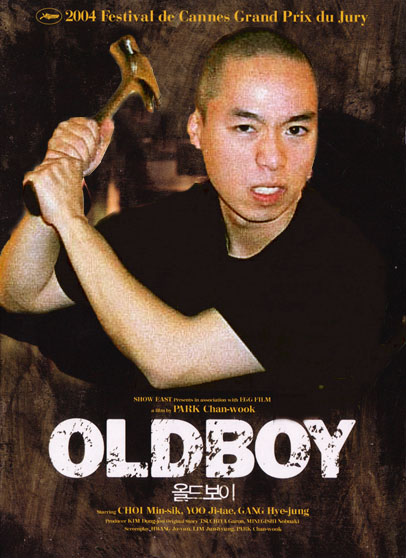
And I hate to reprint one of those images here except that someone at Something Awful, a discussion board I know nothing about, noticed the similarity between one of Cho’s images and the poster for OldBoy. Here’s the original:

Oldboy

Alone that doesn’t tell us too much. It’s not that strange that a violence-haunted young South Korean would be attracted to a violent South Korean film. However, I think it’s worth noting that the film is not just about violence and revenge, it is also about mind control and manipulation. The hero of the film is kidnapped by an enemy (not the government) and held in a prison for fifteen years while repeatedly drugged and hypnotized to forget aspects of his life and to be “programmed” to carry out a variety of tasks under the illusion that they are of his own free will.

One can be “programmed” in this way by life itself. Given enough trauma in childhood, whole separate selves can split off and carry out lives that the primary personality isn’t even aware of. I don’t know that Cho had multiple personalities. He could simply have been suffering from schizophrenia. However, I do think it is quite reasonable to assume that Cho had experienced some fairly serious abuse. His writings and statements, disjointed as they are, focus very much on this abuse. For some reason, no one is asking many questions about that. Nor does anyone seem to be asking questions about why Cho’s high school has produced TWO psychotic young adults who went on gun rampages within one year of each other. Last May, Michael Kennedy, a student at Westfield High School in Chantilly, Virginia, went on a shooting rampage at a police station, killing two police officers before being fatally shot himself. Authorities consider this just a “horrible coincidence”. Adding to the coincidence is that Michael’s father, Brian Kennedy, was just recently released from jail in charges related to that killing. In fact, he was due in court the day after the Cho killings.

Kennedy was another troubled loner. He suffered, say news accounts, from delusions and grandiose paranoia. Said one friend:

“He thought he was Jesus. He talked about aliens,” said Brandon Baker, a friend of Kennedy’s since sixth grade. Baker said Kennedy told him he sometimes took medication. “He was talking about how he was superhuman.”

Kennedy had also recently changed his MySpace profile name from Kennedy to “Herr Azriel,” in reference to an angel of destruction.

Just before his killing spree, Kennedy text messaged a friend to say that therapy and medication had not worked for him. The only thing he could think of was an “exorcism.”

What didn’t help things much is that Kennedy’s parents, who knew Michael was mentally ill, kept weapons around the house. A LOT of weapons:

The indictment states that Brian Kennedy illegally possessed 20 firearms, including an AK-47 and several bolt-action and semi-automatic rifles and shotguns. He also owned a large variety of handguns — among them a .38 Special Taurus and a 9 mm Luger Commander semi-automatic pistol.
Weapons were everywhere in the Kennedy home; the inventory list of items seized is 10 pages long. Under the mattress in the master bedroom were a Colt 9 mm handgun with one round in the chamber and a leather sheath containing a 9-inch knife. On the nightstand were a bayonet plus high-velocity ammunition for a Remington, semi-automatic shotgun.
A Smith & Wesson knife was under the left, loveseat cushion in the living room, and both a 12-gauge shotgun and a 22-caliber long rifle stood in the corner of the hallway to the basement. An M80 explosive was tucked inside a kitchen cabinet to the right of the stove, and an Atlanta Sharptec knife was stored in the ceiling above the utility-room door.

And his mom did what any concerned mother might do…she took him to a firing range to practice with his new AK.

Strangely, news accounts calling the two shooter’s connection via Westfield High a “coincidence” suggest that they were not at the school at the same time:

Cho and Kennedy lived in Centreville and graduated from Westfield High School, said Officer Courtney Thibault of the Fairfax County Police Department. She said Cho graduated four years ahead of Kennedy.

I’ve only had one cup of coffee this morning, but help me with this math. Michael Kennedy graduated in 2005 and Cho Seung-hui graduated in 2003. Probably just an oversight.

I’ve seen no evidence that these two knew each other. But I also haven’t seen much evidence that anyone has bothered to check it out.

It gets worse, of course, as these things always do. First, have a look at Cho’s literary efforts. Two very short plays that were so horribly written it does make one wonder how he made it to his senior year at Va Tech. One is called “Mr. Brownstone“. In that play, three young people at a casino complain that they can’t find anywhere safe from “Mr. Brownstone.” That name is used by band Guns-n-Roses to mean heroin, but in this case it is a math teacher who has “ass-raped probably half the kids in the school.” That, after all, says one character, is “what high school teachers do.”

When Brownstone does show up, one character asks: “I feel a satanic presence around me. Do you guys feel it?” They then sing much of the Guns -’n-Roses song. Then the main character John wins at the slot machine only to have his winnings taken by Brownstone.

In Richard McBeef, the abuser is this time “John’s” stepfather. In this play, John is only 13. While having a talk with John, Richard puts his hand on the boy’s lap and John explodes, calling him a pedophile and a “Catholic priest.” He then claims that this step-father had murdered his real father and covered it up like “the government has done to John Lennon and Marilyn Monroe.”

Really all I have done here is show that two troubled young adults came out of the same school. But what a school. Westfield High School happens to be in the second richest county in the country. In fact, the median income is over $94,000 per year. And a lot of that cash is coming from defense contractors…with a large subset of THAT being from companies who outsource for the CIA and other intelligence agencies. You may be familiar with “Booz Allen Hamilton” who is called in this article a “huge supplier of intelligence contracting.” They were a primary contractor for the officially defunct “Total Information Awareness Program” as well. Another contractor of interest to readers of this blog who is a big employer in Fairfax is Science Applications International Corporation. These are the folks who took over the remote viewing program, with help from our old friend Jolly West (from Jim Schnabel’s Remote Viewers: The Secret History of America’s Psychic Spies. For more on West, you can check out this previous post.

Now, West died in 1999 and I have no idea if he ever even visited the Virginia branch of SAIC. I am merely giving you a sense of the flavor of the dark world of intel and defense contractors in which both Cho and Kennedy, were raised.

A final intelligence contractor of interest here is Northrup Grumman’s Intelligence Group. Not only does Northrup Grumman have a presence in Fairfax, they in fact have a “business partnership” with Cho’s alma mater, Westfield High. As you can see from that last wiki link, the school has a very high level of academic achievement, including even an Aerospace Science program. So it makes sense that a military and intelligence contractor would “partner” with them in order to help steer students into helpful directions and perhaps engage in outright recruitment. Perhaps this is how Cho’s sister ended up working for McNeil Technologies, another contractor who also has an intelligence division which provides services for clients including Northrup Grumman. She now is working on the “reconstruction” of Iraq in some unnamed capacity.

This is the world Cho grew up in. None of this proves anything about why, ultimately, Cho did what he did. He and Kennedy were both outsiders, as far as I can tell, even though Cho’s sister made it to Princeton and into a defense contractor herself. But here, with overt ties to an intelligence contractor and in the very heart of the military industrial complex, we have a not-so-secret school which has now produced two young men haunted by demons that only mass murder will quiet. With rumors of Satanism (Kennedy) and sexual abuse of children (Cho) and the uncomfortable recognition of both of these themes within that same military/intel complex, it’s time to have a longer look at these latest lone gunmen.

(Note, this is a draft. I do not have time to revise or edit until later but I wanted to put this up now. Comments on typos or inaccuracies are welcome.)

See 125 comments

Saturday, April 21, 2007

101 WAYS TO MASSACRE STUDENTS

Related

Key 'No Child' Initiative Probed
Reading First officials profited off materials toward which federal government steered states.
---
April 19, 2007

By Carolyn Baker

Once again, a horrific eruption of violence in the United States has been turned into a National Enquirer “blood and circuses” spectacle on every television network in the nation. Curiously, grotesque and ghastly as the carnage is, it seems that Americans are not impacted by bloodbaths until they occur in their own back yards. Juan Cole said it best yesterday when he stated, “the horrific shootings at Virginia Tech should give us a baseline for what the Iraqis are actually living through. They have two Virginia Tech-style attacks every single day”.

We seem incapable of coming to terms with violence: Either we distance ourselves from it as “something happening over there” or we voyeuristically wallow in it 24/7 with grisly images of a massacre or the incessant repetition of a video tape made by a perpetrator exuding psychotic rage from every pore. In neither case does America appear to be capable of asking the deeper, disturbing questions in relation to such incidents, but obsessively leaps to “the healing” which Gary Corseri so brilliantly slammed in his piece earlier this week, “Blacksburg: Let The Healing Not Begin.”

As I watched some of the coverage of the Virginia Tech incident this past week, I could not help but be reminded of another massacre that occurred thirty-seven years ago next month at Kent State University. On that day I was being pepper gassed as I marched in solidarity at Michigan State with my fallen comrades at Kent State who were massacred by a government which at that very moment was murdering thousands of Cambodians, dropping bombs it swore it wasn’t dropping and lying through its teeth to the American people in the throes of the Vietnam War. Today I teach with a colleague who on May 4, 1970 took a stray bullet at Kent State and became permanently disabled as a result.

But while Kent State and Virginia Tech are venues of physical assault on students, almost no one is aware of the myriad levels on which, in other venues and without the spilling of blood, students are being massacred. Another article this past week which escaped the notice of many but riveted my attention was Danny Schechter’s “A Student Crisis”. Writing, Schechter says, in the spirit of Roberta Flack’s “Killing Me Softly”, he reminds us of “the way student loans have become a noose around the necks of a whole generation of students making our colleges and universities likely sets for the next edition of one of those crime scene shows.” Furthermore, in recent weeks the corruption around student loans involving kickbacks, gifts, trips, and other perks to college and university officials involved in the lending process has been exposed and appears to be just the tip of the iceberg. California Congressman, George Miller, compares the corruption and abuse in the student loan industry to that of Halliburton. Moreover, Miller’s investigations have also revealed that as well as being deeply mired in corruption, the industry is also involved in datamining of students’ personal records, ostensibly to determine their eligibility for loans.

Meanwhile says Schecter:

Sallie Mae, the nation’s largest student loan company, announced yesterday that it would be bought by a group of private investors in a $25 billion deal that could reduce public scrutiny of the lender at a time when the student loan industry is under siege.

The enormous deal underscores the potential for profit that Wall Street sees in the $85 billion-a-year student loan industry, even as Congress considers slashing billions of dollars in federal loan subsidies and an expanding nationwide probe reveals fresh conflicts of interest in the student lending world.”

Schechter knows about these things as a result of his splendid documentary “In Debt We Trust” which illumines not only the student loan debacle but the seduction of financially unsophisticated college freshmen into the black hole of credit card debt—an average of $20,000 per college graduate.

To fully comprehend the economic plight of today’s college student/graduate, I strongly recommend Anya Kamenetz’s superb book Generation Debt and her article “Greed Aid” which was part of her 2004 “Generation Debt” series of articles in Village Voice. Kamenetz analyzes the student loan/debt issue and reveals the lifelong misery that it is inflicting on millions of students. Tragically, and God forbid, the seeds sown in this present economic assault on students could eventually produce the harvest of another literal massacre on some college or university campus somewhere in the future by some troubled graduate, buried in mid-life under a crushing mountain of debt.

But the economic warfare being waged on students is only one aspect of the massacre. Even more brutal, yet silent and seemingly benign, is the massacre of minds. Supposedly, students attend college and universities to get an education, and supposedly, even if they attend a community college, they are required to show up with basic skills. Yet anyone who has been teaching college students for the past twenty years knows that only a tiny segment of incoming freshmen are capable of writing an English sentence, and even more frightening is the reality that non-English speakers from other countries are often capable of doing so while students educated in the U.S. aren’t. Sadly, I’ve discovered that overall, college students do not like to read and have trouble concentrating on textbook or other reading assignments. It is not uncommon for them to purchase $150 textbooks and almost never open them. Faculty frequently report that they are only able to lecture 15 or 20 minutes and then must incorporate a Power Point presentation or utilize video or DVD material in order not to lose the attention of their students. In other words, the present generation of high school graduates often finds concepts without the dazzle of special effects, elusive and monotonous.

Increasingly, children in public schools are experiencing horrific levels of violence on a daily basis as they are forced to deal with physical or verbal bullying from other students and ineffectual school administrations with no funds to put bullies and their parents in programs that would adequately address the issue. Periodically, protracted bullying erupts in a Columbine or a Virginia Tech incident, perpetrated either by the bully or one of his victims. Then everyone rushes to “heal and move on”, never willing to explore the deeper roots of the violence.

Overwhelmingly, as a result of the No Child Left Behind Act (NCLB), which Greg Palast has so appropriately named “No Child’s Behind Left”, students coming to college from a public school seem to excel in test-taking, but have virtually no critical thinking skills. In my experience, I find that students enjoy critically thinking once they have learned the skill, but they require training for it because it is a foreign concept.

NCLB is a gargantuan assault not only on the minds of public school and college students, but on the entire society. It is, in my opinion, the principal reason, besides skillfully-cultivated fear, that Americans could be lied into the Iraq War. When Colin Powell made his bogus case for war in front of the United Nations in 2003, a society of critical thinkers would have raised their eyebrows and asked more probing questions. As it was, a British news channel exposed his plagiarism of a graduate student’s essay as a fundamental piece of his presentation. (Students serve many purposes for the ruling elite, do they not?) When during that presentation Powell held up a vial of white powder, touting it as anthrax, critically thinking Americans should not have turned as white as the powder with fear, but rather demanded proof that the vial was not filled with baking soda. When Condoleeza Rice threatened that if we did not invade Iraq, a mushroom cloud would hang over America because Iraq was purportedly in the process of manufacturing a nuclear bomb, a country of critical thinkers would have unambiguously and boisterously insisted on proof beyond the whining, photo-op assertions of the former Chevron board member. But as one of my students naively asked later, “If it wasn’t true, why did they have it on CNN?”

My answer: Because CNN is corporate media whose job it is to act as stenographers for the regime and “sell” its agenda to a nation of citizens who are incapable of thinking analytically, and in 2003, the scam was successful beyond the wildest dreams of the necons who devised it.

Naturally, in my field I am constantly reminded of how trivial and irrelevant America’s public education system has rendered the study of history. Most college students have no sense of it and report enduring the mind-numbing boredom of high school history classes either by ditching, text-messaging, or falling asleep. Increasingly, as with art and music programs, funding for history is being slashed both in high schools and colleges and increased for engineering and computer technology programs.

Some years ago I heard John Judge remark that “a people who have no knowledge of their history are easily manipulated and dominated.” Deny students the ability to read, write, critically think, and study history, and you have a nation of sycophants who ask no questions and comply with virtually any directive in the name of patriotism or national security as they are almost certain to do when they are sold the regime’s propaganda regarding the National I.D. Act and the U.S. government’s plan to incorporate its provisions in 2009. After all, who among them is willing to have the privilege of obtaining or renewing a drivers license, opening a bank account, or boarding a plane denied?

So what is the destiny of this generation of students? Where will they end up besides unfathomably in debt? Sadly, they are facing a future hammered by global warming, global energy depletion, and global economic meltdown. They will go forth from the halls of academia, and if they are not well-connected, they will take the jobs they can get. They will graduate into a world of outsourced American jobs which will force them to accept mind and soul-numbing positions with insufficient pay, often with few or no benefits. Those in tech fields may fare better than those in other professions, I wouldn’t be willing to bet that in another decade they will be delirious with a sense of job satisfaction.

Many, wide-eyed with idealism, will enter the teaching profession, determined to teach differently than they were taught, but according to statistics from 2005, half of the teachers surveyed plan to be out of the profession by 2010. These hopeful education majors will vow to give students a genuine education, not just prepare pupils for NCLB tests, but unless they are teaching in private schools where NCLB is not incorporated and which also pay less than public schools, they will be discouraged and demoralized within less than a decade. In public schools they will soon discover that whether they like NCLB or not, their salaries will be tied to the test scores they produce, in which case, why not “teach to the test” instead of giving students an education? They may learn to live with a system that makes authentic teaching virtually impossible, in which case, they will become robotic moving parts in a nationwide dumbing-down mechanism, or choosing not to live with it, they will abandon the career for which they have trained in favor of remaining true to their calling as educators.

Increasingly, trade and tech schools will be the choice of many high school graduates, and a college education will ultimately become untenable financially for the middle-class student and impractical in terms of its value in securing lucrative employment. As the current housing bubble worsens and impacts the credit industry and interest rates, and as the Bush administration endeavors to eliminate the Mortgage Tax Credit, owning one’s home will not be in the future of many college graduates. And given the new bankruptcy laws of 2005, declaring bankruptcy in the face of grinding debt will not be an option, and this generation of graduates will never, ever get ahead financially.

So on the one hand, the carnage at Virginia Tech is equivalent to what innocent Iraqis and most U.S. combat troops experience at least twice a week, and therefore, brings home to our own soil the horrors of mass violence. But at the same time if we are among those critically thinking Americans to whom I alluded above, then we must also consider the full spectrum of assault being waged on today’s students which encompasses high schools, colleges, and universities across America, and we must consider the consequences of those assaults in terms of the misery, despair, and even violence that they are certain to evoke in the coming years.

In recent months I have been pleased to hear of a resurgence of chapters of SDS (Students For A Democratic Society) at U.S. colleges and universities. As well as protesting the Iraq War, some have been instrumental in organizing for wage increases and benefits for campus workers. Hopefully, they will also begin or have already begun to organize against the economic warfare being waged on students by the debt industry.

URL

Photo Evidence that Virginia Tech Killer was a Marine (?)

According to the folks at Liberty Forum, the following image was up on Wikipedia, before it mysteriously disappeared . . .

I have no way of verifying that this is actually him. But, his eyes sure do resemble those of the "killer" whose images were plastered all over the media this week.

Notice his jacket says "HU", "U.S. MARINES."

If true, and he was actually trained as a US Marine, it goes a long way to explain his expertise as a killer.

Hopefully, this image can get out to enough people that the truth will emerge.

Do your part and pass it on.

May the truth set us free and bring justice to the victims.

________________________
Thanks, Joanna Francis

Posted in Submitted by qrswave on Sat, 2007-04-21 08:27. qrswave's blog

The unsung hero of the Virginia Tech massacre

Why haven't you heard about this brave person, but get endless coverage of the American professor who left Israel 20 years ago? Simple. He's a Muslim.
---
Waleed Shaalan

Waleed Shaalan, a 32-year-old graduate student, came to the United States from northern Egypt last year to study engineering. He lived among other Egyptian students in Blacksburg, Va., and was planning on bringing his wife and one-and-a-half-year-old son to America in May to live with him.

He was gunned down on Monday while he was studying in Norris Hall, but witnesses say he died a hero.

According to Randy Dymond, a civil engineering professor at Virginia Tech, Mr. Shaalan was in a classroom with another student when the gunman entered and opened fire.

Mr. Shaalan was badly wounded and lay beside the other student, who was not shot but played dead, as the gunman returned two times searching for signs of life. Just as the gunman noticed the student, Mr. Shaalan made a move to distract him, at which point he was shot a second time and died. The student believed that Mr. Shaalan purposefully distracted the shooter to save him, Mr. Dymond said.

"Waleed was bright, energetic and caring," Mr. Dymond said. "The reason we are in higher education is because there are students who are the bright light to the future. Waleed was one of them."

Equally social and studious, Mr. Shaalan was active in the Muslim Student Association at Virginia Tech, and he especially enjoyed participating in the group's community activities.

The Egyptian Consul has notified Mr.Shalaan's wife and parents, all of who live in Egypt. Mr. Shaalan's body will be flown back to his country in the near future, the vice consul, Mohamed Elghazawy, said.

"This is a very emotional time for his entire family, but especially his mother and father," Mr. Elghazawy said.

Friday, April 20, 2007

Sources: Feds Ordered VA Police To Stand Down at Virginia Tech

Related
No Games Found in Shooter's Dorm at Virginia Tech
---
Ismail X or AX?)
---
Sources: Feds Ordered VA Police To Stand Down
Local authorities were told to take no action to pursue killer

Paul Joseph Watson
Prison Planet
Friday, April 20, 2007

Police and EMT workers at Virginia Tech tell us that campus police were given a federal order to stand down and not pursue killer Cho Seung-Hui as Monday's bloodshed unfolded.

Though wishing to remain anonymous for obvious reasons, we have received calls from police and EMT's who tell us that a stand down order was in place, and this is also confirmed by eyewitness Matt Kazee, who is a student at VA Tech.

Kazee talked to local EMT's and police who told him the same thing, that the order was to wait until federal back up arrived before any action was taken. This explains the complete non-response of the police in the two hour gap between Cho's first two murders and the wider rampage that would follow later that morning.

The policy of federal control over the University was put in place following a previous shooting in August 2006 in which a police officer and a hospital security guard were killed.

In addition, a former long-term University police officer, George French, told the Alex Jones Show that it is routine to seal off a campus on which a suspected gunman is loose.

“Setting up a series of roadblocks, controlling access to very large pieces of property, is very much routine on any university campus in Canada and in the United States,” said French.

“After a double homicide, when you’re looking for a dangerous fellow with a firearm, I find it unfathomable that a series of roadblocks weren’t set up…to prevent the felon from escaping.”

French could find no logical conclusion other than deliberate inaction on the part of officials. “We have another coordinated, allowed event…the parallels are so common in each case; you can write the script in advance.”

Thursday, April 19, 2007

Video: Cho Seung-Hui Manifesto

Sometime after he killed two people in a Virginia university dormitory but before he slaughtered 30 more in a classroom building Monday morning, Cho Seung-Hui mailed NBC News a large package, including photographs and videos, lamenting that “I didn’t have to do this.”

Cho, 23, a senior English major at Virginia Polytechnic Institute and State University, killed 32 people in two attacks before taking his own life.

CLIP 2


Gunman was teased and picked on, former schoolmates say.

You Have Had a Million Warnings - Virginia Tech Killer's Video


Final message ... mass killer Cho Seung-Hui points a gun at the camera in one of a series of shocking images released for the first time today with his video telling viewers you have "blood on your hands" / AP

Don't forget about Iraq

Thursday, April 19, 2007

By Michael J.W. Stickings

As expected -- because it is always so -- a media event has become a media orgy. I'm talking, of course, about the Virginia Tech shootings, but that hardly matters. In search of sensationalism, the media have no shame. Any story will do, pretty much -- but the media play particularly well off stories like this one. Everything about it, after all, seems so juicy. The media do so well with death and destruction, but they also like a human side to the mayhem. Hence the mainstreamization -- if I may coin a term -- of weather news. (Hurricanes are sexy.) But there's more. There is also pain and suffering. And it's all happening right at home, in English, with so much mystery to unravel -- who was he? why did he do it? -- and with so many hot-button issues lingering on the periphery -- gun control, immigration, education.

Why the media do this is beyond the scope of this post, but there are a few points to make: Obviously, the media need to fill up the empty space that follows the reporting of the facts. That was done -- the facts are known, more or less, and so all that's left is repetition and speculation. There is a fine line between journalism and exploitation, and that line has been crossed. Just turn on your media outlet of choice. You'll see what I mean.

On this, see Taylor Marsh, who asks the right questions: "Have we lost all sense of dignity? When did our pain become something we're so proud of we need to broadcast it... never mind. We are a therapy nation now, televising our grief for all to see. It's what we now do best. But did the community of Virginia Tech need our prying eyes? It likely never occurred to anyone to ask." Taylor compares this to the media's coverage of the Iraq War, which has been abysmal. But, then, an Iraqi life is hardly worth an American one, we are left to conclude from this imbalance, and Iraq is way over there, and we don't want to think too much about it, lost cause that it is, and it's not nearly as sensational as what happened in Virginia. (More on Iraq below.)

Americans -- media and media consumers alike -- need answers. They cannot imagine that what happened in Virginia was just some senseless act of violence. There must have been more to it. And so the media orgy revolves around trying to answer the existential questions as well as the factual ones -- not just the who but the why -- that is, to unravel the seeming mystery of it all. Americans do not seem to want such answers to similar questions about the Iraq War -- it is far too remote, it would seem, for there to be needed any such effort -- but we are Virginia Tech and Virginia Tech is us. Even here in Canada, the media have focused disproportionately on the one Canadian who was killed, as if that death is somehow more significant than the others, but so it goes. This isn't about them, the victims, it's about us. We need to soothe ourselves, to have our existential upsurge pacified. We cannot and will not accept meaninglessness. To stare into the abyss is one thing. To accept that the abyss is all there is would shatter our fragile shells of civilized self-understanding. There must be a God.

And so we search for answers -- through the media, which are more than happy -- for ratings, to bolster their self-importance -- to oblige with all the investigation and speculation that can fill up the empty space. In this case, for this story, this leads us to such banal topics as mental illness, alienation, antidepressant medication. Are the answers to be found in there, anywhere? Or are they to be found in the world of politics -- gun control is the hot topic. In its more extreme and repugnant form, this search demands scapegoats, an evil Other upon which our indignant blame can be heaped. This is the world of Michelle Malkin and her ilk -- a world which upon which I discoursed to much fanfare last night.

On this, see also Steven Taylor: "[W]hy do we have to find blame in places other than the fact that a truly disturbed individual simply did an unthinkable act and cracked. There is only so much that can be done in a free society to prevent such situations. This attempt to blame a general 'liberal' attitude at universities and that this somehow has led to a culture of 'conflict avoidance' that somehow, by inference, led to people not defending themselves on Monday -- that is utterly ridiculous." Our own Capt. Fogg also put it well in a comment to a post by Creature: "This guy didn't go nuts because of television or rap music or gay marriage or any of the other shibboleths -- he went nuts because he was human and going nuts is a human affliction. It's an affliction that won't go away despite lectures on personal responsibility or despite bans or laws or wiretaps appeals to family values or protests or rubber bands worn on wrists."

But the truth -- rather than the truthiness presented to willing consumers by sensation-seeking news outlets and deranged commentators -- does not go down so easily. If the truth about Iraq is being largely ignored, or avoided, the truth about the Virginia Tech shootings continues to be overwhelmed by a media orgy that, as of right now, shows no signs of letting up.

**********

And this brings us to Iraq, forgotten Iraq, where today was just another day, as we say, of life and death:

Four car bombs killed 131 people and wounded 164 others across Baghdad Wednesday, the U.S. military said, as bloodshed spiked two months into a U.S.-led crackdown meant to pacify the Iraqi capital.

It was one of the deadliest days of the four-year-old Iraq war, and some news agencies suggested the death toll may be higher. Reuters, quoting local officials, said almost 200 people were killed Wednesday. The Associated Press put the number at 183.

The carnage underscored the profound insecurity that continues to plague the nation, where additional American soldiers are being deployed in an attempt to curb sectarian violence.

Bloodshed. Carnage. Insecurity.

Is it right to compare Iraq and Virginia Tech? Perhaps not. But the juxtaposition -- and specifically the juxtaposition of media coverage -- is nonetheless deeply troubling. (This is Taylor's point.) There has been so much concentrated coverage of what happened in Virginia (and, to an extent, rightly so), but there has been, overall, gross indifference to what is happening in Iraq each and every day. It takes a massive death toll for Iraqi violence to register -- like today's, but, even then, nothing like there should be. And not just Iraqi violence. Stuck in perpetual therapy, Americans don't want to know much about anywhere else, either.

"But this happened in our own backyard," a critic cries. Yes, yes, I know -- and I understand. That, too, was my reaction to the news. The shooting did happen close to home -- closer to home than the violence in Iraq, closer to home in terms of our ability to relate to it, to see ourselves in those we see on television. We are them, they are us. We are all Hokies now.

Fair enough.

All I am saying -- well, perhaps not all -- is that some perspective is in order. Becoming one with Virginia while detaching from Iraq is the easy way out. It allows us to cleanse our souls in yet another media-driven orgy of existential therapy even as more and more blood is spilled in some faraway place that is just too horrible even to attempt to comprehend.

And yet the media will soon move on, as they always do, to the next source of sensationalism, the next object of exploitation. The pain and suffering in Virginia will go on, but we won't care, because it was never really about them -- and because we will once again have managed to lie the ultimate lie to ourselves, to have persuaded ourselves that our questions were answered, that our fears were all dreams, that there was a point to the madness, or at least a reasonable explanation that put everything right again.

And we will follow the media, wherever they may go, from one sensation to the next.

And, media coverage or not, the blood will continue to flow... over there.

American and Iraqi alike, and others too. Whether we pay attention or not.

Labels: , , , ,

Government has list of anti-depressant users!: Virginia Tech killer NOT on it

"Some news accounts have suggested that Cho had a history of antidepressant use, but senior federal officials tell ABC News that they can find no record of such medication in the government's files. This does not completely rule out prescription drug use, including samples from a physician, drugs obtained through illegal Internet sources, or a gap in the federal database, but the sources say theirs is a reasonably complete search."

From

Killer's Note: 'You Caused Me to Do This'

Seung-Hui Cho, 23-Year-Old Shooter, Wrote 'Disturbing' Note and Violent Plays

By NED POTTER, DAVID SCHOETZ, RICHARD ESPOSITO, PIERRE THOMAS and the staff of ABC News

April 17, 2007

Gunman Sent Video During Lull In Slaughter

Menacing Poses And Bitter Words In Mailing to NBC

By Michael E. Ruane and Chris L. Jenkins


Washington Post Staff Writers
Thursday, April 19, 2007; A01

Cho Seung Hui paused Monday morning during the shootings at Virginia Tech to stop at a post office and mail to NBC News in New York a disturbing package of pictures, writings and video before returning to the rampage.

The communications sought to explain his actions but served mostly to display his anger and illness. With threatening images and in a menacing video, America's deadliest gunman photographed himself wearing black and a backward baseball cap and pointing handguns at the camera and himself. He blamed rich people and humanity at large for the perceived wrongs that drove him to kill.

A $14.40 U.S. Postal Service express parcel, which had the wrong Zip code and an incorrect street address, was sent from Blacksburg at 9:01 a.m. Monday, about two hours after Cho's first two killings at a dormitory, West Ambler Johnston Hall.

About 45 minutes after mailing the package, he went to Norris Hall and killed an additional 30 people before killing himself as police closed in. As if trying to justify his plot, Cho glared into the camera and in a rambling diatribe said: "You had a hundred billion chances and ways to have avoided today," according to excerpts aired last night by NBC. "But you decided to spill my blood. You forced me into a corner and gave me only one option. The decision was yours. Now you have blood on your hands that will never wash off." "Jesus loved crucifying me," he said at another point. "He loved inducing cancer in my head, terrorizing my heart and ripping my soul all this time."

"I didn't have to do this," he said. "I could have left. I could have fled. But no."

Investigators have been mystified by the gap -- from 7:15 to 9:45 a.m. -- between the bursts of homicide Monday, and the university has been criticized for a perceived lack of urgency during the lull.

The Virginia State Police superintendent, Col. Steve Flaherty, said Cho's package "may be a very new critical component of this investigation. We are in the process . . . of attempting to analyze and evaluate its worth."

Cho, who has been described by classmates and teachers as brooding, withdrawn and silent, also left a rambling, angry, multi-page document in his dorm room. He wrote at least one bomb threat that police found, as well as a novel and some disturbing poems and plays.

Law enforcement sources said his letter to NBC was nearly identical to the ones found in his dorm room. All mention his disgust toward the privileged and contain the cryptic words "Ismael Ax," which also was tattooed on one of his arms. Authorities are trying to figure out what the words mean.

NBC received the package as fresh reports emerged yesterday of Cho's mental health issues and earlier interaction with Virginia Tech police.

The authorities had investigated Cho for bothering two female classmates in 2005, Tech Police Chief Wendell Flinchum said at a news conference. Cho had hinted at suicide shortly afterward and was temporarily committed, against his will, to a psychiatric hospital for evaluation.

There he was assessed as "mentally ill" but not an imminent danger to himself or others, according to court documents. Because he was not a threat, he was released, the documents say. Campus police said they had no more encounters with Cho.

Both pieces of news came as the school was still trying to regain its balance after the calamity.

But seeing Cho in his burst of anger on television brought many back to the horrors of Monday.

"It was very scary because it's the closest we're ever going to get to seeing what [the people at Norris Hall] saw," said Kristin Fleming-Dahl, a 19-year-old sophomore. "For some of them, that were their last moments. Seeing the pictures made it more real. It was like a slap in the face."

Fleming-Dahl said NBC was too quick to release the pictures. "It probably would have been better to wait," she said.

Michael A. Mason, who heads the FBI's criminal investigations division, said Cho's mailing "feeds into exactly what he wanted to accomplish by this heinous act."

The package includes one nightmarish photograph of a menacing, black-gloved Cho posing in a black baseball cap holding two black pistols at arm's length. He is wearing a black T-shirt and what appears to be a tan safari vest, resembling an apparition out of a violent video game.

In the excerpted pictures and video, Cho has a military-style haircut. Parts of the video seem to have been shot inside a car. Some look as though they might have been shot in a dorm room with white-painted cinderblock walls.

NBC said the package apparently was delayed by the flawed Zip code. It was noticed by a postal worker in New York who spotted the Blacksburg return address and what Cho wrote as his name in the sender's box: "A Ishmael," similar to the well-publicized "Ismael Ax." NBC News President Steve Capus said the network re ceived the package in Tuesday's mail delivery. It was not opened until yesterday and did not include any images of the massacre, Capus said in a written statement.

Among the materials are 23 QuickTime video files showing Cho talking to the camera, Capus said.

The production of the videos indicated that Cho had worked on the package for some time, because he not only "took the time to record the videos, but he also broke them down into snippets" that were embedded paragraph by paragraph into the main document on a CD-ROM, Capus said.

Before the video was released, officials in Blacksburg spoke of their previous encounter with Cho. In December 2005, he was declared mentally ill and was temporarily but involuntarily sent to a Christiansburg mental-health center, according court records.

The night at the mental-health facility came a few weeks after police had been contacted by a female student upset over e-mails Cho had sent her, said Flinchum, the Tech police chief.

The student declined to press charges, and Cho was referred to the university disciplinary system, which took no action because the offense seemed too minor, the chief said.

The next month, a second female student complained to campus police, and within 24 hours, police got a call that Cho might be suicidal, Flinchum said. Police visited him and urged him to seek counseling, the chief said.

On Dec. 13, 2005, a temporary detention order, instructing that Cho be taken to the Carilion St. Albans Psychiatric Hospital in nearby Radford, was signed by a judge, according to court papers. The next day, a Virginia Department of Mental Health document recorded a mental-health professional's description of Cho as seeming blank and "depressed," but denying "suicidal ideation. He does not acknowledge symptoms of a thought disorder. His insight and judgment seem normal."

The form described Cho as mentally ill but added that he did not present an imminent danger to himself or others and did not require involuntary hospitalization.

It was not clear yesterday how long Cho spent in the hospital, but the documents indicate it was one day.

University officials stressed that there was no threat in the e-mails, and the two female recipients only considered them annoying. Neither of the two women was among Cho's victims Monday. "No criminal activities had taken place," Flinchum said.

Ed Spencer, a university associate vice president of student affairs, said the school would not comment on Cho's disciplinary record. "Even upon death, that record is still protected," he said.

Whether the university should have done more after having this contact with Cho will be part of the major review that will begin soon by an independent panel, officials said.

Virginia Gov. Timothy M. Kaine (D) announced yesterday that former state police superintendent Gerald Massengill will participate in the review of the university's response to the shootings.

The incidents came to light at a time when Cho's conduct and writings had raised concerns among several of his teachers in the school's English Department.

Authorities also revealed yesterday what was seized in their search of Cho's university residence, at 2121 Harper Hall.

The search warrant, filed late Tuesday in Montgomery County, Va., Circuit Court, said the items taken included a "folding knife and combination pad lock," a Compaq computer, various documents and writings from Cho's computer, nine books and two notebooks.

Officials also said that before purchasing the 9mm Glock handgun or the Walther P22, which he used in the killings, Cho would have had to fill out a Virginia State Police eligibility form for an instant background check.

One question on the form asks: "Have you ever been adjudicated legally incompetent, mentally incapacitated, or been involuntarily committed to a mental institution?"

Once Cho's background check came back clean, he would have had to fill out federal form No. 4473 asking once again if he had been adjudicated "mentally defective" or committed to a mental institution.

Cho's 24-hour detention before a hearing on his mental status probably does not meet the definition of being involuntarily committed, legal experts said. But there is a question of whether the detention would meet the broader federal standard.

Back at Virginia Tech, the NBC video was the talk of the campus.

Maddy Barnes, a junior English major from Leesburg, had a British literature class with Cho in 2005, when he was briefly hospitalized.

"It's so disturbing," Barnes said of Cho's videos.

"It's horrifying," agreed Pete Hughes, a junior theater major. "It just showed how calculating he was. It definitely gave the answer that he woke up intending to do this."

But, he added, "It's comforting to a degree." Barnes, nodded, saying she understood that. It showed he was not a normal guy who just snapped, she said.

Both students thought the videos showed how narcissistic Cho was. He clearly knew this would bring him attention.

Others, though, said the video did not help them understand.

"I personally don't care what he has to say," said Daniel Frawley, a 2003 graduate, who lives in Blacksburg. "There is no possible good reason for anything that happened. No possible explanation he can offer."

Virginia Tech Gunman Sent Material to NBC

(ismail ax, cho seung-hui, gun control)

Posted Apr 18, 2007 03:06 PM PST
Category: CURRENT EVENTS

1. Shoot people
2. Make video.
3. Transfer to computer.
4. Burn disk.
5. Wrap package.
6. Go to post office.
7. Buy postage.
8. Put postage on package.
9. Mail package.
10. Shoot more people.

Oh yeah, that makes a whole lotta sense!

Fueling the agendas for the "Ban-Gun-Lobby" is the most remarkable factor here. Although, each experienced reader will recognize that there was a GUN BAN in effect on the whole area of the Virginia Tech campus. It failed to protect the victims, clearly - as it would fail to protect ANYONE OF YOU - if any "gunban" would be widened throughout the States.

It is interesting to watch the behaviour of the MSM - especially in the case of the killer at the Appalachian School of Law in January 2002. Three persons got killed before two ARMED students managed to subdue the aggressor and PREVENTED WORSE.

Posted Apr 18, 2007 02:44 PM PST
Category: CURRENT EVENTS

Virginia Tech killer's manifesto stuns students


Videos and photographs of an armed Cho Seung-Hui shock Virginia Tech's community.

Watch excerpts from Cho's video


Photos

This video frame grab image taken from a video aired by NBC News on Wednesday, April 18, 2007 shows Virginia Tech gunman Cho Seung-Hui. The video was part of a package allegedly mailed to the network on Monday, April 16 between Cho's first and second shootings on the Virginia Tech campus. NBC said that a time stamp on the package indicated the material was mailed in the two-hour window between the first burst of gunfire in a high-rise dormitory and the second fusillade, at a classroom building. Thirty-three people died in the rampage, including the gunman, who committed suicide. (AP Photo/NBC)
AP Photo: This video frame grab image taken from a video aired by NBC News on Wednesday,...

Va. Tech stunned by images of gunman

By MATT APUZZO, Associated Press Writer 36 minutes ago

Restaurant patrons cringed and mothers turned their children away from the television as the video came up of an armed Cho Seung-Hui delivering a snarling, venomous tirade about rich "brats" and their "hedonistic needs."

The self-made video and photos of Cho pointing guns as if he were imitating a movie poster were mailed to NBC on the morning of the Virginia Tech massacre. A Postal Service time stamp reads 9:01 a.m. — between the two attacks that left 33 people dead.

"This is it. This is where it all ends," Cho says in one videotape, in which he appears to be more melancholy than angry. "What a life it was. Some life."

Cho, 23, speaks in a harsh monotone in other videotaped rants, but it isn't clear to whom he is speaking.

"You had a hundred billion chances and ways to have avoided today," he says in one, with a snarl on his lips. "But you decided to spill my blood. You forced me into a corner and gave me only one option. The decision was yours. Now you have blood on your hands that will never wash off."

NBC said the package contained a rambling and often incoherent 23-page written statement, 28 video clips and 43 photos.

On NBC's "Today" show Thursday, host Matt Lauer said the decision to air the information "was not taken lightly." Some victims' relatives cancelled their plans to speak with NBC because they were upset over the airing of the images, he said.

"I saw his picture on TV, and when I did I just got chills," said Kristy Venning, a junior from Franklin County, Va. "There's really no words. It shows he put so much thought into this and I think it's sick."

The package helped explain one of the biggest mysteries about the massacre: where the gunman was and what he did during that two-hour window between the first burst of gunfire, at a high-rise dorm, and the second attack, at a classroom building.

"Your Mercedes wasn't enough, you brats," says Cho, a South Korean immigrant whose parents work at a dry cleaners in suburban Washington. "Your golden necklaces weren't enough, you snobs. Your trust funds wasn't enough. Your vodka and cognac wasn't enough. All your debaucheries weren't enough. Those weren't enough to fulfill your hedonistic needs. You had everything."

Earlier in the day, authorities disclosed that more than a year before the massacre, Cho was accused of sending unwanted messages to two women and was taken to a psychiatric hospital on a magistrate's orders and was pronounced a danger to himself. But he was released with orders to undergo outpatient treatment.

The disclosure added to the rapidly growing list of warning signs that appeared well before the student opened fire. Among other things, Cho's twisted, violence-filled writings and sullen, vacant-eyed demeanor had disturbed professors and students so much that he was removed from one English class and was repeatedly urged to get counseling.

Some of the pictures in the video package show him smiling; others show him frowning and snarling. Some depict him brandishing two weapons at a time, one in each hand. He wears a khaki-colored military-style vest, fingerless gloves, a black T-shirt, a backpack and a backward, black baseball cap. Another photo shows him swinging a hammer two-fisted. Another shows an angry-looking Cho holding a gun to his temple.

He refers to "martyrs like Eric and Dylan" — a reference to the teenage killers in the Columbine High School massacre.

NBC News President Steve Capus said the package arrived in Tuesday afternoon's mail, but was not opened until Wednesday morning. It was sent by overnight delivery and apparently had the wrong ZIP code, NBC said.

An alert postal employee brought the package to NBC's attention after noticing the Blacksburg return address and a name similar to the words reportedly found scrawled in red ink on Cho's arm after the bloodbath, "Ismail Ax," NBC said.

Capus said that the network notified the FBI around noon, but held off reporting on it at the FBI's request, so that the bureau could look at it first. NBC finally broke the story just before police announced the development at 4:30 p.m.

It was clear Cho videotaped himself, Capus said, because he could be seen leaning in to shut off the camera.

State Police Spokeswoman Corinne Geller cautioned that, while the package was mailed between the two shootings, police have not inspected the footage and have yet to establish exactly when the images were made.

Cho repeatedly suggests he was picked on or otherwise hurt.

"You have vandalized my heart, raped my soul and torched my conscience," he says, apparently reading from his manifesto. "You thought it was one pathetic boy's life you were extinguishing. Thanks to you, I die like Jesus Christ, to inspire generations of the weak and the defenseless people."

A law enforcement official said Cho's letter also refers in the same sentence to President Bush and John Mark Karr, who falsely confessed last year to having killed child beauty queen JonBenet Ramsey. The official spoke on condition of anonymity because the person was not authorized to speak to the media.

Earlier Wednesday, authorities disclosed that in November and December 2005, two women complained to campus police that they had received calls and computer messages from Cho. But the women considered the messages "annoying," not threatening, and neither pressed charges, Virginia Tech Police Chief Wendell Flinchum said.

Neither woman was among the victims in the massacre, police said.

After the second complaint about Cho's behavior, the university obtained a temporary detention order and took Cho away because an acquaintance reported he might be suicidal, authorities said. Police did not identify the acquaintance.

On Dec. 13, 2005, a magistrate ordered Cho to undergo an evaluation at Carilion St. Albans, a private psychiatric hospital. The magistrate signed the order after an initial evaluation found probable cause that Cho was a danger to himself or others as a result of mental illness.

The next day, according to court records, doctors at Carilion conducted further examination and a special justice, Paul M. Barnett, approved outpatient treatment.

A medical examination conducted Dec. 14 reported that that Cho's "affect is flat. ... He denies suicidal ideations. He does not acknowledge symptoms of a thought disorder. His insight and judgment are normal."

The court papers indicate that Barnett checked a box that said Cho "presents an imminent danger to himself as a result of mental illness." Barnett did not check the box that would indicate a danger to others.

It is unclear how long Cho stayed at Carilion, though court papers indicate he was free to leave as of Dec. 14. Virginia Tech spokesman Larry Hincker said Cho had been continually enrolled at Tech and never took a leave of absence.

A spokesman for Carilion St. Albans would not comment.

Though the incidents with the two women did not result in criminal charges, police referred Cho to the university's disciplinary system, Flinchum said. But Ed Spencer, assistant vice president of student affairs, would not comment on any disciplinary proceedings, saying federal law protects students' medical privacy even after death.

Some students refused to second-guess the university.

"Who would've woken up in the morning and said, `Maybe this student who's just troubled is really going to do something this horrific?'" said Elizabeth Hart, a communications major and a spokeswoman for the student government.

One of the first Virginia Tech officials to recognize Cho's problems was award-winning poet Nikki Giovanni, who kicked him out of her introduction to creative writing class in late 2005.

Students in Giovanni's class had told their professor that Cho was taking photographs of their legs and knees under the desks with his cell phone. Female students refused to come to class. She said she considered him "mean" and "a bully."

Lucinda Roy, professor of English at Virginia Tech, said that she, too, relayed her concerns to campus police and various other college units after Cho displayed antisocial behavior in her class and handed in disturbing writing assignments.

But she said authorities "hit a wall" in terms of what they could do "with a student on campus unless he'd made a very overt threat to himself or others." Cho resisted her repeated suggestion that he undergo counseling, Roy said.

Questions lingered over whether campus police should have issued an immediate campus-wide warning of a killer on the loose and locked down the campus after the first burst of gunfire.

Police said that after the first shooting, in which two students were killed, they believed that it was a domestic dispute, and that the gunman had fled the campus. Police went looking for a young man, Karl David Thornhill, who had once shot guns at a firing range with the roommate of one of the victims. But police said Thornhill is no longer under suspicion.

___

Associated Press writers Allen G. Breed, Vicki Smith, Sue Lindsey and Justin Pope in Blacksburg, Va., Matt Barakat in Richmond, Va., Colleen Long and Tom Hays in New York, and Lara Jakes Jordan in Washington, D.C. contributed to this report.

More Virginia Tech news