May 4, 2007
By David Michael Green
dmg@regressiveantidote.net
One day you’re gonna wake up, America.
And, like every other one since last you can remember, it’s gonna be an ugly morning.
One day you’re gonna wake up and go to your lousy job with its lousy salary and non-existent benefits. You might even remember the good job you once had. Or that the government you once supported gave tax breaks to companies like the one that exported that good job of yours to the Third World (which is what they’re now starting to call your country). Or that that same government undermined the labor unions which fought to get you your good wages and benefits.
One day you’re gonna wake up and be furious at the monstrous tax burden you are carrying, a tab which accounts for fifty of the seventy hours you must work each week just to eke by. You might even figure out why your tax bill is so high. You might remember that the government you once supported shifted the tax burden from the rich onto people like you, and from the taxpayers of the time onto those of today. And that they borrowed money in astonishing quantities to fund their sleight-of-hand, so that you work thirty hours a week just to pay the interest on a mountain of money borrowed decades ago.
One day you’re gonna wake up in anger at the absurdly poor education your children are receiving. You’re gonna remember that it wasn’t always that way, that even after the military’s voracious appetite was temporarily sated, your country still managed to find a few bucks to at least educate a workforce. No more. And you’re gonna remember how you applauded when your educational system was twisted in to a test taking industry that is careful, above all, not to teach children how to think.
One day you’re gonna wake up literally sick and tired. You’re gonna want treatment for your maladies but you won’t be able to touch the cost. You’re gonna wonder what you were thinking when believed your country had the best healthcare system in the world, even though it was the only advanced democracy in the world that didn’t provide universal care, even though it devoted fifty percent more of its economy than those other countries to pay for a system that left fifty million people uninsured, and even though there were massive layers of unnecessary and harmful private sector bureaucracy skimming hundreds of billions of dollars of profits out of the system in the name of free enterprise.
One day you’re gonna wake up too tired to go to work anymore. You’re gonna want to retire in dignity but will be left instead to laugh bitterly at the cruelty of that joke. And you’re gonna wonder what in the world you had been thinking voting for a president who’s primary goal was to allow Wall Street to raid Social Security, destroying what had once been considered the most successful domestic program in human history.
One day you’re gonna wake up and wish that it wasn’t so bloody hot, and that there weren’t so many diseases and species eradications and violent storms lashing the planet. And maybe you’ll even remember that you once supported a government that lied about the very existence of global warming - back when it might have been curtailed - a government that scuttled the barest remedy for the problem in order to protect oil company profits.
One day you’re gonna wake up and wish you had a government that could simply and competently do the basic things it was designed for. A government that could protect you from foreign attack, that could come to your rescue after a devastating hurricane, that could properly manage a new program or other people’s security. An administration that didn’t pervert the purpose of every agency within the government to its opposite, using civil rights lawyers to fight civil rights, for example, or the EPA to protect polluters.
One day you’re gonna wake up and cry out for simple justice, blindly applied without bias. And perhaps you’ll remember when that principle died. When your country stood by and watched the politicization of its judicial system for purposes of partisanship, and said nothing. When it stood by and watched its highest law enforcement officials in the land lie about their failing memory of events and pretended to believe that was acceptable.
One day you’re gonna wake up and wish that you weren’t being drafted to go fight wars you don’t believe in. You’ll remember how soldiers were sent to their deaths for lies. You’ll remember how badly they were treated when they came home maimed and twisted. You’ll remember how real, patriotic, former soldiers were mocked and humiliated by dress-up, unpatriotic, former non-soldiers. And suddenly you’ll understand why no one would volunteer for the military anymore, and why people like you had to be drafted.
One day you’re gonna wake up and want very badly to run outside and scream in anger about a government that long ago stopped serving your interests in favor of the narrow interests of a tiny oligarchy. But instead you’ll stay inside and keep your scream tucked safely in your belly. Because you’ll know that in your country dissent has long since been outlawed, on pain of torture and death. You’ll remember concepts like due process, limitations on government search, seizure and wiretapping, habeas corpus, trial by peers, legal representation and prohibitions against cruel and unusual punishment as historical artifacts no longer even taught in schools.
On day you’re gonna wake up and want so badly to change governments. You’re gonna treasure the concept of democracy like no Soviet dissident ever did. You’re gonna crave the opportunity to own your own government, to make your own societal choices, to make a change of direction never before so desperately necessary. And you’re gonna wonder why you didn’t speak up as you watched first-hand the dismantling of the democracy you had been handed by previous generations of patriots. You’re gonna wish you had been patriotic enough yourself to demand, above all else, free and fair elections, and you’re gonna shake your head in puzzlement at how you stood by watching in silence those that patently were not.
One day you’re gonna wake up and want to get the hell out of your rotting, repressive country. You’re gonna remember a time when that wasn’t true. But, oddly enough, you’ll find that other countries remember too. They’ll remember your country’s arrogance, its unilateralism, its walls, its racism, and its politicized abuse of immigrants. And they’ll remember how your government undermined and violently replaced theirs whenever corporations from your country had their profits threatened. You’re gonna want to leave, but there will be nowhere you’ll be welcome. You’re gonna find out that walls can face both directions.
One day you’re gonna wake up in a hostile world where your country no longer has any friends. There will be governments of other countries - former long-standing allies - that cannot afford to have anything to do with you, lest their publics angrily remove them from office for collaborating with a country as hated as yours. Nor will those governments trust yours anyway. They will perhaps possess intelligence that could save your life, but they will not share it. They will possess forces that could help you survive real security threats, but they will not provide them. Your country will have become an international pariah, the South Africa of the twenty-first century.
And because no one will assist you, one day you’re gonna wake up fearing for your life as your country is brutally attacked by angry militants deploying weapons of mass destruction against your cities. Long dormant connections in your brain will resurface, and you will dimly understand why. On this day - perhaps March 20, 2023 - you might be assisted in your comprehension by the message of one of the attackers, someone whose family your country callously destroyed in its mission accomplished in Iraq, and who spent the next twenty years plotting this day’s revenge. And you will wonder again why you stood by as your country attacked Iraq on a completely bogus pretext. You’ll remember applauding when this mailed fist was long ago sent. And, just as it comes hurling back in your direction at a lethal velocity, stamped “Return to Sender”, you’ll wonder what you were thinking. And you’ll realize just how much you weren’t.
One day you’re gonna wake up, America, and you’re gonna find out what was happening while you were sprawled on the couch watching endless mind-numbing loops of CSI, Desperate Housewives or Dancing with the Stars.
One day you’re gonna wake up and realize that catching all the action during week seven of the 2011 NFL season really wasn’t so critical in the greater scheme of things after all.
One day you’re gonna wake up and wished you’d invested a little more energy into monitoring and choosing the people who made monumental decisions on your behalf.
One day, with a flash of remorse greater than you thought it possible that one human vessel could contain, you’ll remember the ignored warning shots across your bow. Moments later, you’ll discover the human capacity for searing remorse is actually even greater still, as you contemplate your inattention even to the shots that were fired right through the bow. With a fury you would yesterday have thought yourself incapable of, you’ll hurriedly attempt to affix Band-Aids to the tattered splinters remaining from your country’s once sturdy hull. But you’ll learn quickly the toll of those years spent wasted in a civic coma. You’ll find that no amount of patchwork can any longer save this sinking ship from its appointment with the dustbin of history.
In shame, you’ll regret the callous arrogance with which you laughingly dismissed those who sounded the early clarion call. “We are destroying ourselves”, they tried to tell you. But even on the rare occasion when you roused yourself from your stupor long enough to learn the slightest bit about the very threats that jeopardized your life and that of your species, still you found it more reassuring to follow the blustering worst amongst us, with their patently absurd pretended confidence, and their ever constant resort to the cheapest of false solutions, and the rudest of demeanors.
One day, you’ll desperately search for hope of any sort, but none will remain. Nothing will be left to save you.
One day you’ll realize that once there were solutions, but that that day is now long past. You’ll see that human technological capacity ran its evolutionary race with wisdom, and the latter came in second. You’ll sadly realize that you stood by while your country led the once great tool-making species to its own destruction.
One day you’re gonna wake up, America, and realize how far it’s all gone. But if that day isn’t very soon, it won’t matter.
Because one day you’re gonna wake up, and it will be far, far too late.
Showing posts with label debt. Show all posts
Showing posts with label debt. Show all posts
Friday, May 4, 2007


Saturday, April 21, 2007
101 WAYS TO MASSACRE STUDENTS
Related
Key 'No Child' Initiative ProbedReading First officials profited off materials toward which federal government steered states.
---
April 19, 2007
By Carolyn Baker

Once again, a horrific eruption of violence in the United States has been turned into a National Enquirer “blood and circuses” spectacle on every television network in the nation. Curiously, grotesque and ghastly as the carnage is, it seems that Americans are not impacted by bloodbaths until they occur in their own back yards. Juan Cole said it best yesterday when he stated, “the horrific shootings at Virginia Tech should give us a baseline for what the Iraqis are actually living through. They have two Virginia Tech-style attacks every single day”.
We seem incapable of coming to terms with violence: Either we distance ourselves from it as “something happening over there” or we voyeuristically wallow in it 24/7 with grisly images of a massacre or the incessant repetition of a video tape made by a perpetrator exuding psychotic rage from every pore. In neither case does America appear to be capable of asking the deeper, disturbing questions in relation to such incidents, but obsessively leaps to “the healing” which Gary Corseri so brilliantly slammed in his piece earlier this week, “Blacksburg: Let The Healing Not Begin.”
As I watched some of the coverage of the Virginia Tech incident this past week, I could not help but be reminded of another massacre that occurred thirty-seven years ago next month at Kent State University. On that day I was being pepper gassed as I marched in solidarity at Michigan State with my fallen comrades at Kent State who were massacred by a government which at that very moment was murdering thousands of Cambodians, dropping bombs it swore it wasn’t dropping and lying through its teeth to the American people in the throes of the Vietnam War. Today I teach with a colleague who on May 4, 1970 took a stray bullet at Kent State and became permanently disabled as a result.
But while Kent State and Virginia Tech are venues of physical assault on students, almost no one is aware of the myriad levels on which, in other venues and without the spilling of blood, students are being massacred. Another article this past week which escaped the notice of many but riveted my attention was Danny Schechter’s “A Student Crisis”. Writing, Schechter says, in the spirit of Roberta Flack’s “Killing Me Softly”, he reminds us of “the way student loans have become a noose around the necks of a whole generation of students making our colleges and universities likely sets for the next edition of one of those crime scene shows.” Furthermore, in recent weeks the corruption around student loans involving kickbacks, gifts, trips, and other perks to college and university officials involved in the lending process has been exposed and appears to be just the tip of the iceberg. California Congressman, George Miller, compares the corruption and abuse in the student loan industry to that of Halliburton. Moreover, Miller’s investigations have also revealed that as well as being deeply mired in corruption, the industry is also involved in datamining of students’ personal records, ostensibly to determine their eligibility for loans.
Meanwhile says Schecter:
Sallie Mae, the nation’s largest student loan company, announced yesterday that it would be bought by a group of private investors in a $25 billion deal that could reduce public scrutiny of the lender at a time when the student loan industry is under siege.
The enormous deal underscores the potential for profit that Wall Street sees in the $85 billion-a-year student loan industry, even as Congress considers slashing billions of dollars in federal loan subsidies and an expanding nationwide probe reveals fresh conflicts of interest in the student lending world.”
Schechter knows about these things as a result of his splendid documentary “In Debt We Trust” which illumines not only the student loan debacle but the seduction of financially unsophisticated college freshmen into the black hole of credit card debt—an average of $20,000 per college graduate.
To fully comprehend the economic plight of today’s college student/graduate, I strongly recommend Anya Kamenetz’s superb book Generation Debt and her article “Greed Aid” which was part of her 2004 “Generation Debt” series of articles in Village Voice. Kamenetz analyzes the student loan/debt issue and reveals the lifelong misery that it is inflicting on millions of students. Tragically, and God forbid, the seeds sown in this present economic assault on students could eventually produce the harvest of another literal massacre on some college or university campus somewhere in the future by some troubled graduate, buried in mid-life under a crushing mountain of debt.
But the economic warfare being waged on students is only one aspect of the massacre. Even more brutal, yet silent and seemingly benign, is the massacre of minds. Supposedly, students attend college and universities to get an education, and supposedly, even if they attend a community college, they are required to show up with basic skills. Yet anyone who has been teaching college students for the past twenty years knows that only a tiny segment of incoming freshmen are capable of writing an English sentence, and even more frightening is the reality that non-English speakers from other countries are often capable of doing so while students educated in the U.S. aren’t. Sadly, I’ve discovered that overall, college students do not like to read and have trouble concentrating on textbook or other reading assignments. It is not uncommon for them to purchase $150 textbooks and almost never open them. Faculty frequently report that they are only able to lecture 15 or 20 minutes and then must incorporate a Power Point presentation or utilize video or DVD material in order not to lose the attention of their students. In other words, the present generation of high school graduates often finds concepts without the dazzle of special effects, elusive and monotonous.
Increasingly, children in public schools are experiencing horrific levels of violence on a daily basis as they are forced to deal with physical or verbal bullying from other students and ineffectual school administrations with no funds to put bullies and their parents in programs that would adequately address the issue. Periodically, protracted bullying erupts in a Columbine or a Virginia Tech incident, perpetrated either by the bully or one of his victims. Then everyone rushes to “heal and move on”, never willing to explore the deeper roots of the violence.
Overwhelmingly, as a result of the No Child Left Behind Act (NCLB), which Greg Palast has so appropriately named “No Child’s Behind Left”, students coming to college from a public school seem to excel in test-taking, but have virtually no critical thinking skills. In my experience, I find that students enjoy critically thinking once they have learned the skill, but they require training for it because it is a foreign concept.
NCLB is a gargantuan assault not only on the minds of public school and college students, but on the entire society. It is, in my opinion, the principal reason, besides skillfully-cultivated fear, that Americans could be lied into the Iraq War. When Colin Powell made his bogus case for war in front of the United Nations in 2003, a society of critical thinkers would have raised their eyebrows and asked more probing questions. As it was, a British news channel exposed his plagiarism of a graduate student’s essay as a fundamental piece of his presentation. (Students serve many purposes for the ruling elite, do they not?) When during that presentation Powell held up a vial of white powder, touting it as anthrax, critically thinking Americans should not have turned as white as the powder with fear, but rather demanded proof that the vial was not filled with baking soda. When Condoleeza Rice threatened that if we did not invade Iraq, a mushroom cloud would hang over America because Iraq was purportedly in the process of manufacturing a nuclear bomb, a country of critical thinkers would have unambiguously and boisterously insisted on proof beyond the whining, photo-op assertions of the former Chevron board member. But as one of my students naively asked later, “If it wasn’t true, why did they have it on CNN?”
My answer: Because CNN is corporate media whose job it is to act as stenographers for the regime and “sell” its agenda to a nation of citizens who are incapable of thinking analytically, and in 2003, the scam was successful beyond the wildest dreams of the necons who devised it.
Naturally, in my field I am constantly reminded of how trivial and irrelevant America’s public education system has rendered the study of history. Most college students have no sense of it and report enduring the mind-numbing boredom of high school history classes either by ditching, text-messaging, or falling asleep. Increasingly, as with art and music programs, funding for history is being slashed both in high schools and colleges and increased for engineering and computer technology programs.
Some years ago I heard John Judge remark that “a people who have no knowledge of their history are easily manipulated and dominated.” Deny students the ability to read, write, critically think, and study history, and you have a nation of sycophants who ask no questions and comply with virtually any directive in the name of patriotism or national security as they are almost certain to do when they are sold the regime’s propaganda regarding the National I.D. Act and the U.S. government’s plan to incorporate its provisions in 2009. After all, who among them is willing to have the privilege of obtaining or renewing a drivers license, opening a bank account, or boarding a plane denied?
So what is the destiny of this generation of students? Where will they end up besides unfathomably in debt? Sadly, they are facing a future hammered by global warming, global energy depletion, and global economic meltdown. They will go forth from the halls of academia, and if they are not well-connected, they will take the jobs they can get. They will graduate into a world of outsourced American jobs which will force them to accept mind and soul-numbing positions with insufficient pay, often with few or no benefits. Those in tech fields may fare better than those in other professions, I wouldn’t be willing to bet that in another decade they will be delirious with a sense of job satisfaction.
Many, wide-eyed with idealism, will enter the teaching profession, determined to teach differently than they were taught, but according to statistics from 2005, half of the teachers surveyed plan to be out of the profession by 2010. These hopeful education majors will vow to give students a genuine education, not just prepare pupils for NCLB tests, but unless they are teaching in private schools where NCLB is not incorporated and which also pay less than public schools, they will be discouraged and demoralized within less than a decade. In public schools they will soon discover that whether they like NCLB or not, their salaries will be tied to the test scores they produce, in which case, why not “teach to the test” instead of giving students an education? They may learn to live with a system that makes authentic teaching virtually impossible, in which case, they will become robotic moving parts in a nationwide dumbing-down mechanism, or choosing not to live with it, they will abandon the career for which they have trained in favor of remaining true to their calling as educators.
Increasingly, trade and tech schools will be the choice of many high school graduates, and a college education will ultimately become untenable financially for the middle-class student and impractical in terms of its value in securing lucrative employment. As the current housing bubble worsens and impacts the credit industry and interest rates, and as the Bush administration endeavors to eliminate the Mortgage Tax Credit, owning one’s home will not be in the future of many college graduates. And given the new bankruptcy laws of 2005, declaring bankruptcy in the face of grinding debt will not be an option, and this generation of graduates will never, ever get ahead financially.
So on the one hand, the carnage at Virginia Tech is equivalent to what innocent Iraqis and most U.S. combat troops experience at least twice a week, and therefore, brings home to our own soil the horrors of mass violence. But at the same time if we are among those critically thinking Americans to whom I alluded above, then we must also consider the full spectrum of assault being waged on today’s students which encompasses high schools, colleges, and universities across America, and we must consider the consequences of those assaults in terms of the misery, despair, and even violence that they are certain to evoke in the coming years.
In recent months I have been pleased to hear of a resurgence of chapters of SDS (Students For A Democratic Society) at U.S. colleges and universities. As well as protesting the Iraq War, some have been instrumental in organizing for wage increases and benefits for campus workers. Hopefully, they will also begin or have already begun to organize against the economic warfare being waged on students by the debt industry.
Wednesday, April 18, 2007
The U.S. Is Just About Bankrupt, Yet No One Seems To Care
April 18, 2007
By Jim Kingsland
jimkingsland@gmail.com
While I am greatly appreciative of the blogosphere for the wide selection of thought - whether left, or right - it is getting to be quite redundant. The mantra of "Democrats evil, Republicans good" and vice versa gets a bit old. I find it to be constant and tiresome sniping while the world flies by and problems all around us become worse and remain uncorrected and literally unattended. Beyond politics there's a nascent but snowballing financial collapse in the making. It should be rooted in the core of political discussion, but ends up being widely ignored because of the complexities involved.
There's no shortage of coverage for our biggest national disaster: The War in Iraq. Every day lives are being wasted with no solution, or end in sight. I'm not here to discuss my opposition to the war which is a subject that has been well covered by pretty much anyone with functional brain cells. We're losing, or have lost and if the stars become aligned in the wrong direction we'll likely go after Iran and probably see our first aircraft carrier sunk since 1945. But I'm not going to get into the war and politics since it's so well covered already.
What concerns me, because of lack of coverage, is the growing financial storm that's occuring in this county with so many (unless they've lost their house) unaware. While subprime meltdown has made the nightly news, something that doesn't make the news to give widescale sense of appreciation and urgency is the sagging fortunes of the U.S. dollar and the near insolvency of our county.
That's why I and this diary will be here. Folks need to be jolted out of the mindless, partisan bickering to understand that great structural problems threaten to tear the country apart from the inside. The question needs to be asked - "Why are we letting this happen to ourselves, and Why are we allowing our politicians to perpetuate the problems by allowing them to do nothing?"
The dollar this year has tumbled vs major currencies with the exception of the Yen where the Yen has also slumped. The Treasury and even Fed Chairman Ben Bernanke have warned of future liabilities from social security, medicare, pensions, etc in excess of $50 TRILLION dollars. The country is pretty much bankrupt, yet all I hear on the radio whether its Rush or Air America, or read on the web is that one side is evil vs the other side.
It goes even deeper. The U.S. has lost its edge in many ways - China, for example, is on the verge of becoming the top exporter in the world and already is to Europe. European markets have overtaken our markets in value, etc. The U.S. has suffered a major fade economically just since the turn of the century - yet we're led to think that the Bush economy is "best ever".
I have a blog where I chronicle events in the markets:
http://buttonwood1792.blogspot.com/
I hope you will take a look. You will see that the chart of the dollar looks like a bankruptcy chart.
The next 3 to 6 months will be crucial. In all likelihood, we're headed for recession. How many realize that?? Most are so overly complacent, really clueless, and thus feel they have the luxury or being able to engage in the usual partisan discourse when they should be removing the wool from their eyes provided by liars like Bernanke and Paulson that all is well. All is not well. Will the body politic do something?
Half the battle is to recognize there's a problem. The present power base - both dems and repubs - don't want you to know what can hurt you. But there's a lot out there that can hurt you financially. I hope to shed some light and keep you informed.
By Jim Kingsland
jimkingsland@gmail.com
While I am greatly appreciative of the blogosphere for the wide selection of thought - whether left, or right - it is getting to be quite redundant. The mantra of "Democrats evil, Republicans good" and vice versa gets a bit old. I find it to be constant and tiresome sniping while the world flies by and problems all around us become worse and remain uncorrected and literally unattended. Beyond politics there's a nascent but snowballing financial collapse in the making. It should be rooted in the core of political discussion, but ends up being widely ignored because of the complexities involved.
There's no shortage of coverage for our biggest national disaster: The War in Iraq. Every day lives are being wasted with no solution, or end in sight. I'm not here to discuss my opposition to the war which is a subject that has been well covered by pretty much anyone with functional brain cells. We're losing, or have lost and if the stars become aligned in the wrong direction we'll likely go after Iran and probably see our first aircraft carrier sunk since 1945. But I'm not going to get into the war and politics since it's so well covered already.
What concerns me, because of lack of coverage, is the growing financial storm that's occuring in this county with so many (unless they've lost their house) unaware. While subprime meltdown has made the nightly news, something that doesn't make the news to give widescale sense of appreciation and urgency is the sagging fortunes of the U.S. dollar and the near insolvency of our county.
That's why I and this diary will be here. Folks need to be jolted out of the mindless, partisan bickering to understand that great structural problems threaten to tear the country apart from the inside. The question needs to be asked - "Why are we letting this happen to ourselves, and Why are we allowing our politicians to perpetuate the problems by allowing them to do nothing?"
The dollar this year has tumbled vs major currencies with the exception of the Yen where the Yen has also slumped. The Treasury and even Fed Chairman Ben Bernanke have warned of future liabilities from social security, medicare, pensions, etc in excess of $50 TRILLION dollars. The country is pretty much bankrupt, yet all I hear on the radio whether its Rush or Air America, or read on the web is that one side is evil vs the other side.
It goes even deeper. The U.S. has lost its edge in many ways - China, for example, is on the verge of becoming the top exporter in the world and already is to Europe. European markets have overtaken our markets in value, etc. The U.S. has suffered a major fade economically just since the turn of the century - yet we're led to think that the Bush economy is "best ever".
I have a blog where I chronicle events in the markets:
http://buttonwood1792.blogspot.com/
I hope you will take a look. You will see that the chart of the dollar looks like a bankruptcy chart.
The next 3 to 6 months will be crucial. In all likelihood, we're headed for recession. How many realize that?? Most are so overly complacent, really clueless, and thus feel they have the luxury or being able to engage in the usual partisan discourse when they should be removing the wool from their eyes provided by liars like Bernanke and Paulson that all is well. All is not well. Will the body politic do something?
Half the battle is to recognize there's a problem. The present power base - both dems and repubs - don't want you to know what can hurt you. But there's a lot out there that can hurt you financially. I hope to shed some light and keep you informed.
Thursday, April 12, 2007
How America owes the world
THE GLOBALIST QUIZ
US federal debt reached $11.4 trillion in late 2006. Of that amount, $3.2 trillion — or 28 percent — is held by foreigners. How much does the US government have to spend each year just on interest payments to its foreign creditors?
A. More than 1 percent of US gross domestic product
B.More than $1 for every American, every day of the year
C.More than combined spending on child nutrition, food stamps, and foster care
D. All of the above
A. More than 1 percent of US gross domestic product is correct.
With high levels of borrowing and rising interest rates, US interest payments on foreign-held debt are estimated to have grown to $125 billion in 2006, according to
B. More than $1 for every American, every day of the year is correct.
In total, interest payments on US government debt held by foreign investors reached $113.6 billion in 2005, the last year for which official data are available.
Put another way, the United States currently spends more than $310 million paying its foreign creditors each day. That, in turn, comes to slightly more than $1 daily for every man, woman, and child in the country today.
Monday, April 2, 2007
The Debt Explosion, Income Inequality and Economic Fairness
Apr 2, 2007
By Bonddad
bonddad@prodigy.net
By now I think everyone who reads anything I have written over the last few years is familiar with this graph which shows the rise of household debt over the last 40+ years:
By Bonddad
bonddad@prodigy.net
By now I think everyone who reads anything I have written over the last few years is familiar with this graph which shows the rise of household debt over the last 40+ years:
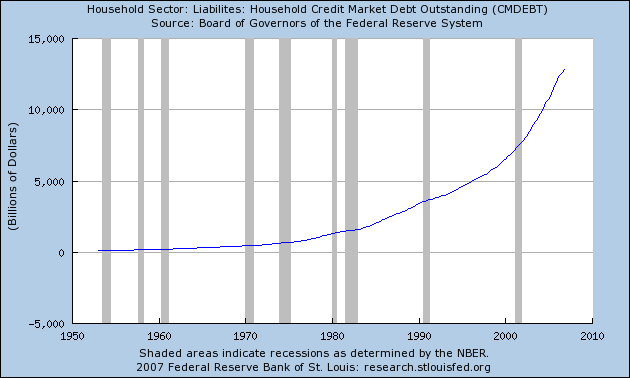
Let's look at how this is playing out.
"Having a credit card is kind of like being a millionaire," says Scott Davis, a 37-year-old facility maintenance worker who lives in Arlington, Texas. He says he and his wife, whose household income is $38,000 a year, had "seven or eight" credit cards they used to buy sporting goods, go on vacations and remodel their home.
Mr. Davis isn't unusual. According to Fed data, outstanding debt, including mortgages, for families in the bottom 50% of earners -- those with household income below $43,000 -- almost doubled to an average $40,676 in 2004 from an inflation-adjusted $20,733 in 1992. Debt outstanding in the top 50% of households rose 83.5% to $150,821 in 2004 from $82,214 in 1992.
Ray Hooper, education and housing director at Consumer Credit Counseling Service in Dallas, says with credit conditions so easy, lower-income consumers have been able to "get what they want, even though they can't afford it." And the easy credit isn't just related to subprime lending. "It's not just the house," adds Mr. Hooper. "It's the furniture, the appliances, the lawn mower."
Let's go back through this paragraph to see what's going on.
1.) The couple had an annual income of $38,000.
2.) They had "7 or 8 credit cards."
Let's go through it one more time ....
$38,000 in income and 7 or 8 credit cards.
That is insane. There is no other way to describe it.
At this point we get into a discussion about the lines between corporate responsibility and personal responsibility. Or better yet, this is really a discussion about the difference between corporate and personal irresponsibility.
Yes I know this couple probably received about 10 mail offers/week for a credit card. And in doing so soliciting companies were pretty irresponsible.
At the same time, when 1 credit card is maxed out it's a really stupid idea to get another card instead of paying the old one off.
But I digress from the point I want to make.
Are we really a rich country, or are we a country living on borrowed growth -- debt-financed growth we haven't paid for yet? The answer is the latter - we're living off growth we haven't paid for yet. Think about the following statement from Barron's (subscription required):
So far this decade, nominal gross domestic product has risen at a 5.1% pace, while outstanding credit-market debt is increasing at 8.4%, notes Punk Ziegel analyst Richard Bove. "If the long-term rates were to rise further or incomes grow at slower rates, then it seems highly likely that there would be a rash of defaults throughout the economy," he says.
Debt is growing faster than GDP. That means -- as the above analyst points out -- if the economy slows we may have a bigger problem as debt defaults move through the system.
This is where another really important issue comes into play -- income inequality which grew in 2005.
Income inequality grew significantly in 2005, with the top 1 percent of Americans — those with incomes that year of more than $348,000 — receiving their largest share of national income since 1928, analysis of newly released tax data shows.
The top 10 percent, roughly those earning more than $100,000, also reached a level of income share not seen since before the Depression.
While total reported income in the United States increased almost 9 percent in 2005, the most recent year for which such data is available, average incomes for those in the bottom 90 percent dipped slightly compared with the year before, dropping $172, or 0.6 percent.
The gains went largely to the top 1 percent, whose incomes rose to an average of more than $1.1 million each, an increase of more than $139,000, or about 14 percent.
The new data also shows that the top 300,000 Americans collectively enjoyed almost as much income as the bottom 150 million Americans. Per person, the top group received 440 times as much as the average person in the bottom half earned, nearly doubling the gap from 1980.
People who aren't benefiting from economic growth -- and there are a ton of those people in the current environment -- want a piece of the pie. That's a natural human emotion. But the problem is to benefit, most people have to go into debt which only increases their inability to move up the socio-economic ladder.
Let me be clear: I'm a capitalist. I like money. I'm not run by this desire, but I certainly wouldn't turn down a million dollars in the name of political thought purity.
At the same time, we have to think about how the benefits of the largest and most productive economy in the world are distributed to everybody -- not just those who can afford to buy the latest political party du jour.
Update [2007-4-2 9:31:11 by bonddad]:: Since 1975, total household debt outstanding has increased as a percentage of GDP.
The Fed's Flow of Funds statement goes back to 1975.
GDP is from the Bureau of Economic Analysis (see link on my blogroll).
Total Household debt outstanding/GDP = total household debt outstanding as a percentage of GDP
75. 734/1638 = 44%
80. 1396/2789 = 50%
85. 2270/4220 = 51%
90. 3589/5803 = 61%
95. 4855/7397 = 65%
00. 6999/9817 = 71%
05. 11803/12455= 94%
06. 12815/13246 = 96%
For economic commentary and analysis, go to the Bonddad Blog
Thursday, March 29, 2007
One man's campaign against federal debt
UPDATE: March 30, 2007 Editor's note: I am posting at the secondary blog(also see March 29th articles at the overblog blog, the secondary blog and here below).
---
Story Highlights
•Top accountant touring the country to warn people about the federal debt
• Debt has risen from more than $2 trillion in 1986 to nearly $9 trillion in 2007
• Baby boomers will soon stretch U.S. finances even further
---
Story Highlights
•Top accountant touring the country to warn people about the federal debt
• Debt has risen from more than $2 trillion in 1986 to nearly $9 trillion in 2007
• Baby boomers will soon stretch U.S. finances even further
By Kyle Almond
CNN
CNN
(CNN) -- He has recently made stops in Iowa, New Hampshire and South Carolina, giving speeches and holding town hall meetings. But he's not seeking the presidency.
David M. Walker, the nation's top accountant, is instead touring the country to warn Americans about the consequences of a federal debt he says is on an unsustainable course.
Walker, who heads the General Accountability Office (GAO), has visited college campuses, spoken to lawmakers in Washington and toured 19 states in the last year and a half.
He plans to continue through next year and is focusing on states that could affect the 2008 presidential race, in hopes that candidates will heed his message.
"If [the candidates] don't make [the debt] one of their top three priorities, in my opinion, they don't deserve to be president and we can't afford for them to be president," he told CNN.
The federal debt has soared during the last two decades -- from $2.13 trillion in 1986 to $5.22 trillion in 1996 and $8.51 trillion in 2006.
The federal debt now stands near $9 trillion.
The way programs such as Social Security, Medicaid and Medicare are structured, the government will incur an additional debt of $50 trillion during the next 20 years, according to GAO figures.
The $50 trillion total amounts to about $440,000 per American household, Walker said.
The primary drivers behind the additional rise in spending are the baby boomers, who start becoming eligible for Social Security in 2008 and Medicare in 2011.
"We are talking about an unprecedented change in the demographic landscape of America," Walker said. "And we are not prepared for this oncoming wave."
The consequences of federal debt
The federal debt increases every time there is a budget deficit at the end of the fiscal year. A budget deficit occurs when the government spends more than it receives in revenue, as it has for the past five fiscal years and 16 of the past 20, according to the Office of Management and Budget.
The causes for such deficits range from tax cuts and spending increases to congressional earmarks in appropriations bills, costs associated with the wars in Iraq and Afghanistan and catastrophes like the 9/11 terror attacks and Hurricane Katrina.
The government makes up the difference by printing and selling Treasury bills and bonds, which are increasingly being bought by overseas investors looking to profit from the interest.
More than three-quarters of the federal budget deficit from March 2001 through September 2006 was underwritten by overseas investors, according to Christian Weller, the senior economist at the Center for American Progress, a Washington-based, left-of-center think tank.
Such financing is not necessarily a bad thing for the average American because it has helped keep interest rates relatively low, Weller said.
"The budget deficit brought in all of this foreign cash, and that foreign cash basically washed into the credit market, [making] it easier for homeowners and for others to borrow money," Weller said.
Observers are concerned, however, that interest rates could rise if the federal government doesn't show more fiscal responsibility.
For example, a country that typically lends money to the United States could begin charging higher interests rates on the loan out of concern for what it sees as an uncertain U.S. financial future, said Bill Beach, an economist associated with The Heritage Foundation, a conservative think tank.
"So we [would] all end up paying more for mortgages, more for cars and so forth," Beach said.
Beyond interest rates
In the worst-case scenario, other countries -- instead of just charging higher interest rates -- could decide to take their money elsewhere, which could spur inflation and increase financial uncertainty.
However, several things would need to happen -- such as a series of international crises or a collapse in U.S. home values -- for countries to move their investment out of the United States, according to Beach.
Meanwhile, as a result of existing debt, the United States has less money to spend on infrastructure, technology and education -- improvements needed for the country to remain competitive in the global market, Weller said.
"With the government running massive deficits and spending large amounts on debt service, we have less money available to address those concerns, to really face the challenges of the future," he said.
Though economists of different political persuasions agree the federal debt is a growing problem, the solutions they recommend differ. Some ideas include caps on government spending and repealing certain tax cuts.
The GAO's Walker believes reforms of health care and programs like Social Security are the most important steps.
"The fact is that we could eliminate the Iraq war tomorrow. We could eliminate every dime of pork-barrel spending. And we wouldn't come close to solving our problem," he said.
Walker said it is necessary to balance the budget within the next five years, make a down payment on the $50 trillion imbalance and begin reforming government programs.
"It's going to take us probably 20 years to do all the things that need to be done, " he said. "But we need to get started now because the clock is ticking and time is working against us."
Monday, March 26, 2007
Lets Broaden Our Focus To Include Economic Issues: It’s Time To ‘Stop The Squeeze’

Another week has passed with most of the progressive community mesmerized by the political game playing in Washington. Don’t we realize yet that a totally compromised political process in Washington, built around wheeling and dealing, will not have the courage or the consciousness to do what must be done to stop the Iraq War?
The House’s latest watered down “withdrawal” bill will never become the law in an environment laced with veto threats and the White House’s efforts to mobilize the military against the Democrats — as if somehow the soldiers can be viewed apart from the war. Alas, the votes to prevail are not there.
Don’t we also realize the debate over what Alberto Gonzalez did or didn’t do is a sideshow. Sure he “did it,” and yes, he’s been caught—but so what?
Let’s acknowledge that the GOP is not the only party that politicizes the Justice System—and, yes, the Clinton Administration did clean house of US Attorneys in its time. The problem here is deeper than mere partisan bickering.
Unfortunately, if Gonzo goes—as he may—another legal Neanderthal who may play the game with an even harder line will replace him.
The mainstream AND indy media focus on every tick and burp in Washington assumes that the politicians are the real power—and often ignores the big money and corporate clout stage-managing the process.
Too many bloggers focus on the smoke and mirrors of politics, as if it is a recreational sport or parlor game, taking polls too seriously and trends not seriously enough. There’s still more of an obsession over the scandal of the day than over the interests in the wings—the people who are financing the politicians and orchestrating their maneuvers.
The political crisis engages the bashing brigade of message point polemicists on the right and left who both tend to ignore economic interests. They are the forces that are devastating the lives of so many Americans who have lost their jobs, can’t pay their bills and are victimized by the growing inequality in our nation, which does not seem to have become a political issue yet.
No one’s marching on the banks or Wall Street to demand economic justice.
Think of all the soldiers who join the military because the pay is better or they have no other choice. Think of all the poor Iraqis being killed by poor Americans who return to find themselves going even more deeply in debt. They are the ones being victimized by payday lenders whose signs advertising easy money line the boulevards outside military bases. Speak to military families and you will find that their lives are harder than ever.
And then meet the folks who are among the 1.1. MILLION Americans on the verge of losing their homes in America because of the subprime loans they took at usurious rates in order to improve their lives by putting a nicer roof over the heads of their families. The companies that gave them the mortgages with no credit checks made small fortunes doing so, but so overplayed their greedy hands that now some have lost BILLIONS and hurt the whole economy. Some economists fear a recession (or worse) because of this time bomb.
How did it happen? The federal regulators were absent without leave and, according to the Wall Street Journal, 52% of the loans were made by scores of predatory independent companies that are not regulated. As Alan Fishbein of the Consumer Federation of America put it, “Only when the market experienced losses and lenders started to shut their doors did real attention start to be paid to the issue.”
What we are seeing, according to Robin Blackburn in Counterpunch, is vicious and legitimated loan sharking. He writes: “In recent times high-profile Wall Street investment banks have brought slick financial reasoning to the base art of loan-sharking. The most vulnerable Americans have been targeted for loans they can ill afford. Those with poor credit histories can be charged at double or triple the interest of a customer in good standing with the rating agencies.”
The details of all of this money grubbing are now in the press, which was also asleep at the switch and is just waking up to the impact that this crisis is having on working America. The story has finally moved from the business section to the news section, from page 50 to page l. Unless something is done, these headlines will lead to breadlines.
While some politicians are starting to talk about this crisis, you have to wonder what they are willing to do. If they won’t really challenge the Bush Administration on the war, even as the war and the President’s popularity sinks into the toilet, do they have the guts to take on the power of the big banks?
Knock, knock progressive bloggers and activists: let’s get on this issue like white on rice. (That’s not a racial allusion—a large percentage of the victims here are, predictably, Americans of color.)
Knock, Knock MoveOn: I wrote to one of your decision makers who told me that this issue is not on a list of issues members said they care about. But the list was made last year. Guess what? This crisis that has long been warned about only just erupted! No one anticipated Katrina either.
Let’s expose the real power in this country—the economic engine driven by the financialization of consumerism that sells us what we don’t need and lends us what we can’t pay back. As we fight the military-industrial complex, let’s not ignore the credit and loan complex.
Last week, in a story about mounting foreclosures, the Journal noted that most of us need not worry about the problem, which, translated, means that the upper class and parts of the middle class can ride out the crisis. That struck one of the readers of the News Dissector blog on MediaChannel.org as amusing. Faith Carr wrote:
“My family was ahead of the curve on this insanity. After a job loss, losing our 5/3 home, and the bankruptcy before the legislation change, we are living humbly in a 27-year-old trailer in the country. Just wait until those making 100K + have one tiny little bubble in their lives. Gonna fall like the house of cards it is.”
So beware: this crunch affects all of us, and yes, we can do something about it. My film IN DEBT WE TRUST is just rolling out. Help us organize screenings to educate people about the roots of the crisis. The website STOPTHESQUEEZE.ORG just announced a campaign by Americans for Debt Relief Now to make this issue our own.
Join it, because it’s time to fight back.
– News Dissector and filmmaker Danny Schechter is the blogger in chief of MediaChannel.org. Comments to Dissector@mediachannel.org
Friday, March 16, 2007
Keeping Our Demons at Bay
Posted on Mar 16, 2007 * * *
By Stan Goff
Last year, I began to research and write on the case of Pat Tillman. One of the central characters in the Tillman story was Lt. Col. Ralph Kauzlarich, who was the regimental executive officer for 75th Ranger Regiment in Afghanistan in 2004 when Tillman was killed by friendly fire. He was also a key figure in the Pentagon’s attempts to first cover up and then spin the fratricide. Kauzlarich was the officer assigned to conduct a second investigation of the circumstances of Tillman’s death. The first investigation—conducted by Capt. Richard Scott—had found criminal negligence and professional incompetence, so a higher-ranking officer was required by law to follow up in the event that a general court-martial would become necessary. Not surprisingly, no one was charged with either crime, though some minor administrative actions were taken, including reassignments out of the Rangers and “letters of reprimand” for two officers. But that is not what this commentary is about. This is about Lt. Col. Ralph Kauzlarich, a Washington Post writer and the power of cultural myths.
In the course of my research, Kauzlarich emerged as an unlikable person, although I admit that I still bear class resentment toward most commissioned officers from my days in the military. My memories are still pretty fresh regarding the cannibalistic promotion system that advanced so many self-important, puffed-up anal-retentives ahead of the few very competent military leaders. Competent, principled officers had a relatively short lifespan in the Officer Personnel Management System.
His rank isn’t the only thing that bothers me. As reported previously on Truthdig, Kauzlarich had made some very offensive remarks about the Tillman family’s agnosticism. Then both Robert Scheer (Truthdig’s editor) and Mary Tillman (Pat’s mom) contacted me on Feb. 26 to tell me that he was back in the news.
David Finkel of The Washington Post had written a 5,000-word feature article on Kauzlarich entitled “11 Days to Baghdad.” It was a scripted account of the 2nd Battalion, 16th Infantry Regiment, of the 1st Infantry Division—Kauzlarich’s battalion—preparing to deploy to Baghdad as part of the Bush administration’s “surge” strategy to salvage the city from defeat. Kauzlarich was featured as the leading man, with his family and the battalion as a supporting cast.
In the opening scene, with the winter storm blowing against the doors of a gymnasium filled with troops in formation and families in the bleachers, Finkel gave Lt. Col. Ralph Kauzlarich one hell of an entrance:
Outside, snow was coming toward this isolated place. Inside, as the bleachers filled and the doors swung closed against the cold, a 41-year-old soldier near the middle of the floor began clapping his hands in anticipation.
And now waved at his wife and children.
And now took his position in front of the soldiers he would soon be leading into combat.
This was Lt. Col. Ralph Kauzlarich, the commander of an Army battalion called the 2-16—the 2nd Battalion, 16th Infantry Regiment of the 4th Infantry Brigade Combat Team, 1st Infantry Division. The unit has 800 soldiers, most in their late teens and deploying to Iraq for the first time under the command of a man who, in this gymnasium filled with believers, was among the biggest believers of all.
“We are America,” is how Kauzlarich would describe his belief a few days later, just before boarding a plane that would take him and his soldiers for a year’s deployment into the center of an increasingly unpopular war. “This nation can do anything that it wants to do.”
Kauzlarich was a student at West Point when I taught military science there, but I didn’t know him then. The academy is a big place, and the students are all alike—dressed in gray, striding purposefully between gray buildings, through gray snow, alongside the gray Hudson River.
“Gray. Dismal. A very sad place to live,” is how Kauzlarich’s wife, Stephanie, herself a West Point grad, described Iraq in the Washington Post article. If that were the case, the Kauzlarichs may have been flashing back to their student years.
Kauzlarich and I certainly saw each other unknowingly at West Point, somewhere—an ambitious cadet walking past a sergeant first class. I was an authority figure to be avoided. He was en route to obey other authority figures, struggling through each hectic day with his mind focused on a gold bar and a ring.
In my classes there, I had to stick to the subjects. We were training the cadets to pass tests, years ahead of public schools adopting the same prime directive; and training to take tests takes time. But there were occasions when the cadets wanted to know about Vietnam. They were surrounded by Vietnam veterans. Plenty of the officers there told them that America was stabbed in the back by the press, and that the Vietnam War could have been won. I was an NCO, preparing to leave the Army (though I would go back yet again); so I told them what I knew.
We should not have been in Vietnam. The Vietnamese didn’t want us there. That’s why we lost the war.
Nearly 3 million people died in that war. How many more millions of corpses, I said in rebutting the stabbed-in-the-back theorists, would have been required to deliver the “victory”? Sometimes I’d have the time to explain that there are wars where the possibility of winning—as in the surrender of a sword or some such pomp—is nonexistent. In that case neither side wins, but one side loses by not winning. It’s tricky.
Kauzlarich wasn’t in my classes nor among those cadets who dropped by my office to chat.
In The Washington Post article, Kauzlarich is quoted:
“What we’re about to do is going to change every one of our lives. And it’ll all be okay… as long as we win.”
Winning. Kauzlarich muses with Finkel:
“Who will win?” he said, rephrasing the questions. “I will win.”
He thought about his answer.
“Is that belief or confidence?” he asks rhetorically. “Is it confidence, or is it overconfidence? Those are questions I have to ask myself. Because if it’s overconfidence, it’s arrogance.”
He thought some more.
“I will win,” he said again.
I will win! Me, Ralph Kauzlarich, the star ... the leading man.
Back on Earth, however, the war is already lost.
The generals in 1968 told their administration that the United States could not win (and therefore would lose). This assessment was hidden until Daniel Ellsberg outed them. Ellsberg and the generals who kept their mouths shut like good fucking Germans all knew the simplest truth about “winning.” Military success is not predicated on tactical outcomes, but on political ones.
That’s why we have body counts and metrics as the public’s score sheets for lost wars. These are veils draped over the bloody reality of the can’t-win-defeat.
Back on Earth, The Surge™ is an attempt to salvage Baghdad from the general Anglo-American loss of the war. It is based on a puppet government with popular bases that orient toward Iran, a nation whose growing prestige and influence will edge the United States further out of the region. The “allied Iraqi forces” are heavily infiltrated, with many men moonlighting for sectarian death squads. The majority of the Iraqis don’t merely want the U.S. to leave immediately; they approve of armed attacks against American troops and contractors until they do leave. The Iraqi government, which is the last hope of the U.S. ambition to establish a permanent military presence there, is seen by most of the Iraqi resistance as collaborators—the eyes and ears of the occupation—that must be destroyed: a tactical imperative to blind the occupation forces.
In this sense, the single most significant catalyst for inter-Iraqi violence—which is destabilizing the country to the point where the U.S. can never appoint an effective and compliant government (the goal of the war)—is the occupation itself. In effect, the pursuit of the most basic political goal of the war is rendering that goal impossible.
Iraq is what an unacknowledged political defeat looks like. That makes it a military defeat.
We should not have been in Vietnam. The Vietnamese didn’t want us there. That’s why we lost the war. We should not be in Iraq. The Iraqis don’t want us there. That’s why we lost the war.
But Ralph Kauzlarich is going to snatch victory from the jaws of defeat, and David Finkel has written Kauzlarich’s pre-deployment hagiography.
In 5,000 words, there is not a single mention of Iraqis except as a government and as “suspected insurgents.” Not one. Yet throughout the article, what is emphasized—in manipulative and melodramatic terms—is the danger of Iraq, the anticipation of danger, the fear of killing and being killed ... for the American troops.
The much maligned Lancet report—which actually used a very sound enumeration method—has already shown us that (by now) about 700,000 Iraqis have been killed in this war, almost 2 million displaced, untold numbers wounded—physically and psychologically—and a once vibrant if imperfect society (like we can talk) has been reduced to a sea of terror and misery. Babies live in this.
Kauzlarich and his battalion were sent to Sadr City—a poor area with the population of Brooklyn. What they anticipated was killing. That is what the infantry does—it kills close up. Yet in Finkel’s 5,000 words about one of the leaders in this war—one already tainted by his careerism and his public displays of intellectual mediocrity—there is not a single word about Iraqis.
That’s not to say that the Iraqis aren’t there, in every line of text, in every paragraph, in every turn of phrase. They are there ... as the backdrop on the stage, as the amorphous danger against which these young men must undergo their rite of passage into the death-cult of imperial masculinity. And because this othering of the Iraqis is so consistent, so perfectly fitted to existing cultural and entertainment conventions, there is little doubt that Finkel used the Iraqis in exactly this way—as a racialized reduction, as expendable extras on his set.
For this reason, I accuse. David Finkel, no less so than Judith Miller during her apprenticeship under Ahmad Chalabi, is not merely a journalist. He has become part of the war machine. There is blood on his hands, and just as with Judith Miller, Finkel will have to bear that Macbethian stain.
More than once now, I’ve made note of the Bush administration’s affinity for entertainment conventions and scripted performances. These are characteristic of all politicians in this age of mass media, to be sure. But the Bush administration (and more than one generation of Americans) has been immersed in these conventions and performances in an instrumental way. Life has come to imitate art in such a way that the entertainment conventions have become “active ingredients in reality.” Unfortunately, for the Bush administration and the world, the ability to impose a script on the rest of the globe is not the same as being able to control the outcomes. Not everyone is sticking to this script.
The media have assumed a totalizing role in our lives. Evidence of how effective this role has been is the fact that most of us still believe that the “reputable” media (NYT, Washington Post, CNN, etc.) merely reflect (imperfectly) the realities about which they “report.” Yet the Finkel hagiography is a perfect example of fitting a narrative to cultural conventions (especially the conventions of the film script) in ways that actively participate, and invite the audience to participate, in the reproduction of the racism and patriarchy inherent in those conventions. The Safe-World is somewhere in the suburbs, ringed with layers of defense: lawns, fences, homeowners associations, bands of strip malls, interstate highways, contract security, cops, the oceans, the aircraft carriers and nuclear armed submarines....
Outside the layered defenses of Safe-World, surrounding it, are dark, unpredictable, primitive Others. Inside Safe-World, when stability reigns, men can provide and rest at the hearth. But the real rite of passage for Men is to leave the safety of the hearth to confront this Dark Otherness outside Safe-World. Having done their duty disciplining the teeming periphery, they can return to the hearth, where Woman stands by, waiting, appropriately grateful for her security to this bloodied Man. In exchange for his security (also against other men), she is dutiful.
Their camouflage on, their wives carrying infants, their older children carrying flags, the soldiers of George W. Bush’s surge crowded into a gymnasium for their brigade deployment ceremony, a last public viewing before they disappeared into Iraq.
This is the opening sentence in Finkel’s article.
As one of his soldiers said: “He’s the kind of guy you follow to hell and back. He’s that kind of leader.”
There it is. They are leaving Safe-World for Hell, to keep Hell far back from home. Our need to believe this in the face of evidence to the contrary has only increased since 9/11.
“Okay, there’s a reason I’m here,” Kauzlarich said he decided that day, as his parents listened, and his wife, Stephanie, went to get the apple crisp out of the oven, and his 7-year-old daughter, Allie, climbed onto his lap for a hug, and his son Jacob, who was born just after Sept. 11, 2001, slid laughing across the floor on his belly. “I wasn’t afraid of anything from that point on.”
Even Stephanie, herself a West Point graduate and former Army officer, has reverted to the norm. She is dutiful. She tends the hearth while Ralph goes forth into Dark-World (Hell) to maintain the integrity of the layered defenses of the suburbs.
Safe-World is a mythical place and a real one: that is, the norm. It is positively dripping with the prevailing storylines that simultaneously conceal and reproduce real power. This narrative contains a meme cluster readily recognizable to all of us. It just sits there waiting for anyone to tap into its resonant power. As Finkel did. His story is a movie trailer. We’ve already seen the movie, again and again and again. We know how to climb right in. We are an enthusiastic audience, the best kind. We suspend our disbelief ... oh, do we ever!
As our cultural distinctions have collapsed under the onslaught of megamerger monoculture, we have seen wholesale uniformity imposed on our constructed environment. All the distinct cultural meanings of past communities have gone under the wheels. But human beings cannot live without meaning.
Meaning-making is a distinctly human need. We are the only species that can see the cosmic abyss that surrounds our incandescent islets of awareness. With the enclosure of Middle America™ into the constructed spaces of the work cubicle, the strip mall and the suburban living room, meaning-hunger is being answered in exactly the same commodified way as actual hunger: with taylorized, mass-produced cultural meanings, disseminated as “entertainment.” Journalism has been swept up in this process, now obliged by The Market™ to be “entertaining.” (Big-money journalism has always been generally obedient; it’s the adoption of glitz that has changed it.)
Life, at last, must imitate art. And with only one monocultural art, we will be truly one in our imitation.
That’s the danger to stability of cultural criticism. It identifies the patterns, mapping and deconstructing them until they are drained of their authority.
The durability of these norms and conventions is the constant Nemesis of social change agents. They still think a simple, well-constructed argument should be enough to “change one’s mind,” such a pale linguistic marker for what this proposes. Enough to begin demolishing the foundational structures of one’s entire worldview, and with it every decision taken on behalf of that worldview, every emotional attachment developed within its framework, and every single thing that gives them meaning as a safety rail along the Abyss. The Big Dark-World. Infinity that swallows us up. This is always the preoccupation of those who understand themselves as simply ... individuals.
Kauzlarich was filling out something called the Family Contingency Workbook.
I want to be buried, cremated: Buried.
Location of Cemetery: West Point.
Personal effects I want buried with me: Wedding Band.
Yes, he told Stephanie, whom he had met when they were students at West Point and who hadn’t exactly been seduced by his first words to her, which were: “You can call me The Kauz.” That was all he wanted to be buried with.
Type of head stone: Military.
Scripture you want read: Psalm 23.
Music you want played: Something upbeat.
“Ralph, upbeat music?” Stephanie asked.
“I don’t want people to be sad at my funeral,” Kauzlarich said.
This kind of saccharine script is irresistible to the narcissistic personality of our age. Our collective narcissism is the moth; the script is the flame.
Christopher Lasch, in “The Culture of Narcissism: American Life in an Age of Diminishing Expectations,” published all the way back in 1979, concluded (in perfectly predictable patriarchal terms, and with a powerful Freudian inflection) that the narcissism we see in American life is related to the loss of authority of the male. That’s Lasch’s misogyny, of course, so I am compelled to just name it. Nonetheless, Lasch’s description of cultural narcissism had a lot of pearls.
“Success in our society has to be ratified by publicity,” he said.
[A]ll politics becomes a form of spectacle. It is well known that Madison Avenue packages politicians and markets them as if they were cereals or deodorants; but the art of public relations penetrates more deeply into political life.... The modern prince ... confuses successful completion of the task at hand with the impression he makes or hopes to make on others. Thus American officials blundered into the war in Vietnam.... More concerned with the trappings than with the reality of power, they convinced themselves that failure to intervene would damage American “credibility”.... [They] fret about their ability to rise to crisis, to project an image of decisiveness, to give a convincing performance of executive power.... Public relations and propaganda have exalted the image and the pseudo-event. (Emphasis added)
This script gets turned on by the likes of “journalists” such as David Finkel, and the public transfers its amorphous fear. We make the classic patriarchal deal writ large, the one expected of infantilized women. We accept the “protection” of the Father-State, and in exchange we offer up ... obedience and conformity ... even vigilance on behalf of the Father-State. We become dutiful.
Surveillance is established in the prisons, and we accept that. Then the hospitals, and we accept that. Then the factories, the offices, the corner stores ... dark danger is ubiquitous. Even in the family.
The beauty of this new Panopticon is not that it simply takes our eyes off the real war, the real plunder, the real system; it is that it stations a pernicious little watcher inside our individual brains. We become aware that we are under surveillance all the time, and this surveillance constitutes not the one discipline of the edict, but the implanted discipline that a complex society requires of its subjects to police themselves.
Finkel is not a dupe, any more than Judith Miller or Wolf Blitzer. They are all active agents of the war establishment. They are collaborators. It is this disciplinary process with which they collaborate. They teach us that Dark-World is real, and there we might be, but for the grace of God and our protectors: the cop, the soldier, the mercenary, the prison guard, the surveillance camera—the rat mentality that urges some of us to police others for conformity.
But suburbia is not safe. This is the central illusion.
While suburbia has had its eyes fixed on threatening images of Arabs and Persians and Latinos and deepest, darkest African America, the same establishment that makes war and builds prisons and gazes into our lives has picked suburban pockets with one hand and gripped the ’burbs as loan sharks with the other.
Suburbia is not being protected; it is being saved for dessert.
It is this sector with its fragile, technological, disembodied living standard that will now come under attack. In the short term, that is already happening through financial manipulation and the further disappearance of living-wage jobs. The tremendous personal debt burden that is mounting in the American “middle class,” fueled by past low interest rates and cash-out equity loans, was the latest maneuver to prop up this sector’s role as global consumer—a time bomb that will explode directly under Suburbia’s feet.
Meanwhile, the liquidation of the commons—from Medicare to Social Security to public services—constitutes a massive transfer of wealth saved by these working people directly into the speculative money pit that is Wall Street. Suburbanites are workers in the truest sense, even though they seldom stand on the factory floor now. They don’t know it, but they are weak, dependent, high-maintenance workers in a consumer mill.
The bill for the United States from Treasury loans to other nations—already impossible to pay—grows exponentially to support the cost of the military now conducting the war, those we see as the guardians of civilization. Our children are inheriting this impasse. We have witnessed what happens when the suburbanites are fleeced; with the taxpayer bailout of the savings and loan criminals, the Long Term Capital Management hedge fund, these burdens will invoke the “too big to fail” principle. From Chrysler to Enron, the so-called middle class will pick up the tab.
The real threat will not appear as an Arab with a bomb or a 16-year-old with brown skin and a Glock. It is already present. It has appeared as pension funds disappearing in strategic bankruptcies. It has appeared as sub-prime lending and subsequent foreclosures.
“Thank you for buying all these houses,” the banks are already saying. “Now we can take them back and rent them to you.”
As Suburbia works harder and faster to keep up with the mounting debt, as it is forced to further ingratiate itself to Suburbia’s employers, as it learns to kiss more ass, get personality makeovers to fit itself heart-and-soul to the boss, it is obliged first and foremost to purchase the bare minimum of status markers (like stage props) that validate this new personality. To call narcissism in this age a “disorder” is a cruel pun. It is a cultural mandate—the norm.
Outside the ’burbs, the treatment of the others as Dark-World has become a kind of local self-fulfilling prophecy. Blending of police and military functions corresponds to an increasingly uniform (urban, unemployed, young) and crisis-ridden global human ecology. Nonetheless, the imposition of a garrison state on people who have been previously privileged as a core political base (like Suburbia) is no simple matter.
If an openly warlike state is to impose control without the middlemen, it requires Spectacle as camouflage.
Soldier and SWAT spectacle ... soldier and SWAT reality. They are not the same, the spectacle and the reality.
Spectacle conceals reality.
Spectacle requires publicity and amplification.
What better publicity, what better amplifier, than Finkel’s crude reduction of this war to an adolescent docudrama for The Washington Post? Ever since the neocons came to power, most of the so-called reputable press has been so craven in its collaboration with our government that it might as well be assigned a formal position on the Pentagon staff.
The Dark-World set of establishment publicists like David Finkel and political consultants like Karl Rove is like a movie in one other respect. The light you see is on the screen. The story you see is framed in shadow. Remain passive. All will be well.
Why the subprime bust will spread
Years ago when the US debt bubble spread to the housing sector, warnings from many quarters - including Henry C K Liu - about the systemic danger of subprime mortgages were dismissed by Wall Street cheerleaders as "sky is falling" hysteria. Now, belatedly, financial wizards are slowly realizing that their earlier departure from reason has fueled a phenomenon that is poised to cause severe damage to the global finance system.
Thursday, March 8, 2007
Drowning in cheap money
Jubak's Journal
3/6/2007 12:00 AM ET
If there is a major stock market tumble, it won't be the fault of the overall U.S. economy. Instead, point the finger at too much risk-taking in the debt market.
By Jim Jubak
After Federal Reserve Chairman Ben Bernanke's Feb. 28 testimony, one member of the House Budget Committee asked him whether the sell-off in global stock markets a day earlier -- and in particular the 416-point drop in the Dow Jones Industrial Average ($INDU) -- had changed the Fed's thinking.
--MORE--
3/6/2007 12:00 AM ET
If there is a major stock market tumble, it won't be the fault of the overall U.S. economy. Instead, point the finger at too much risk-taking in the debt market.
By Jim Jubak
After Federal Reserve Chairman Ben Bernanke's Feb. 28 testimony, one member of the House Budget Committee asked him whether the sell-off in global stock markets a day earlier -- and in particular the 416-point drop in the Dow Jones Industrial Average ($INDU) -- had changed the Fed's thinking.
--MORE--
Tuesday, March 6, 2007
Just who owns the U.S. national debt?

| MSNBC.com |
And is growing foreign investment in the U.S. bad for America?
COMMENTARY
By John W. Schoen
Senior Producer
MSNBC
Updated: 1:27 p.m. MT March 4, 2007
This week, readers are worried about the about the dangers of the steady rise in U.S. debt – after back-to-back warnings from sources as diverse as Fed Chairman Ben Bernanke presidential candidate Hillary Clinton and investment guru Warren Buffet. Dick in Michigan wants to know just where this borrowed money comes from; Kim in Maryland is worried that foreign lenders like China may be gaining an unhealthy upper hand in its relations with the U.S.
The Bush administration talks about spending a million here and a billion there adding up to trillions for the war. Since the country is so far in debt, where is all this money they are talking about spending, coming from? I know it is borrowed, but from whom?
-- Dick, Howard City, Mich.
The money is borrowed from buyers of Treasury securities -- which are basically a big batch of IOUs that are auctioned off every three months. As the auction date approaches, the Treasury figures out how much it will need to pay off old debt and cover the government’s latest round of overspending.
When the auction day comes, buyers submit bids in the form of the interest rate they’re willing to accept. You can choose to make a competitive bid (you ask for a specific rate) or a non-competitive bid (you agree to accept the average rate of other winning bids.) When all the bids are in, the Treasury starts at the bottom, taking the lowest bids until it has collected enough money to cover that round of borrowing.
The money flows in from all over the place: from individual investors and corporations, pension funds and governments, both in the U.S. and around the world. Basically, anyone with a large amount of cash looking for a safe place to put it is a good candidate for holding U.S. Treasury debt.
So just who are these lenders? As of last June (the latest complete breakdown available), the biggest holder of Treasury debt was the U.S. government itself, with about 52 percent of the total $8.5 trillion in paper that's out there. Most of the government’s holdings are massive savings accounts for programs like Social Security and Medicare. Just as you may prefer to keep your Individual Retirement Account in the safe Treasury bonds, the folks who manage the Social Security Trust Fund are looking for a secure investment, too.
That’s leaves a little over $4 trillion in public hands. The biggest chunk (about 25 percent of the $8.5 trillion total) is held by foreign governments. Japan tops the list (with $644 billion), followed by China ($350 billion), United Kingdom ($239 billion) and oil exporting countries ($100 billion).
Other big holders of Treasury debt include state and local governments ($467 billion); individual investors, including brokers ($423 billion); public and private pension funds (319 billion); mutual funds ($243 billion); holders of US savings bonds ($206 billion); insurance companies ($166 billion) and banks and credit unions ($117 billion.)
Once issued at auction, Treasury securities enjoy a healthy second life when they’re traded in the so-called “secondary market” (aka the “bond market.”) The prices of bonds bought on the open market go up and down as the market reacts to changes in demand and news about the economic outlook like inflation. But no matter what you pay for a bond, if you hold it until it matures, the government has to pay back the full amount that was borrowed when the debt was first auctioned and issued.
Why should I invest in US treasuries if in the past I would have made more money in the stock market?
-- Grant M., Richmond, Va.
Because you face a substantial risk of losing money in the stock market in the future. It’s true that the historical average return on stocks is higher than the current yield on Treasuries. But as mutual funds are required to warn new newcomers: “Past performance is no guarantee of future results.”
If you’re investing for the long haul and figure you can ride out stock market downturns - and still sleep nights when the market behaves like it did last week - you may be better off with stocks. On the other hand, if you’re retired and living on a fixed income or counting on the money being there in a few years - or you just can’t stand the idea of losing money - you may not want to take on the added risk of stocks.
Is it true that the Bank of China is gaining, while the American dollar continues to fall? If so, is it even a remote possibility that America will one day be run by foreign government through the power of the dollar? Or are the large purchases of American companies and land already a forerunner to this?
-- Kim M., Catonsville, Md.
As a sovereign nation, the U.S. cannot be run by a foreign government – short of an invasion and military occupation. With the current level of U.S. defense spending, we’d put the odds of that at extremely remote to nil.
But relying on foreign governments to maintain our standard of living also comes with certain risks. Sen. Hillary Clinton told CNBC last week she sees “a slow erosion of our economic sovereignty,” and she singled out China’s big holdings of Treasury debt as an example.
As my MSNBC.com colleague Tom Curry wrote last week, Clinton is making America’s dependence on Chinese investors a central theme of her 2008 presidential campaign. When people ask her why the U.S. doesn’t get tougher with China on issues like trade, she says, her response has been: “How do you get tough on your banker?"
Foreign investment in the U.S. – in U.S. stocks, bonds, real estate and businesses – isn’t necessarily a bad thing. Some observers point out that strong demand for U.S. investment is a sign that the U.S. is still the best place in the world to invest. What matters most is the ongoing strength of the U.S. economy and the federal government’s financial health. To the extent that Congress can control spending, eliminate the federal budget deficit and keep the economy growing, we should be fine.
But the current trends aren’t promising. At the moment, the U.S. economy is still relatively strong - both unemployment and inflation are relatively low. But growth seems to be slowing and, at some point, the economy could slide into a recession. When that happens, the economy shrinks and so do tax revenues. But Uncle Sam still has to the pay interest on what he's borrowed - just like you don’t get a break on your mortgage payment when you lose your job. If we keep spending more and more on interest, the federal budget gets squeezed that much harder when the economy eventually stumbles.
Even though times are relatively good, consumers and the government are piling on more debt. Right now, money is pretty easy to come by; interest rates are low. If that changes, rising rates would create a drag on the economy. And as the cost of paying Social Security and Medicare benefits continues to rise, the national debt monster is going to be even harder to tame.
So far, the consequences of all this are hard to put your finger on. As Warren Buffett pointed out last week in his widely-read annual letter to shareholders (pdf file, page 16), a big reason we can fund our budget and trade deficits is that the U.S. is still an incredibly wealthy country with lots of stock, bonds, real estate and companies to sell. And we got that way because of the hard work of generations that come before us.
And American investors and companies also have investments in foreign countries. But as Buffett noted, last year marked the first time since 1915 that the net balance of this investment turned negative.
“Foreigners now earn more on their U.S. investments than we do on our investments abroad,” Buffett wrote to shareholders “In effect, we’ve used up our bank account and turned to our credit card. And, like everyone who gets in hock, the U.S. will now experience ‘reverse compounding’ as we pay ever-increasing amounts of interest on interest.”
The wealth gap between the U.S. and other countries — even those with huge, rapidly growing economies like China — is still big. That means our credit with the rest of the world should be good for years — if not decades — to come. But no matter how rich you are, borrowing on top of borrowing is not a great long-term financial plan.
"I believe that at some point in the future, U.S. workers and voters will find this annual 'tribute' (of interest payment on the debt) so onerous that there will be a severe political backlash," Buffett wrote. "How that will play out in markets is impossible to predict – but to expect a 'soft landing' seems like wishful thinking."
I heard that the Fed might lower interest rates again in May. Should I wait until then to refinance my home?
-- Alicia M., Idaho Falls, Idaho
Despite a cottage industry devoted to Fed watching, there is no way to know reliably what the central bankers will decide to do until they do it.
But if you could forecast Fed moves, you could probably make enough money in the bond market to skip the refinancing and buy your house with cash.
Subscribe to:
Posts (Atom)