Commentary
Charles R. Larson
May 4, 2007
WASHINGTON -- When viewed through American eyes, the recent protests in Istanbul and Tel Aviv demanding that their governments become accountable are truly impressive and extraordinary.
For a US liberal - which is what I consider myself to be - the Israeli and the Turkish protests are also a disturbing reminder that Americans have apparently forgotten one of their constitutional rights: the right to protest. Americans are loud at proclaiming their rights, but, lately, they have been reluctant to practice them. Indeed, a couple of years ago, when Iraq was writing its new constitution, a joke was frequently repeated in limited circles: "Why not give them the US constitution, since we're not using it?"
The George W. Bush presidency has articulated, ad nauseam, America's plan for exporting democracy to the rest of the world - especially to the Middle East. Yet, rarely does the Bush administration proclaim the need for democracy outside of areas where oil is of our concern.
Take Africa, for example. A couple of years ago, it was Liberia, which, under Charles Taylor, became one of the most wretched places for human rights in the world. Taylor could have been unseated quickly and expeditiously with minimal force, and the United States certainly had historical reasons for "liberating" Liberia from its monstrous dictator. But Taylor stayed in power until he wrecked his country, at which stage the US sent in a handful of marines to make a belated push to force Taylor to leave.
More recently, Zimbabwe and Nigeria ought to be of major concern regarding constitutional abuses, but Robert Mugabe still reigns supreme in the former country (that has no oil) and the rigged election in Nigeria two weeks ago, which ought to have triggered a barrage of criticism from the American State Department, resulted in hardly a puff of smoke. (Actually, in the case of Nigeria - one of America's major oil suppliers - it looks as if oil did contribute to Bush's decision to do nothing.)
But it is the war in Iraq that ought to have led to major protests in the United States by now, because of the administration's "selective" push for democracy around the world.
Three weeks ago, a lone gunman at Virginia Tech murdered 32 innocent students and faculty members, triggering a massive outcry for a few days, but no one expects that America's obsession with guns is about to change. One hundred US soldiers have died in Iraq in the last month alone, and there is nary a protest or airing of concern from Americans, who have clearly stopped paying any attention to the debacle - except to say that they "want our soldiers to come home."
Americans have so compartmentalized the war that hardly anyone pays attention to what's happening in Iraq, except the families of the 150,000 US soldiers who are dying there. Most other Americans have stopped reading articles in the newspapers about the war and muted their TV sets during the evening news when the declining minutes of daily coverage are broadcast.
In part, the utter lack of concern about the war is because Americans are convinced that it has nothing to do with them economically - they have certainly not been asked to make any sacrifice to pay for the war. So, the war continues to drain the country of billions of dollars, while the American consumer continues to prop up the economy by increasing personal debt. That is, of course, a mirror of the government's own massive debt because of Bush's folly.
And it is not just the war that Americans are reluctant to protest about - but just about everything else involving George W. Bush's vision for the country and the world. The country's top law enforcer, Attorney General Alberto Gonzales has been disgraced by recent partisan acts that clearly were designed to support the Republican agenda. Yet, Gonzales is praised almost daily by President Bush, while he violates other parts of the constitution in acts that have systematically eroded all of our individual rights.
Paul Wolfowitz, head of the World Bank, is similarly lauded by President Bush and Vice-President Cheney, though Wolfowitz has also compromised his position and run the morale of the World Bank into the ground.
The list of abuses at the hands of the neocons in their attempt to cram right-wing conservatism down the throats of every American are so ubiquitous that the only pleasure a sane person can take these days is the occasional smile, and the remark, "I told you so," which echo a bumper sticker seen on many vehicles in the country for the past six years: "If You're Not Outraged, You're Not Paying Attention."
Americans are asleep. They have tuned out and shut down to recent events because of the staggering amount of outrage and abuse by their government during the past half-dozen years. Even in the best of times, a large portion of the population pays little attention to world events. If you visit the outlying sections of the country and pick up a local newspaper, you might conclude that the readers of that gazette were only concerned about local events. An international incident, which ought to be of concern for everyone, is either given no attention at all or buried in a minor paragraph at the back of the paper.
One wonders what kind of outrage would finally draw Americans into the streets as the citizens of Istanbul and Tel Aviv did earlier this week.
Charles R. Larson is Chair of the Department of Literature at American University in Washington, DC. He is a frequent Contributor to Salon, The Nation, and The Washington Examiner magazines. He submitted this commentary to the Middle East Times.
Showing posts with label dissent. Show all posts
Showing posts with label dissent. Show all posts
Friday, May 4, 2007


Thursday, April 12, 2007
Stop conflating anti-Zionism and anti-semitism
Our politicians are using semantics to outlaw criticism of US and British foreign policy.
April 12, 2007 12:30 PM
Tony Greenstein
Tony Greenstein
When the incitement to religious hatred bill was laid before parliament two years ago, numerous figures from the media and entertainment industries, as well as the human rights, humanist and civil liberties lobbies, condemned the legislation as an attack on free speech. In the words of the actor Stephen Fry, the legislation was "a sop to the Muslim community", whose problems really centred around race, not religion.
Yet barely a murmur has greeted the report of the all parliamentary inquiry into anti-semitism, chaired by the rightwing Labour MP Denis MacShane, who in a previous life as a junior Foreign Office minister greeted the CIA coup that temporarily overthrew Hugo Chávez of Venezuela by denouncing the latter as "a ranting, populist demagogue" (Hugh O'Shaughnessy, March 12 2007).
The committee itself had no status when it drew up the report. It was self-selecting, and not one of the 14 members of the inquiry voted against the war in Iraq on March 18 2003. In other words, they came to the question of anti-semitism from a rightwing political perspective.
Yet the report on anti-semitism, which the government has accepted by upgrading the committee's status to that of a select committee (Jewish Chronicle, March 30 2007: "Police told to focus on hate crime"), is deeply disturbing in its cavalier approach to the definition of anti-semitism, which it conflates throughout with anti-Zionism.
Even the basis for the report itself is hyped and unconvincing. By the reports own' admission (paragraph 29), the year 2005 saw a fall of 14% in recorded anti-semitic incidents compared with the previous year. Of course each and every incident is to be condemned, but where, one might ask, is the all-parliamentary committee on incidents of anti-Muslim abuse; and what, one wonders, would be the level of recorded incidents?
What is more worrying is how anti-semitic incidents are defined. In Brighton and Hove there were two demonstrations against the Lebanon war last summer. Police from Sussex and Surrey swamped the second demonstration, alleging a "serious racial incident" had occurred.
The incident concerned a motorist who had yelled "terrorist" at an Arab demonstrator on the previous march and got into a verbal altercation as a result. Despite a number of eyewitnesses, the police made no attempt to investigate the alleged crime. Instead, it was used as a pretext for some of the heaviest policing of a demonstration, including the use of racial profiling against Arabs, that I have ever seen. It has taken a six-month campaign for Brighton police to accept that the right to demonstrate is not a privilege handed down from on high.
In the course of a conversation I secretly recorded, Brighton's chief of police, Kevin Moore, admitted that before the demonstration, "We made contact with the local Jewish community leaders within the synagogues." In other words, it was the police who made the association between the bombing of Lebanon and the local Jewish community. And in an equally revealing remark, Moore let slip that the police had received a single complaint about the march and, because a "racially motivated incident is one which is declared by any person to be racially motivated", had therefore classified the march as anti-semitic!
The inquiry report is part of a continuum that began with the creation of an offence of "glorifying" terrorism and is continuing with the suggestion that anti-Zionism - that is, opposition to the Israeli state and the movement it created - is anti-semitic. Ironically, it is repeating one of the oldest anti-semitic myths: adopting the EU's working definition of anti-semitism, the report states that anti-semitism includes "denying the Jewish people their right to self-determination, eg by claiming that the existence of a State of Israel is a racist endeavour".
Yet it has long been an article of faith among anti-semites that Jews, wherever they lived and whatever they did, formed a nation separate from those they lived among. The major difference between modern and feudal anti-semitism was that the Jews were seen not as a religion but as a race or nation. It is one of the hallmarks of New Labour that contested political arguments are now being resolved by the criminal law.
And then there is the suggestion that to criticise the nature of the Israeli state, which is unique in defining itself as a state not of its own citizens but of Jews worldwide, is to apply "double standards by requiring of it a behaviour not expected or demanded of any other democratic nation". This is the argument that supporters of apartheid in South Africa used to make. States that accord privileges based on racial/ethnic criteria are indeed unique.
It is argued that "drawing comparisons of contemporary Israeli policy to that of the Nazis" is in itself anti-semitic. Now, it might arguably be offensive, but why anti-semitic? In her book The War Against the Jews, Lucy Dawidowicz reports that it was the position of the SS that "the Zionists adhere to a strict racial position, and by emigrating to Palestine they are helping to build their own Jewish state". Is it anti-semitic to point out that "ethnic cleansing" and the transfer or forced migration of civilian populations was also Nazi policy; or that only in Israel and Nazi Germany were Jews barred from marrying non-Jews?
And it is supporters of the Israeli state itself who have regularly made comparisons between the Palestinians and the Nazis. Who can forget when in 1982 the Israeli premier Menachem Begin compared Arafat in the siege of Beirut to Hitler in his bunker? How many times has the Holocaust been used to justify the Israeli state?
The report defines anti-semitism as "holding Jews collectively responsible for actions of the state of Israel". Agreed. But is it any wonder that there are some misguided people who criticise the Board of Deputies of British Jews when it holds rallies in the name of the Jewish community in support of Israel's bombing of Lebanon?
This report has nothing to do with anti-semitism and everything to do with creating a rightwing political agenda whereby opposition to British and US foreign policy is deemed anti-semitic. If Israel is the west's principal strategic partner in the Middle East and you question the whole basis of that partnership, then you will inevitably be criticised as anti-semitic. In the United States, it has even been argued that if you oppose the majority positions of the Jewish community in favour of the Iraq war, that makes you anti-semitic.
The all-party parliamentary inquiry made no attempt to interview a broad cross-section of Jews, including anti-Zionists; it played softball with the Jewish establishment. Nor did it seek the views of Jews who have been active in the fight against the BNP and National Front apart from those of the pro-Zionist Searchlight magazine. Instead what it has done is produce a report whose only purpose is to try and criminalise political debate in the name of "anti-semitism".
Tony Greenstein is a founding member of Palestine Solidarity Campaign and a member of Jews Against Zionism.
Saturday, April 7, 2007
Why is Arab criticism always labeled as conspiracy to destroy Israel?
Editor's note: I am moving to post at the secondary blog(also see new articles below).
---
Fifth column forever? Abir Kopty Published: 04.07.07
| The Arab-Israeli public recently marked "Land Day." This event originated in 1976, when thousands went on strike and protested the government's intention to expropriate land in northern Israel in order to establish Jewish communities. Six Arab citizens were killed during these protests, and since that time the Palestinian people and broad sections of the Arab people have been marking "Land Day" on March 30 every year as a symbol of the struggle against discrimination and aspiration for peace and equality. In the psyche of the majority of the Jewish public, "Land Day" has been etched as a baseless, motiveless emotional storm. Superficial news stories on television and in the press, several photos from the march, a paragraph or two, and perhaps another sound bite all serve to reinforce the impression that Arab citizens are disconnecting from the State. Mostly there is no mention of the circumstances that gave rise to the event or their importance in the Arab narrative. The second public platform used by the Jewish public to view the Arab public is the many declarations of politicians who present the Arabs as an existential threat. For example, Avigdor Lieberman's declaration that the Supreme Arab-Israeli Monitoring Committees "supports Israel's destruction."
This year, "Land Day" was marked against the backdrop of several documents that present harsh criticism and concrete proposals on a pact regarding relations between the State and its Arab citizens. These documents have been perceived to reflect a threat. For example, the Shin Bet security service characterized Arabs in Israel as a "strategic threat."
Rhetoric of 'extermination' Whenever Arabs speak up and voice criticism that does not flatter Israel's policies, this criticism is labeled as an attempt to destroy and exterminate. Every time the question of the relationship between the State and its Arabs citizens is on the political and media agenda in Israel, many opinion leaders choose to consistently make use of rhetoric of "extermination." This use is not casual: It is connected to the most painful experience in the Jewish collective memory and arouses difficult connotations. The rhetoric and myth regarding the "threat" are used to reject any criticism or proposal for change. This even shapes to a large extent the perception of the Arab public being an "enemy" and apparently legitimizes the continuation of hostile policies towards it instead of reaching a mutual understanding. However, the constitutional proposal we raised, just like other documents published recently, did not only feature criticism but also alternatives that take Jewish citizens into consideration. The documents attempted to propose arrangements that would provide equality for all, both Jews and Arabs. The elimination and "extermination" of Jews is not what the offers care most about, but rather, possible ways for creating a common future. Moreover, those who drafted the documents constantly emphasize that we are talking about a basis for dialogue, rather than "red lines."
The exclusion of Arabs from the media and other public circles in Israel limits the possibility of the others to be exposed to new information about Arabs and prevents them from finding out, in depth, what Arabs really think. Thus, without direct contacts and with the absence of fair reporting, the Jewish public is left with stereotypes and a one-dimensional picture that are very difficult to disprove. And this process is like the "chicken or the egg" debate – the Arab public, which is increasingly marginalized, is undergoing natural processes of alienation from its country of residence. The obstacles are only growing among both sides. In order to break through them we need work that would replace the rhetoric of "extermination" by "change" and "threat" by "cooperation." |
Sunday, March 25, 2007
NYPD spied broadly on citizens before '04 GOP convention
Report: NYPD Watched RNC-Bound Activists
Sunday March 25, 2007 7:31 AM
NEW YORK (AP) - Undercover NYPD officers traveled around the U.S. and even to Europe to observe activists who planned to protest at the 2004 Republican National Convention - including hundreds who showed no sign of illegal intent, a newspaper reported.
Posing as activists or sympathizers, the officers attended meetings of political groups in at least 15 states and filed reports with the police department's intelligence division, The New York Times reported on its Web site Saturday.
The officers involved in the ``RNC Intelligence Squad'' then identified certain groups as potential threats, the Times reported, citing hundreds of still-secret reports it had viewed from the police department's intelligence division. The police often shared information with departments in other cities.
Police spokesman Paul Browne said the activities were legal. He said the operation was an essential part of preparations for the huge crowds that came to the city during the convention.
``Detectives collected information both in-state and out-of-state to learn in advance what was coming our way,'' Browne told the Times.
The secret digests said some of the groups planned acts such as blocking intersections and hacking into Web sites. But the Times reported that the vast majority of the reports it viewed described people who gave no obvious sign of wrongdoing, such as members of the satirical performance-art group ``Billionaires for Bush'' and a group that had planned concerts peppered with political speeches.
Donna Lieberman, the executive director of the New York Civil Liberties Union, said the revelations of ``spying'' were shocking.
``The New York Civil Liberties Union condemns this operation and is considering legal action against the police department,'' she said in a statement.
More than 1,800 people were arrested at the four-day convention at Madison Square Garden, where President Bush accepted his party's nomination for a second term in office. The convention was policed by as many as 10,000 officers.
Pending civil rights lawsuits have challenged the legitimacy of the arrests. Documents released under a court order in January showed that arrested protesters were held before their initial court appearances for up to six times longer than those arrested on charges unrelated to the convention.
The documents also show that the 2001 terrorist attacks heavily influenced the city's decision to detain and fingerprint hundreds of protesters at the convention.Wednesday, March 21, 2007
Danny Glover for Mayor: "AIPAC forces are out from New York to San Francisco to smother this baby in its crib"
"Danny Glover for Mayor
Jesus Christ, does this one have legs!?! The unapologetic AIPAC forces are out from New York to San Francisco to smother this baby in its crib before it even gets its first bottle. Go Danny go."
---
COURT JESTERINGS
With h brown
Photo(s) by Luke Thomas
Court Jester seeks Amnesty International
intervention in Wolf case
By h. brown
March 20, 2007
Does Josh need Amnesty International?
(will they move him to Guantanomo?)
Josh Wolf is a political prisoner within his own country. That is a fact. He is held because of his political beliefs. No other reason.
So, what do you do when there can be no justice from your own government? You seek it through the World Court. But first, through publicity from Amnesty International.
The Bush administration locked him up. Bush's Attorney General, Alberto Gonzales personally signed the order to arrest Josh. This is the same Alberto Gonzales who wrote a legal rationalization supporting the right of the Bush administration to move anyone they want from country to country and torture them in secret prisons.
This is the same Alberto Gonzales who just fired 8 federal district attorneys generals for political purposes. What are you gonna do? Appeal to the Supreme Court, perhaps? It's stacked and votes along party lines. There is, in fact, no ultimate justice in today's continuum of American jurisprudence.
Are you listening? Your president is doing this and no one is calling for his impeachment? Certainly not Nancy Pelosi. Or, Harry Reid. Where does one turn?

Speaker Nancy Pelosi
Peaceful protest
Starting today, Josh's mom and dad will welcome fellow well-wishers to their vigil in front of the Federal building on Larkin at Golden Gate. The 24/7 demonstration will evolve into a mother's hunger strike if Josh is not released. We may need, as mentioned, Amnesty International on this one and it could end up with the Attorney General of the United States indicted by the World Court. These people make Nixon look like a bleeding-heart liberal.
I'm dusting off my 'Free Josh' sign and heading over there and if you value freedom of the press and have a few minutes, it is your duty as an American to come by and hang out. Realize what you're up against.
You will be photographed and catalogued by the FBI. Homeland Security probably already has a file on you. This is not your father's America. This is Bushland. They'd kill you if they could. The last demonstration I attended in front of that building featured a security force with only half of the guards wearing ID's. Look for the ones without ID's. They'll be the first to snap a visor down and start whacking grandmothers with billy clubs.
If you have a camera, take pics of the cops. Particularly the ones who don't have any identification. It's illegal for them to not have any identifying numbers. Some of them will put tape on their badge numbers. Watch out for these pricks. They have decided in advance that they are going to bust some skulls and they are too cowardly to do it with their family names over their breast pocket.
Danny Glover for Mayor
Jesus Christ, does this one have legs!?! The unapologetic AIPAC forces are out from New York to San Francisco to smother this babyin its crib before it even gets its first bottle. Go Danny go.
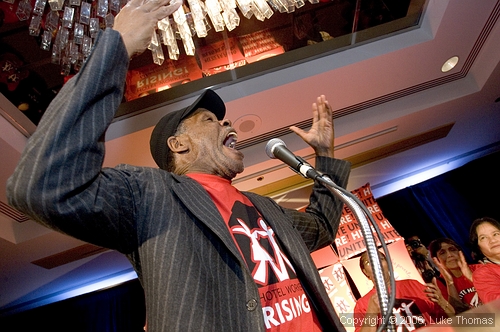
Danny Glover
The Gonzalez forces hate the idea. The Newsom people must have run a poll because they are approaching apoplexy. Let me say a few words about this subject.
Idea came from 'Wish you were dead'
Political junkies in town are divided upon the idea of Glover running for Mayor. Half of them are Downtwon hacks terrified of the prospect. The other half are trying to take credit for the idea.
We'll deal with the first half of the mob later. As regards the origination of the idea (listen up, Danny) … it came from an anonymous poster who titles himself: 'Wish you were dead'. He began pushing your name for public office last year when Sarah Lipson announced she wouldn't run for re-election to the School Board. Clearly, that wouldn't have been a position from which you can have maximum impact. 'Wish' prefers to remain anonymous.
Mirkarimi to call Press hearing?
The Josh Wolf Vigil began an hour or so ago in front of the Federal Building at Larkin and Golden Gate. I brought the subject up with D-5's Supervisor, Ross Mirkarimi at his monthly art opening in his office last Friday. I noted that with the entire argument of Josh's imprisonment revolving around the definition of 'journalist' in today's America, that it might be a good idea to have another hearing on the topic.
Ross agreed but noted that the last hearing was before the Rules Committee and that Rules Chair, Tom Ammiano would have to call up the item. So, Tom, how about it?
I intend to bring up the topic of the federal shield law at the hearing, should it occur. My concern is that, as presently defined, the law does not cover unpaid online journalists who could still be locked up by the likes of Judge William Alsup. Federal law should not enshrine the idea that the likes of Ken Garcia and Pat Murphy - paid by Downtown interests and are totally biased - are legitimate journalists who can keep their sources private, … but that writers such as myself who are unpaid (and, admittedly, nevertheless of a totally biased point of view) … should have to give up Eileen Left's real name.
At any rate, I call upon the good Supervisor Mirkarimi to make note of the Wolf family's continuing vigil for Josh's release when he makes his 'Roll Call for Introductions' presentation before the Full Board at Tuesday's meeting.
Odds and ends and odd ends
Salon on Friday was alive with ideas growing like fungi in the warm sun. An 'associate' ("I used to work for Kamala, but I don't now.") of D.A., Kamala Harris, showed up for the 2nd time in 3 weeks and sat next to our roiling group to listen. She'd been pointed out to me a couple of weeks ago but I didn't say anything to her. I mean, shit, you don't have to spy on us. Just show up and sit at the table with us. I'll out her by name if she shows up again.
Gonzo roomie, Jimmy Dorenkott showed up at the Mirkarimi event, soused, angry, threatening and unkempt. Christ, it was like looking in the mirror.
So, Dorenkott threatened Marc Salomon (which he's done before) and trembled with rage until calmed by the 'Persian Colossus' himself. Email contacts with Gonzalez requesting he rein in this present-day, Luca Brazzi heard Matt reply that: "Jim is his own man.". Sure, and Jennifer Siebel didn't get her ideas about Ruby Tourk from Gavin. Poor form. Kind of fun, though. Look for a repeat side-show at noon today when all sides of the conflict (has to do with feminism and equal billing for women) will gather in front of the aforementioned Federal Building to either implore the new House Speaker to push for the withdrawal of U.S. troops from Iraq, … or, perhaps, the Greens will just roll on the ground and fight with each other.
h. brown is a 62 year-old keeper of sfbulldog.com, an eclectic site featuring a half dozen City Hall denizens. h is a former sailor, firefighter, teacher, nightclub owner,and a hard-living satirical muckraker. Email h at h@ludd.net.
Monday, March 19, 2007
Where is our Orwell, where is our Dickens?
No wonder the government remains virtually unbloodied when the voices of intellectual and radical opposition have fallen shamefully silent
Henry Porter
Sunday March 18, 2007
The Observer
Henry Porter writes commentary for the Observer. He was born in 1953 and has published four novels with Orion, Remembrance Day, A Spy's Life, Empire State and Brandenburg. The last won the Ian Fleming Crime Writers’ Association Steel Dagger as the best thriller of 2005. It is set in the eight weeks before the fall of the Berlin wall in 1989, and was published in paperback in February 2006. He has also written one non-fiction title, Lies Damned Lies, a study of truthfulness in British journalism. He has written for the Sunday Times, Guardian, Daily and Sunday Telegraphs and the London Evening Standard. He is the London editor of Vanity Fair magazine and is also a keen painter, walker and amateur bird watcher. His two favourite spots in the world are the French Pyrenees and the Highlands and islands of Scotland. But he makes do with London.
Henry Porter
Sunday March 18, 2007
The Observer
Who's doing the thinking these days? Well, there's Matthew Taylor, former chief policy adviser at Number 10 and now head of the Royal Society for the Encouragement of Arts, Manufactures and Commerce, who has much to say on citizenship. Unfortunately, it extrudes from his laptop, falling with the lightness of touch, clarity and elegance of mind found in a manual for a domestic boiler.
'One of the tasks of the RSA's pro-social project will be to explore a model of how individual behaviour is shaped and - as a consequence - social outcomes are achieved. Such a model needs to be nuanced and dynamic.'
There are hundreds of sentences like this in Taylor's work. The stuff on citizenship just pours from him and also from the Department for Constitutional Affairs. It is dangerous, befuddled and dreary and can be read as a penance during Lent.
Today, it passes for new thinking, the leading edge of commentary that is propelled by unquestioned civic rectitude, yet when you've plunged through the thickets of prose, you realise it is simply a description of our obligations to the ultra-inquisitive and demanding state of the future.
So, think-tanks are doing the thinking, and people like Matthew Taylor seek to advance themselves with this hectic and verbose attempt to remake us into 'pro-social citizens'. It is not independent thinking, however, because it is all part of the Westminster set-up and is calculated to alter or inspire policy, which means it must attract one lot of politicians or the other.
There's nothing wrong with these chaps showing a bit of leg, but it is hardly the sort of clear-headed commentary which, in the words of film-maker Adam Curtis, 'grapples with the new complexities of power and makes sense of them'. Something more is needed - sharper eyes and braver minds. If you had asked me a couple of years ago who provided this service, I would have named our public intellectuals - Richard Dawkins, Germaine Greer, Melvyn Bragg, AC Grayling, Robert Winston, Karl Miller, Timothy Garton Ash, Susan Greenfield - and added a list of writers - Pinter, Rushdie, Amis, McEwan, AS Byatt etc.
There was never any shortage of serious criticism to be had. It was a part of British life that you didn't have to worry about; each generation threw up a Muggeridge or new varieties of Amis and Toynbee.
But last year, I began to notice that it wasn't writers or public intellectuals who had the most interesting things to say but lawyers, who are routinely accused of being grasping and out of touch. Lord Steyn, Lord Lloyd, Lord Bingham and Baroness Kennedy all made speeches that were more thoughtful and trenchant about what Labour had done to the law and the ordinary person's rights than any other available analysis. These are hardly radical figures, but they're the only intellectual opposition this government has outside Parliament and the entertainment-obsessed media. Public intellectuals just aren't cutting it any more and writers who could have been so important in this role have taken themselves on an extended book tour.
This may seem harsh, but where are the novelists with their indictments of government and society? Where are exposés of some unregarded part of the termite heap? Where are the dramatists who can barely speak for their anger? Harold Pinter opposed the war vociferously and David Hare wrote a terrific play about it called Stuff Happens, but there has been very little thinking outside that which isn't either controlled by or seeks the approval of the political parties.
I don't think that there has been any conscious landgrab by the politicians: it's just that artists have absented themselves from the floor since Labour came into power. We are much the worse off for it because we desperately need the moral force of an independent-minded writer training his or her guns on a target that journalists may not have seen and politicians may not want us to see.
Think of the contributions made by Charles Dickens and George Orwell in Britain, Vaclav Havel in Czechoslovakia, Aleksandr Solzhenitsyn in the USSR, Nadine Gordimer in South Africa or Orhan Pamuk in Turkey.
Our creative writers won't be inspired by the same things because we live in utterly different circumstances. This is not to say that writers should go on forced missions of social realism, give up their stylistic experiments or stop writing about themselves. We don't need organised relevance, but we do need the engagement you see in the TV drama of Paul Abbott or in the argument fielded by Adam Curtis's current three-part BBC series, The Trap. We need a better class of what American philosopher Ronald Dworkin has called the civic discourse. Writers are essential to that process.
Last week, a literary impresario made the point to me that I could no more expect writers to influence politics than journalists to contribute to current styles of ballet. That is true if you think writers only have a duty to themselves. But writers are sometimes better off if saved from personal deliberations. Nowadays, there seem to be an awful lot of middle-aged blokes dragging their tortured souls around the literary circuit, fretting about their display in Waterstone's.
It hasn't always been like this. During the Thatcher years, writers and various public intellectuals such as Melvyn Bragg, Germaine Greer and Mary Warnock were much more keen to attack an administration that derided education, culture and the very idea of society. In 1987, the June 20 Group was formed at the Campden Hill Square home of Lady Antonia Fraser and Harold Pinter. The group included David Hare, Ian McEwan, Michael Holroyd, John Mortimer, Harold Pinter, Salman Rushdie, Germaine Greer and Anthony Howard.
When they were ridiculed in the Conservative press, Pinter issued a statement: 'We have a precise agenda and we're going to meet again and again until they break all the windows and drag us out.' David Hare later recalled: 'There was something preposterously enjoyable about the notion of Mr Mortimer's portly frame, or Lady Antonia's gracious person, being squeezed through the windows of Campden Hill Square. Pinter, master of the absurd, is splendidly unaware of it in himself - one of the things his friends love him for.'
In the end, it became clear that writers do not make good political groups because they are by nature solitary and used to having things their own way. Still, the agitation of the Eighties, however ridiculous, is much preferable to the desiccated solipsism of today.
What has happened is partly due to the politicisation of thinking in the last 10 years, but there must also be something in the fact that about 90 per cent of writers and public intellectuals voted Labour in 1997. With Tony Blair's victory, they eased back. The new Prime Minister seemed to be so completely the product of their own values and at one with their view of society that there was no longer any need to concentrate.
It is a terrible shame, because there is so much material out there, so much that requires the urgent attention of a writer's sensibility: for instance, the widening gap between poor and rich, the seething anger of the underclass, the steady attack on the rights of those who cannot protect themselves, the war in Iraq, the regular deaths of British soldiers in Helmand province, Afghanistan, Guantanamo, rendition. George Orwell would have found much to write and think about. Why not the writers of our own time?
Henry Porter writes commentary for the Observer. He was born in 1953 and has published four novels with Orion, Remembrance Day, A Spy's Life, Empire State and Brandenburg. The last won the Ian Fleming Crime Writers’ Association Steel Dagger as the best thriller of 2005. It is set in the eight weeks before the fall of the Berlin wall in 1989, and was published in paperback in February 2006. He has also written one non-fiction title, Lies Damned Lies, a study of truthfulness in British journalism. He has written for the Sunday Times, Guardian, Daily and Sunday Telegraphs and the London Evening Standard. He is the London editor of Vanity Fair magazine and is also a keen painter, walker and amateur bird watcher. His two favourite spots in the world are the French Pyrenees and the Highlands and islands of Scotland. But he makes do with London.
Sunday, March 18, 2007
4 Years After Start of War, Anger Reigns
Related
Ridiculous coverage: Goodbye WaPo
The article, entitled "4 Years After Start of War, Anger Reigns", makes some ridiculous assertions, passes more rumor and opinion as fact, and was the last straw in my ever-shortening patience for the shitrag that used to pass for the nation's preeminent political paper.
---
Is WaPo good enough to be a shitrag?
I think not
---
Photo #8 - shown above
---
Demonstrators Brave Cold to Carry Message to Pentagon, as Counter-Protesters Battle Back
By Steve Vogel and Michael Alison Chandler
Ridiculous coverage: Goodbye WaPo
The article, entitled "4 Years After Start of War, Anger Reigns", makes some ridiculous assertions, passes more rumor and opinion as fact, and was the last straw in my ever-shortening patience for the shitrag that used to pass for the nation's preeminent political paper.
---
Is WaPo good enough to be a shitrag?
I think not
---
Photo #8 - shown above
---
Demonstrators Brave Cold to Carry Message to Pentagon, as Counter-Protesters Battle Back
By Steve Vogel and Michael Alison Chandler
Washington Post Staff Writers
Sunday, March 18, 2007; A01
Thousands of demonstrators protesting the fourth anniversary of the war in Iraq marched on the Pentagon yesterday, jeered along the way by large numbers of angry counter-protesters.
Organizers billed the antiwar rally as marking the 40th anniversary of the 1967 march on the Pentagon. At times, verbal clashes during the cold and blustery day demonstrated that the bitter divisions of four decades ago sparked by Vietnam are very much alive in the debate over Iraq.
The march, part of a weekend of protests that included smaller demonstrations in other U.S. cities and abroad, comes as the Bush administration sends more troops to Iraq in an attempt to regain control of Baghdad and Congress considers measures to bring U.S. troops home.
Paul Miller, 72, a Korean War-era Marine Corps veteran who flew from California for the march with his brother, was making his first appearance at an antiwar rally. "I was like everybody else. I trusted the people who ran the country, and I'm tired of being lied to," Miller said, standing on a hill overlooking the Pentagon, a beret with a Marine Corps pin on his head. "I feel so bad for the young Marines who are getting their legs blown off and losing their lives."
Organizers said yesterday's march on the Pentagon reflected the public's sense of betrayal over the escalation of the war. As some speakers called for the impeachment of President Bush and Vice President Cheney, others denounced Congress in equally bitter terms for not cutting off funding for the war. Yet attendance at yesterday's march was noticeably smaller than one held in Washington in January, police said.
Much of the passion yesterday was supplied by thousands of counter-demonstrators, many of them veterans who mobilized from across the country to gather around the Vietnam Veterans Memorial. Some said they came in response to appeals on the Internet to protect the Wall against what they feared would be acts of vandalism; no such acts were reported.
Others said they were tired of war protesters claiming to speak for the country. "I'm here because I think we need to commit to our troops in the field," said Guy Rocca, 63, a veteran who drove nine hours from Detroit.
Some counter-protesters yelled obscenities and mocked the marchers as traitors. War protesters responded with angry words of their own, and police intervened at times to prevent shouting matches from escalating.
The counter-demonstrators ringed the Lincoln Memorial and continued along portions of Arlington Memorial Bridge. "You've got no pride and no honor," yelled Kenneth Murphy, a Vietnam veteran from North Carolina.
When marchers reached the Virginia side of the bridge, they were greeted by more protesters at the traffic circle in front of Arlington National Cemetery, along with a banner that read in part: "You dishonor our dead on Hallowed ground." The war protesters might have found the warmest reception of the day at the Pentagon, where police had the building blocked off, but no counter-demonstrators were waiting.
"It's strange to say, but welcome to the Pentagon," said protest leader Mara Veheyden-Hilliard, speaking on a stage in the north parking lot as the first streams of marchers began arriving.
A group of protesters who tried to reach the Pentagon by charging toward the south parking lot ended up in a tense standoff with police. Five arrests were made in the incident. But beyond shoving matches, no violence was reported.
After a night of rain, sleet and snow, the day began with bright sunshine but low temperatures. Marchers assembled at first in relatively sparse numbers on a muddy playing field at 23rd Street and Constitution Avenue NW.
Organizers, who had predicted tens of thousands of marchers would demonstrate, gave estimates ranging from 15,000 to 30,000. Police no longer provide official estimates of crowd size but informally put it at 10,000 to 20,000, with a smaller but sizable contingent of counter-protesters.
War protest leaders said a large winter storm that hit the Northeast hurt turnout. More than 60 bus loads of protesters who had been scheduled to come from the region canceled their trips Friday night, according to Brian Becker, national coordinator for the Answer Coalition, the event's main sponsor.
It was quickly apparent that the weather had not prevented counter-demonstrators, many in black leather motorcycle jackets, from showing up in force and surrounding all sides of the Wall.
At one point before the march started, counter-demonstrators formed a gantlet along an asphalt walkway on Constitution Avenue and heaped verbal abuse at protesters who walked through on their way to the assembly area. One Vietnam veteran in a wheelchair yelled obscenities at demonstrators, including some with children.
Some demonstrators supporting the war effort engaged in good-natured banter with war protesters. But others blocked paths and prevented marchers from getting near the Wall, particularly anyone carrying a sign. District resident Eric Anderson, 47, had his sign ripped from his hands and thrown in the mud.
Bob Anders, 60, an Iowa banker who said he served with the 25th Infantry Division in Vietnam and rode a bus from Iowa to protest the war, had his heart set on seeing the memorial but turned around after seeing the situation. "I've never seen the memorial, and I wanted to see it in a spirit of protest," he said.
After speeches from antiwar activists including Cindy Sheehan, the first marchers took off across the bridge shortly before 1 p.m. The marchers began arriving at the Pentagon about 1:45, some gathering in front of the stage in the north parking lot and others perched on a hill by a Route 27 overpass.
About 2:10, a group of several hundred young people continued past the rally point and marched down Route 27 toward the south parking lot until they confronted a police barricade. Some youths who carried traffic barrels cut in half and painted red and black as shields and wore scarves over their faces pressed forward as Pentagon police, backed by Virginia state troopers in riot gear, stood two layers deep, trying to push them back. When that failed, the police donned gas masks. One of the protesters threw a firecracker, and many people ran off.
About 70 to 80 people sat down and were threatened with arrest. Protesters chanted, "The whole world is watching." Then protesters took a vote and opted to back off.
Yet, many demonstrators showed respect toward police and the military.
Among those marching on a day of cold, whipping wind was Maureen Dooley of Melfa, Va., who first marched on the Pentagon when she was 18; now she is 58. "I came, as I did today, to be quietly counted among the people opposed to this war," she said.
Dooley said she wished she could "apologize for my generation" for the way the antiwar movement treated Vietnam veterans on their return home. "This time, we're with our young men and women," she said.
The Pentagon's windswept north parking lot was cold, and many protesters did not linger long. By 3:30 p.m., only a few hundred marchers remained huddled around the stage. Most had left, with many of the out-of-towners seeking refuge on the floor of the nearby Arlington Cemetery Metro station.
One group that had come by overnight bus from Iowa City huddled on the floor near the station elevators. They had survived the 22-hour bus ride as well as the insults of the counter-protesters, only to be defeated by the bitter cold.
"We just couldn't take it anymore," said Christine Gaunt, 50, a hog farmer from Grinnell, Iowa. Now, with a voice fatigued from chanting litanies against the president and feet tired from marching on the military industrial complex, Gaunt just counted the hours to the group's scheduled bus pickup at 7 p.m.
If she was lucky, she said in a tired voice, she would get home this afternoon, just in time to haul her pigs to the Sunday market.
Staff writers Nelson Hernandez, William Wan and Theola Labb? and the Associated Press contributed this report.
Saturday, March 17, 2007
Lunch with the FT: Tony Judt - Israel critic
By Graham Bowley
Published: March 16 2007 16:30 | Last updated: March 16 2007 16:30
Wistfully, Tony Judt admits he misses Europe. That seems to be one reason why he chose Cafe de Bruxelles in New York's Greenwich Village for our lunch. It is on a street of British shops where nostalgic expats can munch on fish and chips, or sip cups of tea. The cafe itself is a long, low, slightly grubby sun-washed place, where a sign outside lists mussels specialities. Inside, pictures on the walls evoke the Palace of Justice and various other Brussels sights.
At just after midday, Judt, who is 59, walks through the door and shuts the police sirens of Greenwich Avenue behind him. As professor of European studies at New York University, he is one of the most prominent liberal academics in the US. Yet he appears an unassuming, bookish man, wrapped up against the Manhattan cold in a lumpy, unstylish coat and cap. He has a beard of greying stubble, a broad balding head, an intelligent pale face, a precise handshake and smile - an intellectual. Not at all, I think, the incendiary figure who has recently drawn the ire of some Jewish groups in New York City by arguing that an “Israel lobby” influences US policy towards the Middle East and shuts down proper debate about it.
Judt wanted an early lunch because he has to meet some of his students in the afternoon, just around the corner on Washington Square - where he works and also lives with his second wife and two sons, aged 12 and nine. At this hour, we have Cafe de Bruxelles to ourselves. The polite waiter points to a table set in the middle of the room and warns us that a party of 10 will arrive soon. With a nod, Judt picks his way to a small table tucked away in the furthest, quietest corner.
“In the worst moments I have had death threats, and much worse, threats against my family,” says Judt, after he sits down opposite me and begins to describe the reactions to his writing and his talks. “These people would call up my office and they would say, 'Tell Tony Judt he had better not let his kids out on the street,' or 'Tell Tony Judt this is Hitler calling and he says, Congratulations.'” He winces and shakes his head. “I didn't think I knew until then just how deep and how uniquely American this obsession with blocking any criticism of Israel is. It is uniquely American.” Not European, not Israeli.
He adds: “People accuse me of wanting to see the abolition of Israel, which is nonsense. Israel exists. The question is what kind of state is it going to be in future years, what kind of laws is it going to have for first- and second-class citizens?”
Judt, who is Jewish, grew up in a stoutly middle-class family in London. In an impressive academic career, he went to King's College, Cambridge, Paris's Ecole Normale Superieure, Berkeley and Oxford. He moved to New York in 1987 to teach European history and French studies, when, he says ruefully, “the study of France was still a fashionable and desirable activity and not something you had to hide your head in shame about.”
His last book, Postwar, is a fluid history of Europe since 1945. It tells of the continent's rise from the ashes and the emergence of the European Union, which he is rather bullish about. The book was nominated for a Pulitzer prize, and was one of The New York Times top 10 books of 2005. Part of his job in New York, he says, is to explain Europe to Americans - people accuse him of forever trying to “sell” Europe to Americans, he says - as well as to explain America to Europeans. It is a tough job, Judt says, when, in their worldviews, the two are growing further apart.
Judt seems to be concerned with divisions. As well as the “vertical” separation between Europe and the US, he says, there are widening “horizontal” chasms within countries - between wealthy jet-travelling elites and the rest of the population.
“We probably face a world that is divided much more horizontally than vertically. We have a class of world travellers - as the medievals might have called them, 'clerks' - who speak Latin, or English, and feel at home in Tokyo, New York or Singapore. Underneath are the 'villains', the serfs, who don't speak English, who don't travel - beyond the occasional cheap vacation flight abroad - and who are still very much in a national, local cultural world. They are as much separated from their own airport people as from serfs of other countries.”
It is the gaps between cultures that concern Judt most, and especially the division between America and Europe.
One aspect of that rift is their attitude to Israel. On October 3, Judt was due to give a talk to an independent think- tank, called Network 20/20 about the “Israel lobby” in the US. The event was being held at the Polish Consulate in New York. Hours before he was scheduled to stand up, the consulate cancelled the talk, under pressure, Judt alleged, from influential Jewish groups in New York such as the Anti-Defamation League and the American Jewish Committee.
The cancellation brought outraged support from a roster of Judt's fellow academics and intellectuals. They said there had been an attempt to intimidate and shut down free debate - seeming to prove the point that Judt had wanted to make. A 114-signature letter was written to Abraham Foxman, the prominent national director of the Anti-Defamation League, and published in The New York Review of Books. But it is still not clear who telephoned whom, when, and to apply what sort of pressure during the incident, which The New York Observer called “l'affaire Judt”.
The ADL and AJC said they did not force the consulate to call off the talk. Still, they openly welcomed the outcome. For his critics, Judt is part of a worrying and dangerous trend, one of a number of liberal intellectuals, many of them Jewish, whose outspoken criticism of Israel, and whose support for Palestinians, they argue, provides ammunition for far more dangerous opponents. This, they believe, comes at a time when Israel's existence is probably as precarious as it ever has been.
Sitting at our table, Judt throws up his hands and says the debate at times must seem like “a weird inter-Jewish dispute about Israel”. But it has had personal consequences. He has lost two close friends, including Leon Wieseltier, literary editor of The New Republic, a magazine for which Judt used to write.
“Apparently, the line you take on Israel trumps everything else in life,” Judt says, quite sadly.
It has made his domestic life more difficult, too, because his wife, Jenny, a former ballerina, is The New Republic's dance critic. “The editor calls up and says, 'Jenny, we would like a piece and give my regards to Tony,' and she feels kind of squidged.”
In Cafe de Bruxelles, the party of 10 arrives. Around us the room fills with laughter and loud voices. Judt comes to the restaurant quite regularly. But this lunchtime one of his favourite dishes, carbonade de boeuf, is not on the menu. He looks disappointed. The waiter says he will consult the kitchen anyway. We order two Belgian blonde beers. Sipping them, we wait in suspense until the carbonade, heavy in gravy and cabbage, is laid on the tablecloth.
“I shall enjoy this as you can't imagine,” Judt says with a laugh. His critics “think I am some sort of weird far-out, provocative figure”, he says. “But this is down the line, mainstream, winter Belgian food.”
I wait for my chicken crepe. As we pick at a shared cup of frites in the middle of the table, Judt tells me more about his past.
His mother was a hairdresser. His father came from Antwerp. Members of his father's family had been killed in the Holocaust. His father, he says, “was talented at many things but making money was not one of them. Eventually he discovered a talent for bookselling - just at the point that Barnes & Noble and the like were sweeping away smaller booksellers.”
As a teenager, Judt became involved in leftwing Zionism. In 1967, he travelled to Israel as a volunteer during the Six Day War. He worked as a translator of French and Hebrew, and drove captured Syrian trucks. “Up on the Golan Heights, I met and heard officers talking, and for the first time I was seeing a side of Israel I had managed to turn a blind eye to,” he tells me. “Until then, the dominant rhetoric in Israel had still been that you didn't disparage the Arabs, you believed in socialism and equality. Now it was straightforward anti-Arab sentiment. What began in 1967, and accelerated in a great tumble through the mid-1970s, was the rise of a different Israel: hard-line, rightwing, very often religious, believing they had a real-estate pact with God. It was very ugly, at least I found it very ugly.”
In those years, he says, America didn't care so much for Israel. France was the great friend of Israel, he says, providing jets for the Israeli air force. But that changed, he says, due in part to the rise of identity politics in the US. This, he argues, eventually had an effect on American foreign policy.
“America at that time had a very low collective public consciousness of the Holocaust,” he says, eating the carbonade carefully. “People were not reading Primo Levi. They were not even reading Anne Frank. It became possible, fashionable and in the end almost necessary to identify yourself - Irish-American, Italian- American, Native American, Asian-American. Part of it was because of the rise of the culture of the victim but also because it was a way of being part of the new multicultural space.”
You couldn't just be Jewish-American, however, he says. To create an identity, he says, Jewish people instead tied themselves to the Holocaust and to Israel. “So it became very much a threat to American-Jewish identity to unravel one of these.”
The party of 10 has gone. The restaurant is quiet again. There is only a single diner next to us, reading The New York Times.
Judt says he doesn't lie awake at night worrying about his critics. But, still, he seems to me to carry a sense of anger and despondency about him. He admits that although he likes many Americans, he does not altogether like America. “Tom Friedman is talking through his hat. The world is not flat at all. The world is shaped still in many ways as it was in my generation by culture, by the place you grew up, by the assumptions you make about the place of religion in public life, about the relative importance of the state and the individual.”
Judt says he really has to make his student meetings. His next work projects, he tells me, include a book about 20th-century thought, and a theme likely to keep him clearer of controversy - a history of railways. When he was growing up in London, he loved riding the train into the countryside.
We drink our espressos and march out east across the traffic- clogged avenues towards Washington Square.
As the breach with Europe widens - “Now we are passing through a period of America's simultaneous withdrawal and resentment at the world,” he says - he knows for sure which side he wants to be on.
“I am tempted at least twice a day to go back to Europe,” he says.
Friday, March 16, 2007
Israeli PM's office threatens legal Arab dissent
PMO to Balad: We will thwart anti-Israel activity even if legal
By Yoav Stern, Haaretz Correspondent
The Prime Minister's Office has sent a letter to the editor of the publication of the predominantly Arab party Balad saying it would combat the activity of any group or individual seeking to harm Israel's "Jewish or democratic character," even if that activity was legal.
"The Shin Bet security service will thwart the activity of any group or individual seeking to harm the Jewish and democratic character of the State of Israel, even if such activity is sanctioned by the law," read the letter, sent by the Prime Minister's Office on behalf of the Shin Bet to editor Ala Hlehel.
The letter, published Friday, also said that the Shin Bet would fulfill this task with the "force of the principle of a democracy that defends itself."
Hlehel petitioned the PMO last week following media released information of a closed-door meeting between Prime Minister Ehud Olmert and head of the Shin Bet, Yuval Diskin, in which the latter reportedly described Israel's Arab population as a "strategic threat" to the prime minister.
The two reportedly discussed four documents drafted by groups representing Israel's Arab population which call for a change in Israel's character: "The Future Vision of the Palestinian Arabs in Israel," by the Higher Arab Monitoring Committee, the Musawa oganization's "Ten Point Document," the "Democratic Constitution," by the Adala Center, and the yet unpublised "Haifa Treaty."
When Hlehel accused the Prime Minister's Office of "attempting to shut mouths," the Shin Bet responded by saying that there was nothing wrong with the formulation of the documents "unless they reflect or encourage subversive activity," and that the Shin Bet's activity includes foiling such activity on the part of various groups "even if their activity utilizes democratic tools."
Hlehel told Haaretz on Friday that the Shin Bet's response violates the law that regulates its activity, constitutes a blatant breach of its authority, and proves that the "era of military rule imposed upon Arab citizens never ended."
"The Shin Bet is supposed to defense the security of the country, not prevent democratic discussions over the nature of the state... this is very grave and affects all citizens of the state, not just the Arabs," he added.
By Yoav Stern, Haaretz Correspondent
The Prime Minister's Office has sent a letter to the editor of the publication of the predominantly Arab party Balad saying it would combat the activity of any group or individual seeking to harm Israel's "Jewish or democratic character," even if that activity was legal.
"The Shin Bet security service will thwart the activity of any group or individual seeking to harm the Jewish and democratic character of the State of Israel, even if such activity is sanctioned by the law," read the letter, sent by the Prime Minister's Office on behalf of the Shin Bet to editor Ala Hlehel.
The letter, published Friday, also said that the Shin Bet would fulfill this task with the "force of the principle of a democracy that defends itself."
Hlehel petitioned the PMO last week following media released information of a closed-door meeting between Prime Minister Ehud Olmert and head of the Shin Bet, Yuval Diskin, in which the latter reportedly described Israel's Arab population as a "strategic threat" to the prime minister.
The two reportedly discussed four documents drafted by groups representing Israel's Arab population which call for a change in Israel's character: "The Future Vision of the Palestinian Arabs in Israel," by the Higher Arab Monitoring Committee, the Musawa oganization's "Ten Point Document," the "Democratic Constitution," by the Adala Center, and the yet unpublised "Haifa Treaty."
When Hlehel accused the Prime Minister's Office of "attempting to shut mouths," the Shin Bet responded by saying that there was nothing wrong with the formulation of the documents "unless they reflect or encourage subversive activity," and that the Shin Bet's activity includes foiling such activity on the part of various groups "even if their activity utilizes democratic tools."
Hlehel told Haaretz on Friday that the Shin Bet's response violates the law that regulates its activity, constitutes a blatant breach of its authority, and proves that the "era of military rule imposed upon Arab citizens never ended."
"The Shin Bet is supposed to defense the security of the country, not prevent democratic discussions over the nature of the state... this is very grave and affects all citizens of the state, not just the Arabs," he added.
Saturday, March 3, 2007
Jewish Opposition to Israeli Human Rights Crimes is Growing
February 24 / 25, 2007
Criticizing Israel is Not an Act of Bigotry
By JASON KUNIN
A grassroots revolt is underway in Jewish communities throughout the world, a revolt that has panicked the elite organizations that have long functioned as official mouthpieces for the community. The latest sign of this panic is the recent publication by the American Jewish Committee of an essay by Alvin H. Rosenfeld, entitled Progressive Jewish Thought and the New Anti-Semitism, which accuses progressive Jews of abetting a resurgent wave of anti-Semitism by publicly criticizing Israel.
This is the latest attempt to conflate anti-Semitism with anti-Zionism in order to silence or marginalize criticism of Israel. This approach is widely used in Canada. Upon becoming CEO of the Canadian Jewish Congress, Bernie Farber declared that one of his goals was to "educate Canadians about the links between anti-Semitism and anti-Zionism."
It is misleading for groups like the Canadian Jewish Congress to pretend that the Jewish community is united in support of Israel. A growing number of Jews around the world are joining the chorus of concern about the deteriorating condition of the Palestinians in the Occupied Territories as well as the inferior social and economic status of Israel's own Palestinian population.
In a world where uncritical support for Israel is becoming less and less tenable due to the expanding human rights disaster in the West Bank and Gaza, leaders of Jewish communities outside Israel have circled their wagons, heightened their pro-Israel rhetoric, and demonized Israel's critics. These leaders imply that increased concerns about Israel do not result from that state's actions, but from an increase in anti-Semitism.
Despite this effort to absolve Israel of responsibility for its treatment of Palestinians, Jewish opposition is growing and becoming more organized. On Feb. 5, a group in Britain calling itself Jewish Independent Voices published an open letter in The Guardian newspaper in which they distanced themselves from "Those who claim to speak on behalf of Jews in Britain and other countries (and who) consistently put support for the policies of an occupying power above the human rights of the occupied people." Among the signatories of the letter were Nobel-prize winning playwright Harold Pinter, filmmaker Mike Leigh, writer John Berger, and many others.
This development follows the emergence of similar groups in Sweden (Jews for Israeli-Palestinian Peace), France (Union Juive Francaise pour la paix, Rencontre Progressiste Juive), Italy (Ebrei contro l'occupazione), Germany (Jüdische Stimme für gerechten Frieden in Nahost), Belgium (Union des Progressistes Juifs de Belgique), the United States (Jewish Voice for Peace, Brit Tzedek, Tikkun, the Bronfman-Soros initiative), South Africa, and others, including the umbrella organization European Jews for a Just Peace and the numerous groups within Israel itself. In Canada, the Alliance of Concerned Jewish Canadians (ACJC) has been founded as an umbrella organization bringing together Jewish individuals and groups from across the country who oppose Israel's continued domination of the West Bank and Gaza.
Criticism of Israel is not anti-Semitic, nor does it "bleed into anti-Semitism," a formulation that says essentially the same thing. Some genuine anti-Semites do use Israel as a cover for maligning the Jewish people as a whole, but it is fallacious to argue that anyone who criticizes Israel is anti-Semitic because anti-Semites attack Israel. There are some anti-Semites who support Israel because they are Christian fundamentalists who see the return of Jews to Jerusalem as a precondition for the return of Christ and the conversion of Jews to Christianity, or because they are xenophobes who want to get rid of Jews in their midst. Anti-Semites take positions in support of and in opposition to Israel.
It is wrong to criticize all Jews for Israel's wrongdoings, yet Israel's leadership and its supporters in the Diaspora consistently encourage this view by insisting that Israel acts on behalf of the entire Jewish people.
This shifts blame for Israel's crimes onto the shoulders of all Jews. But Jewish critics of Israel demonstrate through their words and deeds that the Jewish community is not monolithic in its support of Israel.
Defenders of Israel often argue that Israel is forced to do what it does -- to destroy people's homes, to keep them under the boot of occupation, to seal them into walled ghettos, to brutalize them daily with military incursions and random checkpoints -- to protect its citizens from Palestinian violence. Palestinian violence, however, is rooted in the theft of their land, the diversion of their water, the violence of the occupation, and the indignity of having one's own very existence posed as a "demographic threat."
To justify Israel's continued occupation and theft of Palestinian land, the state and its defenders attempt to deny Palestinian suffering, arguing instead that Palestinian resentment is rooted not in Israeli violence, but rather in Islam, or the "Arab mentality," or a mystical anti-Semitism inherent in Arab or Muslim culture. Consequently, pro-Israel advocacy depends upon on the active dissemination of Islamophobia. Not surprisingly, engendering hatred in this manner inflames anti-Jewish sentiment among Arabs and Muslims. None of this is a recipe for making Jews safe.
Jewish people can help avert the catastrophic effects of Israeli behaviour, but only by taking a stand in opposition to it.
Jason Kunin of Toronto is a member of the administration council of the Alliance of Concerned Jewish Canadians.
This article, which originally appeared in the Winnipeg Free Press, was written with help from other council members, including Cy Gonick and Dr. Mark Etkin, both of Winnipeg, Andy Lehrer of Toronto, Sid Shniad of Vancouver and Abraham Weizfeld of Montreal.
Wednesday, February 28, 2007
Pro-Israeli lobby is silencing dissent
By George Bisharat
Published 12:00 am PST Sunday, February 25, 2007
Published 12:00 am PST Sunday, February 25, 2007
One day in 1981, my late father, Maurice Hanna Bisharat, returned from a long day at his Sacramento medical office with an extra bounce in his step, his eyes dancing with excitement. His friend, Michael Himovitz, the young owner of a local art gallery, had called, offering to hold a one-person show of my father's paintings -- mostly California landscapes. My father had taken up painting after immigrating to this country from Palestine in the late 1940s, and although an amateur, had won a national art award after two years. But the demands of medical practice, raising a large family and other avocations took their toll. It had been many years since my father's art had been publicly exhibited, and he was tickled.
My father was not a politician, but like any Palestinian living in the United States, he felt obligated to relate his people's experience to American friends. Educated and articulate, he spoke publicly in defense of Palestinian rights, and was a frequent commentator on Middle East events in the local media. Michael, a Jew, was perfectly aware of this side of my father's life. It did nothing to diminish his appreciation of my father's art, or to inhibit their friendship.
Some weeks later I saw my father sitting, stony faced. He turned to me and whispered: "I just got a call from Michael. My show has been canceled." Michael had been visited by a group from the Sacramento Jewish community, my father said. Their message: "If you show Bisharat's art, we will boycott your gallery and close you down." Michael may have been as crushed as my father, apologizing: "I just can't risk it -- it's my livelihood." The indirect message to my father, of course, was: "If you speak critically of Israel, you will suffer." Fortunately, art was not my father's livelihood, and he survived this incident. But a deep sense of outrage never left him.
So when former New York Mayor Edward Koch and Rafael Medoff asked incredulously in a recent commentary critical of President Jimmy Carter's recent book "Palestine: Peace not Apartheid" "Are Jews suppressing speech?" -- or when 14 Carter Center advisory board members resigned in protests of the president's positions -- the answer, for me, is not so straightforward.
The fact is that "Jews" are not suppressing speech. Michael Himovitz certainly didn't suppress my father's attempts to explain the Palestinian perspective to his fellow citizens. Many American Jews hold views not dissimilar to my father's -- supporting peace, reconciliation and equal rights for Palestinians and Jews.
Yet a minority of Jews, backed by some non-Jewish supporters, stridently protests any unflattering portrayal of Israel, often with unfounded accusations of anti-Semitism. Indeed, insinuations of anti-Jewish bias are now being unfairly raised against Carter. And some supporters of Israel, apparently, are willing to exploit economic clout to punish those who, like my father, buck the trend and defend Palestinian rights.
Nor is the example of my father isolated. Countless variations are recounted in former Illinois Republican congressman Paul Findley's book, "They Dare to Speak Out." More chilling, these efforts at intimidation are not always the spontaneous responses of individuals, as in my father's case, or likely in the resignations of the Carter Center advisory board members.
On the contrary, the pro-Israel lobby, joined by the Israeli government, sustains a systematic campaign to shape American public opinion. For example, the Committee on Accuracy in Middle East Reporting in America, known as CAMERA, harangues journalists over alleged "mistakes." In 2002, CAMERA attacked National Public Radio, claiming anti-Israel bias, including failure to report Israeli deaths. Two Boston area businessmen associated with CAMERA organized a boycott of local NPR affiliate WBUR. Meanwhile, a study of NPR's coverage by Fairness and Accuracy In Reporting, or FAIR, showed that NPR had disproportionately reported Israeli deaths.
HonestReporting is a media organization that mobilizes 140,000 subscribers worldwide. Its Web site once touted "major editorial changes at CNN which greatly shifted public perception of the Arab-Israel conflict." The impetus, according to the Jerusalem Post, was "up to 6,000 e-mails per day to CNN executives, effectively paralyzing their internal e-mail system."
The Israeli government also applied pressure to CNN, according to verbatim notes of a conference call in 2000 obtained by advocate/researcher Phyllis Bennis. In the call, Israeli government spokesman Nachman Shai, outlined Israel's media strategy with 30 to 60 U.S. Jewish leaders, focusing concern on CNN, and especially two Palestinian reporters. "We are putting real pressure on the heads of CNN to have them replaced with more objective pro-Israel reporters that are willing to tell our side of the story."
Monitoring media to ensure accuracy is a public service. Yet as besieged journalists have concluded, the goal of this campaign is not truth, but pro-Israeli advocacy and silencing dissent. WBUR's general manager Jane Christo described CAMERA's message as: "Report our point of view, or we'll shut you down." Dissenting American Jews are not spared. Jilian Redford, head of the Hillel Jewish student group at the University of Richmond was dismissed in 2004 after protesting the Israeli embassy's repeated e-mail propaganda directives. Redford saw Hillel's mission as facilitating Jewish religious life on campus, not doing "hasbara" (Hebrew for "explanation," or "propaganda" as Israel's critics call it) for the Israeli government.
To reiterate: This is not a "Jewish" campaign. "Hasbara," coordinated with, if not directed by right-wing Israeli governments, is unrepresentative of largely liberal American Jews. Many would no doubt be horrified by the actions of these self-appointed guardians of thought. Nor does the Israel lobby "control" the media, as publication of Carter's book and this article attest.
But the price of our still mostly one-sided exposure to Middle East affairs is high, and it is much greater than the hurt inflicted on my father and others like him. Americans are shielded from diverse perspectives about a pivotal conflict, and are thus hampered in critically evaluating U.S. policies. Our unconditional support for Israel is a principal cause of global anger against us.
Last summer our government ran diplomatic cover for Israel's invasion of Lebanon, prolonging the attack for weeks. Israel killed more than a thousand Lebanese, mostly civilians, heavily damaged the country's civilian infrastructure and displaced a quarter of the population. The consequence: National Intelligence Director John Negroponte, delivering the annual U.S. threat estimate recently, said the Lebanese group Hezbollah, which has not targeted Americans for decades, poses a significant threat. Meanwhile, UPI editor Arnaud de Borchgrave reports that former Israeli Prime Minister Benjamin Netanyahu and other prominent Israelis are urging a public relations blitz to instigate a U.S. strike on Iran.
It is one thing to match ideas with ideas, information with information, perspective with perspective. It is entirely different to threaten, bully, discredit and harass opponents of one's views -- whether they are writers, artists, Jewish dissidents, former presidents or anyone else.
And in this case, our resulting ignorance is not bliss. It is downright dangerous.
Friday, February 16, 2007
Journey of a ("Self-Hating") Jew
Tuesday, February 13, 2007
Among other events in recent history, the formation of the group Independent Jewish Voices in the UK has once again pushed the debate on Israel and Palestine into the spotlight. Along with this, the usual, tired and outrageously misplaced allegations of “self-hatred” are made by the more shrill voices among the “Israel can do no wrong” lobby. Here are some of my ruminations on this discussion.
David Rovics
There are few issues more divisive in US society, including on the left, than the issue of Israel and Palestine. Even the word “Palestine” is divisive! The state of Israel claims to represent Jews worldwide. This is a preposterous and plainly incorrect claim, but one often made and often assumed, to the detriment of much of humanity. People who vocally oppose Israeli policies are labelled anti-Semites. Jews who oppose Israeli policies – or who dare to question the right of this apartheid state to exist as such – are labelled “self-hating Jews.” Supporters of Israel are using historic anti-Semitism and the memory of the Nazi holocaust as a means to stifle dissent. Reason and compassion is not on their side, so they resort to name-calling. I have some personal experiences with this state of affairs, and I thought I’d recount some of them and share some thoughts on the subject.
I used to be lovers with a woman from Germany. She and I were visiting my grandmother at her retirement community in Florida. It seems about half the Jewish population of Brooklyn ends up in Florida by the time they’re 65, and grandma Diane was among them. One of the women grandma played Bridge with was a German Jewish holocaust survivor. When she met my partner, there was something she clearly felt compelled to tell her. “We were Germans,” she said. “We were Germans.” That was all, three words.
Any non-fascist historian can confirm this fact. By the early twentieth century most German Jews were what they call “assimilated.” They were about as German as any other German. For many, their Jewish identity was about as important to them as which Christian denomination their neighbors belonged to. They were integrated members of a European society, Europeans, Germans. They were communists, social democrats, conservatives. They were laborers and they were bosses. They were renters and landlords, rich, poor, and in between. Obviously, the rise of Hitler changed all that, and suddenly Jews recognized themselves as Jews again. The Nazis wanted to kill all of them, so Jewish identity suddenly became a matter of life and death. When people are thus threatened, oppressed, and ultimately slaughtered in their millions, this sort of thing tends to bring people together to attempt to defend themselves. Thus from this disparate group of people once again is born a “community.”
Enter 21st-century USA. There is no such thing as a “Jewish community.” There is no such thing as a “Christian community” either, or an “Irish community,” “Italian community,” etc. There is no oppression to speak of in the US or Europe directed at people based on their Jewish or Christian identity, any more than there is still oppression against people of Irish or Italian descent. Certainly there used to be all of these things, but it’s been a while. In the forty years I’ve been living in the US I have hardly ever heard a serious anti-Semitic remark. I’ve never been victimized in any way as a result of being Jewish, and I don’t think I have ever met anyone of my generation who has had a problem with anti-Semitism of any significance, either.
Jewishness of course is an unusual phenomenon that is often defined as a religious, ethnic, and/or quasi-national identity, depending on who’s doing the defining. Regardless of the definition, there is plenty of common history for Jews anywhere, but like Catholics, Poles or whoever else in the modern US, Jews do not have a common identity in terms of their politics, professions, geography, etc. Jews are not ghettoized anymore, whether by law or by a generalized discrimination. They are rich, poor and in between, and they live anywhere in the country where you might find other people. Sometimes in large numbers, sometimes in very small numbers. Sometimes they have contact with each other as Jews for one reason or another, usually they don’t.
Once I had a gig at a law school in Vermont. Three people came to hand out literature about my alleged anti-Semititic views to people coming to the show. These three people were in a group that called itself The Jewish Community, as I recall. But in the civilized discussion that followed my concert, it turned out that there were more than three people of Jewish lineage in the crowd who were not members of The Jewish Community and didn’t share their views on Israel. It didn’t seem to me that these Jews were any less Jewish than The Jewish Community -- they just weren’t in a group that called itself The Jewish Community.
This also, it seems to me, is the distinction between groups like AIPAC and the rest of the Jewish population. The rest of us don’t tend to organize as a “Jewish community,” but as whoever we are – environmentalists, anarchists, union members, real estate developers, whatever.
Of course, there is plenty of oppression in the US. Racism, for example, permeates society. Race, of course, is a social construct with no biological basis, but it is a social construct that is the basis for both historical and ongoing discrimination of massive proportions. But if a Jew, a Catholic, or even a Muslim is white, then he or she is white, and treated as such. This is how modern US society functions. There is a sort of caste system, and it changes in various ways over time. It used to be a liability to be most anything other than a White Anglo-Saxon Protestant. This is no longer the case. Over the course of the post-war period the “white” category has expanded to include light-skinned Jews and other historically-oppressed ethnic and religious groups such as Irish and Italian Catholics.
This is not to say that white people don’t suffer from discrimination. You can still be discriminated against according to your regional accent, how you dress, whether you can read or write, etc. As a youthful, long-haired hippie driving an old beat-up car, I was pulled over by the cops many times more than most other white people, probably for all of those offenses – being young, having long hair, and driving an old car. But I’m quite certain it was not for being Jewish.
History is another matter entirely. While the label of “self-hating” is generally misapplied and used to try to silence Jews critical of Israel, self-hatred certainly exists, and other conditions like it. I think of my nanny when I was very young, living in upper Manhattan. She was a deeply loving woman full of enthusiasm for life, and children, her own two sons and the many young children she took care of. I visited her now and then for decades after my family moved from New York City when I was a small child. She was full of stories. She talked about all the gangsters in the area and how they never pick on her because she’s known them all since they were babies. New York was her city. She had a strange accent, impossible to place. She said she was English. She met an Italian-American jazz musician there in England and moved back to New York with him after the war. She talked about being a teenager in London during the blitz, and how she used to use the air raids to her advantage, to spend more time with boys. “Sorry mom, I can’t come home now, there’s an air raid happening.”
She raised her kids to be Irish-American Catholics in New York City. Several years ago I was visiting New York and I gave her a call. Her eldest son answered the phone. His mother had died a few months before, he told me. He also told me that he had found out during the last year or so of her life that she was not from England -- she was a German Jew. She was one of the last Jewish children sent to England during the Kindertransports. For whatever reason, she had hidden her identity from everyone, her friends, her family. She told her son on her deathbed about how her society, Germany, had rejected her. Perhaps the rejection was too much to bear, and she had to try to forget about her past, her German and Jewish identity. Perhaps the term “self-hating” could in some measure apply to this wonderful, vibrant, but apparently troubled woman, although the term seems far too simplistic to fit such a complex person so full of love for humanity.
Perhaps it was experiences she had after arriving in the US that strengthened her resolve to keep her ethnic and national identity hidden. My grandmother’s mother was from Russia, and spoke Yiddish, never becoming very fluent in English. When my dad was young it was Yiddish that the matriarchs of the house spoke, their secret language which they never taught him. Grandma Diane’s parents were refugees, leaving Russia because they didn’t want to be killed in the pogroms and didn’t wanted to be drafted into the Tsar’s army, a death sentence in itself. Before the Nazi holocaust, Diane Rovics and her mother were in touch with dozens of relatives in Europe, Diane once told me. Her mother died soon after the war, and I don’t know how much Diane tried to get back in touch with her relatives across the ocean, but she said she never heard from any of them, and presumed them all to be dead.
Grandma Diane’s Jewish identity was always terribly complex for her. For a long time she was looking for housing outside of Brooklyn. This search went on for years before she eventually moved to New Jersey and then Florida. In every community she visited there were either too many Jews or not enough Jews. She wanted the safety of having lots of Jews around, but didn’t want anybody else to notice. When I was a child she often told me that I was lucky to have blond hair and blue eyes and not to “look Jewish.” She’d say the same about our last name, from Grandpa Alvin’s part of the family, Rovics, which she informed me was not a typical Jewish last name.
Once when she left the safety of New York City to visit Connecticut about a half century ago, land of the “gentiles” back then, there was a sign on the beach saying “no Jews or dogs allowed.” I’m sure she had many other similar experiences. Being Jewish was for her a source of strength and a source of anguish, but mostly anguish. She always just wanted to fit in, to be an American, and ultimately, she did, and she was. She was traumatized by her family history and by the Nazi holocaust, but she wanted to put it behind her. She would often tell her idealistic leftwing grandson, “you can’t change the world.” She’d tell me to just look out for myself, get a good job, go to business school, become a dentist, be a respectable part of society and hopefully you will be respected in turn, or at least left alone.
For other assimilated, white, light-haired, blue-eyed US citizens such as Diane’s daughter, my aunt Judy, who knows where life could have gone. But as with so many others, the Jewish genocide that was going on when she was born in 1941 made a lasting impact. The Zionist movement for a Jewish homeland, not very popular among Jews worldwide before the Nazi holocaust, became much more popular after it. Lots of Jews – though far from all – joined that bandwagon, and my aunt was one of them. We haven’t spoken in years, but from what I understand, for her and her synogogue in New Jersey, criticism of Israel is completely unacceptable, there is no room for debate.
For people like Judy, “never again” means “never again to us.” Fuck everybody else, especially Arabs. The fascists in Europe killed us, nobody stopped them, and now if we need to steal somebody else’s land in order to have a home, so be it. People like Judy invent all kinds of outrageous theories to justify the fundamentally racist movement that has led to the state of Israel. There are no Palestinians, they’re all Arabs, and the 800 million Arabs in the world all hate Jews and want to “drive the Jews into the sea.” The Palestinians are really Jordanians and should be just as happy there as in the land of their ancestors. The hundreds of Palestinian villages destroyed by the Zionists never really existed. The Palestinians were all nomads if they weren’t Jordanian. The refugee problem is one created by the Arab states -- not the Jews who drove the refugees off their land.
People like Judy live in a sea of lies, and are miserable. At least they’re miserable. Hating other people so vehemently – Arabs, your fellow Jewish critics, and whoever else – causes one to be miserable. I’m sure there must be some happy ones out there, but the “ardent Zionists” I meet tend to be about as miserable as other members of hate groups I’ve met. I remember seeing the Orange marchers in Glasgow one time. What a miserable bunch. They all looked so pathetic, those men and boys dressed in their antiquated outfits, singing songs about being “knee-deep in Fenian blood.” These people have decided that the solution to their perceived problems lies in the oppression of another people. Not only does this kind of mentality breed misery, but it also doesn’t work.
Disenfranchised people always struggle for their liberty. Sometimes their struggles will be crushed, as in the case of the German left in the 1930’s. Sometimes their struggles will meet with relative success, such as the European labor movements that have been largely responsible for creating many of the most prosperous societies on Earth. Other times the oppression of a people leads to an ongoing struggle for justice that goes on for decades, such as the Palestinian struggle for self-determination. There can never possibly be peace and security for Israel as long as there are millions of impoverished, angry refugees surrounding it, no matter how high the walls they build, no matter how many children they massacre, no matter how many youths they torture in their prisons. History has demonstrated this fact, over and over again. Where there is oppression there will be resistance. The resistance may or may not be successful, but it will always harm the oppressor to one degree or another. This is not mere rhetoric. It is history and current events, all over the world.
There are those for whom “never again” takes on a very different meaning than for people like my aunt. For them, these lessons of history are learned. Of course, such people have existed since long before the Nazi holocaust, but the holocaust also was responsible for creating lots more of them. People who believe oppression should be opposed in all it’s forms, and those struggling for their lives and liberty should be supported. For these people, the term “us” means something much bigger than Jews, Catholics, Americans, or some other such limited category. Bob Steck is one such example.
Bob Steck died last December at the age of 95. He was a friend of mine, who I used to see much more of back when he lived near my mother in Connecticut, before he and his wife moved to Arizona. Bob grew up near Davenport, Iowa. When he was a boy in the 1920’s, Davenport was a town full of socialist intellectuals. The countryside around the town was full of radical farmers. When the fascist generals rebelled against the democratically-elected government in Spain in 1936, Bob was one of many thousands of Americans who volunteered – against the wishes of the US government – to fight fascism in Europe. Bob had never been to Spain, and I’m not sure if he had ever even met a Spaniard before, out there in the middle of the farm belt. He was not fighting for people he knew, or for “his people” in some kind of limited sense – he was fighting for humanity, for the future, for justice, for dignity.
Along with Bob, thousands of young men and women joined the International Brigades from England, Ireland and elsewhere. The biggest contingents of people ready to die in the fight against fascism came from Germany and Italy. After more than a year fighting the war in Spain he was captured, and spent 16 months in a concentration camp where he was regularly beaten, where the conditions were atrocious. Some German Nazis visited the camp once and measured everybody’s faces, thinking they could tell the Jews apart from the others by the size of their noses. He was Jewish, though that never occurred to me until one morning at his house when he made a particularly tasteless Matzo Ball omelette for me. Most of the Americans to go to Spain were killed there, but Bob was one of the those who ultimately returned home.
More than anything, Bob was a communist, and a historical optimist. He would tell me that ever since society has been divided into classes, several thousand years ago for much of the planet, there has been a class struggle, and this struggle will continue until we eventually abolish poverty, racism, and these sorts of divisions in society. Just as he fought against fascism in Europe, he fought against racism in the US. He was the Director of Activities of Camp Unity, a daring inter-racial working-class resort in upstate New York. He saw himself as a part of a movement, not as an exceptional individual, though he was most certainly both. He taught history for 30 years in the public schools of New York City, playing his part in the evolution of society, with books and lectures, just as he had in Spain with rifles and supply trucks. Yes, he was Jewish, and like so many Jews and so many other people of his generation, he was a communist first and foremost.
Bob was a very stoic man, by his own admission. He was stoic before the Spanish Civil War, but being held in the concentration camp taught him stoicism to a much larger degree. Never let the guards know how badly you are suffering, or it will demoralize the other prisoners. This was his view. I don’t know how much he may have had to question his beliefs from time to time, but when I asked him what his thoughts were on Israel, his response was quick and unequivocal. There must be justice for the Palestinians.
Long before I ever went to Israel I had strong opinions on the behavior of the Israeli government, and whether there should even be an Israeli government as such (that is, a government wherein non-Jews are systematically discriminated against, disenfranchised or killed). I had never been there, but my impression was that it was a colonial state, a society of settlers, like South Africa, Australia, the US, Canada and others. One of many societies where European invaders had colonized the place at gunpoint and either killed or driven out the indigenous population. The scars of living in societies like these can be seen on anybody living in them, whether they are members of one of the oppressed groups or one of the privileged groups. Whether they are being killed, doing the killing, or giving the orders to fire.
I was uncertain what to do when in 1999 I received an invitation from the Israeli Folk Music Society to do a tour of Israel that they would set up. But I quickly decided I should do it. I lived in one society that was brutally colonized by European invaders, so it seemed silly not to go, just because Israel was much more recently-conquered territory than the US. Besides, I wanted to see first-hand what was up there, and the offer to organize a tour was a perfect way to meet real Israelis.
And that’s what I did. Not Peace Now, not Gush-Shalom, not Women In Black, not Anarchists Against the Wall. They’re not members of the Israeli Folk Music Society. I met regular Israeli Jewish anglophone folk music fans. Like so many Israelis, the vast majority of the men and women I met were not born in Israel. Many were from New York, and others originally came from Britain, Australia and elsewhere. I was trying to be sort of undercover, wanting to see what Israeli Jews thought about their situation, not wanting to impose my viewpoint first. Besides, I hadn’t yet written any songs about the Palestinian struggle (at least nothing I liked enough to sing in public), so that made it easier for me.
What I found in my ten-day tour of Israel was the most racist society I had ever encountered. The secular yuppies of Tel Aviv were the worst, while the most compassionate people opposed to the occupation of the West Bank and Gaza tended to be very religious, which was an unexpected revelation for me. The most sensible person I met on that trip was a religious man who was in the Israeli military for the wars of both 1967 and 1973. It was after 1973 that he had an awakening, and came to recognize the brutal reality of the Israeli occupation.
I met some other fairly decent folks there, but most people I encountered seemed to be right out of a Klan rally in 1950’s Alabama. Very odd, since many of the Americans among them had been involved with the Civil Rights movement back in the day. But they seemed to have no problem talking about “the Arab mind,” refusing to use the term “Palestinian” in conversation, even when avoiding it meant jumping through all kinds of verbal hoops. They talked fondly of one friend living on a West Bank settlement, whose politics were often described as “somewhere to the right of Ghengis Khan.” One of them talked often of her “Christian Arab” friend who lived in a “Christian Arab” town in Israel, who we should visit at some point. (We never did.)
Once I was doing a house concert there. As long as I sang about oppression elsewhere in the world people loved it. They were reminiscing of their days in the movement against the Vietnam war and their time in SDS. I was trying to end my show after quite a while, but they wanted more, more. It was at least the fifth encore, and I thought, OK, now I’m gonna hit ‘em with a song against the US bombing raids and UN sanctions that were currently causing mass suffering in Iraq. It was the first time I sang a song at a gig and nobody clapped.
After a very pregnant silence, a self-described socialist originally from Scotland began clapping, but no one joined him. There was basically unanimity in the room. The song was wrong, the bombing of Iraq was right. And how outrageous to sing that song in Israel, I was told, since “we had to put gas masks on our children and hide in bomb shelters.” A handful of Israelis were killed by the Scud missiles, a few years after Israel had itself bombed Iraq, and the Israelis had to sleep in bomb shelters, all emerging safely the next morning, unlike the Iraqis who were being killed in their hundreds of thousands, including those incinerated by the US Air Force while hiding in their bomb shelters.
But for these people, the suffering of the Iraqis simply was irrelevant. The Iraqis didn’t matter, they all wanted to kill the Jews, even the Iraqi children, I was told there to my unbelieving face.
My German girlfriend was with me on that tour. In the long discussion that followed me singing the song about the war on Iraq, she and I were told that the bombing of Dresden was a good thing. This man was telling us that the killing of a hundred thousand women and children, for no reason other than to kill them, was a good thing. He was telling us that one of the great war crimes of world history -- right up there with other mechanized mass killings, such as the blitz, the Nazi holocaust or the carpet-bombing of Korea and Vietnam – was a good thing. He couldn’t justify it in any way, but it was good, and he wanted us to know that.
This was around the time that I realized that the whole of Israeli society is full of trauma survivors of one sort or another. Palestinians inside and outside Israel traumatized by ongoing oppression of so many sorts, and Jews traumatized by living in the war zone they created when they declared their “independence” (from whom?) in 1948. Traumatized by their parents and other relatives being killed in Europe. Traumatized in such a way that most of them had decided, it seemed, that “never again” clearly meant “never again to us Jews.” To hell with everybody else.
About a year later, to my surprise, the Israeli Folk Music Society offered to organize another tour for me. I again decided in favor of constructive engagement. But then, a couple months before the tour was to happen, Ariel Sharon took a thousand troops to the Al-Aqsa Mosque, the spark – along with the settlement-building, the road closures, the increasing numbers of checkpoints, the bulldozing of houses and olive groves -- that lit the powder keg that set off the second Intifada. And then I wrote a song about the Israeli soldiers gunning down children with live ammunition soon after Sharon’s visit to the mosque, and it was all over.
The organizer of the tour didn’t cancel it right away. One by one, the organizers of nine of the ten shows I was scheduled to do wrote me outraged emails. How could you write a song like this, how could you say these things, we thought you were one of us, you sound like them. From most of the presenters there, and then from other supporters of Israel from the US and elsewhere, I started receiving emails regularly calling me a self-hating Jew, a neofascist, a fascist, a Nazi, etc. One of the ten presenters wrote me and said he liked the lyrics and looked forward to hearing them. He was the veteran of 1967 and 1973 I mentioned earlier.
Then a few days later I started receiving emails from Palestinians throughout the diaspora who had gotten the lyrics to my song somehow, too. These emails far outnumbered the ones from the Israel supporters. Many were short, just thanking me for making this statement. Others were much longer and full of stories of the nakba, “the catastrophe,” as they call the events of 1948. Others wrote about the brutality and humiliation of life under occupation, or life in the refugee camps. I started meeting Palestinians of all walks of life, in the US, Canada, England, and eventually in Palestine itself.
The news lately is full of factional fighting between Fatah and Hamas. But this is not the sort of thing that characterizes Palestinian society. Palestinians do have a community. One reason for this is the fact that they are all under siege, and all struggling to live under the occupation, all wanting it to end. The Muslims and Christians get along fine. They are all Palestinian. When you’re there, these things are obvious, especially if you’ve visited other communities engaged in resistance. You see those common signs, that universal sense of determination, purpose, existing in the moment, not knowing what horrors tomorrow may bring, whether their house will be bulldozed, whether their daughter will be shot by a sniper while sitting in school, whether the olive grove will be burned by settlers. On the ground in Palestine, it’s very clear what’s happening. This is a place under occupation by a massive, fundamentally racist military power.
Most people in the world with a knowledge of world events recognize the situation for what it is. This is certainly true in Europe. According to polls I’ve seen lately, most Jews in Europe and in North America do not identify with Israel as a country that represents them. Most people in Europe do not have any problems with Jews. There are always a few boneheads here and there desecrating cemetaries. It doesn’t take many people to do that. But generally, serious acts of anti-Semitism are virtually unheard of in Europe or North America. Most Europeans, however, are very critical of Israel and concerned about the plight of the Palestinians. And most Europeans recognize that there is no contradiction here, since they understand that “Israel” and “Jews” are, thankfully, two different things.
Germany, however, is a unique case, where as far as Israel and Palestine are concerned, it’s a different story.
In my family there’s long been a bit of a suspicion of Germany and Germans. Most of us have been to Europe, but only a couple have actually visited Germany. Bordering countries, yes – Holland, France, Denmark, but not Germany. Of course, the neighboring countries are all much more attractive, since most of their cities survived WWII intact, while almost all of Germany’s were destroyed by British and American carpet-bombing. But the comparative lack of pre-war architecture wasn’t why my family avoided visiting Germany.
I was a bit hesitant about it the first time I visited. I didn’t know a lot about recent German history. I mostly knew German accents from WWII movies. After spending quite a bit of time there, though, I developed a real affection for German society. Spending lots of time with lots of Germans, I found so much beauty, and so much anguish. As much as German society suffered from the Allied bombardments, from a generation of young men being sent off to kill and be killed in battle, from so many non-Jewish Germans also being killed in the camps, Germans as a whole are even more paralyzed with an unbearable guilt about the genocide of their Jewish brethren. Most Germans today have no recollection of what society was like with millions of German Jews in it, but their absence is like a ghost standing on every street corner.
Most Germans would be horrified to be accused of anti-Semitism. Whereas the left throughout almost the entire world is critical of Israel and supports Palestinian sovereignty, the German left is largely quiet about it, or actively and uncritically supporting Israel.
I remember one guy in the neighborhood in Hamburg where I spent quite a bit of time, who had a radio show at the local free radio station (equivalent of what we’d call community radio in the US). For one of his shows he interviewed a Palestinian doctor about life under the Israeli occupation.
Specifically about the challenges of providing medical care under the circumstances, with the checkpoints delaying ambulances for hours or turning them back, with tanks firing at ambulances, etc. By consensus, the collective board that ran the radio station canned his show permanently for this offense. What did he do? He failed to have an Israeli on his show at the same time. To dare to have a Palestinian doctor with no Israeli to somehow balance out his views was unacceptable.
Many Germans on the left who have dared to try to be consistent internationalists in solidarity with oppressed people around the world, and have included Palestinians within that worldview, have suffered similar fates. When you know that this is the environment on the German left and in German society in general, the Autonomen become even more impressive. These were Germans in the tradition of Bob Steck, true internationalists who supported liberation everywhere, including for Palestinians.
In the 1980’s the German autonomous movement followed in the footsteps of the Italian autonomous movement a decade before. They ccupied buildings, reclaiming the commons, building a different society. They rejected the Soviet model as well as the capitalist one. They opposed US as well as German military and economic intervention in the Third World. They were antifascists to the core, spending much of their time physically battling Nazi boneheads on the streets of Germany, and often battling the German police as well. (When they have to choose, the police almost always side with the right in these situations.) They supported struggles for self-determination around the world. And, consistent with the rest of their principles around anti-racism and Third World liberation, at the top of their flagship squat in Hamburg, Haffenstrasse, were two words that shocked German society probably more than anything else coming from the Autonomen: “free Palestine.”
But with the decline of the Autonomen has come, among other things, the rise of a uniquely German organization known as the Anti-Deutsche.
I’ll be returning to Germany for the G8 protests this summer, but the last time I was there was several years ago, and the last concert I did there was in the town of Marburg. I had seen a flyer that the Anti-Deutsche had made, criticizing me and my music the night before. This time, when I got to the arts center in Marburg where my concert was to happen, there were eight or so blond men and women in their early twenties, forming a gauntlet in front of the entrance to the building, handing out the flyers. Some people didn’t go to the show as a result, I don’t know how many.
The flyers claimed I was an anti-Semite. I was clearly an anti-Semite because I support the Palestinian struggle, and the Palestinians all hate women and hate their own children, since they fail to prevent them from being shot by Israeli tanks. They furthermore argued that since I was critical of capitalism, I was therefore anti-Semitic because making statements against institutions like the World Bank is a veiled anti-Semitic thing to do. This kind of thinking seems to be supporting all kinds of strange anti-Semitic myths about the ranks of Jews being filled with rich bankers, but there you go. Also, since I opposed the war in Iraq, I was an anti-Semite, since the war in Iraq was being waged to benefit Israel, and therefore it was good, and therefore the US should be supported most of the time, and Israel all of the time. I approached them politely to try to have a civil discourse about the flyer, but was told by one of them that “we don’t talk to fascists,” so there would be no discussion.
If this was an isolated cult of wingnuts it would be one thing, but the Anti-Deutsche are a fairly common phenomenon all over Germany, with their base in Leipzig. They actually originally come out of the more communist end of the German left. Many Germans will privately acknowledge them as nutters, but they’re often loathe to confront them, fearing the label of anti-Semitism.
To their credit, the Anti-Deutsche apparently spend much of their time opposing actual fascists. But they seem to spend at least as much time harassing people like me. I haven’t seen any overviews on this sort of thing, but my friend Attila the Stockbroker, a punk rock songwriter and poet from England who tours in Germany regularly, has recently been banned from a number of music venues on account of his fairly mild opposition to Israeli policies. He hasn’t written any songs specifically on the subject, but just mentioning his opposition to the Israeli occupation of the West Bank and Gaza was enough to get the Anti-Deutsche to actively denounce him. And that was enough to get several venues to ban him, and for some of his traditional leftwing punk audience to stop coming to his shows.
As irrational as the Anti-Deutsche patently are, they have a chilling effect on the German left, and they are a real product of German history, and of the German collective guilt complex. So in order to avoid being anti-Semitic, that is, in order to avoid being anti-racist, they must support a racist regime. It’s convoluted logic that most people outside of Germany can see through, but in Germany this logic plays pretty well. Two wrongs make a right. We are traumatized because our people killed millions of Jews, therefore we must support the traumatized victims of the Nazi holocaust as they act out their displaced feelings of aggression towards us and focus them against the Palestinians, slaughtering thousands of them annually and making sure the rest live in a state of squalor.
Jews like my aunt or like so many Israelis say “never again to us,” while the Anti-Deutsche and other Germans say “never again to them.” The Autonomen and the Bob Stecks of the world say never again to anyone.
Who holds the moral high ground is obvious. The thing that allows people like me to sleep well at night, though, is having the knowledge that not only is this the moral view, the view that is easier to live with as a human being with a conscience, but it is also the sensible understanding of history and reality. Blinded by rage, trauma, or guilt, what the pro-Israel people apparently don’t see is that no matter what you do, a subjugated people will fight back. As anybody who’s visited a VA clinic in the US can tell you, the cost of oppression is also very high for those doing the oppressing.
So I say save the Jews and free Palestine!
Subscribe to:
Posts (Atom)