Showing posts with label prisons. Show all posts

Thursday, April 12, 2007

ISRAEL ATTEMPTS TO SILENCE HIZBOLLAH MEN THAT CAPTURED ISRAELI SOLDIERS INSIDE LEBANON

Thursday, April 12, 2007

There is more to the Israeli government’s desire to change the status of three Hizbollah prisoners, captured during last years war in southern Lebanon, from ‘prisoners of war’ to ‘illegal combatants’ than meets the eye. All three of them it seems were captured on August 4 in the villages of Aita al-Shaab and Shihine, just inside the Lebanese border with northern Israel.

The Israeli government wants to charge at least one of the men, 23 year old Hussein Suleiman, with aiding in the capture of two Israeli soldiers. Now, readers may recall that it was at Aita al-Shaab, a village that is inside the Lebanese border, where the two Israelis were captured. The problem for the Israelis is; if their Hizbollah prisoners maintain their ‘prisoner of war’ status then the Israelis will have no alternative but to release the men once the deal has been struck to exchange prisoners. Since the Israeli government has insisted that their soldiers were captured inside Israel and not Lebanon, and if Suleiman is released knowing the real story, and then subsequently spills the beans, the Israelis are going to end up with even more egg on their faces than they already have. Imagine the furore there would be if the man that actually had a hand in capturing the Israelis inside Lebanon were able to tell his story.

The only way that the Israelis can prevent this from happening is to change the status of their prisoner to the extremely controversial status of ‘illegal combatant’, a status similar to that of America’s so-called ‘unlawful combatant’ under which ‘law’ the US feels entitles them to keep their prisoners indefinitely and to be tried whenever the US can dream up a charge to try them with. As an ‘illegal combatant’ Suleiman can then be charged with whatever crime the Israelis fancy they can get away with and then keep him locked up indefinitely.

First, however, the Israeli government has to front up to the Israeli courts in order to get Suleiman and the other two prisoners’ status changed. There are three things working in the prisoners favour; first is the obvious and transparent ulterior motives the Israeli government have for wanting to change their status; secondly, the Israeli people are beginning to get more than a bit fed up with the way Olmert and the other right-wing Zionists are handling Israel’s affairs and, third; a change in the status of Hizbollah prisoners may also have an effect on the status of the two Israeli prisoners. Given this, the courts might not necessarily look favourably at the Israeli government’s quest.

Olmert increasingly is on the nose of Israelis as well as the rest of the Arab world.

Wednesday, April 4, 2007

Israel: Gaza is no longer occupied, but it still exerts much control

By: GAZA GOODS - Associated Press

RAFAH, Gaza Strip -- Raouf Ziara's love life is in Israel's hands.

When Ziara, a 36-year-old officer in the Palestinian security forces, crossed from Gaza to Egypt in late March to visit his Egyptian wife, he had spent more than a month repeatedly trying to get through a border station that Israel only rarely allows to open.

Now in Cairo, Ziara doesn't know when he'll be able to return. But he knows he'll be doing it alone since Israel has frozen immigration to Gaza, which is why his wife is stuck in Egypt and can't join him.

Despite its withdrawal from Gaza in September 2005, Israel still exerts considerable control over the lives of the 1.4 million Palestinians there by controlling access.

The movement of crops crucial to farmers' livelihoods, the decision on when residents of the coastal strip can leave and when they can come back, permission for a foreign-born spouse to move to Gaza -- it's all still up to Israel.

Yet Israel says it no longer occupies Gaza because it pulled out its soldiers and settlers. Under international law, Israel argues, it has no obligations to Gaza's residents but on its own initiative will try to keep supplies flowing to the crowded, poverty-stricken territory to avert a humanitarian crisis.

"We are no longer an occupying power," said Israeli Foreign Ministry spokesman Mark Regev. "The legal responsibilities defined by being an occupying power no longer apply."

For Gaza's residents, a brief period of relatively free movement followed Israel's withdrawal.

But despite those gains, Palestinian militants inside Gaza continued to fire rockets at towns inside Israel, and Israel tightened the borders again. It clamped down further when militants linked to the Islamic movement Hamas tunneled into Israel in June 2006 and abducted a soldier.

Israel says it's now turning the crossings with Gaza into international border points, formalizing its farewell from the territory it captured in the 1967 Six Day War.

It has built a high-tech passenger terminal at the main crossing at Erez -- with signs declaring it a "border control point." From behind bulletproof glass, inspectors issue orders over loudspeakers to travelers making their way through a maze of metal detectors, remote-controlled gates and passport control.

But the United Nations says Gaza remains occupied, arguing that Israel retains control over the crossings and that Gaza and the West Bank constitute one unit. Since the West Bank is still occupied, the U.N. says, so is the rest.

Gisha, an Israeli human rights group, accuses the international community of failing to hold Israel to its responsibilities as an occupier, such as ensuring passage of people and goods from the narrow strip where more than half the people live in poverty and unemployment is 36 percent.

"Israel's failure to uphold those obligations has contributed to a humanitarian crisis in Gaza that is unprecedented in 40 years of occupation," said Gisha director, Sari Bashi.

Despite an agreement between Israel and the Palestinians, brokered by the U.S. in November 2005, movement through the crossing points is far below capacity.

Younis Abu Shabana, who grows chili peppers and tomatoes for export to Europe, said he was able to ship just 250 tons of his 4,000 tons of produce last season. He said he threw away 750 tons that had already been packed, and let the rest rot in the fields.

Israel says it restricts Palestinian movement mainly because of the rocket attacks and the kidnapping of the soldier, Cpl. Gilad Shalit. After the abduction, Israeli troops unleashed a weeks-long military offensive and bombed Gaza's power plant, severely disrupting the electricity supply.

Israel determines who can visit or settle in Gaza through its control over the population registry. Only those on the list get Israeli-issued ID cards crucial for travel in and out of the strip, including through the Gaza-Egypt border that in theory is under Palestinian control.

At Israel's insistence, the 2005 agreement stipulated that only legal Gaza residents can cross that border, along with a limited number of foreigners.

Israel has frozen immigration since the Palestinian uprising erupted in 2000, meaning that foreign-born relatives or spouses such as Ziara's Egyptian wife cannot move to the territory. More than 50,000 Palestinians who came on visitors' permits in the 1990s, following interim peace agreements with Israel, don't have residency rights. If they leave, they won't be allowed back.

In February, the Palestinian Authority began issuing its own ID cards, but Israel doesn't recognize them.

In Gaza City, Issam Helmi, 36, recently waited at the Palestinian Interior Ministry to apply for the local ID for his Ukrainian-born wife, Olga. She came in 1996 as a visitor but wasn't granted residency by Israel. Having overstayed her visa, she took a risk last June by leaving to visit Ukraine. Now she can't come back.

Soon after Israel's pullout, the Palestinians were thrilled to gain control over Gaza's border with Egypt. Passage through the Rafah crossing was relatively easy then, giving Gazans a lifeline to the rest of the world for the first time in decades.

But Israel's policy changed after the Palestinians elected a government led by Hamas, which is responsible for dozens of suicide bombings and remains committed to Israel's destruction. Since Shalit's capture, Israel has allowed the border to open only one-fifth of the time.

Though Israeli inspectors no longer staff the border terminal, Israel controls whether European monitors assigned to Rafah under the crossings agreement can report to work. If the monitors don't show up, the terminal remains closed.

The Israeli Defense Ministry says the crossing has been exploited for smuggling weapons and money to Gaza, and that Israel allows it to open periodically on humanitarian grounds. Regev, the Israeli spokesman, said Israel is acting in line with the crossings agreement.

However, Gisha published a transcript of an August meeting of Israeli security officials in which some participants said closing Rafah should be used as a pressure tactic to try to free Shalit.

The head of the European monitors, Italian Lt. Gen. Pietro Pistolese, has warned that frequently shutting the crossing "only encourages more people to resort to extremism and terror."

Israel notifies Palestinian border officials of a planned opening the night before, and the news is then broadcast on Palestinian TV and radio, usually causing a crush of thousands of people desperate to cross. The terminal can only handle 1,200 people in each direction on any day.

Ziara, the security officer, tries to visit Cairo every three months to see his wife, whom his Egyptian mother selected for him eight years ago.

During the month he spent trying to cross, Ziara left his packed suitcase at a cousin's house a mile from the terminal to try to get in line quickly. One night, he slept in a car at the border hoping to get across, but a thousand others had done the same thing.

"People were paying bribes to pass through before us and there was no order -- it was all chaos," Ziara said. "So I left the car and I crossed the first gate, but the second gate -- I tried to jump over it. Many people were doing the same thing. The (Palestinian) soldiers there fired at us and we all ran away. So I didn't make it."

Like the movement of people, the movement of goods and produce is restricted, with cargo trucks allowed into Israel only through the Karni crossing.

In an attempt to boost exports while addressing Israeli safety concerns, the U.S. has endorsed a plan for the Palestinians' elite Presidential Guard to run their side of Karni and for scanners to speed up security checks.

But the scanners and the guards' barracks still aren't in place. Congress is considering a Bush administration request for $16 million to help with the upgrades.

About 1,200 trucks leave Gaza every month, up from 400 in the fall but still far below the 400 a day envisioned by the U.S.

Mounds of scrap metal along Gaza's main road are one sign of the export squeeze and reflect the poverty of Palestinians, who collect bits and pieces for extra cash.

Trader Ibrahim Barakeh, 32, said he used to export large amounts of the metal, crushed into neat blocks, but new restrictions mean he can get only 100 tons through Karni every year. The backlog sits in large piles on a nearby lot, costing him $1,000 a year for storage.

"We depend on the Israelis," he said. "They have the power in their hands."

Monday, April 2, 2007

THE GATES ARE LOCKED FOR PASSOVER

Sunday, April 01, 2007


As the Jews in Israel and throughout the world celebrate Passover, the Festival of FREEDOM... the very thing that is celebrated is denied to an entire nation. Palesinians will be welcome to stay at home... or wander if they wish... but only within their own villages and only behind the wall that separates them from family and friends.

Christian Palestinians will be able to attend Easter services and visit family members, again creating an apartheid within apartheid by distinguishing between the Christian and Muslim residents.

And yet Israel talks peace.... promises to end closures.... promises to remove roadblocks.... WHEN????

As I said above, Passover is the Festival of Freedom.... to the Palestinians it has become the Festival of Continued Suffering.

Following is a report from Ynet about the closure...

Closure on territories

Full closure imposed on West Bank ahead of Passover. IDF to allow Christians to enter Israel for family visits during Easter holiday

A full closure has been imposed on the West Bank starting Saturday night, and will be in effect for the remainder of Passover. The closure will be lifted following another security assessment after the holiday is over.

Entry into Israel from the West Bank during Passover will only be permitted in humanitarian cases.

International organization workers, lawyers, medical professionals, clergymen, and other populations will also be permitted entry, under the coordination of Israeli security forces and the Palestinian Authority.

Security forces have also prepared for Easter which overlaps with Passover this year. Thousands of the West Bank’s Christian residents will be permitted entry into Israel to celebrate the Easter holiday with their families.

Israeli citizens will be allowed entry to Jericho, Bethlehem, and the Gaza Strip in order to participate in religious ceremonies and family visits.

In addition, hundreds of Gaza’s Christian resident will be permitted to leave the Strip in order to take part in religious ceremonies taking place in Israel.

posted by DesertPeace @ 2:22 PM 10 comments

Wednesday, March 21, 2007

Danny Glover for Mayor: "AIPAC forces are out from New York to San Francisco to smother this baby in its crib"

"Danny Glover for Mayor

Jesus Christ, does this one have legs!?! The unapologetic AIPAC forces are out from New York to San Francisco to smother this baby in its crib before it even gets its first bottle. Go Danny go."
---

COURT JESTERINGS

With h brown


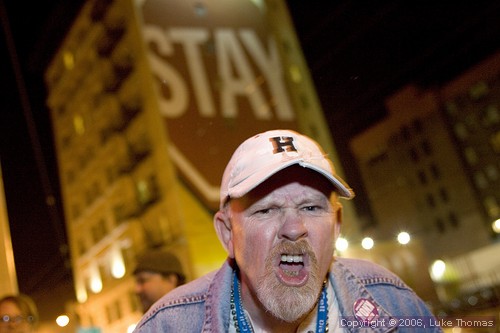
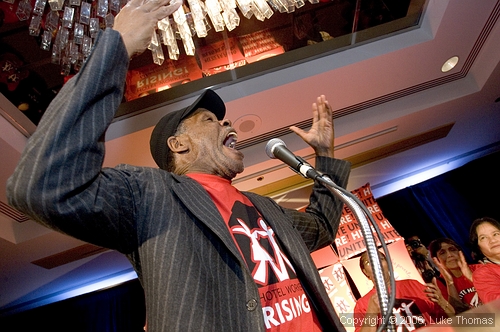
Photo(s) by Luke Thomas

Court Jester seeks Amnesty International
intervention in Wolf case

By h. brown

March 20, 2007

Does Josh need Amnesty International?

(will they move him to Guantanomo?)

Josh Wolf is a political prisoner within his own country. That is a fact. He is held because of his political beliefs. No other reason.

So, what do you do when there can be no justice from your own government? You seek it through the World Court. But first, through publicity from Amnesty International.

The Bush administration locked him up. Bush's Attorney General, Alberto Gonzales personally signed the order to arrest Josh. This is the same Alberto Gonzales who wrote a legal rationalization supporting the right of the Bush administration to move anyone they want from country to country and torture them in secret prisons.

This is the same Alberto Gonzales who just fired 8 federal district attorneys generals for political purposes. What are you gonna do? Appeal to the Supreme Court, perhaps? It's stacked and votes along party lines. There is, in fact, no ultimate justice in today's continuum of American jurisprudence.

Are you listening? Your president is doing this and no one is calling for his impeachment? Certainly not Nancy Pelosi. Or, Harry Reid. Where does one turn?


Speaker Nancy Pelosi

Peaceful protest

Starting today, Josh's mom and dad will welcome fellow well-wishers to their vigil in front of the Federal building on Larkin at Golden Gate. The 24/7 demonstration will evolve into a mother's hunger strike if Josh is not released. We may need, as mentioned, Amnesty International on this one and it could end up with the Attorney General of the United States indicted by the World Court. These people make Nixon look like a bleeding-heart liberal.

I'm dusting off my 'Free Josh' sign and heading over there and if you value freedom of the press and have a few minutes, it is your duty as an American to come by and hang out. Realize what you're up against.

You will be photographed and catalogued by the FBI. Homeland Security probably already has a file on you. This is not your father's America. This is Bushland. They'd kill you if they could. The last demonstration I attended in front of that building featured a security force with only half of the guards wearing ID's. Look for the ones without ID's. They'll be the first to snap a visor down and start whacking grandmothers with billy clubs.

If you have a camera, take pics of the cops. Particularly the ones who don't have any identification. It's illegal for them to not have any identifying numbers. Some of them will put tape on their badge numbers. Watch out for these pricks. They have decided in advance that they are going to bust some skulls and they are too cowardly to do it with their family names over their breast pocket.

Danny Glover for Mayor

Jesus Christ, does this one have legs!?! The unapologetic AIPAC forces are out from New York to San Francisco to smother this babyin its crib before it even gets its first bottle. Go Danny go.


Danny Glover

The Gonzalez forces hate the idea. The Newsom people must have run a poll because they are approaching apoplexy. Let me say a few words about this subject.

Idea came from 'Wish you were dead'

Political junkies in town are divided upon the idea of Glover running for Mayor. Half of them are Downtwon hacks terrified of the prospect. The other half are trying to take credit for the idea.

We'll deal with the first half of the mob later. As regards the origination of the idea (listen up, Danny) … it came from an anonymous poster who titles himself: 'Wish you were dead'. He began pushing your name for public office last year when Sarah Lipson announced she wouldn't run for re-election to the School Board. Clearly, that wouldn't have been a position from which you can have maximum impact. 'Wish' prefers to remain anonymous.

Mirkarimi to call Press hearing?

The Josh Wolf Vigil began an hour or so ago in front of the Federal Building at Larkin and Golden Gate. I brought the subject up with D-5's Supervisor, Ross Mirkarimi at his monthly art opening in his office last Friday. I noted that with the entire argument of Josh's imprisonment revolving around the definition of 'journalist' in today's America, that it might be a good idea to have another hearing on the topic.

Ross agreed but noted that the last hearing was before the Rules Committee and that Rules Chair, Tom Ammiano would have to call up the item. So, Tom, how about it?

I intend to bring up the topic of the federal shield law at the hearing, should it occur. My concern is that, as presently defined, the law does not cover unpaid online journalists who could still be locked up by the likes of Judge William Alsup. Federal law should not enshrine the idea that the likes of Ken Garcia and Pat Murphy - paid by Downtown interests and are totally biased - are legitimate journalists who can keep their sources private, … but that writers such as myself who are unpaid (and, admittedly, nevertheless of a totally biased point of view) … should have to give up Eileen Left's real name.

At any rate, I call upon the good Supervisor Mirkarimi to make note of the Wolf family's continuing vigil for Josh's release when he makes his 'Roll Call for Introductions' presentation before the Full Board at Tuesday's meeting.

Odds and ends and odd ends

Salon on Friday was alive with ideas growing like fungi in the warm sun. An 'associate' ("I used to work for Kamala, but I don't now.") of D.A., Kamala Harris, showed up for the 2nd time in 3 weeks and sat next to our roiling group to listen. She'd been pointed out to me a couple of weeks ago but I didn't say anything to her. I mean, shit, you don't have to spy on us. Just show up and sit at the table with us. I'll out her by name if she shows up again.

Gonzo roomie, Jimmy Dorenkott showed up at the Mirkarimi event, soused, angry, threatening and unkempt. Christ, it was like looking in the mirror.

So, Dorenkott threatened Marc Salomon (which he's done before) and trembled with rage until calmed by the 'Persian Colossus' himself. Email contacts with Gonzalez requesting he rein in this present-day, Luca Brazzi heard Matt reply that: "Jim is his own man.". Sure, and Jennifer Siebel didn't get her ideas about Ruby Tourk from Gavin. Poor form. Kind of fun, though. Look for a repeat side-show at noon today when all sides of the conflict (has to do with feminism and equal billing for women) will gather in front of the aforementioned Federal Building to either implore the new House Speaker to push for the withdrawal of U.S. troops from Iraq, … or, perhaps, the Greens will just roll on the ground and fight with each other.

Glover for Mayor.

h. brown is a 62 year-old keeper of sfbulldog.com, an eclectic site featuring a half dozen City Hall denizens. h is a former sailor, firefighter, teacher, nightclub owner,and a hard-living satirical muckraker. Email h at h@ludd.net.

URL

Saturday, March 10, 2007

Want out of prison? Donate an organ

Can you say evil?

---

S.C. bill gives inmate organ donors time off

Seanna Adcox / Associated Press

COLUMBIA, S.C. -- Inmates in South Carolina could soon find that a kidney is worth 180 days.

Lawmakers are considering legislation that would let prisoners donate organs or bone marrow in exchange for time off their sentences.

A state Senate panel on Thursday endorsed creating an organ-and-tissue donation program for inmates. But legislators postponed debate on a measure to reduce the sentences of participating prisoners, citing concern that federal law may not allow it.

"I think it's imperative that we go all out and see what we can do," said the bills' chief sponsor, Democratic Sen. Ralph Anderson. "I would like to see us get enough donors that people are no longer dying."

The proposal approved by the Senate Corrections and Penology Subcommittee would set up a volunteer donor program in prisons to teach inmates about the need for donors. But lawmakers want legal advice before acting on a bill that would shave up to 180 days off a prison sentence for inmates who donate.

South Carolina advocates for organ donations said the policy would be the first in the nation.

Federal law makes it illegal to give organ donors "valuable consideration." Lawmakers want to know whether the term could apply to time off of prison sentences.

"We want to make this work, we really do," said Republican Sen. John Hawkins. "But I want to make sure no one goes to jail for good intentions."

Mary Jo Cagle, chief medical officer of Bon Secours St. Francis Health System in Greenville, urged senators to find an allowable incentive.

"We have a huge need for organs and bone marrow," Cagle said.

But Melissa Blevins, executive director of Donate Life South Carolina, said any incentive would break the law and the principle behind donations.

Palestinian Child Political Prisoners 2006 Report

2007/03/04

Palestinian Child Political Prisoners 2006 Report

In 2006, Israel continued its policy of arresting and imprisoning Palestinian children. Some 700 Palestinian children (under 18) were arrested by Israeli soldiers over the course of the year. Of these, around 25 children were held on administrative detention orders, imprisonment without charge or trial. The overwhelming majority of those arrested in 2006 were boys; there were eight girl child prisoners who served sentences at different points during the year. Of these, four had been arrested in 2006.

Full Report [Doc Format 137KB]

Tuesday, February 27, 2007

Irish bishops: Israel has turned Gaza Strip into a 'large prison'

Last update - 19:47 27/02/2007

By The Associated Press

A group of Irish Roman Catholic bishops on Tuesday called into question Ireland's commercial ties with Israel, saying Israel has made the Gaza Strip "little more than a large prison" for Palestinians.

"Where there is evidence of systematic abuse of human rights on a large scale, as in the Occupied Territories, there are questions that must be asked concerning the appropriateness of maintaining close business, cultural and commercial links with Israel," said auxiliary Bishop of Dublin Raymond Field.

There is a long history of support for Palestinians in Ireland, particularly among nationalist parties such as Sinn Fein, which equate their own fight to end British rule in Ireland with the desire by Palestinians for their own state.

Field, chairman of the Irish Commission for Justice and Social Affairs (ICJSA), which advises Ireland's top Catholic clerics on social issues, described travel restrictions on Palestinians in the West Bank and Gaza as an "injustice."

"We are calling for an end to restrictions on family reunification, and an end to humiliating treatment of people at checkpoints," Field said in an ICJSA statement ahead of a meeting with Irish Foreign Minister Dermot Ahern.

Field said restrictions, which Israel says protect it against Palestinian attacks, also make it difficult for Christians to worship at Bethlehem's Church of the Nativity and the Church of the Holy Sepulchre in Jerusalem.

"In effect, the communities of Bethlehem and East Jerusalem are forced to live divided by a 25 foot wall," said Field.

"We also intend to raise with Minister Ahern the intolerable situation that is the daily lot of the Palestinians who live in Gaza," Field said.

The ICJSA's statement also questioned the way in which the European Union handled its dealings with Israel.

"While we welcome cooperation between the EU and its neighbouring countries, nevertheless such cooperation should not be at the expense of a large segment of the indigenous population - in this case the Palestinians."

Monday, February 26, 2007

Facility Holding Muslim Inmates Limits Communication


Facility Holding 'Terrorism' Inmates Limits Communication

By Dan Eggen
Washington Post Staff Writer
Sunday, February 25, 2007; A07

The Justice Department has quietly opened a new prison unit in Indiana that houses a hodgepodge of second-tier terrorism inmates, most of them Arab Muslims, whose ability to communicate with the outside world has been tightly restricted.

At the Communications Management Unit, or CMU, in Terre Haute, Ind., all telephone calls and mail are monitored, the number of phone calls limited and visits are restricted to a total of four hours per month, according to special rules enforced by the Justice Department's U.S. Bureau of Prisons. All inmate conversations must be conducted in English unless otherwise negotiated.

The unit appears to be a less restrictive version of the "supermax" facility in Florence, Colo., which holds some of the United States' most notorious terrorists, including al-Qaeda operative Zacarias Moussaoui and Unabomber Theodore J. Kaczynski.

The Indiana unit, by contrast, is part of a medium-security facility and includes inmates set to be released in as little as two years. Prisons spokeswoman Traci Billingsley said the unit's population will not be limited to inmates convicted of terrorism-related cases, though all of the prisoners fit that definition.

Prison officials said they already seek to fully monitor the mail and other communications of all 213 "terrorist inmates" in the system. "By concentrating resources in this fashion, it will greatly enhance the agency's capabilities for language translation, content analysis and intelligence sharing," the bureau said in a summary of the CMU.

The unit, in Terre Haute's former death row, has received 17 inmates since it was launched in December and eventually will hold five times that number, officials said.

Defense lawyers and prisoner advocates complain that the unit's communication restrictions are unduly harsh for inmates not considered high security risks. They also say that the ethnic makeup of the CMU's population may indicate racial profiling. "If they really believed these people are serious terrorists, they wouldn't be in this unit," said David Fathi, staff counsel for the National Prison Project at the American Civil Liberties Union. "They'd be in Colorado with [Atlanta Olympics bomber] Eric Rudolph and the Unabomber and the rest of the people that the Bureau of Prisons thinks are serious threats."

The prison bureau has come under sharp criticism in recent months for failing to adequately monitor terrorist inmates' communications. The Justice Department's inspector general reported in October that three terrorists imprisoned for the 1993 World Trade Center bombing had sent nearly 100 letters to alleged terrorists overseas from the maximum-security facility in Colorado.

"The inclusion of this unit is one of the many things we're doing to improve our monitoring capabilities," Billingsley said.

According to prison records, current residents at Terre Haute include five members of the so-called Lackawanna Six, a group of Yemeni natives from Upstate New York who attended an al-Qaeda training camp. The unit also houses Randall Royer, a defendant prosecuted as part of the "Virginia jihad" case in Alexandria, and Enaam M. Arnaout, an Islamic charity director who pleaded guilty to diverting money to Islamic military groups in Bosnia and Chechnya.

The only non-Muslim inmates are an unidentified Colombian militant and Zvonko Busic, 61, former leader of a Croatian extremist group that hijacked a jetliner and set off a bomb that killed a police officer in 1976, according to prison records and defense lawyers.

Another CMU resident is Rafil Dhafir, 58, an Iraqi-born physician from Syracuse, N.Y., who was sentenced to 22 years for defrauding charity donors and conspiring to violate U.S. economic sanctions against Saddam Hussein's government.

In a recent letter to supporters, Dhafir recounted his abrupt, heavily guarded transfer to Terre Haute in December and described it as part of "a nationwide operation to put Muslims/Arabs in one place so that we can be closely monitored regarding our communications."

"We are all concerned about the close intrusion on our communications," Dhafir wrote. "We knew all along that our calls, mail and visits were monitored, but with the new system we will have absolutely no privacy including our visits. This is causing a great deal of anxiety and resentment especially among those whose families speak no English."

Dhafir wrote that prison officials "are allowing us total freedom for our religious activities" and appear to be working with inmates to improve conditions.

Prisoner advocates and prisons officials generally agree that the bureau is within its rights to monitor prisoners' mail, phone calls and visits. They differ on whether the intensive use of these tactics is justified for these inmates.

Some lawyers and prison advocates said there are important problems with the CMU, including a lack of public notice about its formation and a lack of clarity about how inmates are chosen to be sent there.

Washington lawyer Carmen Hernandez, who represents Busic and is president-elect of the National Association of Criminal Defense Lawyers, noted that being sent to the unit is not considered a punitive measure by prisons officials. As a result, authorities do not have to provide hearings and other procedures that are required when punishments are to be administered.

"They claim it's not a punitive measure, but when you start restricting access, it certainly would appear to be punitive," Hernandez said. "If you're going to restrict people's liberties beyond what they already are, it ought to be for a good, particularized reason, and there does not appear to be one here."

Howard Kieffer, a Santa Ana, Calif., defense lawyer who runs a Web site focused on federal prisons, also argues that the unit "screams racial profiling."

"It's highly suspect that basically all of the people in this program are of Middle Eastern descent," Kieffer said.

Billingsley said inmates are not placed in the unit based on ethnicity or religion. She said the facility will eventually house a variety of prisoners, including sex offenders who attempt to communicate with victims and others who have abused mail or phone privileges.

"What they all have in common is a demonstrated need to more closely monitor their communications," Billingsley said.

During a tour of the Colorado prison last week, Attorney General Alberto R. Gonzales said the monitoring problems there had been solved, although prison guards say the facility remains understaffed.

Staff researcher Julie Tate contributed to this report.

Thursday, February 1, 2007

Grannies get hard time

Grandmothers for Peace Sentenced to Federal Prison

Thursday, February 01 2007 @ 12:25 AM EST

More than a dozen Fort Benning protesters sentenced to federal prison

BBSNews 2007-02-01 -- By Bill Quigly. Cathy Webster, a grandmother living in Chico California, organized "A Thousand Grandmothers for Peace" to protest in November 2006 against the torture-training School of the Americas (SOA) (now called the Western Institute of Security Cooperation or WHINSEC) located at Ft. Benning Georgia.

Western Hemisphere Institute for Security Cooperation (WHINSEC) seal.

Image Credit: WHINSEC. Accessed 2007-01-31.

SOA-WHINSEC has been the subject of international criticism since it was disclosed that torture manuals were used in the training of Latin American military personnel. Amnesty International USA called for the closing of the school, an investigation into the human rights atrocities committed by its graduates, an apology to its victims and reparations.

This week a federal judge in Columbus, Georgia sentenced Ms. Webster to 2 months in federal prison for stepping through a hole in the fence onto the grounds of Ft. Benning to carry her protest to the doors of the SOA-WHINSEC.

Two other Grandmothers for Peace were also sentenced to federal prison for the nonviolent protest – Julienne Oldfield of Syracuse NY and Val Fillenwarth of Indianapolis IN.

The three grandmothers were part of a group of 16 human rights activists, ages 17 to 71, who were on trial in federal court in Georgia this week. Fifteen of the activists were given federal prison sentences of one to six months.

Alongside the grandmothers were five inspiring college students: Melissa Helman of Ashland WI, Martina Leforce and Nathan Slater from Berea KY, Graymon Ward of Raleigh NC and Whitney Ray of Grinnel, IA. All were all arrested and prosecuted for trespass as well. Four were also sentenced to prison.

Ms. Webster told the judge "You will notice that increasingly, it is the elders who are speaking out and acting boldly and authoritatively to bring understanding of what justice, kindness, generosity and compassion mean in a world weary of the endless conquest and dominance mindset of nations."

Ms. Webster estimated that over 1000 grandmothers participated in the November protest organized by School of Americas Watch which was attended by nearly 20,000 people. The annual protest commemorates the thousands who have died at the hands of the graduates of the SOA-WHINSEC, which used and taught from publicly disclosed torture manuals in its training of Latin American military personnel.

The grandmothers and the rest of the 16 protestors will join over 250 other activists who have spent a collective 92 years in prison and dozens of years on federal probation for prior nonviolent civil disobedience at the gates to Ft. Benning and the SOA-WHINSEC.

For more on the human rights activists going to federal prison and more on the campaign to close the SOA-WHINSEC, see www.soaw.org.

Bill QuigleyBill Quigley is a law professor as well as Director of the Law Clinic and the Gillis Long Poverty Law Center at Loyola University New Orleans. Bill has been an active public interest lawyer for over 25 years. Bill has served as counsel with a wide range of public interest organizations on issues including public housing, voting rights, death penalty, living wage, civil liberties, educational reform, constitutional rights and civil disobedience.

0 comments

Friday, January 19, 2007

Torture and the Future

University of California, Santa Barbara

Perspectives from the Humanities

Critical Issues in America, January 2007 - June 2007

This series of events addresses the critical issues surrounding the use of torture by the most powerful democracy in the world. The series will focus on four areas: the devastating effects of torture conducted by democratic societies on the concept and practice of democracy; the consequences of state-sanctioned torture on the principles and practices of scholarship and education; the role of mass media in the increasing acceptability of the use of torture; and the relationship between torture used in US-run prisons abroad, and human rights violations on American soil. The series features scholars whose work on torture and human rights effectively crosses the disciplinary gap between the humanities and social sciences, as well as artists, activists and lawyers whose work is committed to an ethics and politics of response and resistance.

View Press Release

Main Page | Project Description | Events/Lectures | Coordinators | Links | Giving | Contact

Thursday, December 21, 2006

'We are facing the hardest Christmas yet'

Israeli road obstacles rise by 40% in a year, strangling the Palestinians, says UN

Rory McCarthy
Thursday December 21, 2006
The Guardian

Bethlehem is suffering from 65% unemployment and government workers have gone unpaid for four months.


On a map the route looks straightforward enough. From Nazareth, amid the ploughed brown farmlands of northern Israel, Highway 60 travels south for nearly 100 miles, winding down through the mountains of the West Bank, through the heart of central Jerusalem and into the narrow streets of Bethlehem.

This is the direct route from Nazareth to Bethlehem, the closest approximation to the journey described in the Bible when Joseph and Mary travelled south to register for taxes in the time of Caesar Augustus.

But to travel the route today is to go through the geographical and political labyrinth of the Middle East conflict, through occupied land, restricted roads, military checkpoints, heavily guarded Israeli settlements, strongholds of Palestinian militancy and the West Bank barrier.

Today, the Archbishop of Canterbury, Rowan Williams, the Archbishop of Westminster, Cardinal Cormac Murphy-O'Connor, and other church leaders from Britain will visit Bethlehem.

Nazareth sits above a broad plain dotted with Arab villages and long plastic greenhouses. A few minutes' drive south the road crosses the 1967 boundary dividing Israel from the occupied West Bank. The Green Line, as it is known, is invisible on the ground and not shown in Israeli school textbooks. The road crosses at the Jalama checkpoint, a large set of yellow metal gates guarded by a two-storey concrete watchtower. A picture of a reindeer has been spraypainted on a wall of army concrete blocks nearby.

At this point the West Bank barrier runs along the Green Line, although for much of its half-completed route it crosses into the West Bank. When finished it will put 10.17% of the West Bank and East Jerusalem between the barrier and the Green Line, according to the UN Office for the Coordination of Humanitarian Affairs.

Mark Regev, Israel's foreign ministry spokesman, said the system of checkpoints and closures across the West Bank was based on security concerns. "It is an unfortunate necessity. Hopefully it won't be forever. But this is the reality of the situation," he said.

"In 2006 we had less suicide bombings than we had in one week in 2002 and this is largely because of the measures Israel has taken to prevent suicide bombings and checkpoints are part of that." He said the West Bank barrier had made a significant impact reducing attacks inside Israel. "Where the fence is an issue of quality of life for the Palestinians, for the Israelis on our side of the fence it is an issue of life or death itself."

Cars with yellow Israeli number plates are not allowed to cross Jalama into the West Bank. The road heads into Jenin, one of the main cities of the West Bank, a stronghold of some of the most extreme Palestinian militant groups, including those responsible for suicide bombings. The Israeli military sometimes imposes age restrictions at certain checkpoints, which make it difficult for young men from Jenin to leave the city.

In the centre of town, Sami Jowabri, 44, runs his own taxi company. His drivers have become experts in monitoring the system of checkpoints, road closures and barriers that dot the roads of the West Bank. The number of Israeli military obstacles has risen by 40% in the past year. There are now 528 physical obstacles, the UN said in September. It said closures were a primary cause of the Palestinian humanitarian crisis.

"It's affected our work a lot," said Mr Jowabri. "We have drivers who spend so long at checkpoints they have to sleep in their cars. They tell us it's for security, but I don't think it's about security. If people really want to set off bombs they find a way around the checkpoints."

From Jenin the highway runs down through winding hills and then suddenly runs up against a large series of plastic barriers blocking the road. There is nothing to explain the closure, except a passing Israeli army jeep and the concrete walls of the Shave Shomeron settlement, just north of Nablus.

All the other Palestinian cars on the road turned off a few minutes earlier, avoiding the roadblock as well as a checkpoint nearby at Anabta. Instead, the drivers cross an unofficial dirt road through several fields and over steep ditches. It comes out on a rerouted Highway 60, this time with the occasional car with Israeli plates, driven by residents of the several nearby settlements - settlements considered illegal under international law.

A little further on is a checkpoint. All the Palestinian cars, with their green plates, queue to be checked. The settlers, in their Israeli plated cars, can drive by without stopping.

Soon there is the city of Nablus, closed in by checkpoints where again the Israeli military sometimes imposes age restrictions and where queues at the checkpoints are frequently long and hot-tempered. "It's a humiliation, like we're still living in the 2nd century, not the 21st," said Ali Hassan Ali, 57.

Just before the entrance to Jerusalem, all the Palestinian cars turn off the road. For those West Bank Palestinians who do not have the identity cards needed to enter Jerusalem, they must travel a long and circuitous route along an old British army supply road that runs near Jericho and skirts around the eastern edge of Jerusalem. It takes more than an hour if there are no hold-ups at checkpoints.

Ahmad Shahab, 51, an Islamic studies schoolteacher, is heading from Ramallah to Eizariya, halfway to Bethlehem. "Are these restrictions because they are afraid of attacks? But a person like me over 50, what threat am I for them?"

In Bethlehem itself, Victor Batarseh, the mayor, looks from his office into the doorway of the Church of the Nativity. He blames the checkpoints and closures for the economic crisis that has shaken his town. Unemployment is 65%, large parts of the town's farmland have been taken up by the West Bank barrier, and a financial boycott on the Palestinian Authority has meant no salaries have been paid at the municipality for four months.

"This year is I think the hardest Christmas we are facing," he said. "The wall is turning this city into a big prison for its citizens. There is confiscation of land, closure of the main entrances to the city. All this has a physical and a psychological effect. We can only hope for change."

Saturday, December 16, 2006

Gaza: a prison again

chAfter the worst years in memory, charities try to offer hope where there is deep despair

By Donald Mcintyre
The IndependentGAZA STRIP (Dec 16, 2006)

Maybe they are just conveniently forgetting other periods in Gaza's turbulent and blood-stained history, but most Gazans will tell you that 2006 is the worst year they can remember.

In Gaza City's deserted gold souk, people are not even coming to sell their jewellery any more.

"We just sit and drink tea," said Yasser Moteer, 35, who runs a jewellery stall. "It's worse than any time in the 20 years I've been here. It's crazy."

The gold-selling started soon after the international and Israeli boycott of the Hamas-led Palestinian Authority started to plunge Gaza's economy into collapse last March. But having long ceased to buy here, the poor have nothing left to sell.

Certainly, the 1.3 million people of this ancient coastal strip of territory, a mere 360 square kilometres, can never have experienced as intense a swing of hope to despair as they have in little more than 12 months.

Ariel Sharon's decision to withdraw Israel's settlers and troops in August 2005, for all the criticism that it was unilateral and circumscribed in both its genesis and its implementation, made many Palestinians here, almost despite themselves, hope for a better future.

It was not just the sudden freedom to travel from north to south without the endless delays at the hated Abu Houli checkpoint, or that children in the southern town of Khan Younis could run west through what were now the ruins of the Jewish settlement of Neve Dekalim and plunge into a Mediterranean they had only ever dreamt about, or that families could again cross the southern border at Rafah and reunite with their relatives in Egypt.

It was the sense that for the first time in five dark, stifling and dangerous years, Gaza could breathe -- psychologically and, just maybe, economically.

As 2006 nears its close, it is easy to see how cruelly those hopes have been mocked by what has happened this year.

Since Hamas and other Gaza militants seized the Israeli corporal, Gilad Shalit, and killed two of his comrades in late June, shells, drones and machine-gun fire from Israeli forces have killed some 400 Palestinians, including civilians -- women and children among them -- in a conflict overshadowed to a large extent by the war in Lebanon.

For five long months, electricity was cut to eight hours a day, damaging water supplies, after a surgically accurate bombing condemned by Israelis as well as foreign human rights groups as collective punishment in breach of humanitarian law.

Reaching a peak in July, the use of sonic booms, often deliberately timed as children were going to school, created misery and fear. As if that was not enough, a far lower but significant number of civilians, also including children, have been killed or wounded in the sporadic fighting between Fatah and Hamas, the two dominant factions in Palestinian politics, or in battles between extended families.

For the immediate survivors of the Israeli shells that killed 17 members of the Athamneh family as they tried to flee their home in Beit Hanoun as it was attacked, the bereavement is, if anything, harder to bear now that just over a month has elapsed since it happened.

In late afternoon sunshine recently, in the eerily peaceful alley where the carnage was perpetrated, Hayat Athamneh, 56, a strong woman who lost three adult sons, all fathers themselves, sat with their still devastated and injured brother Amjad, 31, and his wife, who lost their own son Mahmoud, 10.

"Now I feel it," said Hayat, covering her eyes as they fill with tears.

"It wasn't so bad at the beginning. There were a lot of people around. Now there is nobody."

As she reeled off the list of Palestinian and foreign dignitaries who had visited the site, her daughter-in-law Tahani, 35, said: "They all came. But nothing happened." Tahani talks about the three surviving Athamneh family members, two of them children, who lost limbs in the attack.

"We have to worry about the one who lost arms and legs now and will see the others who haven't. We have to look after them and then worry about where we are going to live."

Her brother-in-law Majdi Athamneh, who lost his 12-year-old son Saad, says that the extended-family members are afraid to go back to their shelled house because of the structural damage, but what's more, they no longer think they should live together as they had for so many years.

"When so many members of one family were killed, it is better to make sure it doesn't happen again and live apart," he said to nods from his relatives.

Eight kilometres away in Gaza City, Adeeb Zarhouk, 44, is a man used to hard work. He used to support his wife Majda and their seven children during the 20 years he was employed in Israel as a freelance metalworker and electrician, and the five years he has worked for an Israeli company in the now flattened Erez industrial zone on the northern edge of Gaza.

But this morning he apologizes for being asleep when we call.

Each day, he hopes for a request to install a satellite TV dish or do another odd job. "But the phone hasn't rung for weeks," he says. "Nobody has any money to do these things."

Zarhouk is part of the 64 per cent increase in "deep poverty" among Palestinian refugees in the last year He is naturally cheerful but, as his wife prepares a three-shekel (80-cent) family breakfast of beans, falafel and a few tomatoes, he says: "When I'm at home by myself, I start crying. When your son asks you for half a shekel and you don't have it ... ."

Zarhouk gets up to wash the tears from his eyes. Then he says that although as a refugee he earned almost $240 a month on a three-month United Nations Relief and Works Agency job program, he now owes $540 in rent and that the family eats meat only when his 20-year-old son gets an irregular $350 handout in lieu of his salary as a Palestinian Authority policeman.

Who does Zarhouk, who voted Fatah in the last election, blame? "I blame democracy," he says with a flash of sarcasm. "The whole world wanted us to have democracy and said how fair our election had been. The problem is they didn't like our results."

The world's boycott of the PA since those elections ended salaries for the PA employees on whose spending Gaza's economy disproportionately depends. The highly professional but desperately under-equipped health service is suffering.

In her bed at Shifa hospital, Intisar al Saqqa is waiting for the drug Taxoter which doctors say she needs to treat breast cancer that has spread to her lungs and her liver.

"Every week, they say it will come on Monday," says her mother, Hadra, 62. "But it doesn't. Inshallah, it will come soon." Her daughter says, "I don't blame anybody."

The agreement Condoleezza Rice persuaded Israel to sign a year ago to the free the passage of goods and people into and out of Gaza has not been implemented, as a UN report pointed out. The UN's Office of Co-ordination of Humanitarian Affairs said Gaza's access to the outside world is "extremely limited" and that commercial trade is "negligible."

That is diplomatese for saying Gaza is a prison again. Israel refuses to take the blame, saying the boycott and closures result directly from security anxieties and from the refusal of Hamas to modify its stances on recognition and violence, and refusing -- so far -- to release the Israeli corporal.

Now, with talks between Hamas and Mahmoud Abbas past collapse, there is little hope, and plenty to do for the non-governmental organizations and charities trying to keep Gaza alive.

Friday, December 15, 2006

No Mr. Buckley, No

Dec 15, 2006

By Anwaar Hussain

Dear Mr. Buckley,

Writing in National Review Online in February 2006, you William F. Buckley Jr. its Editor at Large and a diehard conservative icon, admitted that the U.S. mission in Iraq has failed but gave the following reason for the disaster;


“Our mission has failed because Iraqi animosities have proved uncontainable by an invading army of 130,000 Americans…………they have not been able to contend against the ice men who move about in the shadows with bombs and grenades and pistols.”

No Mr. Buckley, no. You are muddying the water.

Since your chant has now been taken up by many Cons, Neocons and Repubs, the record must be set straight.

Mr. Buckley, your great country went to war with a nation that was already impoverished by more than 20 years of war and American led, UN-imposed sanctions. The immediate aftermath of the war found the traumatized Iraqi society without a recognized head of state or a working administration with well over 70 highly fragmented political parties pulling their unfortunate country in every which way.

Mr. Buckley, that Iraq would indeed have plunged into complete chaos was a foregone conclusion clear to every one but the likes of your good self. Your military annihilated Iraq’s central leadership, disbanded its armed and police forces, decimated its bureaucracy and stumped its judiciary with mock trials. Your country encouraged competing tribal and ethnic forces to pull Iraq apart. With no infusion of money, no central leadership, no overseeing bureaucracy, no American commitment for rebuilding, and no self-sustaining industry, Iraq was certain to sink into a bloody civil war and that is precisely what has happened. Do not muddy the water Mr. Buckley.
Moreover, any nation, including yours that has now become not a dream but a nightmare for many, would have behaved the same way under similar circumstances.

As a matter of fact, your country may have fared far worse. Your society, sir, has now been transformed into a culture of carnivorous marauders, most of them with a past criminal record. Allow me to give a glimpse of this violent nature of the society of which you are a mouthpiece.

According to Christian Science Monitor, in 2003 alone, more than 5.6 million Americans were in prison or had served time there. That's 1 in 37 adults living in the United States, the highest incarceration level in the world. Talk of ice men who move about in the shadows with bombs and grenades and pistols Mr. Buckley.

Not only that, with over 570,000 prison inmates released annually, "the suspect has a criminal record" has become more like a broken record playing over and over for American victims and their families. In the past about four decades, total crime in America has increased over 350%. Millions of criminals have been released from prison, many have been given probation for their crimes. All now roam the streets of America like cocked guns and ticking bombs. Talk of ice men who move about in the shadows with bombs and grenades and pistols Mr. Buckley.

Yours is the most violent society in the world presently Mr. Buckley. In your great country, the crime clock continues to click incessantly. According to reliable statistics, there is one murder every 22 minutes, one rape every 5 minutes, one robbery every 49 seconds, and one burglary every 10 seconds. Not only that, the cost of crime in your beloved country continues to mount: $78 billion for the criminal justice system, $64 billion for private protection, $202 billion in loss of life and work, $120 billion in crimes against business, $60 billion in stolen goods and fraud, $40 billion from drug abuse, and $110 billion from drunk driving. When you add up all, crime costs Americans a staggering $675 billion each year. Talk of ice men who move about in the shadows with bombs and grenades and pistols Mr. Buckley.

The crime battle in America now rages in terms of seconds and minutes within your own national boundaries Mr. Buckley. It rages in your states, cities, towns, communities and yes even in your own streets and homes. With crimes to property occurring every two seconds, and a violent crime every 19 seconds, crime is a war with casualties now being counted in seconds and minutes. Talk of ice men who move about in the shadows with bombs and grenades and pistols Mr. Buckley.

And hush Mr. Buckley. It is not a just a matter of crime statistics availability in your country. Compare your beloved country with some other developed countries of the world for example. You would squirm if I informed you that of the 10 cities having the highest murder rate in USA and Europe, 8 are American cities i.e. Washington, Philadelphia, Dallas, Los Angeles, Chicago, Phoenix, Houston and New York City. Talk of ice men who move about in the shadows with bombs and grenades and pistols Mr. Buckley.

Now if by a quirk of fate, a world force of a million odd strong men were formed up from countries that have had enough of you and your divine country’s endless machinations, landed in your great country, surrounded your murderous capital and cities like Chicago and New York, dissolved your federal and state administrations, disbanded your armed, civil and police forces, threw into the stockade your lying bunch of criminal leaders and announced the arrival of a New American Century of dog eat dog within you geographical confines, what would happen in your society that has more guns than hands Mr. Buckley? Talk of Iraqi animosities and ice men who move about in the shadows with bombs and grenades and pistols Mr. Buckley.

This is how criminal and violent your society has become Mr. Buckley. This is what you need to keep in mind next time you talk of Iraqi animosities and ice men who move about in the shadows with bombs and grenades and pistols Mr. Buckley. And I have not even touched upon the racial and religious tensions simmering on the fault lines just below the surface of your national fabric.

Get this straight Mr. Buckley.

Iraq fiasco was, is and always will be a gigantic human catastrophe, resulting from the stillborn vision of small men who wanted to ride high on their demented dreams.

No Mr. Buckley, no. Do not muddy the water.


Yours Truly,

Anwaar Hussain


Sources:

1. http://www.nationalreview.com/buckley/buckley200602241451.asp

2. http://www.csmonitor.com/2003/0818/p02s01-usju.html

3. http://www.leaderu.com/orgs/probe/docs/crime.html

4. http://www.atps.com/crime/usa.htm

5. http://tinyurl.com/y5cjqp

Friday, December 1, 2006

Official Fined for Jailing Mentally Ill

Friday December 1, 2006 6:16 PM

CLEARWATER, Fla. (AP) - The state's human-services chief was ordered to pay $80,000 for keeping mentally ill inmates in jail, a fine that came a week after she was charged with criminal contempt.

Judge Crockett Farnell imposed the sanction against Department of Children & Families chief Lucy Hadi on Thursday during a hearing on the status of seven Pinellas County jail inmates found incompetent months ago but only recently moved to mental health facilities.

Under state law, the inmates should have been moved sooner, and Farnell charged Hadi last week with indirect contempt of court.

The agency will appeal the fine, spokeswoman Al Zimmerman said. ``We'd like to work with the court in solving this problem, not against the court,'' Zimmerman said.

As of Monday, 237 inmates in the state's jails have been declared incompetent and have been in jail longer than 15 days, Zimmerman said.

Thursday, November 30, 2006

Justice system is absurd. Broken. Chaotic

Related

2.2 million in US prisons and jails
One in every 32 American adults behind bars, on probation or on parole.
http://tinyurl.com/y8xukd
---

Lord Ramsbotham exclusive

The former prison chief lambasts a justice system in meltdown after Tony Blair's decade of failure on crime and punishment

Published: 30 November 2006

Yesterday's announcement that the prison population now exceeds 80,000 is the latest low point in what one can only describe as the Government's headlong and self-induced race to absurdity as far as the conduct of imprisonment is concerned.

The reasons for this dreadful figure are not hard to find. If you produce legislation that results in longer prison sentences, more people will be in prison. If you do not resource prisons, to enable them to conduct work, education and training, prisoners are more likely to reoffend, as proved by the fact that the reoffending rate among adult males has gone up from 55 per cent to 67 per cent in the past five years. If you continue to have a dysfunctionally organised prison service, you will continue to have dysfunctional organisation of an overstretched system. And so on.

Many people have been warning the Government about this for years but, instead of listening to those with practical experience, it has preferred to take advice from people who know nothing about running large organisations, let alone an operational service. When, as now, the whole is run by a home secretary who, within weeks of taking office, publicly described the Home Office and the overburdened immigration service as not being fit for purpose, and recently disparaged the probation service to prisoners in Wormwood Scrubs, you do not exactly have a recipe for getting out of what is an increasingly dire situation. Leaders undermine the morale of their own troops at their peril. If, at the same time, you continue to bombard them with a continuous torrent of flawed legislation, much of which replaces previous legislation before the ink on it is dry, you create a mess that can only be cleared up by long-term planning, based on discussion with those who understand not only what needs to be done but how it might be done. That requires ditching current plans that are marching the whole system into even greater chaos.

The result of all the upheaval in the Home Office over the past decade is we have a prison service left in a state of shambles. Every time a governor changes in a prison, then the regime in that prison changes, and all the good work that is under way is in danger of being ditched - it's a ridiculous way of trying to introduce systems that are meant to prevent reoffending.

Prisons are split between the public and private sectors - but prisoners are the same whichever institutions they are in. Education is being run by the Learning and Skills Council, without direction from the Home Office. It's all recipe for confusion.

The probation services are overstretched - there are 300 fewer officers and 1,500 more bureaucrats than five years ago. Now they face a new period of uncertainty as the Government threatens to hand some of their services to the private and voluntary sectors.

In addition, they are being asked to focus on the most serious "heavy" offenders, because of pressure from the press, rather than the repeat offenders who cause real concern to the public.

What would I do? It is difficult to know where to start but my first move would be to drop any move towards what is euphemistically called a national offender management service.

That is getting in the way of making essential improvements to imprisonment and probation. Imprisonment needs firstly a reorganisation into regional clusters of prisons, so no prisoner, with the exception of those requiring high security conditions, is held too far from home. Secondly, named individuals, responsible and accountable for each type of prisoner, need to be appointed to see consistent treatment and conditions, including courses designed to help prisoners to live law-abiding lives, are provided in every prison holding that type.

Existing Area Criminal Justice Boards should be made responsible for ensuring that what goes on in prisons in their area is related for conditions in that area, for example in job training. Population management should be delegated to regions, so that both local prison and probation services are responsible for deciding who moves where, for what and when.

That will cut down the vast waste caused by endlessly moving prisoners to where there is a bed in a cell, rather than because of a course that he or she needs.

Local government should be made responsible for establishing adult offender teams, male and female, along the lines of youth offender teams. These are multi-functional including education, health care and the voluntary sector in their set-up. They would cater for the supervision of low-level offenders, leaving high level to specialist probation officers.

Of course much more could follow, but such a foundation could stand the strain of overcrowding much more easily. There are no short-term palliatives to the nonsense the Government's approach has created in the past nine years, but, unless it recognises its long-term thinking and planning is deeply flawed, and the situation is bound to get worse before any palliative can be introduced, there can be no satisfactory solution.

The system

80,000 Prison population today. There are just 317 spare places.

60 Pieces of legislation relating to criminal justice since Labour came to power in 1997.

25,000 10-year rise in prison population.

£100,000 Cost of each new prison place.

4,452 Female prisoners in 2004 compared with 1,804 in 1994

10,089 Foreign national prisoners.

80% Foreign female prisoners who have committed drug offences.

2, 528 15-17 year-olds in prison. There were 100 under-15s in 1992.

78 Self-inflicted deaths in prison in 2005. There were 65 in 1997.

http://news.independent.co.uk/uk/crime/article2026812.ece