Showing posts with label neocons. Show all posts

Tuesday, May 8, 2007

Meyrav Wurmser: The Neocons’ Den Mother

Washington Report on Middle East Affairs, April 2007, pages 17-18

Neocon Corner

By Richard H. Curtiss


MEMRI co-founder Meyrav Wurmser (The Hudson institute)

MEYRAV WURMSER, den mother of the neoconservatives, is now head of the Center for Middle East Policy at the far-right Hudson Institute in Washington, DC. A typical institute program included a Feb. 5 lecture by the former Israeli ambassador to the United Nations, American-born Dore Gold, who introduced his new book, The Fight for Jerusalem: Radical Islam, the West and the Future. Gold’s previous Arab-bashing book, published in 2004, was Hatred’s Kingdom: How Saudi Arabia Supports the New Global Terrorism, published by Regnery Publishers.

When I last wrote about Dr. Wurmser (April 2003 Washington Report, p. 14), she and her colleague, Col. Yigal Carmon of Israel’s Mossad, had launched the Middle East Media Research Institute (MEMRI), a nonprofit, 501(c)(3) organization. Founded in February 1998, MEMRI specializes in translating and distributing articles that present Arabs in a highly negative light, and providing these articles and free Internet advisories to the media in the U.S., Britain and, presumably, to other countries as well.

According to Vincent Cannistraro, a former CIA counterintelligence official, MEMRI is selective and acts as propagandists for a political point of view which follows the extreme right of Likud. “MEMRI follows a familiar pattern,” noted journalist Brian Whitaker. “Either it reflects badly on the character of Arabs or it in some way furthers the political agenda of Israel.”(See November 2002 Washington Report, p. 22.)

In recent years prominent people have quoted MEMRI translations, including, astonishingly, Richard Cohen of The Washington Post. Others, predictably, include Prof. Bernard Lewis of Princeton University; Israel-firster Charles Krauthammer of The Washington Post; Martin Peretz, editor-in-chief of The New Republic; U.S. Rep. Thomas Lantos (D-CA); and former CIA Director James Woolsey.

According to the conservative National Review, 250 foundations and individuals fund MEMRI’S activities. Among these private donors is the right-wing Lynde and Harry Bradley Foundation, which gave MEMRI $100,000 from 1999 to 2000. In 2001, the Randolph Foundation gave MEMRI $100,000, and in 2004 the John M. Olin Foundation gave $5,000, according to Media Transparency. All these donations were tax-deductible.

Prof. Halim Barakat of Georgetown University complained about MEMRI’s translations of his articles: “Every time I wrote Zionism, MEMRI replaced the word by Jew or Judaism,” he wrote. “They want to give the impression that I’m not criticizing Israeli policy, but that what I’m saying is anti-Semitic.”

Indeed, MEMRI seems bent on stigmatizing anyone who criticizes Israel and/or Zionism as being anti-Jewish.

With the exception of Meyrav Wurmser, who actually is an Israeli, neoconservatives are Americans extraordinarily sympathetic to Israel. Dr. Wurmser studied at the Center for Strategic and International Studies (SAIS). Her Ph.D. thesis was based on the Revisionist/Herut/Likud Party from Ze’ev (Vladimir) Jabotinsky through Menachem Begin to Yitzhak Shamir.

Wurmser has taught political science at Johns Hopkins University and at the United States Naval Academy. She writes articles for such pro-Israel publications as William Kristol’s Weekly Standard and the extremist Middle East Quarterly.

Among the neoconservatives who have prospered—at least until recently—in the George W. Bush administration are Paul Wolfowitz, former Deputy Secretary of Defense, whose obsequiousness toward President Bush was exceeded only by his reputation for craftiness; former Assistant Secretary of Defense in the Reagan administration Richard Perle, who resigned as chair, and later as a member, of the Pentagon’s Defense Policy Board, and who has received large profits as a lobbyist; former Undersecretary of Defense for Policy Douglas Feith; Elliott Abrams, a well-known figure from the Reagan era who was convicted and later pardoned on charges related to the Iran-Contra scandal and now is a central player as deputy national security adviser (see story p. 10); and ideologue Michael Ledeen, who basically believes that violence in the service of the spread of democracy is America’s manifest destiny.

Yet another neocon is Meyrav Wurmser’s husband, David Wurmser, an adviser to Vice President Dick Cheney on Middle East affairs.

Many of the neocons’ dreams now have turned to ashes, leaving a ruined Iraq but not yet having destroyed either Iran or Syria as most of the neocons desire. Strangely, it is Meyrav Wurmser who can’t stop talking about what might have been. In unguarded moments she clearly has no regrets about the havoc she and her fellow travellers have wrought upon the United States and its allies.

Wurmser seemingly pays little attention to non-Jewish neocons such as former Ambassador to the U.N. John Bolton (or their victims). Foremost among them, of course, is Vice President Richard Cheney, who became a willing accomplice of the neocons. Cheney might end up having to resign from the vice presidency, and his former chief of staff, I. Lewis (Scooter) Libby, may end up behind bars if President Bush doesn’t pardon him before the end of his second term. Ex-Secretary of Defense Donald Rumsfeld may get off scot-free only because he seemed to be more of a blowhard than a conspirator.

Then there is Secretary of State Condoleezza Rice, who never became a neocon, but on the other hand never fought enough against them. Former Secretary of State Colin Powell, who refused to be taken in by the neocons, was unceremoniously dumped at the end of Bush’s first term.

Meyrav Wurmser almost seems to look back on the neocons’ glory days as a golden time. After all, the neocons kept the United States busy and distracted from solving the Israeli-Palestinian problem.

According to Israeli writer Yitzhak Benhorin of the Israeli Web site Ynetnews.com, “Despite the fact that many neocons are no longer part of the government, it turns out that they are still one big happy family who make sure to remain in touch.” He continues, “Many are Jews who share a passionate love for Israel. Some of the accusations against the government regarding the war in Iraq is that it was undertaken primarily for Israel’s sake and that the attack on Iraq was actually an Israeli objective.”

In an interview with Ynet, Dr. Wurmser refuted the accusations and criticism. “Since I’m an Israeli in the gang, you wouldn’t believe what’s been written about me,” she said. “That I’m proof of the covert neoconservative connection with Israel and the Mossad.”

Wurmser went on to explain: “The group is comprised of academics, most of them lacking operational experience, which became part of the Bush administration but failed to get their ideas through the bureaucracy. These are intellectuals who came with great ideas, in which I still believe, but did not find a way to promote their beliefs in the complexities of bureaucracies.

“The final decisions were not in their hands,” she insisted. “In the Pentagon, the decisions were in the hands of the military, and the political leadership had a lot of clashes with the military leadership.”

Wurmser continued: “Powell curbed our ideas and they did not pass. There was a lot of frustration over the years in the administration because we didn’t feel we were succeeding.

“Now Bolton has left [the U.N.] and there are others who are about to leave. This administration is in its twilight days. Everyone is now looking for work, looking to make money…We all feel beaten after the past five years.”

Later in the interview, Wurmser stated: “Hezbollah defeated Israel in the war. This is the first war Israel lost.”

She continued: “The neocons are responsible for the fact that Israel got a lot of time and space…They believed that Israel should be allowed to win. A great part of it was the thought that Israel should fight against the real enemy, the one backing Hezbollah. It was obvious that it is impossible to fight directly against Iran, but the thought was that its strategic and important ally should be hit.

“It is difficult for Iran to export its Shi’i revolution without joining Syria, which is the last nationalistic Arab country,” Wurmser explained. “If Israel hit Syria, it would have been a harsh blow for Iran. The hit would have weakened it and changed the strategic map of the Middle East. The final outcome is that Israel did not do it. It fought the wrong war and lost.”

In an interview with a May 18, 2003 episode of the BBC program “Panorama” entitled “The War Party,” Meyrav Wurmser talked about the war in Iraq. She also referred specifically to the neocons’ real fundamental love of power and their 1996 paper written for then-incoming Israeli Prime Minister Binyamin Netanyahu called “A Clean Break: A New Strategy for Securing the Realm.”

“It was no more than a mental exercise in a think tank by a group of people. Yes, many of us are Jewish, there is no need to apologize for that. Most of us, all of us, in fact are pro-Israel. Some of us more fiercely so than others. But we have no problem also criticizing Israel…

“There is no dual loyalty. The people in the group are Americans first and foremost, and view themselves as American thinkers, and as people who are most interested in American policy. We see a tremendous similarity between Israel and America, and Britain for that matter, simply because these are leading democracies. In the case of Israel, it’s the only democracy in the Middle East.”

Wurmser continued, “We don’t claim credit for the activities of the group [the neocons] at all…You could say our power is a figment of our enemies’ imagination. It might be absolutely true. We are not claiming to be running the world. Our job is just to think, and if ideas get adopted, and if ideas turn into policy—wonderful. That’s what we’re here for…

When the attack on Iraq began, Wurmser said, “We actually opened a bottle of champagne. This was a moment we waited for, for many, many years. I mean we’ve been working on freedom for Iraq for the past nine years maybe. My personal feeling was that we were doing an incredibly good deed by pushing this war because, you know…people got their freedom out of it…

“Contrary to popular belief there is no conspiracy,” she insisted “and the group would not have been so powerful were it not for an administration and a president who is susceptible and was willing to adopt many of those ideas. Nobody hijacked anything. Nobody has brainwashed the American president. He’s acting according to his own convictions and beliefs.”

Richard H. Curtiss is the executive editor of the Washington Report on Middle East Affairs magazine.

Friday, May 4, 2007

Prominent Client Turns The Tables, Will Testify Against D.C. Madam

Related

Meet Dr. Harlan Kenneth Ullman and Madam Palfrey

---

'D.C. Madam' Client Ready to Testify About Sex

May 04, 2007 2:04 PM

Brian Ross Reports:

Dc_madam_client_mn One of the prominent Washington men named as an escort service customer of the so-called "D.C. Madam" is apparently ready to testify he had sex with a woman or women from the madam's now-infamous Pamela Martin and Associates.

A lawyer for Harlan Ullman, a renowned military analyst and Washington Times columnist, says his client won't back down if he is called to testify by Jeane Palfrey, who prosecutors say ran an illegal prostitution ring for 13 years.

Palfrey maintains her service did nothing illegal and only provided "fantasy, legal sex," which does not include intercourse of any kind or oral sex.

"Any notion that Ms. Palfrey has that Mr. Ullman will help her in any way is incorrect," said Ullman's lawyer, Mark Mukasey, in a statement to the Blotter on ABCNews.com.

Previously, Ullman had told reporters that the allegation he used Palfrey's service was "beneath the dignity of comment."

Click Here for Full Blotter Coverage.

When informed of Ullman's new stance, Palfrey told ABC News the former Rumsfeld colleague could be prosecuted along with her.

"If Mr. Ullman committed illegal acts, he can be charged with racketeering as well, since he would be a part of the overall conspiracy the government is alleging," Palfrey said. "It takes two to tango."

Ullman was named by Palfrey in court papers and in public statements outside the courthouse earlier this week.

Watch the full report on "20/20" tonight at 10 EDT.

Phone records provided to ABC News by Palfrey show Ullman was a repeat customer, who Palfrey says was known by her women as "Mr. U" and is well-remembered.

"He was a disagreeable character," Palfrey says, "and there were some complaints about him." She said some of the women refused to service him a second time "because he was an unpleasant person."

Palfrey has rejected an offer from federal prosecutors to plead guilty to reduced charges in return for a four-month prison term.

"I told them to go to hell with their deal," Palfrey said, "and instead will call my clients to testify in my defense."

To Blotter Homepage

May 4, 2007 in D.C. Madam Affair | Permalink

America's Coming Dictatorship

May 4, 2007

The theory and practice of oligarchical "conservatism"

by Justin Raimondo

The Iraq war and the inquiry into its origins has provoked interest in a number of subjects formerly considered obscure, the discussion of which was once limited to the rarified aeries of academia and specialty journals. Some examples are neoconservatism, just war theory, and, most surprisingly, the theories of Leo Strauss, the philosophical avatar of a cynical Machiavellianism that promotes the idea of the "noble lie." As the disaster in Iraq unfolded, subjects once considered abstruse were introduced into the pages of the popular press, so that, at one point, we were treated to a long explanation of the doctrines of Strauss in the pages of the New York Times.

As Jeet Heer put it in the Boston Globe,

"Odd as this may sound, we live in a world increasingly shaped by Leo Strauss, a controversial philosopher who died in 1973. Although generally unknown to the wider population, Strauss has been one of the two or three most important intellectual influences on the conservative worldview now ascendant in George W. Bush's Washington. Eager to get the lowdown on White House thinking, editors at the New York Times and Le Monde have had journalists pore over Strauss's work and trace his disciples' affiliations. The New Yorker has even found a contingent of Straussians doing intelligence work for the Pentagon."

This sudden interest was due to the unusual number of Straussians who had found their way into close proximity to the centers of power in Washington – an extraordinary number of Strauss's students (or students of his leading followers) were employed in and around the Bush administration, particularly at key points in the national security bureaucracy, as William Pfaff pointed out, including then- "Deputy Defense Secretary Paul Wolfowitz; Abram Shulsky of the Pentagon's Office of Special Plans, Richard Perle of the Pentagon advisory board, Elliott Abrams of the National Security Council, and the writers Robert Kagan and William Kristol."

One can easily see how the concept of the "noble lie" fits neatly into the neoconservative scheme of things, and the run-up to the Iraq war is surely a textbook example of the Straussian method in action: an enlightened elite deceives the public into an action that must be taken, after all, for their own good. In this case, we were lied into invading and occupying Iraq, for reasons that had nothing to do with "weapons of mass destruction" and Saddam's alleged links to al Qaeda and the 9/11 terrorist attacks, both of which the promulgators knew to be lies, and yet reiterated ceaselessly.

Since we are now permanently at war, the ideal atmosphere for a Straussian (or any authoritarian) to theorize in, this is the time for the War Party to come out in the open with its theory of government, which, in normal times, is dressed up as "peace through strength," and now comes out of the closet as "peace through dictatorship." Aside from rationalizing a regime based on lies, the Straussian method, and philosophy, is useful in other ways. The prominent Straussian Harvey Mansfield, a professor of government at Harvard, demonstrates his usefulness as a promoter of the regime's authority, and specifically the supremacy of the executive branch of government in wartime. Mansfield makes "The Case for the Strong Executive" in the pages of the Wall Street Journal, and it is an argument that constitutes a vital part of the intellectual blueprint for the dictatorship I wrote about the other day.

Mansfield starts out with a paean to the incorrect and unfortunately near-universal conception of the Constitution as a "flexible" document, and the resulting reference to "the living Constitution" is one of those cliches that no one ever thinks to challenge – except when it's too late. When the tanks are already rolling through the streets, that is …

Look: there is nothing "flexible" about the Constitution. It means precisely what it says, and its language is not in any way obscure or complex. Furthermore, I would note that every time someone is about to take away our liberties, or in some way circumvent the plain intent of the Founders, they inevitably preface it with odes to the Constitution's "flexibility." Balderdash! The Founders meant what they said, and said what they meant in plain and simple English, language that even a Harvard professor can understand. Yet, examining Mansfield's case for an executive dictatorship – and that is surely the intent of his piece – we see at work the old Straussian method of "reinterpreting" an author's clear intent to mean its exact opposite.

Now it would seem that the Founders, being revolutionaries, and even libertarians of a sort (except for Hamilton), were intent on setting up a republic of freemen, that is, a form of government that was constitutionally limited and certainly had nothing to do with the royalism against which they had recently rebelled. Ah, but a Straussian can find "hidden" meanings that the rest of us are blind to, and Mansfield detects a built-in contradiction, a deliberate tension between "one-man rule" and the republican spirit that imbues the Constitution with – yes, an authoritarian streak:

"Now the rule of law has two defects, each of which suggests the need for one-man rule. The first is that law is always imperfect by being universal, thus an average solution even in the best case, that is inferior to the living intelligence of a wise man on the spot, who can judge particular circumstances. This defect is discussed by Aristotle in the well-known passage in his ‘Politics' where he considers ‘whether it is more advantageous to be ruled by the best man or the best laws.'

"The other defect is that the law does not know how to make itself obeyed. …There must be police, and the rulers over the police must use energy (Alexander Hamilton's term) in addition to reason. It is a delusion to believe that governments can have energy without ever resorting to the use of force.

"The best source of energy turns out to be the same as the best source of reason – one man. One man, or, to use Machiavelli's expression, uno solo, will be the greatest source of energy if he regards it as necessary to maintaining his own rule. Such a person will have the greatest incentive to be watchful, and to be both cruel and merciful in correct contrast and proportion. We are talking about Machiavelli's prince, the man whom in apparently unguarded moments he called a tyrant."

This is the theme of Mansfield's book, Taming The Prince, in which he asserts that the modern idea of the executive is merely the old Aristotleian portrait of a royal personage who exemplifies the right of the strong to rule over the weak. In our own time, we are unable to directly acknowledge this ancient legacy and so we mask it in the mythology of the Constitution. We cloak the royalist reality in the raiment of republicanism, and promulgate the myth that the executive is somehow the servant of the people. "The American Founders," Mansfield avers, had a different idea, because they

"Heeded both criticisms of the rule of law when they created the presidency. The president would be the source of energy in government, that is, in the administration of government, energy being a neutral term that might include Aristotle's discretionary virtue and Machiavelli's tyranny – in which only partisans could discern the difference."

Tyranny, discretionary virtue – whatever. It's all a matter of partisan, i.e. totally subjective, opinion. In any case, the cult of Strauss is built around the cult of the Leader, or the "wise man," as Mansfield puts it, the solo uno who sees beyond what ordinary citizens can perceive. Sure, he's driven by a relentless drive to achieve and maintain his own power, but this very ruthlessness is what gives a republic its "energy" and the ability to survive its own inherent fragility.

"A free government" avers Mansfield, "should show its respect for freedom even when it has to take it away." This little aphorism, worthy of being carved in stone on the gravestone of the American republic, just about sums up the tone and content of Mansfield's panegyric to the "greatness" of the presidential office, and its necessary "expansion" in time of war – which means, in the neocon lexicon, from now on.

Rights are not inherent, in the Manfieldian-Straussian universe, but purely conditional, and our condition today is one that cannot afford such luxuries. According to Mansfield:

"In our time … an opinion has sprung up in liberal circles particularly that civil liberties must always be kept intact regardless of circumstances. This opinion assumes that civil liberties have the status of natural liberties, and are inalienable. This means that the Constitution has the status of what was called in the 17th-century natural public law; it is an order as natural as the state of nature from which it emerges. In this view liberty has just one set of laws and institutions that must be kept inviolate, lest it be lost.

"But Locke was a wiser liberal. His institutions were ‘constituted,' less by creation than by modification of existing institutions in England, but not deduced as invariable consequences of disorder in the state of nature. He retained the difference, and so did the Americans, between natural liberties, inalienable but insecure, and civil liberties, more secure but changeable. Because civil liberties are subject to circumstances, a free constitution needs an institution responsive to circumstances, an executive able to be strong when necessary."

I won't dispute Mansfield's reinterpretation of the Lockean position on natural rights, except that it resembles a Bizarro Locke, inverting the philosopher's defense of natural rights and limited government, and somehow managing to turn it into the manifesto of a super-centralism that the 17th century English liberal would recoil from in horror. This is typical of the Straussian method.

Leaving Locke entirely out of it, however, let us look at the Mansfieldian theory of "civil liberties" as forever "subject to circumstances" – just like our "flexible" Constitution, and, of course, the "secure but changeable" Bill of Rights. In the Bizarro-Mansfieldian world of perfect "freedom," where "a free government should show its respect for freedom even when it has to take it away," there is no right to free speech, no right to assemble, nor, really, any rights at all, including the right to hold property: all of these are merely temporary privileges, and are particularly ethereal in wartime. Inalienable rights? Not if the President says otherwise.

This is nothing less than a rationalization for a dictatorship. It is authoritarianism dressed up in seemingly "American"-sounding verbiage, a prescription for fascism just as surely as the rantings of Alfred Rosenberg or the polemics of Robert Brassillach. As John T. Flynn, the liberal-turned-‘Old Right' opponent of the New Deal put it:

"When fascism comes it will not be in the form of an anti-American movement or pro-Hitler bund, practicing disloyalty. Nor will it come in the form of a crusade against war. It will appear rather in the luminous robes of flaming patriotism; it will take some genuinely indigenous shape and color, and it will spread only because its leaders, who are not yet visible, will know how to locate the great springs of public opinion and desire and the streams of thought that flow from them and will know how to attract to their banners leaders who can command the support of the controlling minorities in American public life. The danger lies not so much in the would-be führers who may arise, but in the presence in our midst of certain deeply running currents of hope and appetite and opinion. The war upon fascism must be begun there."

Flynn, one of FDR's bitterest opponents, wrote these words in As We Go Marching, his indictment of a postwar America that had fought national socialism – and was beginning to fight Soviet totalitarianism as the book was published – but, he feared, would lose the fight against incipient authoritarianism on the home front. Flynn defined fascism in a way that was congruent with the rising Welfare-Warfare State, founded on the principle of Big Government at home and militarism abroad. "First let us state our definition of fascism," he writes:

"It is, put briefly, a system of social organization in which the political state is a dictatorship supported by a political elite and in which the economic society is an autarchic capitalism, enclosed and planned, in which the government assumes responsibility for creating adequate purchasing power through the instrumentality of national debt and in which militarism is adopted as a great economic project for creating work as well as a great romantic project in the service of the imperialist state."

What a near-perfect anticipation of our present state! He must have seen it in a dream. As an unpopular war reaches its horrific crescendo, and the President upholds his "right" to wage it in defiance of Congress and the popular will, the theoreticians of the new fascism – what Lew Rockwell trenchantly calls "red-state fascism" – are given ample space on the editorial page of the War Street Journal to make their case. Are the masses growing increasingly discontented with the "wisdom" of their rulers, who are, after all, by definition, their betters? Well then, let us endow the President with kingly powers, so he can disregard the "temporary delusions" of the people, as Mansfield puts it – such as, for example, the "delusion" that we cannot win the war in Iraq, and shouldn't have gone there in the first place – and let our glorious Leader and Commander-in-chief get on with the job. This, Mansfield avers, is true "greatness." Naturally he invokes the spirit of FDR, among others (Lincoln, the great "emanicipator," who jailed his opponents and closed down newspapers for "seditious" utterances, also gets Mansfield's strong endorsement).

What is odd is that both Flynn and Mansfield are considered conservatives, men of the Right – and yet their political and moral stances could not be more adversarial. What kind of "conservatism" is it that extols the Leader Principle, disdains the Constitution and the concept of "rights" as inalienable, and openly calls for authoritarian rule in case of "emergencies"?

Today we have an ostensible "conservative," Thomas Sowell, pining for a military coup in the pages of National Review, and, in the same magazine, Col. "Buzz" Patterson, author of War Crimes: The Left's Campaign to Destroy Our Military and Lose the War on Terror, opining that the Democratic party, and especially its congressional branch, is legally guilty of "treason," and ought to be punished for this crime forthwith. Mansfield articulates the theory, while Sowell and Patterson – along with the Anne Coulters and David Horowitzes of the neoconized "conservative" movement – exemplify the practical politics of red-state fascism. The American Right has come a long way from The Conscience of a Conservative.

The legislative basis of the new autoritarianism – the "Patriot Act," the Military Commissions Act [.pdf], the growth of the national surveillance state – is underpinned by the Mansfieldian theory of presidential supremacy and the concept of the "unitary presidency" – in short, the Leader Principle, which is the foundation stone of the modern fascist edifice.

Centered around imperialism and the push to expand its system over all or most of the earth, this "energetic" ideology employs the administrative and economic centralism that is the hallmark of modern American "liberalism," and the militarism and imperialism that is the hallmark of the modern "conservative," in a perfect synthesis of "left" and "right" that satisfies everyone and leaves the dissidents in the "far left" and "far right" margins. This is how our modern fascists can, with some justification, call themselves "centrists," and even "moderates."

In the Bizarro World we seem to have fallen into, post-9/11 – when a rip in the space-time continuum, caused by the explosive power of the planes' impact on the World Trade Center, caused us to slip into another dimension – who will dispute their self-characterization? After all, in Bizarro World, up is down, truth is a lie, and "democracy" means rule by a self-appointed elite. A Straussian is perfectly comfortable with this universal inversion: as for the rest of us, we'll just have to get used to it.

Meet Dr. Harlan Kenneth Ullman and Madam Palfrey

Related
'D.C. Madam' Client Ready to Testify About Sex
---
From AxisofLogic.com

Featured

By Les Blough, Editor

May 3, 2007, 03:40

"The harder they come, the harder they fall"

- Jimmy Cliff


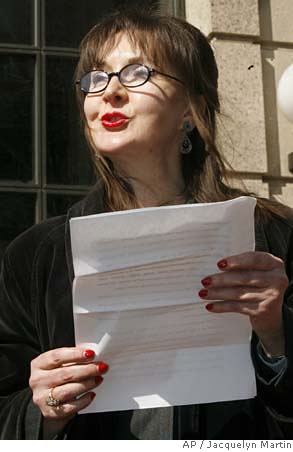
Dr. Harlan Kenneth Ullman

Madam Deborah Jean Palfrey

AP photo -Jacquelyn Martin


This hot story has been sizzling in the corporate media for the last 2 weeks - all the way from the"respectable" media to the porn sites. It's the brand, spanking new DC sex scandal. The government and corporate media served up Randall Tobias as Madam Palfrey's first victim. He was the head of foreign aid programs for the Bush regime who quit his job after the media revealed his name as a client of Madam Deborah Jean Palfrey's prostitution ring in Washington DC. Palfrey is accused of running her $400/Hr prostitution ring for over 13 years in Washington from her home in Vallejo, California. The ring has employed over 130 women. She's also been charged with a multiple-count racketeering and money-laundering indictment.

Yes, it's a bit tiresome, these crusty old politicians getting caught with their pants down again in the midst of carrying on the business of the world's "superpower". But there are a few trysts in this road that make it a little more interesting. The corporate media put Tobias on the block first but he wasn't the first to be named by Madam Palfrey.

According to court documents, Dr. Harlan K. Ullman was the first name provided to authorities by Madam Palfrey. It's little wonder if you've never heard of him. Harlan likes to work in the background and based upon our lengthy search for his photos, he appears to be a little camera-shy too.

Who is Dr. Harlan K. Ullman?

Mr. Shock & Awe

Ullman, Mr. "Shock and Awe" himself, is one of the Neoconservatives who planned the U.S. invasion of Iraq. He's a retired U.S. Naval Commander who is known as the mastermind behind the U.S. "Rapid Dominance" strategy used in the bombing of Iraq in April, 2003. Indeed, he coined the phrase, "Shock and Awe". He is a senior adviser at the Center for Strategic and International Studies (CSIS) and the Atlantic Council. One of his books, a product of the National Defense University, promotes the doctrine of shock and awe. It technically is known as "rapid dominance" and is a military doctrine based on the use of "overwhelming decisive force", "dominant battlefield awareness", "dominant maneuvers", and "spectacular displays of power" to "paralyze an adversary's preception of the battlefield and destroy its will to fight".

"Bloodless Victory"

According to Global Security, "Mr. Ullman says shock and awe and its use of targeted, finely orchestrated attacks on specific military targets is the way to take out the enemy leadership, which can lead to an early, relatively bloodless victory. He says we'll know soon enough whether this will happen with Operation Iraqi Freedom."

"Incomprehensible Destruction"

In his March 20, 2003 Incomprehensible Destruction, Sandy Tollman described Ullmann's plans for Iraq:

"The Pentagon's plan for these first 48 hours of strikes on Baghdad are expected to incorporate a military doctrine known as "Shock and Awe": an estimated 3000 bombs and missiles, nearly one every minute, streaking down on the Iraqi capital. The doctrine is fathered by Harlan Ullman, a veteran military strategist whose 1996 book, "Shock and Awe: Achieving Rapid Dominance", recommends 'nearly incomprehensible levels of massive destruction" to achieve an 'overwhelming level of Shock and Awe against an adversary on an immediate or sufficiently timely basis to paralyse its will to carry on'. The impact of the current strikes can be better understood through a close reading of the book, which cites the atomic bombs on Hiroshima and Nagasaki as successful past examples of "shock and awe".

"It suggests civilian casualties will be far higher than Pentagon officials had previously calculated. Moreover, it appears administration accusations against Saddam Hussein using "human shields" may be part of a campaign to shift the blame for a large civilian death toll in Iraq. And, it raises serious questions over the strategy of democracy by invasion: after such devastation, how would American troops be seen as liberators? In their 1996 book, published by the National Defence University, Ullman and co-author J P Wade lay the groundwork for the current Pentagon thinking on Iraq. The paralysis of the enemy's will, they write, would render him 'totally impotent and vulnerable' through 'total mastery achieved at extraordinary speed and across tactical, strategic, and political levels', which would 'destroy the will to resist'."

The "Hiroshima effect"

Veteran Journalist John Pilger wrote 3 months before the invasion of Iraq:

"A military strategist named Harlan Ullman told American television: 'There will not be a safe place in Baghdad. The sheer size of this has never been seen before, never been contemplated before.' The strategy is known as Shock and Awe and Ullman is apparently its proud inventor. He said: 'You have this simultaneous effect, rather like the nuclear weapons at Hiroshima, not taking days or weeks but minutes.' What will his "Hiroshima effect" actually do to a population of whom almost half are children under the age of 14? The answer is to be found in a 'confidential' UN document, based on World Health Organisation estimates, which says that 'as many as 500,000 people could require treatment as a result of direct and indirect injuries'."

A Member of the Club

Unlike Paul Wolfowitz, Richard Perle, Douglas Feith and the other neoconservatives who planned the invasion and occupation of Iraq, Harlan Ullman maintains a low profile when questions about Palestine are raised. Middle East Realities (MER), an analytical website on the state of Israel has this to say about Ullman:

"When it comes to situation with Israel Ullman treads very lightly. He hardly mentions Israel until near the end; and then he does so very much in the Kissinger/Brzezinski mold never even mentioning aid and arms to Israel or the Israeli/Jewish lobby; only hinting very obliquely at the need to bring Israel into line even with U.S. policies and interests while putting most of the burden on the occupied Palestinians and the Arab regimes to do what they are told and to accept whatever they are offered."

Indeed, Ullman's only strong opinion Palestine and Israel found in our extensive review of his writing was this:

"This is not a question of who is right and who is wrong. This is a question of preventing that part of the world from exploding. So that will require very aggressive, very forceful diplomacy in a country which is very much pro-Israel, in which Congress is very pro-Israel and in which the public is and so that is going to require a statement and a position which I think is going to be very difficult, if not impossible for the administration to be able to assume. So therefore while you say there is an opportunity, and I agree, the sort of aggressive dynamic diplomacy may be beyond any administration, and particularly this one."

"The harder they come"

Harlan K. Ullman,
Member of CSIS

No, there can be no doubt that he is a solid member of the neocon club that carefully laid the plans for the U.S. invasion dating back at least to the early-nineties. His bio reveals he is a senior fellow and director of the Center for Strategic and International Studies (CSIS); director of the Political-Military and Strategy Programs; consulted with a number of Fortune 100 companies; elected to the board of the Wall Street Fund; formed his own company, the Killowen Group, a consulting firm with broad financial interests; served on the boards of several related investment and venture capital companies with holdings in Asia; a senior partner and vice chairman of two companies in the high-technology area; currently chairman of the advisory board of two companies engaged in Smart Zone Management and homeland security; chairs the Senior Seminar at the Center for Naval Analyses; serves at the National Defense University and is on the Senior Advisory Board of the U.S. European Command and the NATO Defence College." The CSIS provides "Strategic Insights and Policy Solutions" to the U.S. government.

"The harder they fall"

Now it is Mr. Ullman who is experiencing his own little piece of "shock and awe" by the bomb Madam Palfrey dropped when she named him first and called him one of her "regular customers". Ullman's pain is of course, not to be compared with the brutality he inflicted upon the good people of Iraq; sufficient payback to this "gentleman" will forever be an impossibility.

Ullman denied being a client of Madam Palfrey
Ullman refused to talk about the Palfrey's revelation last week when he spoke with The Associated Press in a phone call. All he had to say was, "the allegations are beneath the dignity of a comment." Bush Whitehouse fake journalist and male prostitute, Jeff Gannon joined Harlan Ullman for the lunchtime "Q&A Cafe discussion series" at Nathan's Restaurant in Georgetown according to The Examiner in Washington. When asked about his use of Palfrey's prostitution service, Ullman told interviewer Carol Joynt: “The allegations are outrageous and do not dignify a response,” Ullman also told the crowd at Nathans, “My wife and I view this as most bizarre. ... It’s like being in a bad Franz Kafka novel.” When Joynt asked him if he'd ever met Palfrey, he replied, "absolutely not,” adding “I have no idea why lightning happened to strike me.” - The term, 'Kharma' comes to mind.

On March 22, 2007, the elitist The Denver Forum headlined, "The Denver Forum Proudly Presents Dr. Harlan Ullman" when Ullman spoke on "America's Promise Restored: Preventing Culture, Crusade and Partisanship from Wrecking Our Nation". The Corporate Sponsor of the event was Lockheed Martin.

Madam Palfrey says Ullman is "only one of dozens of such officials" who will be shocked and awed. Palfrey says she will expose dozens of officials and that she has "46 pounds of phone records that could expose thousands more clients" - as many as 10,000. Her attorney said that they turned the phone records over to ABC, seeking help in identifying her clients who might be called as witnesses. A search of ABC's website reveals many reports on Tobias, but only one report on Arlan Ullman. These reports are frequently updated on ABC and subject to change. Speaking of Tobias, Palfrey is quoted on ABC's website, "I'm sure as heck not going to be going to federal prison for one day, let alone four to eight years, because I'm shy about bringing in the deputy secretary of whatever. I'll bring in every last one of them in if necessary".

Perhaps Harlan Ullman can take a little solace in knowing that he is not alone among those names given up by Madam Palfrey. Perhaps he can even find some comfort in the damage control exercised by the corporate media. But he will never find refuge from a world that knows about the millions whose lives he has destroyed and all the misery and death his mind has wrought for generations to come.

© Copyright 2007 by AxisofLogic.com

Biography and additional essays by Les Blough

Tuesday, May 1, 2007

Neocons love Obama

Obama's foreign policy speech

by Jerome a Paris
jeromeguillet@yahoo.fr

Tue May 1st, 2007 at 08:42:00 AM EDT


Barack Obama's speech on foreign policy is attracting strange supporters:

Robert Kagan: Obama the Interventionist

Andrew Sullivan: The Re-Branding of America

The Washington Post Editorial Board: Mr. Obama's Worldview - An encouraging start to talking policy

And they are quite clear as to why they love what they heard:

America must "lead the world in battling immediate evils and promoting the ultimate good." With those words, Barack Obama put an end to the idea that the alleged overexuberant idealism and America-centric hubris of the past six years is about to give way to a new realism, a more limited and modest view of American interests, capabilities and responsibilities.

(...)

Obama talks about "rogue nations," "hostile dictators," "muscular alliances" and maintaining "a strong nuclear deterrent." He talks about how we need to "seize" the "American moment." We must "begin the world anew." This is realism? This is a left-liberal foreign policy?

Kagan is literally gleeful. More military, more interventionism, more "values", more preemptive attacks. Sullivan is not far behind:

Obama's speech (...) is emphatically not against the use of military force when necessary; it is emphatically pro-military in its call for many more troops. On the critical issue of Iraq, Obama has taken a stand - a clear one for withdrawal, with the possibility of a strike-force over the horizon. This is a very difficult call, and the timing and execution of withdrawal will be dispositive. But one core strength of Obama's candidacy is that he got this war right when many of us got it wrong. He deserves more of a listening than many of us do.

Ditto with the Washington Post:

As an opening statement of Mr. Obama's philosophy, there is much that we found significant -- and encouraging -- in the Chicago speech. Acknowledging that "many Americans may find it tempting to turn inward" after the failures in Iraq and elsewhere, the senator quoted Franklin Roosevelt in saying the United States nevertheless must continue to "lead the world in battling immediate evils and promoting the ultimate good." Mr. Obama called for a sizable increase in the size of the Army and for the reinforcement of NATO forces in Afghanistan. He said that "no president should ever hesitate to use force -- unilaterally if necessary -- to protect ourselves and our vital interests when we are attacked or imminently threatened."

To be fair, the WaPo does see him as a bit weak, or at least uncommitted, on the War on Terror:

Still, Mr. Obama ought to explain more directly how he views jihadism. Is it an ideological challenge comparable to communism and fascism, as Mr. Bush contends, or merely an esoteric dogma held by bands of criminals, like the anarchism of the early 20th century? Is terrorism the central threat of the early 21st century, or, as some Democratic strategists argue, merely one of a panoply of challenges that include global warming, pandemics and the rise of China?

And when you read the speech, it's hard not to note the multiple references to the military, how it must be supported, increased in size, and used, preemptively if necessary (as quoted above). Even his bits about diplomacy focus on military alliances (NATO is lenghthily mentioned, but not the EU), and his examples of how the US should conduct "hearts and minds" operations in various countries are, again, run by the military.

The WaPo's note that he does not explicit his position on the "war on terra" is strange, considering that most of the places mentioned in his speech are in the Muslim world, and most of the threats seem to come from there. The only non-Muslim threat he also focuses on is loose Russian storage of nuclear material, but that's also part of the 'war on terra' - indeed, it is its signature threat, the one that has been used to justify most of the excesses of the past few years, and the attacks at home on civil rights - let us protect you from the mushroom cloud.

Basically, his proposal is to accept the goals of the George Bush administration, use the same tools, but run the policy competently and less boneheadedly. To his credit, he is not proposing that for Iraq itself, which he explicitly states the US must leave (well, except for a "few troops"), but in the wider picture, it's still about bringing democracy to others, and in particular to the Muslim world, and about having the biggest, most ass-kicking military force in the world.

:: ::

Now, in the interest of fairness, I'll add this second quote from Andrew Sullivan:

The simple existence of Obama as a new president in a new century would in itself enhance America's soft power immeasurably, just as a clear decision to leave Iraq would provide much greater leverage for diplomacy and military force in a whole variety of new ways. Obama would mean the rebranding of America, after a disastrous eight years. His international heritage, his racial journey, his middle name: these are assets for this country, not liabilities.

This is the hope that with a decent, competent president, things will go back to normal, the idea of the USA will shine brightly again, and it will be able once again to fulfill its international policy objectives by leading instead of by bullying.

Barck Obama says it thus:

But if the next President can restore the American people’s trust – if they know that he or she is acting with their best interests at heart, with prudence and wisdom and some measure of humility – then I believe the American people will be ready to see America lead again.

They will be ready to show the world that we are not a country that ships prisoners in the dead of night to be tortured in far off countries. That we are not a country that runs prisons which lock people away without ever telling them why they are there or what they are charged with. That we are not a country which preaches compassion and justice to others while we allow bodies to float down the streets of a major American city.

That is not who we are.

The problem is that yes, this is precisely who America is today in the eyes of most of the world - whether the genuinely aghast or the hypocritically gleeful to have a kettle to hide their pot.

Finally stopping the most atrocious behaviour will not eliminate the fact that it took place, that it took place for a long time, and that it was supported by a surprisingly high proportion of the population - and an higher, and even more terrifying, proportion of the punditry, which should have known better than fall for the nasty propaganda and fearmongering of the Bush administration. These were policies of a big chunk of the elite in Washington, as kossacks all know (and despair about).

But I am also struck about Obama's description of the world as a source only of threats for America - most related to terrorism one way or another, with a nod to global warming. Opportunity is only what America can bring to the world, not the other way around. In a word, just like with the current administration, the world has only headaches to bring to the USA. Thus the need for a big army to wage two wars at the same time. Thus the need to be everywhere to engage would-be terrorists before they actually turn into ones. Thus the need to lead alliances. The methods will be different: the relevant countries will need to be convinced rather than coerced, but the only goal is still to get them aligned behind US objectives.

And yet America will not be in a position to lead until it has atoned. You don't eliminate such a stain, such a loud precedent (which many others will be all too happy to use as an excuse for their own abuses for a long time) just by not doing it anymore. The credibility to talk about values, about democracy, about cooperation, about peace - just isn't there. And talking about a stronger military, more interventionism in other countries (even of the humanitarian or modest kind), and bringing the American model back to the world is not going to work, because it is yet more meddling.

Oh, sure, the weak and weasely leaders of Europe will be all too happy to be seduced rather than bludgeoned into submission, and the 'international community' will be all too happy to pretend that adults are in charge again, and that we can all go back to normal. Cooperation between secret services. Joint military/humanitarian missions (like the failing Afghanistan occupation, maybe?). More police coordination - with more uncontrolled data swapping between governments? After all, there are still evil terrrists out there. We cannot let the guard down too much. But at least we are all defenders of human rights and democracy again, for real this time.

Nah. As the quote from Obama's speech above suggests, this is a discourse for Americans, not for the rest of the world. They don't get to elect their overlords.

:: ::

Maybe it is too much to expect anything different, and, without the Bush/Iraq precedent, the speech would be mostly uncontroversial. After all, anything less intervention-prone would be shot down as "weak", "defeatist", etc... the whole gamut of Republican smears. The fact is that political discourse is still dominated by the need to appear 'strong' and to support the military without any restriction, and by the conviction that it is America's absolutely legitimate right to intervene in any other country's affairs because it is a model for the world and if only everybody else were in its image, all would be well.

Peddling to these deep strands in America's psyche may be smart politics, but it is not going to change policy - and current policy is creating more threats by the minute, via the preference for 'might is right' logic, the refusal to contemplate any leadership by example where it matters (energy consumption and carbon emissions - Obama only talks about demanding "equal efforts" from the USA and much poorer China or India), and the bizarre need to turn a small band of nasty gangsters with grievances into an apocalyptic threat.

So yeah, I understand why the neocons love Obama. He's not really challenging the reckless policy logic they have successfully instilled in your govenrment. Getting out of Iraq is not a proof of sanity, it's just an absence of proof that you are insane or deluded or both. That this is seen as progress only goes to show how low the standards have be brought down by this administration.


Be sure to see the comments section!

George Tenet on the staircase with the neocons

In his book and on TV, former CIA Director George Tenet remembers all the things he should've said before we invaded Iraq but didn't.

By Juan Cole

Apr. 30, 2007 | The French call it "the spirit of the staircase" (l'esprit d'escalier), the clever reply to someone that comes to you on your way up to the bedroom after a cocktail party. In his new book, released Monday, former CIA Director George Tenet has delivered himself of hundreds of pages on the staircase, imagining what he should have said or could have said to Richard Perle, Dick Cheney, Condi Rice and the other neoconservatives who marched the country to war in Iraq using the pretext of Sept. 11. In his April 29 interview with "60 Minutes" touting the book, Tenet came across as a spectacularly tragic Walter Mitty, daydreaming about how things would have been different if only he had spoken up, if he'd only been a James Bond-style spymaster instead of a timid, fawning bureaucrat. But of course, when it really mattered, at the critical juncture of his seven-year tenure as CIA chief, Tenet said nothing.

Tenet has revealed for the first time that he encountered Pentagon advisor Richard Perle on the day after the Sept. 11 attacks. As Tenet recounted the story on "60 Minutes," Perle "said to me, 'Iraq has to pay a price for what happened yesterday; they bear responsibility.'" Tenet told interviewer Scott Pelley that he was startled at the allegation. "It's September the 12th," said Tenet. "I've got the manifest with me that tells me al-Qaida did this. Nothing in my head that says there is any Iraqi involvement in this in any way, shape or form, and I remember thinking to myself, as I'm about to go brief the president, 'What the hell is he talking about?'"

Is that really what Tenet should have been thinking to himself? Just, "What the hell is he talking about?" Perle was then the chairman of the civilian Defense Policy Board, which had great influence over Pentagon policy, and he was intimately linked to Paul Wolfowitz and Douglas Feith, the No. 2 and 3 men at the Department of Defense. He was also close to Cheney and to the latter's chief of staff, I. Lewis "Scooter" Libby. Perle had coauthored with Feith and others a 1996 white paper for Israeli politician Bibi Netanyahu and his right-wing Likud Party, advocating a war against Iraq. Perle believed that the Saddam Hussein regime posed a dire threat to Israel and that overthrowing it would enhance Israel's security. If Tenet had been as street savvy as he likes to pretend -- what with being a Greek from Queens and all -- he should have been thinking, "Aha! So that is how the neoconservatives are going to play this thing. How can I head them off at the pass?"

Tenet's experience was nearly identical to that of former terrorism czar Richard Clarke. In his own "60 Minutes" interview three years ago, and in his 2004 book, "Against All Enemies," Clarke said that he met Defense Secretary Donald Rumsfeld on Sept. 12, 2001, and Rumsfeld was pushing for an attack on Iraq in response: "We have to bomb Iraq," he is alleged to have said. Clarke was so surprised that he said he at first thought Rumsfeld was joking.

Tenet encountered the same skepticism or unconcern about al-Qaida in high Bush administration officials as had Clarke. He confirmed that the CIA had ongoing covert operations in Afghanistan from 1999, but that he could not get the go-ahead from either President Clinton or President Bush to attempt to overthrow the Taliban and kill or capture Osama bin Laden. He maintains that in the summer of 2001, he sought a meeting with National Security Adviser Condoleezza Rice at which he presented a briefing. As he recalled to "60 Minutes," "Essentially, the briefing says, there are gonna be multiple spectacular attacks against the United States. We believe these attacks are imminent. Mass casualties are a likelihood." He told "60 Minutes" that his message to her was: "We need to consider immediate action inside Afghanistan now. We need to move to the offensive." Rice has denied that she received any such specific information or suggestions from Tenet.

In his interview on April 29, Tenet alleged that Rice delegated the issue of immediate action in Afghanistan to "third-tier officials." When pressed as to why he did not go straight to the president, Tenet implied that he did not have the ability to put things on Bush's agenda, while Rice did. In the cliquish Bush White House, he was perhaps not the insider he had thought he was. Or perhaps he did not want to risk Bush's ire and was pressing Rice to take the heat for urging on the lackadaisical Bush a covert operation he had already once refused to consider.

CBS's Pelley implicitly criticized the ex-CIA chief for not pressing Bush on his innuendo about Saddam Hussein and al-Qaida's being in cahoots. Pelley read Tenet a passage from a Bush speech: "The president, in October of 2002, quote: 'We need to think about Saddam Hussein using al-Qaida to do his dirty work.' Is that what you're telling the president?" Tenet shot back, "Well, we didn't believe al-Qaida was gonna do Saddam Hussein's dirty work."

Pelley pressed the point: "January '03, the president again, [said] quote: 'Imagine those 19 hijackers this time armed by Saddam Hussein.' Is that what you're telling the president?" Tenet denied ever suggesting a link between 9/11 and Iraq to Bush, and said the connection was nonexistent. "In terms of complicity with 9/11, absolutely none," insisted Tenet. "It never made any sense. We could never verify that there was any Iraqi authority, direction and control, complicity with al-Qaida for 9/11 or any operational act against America. Period."

Among Tenet's major targets is Vice President Dick Cheney. Three years after leaving the CIA, Tenet finally seems eager to take on the stovepiper of intelligence, now that he is a widely disliked lame duck. Cheney, of course, was among the major proponents of alleged links between al-Qaida and Saddam. Now Tenet complains that Cheney kept alleging things for which there was no good evidence.

Prior to the invasion of Iraq, in his speech at the Veterans of Foreign Wars' 103rd National Convention on Aug. 26, 2002, Cheney said, "We now know that Saddam has resumed his efforts to acquire nuclear weapons ... Many of us are convinced that Saddam will acquire nuclear weapons fairly soon." In fact, Tenet says now, the CIA estimate was that even if Saddam had such a program, it was years away from success. Cheney concluded, "Simply stated, there is no doubt that Saddam Hussein now has weapons of mass destruction."

Tenet reports having been deeply disturbed by the speech, which went substantially beyond what the CIA could certify as factual. But he does not appear to have weighed in at that time. Bush administration officials were allowed to invoke the phantasmagoric mushroom cloud again and again, and members of Congress have repeatedly said that the threat of Saddam's nukes persuaded them to vote for the war. Six months after Cheney's speech to the VFW, on the eve of the invasion itself, Tenet finally was able to intervene. The New York Times, which got hold of an advance copy of Tenet's book, revealed on April 27 that Tenet nixed a Cheney speech "because its claims of links between al-Qaida and Iraq went 'way beyond what the intelligence shows.'" Tenet said that he went to Bush on the issue, saying, "Mr. President, we cannot support the speech and it should not be given."

On that occasion, Tenet won and Cheney was reined in. Surely, however, it hardly mattered at that point, since Cheney's propaganda technique of linking Saddam to bin Laden had been intended to foment a war with Iraq and the war was on. It is rather pitiful that Tenet must now dredge up this minor victory, as he daydreams on the staircase about stopping the Iraq war in its tracks by shooting down Cheney's lies.

In that same speech to the VFW, Cheney addressed criticisms of the looming Iraq war: "Another argument holds that opposing Saddam Hussein would cause even greater troubles in that part of the world, and interfere with the larger war against terror. I believe the opposite is true. Regime change in Iraq would bring about a number of benefits to the region. When the gravest of threats are eliminated, the freedom-loving peoples of the region will have a chance to promote the values that can bring lasting peace. As for the reaction of the Arab 'street,' the Middle East expert Professor Fouad Ajami predicts that after liberation, the streets in Basra and Baghdad are 'sure to erupt in joy in the same way the throngs in Kabul greeted the Americans.' Extremists in the region would have to rethink their strategy of Jihad. Moderates throughout the region would take heart. And our ability to advance the Israeli-Palestinian peace process would be enhanced, just as it was following the liberation of Kuwait in 1991."

No longer concatenation of illogical, wishful thinking, appeals to false authority, inappropriate analogies and arrogant ebullience has been enunciated since the mass political movements of the 1940s.

Tenet reveals that the CIA voiced substantial dissents from Cheney's "end of history" utopia. On April 27, the Associated Press reported that the book describes how CIA analysts prepared a briefing book with some worst-case scenarios for the invasion of Iraq. The books were distributed to high-ranking Bush officials in early September 2002, seven months before the invasion, and reviewed at Camp David. The scenarios included "a surge of global terrorism against U.S. interests fueled by deepening Islamic antipathy toward the United States"; "regime-threatening instability in key Arab states"; and "major oil supply disruptions and severe strains in the Atlantic alliance." Tenet, with his typical refusal to be confrontational, will not call these utterly prescient and perfectly correct scenarios "predictions" and will not say the obvious, that they proved the CIA right. Could he not just quote Cheney's VFW speech and point to the contrast between the vice president's fantasy world and the real one that his analysts inhabited?

Tenet comes across as a toady who could never stand up to the powerful. But he could order people less powerful than himself, like the helpless prisoners of his war on terror, to be tortured. His subsequent pitiful denial that he ever commanded torture, at the same time that he clearly was attempting to justify it, recalls all the worst excesses of the administration he enabled. Some elements of petty revenge on the perpetrators for having so humiliated Tenet with their sneak attack peek out from the edges of his righteous anger. There are times when the would-be James Bond seems more like Goldfinger, he of the laser between the legs.

Even John McCain, among the few remaining Iraq hawks, is now lambasting Tenet for his willingness to "waterboard" his captives. The senator told Fox News on April 29, "I don't care what George Tenet says. I know what's right. I know what's morally right as far as America's behavior." He observed, "Look at the war in Algeria. Look, the fact is if you torture someone, they're going to tell you anything they think you want to know. It is an affront to everything we stand for and believe in ... We cannot torture people and maintain our moral superiority in the world." All you have to do is listen to that voice, the voice of a former POW who was himself tortured, to hear the real America and to realize how mealy-mouthed Tenet's performance really was.

Much of the reporting about the book and the interview has focused on Tenet's feeling of betrayal over the use to which Cheney and Rice later put his comment that presenting the case for an Iraq war to the American public would be a "slam-dunk." He resented the White House leaks that made it appear that he had urged a war on the grounds that the war itself would be a cinch, and the implication that his "slam-dunk" comment is what finally decided the president on his course of action. Tenet's outrage is outrageous. Why was he alleging that a good case could be made for a war that he now says he did not believe in? Why was he selling a war that, all these years later, he claims he believed was a distraction from the important struggle against al-Qaida?

In the end, Tenet exhibits all the symptoms of an abused spouse. He praises Bush and even has good things to say about Cheney. He never could pick up the phone and call the police in the midst of being beaten up. He never cared enough about the fate of the country to stand up and say that the country was being driven to war on the basis of obvious falsehoods and a tissue of lies. Even now, his high dudgeon concerns affronts to his own reputation, and that of his agency, rather than the deaths of more than 3,300 U.S. troops and hundreds of thousands of Iraqis. Some of his last words in the "60 Minutes" interview were among the most revealing, but not in the way he implied. "You know, at the end of the day, the only thing you have is trust and honor in this world. It's all you have. All you have is your reputation built on trust and your personal honor. And when you don't have that anymore, well, there you go." You can imagine him mumbling those words over and over again as he walks up the stairs to go to bed.

Foreign policy challenge: see world as it really is

Published: 04.30.2007
ONLINE EXCLUSIVE

ROBERT ROBB

The neoconservative hubris that the United States can and should reshape the world has been a casualty of the Iraq war, both substantively and politically.

The practical limitations on the ability of the United States to direct the destiny of other peoples and cultures, and the cost of such ambitions, have been exposed.

Nevertheless, the three leading Republican candidates for president in 2008 - Rudy Giuliani, John McCain and Mitt Romney - cling to some version of the neoconservative vision.

This gives Democrats the chance to forge a new direction and consensus on foreign policy. However, if Barack Obama's speech last week to the Chicago Council on Global Affairs is illustrative, and it probably is, they aren't really up to the task.

The foreign policy challenge for the United States is figuring out how to operate in a world less and less interested in U.S. leadership.

Europe already has an economy roughly as large as that of the United States. The major Asian-Pacific economies (Japan, China, South Korea, India, Australia and Taiwan) are now about three-quarters as large. So, while obviously still a very important market, the United States is no longer a dominant economic force.

The United States does still have the only military with truly global reach. However, this yields considerably less influence than it used to, particularly after Iraq.

For the most part, other global powers see the U.S. military as a force not so much to be feared, as to be harnessed for sanctioned international missions or in response to international calamities, such as tsunamis and earthquakes.

In his speech, Obama acknowledged that the willingness to accept U.S. leadership has waned. However, he seems to think that it is just because George Bush is such a boor.

With nice and skillful American diplomacy, he maintains, the United Nations can be effective, the countries of Europe will spend more on defense, and NATO can assume more of the military burden.

There's no objective basis for this belief. The U.N. is structurally dysfunctional and its members like it that way. No amount of skilled diplomacy by the U.S. is going to overcome the lack of domestic support for increased military spending in Europe.

And Afghanistan has demonstrated that, while NATO may be useful for peace-keeping missions, it is ineffective as a fighting force.

The harsh reality is that if there are tough things that have to be done in the world, the United States is not going to have much company or support in taking them on.

Bush believes that, to protect the country against terrorism, the United States has to be an active agent of democratic change around the world.

Obama seems to believe that, to protect the country against terrorism, the United States has to be an active agent helping to provide clean water, food, medicine, shelter and education around the world. He would increase foreign and developmental aid to $50 billion a year and establish a $2 billion "Global Education Fund."

The track record on foreign aid is abysmal. Countries with sound governance don't need it. It doesn't do any good in countries without sound governance. Nor is there any indication that it can lead to sound governance, a conceit Obama shares with Bush.

Obama says he supports a strong military, but apparently wants to turn it into a sort of international WPA. He quotes with great approbation a Djibouti U.S. base commander who said that "our mission is at least 95 percent civil affairs."

According to Obama, the United States "must lead the world, by deed and example."
The essence of Obama's foreign policy perspective, then, is this: If the United States tries hard enough to do good and be nice, the rest of the world will be impressed and grateful and accept U.S. leadership.

That's not the world as it really is.

Obama's delusion, widely shared by Democrats, isn't nearly as dangerous as the neoconservative delusion still being served up by the Republicans. It's still a delusion, nonetheless.

Monday, April 30, 2007

Why They Fight

by Anne Williamson

Watching Paul Wolfowitz, exposed in a sex and corruption scandal involving fellow World Banker and private squeeze, Shaha Ali Riza, grappling for several weeks now to save his super-cushy job at the World Bank has brought to mind the infamous quote Ron Suskind teased from a neocon senior aid to George W. Bush, "We're an empire now, and when we act, we create our own reality...and you, all of you, will be left to just study what we do."

Regarding reality, Wolfowitz, it seems, has had to call in re-write (and not for the first time).

By requesting his resignation, the Bank's Board demonstrated to any clear-eyed neocon that they were not studying the correct material. Wolfowitz, instead of acting upon the Board's decision as he previously indicated he would, has hired lawyer-insider Robert Bennet to represent him before that same Board.

Wolfowitz knows the big script, history, clearly has him strategically placed at the World Bank, in control of $25 billion in lending per annum and holding a magic stick of "corruption charges" with which to prod borrowers and trim staff, thereby riding out the Bush administration's departure, especially with a second, possibly even a third, five-year appointment, thereby extending his own foreign policy impact well into the future.

Going forward, the job may prove only a fringe presence in the high-powered world of Washington policymaking, but for Wolfowitz, losing it would be a personal disaster. Bush's political clout is in decline, leaving little chance the president could deliver a comparable perch even if persuaded to expend some of his dwindling power trying. The man himself couldn't survive a hearing for congressional approval which the very best government jobs require, and he sure can't get himself elected. What to do? A sinecure at AEI? How very bleak.

Even were the deluded Wolfowitz to beat the unjustly-enriching-girlfriend-with-other-peoples'-money rap, his behavior in the breech insures he'll never salvage his job. (Today the ministers of the European Parliament have called for his ouster.) If the Bank were the corpse it deserves to be, it's president's current behavior would have it turning over in its grave.

Clumsily, Wolfowitz has attempted what he and his neocon pals managed to do to the Pentagon and the CIA, but unlike those weenies, World Bank staff fought back, proving the old saw, "The price of privilege is eternal vigilance." In an uncharacteristically noisy string of special meetings, memos, reports, internet message boards, chat rooms, public hissing displays and press leaks, they refused to be intimidated while their institution is made a shell and re-designed from within. No "Office of Special Plans Under Construction" sign on their premises!

What Wolfowitz wants – the re-politicization and militarization of the Bank on behalf of a neocon-inspired global imperium centered in Washington preferably no more than a short limo ride from his personal residence – is not what the 10,000 member World Bank staff want. Nor, it seems, is it what the majority of the184 other member nations of the World Bank want.

Just when the entire global gang was coming to town for the Spring Meetings, the damning details of Wolfowitz's years of living large spilled out in news reports along with his initial denials and, later, acceptance of the reported facts after a botched cover-up. Handing out territory and cash flows like a Mafia don, he saw to the girlfriend's interests, those of his favored defense department aides', along with his own, negotiating out-sized salaries, guarantees and privileges. In a nice Trotskyite touch, he further made the appointment of a Republican operative and White House pal as director of the Department of Institutional Integrity where, staff says, said agent is to function as Wolfowitz's personal spy on all of them.

A funny turn of events. Republican neocons pulled the congressional dogs off the international institutions just when the Republican Senate's Cox Committee was establishing the abject failure of both the Bank and the Fund in the Russian reform masquerade of the 1990s, which, in turn, threatened both institutions' future funding, possibly even their existence. Neocons, sensing the Republican 2000 victory for the White House, wanted both institutions along with the US bilateral foreign aid infrastructure available for their own use once they had control of the executive branch.

Lucky thing that – just when Iraq started to go south, James Wolfensohn's retirement from the Bank offered an ideal hiding place from an increasingly inquisitive congress and media. The candidate for the Bank's presidency did not require congressional approval, and traditionally the appointment has always been the American executive's. (How terrifying it must be for Wolfowitz to contemplate the current humiliation of Alberto Gonzales!)

Once installed, Wolfowitz decided to focus on Africa, a public relations success. Even now, it continues paying dividends as what support he has received to stay on at the Bank has mostly come from Africa. But as the Bank's very first priority Wolfowitz chose to expand on his predecessor's anti-corruption initiative.

The centerpiece of the policy worked out last September is a Voluntary Disclosure Program (VDP) under which firms, NGOs or individuals who work as contractors on Bank projects are to report their corrupt acts regarding Bank projects for the last five years. In return, the penitents receive confidentiality and the right to continue bidding on Bank projects, all of which actually immunizes wrong-doers while allowing the Bank to cover up its own negligence and/or political agenda.

Hmmm. Written confessions on file. Another nice touch that.

Practically speaking, the program is just dumb. Corruption is part of the organizing structure in the developing world. If you are opening a prenatal care center or a silver mine, doesn't matter which, and the local chief wants his palm greased to demonstrate to the tribe your desire to be part of the community, you are not going to waste the daily cost of labor, of maintaining site infrastructure, and of interest on business loans, to march back to the capital and file a complaint. You are going to darken that man's palm, viewing it not as a bribe but as a tax, and one with the advantage of being directly negotiated. Under Wolfowitz's plan, any rational expediency or opportunity cost could be labeled as criminal conduct.

Wolfowitz has cut off funds to Chad, delayed projects to Kenya, and ordered a stoppage of funds to the Congo and Ecuador (which expelled their in-country World Bank representative today) over various corruption issues and charges, which have mostly served to create confusion and resentment. Critics charge that his concerns regarding what are inarguably high levels of corruption in World Bank projects evaporated when considering lending for Iraq, Pakistan and Afghanistan. Money further flowed to the countries Wolfowitz once recruited to sign on to Washington's counter-terrorism agenda. In the same vein, he elevated nationals from Spain, from San Salvador, and from Jordan – all nations that strongly backed the US invasion of Iraq – to extremely sweet positions within the Bank hierarchy. In contrast, when Uzbekistan denied landing rights to American military aircraft he promptly suspended their Bank program.

By demonstrating that good things and huge streams of cash flow to those countries and individuals that sign on to U.S. aggressions, Wolfowitz is slowly laying the basis for a new exploitation, i.e. the option of contributing troops to US global adventures via an expanded Nato in return for grants. (Grants are flexible, they can be loaded with extraneous political conditions. Loans are precise, legal documents with troublesome consequences if defaulted.)

It might seem surprising but the bank has always had a problem with lending. It was never much of a force in the reconstruction of European industry. By the early '50s there was little demand for its lending, it should have been dismantled then.

Instead, to solve its problem, the Bank cooked up a new agency funded through the donations of wealthy nations that would subsidize credit at zero percent interest on 50-year loans! Thus was born the International Development Association (IDA) which is the funding that allowed the Bank to plunge into the developing world, where it has been disastrously wasting money and harming developing countries ever since, not to mention taxpayers, who are compelled to bail out the bankers cyclically.

The Bank is completely unnecessary. In a world in which central banks are pumping out money and global liquidity is at tsunami levels, there certainly is no need for preferential government-organized taxpayer-subsidized loans. The poor would have been much better served over the decades by arranging for loans on a commercial basis as the discipline required to fulfill standard obligations would represent an economic and political advance for a developing nation, the right of contract being essential to prosperity.

Currently the Bank is in an IDA donor drive, an every third year affair. Contributions are way, way down.

The U.S.'s 16% ownership of the Bank puts it in the institution's driver's seat. Wealthy countries are not eager to donate money for the as yet unknown specifics of what is now viewed as an alarming US foreign policy. Why should anyone sign on to possible future U.S. aggression indirectly through World Bank lending?

Wolfowitz's agenda puts at risk a very cozy world based on the post–World War II modus operandi in which dollar loans are extended to undeveloped and impoverished nations in order to grab control over their resources and governments. The main point is the loan, not the borrower's ability or commitment, but the lender's claim on national collateral. The corruption emerges from institutional action, action inherent in and according to the World Bank's design as a political lender masquerading as a humanitarian enterprise, and nothing effective can be done about it as long as the institution exists. Reform is not an option, only elimination.

For the well-positioned second-raters that people the Bank, there's no advantage in trading in a country club existence and perfumed reputation just to browbeat and bludgeon troops out of poor nations in return for dollar grants. It's so much more agreeable to posture as a helping-hand, hiding the nasty imperial bits in the loan covenants. True, the policies the loans require often lead to public riots, and to resource, land and territorial wars among their clients, but the mainstream media never connects the loans to their bloody consequences. At worst, details of the borrower's thievery leak out.

What's really at stake for staff is the richest, absolute best government plantation in the entire world. World Bankers, along with IMF, IFC and EBRD employees, enjoy a mem-Sahib lifestyle; tax-free six-figure salaries, foreign expeditions involving first-class travel, five-star hotels, generous per diems, lavish banquets, and – if one is obliged to "stay on" overseas for "mission" work – extensive local staff and personal aides, language tutors, tuition support for the children, numerous mandated vacations home per annum, residential rent subsidies, full insurance packages, diplomatic mail for those legally-dubious art acquisitions, the best address, and fancy invites.

If you are a foreign national lucky enough to escape your native backwater for an assignment in Washington, or London, or Paris, or Geneva – all the best places! – there is no treachery you wouldn't commit to stay in place. (The very best institutional reform scheme ever put forward was Christopher Fildes's suggestion to move the Bank's headquarters to Bangladesh.)

If you are a consultant, or an academic "adviser," you'll keep your honest opinions to yourself, and do the job, no matter how mad or useless. There's no way your university could, or your firm would, roll out a red carpet like the World Bank does.

If you are a Third World borrower and a government official and therefore advantageously-positioned to skim the loans and use the principal for purposes more useful to you and your continuing hold on power than to the nation, the World Bank is your literal lifeline. Without scads of dollars to hand out, an honest election or worse – open revolt – are always possibilities.

If you are a large, richly-endowed private corporation with an eye on the profit possibilities in some foreign hellhole, you'll play along, doing your bit to legitimize, publicize and generally support the Bank. After all, those giveaway loans may well be your critical leverage indirectly. Tit for tat. Loan for license.

Clearly, there's a lot of mouths to be fed. Luckily for the class of useless hors d'oeuvre eaters, there is China.

China is a rare creature in the World Bank firmament in that it is a large and paying customer, taking full advantage of the Bank's subsidized loans despite having an unprecedented $1.2 trillion in reserves. The income China represents to the World Bank is critical; already the Bank's sister institution, the IMF, an agency China does not patronize, is unable to make enough of a return on its international loans to pay its costs and is currently floating the idea of selling a portion of the Fund's contributed gold horde for cash to pay for their jobs and privileges.

The World Bank does not wish to be similarly indisposed.

There really wasn't much heat in the Shaha Riza story. After all, a couple of middle-aged parasites and public policy bores divvying up a big bag of other peoples' money while giving free reign to their shared delusions of bayonet democracy and the Middle East is somehow depressingly familiar.

But in the initial scandal data dump to the Washington Post on 12 April ("World Bank Chief's Leadership Role Called Into Question"), one sizzling fact leaked out apparently by mistake as it was never mentioned again in future reports. The maverick leak was an e-mail "noting that the bank had received a warning from China that it might halt future borrowings if Wolfowitz refused to curb anti-corruption investigations."

Wolfowitz is toast.

Alas, the Bank is not. Not yet, anyway.

If we must have a World Bank, and I am pained to write that it seems we must apparently right up until the very instant of our coming national insolvency, then let it be the redundant, inefficient, indulgent, corrupt waste currently on offer.

A militant, lean and mean neocon lending machine would be far worse.

April 28, 2007

Anne Williamson [send her mail] has been observing the international aid institutions since their arrival in Russia after the 1991 collapse of the Soviet Union. Currently she is expanding and revising her opus on the post-Cold War era, Contagion: The Betrayal of Liberty; the United States and Russia in the Post-Cold War World, to be published by Poor Richard's Press this coming autumn. She no longer lives in the United States. This article was originally published by Sanders Research Associates.

Copyright © 2007 LewRockwell.com