| May 4, 2007 |
The theory and practice of oligarchical "conservatism" |
| by Justin Raimondo |
| The Iraq war and the inquiry into its origins has provoked interest in a number of subjects formerly considered obscure, the discussion of which was once limited to the rarified aeries of academia and specialty journals. Some examples are neoconservatism, just war theory, and, most surprisingly, the theories of Leo Strauss, the philosophical avatar of a cynical Machiavellianism that promotes the idea of the "noble lie." As the disaster in Iraq unfolded, subjects once considered abstruse were introduced into the pages of the popular press, so that, at one point, we were treated to a long explanation of the doctrines of Strauss in the pages of the New York Times. As Jeet Heer put it in the Boston Globe, "Odd as this may sound, we live in a world increasingly shaped by Leo Strauss, a controversial philosopher who died in 1973. Although generally unknown to the wider population, Strauss has been one of the two or three most important intellectual influences on the conservative worldview now ascendant in George W. Bush's Washington. Eager to get the lowdown on White House thinking, editors at the New York Times and Le Monde have had journalists pore over Strauss's work and trace his disciples' affiliations. The New Yorker has even found a contingent of Straussians doing intelligence work for the Pentagon." This sudden interest was due to the unusual number of Straussians who had found their way into close proximity to the centers of power in Washington – an extraordinary number of Strauss's students (or students of his leading followers) were employed in and around the Bush administration, particularly at key points in the national security bureaucracy, as William Pfaff pointed out, including then- "Deputy Defense Secretary Paul Wolfowitz; Abram Shulsky of the Pentagon's Office of Special Plans, Richard Perle of the Pentagon advisory board, Elliott Abrams of the National Security Council, and the writers Robert Kagan and William Kristol." One can easily see how the concept of the "noble lie" fits neatly into the neoconservative scheme of things, and the run-up to the Iraq war is surely a textbook example of the Straussian method in action: an enlightened elite deceives the public into an action that must be taken, after all, for their own good. In this case, we were lied into invading and occupying Iraq, for reasons that had nothing to do with "weapons of mass destruction" and Saddam's alleged links to al Qaeda and the 9/11 terrorist attacks, both of which the promulgators knew to be lies, and yet reiterated ceaselessly. Since we are now permanently at war, the ideal atmosphere for a Straussian (or any authoritarian) to theorize in, this is the time for the War Party to come out in the open with its theory of government, which, in normal times, is dressed up as "peace through strength," and now comes out of the closet as "peace through dictatorship." Aside from rationalizing a regime based on lies, the Straussian method, and philosophy, is useful in other ways. The prominent Straussian Harvey Mansfield, a professor of government at Harvard, demonstrates his usefulness as a promoter of the regime's authority, and specifically the supremacy of the executive branch of government in wartime. Mansfield makes "The Case for the Strong Executive" in the pages of the Wall Street Journal, and it is an argument that constitutes a vital part of the intellectual blueprint for the dictatorship I wrote about the other day. Mansfield starts out with a paean to the incorrect and unfortunately near-universal conception of the Constitution as a "flexible" document, and the resulting reference to "the living Constitution" is one of those cliches that no one ever thinks to challenge – except when it's too late. When the tanks are already rolling through the streets, that is … Look: there is nothing "flexible" about the Constitution. It means precisely what it says, and its language is not in any way obscure or complex. Furthermore, I would note that every time someone is about to take away our liberties, or in some way circumvent the plain intent of the Founders, they inevitably preface it with odes to the Constitution's "flexibility." Balderdash! The Founders meant what they said, and said what they meant in plain and simple English, language that even a Harvard professor can understand. Yet, examining Mansfield's case for an executive dictatorship – and that is surely the intent of his piece – we see at work the old Straussian method of "reinterpreting" an author's clear intent to mean its exact opposite. Now it would seem that the Founders, being revolutionaries, and even libertarians of a sort (except for Hamilton), were intent on setting up a republic of freemen, that is, a form of government that was constitutionally limited and certainly had nothing to do with the royalism against which they had recently rebelled. Ah, but a Straussian can find "hidden" meanings that the rest of us are blind to, and Mansfield detects a built-in contradiction, a deliberate tension between "one-man rule" and the republican spirit that imbues the Constitution with – yes, an authoritarian streak: "Now the rule of law has two defects, each of which suggests the need for one-man rule. The first is that law is always imperfect by being universal, thus an average solution even in the best case, that is inferior to the living intelligence of a wise man on the spot, who can judge particular circumstances. This defect is discussed by Aristotle in the well-known passage in his ‘Politics' where he considers ‘whether it is more advantageous to be ruled by the best man or the best laws.' "The other defect is that the law does not know how to make itself obeyed. …There must be police, and the rulers over the police must use energy (Alexander Hamilton's term) in addition to reason. It is a delusion to believe that governments can have energy without ever resorting to the use of force. "The best source of energy turns out to be the same as the best source of reason – one man. One man, or, to use Machiavelli's expression, uno solo, will be the greatest source of energy if he regards it as necessary to maintaining his own rule. Such a person will have the greatest incentive to be watchful, and to be both cruel and merciful in correct contrast and proportion. We are talking about Machiavelli's prince, the man whom in apparently unguarded moments he called a tyrant." This is the theme of Mansfield's book, Taming The Prince, in which he asserts that the modern idea of the executive is merely the old Aristotleian portrait of a royal personage who exemplifies the right of the strong to rule over the weak. In our own time, we are unable to directly acknowledge this ancient legacy and so we mask it in the mythology of the Constitution. We cloak the royalist reality in the raiment of republicanism, and promulgate the myth that the executive is somehow the servant of the people. "The American Founders," Mansfield avers, had a different idea, because they "Heeded both criticisms of the rule of law when they created the presidency. The president would be the source of energy in government, that is, in the administration of government, energy being a neutral term that might include Aristotle's discretionary virtue and Machiavelli's tyranny – in which only partisans could discern the difference." Tyranny, discretionary virtue – whatever. It's all a matter of partisan, i.e. totally subjective, opinion. In any case, the cult of Strauss is built around the cult of the Leader, or the "wise man," as Mansfield puts it, the solo uno who sees beyond what ordinary citizens can perceive. Sure, he's driven by a relentless drive to achieve and maintain his own power, but this very ruthlessness is what gives a republic its "energy" and the ability to survive its own inherent fragility. "A free government" avers Mansfield, "should show its respect for freedom even when it has to take it away." This little aphorism, worthy of being carved in stone on the gravestone of the American republic, just about sums up the tone and content of Mansfield's panegyric to the "greatness" of the presidential office, and its necessary "expansion" in time of war – which means, in the neocon lexicon, from now on. Rights are not inherent, in the Manfieldian-Straussian universe, but purely conditional, and our condition today is one that cannot afford such luxuries. According to Mansfield: "In our time … an opinion has sprung up in liberal circles particularly that civil liberties must always be kept intact regardless of circumstances. This opinion assumes that civil liberties have the status of natural liberties, and are inalienable. This means that the Constitution has the status of what was called in the 17th-century natural public law; it is an order as natural as the state of nature from which it emerges. In this view liberty has just one set of laws and institutions that must be kept inviolate, lest it be lost. "But Locke was a wiser liberal. His institutions were ‘constituted,' less by creation than by modification of existing institutions in England, but not deduced as invariable consequences of disorder in the state of nature. He retained the difference, and so did the Americans, between natural liberties, inalienable but insecure, and civil liberties, more secure but changeable. Because civil liberties are subject to circumstances, a free constitution needs an institution responsive to circumstances, an executive able to be strong when necessary." I won't dispute Mansfield's reinterpretation of the Lockean position on natural rights, except that it resembles a Bizarro Locke, inverting the philosopher's defense of natural rights and limited government, and somehow managing to turn it into the manifesto of a super-centralism that the 17th century English liberal would recoil from in horror. This is typical of the Straussian method. Leaving Locke entirely out of it, however, let us look at the Mansfieldian theory of "civil liberties" as forever "subject to circumstances" – just like our "flexible" Constitution, and, of course, the "secure but changeable" Bill of Rights. In the Bizarro-Mansfieldian world of perfect "freedom," where "a free government should show its respect for freedom even when it has to take it away," there is no right to free speech, no right to assemble, nor, really, any rights at all, including the right to hold property: all of these are merely temporary privileges, and are particularly ethereal in wartime. Inalienable rights? Not if the President says otherwise. This is nothing less than a rationalization for a dictatorship. It is authoritarianism dressed up in seemingly "American"-sounding verbiage, a prescription for fascism just as surely as the rantings of Alfred Rosenberg or the polemics of Robert Brassillach. As John T. Flynn, the liberal-turned-‘Old Right' opponent of the New Deal put it: "When fascism comes it will not be in the form of an anti-American movement or pro-Hitler bund, practicing disloyalty. Nor will it come in the form of a crusade against war. It will appear rather in the luminous robes of flaming patriotism; it will take some genuinely indigenous shape and color, and it will spread only because its leaders, who are not yet visible, will know how to locate the great springs of public opinion and desire and the streams of thought that flow from them and will know how to attract to their banners leaders who can command the support of the controlling minorities in American public life. The danger lies not so much in the would-be führers who may arise, but in the presence in our midst of certain deeply running currents of hope and appetite and opinion. The war upon fascism must be begun there." Flynn, one of FDR's bitterest opponents, wrote these words in As We Go Marching, his indictment of a postwar America that had fought national socialism – and was beginning to fight Soviet totalitarianism as the book was published – but, he feared, would lose the fight against incipient authoritarianism on the home front. Flynn defined fascism in a way that was congruent with the rising Welfare-Warfare State, founded on the principle of Big Government at home and militarism abroad. "First let us state our definition of fascism," he writes: "It is, put briefly, a system of social organization in which the political state is a dictatorship supported by a political elite and in which the economic society is an autarchic capitalism, enclosed and planned, in which the government assumes responsibility for creating adequate purchasing power through the instrumentality of national debt and in which militarism is adopted as a great economic project for creating work as well as a great romantic project in the service of the imperialist state." What a near-perfect anticipation of our present state! He must have seen it in a dream. As an unpopular war reaches its horrific crescendo, and the President upholds his "right" to wage it in defiance of Congress and the popular will, the theoreticians of the new fascism – what Lew Rockwell trenchantly calls "red-state fascism" – are given ample space on the editorial page of the War Street Journal to make their case. Are the masses growing increasingly discontented with the "wisdom" of their rulers, who are, after all, by definition, their betters? Well then, let us endow the President with kingly powers, so he can disregard the "temporary delusions" of the people, as Mansfield puts it – such as, for example, the "delusion" that we cannot win the war in Iraq, and shouldn't have gone there in the first place – and let our glorious Leader and Commander-in-chief get on with the job. This, Mansfield avers, is true "greatness." Naturally he invokes the spirit of FDR, among others (Lincoln, the great "emanicipator," who jailed his opponents and closed down newspapers for "seditious" utterances, also gets Mansfield's strong endorsement). What is odd is that both Flynn and Mansfield are considered conservatives, men of the Right – and yet their political and moral stances could not be more adversarial. What kind of "conservatism" is it that extols the Leader Principle, disdains the Constitution and the concept of "rights" as inalienable, and openly calls for authoritarian rule in case of "emergencies"? Today we have an ostensible "conservative," Thomas Sowell, pining for a military coup in the pages of National Review, and, in the same magazine, Col. "Buzz" Patterson, author of War Crimes: The Left's Campaign to Destroy Our Military and Lose the War on Terror, opining that the Democratic party, and especially its congressional branch, is legally guilty of "treason," and ought to be punished for this crime forthwith. Mansfield articulates the theory, while Sowell and Patterson – along with the Anne Coulters and David Horowitzes of the neoconized "conservative" movement – exemplify the practical politics of red-state fascism. The American Right has come a long way from The Conscience of a Conservative. The legislative basis of the new autoritarianism – the "Patriot Act," the Military Commissions Act [.pdf], the growth of the national surveillance state – is underpinned by the Mansfieldian theory of presidential supremacy and the concept of the "unitary presidency" – in short, the Leader Principle, which is the foundation stone of the modern fascist edifice. Centered around imperialism and the push to expand its system over all or most of the earth, this "energetic" ideology employs the administrative and economic centralism that is the hallmark of modern American "liberalism," and the militarism and imperialism that is the hallmark of the modern "conservative," in a perfect synthesis of "left" and "right" that satisfies everyone and leaves the dissidents in the "far left" and "far right" margins. This is how our modern fascists can, with some justification, call themselves "centrists," and even "moderates." In the Bizarro World we seem to have fallen into, post-9/11 – when a rip in the space-time continuum, caused by the explosive power of the planes' impact on the World Trade Center, caused us to slip into another dimension – who will dispute their self-characterization? After all, in Bizarro World, up is down, truth is a lie, and "democracy" means rule by a self-appointed elite. A Straussian is perfectly comfortable with this universal inversion: as for the rest of us, we'll just have to get used to it. |
Friday, May 4, 2007
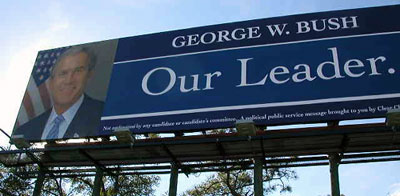
America's Coming Dictatorship


Monday, April 30, 2007
Living Under the Guillotine's Blade
April 27, 2007
One aspect of the drama playing out before you is exceptionally strange. No one is forcing the man to remain on his knees, with his head calmly resting on the block. He could get up and walk off the platform at any moment. Yet he doesn't. He appears to be entirely unconcerned about the fatal danger above him, the blade that hangs there with infinite patience, silently waiting for its moment. There are others watching this scene with you. Some of them, like you, shout out warnings to the man. Still he does not get up. You and the others have been unable to move the man, or to disable the blade. Only the man with his head on the block can save himself. He won't. He stays on his knees, with his head on the block. With every moment that passes, the rope holding the blade back weakens. You know, as the man himself knows, that the rope will break eventually.
Yet he stays there. Warnings continue to be shouted; he continues to ignore them. The rope frays still more. Some people in the gathered crowd finally leave. The tension had become unbearable to them. But you and a few others remain. Surely, you think, the man will get up eventually, before the rope breaks. Why would he remain there, when he knows that will mean his certain death? And still he doesn't move.
The minutes pass, and turn into hours. Nothing changes. The man remains in position. The blade waits. The only unknown is the precise moment when the blood will begin to flow, the moment when another life will be brutally destroyed, as so many have been destroyed before.
You feel compelled to remain, and to watch. You are unable to turn away. Death hangs in the air.
********************
This is how we live in America today. The final destruction of liberty, and of life itself, could begin at any moment. Yet we act like the man with his head resting on the block. We seem to believe there is nothing especially unusual in our circumstances, nothing that requires us to take action. Life goes on as it always did. Like the man under the blade, we could choose to alter our fate. We will not. We believe, as perhaps the man under the blade believes, that our situation isn't that bad; we'll be able to get through this, just as we always have. We forget all those who have gone before us, all those who have died bloody and painful deaths. But, we may tell ourselves, we are different from all those others. Their fate will not be ours, because we are special and unique. We forget that all the earlier victims thought the same.
Perhaps it is the case that the man with his head resting on the block isn't very intelligent. It is possible he doesn't understand that the rope holds the blade back, and that when the rope breaks, the blade will descend and cut through his flesh. At this moment in history, it is indisputably the case that Americans generally, and the political class and most of those who write about politics (including almost all bloggers), are not very intelligent. They appear to understand almost nothing about political principles, or how they operate. Gathering dangers hold no reality for such people. They will understand the guillotine's purpose only when the blade first touches their necks, and the blood finally gushes out. Yes, they will certainly comprehend the danger then, when all possibilities for action have been destroyed.
The man in my story has only one blade suspended above him; we have at least four blades hanging over us, any one of which could be fatal.
The first blade, probably the most dangerous one, is the Military Commissions Act. What is it that people fail to understand about this abomination? I know that I and others have explained its immense dangers and its fatal implications numerous times; perhaps we haven't explained it very well. But I don't know how to say it any more plainly than this:
There is no question that the Military Commissions Act, given the language it now contains, grants -- in principle -- full dictatorial powers to the executive. As I explained in the earlier essay, the executive and certain entities it controls can designate anyone, including any American citizen, as an "unlawful enemy combatant." That person can then be imprisoned for the rest of his life, with no recourse whatsoever. Period.The Democrats have proposed the "Restoring the Constitution Act," although its passage hardly appears to be a matter of great urgency to them. If they do not view the destruction of the foundation of liberty as a genuine emergency requiring almost instantaneous action, what would constitute an emergency? Beyond this, proposing new legislation to "fix" the original bill is precisely the wrong way to fight this battle, as I explained in "America, Now Without the Revolution":
...
The critical point is what, in principle, the grant of power includes. As noted, the grant is absolute: it includes everything. As I have pointed out, the determination of the Bush administration to achieve absolute power has been indisputably clear since shortly after 9/11. And this is hardly the first time that I and others have noted that the mechanisms for a complete dictatorship have now been put in place.
...
With proper preparation, and with the requisite understanding that freedom itself was imperiled, the Democrats could have achieved these aims. All of us would be forever in their debt. Surely liberty itself is worth such a battle, isn't it? But the Democrats did none of these things, so the bill passed. Thus, they share in the guilt and responsibility. The guilt and responsibility that accrues to the Democrats is not as great as that of the Republicans, but it is surely great enough. And when your freedom, and that of your family and friends, and that of every single one of us, is destroyed in this manner, how do you even go about measuring degrees of guilt? How do you say this failure is worse than that one? The bill passed. They all failed, Republicans and Democrats alike. In principle, torture was enshrined and liberty was destroyed.
...
Some argue that the Supreme Court will find the act, or at least certain key provisions, unconstitutional. That, too, is a hope, but I myself am far from certain that the Court will rule in such a manner. In any event, we do not know what the ultimate outcome will be as far as the judicial system is concerned.
So we are confronted with one stark certainty, opposed by fragile and uncertain future hopes. We know the Military Commissions Act destroys liberty at its very foundation. We do not know if this fatal injury will ever be ameliorated. The Act should have been stalled at the very least. It was not.
Destroying the very basis of liberty is not an event that occurs every day. Mark the date. Historians may well have cause to note it.
If we genuinely seek to walk the long road back to a constitutional republic, the Act must be repealed. It must be wiped from the books completely. Instead, the Democrats propose to enact another bill, "correcting" the errors in the first. Inevitably, this will lead to endless debates, in Congress, in the courts and everywhere else, about how the two bills should be construed in relation to each other. These debates and confrontations will go on for years -- and all the while, the Military Commissions Act will remain the law of the land, a law that destroys the very concept of law in terms of what it had once meant.But here is where stupidity enters the picture. Just as the man does not grasp the operation of the guillotine or the fact that, if he does not move, the blade will kill him, our political class (and most writers and bloggers) appear not to understand the profound dangers of the Military Commissions Act because of only one fact: its full powers have not yet been implemented. In an earlier essay, I quoted Jacob Hornberger on this point. Hornberger deconstructs two common objections to the statement of fact that the Executive now possesses full dictatorial powers. With regard to the second objection, he writes:
You do not "fix" evils of this kind. You obliterate them as required. It is required here. At long last, let the Democrats understand the nature of this battle, as I discussed it in the earlier essay. Let them educate themselves, other members of Congress, and the American public. Let them attempt to mobilize Americans to demand that the Act be repealed, on a scale and in a manner that cannot be ignored. All our political leaders endlessly praise those who give their lives in defense of liberty, as they should when it is true. (It is not true in Iraq.) If they are sincere in that praise to any degree at all, can't they fight a legislative battle to restore the basis of liberty? They are being asked to take up only intellectual arms. For God's sake, they can do it sitting down the entire time.
But, you say, Bush will veto legislation repealing the Military Commissions Act. I initially note that Bush is equally likely to veto any attempt to "fix" that Act. But if the Democrats waged the necessary campaign and enlisted a significant part of the American public on their side, then let him. He will stand alone, revealed as the enemy of liberty and civilization that he is.
"Well, then, where are the mass round-ups, and where are the concentration camps?"I went on to note:
Again, people who ask that type of question are missing the point. The point is not whether Bush is exercising his omnipotent, dictatorial power to the maximum extent. It's whether he now possesses omnipotent, dictatorial power, power that can be exercised whenever circumstances dictate it — for example, during another major terrorist attack on American soil, when Americans become overly frightened again.
I've made this point repeatedly over the last several years, and it is only a measure of the remarkably primitive quality of our national conversation that so many Americans seem incapable of grasping it.Hornberger's comments and mine on this issue were written before passage of the Military Commissions Act. Bush had asserted these dictatorial powers earlier and utilized them, but only very selectively. The Military Commissions Act codified those powers, and made dictatorship and torture the law of the land.
To put the point the other way, which will hopefully penetrate the wall of resistance erected by so many people: the only reason you aren't in a concentration camp right now is because Bush hasn't decided to send you to one -- yet. But he claims he has the power to do so -- and there are almost no voices of any prominence to dispute the contention. What is even worse than the loss of liberty is the fact that most Americans aren't even aware that the loss has occurred. If there are any national leaders who understand these issues and have the courage to fight for our freedom here at home, they ought to realize that the battle must be waged now. Given the hysteria that followed 9/11 -- and the hysteria that would certainly follow another terrorist attack in the U.S. of the same or even greater magnitude -- protesting against round-ups at that point would be entirely futile, and would come far too late.
But to watch the actions of our political class and to read most political writers, none of this requires urgent action. The guillotine has no reality for us; it will become solid only when we feel the touch of the blade. You may be certain of one fact: when powers of this kind are granted to political leaders, men and women prepared to use them in full will come along sooner or later, probably sooner in our case and almost certainly after another major terrorist attack within our own shores The round-ups will come, as will the concentration camps, as will comprehensive censorship. The executions without trial will come, as well. The torture is already here, and has been for some time.
The second blade is related to the first one; it could be fatal on its own, and it would certainly be fatal in conjunction with the Miitary Commissions Act. I will let one of the rare writers who grasps these dangers consistently, whether they are proposed and supported by Republicans or Democrats, explain it. In a new article, Jim Bovard writes:
The Defense Authorization Act of 2006, passed on Sept. 30, empowers President George W. Bush to impose martial law in the event of a terrorist “incident,” if he or other federal officials perceive a shortfall of "public order," or even in response to antiwar protests that get unruly as a result of government provocations.Note the crucial dynamic identified by Bovard, one I have noted on many occasions: the government is granted massive powers "for our own good," and to "protect us." An emergency arises, and the government abjectly fails to protect us. The failure is used to argue that the problem is that the government didn't have enough power, so it is granted still more expansive powers. Then the government fails again, at which point it is given still further powers. This has been the pattern in the United States since the late nineteenth century, as it has been the pattern in many other countries in the past. At every step, almost all politicians and writers cheer as the leviathan state grows, and as individual liberty is destroyed. The number of times this pattern can be successfully repeated depends upon how hungry for power the political class is, and how ignorant (or stupid, if you will) the public is. Our political class has a boundless hunger for power which will remain unsatisfied until its power is absolute, and the American public adamantly refuses to learn a single damned thing. Our road to Hell is open and unobstructed.
...
It only took a few paragraphs in a $500 billion, 591-page bill to raze one of the most important limits on federal power. Congress passed the Insurrection Act in 1807 to severely restrict the president’s ability to deploy the military within the United States. The Posse Comitatus Act of 1878 tightened these restrictions, imposing a two-year prison sentence on anyone who used the military within the U.S. without the express permission of Congress. But there is a loophole: Posse Comitatus is waived if the president invokes the Insurrection Act.
Section 1076 of the Defense Authorization Act of 2006 changed the name of the key provision in the statute book from "Insurrection Act" to "Enforcement of the Laws to Restore Public Order Act." The Insurrection Act of 1807 stated that the president could deploy troops within the United States only “to suppress, in a State, any insurrection, domestic violence, unlawful combination, or conspiracy.” The new law expands the list to include "natural disaster, epidemic, or other serious public health emergency, terrorist attack or incident, or other condition"—and such "condition" is not defined or limited.
These new pretexts are even more expansive than they appear. FEMA proclaims the equivalent of a natural disaster when bad snowstorms occur, and Congress routinely proclaims a natural disaster (and awards more farm subsidies) when there is a shortfall of rain in states with upcoming elections. A terrorist "incident" could be something as stupid as the flashing toys scattered around Boston last fall.
The new law also empowers the president to commandeer the National Guard of one state to send to another state for up to 365 days.
...
The story of how Section 1076 became law vivifies how expanding government power is almost always the correct answer in Washington. Some people have claimed the provision was slipped into the bill in the middle of the night. In reality, the administration clearly signaled its intent and almost no one in the media or Congress tried to stop it.
...
Section 1076 was supported by both conservatives and liberals. Sen. Carl Levin (D-Mich.), the ranking Democratic member on the Senate Armed Services Committee, co-wrote the provision along with committee chairman Sen. John Warner (R-Va.). Sen. Ted Kennedy openly endorsed it, and Rep. Duncan Hunter (R-Calif.), then-chairman of the House Armed Services Committee, was an avid proponent.
...
This expansion of presidential prerogative illustrates how every federal failure redounds to the benefit of leviathan. FEMA was greatly expanded during the Clinton years for crises like the New Orleans flood. It, along with local and state agencies, floundered. Yet the federal belly flop on the Gulf Coast somehow anointed the president to send in troops where he sees fit.
"Martial law" is a euphemism for military dictatorship. When foreign democracies are overthrown and a junta establishes martial law, Americans usually recognize that a fundamental change has occurred. Perhaps some conservatives believe that the only change when martial law is declared is that people are no longer read their Miranda rights when they are locked away. "Martial law" means obey soldiers’ commands or be shot.
...
Some will consider concern about Bush or future presidents exploiting martial law to be alarmist. This is the same reflex many people have had to each administration proposal or power grab from the Patriot Act in October 2001 to the president’s enemy-combatant decree in November 2001 to the setting up the Guantanamo prison in early 2002 to the doctrine of preemptive war. The administration has perennially denied that its new powers pose any threat even after the evidence of abuses—illegal wiretapping, torture, a global network of secret prisons, Iraq in ruins—becomes overwhelming. If the administration does not hesitate to trample the First Amendment with "free speech zones," why expect it to be diffident about powers that could stifle protests en masse?
The reaction to the first two blades on the part of politicians and most political writers is also the same: there is next to response at all. As Bovard notes, the president can declare martial law because of "natural disaster, epidemic, or other serious public health emergency, terrorist attack or incident, or other condition" -- which means he can declare martial law whenever he wants. Since we have a press that primarily acts as a handmaiden to the powerful and which, with very rare exceptions, transmits government propaganda to a degree that effectively makes it another branch of government, who would challenge the president's assertion of such powers? And we have seen the public's ready acceptance of grievous restrictions of freedom in the hysteria following 9/11, and that acceptance continues today. When is the last time you heard of anyone seriously protesting the government's idiotic search protocols at an airport, or objecting to any of the much more serious incursions into what had once properly been regarded as a citizen's zone of privacy? We have become a nation of whining, sniveling cowards. When we are sufficiently scared, and when the government tells us it acts only to "make us safe," we will do whatever we are ordered to do. If we ask any questions at all, it will only be much later, when the liberties we have so blithely surrendered cannot be recovered.
That the president can declare martial law whenever he wishes, on a whim or to finally realize his dreams of absolute power (and I know this may shock you, but such dreams do not belong only to Republicans), causes virtually no one to think that action to prevent such a catastrophe must be taken -- and that it must be taken now. Many Americans don't even know this blade is there; most of those who do see it appear not to care at all that it exists. When the troops appear in your city and on your street, and when some of your neighbors and friends begin to disappear (remember the first blade), why, then you might care, when there is nothing whatsoever to be done about it, lest you too be spirited away in the dead of night.
The third and fourth blades are forged in the realm of foreign affairs, but their effects extend to the United States on the domestic front. Stupidity puts in another appearance here. Most Americans, including our governing class and our commentators, cannot grasp the operation of political principles when they are confined here at home. When connections must be made between events overseas and domestic politics, our brains are entirely incapable of making the integrations. In addition, our narcissism is almost perfect: when death and chaos are visited upon peoples abroad -- peoples who are almost without exception darker than we are (or at least, darker than most of our leaders are), poor, and largely defenseless -- we barely notice. It's not as if Americans were being killed; even then, as the death toll of Americans in Iraq continues to rise, we see no reason to bring matters to a quick conclusion. As long as it's over there, what do we care?
Every prominent politician, Democrat and Republican, agrees that we have the "right" to attack Iran if Iran does not conduct itself in accordance with our demands. The source of this "right" has never been explained, since it cannot be explained. This is an axiomatic truth for our governing class, and it applies to every country in the world that cannot respond to a U.S. attack in a serious, large-scale manner. Note Hillary Clinton's comments only a couple of days ago about Iran, and our "right" to take "offensive military action." I have explained in some detail why an attack on Iran in the current circumstances and in the foreseeable future would be a monstrous crime; see "Morality, Humanity and Civilization: 'All that remains...are memories.'" But keep the possible consequences in mind: many thousands dead, and millions dead if we were to use even "tactical" nuclear weapons; spreading chaos across the Middle East and very likely beyond; possible economic calamity, which could lead to a significant collapse of the U.S. economy, as well as the economies of many other nations, and on and on. The consequences would spread around the globe, and would be felt for decades to come.
There is still a further result, beyond the fact that an attack on Iran would make us the equivalent of Nazi Germany and its attack on Poland. I discussed it in the second part of my "Dispatch from Germany" series, where I again quoted Jim Bovard:
Attacking Iran will put American civilians in the terrorist crosshairs, with little or no federal Kevlar to protect them. The key question is not whether terrorists will attack but how the American people will likely respond and how politicians could exploit the situation.So you see how the third blade, an attack on Iran, ties into the second blade, the president's unlimited ability to impose martial law, which ties into the first blade, the Executive's ability to declare anyone an enemy of the state on any basis or no basis at all, and then to imprison and torture them for the rest of their lives.
There is no reason to expect the American people to be less docile than they were after 9/11. The percentage of Americans who trusted the government to do the right thing most of the time doubled in the week after 9/11. It became fashionable to accuse critics of Bush administration policies of being traitors or terrorist sympathizers. ...
The Bush administration has a record of exploiting terrorist attacks to seize nearly boundless power. After the 9/11 attacks, the Bush administration effectively temporarily suspended habeas corpus, railroaded the Patriot Act through Congress, authorized warrantless domestic wiretaps, and nullified restrictions on torture by the CIA and U.S. Military. The Bush administration now claims that the Authorization to Use Military Force resolution passed by Congress in September 2001 raised the president’s power above the Bill of Rights.
If there are new terror attacks at home, how much more latent presidential power will administration lawyers claim to discover within the penumbra of the Constitution? How broad would the roundup of suspects be? How many years would it be until Americans learned of how much power the government had seized? Is there any reason to expect that a series of attacks would not quickly result in attempts to proclaim de facto martial law?
...
If Bush does bomb Iran, the chain reaction could wreck American democracy. The Bush administration shows no signs of developing either an allergy to power or an addiction to truth. The American republic cannot afford to permit a president to remain above the law and the Constitution indefinitely. Anything that raises the odds of a terror attack reduces the odds of reining in the government.
I have suggested a number of actions that might be taken in an attempt to prevent an attack on Iran. A few people have noted that post, and some have followed through on some of those suggestions individually. But no one and no organization in this country is trying to motivate a sufficient number of people to take action on the scale required. Given the frequency with which our politicians announce that the possibility of a nuclear-armed Iran is too great a danger to "civilization" to be "tolerated," most of us have to know this blade is there. We see it, and we don't care. The blade hangs over our heads, and over the entire world. We will not move.
If we are fortunate enough to make it through the remainder of Bush's term without a U.S. attack on Iran, it will not be because of anything anyone has done to prevent it. No one has done anything to prevent it. It will simply be because we were lucky. But as the remarks from Hillary Clinton and every other leading Democrat make clear, the danger will not pass away with Bush's exit from the national stage. As long as our governing class and the foreign policy establishment remain committed to American global hegemony as our foundational foreign policy goal (see "Dominion Over the World"), I consider it certain that the U.S. will attack Iran at some point, if not during this administration, then probably during the next one.
The fourth blade is, of course, the unending occupation of Iraq. As I explained yesterday, it will be unending, even if the number of American troops is reduced to 50,000 or 70,000 in the next few years. We will be there for decades into the future; no prominent politician, Democrat or Republican, opposes that plan, which was the plan from the outset. As a number of knowledgeable people predicted prior to the Iraq invasion, Iran has been the primary victor in this imperial disaster. The episode with the British sailors recently demonstrated, as have any number of other incidents, that the longer we remain in Iraq, the greater the likelihood that some incident, real or manufactured, will lead to open conflict with Iran, and to the attack on Iran that every leading politician seems to long for. Our ruling elites are determined to effect "regime change" in Iran in any case, but a border incident or one of some other kind might hasten the schedule, and make a U.S. attack easier to "sell" to a gullible American public.
So we see how the fourth blade connects to the third, and how all the blades interconnect and multiply the dangers. We have already destroyed Iraq, and we may yet destroy Iran and much of the Middle East. We may cause an international economic collapse, or severe economic dislocation at a minimum. We may see the final end of liberty here at home, and the installation of a dictatorship via a declaration of martial law.
And almost no one speaks of the incomprehensible catastrophes that lie in wait. Almost no one takes action to prevent even one of them. Our lives proceed as if nothing at all unusual is transpiring in our world, either abroad or at home. Occasionally, a few people shout warnings. They are almost entirely ignored.
The blade is suspended above us. With every moment that passes, the rope that holds it back frays and weakens still more.
Death hangs in the air.
We will not move.
Friday, April 27, 2007
Justice Dept. Won't Release All Documents Lawmakers Seek
After releasing nearly 6,000 pages of documents related to the firings of eight U.S. attorneys, the Justice Department says it is drawing the line.
In a letter sent last night to the Senate and House Judiciary committees, Justice gave a list of 171 documents it is withholding from Congress because they involve "congressional and media inquiries" about the dismissals, seven of which occurred Dec. 7.
According to descriptions on the list, Justice will hold e-mails plotting media strategies, draft letters to Capitol Hill, various memoranda and "discussions" related to conversations between Attorney General Alberto R. Gonzales and lawmakers.
One e-mail from D. Kyle Sampson, Gonzales's then-chief of staff, focuses on a hotly disputed meeting in December between Gonzales and Sen. Mark Pryor (D-Ark.). Pryor has said he felt lied to by Gonzales because the attorney general had assured him that Justice had no plans to circumvent Senate confirmation for a new U.S. attorney in Little Rock. Subsequent documents show that such a plan was discussed by Gonzales's aides before and after the Pryor meeting. Gonzales has said he opposed the idea.
The records also indicate that senior Justice officials, including Deputy Attorney General Paul J. McNulty, spent a great deal of time critiquing press coverage. The department chose to release a handful of e-mails focused on two stories in the New York Times and The Washington Post in early March.
Thursday, April 26, 2007
Sic Semper Tyrannis
Copyright © 2007 The American Conservative
by Llewellyn H. Rockwell Jr.
Maybe the authors of the Federalist Papers were liars. Maybe they were just engaged in political propaganda in order to shove through the Constitution. In secret, perhaps, they were plotting a Leviathan state with a president who can do all that the Bush administration claims he can, which pretty much amounts to whatever Bush wants to do.
If that was the case, they knew better than to advertise it. The Constitution would never have passed. Fear of a powerful president was one of the main reasons that people were fearful of abandoning the Articles of Confederation, which had no executive to speak of.
Recall that the founders had long tangled with the king in England. The entire Declaration of Independence was a personal attack on him and his policies. These were the days of “personal states” in the sense that a government was still thought to be the private property of a monarch. The bad aspect of this system was that the king could become a tyrant. The good aspect was that people knew whom to target to end the tyranny or, in the case of the founders, whom to denounce in the course of a political separation.
As an alternative to the personal executive state, the founders (perhaps naïvely) believed that they could create a Roman-style republic with a twist. There would be a head of state, but he would be controlled by a legislature. In fact, controlling the president would be the main job of the legislature. The founders went this one better by refusing to invest much power in the central government. Instead, the powers were decentralized and belonged to the member states.
The anti-federalists were skeptical. How can you create a presidency and not expect it to become corrupt? Alexander Hamilton was absolutely reassuring in Federalist 69. He said that the president bears no resemblance at all “to the Grand Seignior, to the khan of Tartary, to the Man of the Seven Mountains, or to the governor of New York.” He concedes that the president has some resemblance to the king of Britain, but there are important and critical differences. He would only be president for four years, which is too little time “for establishing a dangerous influence in a single State.”
He raises a point that was very much central to the minds of that generation. A king cannot be removed from office through peaceful means. In contrast, the president “would be liable to be impeached, tried, and, upon conviction of treason, bribery, or other high crimes or misdemeanors, removed from office; and would afterwards be liable to prosecution and punishment in the ordinary course of law.”
Yes, said Hamilton, the president is commander in chief of the military. But this power is only “occasional”: when the legislature has authorized the military for actual service. He has no power to declare war or to raise and regulate armies. All these powers “appertain to the legislature.” Finally, he reminds us, if any powers are abused—such as the power of pardon—the president can be impeached immediately.
One gathers from these passages a vision of the president as a temporary manager, doing only what the legislature approves, always under the relentless threat of impeachment. Presidents would come and go, and they would be in fear of the legislature. One misstep and they could be tossed out. Oh, and by the way, the president can’t get rid of the legislature except in one narrow case: he can adjourn them when they otherwise can’t agree on how or when to leave.
What about his powers? He can negotiate treaties and commercial agreements. He can welcome ambassadors. Everything else can only be done with the advice and consent of the Senate.
Was Hamilton a liar? He is usually presented as the advocate of presidential supremacy and certainly he went much farther than the Jeffersonians in his view of government. He was an extremist by any standard. He favored leviathan by comparison to the anti-federalists. And yet, from his own writings, the president in his vision of the Constitution is nothing more than a hired manager with few powers, and those not trivial are subject to the legislature. If he abuses power, he goes to the gallows in the republican fashion: he is impeached.
How does this contrast with the view of the Bush administration? It is opposite in every respect. Consider the claim of John Yoo, author of The Powers of War and Peace, the bible of the Bush administration’s claim of totalitarian powers in war, and the reputed author of most of the Bush administration’s torture policies. Yoo’s book is a twisted mess, an attempt to justify reading the founding period in an opposite way from its historical reality. It’s like arguing that King Lear is a comedy, that Beethoven was second rate, or that the Bible endorses Satanism. There is always someone around to make any crazy claim you want, and if you are the ruling party, intellectuals will crawl out of the woodwork to say what you want them to say.
In any case, this book by Yoo dismisses the whole of what Hamiliton says in Federalist 69 as “rhetorical excess.” And an article in the Boston Globe quotes him as saying that “Fed 69 should not be read for more than what it is worth.” Why? Because all presidents since FDR have used the imaginary war power to do their dirty tricks.
This is an interesting argument. It says that because some tyrants have violated the Constitution, all presidents should presume the right to be tyrants in the manner in which the Constitution’s framers tried to guard against. Now if some intellectuals set out to say that the Constitution is really just a myth, that our past doesn’t matter, that the founders’ intentions are irrelevant, that the rule of law is and should be a dead letter, that would be one thing. We would be back to the fundamental debate of liberty versus despotism.
Instead, keep in mind that the people arguing for executive dictatorship fashion themselves as conservatives. Contrast this with the genuine conservatism of Robert Taft, who saw the postwar period as a time to set matters right and return to first principles. He attacked Truman for his Cold War forays and stated clearly that Congress alone has authority to declare war and manage foreign policy. FDR’s attitude toward his power, Taft wrote, was inconsistent with our heritage.
To return to my original question: what if the authors of the Federalist Papers were liars? This is not as crazy a theory as it might sound. Patrick Henry believed that they were, which is why he opposed the Constitution to begin with. It was too much of a risk, he said, to create any sort of president: “If your American chief be a man of ambition and abilities, how easy is it for him to render himself absolute!”
Patrick Henry lost the debate because enough people believed that Hamilton was sincere in his promises and that the president would be restrained. So let us be clear about what the advocates of executive rule are really saying. They are saying things that if they had been said to that founding generation of Americans would have prevented the Constitution from ever being passed. But it did pass. So until we can restore the Articles, let’s live up to the Constitution, and stop the dissembling, especially in the name of “conservatism.”
Llewellyn H. Rockwell Jr., is founder of the Ludwig von Mises Institute and editor of LewRockwell.com.
Wednesday, April 25, 2007
Monday, April 9, 2007
Constitutional Hardball
A shorthand sketch of constitutional hardball is this: It consists of political claims and practices -- legislative and executive initiatives -- that are without much question within the bounds of existing constitutional doctrine and practice but that are nonetheless in some tension with existing pre-constitutional understandings.3 It is hardball because its practitioners see themselves as playing for keeps in a special kind of way; they believe the stakes of the political controversy their actions provoke are quite high, and that their defeat and their opponents' victory would be a serious, perhaps permanent setback to the political positions they hold.
Constitution's framers split powers to bridle 'dog of war'
| Posted on Sun, Apr. 08, 2007 |  | |
| No end in sight for Iraq feud Washington Bureau 1/83/8 WASHINGTON | Congress and the White House are locked in a high-stakes game of chicken over the war in Iraq, with no easy way out for either side. If Congress wins, American troops could be home as soon as next March - whatever the consequences for Iraq and the broader war on terrorism. If President Bush wins, the troops will stay and keep trying to transform Iraq into a stable democracy - whatever the cost in lives and dollars. History, political calculation and simple math suggest that congressional Democrats will blink first, but that won't end the fight. It's a power struggle with deep roots in American history. More than 200 years after the drafters of the Constitution split war powers between the president and the Congress, Americans are still arguing over the proper balance. The president is the commander in chief of the armed forces, but only Congress can declare war and provide funding for the military. The drafters knew the division of labor would be messy, but that's what they wanted. In a 1789 letter to James Madison, Thomas Jefferson expressed hope that the Constitution would restrain "the dog of war, by transferring the power of letting him loose from the executive to the legislative body." Madison made clear his belief that Congress could end wars as well as start them. He even suggested that the commander in chief couldn't be trusted with that responsibility. "Those who are to conduct a war cannot in the nature of things be proper or safe judges whether a war ought to be commenced, continued, or concluded," he wrote in the Federalist Papers. Congressional Democrats couldn't agree more. They plan to send Bush legislation in the next few weeks calling for a phased withdrawal from Iraq. Slightly different versions of the bill have already passed the House of Representatives and Senate. The Senate voted to require the nonbinding goal of withdrawal of all combat troops by the end of March 2008. The House set a deadline for withdrawal by the end of August 2008. Congressional leaders hope to resolve the differences and have a bill ready for Bush by mid-April. Bush says he'll veto any bill that includes a timetable. But here's the twist: The withdrawal language is attached to a $123 billion war-spending bill. The two sides differ over how quickly money for Iraq would run out, but everyone agrees that the troops would suffer if the stalemate drags on. "The president doesn't have the authority to go into the U.S. Treasury on his own and cut a big check and send it over to the troops. That's where Congress' leverage is greatest," said Christopher Schroeder, a law professor at Duke University. "The president's leverage is we've got 135,000 troops over there who need to be supplied." Bush and his allies are working hard to ensure that Congress is blamed for any interruption in war funding. "Congress' most basic responsibility is to give our troops the equipment and training they need to fight our enemies and protect our nation," Bush said at a Tuesday press conference, one of a series of events designed to increase pressure on lawmakers. "They're now failing in that responsibility, and if they do not change course in the coming weeks, the price of that failure will be paid by our troops and their loved ones." Some Democrats acknowledge that it's only a matter of time before they deliver a bill that Bush will sign. "Ultimately, politically, we have to give him money," Rep. Charles Rangel, D-N.Y., said on NBC's "Meet the Press" last weekend. But Democrats also have some leverage in the standoff. They're fighting against a politically weakened president who is trying to defend an unpopular war. Plus, polls show that Democrats can rightfully claim that the public is on their side on the issue of a timetable for withdrawal. While Bush wants to frame the debate as a fight over funding the troops, Democrats want to keep the focus on their plan to bring the troops home. "There's going to be a battle in the next six weeks to frame this the right way," said Jon Soltz, an Iraq war veteran and co-founder of www.votevets.org, a group that opposes the Iraq war. "There's no perception that people who are challenging the war don't support the military. If the Democrats lose that image, it becomes much harder for them to challenge the war." Polls underscore the risks for Democrats in the struggle to define the terms of the debate. A Gallup poll in late March found that 60 percent of Americans would support a timetable calling for all troops to come home by next fall. But only 36 percent would support cutting off funds for additional troops. Of course, public opinion doesn't necessarily alter government policy. Support for the Vietnam War collapsed in 1968, but the conflict dragged on for five more years. Anti-war lawmakers offered bill after bill to end the war, with little success. Members of the new generation of anti-war activists say they won't be deterred if Congress backs down in the current standoff. They predict that congressional support for withdrawal will increase in the months ahead if Bush's latest plan for Iraq fails to make a significant difference. "You have to look at this as a long haul, as a marathon," said Soltz, the Iraq veteran who turned against the war. "Even if the Democrats back down in two months, they'll put up a fight that the public supports. Either way, it's a win." | ||
Saturday, April 7, 2007
Conservatives for the Constitution
John Nichols
Just imagine if one of the leading candidates for the Democratic presidential nomination endorsed this radical agenda:
• End the use of military commissions to prosecute crimes.
• Prohibit the use of secret evidence or evidence obtained by torture.
• Prohibit the detention of American citizens as enemy combatants without proof.
• Restore habeas corpus for alleged alien combatants.
• End National Security Agency warrantless wiretapping.
• Empower Congress to challenge presidential signing statements.
• Bar executive use of the state secret privilege to deny justice.
• Prohibit the President from collaborating with foreign governments to kidnap, detain of torture persons abroad.
• Amend the Espionage Act to permit journalists to report on classified national security matters without threat of persecution.
• Prohibit of the labeling of groups or individuals in the U.S. as global terrorists based on secret evidence.
Of course, it is difficult to conceive of Hillary Clinton, Barack Obama or even the somewhat more Constitutionally-courageous John Edwards going to such extremes.
They are, above all, cautious candidates. They don't want to be accused of getting too serious about maintaining the basic underpinnings of the Republic.
Only the nuttiest of radicals who ask that candidates for president would ask that candidates for nation's top job to start talking about the notion that the lawless presidency of George W. Bush has created a Constitutional crisis.
So what left-wing cabal is promoting the above assault on the executives excesses of the Bush administration?
The group that's advancing this so-called "American Freedom Agenda" is chaired by Bruce Fein, a former Nixon administration aide who served as deputy attorney general under President Reagan and who helped to formulate some of the serious -- pre-blue dress -- arguments for impeaching Bill Clinton. Fein is joined by former Georgia Republican Congressman Bob Barr, veteran conservative fund-raiser Richard Viguerie and David Keene, the former aide to Bob Dole who for many years has served as chairman of the American Conservative Union.
What gives? How come conservatives are taking the lead in the fight to restore basic Constitutional protections?
"The most conservative principles of the Constitution have been repeatedly violated in the last several years," says Fein. "[The] Founding Fathers engrafted a system of checks and review of one branch by another -- a system of due process safeguards against injustice that is likely to occur because of prejudice and fear. And those checks and balances have eroded enormously over the last several years, particularly since 9/11."
Viguerie is even blunter, suggesting that "a constitutional crisis... has developed to alarming proportion under President George W. Bush."
Rejecting the suggestion that conservatives must remain silent because Bush is supposedly one of their own, Viguerie says, "Conservatives must not fail to oppose the massive expansion of presidential powers out of fear they will be aid and comfort to the Left. Concern about one branch of government acquiring excessive power should not be the providence of liberals, moderates, or conservatives. It must be the concern of all Americans who value liberty…"
Barr echoes that view, arguing that, "[We]" cannot sit by and wait thirty years for court decisions. We cannot wait until another four-year election cycle is concluded to have the Bill of Rights restored and defended."
The American Freedom Agenda campaign is the vehicle that these conservatives have established, with a self-described twofold mission: "the enactment of a cluster of statutes that would restore the Constitution's checks and balances as enshrined by the Founding Fathers; and, making the subject a staple of political campaigns and of foremost concern to Members of Congress and to voters and educators. Especially since 9/11, the executive branch has chronically usurped legislative or judicial power, and has repeatedly claimed that the President is the law. The constitutional grievances against the White House are chilling, reminiscent of the kingly abuses that provoked the Declaration of Independence."
The agenda was launched two weeks ago. So far, one candidate has expressed support it: Texas Congressman Ron Paul, the libertarian Republican who explains that: "[They] say that the executive branch is always hungry. That's why it's up to the people, up to the congress to reign in the power of the executive branch."
Paul's right to sign on. The question now is whether any Democratic presidential contenders will join him in doing so.
The restoration of the Constitution's system of checks and balances ought not be a project of the left or right. It ought to be something that every presidential candidate can endorse. And, for Democrats, the American Freedom Agenda initiative creates a perfect opportunity to do the right thing with "political cover." After all, if Hillary Clinton, Barack Obama or John Edwards were to express support for the restoring the system of checks and balances and undoing the damage done to the Constitution during the Bush years, they tell the Democratic strategists who constantly counsel ideological caution: "Don't worry, I'm not taking any risks. I'm just making like the conservatives."
Thursday, April 5, 2007
Bush Sidessteps Senate To Name Swift Boat Donor As Ambassador
Bush bypasses Senate to name ambassador
By JENNIFER LOVEN, Associated Press Writer Wed Apr 4, 6:28 PM ET
President Bush named Republican fundraiser Sam Fox as U.S. ambassador to Belgium on Wednesday, using a maneuver that allowed him to bypass Congress, where Democrats had derailed Fox's nomination.
The appointment, made while lawmakers were out of town on spring break, prompted angry rebukes from Democrats, who said Bush's action may even be illegal.
Democrats had denounced Fox for his donation to the Swift Boat Veterans for Truth during the 2004 presidential campaign. The group's TV ads, which claimed that Sen. John Kerry exaggerated his military record in Vietnam, were viewed as a major factor in the Massachusetts Democrat's election loss.
Recognizing Fox did not have the votes to obtain Senate confirmation in the Foreign Relations Committee, Bush withdrew the nomination last week. On Wednesday, with the Senate on a one-week break, the president used his power to make recess appointments to put Fox in the job without Senate confirmation.
This means Fox can remain ambassador until the end of the next session of Congress, effectively through the end of the Bush presidency.
"It's sad but not surprising that this White House would abuse the power of the presidency to reward a donor over the objections of the Senate," Kerry said in a statement.
Sen. Chris Dodd, D-Conn., a member of the Foreign Relations Committee, said he plans to ask the Government Accountability Office to issue an opinion on whether the recess appointment is legal.
Recess appointments are intended to give the president flexibility if Congress is out for a lengthy period of time, such as the four-week adjournment in summer. But Dodd said the law was not intended to circumvent lawmakers' approval.
"This is really now taking the recess appointment vehicle and abusing this beyond anyone's imagination," said Dodd, a candidate for the 2008 Democratic presidential nomination. "This is a travesty."
Bush also used his recess appointment authority to make Andrew Biggs deputy director of Social Security. The president's earlier nomination of Biggs, an outspoken advocate of partially privatizing the government's retirement program, was rejected by Senate Democrats in February.
Presidents since George Washington have made appointments during congressional recesses to fill positions in the executive and judicial branches. Bush has used the authority more frequently than some — but not all — of his most recent predecessors, making 171 so far, compared with 140 for President Clinton over two terms, 77 by his father in one term and 243 by President Reagan during two terms.
Some of Bush's more notable recess appointments include John Bolton as U.S. ambassador to the United Nations. Bolton arrived at the U.N. in August 2005 after being appointed during a congressional recess because he twice failed to be confirmed by the Senate. Still unable to get Senate backing, he stepped down in December.
Others include include William Pryor and Charles Pickering (news, bio, voting record) as federal appeals court judges, in 2004, and Otto Reich as an assistant secretary of state, in 2002.
Fox, a 77-year-old St. Louis businessman, gave $50,000 to the Swift Boat group. He is national chairman of the Jewish Republican Coalition and was dubbed a "ranger" by Bush's 2004 campaign for raising at least $200,000. He is founder and chairman of the Clayton, Mo.-based Harbour Group, which specializes in the takeover of manufacturing companies.
Fox has donated millions of dollars to Republican candidates and causes since the 1990s.
In answer to questions about the Swift Boat donation, Fox has said he gives when asked, insisting he was not involved with the writing of the ad scripts and never saw them before they aired but had been aware of the general thrust of the group.
Fox issued a statement saying he is "delighted and honored" to accept the ambassadorial appointment.
"As the son of a man who fled Europe to find freedom and a better life, I am especially humbled by the opportunity to return to that continent as this nation's representative," he said.
Wednesday, March 28, 2007
Patriot Act Debacle
TODAY'S COLUMNIST
By Gary Aldrich
March 28, 2007
The FBI has recently issued a new set of guidelines to agents regarding the authority granted to this powerful law-enforcement agency under the Patriot Act. The guidelines were prompted by a recent investigation by the inspector general's office of the Department of Justice to determine if there had been abuses stemming from these fairly severe law changes.
The investigation found that there have been more than 3,000 instances of agents improperly obtaining phone or other records of those they suspected of breaking the law or engaging in terrorist activity. But, these improprieties were predictable the moment President Bush signed the Patriot Act into law.
Concerns voiced by many protectors of personal liberty, such as former Rep. Bob Barr of Georgia, were downplayed or ignored altogether in favor of feel-good reassurances from the proponents of big government who claimed rigorous oversight and tightly written policies would serve to protect our rights.
"Perfect" or even "near-perfect" in any federal agency will never exist, even in the vaunted FBI. Well-intentioned agents are people, too. No matter how careful FBI agents try to be, mistakes are often made by those who have simply misunderstood the complicated instructions.
The only "perfect" in a discussion about our personal freedoms is the freedom itself. Liberty and the foundational concepts that fathered the belief that liberty exists for all of mankind are the standards, and everything else falls short of perfection. Liberty is the jewel, as Patrick Henry stated. Everything else is mere setting, or decoration.
The Founding Fathers knew this and wrote our Constitution to set aside those precious rights that should never be compromised. To put a finer point on it, they added a Bill of Rights for those who needed plainer English. The message: The government has no right to take the liberty or freedom of a single innocent citizen.
Sadly, too many would set liberty aside in times of terror and war, to be able to protect innocent lives; thus we have the Patriot Act. Another problem with this law is that it was fashioned by Congress. Any document that comes out of that rendering plant is guaranteed to be imperfect. Consider the current legislation that is supposed to fund the war on terror. It is riddled with pork-barrel spending projects which have nothing to do with national security, totaling billions of dollars.
If Congress can do this to a war-funding budget, then how can we be convinced that the Patriot Act only impacts the rights of terrorists? Alas, the Patriot Act was also used to address other criminal activity unrelated to terrorism. As the Patriot Act was being cobbled together, interested parties, including federal agencies who were seeking to "fix" a multitude of impediments to enforcement, lined up to lobby for their favorite issue.
Today the FBI can enter your home, search around, and doesn't ever have to tell you it was there. You could be perfectly innocent, yet federal agents can go through your most personal effects.
When considering new laws, a test of impact on liberty should be required. We obsess over the environment and demand an impact study before we allow construction projects to move forward. Do we consider our liberty to be worth less than a snail or a rodent?
The federal government does not have even one small agency that spends a minute to discover new or expanded rights for our citizens. There is no agency whose mission is to find and discard unneeded laws, each one having some impact on liberty.
How foolish to assume that any branch of the federal government is watching out for our freedoms. Today the federal government serves somebody's idea of a utopian collective good. Patrick Henry's style of plainspoken English has been replaced by legalistic doubletalk that allows bureaucrats to trample our liberties. Freedom of speech and the freedom to bear arms are threatened. Any freedoms that may offend an aggrieved special-interest group are snatched away without regard to the future impact on our national character, such as the virtues of thinking independently or questioning authority.
Patrick Henry stood up for liberty when there was no constitution and at a time when he could have been hanged for speaking his mind. Surely we can stand up for our liberty today when the only risk to us is an angry stare from a big-government bureaucrat.
Gary Aldrich is a former FBI agent who served in the Clinton White House.
Monday, March 26, 2007
Lowering the bar to "egregiously illegal"
---
Mar 26, 2007
Last night, after watching a rerun of the morning's Meet The Press where both David Iglesias and John McKay tore Attorney General Alberto Gonzales a new one over their firings, my wife turned to me and said "you know, it's like this administration is pissing all over the very foundation of this country" (yet another reason why my wife is the most awesome person ever).
And it dawned on me that the real intent and underlying theme of this administration was not only that (or as I liked to say "wipe their collective ass with the Constitution), but to push things so far past the point of right vs. wrong, or even upholding their oaths of office, but more so to the point where if it isn't so egregiously illegal that they can actually be hauled off to prison for it then it is ok.
That is how far things have devolved. That is the bar being used to judge the actions of this administration. By the mainstream media. By the wingnuts. By the talking meatsticks. And even by us here - it is not nearly enough that the Attorney General most probably lied to Congress under oath or even that he most definitely lied to reporters (which certainly is way past the point of an ethical lapse which should be grounds for disbarment).It is not nearly enough that administration officials at the highest levels of government leaked classified information as revenge for calling bullshit. It is not nearly enough that the President knew about this and still did nothing to those who were involved. It is not nearly enough that an Executive Order was issued related to the ability of the Vice President to declassify information whenever and however he wants right before the leak.
It is not nearly enough that evidence was ignored or manufactured or twisted in order to hoodwink the world into the biggest and most deadly disaster in decades. It is not nearly enough for these officials to flout their oath to preserve, protect and defend the Constitution of the United States.
It is not nearly enough to ignore all warnings about an impending hurricane and then ignore all calls for help - leaving the entire Gulf Coast to deteriorate. It is not nearly enough to change the laws in a sneaky manner in order to "legally" be able to fire US attorneys and replace them with partisan hacks. Especially when only 10 of the 468 prior US attorneys to leave office did so involuntarily (and those were for egregious cause).
It isn't nearly enough to retroactively change laws to make it ok to use formerly illegal methods to spy on Americans. It isn't nearly enough to act against the interest of Americans with respect to healthcare, social security, tax laws, education or the environment. It isn't nearly enough to use government money for paid propaganda. Or "faith based initiatives". Or to strong arm NASA, or other agencies to change the conclusions and reports of scientists and other experts to fit a preconceived agenda.
It isn't enough to lie. It isn't enough to do something that is clearly unethical and quite probably illegal. No, it must be so illegal that even all of the retroactive law changes and covering up STILL can't hide the illegality of the acts. It must be SO bad that the discussion isn't whether the perpetrators did something that clearly warrants them to resign or be removed from office in shame.
No, the bar has been lowered and the debate has shifted to such an unconscionable threshold. It doesn't matter if it is right or wrong. It doesn't matter if it is unethical. It doesn't matter if there were lies or coverups. What matters is whether it is so bad that even Congressional subpoenas will be fought all the way to the Supreme Court.
Just being a lying fucking scumbag who doesn't deserve to be in office isn't enough anymore. Not even enough to be the START of a conversation. Sadly, the conversation isn't about whether obstruction of justice is likely a major reason for the US attorney firings, the subsequent lies and coverups.
"Yeah, it was horrible and unethical, but it wasn't illegal". You know what? It probably was illegal. And shame on those who think that this is the new bar of what we should hold our "elected" officials to.
by: cmmyc
Friday, March 23, 2007
Executive Overreach
By Beth Nolan
Friday, March 23, 2007; A17
The Framers of our Constitution envisioned that in the exercise of their authorities, the two political branches would assert their prerogatives against each other. A process of negotiation and accommodation between the branches is what one would expect. That process isn't elegant, but a push-pull between the branches doesn't necessarily mean that anything is wrong.
What is going wrong today, however, is the take-it-or-leave-it position of the White House.
The struggle between Congress and the executive branch over the requested testimony of White House officials regarding the removal of eight U.S. attorneys is playing out in the political arena. In fact, the political arena is where the contours of these prerogatives are largely shaped, rather than in our courts. While executive privilege is based in constitutional principles of the separation of powers and the authority of the president over the executive branch, and the privilege has been recognized by the Supreme Court, its scope has been largely determined outside the judicial process.
President Bush's counsel not inappropriately started by seeking to shield high-level White House advisers from compelled testimony before Congress. The White House offered the officials for private interviews by lawmakers and their staffs, so long as there are no oaths, transcripts, follow-up interviews or queries delving into White House discussions. Lawmakers have rejected that offer as insufficient to permit Congress to exercise fully its oversight and legislative roles, and congressional committees have authorized the issuance of subpoenas.
Out of respect for the separation of powers, Congress should not ordinarily call on such officials for testimony but should leave such officials to devote their attention to their duties for the president. This rationale no longer has force for those who have left the White House, such as Harriet Miers, but even then, communications with the president or internal White House communications about the president's decision to dismiss his appointees should usually be shielded from disclosure. Presidents need candid advice from their counselors, and respecting the privilege enhances the likelihood of such candor.
But Congress has duties and responsibilities in our constitutional system as well, and the president has an equal responsibility to respect Congress's important and legitimate interests in this matter. Serious questions have been raised about whether illegitimate considerations played into those dismissal decisions. These are questions Congress should be exploring. While any president has the authority to fire his or her appointees, including U.S. attorneys, the independence of our prosecutors from improper political (not policy) influence is a bedrock principle of our criminal justice system.
We don't know exactly what happened, but enough questions have been raised by the e-mails that have been disclosed and officials' changing stories to establish that Congress -- and the American people -- are entitled to know more. When Congress has already received information and testimony that raises serious questions about possible wrongdoing, the White House counsel's offer -- a closed-door session that may not be recorded, even by a transcript, and on the condition that Congress has only one bite at the apple, no matter what it may subsequently learn -- is simply inadequate. Executive privilege is an important and essential constitutional principle, but it is not the only important principle at issue here.
Congress can be too aggressive in intruding on executive prerogatives. When I was counsel to the president, we were deluged with subpoenas, many of which were issued unilaterally by a committee chair and served on us without even the courtesy of a phone call first. So much for respecting a co-equal branch or engaging in a process of accommodation. I testified before Congress twice, under oath and pursuant to subpoena, on White House e-mail reconstruction. Even after the change in administrations, I testified under oath when Congress sought information about presidential pardons. (Once, the president asserted a privilege when my testimony was sought regarding earlier pardons.) Too often during that period, Congress failed to show proper restraint in seeking information from the White House.
But the executive can also be too aggressive in asserting its prerogatives in the face of a legitimate need of Congress. Each branch should vigorously seek to protect its legitimate powers, and each branch should recognize the legitimacy of the others' concerns. The White House's current insistence that its restrictive offer is nonnegotiable prevents the process from working as it should.
The writer is a litigation partner in the Washington-based law firm Crowell & Moring LLP. She was counsel to the president from September 1999 to January 2001 and served in the Justice Department's Office of Legal Counsel as deputy assistant attorney general from 1996 to 1999.
Thursday, March 22, 2007
Ol’ Smedley Knew a Racket When He Saw (and Slew for) One
By Mark Drolette
On a picture-perfect St. Patrick’s Day morning, I heard that strangely seductive lament of bagpipes drifting through the open window of my downtown Sacramento apartment, a second-story unit right across the street from beautiful Capitol Park (an expanse of delightful urban greenery sullied only by the presence of the White Sepulcher of Corruption, otherwise known as the State Capitol, sitting smack dab in its middle).
Curious, I headed outside.
Spotting a sizeable crowd near the California Vietnam Veterans Memorial that sits just inside the park, I moseyed over.
As I neared, even these failing old eyes could make out soon enough it was some sort of support the troops/war/killing-of-swarthy-people rally. There were probably about two hundred folks present. Vets, obviously, but also wives, husbands, moms, dads and youngsters.
Including a few “Young Marines,” proudly decked out in big black boots and camouflage finery, signifying they were, indeed, well on their way to unquestioningly serving the good, ol’ Imperialistic States of America.
The Web site for “Young Marines” says it “is a youth education and service program for boys and girls, ages 8 through completion of high school. The Young Marines promotes the mental, moral, and physical development of its members.”
I don’t know about you, but I find this unsettling. What about all the six and seven year-olds who want to join, too?
Anyway, back at the park, it took but moments to sense a weird vibe.
A man, about sixty, wearing a military-type cap and adorned with a military-type vest with military-type patches on it -- in other words, a military type -- appeared to bark something at a woman near the memorial’s granite pedestal upon which was displayed, under glass, the cold, static names of California’s Vietnam War dead, all 5,622 of them. He then stood in front of it with arms crossed, staring straight ahead as if protecting it.
From whom? The woman? Oh my god, was she a terrorist? I just can’t tell who I’m supposed to be afraid of anymore. (Maybe that’s the point.)
Or maybe she’d violated some lesser-known provision of, say, the Military Commissions Act. You know, the one our freedom-loving Congress passed in October that, along with jettisoning habeas corpus and giving the current King George the power to unilaterally send any of us to the hoosegow forever, perhaps now also makes it a crime to read the names of Americans killed in war.
I just can’t tell what’s illegal anymore. (Maybe that’s also the point.)
Wondering what would happen if I audaciously began perusing the names of the hyper-vigilant vet’s unfortunate brethren who’d been soullessly used as corporate cannon fodder in Southeast Asia, I ambled over to the pedestal and began silently reading. I wasn’t told to move so I guess I’d not yet broken any unknown law, rule, regulation, tradition or superstition.
He was focused elsewhere at the moment anyway, for I soon heard him boom: “Get off my map!!” Within moments, he was striding over to the large bas-relief depiction of South Vietnam laid out at the memorial’s entrance, ready to admonish any hapless passersby who might happen to tread on it.
I was tempted to ask him what made it his map but thought better of it. Perhaps it was also forbidden now in these Orwellian days to walk on public property. More likely, of course, the poor guy had forever left a good part of his psyche fighting a pointless war inside the very country the map represented.
It appeared his body had fared no better, given his stiff gait which looked to belie the existence of an artificial leg inside those crisply-pressed slacks.
He soon returned to reassume his prior somber, cross-armed position.
In the meantime, a couple of other men, big guys who were also presumably veterans, had approached the pedestal from behind and were now leaning against it.
The first made small talk with Map Man and then asked: “So all these people, are they all supporters out here today?”
“Oh, yes,” came the authoritative response, “they’re all supporters.”
“Well,” the first vet rejoined, chuckling, “it’d take an awfully brave person not to be with this crowd.”
Now I’m not a brave person but I play one in my reverie. Besides, I could stay silent no longer.
“I don’t support the war,” I said, looking up.
“D’ya support the troops?” the second man shot back with amazing quickness, his sharp narrowed eyes zeroed in on mine.
With scant hesitation, I responded: “To engage in an illegal activity? No.”
“Well, love you my friend,” he said before immediately walking away.
I think he might have been being sarcastic.
I left soon thereafter because, as noted, I am not a brave person. I also had no great desire to determine if I could trigger a case (or several) of post-traumatic stress disorder all on my own.
I was not happy later with my response, however, for a couple of reasons. For one thing, I should’ve asked my knee-jerk inquisitor: “When you say ‘support the troops,’ just what, exactly, do you mean?”
Because, really, what does it mean? We’ve all heard and seen it for years now and yet no one, to my knowledge, has ever defined it. Here was a prime opportunity for me to at last find out for all of us, and I blew it.
Sorry, gang.
For another, I’d prettied up my reply. What I was thinking of saying was: “You mean, support their ongoing murder of innocents and continuing engagement in one colossal war crime? No.”
There. I said it.
As anti-war activist Stephen S. Pearcy stated so well recently in Counterpunch:
[W]e’re all presumed to know the law. If we accept that fundamental legal presumption, then those of us who claim that the war is illegal must also acknowledge that the troops are unexcused aiders and abettors.
Publicly available information about the Iraq invasion has become plentiful over the last several years. Reasonable people contemplating service in the U.S. military should know that people throughout the world regard participation in the occupation as tantamount to aiding and abetting in mass murder, fraud, human rights violations, and international war crimes. By now, all of the troops should recognize this, and ignorance is no excuse.
So, no, I don’t support any aspect of the slaughter of over half a million innocents that the illicit presence and actions of American armed forces in Iraq have clearly precipitated, directly or not (dead is dead). This unquestioned “support for the troops,” regardless the troops’ actions or the reason(s) they’re there, has got to stop.
It’s time to end the slavish glorification of the U.S. military, the sanctity of warriorhood we’ve all been sold from day one in this country, a nonstop snake oil job from the ruling mega-wealthy warmakers who’ve forever wrapped their lust for new markets in the red, white and blue so they could once again scurry atop the resultant carnage to grab every last viscera-drenched dollar possible while making sure to never once personally risk setting foot in the firing line.
In A People’s History of the United States, Howard Zinn reports how a young James Mellon, who had (legally) paid three hundred dollars to avoid fighting in the American Civil War, subsequently received this heartwarming reassurance from his father Thomas, founder of Mellon Bank and patriarch of the filthy rich Mellon clan.
“. . . a man may be a patriot without risking his own life or sacrificing his health. There are plenty of lives less valuable.”
Yeah. One can only hope it works out quite well for them.
What kills me is how those who have killed, almost been killed and seen plenty of killing can still so vigorously perpetuate the notion that going to war in a U.S. military uniform is all invariably done in the defense of life, liberty and preservatives-laden apple pie. You’d think just about any surviving soldier ill-fated enough to have served in Vietnam would have a leg up (if lucky enough to still have one, that is) on this old load of tripe, especially given the extreme rankness of the travesty in question (not that any war is a “good” war but some are more obviously onerous than others).
Yet, while many do, too many don’t, as verified by my experience in Capitol Park, which, unsurprisingly, included espying a banner sporting this classic hackneyed propaganda tailor-made for a paranoid populace:
“The price of freedom is eternal vigilance.”
Freedom to what, shop? (Nine days after 9/11, George W. Bush exhorted traumatized Americans to show their patriotic mettle via “continued participation and confidence in the American economy.”)
Steve Vogel and Clarence Williams of The Washington Post, reporting on Washington, D.C., anti-war activities surrounding the Iraq War’s just-passed fourth anniversary, relay the following comments regarding “war protestors past and present” from Vietnam vet and counter-protestor Rod Linkous:
“We defended their right to say whatever they want. They have the freedom of speech. We gave that freedom by fighting and dying for it.”
No, Mr. Linkous, you didn’t. Truly, with all due respect to you and Map Man and all your soldier brothers, you weren’t shipped off half a planet away to kill to protect freedom of speech or even to stop commies from taking over the world. You were sent there to secure the considerable perimeter so American munitions makers could ceaselessly leap for joy and other U.S. corporate interests could do what they do best: steal as many resources as possible while maximizing profits and minimizing losses (your and your buddies’ irrecoverable ones glaringly excepted).
Same as it ever was.
Zinn again:
“Early in 1963, [President John F.] Kennedy’s Undersecretary of State, U. Alexis Johnson, was speaking before the Economic Club of Detroit:
What is the attraction that Southeast Asia has exerted for centuries on the great powers flanking it on all sides? Why is it desirable, and why is it important? First, it provides a lush climate, fertile soil, rich natural resources, a relatively sparse population in most areas, and room to expand. The countries of Southeast Asia produce rich exportable surpluses such as rice, rubber, teak, corn, tin, spice, oil, and many others...”
Now, I’m no foreign policy expert, but somehow I’m not thinkin’ this is what the U.S. government meant when it kept intoning all those years about the “domino effect.”
Mind you, it makes complete sense how one who had suffered through the soul-pulverizing madness that was Vietnam (or any war) would be desperately driven to use whatever rationalization it took to somehow “make sense of it all” because the alternative -- that one’s ass was on the line simply to (over)fill some anonymous greedhead’s pocket -- is too horrifying to contemplate.
Yet, for all their ham-fisted attempts at subterfuge, the plain fact is one couldn’t find a crew more obvious about its sick motives than this current crop of arrogant death-dealing fascists composing the Bush administration. From the very get-go, they couldn’t have been more breathtakingly overt about their intentions than if they’d been broadcast live on all seven thousand cable channels unlocking the doors to the U.S. Treasury, marching into an open vault and then cramming giant sacks full of bazillion dollar bills, the whole time evilly smiling (how else would they smile?) and leering straight into the camera, cackling: “Look what we’re doing here: ripping you all off big-time! Here, now we’re doing it again. And now, see? -- again! Hot-damn, here’s some more. Wheeeeeeeeeeeeee! Suck-ers!”
The only surprise at this point, is that anyone would be surprised at this point.
For what it’s worth (zilch), at least the Democrats’ cover now has been thoroughly pulled (for those who still had doubt as to how shamefully compromised they are). Seems they’ve come up a bit short in stopping the war, since now there are even more troops in Iraq than there were before the Dems curiously “won” both houses in November. And that power of the purse thing? Not only do Democratic “leaders” agree to fully fund Bush’s latest wholesale money-grubbin’ grab for his (and their) weapons industry buds, they want to give him a billion dollars more!
I almost put the following on my sign at the March 18th San Francisco anti-war march: “Good thing the Dems have Congress. Else, we’d be in a real fix.”
What I wrote instead, though, was “Just imagine if America were war-like!” and, on the other side, “War is a racket -- Smedley Butler.”
For some strange reason (hmm, what could it be?), Americans aren’t taught in school about Smedley Butler, an important figure in United States history who spent thirty-three years in the Marine Corps before retiring as a major general in 1931. Widely respected (he’s one of only two Marines to win the Congressional Medal of Honor twice), he was recruited in 1933 by fascism-admiring, über-rich American businessmen to lead a coup against President Franklin Delano Roosevelt. Imagine their surprise when Butler reported the plan to a congressional committee instead.
Though the committee’s final report corroborated Butler’s testimony, no further action was taken.
Shocking, eh?
Bluntly honest, Butler frequently spoke after his retirement to gatherings sponsored by “veterans, communists, pacifists and church groups” (Wikipedia) in which he made no bones about the masters he truly served during his career. Probably Butler’s best-known quote comes from a 1935 issue of Common Sense, a socialist newspaper:
I spent 33 years and four months in active military service and during that period I spent most of my time as a high class muscle man for Big Business, for Wall Street and the bankers. In short, I was a racketeer, a gangster for capitalism. I helped make Mexico and especially Tampico safe for American oil interests in 1914. I helped make Haiti and Cuba a decent place for the National City Bank boys to collect revenues in. I helped in the raping of half a dozen Central American republics for the benefit of Wall Street. I helped purify Nicaragua for the International Banking House of Brown Brothers in 1902–1912. I brought light to the Dominican Republic for the American sugar interests in 1916. I helped make Honduras right for the American fruit companies in 1903. In China in 1927 I helped see to it that Standard Oil went on its way unmolested.
Not a whole lot there about defending the Bill of Rights, I see.
In 1935, Butler penned a damning, no-frills booklet, War is a Racket, detailing his dim views on the real motivations behind armed conflict. In his short work, he asserts American military forces should be used only for defensive purposes. This would appear to be a no-brainer, although that’s obviously not quite how the no-brainers driving the wars in Afghanistan, Iraq and next, Iran (count on it), see it.
And, hey -- what’s this? Even the Constitution supports Butler on this point, declaring it has been ordained and established to help we the people, among other stuffy stuff, “provide for the common defence….” (Yes, I know the Constitution no longer exists but I like to quote it now and again just for old time’s sake.)
So let’s not pretend “our troops” are innocent bystanders in America’s relentless wars of imperialism and profiteering. Let’s not try to have it both ways by (rightly) asserting how horrified we are by a conflict that is irrefutably illegal while at the same time saying that somehow those who continue the killing and the maiming and the torturing and the razing are blameless or have no choice. Granted, standing up to the mighty ‘merican military machine by refusing to follow illegal orders and risking incarceration for a good long while is an excruciatingly tough row to hoe -- just ask First Lieutenant Ehren Watada -- but so is the alternative: a lifetime of knowing you participated in immorally destroying an entire country just so the animals who sent you there can buy that nice little second yacht they’ve had their beady, greedy little eyes on for some time.
‘Course, there’s another pitiable group: the ones who never can see past the nationalistic catchphrases that were so freely bandied about to cynically insert them and their dead and crippled comrades into an utter hell, the same slogans they continue to swallow whole and unthinkingly repeat as they pass the bloody baton on to, say, Young Marines.
Signed your eight-year-old up yet?
Mark Drolette is a writer from Sacramento, California. His upcoming book Why Costa Rica? Why the hell not? will be available once it’s finished, published and then made available. In the meantime, Mark can be reached at: mdrolette@comcast.net.