Monday, February 5, 2007

Wrong on Habeas Corpus

By Nat Hentoff

Published February 5, 2007

This is an astonishing dismissal by our chief law enforcement officer of the oldest fundamental right in Anglo-Saxon law that even precedes the Magna Carta of 1215.
Alberto Gonzales is dead wrong.

The Magna Carta has resonated for centuries and states: "No free man shall be taken or imprisoned... except by... the law of the land." In 1679, Parliament passed the Habeas Corpus Act that also extended the "Great Writ" to any citizen arbitrarily imprisoned "beyond the seas." In our country, as the Constitution was being proposed and debated, Thomas Jefferson, then our envoy to Paris, wrote to James Madison insisting that habeas corpus be imbedded in the body of the Constitution as it was. Jefferson even objected that habeas could be suspended during an insurrection or invasion. He didn't want any tampering with habeas corpus. He lost on that clause.

Alexander Hamilton, in the Federalist Papers, wrote that "the practice of arbitrary imprisonments, have been, in all ages, the favorite and most formidable instruments of tyranny." Hamilton cited the 18th-century English jurist, William Blackstone, whose commentaries are still referred to in courses on the law: "Confinement of the person, by secretly hurrying him to jail, where his sufferings are unknown or forgotten... is a... dangerous engine of arbitrary government," said Blackstone.

Hamilton was convinced that habeas corpus was such a strong anchor of our rights that he claimed a separate Bill of Rights (the first 10 amendments to the Constitution) would not be necessary. Madison and George Mason overruled him on that.

I would recommend urgently that Mr. Gonzales read the chapter on habeas corpus in professor Leonard W. Levy's "Origins of the Bill of Rights" (Yale University Press, 2001). For many years, Mr. Levy's many books and articles gave given me a continuing graduate-school course on why we are Americans. In "Origins," he also summonsSir William Blackstone into the 21st century, noting that in his 18th-century "Commentaries": "Blackstonedescribed habeas corpus as 'the most celebrated writ in the English law' and available to 'every subject of the kingdom that superseded all other proceedings and should not be evaded or delayed.' " Surely, Mr. Gonzales must have heard of Blackstone during his law-school years as well as our celebrated Chief Justice John Marshall, who rooted habeas corpus into American law. In the 1807 case, Ex Parte Bollman, Marshall congratulated Congress for enacting a system of federal courts that thereby gave judges the authority to issue writs of habeas corpus "this great constitutional privilege." It could be that Mr. Gonzales is critical of Justice Marshall as "an activist judge" because he established the power of the Supreme Court to declare acts of Congress unconstitutional through judicial review. But Justice Marshall's opinions on this and habeas corpus remain the law of the land. Accordingly, habeas is indeed guaranteed to every individual in the United States, contrary to the attorney general's statement to the Senate Judiciary Committee.

I would also suggest to Mr. Gonzales that he look into the chapter on habeas corpus in the four-volume "Encyclopedia of the American Constitution" (Macmillan 1986) of which Leonard Levy was the editor in chief. The chapter emphasizes that "a measure of the state of liberty in the United States is that so much of our constitutional liberties can be taken for granted." It continues: An essential definition of our freedom "from arbitrary authority" is habeas corpus and "the existence of the Great Writ precisely in its taken-for-granted quality plays a major role in supporting and reinforcing the conditions of freedom."

It is a pity that the chief law-enforcement officer of the United States not only does not take habeas corpus for granted, but says that it is not guaranteed to all of us. If our attorney general doesn't know that, consider how many students throughout our school systems may also be uneducated in the Great Writ -- and its history. How would the president do in an unannounced quiz on habeas corpus?

Seen through a Syrian lens, 'unknown Americans' are provoking civil war in Iraq

Robert Fisk

Published: 28 April 2006

In Syria, the world appears through a glass, darkly. As dark as the smoked windows of the car which takes me to a building on the western side of Damascus where a man I have known for 15 years - we shall call him a "security source", which is the name given by American correspondents to their own powerful intelligence officers - waits with his own ferocious narrative of disaster in Iraq and dangers in the Middle East.

His is a fearful portrait of an America trapped in the bloody sands of Iraq, desperately trying to provoke a civil war around Baghdad in order to reduce its own military casualties. It is a scenario in which Saddam Hussein remains Washington's best friend, in which Syria has struck at the Iraqi insurgents with a ruthlessness that the United States wilfully ignores. And in which Syria's Interior Minister, found shot dead in his office last year, committed suicide because of his own mental instability.

The Americans, my interlocutor suspected, are trying to provoke an Iraqi civil war so that Sunni Muslim insurgents spend their energies killing their Shia co-religionists rather than soldiers of the Western occupation forces. "I swear to you that we have very good information," my source says, finger stabbing the air in front of him. "One young Iraqi man told us that he was trained by the Americans as a policeman in Baghdad and he spent 70 per cent of his time learning to drive and 30 per cent in weapons training. They said to him: 'Come back in a week.' When he went back, they gave him a mobile phone and told him to drive into a crowded area near a mosque and phone them. He waited in the car but couldn't get the right mobile signal. So he got out of the car to where he received a better signal. Then his car blew up."

Impossible, I think to myself. But then I remember how many times Iraqis in Baghdad have told me similar stories. These reports are believed even if they seem unbelievable. And I know where much of the Syrian information is gleaned: from the tens of thousands of Shia Muslim pilgrims who come to pray at the Sayda Zeinab mosque outside Damascus. These men and women come from the slums of Baghdad, Hillah and Iskandariyah as well as the cities of Najaf and Basra. Sunnis from Fallujah and Ramadi also visit Damascus to see friends and relatives and talk freely of American tactics in Iraq.

"There was another man, trained by the Americans for the police. He too was given a mobile and told to drive to an area where there was a crowd - maybe a protest - and to call them and tell them what was happening. Again, his new mobile was not working. So he went to a landline phone and called the Americans and told them: 'Here I am, in the place you sent me and I can tell you what's happening here.' And at that moment there was a big explosion in his car."

Just who these "Americans" might be, my source did not say. In the anarchic and panic-stricken world of Iraq, there are many US groups - including countless outfits supposedly working for the American military and the new Western-backed Iraqi Interior Ministry - who operate outside any laws or rules. No one can account for the murder of 191 university teachers and professors since the 2003 invasion - nor the fact that more than 50 former Iraqi fighter-bomber pilots who attacked Iran in the 1980-88 Iran-Iraq war have been assassinated in their home towns in Iraq in the past three years.

Amid this chaos, a colleague of my source asked me, how could Syria be expected to lessen the number of attacks on Americans inside Iraq? "It was never safe, our border," he said. "During Saddam's time, criminals and Saddam's terrorists crossed our borders to attack our government. I built a wall of earth and sand along the border at that time. But three car bombs from Saddam's agents exploded in Damascus and Tartous- I was the one who captured the criminals responsible. But we couldn't stop them."

Now, he told me, the rampart running for hundreds of miles along Syria's border with Iraq had been heightened. "I have had barbed wire put on top and up to now we have caught 1,500 non-Syrian and non-Iraqi Arabs trying to cross and we have stopped 2,700 Syrians from crossing ... Our army is there - but the Iraqi army and the Americans are not there on the other side."

Behind these grave suspicions in Damascus lies the memory of Saddam's long friendship with the United States. "Our Hafez el-Assad [the former Syrian president who died in 2000] learnt that Saddam, in his early days, met with American officials 20 times in four weeks. This convinced Assad that, in his words, 'Saddam is with the Americans'. Saddam was the biggest helper of the Americans in the Middle East (when he attacked Iran in 1980) after the fall of the Shah. And he still is! After all, he brought the Americans to Iraq!"

So I turn to a story which is more distressing for my sources: the death by shooting of Brigadier General Ghazi Kenaan, former head of Syrian military intelligence in Lebanon - an awesomely powerful position - and Syrian Minister of Interior when his suicide was announced by the Damascus government last year.

Widespread rumours outside Syria suggested that Kenaan was suspected by UN investigators of involvement in the murder of the former Lebanese prime minister Rafik Hariri in a massive car bomb in Beirut last year - and that he had been "suicided" by Syrian government agents to prevent him telling the truth.

Not so, insisted my original interlocutor. "General Ghazi was a man who believed he could give orders and anything he wanted would happen. Something happened that he could not reconcile - something that made him realise he was not all-powerful. On the day of his death, he went to his office at the Interior Ministry and then he left and went home for half an hour. Then he came back with a pistol. He left a message for his wife in which he said goodbye to her and asked her to look after their children and he said that what he was going to do was 'for the good of Syria'. Then he shot himself in the mouth."

Of Hariri's assassination, Syrian officials like to recall his relationship with the former Iraqi interim prime minister Iyad Alawi - a self-confessed former agent for the CIA and MI6 - and an alleged $20bn arms deal between the Russians and Saudi Arabia in which they claim Hariri was involved.

Hariri's Lebanese supporters continue to dismiss the Syrian argument on the grounds that Syria had identified Hariri as the joint author with his friend, French President Jacques Chirac, of the UN Security Council resolution which demanded the retreat of the Syrians from Lebanese territory.

But if the Syrians are understandably obsessed with the American occupation of Iraq, their long hatred for Saddam - something which they shared with most Iraqis - is still intact. When I asked my first "security" source what would happen to the former Iraqi dictator, he replied, banging his fist into his hand: "He will be killed. He will be killed. He will be killed."

Neocons to Iraq: Screw You

February 5, 2007

Charles Krauthammer: moral monster
by Justin Raimondo

Having destroyed the Iraqi state, and murdered some 600,000 Iraqis in the process, the War Party is now denying all responsibility for the subsequent civil war threatening to plunge the nation into a maelstrom of sectarian violence. Hard to believe, I know, but here's Charles Krauthammer – always in the avant-garde of neocon-dom – blaming it all on … the Iraqis!

"We gave them a civil war? Why? Because we failed to prevent it? Do the police in America have on their hands the blood of the 16,000 murders they failed to prevent last year?"

If the police invaded and destroyed, say, South Central Los Angeles, bombing the place into rubble and installing a puppet "government" that employed death squads to do its bidding, then, yes, they would indeed have the blood of the victims on their hands.

What's jaw-dropping, however, is the completely amoral stance of an alleged "conservative" like Krauthammer, who yelled himself hoarse calling for war with Iraq and now blames the "liberated" Iraqis for the fate that has befallen them. Conservatives used to believe in taking responsibility for the consequences of one's actions and living with them. Not Krauthammer. According to him, the internecine warfare in Iraq is "bewildering."

Really? I don't buy that for a minute, just as I don't believe that the intellectual architects of this war are horrified by what is happening in Iraq today. Anyone could have predicted the probable results of an American invasion: a Sunni minority ruled Iraq for decades while a Shi'ite majority groaned under the increasingly heavy burden of a sectarian tyranny – was there ever any doubt that the destruction of the Ba'athist regime would lead to chaos and civil war? Not on my part – and not, I firmly believe, on the part of any of the more informed war advocates, either. They are neither "bewildered" nor even much bothered by the sectarian slaughter in Iraq – because it's just what they wanted all along. That's one more Arab country that is divided, unable to offer resistance to the U.S.-Israeli battle plan, which aims at nothing less than the "liberation" (i.e., utter destruction) of every nation in the Middle East.

Do you think Krauthammer is saddened by the vicious killing that is now taking Iraq down into a bloody abyss? Not a chance. The neocons hate Arabs, all of them, Shia and Sunni alike (and the Persians, too). As long as these folks are killing each other, they can't attack the United States – or Israel. That's what motivated the invasion of Iraq, and it's what is pushing them to do the same to Iran – sheer malevolence, but malevolence, I might add, with a purpose.

Notice how the neocons are pushing this idea of splitting Iraq up into its religio-ethnic components: that's another aspect of the atomization strategy they're employing in the Middle East. Smash and reduce the Muslim nations to splinters – set the Azeris against the Persians, the Kurds against the Arabs, the Shia against the Sunni, and let the catastrophe spread from Beirut to Tehran to the oil fields of Saudi Arabia.

"Among all these religious prejudices, ancient wounds, social resentments, and tribal antagonisms," complains Krauthammer, "who gets the blame for the rivers of blood? You can always count on some to find the blame in America." Aside from Osama bin Laden and his immediate circle few blame "America," in the collective sense: there are, however, a few American individuals who bear ultimate responsibility, and they are known as neocons, i.e., Krauthammer and his gang of world-conquering "liberators."

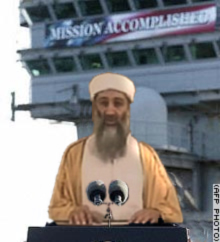
They plotted and pined for war, they falsified the "intelligence" to fit their goal of "regime change," and when the blood began to flow – after the "liberation" and the celebrations of a "mission accomplished" – they washed their hands of it and blamed the victims.

That's about par for the course with the neocons: after all, aren't they blaming the hapless idiot Bush for bollixing up their glorious war – for not putting in enough troops, for disbanding the Iraqi army, for supposedly not following their prescriptions to a tee? The axis of chickenhawks got what they wanted – death and destruction in the Arab world on a massive scale – and now they're busy assigning the blame to everyone but themselves.

The ugly secret of the neocons is that their program of "regime change" throughout the Middle East doesn't mean taking down tyrannies and replacing them with governments of a more democratic or even liberal character – it means toppling one regime and replacing it with… nothing. Michael Ledeen, the Machiavelli of this crowd, calls it "creative destruction." I'm not sure how creative it is – although I guess it depends on what you're trying to create – but clearly, by these standards, they have every right to claim Iraq as a "victory" and crow "Mission accomplished!"

Krauthammer asks:

"Did Britain 'give' India the Hindu-Muslim war of 1947-48 that killed a million souls and ethnically cleansed 12 million more? The Jewish-Arab wars in Palestine? The tribal wars of post-colonial Uganda?"

The British didn't come in with the idea of destroying the local culture and political structure, but of subsuming it under their own suzerainty in the classical pattern of imperialism. The consequences of that policy played out over a much longer period of time than what is occurring in Iraq, but, yes, the British do bear some responsibility for the Hindu-Muslim pogroms.

The British incursion interrupted and prevented the development of an indigenous solution to the sectarian divide. Who knows what direction the history of the region might have taken if the British hadn't intervened? In the end, their policy of "benevolent" imperialism didn't prevent the catastrophe but only delayed it – and probably exacerbated it, by keeping it under wraps for so long.

As for the Jewish-Arab wars in Palestine – is Krauthammer seriously asking whether the Balfour Declaration had anything to do with making Palestine a perpetual battleground? By taking up the cause of Theodore Herzl and making the implantation of a settler state possible, the legacy of British imperialism will afflict the entire region for the foreseeable future. Imperialism always has a deforming effect, whether it be in Iraq, Palestine, or Uganda, precisely because it is founded on coercion.

I would emphasize, however, that what we are doing to Iraq is fundamentally different from the classic form of imperialism, which always seeks to derive some material or political benefit from its conquests. I realize that far too many of my readers are committed to the tired leftist idea that this was a "war for oil," but I don't see any oil flowing – it was supposed to pay for the war, you'll remember, according to none other than Paul Wolfowitz. This war was about one thing and one thing only: advancing Israel's interests in the region. As Professor Paul Schroeder put it in The American Conservative, the U.S. making war on Iraq

"would represent something to my knowledge unique in history. It is common for great powers to try to fight wars by proxy, getting smaller powers to fight for their interests. This would be the first instance I know where a great power (in fact, a superpower) would do the fighting as the proxy of a small client state."

The U.S. has gained no political or economic advantages from the invasion and occupation of Iraq. Quite the contrary, we are paying through the nose, and the economic costs (totaling some $1 trillion) are almost as high as the political price – world isolation and the threat of terrorism on U.S. soil.

This is not imperialism: it is the foreign policy of a lemming state.

In Europe, pushback against US 'war on terror'

from the February 05, 2007 edition -

German solidarity with the indictment of 13 CIA operatives underscores a shifting tone across Europe.

The Christian Science Monitor

Reaction in Germany was hardly neutral when a prosecutor in Munich indicted 13 CIA officials last week for kidnapping a German of Lebanese descent and interrogating him in Afghanistan before apparently realizing they had the wrong man. Germans solidly backed the prosecutor.

Since Christian Schmidt-Sommerfeld took the unprecedented step, both the right and left in Germany have supported the "rule of law" principles he articulated.

The media have been unified as well. Typical is the centrist Süddeutsche Zeitung: "The justice system has stood up for the rule of law. Whether the government will do so is a different matter. Berlin must push for the kidnappers to be extradited, or ... tried in the USA. But it is unlikely to have that much courage."

The solidarity underscores a shifting tone in Europe. As changes of leadership loom in Britain and France, and capitals contemplate relations with a post-Bush US, Uncle Sam may expect stronger "pushbacks" from Europe, experts here say. Public disapproval of the US-led "war on terror" is also growing, spurring the change.

"There is a deep gap between government policy and public opinion in Europe, and that opinion may be shaping the direction here right now," says Frederic Bozo, professor of European Studies at the Sorbonne in Paris. "Europe doesn't want to upset the careful balance with the US. I don't think there is a united opposition against the US at all. But Europe is setting the groundwork for its own identity."

Gordon Brown, who is shortly expected to take over as prime minister in Great Britain, opposed the Iraq war from the start, and has made no secret that he plans to carve out an independent line on the venerable "special relationship" with the US. Many anticipate that British troops will leave Iraq by the end of the year.

In France, even the avidly pro- American Nicolas Sarkozy, current front-runner in the French elections this spring, stated in an interview taped in New York last week that Americans need to "get interested in the world, and the world will learn to love you."

To be sure, European cooperation with the US on a wide range of areas, including counterterrorism, is extremely strong, even in France, where the Chirac government has steadily gone it alone in Europe in opposition to the Iraq campaign.Yet Europeans have steadily refused to accept the concept and phrase, "war on terror," a sentiment that extends to its application to Iraq.

Last week, European Union officials in Brussels sought to reduce the amount of information given to US agencies on air passengers leaving Europe. An official in charge of data protection for the European Central Bank similarly advised that millions of pieces of financial information being sent regularly to the US after Sept. 11 were in violation of EU privacy codes.

The "secret, routine, and massive access" by US agencies to banking SWIFT codes – needed to transfer in and out of European financial institutions – is "unacceptable," stated Peter Hustinx, the Brussels official responsible for EU data oversight.

Boosting this sentiment is Europeans' recognition that the US is also in flux with an election season starting up, and that President Bush's term appears to be winding down with the United States in a vulnerable position overseas.

The US legal basis for conducting interrogation centers at Guantánamo Bay, for example, has long rankled in Europe.

"Most of the French opinion, many of the German people, a large share of the Labor constituency in the UK, the Spanish, and now Italy, don't just oppose the policy, but the basis of US policy," says Georges Le Guelte, of the Institute for International and Strategic Relations in Paris. "You can't have renditions and Guantánamo and talk human rights at the same time. That is more clear to many of us."

In Italy, prosecutors put out warrants several months ago for 25 members of a CIA team that abducted a Muslim cleric in Milan.

Nor is Europe alone in its willingness to speak more pointedly to the White House about its foreign affairs. On page 1 of last Thursday's People's Daily, a newspaper of record in China, a Chinese official criticized Mr. Bush for inflammatory rhetoric that turned the war in Iraq into a "religious war."

The comment was unprecedented in a state where official decorum is rigidly maintained. (For nearly a decade, China has conducted a brutal campaign of summary executions of Muslims in its far-west Xinjiang region, as documented in human rights reports.)

In the case of the Munich renditions, announced Jan. 31, 13 American CIA operatives allegedly apprehended German citizen Khaled el-Masri in Macedonia in 2004 and whisked him to an Afghan prison called "the Salt Pit." Realizing he was the wrong man, they left him on a hillside in Albania five months later, warning him never to talk of his experience. Mr. el-Masri instead filed suit in a Virginia court. Masri's case was dropped in Virginia after arguments that a trial would jeopardize US security operations.

But with help from Spanish police, the Munich prosecutors discovered the identity of the operatives through flight and hotel records in Palma de Mallorca, where they stopped to relax.

On Friday, in Washington, German foreign minister Frank-Walter Steinmeier told US Secretary of State Condoleezza Rice that the Munich warrants were only valid in Germany at present, but that Berlin felt the local court might issue an international warrant, according to German papers.

Ms. Rice said the warrants would not harm US-German relations. Justice Department officials have not responded to approaches by the German prosecutors.

Robert Marquand | Staff writer

They've forgotten what democracy is for: The US media is gripped by election fever but fails to discuss the issues

Obsessed by personalities, they've forgotten what democracy is for

The US media is gripped by election fever - but discusses the candidates' highs and lows rather than the real social issues

Gary Younge in Washington
Monday February 5, 2007
The Guardian


"You want to run for president?" asked Frank Bruni in his book Ambling into History. "Here's what you need to do: Have someone write you a lovely speech that stakes out popular positions in unwavering language and less popular positions in fuzzier terms. Better yet if it bows to God and country at every turn - that's called uplift. Make it rife with optimism, a trumpet blast not just about morning in America but about a perpetual dazzling dawn. Avoid talk of hard choices and daunting challenges; nobody wants those. Nod to people on all points of the political spectrum ... Add a soupcon of alliteration. Sprinkle with a few personal observations or stories - it humanises you. Stir with enthusiasm."

Watching the contenders for the Democratic party nomination at the Washington Hilton this weekend during the party's winter meeting was to see Bruni's formula applied with precision (though he might have added: "Have millionaire backers, be tall, married and able-bodied" - it is unlikely the wheelchair user FDR would have been elected in the era of mass television).

The candidates were each allowed seven minutes, 30 seconds of theme music, and 100 poster-waving fans, to lay out their stall for the new American century. Each one spoke of how the nation's historic mission as a beacon of liberty, justice and opportunity throughout the globe, had been traduced by the Bush administration. There was nothing bad enough you could say about the Iraq war, the budget deficit or the state of healthcare. There was also nothing concrete that most of the candidates would say about what they would do to fix them. With little of substance on offer, delivery was everything. Barack Obama, who delivered beautifully, called for an end to cynicism in American politics. That's a lot of work for just seven minutes.

Americans, such demanding consumers in every other aspect of their lives, curiously expect little from their political leaders. They hold the principle of democracy dear; but the purpose of democracy remains elusive. The notion that "the people shall govern" is the cornerstone of American political identity - even if the nonchalance with which they watched Bush steal the 2000 election revealed a disturbing reluctance to defend it. Yet the idea that elections should be the mechanism for effecting real change barely seems to register - which is why it was relatively easy for Bush to get away with robbery.

The weekend before November's midterms, for example, I walked up the Las Vegas Strip asking people if they thought the coming elections mattered. Roughly one in five either did not know the elections were taking place or had no intention of voting. Yet precisely 100% said they thought the elections mattered. This dislocation is not particular to the US. For all its inadequacies, America's political culture has proved far more responsive to opposition to the war or corruption than Britain's. But both the popular attachment to democratic ideals and the general ambivalence to democratic outcomes are more intense, making the discrepancy more pronounced.

Everybody knows that, if counted (a significant if), their vote will make a difference to who is actually elected. But few expect that whoever they elect will really make any difference to the issues they care about. And so voting takes on a ritualistic quality. Like Independence Day or Thanksgiving, it marks a date on the calendar not for changing America's politics, but for celebrating its promise.

Whether one participates or not seems less important than the fact of the event itself. The consensus view of November's elections is that voters turned their back on the war and the Bush agenda and opted instead for a new course in favour of bipartisanship and troop withdrawal. But the truth is that most of them turned their back on the elections. The fact that, at only 42%, this was the highest midterm turnout for 36 years is merely an indication of how entrenched this condition has become. The so-called Gingrich revolution of 1994 was won with just 38.8% of the vote. In the words of Gil Scott-Heron: "The first thing I want to say is: mandate, my ass."

The point here is not that there is no difference between the two main parties but that the difference is insufficient to make a significant impact on the lives of large numbers of Americans. The problem is not that people don't want or need change - the poorer you are, the less likely you are to vote - but that they have long since given up on the idea that voting is the way to get it.

The future of the country was supposed to hinge on the outcome of the 2004 presidential election. But somehow the issues of poverty, racism and infrastructural decay that were evident in the aftermath of Hurricane Katrina nine months later just never came up. By the time the midterms arrived, little over a year later, Katrina had somehow become irrelevant again.

It's not difficult to see why. Elections are big business. Last year the parties spent $2bn on ads alone. Throw in the fees for thousands of lobbyists, consultants and fundraisers and the electoral-industrial complex starts to develop a momentum of its own. Hillary Clinton, who faced only token opposition in a Senate race she won by 30 points, still lavished $27,000 on valet parking and $13,000 on flowers. The people who provide this money have healthcare, housing and decent schools for their kids. They pay the pipers and name the tune.

The mainstream media dances dutifully. Reporters somehow never encounter non-voters, instead constructing a country hotly debating the issues and weighing up the candidates. Obsessed by polls and personalities, they have a surreal fixation about who is up and who is down, with little indication of why we should care. They have barely digested the results of one election before they move on to devour the next. The morning after the midterms, with the fate of the Senate in the balance, CNN already had a banner along the bottom of its screen that read "America votes 2008". New York magazine hit the stands with a picture of Hillary Clinton on the cover and the words: "And now the real race begins".

And so in the Washington Hilton the permanent campaign that transforms American politics into a never-ending soap opera continues. Four years ago a rank outsider, Howard Dean, made his name at this event with an anti-war speech that transformed the dynamics of the campaign. This year he wielded the gavel as the leader of the Democratic National Committee and everybody is against the war.

It's almost two years until the presidential elections. We can only hope that between now and then progressive movements will again see the candidates' opportunism as their opportunity and bring their influence to bear on whoever decides to run. In the meantime, with little of substance to debate, the media are reduced to discussing strategy and style. Can the Democrats reclaim the west? Should they abandon the south? When will Obama's star fade? Are Hillary's positives greater than her negatives? Is America ready to elect a Mormon, a black man or a white woman? Enjoying the race, and ignoring what lies beyond the finish line.

g.younge@guardian.co.uk


Gary Younge is a Guardian columnist and feature writer based in the US. He was formerly the paper's New York correspondent. His most recent book is Stranger in a Strange Land: Encounters in the Disunited States; he is also the author of No Place Like Home, published in 1999.

We will not accept the vilification of those who protest at injustices carried out in the name of the Jewish people

Feb 5, 2007

Who speaks for Jews in Britain?

Brian Klug

If there is one thing on which Jews can agree, it is this: it's good to argue. Jewish culture has thrived on argument - frank, sincere disagreement - ever since Moses disputed with God. But today an oppressive and unhealthy atmosphere is leading many Jews to feel uncertain about speaking out on Israel and Zionism. People are anxious about contravening an unwritten law on what you can and cannot discuss, may or may not assert.

It is a climate that raises fundamental questions: about freedom of expression, Jewish identity, representation, and the part that concerned Jews in Britain can play in assisting Israelis and Palestinians to find their way to a better future.

As the situation in the Middle East deteriorates yearly, more and more Jews watch with dismay from afar. Dismay turns to anguish when innocent civilians - Palestinians and Israelis - suffer injury and death because of the continuing conflict. Anguish turns to outrage when the human rights of a population under occupation are repeatedly violated in the name of the Jewish people.

No one has the authority to speak for the Jewish people. Yet during Israel's war with Lebanon last summer, Ehud Olmert, the prime minister, told an American audience: "I believe that this is a war that is fought by all the Jews." His belief is not based on evidence: it is an article of faith, a corollary of the doctrine that Israel represents Jewry as a whole - in Britain included.

This is a fallacy; and, moreover, a dangerous one, since it tars all Jews with the same brush. Yet this misconception is reinforced here by those who, claiming to speak for British Jews collectively or allowing that impression to go unchallenged, only ever reflect one position on the Middle East. On its own account, the Board of Deputies of British Jews (which calls itself "the voice of British Jewry") devotes much of the time and resources of its international division to "the defence of Israel". When a "solidarity rally" was held in London last July in the midst of the conflict with Lebanon, it was the board that organised it.

All of which suggests that British Jewry, speaking with one voice, stands solidly behind the Israeli government and its military operations.

Two things are wrong with this suggestion. First, it's false. Jews were deeply divided over Israel's campaigns in Gaza and Lebanon last year. Certainly, there were those who shared the sentiment of the chief rabbi, Sir Jonathan Sacks, who, addressing the rally, said: "Israel, you make us proud." Others felt roughly the opposite emotion.

Second, the board has no business taking a partisan position on the Middle East. Let groups such as the Zionist Federation or perhaps the Israeli embassy organise solidarity rallies. The role of the board is to promote the welfare of British Jews in all their variety, not to defend Israel. Similarly, the chief rabbi is entitled, ex officio, to bring a religious perspective to political matters, but it is not his role to act as political spokesman for his flock.

Faced with this state of affairs, a group of Jews in Britain has come together to launch Independent Jewish Voices (IJV). We come from a variety of backgrounds and walks of life. Some of us are religious, some not. A number feel a strong attachment to Israel as Jews, others feel none. We do not all share the same vision for the Middle East. We are a network of individuals, not a movement or political party.

But we are united by certain fundamental commitments. These are set out in our launch statement, published today on the Guardian's Comment is Free website and in advertisements placed in the Jewish Chronicle and the Times. They include: putting human rights first; giving equal priority to Palestinians and Israelis in their quest for a peaceful and secure future; and repudiating all forms of racism aimed at Jews, Arabs, Muslims or whomever.

We believe that these commitments - not ethnic or group loyalties - define the limits of legitimate debate. We invite like-minded Jews in Britain to add their names to the list of IJV signatories.

Jews abroad who are confronted with the same climate are taking similar steps to make their voices heard. The Alliance of Concerned Jewish Canadians has been formed to promote "an alternative public Jewish voice" on Israeli policies. Last July "concerned South African Jews" appealed to "all who share our commitment to a common humanity" to call for Israel to stop its bombardment of Lebanon. In the past few years, Jewish groups speaking out against Israel's violations of human rights have proliferated, notably in the United States, but especially in Israel itself.

We are not setting ourselves up as an alternative to the Board of Deputies or any other body. But we challenge the standard concept of "the Jewish community" as a collective entity for which the board is the secular voice and the chief rabbi the religious voice. This system was developed in another era - though it is being used today as a template for other minorities. It pictures "the Jewish community" as a single bloc that, whatever its internal complexity, presents a common face to the outside world via its ambassadors.

There is an affinity between our initiative and the New Generation Network, which was launched in the Guardian last November. A diverse group of Britons questioned the idea that the pie of British society (or that portion consisting of "minorities") can be divided into neat ethnic or religious slices: discrete "communities" with authoritative "leaders". For many of us, this model is suffocating and goes against the grain of our experience.

Among other things, it places a premium on keeping disagreement "in the family". For Jews, this ethos is especially stifling if the subject is Zionism or Israel. Some people, rightly condemning demonisation of the Jewish state, do not hesitate to demonise fellow Jews who, when expressing their views on these subjects in public, cross an invisible line of acceptability. We reject any attempt to suppress legitimate public debate and we abhor the culture of vilification.

The slur of "traitor" or "self-hating Jew" is especially noxious. For, if we feel compelled to protest against injustice to Palestinians, this is partly because of the lessons of our own history: the Jewish experience of marginalisation and persecution. Furthermore, when the language of human rights is spoken, many of us (secular and religious) hear the voices of those Hebrew prophets, rabbis, writers, activists and other
Jewish figures down the centuries for whom Judaism means nothing if it does not mean social justice.

So, when we speak out against Israel's occupation of the West Bank and Gaza, or the bombing of Lebanon, or discrimination against Palestinians within Israel itself, we are not turning against our Jewish identity; we are turning to it. Some of us, recalling that nearly 40 years have passed since Israel's occupation began, hear a resonance. This was the length of time the Israelites wandered in the wilderness, near the end of which Moses gave them a directive: "Justice, justice shall you pursue" (Deuteronomy 16:20). It is a compass bearing for all humanity, especially when we are trying to find our way - or help others to find theirs - to a better future.


Click here for a full list of articles in the Independent Jewish Voices debate.


Dr Brian Klug is senior research fellow & tutor in philosophy at St Benet’s Hall, Oxford and member of the Faculty of Philosophy at Oxford University. He is an honorary fellow in the Parkes Institute for the Study of Jewish/non Jewish Relations at the University of Southampton, associate editor of Patterns of Prejudice and a founder member of the Jewish Forum for Justice and Human Rights. He has published widely on race, antisemitism, Jewish identity, Zionism and related subjects. Books include, Children as Equals: Exploring the Rights of the Child (co-editor) and Ethics, Value and Reality: Selected Papers of Aurel Kolnai (co-editor).

Cheney Might Be Wishing for a Libby Pardon

by Jacob G. Hornberger

I wonder if Vice President Cheney is wishing that President Bush had pardoned Scooter Libby before Libby’s criminal trial started. Libby is charged with false statements and perjury as part of the federal investigation into the leaking of Valerie Plame’s identity as a CIA agent.

In a report on the trial last Friday, the New York Times reported:

“In an intriguing but unexplored exchange with a prosecutor, Peter Zeidenberg, Ms. Bond also said that Mr. Libby had acknowledged in one of the interviews that he might have talked to Mr. Cheney aboard Air Force Two about whether to tell the press about Ms. Wilson as part of the effort to rebut Mr. Wilson’s criticisms.”

Yet, the same article reports the following interesting tidbit:

“On Thursday jurors also saw videotape from July 2003 showing Scott McClellan, then the White House press secretary, telling reporters that Mr. Libby had no involvement in the leak of Ms. Wilson’s name. Mr. McClellan had initially declined to do so, but was ordered by Mr. Cheney to provide the same exculpatory comments he had given earlier for Mr. Rove.”

Well, well, well!

That means that if Cheney and Libby were in fact discussing whether to tell the press about Ms. Wilson (Valerie Plame), then Cheney had to know that Libby was in fact discussing Plame with the press. But if that’s the case, then if Cheney did in fact order Scott McClellan to say that Libby had no involvement in the leak of Plame’s name, as McClellan has testified, that means that Cheney was telling McClellan to lie to the press and the American people.

Imagine that: another sitting vice president of the United States lying. Keep that in mind as the U.S. bombs start falling on the Iranian people.

It seems to me given the overwhelming evidence at the trial showing that Libby did lie about how he acquired Plame’s identity and to whom he released it, Libby is going to have to take the witness stand to establish his “poor memory” defense. If so, there could be some very interesting revelations about Dick Cheney’s role in the Plame affair during cross-examination.

Moreover, the trial could get even more interesting if Libby follows through with his plan to summon the vice president to the witness stand, where he will have to testify under oath, under penalty of perjury, and be subjected to the rigors of cross examination.

Like I say, I wonder if Cheney is wishing that Bush had pardoned Libby a long time ago.

P.S. For an interesting analysis on Cheney’s discomfort over the Libby trial, see Frank Rich’s article in the Sunday New York Times (subscription required), “Why Dick Cheney Cracked Up,” in which Rich states, “Mr. Cheney, in other words, understands the danger this trial poses to the White House even as some of Washington remains oblivious.”

Mr. Hornberger is founder and president of The Future of Freedom Foundation.