Thursday, February 15, 2007

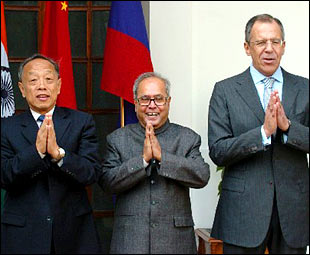
Trilateral FM Summit in New Delhi


Chinese, Indian and Russian foreign ministers met in New Delhi Wednesday, stating that their trilateral cooperation did not aim at harming any other nation but to promote international harmony and understanding.

The three ministers reaffirmed the strong commitment made between India, Russia and China to multilateral diplomacy, according to the Joint Communiqué issued after latest trilateral meeting.

They agreed that the three nations, as countries wielding increasing international influence, could all actively contribute to global peace, security and stability.

"China, India and Russia have developed friendly and frequent cooperation on international and regional issues," said Chinese Foreign Minister Li Zhaoxing, speaking at a press conference after the meeting, "The trilateral cooperation will include collaboration in regional organizations like Shanghai Cooperation Organization (SCO) and in the United Nations."

China and Russia further welcomed India joining the SCO as an observer country, according to the Joint Communiqué.

Li said all trilateral relations between the three sides would be open, inclusive, transparent and constructive.

The three countries also determined precise avenues for beneficial economic interaction in areas such as energy, transport, infrastructure, health and high technologies including IT and biotechnology.

As a result, the ministers pledged to advise their respective business bodies to organize a trilateral business forum within the year.

The three sides stressed the importance of UN reforms including the UN Security Council in which both China and Russia would support a greater role to be played by India.

An exchange of opinion also took place concerning the anti-terrorism issue, underlining the necessity of working together against terrorism through regional organizations.

They were of a common voice that terrorism should be fought in a consistent, sustained and comprehensive manner with no double standards.

The Joint Communiqué further revealed that the three countries would from now on coordinate on taking swift measures against any factor fueling international terrorism including financing thereof, illegal drug trafficking and trans-national organized crime.

In closing, the document specified that the next trilateral meeting between China, India and Russia would be held in China.

(Xinhua News Agency February 15, 2007)

Next Stop: Tehran

February 12, 2007 Issue
Copyright © 2006 The American Conservative

The White House denies plans to attack Iran, but the signs all point in that direction.

by Philip Giraldi
Philip Giraldi is a former CIA Officer.

By the time President Bush finally announced it, his surge strategy was old news. But an unexpected section of the speech jarred the normally somnolent mainstream media: “Iran is providing material support for attacks on American troops. We will disrupt the attacks on our forces. … And we will seek out and destroy the networks providing advanced weaponry and training to our enemies in Iraq.” Speculation that Bush was already plotting his next war nearly stole the story of how he plans to salvage the current one.

Picking up the presidential cue, the administration began advancing the fiction that Iranian support of America’s “enemies” in Iraq is killing U.S. soldiers—an implausible assertion since the insurgents and al-Qaeda are Sunnis, while the Iranians are Shi’ites linked to parties within the current Iraqi government. The day after the speech, Secretary of State Condoleezza Rice, on her way to the Middle East to pull together a Sunni coalition against Iran, asserted willingness to confront Tehran over its “destabilizing behavior.” And by Jan. 15, the administration’s supposed realist, Secretary of Defense Robert Gates, had jumped on the scrum, declaring that Iran has been “very negative,” while admitting for the first time that the naval buildup in the Persian Gulf was designed to threaten Iran and “reassure allies.” White House sources report that the National Security Council has already considered likely consequences of a war with Iran, and an assessment of Tehran’s ability to retaliate concluded that the resulting damage to American facilities and interests worldwide would be “acceptable.”

White House Press Secretary Tony Snow dismissed as “urban legend” the notion that war preparations are underway. But he persuaded neither a public turned skeptical by the Iraq invasion nor certain congressional Democrats. The Jan. 11 Special Forces raid on the Iranian Consulate in the Kurdish Iraqi city of Irbil, a calculated provocation personally authorized by President Bush and evidently representative of the more muscular new policy, fueled questions about the administration’s intentions. Sen. James Webb asked Secretary Rice, “Is it the position of this administration that it possesses the authority to take unilateral action against Iran in the absence of a direct threat without congressional approval?” She ducked the question. Similarly, on ABC’s “This Week,” National Security Adviser Stephen Hadley would not say whether he agrees with senators who insist that the president needs congressional approval for an attack. Other administration sources assert that Bush believes he could strike Iran in his capacity as commander in chief or under his 2003 Iraq authorization. Senate Intelligence Committee Chairman Sen. John D. Rockefeller voiced his alarm: “It’s Iraq again. This whole concept of moving against Iran is bizarre.”

In some sense, the war has already begun. For the past two years, the U.S. has been conducting secret operations inside Iran, employing Special Forces units operating out of Afghanistan, while Pentagon-supported dissidents have been carrying out armed raids into Iran’s predominantly Arab provinces.

A second carrier group, the USS John Stennis, is moving toward the Persian Gulf to supplement the carrier USS Dwight D. Eisenhower—the last time two carrier groups were in the Gulf was during the invasion of Iraq—and a flotilla of minesweepers accompanied by an Aegis class cruiser was sent to the region at the end of 2006. The carrier aircraft, useless against insurgents and terrorists in Iraq, can only be employed in a war with Iran, while the minesweepers would be needed to keep clear the Strait of Hormuz for oil tankers and other shipping.

The naval presence in the region will be directed by Adm. William Fallon, the recently appointed chief of Central Command, replacing the uncooperative Gen. John Abizaid, who had opposed the surge. Fallon knows little of ground combat but a great deal about naval air operations. The dearth of “boots on the ground” Army and Marine infantry would be irrelevant in Iran as an assault would be conducted from the sea and air, where the U.S. has more than enough available resources.

Bush has also ordered Patriot missile batteries to the region, clearly intended to defend against Iranian ballistic missiles and airstrikes launched in a retaliatory attack against vulnerable U.S. bases in Iraq and in Kuwait and against the region’s oil fields.

Once the military and naval resources arrive at the end of February, the precise timing for a strike would depend on political and economic factors, as well as suitable weather conditions permitting aerial and satellite reconnaissance. But maintaining two carrier groups and support vessels in the Persian Gulf is hugely expensive, so the administration will be motivated to use them once all the components for an attack are in place. A Kuwaiti newspaper, relying on confidential sources in the Emirate’s government, predicts that the attack will take place before the first week of April, when Tony Blair steps down as British prime minister, under the assumption that he will provide political cover as well as material support in the form of minesweepers. As Kuwait’s government, host to the sprawling U.S. base Camp Doha and a prime target for Iranian retaliation, has been in the loop for planning vis-à-vis Iran, the suggested date has a high level of credibility.

As for casus belli, an attack might be preceded by a Gulf of Tonkin type incident in which Iran fires on or otherwise interferes with a U.S. warship. As two carrier groups will basically fill the shallow and narrow waters of the Persian Gulf, the potential for an incident is obviously very high.

At least as significant as the military buildup is the intensifying rhetoric surrounding the Iranian threat. President Bush has guaranteed Israeli Prime Minister Ehud Olmert that the U.S. will defend Israel against Iran and will not engage Tehran in negotiations. At the 2006 annual meeting of AIPAC, the principal Israeli lobbying group, Vice President Dick Cheney stated in his keynote address, “We will not allow Iran to have a nuclear weapon.’’ There have been similar, and frequent, iterations of that theme by Rice, Hadley, former Defense Secretary Donald Rumsfeld, and, most recently, by the Undersecretary of State Nicholas Burns addressing an audience in Israel. Those who hope that Democrats will stop the rush to war need only note the repeated excoriation of Iran by party leaders like Hillary Clinton, Nancy Pelosi, Steny Hoyer, and Charles Schumer. Howard Dean has declared that the U.S. attack on Iraq was directed against the “wrong enemy” while Iran is “the right enemy.” Dean’s DNC, which reportedly receives more than half of its funds from Jewish sources, would be understandably reluctant to oppose war against Iran.

Former Prime Minister Benjamin Netanyahu and Deputy Prime Minister Avigdor Lieberman urge an expeditious attack to destroy Iran’s nuclear capabilities—arms inspector Scott Ritter has called the drive to attack Iran a policy “made in Israel.” And outspoken former Israeli Brigadier General Oded Tira has called on the Israeli lobby to engage Democratic hawks and exploit media connections to bring about action against Iran:

President Bush lacks the political power to attack Iran. As an American strike in Iran is essential for our existence, we must help him pave the way by lobbying the Democratic Party (which is conducting itself foolishly) and U.S. newspaper editors. We need to do this in order to turn the Iranian issue to a bipartisan one and unrelated to the Iraq failure.

Tira joins other advocates of war with Iran in recognizing the power of the mainstream media to prime the public for an attack. Four separate Iran groups working within the U.S. government—and staffed by many of the same individuals who brought about the Iraq War—will likely preface military action against Tehran with a series of leaked stories to latter-day Judith Millers demonizing the designated enemy. As with the lead-up to the invasion of Iraq, ideologically driven intelligence centers relying on dubious sources like the terrorist group Mujahadeen e Khalq have been established at the Pentagon and elsewhere to offer alarmist assessments of Iran.

The propagandizing effort has already begun. A late-2006 series of largely fictional Israeli-generated stories in Rupert Murdoch’s Times newspapers of London hyped the Iranian threat. Most recently, the Times reported that Israel is preparing for its own attack on three key Iranian nuclear facilities. The planning reportedly includes use of nuclear devices to eliminate deeply buried facilities, a refinement to the story added to encourage the United States to attack instead, as the U.S. believes it could take out the targets without using nuclear weapons.

Other indicators suggest that an attack against Iran is impending, if not imminent. Pentagon planners, conscious that if attacked Iran would stir up its Shi’ite friends in neighboring Iraq, anticipate that extra soldiers being used in the surge might be shifted to the Iran-Iraq border to seal it off when military operations against Tehran start. Retired Air Force Col. Sam Gardiner, who taught strategy and military operations at the National War College, believes that combat brigades ostensibly being collected for the surge pacification of Baghdad might instead be sent directly to the border with Iran. The Department of Defense is also reported to be hiring more Farsi speakers to train soldiers in the language—a pointless exercise unless some level of engagement with Iran is anticipated—while Washington contractors providing translation services to the Pentagon are working seven days a week on Farsi documents, seeking the “silver bullet” linking Iran to terrorism, thus making some case for war.

The rejection of the Iraq Study Group’s suggestion that the U.S. work diplomatically and constructively with all parties in the Persian Gulf region provided further evidence of the administration’s intentions. Likewise, its refusal to approach the bargaining table until Iran agrees to abandon its nuclear energy program. That program, monitored by the International Atomic Energy Agency, exists in response to a legitimate need for electrical generating capacity based on projections that Iran’s oil resources will soon sharply diminish and eventually be depleted. An as yet unreleased U.S. National Intelligence Estimate on Iran concludes that the evidence for a weapons program is largely circumstantial and inconclusive, while the Director of National Intelligence John Negroponte reported that Iran is five to ten years away from having a weapon even if it accelerates the process and no one interferes with its development. Negroponte was predictably fired for his unwillingness to alter the intelligence, and the NIE is unlikely to see the light of day unless it is rewritten to conclude that Iran is an immediate threat.

Other attempts to build bridges between Washington and Tehran have also failed. Years of negotiations with Iran by Britain, France, and Germany went nowhere because of American refusal to play a part in the process, which came very close to a comprehensive settlement on a number of occasions. The U.S. instead chose to block agreements that did not include complete Iranian surrender on the key issue of its nuclear program. A series of compromises proposed by Tehran between March 2005 and October 2006 that would have banned nuclear-weapon production and permitted round-the-clock complete-access inspections were rejected due to American objections.

Iran has also reached out directly to the United States to establish a basis for negotiations but has been rebuffed repeatedly by an intransigent White House. In the spring of 2006, confidential negotiations between Iran and American Ambassador to Iraq Zalmay Khalilzad to help stabilize Iraq were suspended under orders from Vice President Cheney. Iranian President Mahmoud Ahmadinejad’s 18-page letter to President Bush in May 2006, widely interpreted in Iran as an attempt to establish dialogue, was summarily rejected. Bush did not even bother to read it. Yet the overtures continued. Former Iranian President Mohammad Khatami’s September visit was a backdoor approach for opening discussion. But Rice’s State Department only reluctantly permitted the visit, and the White House then ignored it, failing to grasp the extended olive branch. It is the ultimate irony that the Iraqi government, which the U.S. is ostensibly protecting, is regularly meeting Iranian leaders to establish a modus vivendi, while Washington refuses to engage.

Iran is not an imminent threat and clearly doesn’t want war, while the United States can ill afford another. But the Bush administration seems intent on toppling Ahmadinejad. The overwhelming victory of moderates and reformers in Iran’s December election shows that the Iranian people are peacefully working toward the same end. But the White House, showing interest neither in dialogue nor in letting the democratic process do its work, seems more inclined to let bombs do the talking.
________________________________________________

Philip Giraldi, a former CIA Officer, is a partner in Cannistraro Associates, an international security consultancy.

Money for Nothing: Iraq War Funding, 2004-2007

Feb 15, 2007

What is it that the US military is doing so differently in Iraq today than it was last year or the year before that would justify such a tremendous leap in spending on Operations & Maintenance? Asks Jeff Leys.


On February 5, President Bush submitted his war budget for 2007 and 2008 to Congress. He is seeking an additional $93 billion in funding for the Iraq and Afghanistan wars for the period that ends on September 30 of this year, as well as another $142 billion for the coming fiscal year which runs from October 1, 2007 through September 30, 2008. The February 8 hearing of the House Appropriations Defense Subcommittee suggested little hope that Congress will cut funding for the Iraq war. Representative John Murtha (Chair of the Appropriations Defense Subcommittee) and Representative Dave Obey (Chair of the House Appropriations Committee) each emphasized that they will pass all funds necessary to "ensure the troops have all they need" (a paraphrase). Each stated he has worked to increase levels of funding for the war above and beyond what the White House asked for in prior spending bills, most notably in the so-called "bridge fund" passed last fall which provided $70 billion for the wars in this fiscal year. Murtha emphasized that he and Obey are committed to ensuring a vote on the bill by the full House of Representatives by March 14 or 15.

At the same hearing, General Peter Schoomaker stated that units which are deployed to Iraq are fully equipped. He stated that the problem which the military encounters is Unit A "borrows" the equipment of Unit B when Unit A deploys to Iraq and Unit B remains at home. The deficiency then becomes that Unit B is not able to adequately train. The issue is explicitly NOT that Unit A enters the war in Iraq without sufficient equipment, weapons, etc.

In this article, I aim to lay out an overview of the growth of war spending between 2004 and 2007, up to and including the current request for $93 billion more in supplemental war spending. I'll focus upon the three main categories of funding: Personnel; Operations and Maintenance; and Procurement. Within the Operations and Maintenance section I'll focus upon those funds appropriated or requested for use by U.S. military forces (including active duty as well as Guard and Reserve units), as opposed to those funds appropriated for such items as the Iraq Security Forces fund and the Afghanistan Security Forces fund. In doing so, I hope to maintain a control of sorts on the dollar amounts and categories discussed in the following analysis-comparing apples to apples rather than apples to oranges.

In the following discussion, the dollar amounts given for FY 2007 include funds provided in the "bridge fund" passed last fall and the funds sought by President Bush in the supplemental spending request. Dollar amounts are derived from the various House - Senate Conference Committee reports that accompanied prior war funding bills and the current supplemental request submitted by President Bush.

PROCUREMENT

The "Procurement" category covers the cost of buying new equipment, ammunitions, weapons systems, etc. The amount budgeted to buy new items grew from FY 2004 to FY 2006, but is now slated to take a gigantic leap in FY 2007.

FY 2004 -- $5.5 billion

FY 2005 -- $18.8 billion

FY 2006 -- $23 billion

FY 2007 - $44.6 billion

When Congress appropriates Procurement funds, it specifies that the money will be available for expenditure over the following three years. This is the standard life cycle of the procurement process, as it takes time to bid out the contracts; to produce the item; and to get the item shipped to the field. Indeed, at the February 9, 2007 hearing of the House Appropriations Defense Subcommittee, General Peter Schoomaker and Secretary of the Army Frances Harvey both stated that it takes at least 18 months for equipment to be secured once funds have been appropriated for the purchase of an item, giving the example of an 18 month lag time for obtaining a vehicle transmission.

Because Procurement money is carried over from one fiscal year to the next, it becomes difficult to determine exactly how much money is available in a given fiscal year for Procurement. The Government Accountability Office (GAO) reported that as of June 2006, $2.17 billion remained to be spent of the $6.8 billion appropriated in the fall of 2005 for FY 2006. In June 2006, Congress appropriated an additional $14.7 billion for FY 2006. This means that, as of June 2006, $16.8 billion remained to be spent of funds appropriated for procurement during FY 2006. The GAO concluded that the bulk of this $16.8 billion would most likely be rolled over into and spent in FY 2007. If indeed most of this $16.8 billion rolled over into the current year, it would mean that the Department of Defense would have upwards of $61.4 billion to spend on Procurement alone this year (the $16.8 billion carry over, plus the $44.6 billion to be appropriated for Procurement for FY 2007).

Now, let's take a look at the incredible increase in procurement monies being appropriated by Congress-a stunning 94% increase from FY 2006 to FY 2007, or $21.6 billion more this year than last year if the supplemental spending bill is passed.

If the supplemental war funding bill is passed, Congress will have approved $44.6 billion for Procurement this year alone-nearly as much as the $47.3 billion approved by Congress for the past three years combined.

While details are very sketchy about what these funds will be used for, some limited information is available within the supplemental request. The Army will receive the lion's share of these funds. For example, the subcategory for "weapons and tracked combat vehicles" is slated to receive $6.9 billion this year-compared to $5.3 billion total for the last 3 fiscal years combined. "Army aircraft" is to be funded at $2 billion this year-compared to $1.1 billion the past 3 fiscal years combined. "Army other" is to be funded at $14.9 billion this year-compared to $17.1 billion for the past 3 fiscal years combined. This "other" category includes the acquisition of such items as tactical and support vehicles; communications and electronics equipment; and other support equipment.

Spending on procurement of Air Force aircraft is also slated to leap in 2007, with $4.9 billion total being appropriated if the supplemental spending bill is passed. This compares to the $1.1 billion total appropriated in the last three fiscal years.

Again, it is important to stress that just because the funds are appropriated now does not mean that the equipment and weapons systems will automatically appear in the field for use by soldiers tomorrow. A one to three year lag time exists between the time funds are appropriated and the time an item is available to soldiers in the field. The funds being appropriated now are not to provide for soldiers in the field today. The funds being appropriated now for procurement purposes are to provide material for soldiers fighting the war in Iraq one to three years in the future.

PERSONNEL

The funding levels for personnel costs have remained remarkably consistent, despite fluctuations in levels of personnel deployed to fight the wars in Iraq and Afghanistan. Indeed, personnel costs for FY 2007 (the current fiscal year) will be almost identical to personnel costs in FY 2004 (the first full fiscal year during the Iraq war):

2004 -- $17.8 billion

2005 -- $18.6 billion

2006 -- $16.5 billion

2007 -- $17.5 billion

Items included in this category are: special pays like foreign language proficiency; costs associated with stop-loss orders (forcing people to serve beyond their original end-date for enlistment); hazardous duty pay; increased life insurance payouts; and the like. Personnel costs do include the base rate of pay plus any special pays for members of the Reserves and National Guards who are on active duty.

Congress also made the political decision to fund the build up of the military through supplemental spending rather through the regular appropriations process. Each branch of the military is funded through the regular appropriations process for a set number of positions. Throughout the wars in Afghanistan and Iraq, the military has exceeded this number-called "over strength". Congress decided politically to fund this "over strength" through supplemental spending bills rather than including it in the baseline Department of Defense budget.

OPERATION & MAINTENACE (O & M)

The Operation & Maintenance portion of the budget continues to grow in leaps and bounds. Assuming the supplemental spending bill is approved, spending on O & M will be $77 billion this year-a 29.2% increase over last year and an astounding 108% increase over the 2004 cost.

Here's the growth in spending on O & M since 2004:

FY 2004 - $37.2 billion

FY 2005 -- $46.5 billion

FY 2006 -- $59.6 billion

FY 2007 -- $77 billion

As in past years, the Department of Defense's justification materials fail to provide much in the way of concrete and detailed information on how these funds will be expended. Nor does it give any indication of why the costs are growing so exponentially yet again.

This is a common critique of the funding process, especially as it relates to the area of Operations and Maintenance. The Congressional Research Service, the Government Accountability Office and the Congressional Budget Office each issued reports or testimony in the past year which are critical of the accounting process. Each asserts that it is simply impossible to determine the purposes for which monies are spent.

The U.S. Government Accountability Office reported in November 2006 that "…in fiscal year 2005, close to 26 percent of obligations reported in the operation and maintenance account were in 'other supplies and equipment' and 'other services and miscellaneous contracts.' This trend has continued in fiscal year 2006."

In testimony given on February 6, 2007 before the Senate Budget Committee, J. Michael Gilmore, Assistant Director for National Security of the Congressional Budget Office stated that according to reports of the Defense Finance and Accounting Services of the Department of Defense, "…about $98 billion was obligated for military operations in Iraq and the war on terrorism in fiscal year 2006. Of that amount, almost 25 percent ($23 billion) was allocated for purposes described as 'other'. Little information was provided to suggest how those 'other' funds were obligated."

Absent any concrete justification materials or line item accounting of expenditures, it is indeed impossible to determine why the costs of Operations and Maintenance are skyrocketing. Is it the cost of fuel? Are more bombing runs being flown by the Air Force? Has the cost of food risen that dramatically? What is it that the U.S. military is doing so differently in Iraq today than it was last year or the year before that would justify such a tremendous leap in spending on Operations & Maintenance?


Jeff Leys is Co-Coordinator of Voices for Creative Nonviolence (www.vcnv.org) and a national organizer with the Occupation Project campaign of sustained civil disobedience to end Iraq war funding. He can be reached via email, jeffleys@vcnv.org
In Congress, Opposing the War but Doing Nothing to Stop It

Related

February 12, 2007: Another Supplemental Spending Bill for the War in Iraq
---

WATCH CONGRESSMAN PAUL ONLINE

New!
February 14, 2007:
Congressman Paul speaks on the Iraq War Resolution

Windows Media Required

---

Speeches And Statements


HON. RON PAUL OF TEXAS
Before the U.S. House of Representatives

February 14, 2007


Statement on the Iraq War Resolution

This grand debate is welcomed but it could be that this is nothing more than a distraction from the dangerous military confrontation approaching with Iran and supported by many in leadership on both sides of the aisle.

This resolution, unfortunately, does not address the disaster in Iraq. Instead, it seeks to appear opposed to the war while at the same time offering no change of the status quo in Iraq. As such, it is not actually a vote against a troop surge. A real vote against a troop surge is a vote against the coming supplemental appropriation that finances it. I hope all of my colleagues who vote against the surge today will vote against the budgetary surge when it really counts: when we vote on the supplemental.

The biggest red herring in this debate is the constant innuendo that those who don’t support expanding the war are somehow opposing the troops. It’s nothing more than a canard to claim that those of us who struggled to prevent the bloodshed and now want it stopped are somehow less patriotic and less concerned about the welfare of our military personnel.

Osama bin Laden has expressed sadistic pleasure with our invasion of Iraq and was surprised that we served his interests above and beyond his dreams on how we responded after the 9/11 attacks. His pleasure comes from our policy of folly getting ourselves bogged down in the middle of a religious civil war, 7,000 miles from home that is financially bleeding us to death. Total costs now are reasonably estimated to exceed $2 trillion. His recruitment of Islamic extremists has been greatly enhanced by our occupation of Iraq.

Unfortunately, we continue to concentrate on the obvious mismanagement of a war promoted by false information and ignore debating the real issue which is: Why are we determined to follow a foreign policy of empire building and pre-emption which is unbecoming of a constitutional republic?

Those on the right should recall that the traditional conservative position of non-intervention was their position for most of the 20th Century-and they benefited politically from the wars carelessly entered into by the political left. Seven years ago the Right benefited politically by condemning the illegal intervention in Kosovo and Somalia. At the time conservatives were outraged over the failed policy of nation building.

It’s important to recall that the left, in 2003, offered little opposition to the pre-emptive war in Iraq, and many are now not willing to stop it by de-funding it or work to prevent an attack on Iran.

The catch-all phrase, “War on Terrorism”, in all honesty, has no more meaning than if one wants to wage a war against criminal gangsterism. It’s deliberately vague and non definable to justify and permit perpetual war anywhere, and under any circumstances. Don’t forget: the Iraqis and Saddam Hussein had absolutely nothing to do with any terrorist attack against us including that on 9/11.

Special interests and the demented philosophy of conquest have driven most wars throughout history. Rarely has the cause of liberty, as it was in our own revolution, been the driving force. In recent decades our policies have been driven by neo-conservative empire radicalism, profiteering in the military industrial complex, misplaced do-good internationalism, mercantilistic notions regarding the need to control natural resources, and blind loyalty to various governments in the Middle East.

For all the misinformation given the American people to justify our invasion, such as our need for national security, enforcing UN resolutions, removing a dictator, establishing a democracy, protecting our oil, the argument has been reduced to this: If we leave now Iraq will be left in a mess-implying the implausible that if we stay it won’t be a mess.

Since it could go badly when we leave, that blame must be placed on those who took us there, not on those of us who now insist that Americans no longer need be killed or maimed and that Americans no longer need to kill any more Iraqis. We’ve had enough of both!

Resorting to a medical analogy, a wrong diagnosis was made at the beginning of the war and the wrong treatment was prescribed. Refusing to reassess our mistakes and insist on just more and more of a failed remedy is destined to kill the patient-in this case the casualties will be our liberties and prosperity here at home and peace abroad.

There’s no logical reason to reject the restraints placed in the Constitution regarding our engaging in foreign conflicts unrelated to our national security. The advice of the founders and our early presidents was sound then and it’s sound today.

We shouldn’t wait until our financial system is completely ruined and we are forced to change our ways. We should do it as quickly as possible and stop the carnage and financial bleeding that will bring us to our knees and force us to stop that which we should have never started.

We all know, in time, the war will be de-funded one way or another and the troops will come home. So why not now?

Nita Lowey Carries Water for AIPAC, Throws Personal Wrench Into U.S. Mideast Policy

February 14, 2007 at 5:34 pm

It's classic guerrilla legislative tactics and it has AIPAC written all over it. Nita Lowey is one of AIPAC's staunchest allies in Congress and is the fifth on the House list (as of 2004) of career recipients of pro-Israel PAC campaign funds. And today, Reuters reports that thanks to her, Condi Rice has yet another headache to deal with as she prepares for her three-way Israeli-Palestinian-U.S. summit on Monday:

A Bush administration request for $86 million in U.S. funds to help train and equip Palestinian President Mahmoud Abbas's security forces is being blocked by a U.S. lawmaker who has concerns about how the money might be used.

"Early last week, I placed a hold on the $86 million," Rep. Nita Lowey, a New York Democrat, told Reuters on Tuesday. "It is imperative that we have a fuller understanding of exactly what the funding is for and what the situation is on the ground," said Lowey, who sits on the House Appropriations Committee, which controls U.S. funding for domestic and foreign projects.

While Lowey said she had acted to hold up the money before last week's deal between Abbas and Hamas leaders to form a unity government, that agreement "raised additional questions."

Lowey said she has asked the State Department to provide more information on how the $86 million would be used.

And lest you think this might be a one-off thing for Lowey, she seems to be a serial offender on the issue of blocking Palestinian aid according to Eric Alterman.

So let's explain how it goes. AIPAC worries that Condi may use too much force against the Israeli position in the talks; that she may, for example, consider ending the U.S. siege on Gaza and the PA. So it sends a shot across Condi's bow by bottling up the $86 million the Bush Administration has allocated to support Mahmoud Abbas and his political position among the Palestinians. The message is: if you dare to cross AIPAC's position on any of this we'll twist your Mideast policy in knots.

It's all pretty pro forma and SOP for AIPAC. Of course, it is a vapid, bankrupt response to the Israeli-Palestinian conflict. It's simply stonewalling for stonewalling's sake. So tiresome and yet so familiar.

And proof that Lowey's action is mere grandstanding lies in this closing sentence from the article:

Neither Lowey nor aides specified what information she wants from the State Department to convince her to lift her hold on the $86 million.

Shmuel Rosner provides his usual mis-coverage of the story, which he (or someone at Haaretz) erroneously titles, Congress Blocks $86m in Aid to PA:

The Bush administration's pledge to transfer $86 million to Palestinian Authority Chairman Mahmoud Abbas was blocked by Congress. The U.S. administration had publicly pledged the funds, but a number of congressmen are skeptical about the funding.

First regarding the headline, all media sources I've seen except this one have noted the aid is intended to buttress Mahmoud Abbas, not the PA, which is controlled by Hamas. Second, Abbas is president of the PA and not chairman (that was Arafat). Third, the Reuters story above clearly says that only Lowey has put a hold on the appropriation. There is no mention of "a number of congressmen [sic]." Also, I hope that Rosner's editor (does he even have one?) realizes that Lowey is not a "Congressman." Returning to our point, there may be a number of Congress members who support Lowey, but I've nowhere seen any reference to their existence. So unless Rosner can present those names with proof that they exist, Haaretz shouldn't include such a statement. In addition, to say that a hold placed by a single member of Congress constitiutes being "blocked by Congress" is a wholly inflated statement which doesn't deserve seeing the light of day in an otherwise stellar newspaper.

Hat tip to Brit Tzedek Newsdigest for the Reuters story.

Filed under Mideast Peace, Politics & Society


Biography

I write Tikun Olam, a peace blog on the Israeli-Palestinian conflict, U.S. politics and world music. I also maintain Israel Palestine Blogs, a Mideast peace blog aggregator.

I live in Seattle & share life with three young children, my wife & our dog.

Homepage
http://www.richardsilverstein.com/tikun_olam/category/politics-society/


Think very carefully, then act quickly

Giants meet to counter US power

February 15, 2007

India, China and Russia account for 40 per cent of the world’s population, a fifth of its economy and more than half of its nuclear warheads. Now they appear to be forming a partnership to challenge the US-dominated world order that has prevailed since the end of the Cold War.

Foreign ministers from the three emerging giants met in Delhi yesterday to discuss ways to build a more democratic “multipolar world”.

It was the second such meeting in the past two years and came after an unprecedented meeting between their respective leaders, Manmohan Singh, Hu Jintao and Vladimir Putin, during the G8 summit in St Petersburg in July.

It also came only four days after Mr Putin stunned Western officials by railing against American foreign policy at a security conference in Munich.

The foreign ministers, Pranab Mukherjee, Li Zhao Xing and Sergei Lavrov, emphasised that theirs was not an alliance against the United States. It was, “on the contrary, intended to promote international harmony and understanding”, a joint communiqué stated.

Their formal agenda covered issues ranging from Iran, Iraq, Afghanistan, the Middle East and North Korea to energy security, nuclear non-proliferation and trade. The subtext, however, was clear: how to use their growing economic and political muscle to prevent Washington from tackling such issues alone.

“In the long term, they feel that the whole structure of international relations has to shift in their direction,” said Vinod C. Khanna, of the Institute of Chinese Studies, Delhi. “What has happened is that quite independently they’ve reacted very similarly to recent international events.”

Mr Mukherjee said: “We agreed that cooperation rather than confrontation should govern approaches to regional and global affairs. We also agreed on the importance of the UN.”

Diplomats say that it is premature to talk of a strategic axis between the world’s largest and two most populous nations because they still have more in common with the West than with each other.

Delhi was close to Moscow in Soviet times, but has forged a new friendship with Washington. Chinese relations were soured by its border wars with India in 1962 and the Soviet Union in 1969, and by its arms sales to Pakistan. Russia appears keener than China or India to challenge American hegemony. But there has been a convergence of interests as each struggles to make the transition from a command economy to free markets. Since 2003 they have found further common ground in opposing the US-led invasion of Iraq.

One area of agreement is opposition to outside interference in separatist conflicts in Chechnya, the northeast of India and the northwestern Chinese region of Xinjiang.

Another is energy. India and China are desperate for Russian oil and gas, and Moscow is worried about its dependence on Western markets. But their most significant common ground is opposition to US military intervention in Iran. The joint statement did not mention Iran, but the three countries have taken a common stance in calling for a negotiated solution through the International Atomic Energy Agency. None of them wants a nuclear-armed Iran, but Russia sells Tehran nuclear technology and India and China need Iranian gas.