Showing posts with label India. Show all posts

Sunday, March 18, 2007

Why Pakistan is crucial to the world's stability

Denis Macshane
Sunday March 18, 2007
The Observer


Anyone who wants political power in Pakistan, so say the street pundits, must hold three aces - America, the army and Allah. As Pakistan plans its 60th birthday celebrations this year, it may hope for a future less in thrall to its military, to its mullahs and to Washington. President Pervez Musharraf, who took power in a bloody 1999 coup, is facing a crisis.

Far from being Nato's calm eastern ally, a new front in the fight against terrorism, Islamabad's streets feel shaky, divided and waiting for the worst. Pakistan is neither dictatorship nor democracy. Its newspapers are louder in criticism of their President than the anti-Blair or anti-Bush press in the West. Its intellectuals roam the world, trashing their country. Opposition politician, Cambridge-educated billionaire, Benazir Bhutto, is free to return home when she wants. But General Musharraf and his army are in charge. The house arrest of Chief Justice Iftikhar Muhammad Chaudhry, after he refused Musharraf's demand to resign, has caused outrage. In a nation that reveres high office, the manhandling of the judge shocked even the most cynical of Pakistani politicians.


Pakistan urgently needs a return to democratic civilian rule even if its elected leaders in the Nineties became bywords for corruption, encouraging the Taliban and the madrassas, as well as the long-bearded, turban-wearing politicians who insist the law should be subordinate to theocracy. Democracy requires compromise between the military and the politicians. Instead there may be a slow drift towards increased authoritarianism under Musharraf, further alienating Pakistan.

In fact, the most poignant story in Pakistan last week was not about the Chief Justice but the stoning to death of a woman and two men accused of adultery. The rise of religious intolerance is now a political danger from the Christian West to the Muslim East. Yet it is all too easy to patronise Pakistan. Britain is currently gushing over India with its clever graduates and Midas-touch businessmen. But India's record on human rights and the illiteracy of half its population is little better than Pakistan's. India is rightly seen as a strategic partner for the West, especially the US, which is playing a balance-of-power game using India against China. But Pakistan, not India, is key to stability in the new world order.

The chain reaction that began when the West and Saudi Arabia called into being the jihadi movement to oust the Russians from Afghanistan is coming back to haunt Pakistan. In the Eighties it allowed itself to be the base for military attacks on Russia, even as the USSR tottered on the edge of history's dustbin. Now the jihadis are heading steadily eastwards as fanatical Islamism preaches hate and justifies suicide bombings. But Afghanistan could be saved if a political-economic-social campaign can gain ground from a purely military definition of the challenges. Earlier this month US soldiers ran amok after a bomb attack. They fired indiscriminately, killing 30 people. A few more Bloody Sundays like this and Pakistan's neighbour will be Iraqified before reconstruction pays off.

Britain is sending one of its toughest trouble-shooting diplomats to take over a beefed-up presence in Kabul. The UN agencies, the European Commission plus the European Council, plus dozens of NGOs constitute the huge effort being made in Afghanistan, yet without better co-ordination it may end up chasing its tail.

The news is good in terms of schools, roads and hospitals built. Kabul looks richer than when it was a hippy-trail stopover three decades ago. But relentlessly the Taliban and the jihadis from among the three million Afghan refugees in Pakistan are back in business. Pakistan is endlessly reproached about not doing enough. It is told to close its frontier, as if the US can close the Mexican border or 30,000 British soldiers could seal the border across which IRA killers roamed. Pakistan is pressured to hunt bin Laden, but Nato can't find Radovan Karadzic or persuade the Serbian army to stop protecting Ratko Mladic.

The time is overdue to acknowledge the sacrifices Pakistan has made. It has 80,000 soldiers along the 2,300km frontier with Afghanistan; 500 have been killed, far in excess of Nato casualties in Afghanistan or Britain's in Iraq. India could join the war against terror by removing its 700,000 soldiers from Kashmir and opening the border. Musharraf has been braver than his predecessors in acknowledging that Indian-controlled Kashmir is not going to return to Pakistan.

If Pakistan felt its eastern flank was secure, it could transfer its military to the west - Afghanistan. Britain in recent years has given £1bn in aid to India, while India spends £200m on aid to Afghanistan. UK aid is, in effect, subsidising India's efforts to pull Afghanistan into its orbit. India is opening consulates in parts of Afghanistan where no Indian has been seen in years. From Pakistan's perspective, this looks like India seeking influence in order to keep up pressure on its old foe.

This summer heroin will be cheaper on the streets of Pakistan than sweets. India and China have a bigger drugs problem than the UK. Both countries should cut Islamabad some slack. If Afghanistan goes wrong, the next target for the ideologues who unleash suicide bombers will be Pakistan with its nuclear arsenal. Pakistan is the key to defeating the new threats to the world. Time and again, the West has turned its back on Pakistan. That mistake should not be made again. Britain, with its close links to Pakistan, its able, articulate Muslim MPs, and its duty to tell America to change tactics, should help before it is too late.

· Denis MacShane is Labour MP for Rotherham and was a minister at the Foreign Office until 2005.

Thursday, March 15, 2007

Maoist rebels kill at least 49 Indian police officers

Related
Six protesters die in Indian land clashes
· Riot police battle farmers over new economic zones
· Loss of livelihoods fuels violence in West Bengal
---
10.30am

Randeep Ramesh in New Delhi
Thursday March 15, 2007
Guardian Unlimited


Maoist rebels march during their ninth convention at an undisclosed location in the jungles of Indian state of Chattisgarh
Maoist rebels march during their ninth convention at an undisclosed location in the jungles of Indian state of Chattisgarh. Photograph: AP


Hundreds of Maoist rebels armed with guns, grenades and home-made bombs attacked a remote police station in the dense forests of eastern India, in a pre-dawn raid that left at least 49 police officers dead.

The attack, which began at just after 2am, took the police station in the state of Chattisgarh, nearly 1,500km (930 miles) south-east of New Delhi, "by total surprise" said one official.

Between 300 and 400 rebels attacked the camp in the jungles in the southern part of the state, throwing grenades and petrol bombs. After killing 15 state police officers and 24 security officers from a state-armed militia force, the guerrillas set fire to the post before escaping with a substantial arms haul.


The Naxalites, as they are known, are part of a hidden war in the middle of India's mineral-rich tribal belt in central India. These hardline fighters are heirs of the revolutionary ideology of Mao Zedong. Chhattisgarh is the state that suffers most from Maoist attacks, accounting for about half of national casualties in 2006, according to the Asian Centre for Human Rights.

Unlike their ideological cousins in Nepal, the guerrillas are not prepared to consider swapping the bullet for the ballot box. Across a wide swath of India, from Andhra Pradesh in the south to the Nepalese border, there are reports of underground armies hijacking trains, mounting audacious jailbreaks and murdering local politicians.

Ajai Sahni, executive director at the New Delhi-based Institute for Conflict Management told Reuters that the rebels have spent much of last year amassing an enormous cache of arms.

"This period has been a period of planning and of consolidation and you will now see the consequences," Mr Sahni said, adding that mass support continued to grow across the "red corridor". "You can expect a fairly abrupt escalation of violence over coming weeks and months," he added.

Last year the prime minister, Manmohan Singh, described the rebels as "the single biggest internal security challenge ever faced by our country" but the Indian army has yet to called up to take on the guerrillas.

Instead, the army's jungle warfare units have been drafted to create village militias which can take on Naxalites in the villages. Last year, army commanders in Chhattisgarh told the Guardian that the Naxalite menace would be finished "in months".

Following today's raid, there was immediate speculation on India's news channels that the Indian soldiers would find themselves engaged in combat with the guerrillas, many of whom are barely out of their teens.

Like yesterday's battle in West Bengal, the issue is one of land. New Delhi would like big business to dig out the mineral wealth to fuel India's industrial surge and appears to be depopulating the forests in preparation for the sale.

In clearing villages they have created a well of deep dissatisfaction, which can be exploited by the Naxalites. Last year city brokers CLSA said in a note that a "lack of policy initiatives and the inability to win over the tribals, the largest stakeholder in the hinterlands where the Maoists hold sway, means the Naxalite movement is becoming stronger".

Wednesday, March 14, 2007

Another U.S. base in the Indian Ocean?

News Feature
Tuesday, 13 March 2007

India, from a long-term perspective, has every reason to be concerned about the Acquisition and Cross-Servicing Agreement between the U.S. and Sri Lanka. THE TEN-YEAR Acquisition and Cross-Servicing Agreement (ACSA) signed by the United States and Sri Lanka on March 5, which provides for among other things logistics supplies and re-fuelling facilities, has major ramifications for the region, particularly India.

However, New Delhi's silence on the development is a reflection of the changed geo-political environment in the post-Cold War era with the emergence of the U.S. as the sole superpower. The new dynamics in India-U.S. ties could be another reason for South Block's silence.

For all the sophistry and spin by the Americans, the ACSA is a military deal and, on the face of it, is loaded in Washington's favour. For the U.S., it is as good as acquiring a base in the Indian Ocean and at little or no cost. In the immediate context, the ACSA suits the Mahinda Rajapaksa Government as an advertisement of its influence with the superpower in general and in its fight against the Liberation Tigers of Tamil Eelam in particular.

Just a few years ago, such an agreement would have been inconceivable given the sensitivities of India in view of the geographical proximity of Sri Lanka. For example, the grant of permission by Colombo to Voice of America to establish its transmitter in the island and the leasing of oil tanks in Trincomalee port to pro-American firms were major bones of contention between India and Sri Lanka for decades.

Both the subjects were covered elaborately in the exchange of letters between Prime Minister Rajiv Gandhi and Sri Lanka's President J.R. Jayawardene as part of the 1987 Indo-Sri Lanka Accord. The key element in the letters was the agreement that given "the importance of nurturing this traditional friendship, it is imperative that both Sri Lanka and India reaffirm the decision not to allow our respective territories to be used for activities prejudicial to each other's unity, territorial integrity and security."

The provisions of the ACSA cannot be described as being detrimental to New Delhi's interests in the current phase of its relations with Washington.

However, in a possible new context India has every reason to be concerned about the pact. A brief summary of the nature of the agreement will illustrate this.

Sri Lanka is the 90th country to sign an ACSA with the U.S.; Washington had been keen on such an agreement for years. The fact it took so long for Colombo to join the ACSA club is illuminating. The agreement provides a framework for increased inter-operability to transfer and exchange logistics supplies, and support and re-fuelling services during peacekeeping missions, humanitarian operations, and joint exercises.

The U.S. is engaged in these operations in different parts of the globe. Sri Lanka, a nation of 20 million saddled with an ethnic conflict, does not have the capabilities or infrastructure for such ventures even if it desired. The definition of some of the operations under the ASCA could be politically tricky. Iraq and Afghanistan are a case in point. Are the U.S. and its allies engaged in peacekeeping operations or waging a war in Iraq and Afghanistan? The answer will depend on who is posing the question to whom.

The categories of allowable goods and services include food, petroleum, and transportation. Of course, the provision of weapons systems or ammunition is expressly prohibited under the agreement. There are examples galore where food and fuel have been used as weapons. Indeed, there are safeguards in the pact that logistics support allowed under it cannot be transferred beyond the forces of the receiving party without consent of the providing party. And all transactions must be mutually agreed upon before any transfer is made.

However, is a foolproof mechanism possible to ensure compliance in letter and spirit of such accords particularly for smaller countries in dealing with a superpower?

Curiously, the signatory to the document from the Sri Lankan side was Gothabaya Rajapaksa, Defence Secretary and brother of the President. The American side was represented by its envoy in Colombo, Robert Blake. The ACSA comes under the Pentagon's jurisdiction. Though the signing ceremony took place in Colombo, the Sri Lankan Government did not deem it necessary to issue any statement on the subject. The Ministries of Defence, Foreign Affairs, and Information merrily circulated the press release issued by the U.S. Embassy in Colombo on the deal.

B. Muralidhar Reddy - The Hindu

Tuesday, February 27, 2007

Afghanistan's proxy war

XENIA DORMANDY

THE PAPERS ARE full of the slow demise of Afghanistan. The Pakistanis are to blame; no, the Afghans; no, the United States. America didn't do enough or did too much. NATO isn't stepping up to the plate, or is it the Germans, or the French people. Is it the Taliban, Al Qaeda , or Pakistan's Inter-Service Intelligence that is pulling the strings? Is President Karzai powerless, or is he boosting the warlords, or is he a puppet for Americans , or all three? The blame is widespread.

But a large part of the problem is being missed. There's talk about the U S -Pakistan-Afghanistan tripartite, but it's the wrong one. The focus should be on the Afghanistan-Pakistan-India triangle.

In the 1980 s and early 1990 s, Afghanistan was a proxy battleground for the Cold War between the United States and the Soviet Union. One could argue that America was the winner in that battle (the Soviet Union and Afghanistan certainly weren't), except that US actions then created the threat from the Taliban today. There were no winners.

America and the Soviet Union brought two other neighbors into that Cold War fight: Pakistan and India. India stood by the Soviet Union as it quietly did in many other areas. Pakistan and its intelligence service became the middleman between the United States and the mujahedeen (later to form the Taliban).

When Soviet forces pulled out in 1989, Pakistan continued to support the rebels; India supported the forces that years later became the North Alliance. Now, 15 years later , the battle over influence in Afghanistan has not stopped. India is working on hearts and minds, opening consulates and providing over $750 million in infrastructure and training support, while Pakistan is trying to bridge the hostility existing since the Afghan and Pakistan governments ended up on different sides. And so the proxy war continues with a different cast.

There is more to this unacknowledged war than merely emotion and history. As long as India and Pakistan remain hostile to each other , Afghanistan is strategically important to both. It is vital to Pakistan that it not have unfriendly powers on both its east (India) and west (Afghanistan) borders, just as from India's perspective, Afghanistan would provide a good strategic high-ground to squeeze Pakistan. Economically, too, Afghanistan holds great promise. The United States last year tied Afghanistan and Pakistan together through the creation of Reconstruction Opportunity Zones along their mutual border which would get American tax exemptions. Afghanistan also is the l inch pin of the trade routes and energy pipelines to Central Asia. So, if the United States is going to reverse this sad decline in Afghanistan, it will need the support of both India and Pakistan. These two great nations should learn from past mistakes -- fighting over Afghanistan is not the solution. The costs are too great for all parties. The United States and Afghanistan need to find ways to invest both nations in helping to make this country a success; they clearly need all the help they can get.

--MORE--

Monday, February 19, 2007

The Insane Neocon Masterplan - Pitting Hindu India against Islam

Related

Firebomb attack kills 67 aboard India-Pakistan train
Terror blast kills 66 on India-Pakistan friendship train

---
The Insane Zionist Masterplan - Pitting Hindu India against Islam

Don't make the mistake of assuming that because India is not in the Middle East that it's not an integral part of the Zionist master plan.

This opinion piece by Maryum Saifee published in the Columbia Spectator Online is crucial reading for anyone who wants to understand the latest horrific developments involving Pakistan and India and to figure out who is behind them.

Last Monday, a number of organizations convened a panel at Columbia University law school to celebrate emerging relations between India and Israel. As a person of Indian origin with a Middle East regional focus at SIPA, I was particularly intrigued by the subject matter of the talk and wanted to learn more about this budding relationship.

After attending the talk, I realized that much of the content was not academic in nature and was politicized to the point of propaganda.

The panelists included members of the American Jewish Committee (AJC), the former Indian ambassador to Israel, and the United Nations Development Programme. By the end of the talk, I found the panelists to collectively reflect a very biased and unrepresentative point of view that is not shared by the majority of moderate-minded Indians and Israelis.

The AJC, one of the lead organizers, recently endorsed an article by Indiana University professor Alvin Rosenfeld conflating Jewish criticism of the Israeli state policies with anti-Semitism. The AJC's decree has sought to silence a constructive debate on Israeli state and foreign policies by labeling any dissent as falling inside the category of anti-Semitic hate speech.

Although the panelists harked back to long-time relations between India and Israel and glorified India as one of the only nations with no traces of "anti-Semitism," the two nations only established normalized diplomatic relations in 1992, coinciding with the rise of a Hindu nationalist-led Indian government. The talk offered little convincing substance that the two countries shared much in common aside from rising Hindu nationalist and intolerant AJC-style fundamentalisms.

The theme reiterated throughout the talk was that both India and Israel are democracies under attack by a Muslim fundamentalist threat-both internal and external. This rhetoric of fighting a common war on terror against an Islamic enemy serves to fuel a rising Islamophobia that has become mainstreamed in Israeli, Indian, and even American discourse. We can see manifestations of these policies in Israel to justify the occupation of the Palestinian territories, in India to create a motive for the state-sponsored pogrom against Gujarati Muslims in 2002, and in the United States with Guantanamo Bay and a wide array of civil-liberties infringements against Muslims/ Muslim-Americans.

Rather ironically, the panelists invoked the rhetoric of both Mahatma Gandhi and Jawaharlal Nehru to illustrate Indian and Israeli commitments to nonviolence and plurality. Nehru never supported the creation of a nation-state based on religio-political nationalism and I am confident that if Gandhi were alive, he would not have endorsed the Israeli occupation and apartheid wall as part of his definition of ahimsa (nonviolence).

The panelists described both Indian and Israeli principles guiding state policies by referring to Nehru's famous words that "the only alternative to coexistence is codestruction." While this is predominantly true in the case of India (with the exception of episodic outbreaks of politicized Hindu-Muslim violence, India's one billion plus do live in harmony), I do not believe this analogy extends to the state of Israel, as both Desmond Tutu and Jimmy Carter have analogized Israeli treatment of Palestinians to that of the South African apartheid system.

Another disappointing aspect of the talk was the perpetuation of the model-minority myth to describe Indian-Americans and Jewish-Americans. The AJC representative talked about the commonalities between both groups as being peoples tied by cultural ethics-such as hard work, family ties, and an emphasis on education. She identified cultural reasons as lending to the success of these two groups. As an Indian-American, I know that one of the main reasons I and my compatriots were able to succeed in this country had less to do with inherent cultural superiority, and more to do with immigration policies of the late 1960s.

During my parents' generation, the United States had an aggressive policy of recruiting skilled professionals (engineers and doctors) to come to the United States in response to a labor shortage. Most sociologists and historians who study the period would agree that the success of Indian-Americans in the United States context has to do with filtered immigration policies rather than cultural/racial superiority.

Aside from the racially charged content and questionable historical accuracy of the talk, I was most surprised by the fact that the Earth Institute, which generally sponsors events and conferences of high academic caliber, was included as one of the co-sponsors for an event promoting right-wing fundamentalists on both sides of the Indian and Israeli spectrums.

When I made an inquiry to professor Jeffrey Sachs, director of the Earth Institute, he stated that the talk was never approved by the Earth Institute and that an individual must have used the logo without the permission of Earth Institute's senior management. While Sachs is making a concerted effort to find out exactly what went wrong, it seems clear to me that at least one individual within the Earth Institute must have been aware the event took place as an announcement was circulated to the Earth Institute list on Friday, Feb. 9.

Whatever the case may be as to how and why the Earth Institute was involved in the talk, I was relieved to hear from Sachs that the Earth Institute had no intention of sponsoring such a talk. I was particularly concerned that the Earth Institute's sponsorship of such an event would not only lend credibility to such propaganda, but also tarnish the Earth Institute's reputation for rigorous academic standards.

The talk ended in a rather tasteless display of solidarity with participants indulging in spicy Kosher Vegetarian Indian cuisine. I left the talk depressed, but not discouraged. Despite the offensive nature of the content, the event has opened the door to what will hopefully be a more constructive debate on campus that will critique this one-sided Hindu nationalist/ right-wing AJC-style narrative of Indian-Israeli relations predicated on a common Muslim enemy.

To further understand the insane zionist masterplan, that involves pitting the Hindu world against Islam, I urge readers to review the maps in Redrawing Borders (to get at the oil) and israeli pipedreams.

2007-02-19 23:09. qrswave's blog

Firebomb attack kills 67 aboard India-Pakistan train

by Elizabeth Roche 38 minutes ago

Sixty-seven people have burned to death after blasts ignited a fireball on a train from India to Pakistan in an attack condemned as terrorism aimed at derailing the South Asian peace process.

Explosives found in two suitcases directly pointed to sabotage, Indian Railways Minister Lalu Prasad Yadav told reporters Monday following the midnight blast on the "Samjhauta (Friendship) Express".

The blasts came on the eve of a visit by Pakistan Foreign Minister Khurshid Kasuri, who called the attack a "horrendous act of terrorism". He said most of the victims were Pakistani nationals taking the cross-border train home.

Experts said explosives were used to ignite bottles of kerosene in the train, which was carrying more than 750 people when the blasts occurred near Deewana station, 100 kilometres (60 miles) north of New Delhi.

"The intention is clear -- it is an effort to destabilise peace between India and Pakistan. Innocent people have been killed," said Yadav.

Pakistan President Pervez Musharraf called for a full investigation by Indian authorities but vowed not to let the bloodshed undermine the peace effort between the neighbours, which have fought three wars in the past 60 years.

"Such wanton acts of terrorism will only serve to further strengthen our resolve to attain the mutually desired objective of sustainable peace between the two countries," he said, according to a Pakistan government statement.

New Delhi Television, citing intelligence sources, said the blasts may have been linked to an attack on commuter trains in Mumbai last July that left at least 185 dead and led India to suspend peace talks for several months.

Indian Prime Minister Manmohan Singh expressed "anguish and grief" at the loss of lives.

"The culprits will be caught," he vowed in a statement.

Singh later called his Pakistani counterpart Shaukat Aziz and assured action against attackers.

"The prime minister declared India's abhorrence for this heinous terrorist act and reaffirmed our commitment to doing everything possible to ensure that its perpetrators are punished," Singh's office said in a statement.

No group had claimed responsibility for the attack, but one suspect was detained at the site, Railways minister Yadav said.

Survivors said the blasts unleashed a ball of fire.

The carriages had doors for access to platforms, but not at each end. Passengers struggled to break through the barred windows and to open the doors of the moving train.

"There was a huge fire and I saw smoke coming out," said Usman Ali, who was headed back to his native Pakistan. "When I came out of the coach, I saw that the doors of one (carriage) were closed and people could not escape."

Pakistan's Railways Minister Sheikh Rashid said the doors of the carriages had been locked as part of security procedure.

"Most of the deaths occurred because the bogies were locked from inside. Some people jumped out of train after breaking window glass," Rashid told state television from the station at Wagah, the main border crossing between the two countries.

After the blaze, 11 of 16 carriages continued the journey while five, including the two wrecked coaches -- littered with burnt bangles, shoes and clothes -- remained at Deewana for investigators to examine.

"We now have an official count of 67 bodies recovered from the (blast) site," said Haryana state police chief Rajiv Dalal.

A dozen unexploded bottles filled with kerosene had also been recovered, and two other bombs had been defused, said J.S. Mahanwal, the director of the state's forensic laboratory.

He said the mix of kerosene, sulphur and nitrate believed used was different from similar attacks in the past, which had employed a plastic explosive known as RDX.

The new mix led to the fire, which charred bodies beyond recognition.

"It's very difficult to say who the victims were," said Dr. Ved Gupta, the head of post-mortem operations at the hospital in Panipat, five kilometres (three miles) from Deewana.

Distraught and grieving relatives, meanwhile, blamed lax Indian railways security for the tragedy.

"Why couldn't the police check the bags properly at Delhi station? If they had, my sister-in-law would still have been alive," said 58-year-old Haji Nasiruddin, a businessman from New Delhi.

Railways minister Yadav admitted at the site of the accident that there had been a security lapse, but said the giant state-owned rail network relied on metal detectors and did not individually check bags.

The Friendship Express was suspended in 2002 because of tensions following an attack on India's parliament in December 2001 by suspected Pakistan-backed militants. It was restarted in January 2004, when a new peace process was launched.

Foreign capitals condemned the blasts and also urged New Delhi and Islamabad to redouble their work for peace.

Sunday, February 18, 2007

India's anti-Iran votes were coerced, says former US official

2/17/07

New Delhi, Feb 17, IRNA - A former ranking official of the Bush administration has acknowledged that India's votes against Iran at the International Atomic Energy Agency (IAEA) were 'coerced'.

According to Hindu, a New Delhi-based English daily, Stephen G. Rademaker -- who quit his job as assistant secretary for non- proliferation and International Security at the US State Department last December, in a talk here on 'Iran, North Korea and the future of the NPT' at India's Institute for Defense Studies and Analyses (IDSA)' said the July 2005 nuclear agreement had helped bring about a big change in India's attitude towards 'non-proliferation'.

"The best illustration of this is the two votes India cast against Iran at the IAEA," he said, adding: "I am the first person to admit that the votes were coerced."

A key role in the entire process was played by the Congressional hearings on the nuclear deal, the former State Department official noted.

"In the end, India did not vote the wrong way," he said. And India's votes against Iran, in turn, 'paved the way for the Congressional vote on the civilian nuclear proposal last year'.

The former Bush administration official claimed Iran was developing nuclear weapons and that the international community was going to have to take tougher measures to persuade Iran to change course.

"Whether there will be more UN sanctions or more measures taken outside the UN context, we'll have to see."

Russia, said Rademaker, was 'not fully cooperating' with the US.

"If the UN Security Council acts against Iran, this would make things easier for countries like India. But if things go in the direction of increasing economic pressure by a coalition of countries like the US, Europe and Japan, India will have to make a choice," he said.

India would have to decide whether to join these countries in the economic measures they took.

"It is India's prerogative to decide, but should it (not join), it would be a big mistake and a lost opportunity," he added.

As a 'first step' towards tightening the screws on Iran, India should withdraw from the proposed Iran-Pakistan-India pipeline project, the former US official argued.

'This would send a strong message to Iran, while not hurting India's economic interests' because the pipeline was unlikely to be economically viable, he claimed.

"I am not sure what kind of investor would put up money for a pipeline running from Iran through Pakistan. What happens if there is an incident in Kashmir?"

Walking away from the Iran, Pakistan and India (IPI) pipeline project, said Rademaker, would, therefore, be 'a low cost way of India demonstrating its commitment to non-proliferation'.

He clarified that the US did not consider the Iran pipeline to be a 'litmus test' for India.

But scrapping the project 'would be a smart thing for India to do'.

India, he stressed, 'needs to stop thinking of itself as a Third World country... and start aligning itself with the First World countries'.

Asked about the possibility of US military action against Iran, Rademaker said, "I have never been a proponent of military strikes against Iran because I am not persuaded they would be effective." Rademaker joined the State Department in 2002 as assistant secretary of state for arms control and was put in charge of the combined bureaus of arms control and non-proliferation in 2005.

At the end of 2006, he quit the US government to take up a job with Barbour Griffith & Rogers, the lobbying firm whose clients include the Government of India.

During the time he served in the State Department, Rademaker was involved in bilateral negotiations with India on nuclear matters.

He also headed the US delegation to two meetings of the Nuclear Suppliers Group held soon after the July 2005 Indo-US nuclear deal.

Though the civil nuclear bill had now cleared Congress, said Rademaker, 'more is going to be required [of India] because the problems of Iran and North Korea have not been solved'.

The July 2005 Indo-US nuclear agreement had 'opened a door for India to further its integration with the industrialized world and it would be bad for India to squander this opportunity', Rademaker said.

"So I hope India, for its own self-interest, decides to participate in these measures)."

Attack on Iran to hit India most: Scientist

THE ASIAN AGE
by Ramesh Ramachandran

New Delhi, Feb. 14, 2007: An American geoscientist has warned that India is "downwind" of Iran and is, therefore, predisposed to the harmful, radiation-laded winds that will blow eastwards if the United States were to attack Iran using depleted uranium in dirty bombs or bunker busters like it did in 2003 in Iraq. A bunker buster is said to contain about two tonnes of depleted uranium.

Ms Leuren Moret, a former employee of the Livermore Nuclear Weapons Laboratory in the US, who now works as an independent activist on the use of depleted uranium, warned of the health and environmental effects of the use of depleted uranium by the US in armour-piercing shells, which will have disastrous consequences for generations of Indians to come.

"India has [already] been contaminated by the depleted uranium used in Iraq, Yugoslavia, Lebanon and Afghanistan, which is blowing off the Himalayas all over northern India," she told this newspaper during a visit to New Delhi. Ms Moret said, "What India [needs] to understand is first of all they’ve been nuked, they’ve been completely contaminated through contamination of the Himalayas... you don’t have to drop a nuclear bomb on a country to nuke it, you can contaminate the water, the soil and the air, and no one even knows. India doesn’t even realise this."

She cautions that this "covert nuclear war" extends to selling nuclear power plants to India and other "tiger economies". "[Selling nuclear plants] is second covert nuclear war... we will have a tsunami of chronic illness [and] humanity won’t survive this covert nuclear war," she observed. Ms Moret, who is a past president of the Association for Women Geoscientists, warned of an exponential increase in diseases like diabetes and cancer in India because of this contamination.

"India [has] a pandemic of diabetes and it is from the atmospheric testing [conducted by certain countries] which contaminated the Himalayas," she asserted. She cited Japanese, Norwegian and British government data to suggest that there is a global increase in the incidence of cancer, diabetes and other diseases. "We’ve got it all — obesity, cancer, low birthweight, etc — and we’re exporting it to [India]," she told this newspaper.

Adviser to the Indian Space Research Organisation (Isro), Prof. M.G.K. Menon, says that what constitutes a crime against humanity merits serious consideration. "We have a lot of depleted uranium in India but we have never put it on armour piercing shells. We have used tungsten," he said, referring to Ms Moret’s claims. Prof. Menon added, "The depleted uranium is used for its weight, burning capability and armour piercing characteristic... The US used it in Yugoslavia and Iraq.

Uranium vaporises [and can contaminate] soil, water and [can get] into humans. It is alpha-emitting and has a long life, therefore, anything ingested is damaging for generations to come." A former Union minister of state for science and technology, Prof. Menon has held several important, posts including scientific adviser to the Prime Minister, scientific adviser to the defence minister, director-general of the Defence Research and Development Organisation and chairman of Isro.

Ms Moret tells sceptics who label all of this as conspiracy theory that there are "very well-established studies" on Hiroshima and Nagasaki victims and on the Chernobyl survivors establishing that radiation causes diabetes. "It’s not just a correlation, it’s a causal effect," she asserted.

Original article: www.deccan.com/home/homedetails.asp

URL of this article: http://peaceinspace.blogs.com/peaceinspaceorg/2007/02/attack_on_iran_.html

Friday, February 16, 2007

The US will have to accept a multipolar world

Like it or not, the US will have to accept a multipolar world

Around the three poles of Europe, India and South America, we could create a more balanced and democratic world order

David Clark
Friday February 16, 2007
The Guardian


One of the many casualties of 9/11 and its aftermath has been the idea, fashionable in the 1990s, that a world with only one superpower would be a more comfortable place to live. This hinged on the argument that in a unipolar world order the dominant state, in pursuit of its global interests and responsibilities, acts as a producer of global public goods from which everyone benefits, such as security, stability and free trade.


That is the basis on which the advocates of US primacy have always defended its legitimacy. Paul Wolfowitz's famous Defence Planning Guidance paper of 1992 talked about the need for the US to "account sufficiently for the interests of the advanced industrial nations to discourage them from challenging our leadership or seeking to overturn the established economic and political order". Far from being the conceit of neoconservative intellectuals, faith in the benign effect of US power was shared by Republicans and Democrats alike.

Things look very different today. The intervention in Iraq has strengthened the very forces of extremism and violence it was meant to weaken, with the result that we are in much greater danger. The Bush administration continues to drag its heels on the environment and prevent the action needed to meet an even greater threat in the form of climate change. The US's unwillingness to address its $764bn trade deficit and its determination to continue consuming beyond its means is responsible for global economic imbalances that threaten meltdown and worldwide depression. Instead of acting as a provider of global public goods, the US looks more like a global free rider, using its power selfishly and irresponsibly to the detriment of the greater good.

A common mistake is to see this as a reflection of the American character, rather than as the inevitable consequence of unrestrained power. The truth is that any other nation in the US's position would do the same and probably much worse. Dominant powers are always prone to trampling on the interests and rights of others. The problem with US hegemony is that it's hegemonic, not that it's American. As Vladimir Putin pointed out in a speech at the weekend (an extract of which was published on these pages), the unipolar model is inherently flawed because it concentrates power in ways that are unhealthy and undemocratic.

Very true, but how strange to hear it from the lips of the Russian president. In each of the criticisms he levelled at the US, more or less the same could be said about the government he leads. Putin deplores America's conduct of the war on terror, but the brutality of his assault on Chechnya makes the abuses at Guantánamo look mild by comparison. The bullying of Russia's neighbours through energy cut-offs, trade embargoes and the sponsorship of local insurgencies shows scant regard for the high-minded diplomatic principles espoused in his speech.

And when it comes to ripping up treaties and ignoring international law, Putin has little to learn from Bush. He refuses to accept Russia's obligations as a signatory of the Energy Charter Treaty, for instance, and prefers the unilateral use of energy dominance for geopolitical and commercial advantage. Putin's only real objection to a unipolar world order is that Russia is not the unipole. In every other respect his foreign policy doctrine is similar to the neoconservative approach he purports to oppose. Anyone who takes his concern for democratic standards seriously hasn't been paying enough attention to the erosion of political and civil rights under his leadership.

Britain, along with the rest of Europe, certainly needs a strategy for creating a more balanced and legitimate distribution of global power, but it shouldn't be one that follows Jacques Chirac's efforts to offset US influence through big power summitry with an authoritarian Russia. It must be one that is true to Europe's democratic values. Of course, the concept of power balancing is in itself controversial. For some, such as Tony Blair, the suggestion that US power needs to be balanced is evidence of anti-Americanism. But his alternative of seeking influence in Washington has been given more than a fair wind, and he has precious little to show for it.

There is an alternative that allows Europe to pursue an effective power balancing strategy without resort to the cynical realpolitik of old, and it has been made possible by the remarkable political transformations of the last three decades. Almost two-thirds of the world's population, accounting for three-quarters of nation states, now live under democratic rule. It is those states collectively that form the body of legitimate world opinion and must be mobilised. US policymakers have marginalised the United Nations on the grounds that universal membership confers power and legitimacy on despots and tyrants. But what was striking about the debate on Iraq was the fact that most world democratic opinion was opposed to America's approach. The objective of power balancing must be to ensure it is brought to bear more effectively in future.

India will, on current trends, overtake China to become the world's most populous country by the middle of the century. Unlike China, it is an established democracy and ought to be a natural ally in any attempt to create a more balanced and democratic world order. Another priority should be South America, where the democratic gains of the last 20 years have been as great as those of eastern Europe. Its regional trade blocks, the Andean Community and Mercosur, are in the process of merging to form a South American Community of Nations modelled on the EU. With a population of 361 million, there are plans for a single market, a common currency and a common foreign policy.

Around these three poles - Europe, India and South America - it would be possible to galvanise a new global democratic sentiment that rejects unipolarist assumptions without being antagonistic towards the US. The end of American primacy is coming, whether Washington likes it or not. The choice is between a bipolar system in which it faces an authoritarian and increasingly confident China, or a multipolar order in which it can share the challenges of global leadership with other centres of democratic power. The shift from unipolarity to a democratic multipolarity should be our common project of the 21st century.

· David Clark is chairman of the Russia Foundation and was a special adviser at the Foreign Office from 1997 to 2001
Dkclark@aol.com

Thursday, February 15, 2007

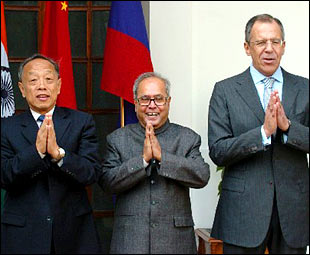
Trilateral FM Summit in New Delhi


Chinese, Indian and Russian foreign ministers met in New Delhi Wednesday, stating that their trilateral cooperation did not aim at harming any other nation but to promote international harmony and understanding.

The three ministers reaffirmed the strong commitment made between India, Russia and China to multilateral diplomacy, according to the Joint Communiqué issued after latest trilateral meeting.

They agreed that the three nations, as countries wielding increasing international influence, could all actively contribute to global peace, security and stability.

"China, India and Russia have developed friendly and frequent cooperation on international and regional issues," said Chinese Foreign Minister Li Zhaoxing, speaking at a press conference after the meeting, "The trilateral cooperation will include collaboration in regional organizations like Shanghai Cooperation Organization (SCO) and in the United Nations."

China and Russia further welcomed India joining the SCO as an observer country, according to the Joint Communiqué.

Li said all trilateral relations between the three sides would be open, inclusive, transparent and constructive.

The three countries also determined precise avenues for beneficial economic interaction in areas such as energy, transport, infrastructure, health and high technologies including IT and biotechnology.

As a result, the ministers pledged to advise their respective business bodies to organize a trilateral business forum within the year.

The three sides stressed the importance of UN reforms including the UN Security Council in which both China and Russia would support a greater role to be played by India.

An exchange of opinion also took place concerning the anti-terrorism issue, underlining the necessity of working together against terrorism through regional organizations.

They were of a common voice that terrorism should be fought in a consistent, sustained and comprehensive manner with no double standards.

The Joint Communiqué further revealed that the three countries would from now on coordinate on taking swift measures against any factor fueling international terrorism including financing thereof, illegal drug trafficking and trans-national organized crime.

In closing, the document specified that the next trilateral meeting between China, India and Russia would be held in China.

(Xinhua News Agency February 15, 2007)

Giants meet to counter US power

February 15, 2007

India, China and Russia account for 40 per cent of the world’s population, a fifth of its economy and more than half of its nuclear warheads. Now they appear to be forming a partnership to challenge the US-dominated world order that has prevailed since the end of the Cold War.

Foreign ministers from the three emerging giants met in Delhi yesterday to discuss ways to build a more democratic “multipolar world”.

It was the second such meeting in the past two years and came after an unprecedented meeting between their respective leaders, Manmohan Singh, Hu Jintao and Vladimir Putin, during the G8 summit in St Petersburg in July.

It also came only four days after Mr Putin stunned Western officials by railing against American foreign policy at a security conference in Munich.

The foreign ministers, Pranab Mukherjee, Li Zhao Xing and Sergei Lavrov, emphasised that theirs was not an alliance against the United States. It was, “on the contrary, intended to promote international harmony and understanding”, a joint communiqué stated.

Their formal agenda covered issues ranging from Iran, Iraq, Afghanistan, the Middle East and North Korea to energy security, nuclear non-proliferation and trade. The subtext, however, was clear: how to use their growing economic and political muscle to prevent Washington from tackling such issues alone.

“In the long term, they feel that the whole structure of international relations has to shift in their direction,” said Vinod C. Khanna, of the Institute of Chinese Studies, Delhi. “What has happened is that quite independently they’ve reacted very similarly to recent international events.”

Mr Mukherjee said: “We agreed that cooperation rather than confrontation should govern approaches to regional and global affairs. We also agreed on the importance of the UN.”

Diplomats say that it is premature to talk of a strategic axis between the world’s largest and two most populous nations because they still have more in common with the West than with each other.

Delhi was close to Moscow in Soviet times, but has forged a new friendship with Washington. Chinese relations were soured by its border wars with India in 1962 and the Soviet Union in 1969, and by its arms sales to Pakistan. Russia appears keener than China or India to challenge American hegemony. But there has been a convergence of interests as each struggles to make the transition from a command economy to free markets. Since 2003 they have found further common ground in opposing the US-led invasion of Iraq.

One area of agreement is opposition to outside interference in separatist conflicts in Chechnya, the northeast of India and the northwestern Chinese region of Xinjiang.

Another is energy. India and China are desperate for Russian oil and gas, and Moscow is worried about its dependence on Western markets. But their most significant common ground is opposition to US military intervention in Iran. The joint statement did not mention Iran, but the three countries have taken a common stance in calling for a negotiated solution through the International Atomic Energy Agency. None of them wants a nuclear-armed Iran, but Russia sells Tehran nuclear technology and India and China need Iranian gas.

Saturday, December 23, 2006

Condi's Nuclear Proliferation Triumph

December 23, 2006

By Gordon Prather

Last year Condi whizzed down to New Delhi to prevent India from finalizing technical and commercial contracts for a $4.5 billion natural gas pipeline – the so-called "Peace Pipeline" – that would transit Pakistan but provide Iranian natural gas mostly to India.

Iran proposed making India effectively a "partner" in the gas pipeline, oil refining and other energy related projects to the tune of $40 billion.

Well, an Iranian-Pakistani-Indian Islamic law-friendly energy "partnership" would never do. So, Condi proposed, as a mutually exclusive alternative, a U.S.-Indian Nuclear Cooperation Agreement.

Of course, under the terms of the Atomic Energy Act, such an agreement required Congressional approval.

Now, India – although a member of the International Atomic Energy Agency – had never become a signatory to the Treaty on Non-Proliferation of Nuclear Weapons.

So, when India tested a "nuclear explosive device" in 1974, Congress passed the Nuclear Non-Proliferation Act, requiring any future recipient of US nuclear exports to submit to "full scope" IAEA Safeguards. Nuclear exports to any recipient state which subsequently detonated a "nuclear explosive device" were to be terminated.

Furthermore, the US took the lead in establishing the Nuclear Suppliers Group, a 40-plus member voluntary organization which includes the U.S., UK, Russia, China and France.

NSG "Guidelines for Nuclear Transfer" have long required the acceptance by the recipient state – whether NPT signatory or not – of IAEA Safeguards on certain imported items.

But, as a consequence of what the IAEA found in Iraq in the aftermath of the first Gulf War, the NSG soon promulgated "Guidelines for Transfers of Nuclear-Related Dual-Use Equipment, Material and Related Technology."

Since then, if any new NSG transfers are required by NSG Guidelines to be made subject to IAEA Safeguards, NSG guidelines now require all existing nuclear equipment at all facilities in the country be made subject.

Russia built two IAEA Safeguarded 1000 MWe nuclear power plants at Koodankulam and intended to build four more.

But, largely as a result of US pressure, the director of the Russian Federal Atomic Energy Agency announced last year that Russia would be unable to construct them.

That is, unless India agreed to subject its entire nuclear program – including its weapons program – to the full-scope IAEA Safeguards regime.

Of course, India is unwilling to do that.

And to make matters worse, in 1998 India had conducted a series of nuclear weapons tests.

So, that meant that the US-India deal Condi was proposing was not only contrary to NSG guidelines, but was prohibited under US law.

In its closing hours, the 109th Congress passed the US-India Peaceful Atomic Energy Cooperation Act, which supplied conditional Congressional exceptions to existing law.

Conditional?

Yes, if the President can make certain specific "determinations" he may exempt the US-India Nuclear Cooperation Agreement from certain prohibitions in the Atomic Energy Act. He must determine, inter alia, that

"The NSG has decided by consensus to permit supply to India of nuclear items covered by the guidelines of the NSG"

The Act goes on to say it "shall" be US policy to

"Act in a manner fully consistent with the Guidelines for Nuclear Transfers and the Guidelines for Transfers of Nuclear-Related Dual-Use Equipment, Materials, Software and Related Technology developed by the NSG, and decisions related to the those guidelines, and the rules and practices regarding NSG decisionmaking."

Well, that tears it.

Congress has made exemptions to US law effectively conditional on either India accepting full-scope IAEA Safeguards on all its nuclear programs, or the NSG drastically revising – virtually repealing – its existing guidelines.

Within hours of signing the US-India PAEC Act, King George issued a "signing statement" in which he declared, inter alia

"Section 103 of the Act purports to establish U.S. policy with respect to various international affairs matters. My approval of the Act does not constitute my adoption of the statements of policy as U.S. foreign policy. Given the Constitution's commitment to the presidency of the authority to conduct the Nation's foreign affairs, the executive branch shall construe such policy statements as advisory.

"Also, if section 104(d)(2) of the Act were construed to prohibit the executive branch from transferring or approving the transfer of an item to India contrary to Nuclear Suppliers Group transfer guidelines that may be in effect at the time of such future transfer, a serious question would exist as to whether the provision unconstitutionally delegated legislative power to an international body."

Well, Congress is likely to be grateful for Bush’s concern about whether the conditional exemption to existing law they have provided is "constitutional" or not.

Of course, if the PAEC Act is unconstitutional, then the US-India Nuclear Cooperation Agreement is illegal. A non-starter.

And even if Bush gets the NSG to essentially repeal its guidelines, the US-India Nuclear Cooperation Agreement may still be a non-starter.

Why?

Well, for one thing, the US doesn’t have much nuclear to offer.

Last week Chinese Minister Ma Kai did sign a Memorandum of Understanding with US Energy Secretary Samuel Bodman, under which certain US technology will be provided to China.

China had earlier announced its decision to award Westinghouse Electric a multi-billion dollar contract to build four AP 1000 nuclear power plants in China.

China said it chose Westinghouse partly because of "technology transfer and issues of self-reliance and localization of technology."

Westinghouse has already transferred design and manufacturing capabilities to France, Japan, and South Korea. In fact, Westinghouse technology transfers have allowed South Korea to become self-reliant in the design and construction of nuclear power plants, components and fuel.

But, until recently, Westinghouse Electric was owned by British Nuclear Fuels, a Brit government-owned company. Toshiba bought Westinghouse from the Brits earlier this year.

Toshiba? Japan? Then why did the Chinese find it necessary to sign an MOU with our DOE?

Well, much of the technology incorporated in the AP-1000 was developed when Westinghouse was US-owned. In particular, the "canned" reactor cooling pumps were developed for our nuclear Navy.

Now, all that technology – and more – will be "transferred" to China.

Could Chinese "knock-off" AP-1000 plants – already capable of burning Russian-supplied mixed-oxide (MOX) fuel – be transferred by China to Pakistan?

Or to India?

Well, only if China consents to the expected Bush-Rice request for virtual repeal of the NSG Guidelines.

Thursday, December 21, 2006

Bum Boys for Bush Bitch

The 42 presidents prior to the Chimp issued over 600 signing statements exempting them fom Congressional laws. Bush has signed 1000. And the sluts rolled over.
---
Bush India statement raises Congress concerns
Thu Dec 21, 2006 6:37am ET
By Carol Giacomo, Diplomatic Correspondent

WASHINGTON (Reuters) - A statement by President George W. Bush issued in connection with the just-signed U.S.-India civil nuclear cooperation law has raised concerns that Bush may try to circumvent some of Congress' intentions, lawmakers and analysts say.

The statement, clarifying Bush's views on law and policy, was issued after he signed new legislation on Monday permitting U.S. sales of nuclear fuel and reactors to India for the first time in 30 years.

In the statement, Bush said his signature "does not constitute my adoption of the statements of policy (in the law) as U.S. foreign policy." Also in responding to reports mandated by Congress, he would consider how releasing data requested by lawmakers might "impair foreign relations."

In one of its most controversial directives, Congress stipulated in the law that presidents should report annually on India's cooperation in restraining Iran's nuclear program, which Bush has condemned as a major international threat.

"With his recent signing statement, once again the president has shown he views Congress as a nuisance rather than an equal branch of government under the Constitution," said Sen. Thomas Harkin of Iowa, a Democrat whose party will control a majority of the new Congress to be sworn in next month.

It was "outrageous that the president has repeatedly stated the greatest threat to U.S. national security is a nuclear Iran, yet explicitly rejects Congress' declaration that it shall be the official policy of the United States that India will not use its nuclear technology to help develop Iran's nuclear weapons arsenal," Harkin said in a press release.

In the statement, Bush also said he considered as only "advisory" a congressional directive prohibiting nuclear transfers to India that conflict with guidelines of the 45-nation Nuclear Suppliers Group, which the United States helped establish years ago to restrain nuclear trade.

Democratic Rep. Edward Markey of Massachusetts said this shows Bush is "reserving the right to ignore the Nuclear Suppliers Group."

The president is "turning decades of U.S. international policy on its head -- and thumbing his nose at Congress at the same time," added Markey, co-chair of the House of Representatives task force on non-proliferation.

Before U.S. nuclear exports to India can begin, several other approvals are needed, including an NSG decision to change its rules prohibiting trade with India and passage of a second U.S. law.

Reuters Pictures

Editors Choice: Best pictures
from the last 24 hours.
View Slideshow

Some non-proliferation experts worry that if the United States is unable to win NSG approval -- which must be by unanimous consent -- Bush will let the trade with India go forward.

The White House and State Department rejected such interpretations of Bush's statement.

Asked if Bush might ignore the NSG, a State Department official told Reuters: "No, quite the opposite."

He said that while NSG guidelines are "political commitments," Secretary of State Condoleezza Rice "has been very clear that we're not going to do the (nuclear) deal without consensus in the NSG."

Meanwhile, a White House official said the statement's treatment of the NSG "is not regarding any particular intended course of foreign policy or with any particular practical effect in terms of intended treatment of material (nuclear) transfer."

Rather, the statement is intended to deal with the "domestic issue of government power rather than an issue of international nuclear policy," he said.

Justice Department lawyers were concerned the way the law is written meant that a change in NSG rules would force a change in U.S. law, a U.S. official said.

Wednesday, December 20, 2006

Deal and no deal

Nuclear


U.S. threatens sanctions against Iran while signing nuclear deals with India and China

December 19, 2006
iranian.com

Only two things are infinite, the universe and human stupidity, and I'm not sure about the former.
--
Albert Einstein

It should come as no surprise that President Bush has put one of the worst disasters in American history on the back burner. Having disregarded the Iraq Study Group findings, and mindless of the dead-count both at home and in Iraq, he is busy outdoing himself by making deals that would affect not only America, but effectively deprive world citizens of their trust and dependence in international institutions.

In December 2006, Congress overwhelmingly signed a controversial bill to expand the sale of civilian nuclear technology to India, a deal that Mr. Bush had proposed to India in exchange for its vote against Iran. Not only is this bill in violation of Article III of the non-proliferation Treaty (NPT) given that India is not a member state of the NPT, but the irony is that the catalyst for the Nuclear Supplier Group (NSG)) in 1976 was India’s nuclear test. This group (first called the London Group) met to restrain the transfer of uranium-enrichment and plutonium-extraction equipment and technology.

Experts say India has already produced about 50 nuclear weapons and plans to reach up to 400 in a decade. Selling India U.S.-origin fuel for civilian energy use will free up New Delhi's indigenous uranium stocks for weapons. Regardless, upon Mr. Bush signing the bill into law, Nicholas Burns had the audacity to undermine the American public’s intelligence and mock the world by announcing that “after 30 years we have realized that the NPT is ineffective, therefore we are going to reward India for non-proliferation [*] . In response to a reporter who quizzed him about Iran, he said we plan to punish Iran for violating the NPT!” (CNN – Monday, December 18, 2006). The very NPT that he announced is effective and therefore inapplicable should be applied to punish Iran. Not only are the public being lied to since India has had dealings with Israel, but they are bluntly being told to be dim-witted.

Eager to play power-broker in Southeast Asia, China offered nuclear know-how to both India and Pakistan. Not only have these two rivals been engaged in conflict for decades, but the growing fundamentalism in Pakistan is alarming. The special relationship between the Taliban and Pakistan’s ISI pre 9/11, and the re-emergence of the Taliban along Pakistan’s border is fear-provoking. Vying for regional influences, China, in violation of the NPT, will provide nuclear technology to Pakistan, in violation of the NPT; the funding for these nukes will come from the generous aid of the US taxpayers.

The icing on the cake of all this, is the US-China deal.

In spite of sanctions imposed on several firms by the Bush administration, on December 16, 2006, a multi-billion dollar civilian nuclear deal was concluded with China. While the US-China deal may well be a sweetener to nudge China into signing the Iran-sanctions bill, much like the 800-page WTO agreement signed in Hanoi between Bush and Putin, one must wonder if the nuclear technology that the US will hand over to China will end up in the hands of the Taliban or Bin-Laden!

It is clear that Mr. Bush must heed Prime Minister Olmert’s wishes. How far will this administration go in bribing UN Security Council members in order to sanction Iran? More importantly, this morning it was announced on CNN that Pentagon has dispatched a second US vessel to the Persian Gulf as warning to Iran – Let us hope that this administration understands that naval blockade of Iran needs UN authorization and without a UN resolution, such an act will be recognized as an act of war by the [biased and impotent] UN.

Can the world sit by passively and accept the irrationality of the United States imposing sanctions on Iran citing the NPT while at the same time it calls the NPT ineffective in order to reward those states that do not abide by it? Can sanctions be imposed on firms or nations for the transfer of dual usage technology while the United States violates the NSG agreement? And can the United States justify its naval buildup in the Persian Gulf to ‘enforce sanctions on Iran’ and allegedly to stop the possible transfer of material for missiles and WMD to Iran while itself has invalidated both the NPT and the NSG?

Institutions and laws have been implemented to protect individuals and collectively the nation-state. Should the citizenry fail to place its trust in institutions, there will be chaos, destruction, and death. Mr. Bush has already demonstrated this in Iraq. It must be understood that under the law, all nations are equal regardless of their size or might. It is the right of the citizenry that I am defending. It is not only Iran that has been stripped of her right, but each one of us has been individually violated by desecrating the international laws set up to protect us. Nuclear armed, non-NPT states are rewarded with nuclear technology. Israel not only receives technology but $6 billion in annual aid for conducting the US foreign policy; whereas NPT states acting within the NPT framework are being punished.

No doubt insanity has prevailed for too long; its rule must come to an end. Lest we are ruled by law, believe in equality for everyone, we will live to regret our inaction and watch the demise of civilization; it is for the sake of civilization that we must all speak with one voice. As Mark Twain said: “The universal brotherhood of man is our most precious possession.”. The demand for the implementation of international law cannot be denied in the face of universal unity. Comment

Soraya Sepahpour-Ulrich has lived and studied in Iran, the UK, France, and the US. She obtained her Bachelors Degree in International Relations from the University of Southern California, Los Angeles. She is currently pursuing her education in Middle East studies. Soraya has done extensive research on US foreign policy towards Iran and Iran’s nuclear program.

[*] By the year 2000, Israel’s nuclear commerce with India reportedly reached $500 million per year – this is two non-NPT members trading in violation of international law, and proliferating – (Yossi Melman, "India's Visiting strongman Wants to Expand Nuclear Cooperation with Israel," Ha'aretz, June 16, 2000.)

Tuesday, December 19, 2006

Bush signed India nuclear deal with disappearing ink

India gave Iran nuclear technology. Think about it.
---

Bush signing statement on US-India nuclear deal erases Congressional restrictions

12/19/2006 @ 6:51 am

Filed by Michael Roston

Hours after signing an agreement yesterday on cooperation with India on civilian nuclear technology, President George W. Bush issued a "signing statement" insisting that the executive branch was not bound by terms of the agreement approved by the House of Representatives and Senate, RAW STORY has learned.

The "Henry Hyde United States-India Peaceful Atomic Energy Cooperation Act" was signed following a year of difficult negotiations with the Congress over the terms of the agreement. The agreement between the US and India itself took years to achieve. Critics of the agreement warned that it would send a bad message to states like Iran who may be on the threshold of a nuclear weapon capability. They also worry that by making it possible for the South Asian giant to access larger supplies of nuclear fuel for use in its civil nuclear power plants, the deal will free up India's small existing uranium supplies for use by its military.

But President Bush was unfazed in explaining his reasons for supporting the agreement, first and foremost emphasizing the benefits for the bilateral relationship between the US and India. He also used the legislation as an opportunity to promote the value of the use of nuclear energy by both states. Moreover, he reasoned "the bill will help keep America safe by paving the way for India to join the global effort to stop the spread of nuclear weapons."

To make these improvements in the bilateral relationship possible, President Bush pledged that "As part of the agreement, the United States and India have committed to take a series of steps to make nuclear cooperation a reality, and we're going to fulfill these commitments. The bill I sign today is one of the most important steps, and it's going to help clear the way for us to move forward with this process."

However, a reading of the presidential signing statement which came later in the day made unclear the strength of some of those commitments, especially those made to Congress. In all, President Bush took exception to nine full sections of the bill approved by Congress.

First, President Bush took particular exception to a section declaring the policies of the United States, noting that his "approval of the Act does not constitute my adoption of the statements of policy as U.S. foreign policy." The statements of policy included opposition to nuclear weapons production by all non-nuclear weapons states, as well as promoting India's commitments to control the proliferation of nuclear fuel cycle technology, cooperate in preventing Iran's development of nuclear weapons, and limit expansion of existing nuclear arsenals in South Asia.

Next, President Bush said that a control placed by Congress on transfers to India of items that would run afoul of Nuclear Suppliers Group guidelines "unconstitutionally delegated legislative power to an international body," and he therefore considered the section "advisory" in nature.

Then, the president declared that 8 sections of the bill in total had to be construed "in a manner consistent with the President's constitutional authority to protect and control information that could impair foreign relations, national security, the deliberative processes of the Executive, or the performance of the Executive's constitutional duties."

One section of the bill to which the president qualified his assent called on the the National Nuclear Security Administration of the US Department of Energy to engage the nuclear scientific community in India to develop cooperative nonproliferation activities, particularly with nuclear safeguards in mind. In another section of the bill, Congress had called on the president to issue determinations to Capitol Hill that India was aligning its nonproliferation policy in a manner consistent with US global nonproliferation goals, and also that civil cooperation with the US was not contributing to India's nuclear weapons program

Chris Kelley, a political science professor at Miami University of Ohio who has studied presidential signing statements closely, remarked on his personal blog last night that "All of the attention that the signing received was directed precisely where the administration wanted, and away from the sections of the bill that the President has undermined."

He added "With today's challenges, President Bush has issued a total of 137 signing statements and has made 1097 separate and distinct challenges to the provisions of the laws he has signed."

In a seeming echo of Bush's statement, Reuters reported India's Prime Minister Manmohan Singh as responding to domestic critics of the agreement that "India would not be bound by "extraneous" conditions attached to the deal when it was passed by the U.S. Congress this month, rejecting efforts to constrain New Delhi's policy towards Iran or its own nuclear weapons programme."

Bush's presidential signing statement can be accessed in full at the White House website. The sections of the legislation affected by the presidential signing statement are included at this link.

Saturday, December 16, 2006

So Much for Inalienable Rights

December 16, 2006

by Gordon Prather

Two weeks ago, during his Senate confirmation hearings, nominee Robert Gates was asked if he believed the Iranians were trying to acquire a nuclear weapons capability.

Gates said he did.

He was then asked if he believed "the Iranians would consider using that nuclear weapons capability against the nation of Israel."

Gates said he didn’t. In fact, he believed the Iranians were seeking a nuclear weapons capability as a "deterrent." After all, Gates noted that –

"They are surrounded by powers with nuclear weapons: Pakistan to their east, the Russians to the north, the Israelis to the west and us in the Persian Gulf."

Notice that Gates was asked not about nuclear weapons, but about "nuclear weapons capability."

What’s the difference?

Well, to the Likudniks and their Congressional sycophants, there isn’t any.

But, as far as the Treaty on Non-Proliferation of Nuclear Weapons and the Statute of the International Atomic Energy Agency, and the Guidelines of the Nuclear Suppliers Group are concerned, there is an enormous difference.

As an NPT signatory, Iran has an "inalienable right" to develop "without discrimination" the capability to enrich uranium – subject, of course, to an IAEA Safeguards Agreement, entered into for the exclusive purpose of verifying that no "source or special fissionable material" has been diverted to a military purpose.

Furthermore, the United States, United Kingdom, France, Germany, Russia and China – as signatories to the NPT– have all undertaken to "facilitate" that development by Iran.

Nevertheless, despite at least a dozen quarterly reports by IAEA Director-General Mohamed ElBaradei that he could find no indication that Iran had ever diverted any source or special fissionable material to a military purpose, Bush and the Likudniks have managed to get the IAEA Board of Governors to repeatedly violate the IAEA Statute and the UN Security Council to repeatedly disregard the UN Charter, demanding that Iran give up its rights guaranteed by both the NPT and by the IAEA Statute.

Now, you might think that the Likudniks – and maybe even Bush and Bobby Gates – know something ElBaradei doesn’t know. That they are not complete idiots. That they don’t really consider an Iranian capability to enrich uranium in an IAEA Safeguarded facility to be tantamount to Iran having nuclear weapons.

But no, one of the more interesting revelations elicited by Seymour Hersh from Scott Ritter during their televised public discussion this past October of Ritter’s latest book Target Iran, was that Ritter had cultivated a close working relationship with Israeli intelligence analysts, beginning while a US Marine intelligence officer, assigned to the staff of General Norman Schwartzkopf during Operation Desert Storm, continuing through his seven years as Chief Inspector for the UN Commission on Arms Control in Iraq, even informing the books Ritter has written since resigning from UNSCOM.

After praising ElBaradei for having conducted a multi-year program of inspections of unprecedented scope and thoroughness, resulting in no evidence of undisclosed nuclear activity, much less a diversion of source or special fissionable materials, Ritter revealed that Israeli intelligence has also been unable – despite considerable use of on-the-ground "human intelligence" and analysis of spy-satellite images – to find any indication of a hidden Iranian nuclear program.

Nevertheless;

"Israel has drawn a red line that says, not only will they not tolerate a nuclear weapons program in Iran, they will not tolerate anything dealing with nuclear energy, especially enrichment, that could be used in a nuclear program.

"So, even if Iran is telling the truth – Iran says, 'We have no nuclear weapons program. We just want peaceful nuclear energy' – Israel says, 'So long as Iran has any enrichment capability, this constitutes a threat to Israel,' and they are pressuring the United States to take forceful action."

So, Bush and Gates and the Likudniks don’t know something about Iran’s nuclear programs that ElBaradei doesn’t know, that our intelligence community doesn’t know, that Congress doesn’t know.

Speaking of the Best Congress Money Can Buy, what were they doing while Bush-Bolton-Rice were corrupting the IAEA Board of Governors and emasculating the UN Security Council?

Well, busy passing the Iran Freedom and Support Act which, inter alia, declared it "should" be the policy of the United States not to bring into force an agreement for cooperation with the government of any country unless "either on its own initiative or pursuant to a binding decision of the United Nations Security Council, suspended all nuclear assistance to Iran and all transfers of advanced conventional weapons and missiles to Iran."

That law was aimed at Russia, an NPT signatory still attempting to honor its NPT commitments to Iran.

Then, in their final hours, the 109th Congress enacted the US-India Nuclear Cooperation Act, which, inter alia, declared it "shall" be the policy of the United States to

"Secure India's full and active participation in United States efforts to dissuade, isolate, and, if necessary, sanction and contain Iran for its efforts to acquire weapons of mass destruction, including a nuclear weapons capability and the capability to enrich uranium or reprocess nuclear fuel, and the means to deliver weapons of mass destruction."

What if India is not assessed by the President to be fully and actively participating in such efforts?

He is to provide them a report setting out

"(I) the measures the United States Government has taken to secure India's full and active participation in such efforts;

"(II) the responses of the Government of India to such measures; and

"(III) the measures the United States Government plans to take in the coming year to secure India's full and active participation;"

As for the Likudniks, upon emerging from a meeting last week with Bush, Israeli Prime Minister Olmert alluded once again to the possibility of Israeli military action against Iran, saying, "the people of Iran must understand that if they do not accept the request of the international community [to give up their inalienable rights], they're going to pay dearly."

Wednesday, November 22, 2006

American Hegemony: India and Iran in the New World Order

21.11.06

Lord Acton once implored us to remember a simple mantra:


Where you have a concentration of power in a few hands, all too frequently men with the mentality of gangsters get control. History has proven that. All power corrupts; absolute power corrupts absolutely.Since its inception, American foreign policy has essentially been to expand the sphere of American dominance at whatever cost is necessary. It began with simple expansion out along the American continent, slaughtering the inhabitants along the way. In 1899 President McKinley issued the "Benevolent Assimilation Proclamation" announcing Americas intention to set up its own version of the British Empire. This policy continued through the years of "Wilsonian Idealism" and accelerated after World War II, reaching its climax under the guise of "Humanitarian Intervention" under Clinton. Each step along the way has seen an increase in the scope of Americas hegemonic ambitions, and each time the sphere of influence was expanded. First it was just the North American continent, then nearby islands, Central and South America, and finally expanding through the Middle and Far East.Americas two most recent conquests, Afghanistan and Iraq, are becoming indicators that the time of American Empire may be coming to an end. After the collapse of the Soviet Union, the United States remained as the sole world superpower, excersising its will with reckless abandon. However, the extension - and expansion upon - these policies by George Bush Junior has polarised the world in a very different way. The unipolar order of The United States and everybody else is giving way under the paralysing weight of American ambitions of dominance. What is emerging is a multipolar order, with the United States being put in a position of being unable to exert its influence at will, and instead having to increasingly accept foreign influence and input in world affairs.

The end of America's reign as the worlds sole superpower, and the absolute corruption that such power brings along, should be welcomed and encouraged by people the world over. As important policies in America are seldom even discussed (The Kyoto Protocols, Nuclear Disarmarment, Human Rights), and the US is using its global power to marginalise such important doctrines as those set forth by the Geneva Conventions, any move away from the absolutely corrupting Absolute Power given to American interests should be heralded as a positive move by anyone concerned about the safety and well being of our species as a whole.

Lynchpin: IndiaThe United States Senate last week passed (by a vote of 85 to 12) a measure approving the transfer of Nuclear technology, equipment, and fuel to India. Doing so required that an exception be made to the Atomic Energy Act, which specifically forbids the sale of nuclear materials to countries that are non-signatories to the Nuclear Nonproliferation Treaty. The important reasoning behind this was spelled out in a recent article in The New York Times which stated that the vote was "expressing that a goal of nurturing India as an ally outweighed concerns over the risks of spreading nuclear skills and bomb-making materials." Such an agreement also brings to an end the 30 year old doctrine prohibiting the transfer by the United States of Nuclear reactor components and fuel to other countries.Today, Chinese Premier Hu Jintao is in India on a visit meant to increase bilateral ties between the two countries. The China Daily reports that
As the first Chinese president to visit the country in a decade, Hu is expected to work with Indian Prime Minister Manmohan Singh, to "fill in the specifics" in the strategic partnership, according to Sun Yuxi, Chinese ambassador to India.China and India announced the establishment of their strategic partnership for peace and prosperity last April in a joint statement signed by Premier Wen Jiabao and Singh.Hu's talks with Singh today will iron out the details for enhancing this partnership in political, economic, military, cultural, scientific, technological and educational spheres, Sun revealed in a group interview last Friday with Chinese journalists at his residence.Meanwhile, The Boston Globe reports that this meeting between Chinese and Indian premieres is likely to lead to a Nuclear arrangement being ironed out between those two countries as well, with China adding their bid for India to the one already on the table from the US.

If China and India enter into a nuclear cooperation agreement, it will mark a new stage in the increasing competition between China and the United States for India's friendship.President Bush branded China a "strategic competitor" as soon as he came to office in 2001. Since India's burgeoning economy and muscular military can tip the balance of power in Asia, over the last year the United States and China have been trying to build closer ties with India, said Sun Shihai, deputy director of the Institute for Asia Pacific Studies at the Chinese Academy of Sciences in Beijing."The US always said it wants to use India to balance China," Sun said. "China feels it needs to engage India more [and] develop some kind of Russia-China-India cooperation" that can balance US hegemony. "So there is some kind of competition happening."The White House's July 2005 decision to enter into civilian nuclear cooperation was widely seen as a critical step in attracting India into the US orbit.The worrysome emergence of spheres of influence outside of US control, specifically Russia and China (with partnerships growing to include Latin America, India, Iran and Pakistan), has US planners on their heels, of which the US offer of Nuclear technology to India is merely a byproduct.The most specific worry for US planners is the duo of China and Russia extending their influence beyond the Shanghai Cooperation Organisation and including countries in Latin America (Brazil, Venezuela) and such strategic heavyweights as India, Pakistan, and Iran. Since the demise of the Soviet Union, the US has aggressively been trying to expand NATO influence as far east as possible, encompassing many former Warsaw Pact nations. This is where the importance of India comes into play.Were India to join a strategic alliance with China and Russia, they would throw their sizeable population (over 1 Billion people, the 2nd most populous nation on the planet behind China and much larger than the US with 300 Million) and strategic central-asia location (between China and another country the SCO has been courting, Pakistan) into the already economically- and militarily- hefty China/Russia partnership. Moves have already been made in increasing cooperation between China and India with trade set to exceed $20billion (US) this year, exceeding the target set by the two governments for 2008. There is also talk of a bilateral free trade agreement between the two countries, which could enable an increase in the already strong rate of general economic growth in the region.There are, of course, a couple of sticking points in the China-India relationship, which the US is trying to take advantage of while it still has the opportunity. These include Chinese cooperation with India's foe Pakistan, the asylum of the Dali Lama from Tibet in India, and the China/India border. The border was in fact originally drawn by the British government near the end of their colonial reign, and has not been agreed upon by China or India. In the heat of the Cuban Missile Crisis in 1962, Nikita Kruschev is rumored to have encouraged Chairman Mao to go ahead and attack India over their disputed border, which India accepts but China views as claiming for India 90,000sq-km of Chinese territory. This act set in motion stronger ties between the US and India, which continue to this day; for instance, including a ten year mutual protection pact between the two countries currently in effect.However, steps have also been taken in recent years to increase military cooperation between China and India, another factor worrying to US planners who hedge their bets on permanent US military dominance. This cooperation is being manifested in the areas of economics and defense, mainstays in the US's exertion of dominance in world affairs.The value of courting India away from China/Russia is not lost on analysts, with such influential writers as Henry Kissinger and Noam Chomsky making their opinions heard on the subject. A regional economic and military alliance comprising Russia, China, and India, would have severe implications for continued American dominance.

Battleground: IranSuccessful defiance of American hegemonic interests is not undertaken lightly. However, the failed US invasion and occupation of Iraq has put the United States in its weakest position in decades, leaving open the opportunity for other power centres to assert their influence.Previous attempts at defiance have led to serious consequences for countries such as Cuba, which suffered at the hands of an American economic strangulation since the overthrow of the US-backed Batista regime. Overt actions have been taken against others guilty of defiance in the past, such as many Latin American countries, North Korea, Vietnam, Sudan, and the recent US-sponsored coup attempt in Venezuela to oust the elected president Hugo Chavez.Historically, Russia and/or China have consistantly fought the US on different battlegrounds, with Mao's troops fighting American troops in both North Korea and Vietnam (in the latter, the 100,000 strong Chinese forces even went so far as to don their Chinese military uniforms), the placement of Russian Nukes in Cuba, American Nukes in Turkey, and so on.The re-emergence of Russia and China as global players is today being showcased in Iran. What was originally a confrontation strictly between France (proportedly representing the EU, although EU polls at the time indicated that the EU population was more worried about US militarism than Iran's nuclear program) and Iran has become a standoff between the East (Russia/China) and West (US/UK). Backed by these two UN Security Council Veto holders, Iran has refused to back down in front of US pressure regarding their nuclear program. Simultaneously, Iran is stepping to the forefront of one of the major issues of the day, the civil war raging in Iraq.After two decades of diplomacy suspension, Iran's close ally Syria and American occupied Iraq are resuming diplomatic relations. Syria, branded by George Bush Jr. as a member of the "axis of evil" along with Iran and North Korea, broke ties with Iraq in 1982 in reaction to the US-backed war against their partner Iran; increasing ties between Syria and the US-installed regime of Malaki (and Talabani) could only be as surprising to their US masters as Malakis denunciation of Israel's US-backed murderous escapades in Lebanon and Palestine over the past few months.Even more surprising for the US is the acceptance of the offer of a state visit to Iran by Talabani this weekend, where the major issue is likely to be the civil war raging in Iraq (it is often referred to in the western media as the "security situation" but to a rational observer 100 sectarian murders a day is beyond a simple "security situation"). This is on the heels of a call by Tehran for a summit with Iraqi and Syrian leaders to discuss Iraqs deep seeded problems.The idea of such a summit occuring is so worrysome to the US that the US Embassy immediately issued a warning to the Iraqi government to stay away from Iran and Syria, and The US Propaganda machine immediately issued a report that such a summit would never happen.Why should America be so worried about Iranian influence on Iraq? It is generally accepted by those who look beyond Fox News Headlines that the US's intention was to impose a client regime on Iraq, opening up for US businesses "economic opportunities," in other words unfettered access to Iraqs vast reserves of natural resources, and a permanent US presence in the center of the resource-blessed region. Iran, on the other hand, wholeheartedly rejects the idea of any American and British influence in the region. An op-ed in the Iran Daily reflects this:
Many Arabs and Muslims I talked to at the weekend about his new round of irresponsible statements about Iran were of the opinion that Blair could be suffering from a fresh bout of dementia.In a television interview, the Labour boss known to many peace lovers in and outside Britain as “Tony Bliar“, “Phoney Tony“ and “King of Spin“, publicly admitted that the war he jointly engineered with George Bush was a “disaster.“However, that admission of defeat did not stop him from blaming Tehran for all that has been going very wrong in occupied Iraq as a direct result of the Bush-Blair arrogance....He said he had a message for Tehran and Damascus: “If you are prepared to be a part of the solution, there is a partnership available to you.“We cannot speak for the leadership in Syria, nor do we know if or when Bashar Assad proposed any mechanism to help bring peace to the volatile Middle East. As far as Tehran is concerned, Blair, who will be remembered by posterity as a pro-war ruler obsessed with Israeli security and interests, had the wrong address once again. Those who decide foreign policy in our country do not recall ever wanting to be partners with killers of innocent Muslims like Blair or Bush.Having said that, it deserves mention that the UK prime minister who dragged his country into the bottomless quagmire in Iraq and Afghanistan, is simply not in a position to make offers or speak on behalf of the people in our part of the world. One need not be a political scientist to understand that there is not one single country in the Muslim-Arab world that wants even impartial western rulers to speak on its behalf. Now, how can Iran get away with such blatant disobedience of American power? The answer lies, once again, in the East. Iran's ties with Russia and China are consistantly played down in the western media in favor of a portrayal of Iran as a country on the verge of aquiring nuclear weapons and intent on using them to commit genocide against Israel. However, if we look back at the timeline of the most recent developments in the confrontation we see other important factors. Iran's military is being supplied by the Chinese (who in turn were supplied by Russia), and their military capabilities were most recently demonstrated in excersises they carried out in nearly half of their provinces and the Persian Gulf. This chinese-supplied military capability is widely seen as a deterrant to the American military option. Additionally, Iran has secured a trade partnership with Russia (and, in turn, the SCO) that comprises the worlds largest supply of Natural Gas and one of the top five supplies of crude oil, and it is Russia (not Iran) that is building in Iran a new state-of-the-art nuclear reactor.Strategically, Iran is in an ideal position to all but cut off the supply of Middle East oil to the West, while allowing oil supply to continue through pipelines to their allies in the East. Iran's close ties with China and Russia are likely to prevent the US taking any more aggressive stance against the country than they already have, for economic reasons I have explained before:
Another dangerous economic trend is the steady decline in value of the US Dollar. Against the Euro it has dropped by more than a third of its value over the past five years. America's aggressive foreign policy isn't helping the situation much either, as the countries that were subsidising the US's enormous budget deficit by (as required by the IMF) purchasing US government bonds as collateral to insure their own currencies, such as many South American, Asian, and "Old Europe" countries, are looking to withdraw from their IMF obligations and take their money elsewhere in response to what they rightly perceive as American Imperialism.Perhaps more worrysome for the American economy is the fact that major energy-commodity trading countries, which have been propping up the value of the dollar since the seventies as it is the major trading currency for oil, are also responding to american imperialism with a desire to switch to other currencies as their oil buying and selling currency. Most notable would be China, which holds the largest foreign reserve of US dollars on the planet, and which has begun serious discussions this year to switch to Euros as its oil buying currency. That would lead their main oil supplier Iran, which the US has been bullying recently, to switch to Euros as well (for oil), and could lead other OPEC countries to follow suit. This would lead to a rapid decline in the value of the already weak dollar, and skyrocketing inflation in America.The end result is that the US, bogged down in Iraq and Afghanistan and facing strong eastern opposition, is not currently in any position to enforce their hegemony.

Future ImplicationsOnce an empire enters into decline, history tells us that the end result is consistantly terminal to their ambitions of dominance. Rome, Greece, Persia, the Ottomans, Britain; each have fallen by the wayside as their policies led to their downfall. What is emerging now is a multipolar order (rather than a unipolar order under US control) with the US sharing its global power with China and Russia, India (whom America is having to attempt to woo away from the other emerging powers), and a Latin America being led by Democratic Venezuela in partnership with defiant Cuba and economically strong Brazil, and with close ties to the strategic alliance of Russia and China in the East.The indications of the demise of America as the worlds sole dominant superpower can only be welcomed by those who care about the future of our civilisation. The absolute power and absolute corruption that a system of American Hegemony has brought along is far from the best interests of the people, and it will be the people who benefit from moving away from the current Status Quo.

http://misneach.blogspot.com/2006/11/american-hegemony-india-and-iran-in-new.html