Showing posts with label China. Show all posts

Saturday, March 31, 2007

Unravelling The US Political-Military Paradox

March 29, 2007

By Jim Kirwan

What got us into this nightmare was a lengthy string of mega-lies that originated within the twisted plans of Dick Cheney and Donald Rumsfeld, back in the 1970’s. The U.S. presidents that have come and gone since then, have each played their part, in bringing us kicking and screaming to this decision point. There are several major parallax-views that have led the public to misunderstand and misinterpret the political events and military actions in the Middle-East: Actions that have kept our invasions going, and that now threaten to up-end the world—if these lies are allowed to serve, yet again; for another cover-story that can only end in chaos!

The November elections set the stage for this final confrontation between the desires of the public and the needs of the Outlaws: when it comes to funding and perpetuating our illegal and unilateral military responses to circumstances and to the control of those powers and resources that have become the global stance which has always underpinned the players in their intrigues in the Middle-East. Many nations now are involved to the point of self-extermination in the literal outcomes of how our continued presence there is handled.

It has taken almost forty years to get to the point where the United States government could be reduced from a single government consisting of three branches—to a cabal that has absolute power and that speaks for not only the other two branches, but who is totally opposed to the preferences and the well-being of the people of the United States as well!

One indication of this paradox is the recent behavior of Nancy Pelosi, in her capacity as the Speaker of the US House of Representatives. If George W. Bush launches a pre-emptive war on Iran, House Speaker Nancy Pelosi will bear full moral responsibility for that war; and her hands will always have the bloodstains of millions of lives upon them – so long as she lives!

“For it was Pelosi who quietly agreed to strip out of the $100 billion funding bill for Iraq a provision that would have required President Bush to seek congressional approval before launching any new war on Iran. "'It would take away perhaps the most important tool the U.S. has when it comes to Iran,' she said of the now-abandoned provision.

"'I don't think it was a very wise idea to take things off the table if you're trying to get people to modify their behavior and normalize in a civilized way,' said Gary Ackerman of New York." According to John Nichols of The Nation, Pelosi's decision to strip the provision barring Bush from attacking Iran without Congress' approval "sends the worst possible signal to the White House."

"The speaker has erred dangerously and dramatically," writes Nichols. Her "disastrous misstep could haunt her and the Congress for years to come." Nichols does not exaggerate.

If Bush now launches war on Iran, he can credibly say Congress and the Democrats gave him a green light. For Pelosi, by removing a provision saying Bush does not have the authority, de facto concedes he does have the authority. Bush and Cheney need now not worry about Congress. They have been flashed the go-sign for war on Iran.

Nothing in the provision would have prevented Bush, as commander in chief, from responding to an Iranian attack or engaging in hot pursuit of an enemy found in Iraq. Nor would the provision have prevented Bush from threatening Iran. It would simply have required him to come to Congress -- before launching all-out war. Now Pelosi has, in effect, ceded Bush carte blanche to take out Iran's nuclear facilities. It's all up to him and Cheney.” (1)

The Second Indication that something is dangerously amiss – are the numbers in the surge. The original demand was for 21,000. That number has since been added to, twice; and now it looks more like 40,000 total. There was never any attempt to comply with the wishes of the electorate or the congress, because the Decider acted immediately upon the announcement of his stated decision – as though no approval was required, from either the people or the congress: This, despite the fact that the public, the congress, and the world had all registered strong disapproval for his plans from the moment he announced them. If The Decider is determined to ‘act as a president and not a Dictator—he has a direct obligation to respond to obvious opposition, with something besides contempt!

But that’s only a sideshow: The real point is how these ‘surged’ troops will now be used. The Decider says they will be assigned to Baghdad. But it’s far more likely that these are the same troops that a Russian Satellite has just spotted, massing along the Iran border with Iraq—troops that will now be used to pre-emptively invade Iran. (2) Bush is lying to the world one more time, to create yet another WAR-Without-Reason: except of course to keep him, his friends, and his supporters out of jail and still in office—until he can disappear into Paraguay, without a backward glance. He’s lied to the world so many times before, what’s one-more-LIE, when the world has apparently swallowed so many of his lies already?

The Third Indication is the immediate reactions by those in the area, to what is obviously about to be. There were supposed to be US war games taking place yesterday and today in the Gulf: last night the media had “film at eleven” of two US aircraft carriers conducting war-games just beyond the territorial limits of Iran, in the Gulf. An Iranian Admiral has just denied that any such actions ever happened. (3) The Brits are also making warlike noises over the detention of 15 British Sailors and Marines, captured by Iran, in what Iran claims were Iranian waters. Tony Blair says otherwise and is demanding their release. So now there are two clay pigeons sitting outside or inside Iran either or both of which can be used as the next “Tonkin Gulf incident” for Iran.

The Fourth Paradox is perhaps the most complex and dangerous element: yet in an ironic twist of potentials, this one may just offer a possible way out, if it doesn’t become the actual reason to launch this operation—for in the twisted minds of the rabid American and Israeli war-mongers they absolutely want these new wars to happen!

“DUBAI, United Arab Emirates: The president of the United Arab Emirates forbade the U.S. military from using bases in his country to attack or spy on Iran as mammoth U.S. Navy maneuvers in the Gulf entered their second day. Sheik Khalifa bin Zayed Al Nahyan, who leads this key U.S. ally, said Tuesday that the Emirates had assured Iran that it was not siding with Washington in its dispute over Tehran's nuclear program.

Leaders of Arab nations around the Gulf have grown increasingly uneasy with the tough U.S. stance toward Iran, believing any outbreak of war would bring Iranian retaliation on their own soil, which lies in easy reach of Iranian missiles. On Wednesday, the U.S. Navy continued its largest show of force in the Gulf since the 2003 invasion of Iraq, with 15 ships, 125 aircraft and 13,000 sailors taking part in an exercise that veered within a few dozen miles of Iran's coast.” (4) However it should be noted that Egypt, Lebanon, Syria, and Turkey, along with a host of other states would also be drawn, one way or another, into any new war on Iran.

“The Russians and the Chinese for their part are also concerned, beyond their strictly commercial interests in that nation. “Russia's Foreign Ministry has sharply criticized the United States for what it called over-reliance on force and warned Washington against military action against Iran, The Associated Press reported. Russia criticized what it called "the creeping American strategy of dragging the global community into a large-scale crisis around Iran," saying that Tehran helps maintain stability in Afghanistan and Central Asia.” In an already scrubbed report, Russian and China had also warned the US that Washington must sit down at the table with Iran and solve this dilemma diplomatically. Simultaneously they also told Iran that they needed to back down from their hard line position on developing nuclear facilities. It would appear that these two major nuclear powers want this stand-off defanged, so that the world can return to that time before the USA began to behave like the Hulk-of-all-Superpowers that has become overly enchanted with their own purely-macho approach to international affairs.

This is the totality of what’s on the table now, and thanks to Nancy Pelosi, there is no congressional way to stop the Bushwhackers from shattering the Middle-East—like the proverbial PiƱata that floats above the banquet-table of the war-mongers—drooling over the ‘possibilities’ that await their next and perhaps final move to empower Israel, and to capture the entire Middle-East, for the Corporatocracy and the Oil, in a bold and savage move.

The only final Paradox that remains, is that in all of this American Military planners have failed to account for what they may actually face with this new attack—exactly as they did when Rummy ran his dog & pony show into Baghdad in 2003. No matter how many times the lies of this administration are repeated—it does not make them true! As the intensity of the bloodlust in their greed does not insure success; so too the half-hearted assessments of the defense of Iran, will not change the outcomes of the trajectories of Iranian missiles one iota. If this misguided and criminal attack gets underway—at any time—the world will suffer for this crime: for decades to come if any of us survive at all. Congress is now irrelevant—again—but the rest of the planet is apparently awakening to the reality that now threatened people everywhere. Why not add your voice to those of the other peoples that oppose this Nightmare NOW! (6)

kirwanstudios@sbcglobal.net

1) The AIPAC Girl, Nancy Pelosi Leaves Iran War in Bush/Cheney Hands

http://www.postchronicle.com:80/commentary/article_21270952.shtml

2) Russian intelligence sees U.S. military buildup on Iran border

http://en.rian.ru/russia/20070327/62697703.html

3) Iran Admiral – US War Games Claims – False

http://www.presstv.ir/detail.aspx?id=4137&sectionid=3510101

4) Gulf Arabs distance themselves from U.S. Treats against Iran

http://www.iht.com:80/articles/ap/2007/03/28/africa/ME-GEN-Arabs-US-Iran.php

5) Easter Surprise Attack on Iran, new 9/11. . . Or Worse

http://www.wakeupfromyourslumber.com:80/node/1052

6) Accept Peace or Face War, Israel told

http://mparent7777.blogspot.com/2007/03/accept-peace-plan-or-face-war-israel.html

Wednesday, March 28, 2007

Russia ,China at highest alert

Related
Russian intelligence sees U.S. military buildup on Iran border
---
The Russians are securing China’s vital sea lanes around the contested island of Taiwan.
to which the US has vowed to defend against both China and Russia.

We can assume that Russia and China are now at highest alert.
---
Russia starts Pacific naval exercise

26/03/2007 12:48 VLADIVOSTOK, March 26 (RIA Novosti) - Russia has begun a scheduled naval exercise in the Sea of Japan, the Pacific Fleet press service said Monday.

A major naval force, Russia's Pacific Fleet has strategic underwater missile cruisers, multipurpose nuclear and diesel submarines, surface ships for operations in the coastal and open-sea zones. The Pacific Fleet also has maritime missile-carrying, antisubmarine and fighter aviation, land troops and coastal guards.

"The exercise, which marks the end of winter combat training, will feature missile and artillery firing, and the search and destruction of submarines," a press service spokesperson said.

Over 15 combat and auxiliary vessels, shore and deck-based aircraft of the Primorye Territory in the Far East will participate in the exercise.

Aircraft crews will practice take-off and landing on the decks of submarine chasers in day and night conditions, while submarine crews will conduct torpedo launches.

© 2005 RIA Novosti

Monday, March 26, 2007

China, Russia leaders reject force on Iran, N.Korea

By Oleg Shchedrov 48 minutes ago

Visiting Chinese President Hu Jintao and Russian leader Vladimir Putin called on Monday for peaceful solutions to the crises over Iran and North Korea's nuclear programs and pledged to stop an arms race in space.

The two leaders, who hope to counter Washington's clout by promoting internationally agreed solutions to world crises, said in a joint declaration that they shared a common position on big global issues.

"I would like to emphasize with satisfaction that the positions of Russia and China on all the issues discussed either coincide or are similar," Putin said.

Hu, on his third visit to Russia, described Putin as "my good friend" and spoke of the "warm atmosphere of trust" at their meeting, underlining the growing friendliness between the two erstwhile Communist rivals.

"We have agreed that strategic cooperation between China and Russia, permanent members of the U.N. Security Council, has major importance for international affairs in creating a favorable atmosphere, in making international relations more democratic and ensuring global peace," Hu added.

There was no immediate sign of major new energy deals between Russia, the world's second biggest oil exporter, and resource-hungry China.

The leaders pledged to increase "bilateral, long-term strategic cooperation" on energy but signed only a protocol to increase Russian oil deliveries to China, something already promised in the past by Moscow.

Putin and Hu then presided over a ceremony in a Kremlin hall formally opening the Year of China in Russia.

The leaders addressed the audience of 6,000 dignitaries from a stage featuring a giant backdrop showing a Chinese panda holding hands with a Russian bear.

A joint Sino-Russian declaration said that the problem of Iran's civilian nuclear program, believed by Washington to be a cover for an atomic weapon, "should be resolved exclusively in a peaceful way, through negotiations."

The wording on North Korea was similar, with both sides aiming to find "a full and all-encompassing solution to the nuclear problem of the Korean peninsula through a peaceful, diplomatic way."

China and Russia have used the threat of their veto at the United Nations as an instrument to blunt Western efforts to impose sanctions on Iran and North Korea.

The two nations said they wanted to prevent an arms race in space and underlined the importance of international agreements to prevent the deployment of weapons in space.

In an apparent rebuff to Washington's efforts to build influence in the vast Central Asian region, Hu and Putin pledged to "strengthen cooperation with Central Asian countries in the political, trade and economic spheres, as well as in security issues."

Putin earlier praised the "high level of cooperation in the arms sector and between our militaries" - a reference to Russia's big and lucrative arms sales to China - but did not give details.

The two countries' potential partnership has been stymied by their desire to keep a state grip on energy deals. Previous plans for key oil and gas pipelines have languished after both sides trumpeted initial agreements.

On Wednesday, Hu was to visit the oil-rich region of Tatarstan, which may yield an oil deal with the regional oil firm Tatneft, a local government spokeswoman said. She declined to give details and said the deal was not yet definite.

(Additional reporting by Tom Miles in Moscow)

Sunday, March 18, 2007

Why Pakistan is crucial to the world's stability

Denis Macshane
Sunday March 18, 2007
The Observer


Anyone who wants political power in Pakistan, so say the street pundits, must hold three aces - America, the army and Allah. As Pakistan plans its 60th birthday celebrations this year, it may hope for a future less in thrall to its military, to its mullahs and to Washington. President Pervez Musharraf, who took power in a bloody 1999 coup, is facing a crisis.

Far from being Nato's calm eastern ally, a new front in the fight against terrorism, Islamabad's streets feel shaky, divided and waiting for the worst. Pakistan is neither dictatorship nor democracy. Its newspapers are louder in criticism of their President than the anti-Blair or anti-Bush press in the West. Its intellectuals roam the world, trashing their country. Opposition politician, Cambridge-educated billionaire, Benazir Bhutto, is free to return home when she wants. But General Musharraf and his army are in charge. The house arrest of Chief Justice Iftikhar Muhammad Chaudhry, after he refused Musharraf's demand to resign, has caused outrage. In a nation that reveres high office, the manhandling of the judge shocked even the most cynical of Pakistani politicians.


Pakistan urgently needs a return to democratic civilian rule even if its elected leaders in the Nineties became bywords for corruption, encouraging the Taliban and the madrassas, as well as the long-bearded, turban-wearing politicians who insist the law should be subordinate to theocracy. Democracy requires compromise between the military and the politicians. Instead there may be a slow drift towards increased authoritarianism under Musharraf, further alienating Pakistan.

In fact, the most poignant story in Pakistan last week was not about the Chief Justice but the stoning to death of a woman and two men accused of adultery. The rise of religious intolerance is now a political danger from the Christian West to the Muslim East. Yet it is all too easy to patronise Pakistan. Britain is currently gushing over India with its clever graduates and Midas-touch businessmen. But India's record on human rights and the illiteracy of half its population is little better than Pakistan's. India is rightly seen as a strategic partner for the West, especially the US, which is playing a balance-of-power game using India against China. But Pakistan, not India, is key to stability in the new world order.

The chain reaction that began when the West and Saudi Arabia called into being the jihadi movement to oust the Russians from Afghanistan is coming back to haunt Pakistan. In the Eighties it allowed itself to be the base for military attacks on Russia, even as the USSR tottered on the edge of history's dustbin. Now the jihadis are heading steadily eastwards as fanatical Islamism preaches hate and justifies suicide bombings. But Afghanistan could be saved if a political-economic-social campaign can gain ground from a purely military definition of the challenges. Earlier this month US soldiers ran amok after a bomb attack. They fired indiscriminately, killing 30 people. A few more Bloody Sundays like this and Pakistan's neighbour will be Iraqified before reconstruction pays off.

Britain is sending one of its toughest trouble-shooting diplomats to take over a beefed-up presence in Kabul. The UN agencies, the European Commission plus the European Council, plus dozens of NGOs constitute the huge effort being made in Afghanistan, yet without better co-ordination it may end up chasing its tail.

The news is good in terms of schools, roads and hospitals built. Kabul looks richer than when it was a hippy-trail stopover three decades ago. But relentlessly the Taliban and the jihadis from among the three million Afghan refugees in Pakistan are back in business. Pakistan is endlessly reproached about not doing enough. It is told to close its frontier, as if the US can close the Mexican border or 30,000 British soldiers could seal the border across which IRA killers roamed. Pakistan is pressured to hunt bin Laden, but Nato can't find Radovan Karadzic or persuade the Serbian army to stop protecting Ratko Mladic.

The time is overdue to acknowledge the sacrifices Pakistan has made. It has 80,000 soldiers along the 2,300km frontier with Afghanistan; 500 have been killed, far in excess of Nato casualties in Afghanistan or Britain's in Iraq. India could join the war against terror by removing its 700,000 soldiers from Kashmir and opening the border. Musharraf has been braver than his predecessors in acknowledging that Indian-controlled Kashmir is not going to return to Pakistan.

If Pakistan felt its eastern flank was secure, it could transfer its military to the west - Afghanistan. Britain in recent years has given £1bn in aid to India, while India spends £200m on aid to Afghanistan. UK aid is, in effect, subsidising India's efforts to pull Afghanistan into its orbit. India is opening consulates in parts of Afghanistan where no Indian has been seen in years. From Pakistan's perspective, this looks like India seeking influence in order to keep up pressure on its old foe.

This summer heroin will be cheaper on the streets of Pakistan than sweets. India and China have a bigger drugs problem than the UK. Both countries should cut Islamabad some slack. If Afghanistan goes wrong, the next target for the ideologues who unleash suicide bombers will be Pakistan with its nuclear arsenal. Pakistan is the key to defeating the new threats to the world. Time and again, the West has turned its back on Pakistan. That mistake should not be made again. Britain, with its close links to Pakistan, its able, articulate Muslim MPs, and its duty to tell America to change tactics, should help before it is too late.

· Denis MacShane is Labour MP for Rotherham and was a minister at the Foreign Office until 2005.

Friday, March 2, 2007

China Squeeze: Stephen Roach

Global

February 28, 2007

By Stephen S. Roach | New York

Like nearly everything else in the world these days, it now appears that global stock market corrections are made in China. I have no idea if the rout that began in China was just a brief flash or the start of something big. But I have long felt that something has to give in China. This may well be the beginning of an important venting process.

The basic premise of this story is that China — despite its remarkable successes on the economic development front — now has a seriously unbalanced economy. The main problem is a runaway investment boom. By our estimates, in 2006, fixed asset investment exceeded 45% of Chinese GDP — a record for China and, in fact, a record for any major economy in the world (see accompanying chart). By comparison, Japan’s investment ratio in the 1960s — the period of maximum rebuilding from the destruction of World War II — never exceeded 34% of GDP. China’s annual growth in fixed asset investment has averaged 26% over the past four years. Should the investment boom continue at this pace, the odds of capacity excesses and a deflationary endgame will only increase. That’s the very last thing China wants or needs.

The Chinese government recognizes the perils of just such a possibility. For nearly three years, it has conducted an on-and-off tightening campaign aimed at cooling down its overheated investment sector. Following relatively limited actions first implemented in the spring of 2004, Chinese authorities have upped the ante in the past eight months. The People’s Bank of China has raised its short-term policy rate twice by a total of slightly more than 50 basis points, and beginning in mid-2006 the central bank boosted bank reserve requirements five times in increments of 50 bps from 7.5% to 10% — the last such action taking effect on 25 February.

The problem for China is that it is still very much a blended economy —both state and market driven. As such, market-based policy actions — especially interest rate adjustments — have had only limited success, at best. Two additional factors compound this problem: First, Chinese banks run chronic excess reserve positions; reserves amounted to 14% of total deposits by year-end 2006 — well above the mandated 10% requirement set by the latest policy action. That means, of course, that recent increases in bank reserve ratios are not a binding constraint on the banking system. Second, much of China’s bank lending remains outside the scope of the central control of its monetary authorities; dominated by a vast and highly fragmented system of autonomous local banks, there is only limited traction between monetary policy adjustments and broad trends in Chinese bank lending. In light of that disconnect, together with only limited development of a domestic corporate bond market, Chinese macro officials have had to rely largely on “administrative controls” — namely, a case-by-case project approval mechanism — to rein in the excesses of a runaway investment boom.

The results of this effort have been mixed. Courtesy of the administrative edicts issued by the National Development and Reform Commission — the modern-day counterpart of China’s old central planning bureau — investment growth slowed from near 30% at the start of 2006 to around 14% at the end of the year. Unfortunately, bank lending went the other way — actually accelerating from 13% y-o-y growth in mid-2006, when the latest tightening campaign began in earnest, to 16% by December. That, in a nutshell, could well be the key to this story: China’s central bank has been unable to get traction on bank credit expansion at the same the central planners have succeeded in achieving traction in prompting the investment slowdown. This has resulted in an excess of bank-induced liquidity creation that is undoubtedly spilling over into the financial system. As a doubling of the Shanghai A-share index over the past six months suggests, the Chinese stock market appears to have been a major beneficiary of this mismatch.

Here’s where the story gets especially interesting — and, admittedly, somewhat conjectural. In China, stability is everything. The Chinese leadership believes it cannot afford to lose control of either its real economy or its financial markets. Pure market-based systems can rely on interest rates, currencies, fiscal policies, and other macro stabilization instruments to contain the excesses. A blended Chinese economy does not have that option. The quasi-fixed currency regime compounds the macro control problem — making it difficult for China manage its currency in a tight range without fostering excess liquidity creation. That puts the onus on Chinese policymakers to opt for non-market control tactics. Just as China has moved to bring its central planners into the business of containing the excesses in the real economy through administrative measures, I suspect it now feels compelled to rely on a similar approach in order to deal with excesses in its financial system.

All this puts the onus on China’s financial regulators to face up to the risks inherent in any asset bubble — in the current instance, an equity bubble. That’s especially the case in the weeks just before the annual early March meeting of the National People’s Congress — always a critical and delicate point in the Chinese policy cycle. In that context, there were countless rumors of government intervention in the markets on 27 February. The only such action our China team has been able to verify — and it’s an important one — pertains to State-directed sales of its massive holdings of so-called reformed shares. Apparently, yesterday (27 February) it became public information that various local affiliate holding entities under the SASAC (State-owned Assets and Supervision Administration Commission) have been reducing government stakes in about 15 listed Chinese companies by close to the annual limit of 5% of total outstanding shares. Following the equity market reforms of 2005, these previously unlisted shares have since been classified as market tradable shares — thereby opening the door for actions such as those which became evident on 27 February. The 9% one-day plunge in Chinese A-shares could certainly be interpreted as a sign that “inside sellers” played a key role in sparking the decline — either acting at the explicit request of the government or out of fiduciary conviction that the end was close at hand.

Inside selling or not, the bottom line is that China’s macro control imperatives are a critical ingredient of its overall stability objectives. And in recent years, risks have been multiplying on the control front. Just as China cannot afford an overhang of excess capacity, it cannot afford a major equity bubble. Lacking in market-based mechanisms to address these problems, the administrative option remains a very important tool in the Chinese policy arsenal. So far, that’s mainly been true on the real side of the economy. The near-parabolic increase in the Chinese equity market over the past six months is good reason to believe this strategy is about to be tested on the financial side of the economy.

In the last five years, China has emerged as a major engine on the supply side of the global economy. But with that achievement has come a new set of risks — especially an overheated investment sector and an equity bubble. These two problems are related in that they are both very visible manifestations of China’s control problem. The sharp break of share prices on 27 February may well be symptomatic of China’s increased determination on the macro control front. Ultimately, this is good news for China and the broader global economy — it sets the stage for balanced and sustainable growth. But for those counting on open-ended Chinese growth, any such slowdown could come as a rude awakening. The China squeeze now appears to be on in earnest.

China demands US cancel planned missile sale to Taiwan

Friday March 2, 11:55 PM

AFP

China demanded Friday the United States scrap a planned sale of hundreds of missiles to Taiwan, warning the deal would harm regional stability and bilateral ties.

"We solemnly demand the leader of the United States... immediately cancel this weapons sale (and) avoid harming the peace and stability of the Taiwan Straits and Sino-US relations," foreign ministry spokesman Qin Gang said.

"The Chinese side expresses its strong dissatisfaction and resolute opposition to this. We have raised solemn representations with the US side."

The US Department of Defence this week notified Congress that it planned to sell Taiwan 421 million US dollars worth of missiles, which would help boost the island's defences against rival China.

"The proposed sale will help improve the security of the recipient and assist in maintaining political stability, military balance, and economic progress in the region," the US Defence Security Cooperation Agency said.

Acquisition of 218 Advanced Medium Range Air-to-Air missiles and 235 Maverick missiles would help Taiwan "modernise its armed forces and enhance its defence ability to counter air and ground threats," it said.

Qin said the sale violated US commitments to a "one China policy," which maintains that there is only one China with Beijing as its capital.

By selling weapons to Taiwan, Washington was also violating its promise to gradually reduce sales to the island territory, he said.

"By selling these missiles to Taiwan, the United States is violating ... its commitments," Qin said.

"This is rude interference into China's internal affairs."

China considers Taiwan a part of its territory to be reunified by force if necessary.

The United States is committed to providing Taiwan with defensive weaponry in accordance with the Taiwan Relations Act, a US law passed when it switched its political recognition from Taipei to Beijing in 1979.

The proposed sale comes after US Vice President Dick Cheney last week expressed concerns over China's growing military might and as top US intelligence officials said Beijing was trying to achieve parity with the US in military affairs.

"China's continued fast-paced military build-up are... not consistent with China's stated goal of a 'peaceful rise,'" Cheney said while on a trip to Australia.

Retired admiral Michael McConnell, the new director of US national intelligence, told Congress on Tuesday that "it's a matter of their building their military, in my view, to reach some sort of state of parity with the United States.

"They are a threat today, they will become an increasing threat over time."

US officials estimate China's annual defence spending at between 80 and 115 billion dollars, the highest in the world after the United States, and well above their stated defence spending of 35 billion dollars last year.

Following the barrage of criticism, China insisted this week that it posed no military threat to the rest of the world.

"China adheres to the role of peaceful development. We are an important force for maintaining peace and stability," foreign ministry spokesman Qin Gang said when asked about Cheney's comments.

Wednesday, February 28, 2007

Tuesday, February 27, 2007

Chinese stock prices plunge nearly 9 percent, biggest drop in a decade

Tuesday February 27, 2007

Chinese stock prices plunge nearly 9 percent, biggest drop in a decade

SHANGHAI, China (AP): Chinese stocks plunged nearly 9 percent on Tuesday, their biggest drop in more than 10 years, sending ripples through markets from Hong Kong to Australia.

Investors who had just lifted the market to a record Monday unloaded stocks to lock in profits and amid speculation about a fresh round of austerity measure from the Chinese government to slow sizzling economic growth.

Chinese stocks have been extremely volatile this year, notching one-day drops of 4.9 percent and 3.7 percent already this year _ and each time the market has bounced back to record highs.

The Shanghai Composite Index tumbled 8.8 percent to close at 2.771.79, its biggest single-day decline since it fell 8.9 percent on Feb. 18, 1997, at the time of the death of Communist Party elder Deng Xiaoping. The index had gained 1.4 percent on Monday to a record 3,040.60.

The Shenzhen Composite Index on China's smaller exchange plummeted 8.54 percent Tuesday to 709.81.

Chinese share prices doubled last year as investors piled into the market following the completion of shareholding reforms that helped to reduce worries over a potential flood of shares entering the market. But the markets have become increasingly volatile.

Market heavyweights plunged Tuesday on heavy selling by institutional investors, which in turn spooked retail investors. "The most important reason for today's decline was pressure for profit-taking,'' said Peng Yunliang, a senior analyst at Shanghai Securities.

"People viewed 3,000 as a psychological benchmark. It's understandable they might want to pull back after the market hit that peak,'' Peng said.

Large-cap Baoshan Iron & Steel hit the 10 percent downside limit at 9.03 yuan, CITIC Securities fell 9.7 percent to 36.21 and China Life Insurance declined 9 percent to 33.89 yuan.

Airline shares were battered after light, sweet crude for April delivery gained a cent to US$61.40 a barrel, a two-month high, on the New York Mercantile Exchange. Air China slid 10 percent to 6.79 yuan and China Southern Airlines lost 5 percent to 5.81 yuan.

China still limits foreigners' purchases of the yuan-denominated stocks that make up the biggest share of the markets, though that is gradually changing as regulators allow increasing participation by so-called qualified foreign institutional investors.

Friday, February 16, 2007

Anti-China bills follow U.S. trade deficit

The U.S. did this to Japan once and started a war, profitable for corporations, lotsa dead people.
---
Published: Feb. 16, 2007 at 10:45 AM

WASHINGTON, Feb. 16 (UPI) -- The record $764 billion U.S. trade deficit has led to bipartisan bills in Congress that could punish China for its exports, a newspaper analysis said Friday.

A bill introduced Tuesday with Republican and Democratic support would revoke China's Permanent Normal Trade Relations status with the United States, The Christian Science Monitor said.

Another bipartisan bill, the Fair Currency Act of 2007, classified China as a currency manipulator in violation of U.S. trade law and threatened to add retaliatory tariffs on Chinese products.

"There was a time 10 years ago when it seemed like globalization was consensual, and there were very few remaining questions about whether it was ... a good thing," global economics expert and Harvard University government Professor Jeffry Frieden says.

The new reality, he says, includes a caveat: Global trade "can make everyone better off, so long as you compensate the losers."

Globalization concerns are not limited to Washington, the newspaper notes.

But the United States, the world's largest economy, has pushed expanding trade for decades and remains a key world influence.

Thursday, February 15, 2007

Trilateral FM Summit in New Delhi


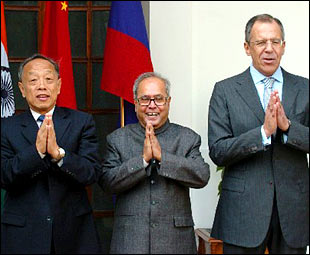
Chinese, Indian and Russian foreign ministers met in New Delhi Wednesday, stating that their trilateral cooperation did not aim at harming any other nation but to promote international harmony and understanding.

The three ministers reaffirmed the strong commitment made between India, Russia and China to multilateral diplomacy, according to the Joint CommuniquƩ issued after latest trilateral meeting.

They agreed that the three nations, as countries wielding increasing international influence, could all actively contribute to global peace, security and stability.

"China, India and Russia have developed friendly and frequent cooperation on international and regional issues," said Chinese Foreign Minister Li Zhaoxing, speaking at a press conference after the meeting, "The trilateral cooperation will include collaboration in regional organizations like Shanghai Cooperation Organization (SCO) and in the United Nations."

China and Russia further welcomed India joining the SCO as an observer country, according to the Joint CommuniquƩ.

Li said all trilateral relations between the three sides would be open, inclusive, transparent and constructive.

The three countries also determined precise avenues for beneficial economic interaction in areas such as energy, transport, infrastructure, health and high technologies including IT and biotechnology.

As a result, the ministers pledged to advise their respective business bodies to organize a trilateral business forum within the year.

The three sides stressed the importance of UN reforms including the UN Security Council in which both China and Russia would support a greater role to be played by India.

An exchange of opinion also took place concerning the anti-terrorism issue, underlining the necessity of working together against terrorism through regional organizations.

They were of a common voice that terrorism should be fought in a consistent, sustained and comprehensive manner with no double standards.

The Joint CommuniquƩ further revealed that the three countries would from now on coordinate on taking swift measures against any factor fueling international terrorism including financing thereof, illegal drug trafficking and trans-national organized crime.

In closing, the document specified that the next trilateral meeting between China, India and Russia would be held in China.

(Xinhua News Agency February 15, 2007)

Giants meet to counter US power

February 15, 2007

India, China and Russia account for 40 per cent of the world’s population, a fifth of its economy and more than half of its nuclear warheads. Now they appear to be forming a partnership to challenge the US-dominated world order that has prevailed since the end of the Cold War.

Foreign ministers from the three emerging giants met in Delhi yesterday to discuss ways to build a more democratic “multipolar world”.

It was the second such meeting in the past two years and came after an unprecedented meeting between their respective leaders, Manmohan Singh, Hu Jintao and Vladimir Putin, during the G8 summit in St Petersburg in July.

It also came only four days after Mr Putin stunned Western officials by railing against American foreign policy at a security conference in Munich.

The foreign ministers, Pranab Mukherjee, Li Zhao Xing and Sergei Lavrov, emphasised that theirs was not an alliance against the United States. It was, “on the contrary, intended to promote international harmony and understanding”, a joint communiquĆ© stated.

Their formal agenda covered issues ranging from Iran, Iraq, Afghanistan, the Middle East and North Korea to energy security, nuclear non-proliferation and trade. The subtext, however, was clear: how to use their growing economic and political muscle to prevent Washington from tackling such issues alone.

“In the long term, they feel that the whole structure of international relations has to shift in their direction,” said Vinod C. Khanna, of the Institute of Chinese Studies, Delhi. “What has happened is that quite independently they’ve reacted very similarly to recent international events.”

Mr Mukherjee said: “We agreed that cooperation rather than confrontation should govern approaches to regional and global affairs. We also agreed on the importance of the UN.”

Diplomats say that it is premature to talk of a strategic axis between the world’s largest and two most populous nations because they still have more in common with the West than with each other.

Delhi was close to Moscow in Soviet times, but has forged a new friendship with Washington. Chinese relations were soured by its border wars with India in 1962 and the Soviet Union in 1969, and by its arms sales to Pakistan. Russia appears keener than China or India to challenge American hegemony. But there has been a convergence of interests as each struggles to make the transition from a command economy to free markets. Since 2003 they have found further common ground in opposing the US-led invasion of Iraq.

One area of agreement is opposition to outside interference in separatist conflicts in Chechnya, the northeast of India and the northwestern Chinese region of Xinjiang.

Another is energy. India and China are desperate for Russian oil and gas, and Moscow is worried about its dependence on Western markets. But their most significant common ground is opposition to US military intervention in Iran. The joint statement did not mention Iran, but the three countries have taken a common stance in calling for a negotiated solution through the International Atomic Energy Agency. None of them wants a nuclear-armed Iran, but Russia sells Tehran nuclear technology and India and China need Iranian gas.

Wednesday, February 14, 2007

India on the front line in energy war

Related
India, Russia, China for positive contribution to peace Hindu
India, Russia, China for multi-polar world, discuss Iran India eNews.com
India, Russia, China for multi-polar world, discuss Iran Telugu Portal
---
From India's perspective, Russia's resurgence as an assertive player on the global scene and Iran's preference to foster energy cooperation with the Asian market open up the prospects of a unified Asian market for gas. Washington, though, can be expected single-mindedly to try to scuttle Indo-Iranian energy cooperation, while Moscow will encourage such cooperation and offer to be party to it.

Feb 14, 2007

By M K Bhadrakumar
M K Bhadrakumar served as a career diplomat in the Indian Foreign Service for more than 29 years


While the United States has been stealthily finessing a pretext for launching a military attack on Iran, it has also been prevailing on its close allies and friends to stay clear of bilateral political exchanges with Tehran. Isolation and containment of Iran and a "regime change" in that country have become the leitmotif of US foreign policy in the remaining two years of the presidency of George W Bush.

But Washington either made an exception for India, or India after all didn't belong in the gallery of Washington's close or "natural" allies. At any rate, New Delhi acted in its best interests when Indian Foreign Minister Pranab Mukherjee paid a two-day visit to Tehran on February 6-7.

The timing of the visit was indeed sensitive. It was only five days earlier, in testimony before the US Senate Foreign Relations Committee, that former US national security adviser Zbigniew Brzezinski made an astounding statement accusing the Bush administration of plotting situations to justify war against Iran.

Someone of the stature of Brzezinski, who has close connections with the US intelligence community and security establishment, wouldn't have made an irresponsible allegation. Yet Mukherjee went ahead with the visit. He also made it unequivocally clear in his media comments that India is opposed to any use of force against Iran.

Most importantly, apart from underlining that expansion of relations with Iran is important for India, Mukherjee described Iran as a factor for stability in the region. That is to say, India disregards Washington's propaganda that Iran is aiding and abetting terrorism and is threatening regimes in neighboring countries.

Equally, Mukherjee called for the Iran nuclear file to be sent back to the International Atomic Energy Agency (IAEA) as the competent forum to handle the issue. "A solution based on talks and a peaceful approach can be realized through close cooperation between Iran and the IAEA. Besides, both sides should be flexible," he said. In sum, Mukherjee made out with great poise and resoluteness that New Delhi has its own independent foreign policy toward the Iran nuclear issue.

The main purpose of Mukherjee's visit was to set a political climate in India's bilateral relations with Iran that will be conducive to the advancement of energy cooperation between the two countries. Coming weeks and months should testify whether the proposals for a gas pipeline from Iran to India via Pakistan and a 25-year deal on liquefied natural gas (LNG) will gather pace or not. Difficulties still lie ahead. Principally, Washington can be expected to do all that is possible to ensure that New Delhi is arrested on its current path. Subtle pressure tactics seem to have already begun.

Speaking in Washington last week, the powerful new chairman of the House Foreign Affairs Committee, Tom Lantos, who is well known for his pro-Israel political stance and has consistently warned India publicly in the past against cozying up to Iran, fired a public salvo to the effect that New Delhi must "fulfill its promises". He said Delhi must keep its side of the bargain, "which India is not doing", over the nuclear deal with the US and that it is imperative that "we have to work on that issue". Lantos said even a "small country like Finland, for example, is sticking to whatever promises it has made", and, naturally, it behooved a "great country like India" to deliver on its promises.

The pro-Israel think-tank Heritage Foundation also chipped in by calling for a robust intervention by the Bush administration in the Kashmir issue and India-Pakistan peace process in general, as otherwise, "the US-India civil nuclear deal has the potential to contribute to deepening tensions in the region". The think-tank called on the US administration to take up with New Delhi the issues of human rights, economic development and good governance in Jammu and Kashmir.

Curiously, the author of the Heritage report, Lisa Curtis, is a former foreign-policy aide to Senator Richard Lugar, the erstwhile Republican chairman of the Senate Foreign Relations Committee, and she previously worked as a political analyst on South Asia in the Central Intelligence Agency, apart from serving in the US embassies in New Delhi and Islamabad in the 1990s.

In addition, unnamed US officials have begun sounding impatient about the lack of progress in the negotiation of the so-called 123 Agreement between India and the United States - the final lap of the Indo-US nuclear deal. There seem to be fears in Washington that India may be dragging its feet and, in the process, Russia may steal a march over US companies in supplying nuclear plants to India. It is estimated that the nuclear deal will generate US$80 billion in downstream business.

How these tricky undercurrents play out will have a bearing on the incipient Iran-India energy cooperation, assuming that New Delhi will be plucky enough to press ahead regardless of concerted US opposition. Indeed, there are larger dimensions. In fact, India-Iran energy cooperation forms a crucial vector of emergent Asian security.

This became apparent during the visit of Russian President Vladimir Putin to New Delhi on January 25-26, where the focus was on all-around cooperation between the two countries in the field of energy. Indian Prime Minister Manmohan Singh characterized energy security as "the most important of the emerging dimensions" of the Indo-Russian strategic partnership.

He said, "Russia's position as a global leader on energy issues is widely recognized. We look forward to long-term partnership with Russia in this vital field." Two working groups were constituted to examine both upstream cooperation (access for Indian participation in the funding, exploration and development of oil and gas fields in Russia) and downstream cooperation (participation by Russian companies in marketing oil products and LNG in India).

Moscow has repeatedly shown interest in taking part in the financing and construction of the Iran-India gas pipeline. Russian Deputy Prime Minister and Defense Minister Sergei Ivanov, who accompanied Putin to New Delhi, stated, "We are pegging big hopes on the Gazprom-GAIL [Russian and Indian gas companies] strategic partnership, including joint efforts in building the Iran-Pakistan-India gas pipeline."

For Pakistan's part, President General Pervez Musharraf was recently in Tehran, where he met with Iranian President Mahmud Ahmadinejad, and according to media statements, the gas-pipeline project was discussed. "Now that the pricing mechanism has been worked out between Iran and Pakistan, the two countries will discuss early implementation of the pipeline project," Ahmadinejad said.

Russian companies are evidently conscious of the huge volume of business generated through the transportation of Iranian gas to the rapidly growing South Asian market, apart from the highly lucrative distribution and retailing of the gas in India and Pakistan. By a rough assessment, for receiving the gas coming through the $7 billion pipeline, infrastructure development within India alone will generate business close to $40 billion in immediate terms.

But energy cooperation among Russia, Iran and India has a much wider backdrop than business opportunities. Energy security, inevitably, is a subject where politics mixes with economics. India is keenly watching the tectonic shifts in the Eurasian gas market. Iran has proven gas reserves of about 28 trillion cubic meters, while its gas output increases by 10% annually. At present, Iran uses almost its entire gas production in its domestic market. About 100 billion cubic meters (bcm) is supplied to domestic consumers, including 35bcm for power plants, while 40bcm is pumped into the country's oil beds for maintaining the well flow rate. In other words, Iran's export capacity is poised to grow dramatically in the near term.

New Delhi is aware that many of Europe's plans to diversify its gas supply involve Iran. In other words, a competitive struggle for Iranian gas between the European market and the Asian market is becoming inevitable in the near future as Europe faces an acute gas shortage by 2015, even if Russia keeps up its supplies and the Northern Gas Pipeline becomes operational.

India has been watching with interest Ahmadinejad's proposal to Putin on the sidelines of a Shanghai Cooperation Organization (SCO) summit last June that Iran is prepared to determine gas prices jointly with Russia and the main routes of gas pipelines. The Russian-Iranian energy dialogue has significantly advanced since then, culminating in the proposal by Iranian Supreme Leader Ali Khamenei to Putin on January 28 that the two countries must cooperate along the lines of the Organization of Petroleum Exporting Nations. To be sure, New Delhi has taken careful note that the prospects for the merging of Russian and Iranian gas-transportation networks have distinctly brightened.

Taking matters further, the Iranian Supreme Leader's adviser on international affairs, Ali Akbar Velayati, visited Moscow last week and held discussions with Putin. Velayati said on his return from Moscow that Tehran sees the present juncture as a "turning point" in Iran's strategic cooperation with Russia. He alleged that Washington is trying its utmost to disrupt the emerging Russian-Iranian strategic cooperation in the transit of energy, as it will impact phenomenally on the correlation of forces internationally.

With Russia controlling 27% of the world's gas reserves and Iran 15%, cooperation between these countries is bound to have huge potential in terms of global gas distribution. It is only natural for a major potential gas consumer like India optimally to exploit the opportunities arising out of the matrix of energy cooperation between these two countries with which it has traditionally enjoyed close and friendly relations.

From the Indian perspective, Russia's resurgence as an assertive player on the global scene and Iran's preference to foster energy cooperation with the Asian market open up the prospects of a unified Asian market for gas, involving the Central Asian countries as well.

China, which has a gas deal with Turkmenistan for the supply of 30bcm of gas annually with effect from 2009, is already anticipating the enormous implications of these developments for its energy security. Last June, coinciding with the SCO summit, the Beijing Morning Post gave a detailed description of China's prospective plan for developing its domestic gas-pipeline network during the next 20 years in anticipation of gas supplies from Russia and Central Asian countries. According to the report, China's 24,000-kilometer gas-pipeline grid will be expanded to 36,000km by 2010.

New Delhi has no alternative but to partake of the emerging Asian market for gas if it is to get anywhere near seriously addressing its energy-security problems. In comparison, the Indo-US nuclear deal will have a very long gestation period before it makes any real impact on India's energy map. Nuclear energy will remain a marginal player in the Indian economy in the foreseeable future.

In the geo-economic context of energy security, Indian and US interests are far apart at the moment. Whereas the US favors European projects for diversifying gas supplies that will reduce the West's dependency on Russian supplies, India has a definite interest in Tehran's preference to direct the bulk of its gas resources to Asia. India cannot attach credibility to the US counsel to trust the market instead of trying to "lock in" energy supply when Washington is actively promoting various oil- and gas-pipeline projects heading toward the European market from the Caspian and Central Asian regions.

Without doubt, Russia will be actively supportive of the warming of Indo-Iranian ties, which went through a rough patch after India's vote against Iran at the IAEA in October 2005. Curiously, a meeting of the foreign ministers of India, Russia and China in New Delhi set for February 24 closely follows Mukherjee's visit to Iran. A Chinese Foreign Ministry spokesperson said in Beijing that the three foreign ministers will discuss cooperation in the economic field and that their meeting will "help the three countries to expand common ground and push forward trilateral mutually beneficial cooperation".

India and Russia share deep apprehension over Washington's aggressive stance against Iran. Any US military attack against Iran will threaten to have adverse consequences for India's energy supplies. Again, while Washington can be expected single-mindedly to try to scuttle Indo-Iranian energy cooperation, Moscow will encourage such cooperation and offer to be party to it.

Finally, while Washington may have plans for inveigling India as a counterweight to China, Moscow hopes to foster greater Sino-Indian understanding within which an Asian market of energy producers and energy consumers could flourish.


M K Bhadrakumar served as a career diplomat in the Indian Foreign Service for more than 29 years, with postings including ambassador to Uzbekistan (1995-98) and to Turkey (1998-2001).

Tuesday, February 13, 2007

Russia Demands Explanation as U.S. Defense Secretary Not Sure of Future Relations

Related
Iran: Velayati's Moscow Visit Seen Strengthening Relations With Russia
Russia spooks Europe with talk of forming gas cartel
Analysis: Putin reclaims Russian clout
US Sending Third Carrier Strike Group to Persian Gulf
Gates prepares for a large-scale war with Iran, North Korea, China and Russia
Russia is not a clay pigeon on an American shooting range

Cheney Pushing for Iran Attack

EXPORTING DEATH AND VIOLENCE TO THE FOUR CORNERS OF THE EARTH
---

The Bush admin has brought America to the brink of holocaust. The East and West Coasts are a half hour from being - GONE. TIME TO WAKE THE FUCK UP, AMERICA.

---
Created: 13.02.2007 10:26 MSK (GMT +3), Updated: 13:02 MSK, 6 hours 11 minutes ago

MosNews

Moscow has demanded Washington’s explanation of the U.S. defense secretary’s Wednesday statement on uncertain prospects of developments in Russia, North Korea, Iran and China, a Russian foreign ministry spokesman said Monday.

Robert Gates said Wednesday the United States needs forces to combat big armies and special units to counter terrorism as he is unaware what may develop in such countries as Russia, North Korea, Iran and China.

Mikhail Kamynin said Russia “is perplexed” by the recent statements by Gates and other high-ranking U.S. officials and intelligence officers.

He said such statements make “a certain system of negative assessments” of Russia.

“We proceed [from the assumption that] our relations are based on mutual interest in the consolidation of strategic partnership, above all in the joint fight against real and not imaginary threats to the global order, international terrorism, WMD proliferation and so on,” he said.

Kamynin said he hopes Gates’ statements do not reflect the real U.S. policy and are mere polemics as part of his attempt to pressure the U.S. Congress to approve the Pentagon’s budget.

Commenting on the issue, Russian Defense Minister Sergei Ivanov said Friday, “In principle, as defense minister, I can understand this statement. All sorts of tricks are used to approve the budget.”

“As far as predictability is concerned, I believe that Russia is as predictable as the U.S.,” the minister added.

Sunday, February 11, 2007

Bush is dreaming and won't wake up ; The decline in US mental health

I contend that not only Bush, but the leadership of America, both Democrat and Republican, are mentally unwell, as is a significant portion of US citizens. I know this is difficult for one to see immersed in the insane US mental environment, but bear with me.
---
Related
Group: TV Torture Influencing Real Life
---
"The president's persistence in the face of reality represents a disturbing state of mind."

***
"But denial is just the tip of the Freudian iceberg. Psychologically, Bush has been in a more serious state: dissociation from reality."
***
---

Bush is dreaming and won't wake up
The president's persistence in the face of reality represents a disturbing state of mind
BY PAUL SIEGEL

Paul Siegel is assistant professor of clinical psychology at the State University of New York, Westchester.


February 11, 2007

Critics are charging almost daily that President George W. Bush is in "denial" about Iraq. A recent Newsweek poll found that "67 percent of Americans believe that the president's decisions are more influenced by personal beliefs than by the facts." But denial is just the tip of the Freudian iceberg. Psychologically, Bush has been in a more serious state: dissociation from reality.

Dissociation is a more complicated defense mechanism than denial. It doesn't just pretend that reality isn't there. It replaces reality with a fantasy world. We dissociate when we daydream. But when we repeatedly live in our own world, we do so at our peril. A gambling addict buried in debt is sure that next time he is going to win, but he almost never does. Despite his wife's expressions of unhappiness, a husband believes he is in a good marriage, and is shocked when she announces she wants a divorce. A patient avoiding childhood memories of sexual abuse tells her therapist she had a happy childhood when it couldn't possibly have been.

We see evidence of the president's dissociation in his assessments of Iraq. Despite overwhelming evidence to the contrary, he still maintains that Iraq is not in a civil war, but "in a difficult struggle against the insurgents." Long after his generals concluded that we are not succeeding there, he repeatedly declared "we are winning."

Last week, some Iraqi officials blamed the new U.S. strategy in Baghdad for the worst single suicide bombing in the war, at a Shia market in Baghdad. The Mahdi Army, the Shia militia, which had been deterring sectarian reprisals, was scattering before new U.S. troops arrived. Bush's response: "It's a good sign that there's a sense of concern and anxiety" about Baghdad security.

Such statements are not just political spin. Political spin is crafted to frame specific situations. Dissociation reveals itself in a persistent pattern of behavior. Present-day Iraq is hardly the only situation in which the president has dissociated. Lacking evidence of any link between Iraq and al-Qaida, the president insisted for years that the two were intimately connected.

He uttered perhaps his most famous dissociated line - "You're doing a heck of a job, Brownie" - as New Orleans was subjected to destruction on a biblical scale and the federal government responded incompetently. More recently, his new Iraq policy ignored the results of the midterm congressional elections and the recommendations of the Baker-Hamilton Commission. We see a clear pattern of avoiding reality.

Behind every dissociation is a fantasy - such as the husband's belief that he's in "a good marriage," or the sexual abuse victim's that she had a "happy childhood." In Bush's case, the fantasy is a grand vision of a free, democratic Iraq, a wish that seems difficult for him to relinquish. He has staked his presidency on it.

Imagine for a moment that you are he, and the possibility of failure is dawning in your consciousness. How would you cope? Acknowledging the possibility of failure could be tantamount to committing psychological suicide - unleashing enough guilt and shame to demolish your identity as commander-in-chief. Dissociation, however, would allow you to absorb the blows that reality has dealt to your dream of a new Iraq, and to devise a plan to rescue it. Hence the troop surge.

Were he not dissociated, the president could acknowledge, as most military experts have suggested, that a far larger presence of U.S. troops is necessary in Iraq. Or he might face up to the full degree of ethnic conflict and begin to withdraw our troops. I believe the president is being genuine when he says that sending 21,500 additional troops will make a real difference. Psychological magic tricks work when people believe them.

A psychotherapist, were Bush willing to see one, or a wise counselor might be able to help the president to understand his deepest wishes and see how he dissociates on behalf of them. Bush might then arrive at the conclusion that too many Shia, Sunnis and Kurds seem more interested in killing one another than in building a democracy, and that democracy is his dream, not theirs. For this president, what a frightening thought that would be.

Copyright 2007 Newsday Inc.

---
Heather just mailed this to me. It will be up at her site soon.
---
Sun, 11 Feb 2007

Let’s Go Crazy: The Decline in US Mental Health under Bush

By Heather Wokusch
heather@heatherwokusch.com

Factors linked with mental illness (including poverty, homelessness,
violence and social uncertainty) have run rampant during the Bush years
while psychiatric treatment options have disappeared.

Nowhere has this trend been more prevalent – and more heartbreaking -
than with Katrina survivors and veterans of Bush’s wars.

Suicide levels in the Big Easy soared 300% in the four months following
Katrina, and hurricane-related mental disorders remain widespread
today. Yet with hospitals still shuttered and psychiatric clinics closed,
those suffering from chronic mental illnesses or post-Katrina depression
and post-traumatic stress disorder have few options. A Centers for
Disease Control and Prevention survey found that while 26% of respondents
reported at least one family member needing mental health support
following Katrina, less than 2% was receiving any.

New Orleans’ mental health crisis exacerbates its already debilitating
crime rate, with police reporting a 15% higher incidence of
psychiatric-related emergency calls than before Katrina. But instead of receiving
treatment, many of the mentally ill end up in local prisons – a trend
repeated across the country.

In Florida, for example, over 250 prisoners who should have been
transferred to state mental hospitals languish in prisons unequipped to
handle their special needs. As The St. Petersburg Times reported last month,
mentally-ill inmates "play poker with ghosts, climb the bars like bats
or dump their lunch trays into the toilet and eat the food like soup.
They will slam their heads against the wall, slice themselves with
razors or plunge head-first off their bunks onto the concrete floor." With
no psychiatric beds available due to funding cutbacks, inmates charged
with only misdemeanors end up deteriorating in jails one Floridian
official called "a dumping ground for the mentally ill."

Veterans face a similar lack of support. An estimated one out of every
five service members returning from Iraq suffers from psychiatric
problems and, with a backlog of 400,000 cases, the Department of Veterans
Affairs has proven incapable of handling the deluge. Veterans
subsequently have to wait an average of five and a half months for an initial
decision on disability benefits and an appeal can take years.

That’s not supporting our troops.

The number of veterans trying to get mental health support doubled to
9,103 between October 2005 and June 2006. The Government Accountability
Office recently found, however, that most who show symptoms of
post-traumatic stress disorder (PTSD) are not referred for treatment, no doubt
due to the VA’s lack of capacity to meet demand.

Considering that combat PTSD can take years to surface and that over a
million troops have been deployed, it’s safe to say the US will soon be
facing a mental health crisis of ominous proportions.

After the Vietnam War, tens of thousands of veterans either committed
suicide, became drug addicts or ended up on the streets. Today, the
National Coalition for Homeless Veterans reports that almost 200,000
veterans are homeless each night, roughly one in three adult homeless males.
Half of today’s homeless vets suffer from substance abuse problems and
45% from mental illness. Yet the administration continues to fund
military escalation instead of providing them with shelter and treatment.

The psychiatric needs of active-duty service members have also been
ignored. A tragic example is Steven Green, the former Army private charged
in the March 2006 murder of an Iraqi family and the rape/murder of
their 14-year-old daughter. In December 2005, Green had tried to get help
from an Army Combat Stress Team in Iraq, claiming that he was enraged
and wanted to kill Iraqi citizens. Doctors diagnosed Green with
"homicidal ideations," gave him a psychoactive drug, told him to rest – and sent
him back to fight. It took Army mental health officials a full three
months to contact Green again (over a week after the family had been
murdered) due to reports he had thrown a puppy off a roof and set its body
on fire.

It’s safe to say that many other US service members are like Green,
walking time bombs in desperate need of psychiatric care they may never
receive.

Bush has, unfortunately, been pro-active in one mental health area: the
push for mandatory screening of US citizens. In April 2002, Bush set
up the New Freedom Commission on Mental Health, ostensibly to "eliminate
inequality for Americans with disabilities" but whose recommendations
include broad-based mental health screening for US adults/children and
the prescription of psychoactive medication. Civil rights advocates fear
the disturbing implications of comprehensive mandatory psychological
testing and therapists question the Commission’s emphasis on psychiatric
drugs over other forms of therapy.

Put bluntly, big-donor pharmaceutical companies are slated to profit at
the expense of US citizens’ rights.

David Oaks, Director of the advocacy group MindFreedom International,
had this to say about the administration’s screening plans: "President
Bush wants to test all Americans for 'mental illness.' We demand that
President Bush start with himself first. We will provide the mental
health professional to do the screening." Virginia-based physician Patch
Adams even volunteered to screen Bush, adding, "He needs a lot of help.
I'll see him for free."

The National Alliance on Mental Illness recently conducted an analysis
of mental health care systems across the US, incorporating factors such
as infrastructure and information access. The national average grade
was D, a shameful record for such a wealthy nation. Factoring in the
long-term psychiatric implications of Bush’s ongoing military adventurism,
the future looks even worse. That is for everyone but pharmaceutical
companies.

Action ideas:

1. Visit the National Alliance on Mental Illness site (www.nami.org)
for information on everything from "Public Education and Information
Activities" to "Advocacy on Behalf of People Living with Mental Illness."
Find out how your state ranks on mental health care and consider signing
up for their fundraising walks. Also check out the terrific MindFreedom
International site (www.mindfreedom.org) dedicated to "defending human
rights and promoting humane alternatives in mental health."

2. Urge your congressmembers to provide more mental-health support to
those hit by Katrina.

3. Learn about the plight of homeless veterans at the National
Coalition of Homeless Veterans site (www.nchv.org), which offers legislation
information, support for homeless veterans and service providers and

opportunities to get involved.
---

Take a good look at who you are collectively.

EXPORTING DEATH AND VIOLENCE TO THE FOUR CORNERS OF THE EARTH

And at what you will allow to be done in your names:

Gates prepares for a large-scale war with Iran, North Korea, China and Russia

U.S. Enrages Russia

Tonkin-Era Legislators Size Up Lessons for Iraq Conflict


This morning I posted a piece on the political media celebrity of the moment:

Stop Him Before He Gets More Experience: FRANK RICH - Obama Got It Right

This is my added comment to the article above:

Marc Parent mparent7777 mparent CCNWON said...

Editor's note:

I question Senator Obama's judgement.

He calls for missile strikes on Iran's nuclear power facilities. Tens of thousands of people work in these facilities. Tens of thousands of other civilians live nearby.

Senator Obama is Dick Cheney in black skin. He talks nice, but is as power mad, vicious and cruel, as McCain, Guiliani, Clinton, and Edwards. You would almost think the U.S. presidential 2008 election is fixed.

I have more than enough evidence to support these claims. Drop me a line here if you are interested. No comment registration is required. Simply select the anonymous box.

Obama would consider missile strikes on Iran | Chicago Tribune
http://tinyurl.com/7hle7

Gates prepares for a large-scale war with Iran, North Korea, China and Russia
http://tinyurl.com/342clu

Best,

Marc
CCNWON


The shitstorm you are about to bring down on yourselves and the world is undeniable. You had better get off you ass and do something quickly, as most of your leadership, and many of you, are out of your fucking minds.

Thursday, January 25, 2007

China economy records huge growth

China's economy expanded by 10.7% in 2006, marking the fastest growth since 1995, the National Bureau of Statistics (NBS) has said.

It said the rise of the world's fourth-largest economy was mainly fuelled by investments and exports.

The figure was above the 10.5% that officials had predicted.

The government is worried that such high levels of growth may be unsustainable, and has taken a series of measures to try to slow it down.

The Chinese economy has now enjoyed four consecutive years of at least 10% growth, the NBS said.

The expansion in 2006 topped the 10.4% rate a year earlier, and is the highest since 1995, when the economy grew by 10.9%.

"In 2006, the national economy maintained steady and fast growth," NBS commissioner Xie Fuzhan told reporters in Beijing.

China's economy continues to be powered by a huge appetite for investment, and a boom in exports that generated a trade surplus of $177.47bn last year.

But the government is concerned that some parts of the economy are becoming overheated.

Beijing has taken a number of steps in order to cool things down.

"These policies and measures proved to be effective and helped economic development avoid moving from speedy growth to overheating," Mr Xie said.

Pollution problems

A lot of the money that China is making from exports has ended up in Shanghai's stock exchange.

It has turned from being one of the world's worst performers to one of the best, says the BBC's Quentin Somerville in Shanghai.

But some experts are worried that the government has swapped a property bubble for a stock market bubble, our correspondent says.

He adds that China's success is thanks to low wages, good infrastructure and enormous amounts of pollution.

Factories can almost pollute at will, and the economic cost to the environment and to the health of the Chinese people has not been properly recorded, our correspondent says.

China's growth figures themselves come with a health warning, he adds.

Halfway through last year the government discovered that the economy was $100bn bigger than previous estimates.

Friday, January 19, 2007

The great games over Iraq

Editor's note: I am moving over to the other blog.
---
The US has signaled a dramatic shift in its Iraq policy, aimed at deterring Iran's "hegemony" and putting Washington in league with the anti-Iran Sunni alliance. Moscow and Beijing have their own imperatives, and destabilizing Iran is not one of them. Kaveh L Afrasiabi
foresees a future in which local and international rivals clash head on in the region.

Jan 20, 2007

By Kaveh L Afrasiabi

No doubt, we are now witnessing the dawn of a new great game over Iraq. A recent communique by the Gulf Cooperation Council (GCC) has stated its "collective desire to prevent Iraq from becoming a battleground for regional and international powers".

The irony, however, is that this communique is also signed by two "out of area" Arab states, Jordan and Egypt, whose inclusion in the security calculus of the Persian Gulf rattles Iran and fuels the growing rivalry between the Shi'ite power bloc and the Sunni Arabs led by Saudi Arabia.

Simultaneously, in a clue to the rather dizzying pattern of cross-cutting, paradoxical alliances and would-be alliances, the US has signaled a dramatic shift in its Iraq policy, aimed at deterring Iran's "hegemony", which puts Washington in league with the anti-Iran Sunni alliance precisely at a time when the US-Shi'ite alliance in Iraq is, while strained, still holding and there is no conceivable alternative to it, given the Shi'ite majority in the country. Or is there?

Shi'ites betrayed again?
Are they going to be betrayed again? This is a question increasingly on the mind of many Shi'ites in Iran, Iraq and elsewhere, who have a vivid memory of how then-US president George H W Bush betrayed Iraq's Shi'ites during the Gulf War in 1991 by first exhorting them to rebel against the late Iraqi president Saddam Hussein and, when they did in Basra, Najaf and Karbala, became complicit in their suppression.

The Americans not only failed to support them but, worse, by lifting the no-fly zone for Saddam's helicopters that airlifted troops to the rebellious south, the dictator's forces were given the green light by none other than the US Central Command chief at the time, General Norman Schwarzkopf. That little episode is barely mentioned in Schwarzkopf's memoir, A Soldier of Conscience.

From the vantage point of many Shi'ites in the region, the new accent on Iran in Iraq is a ruse for a change of heart in Washington toward the post-Saddam political process, and a prelude for a U-turn. Little wonder it took Prime Minister Nuri al-Maliki more than two days to provide a tepid response to US President George W Bush's "new Iraq strategy", which ignores Maliki's own script for Baghdad security - the latter includes his appointment of a new commander for Baghdad, from the Shi'ite south and distrusted by the US generals.

"The US wants to have its cake and eat it too," a Tehran political analyst told the author, adding, "Bush is now appeasing the Sunni bloc and squeezing the Shi'ites and still wants to claim a continuity of US policy in Iraq when it is abundantly clear that discontinuity is gaining the upper hand."

Another point conveyed by this analyst concerned the US kidnapping of several Iranians at the consular office in the Kurdish city of Irbil. US officials have accused those Iranians of being from the Qods Group of the Revolutionary Guards and involved in subversive activities, a charge vigorously denied by Tehran.

A shade of Bosnia
"There is a shade of Bosnia here," explained the analyst, referring to the US-Iran cooperation in Bosnia-Herzegovina during the early 1990s, which saved the beleaguered Bosnian Muslims from Serbian atrocities, notwithstanding a United Nations arms embargo.

Then-US president Bill Clinton, urged by his top aides, authorized that cooperation, which involved "the Pentagon's own secret service" instead of the Central Intelligence Agency, as per a 1997 congressional document. According to that report, the United States was "very closely involved" in the Iranian arms pipeline to Bosnia through Turkey and Croatia, which involved small arms, mortars, anti-tank guns and surface-to-air missiles.

Indeed, the history of US-Qods cooperation in Bosnia and subsequently in Afghanistan is instructive, given the avalanche of negative commentaries in the US media that portray a completely adversarial relationship between the US and Iran. In 1996, Newt Gingrich, then Speaker of the US House of Representative, set up a special committee to investigate US-Iran relations in Bosnia, which some US senators, including John Kerry, castigated as Clinton's version of the "Iran-Contra affair", with Kerry accusing Clinton of "turning a blind eye to Iranian shipments".

As a result of such political pressures, the Clinton administration shifted its policy toward the Iranians in Bosnia: the Revolutionary Guards' offices in Bosnia were ordered closed and, in one case reminiscent of the Irbil incident, US forces took over one of those liaison offices and temporarily apprehended several Iranians whom they accused of subversive activities.

Expelling the Iranians from Bosnia after they were no longer needed seemed like the right policy, and all the signs are that the US is inclined to repeat it in Iraq, irrespective of the stark differences relating to Iran's proximity to neighboring Iraq and the wealth of historical and religious ties.

But as stated above, in addition to Bosnia, the US military and the Qods Group cooperated in Afghanistan. In a conversation with the author in Tehran in the autumn of 2004, a Revolutionary Guard commander recalled his meeting with a top US general in a tent at Baghram Airport, where the two hammered out the number of northern front troops who would enter Kabul without causing much-feared bloodshed.

Turning to Iraq, the question is: What is the ultimate objective of the US? Clearly, the Bush administration has nullified the possibility of US-Iran cooperation in Iraq, as called for by the bipartisan Iraq Study Group, opting instead for the path of hostility and confrontation. There is now open talk of "crossing into Iran" and smashing the Iranian networks inside Iraq, as if those networks are constantly working at cross-purposes with the US mission. But what exactly is the US mission in Iraq?

The facade of a self-imposed mission to "spread democracy" is wearing thinner by the hour, seeing how Secretary of State Condoleezza Rice did not bother to invoke the word "democracy" once in her latest trip to Cairo and Riyadh, focusing instead on "stability" and raising the specter that "the Iranians are coming" - this from a specialist in Russia and the Cold War who is at home with Cold War posturing.

Handicapped by her lack of knowledge of Middle Eastern history and politics, Rice must now ponder the quick drift toward military confrontation with Iran in light of the nuclear standoff and the seemingly irresistible Israeli pressure to act now before Iran reaches "the point of no return". We must also add: before the Bush administration becomes a "lame duck" and is drawn by the president's own weakness into yet another foreign gambit by the weight of upcoming electoral politics.

Spring of military action
Various US pundits have openly opined that the first half of 2007 is the best time for military action against Iran, with that country internationally isolated, the Arab tide against Tehran at its all-time highest, and Iran's own house divided among competing factions unable to reach consensus on important foreign-policy priorities.

Bulking up its military presence by dispatching a fresh aircraft-carrier task force to the Persian Gulf, as well as several nuclear-armed submarines, and sending Patriot missiles to the US-friendly states in the region, the Bush administration might actually gain in Iraq by subduing Iran militarily, ostensibly over the nuclear issue.

The problem with this rationale, however, is that it disregards the likelihood of Iranian retaliation in Iraq, regional "blowback", and the threats to the world economy posed by curtailed oil traffic through the Strait of Hormuz. Concerning the last, the US has reportedly made contingency plans for the indefinite takeover of Iranian territory in Chah Bahar, which would deny Tehran its strategic leverage with Hormuz.

A limited war with Iran is, as pointed out by this author previously, likely to degenerate into a regional conflagration, substantially complicating the picture in Iraq (and Afghanistan as well), perhaps prompting the US to push for outright "regime change" in Tehran, despite the lack of troops necessary for even a limited, contained war. That would mean expanding the Iraq war to Iran, with several intended and unintended consequences, one of which is potentially depriving Russia of the Iranian buffer it now enjoys vis-a-vis the power of the US military machine.

It comes as no surprise, then, that in the midst of US-Russian common cause at the UN Security Council against Iran, Moscow has proceeded with the delivery of an air-defense system to Iran and is hinting at the sale of an even more advanced system in the future. Russia's national-security interests would be badly bruised by a US-Iran military showdown that would bring the intrusive Western superpower closer to Russia's (insecure) southern borders.

Nor would China benefit geostrategically from such an outcome, in light of that country's burgeoning energy relations with Iran today, further solidified by a new US$3.6 billion Tehran-Beijing agreement for liquefied natural gas.

In signing this LNG deal, the Chinese government had to ignore a blunt US warning not to proceed, with the foreign minister telling the US "not to meddle" in China's relations with Iran. Clearly, China could not have the same expectations about the nature of Iranian regime change after an unequal bout between the recalcitrant Iranians and the US.

In a word, the long-term geopolitical ramifications for both China and Russia are too serious to ignore by their policymakers. Moscow and Beijing have joined the bandwagon over US-led efforts to impose sanctions on Iran, overlooking their own previously stated insight that such sanctions would be a "prelude to war".

Indeed, how little time Washington has lost in following up Security Council Resolution 1737 with ratcheted-up military threats against Iran. Looking far ahead, this, in turn, raises another vexing question: Is the US-Iran rivalry the outer ring of a broader, new Cold War between the US and the countervailing powers of China and Russia?


Kaveh L Afrasiabi, PhD, is the author of After Khomeini: New Directions in Iran's Foreign Policy (Westview Press) and co-author of "Negotiating Iran's Nuclear Populism", Brown Journal of World Affairs, Volume XII, Issue 2, Summer 2005, with Mustafa Kibaroglu. He also wrote "Keeping Iran's nuclear potential latent", Harvard International Review, and is author of Iran's Nuclear Program: Debating Facts Versus Fiction.

Copyright 2007 Asia Times Online Ltd.