Showing posts with label security. Show all posts

Thursday, April 19, 2007

Wolfowitz's girlfriend problem

Not only did the World Bank president find his companion Shaha Ali Riza a cushy job in the State Department, but she received a security clearance -- unprecedented for a foreign national.

By Sidney Blumenthal

Apr. 19, 2007 | Paul Wolfowitz's tenure as president of the World Bank has turned into yet another case study of neoconservative government in action. It bears resemblance to the military planning for the invasion of Iraq, during which Wolfowitz, as deputy secretary of defense, arrogantly humiliated Army chief of staff Eric Shinseki for suggesting that the U.S. force level was inadequate. It has similarities to the twisting of intelligence used to justify the war, in which Wolfowitz oversaw the construction of a parallel operation within the Pentagon, the Office of Special Plans, to shunt disinformation directly to the White House, without its being vetted by CIA analysts, about Saddam Hussein's alleged ties to al-Qaida and his weapons of mass destruction, and sought to fire Mohamed ElBaradei, director of the United Nations' International Atomic Energy Agency, for factually reporting before the invasion that Saddam had not revived his nuclear weapons program. Wolfowitz's regime also uncannily looks like the occupation of Iraq run by the Coalition Provisional Authority, from which Wolfowitz blackballed State Department professionals -- instead staffing it with inexperienced ideologues -- and to whom Wolfowitz sent daily orders.

Wolfowitz's World Bank scandal over his girlfriend reveals many of the same qualities that created the wreckage he left in his wake in Iraq: grandiosity, cronyism, self-dealing and lying -- followed by an energetic campaign to deflect accountability. As with the war, he has retreated behind his fervent profession of good intentions to excuse himself. The ginning up of the conservative propaganda mill that once disseminated Wolfowitz's disinformation on WMD to defend him as the innocent victim of a political smear only underlines his tried-and-true methods of operation. The hollowness of his defense echoes in the thunderous absurdity of Monday's Wall Street Journal editorial: "Paul Wolfowitz, meet the Duke lacrosse team."

Superficially, Wolfowitz's arrangement for his girlfriend of a job with a hefty increase in pay in violation of the ethics clauses of his contract and without informing the World Bank board might seem like an all-too-familiar story of a man seeking special favors for a romantic partner. Wolfowitz has tried to cast the scandal as a "painful personal dilemma," as he described it in an April 12 e-mail to outraged employees of the World Bank, who have taken to calling the neoconservative's girlfriend his "neoconcubine." He was, he says, just attempting to "navigate in uncharted waters." But the fall of Wolfowitz is the final act of a long drama -- and love or even self-love may not be the whole subject.

Wolfowitz's girlfriend, Shaha Ali Riza, is a Libyan, raised in Saudi Arabia, educated at Oxford, who now has British citizenship. She is divorced; he is separated. Their discreet relationship became a problem only when he ascended to the World Bank presidency. Riza had floated through the neoconservative network -- working at the Free Iraq Foundation in the early 1990s and the National Endowment for Democracy -- until landing a position in the Middle East and African department of the World Bank. The ethics provisions of Wolfowitz's contract, however, stipulated that he could not maintain a sexual relationship with anyone over whom he had supervisory authority, even indirectly.

Back in 2003, Wolfowitz had taken care of Riza by directing his trusted Pentagon deputy, Undersecretary of Defense Douglas Feith -- who had been in charge of the Office of Special Plans and had been Wolfowitz's partner in managing the CPA -- to arrange for a military contract for her from Science Applications International Corp. When the contract was exposed this week, SAIC issued a statement that it "had no role in the selection of the personnel." In other words, the firm with hundreds of millions in contracts at stake had been ordered to hire Riza.

Riza was unhappy about leaving the sinecure at the World Bank. But in 2006 Wolfowitz made a series of calls to his friends that landed her a job at a new think tank called Foundation for the Future that is funded by the State Department. She was the sole employee, at least in the beginning. The World Bank continued to pay her salary, which was raised by $60,000 to $193,590 annually, more than the $183,500 paid to Secretary of State Condoleezza Rice, and all of it tax-free. Moreover, Wolfowitz got the State Department to agree that the ratings of her performance would automatically be "outstanding." Wolfowitz insisted on these terms himself and then misled the World Bank board about what he had done.

Exactly how this deal was made and with whom remains something of a mystery. The person who did work with Riza in her new position was Elizabeth Cheney, then the deputy assistant secretary of state for Near Eastern affairs. And Riza's assignment fell under the purview of Karen Hughes, undersecretary of state for public diplomacy. But these facts raise more questions than they answer.

The documents released by the World Bank do not include any of the communications with the State Department. How did Elizabeth Cheney come to be involved? Did Wolfowitz speak with Vice President Dick Cheney, for whom he had been a deputy when Cheney was secretary of defense in the elder Bush's administration?

Riza, who is not a U.S. citizen, had to receive a security clearance in order to work at the State Department. Who intervened? It is not unusual to have British or French midlevel officers at the department on exchange programs, but they receive security clearances based on the clearances they already have with their host governments. Granting a foreign national who is detailed from an international organization a security clearance, however, is extraordinary, even unprecedented. So how could this clearance have been granted?

State Department officials familiar with the details of this matter confirmed to me that Shaha Ali Riza was detailed to the State Department and had unescorted access while working for Elizabeth Cheney. Access to the building requires a national security clearance or permanent escort by a person with such a clearance. But the State Department has no record of having issued a national security clearance to Riza.

State Department officials believe that Riza was issued such a clearance by the Defense Department after SAIC was forced by Wolfowitz and Feith to hire her. Then her clearance would have been recognized by the State Department through a credentials transmittal letter and Riza would have accessed the State Department on Pentagon credentials, using her Pentagon clearance to get a State Department building pass with a letter issued under instructions from Liz Cheney.

But State Department officials tell me that no such letter can be confirmed as received. And the officials stress that the department would never issue a clearance to a non-U.S. citizen as part of a contractual requisition. Issuing a national security clearance to a foreign national under instructions from a Pentagon official would constitute a violation of the executive orders governing clearances, they say.

Given these circumstances, the inspector general of the Defense Department should be ordered to investigate how Shaha Ali Riza was issued a Pentagon security clearance. And the inspector general of the State Department should investigate who ordered Riza's building pass and whether there was a Pentagon credentials transmittal letter.

Wolfowitz's willful behavior, as though no rules bound him or facts constrained his ideas, should not have surprised anyone. At the Pentagon, Wolfowitz was an insistent force behind an invasion of Iraq, bringing it up at the first National Security Council meeting of the Bush administration, months before Sept. 11. For years he had been a firm believer in the crackpot theories of Laurie Mylroie, a neoconservative writer, who argued that Saddam was behind the 1993 World Trade Center bombing and even the 1995 Oklahoma City bombing. After Sept. 11, Wolfowitz pursued his obsession by sending former CIA Director James Woolsey on a secret mission to attempt to confirm the theory. Woolsey came back with nothing, but Wolfowitz continued to believe. His beliefs are stronger than any evidence.

Surrounded by his Praetorian Guard, Wolfowitz insulated himself at the World Bank from the career staff. There, as at the Pentagon, Wolfowitz pushed aside the professionals and replaced them with a small band of politically reliable assistants. Wolfowitz rewarded them, too, on his own authority, with enormous tax-free salaries. Consider Kevin Kellems, his public affairs officer at the Pentagon, who had guided conservative media from that perch and is known as "keeper of the comb," for having been the person to hand Wolfowitz the infamous comb he licked before slicking down his hair in the Michael Moore film "Fahrenheit 9/11." Kellems was given a salary of $240,000, at least equal to what World Bank vice presidents with years of service earn.

Wolfowitz had spent his career staging neoconservative insurgencies against what he considered to be liberal establishments. But at the World Bank he tried to model himself after Robert McNamara, who had turned his presidency at the bank into his vehicle for redemption for his part in the Vietnam War. Wolfowitz, the chief intellectual and policy advocate for the Iraq war, no longer mentioned it. Now he pleads to the World Bank board that his corrupt dealings be overlooked for the greater good of his crusade against corruption. His refusal to resign discredits and paralyzes the institution he had hoped would vindicate him.

Tuesday, April 10, 2007

Americans Refute Link Between Iraq and U.S. Safety

Angus Reid Global Monitor : Polls & Research
April 10, 2007

(Angus Reid Global Monitor) - Many adults in the United States believe the outcome of the coalition effort will not directly affect domestic security, according to the Public Agenda Confidence in U.S. Foreign Policy Index released by Foreign Affairs. 61 per cent of respondents think America’s safety from terrorism does not depend upon the country’s success in Iraq.

The coalition effort against Saddam Hussein’s regime was launched in March 2003. At least 3,268 American soldiers have died during the military operation, and more than 24,400 troops have been wounded in action.

In December 2005, Iraqi voters renewed their National Assembly. In May 2006, Shiite United Iraqi Alliance member Nouri al-Maliki officially took over as prime minister.

On Mar. 23, the U.S. House of Representatives voted 218-212 to authorize an emergency supplemental war spending bill, which sets a deadline of Aug. 31, 2008 for the end of the coalition effort in Iraq. On Mar. 29, the U.S. Senate voted 51-47 to pass a separate bill, which calls for all combat troops to be removed from Iraq by Mar. 31, 2008. 51 per cent of respondents would gradually withdraw all troops from Iraq over the next 12 months, 27 per cent think the soldiers should stay in Iraq, and 19 per cent would remove all troops immediately.

In his Apr. 7 radio address, U.S. president George W. Bush discussed the current situation, saying, "In both the House and Senate, Democratic majorities have passed bills that would impose restrictions on our military commanders, set an arbitrary date for withdrawal from Iraq, and fund domestic spending that has nothing to do with the war. The Democrats who passed these bills know that I will veto either version if it reaches my desk, and they know my veto will be sustained. Yet they continue to pursue the legislation. And now the process is on hold for two weeks, until the full Congress returns to session."

Polling Data

Do you think America’s safety from terrorism depends upon our success in Iraq, or does it not depend on our success in Iraq?

Does not depend upon our success in Iraq

61%

Depends upon our success in Iraq

34%

Don’t know

5%

In your opinion, should the United States...?

Withdraw all troops from Iraq immediately

19%

Gradually withdraw all troops over the next 12 months

51%

Have troops stay in Iraq for as long as
it takes to stabilize the country

27%

Don’t know

3%

Source: Public Agenda Confidence in U.S. Foreign Policy Index / Foreign Affairs
Methodology: Telephone interviews to 1,013 American adults, conducted from Feb. 21 to Mar. 4, 2007. Margin of error is 3 per cent.

Complete Report (PDF)

Monday, March 26, 2007

Security Council resolution on Iran a grave threat to international peace and security

"This resolution by establishing sanctions is punishing a country that according to the IAEA [International Atomic Energy Agency] has never diverted its nuclear program ... with all its nuclear facilities under the monitoring of the IAEA's inspectors and their cameras," Mottaki said. He added that Iran has "fulfilled all its commitments to the IAEA and the NPT and demands nothing more than its inalienable rights under the NPT. Is there any better way to undermine an important multilateral instrument that deals directly with international peace and security? Isn't this action by the Security Council in and of itself a grave threat to international peace and security?"

Iran: A mountain that doesn't move
Despite another round of UN sanctions, Iran will not suspend its uranium-enrichment activities, a stance that is gaining support in the international community. Indeed, by seizing 15 British sailors, Tehran has shown that those who inflict pain will pay a price, even if it means a new spiral of proxy attacks and hostage-taking leading to bigger and deadlier showdowns. - Kaveh L Afrasiabi
(Mar 26, 2007

Kaveh L Afrasiabi, PhD, is the author of After Khomeini: New Directions in Iran's Foreign Policy (Westview Press) and co-author of "Negotiating Iran's Nuclear Populism", Brown Journal of World Affairs, Volume XII, Issue 2, Summer 2005, with Mustafa Kibaroglu. He also wrote "Keeping Iran's nuclear potential latent", Harvard International Review, and is author of Iran's Nuclear Program: Debating Facts Versus Fiction.

Thursday, February 15, 2007

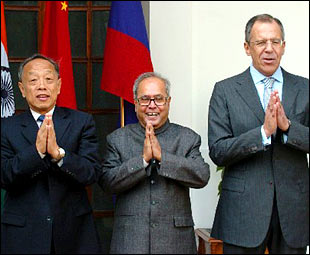
Trilateral FM Summit in New Delhi


Chinese, Indian and Russian foreign ministers met in New Delhi Wednesday, stating that their trilateral cooperation did not aim at harming any other nation but to promote international harmony and understanding.

The three ministers reaffirmed the strong commitment made between India, Russia and China to multilateral diplomacy, according to the Joint Communiqué issued after latest trilateral meeting.

They agreed that the three nations, as countries wielding increasing international influence, could all actively contribute to global peace, security and stability.

"China, India and Russia have developed friendly and frequent cooperation on international and regional issues," said Chinese Foreign Minister Li Zhaoxing, speaking at a press conference after the meeting, "The trilateral cooperation will include collaboration in regional organizations like Shanghai Cooperation Organization (SCO) and in the United Nations."

China and Russia further welcomed India joining the SCO as an observer country, according to the Joint Communiqué.

Li said all trilateral relations between the three sides would be open, inclusive, transparent and constructive.

The three countries also determined precise avenues for beneficial economic interaction in areas such as energy, transport, infrastructure, health and high technologies including IT and biotechnology.

As a result, the ministers pledged to advise their respective business bodies to organize a trilateral business forum within the year.

The three sides stressed the importance of UN reforms including the UN Security Council in which both China and Russia would support a greater role to be played by India.

An exchange of opinion also took place concerning the anti-terrorism issue, underlining the necessity of working together against terrorism through regional organizations.

They were of a common voice that terrorism should be fought in a consistent, sustained and comprehensive manner with no double standards.

The Joint Communiqué further revealed that the three countries would from now on coordinate on taking swift measures against any factor fueling international terrorism including financing thereof, illegal drug trafficking and trans-national organized crime.

In closing, the document specified that the next trilateral meeting between China, India and Russia would be held in China.

(Xinhua News Agency February 15, 2007)

Giants meet to counter US power

February 15, 2007

India, China and Russia account for 40 per cent of the world’s population, a fifth of its economy and more than half of its nuclear warheads. Now they appear to be forming a partnership to challenge the US-dominated world order that has prevailed since the end of the Cold War.

Foreign ministers from the three emerging giants met in Delhi yesterday to discuss ways to build a more democratic “multipolar world”.

It was the second such meeting in the past two years and came after an unprecedented meeting between their respective leaders, Manmohan Singh, Hu Jintao and Vladimir Putin, during the G8 summit in St Petersburg in July.

It also came only four days after Mr Putin stunned Western officials by railing against American foreign policy at a security conference in Munich.

The foreign ministers, Pranab Mukherjee, Li Zhao Xing and Sergei Lavrov, emphasised that theirs was not an alliance against the United States. It was, “on the contrary, intended to promote international harmony and understanding”, a joint communiqué stated.

Their formal agenda covered issues ranging from Iran, Iraq, Afghanistan, the Middle East and North Korea to energy security, nuclear non-proliferation and trade. The subtext, however, was clear: how to use their growing economic and political muscle to prevent Washington from tackling such issues alone.

“In the long term, they feel that the whole structure of international relations has to shift in their direction,” said Vinod C. Khanna, of the Institute of Chinese Studies, Delhi. “What has happened is that quite independently they’ve reacted very similarly to recent international events.”

Mr Mukherjee said: “We agreed that cooperation rather than confrontation should govern approaches to regional and global affairs. We also agreed on the importance of the UN.”

Diplomats say that it is premature to talk of a strategic axis between the world’s largest and two most populous nations because they still have more in common with the West than with each other.

Delhi was close to Moscow in Soviet times, but has forged a new friendship with Washington. Chinese relations were soured by its border wars with India in 1962 and the Soviet Union in 1969, and by its arms sales to Pakistan. Russia appears keener than China or India to challenge American hegemony. But there has been a convergence of interests as each struggles to make the transition from a command economy to free markets. Since 2003 they have found further common ground in opposing the US-led invasion of Iraq.

One area of agreement is opposition to outside interference in separatist conflicts in Chechnya, the northeast of India and the northwestern Chinese region of Xinjiang.

Another is energy. India and China are desperate for Russian oil and gas, and Moscow is worried about its dependence on Western markets. But their most significant common ground is opposition to US military intervention in Iran. The joint statement did not mention Iran, but the three countries have taken a common stance in calling for a negotiated solution through the International Atomic Energy Agency. None of them wants a nuclear-armed Iran, but Russia sells Tehran nuclear technology and India and China need Iranian gas.

Sunday, February 11, 2007

Loss of privacy threatens civilization

Privacy or protection?

Sunday, February 11, 2007

While probably more often remembered for his prescient warning that America must beware the too-powerful "military-industrial complex," former five-star general and president of the United States, Dwight D. Eisenhower, also possessed a deep understanding of the folly of over-reliance on government power to deliver security to a populace.

In 1949, three years before his election to the presidency and while serving as president of Columbia University, Eisenhower dryly remarked that if security were the ultimate goal of Americans, then "prison ... [where] they'll have enough to eat, a bed and a roof over their heads," should be their abode of choice. While not as memorable as Patrick Henry's "give me liberty or give me death" speech in 1775 that helped spark a revolution in freedom that echoed through the ages, Eisenhower, too, clearly understood that complete security -- if it ever might be secured -- could only be attained at the cost of freedom itself.

America, for its first two and a quarter centuries, inherently understood that a measure of the price paid for freedom is a certain lack of security -- a degree of risk, as it were. While in prior times of peril our nation back slid in its understanding of this principle of liberty, and allowed government to seize power to the extent fundamental freedom was threatened -- the Alien and Sedition Acts early in the 19th century, the suspension of habeas corpus in the Civil War era, the "Red Scare" and the "Palmer Raids" in the time of World War I, the internment of Japanese Americans in World War II -- in each instance, corrective action was taken.

The terrorist attacks of 2001 and the resulting and unprecedented power grab by the federal government in its drive to bring "security" to an America frozen with fear over another such attack, for the first time in our nation's history threatens to permanently enshrine the notion that security trumps freedom.

In no sense is the big hand of government power more apparent than in the incessant drive by Washington to abolish any vestige of privacy enjoyed by our citizens. The mantra is a familiar one: "you must be prepared to give up a little privacy in order to have security." The question is often posed, "if you have nothing to hide, why should you be concerned if the government listens in to your phone calls or reads your e-mails?" Ultimately, the administration falls back on the refrain that "we are fighting a new and dangerous enemy, of the sort never contemplated by those who drafted the Fourth Amendment many decades ago, and we need new powers to do meet these grave threats."

The fact is, of course, our Founding Fathers, those geniuses in gray wigs, knew exactly what they were doing. They knew that power corrupts and that the power of the government to invade a person's property, belongings and beliefs constitutes the power to control. They understood that if government enjoyed absolute power to invade or take away a person's privacy, then the government enjoyed absolute control over that person, who therefore had no liberty or freedom. It's that simple.

At the time the Bill of Rights was being debated and adopted, and in the first few years thereafter, the United States faced a threat far greater than that posed by potential terrorist cells today. We faced invasion and conquest by the most powerful nation on the face of the Earth: Great Britain.

Yet, in the face of such a threat, our framers deliberately and knowingly limited the ability of the government to invade people's privacy and gather evidence against them. The Fourth Amendment allows government to do so only in those instances in which it has good reason to suspect the person of criminal acts (yes, that includes suspected "terrorist" conduct). To claim that the limitations in the Fourth Amendment do not apply in the year 2007 because the threat we face is somehow different from or worse than the threat we faced two and a quarter centuries ago is at odds with historical reality; it is mere sophistry.

Why is this so important? Is it simply because we don't want the government to learn our bank account balance ... or our medical history ... or our travel patterns ...or whatever? Yes, but not really. It is vitally important that we rectify this frightening erosion of our constitutional underpinning because, as philosopher Ayn Rand correctly concluded in her 1943 novel, "The Fountainhead," privacy is the very foundation of freedom. "Civilization," she said, is the "progress toward a society of privacy." It is after all, "the process of setting man free from men."

Our Founding Fathers understood that. The Bill of Rights and the Fourth Amendment protects it. This administration disdains it. And the American people truly must re-establish it, if our very notion of a society based on freedom is to survive.

Bob Barr formerly represented the Seventh Congressional District of Georgia in the U.S. House of Representatives.

This article appeared on page C - 5 of the San Francisco Chronicle

Monday, December 11, 2006

Data Mining Can't Improve Our Security

December 8, 2006

by Jim Harper

Jim Harper is director of Information Policy Studies and the author of Identity Crisis: How Identification is Overused and Misunderstood. He is coauthor of the forthcoming Cato policy analysis, "Effective Counterterrorism and the Limited Role of Predictive Data Mining."

When the Department of Homeland Security put into effect its Automated Targeting System this week, it added to a growing list of programs that use information about ordinary Americans to seek after terrorists. An outgrowth of systems used to track cargo, ATS now assigns a "risk score" to Americans crossing the border, using data about them from a wide variety of databases.

ATS appears to use data mining to single out people as suspected terrorists or criminals. If data mining worked to catch terrorists, a program like ATS would deserve widespread endorsement. Unfortunately, data mining does not have this capability.

Data mining is a technique for extracting knowledge from large sets of data. Scientists, marketers and other researchers use it successfully to identify patterns and accurate generalizations when they do not have or do not need specific leads.

For example, 1-800-FLOWERS has used data mining to distinguish among customers who generally only buy flowers once a year — on Valentine's Day — and those who might purchase bouquets and gifts year-round. It markets to the first group less often, and to the second group more often. With thousands of customers to study, their researchers get useful information from data mining.

However, despite the investment of billions of dollars and unparalleled access to U.S. consumer behavior data, the direct marketing industry achieves response rates ranging from 5.78 percent for telephone solicitation to 0.04 percent for direct response television. Marketers do not know which potential customers will come to a new store, much less what they will buy. Data mining cannot predict such specific information.

Data mining for terrorism prediction has two fundamental flaws:

— First, terrorist acts and their precursors are too rare in our society for there to be patterns to find. There simply is no nugget of information to mine.

— Second, the lack of suitable patterns means that any algorithm used to turn up supposedly suspicious behavior or suspicious people will yield so many false positives as to make it useless. A list of potential terror suspects generated from pattern analysis would not be sufficiently targeted to justify investigating people on the list.

In a paper to be issued by the Cato Institute on Monday, Jeff Jonas, the founder of data analysis firm Systems Research and Development, and I write that using data mining in an attempt to find terrorists would waste national security resources and threaten the privacy and civil liberties of the thousands of innocents whose lawful activities coincide with a purported terror pattern.

Data mining may be useful for targeting common crimes, about which there is enough information to develop relatively accurate patterns. It may reveal potential identity fraud or credit card fraud. A certain transaction pattern might justify, for example, a credit card company calling a customer to see if she made a certain purchase. But whether data mining can be used to give government authorities reasonable suspicion of ordinary crime is fraught with difficulty. One thing is certain: They won't catch terrorists this way.

Nearly a year ago, The New York Times revealed that the National Security Agency was monitoring the international phone calls of Americans. During the course of the year, additional revelations emerged of telephone companies providing domestic call logs to the NSA and a European financial network providing records of Americans' financial transactions to the Treasury Department.

In October, National Journal reported that much of the Total Information Awareness program that Congress explicitly had rejected had reconstituted itself under the name Tangram. We take as a given that the government officials involved are people of good faith trying to protect the country from terrorists. But Americans are right to be concerned that large storehouses of data about their lives are being used without the benefit of a clear legal structure and robust oversight.

They also are right to worry that our national security services might be wasting time and money on data mining, rather than employing effective counter-terrorism methods that are known to work.

The 9/11 Commission report showed how investigators following leads and using traditional investigative techniques could have foiled al-Qaida's plans, although hindsight is 20/20. Had anyone in the national security bureaucracy known the devastating consequences the attacks would have, they would have had the focus to prevent them. That this did not happen is not an indictment of traditional investigative techniques, nor does it call for using data mining on problems it can't solve.

Unfortunately, there is no magic bullet that solves the security conundrums created by terrorism. Data mining is a useful technique in many areas, but not this one.

This article appeared in the St. Louis Post-Dispatch online on December 7, 2006.

Friday, December 8, 2006

Impunity and Immunity: The Bush Administration Enters the Confessional

Tomgram: Greenberg, In a Confessing State of Mind

An early impulse of Bush administration officials after the attacks of September 11, 2001 was to take off "the gloves," or, as CIA Director George Tenet put it (so Ron Suskind tell us in his book, The One Percent Doctrine), "the shackles." Those were the "shackles" that they believed had been placed on the imperial presidency after Richard Nixon came so close to committing the constitutional coup d'état that we have come to call Watergate, but that involved an illegal war (in Cambodia), illegal wiretapping, illegal break-ins, robberies, black-bag jobs and so many other crossing-the-line events. That was the moment that Dick Cheney, Donald Rumsfeld, and all the Bush administration advocates of a "unitary executive theory" wanted to return us to -- the impeachable moment.

The neocons and their patrons, especially our Vice President, wanted to unchain executive power, but that wasn't all. They weren't about to waste perfectly good shackles. Another impulse of theirs after the 9/11 attacks was to capture or kidnap, detain, secretly imprison, shackle, and torture their enemies, picked up on battlefields as well as peaceful city streets around the world. The accumulation of leaked documentation from their secret world has long indicated that they had torture on the brain. The urge to institute a torture regime had, perhaps, less to do with torture itself than with the knowledge that if you somehow gained the right to torture, you could gain the right to do just about anything; you could, in short, unchain the presidency in a major way.

Perhaps the most striking thing about Bush administration officialdom was that, before they reached for their waterboards, they reached for their dictionaries; and so, out of their world of secret imprisonment, humiliation, and pain emerged an unending stream of twisted definitions of otherwise common terms in classified but quickly leaked documents. Karen Greenberg, executive director of NYU's Center for Law and Security and co-author of The Torture Papers (which collected all those grim classified memorials to these last years of excess), now considers the most secret impulse of all revealed by this sordid collection of documents -- the impulse to confess. Tom

Impunity and Immunity

The Bush Administration Enters the Confessional
By Karen Greenberg

Confession, the time-honored, soul-soothing last resort for those caught in error, may not survive the Bush administration. It has, after all, long made a mockery of such revelations by manufacturing an entire lexicon of coercive techniques to elicit often non-existent "truths" that would justify its detention policies. And yet, without being coerced in any way, administration officials have been confessing continually these past years -- in documents that may someday play a part in their own confrontation with justice.

The Bush administration trail of confessions can be found in the most unlikely of places -- the very memos and policy statements in which its officials were redefining reality in their search for the perfect (and perfectly grim) extractive methods that would give them the detainee confessions they so eagerly sought. These were the very documents that led first to Gitmo, then to Abu Ghraib, and finally deep into the hidden universe of pain that was their global network of secret prisons.

Strangely enough, the administration confessional was open for business within weeks of the attacks of September 11th, 2001. It could be found wrapped in persistent assertions of immunity, assertions that none of their acts to come could ever be brought before the bar of justice or the oversight of anyone. The first of these documents was issued on September 25th, 2001. Deputy Assistant Attorney General John Yoo, writing for the Office of Legal Counsel, laid out the reasons for the President of the United States to assume broad executive powers in the war on terror. The last footnote of the memo declared, "In the exercise of his plenary power to use military force, the President's decisions are for him alone and are unreviewable."

This notion of unreviewable behavior, then still buried in the land of footnotes, has characterized the administration's general stance on its war on terror policies. On January 9th, 2002, just as Guantanamo opened for business as a detention facility supposedly beyond the review of American courts, John Yoo and fellow Office of Legal Counsel member Robert Delahunty explained why a breach with international law would not constitute a crime for the Bush administration. In their secret memo, the United States, through the Justice Department, was to exempt itself ahead of time from the laws it was about to break. In essence, it was to give itself the equivalent of a hall pass for future illegal activities in the new policies and practices of detention.

The memo contorted the Geneva Conventions into a pretzel of excuses for America's impunity on the matter of war crimes; it offered tortured reasoning about the inapplicability of Common Article Three of the Conventions -- guaranteeing humane treatment during armed conflict to those individuals who are not engaged in battle (non-combatants, prisoners-of-war, those who have lain down their arms, etc.) -- to the conflicts then at hand. Thus, the Taliban was redefined not as a state but as a failed state; Al Qaeda became a non-state actor; the Conventions, they now claimed, were created largely for civil wars, not for "other types of internal armed conflict." As the memo asserted over and over again, "As a constitutional matter, the President has the power to consider performance of some or all of the obligations of the United States under the Conventions suspended."

In this way, any captives from our Afghan War were redefined as possible subjects for utterly lawless behavior, while the President was given the right not to follow international law. They put the matter this way: "The President could justifiably exercise his constitutional authority over treaties by regarding the Geneva Conventions as suspended in relation to Afghanistan."

Foreshadowing the infamous "torture memo" of 2002 in which the same group of advisors redefined torture, nearly casting it out of legal existence, this early opinion stated that American officials could only be held accountable in the following circumstances: "causing great suffering or serious bodily injury to POWs, killing or torturing them, depriving them of access to a fair trial, or forcing them to serve in the Armed Forces." The memo concluded with what would become the legal mantra of the Bush administration -- the assertion of immunity, stating that "customary international law has no binding legal effect on either the President or the military because it is not federal law."

As Guantanamo received its first planeloads of prisoners, Alberto Gonzales, then counsel to the President, and William J. Haynes, counsel to the Department of Defense, took the idea of administration immunity for war crimes to a new level. They used their high offices to clear the way for the substandard treatment of detainees. Trusted with the justice and safety of the nation, they both concurred with their colleagues at the Office of Legal Counsel: "We conclude that customary international law does not bind the President or the US Armed Forces in their decisions concerning the detention conditions of al Qaeda and Taliban prisoners."

Though confidently proposing ways that any future prosecution for war crimes could be avoided, these memo-style declarations of immunity proved insufficiently comforting to an administration that had, by its own implicit admission, chosen to take a giant step into realms outside anyone's previous definition of the law.

They soon grasped a simple point: Declaring themselves immune was one thing; ensuring immunity, quite another. To fully protect their clients -- the President of the United States as well as high Pentagon and CIA officials -- administration lawyers confronted the potential problem of domestic legal constraints on the mistreatment of detainees.

Gonzales tried to strengthen the assurances of Bush's legal team by concluding that declaring exemption from the Geneva Conventions in turn "substantially reduces the threat of domestic criminal prosecution." Attorney General John Ashcroft concluded that the President's determination in detention matters "was fully discretionary and will not be reviewed by the federal courts." Ashcroft made the stakes clear: If the prisoners in U.S. hands were considered prisoners of war, American law would "not accord American officials the same protection from legal consequences." Thus it became doubly crucial to redefine them not as POWs but as "enemy combatants."

To the Bush administration, words, it seemed, were everything. And if the laws, domestic and international, depended upon definitions, then the definitions of words would simply have to change across the board. So it was unavoidable that the first casualty in the President's Global War on Terror, which also became his global war for immunity, would be language itself. The captives who arrived at Gitmo were not to be called prisoners, nor was the facility itself to be referred to as a prison; it was a "detention facility" and the inmates were "detainees" and "enemy combatants." If other words were used -- prison, prisoner, prisoner-of-war -- then high officials and members of the Armed Forces would not, as Ashcroft explained, be immune from the law.

In the same vein, torture was to be banned from the premises (but only as a word); instead coercive techniques that for centuries plainly came under the rubric of torture were relabeled "counter-resistant coercive interrogation techniques." The infamous "torture memo" of August, 2002 drew narrow parameters around the definition of torture, which was now to be limited to "serious physical injury such as death." Repeatedly, the memo asserted that other methods "do not amount to torture." And it essentially turned the very definition of torture over to the torturer. Abetted here as elsewhere by the media, the Bush administration also successfully de-legitimized the statements of the detainees themselves, consigning them to the trash heap of history -- all of them were the accounts of well-drilled liars, false accusations inspired by Al Qaeda training manuals.

And yet, even reclassifying words and redrawing the lines of the law did not sufficiently assuage their fears -- and here's where the hidden confessional element of all this crept into play. They were clearly hounded by what can only be called a kind of lurking institutional conscience, a sense that the acts already being committed in their name (or future ones) might someday be declared illegal under laws and agreements they were trying unilaterally to abrogate, resulting in prosecutions.

So, to ensure that their legal reasoning and linguistic demands would hold sway in the policy world, Bush administration officials found they had to go even further. They determined to find a way to control the environment of detention as completely as possible. First, of course, they chose an American base in Cuba to be the jewel in the crown of the detention system they were putting in place globally because it seemed to lie "in legal limbo" outside any international or domestic legal system. Second, "ghost prisons," some in facilities borrowed from allies known to employ torture themselves, were established so that the techniques for extracting confessions, even though no longer defined as torture, could not be seen or known about. Third, just to be sure about things, the United States launched a campaign to free itself from any future international prosecution for war crimes under the auspices of the new International Criminal Court (ICC). In return for money and services, after cases of remarkable diplomatic arm twisting, 102 countries agreed, one by one, to an American demand for immunity from future ICC prosecution.

Then, the Bush administration charged ahead, convinced that it had addressed its legal liabilities and given itself that eternal hall pass. In truth, however, it had been confessing all along, laying out a remarkable record of tacit admission to criminal activity. The administration had, for example, informed the military commanders at Gitmo that they should consider themselves to be "guided by the Geneva Conventions but not bound by them." At Guantanamo and Abu Ghraib, interrogation needs took precedence over matters of detention -- and it was all on the official record.

The administration's urge to claim immunity, which is, in essence, the confession of crimes about to be committed (or already committed), has not waned over the years. If anything, it has gotten stronger. Only recently, for instance, John Yoo, now a law professor at the University of California, Berkeley, insisted once again that extralegal measures were necessary in the war on terror. "Is a second [9/11] attack," he wrote, "an acceptable price to pay for rejecting coercive interrogation?" He then suggested, among other ways of avoiding prosecution for such acts, a possibility that may loom ever larger before George W. Bush's second term in office is over -- the issuing of presidential pardons.

The President has weighed in aggressively on the issue as well, publicly embracing the idea of immunity. Twice, in his not-to-be-overlooked September 6th speech on the existence of the CIA "program" for "high-value detainees," the President insisted upon immunity for those involved in detention and interrogation. In this speech, in which he announced his intention to submit the Military Commissions Bill to Congress, he explained, "[S]ome believe our military and intelligence personnel involved in capturing and questioning terrorists could now be at risk of prosecution under the War Crimes Act -- simply for doing their jobs in a thorough and professional way. This," he declared, "is unacceptable." Moments later he reiterated his firm opposition to any such prosecutions. "I'm asking that Congress make it clear that captured terrorists cannot use the Geneva Conventions as a basis to sue our personnel in courts -- in U.S. courts. The men and women who protect us should not have to fear lawsuits filed by terrorists because they're doing their jobs."

What more could a prosecutor want than a trail of implicit confessions, consistent with one another, increasingly brazen over time, and leading right into the Oval Office? For five years now, the Bush administration has given itself an inviolable command: declare immunity for what you have done, what you are doing, and what you are about to do. When the President's Military Commission Bill did pass, its many astounding "reforms" actually codified immunity retroactively for a range of abuses against detainees.

To overlook the trail of confessions that is part and parcel of the administration's torture narrative is to perform an act of extraordinary rendition not just on the truth but also on the importance of confessions themselves. Professional interrogators, priests, psychiatrists, and others who deal with confession regularly say that people normally want to talk, that they want to tell you their story, that confession is a deep and satisfying part of all our lives.

In the case of the Bush administration, it is the documents themselves that seem to want to confess, that are bursting with the desire to talk, to tell the story of these last years of illegality. Americans, and the Congress they have just elected, should take heed. The time has come, after five years, to restore language, law, and accountability to the American ethos by insisting that declarations of immunity be seen for what they are: Confessions about actions that are both reviewable and unpardonable.

Karen J. Greenberg is the Executive Director of the Center for Law and Security at the NYU School of Law and is the co-editor of The Torture Papers: The Road to Abu Ghraib. She also edited The Torture Debate in America.

Copyright 2006 Karen Greenberg

Thursday, November 30, 2006

Dangerous reality in Mosul


Colour-coded perception defies dangerous reality in Mosul

Jonathan Steele in Mosul
Thursday November 30, 2006
The Guardian


"Do you agree that security can be colour-coded green?" asked the US colonel. There was an awkward pause. The governor of Mosul, the deputy governor, and the police chief looked at each other, then focused on the piece of paper the Americans had handed them at the start of the meeting.
It was the day's agenda, with six items listed for discussion, coloured circles beside each one. Electricity: half yellow, half amber. Fuel supplies: red. Anti-government activities at Mosul university: yellow. Activities of the judiciary: yellow and amber. Reconstruction and development funding: yellow. The only circle marked green was for security.

The setting was Governor Duraid Kashmoula's fortified compound and a routine meeting with the province's American commanders as Iraqi troops ringed the building. The Americans had arrived in armoured vehicles. Khasro Goran, the deputy governor, had brought The Guardian from Irbil in a convoy of seven deliberately inconspicuous cars, beaten up Mercedes, BMWs and Toyotas, each with two armed men.

"Well, it's true the terrorists cannot stand up to the police on the street during patrols," the governor replied to the colonel's question, somewhat evasively. Then he listed two demands: extra fortification for police posts on two roads and the rescinding of an order for an Iraqi army battalion in Mosul to be redeployed to Baghdad.

The deputy governor decided not to beat about the bush. "I don't agree that security is green and people feel safe. Not one day goes by without someone being killed in Mosul." He added: "The terrorists are a hidden force. They go out in civilian clothes and threaten contractors with death if they start work on reconstruction projects. They kill interpreters. They hand out flyers at the mosques, calling for support for al-Qaida and the Ba'athists. On Thursday when I was visiting people they told me 15 families had been told to leave town. A well-known singer was shot in the street this week."

Mosul, in northern Iraq, is Iraq's second city, with a population of 1.7 million people. Yet unlike Baghdad and Basra it receives minimal media coverage. Car bombs and suicide attacks are relatively rare, but as the city's senior officials make clear, a more complex war is under way.

"Of course the army can do raids, but what we have here is a cat and mouse game," the deputy governor said. "We have 18,000 police now and orders to recruit 3,000 more. It would be good to have them as secret agents, in the mosques and at the university. There are 40,000 students and it's easy to recruit terrorists there. We don't want to be like the Ba'athists and violate human rights, but we need intelligence."

The American colonel conceded the point: "The second and third Iraqi army divisions [stationed in Mosul] are still being trained in intel. They're not ready yet."

Over lunch General Wathiq Mohammed al-Hamdani, a retired army officer who now serves as police chief, complained that judges were afraid to give convicted terrorists long sentences. New ones were being sent from Baghdad in the hope that as outsiders with no family in Mosul they would feel free to be tough.

Back in the meeting room, the police chief's mobile phone rang. His conversation was agitated, and discussion stopped while everyone listened and the American interpreter whispered to the colonel. The police chief finished his call. "A distant cousin of mine is linked to the terrorists," he said. "The police have just raided his house. One policeman was killed in an exchange of fire, another is injured. One terrorist was killed."

The security discussion was over and the colonel summed up. "We'll change the coding to yellow," he said. The US colonel embraced the three Iraqis. His officers picked up their M16 rifles and they all piled back into their armoured vehicles.

"Americans can sometimes be naive," Mr Goran suggested. "At least they now call it yellow. They're moving in the right direction."

http://www.guardian.co.uk/international/story/0,,1960216,00.html