Showing posts with label Christians. Show all posts

Monday, April 16, 2007

Petition against Israeli assault on Al Aqsa and all Muslim and Christian holy sites in Jerusalem

(Jerusalem) Maisa Abu Ghazaleh

Sunday, 15 April 2007

A Muslim and Christian petition is out on behalf of Al Aqsa Mosque. As is much of the nonviolent resistance to Israeli destruction at the Muslim holy site, the petition is sponsored by head of the Islamic Movement inside the Green Line, Sheikh Ra'ed Salah.

Organizers have gathered hundreds of thousands of signatures as part of efforts to stop Israeli excavations and their devastating impact at the Muslim holy site in East Jerusalem's Old City.

Aimed at Palestinians living within Israeli boundaries, the petition reads in part, “We, the undersigned, representing the entire spectrum of Palestinian society, men and women, young and old, from Jerusalem and the Naqab, the Galilee and the Triangle, and the coastal cities of Haifa, Jaffa, Lod and Ramle...pronounce our support for Jerusalem, the Al Aqsa Mosque, and other Islamic and Christian holy places.”

Signatories pledge to “work using all legitimate means to expose the crimes of the occupation and address its aims to Judaize the holy city, its gradual destruction and confiscation of Al Aqsa and other Islamic and Christian holy places.”

Within the petition are three-points, the first of which is addressed to the present Arab and Muslim leaders in science, politics and civil society. It demands that they assume responsibility for Jerusalem and its "sacred shrines."

The second letter is addressed to the Palestinian Presidency, government and all factions, to agree on a clear strategy. They must work with the complete understanding that Jerusalem remains the capital and that no one has the authority to negotiate away that legitimate right.

The third point addresses international humanitarian organizations to “curb the spread of Israeli hysteria” and implement international law in order to put an end to the “continuing crimes in the city of Jerusalem.”

President of the Council of Muftis, Sheikh Khalid Ghaneim, said that the petition and its signatories illustrate "the profound loyalty to Al Aqsa Mosque and the utter rejection of any attacks against it."

The Sheikh said that the petition will be presented to the Arab League, the Organization of the Islamic Conference, and the United Nations Educational, Scientific and Cultural Organization, UNESCO.

Tuesday, April 10, 2007

ARAB CHRISTIANS HEAD FOR EXITS

By ROBERT D. NOVAK

April 9, 2007 -- BETHLEHEM, WEST BANK

HANI Hayek, an accountant who is the Christian mayor of the tiny Christian-majority Palestinian vil lage of Beit Sahour, was angry last week driving me along the Israeli security wall.

"They are taking our communal lands," he said, pointing to the massive Israeli settlement of Har Homa. "They don't want us to live here. They want us to leave."

Har Homa, dwarfing nearby dwellings of Beit Sahour, seemed larger than when I saw it at Holy Week a year ago. It is. The Israeli government has steadily enlarged settlements on the occupied West Bank.

Nearing the 40th anniversary of the Israeli military occupation of the West Bank, the territory has been so fragmented that a Palestinian state and a "two-state solution" seem more difficult.

The security wall has led to virtual elimination of suicide bombings and short-term peace. But life is hard for Palestinians, whose deaths due to conflict increased 272 percent in 2006 while Israeli casualties declined. In a minor incident of the type that goes unnoticed internationally, Israeli Defense Forces (IDF) troopers last week killed a Palestinian man accused of illegally entering a firing zone while collecting metal scraps to sell.

Palestinians argue things have gotten worse because of pervasive feelings of hopelessness. Students at Bethlehem University (run by the Catholic Brothers of De La Salle with an enrollment 70 percent Muslim) sounded more pessimistic and radicalized than a year ago. Ahmad Al Issa, a fourth-year journalism student, was imprisoned for a year in Israel on charges of throwing stones at Israeli troops. Now he has bought into the libel that Jewish employees at the World Trade Center were warned in advance of the 9/11 attacks.

The U.S.-backed boycott following the election victory of the extremist Hamas in early 2006 has made the Palestinian Authority (PA) destitute, crippling government services. Deprived of help from the PA with the economy in a shambles, city governments are bankrupt. Bethlehem Mayor Victor Batarseh has a special problem because tourists and pilgrims no longer stay overnight in the city of Christ's birth. Out of money and credit, he is ready to lay off the city's 165 staffers.

Batarseh, a U.S. citizen who practiced thoracic surgery in Sacramento, Calif., is pinned down in Bethlehem. A Christian and political independent who calls himself a private-enterprise democrat, Batarseh is on the Israeli blacklist because he contributed to the Popular Front for the Liberation of Palestine (a State Department-designated terrorist organization). Denied permits for Jerusalem, the mayor must drive to Amman, Jordan, to get to meetings in Europe.

Contact with the PFLP is not a requirement for being holed up by the IDF. Bethlehem University students can't get to Jerusalem, a few minutes' drive away, unless they sneak in illegally. The university's students from the separated Gaza enclave have to take classes from Bethlehem via the Internet.

Rep. Chris Smith (R-N.J.) was at the university the same day I was, and Bethlehem faculty members could hardly believe a real live member of the U.S. Congress was there. Smith later was given a tour of Jerusalem to see with his own eyes that the separation barrier in most places is a big, ugly and intimidating wall and not merely a fence.

Smith, an active Catholic layman, was drawn here because of the rapid emigration of the Holy Land's Christians. They leave more quickly than Muslims because contacts on the outside make them more mobile. Catholic Brother Peter Corlano of Bethlehem University told Smith and me: "We live the same life [as Muslims]. We are Palestinians."

Concerned by the disappearance of Christians in the land of Christianity's birthplace, Smith could also become (as I did) concerned by the plight of all Palestinians. If so, he will find precious little company in Congress.

Worse than Apartheid?

Christians fleeing faith's birthplace

Israeli policies, security wall fuel Palestinians' feelings of hopelessness

April 9, 2007
ROBERT NOVAK
BETHLEHEM, West Bank -- Hani Hayek, an accountant who is the Christian mayor of the tiny Christian-majority Palestinian village of Beit Sahour, was angry last week driving me along the Israeli security wall. "They are taking our communal lands," he said, pointing to the massive Israeli settlement of Har Homa. "They don't want us to live here. They want us to leave."

Har Homa, dwarfing nearby dwellings of Beit Sahour, seemed larger than when I saw it at Holy Week a year ago. It is. The Israeli government has steadily enlarged settlements on the occupied West Bank.

Jimmy Carter raised hackles by titling his book about the Palestinian question Peace Not Apartheid. But Palestinians allege this is worse than the former South African racial separation. Nearing the 40th anniversary of the Israeli military occupation of the West Bank, the territory has been so fragmented that a genuine Palestinian state and a "two-state solution" seem increasingly difficult.

The security wall has led to the virtual elimination of suicide bombings and short-term peace. But life is hard for Palestinians, whose deaths due to conflict increased 272 percent in 2006 while Israeli casualties declined. The Britain-based Save the Children organization estimates half the children in the occupied territories are psychologically traumatized.

Palestinians argue things have gotten worse because of pervasive feelings of hopelessness. Students at Bethlehem University (run by the Catholic Brothers of De La Salle with an enrollment 70 percent Muslim) sounded more pessimistic and radicalized than a year ago. Ahmad Al Issa, a fourth-year journalism student, spent a year in an Israeli prison on charges of throwing stones at Israeli troops. Now he has bought into the libel that Jewish employees at the World Trade Center were warned in advance of the 9/11 attacks.

The U.S.-backed boycott after the election victory of the extremist Hamas in early 2006 has made the Palestinian Authority destitute. Deprived of help from the authority with the economy in a shambles, city governments are bankrupt. Bethlehem's Mayor Victor Batarseh has a special problem because tourists and pilgrims no longer stay overnight in the city of Christ's birth. Out of money and credit, he is ready to lay off the city's 165 staffers.

Batarseh, a U.S. citizen who practiced thoracic surgery in Sacramento, Calif., is pinned down in Bethlehem. A Christian and political independent who calls himself a private enterprise democrat, Batarseh is on the Israeli blacklist because he contributed to the Popular Front for the Liberation of Palestine (a State Department-designated terrorist organization). Denied permits for Jerusalem, the mayor must drive to Amman, Jordan, to get to meetings in Europe.

Republican Rep. Chris Smith of New Jersey, at the university the same day I was, was given a tour of Jerusalem to see that the separation barrier in most places is a big, ugly and intimidating wall and not merely a fence.

Smith, a Catholic layman, was drawn here because of the emigration of the Holy Land's Christian minority. They leave more quickly than Muslims; contacts on the outside make them more mobile. Catholic Brother Peter Corlano of the Bethlehem University faculty told Smith and me: "We live the same life [as Muslims]. We are Palestinians." Concerned by the disappearance of Christians in the land of Christianity's birth, Smith also could become (as I did) concerned by the plight of all Palestinians. If so, he will find precious little company in Congress.

ROBERT NOVAK

Thursday, April 5, 2007

Palestinian Christians and the effects of Israeli Apartheid

April 4th, 2007 |

Palestinian Chrisitians prevented from reaching Bethlehem on Palm Sunday

by Snyder, 4 April 2007

As hordes of tourists flocked to the holy sites of Jerusalem to carry Palm leaves through the Old City, hundreds of Palestinian Christians were prevented from passing through the Bethlehem terminal.

On the evening before Palm Sunday, I passed through the terminal and met a group of Palestinian women traveling to Jerusalem for the celebrations. They had expected that the soldiers would let them through out of respect for the holy day. However, restrictions on movement had been tightened for the Jewish Pesacht holiday and they were being turned away. The checkpoint had only a skeleton staff of soldiers and police due to the Jewish holiday and as a result only one aisle was open causing huge delays.

Since the construction of Israel’s illegal annexation barrier, the Bethlehem ‘terminal’ has been the only direct route between Bethlehem and Jerusalem. The barrier is designed like an international border with Palestinians having to undergo searches, x-rays of baggage and fingerprint scans. The majority of West Bank Palestinians not residing in Jerusalem are not permitted to enter Jerusalem.

Other restrictions imposed on Palestinians for the Pesacht period have been the tightening of controls at the checkpoints around Nablus, with young men prevented from leaving the city, and a checkpoint set up on the road from Nablus to Tubas causing chaos and preventing pedestrian access along the road.

While Palestinian freedom to worship at holy sites has been severely limited, the army has facilitated the visit of thousands of Jewish visitors to the Palestinian city of Hebron. Last year, during Pesacht, the IDF ordered a Closed Military Zone in Hebron preventing Palestinians from walking around their neighborhood for the ‘protection’ of Jewish visitors. The army also allowed Jewish visitors to Hebron to pass through a checkpoint on Schuhada Street into the ‘Palestinian Controlled’ area to visit a holy site - this was illegal unde Israeli law.

This follows on from Israel’s severe restriction on the right of access to and worship in Jerusalem during Ramadan last year. It appears that the Israeli apartheid system protects the right of Jews to worship, even if that means suppressing the right of Palestinians and conflicts with Israeli law, and ignores the needs of Palestinians wishing to worship on their own land.

Saturday, March 31, 2007

Jerusalem church leaders call for support to end embargo

30 March 2007 | 07-0263 |

Jerusalem (ENI). Leaders of churches in Jerusalem in an Easter message have urged Christians around the world to work to end an international financial boycott of the Palestinian government imposed after the Islamist Hamas movement came to power in 2006.

Monday, March 19, 2007

STOP THE CLASH OF CIVILIZATIONS

Talk is rising of a ‘clash of civilizations’. But the problem isn’t culture, it’s politics – from 9/11 to Guantanamo, Iraq to Iran. This clash is not inevitable, and we don't want it.

So where to start? The Israeli-Palestinian conflict is the key symbol of the rift between Islam & the West. It's time to step up and take the initiative.

Add your voice below and when leaders meet in late March, our message will be delivered in a way they can’t ignore...

--MORE--

Friday, March 16, 2007

Unrepentant

Friday, March 16th, 2007

Here is Slate editor Jacob Weisberg, writing in the Financial Times about the latest American Enterprise Institute shindig, where neocon bigwig Bernard Lewis received an award and made a speech defending the Crusades as the first phase of the necessary struggle against “Islamofascism”:

Were one to start counting ironies here, where would one stop? Here was a Jewish scholar criticising the Pope for apologising to Muslims for a holy war against Muslims, which was also a massacre of the Jews. Here were the theorists of the invasion of Iraq, many of them also Jewish, applauding the notion that the crusades were not so terrible and embracing a time horizon that makes it impossible to judge their war an error. And here was the clubhouse of the neo-conservatives, throwing itself a lavish party when the biggest question in American politics is how to escape the hole they have dug.

In attendance: Dick Cheney, applauding; Clarence Thomas, the first to rise for a standing ovation; Richard Perle, Robert Bork, and Reason editor Nick Gillespie. We hear the crab bisque was “better-than-average.”

in News by Justin Raimondo|

Monday, March 12, 2007

Palestinian Christians fleeing Israel as pressures mount

Misery tempts Palestinian Christians to flee

By Alistair Lyon, Special Correspondent Mon Mar 12, 7:57 AM ET

Despairing of life under Israeli occupation, many Palestinian Christians are moving abroad, threatening their ancient links to Bethlehem and the land where Jesus was born.

"There is a real fear that 50 years down the road, the Holy Land will be without Christians," said Mitri Raheb, 45-year-old pastor of the Lutheran Church in Bethlehem.

Pressures on majority Muslims are just as daunting -- and many of them also leave -- but dwindling Christian communities look more precarious as the young and dynamic pull up roots.

Christians have migrated from Bethlehem and nearby Beit Jala and Beit Sahour for over a century, mainly to Latin America, the United States and Canada, to escape successive wars and crises.

Bethlehem governor Salah al-Tamari said there was no way of tracking accurately how many Christians and Muslims had left since the eruption of Israeli-Palestinian violence in 2000.

"There is no business, no freedom of movement," he said. "We depend on tourism, which is being demolished. Sometimes we receive 1,500 tourists a day but none of them stay the night. They visit the Nativity Church and leave, so we don't benefit."

A towering concrete wall is closing in on Bethlehem as part of a barrier that Israel is erecting, which it calls a defense against suicide bombers from the occupied West Bank. Much of it has been built on Palestinian land.

"Once it's finished there will be only three gates leading in and out of Bethlehem," said Raheb. "Bethlehem will basically be a four-square-mile (10-square-km) open prison."

"This wall has separated many people from each other," said Hiyam Abu Dayyeh, a Christian social worker. "What kind of life is this if you can't feel free or move in your own country?"

PRESSURE CAULDRON

Now unemployed, she hopes to leave Beit Jala for Germany, which she visited often when she was working for the church.

"Many people are without work and without hope," she said. "People are completely exhausted. If it stays like this, Palestine will be a big psychiatric hospital."

About 50,000 Christians live in the territories Israel captured in the 1967 Middle East war -- east Jerusalem, the West Bank and Gaza Strip. Another 110,00 reside in Israel.

The aid-dependent Palestinian economy took a devastating hit when international donors decided to boycott a Hamas government formed after the Islamists won an election in January 2006.

Violent infighting between Hamas and the once-dominant Fatah faction has driven Palestinians closer to breaking point.

Two-thirds of the population now live in poverty, according to the British charity Oxfam, with more than half unable to meet their families' daily food requirements without assistance.

Palestinian Christians are generally better off than other segments of society, but they too have felt the pinch.

"We used to be six people working in the restaurant and we were always busy. Now we are two and we sit here doing nothing," said Maher Rabie, who runs a small pizzeria in Beit Jala.

He took a loss of 30,000 shekels ($7,000) last year to keep it open. He says he might return to the United States, where he lived for 12 years, if the summer does not bring better times.

"Actually we don't have an economy any more. It's finished," he said. "The last five years were hell on earth. Sometimes we say if we go to hell in future, we already know what it's like."

Rabie and his wife Rania have three boys in school aged 8, 14 and 16. "We think of what kind of future we can provide for them if this situation persists," the 47-year-old father said.

LOSS OF HOPE

Christian leaders say they face no religious persecution from the Palestinian Muslim majority or from Israel.

Bernard Sabella, a Palestinian sociologist at Bethlehem University, estimates that 50 to 75 Christian families a year are leaving Jerusalem or the West Bank for new lives abroad, down from a peak of 200 to 250 families in 2002 and 2003.

He said most cited similar motives to Muslim migrants -- political conditions, unemployment and lawlessness, although discomfort with rising Muslim militancy was a factor for some.

"As Christians we want to be part of this society," he said, pointing to the cultural richness, variety and ancient roots of the church communities living in the cradle of Christianity.

The median age of Palestinian Christians is now 37, against 19 in the general population. "If our young people leave, we are in a disaster," Sabella said.

Many Christians have languages, educational skills, money and family links abroad -- factors that make migration easier. But church leaders want to anchor them in their homeland.

"We are asking the world to help Palestinian Christians stay in their country," said Lutheran Bishop Munib Younan, pleading for assistance with education, job creation and housing and with Christian institutions that could serve Palestinians in general.

Christian entrepreneurs who returned from lives in exile in the 1990s -- when it seemed that the Oslo interim accords with Israel might bring peace, prosperity and Palestinian statehood -- are now losing hope.

"It's getting tougher and tougher every day," said Elias Samaan, a 45-year-old who set up a carpentry business after moving to Beit Jala from the United States in 1992.

"We're really thinking about leaving again, leaving everything -- our house, our work, our business, our land."

Saturday, March 10, 2007

Israeli historian confirms Jewish blood libel claims

Posted: 14-02-2007 , 16:22 GMT

At least some part of the blood-libel against Jews in Europe was based on actual ceremonies in which Jews reportedly used Christian blood, maintains a new historical research report recently published in Italy by an Israeli historian. "Passover of Blood," a report by Professor Ariel Tuaf of Israel's Bar-Ilan University, has already drawn fire from academic researchers discounting the study. However, such criticism was quickly snuffed by Tauf, who had also received several threats for publishing his work, in recent interviews with the Italian media.

Tauf, who until one year ago served as the department head of the Israel Studies department at the Bar-Ilan University, is considered an international expert on the Jewish community in Italy during the Middle Ages. His father, Eliyahu Tauf, was the head rabbi of Rome and one of the top figures of the Jewish leadership in Europe who had a central role in managing relations between the Catholic Church, Israel, and the Jewish people, according to Haaretz.

Tuesday, March 6, 2007

Iraqi risks all for a chance to flee fear

COLUMN ONE

A Baghdad man who worked for The Times takes a nerve-racking journey to safety.

By S. Aziz, Special to The Times

March 6, 2007

Related Stories
-
Malmo, Sweden — WHEN we finally reached the Swedish border, the officer at the checkpoint climbed onto our bus and headed toward me, my wife and my daughter all the way in the back.

Our complexions were obviously Middle Eastern, suspicious. My heart jittered. I reminded myself that we had legal passports with legal visas from a European country. But my fears didn't subside. I'd sunk everything I owned into getting me and my family out of Iraq, and I was terrified we'd be sent back.

It was nighttime. The policeman began searching our faces with a flashlight. When he reached me, he stopped.

"Are you alone?" he asked, first in Swedish, then in English.

"No," I answered. "We are a group."

He continued to stare at us. I thought to myself, "That's it, we are finished."

If anyone had asked me a year ago whether I wanted to leave Iraq for good, I might have said yes, but with little enthusiasm. I had a good job as a translator for the Los Angeles Times, my own home, a car, a family and more than enough money.

But since then, violence had become part of my life, just like the darkness that shrouded Baghdad because of the electricity shortage. I walked by bodies that had been left in the streets. I passed burned-out or blown-up cars. I heard explosions and ferocious bursts of gunfire piercing the night, every night.

After the Feb. 22, 2006, bombing of the Shiite shrine in Samarra, I could see the writing on the wall. In glaring red letters it said, "SECTARIAN WAR." A Christian, I had no part in that war.

I had relatives and friends who had fled Iraq, and some of their stories made me hesitate. I heard tales of being lost at sea, walking for days in the mountains to cross borders or being abandoned by smugglers in a no man's land only to be caught and returned to Iraq.

I casually started asking around among friends, distant relatives and even online about escape routes.

It wasn't easy. No one was willing to talk in detail. Every path had its advantages and disadvantages, and you needed to pay a smuggler to lead you in your journey to the unknown.

I contacted a lot of shady people. Some promised me a visa within 14 days for $4,000. But who would assure me that the visa was genuine? I didn't know what a legitimate visa looked like. Who could assure me that I wouldn't be caught and sent back to Iraq?

The questions kept turning over and over in my mind whenever I spoke to smugglers. Despite their reassurances, I knew that their main goals were getting ahold of my money and saving their own skins. I knew they'd abandon us anywhere and anytime.

My anxieties grew. The violence was swelling. Clashes between Shiite and Sunni neighborhoods increased. Men in uniform or in street clothes appeared at phony checkpoints, stopping cars and buses, taking away people of the wrong sect to be tortured and killed.

My Iraqi friends at work noticed my restlessness. I admitted I was trying to get out of the country. They understood. They all had the same misgivings about staying.

When my boss found out I was trying to leave, he was not at all upset. "I don't want to lose any more members of the staff," he said. "But I don't blame you for trying to get out of here."

After months of searching, worrying and running into dead ends, I had a breakthrough. My brother, who has lived for years in Sweden, ran into two distant relatives who had just arrived from Iraq. They had paid a smuggler $8,000 each. Their trip was smooth and they got European visas from an embassy in Jordan.

I got the smuggler's contact number and met the guy. He said he could get visas and transportation to a European country for me, my wife and my daughter. Let's call it Country X, because I've promised not to mention its name. I'd get a legitimate visa for some kind of European training program as an employee of an Iraqi government ministry. From there, because of the borderless European Union, I could go to Sweden and apply for asylum.

The price tag was steep: $25,000 for all of us. But I told him I'd do it. He said he needed a little time to make sure we weren't on any terrorist watch lists.

Ten days later he told me to be ready to go to Amman in two weeks to wait for my visas. He also demanded cash upfront.

Here I faced a problem. I didn't have all the money. I needed more time, maybe a few more months. But I also knew that if I scrapped the deal, another chance like this might not come along.

So I started selling our stuff — my wife's jewelry, our furniture, appliances, car. I borrowed some cash from relatives abroad. I didn't dream of selling our house, only because if word spread that a sale had gone through, armed men might kidnap me and demand ransom. Instead I found a family to stay in my home and guard it, rent-free.

Even under Saddam Hussein's rule, I never thought things could go so bad. After the Americans came, I always managed to convince myself that the warring factions would at some point use their common sense to stop killing each other and use Iraq's oil revenues and international aid to rebuild the country. As I scoured a devastated city looking for people to buy my couches and washing machine, I realized how deluded I had been.

*

WE went early to the airport. It would have been cheaper to take the road, but far less safe. Our heavy luggage made it obvious we were leaving Iraq for good, so we had to pay the customs officer a bribe.

In Amman we booked a motel and waited. I phoned our contact in Baghdad, but he kept putting us off. I decided to rent a small flat, which turned out to be smart because we wound up staying in Amman for 10 weeks, getting the runaround.

There were five others in our group. The head of the smuggling ring, a man we never saw who called himself the Doctor over the phone, gave excuses for the delay: a name was misspelled or a passport number was wrong or his man in the embassy was on holiday.

But we could do nothing. We had paid in advance.

At long last, the Doctor gave us the green light to go to the embassy to apply for the visas. He faxed us documents saying we were Iraqi government employees going to Europe for training. The Doctor instructed us to go to the embassy of Country X well dressed, "as if you are going to a wedding."

The men went to the embassy in suits and ties. One hadn't brought a suit with him from Baghdad, so he bought a new one and went to the embassy with the price tag still attached. We took it off for him, and then we submitted our applications.

The visas came two weeks later. I was relieved, but still nervous. We bought round-trip tickets for Country X.

The Doctor and a man who called himself Mohammed were waiting at the airport in Country X. I wanted to head to Scandinavia, to join my brother, the next day, but the Doctor demanded our passports, and shook us down for more cash. I argued, but even my wife told me to not to rock the boat. I was confused and angry but complied.

Five days later, Mohammed gave us back our passports and advised us to head to Scandinavia by bus. He escorted us to the station to make sure we boarded the bus. The Doctor's main concern, it turned out, was that we might try to seek asylum in Country X.

On the bus at the Swedish frontier, the officer with the flashlight moved on. I relaxed a bit. But my heart jolted again when another guard came on board.

In my confusion, I didn't notice that the second guard had a dog. It began stepping on my feet, sniffing me and my bags.

Later, I learned the guard was a customs officer and far more interested in halting alcohol and drugs than illegal immigrants.

We were in!

*

MY first impression of Sweden was a bad one — a bus station in the south after midnight. There was no one there except us and drunks and homeless people seeking warmth until daybreak. What had I gotten myself into?

But on the bus ride the next morning to Stockholm, I discovered the real Sweden. The landscape was fabulous, studded with trees and covered in green meadows. Lakes spread across the land. Even though I was tired, I couldn't take my eyes off the window. It wasn't even very cold, although it was winter. After a lifetime in steamy Iraq, I found the morning chill refreshing.

"I think I'm going to love this country," I thought.

When I saw my brother and other relatives waiting for us in Stockholm, it was like a mountain had lifted off my chest.

My brother took us to the cavernous hall of the main immigration office the next morning. We took a number and waited for our turn. There were a few people ahead of us, but others started coming. I estimated of the 100 or so people who came in that day, more than half were from Iraq. Many were Christians like me, wearing crosses on their chests.

When our turn came, they took our names, addresses, heights, weights, fingerprints and photos. They gave each of us a piece of paper with our name and photo saying we had reported to the immigration office.

A few weeks later, we were told to report to the immigration office again. They read us our rights as asylum seekers. We were given special IDs and a per diem of about $9 for food.

Now we are attending classes to learn Swedish. There are many words similar to English, but they always change a letter or two and pronounce it a different way. Nine of the 12 students in my class are Iraqis.

It's cold, and life is hard. We were practically rich in Iraq, and our living standards have plummeted here. I have worked for private companies and owned my own businesses in Iraq, so it's painful for me to be a ward of the state, hoping to receive asylum just so I can start looking for any little job.

The other day, my wife, daughter and I were walking back to the apartment under our first snowy sky ever.

"It's much better to walk beneath the snow here," my wife said, "than walk among car bombs and roadside bombs."

In this northern land, we are living without a lot of things: the warmth of the Iraqi sun, money, friends and family. But we are also living without fear.

*


In September, Aziz wrote anonymously about the toll that the violence was taking on him and his family. He described how he and others watched a man dying on a Baghdad street, but did nothing to help.

To read Aziz's first-person account of life in Baghdad, go to

latimes.com/aziz.

Sunday, February 18, 2007

Palestinian Christians offer seldom-heard perspective

Jerusalem-based group is meeting on city's West Side
Saturday, February 17, 2007
Robert L. Smith
Plain Dealer Reporter

The Israeli-Palestinian conflict is often described as a struggle between Muslims and Jews, much to the chagrin of Arab Christians, whose numbers and moderate views make them easy to overlook.

This weekend, voices of Palestinian Christians dominate an unusual peace conference on Cleveland's West Side. The gathering in support of Sabeel, a Jerusalem-based group that calls itself the "voice of Palestinian Christians," has drawn nearly 300 people and prominent Palestinians to the St. Joseph Center on Rocky River Drive.

Organizers say the two-day 2007 Middle East Peace Conference, which began Friday, is meant to balance the American view of Mideast dramas by adding the Christian perspective.

"Theirs is a voice that really is not heard very often," said Jeff Abood, a Lebanese Christian from Akron and a member of the Interfaith Council for Peace in the Middle East, a local interfaith group that helped organize the conference.

But critics of the gathering contend the Palestinian Christian view closely parallels the Palestinian Muslim view. They say an essential perspective is missing, that of the mainstream Jewish community.

Representatives of the Jewish Community Federation of Cleveland and other Jewish leadership groups here say they are ignoring the conference because Sabeel is neither balanced nor objective.

"They paint themselves as just wanting to support peace and justice in the Middle East," then blame Israel for all the problems and do not address terrorism, said Shari Kochman, regional director of the Anti-Defamation League.

Opening remarks Friday, while critical of Israel alone, showed some differences in Palestinian Christian opinion.

Afif Safieh, the Palestine Liberation Organization's representative to America and a Roman Catholic, said he has no problem with the Islamic movement Hamas controlling the Palestinian parliament. He blamed Israel and its occupation of Palestinian villages for the continued emigration of Palestinian Christians, who he said account for only about 2 percent of all Palestinians in the Holy Land.

But the Rev. Naim Ateek, a Palestinian Anglican priest who founded the Sabeel Ecumenical Liberation Theology Center, expressed concern about the aims of Hamas, which the United States calls a terrorist group.

"An Islamic state, we don't like it," Ateek said. "But we also don't like a Jewish state. We want a totally democratic state."

He added that extremism "is not acceptable to people like us."

The conference continues today with workshops titled "Challenging Christian Zionism," "Pal estine: Peace not Apartheid" and "Global Perspectives: Similarities in Palestine, Ireland and South Africa."

To reach this Plain Dealer reporter:

rsmith@plaind.com, 216-999-4024

Sunday, February 11, 2007

Government's precondition for Greek Orthodox patriarch's appointment: 'Sell church property only to Israelis'

Last update - 01:51 11/02/2007

By Meron Rapoport

Israel is demanding that the Greek Orthodox patriarchy conduct a census of all church property in Israel and the Palestinian territories ahead of its sale or long-term lease, and to give Israel the first right of refusal on the property. Israel is also asking that the property purchased by Jewish organizations in the area of Jerusalem's Jaffa Gate will "remain in the hands of the Israeli lessees," according to a document that has reached Haaretz.

The document bears the signature of attorney Renato Yarak, a former senior State Prosecution official, attesting to the fact that Minister Rafi Eitan gave it to him.

Eitan is a member of the ministerial committee dealing with matters pertaining to the patriarchy.

Yarak, the former head of High Court petitions in the State Prosecutor's Office, and another attorney, Rami Mugrabi, said Eitan gave them the document on January 18. The two represent Theophilos, who was elected patriarch by the Greek Orthodox Synod about a year and a half ago, and who has since then been working to obtain Israel's recognition as patriarch. Sources close to Theophilos said his attorneys were told that the acceptance of the clauses in the document were a condition to Israel's recognizing him as patriarch. Theophilos' attorneys rejected the conditions as an "illegal and extraneous" intervention in church matters.

The most problematic clause is the one dealing with properties at the Jaffa Gate. It states that the patriarch and the writer of the document must arrive at a process by which "the hotel" at the Jaffa Gate will remain in the hands of its Israeli lessees.

The property, consisting of three hotels, was sold to a company in the Virgin Islands, with members of the Ateret Kohanim association, which settles Jews in the Old City, acting as intermediaries.

However, the legality of the deal has been challenged in courts. Patriarch Irineos, who was dismissed from his post by the Greek Orthodox Synod after the sale of the hotels to Jews came to light, claimed that he and the Synod had not approved the power of attorney as required by law. The demand by attorney Micha Kirsch, representing Irineos, that the deals be canceled, is now before the District Court in Jerusalem.

Irineos also said his dismissal by the Synod is illegal and that he wants the government to continue recognizing him as patriarch.

The ministerial committee of which Eitan is a member is to inform the High Court of Justice of the government's stand on the matter.

The document delivered by Eitan to Theophilos' attorneys shows that a central issue occupying the committee is how to ensure that Greek Orthodox church assets will be sold to Jewish bodies or to the state.

Eitan refused to comment, saying that the matter was currently before the court.

The Greek Orthodox church owns tens of thousands of dunams of land in the Galilee, central Israel and Jerusalem.

A senior legal official said that if the cabinet would indeed condition its agreement to recognize Theophilos on a doubtful legal deal now before the courts, such a condition was "ugly" and did "not look good."

Israeli historian: Truth to claims that Jews used Christian blood in rituals

Bar-Ilan historian's allegations on blood libels spark outrage

By Ofri Ilani, Haaretz Correspondent, and AP

A Bar-Ilan University historian has raised a storm by alleging in a new book that some blood libels - accusations that Jews killed Christians in ritual murders to add their blood to matza and wine on Passover - may be based on real ceremonies in which the blood of Christians was actually used.

"Pasque di Sangue," by Ariel Toaff, was just released in Italy. It shocked the country's small Jewish community - in part because he is the son of Elio Toaff, the chief rabbi who welcomed Pope John Paul II to Rome's synagogue two decades ago in a historic visit that helped ease Catholic-Jewish relations after centuries of tensions.

The author, who is considered an international expert on Italian Jewry, delves into allegations that resulted in torture, show trials and executions, periodically devastating Europe's Jewish communities.

Historians have long dismissed the allegations as racism, but blood libel stories remain popular in anti-Semitic literature.

Jewish and Catholic scholars have denounced Toaff's work, saying he simply reinterpreted known documents - and has given credence to confessions extracted under torture.

In an interview with the Italian newspaper La Stampa, Toaff responded angrily to his critics, saying, "My research shows that in the Middle Ages, a group of fundamentalist Jews did not respect the biblical prohibition and used blood for healing. It is just one group of Jews, who belonged to the communities that suffered the severest persecution during the Crusades. From this trauma came a passion for revenge that in some cases led to responses, among them ritual murder of Christian children."

Italian rabbis issued a statement recalling that Jewish law has always banned ingesting blood or using it for rituals.

Toaff's 91-year-old father said he was looking forward to reading his son's book and examining the documents, but stressed that according to the Torah and tradition, the consumption of animal blood was strictly prohibited, not to mention that of humans.

In an interview Friday with The Associated Press, Toaff said, "There is no proof that Jews committed such an act." But he added that the confessions do hold some truth - as when the accused recount anti-Christian liturgies that were mainly used on Passover, when the Israelites' liberation from ancient Egypt became a metaphor for Judaism's hope for redemption from its suffering at the hands of Christians.

"These liturgical formulas in Hebrew cannot be projections of the judges who could not know these prayers, which didn't belong to Italian rites but to the Ashkenazi tradition," he said.

The 65-year-old Toaff, a rabbi who holds dual Italian and Israeli citizenship, said, "I wanted to see how the Jews felt in this climate of hatred."

Monsignor Iginio Rogger, a church historian who in the 1960s led the investigation into the murder of a 2-year-old Simon of Trento, for which 16 Jews were hanged, said many scholars have concurred that the confessions were completely unreliable.

"I wouldn't want to be in [Toaff's] shoes, answering for this to historians who have seriously documented this case," he said. "The judges used horrible tortures, to the point where the accused pleaded: 'Tell us what you want us to say.'"

Hebrew University historian Professor Israel J. Yuval, a blood-libel expert, said, "From the information I have received, Professor Toaff's interpretation sounds trumped-up."

The Anti-Defamation League chairman, Abe Foxman, said, "It's hard for me to believe that someone, especially an Israeli historian, would legitimize the baseless claims of the blood libels."

Bar-Ilan University spokesman, Shmulik Algrabli, said, "Professor Toaff is one of the greatest scholars in his field, and we have confidence in his scientific method. The contentions of the study will be clarified when the author returns to Israel."

Thursday, January 25, 2007

A Peace Initiative For The Progeny Of Abraham

Jan 26, 2007

By Dr Tayyaba Qidwai

The Year 2005 and the month of September of that year, is going to resonate in the corridors of history, with the shrill cry of something momentous – it was a cry of anguish of Abrahamic civilization itself, when two of the great cultures of this century prepared to clash on a fundamental issue. According to some, it may have been a war cry as well. No guns or swords were drawn; what was drawn were a series of cartoons, by something mightier – a Pen! In fact they were pens of 12 innocuous artists.

“ Jyllands-Posten and the other western media organs, which supported the offending Danish newspaper, missed one great factor. This is for the first time in human history that the world today is living under one ethnic civilization of two shades and if this civilization collapses there is no fresh civilizational idea immediately available to humanity to re-enact the feat of the seventh century. In the Orient it is the mature but reflexive Islamic Civilization manifest in many regional cultures thriving from Senegal to Indonesia, with some significant outposts in western democracies. In the Occident, it is the accomplished Judeo-Christian Civilization similarly rooted in history and directing an unprecedented technological advancement. It has greatly influenced the regions beyond its home bases.

These were the thoughts, which prompted Tariq Ghazi to write his book. He captured the kaleidoscopic events preceding and following that lament, in a fascinating, perceptive commentary called The Cartoons Cry. When the future generations get to know about the infamous cartoons controversy started by a little known newspaper in "a quiet place in a calm Nordic city", the same corridors would reverberate with the names of such historians, who were perceptive enough to hear that cry and record it for posterity.

For a layperson, who observes the current world events with interest, yet confusion, Ghazi's deeply insightful book provides a clear and accessible study of the mindset of the two major cultures of this era, heading onto a possible collision course according to some astute observers. The Cartoons Cry also draws valuable intuitive guidelines on how that catastrophe can be averted and civilization salvaged.

For readers like me it provided an invaluable insight into a culture, which I share with the author and the maturity needed to stimulate us, for charting out a better future for our grandchildren.

It also provides an unusually perceptive introduction to the West, of a parallel culture descending from Abraham, the common ancestor.

“… Both Islamic and Western Civilizations are in need of ‘challenges’ to jump-start them. .... The two civilizations are original in their thought process and innovative in application of social ideals. The two have freely borrowed from each other, but accepted only what withstood the test of their critical appreciation. The two civilizations also have a long history of conflict and compromise, antipathy and interaction, highlighting a unique relationship that has no parallel in human history. This disposition puts them shoulder-to-shoulder on the same high pedestal of originality and creativity, as compared to other civilizations.”

It would have been a difficult task for the author to tell everything in an honest, yet non-confrontational way. But, it goes to his credit that he took this challenge, minutely researched the subject from worldwide news sources and then penned it, with the confident authority of a veteran journalist, a perceptive social scientist and political analyst.

It is a deftly woven account of the events which eventually led to the two cultures standing face to face for confrontation. On one side was the defense of right of freedom of expression and on the other the fundamental right of respect for religion. It is perhaps no accident that the author personifies both sides – as a journalist and as a practicing Muslim. Like a responsible peace-negotiator, he takes up the task to bring them both together at the negotiating table and provides them the option to choose.

“… the question always confronting the three Sethic-Semitic religions is which side they stand on – are they with Abel and Seth or with Cain? Are they with Noah or with his detractors who opted to be perished by The Flood, with Abraham or with the wicked king of Babylon who tried to burn the latter alive, with Moses or with the pharaoh, with David or with Goliath, with Jesus or with Pilate, with Muhammad or with Abu Jahl?”

The book, at the narrative plain, is a mirror of the historical, social, political, economic and judicial parameters of the international community of the current century.

Democracy – with all its fundamental rights of equality and justice, is also "law is will of the people. The Westerner finds legal ways to circumvent laws, biblical or temporal, and legalizes their diversion through democratic process."


The young people in the West – "worship the symbols of total freedom – free from any form of religious, moral, social or political restrictions “. But, national leaders and the clergy are definitely not their role models.

The Muslims, on the other hand, are seen as a people distinguished by their religious behavior, earning them the sobriquets – from fundamentalists and practicing to moderates, seculars and liberals.

As immigrants, Ghazi feels, Muslims have had nothing to offer to their host countries, as a result they are "there to emulate, to copy, to ape everything their new nation offers, thus encouraging their hosts to demand more assimilation and acceptance of western values, rather than showing respect to the uniqueness of the guests."

The relationship between the powerful and the weak in our times: The powerful and mighty oppressing the weak with sanctions and warring tactics.

The weak trying dialogue, peaceful demonstrations and boycotts initially, but finally resorting to violent tactics when "nobody listens".

The Cartoons Cry gives very informative historical background into the origins of such violent tactics as bounty on the head, burning of effigies, burning of national flags. These are not originally Islamic ways of protest, but have been taken up by excitable minority on the promptings of scheming politicians. The author feels that it is the duty of Muslim social scientists and the media to tell them about the un-Islamic nature of these practices.

It advises, the resort to legal procedures, which is one of the common meeting ground for both the cultures. The Islamic ruling for justice which is based on equal retribution to the original injury and no more, but may be less or forgiven entirely, is an eye-opener for not only Western society but Muslims as well.

Above all, it is a labor of love. Ghazi’s love and reverence for that person shines through, the denigration of whose dignity has probably motivated him to write the book in the first place. In words of devotion and respect he affectionately draws out the personality of Muhammad Rasool-Allah (saw), the Prophet of Islam, and shows how an attack on such a revered personality is likely to disturb the emotional stability of about 1.5 billion of his followers, because they love him more than their own selves. Infact, he shows his love and respect for All the Prophets .

“Muslims do not understand why common Christians fail to react to frequent insults to Jesus Christ. On the other hand, Jesus – as also everyone of the prophets right from Adam to Noah, Abraham, Lot, Ishmael, Isaac, Jacob, Joseph, Moses, Joshua, David, Solomon, Job, Jonah, Elijah, Elisha – is so loved by the Muslims that they wouldn’t refer to anyone of them without saluting each of them with the phrase ‘alaih is-salam’, meaning ‘peace be upon him’. …”

The book demands serious study, particularly by the young generation of all faith communities, and also needs to be preserved in libraries for the important historical contribution it is going to make to the global human community.

The Cartoons Cry is a call for a firm handshake between the children of Abraham. He hopes the Creative Minority of Muslims who have migrated to the West, would be the first to extend their hand.


"The Cartoons Cry" (ISBN: 9781425947644), by Muhammad Tariq Ghazi, can be ordered directly from the publisher at www.AuthorHouse.com for$11.90 ($3.95 for electronic edition). It can be purchased from Barnes and Noble, Amazon and other bookstores at $13.49.

Monday, January 8, 2007

The Christian Divide: Liberal Protestants Criticize Israel, the Religious Right Defends Her

the new york observer

The latest battle in the ideological war over Israel/Palestine took place the other day at a high school outside Boston. Andover High had invited a pro-Palestinian group called Wheels of Justice

to talk at the school. Local Jewish groups rose in opposition; the event was cancelled. Then the ACLU stepped in and the event took place, 300 people jammed into a library, with loud protest.

A few comments:

1. As Jimmy Carter has shown, there is a new actor on the political stage: liberal Christians. (Per the Globe):

The Rev. Ralph Galen, minister of Andover's Unitarian Universalist Congregation and a member of Merrimack Valley People for Peace, said [Rabbi Robert] Goldstein's stance against Wheels of Justice has disappointed him. "The situation in the Middle East is so complex that it's already at a boiling point," said Galen, who helped bring The Wheels of Justice to neighboring North Andover two years ago with less resistance. "It just pushes us over and it's so hard to maintain our rationality, but we must."

Liberal Protestants used to be quiet about the Middle East, now they're demanding to be heard; the Presbyterian church, for instance, is debating divestment. This is part of the rage at Jimmy Carter: rightwing Jews want to keep the Middle East club exclusive.

2. Contrast the liberal churches' position with the strength that pro-Israel groups are drawing from the religious right. See Zev Chafets's new book, A Match Made in Heaven, about evangelicals' support for Israel (celebrated by Commentary Magazine). Chafets calls it the "wonderful Judeo-evangelical alliance." I wonder how wonderful it is. To preserve Israel from criticism, the American-Jewish community is being drawn further and further right.

3. The Globe article features a student at Andover High calling for a balanced panel discussion of the issues, rather than "just" Wheels for Justice. The pity to me here is that a Jewish kid is being mobilized in an argument about a country he probably has never been to, and whose apartheid-like practices he has no idea of. The pressure on Jewish kids these days is sure intense! I feel for them. When I was a little Jewish kid, I was protesting the Vietnam War with my parents and hearing about the Freedom Riders. What larks! True enough, I was being indoctrinated, too, but it was a hopeful set of values, one I still choose to embrace, liberal universalist ideas going back to abolitionism. These kids are being indoctrinated in a narrower set of religious-nationalist values: basically, Arabs Bad, Israelis Good.

Posted by Phil Weiss on January 8, 2007 2:46 PM |

Saturday, December 23, 2006

Zionists Systematically Destroy Cultural Traditions

Saturday, December 23, 2006

The Israeli-built wall is “a sign of all that is wrong in the human heart.” Archbishop of Canterbury


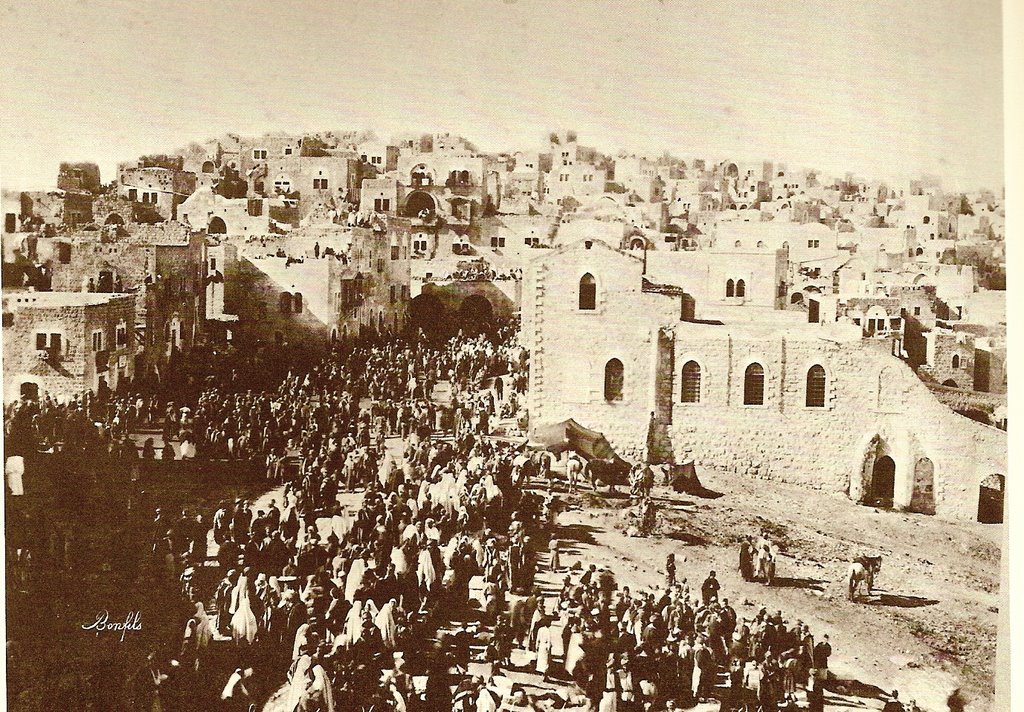
left: Pilgrims in Bethlehem over ninety years ago prior to the Zionist genocide on Palestinian culture (Khalidi, Walid. Before Their Diaspora).

What's particularly smarmy about Zionists is that they kill, maim, dispossess, and then lie about it. Ignorant journalists even let them explain Palestinians, for example in the Chicago Tribune Daniel Rossing, former director of the department for Christian communities in the Israeli Ministry of Religious Affairs is quoted for his 'knowledge' about Palestinian Christians:

"They are viewed by [Israeli] Jews as part of the vast Arab world, and viewed by their Muslim neighbors as suspect because of their Western connections," Rossing said.

I'm not sure why an Israeli government official, a government which is systematically destroying Palestinian cultural traditions that have existed for millenia, is the last word on Palestinian Christians.

Christians in Palestine are living links to the earliest Christians. No longer are Christians from Bethlehem able to pilgrimage on Palm Sunday to Jerusalem. Jerusalem and Bethlehem, one diocese, has been severed by the Wall. Seventy-two out of eighty shops on the Jerusalem-Bethlehem Road have closed.

The economic strangulation as a result of the Apartheid Wall has seen the flight of many Christian families from Bethlehem.

But Zionist equivocators, like the odious American Zionist Justus Weiner, who actually published a hideous book asserting that Edward Said wasn't a Palestinian, are offered up as experts on Palestinian Muslim-Christian relations while Har Homa, the illegal Jews only settlement on Bethlehem land, is setting up a tourist village to accommodate visitors to Bethlehem, so that the Zionists can cash in on the tourist trade. Zionists are also set to annex the land on which Bethlehem's aquifer sits.

Regarding a Church Times newsletter which stated "local Christians are adversely affected by living as a minority within a Muslim society," Palestinian Bishop Riad Abu El Assal in a letter to the Archbishop of Canterbury recently wrote:

"To us, the gentle coexistence of Christians and Muslims is a source of strength; indeed, we regard ourselves as a beacon to the wider Middle East and, through it, the rest of the world. The crisis facing Christians here is entirely due to the Israeli occupation, which, in recent years, has seen entire communities imprisoned behind the Israeli-built wall."

Yet, in today's Church Times (UK subscription only), a Reverend Tim White, obviously more concerned with promoting a very racist, land grabbing, water hoarding genocidal Zionism, rather than defending the few "original stones" left in Palestine disputes Bishop Riad:

"The Bishop in Jerusalem, the Rt Revd Riah Abu El-Assal is in a state of denial when he attributes to Israel sole and exclusive responsibility."

While the Palestinians deal with a very physical wall cutting them off from their farmlands, cutting them off from basic services, cutting them off from their families, we in the west must continue to battle the wall of ignorance.

According to a recent survey, only fifteen percent of Americans even know that Bethlehem is a Palestinian city. No wonder, then, that a headline in the December 21 European Stars and Stripes (full electronic print version) read "Ramstein group traces footsteps of Jesus in Israel."

In the same issue a full page is devoted to "the meaning and traditions of Hanukkah, on which Protestant Women of the Chapel and also Military Council of Catholic Women in Naples, Italy, were enlightened by the Jewish Chaplain.

"'I love the Jews, for they are God's chosen people,' said Army Sgt. Maj. Rozenia Carter, a member of the group. 'I'm here because I heard the rabbi was speaking and I wanted to understand more about their culture. What a belssing it was to light one of the menorahs...It was truly awesome.'"

I am sure that Sgt. Maj. Carter, of the Protestant women, has no clue about the plight of her fellow Christians in Palestine or about the five hundred mixed Christian and Muslim villages that were destroyed in 1947-48. I have an idea that Sgt. Maj. Carter, of the Protestant women, may be one of the eighty-five percent of Americans who doesn't even know that Bethlehem today is a mixed Muslim and Christian town, with a sixty percent unemployment rate.

She probably doesn't know that some of her poor fellow Christians in Bethlehem whose houses were subsidized by the Greek Orthodox Church are facing demolition orders.

She also probably doesn't know that Hanukkah is a very minor holiday, and it probably hasn't occurred to her why it's so highly publicized and feted in the US.

She probably doesn't know that Sis Levin, wife of former CNN correspondent Jeremy Levin, who was also a hostage in Beirut, organized a Palm Sunday procession for the Christian Children of Bethlehem from Bethlehm to Jerusalem, but they were turned away at gunpoint by God's chosen people.

Most likely, the Sgt. Major doesn't know any of this because she grew up in a country that's so Zionised that if we say "Merry Christmas," it's akin to an expletive.

So right now I just don't feel very merry. I was in Bethlehem in the early seventies. I still vividly recall the Israeli sniper on top of the Church of the Nativity I could see from my friend's house.

We Palestinian-Americans have no one to blame but ourselves for the appalling lack of ignorance about Palestine in our society. It is very hard to make inroads in a society that's so Zionised that only fifteen percent of Americans know that Bethlehem is a Palestinian town.

The alternative, however, is to sit back and watch the completion of the destruction of Palestine's cultural traditions. Let ignorant Catholic, Protestant, and maybe not so ignorant Jews light a menorah and delude themselves that this is real multi-culturalism rather than just another exercise in heralding Israel. Palestine was once multi-cultural; it is now Jews preferred and privileged in every way.

In this holy season, let us increase our efforts to de-Zionize the country that our fathers and mothers adopted.

Much of the information here comes from Open Bethlehem. Much more is available at Open Bethlehem. The powerpoint presentations on the site are very informative regarding the effects of Israel's systematic attempt to grab the land and force the indigenous residents out.

'What would happen if the Virgin Mary came to Bethlehem today?'

Independent Appeal

Johann Hari on the plight of pregnant women in the West Bank, where babies are dying needlessly

Published: 23 December 2006

In two days, a third of humanity will gather to celebrate the birth pains of a Palestinian refugee in Bethlehem - but two millennia later, another mother in another glorified stable in this rubble-strewn, locked-down town is trying not to howl.

Fadia Jemal is a gap-toothed 27-year-old with a weary, watery smile. "What would happen if the Virgin Mary came to Bethlehem today? She would endure what I have endured," she says.

Fadia clutches a set of keys tightly, digging hard into her skin as she describes in broken, jagged sentences what happened. "It was 5pm when I started to feel the contractions coming on," she says. She was already nervous about the birth - her first, and twins - so she told her husband to grab her hospital bag and get her straight into the car.

They stopped to collect her sister and mother and set out for the Hussein Hospital, 20 minutes away. But the road had been blocked by Israeli soldiers, who said nobody was allowed to pass until morning. "Obviously, we told them we couldn't wait until the morning. I was bleeding very heavily on the back seat. One of the soldiers looked down at the blood and laughed. I still wake up in the night hearing that laugh. It was such a shock to me. I couldn't understand."

Her family begged the soldiers to let them through, but they would not relent. So at 1am, on the back seat next to a chilly checkpoint with no doctors and no nurses, Fadia delivered a tiny boy called Mahmoud and a tiny girl called Mariam. "I don't remember anything else until I woke up in the hospital," she says now. For two days, her family hid it from her that Mahmoud had died, and doctors said they could "certainly" have saved his life by getting him to an incubator.

"Now Mariam is at an age when she asks me where her brother is," Fadia says. "She wants to know what happened to him. But how do I explain it?" She looks down. "Sometimes at night I scream and scream." In the years since, she has been pregnant four times, but she keeps miscarrying. "I couldn't bear to make another baby. I was convinced the same thing would happen to me again," she explains. "When I see the [Israeli] soldiers I keep thinking - what did my baby do to Israel?"

Since Fadia's delivery, in 2002, the United Nations confirms that a total of 36 babies have died because their mothers were detained during labour at Israeli checkpoints. All across Bethlehem - all across the West Bank - there are women whose pregnancies are being disturbed, or worse, by the military occupation of their land.

In Salfit, on the other side of the West Bank, Jamilla Alahad Naim, 29, is waiting for the first medical check-up of her five-month pregnancy. "I am frightened all the time," she says. "I am frightened for my baby because I have had very little medical treatment and I cannot afford good food ... I know I will give birth at home with no help, like I did with Mohammed [her last child]. I am too frightened to go to hospital because there are two checkpoints between our home [and there] and I know if you are detained by the soldiers, the mother or the baby can die out there in the cold. But giving birth at home is very dangerous too."

Hindia Abu Nabah - a steely 31-year-old staff nurse at Al Zawya Clinic, in Salfit district - says it is "a nightmare" to be pregnant in the West Bank today. "Recently, two of our pregnant patients here were tear-gassed in their homes ... The women couldn't breathe and went into premature labour. By the time we got there, the babies had been delivered stillborn."

Many of the medical problems afflicting pregnant women here are more mundane than Jamilla's darkest fears: 30 per cent of pregnant Palestinians suffer from anaemia, a lack of red blood cells. The extreme poverty caused by the siege and now the international boycott seems to be a key factor. The doctors here warn grimly that as ordinary Palestinians' income evaporates, they eat more staples and fewer proteins - a recipe for anaemia. There is some evidence, they add, that women are giving the best food to their husbands and children, and subsisting on gristle and scraps. The anaemia leaves women at increased risk of bleeding heavily and contracting an infection during childbirth.

Earlier this year, conditions for pregnant women on the West Bank - already poor - fell off a cliff. Following the election of Hamas, the world choked off funding for the Palestinian Authority, which suddenly found itself unable to pay its doctors and nurses. After several months medical staff went on strike, refusing to take anything but emergency cases. For more than three months, the maternity wards of the West Bank were empty and echoing. Beds lay, perfectly made, waiting for patients who could not come.

In all this time, there were no vitamins handed out, no ultrasound scans, no detection of congenital abnormalities. Imagine that the NHS had simply packed up and stopped one day and did not reopen for 12 weeks, and you get a sense of the scale of the medical disaster.

Some women were wealthy enough to go to the few private hospitals scattered across the West Bank. Most were not. So because of the international boycott of the Palestinians, every hospital warns there has been an unseen, unreported increase in home births on the West Bank.

I found Dr Hamdan Hamdan, the head of maternity services at Hussein Hospital, Bethlehem, pacing around an empty ward, chain-smoking. "This ward is usually full," he said. "The women who should be in this hospital - what is happening to them?"

They have been giving birth in startlingly similar conditions to those suffered by Mary 2,000 years ago. They have delivered their babies with no doctors, no sterilised equipment, no back-up if there are complications. They have been boycotted back into the Stone Age. The strike ended this month after the PA raised funds from Muslim countries - but the effects of stopping maternity services are only now becoming clear. Hindia Abu Nabah says: "There is a clear link between the deteriorating health situation and the international boycott.

Amid this horror, one charity has been supporting pregnant Palestinian women even as their medical services fell apart.

Merlin - one of the three charities being supported by the Independent Christmas Appeal - has set up two mobile teams, with a full-time gynaecologist and a paediatrician, to take medical services to the parts of the West Bank cut off by the Israeli occupation. They provide lab technicians and ultrasound machines - the fruits of the 21st century.

I travelled with the team to the Salfit region - scarred by Israeli settlements pumping out raw sewage on to Palestinian land - to see women and children desperately congregating around them seeking help. Amid the dozens of nervous women and swarms of sickly children, Rahme Jima, 29, is sitting with her hands folded neatly in her lap. She is in the last month of her pregnancy, and this is the first time she has seen a doctor since she conceived.

"The nearest hospital is in Nablus, and we can't afford to pay for the transport to get there through all the checkpoints," she says, revealing she is planning - in despair - to give birth at home. Even if she had the cash, she says she is "too frightened of being detained at the checkpoint and being forced to give birth there". She sighs, and adds: "I will be so relieved to finally be seen by a doctor, I have been so worried." But when she returns from seeing the doctor, she says: "I have anaemia, and they have given me iron supplements," supplied by Merlin. She can't afford to eat well; she lives with her husband and four children in a room in her mother-in-law's house, and her husband, Joseph, has been unemployed since his permit to move through the checkpoints expired. "The doctor says I should have been seen much earlier in my pregnancy. My baby will probably be born too small."

All the problems afflicting these 21st century Marys are paraded in Merlin's clinic. One terrified, terrorised mother after another presents herself to the specialists here, and leaves clutching packs of folic acid, calcium, iron and medicine. Dr Bassam Said Nadi, the senior medical officer for this area, says: "I thank Merlin for the specialist care they have brought. Not long ago, we didn't even have petrol in our cars. Alongside other organisations, they are helping us survive this terrible period in our country's history."

Merlin can only maintain these mobile clinics with your help. Leaning in the doorway of her bare clinic, Hindia Abu Nabah says: "Tell your readers that we need their help. There are no Hamas or Fatah foetuses. They don't deserve to be punished. I couldn't stand to look another anaemic woman in the eye and tell her that her baby will be underweight or malformed and we don't have iron supplements to give her. I can't go back to that. I can't."

Wednesday, December 20, 2006

Jesus is a Terrorist

NYT Full page ad: Is Bethlehem Dying?
---

Jesus is a Terrorist
By Johnny Barber
dodger8mo@hotmail.com

Jesus is a terrorist, there ain't no one can doubt it. Born in Bethlehem, what more need I say about it? Thirty foot concrete barriers, soldiers armed with guns, being born in Bethlehem just ain't much fun. Jesus stands on the corner, throwin' stones at tanks. Israeli soldiers don't hold back, they ain't shootin' blanks. Jesus stands defiant, a David 'gainst Goliath. Jesus is a terrorist, he ain't allowed to pass. Being born in Bethlehem, life is over fast.

Jesus is a terrorist, he ain't allowed to pass. You know what they're teaching, in those Christian schools in town. He's learning hate against the state, and what it means to martyr. Jesus is a terrorist, he don't need Jimmy Carter. Jesus knows all 'bout them virgins. That ain't no lie they tell ya, once you pass them pearly gates, it pays to be a fella!

Jesus is a carpenter, but he's not allowed to work. He passes time carving trinkets for those Christian tourist folk. They come and kiss the ground where Jesus once lay swaddled. They bargain him down, then they just turn on back around. They close their eyes to the soldiers, they close their eyes to the wall. Jesus, born in Bethlehem, don't stand any chance at all.

Jesus rode a donkey once, straight on through to Jerusalem. Today, Jesus ain't got a prayer, he's not allowed to pass. Jesus can't stoop low enough to kiss the soldier's ass.

The tourists come back home, blind as before. They go to church, and they sing their songs, and look up on the wall. Jesus still is hangin' there, saving them from the fall. But just like Judas, they turn their backs, no one heeds his call.

Cause Jesus is a terrorist, but don't you worry none. It's just a name they give you when you're Palestinian. A savior born in Bethlehem- it's quite a story, but just not rightcause Jesus is a terrorist, don't you worry 'bout his plight.

Today, the people of Bethlehem are imprisoned behind a thirty-foot high concrete wall, unable to move. The Christian community cannot travel to Jerusalem to pray at the church of the Holy Sepulchre- a short, twenty-minute drive from Bethlehem. The Israeli military occupation, nearing its 40th year, has strangled the economy as well as the people living in the Holy Land, and there is no end in sight. The people are constantly at risk, not even their homes are safe, no sanctuary available- anywhere. The checkpoints and the military incursions are constant reminders that the life of a Palestinian in Bethlehem is cheap. And the Christian community, as well as the world, looks on in silence. At this time of year, as we remember and celebrate the birth of Jesus, may all Christians, and all people of faith, raise their voices and demand justice for the good people of Bethlehem and Palestine.

The occupation must end.

Tuesday, December 12, 2006

Religious equality or the hijacking of Christianity? Jews setting the agenda in the US

Monday, December 11, 2006

Several weeks ago NPR ran a three-part series on European attitudes towards Islam. Overall the rather biased reporting (courtesy of Sylvia Poggioli) indicated that European countries felt that Muslim immigrants to their countries did not want to give up their native customs and refused to integrate as easily as they were expect to. Yet the accusations towards Muslim immigrants to Europe and the US is negligible compared to what vocal Jews in America have dictated in this nation.

In what country of Europe have Muslims turned "Merry Christmas" into "happy holidays"? In which country has the cresent and star turned up next to the Cross? In what country is every single calendar published equalizing Muslim holy days alongside the Christian and national holidays? In which country is a rabbi arrested for praying in an airport or airplane? In what country can an imam threaten to sue the airport because the Christmas trees insult his religion AND THE AIRPORT COMPLIES by taking down all the Christmas decorations?!

In which country do 3% of the population set the agenda for 97% of the remaining majority? Please don't blame Muslims for wanting to practice their religion and culture when you allow vocal Jewish fascists for forcing their icons and religion on the rest of us. Lets be quite clear that "Christ" is being taken out of Christmas is not because of "Islamofascists" or Nasrallah or Iran. The de-Christianization and the increasing Judaicization of America is because of one subsect group alone--the vocal Jews with Judaism and arrogance as dual chips on their shoulders.

Saturday, December 2, 2006

Al-Sadr bloc talks of alliance with Sunnis, Christians

BAGHDAD, Iraq (CNN) -- One day after suspending participation in Iraq's government, the bloc loyal to anti-U.S. Shiite cleric Muqtada al-Sadr announced a possible new political alliance with Sunnis and Christians.

Calling the group a "national front," the head of al-Sadr's bloc in Parliament -- Falah Hassan Shanshel -- said the groups would target the U.N. Security Council's decision to extend the mandate of the 160,000 multinational force in Iraq for another year.

The formation of such an alliance has been in the works for at least two months, said Saleh al-Mutlag, a prominent Sunni politician and vocal critic of al-Maliki.

He called the alliance a nonsectarian, national patriotic front, drawing from different areas of the country and also including secularists, Kurds, Yazidis, Turkmens and clerics.

The group does not include the Mehdi Army, a militia loyal to al-Sadr, al-Mutlag said, adding that he believes the militia should dissolve. He said that al-Sadr himself is "not negative" about the alliance and that it could be achieved peacefully.

Members of the alliance are working with insurgents to get them to lay down their arms, al-Mutlag said. He emphasized that a withdrawal table for U.S. troops would convince insurgents Americans won't stay.

The United States should be talking to members of this grass-roots movement about solving Iraq's problems, al-Mutlag added, saying he believes the government is the cause of the country's problems now.

The al-Sadr bloc's 30 Parliament members and six Cabinet ministers on Wednesday carried out their threat to boycott the government to protest President Bush's meeting with Iraqi Prime Minister Nuri al-Maliki in Jordan. (Details)

Members of the country's largest Sunni bloc -- the Iraq Accord Front -- as well as Christian and independent lawmakers contacted the al-Sadr movement after its boycott to announce their solidarity, Shanshel said. (Watch how much clout al-Sadr and his bloc wieldVideo)

Al-Sadr's group said it will resume government participation when al-Maliki comes up with a timetable for U.S. troop withdrawal. It also wants better security and improvements in infrastructure.

Al-Maliki, who believes disagreements should be addressed within the framework of government, has urged the bloc to reconsider its boycott, calling it "an unproductive turn in the political process."

His spokesman later said that Parliament members may legally suspend their participation, but Cabinet ministers may not -- and must either resign or take leave without pay.

The al-Sadr faction is part of the United Iraqi Alliance, which also includes al-Maliki's party -- the Dawa movement -- and the Supreme Council of the Islamic Revolution in Iraq, a staunch rival of al-Sadr's movement.

It was the issue of federalism that put SCIRI and al-Sadr's people on opposite sides of the camp, with al-Sadr supporters siding with Sunnis in support of a united Iraq, and SCIRI members wanting a Shiite autonomous zone -- similar to the Kurds'.

U.S. commanders believe al-Sadr's Mehdi Army militia has played a key role in stoking sectarian violence this year, but al-Maliki, who draws his support from al-Sadr's supporters, hasn't targeted them.

CNN's Mohammed Tawfeeq, Erin McLaughlin and Arwa Damon contributed to this report