Are You There, God? It's Me, Hitchens.
...
Has anyone in the Bush administration confided in you about being an atheist?
Well, I don’t talk that much to them—maybe people think I do. I know something which is known to few but is not a secret. Karl Rove is not a believer, and he doesn’t shout it from the rooftops, but when asked, he answers quite honestly. I think the way he puts it is, "I’m not fortunate enough to be a person of faith."
Showing posts with label religion. Show all posts
Showing posts with label religion. Show all posts
Friday, May 4, 2007
Top Bush Adviser An Atheist


Tuesday, May 1, 2007
Just War, Jeremiah, and Jeremiah Weed
April 19, 2007
You’ve probably never heard of the hard-edged brand of low-priced bourbon called Jeremiah Weed, and for darn good reason: It is almost unavailable, except on Air Force bases. But U.S. fighter pilots go through the stuff like airplane fuel, and some concede it tastes pretty much the same. As one airman wrote online of the drink: “Weed is one of those things you wonder why anyone would consume! However, after you choke down the first one you try another. After three to four, it becomes strangely pleasant and smooth…. It’s one of those creepy drinks that sneaks up on you long after you thought you had it licked, and inexplicably erases all memory of the evening.”
Jeremiah Weed has been adopted as the almost-official liquor of America’s fighter pilots, who drink it on special occasions out of spent cannon shells—though none can explain exactly why. The closest thing to a trustworthy account appears in C. R. Anderegg’s memoir Sierra Hotel, where he writes of pilots who came to a desert saloon after checking out the site where one of them had crashed a plane. At a nearby bar, they convinced the bearded bartender to join them in a drinking game called “Afterburners”, which involves slamming back shots of whiskey set on fire…. And you don’t want to hear the rest. It involves singed flesh, a blazing beard, and penitent pilots purchasing a case of cheap bourbon from a bartender who was headed for the burn ward. And thus began a tradition. Our pilots have been choking down the stuff ever since.
By inscrutable Providence or happy accident, this bourbon shares a name with one of the Old Testament’s greatest prophets, whose message warned of fire and war (though he didn’t mention crashing F-16s, at least in the Douay-Rheims Catholic translation). Jeremiah taught in the seventh century B.C., at a time when the Jewish nation occupied a unique position: It stood like a deer in the headlights in the middle of the road.
Once a major power in the region under kings David and Solomon, the Jewish kingdom had torn itself apart in civil wars and lapsed from strict religious practice—despite a series of increasingly irritable prophets. To make things worse, the remaining land of Judah lay smack dab between two aggressive empires.
The prophets whom God sent to His people carried a two-fold message, which can be boiled down to this: “Go to Temple—and don’t provoke the goyim!” Again and again, the prophets of Israel countered the claims of ambitious kings and zealous nationalists (think of them as the first neocons), whose plans for national greatness entailed risky and needless wars. In fact, the Hebrew prophets were the precursors of the Christian critique of conquest. While the Church has never advocated outright pacifism, beginning with St. Augustine it has developed increasingly strict criteria by which to judge the causes and conduct of war. The Just War tradition specified that Christians should only take part in a war if it is
• In a good cause, i.e., to repel aggression or protect the innocent. (No, “revenge,” “a presidential sex scandal” or “an upcoming election” don’t count.)
• Waged by legitimate authorities.
• Reasonably likely to succeed.
• Unlikely, proportionately, to cause more harm than good.
• The last resort after attempted negotiations.
• Waged with the minimum force necessary, making every attempt to protect civilians.
These criteria take all the fun out of war—banning naked land-grabs, empire building, torture, mass-rape, fire-bombing cities, and the use of America’s 10,000 or so nukes for pretty much anything at all. Since the Just War tradition is such a buzz-kill, Christians of a certain kind often argue it away as cleverly as a canon lawyer wangling an annulment for a Kennedy.
Sadly, the kings and people of Israel did something similar. They disdained their peacenik prophets, and instead marched off to disaster in places we now call Lebanon and Iraq. This suggests to us that certain current politicians eager to remake the Middle East are indeed reading their Bible. They just don’t understand it.
By Jeremiah’s time, the rump Jewish kingdom called Judah was a subject ally of the rising empire of Babylon. Judah had to pay tribute, but its people could live untroubled, and Jerusalem’s Temple was left untouched. Jeremiah’s message mirrored that of previous prophets: He urged the Israelites to leave well enough alone. Instead of allying with one pagan kingdom—and provoking the others—or “arming for peace,” the Jews should concentrate on pleasing God. He alone had given them their kingdom in the first place, and only He could save it. But Judah’s ruling class were not keen to listen; it didn’t help that Jeremiah’s idea of tact included phrases like “You have polluted the land with your whoring and wickedness.” (Jeremiah, 3:2) Eager to throw off the yoke of Babylon, Judah’s king cut off the tribute and allied with the bumbling king of Egypt who promised to bail the Israelites out. “Fat chance,” said Jeremiah. (My own, contemporary translation.)
Jeremiah wandered the countryside, often two steps ahead of a lynch mob, warning the people and king that their policies would bring on disaster: “I will even give them into the hand of their enemies, and into the hand of them that seek their life: and their dead bodies shall be for meat unto the fowls of the heaven, and to the beasts of the earth,” to be specific. (Jeremiah 34:20)
For his candor, Jeremiah was locked in chains, chased from town to town, and condemned as a traitor who did not support the troops. When the Babylonians did indeed invade, destroy Jerusalem, level the Temple, and lead almost all the Jews off to slavery in exile, those who were left behind dragged Jeremiah off to Egypt—where they would finally pay him back for his prescience by stoning him to death.
From all this, I draw a message for today: When politicians propose a war, get behind it. Don’t ask if it’s just, wise, or winnable—or even which country it is against. Just put that yellow ribbon sticker on your car, hunker down, and support the president. It beats getting stoned in Egypt.
Of course, that’s cold comfort to the brave souls who’ll have to fly combat missions over Pyongyang, Pakistan, or Paris. It’s your duty at least to pray for them—and maybe send a case of Jeremiah Weed.
Excerpted from The Bad Catholic’s Guide to Wine, Whiskey, and Song with the gracious permission of the author.
Monday, April 23, 2007
Is George W. Bush Planning To Trigger Apocalyptic War ?
April 23, 2007
By Bruce Wilson
talk2action@earthlink.net
By Bruce Wilson
talk2action@earthlink.net
Given that neoconservatives close to the Bush Administration have articulated visions for the Middle East that involve the replacement of numerous existing governments in the regions, not to mention the replacement of the atrocious North Korean regime, how could we distinguish, in practice, that plan in action from moves to bring on the apocalypse ? The two projects would tend to look quite similar. Both would involve increasingly expanded theaters of war : maximal mayhem.
IN fact, some prominent neoconservatives have stated their desire for maximal mayhem, maximal war:
"One can only hope that we turn the region [the Middle East] into a cauldron [of war], and faster, please. If ever there were a region that richly deserved being cauldronized, it is the Middle East today." -Michael Ledeen
Is George W. Bush a real Christian ? Is it just a manipulative act ? This post considers evidence that George W. Bush has genuine religious belief and, in fact, believes that the Apocalypse is immanent... even that he might have a divine mission to bring it on.
Yesterday I did a story on the heavy Evangelical penetration of the US military. The concern wasn't about Evangelicals but, rather, religious coercion in the military and troubling questions Weinstein has raised about possible compromises in the US military's chain of command.
Reading this post, please bear in mind that belief, or the absence of belief, is extremely difficult to demonstrate although modern MRI brain imaging techniques can demonstrate activity, or the lack of that, in areas of the brain associated with religious belief. But it is unlikely George W. Bush would submit to such scrutiny, and so we must consider proxy evidence.
If you're concerned about possible war with Iran, Wes Clark is too - you can sign his petition and get a free button ]
"The classical pattern of apocalypse, comprising in its active form, an initial phase of savage destruction followed by a phase of messianic rebirth, can be recognized in individual psychosis and in the Nazi type of destruction, persecution and virtual suicide." - Mortimer Ostow, "The Psychodynamics of Apocalyptic: Discussion of Papers on Identification and the Nazi Phenomenon," International Journal of Psycho-Analysis, 1986
"God wants me to be President." - George W. Bush, 19 January 1999
[UPDATE: Some critics of this post have objected that there are few, if any, apocalyptic Christian Zionists within the Bush Administration. That point, even if correct, does not negate the impact of beliefs George W. Bush might hold. Further, neoconservatives widely held to have had considerable influence, within the Bush administration and in propelling the US towards war with Iraq, talk in terms eerily similar to those of apocalyptic Christian Zionism. Much neoconservative rhetoric is in fact indistinguishable from the rhetoric of apocalyptic Christian Zionists:
Neoconservatives For Maximal War
"[Richard] Perle told journalist John Pilger in 2002 that "if we just let our vision of the world go forth, and we embrace it entirely and we don't try to piece together clever diplomacy, but just wage a total war ... our children will sing great songs about us years from now."
"Israel is part of a global war, the war of radical Islam against civilization. Right now Israel is doing the work of the rest of the civilized world by taking on the terrorists. It is not only for Israel's sake that we must get the facts out -- it is for ourselves, America, for every free country in the world, and for civilization itself." - David Horowitz
"One can only hope that we turn the region [the Middle East] into a cauldron [of war], and faster, please. If ever there were a region that richly deserved being cauldronized, it is the Middle East today." -Michael Ledeen"I think an explosion is long overdue and turning the whole region into a cauldron [of war] is a necessary step toward reforming it." - Mark Steyn
"Norm Podhoretz ranks among the most prominent American editors of the 20th century. And he's doing pretty well in the 21st. (Laughter.) Never a man to tailor his opinions to please others, Mr. Podhoretz has always written and spoken with directness and honesty. Sometimes speaking the truth has carried a cost. Yet, over the years, he has only gained in stature among his fellow writers and thinkers. Today we pay tribute to this fierce intellectual man [sic] and his fine writing and his great love for our country." - George W. Bush, presenting the Presidential Medal of Freedom to Podhoretz in June of 2004
"God willing, Judgment Day is coming to the Middle East." -Michael Ledeen
"Prof Ledeen is...believed to have the ear of the White House's current Chief of Staff Karl Rove, and has regular conversations with him. ...His view on the war on terror is clear, he said: 'Iraq is just one battle in a larger war, bringing down the regime in Iran is the central act...' "
-BBC News"Whether or not the White House listens, it seems that they’ve listened to a lot of things about Iran, that I will say. I mean, some of the language and some of the speech is very familiar to me, and really reflects the sort of thing that I’ve been pushing for." - Ledeen, April 2003
"The regime must go." - [Richard] Perle and [David] Frum, on Iran
"All of Korea will be united in liberty." - Perle and Frum, on North Korea
"We should force European governments to choose between Paris and Washington." - Perle and Frum, on Europe
This post concerns the possibility that George W. Bush holds apocalyptic religious views and believes God has commanded him to attack Iran in order to bring on the Apocalypse.
"It was in his first campaign for governor that George W. began to preach the gospel according to Bush. He literally gave sermons in Houston's mega-churches, laying the blame for America's "failed culture" on the excesses of his generation in the 60s. "The culture of my generation, our generation, has clearly said, ‘If it feels good, do it, and be sure to blame somebody else if you have a problem.'" " - Gail Sheehey, Vanity Fair story on George W. Bush's religious beliefs.
When I woke this morning and made a pot of coffee, the sun was already up, cresting the hill behind my house amidst a din of birds and a riotous explosion, sudden and exuberant, of Spring. It was beautiful, and I think that's why I chose to wrote this now ; so that, in the words of Richard Brautigan's final book, ...The Wind Won't Blow It All Away.
***
About a month ago, a team of Japanese journalists visited Mikey Weinstein of the Military Religious Freedom Foundation, to do a story on Weinstein and his fight against religious coercion in the US military. The journalists told Weinstein they saw a pattern, now in the US, of religious militarism very similar to that which had arisen in Japan prior to World war Two.
"...a short video on faith and diplomacy made in the aftermath of September 11,2001, by Christian Embassy, a behind-the-scenes ministry for government and military elites. It almost seems to endorse deliberate negligence of duty, Dan Cooper, an undersecretary of veterans' affairs, announces that his weekly prayer sessions are "more important than doing the job." Major General Jack Catton says that he sees his position as an adviser to the Joint Chiefs of Staff as a "wonderful opportunity" to evangelize men and women setting defense policy. "My first priority is my faith," he says. "I think it's a huge impact.... You have many men and women who are seeking God's counsel and wisdom as they advise the Chairman [of the Joint Chiefs] and the Secretary of Defense." Brigadier General Bob Caslen puts it in sensual terms: "We're the aroma of Jesus Christ." There's a joyous disregard for democracy in these sentiments, for its demands and its compromises, that in its darkest manifestation becomes the overlooked piety at the heart of the old logic of Vietnam, lately applied to Iraq: In order to save the village, we must destroy it.
Weinstein, a former Air Force lawyer and Reagan White House counsel, saw not just some disturbing theology, but a potential violation of military regulations regarding separation of church and state." - Jeff Sharlet, Jeff Sharlet - Ten Things I Learned from the Pentagon's Prayer Team ( emphases mine )
War, especially religious war, is not a glorious affair. Images in this story are of the outcomes of real war on real humans. Please be advised.
 Also, a few days ago, as you've probably heard, US Senator John McCain sang "Bomb Iran, Bomb Bomb Bomb" to the tune of the Beach Boys' hit "Barbara Ann", before an audience of hundreds at a VFW hall.
Back in April 2006, John McCain said, on "Meet The Press", to Tim Russert, that war with Iran could lead to "Armageddon". Now, McCain's singing about bombing that country as if it were some sort of joke. GOP House Minority Whip Roy Blunt Jr. flew out to Texas, early in 2007, to meet privately with John Hagee as well. The Apocalypse seems to be a popular subject these days in the GOP.
To the right is a picture, by a survivor of the bombing, of victims of the Hiroshima nuclear blast.
***
( image, right: skulls of Hiroshima victims ) Over the course of the last few months, I've been studying what George W. Bush may believe, and what people who are accorded as having been major religious influences on Bush say they believe.
Almost to a man, and they have all been men, those who are held to have shaped George W. Bush's religious beliefs have been apocalyptic Christian Zionists. George Bush speaks in the idiom of Christian apocalyptic premillenial dispensationalism, in common parlance the language of the end-times, of the coming Apocalypse, Rapture, and Armageddon. "Madman" theory does not suffice, from all that I can tell, to explain George W. Bush's numerous statements, that he speaks to God, is on a mission from God, that he is part of a divine plan.
By most evidence, George W. Bush appears to hold a personal, messianic belief that he, personally, must usher in the Apocalypse. And, he might just be able, as the last gasp of his dying presidency, to pull it off. In 2004, David Domke and Kevin Coe did a study of presidential language and come to the troubling conclusion - George W. Bush's language is very different from language used by past presidents:
( image - from archival footage of "The Rape Of Nanking" )
"The religious outlook of George W. Bush has been the focus of recent stories by several major news media. In these pieces White House officials and allies consistently have made the case that Bush’s faith and language are no different from past presidents. In the words of the Rev. Richard Neuhaus in The Washington Post, "This is so conventionally Christian piety and Christian faith" that Bush’s faith is "as American as apple pie."That simply is not so. Bush’s fusion of faith and politics is anything but conventional for the presidency.
The key difference is this: Presidents since Franklin Roosevelt have spoken as petitioners of God, seeking blessing and guidance; this president positions himself as a prophet, issuing declarations of divine desires for the nation and world. Most fundamentally, Bush’s language suggests that he speaks not only of God and to God, but also for God. Among modern presidents, only Ronald Reagan has spoken in a similar manner -- and he did so far less frequently than has Bush." - Published in The Revealer October 11, 2004. ( David Domke is an associate professor in the Department of Communication at the University of Washington. He is the author of God Willing? Political Fundamentalism in the White House, the "War on Terror," and the Echoing Press (Pluto Press, 2004). Kevin Coe is a doctoral student in the Department of Speech Communication at the University of Illinois. )
George W. Bush, at a public appearance Thursday, laid it out for all to see and this should come as no surprise:
As the Republican National Committee reports on its website, President Bush has declared this April 19, 2007, that his "faith" and his family come first, while George W. Bush's loyalty to the United States comes last. ( thanks to Universal Health for the tip )
I wish I was traveling here with Laura. The best thing about my family is my wife. (Applause.) She is a great First Lady. I know that sounds not very objective, but that's how I feel. And she's also patient. Putting up with me requires a lot of patience. But she sends her best; she's in New Orleans today.
And I will tell you, one reason -- this may sound counterintuitive, but a good marriage is really good after serving together in Washington, D.C. It's been an amazing experience to be a husband and then a dad as President of the United States. I emphasize, that is the priority for me as the President. It's my faith, my family, and my country"
Faith, Family, then Country ?
Bush's declaration of presidential loyalty seems to run directly counter to the oath Bush, and all US presidents, have taken upon entering presidential office:
"I do solemnly swear (or affirm) that I will faithfully execute the office of President of the United States, and will to the best of my ability, preserve, protect and defend the Constitution of the United States."
Am I making too much of this ?
Let's look at a recent flap concerning US Representative Keith Ellison's Islamic religious. Critics claimed that Ellison could not be trusted to honor his oath of office because some Islamicists say things like this:
Secularists in the West will agree with this, then they will point out that under Islamic law, people are not all equal. No non-Muslim, for example, could become the president. Well, in response to that fact, in turn, secularism is no different. No Muslim could become president in a secular regime, for in order to pledge loyalty to the constitution, a Muslim would have to abandon part of his belief and embrace the belief of secularism — which is practically another religion. For Muslims, the word 'religion' does not only refer to a collection of beliefs and rituals, it refers to a way of life which includes all values, behaviors, and details of living. ( Dr. Jaafar Sheikh Idris )
Indications are good that, for George W. Bush, religious belief trumps Bush's responsibility to American people who hold religious and philosophical beliefs that differ from his. Signs are strong that Bush wants Apocalypse and that, even though a large percent of American does not wish for Apocalypse, George W. Bush just doesn't care. If he has the power to bring it on, that's that ; he'll do it and damn us all to the hell on Earth he feels God wants him to set in motion.
Let me turn to Jeff Sharlet, to frame the backdrop to all of this:
John Hagee is likely one of religious leaders who helped shape Goerge W. Bush's religious beliefs. Until last Wednesday, John Hagee's "Apocalypse Lobby" website featured an image, of Jerusalem's Wailing wall and the Temple Mount, from which the 3rd Holiest Site in Islam had been airbrushed out. As a result of my blogging, it seems, CUFI last Wednesday replaced its website logo image with another image in which the Haram el-Sharif was visible. A number of observers considered the original, airbrushed CUFI logo image to be wildly provocative to the Islamic world.
In a recent Charisma Magazine issue John Hagee, in a piece entitled "The Coming Holy War", wrote : "Israel and America must confront Iran's nuclear ability and willingness to destroy Israel with nuclear weapons."
On July 19, 2006, at a CUFI sponsored Washington DC event called "A Night to Honor Israel", with GOP Party head Ken Mehlman and US GOP Senators Sam Brownback and Rick Santorum ( President George W. Bush sent recorded greetings to the event ) , Pastor John Hagee declared :
"The United States must join Israel in a pre-emptive military strike against Iran to fulfill God's plan for both Israel and the West... a biblically prophesied end-time confrontation with Iran, which will lead to the Rapture, Tribulation [...] and [the] Second Coming of Christ."
Hagee's beliefs are actually part of mainstream Christian Zionist thought, which tends to hold that, after Christians are "Raptured" bodily up to heaven, most Jews ( 2/3 to be precise ) will die in a subsequent terrible conflict centered around Israel.
Fundamentalism is here, and even provided we can squeak by the Apocalypse we're going to have to learn to deal with it. As Jeff Sharlet writes:
"We keep trying to explain away American fundamentalism. Those of us not engaged personally or emotionally in the biggest political and cultural movement of our times—those on the sidelines of history—keep trying to come up with theories with which to discredit the evident allure of this punishing yet oddly comforting idea of a deity, this strange god. His invisible hand is everywhere, say His citizen-theologians, caressing and fixing every outcome: Little League games, job searches, test scores, the spread of sexually transmitted diseases, the success or failure of terrorist attacks (also known as "signs"), victory or defeat in battle, at the ballot box, in bed.... A divine love that speaks through hurricanes. Who would worship such a god? His followers must be dupes, or saps, or fools, their faith illiterate, insane, or misinformed, their strength fleeting, hollow, an aberration. A burp in American history. An unpleasant odor that will pass.
We don’t like to consider the possibility that they are not newcomers to power but returnees, that the revivals that have been sweeping America with generational regularity since its inception are not flare-ups but the natural temperature of the nation...
The Christian nation of which the movement dreams, a government of those chosen by God but democratically elected by a people who freely accept His will as their own, is a far country. The nation they seek does not, at the moment, exist; perhaps it could in the future. More important to fundamentalism is the belief that it did exist in the American past, not in the history we learn in public school and from PBS and in newsmagazine cover stories on the Founders but in another story, one more biblical, one more mythic and more true. Secularism hides this story, killed the Christian nation, and tried to dispose of the body. Fundamentalism wants to resurrect it, and doing so requires revision: fundamentalists, looking backward, see a different history, remade in the image of the seductive but strict logic of a prime mover that sets things in motion. The cause behind every effect, says fundamentalist science, is God. Even the inexorable facts of math are subject to His decree, as explained in homeschooling texts such as Mathematics: Is God Silent? Two plus two is four because God says so. If He chose, it could just as easily be five. ( Jeff Sharlet, from Through a Glass Darkly, Harpers Magazine, December 2006 )
What does George W. Bush Believe ?
What does George W. Bush believe ? And, given the embattled nature of the Bush Administration, does it even matter ? Isn't Bush a lame duck president ? Hasn't the tide of political cronyism and religious zealotry that swept in as the presidency of George W. Bush crested at last ? With the return of the Democrats in force to Congress, to control the House of Representatives and the Senate, haven't we witnessed, at long last, the crest of the wave, the high water mark of the Bush Administration's proclivity for packing the federal bureaucacy with religious ideologues ?
"While it is well-known that George W. Bush presents himself as devoutly Christian, and he is widely considered beholden to the fundamentalists who are at least a third of the U.S. population and the GOP’s core voting base, whether or not he is a dispensationalist has emerged as one the administration’s most closely held secrets. The White House even refuses to say if the president has read the Left Behind books. Among evangelicals, though, there is a widespread conviction that Bush shares the End Times vision and has been divinely appointed to lead the nation. ( from Glenn Weiser's What Does The President Believe ? )
(video clip: George W. Bush is known to have frequented, as Governor of Texas, John Hagee's Cornerstone Baptist Church. The video clip is set to a sermon, by Hagee, alleging a conspiracy of "international banking" interests to create a sinister, satanic "New World Order" through the United Nations)
Why have we seen, in the last year and in the face of rationality and amidst the failure of the Bush Administration's Iraq gambit, to the ruin of that nation, the same sort of PR buildup, aimed apparently at building a case for war with Iran, we witnessed prior to the invasion of Iraq ?
The administration of George W. Bush may be unraveling, coming apart at the seams, or imploding. But, Bush himself holds one trump card to overrule all trump cards ; war is its own logic, and US forces once committed to an attack on Iran will not be easily withdrawn. Once that Pandora's Box gets opened, whatever demons shriek out at the world will not go away but will be with us for decades or, in human terms, forever.
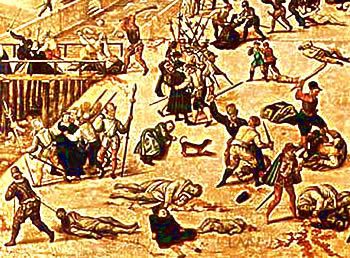 ( image: detail from painting depicting the "St. Bartholomew's Day Massacre" )
The overwhelming bulk of available evidence points towards the likelihood that George W. Bush is a Christian Zionist who believes, really believes, in the need for maximal, catastrophic war in the Mideast. Over the past several months I have been conducting, by myself with the help of a few concerned friends, an exhaustive study of George W. Bush's likely religious beliefs, or his lack thereof. Gail Sheehey, at the onset of George W. Bush's presidential tenure, covered Bush's beliefs. But no one, as far as I can tell, who is familiar with Christian apocalyptic dispensationalism and with the intersection of religion and politics has made concerted effort to gather all available data bits on George Bush's religious belief.
Until now.
Evidence I have gleaned points in one troubling direction, and therefore towards a monumental bifurcation point in world history resting now in the hands, more than any human, of a man who appears to believe, in his heart, in the coming Apocalypse, in immanent, unavoidable Armageddon, in the "Rapture" of "Bible believing" Christians to heaven where they will, in safety, look down upon a world convulsing in hideous military conflict and the slaughter of hundreds of millions, billions of people even, by fire and sword, bullets and bombs, by nuclear incineration.
The Apocalypse, understood in either religious terms of merely viewed in secular terms, as catastrophic world war, would preclude meaningful action to address the penultimate world challenge of our time, Global Warming. Apocalypse would preclude meaningful action on AIDS and poverty, on preserving biodiversity, forests and ocean ecosystems. To significant action across a vast swath of imaginable world problems, even problems unrecognized as of yet, the Apocalypse would shut the door, perhaps forever.
At this moment in time, George W. Bush holds the keys to two radically different kingdoms ; two fates, one leading towards a constructive future and one leading towards catastrophe, towards terrible, destructive unraveling in the fabric of human and biological systems on Earth.
***
Hasn't George W. Bush Been Defanged ?
But, hasn't George W. Bush been rendered toothless and fangless ? Hasn't the charging Texas cowboy been knocked from his horse ?
That seems to be the common consensus :
Recently, I was discussing, with an editor at a national magazine who I'll leave unnamed, a curious issue : the apparent airbrushing of the logo image for a new national Christian lobbying group that lobbies for the Apocalypse, for catastrophic war in the Mideast. The 3rd Holiest site in Islamic had been wiped from the logo image and, intentional or not, the symbolism could have been wildly inflammatory to the Islamic world. Talk of the logo led, of course, to Mideast, and the editor agreed with me that Bush probably wanted maximal Mideast conflict but believed that wiser heads would prevail ; there was fightback, in Republican ranks even, against the Bush Administration's lust to expand the theater of Mideast conflict, to "fail forward" and attack Iran. Wiser heads, he reassured me, would prevail.
I'm not convinced though, and perhaps that's an artifact of what I've been studying lately ; the hot zone of religion and politics, especially when the religious beliefs in question are apocalyptic and the political realm in question concerns the loyalty, or lack thereof, of United States armed services members to religious pluralism, American Constitutional Democracy, and simply to not provoke catastrophic war, can be a troubling realm to pay attention to. Once, at an national environmental activist conference, I happened to overhear the staff of the facility hosting the event quip, about the environmentalists present, "they're worse than people with eating disorders" and I think the realm I gesturing at elicits a similar manic intensity... but for good reason. Sober heads, even advocates for a new Pax Americana such as "The Grand Chessboard" author Zbigniew Brzezinsky, have warned that a US attack on Iran could open a gateway to catastrophe.
As I covered yesterday, the US military has been penetrated to an unknown extent but, arguably, extensively by American Evangelicals with apocalyptic dispensationalist beliefs. Wars are comparatively easy to provoke, and an influential faction in American politics, a coalition perhaps including George W Bush, many evangelicals in the US military, many in Bush's core fundamentalist base, the lobbying blocks of CUFI and to some extent AIPAC, and busy cadres of writers, publicists, and PR specialists, are concertedly pushing for war with Iran.
Such a possibility would have seemed insane six or seven years ago at the onset of the Bush Administration, but here are and the most likely reason we have come to this grim possibility can be expressed in two words:
Christian Zionism.
"Bush addressed the CNP ( Council On National Policy ) in 1999 (there is, of course, no public record of what he said) and begins every day poring over Bible commentary. Do he and Laura read themselves to sleep with LaHaye? That he is sympathetic to what LaHaye stands for, religiously and politically (assuming they can be separated), is a legitimate conclusion. In 1993, Bush unguardedly divulged that only Christians can get to heaven. He secured his base, at the beginning of his presidential campaign, by speaking at Bob Jones University - which he refused to criticise for its ban on interracial dating. At his inauguration, he chose Franklin Graham to deliver the ceremonial prayer - the son of the venerable Billy (the evangelist who saved Bush from the demon drink), who has become notorious for telling the world that Islam "is a very evil and wicked religion". " ( UK Guardian, June 12, 2003 )
"Bush's first real encounter with Jesus came about with the Evangelical Reverend Billy Graham. No problem there. Reverend Graham, though once a registered Democrat, has made a point of staying non-partisan. Since then, Bush has kept the company of some odd pastors, such as James Robison, the anti-abortion fanatic who likes to quote both sides of his conversations with God. Robison prayed with Bush in the Oval Office before the invasion of Iraq. Another is one of Texas' foremost fundamentalist preachers, the Reverend James [sic] Hagee of the Cornerstone Church in San Antonio. Hagee is part of a more off-center form of Christianity tracing back to an Anglian priest who abandoned his church in 1820 to form his own sect. The beliefs Hagee brings from this, known as Dispensationalism, are too complicated to cover here, but basically revolve around Armegeddon and a literal reading of the Book of Revelation. This "end-times" theology can be seen in Bush's foreign policy.
In November of 2002, Hagee addressed his congregation of four thousand people, outlining a foreign policy strangely similar to Bush's policy set forth later. With then-House Majority Leader Tom Delay at his side, Hagee preached about regime change in Syria as well as Iraq, and about destroying the regime of Yasir Arafat. These were policies written six years earlier by Richard Perle, Douglas Feith, Charles Fairbanks, Jr., and others who are now part of the Project for a New American Century (PNAC). Hagee stated, "Listen, Saddam, there's a Texan in the White House, and he's going to take you down."
On more than one occasion, Bush has claimed he takes his orders from God ... literally. Mahmoud Abbas, Palestinian Prime Minister, and Nabil Shaath, his Foreign Minister, describe their first meeting with President Bush in June 2003. Nabil Shaath relates the meeting: "President Bush said to all of us, 'I'm driven with a mission from God. God would tell me, "George, go and fight those terrorists in Afghanistan." And I did, and then God would tell me, "George, go and end the tyranny in Iraq ..." And I did. And now, again, I feel God's words coming to me, "Go get the Palestinians their state and get the Israelis their security, and get peace in the Middle East." And by God I'm gonna do it.'"
Israel's most reputable newspaper, Ha'aretz, related a similar story from the same time. At the cease-fire negotiations between Abbas and faction leaders from the Hamas, Islamic Jihad and the Popular and Democratic Fronts, Bush said, "God told me to strike at al Qaida and I struck them, and then He instructed me to strike at Saddam, which I did, and now I am determined to solve the problem in the Middle East. If you help me I will act, and if not, the elections will come and I will have to focus on them.""What [Rev. Billy Graham] said sparked a change in my heart. We walked and talked at Walker's Point, and I knew I was in the presence of a great man... Reverend Graham planted a mustard seed in my soul... He led me to the path, and I began walking. It was the beginning of a change in my life." - Bush, A Charge to Keep, 1999
"...What are some of those signs we should be watching for?"
"Political unrest... Although Russia no longer is a threat as a superpower, many other nations have access to nuclear weapons and instantly could plunge the world into chaos with the push of a button..."
"Natural disasters... There have always been earthquakes, famines and other natural disasters in the world, but this century [the 20th] has witnessed more of them -- disasters with greater intensity."
"Social unrest... Jesus also said there would be an increase of wickedness and the love of many would grow cold (Matthew 24:12). Read the papers, we're already there.""Religious apostasy... The 'faith which was once delivered unto the saints' (Jude 3) slowly has been eroded throughout this century to the point where the Word of God no longer has any authority in the minds of people."
"Economic instability... Many areas of the globe are experiencing this..."
"The rebirth of Israel. ...God has assimilated into one nation Jews of many cultures and languages and preserved them through five wars with their Arab neighbors. The people have reclaimed and rebuilt the old wastes of ancient cities, towns, and villages. All of this is a major miracle that points unmistakably to Israel's strategic role in the Lord's scenario for the last days."
"Evangelistic permeation... Never in history has there been such a concentrated effort to fulfill the Great Commission as in the days leading up to the start of the new millennium."
"The rise of the Antichrist... Antichrist is an apocalyptic figure that will rise to world power in the last days. He will control the world's economy and religion and will wage war against the church and Israel. Many have sought to identify him through the years with some contemporary figure, as some undoubtedly have resembled his qualities to some degree. Nevertheless, he may be alive right now and just waiting for the right moment to seize power." - Billy Graham, from Graham's last book, "The Beginning Of The End", 1999
"The Reverend Billy Graham taught Bush to live in anticipation of the Second Coming but it was his friendship with Dr. Tony Evans that shaped Bush's political understanding of how to deport himself in an apocalyptic era. Dr. Evans, the pastor of a large Dallas church and a founder of the Promise Keepers movement taught Bush about "how the world should be seen from a divine viewpoint," according to Dr. Martin Hawkins, Evans assistant pastor.
S.R. Shearer of Antipas Ministries writes, "Most of the leaders of the Promise Keepers embrace a doctrine of 'end time' (eschatology), known as 'dominionim.' Dominionism pictures the seizure of earthly (temporal) power by the 'people of God' as the only means through which the world can be rescued.... It is the eschatology that Bush has imbibed; an eschatology through which he has gradually (and easily) come to see himself as an agent of God who has been called by him to 'restore the earth to God's control', a 'chosen vessel', so to speak, to bring in the Restoration of All Thingss." Shearer calls this delusion, "Messianic leadership"-- that is to say usurping the role usually ascribed to the Messiah.
In Bush at War Bob Woodward writes, "Most presidents have high hopes. Some have grandiose visions of what they will achieve, and he was firmly in that camp."
To answer these attacks and rid the world of evil," says Bush. And again, "We will export death and violence to the four corners of the earth in defense of this great nation." Grandiose visions. Woodward comments, "The president was casting his mission and that of the country in the grand vision of Gods Master Plan."
"The lessons of the Bible were a reason for his decision to run for president. He feels that God speaks to him." - Texas megachurch preacher and personal friend to George W. Bush, Dr. Tony Evans
"As Texan preacher Tony Evans, one of his spiritual advisors, recalls: "The lessons of the Bible were a reason for his decision to run for president. He feels that God speaks to him." From then on, Bush defined his work as a mission: "I am convinced that we must fundamentally and permanently change our entire culture. We need spiritual renewal in America."
The occasional churchgoer had become a pious man, a man who continues to practice rigorous discipline in the White House and incorporates the appropriate passage from the Bible into his daily agenda. The insecure drinker has become a president with whom mainstream Americans can identify, precisely because of his mediocrity, fallibility and devoutness."
"Dr. Martin Hawkins, Evans’ assistant pastor, Evans taught Bush "how the world should be seen from a divine viewpoint." And Bush says in his book, A Charge to Keep, that he has been "spellbound" listening to Evans’ sermons'"Bush learned from Evans a whole new approach—cultural rather than economic—to winning political adherents. "On July 4, 1998, Governor Bush listened to Dr. Evans lay out a whole philosophy about how the world should be seen from a divine viewpoint and adjusted politically," says Evans's assistant pastor Dr. Martin Hawkins. Evans, who is said to be a confidant of the man he helped to become governor—they have prayed over the phone together—was one of the builders of the new Christian men's movement known as the Promise Keepers. He has urged men to "take back" authority from their wives, and women to "let your man be a man."
Bush did seem to find direction and develop discipline in his habits through his personal religious revival. "For some people, when they discover a faith in their religion, in God . . . it is a prescription for self-respect," says Lacey Neuhaus. But religion is also an important political tool for him. His evangelical Christianity gives him solid standing as a social conservative. It is also useful in dismissing questions about his character. All he has to say is that his life has changed dramatically since he accepted Christ. He is a new person, and his earlier, irresponsible conduct is irrelevant.
In his political sermons he began calling religious people to become involved in politics, and described the Bible as "a pretty good political handbook." He championed religious groups as the best instrument to change social policy, in place of government or in partnership with it. Not only was that music to the ears of the Christian right, it meant money in their coffers. Here was a politician who would channel government money not into social programs such as welfare but into church partnerships with the state.
Dr. Hawkins says, "There is a strong possibility that we would be one of the faith-based organizations that partner with the federal government, under President Bush, to reach out in the community to take care of housing and jobs."
Unabashedly fired up by the rhetoric of the Christian men's movement, Bush forgot that not everyone accepts Christ as his or her savior. He told a reporter in 1994 that the New Testament teaches that only those who accept Jesus Christ will go to Heaven."
Franklin Graham is more than a long-standing friend of Bush. He is a significant theological mentor. Bush has written in Christian magazines that Reverend Franklin and his father were pivotal in renewing his faith and religious committment as a Christian after his bout with alcoholism. The American public choose to be blithley unaware of Graham’s hatred of Islam. After the 9-11 attacks, and around the same time Bush declared his war on Islamist terrorists a "crusade," Franklin Graham made a highly publicized blanket condemnation of Islam on the Christian TV show 700 Club calling it "a very evil and wicked religion." He has often written that Islam and Christianity will fight each other before the second coming of Christ. Franklin Graham, like his father, who has been the confessor of several American presidents, believes Christ’s coming is imminent.
Given the indelicate words of this prominent Islamaphobe, one might expect the president to distance himself, but no. Gumbel reports that the president invited Franklin Graham to preach at the Good Friday 2003 prayer service held in the Pentagon. I would add that he participated in the Holy Service just as the American invasion of an Islamic country was at its peak.
WOLF BLITZER: So what's your bottom line? Do you believe, based on the reporting you did for this article, that the president of the United States is now aggressively plotting military action, a pre-emptive strike against Iran?SEYMOUR HERSH: The word I hear is "messianic." He thinks, as I wrote, that he's the only one now who will have the courage to do it. He's politically free. I don't think he's overwhelmingly concerned about the '06 elections, congressional elections. I think he really thinks he has a chance, and this is going to be his mission.
"Again, the White House Web site records that on March 3, Bush told a Los Angeles audience, "God loves you, and I love you. And you can count on both of us as a powerful message that people who wonder about their future can hear." After mentioning himself in the same breath with God, Bush then topped himself when the Lancaster New Era reported on July 16 that in a private meeting with an Amish group in Lancaster County, he told them, "I trust God speaks through me. Without that, I couldn’t do my job." The White House has denied the statement."
"Five months later, in August of 2003, MSNBC reported claims by televangelist Jack van Impe that the White House had contacted him seeking an outline of apocalyptic events. Van Impe wrote on his website, "I am not sure whether he (Bush) knows all of the prophecies and how deep of a student he has been in God's Word, but I was contacted a few weeks ago by the Office of Public Liaison for the White House and by the National Security Advisor Condoleezza Rice to make an outline. And I’ve spent hours preparing it. .. it’s in his (Bush’s) hands. He will know exactly what is going to happen in the Middle East and what part he will have under the leading of the Holy Spirit of God."... The White House has denied having made this request."Mr Bush's Christian fervour only confirms suspicions that the looming war with Iraq is indeed a "crusade" against Muslims, exactly as Osama bin Laden suggests. For world-weary Europe the presidential language evokes mirth and queasiness in equal measure. A European leader who spoke in such terms would be laughed off the stage. An American one who speaks this way only increases the fear that simplicities of faith, and a habit of seeing a hideously complicated world in a black-and-white, good or evil fashion, are a recipe for disaster.
Chapter and Verse: Bush and the Bible
"Our prayer tonight is that God will see us through and keep us worthy. Hope still lights our way, and the light shines in the darkness and the darkness will not overcome it."
Speech on the anniversary of the terrorist attacks, 11 September 2002
"We do not claim to know all the ways of Providence. Yet we can trust in them, placing our confidence in the loving God behind all of life, and all of history. May he guide us now."
State of the Union address, 28 January 2003
"In the words of the prophet Isaiah, 'Lift your eyes and look to the heavens.'"
Address to the nation after the shuttle 'Columbia' disaster, 1 February 2003
"It is the greatest gift you can give anybody, to pray on their behalf."
At National Prayer Breakfast, 7 February 2003
"I welcome faith to solve the nation's deepest problems ... We're being challenged. We're meeting those challenges because of our faith ... We carried our grief to the Lord Almighty in prayer."
Speech to National Convention of Religious Broadcasters, 10 February 2003, referring to the 11 September terrorist attacks
"The Archive of Bush's Evil
I asked them the other day, would it be okay if I cut a 30-minute tape, a piece of propaganda, no questions, just here -- here it is, here's 30 minutes of me talking; please run it, not only across your airwaves but run it internationally, if you don't mind; I've got something to say about the conflict and our fight against evil.
President George W. Bush - 11/13It is also a reminder of the great purpose of our great land, and that is to rid this world of evil and terror. The evil ones have roused a might nation, a mighty land. And for however long it takes, I am determined that we will prevail.
President George W. Bush - 11/12Our nations share an urgent mission, which is to stop and defeat terrorism wherever it may exist. That mission is not directed against those who practice Islam. That mission is directed against evil people.
President George W. Bush - 11/10The only thing I know certain about him is that he's evil. And I don't know what to believe about him, except that he wants to hurt Americans.
President George W. Bush - 11/10In a second world war, we learned there is no isolation from evil. We affirmed that some crimes are so terrible they offend humanity, itself. And we resolved that the aggressions and ambitions of the wicked must be opposed early, decisively, and collectively, before they threaten us all. That evil has returned, and that cause is renewed.
President George W. Bush - 11/10We're confident, too, that history has an author who fills time and eternity with his purpose. We know that evil is real, but good will prevail against it. This is the teaching of many faiths, and in that assurance we gain strength for a long journey.
President George W. Bush - 11/10I think there is one universal law, and that's terrorism is evil, and all of us must work to reject evil. Murder is evil, and we must reject murder.
President George W. Bush - 11/9America faces an evil and a determined enemy.
President George W. Bush - 11/9None of us would ever wish the evil that has been done to our country, yet we have learned that out of evil can come great good.
President George W. Bush - 11/8We know that we're fighting evil. And the American people are patient. They've heard the call.
President George W. Bush - 11/8This is an evil man that we're dealing with. And I wouldn't put it past him to develop evil weapons to try to harm civilization as we know it.
President George W. Bush - 11/6Given the means, our enemies would be a threat to every nation and, eventually, to civilization itself. So we're determined to fight this evil, and fight until we're rid of it. We will not wait for the authors of mass murder to gain the weapons of mass destruction. We act now, because we must lift this dark threat from our age and save generations to come.
President George W. Bush - 11/6Our war that we now fight is against terror and evil... Our struggle is going to be long and difficult. But we will prevail. We will win. Good will overcome evil."
PARTIAL EXCERPT from archive of George W. Bush public statements on "evil"
*********
RESOURCES
Here are a number of stories on apocalyptic Christian Zionism
An Editorial Note:
That leading US politicians now happily appear at public events with, cheer on, and consent to share the stage with a man who advocates a fringe conspiracy theory some would call anti-Semitic and urges a "preemptive" use of nuclear weapons in order to cause widespread nuclear war indicates the extent to which US political and religious culture has lurched far right, towards what some call an "apocalyptic death cult", over the past four decades since the era in which Lyndon Johnson's 1964 presidential campaign devastated Barry Goldwater's presidential hopes by airing just one time a 30 second TV commercial, the "Daisy" ad, that effectively tarred Goldwater as eager for nuclear war. Now, for Republican politicians wooing a key bloc of evangelical GOP voters, public expressions of nuclear blood lust are no longer stigmatized or politically toxic ; they are an asset.
Friends Of Israel and AIPAC Envision "Israel's Final Holocaust" and "Jew Toast"
TTA contributor Chip Berlet, Senior Analyst for Political Research Associates, provides some background on the recent history of "New World Order" conspiracism among John Hagee's fellow Christian Zionists such as Tim LaHaye and Pat Robertson in The Age Old Conspiracy
Previous installments in an ongoing series, by Bruce Wilson, on John Hagee and Christian Zionism:
"Pro Israel" Christian Leader Blames Jews For The Holocaust
"Be Jewish In Five Easy Days", The Twelve Tribes Of Hagee
AIPAC Event Helps Mainstream Allegations Of "Satanic Liberal Jewish Conspiracy"
Holocaust For Zion : CUFI's Christian Zionism Made Simple
GOP House Minority Whip Roy Blunt To Help Nuclear War Advocate
What Secret "Other Matters" Did McCain Discuss With "Apocalypse Now" Hagee ?
Dick Armey Denies Bush Administration Trying To Provoke "End Times"
recent stories from other authors:
Frank Cocozzelli: Donohue Softpeddles Hagee's Catholic Bashing
Max Blumenthal : AIPAC Cheers an Anti-Semitic Holocaust Revisionist (and Abe Foxman Approves)
Sarah Posner: The Goy Who Cried Wolf: The Israel lobby gives America's leading Christian right warmonger a warm welcome
Max Blumenthal : Israel, the US, and the Christian Right: The Menage a Trois From Hell
Bill Berkowitz:Holy Warriors Set Sights on Iran
Esther Kaplan : Christian Zionism all juiced up
Richard Bartholomew : Armey: Bush Believes in Tribulation, but not Trying to Make it Happen
Monday, April 16, 2007
Petition against Israeli assault on Al Aqsa and all Muslim and Christian holy sites in Jerusalem
(Jerusalem) Maisa Abu Ghazaleh
Sunday, 15 April 2007
A Muslim and Christian petition is out on behalf of Al Aqsa Mosque. As is much of the nonviolent resistance to Israeli destruction at the Muslim holy site, the petition is sponsored by head of the Islamic Movement inside the Green Line, Sheikh Ra'ed Salah.
Organizers have gathered hundreds of thousands of signatures as part of efforts to stop Israeli excavations and their devastating impact at the Muslim holy site in East Jerusalem's Old City.
Aimed at Palestinians living within Israeli boundaries, the petition reads in part, “We, the undersigned, representing the entire spectrum of Palestinian society, men and women, young and old, from Jerusalem and the Naqab, the Galilee and the Triangle, and the coastal cities of Haifa, Jaffa, Lod and Ramle...pronounce our support for Jerusalem, the Al Aqsa Mosque, and other Islamic and Christian holy places.”
Signatories pledge to “work using all legitimate means to expose the crimes of the occupation and address its aims to Judaize the holy city, its gradual destruction and confiscation of Al Aqsa and other Islamic and Christian holy places.”
Within the petition are three-points, the first of which is addressed to the present Arab and Muslim leaders in science, politics and civil society. It demands that they assume responsibility for Jerusalem and its "sacred shrines."
The second letter is addressed to the Palestinian Presidency, government and all factions, to agree on a clear strategy. They must work with the complete understanding that Jerusalem remains the capital and that no one has the authority to negotiate away that legitimate right.
The third point addresses international humanitarian organizations to “curb the spread of Israeli hysteria” and implement international law in order to put an end to the “continuing crimes in the city of Jerusalem.”
President of the Council of Muftis, Sheikh Khalid Ghaneim, said that the petition and its signatories illustrate "the profound loyalty to Al Aqsa Mosque and the utter rejection of any attacks against it."
The Sheikh said that the petition will be presented to the Arab League, the Organization of the Islamic Conference, and the United Nations Educational, Scientific and Cultural Organization, UNESCO.
Saturday, April 7, 2007
A Jewish Plea
Exclusively serialized by Palestine Times every day this week, this essay is part of a forthcoming collection to be published in Nubar Hovsepian (editor), The War on Lebanon: A Reader (Interlink Publishing, Spring 2007).
by Sara Roy
Part 1 – “We have nothing to lose except everything.” Albert Camus
During the summer my husband and I had a conversion ceremony for our adopted daughter, Jess. We took her to the mikvah, a Jewish ritual bath where she was totally submerged in a pool of living water – living because it is fed in part by heavenly rain – and momentarily suspended as we are in the womb, emerging the same yet transformed. This ritual of purification, transformation and rebirth is central to Judaism and it signifies renewal and possibility.
The day of Jess’s conversion was also the day that Israel began its pitiless bombing of Lebanon and nearly three weeks into Israel's violent assault on Gaza, a place that has been my second home for the last two decades. This painful juxtaposition of rebirth and destruction remains with me, weighing heavily, without respite. Yet, the link deeply forged in our construction of self as Jews, between my daughter’s acceptance into Judaism and Israel’s actions—between Judaism and Zionism—a link that I never accepted uncritically but understood as historically inevitable and understandable, is one that for me, at least, has now been broken.
For unlike past conflicts involving Israel and the Palestinian and Arab peoples this one feels qualitatively different—a turning point—not only with regard to the nature of Israel’s horrific response —its willingness to destroy and to do so utterly—but also with regard to the virtually unqualified support of organized American Jewry for Israel’s brutal actions, something that is not new but now no longer tolerable to me.
I grew up in a home where Judaism was defined and practiced not so much as a religion but as a system of ethics and culture. God was present but not central. Israel and the notion of a Jewish homeland were very important to my parents, who survived Auschwitz, Chelmno and Buchenwald. But unlike many of their friends, my parents were not uncritical of Israel. Obedience to a state was not a primary Jewish value, especially after the Holocaust. Judaism provided the context for Jewish life, for values and beliefs that were not dependent upon national or territorial boundaries, but transcended them to include the other, always the other. For my mother and father Judaism meant bearing witness, raging against injustice and refusing silence. It meant compassion, tolerance, and rescue. In the absence of these imperatives, they taught me, we cease to be Jews.
Many of the people—both Jewish and others—who write about Palestinians and Arabs fail to accept the fundamental humanity of the people they are writing about, a failing born of ignorance, fear and racism. Within the organized Jewish community especially, it has always been unacceptable to claim that Arabs, Palestinians especially, are like us, that they, too, possess an essential humanity and must be included within our moral boundaries, ceasing to be “a kind of solution,” a useful, hostile “other” to borrow from Edward Said.1 That any attempt at separation is artificial, an abstraction.
By refusing to seek proximity over distance, we calmly, even gratefully refuse to see what is right before our eyes. We are no longer compelled—if we ever were—to understand our behavior from positions outside our own, to enter, as Jacqueline Rose has written, into each other’s predicaments and make what is one of the hardest journeys of the mind.2 Hence, there is no need to maintain a living connection with the people we are oppressing, to humanize them, taking into account the experience of subordination itself, as Said would say. We are not preoccupied by our cruelty nor are we haunted by it. The task, ultimately, is to tribalize pain, narrowing the scope of human suffering to ourselves alone. Such willful blindness leads to the destruction of principle and the destruction of people, eliminating all possibility of embrace, but it gives us solace.
Why is it so difficult, even impossible to incorporate Palestinians and other Arab peoples into the Jewish understanding of history? Why is there so little perceived need to question our own narrative (for want of a better word) and the one we have given others, preferring instead to cherish beliefs and sentiments that remain impenetrable? Why is it virtually mandatory among Jewish intellectuals to oppose racism, repression and injustice almost anywhere in the world and unacceptable—indeed, for some, an act of heresy—to oppose it when Israel is the oppressor, choosing concealment over exposure? For many among us history and memory adhere to preclude reflection and tolerance, where, in the words of Northrop Frye, “the enemy become, not people to be defeated, but embodiments of an idea to be exterminated.”3
What happens to the other as we, a broken and weary people, continually abuse him, turning him into the enemy we now want and need, secure in a prophecy that is thankfully self-fulfilling?
What happens to a people when renewal and injustice are rapturously joined?
Sara Roy is a Senior Research Scholar at the Center for Middle Eastern Studies, Harvard University.
Thursday, April 5, 2007
Palestinian Christians and the effects of Israeli Apartheid
April 4th, 2007 |
Palestinian Chrisitians prevented from reaching Bethlehem on Palm Sunday
by Snyder, 4 April 2007
As hordes of tourists flocked to the holy sites of Jerusalem to carry Palm leaves through the Old City, hundreds of Palestinian Christians were prevented from passing through the Bethlehem terminal.
On the evening before Palm Sunday, I passed through the terminal and met a group of Palestinian women traveling to Jerusalem for the celebrations. They had expected that the soldiers would let them through out of respect for the holy day. However, restrictions on movement had been tightened for the Jewish Pesacht holiday and they were being turned away. The checkpoint had only a skeleton staff of soldiers and police due to the Jewish holiday and as a result only one aisle was open causing huge delays.
Since the construction of Israel’s illegal annexation barrier, the Bethlehem ‘terminal’ has been the only direct route between Bethlehem and Jerusalem. The barrier is designed like an international border with Palestinians having to undergo searches, x-rays of baggage and fingerprint scans. The majority of West Bank Palestinians not residing in Jerusalem are not permitted to enter Jerusalem.
Other restrictions imposed on Palestinians for the Pesacht period have been the tightening of controls at the checkpoints around Nablus, with young men prevented from leaving the city, and a checkpoint set up on the road from Nablus to Tubas causing chaos and preventing pedestrian access along the road.
While Palestinian freedom to worship at holy sites has been severely limited, the army has facilitated the visit of thousands of Jewish visitors to the Palestinian city of Hebron. Last year, during Pesacht, the IDF ordered a Closed Military Zone in Hebron preventing Palestinians from walking around their neighborhood for the ‘protection’ of Jewish visitors. The army also allowed Jewish visitors to Hebron to pass through a checkpoint on Schuhada Street into the ‘Palestinian Controlled’ area to visit a holy site - this was illegal unde Israeli law.
This follows on from Israel’s severe restriction on the right of access to and worship in Jerusalem during Ramadan last year. It appears that the Israeli apartheid system protects the right of Jews to worship, even if that means suppressing the right of Palestinians and conflicts with Israeli law, and ignores the needs of Palestinians wishing to worship on their own land.
Wednesday, April 4, 2007
Roseanne Barr Blasts Zionism And Israel
Editor's note: I am moving to post at the secondary blog(also see new articles below).
---
RoseanneWorld.com
4-4-7
On being a jew and not supporting israel...
I think the zionists made a huge mistake when they factioned the left in germany. They ended up trading jewish lives for land, instead of standing together with the socialist factions that opposed hitler. Zionism was the last nail in the casket of European jewry. The arab's protection is the only reason any holy site remains in israel. The jews line up to stone women who try to access those sites. I saw it with my own eyes. The arabs do not invade other countries. The israelis do. I am sick of israel and I am sick of zionists. They are propped up by evangelical christians who cannot wait for the arabs to kill them so that their genocidal war god whom they misname jesus can come back.
In their twisted logic, the jews call that support for israel. In the christian's form of suicidal insanity, all the jews need to die in israel so that "/peace/" can be attained there.
The koran is the exact same book as the torah and Mohammed is just like Paul of tarses.
The jews are raised to be suicide bombers too, and that abusive cult-programming that is done to jewish children, beginning with genital torture, remains strong even after the religion itself is abandoned. There is no israel really, and there will soon be no jews, I fear, unless the promise of the covenant comes to pass.. the covenant states that free thought will allow the jews to abandon their need for separatism, their obsolete and archaic woman hating religion and join the struggle for human rights first, before any other cult indoctrinated group, because the jews will have had access to higher learning and science and therefore give birth to the rational mind therefore transforming religion by re translating the torah into science.
http://www.roseanneworld.com/forum/viewtopic.php?t=1589
Saturday, March 31, 2007
Top Rabbi resigns for stealing ties
|

Monday, March 19, 2007
STOP THE CLASH OF CIVILIZATIONS
Talk is rising of a ‘clash of civilizations’. But the problem isn’t culture, it’s politics – from 9/11 to Guantanamo, Iraq to Iran. This clash is not inevitable, and we don't want it.
So where to start? The Israeli-Palestinian conflict is the key symbol of the rift between Islam & the West. It's time to step up and take the initiative.
Add your voice below and when leaders meet in late March, our message will be delivered in a way they can’t ignore...
--MORE--
Monday, March 12, 2007
Palestinian Christians fleeing Israel as pressures mount
 Misery tempts Palestinian Christians to flee
By Alistair Lyon, Special Correspondent Mon Mar 12, 7:57 AM ET
Despairing of life under Israeli occupation, many Palestinian Christians are moving abroad, threatening their ancient links to Bethlehem and the land where Jesus was born.
"There is a real fear that 50 years down the road, the Holy Land will be without Christians," said Mitri Raheb, 45-year-old pastor of the Lutheran Church in Bethlehem.
Pressures on majority Muslims are just as daunting -- and many of them also leave -- but dwindling Christian communities look more precarious as the young and dynamic pull up roots.
Christians have migrated from Bethlehem and nearby Beit Jala and Beit Sahour for over a century, mainly to Latin America, the United States and Canada, to escape successive wars and crises.
Bethlehem governor Salah al-Tamari said there was no way of tracking accurately how many Christians and Muslims had left since the eruption of Israeli-Palestinian violence in 2000.
"There is no business, no freedom of movement," he said. "We depend on tourism, which is being demolished. Sometimes we receive 1,500 tourists a day but none of them stay the night. They visit the Nativity Church and leave, so we don't benefit."
A towering concrete wall is closing in on Bethlehem as part of a barrier that Israel is erecting, which it calls a defense against suicide bombers from the occupied West Bank. Much of it has been built on Palestinian land.
"Once it's finished there will be only three gates leading in and out of Bethlehem," said Raheb. "Bethlehem will basically be a four-square-mile (10-square-km) open prison."
"This wall has separated many people from each other," said Hiyam Abu Dayyeh, a Christian social worker. "What kind of life is this if you can't feel free or move in your own country?"
PRESSURE CAULDRON
Now unemployed, she hopes to leave Beit Jala for Germany, which she visited often when she was working for the church.
"Many people are without work and without hope," she said. "People are completely exhausted. If it stays like this, Palestine will be a big psychiatric hospital."
About 50,000 Christians live in the territories Israel captured in the 1967 Middle East war -- east Jerusalem, the West Bank and Gaza Strip. Another 110,00 reside in Israel.
The aid-dependent Palestinian economy took a devastating hit when international donors decided to boycott a Hamas government formed after the Islamists won an election in January 2006.
Violent infighting between Hamas and the once-dominant Fatah faction has driven Palestinians closer to breaking point.
Two-thirds of the population now live in poverty, according to the British charity Oxfam, with more than half unable to meet their families' daily food requirements without assistance.
Palestinian Christians are generally better off than other segments of society, but they too have felt the pinch.
"We used to be six people working in the restaurant and we were always busy. Now we are two and we sit here doing nothing," said Maher Rabie, who runs a small pizzeria in Beit Jala.
He took a loss of 30,000 shekels ($7,000) last year to keep it open. He says he might return to the United States, where he lived for 12 years, if the summer does not bring better times.
"Actually we don't have an economy any more. It's finished," he said. "The last five years were hell on earth. Sometimes we say if we go to hell in future, we already know what it's like."
Rabie and his wife Rania have three boys in school aged 8, 14 and 16. "We think of what kind of future we can provide for them if this situation persists," the 47-year-old father said.
LOSS OF HOPE
Christian leaders say they face no religious persecution from the Palestinian Muslim majority or from Israel.
Bernard Sabella, a Palestinian sociologist at Bethlehem University, estimates that 50 to 75 Christian families a year are leaving Jerusalem or the West Bank for new lives abroad, down from a peak of 200 to 250 families in 2002 and 2003.
He said most cited similar motives to Muslim migrants -- political conditions, unemployment and lawlessness, although discomfort with rising Muslim militancy was a factor for some.
"As Christians we want to be part of this society," he said, pointing to the cultural richness, variety and ancient roots of the church communities living in the cradle of Christianity.
The median age of Palestinian Christians is now 37, against 19 in the general population. "If our young people leave, we are in a disaster," Sabella said.
Many Christians have languages, educational skills, money and family links abroad -- factors that make migration easier. But church leaders want to anchor them in their homeland.
"We are asking the world to help Palestinian Christians stay in their country," said Lutheran Bishop Munib Younan, pleading for assistance with education, job creation and housing and with Christian institutions that could serve Palestinians in general.
Christian entrepreneurs who returned from lives in exile in the 1990s -- when it seemed that the Oslo interim accords with Israel might bring peace, prosperity and Palestinian statehood -- are now losing hope.
"It's getting tougher and tougher every day," said Elias Samaan, a 45-year-old who set up a carpentry business after moving to Beit Jala from the United States in 1992.
"We're really thinking about leaving again, leaving everything -- our house, our work, our business, our land."
Saturday, March 10, 2007
Israeli historian confirms Jewish blood libel claims
Posted: 14-02-2007 , 16:22 GMT
At least some part of the blood-libel against Jews in Europe was based on actual ceremonies in which Jews reportedly used Christian blood, maintains a new historical research report recently published in Italy by an Israeli historian. "Passover of Blood," a report by Professor Ariel Tuaf of Israel's Bar-Ilan University, has already drawn fire from academic researchers discounting the study. However, such criticism was quickly snuffed by Tauf, who had also received several threats for publishing his work, in recent interviews with the Italian media.
Tauf, who until one year ago served as the department head of the Israel Studies department at the Bar-Ilan University, is considered an international expert on the Jewish community in Italy during the Middle Ages. His father, Eliyahu Tauf, was the head rabbi of Rome and one of the top figures of the Jewish leadership in Europe who had a central role in managing relations between the Catholic Church, Israel, and the Jewish people, according to Haaretz.
Monday, February 26, 2007
The Future Vision of the Palestinian Arabs in Israel
Related
On Sunday morning in New Jersey, a group of Jews, Christians, Muslims, others) picketed the sale of houses built on Palestinian land to those Orthodox Jews who think God gave them the right to make Palestinians homeless (see Associated Press story picked up by Haaretz . Hear a related sound clip from radio .
---
The Future Vision of the Palestinian Arabs in Israel
Report, The National Committee for the Heads of the Arab Local Authorities in Israel, 12 January 2007
The following is an excerpt from "The Future Vision of the Palestinian Arabs in Israel," a report issued in December 2006
We are the Palestinian Arabs in Israel, the indigenous peoples, the residents of the States of Israel, and an integral part of the Palestinian People and the Arab and Muslim and human Nation.
The war of 1948 resulted in the establishment of the Israeli state on a 78 percent of historical Palestine. We found ourselves, those who have remained in their homeland (approximately 160,000) within the borders of the Jewish state. Such reality has isolated us from the rest of the Palestinian People and the Arab world and we were forced to become citizens of Israel. This has transformed us into a minority living in our historic homeland.
Since the Al-Nakba of 1948 (the Palestinian tragedy), we have been suffering from extreme structural discrimination policies, national oppression, military rule that lasted till 1966, land confiscation policy, unequal budget and resources allocation, rights discrimination and threats of transfer. The State has also abused and killed its own Arab citizens, as in the Kufr Qassem massacre, the land day in 1976 and Al-Aqsa Intifada back in 2000.
Since Al-Nakba and despite all, we maintained our identity, culture, and national affiliation; we struggled and are still struggling to obtain just, comprehensive and permanent peace in the Middle East region, through achieving fair and lasting resolution concerning the Palestinian refugees' resolutions status according to UN and for reaching peace through the declaration of an independent Palestinian State.
Defining the Israeli State as a Jewish State and exploiting democracy in the service of its Jewishness excludes us, and creates tension between us and the nature and essence of the State. Therefore, we call for a Consensual Democratic system that enables us to be fully active in the decision-making process and guarantee our individual and collective civil, historic, and national rights.
In light of this modern complex history, we are moving towards a new era of self-recognition, where it is necessary to create our future path, crystallize our collective identity and draw up our social and political agenda. The establishment of the High Follow up Committee for the Arabs in Israel was a pivotal point in the history of our community where such committee became the highest representative body for all other public and political organizations.
Based on this reality of collective internal changes, the project presented by this document is a continuation of our struggle towards crystallizing clear strategic future vision for the Arab Palestinians in Israel. The project aims at answering the question, "who are we and what do we want for our society?"
In order to obtain this goal, the future vision will be followed by tangible practical steps and a concrete action plan with specific goals. We recommend such document to be a public reference. This document includes all streams of the Arab society, as this vision is an independent Palestinian rhetoric. We hope this future vision would yield unity between different and sometimes contradicting viewpoints and beliefs on the basis of our national collective principles and interests.
The National Committee of the Local Arab Authorities in Israel is responsible for implementing this project, a project which was presented to the High Follow up Committee of the Arabs in Israel.
This project was implemented in two stages:
The group had discussed eight aspects:
The Palestinian Arabs in Israel and their relation to the State of Israel
The Palestinian Arabs in Israel are in need of changing their status. While they are preserving their Arab Palestinian identity, they need to obtain their full citizenship in the State and its institutions. They also aspire to attain institutional self-rule in the field of education, culture and religion that is in fact part of fulfilling their rights as citizens and as part of the Israeli state. They also seek to obtain full equality with the Jewish majority.
Such self-rule within the State poses a system based on Consensual Democracy. A system embodies the presence of two groups, the Jews and the Palestinians. Such system would guarantee real resource, leadership and decision making participation.
The legal status of the Palestinian Arabs in Israel
Our legal vision concerning equality of the Palestinian Arabs depends on the transformational group perspective of equality. Through this principle we seek to obtain practical equality and partnership on the national-collective level, and, opposing economic dependency from which the Palestinian Arabs suffer. This is to achieve a comprehensive structural societal change that fulfils living conditions for the minority not less in its social and economic level than those of the majority. We seek to obtain total freedom of national dependency, exploitation and oppression.
On the basis of this broaden democratic vision we seek to crystallize our collective future vision of the legal status of the Palestinian Arabs in Israel, so it is based on equality, partnership and mutuality.
Land, Planning, and Housing Policy of the Palestinian Arabs in Israel
In order to change the existing reality we recommend the following: Adoption laws of distributional justice between the Arab citizens and the Jewish citizens within the consensual democracy. To cancel all laws of confiscation and the regulations and measures that discriminate against the Arab minority; Changing the Israeli policies within the fields of land and planning starting with recognizing the historic oppression that inflicted the Palestinian Arab minority. The boundaries of the Israeli land must conform to the boundaries of citizenship and not to the boundaries of the Jewish people; Administrative reconstruction of the Israeli institutions that work in the fields of land planning and housing; Expanding the area of jurisdiction boundaries for the Arab villages and towns so that public land (state land) becomes part of this sovereignty; Adoption of a new public rhetoric concerning land and planning. So that it includes a demand to stop the implementation of the current law of planning and housing that discriminated against the Arab citizens.
Economic strategy for the Palestinian Arabs in Israel
The Arab citizens in Israel should merge with a new economic system through a development plan based on activation of the economic resources. This will promote implementation of a social welfare system that includes the basic services and provides work opportunities for all.
The best choice for the Arab citizens in Israel is to adopt a two-fold development: First, merging in the Israeli work market as a legitimate right of equal opportunities in employment and investment market being citizens of the state, second, creation of internal momentum within the economic movement that would lead towards an increase in the chances for the Arab society and relatively free from dependency and attain social unity and equality.
Strategy for social development of the Palestinian Arabs in Israel
The process of social development is a very expansive and comprehensive one and includes all aspects of life. Social development aims at creating a sound and cordial atmosphere that guarantees the solidarity and social equality, where the individuals can enjoy a better life. This means upgrading the status of women through equating them with men in all aspects of life, especially self-assertion aspect; Participation of individuals both men and women in the process of social change; Treatment of social diseases that exhaust social resources and harm social relations; Creating harmonic pace between growth and structural development and between growth and individual and local development; Achieving balance between creative- innovative individuality and collective interest; Guaranteeing a sound social base to nurture collective identity.
Educational vision and strategic planning of the Arab educational system in Israel
The Arabic educational curriculum needs clear educational strategy that takes into accounts the cultural developments and knowledge wide exposure and technology revolution.
The status of the Arab women should be taken into account, in addition to the economic, political and environmental aspects of society.
The strategic work plan should depend on the following:
The right of the Palestinian Arabs in Israel (as indigenous people in their homeland) to self-administration of the educational system and to self-determination of its policy; Adoption of the Arab education objectives as drafted by the Follow-Up Committee for Arab Education in Israel after the fourth Arab education conference back in 1994, taking into consideration the possibility of adjusting such objectives according to current developments, empowering the universal and social values education; The educational systems tasks are made up of the following: 1. The creation of a generation that enjoys crystallized values and identity and confident personalities. 2. Teachers should have the chance to exploit and nurture the abilities and potential of their students; considering educational system as the basic component for any socio- economic, cultural and political collective growth project.
The Palestinian Arab culture in Israel
"Historic Palestine" is the homeland and is the unifying element between all even though this homeland is occupied. The land is wherever Palestinian creative people meet. Sense of belongingness to this place remains the priority of the national, cultural and civilized identity. For the Palestinians artists and intellectuals, this place provides the primary literary language with its special vocabulary of the history, geography and culture.
We, the Palestinians in Israel, are an integral part of this place as it creates our consciousness and our literary language and crystallizes our identity. Israel tried over the past decades to disengage us from this place not through physical transfer but through intellectual emotional transfer. Israel tried to create a new identity on the basis of "loyalty to the state" - as outlined in the goals of the Arab educational curricula. This policy did not succeed as after the Nakba, an Arab Palestinian cultural movement surfaced and became a natural extension to the Palestinian cultural movement that was crystallized back in the early twenties of 20th century.
Thus, we suggest developing a high board of cultural affairs creating higher board to follow up the Palestinian cultural affairs in Israel does not pose a substitute to any already existing framework. Rather, it will back these frameworks and activities and collect and intensify work to maintain and develop our culture.
The Institutional and Political Public Work
The creation of national institutions and clarification of their internal roles and their relations with the State institutions, the elected local authority, individual initiatives, the private sector and the political institutions are the most prominent challenges that require discussion and decision making. Development of the national institutions would promote real change in our collective status in terms of the ability to face the regional conflict. It would promote our status in the State and our collective vision that is being crystallized - especially after the Oslo agreements.
Thus, any strategic vision to be developed has to propose the following objectives: Continuing internal and collective organization aiming to obtain individual and collective rights of the Palestinian Arabs as citizens of the State, being the indigenous people and as part of the Palestinian People dispersed throughout the world and as part of the Arab region and contributors to the global dialogue; Deepening the consciousness over the national Palestinian identity and the democratic humanitarian civil values of the Arab society as basic points to resist the institutional control and challenge ethnic divisions and internal social problems; Developing and empowering the work of Arab institutes aiming to promote social change, and creating a mechanism of networking and coordination between them; Building strategies and institutions aiming to end the regional conflict and promote the peace process by benefiting from the unique status of the Arab society, both locally and regionally; Developing relations and activities with other countries and organizations on the international arena including International Jewish organizations in order to stress the importance of international recognition of the national, cultural, economic and social needs of the Arab society in Israel. This aims promote the status of the Arab society and develop a democratic system equal and just for all groups of people in Israel.
Participants List
Shawqi Khateeb, Dr. Reyad Aghbariyyeh, Sheikh Hashem Abdelrahman, Wakeem Wakeem, Aida Touma, Prof Aziz Haidar, Husam Abu Baker, Iyad Rabi, Dr. Asa'ad Ghanem, Dr. Thabet Abu Ras, Prof Marwan Deerawi, Salman Natour, Ali Haidar, Dr. Nehaya Dawoud, Awni Touma, Nabeeh Bashir, Saber Rabi, Dr. Khaled Abu Asabeh, Dr. Adel Mana'a, Dr. Muhammad Amara, Prof Ismail Abu Sa'ad, Prof Muhammad Haj Yahia, Dr. Mufeed Qasoum, Dr. Hala Espanioli, Dr. Rasem Khamaysi, Rawya Shanti, Dr. Mary Tautary, Ja'afar Farah, Ayman Odeh, Waleed Malla, Sana Watad, Dr. Michael Karyeeni, Dr. Yousef Jabareen, Jaber Asaqleh, Dr. Khansa Diab, Nabeeh Abu Saleh, Baker Awawdeh, Ghaida Rinawie Zoabi.
Download the full report (PDF)
On Sunday morning in New Jersey, a group of Jews, Christians, Muslims, others) picketed the sale of houses built on Palestinian land to those Orthodox Jews who think God gave them the right to make Palestinians homeless (see Associated Press story picked up by Haaretz . Hear a related sound clip from radio .
---
The Future Vision of the Palestinian Arabs in Israel
Report, The National Committee for the Heads of the Arab Local Authorities in Israel, 12 January 2007
 |
| While the celebrations for Israeli independence day are going on in other parts of the country, young Palestinian citizens of Israel observe a march taking place in the destroyed village of Hosheein in memory of the Nakba, 12 May 2005. (MAANnews/Charlotte de Bellabre) |
The following is an excerpt from "The Future Vision of the Palestinian Arabs in Israel," a report issued in December 2006
We are the Palestinian Arabs in Israel, the indigenous peoples, the residents of the States of Israel, and an integral part of the Palestinian People and the Arab and Muslim and human Nation.
The war of 1948 resulted in the establishment of the Israeli state on a 78 percent of historical Palestine. We found ourselves, those who have remained in their homeland (approximately 160,000) within the borders of the Jewish state. Such reality has isolated us from the rest of the Palestinian People and the Arab world and we were forced to become citizens of Israel. This has transformed us into a minority living in our historic homeland.
Since the Al-Nakba of 1948 (the Palestinian tragedy), we have been suffering from extreme structural discrimination policies, national oppression, military rule that lasted till 1966, land confiscation policy, unequal budget and resources allocation, rights discrimination and threats of transfer. The State has also abused and killed its own Arab citizens, as in the Kufr Qassem massacre, the land day in 1976 and Al-Aqsa Intifada back in 2000.
Since Al-Nakba and despite all, we maintained our identity, culture, and national affiliation; we struggled and are still struggling to obtain just, comprehensive and permanent peace in the Middle East region, through achieving fair and lasting resolution concerning the Palestinian refugees' resolutions status according to UN and for reaching peace through the declaration of an independent Palestinian State.
Defining the Israeli State as a Jewish State and exploiting democracy in the service of its Jewishness excludes us, and creates tension between us and the nature and essence of the State. Therefore, we call for a Consensual Democratic system that enables us to be fully active in the decision-making process and guarantee our individual and collective civil, historic, and national rights.
In light of this modern complex history, we are moving towards a new era of self-recognition, where it is necessary to create our future path, crystallize our collective identity and draw up our social and political agenda. The establishment of the High Follow up Committee for the Arabs in Israel was a pivotal point in the history of our community where such committee became the highest representative body for all other public and political organizations.
Based on this reality of collective internal changes, the project presented by this document is a continuation of our struggle towards crystallizing clear strategic future vision for the Arab Palestinians in Israel. The project aims at answering the question, "who are we and what do we want for our society?"
In order to obtain this goal, the future vision will be followed by tangible practical steps and a concrete action plan with specific goals. We recommend such document to be a public reference. This document includes all streams of the Arab society, as this vision is an independent Palestinian rhetoric. We hope this future vision would yield unity between different and sometimes contradicting viewpoints and beliefs on the basis of our national collective principles and interests.
The National Committee of the Local Arab Authorities in Israel is responsible for implementing this project, a project which was presented to the High Follow up Committee of the Arabs in Israel.
This project was implemented in two stages:
1. A Steering committee was created. It contributed to the objectives and strategies of the project to include its actual implementation and check the scope of conformity of the goals with the mechanisms of the program.We hope that our vision would contribute to change our reality and to impact the Israeli agenda, in an effective and positive way. This is a continuous process of the public action that the High Follow up Committee had been implementing since its establishment. We also hope to enrich the public discussion amongst us, Palestinians in the Diaspora, the Jewish society in Israel and the international public opinion.
2. A future vision was crystallized by meetings of Arab intellects and activists throughout the year. This stage is concluded by holding a general conference and a presentation of a conference book that will include the final and complete version of the future vision.
 |
| Palestinian citizens of Israel attend a march marking Land Day in the city of al-Lidda, outside Tel Aviv, 30 March 2006. (MAANnews/Moti Milrod) |
The group had discussed eight aspects:
The Palestinian Arabs in Israel and their relation to the State of Israel
The Palestinian Arabs in Israel are in need of changing their status. While they are preserving their Arab Palestinian identity, they need to obtain their full citizenship in the State and its institutions. They also aspire to attain institutional self-rule in the field of education, culture and religion that is in fact part of fulfilling their rights as citizens and as part of the Israeli state. They also seek to obtain full equality with the Jewish majority.
Such self-rule within the State poses a system based on Consensual Democracy. A system embodies the presence of two groups, the Jews and the Palestinians. Such system would guarantee real resource, leadership and decision making participation.
The legal status of the Palestinian Arabs in Israel
Our legal vision concerning equality of the Palestinian Arabs depends on the transformational group perspective of equality. Through this principle we seek to obtain practical equality and partnership on the national-collective level, and, opposing economic dependency from which the Palestinian Arabs suffer. This is to achieve a comprehensive structural societal change that fulfils living conditions for the minority not less in its social and economic level than those of the majority. We seek to obtain total freedom of national dependency, exploitation and oppression.
On the basis of this broaden democratic vision we seek to crystallize our collective future vision of the legal status of the Palestinian Arabs in Israel, so it is based on equality, partnership and mutuality.
Land, Planning, and Housing Policy of the Palestinian Arabs in Israel
In order to change the existing reality we recommend the following: Adoption laws of distributional justice between the Arab citizens and the Jewish citizens within the consensual democracy. To cancel all laws of confiscation and the regulations and measures that discriminate against the Arab minority; Changing the Israeli policies within the fields of land and planning starting with recognizing the historic oppression that inflicted the Palestinian Arab minority. The boundaries of the Israeli land must conform to the boundaries of citizenship and not to the boundaries of the Jewish people; Administrative reconstruction of the Israeli institutions that work in the fields of land planning and housing; Expanding the area of jurisdiction boundaries for the Arab villages and towns so that public land (state land) becomes part of this sovereignty; Adoption of a new public rhetoric concerning land and planning. So that it includes a demand to stop the implementation of the current law of planning and housing that discriminated against the Arab citizens.
Economic strategy for the Palestinian Arabs in Israel
The Arab citizens in Israel should merge with a new economic system through a development plan based on activation of the economic resources. This will promote implementation of a social welfare system that includes the basic services and provides work opportunities for all.
The best choice for the Arab citizens in Israel is to adopt a two-fold development: First, merging in the Israeli work market as a legitimate right of equal opportunities in employment and investment market being citizens of the state, second, creation of internal momentum within the economic movement that would lead towards an increase in the chances for the Arab society and relatively free from dependency and attain social unity and equality.
Strategy for social development of the Palestinian Arabs in Israel
The process of social development is a very expansive and comprehensive one and includes all aspects of life. Social development aims at creating a sound and cordial atmosphere that guarantees the solidarity and social equality, where the individuals can enjoy a better life. This means upgrading the status of women through equating them with men in all aspects of life, especially self-assertion aspect; Participation of individuals both men and women in the process of social change; Treatment of social diseases that exhaust social resources and harm social relations; Creating harmonic pace between growth and structural development and between growth and individual and local development; Achieving balance between creative- innovative individuality and collective interest; Guaranteeing a sound social base to nurture collective identity.
Educational vision and strategic planning of the Arab educational system in Israel
The Arabic educational curriculum needs clear educational strategy that takes into accounts the cultural developments and knowledge wide exposure and technology revolution.
The status of the Arab women should be taken into account, in addition to the economic, political and environmental aspects of society.
The strategic work plan should depend on the following:
The right of the Palestinian Arabs in Israel (as indigenous people in their homeland) to self-administration of the educational system and to self-determination of its policy; Adoption of the Arab education objectives as drafted by the Follow-Up Committee for Arab Education in Israel after the fourth Arab education conference back in 1994, taking into consideration the possibility of adjusting such objectives according to current developments, empowering the universal and social values education; The educational systems tasks are made up of the following: 1. The creation of a generation that enjoys crystallized values and identity and confident personalities. 2. Teachers should have the chance to exploit and nurture the abilities and potential of their students; considering educational system as the basic component for any socio- economic, cultural and political collective growth project.
The Palestinian Arab culture in Israel
"Historic Palestine" is the homeland and is the unifying element between all even though this homeland is occupied. The land is wherever Palestinian creative people meet. Sense of belongingness to this place remains the priority of the national, cultural and civilized identity. For the Palestinians artists and intellectuals, this place provides the primary literary language with its special vocabulary of the history, geography and culture.
We, the Palestinians in Israel, are an integral part of this place as it creates our consciousness and our literary language and crystallizes our identity. Israel tried over the past decades to disengage us from this place not through physical transfer but through intellectual emotional transfer. Israel tried to create a new identity on the basis of "loyalty to the state" - as outlined in the goals of the Arab educational curricula. This policy did not succeed as after the Nakba, an Arab Palestinian cultural movement surfaced and became a natural extension to the Palestinian cultural movement that was crystallized back in the early twenties of 20th century.
Thus, we suggest developing a high board of cultural affairs creating higher board to follow up the Palestinian cultural affairs in Israel does not pose a substitute to any already existing framework. Rather, it will back these frameworks and activities and collect and intensify work to maintain and develop our culture.
The Institutional and Political Public Work
The creation of national institutions and clarification of their internal roles and their relations with the State institutions, the elected local authority, individual initiatives, the private sector and the political institutions are the most prominent challenges that require discussion and decision making. Development of the national institutions would promote real change in our collective status in terms of the ability to face the regional conflict. It would promote our status in the State and our collective vision that is being crystallized - especially after the Oslo agreements.
Thus, any strategic vision to be developed has to propose the following objectives: Continuing internal and collective organization aiming to obtain individual and collective rights of the Palestinian Arabs as citizens of the State, being the indigenous people and as part of the Palestinian People dispersed throughout the world and as part of the Arab region and contributors to the global dialogue; Deepening the consciousness over the national Palestinian identity and the democratic humanitarian civil values of the Arab society as basic points to resist the institutional control and challenge ethnic divisions and internal social problems; Developing and empowering the work of Arab institutes aiming to promote social change, and creating a mechanism of networking and coordination between them; Building strategies and institutions aiming to end the regional conflict and promote the peace process by benefiting from the unique status of the Arab society, both locally and regionally; Developing relations and activities with other countries and organizations on the international arena including International Jewish organizations in order to stress the importance of international recognition of the national, cultural, economic and social needs of the Arab society in Israel. This aims promote the status of the Arab society and develop a democratic system equal and just for all groups of people in Israel.
Participants List
Shawqi Khateeb, Dr. Reyad Aghbariyyeh, Sheikh Hashem Abdelrahman, Wakeem Wakeem, Aida Touma, Prof Aziz Haidar, Husam Abu Baker, Iyad Rabi, Dr. Asa'ad Ghanem, Dr. Thabet Abu Ras, Prof Marwan Deerawi, Salman Natour, Ali Haidar, Dr. Nehaya Dawoud, Awni Touma, Nabeeh Bashir, Saber Rabi, Dr. Khaled Abu Asabeh, Dr. Adel Mana'a, Dr. Muhammad Amara, Prof Ismail Abu Sa'ad, Prof Muhammad Haj Yahia, Dr. Mufeed Qasoum, Dr. Hala Espanioli, Dr. Rasem Khamaysi, Rawya Shanti, Dr. Mary Tautary, Ja'afar Farah, Ayman Odeh, Waleed Malla, Sana Watad, Dr. Michael Karyeeni, Dr. Yousef Jabareen, Jaber Asaqleh, Dr. Khansa Diab, Nabeeh Abu Saleh, Baker Awawdeh, Ghaida Rinawie Zoabi.
Subscribe to:
Posts (Atom)