Yesterday President Bush vetoed the bill Congress sent to him to fund the wars in Afghanistan and Iraq because it included deadlines for the withdrawal of combat troops from Iraq, calling it "a prescription for chaos and confusion." Apparently, the authority to create chaos and confusion in Iraq belongs to Bush and Bush alone.
Now the Democrats face a stark choice: to fund, or not to fund the war? That is the question.
And we already have the answer. House Democratic Majority leader Steny Hoyer has said in response to the veto "We are going to fund the troops, we are not going to leave our troops in harm's way without the resources that they need." In all likelihood, Democrats in Congress will pass a bill funding the bloodshed in Iraq and Afghanistan that requires Bush to certify that the Iraqi government is meeting "benchmarks" to warrant the continuation of the war as well as political support for and financial aid to the Iraqi government. How anyone can spin this as a "course correction" in Iraq is beyond me - Bus has been touting "progress" in Iraq ever since his "Mission Accomplished" speech on May 1, 2003. How the U.S. is losing despite uninterrupted progress in Iraq also remains to be explained.
Anti-war sentiment propelled the Democrats into power last November. Since then they have done zero, zip, zilch, nada to end the war. To cover their asses, Democrats have come up with pathetic excuses as to why they haven't lifted a finger to stop Bush. Basically their argument is: "we can't cut off funding for the war because that would mean depriving the troops of equipment, food, water, and weapons they need to defend themselves. President Bush, the Commander-in-Chief, can veto our bills and there aren't enough Republicans to help us override that veto." The not-so-subtle-subtext is: vote for us in '08. Only when a Democrat is in the White House will we have the power to end the war.
That's a lie. They have the power to stop the slaughter right now. It only takes one Senator to filibuster and kill the war funding bill in the Senate. All it would take is one well-timed, long, boring, verbose speech by a Senator to save the lives of literally thousands of Americans and hundreds of thousands of Iraqis. Senators John Kerry and Joe Biden love to give those kinds of speeches to mostly-empty Senate seats and C-SPAN cameras, so why don't they do it when it counts? Hillary Clinton promises she'll end the war in Iraq if she's elected, but why wait until January of 2009? What about liberal wet-dream Barack Obama? He wants voters to believe that he's different, that he's an outsider to the dirty and corrupt business of Washington politics, why not prove it? Senator Reid says "this war is lost" - so why doesn't he move to end it?
This reminds me of the scene in Fahrenheit 9/11 when members of the Congressional Black Caucus begged a Senator, any Senator, to sign onto their objections regarding the massive disenfranchisement of black voters in Flordia where Bush Jr's bro was governor. Doing so would have prevented Bush and his gang of incompetent neo-con nut-jobs from taking office in the first place. Not one Democratic Senator gave a damn about black voters enough to sign on, even though it would have put a Democrat into office for the next four years. After they were unable to get the support of a John Kerry, a John Edwards, or a single one of their colleagues, Al Gore (who as Vice President also served as the President of the Senate) out-shouted, overruled, and shut down Caucus speakers.
Since taking Congress, the Democrats have passed a non-binding resolution against Bush's surge. Then they voted unanimously for the men Bush picked to implement the surge they voted to oppose, Gen. Petraeus who is the top general in Iraq and Admiral Fallon who heads all U.S. forces in the Middle East. This was "I voted against it before I voted for it" squared.
After that, they passed a war funding bill they knew Bush would veto that had dates for the withdrawal of combat troops from Iraq. (60,000 out of 140,000 troops in Iraq are combat troops, meaning 80,000 troops would still be in Iraq even if Bush signed the bill into law.)
All of this noise about non-binding resolutions and withdrawal schemes attached to war spending bills is just posturing for the 2008 race for the White House. They want to look like they are doing everything they can to get out of the hole while handing Bush all the shovels he needs to dig deeper. They have a big incentive to keep the disaster in Iraq going until November of next year so that they can repeat their victory of last year. As one Democratic strategist explained to a journalist from the New York Review of Books: "We don't want to own this war. It's Bush's war, and we want him to keep owning it."
It gets worse. After a few minutes of research on Google, I found that the Democratic chair of the House Appropriations Committe, David Obey of Wisconsin, included funding for the construction of permanent bases in Iraq in the war funding bill that Bush just vetoed. This is the same guy that called an anti-war military mom a "liberal idiot" for wanting to cut off funding for the war in Iraq on YouTube. His idiotic response to the demand of "liberal idiots" to cut off funding for the war was "we don't have the votes to get it through." Obey didn't have the votes to pass the bill that funded the wars and the construction of bases that Bush just vetoed either, but it didn't stop him from trying.
Of course, Obey's bill doesn't refer to the four enormous military installations that are being built in Iraq as "permanent bases." Over the course of the last few years, they've morphed from permanent bases, to enduring bases, to contingency operating bases. Contingency has a very temporary sound to it - the contingency being that if Iraq unexpectedly runs out of oil, they'll close those bases and the tens of thousands of troops stationed in them can come home.
Both sides of the aisle in Washington are angling to stay in Iraq permanently in one form or another. The difference is that the Republicans are open about it, while the Democrats are trying hard to fool us into thinking they want out of Iraq ASAP.
Fortunately, people are taking action to hold the Democrats to their (false) promises. Student activists in the Campus Antiwar Network held a sit-in at Wisconsin Democratic Senator Herb Kohl's office demanding an immediate withdrawal from Iraq, full funding for veterans health care, reparations to the Iraqi people, banning the use of depleted uranium munitions, and money for jobs and education and not occupation. Militant activism by grassroots activists like this is the only hope for ending this war.
Friday, May 4, 2007
Lies and the Lying Liars That Tell Them: A Fair and Balance Look at the Dems and War Funding


Thursday, April 26, 2007
Moyers and Me: Before Baghdad Fell
The Bill Moyers documentary on our failed and barren press
---
 When Bill Moyers returned to PBS on Wednesday, I tried to recall this week what I'd said when I appeared on his show in early April 2003 -- as U.S. troops were about to topple Saddam. Did I make a fool myself? A transcript soon told all. By Greg Mitchell (April 25, 2007) -- Bill Moyers Journal returned to PBS on Wednesday night with a powerful indictment of the media for its failures in the run-up to the Iraq war. Last week, in previewing "Buying the War," I tried to recall exactly when I was a guest on Moyers' previous PBS series, NOW. It was right around the time our invasion of Iraq in late-March 2003, but was it just before or after the war started? And what did we mainly talk about? I guessed it had to do with the mixed editorial views of newspapers. Did I say anything I'd now regret, such as predicting that we'd surely be hailed as liberators by the Iraqis? How time flies when you're tearing another country, and your own, apart. Curiosity finally got the best of me, and I managed to find a transcript of the chat on the Web. Turns out it took place on April 4, 2003, just a few days before the American forces took Baghdad. By then, it was clear the U.S. was headed for a quick (apparent) victory. Indeed, the interview concluded with Moyers asking, "Do you have a sense that when the battle is over, this story's only begun?" Apparently I replied: "I don't think most Americans understand that this is going to be something that's with us for years and decades, and I'm not sure we get a sense of that from the coverage which seems to be oriented towards next week or next month, when the battle will be over. The boys will start to come home, and it will be a glorious episode in our past rather than something that's just the beginning of this story. "We're really at the beginning of the story of the US and Iraq and the 21st century." Whew. Here are a few other comments on still-relevant war and press issues from back then. * MOYERS: Do you think the public knows that the reporters who are embedded had to sign a contract with the Pentagon in order to be accepted for this role? That they had to agree to play by the rules? MITCHELL: Well, it's a good question whether they know but also whether they care. I think, as we found in polls over the years, that the American people... believe that there should be all sorts of restrictions. And, of course, everyone agrees that in war time there should be more restrictions. But the question is, to what degree? And we've seen in our interviews with editors in the past couple weeks, many cases of editors getting a lot of mail from readers who are upset about their coverage. And it shows that the people have a really different view about what the rights and the responsibilities of the press are. MOYERS: I saw your story about USA TODAY the other day... the editor of USA TODAY got in trouble for this photograph, didn't he? MITCHELL: Well, they ran a photograph of some dead Iraqi soldiers on the front page. And a large number of readers, they told us, complained because on the same day they ran a photo inside of a U.S. soldier surrounded by happy Iraqi children. And so these people were saying, "Why wasn't that photo on the front page instead of the dead Iraqi soldiers?" And the executive editor of USA TODAY told us that, yeah, the reason was simple. It was a day of great bloodshed. One of those days of great pessimism. And he thought it would have been inappropriate and misleading to show this happy photo on the front page. So he went with the more grim photo. Another example I'll give you, the DALLAS MORNING NEWS editor told us that they've gotten a lot of complaints for showing dead civilians or damaged civilians of Iraqis on the on the front page. And he says that it's viewed by the readers as an anti-war statement... showing the casualties on the other side is an anti-war statement. And that really goes against all the principles of press coverage that we believe in which is, you know, showing what is happening. And letting the people deal with it as they can. MOYERS: Do you think that journalists can be objective about what they're reporting when they are alongside the troops who are protecting them as they move forward? MITCHELL: Well, I think that's one of the problems. These reporters have been living with these troops. Reporting with them, getting to know them. And, of course, that's all terrific. You know, no one could really be against that. But in practice it could modify or adjust what they report about the actions....One of the problems in this whole campaign has been that originally we were told that the embedded reporters would only make up maybe half of the reporters who would be covering the conflict. The rest would be independent. But what's happened is because of the dangers over there-- almost all the reporters are the embedded reporters. So there's very few free-roaming reporters who can report without any restrictions whatsoever. But the problem is that the commentators on TV have almost from the beginning adopted a "we" attitude. They now are reporting, "We are advancing. We are taking fire. We are taking prisoners." So all objectivity has been dropped. And, as human beings, I think we could agree it's understandable in this situation. But, as journalists, it's not the best situation where commentators, anchormen-- reporters in the field -- are talking about this as a "we" rather than a U.S. mission or the U.S. soldiers. MOYERS: Fox News has become the cheerleader for the government. What does it do to other news organizations when Fox proves that jingoism is more popular than journalism? MITCHELL: I think the problem with that is that a lot of the other-- particularly the cable news networks have-- felt that they have to keep up with that. I think there's a certain competition to show that they're not soft on the war, that they don't have any less patriotism than Fox. And we've seen it just this morning. I saw an interview on CNN with an Australian woman who had been in Baghdad and had just left. And the woman kept saying that, you know, she was amazed how much the Iraqi people, although they may not like Saddam Hussein, were very angry about the bombings. Many of their children had been injured or killed....And the person who was the interviewer back in the U.S. asked her one aggressive question after another. After he finished talking to her, he then sort of editorialized on the air, saying-- "Well, we've talked to countless people who say that the Iraqi civilians will welcome with open arms the American soldiers." Now that may or may not be true. But the point is that even after one of the rare kind of dissenting or contrary opinions was expressed, the anchor felt he had to then jump in and editorialize, saying, "You can disregard what this woman said. You know, we have other information." The press should report straight down the line. You know, let the people see all sides. Let the people get all the information as quickly as they can. And let the chips fall where they may.... MOYERS: What concerns you about what's not being covered? MITCHELL: My complaint is with the cable news networks that are on 24/7 and yet have found virtually no time to interview psychologists and theologians and other observers who could talk about what this is doing to us what this is doing to us as a country. MOYERS: Do you see as much cheerleading in the print press as you do on television? MITCHELL: No, I think the print press has played it more straight down the line. They've had a more variety of stories. They have had reports from Baghdad itself. More reports on what people are saying around the world. More reports on protests pro and con about the war. More range of editorial opinions. So I think the print press and newspapers have done a much better job, a more reflective job. MOYERS: What do you think is stake for democracy and how we journalists cover this war? MITCHELL: Edward R. Murrow had a quote on his wall in his office from Thoreau in which he said something like, "To speak the truth, you need two people. One to speak it and one to hear it." And I think that sums up the relationship not only between the military and the press but the press and the American people. You know, the press often is reporting factual matters. And the public sometimes turns away from it. We entered this war, with upwards of half the people in the country believing that Saddam Hussein was behind the 9/11 attack. Now, how did that happen? Was that the media's fault? Was it the government's fault for putting out the stories? Or is the public sometimes not receptive, and the public wants to believe what the public wants to believe? MOYERS: Last question. Do you have a sense that when the battle is over, this story's only begun? MITCHELL: "I don't think most Americans understand that this is going to be something that's with us for years and decades, and I'm not sure we get a sense of that from the coverage which seems to be oriented towards next week or next month, when the battle will be over. The boys will start to come home, and it will be a glorious episode in our past rather than something that's just the beginning of this story. "We're really at the beginning of the story of the US and Iraq and the 21st century." Greg Mitchell (gmitchell@editorandpublisher.com) is editor. |
Monday, April 23, 2007
Government Report Slams "Emergency" War Funding Request
Older stories at the overflow blog.
---
03/28/07 FY2007 Supplemental Appropriations for Defense, Foreign Affairs, and Other Purposes -- Updated - PDF
Thursday, April 19, 2007
8 Million Iraqis Need Urgent Aid: UN
The United Nations warned on Tuesday, April 17, that nearly eight million Iraqis were in dire need of aid, while international relief groups urged world countries, particularly war allies Washington and London, to accommodate millions of Iraqis fleeing their violence-ravaged country.
---
"Up to eight million Iraqi civilians are in urgent need of humanitarian relief," UN humanitarian chief John Holmes told a conference on Iraq's displacement crisis in Geneva, reported Agence France Presse (AFP).
---
"That is around four million more than those who are internally or externally displaced."
There are also four million Iraqi refugees and displaced people, about 2 million in Syria and Jordan and 1.9 million inside the war-torn country.
Holmes asserted that millions of people are facing "a basic survival crisis" in oil-rich Iraq, urging the world to shoulder its responsibility towards traumatized Iraqis.
"Iraq is not just a deeply controversial political and security issue, but a profound and no doubt lasting humanitarian crisis affecting millions of civilians."
A poll conducted jointly by ABC News, the BBC, and German TV network ARD showed on Monday, March 19 that four year after the invasion, two-thirds of Iraqis see a gloomy picture for their future and have lost all confidence in their "liberators".
It found that basic necessities were lacking in Iraq, with 88 percent of respondents saying the availability of electricity was either "quite bad" or "very bad".
About 69 percent gave similar responses for the availability of clean water, and 88 percent for the availability of driving or cooking fuel.
The UN Development Program (UNDP) and an Iraqi government agency said on Sunday, February 18, that a third of Iraq's 26 million people live in poverty.
It added that the living standards of Iraqis have been deteriorating after a thriving economy in the 1970s and 80s.
Open Borders
In a related development, UN Secretary General Ban Ki-moon urged world countries Tuesday to keep their borders open to the growing flood of Iraqi refugees.
"I hope this conference will galvanize international support to provide them with more protection and assistance and I hope it will mobilize resources in establishing much needed protection space," Ban said in a video message.
"For neighboring countries this means keeping borders open and upholding the principle of no forced return," he elaborated.
Some 800,000 Iraqis have fled their homes since February 2006, according to the UN High Commission for Refugees (UNHCR). Up to 50,000 Iraqis their country every month.
The International Federation of Red Cross and Red Crescent Societies, the World's largest relief agency, praised Syria and Jordan for generous reception to Iraqis refugees.
But it warned that infrastructures in those countries have reached their limits.
The Human Rights Watch (HRW) warned Tuesday that some of Iraq's neighbors were "closing off escape routes" for refugees by introducing restrictions, including a seven-billion-dollar high-tech barrier Saudi Arabian was building on the border.
About 95 percent of fleeing Iraqis remain in the Middle East, but the number of Iraqis reaching industrialized countries, mainly Europe, surged by 77 percent (22,200) in 2006, according to UNHCR data.
The US-based HRW singled out the US and Britain for harsher criticism.
"The United States and the United Kingdom bear a particular responsibility to help people displaced in and out of Iraq," said Bill Frelick, refugee director at HRW.
"They undertook a war that has directly caused thousands of deaths, widespread fear and suffering, and forced displacement."
AMSI Net- Agencies
Monday, April 16, 2007
War Objector's Dad Becomes a Critic
By BRIAN CHARLTON
Associated Press Writer
HONOLULU (AP) - Ever since Army 1st Lt. Ehren Watada refused to go to Iraq, his father has toured the country to criticize the war and gain support for his son.
Bob Watada said his life dramatically changed after his son became the first military officer to face a court-martial for publicly refusing to deploy to Iraq.
He researched events leading up the war, started criticizing the Bush administration on its reasons for invading Iraq and spent much of the past year traveling with his wife to speak about his son and raise money for his legal costs.
``It was because of him that I've gone out and educated myself,'' s't want to commit acts that he felt could be war crimes. He faces charges of missing movement and conduct unbecoming an officer. If convicted, he could be sentenced to six years in prison and be dishonorably discharged.
He faces a second court-martial July 16 after his first military trial in February ended when the judge said he didn't believe the soldier fully understood a pretrial agreement he signed.
His lawyers have advised him to stop talking about the case, his father said.
``My son has somewhat backed off a little bit,'' Watada said. ``He's somewhat become afraid of what people are going to do to him right now. He's become very cautious.''
Bob Watada, however, continues to attract attention despite canceling many of his appearances after his wife had a stroke. He said he still gets about 30 e-mails a day.
Watada, who had seven brothers in the military, also opposed the Vietnam War and extended his education to avoid the draft, claiming that that war was illegal.
He said he discussed his opinions on war with his son when Ehren decided to join the Army. ``He felt there were terrorists out there and he wanted to do his part,'' Watada said.
Saturday, April 7, 2007
US Air Strike Kills Six, Including Women and Children
 U.S. air strike hits volatile Iraqi city
1 hour, 15 minutes ago
U.S. forces launched an air strike in Diwaniya on Saturday as U.S. and Iraqi troops fought for a second day to overcome Shi'ite militias and bring the city back under government control.
A local hospital source and a resident said six people, including two children and a woman, were killed in the missile strike on a home in the centre of the city, 110 miles south of Baghdad.
U.S. military spokesman Lieutenant-Colonel Scott Bleichwehl said one person had been killed when a warplane fired on gunmen carrying rocket-propelled grenade launchers.
"The engagement was initiated by a tip that was called in by a local citizen. We had visual confirmation that there was a hostile target. There was no collateral damage," he said.
Iraqi and U.S. forces launched Operation Black Eagle at dawn on Friday to restore the government's authority over a city where Shi'ite militias are a powerful and feared presence, particularly Shi'ite cleric Moqtada al-Sadr's Mehdi Army, which the Pentagon says is the greatest threat to peace in Iraq.
The government said this week it was extending the nearly two-month-old U.S.-Iraqi security crackdown in Baghdad to other cities as it seeks to halt a slide into sectarian civil war.
Diwaniya has been the scene of fierce battles between U.S. and Iraqi forces and militiamen in past months. Forty people were killed in street battles in October.
Thirteen Iraqi soldiers were summarily executed when they ran out of ammunition and were captured during a firefight with Shi'ite militiamen in the city last August. The incident prompted questions about the capabilities of the new Iraqi army.
TWO US SOLDIERS KILLED
The U.S. military said two U.S. soldiers died in separate roadside bombings in the east and west of Baghdad on Friday.
One of the bombs was an explosively formed projectile, a particularly deadly type of device which Washington accuses Iran of supplying Iraqi militants.
In Diwaniya, Saturday's fighting was concentrated in five central districts and gunmen were fighting back with roadside bombs and rocket-propelled grenades in hit-and-run attacks, an Iraqi military source there said.
Colonel Michael Garrett, commander of the 4th Brigade Combat Team, 25th Infantry Division, said three U.S. soldiers had been wounded and two armored Humvees destroyed in the fighting. The Iraqi army said three of its soldiers were wounded. Three gunmen were killed in Friday's clashes, the U.S. military said.
Garrett said U.S.-Iraqi security stations were to be set up in the city, particularly in areas where militias operated. Similar bases set up in Baghdad as part of the crackdown there have helped reduce the daily murder rate in the capital.
North of Baghdad, gunmen staged the latest in a series of mass kidnappings, seizing 10 people traveling in a minibus near Himreen, 100 km (60 miles) south of Kirkuk, police said.
A suicide car bomber also killed five people in an attack on a security force checkpoint near Samarra, north of Baghdad.
The violence came as Iraq's foreign minister, Hoshiyar Zebari, announced that a ministerial meeting between Iraq, its neighbors and world powers on stabilizing the country will be held in Egypt in the first week of May.
The meeting, a rare chance for Washington and its adversaries Iran and Syria to sit at the same table, is a followup to earlier talks in March. Zebari also said that an international conference on a five-year plan for reconstruction of Iraq will be held in Egypt at the same time.
Wednesday, March 28, 2007
A monstrous war crime
Blair's Advisers Backed Lancet Study of Iraqi Deaths
---
With more than 650,000 civilians dead in Iraq, our government must take responsibility for its lies
Richard Horton
Wednesday March 28, 2007
The Guardian
Immediately after publication, the prime minister's official spokesman said that the Lancet's study "was not one we believe to be anywhere near accurate". The foreign secretary, Margaret Beckett, said that the Lancet figures were "extrapolated" and a "leap". President Bush said: "I don't consider it a credible report".
Scientists at the UK's Department for International Development thought differently. They concluded that the study's methods were "tried and tested". Indeed, the Johns Hopkins approach would likely lead to an "underestimation of mortality".
The Ministry of Defence's chief scientific adviser said the research was "robust", close to "best practice", and "balanced". He recommended "caution in publicly criticising the study".
When these recommendations went to the prime minister's advisers, they were horrified. One person briefing Tony Blair wrote: "Are we really sure that the report is likely to be right? That is certainly what the brief implies?" A Foreign and Commonwealth Office official was forced to conclude that the government "should not be rubbishing the Lancet".
The prime minister's adviser finally gave in. He wrote: "The survey methodology used here cannot be rubbished, it is a tried and tested way of measuring mortality in conflict zones".
How would the government respond? Would it welcome the Johns Hopkins study as an important contribution to understanding the military threat to Iraqi civilians? Would it ask for urgent independent verification? Would it invite the Iraqi government to upgrade civilian security?
Of course, our government did none of these things. Tony Blair was advised to say: "The overriding message is that there are no accurate or reliable figures of deaths in Iraq".
His official spokesman went further and rejected the Johns Hopkins report entirely. It was a shameful and cowardly dissembling by a Labour - yes, by a Labour - prime minister.
Indeed, it was even contrary to the US's own Iraq Study Group report, which concluded last year that "there is significant underreporting of the violence in Iraq".
This Labour government, which includes Gordon Brown as much as it does Tony Blair, is party to a war crime of monstrous proportions. Yet our political consensus prevents any judicial or civil society response. Britain is paralysed by its own indifference.
At a time when we are celebrating our enlightened abolition of slavery 200 years ago, we are continuing to commit one of the worst international abuses of human rights of the past half-century. It is inexplicable how we allowed this to happen. It is inexplicable why we are not demanding this government's mass resignation.
Two hundred years from now, the Iraq war will be mourned as the moment when Britain violated its delicate democratic constitution and joined the ranks of nations that use extreme pre-emptive killing as a tactic of foreign policy. Some anniversary that will be.
· Richard Horton is a doctor and the editor of the Lancet
Sunday, March 25, 2007
Dahr Jamail gives an Iraq update with exclusive video from Iraq
March 25, 2007
Dahr Jamail on Free Speech TV "SouceCode" Gives Iraq Update with Exclusive Video from Baghdad
March, 2007 - Dahr Jamail on Free Speech TV Show "SourceCode"
In this 10 minute piece, Dahr Jamail gives an Iraq update with exclusive video from Iraq. He describes some of the origins of the "sectarianism" that the US corporate media is so apt to point to when discussing the violence in Iraq, and shows how the US has been involved in fueling the sectarian tensions.
See the streaming WMV file (30 megs)
Download the high-res file (100 megs mpeg)
View the Streaming Flash file (30 megs)
Posted by Dahr_Jamail at 05:34 PM
Wednesday, February 21, 2007
U.S. Can Endure an 'Unfavorable Outcome' in the Iraq War
February 20, 2007
by Justin Logan
Justin Logan is a foreign policy analyst a member of the Coalition for a Realistic Foreign Policy.
The Bush administration has shifted from forcefully defending the war in Iraq to emphasizing the suspected downsides of withdrawing from it. Ever since his State of the Union address, President Bush has continually asserted that the consequences of leaving Iraq would be "grievous and far-reaching" and result in a "nightmare scenario."
The president has focused on two negative consequences: a loss of U.S. credibility and the prospect that withdrawal would precipitate a sort of reverse domino effect, propping up the authoritarian governments that Bush's Iraq policy was intended to undermine. These claims bear a strong resemblance to the arguments of Lyndon Johnson, who argued against cutting our losses in Vietnam.
The issue of credibility was so central to America's Vietnam policy that tens of thousands of Americans died in the pursuit not of vic tory but of saving face. They died because American leaders believed then -- as the Bush administration apparently believes now -- that defeat would have uncontrollable consequences. But the wiser voices inside the Johnson administration were arguing as early as the mid- 1960s that the costs of defeat were manageable.
On Sept. 11, 1967, the intelligence community issued a secret memo titled "Implications of an Unfavorable Outcome in Vietnam." In it, the authors considered the many dire predictions that had been made about the dangers if the United States were to withdraw from Vietnam. The memo concluded that the perils of accepting an unfavorable outcome would be "probably more limited and controllable than most previous argu ment has indicated." Further, the memo argued, "it should not be be yond the capacity of our leadership and diplomacy to negotiate this passage."
When the memo was written, fewer than 20,000 Americans had died in Vietnam. By the time the Nixon administration finished whispering about a "decent interval," Vietnam had claimed the lives of more than 58,000 Americans.
The issue of credibility is once again at the center of the debate over ending a disastrous American military enterprise. The Bush administration argues that U.S. allies would broadly question America's commitments, concluding that when the going gets tough, America bails out.
This argument is partially true, as it was in Vietnam. Al Qaeda will indeed attempt to link our withdrawal to a larger narrative that includes President Ronald Reagan's retreat from Lebanon after the Marine barracks bombing in Beirut and our depar ture from Somalia after the "Black Hawk Down" incident. But unless our national leader ship allowed our failure in Iraq to call into question other commit ments, this damage certainly could be mitigated.
Any administration extricat ing U.S. troops from Iraq would have to send the message that the U.S. military would now refo cus its full attention on al Qaeda. As for other commitments, why would we allow anyone to conclude that our failure in Iraq had any bearing on them? In withdrawing, the U.S. should answer questions of credibility loudly and clearly. Further, demonstrating that we recognize the error of our ways would indicate a serious ness of purpose and a national magnanimity that have been lacking throughout the Bush years.
The other protest from war supporters is that withdrawal would sound a death knell for the prospect of liberal democratic reform in the Middle East -- a re versed version of the domino theory. But that objection implies that liberal democracy could sweep across the Islamic world if U.S. forces are kept in Iraq. In every location where elections have been held in the Muslim world since the Iraq war -- whether Egypt, the Palestinian territories or Bahrain -- something close to the worst possible result has emerged.
Elections predating significant social change have done little to advance either America's interests or the cause of liberalism. Similarly, the naive assertion peddled by neoconservatives that liberal democratic change was a workable solution to America's terrorism problem has been a blight on U.S. grand strategy. Reform in the Islamic world cannot be precipitated -- or even has tened in a meaningful way -- by pressure from America.
All this said, withdrawing from Iraq will indeed represent a defeat for the United States. It should be taken as a cautionary tale about the perils of nation building and the inadvisability of foreign policy adventurism in general. But in the end, we face the same question as we did in Vietnam: Can the United States end the war and emerge with its fundamental global position unchanged? The 1967 memo offered the almost heretical view that "it seems unlikely that in the end an unfavorable outcome in Vietnam would greatly alter the present pattern of (power) relationships."
We should at least consider whether the same is true of Iraq.
This article appeared in The Star-Ledger on February 15, 2007.
Scooter Libby and World War III
| February 21, 2007 |
How the Libby trial could impact US foreign policy |
| by Justin Raimondo |
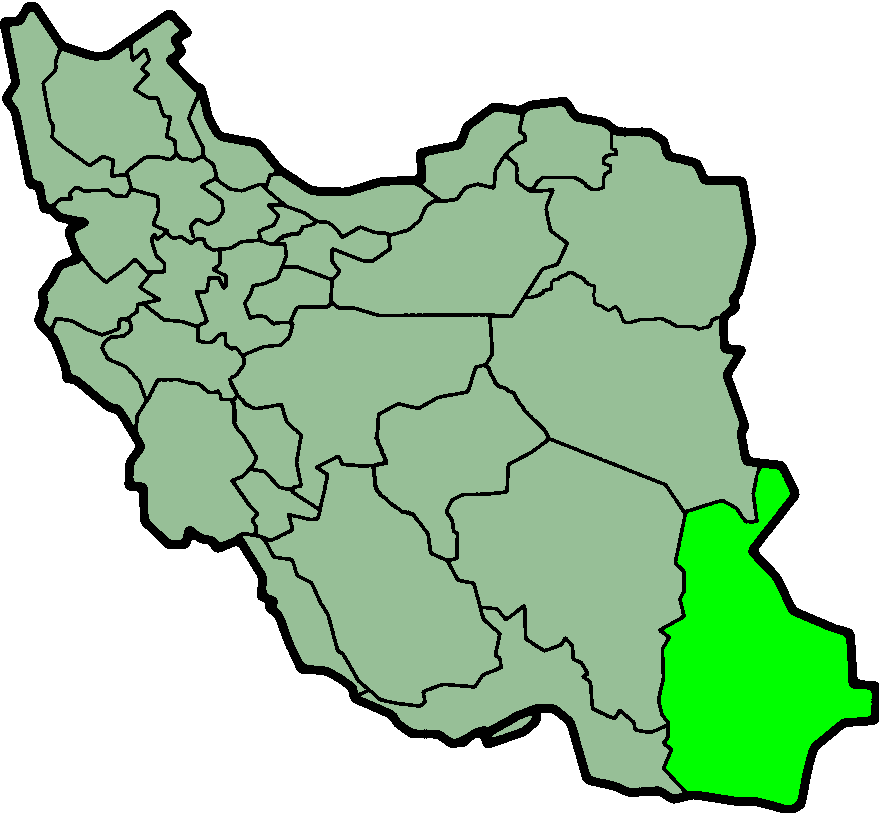
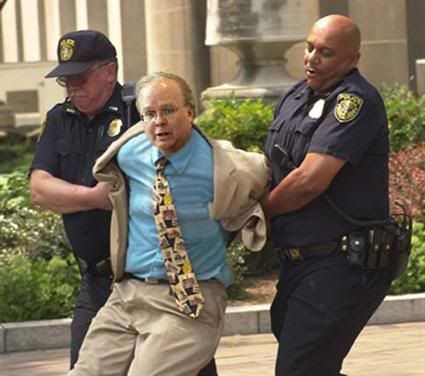
| Cowed into funding a war neither they nor the majority of Americans believe in, congressional Democrats are taking the line that what's needed are some "benchmarks" – well-defined criteria by which to assess whether our efforts are paying off. The idea is to make continued U.S. support contingent on the Iraqis measuring up to these benchmarks. Hillary Clinton even says we should withdraw aid providing for the security of elected Iraqi political leaders if they fail to make the grade. Now that's a way to kill someone off without leaving any fingerprints! (And a good lesson to any other would-be U.S. sock puppets who think they can take the money and run.) The big problem with this approach, however, is that it fails to understand the dynamics of our continued presence in Iraq. In testimony before the Senate Foreign Relations Committee given on Feb. 1, Zbigniew Brzezinski, the hawkish former national security adviser to Jimmy Carter, made a statement that should have set off alarm bells and sent everyone rushing for the lifeboats: "If the United States continues to be bogged down in a protracted bloody involvement in Iraq, the final destination on this downhill track is likely to be a head-on conflict with Iran and with much of the world of Islam at large. A plausible scenario for a military collision with Iran involves Iraqi failure to meet the benchmarks; followed by accusations of Iranian responsibility for the failure; then by some provocation in Iraq or a terrorist act in the U.S. blamed on Iran; culminating in a 'defensive' U.S. military action against Iran that plunges a lonely America into a spreading and deepening quagmire eventually ranging across Iraq, Iran, Afghanistan, and Pakistan." Every moment we stay in Iraq increases the likelihood of war with Iran – that, in my view, is the most powerful argument, aside from this one, for a rapid withdrawal. No sooner had Brzezinski uttered these words than the administration began a concerted campaign to blame the Iranians for U.S. failure in Iraq, and accused Tehran of having a direct hand in the killing of American troops. We hear much about these accusations on the front pages of American newspapers, but what we don't hear about are acts of terrorism directed at both civilian and military targets by Iranian "dissidents," who are reportedly receiving covert U.S. assistance. These groups include the Jundallah organization in Baluchistan, said to be affiliated with al-Qaeda, and the sinister, cult-like Mujahideen-e-Khalq (MEK), a shadowy Marxoid group that was supported by Saddam Hussein and still maintains a presence at Camp Ashraf [.pdf] in Iraq, as well as enjoying a wide array of bipartisan support in Congress. Jundallah recently struck southeastern Iran, in Sistan-Baluchistan, with a series of attacks, including a car bomb in the provincial capital of Zahedan. The Iranians claim that the Jundallah militants are trained in Pakistan, and Iran has displayed samples of alleged captured armaments with "Made in USA" stamped all over them. The leader of Jundallah reportedly announced the attacks on MKO-TV, the satellite television station run out of Great Britain by the MEK, a few minutes before they started. In an interview with the Telegraph, a Jundallah guerrilla fighter sounded very much like he was advertising his services to U.S. policymakers: "Asked whether the satellite telephone he was holding might not lead to his being located, he allowed himself a smile. 'We are not fighting against America,' he said. Support for Jundallah was growing, he said. 'There are hundreds of others who are desperate to sign in, but we ask them to wait because we do not have enough weapons or camps.'" That was last year: surely by this time the Jundallah "freedom fighters" have more than enough weapons and camps, courtesy of Uncle Sam. Scott Ritter, in his book Target Iran: The Truth About the White House's Plans for Regime Change, has described CIA-MEK cross-border operations, in which the Americans – and the Israelis – are conducting provocations that could lead to an open conflict with Iran. The focus of these efforts, he says, is on Baluchistan and Khuzestan. With strong bipartisan support, Congress recently appropriated millions of dollars in aid to Iranian "resistance" groups, with practically no oversight as to how that money is being used – and the scramble for American gold is on. The American front group for the MEK, the National Council of Resistance, has plenty of high-level contacts in Washington, just as Ahmed Chalabi did in the run-up to war with Iraq. The MEK and other Iranian exile groups are busily lobbying for a similar gig as the administration escalates its plans for "regime change" in Tehran. The Iraqi government has recently reiterated its position that the MEK is a terrorist organization, an opinion shared by the European Union and the U.S. Department of State. However, not everyone in the U.S. administration agrees. And what are we to make of the near-total redaction of a mysterious document that came to light in the Libby trial – a memo to Libby from John Hannah detailing "views of MEK leaders on continuing role in Iraq"? That's all we're allowed to know: aside from a reference to MEK briefing slides, the rest is blanked out. The Office of the Vice President (OVP), which sponsored Chalabi, is just as intimately connected to the campaign to gin up a war with Iran as it was with the effort to lie us into war with Iraq. It is reasonable to assume the OVP is just as supportive of the MEK, and may even be directing its activities in collusion with its allies in the Pentagon. Given that U.S. foreign policy is, to a large degree, driven by domestic politics, the motive on the part of the administration to escalate provocative covert actions inside Iran has never been greater. With Scooter Libby likely to be convicted and Fitzgerald's sights increasingly turned on Cheney, the War Party, cornered, has every reason to lash out in one last desperate bid to save its political skin. Fitzgerald, by all indications, is coming for Cheney. After the trial but before the sentencing, Fitz will make a strenuous effort to "flip" Scooter and use his testimony to target the vice president. Murray Waas reports in the National Journal that Cheney wasn't taken in with Libby's Tim Russert fabrication for a moment: "At the time that Libby offered his explanation to Cheney, the vice president already had reason to know that Libby's account to him was untrue, according to sources familiar with still-secret grand jury testimony and evidence in the CIA leak probe." The Fitzgerald probe is a dagger pointed at the dark heart of the administration, the OVP, and the climactic moment of this epic battle is fast approaching. In the early days of the investigation, left-liberal bloggers were exulting in the possibility that they would see Karl Rove frog-marched out of the White House, but the trial has shown that Rove and Libby were antagonists rather than allies. Before it's all over we may yet see the vice president frog-marched out of the White House – at least metaphorically, in the form of an indictment with Dick Cheney's name on it. What better way to distract attention away from this coming political bombshell than by dropping some real bombs on Iran? In the midst of the regional conflagration feared by Brzezinski, prosecuting the Vice President for obstruction of justice and/or perjury would be problematic, at best. In any case, the widening of the war would drive the story off the front pages – think of this as a grand-scale version of Clinton's bombing of the Sudanese pharmaceutical factory just as the Monica Lewinsky was returning to the grand jury. U.S. war plans against Iran have apparently been in the making for quite some time, but the ratcheting-up of both the rhetoric and the actual war preparations indicates a new level of seriousness on the part of this administration. While most reports reassure us that the decision to go to war has not yet been made, one wonders what turn of events would push the key decision-makers, Bush and Cheney, over the line. A direct threat to one – or both – of them coming out of the Libby trial may be all the impetus they need. A cornered rat is dangerous. |

Monday, February 5, 2007
From Afghanistan to Iraq: Connecting the Dots with Oil
By Richard W. Behan, AlterNet
Posted on February 5, 2007
In the Caspian Basin and beneath the deserts of Iraq, as many as 783 billion barrels of oil are waiting to be pumped. Anyone controlling that much oil stands a good chance of breaking OPEC's stranglehold overnight, and any nation seeking to dominate the world would have to go after it.
The long-held suspicions about George Bush's wars are well-placed. The wars in Afghanistan and Iraq were not prompted by the terrorist attacks in New York and Washington. They were not waged to spread democracy in the Middle East or enhance security at home. They were conceived and planned in secret long before September 11, 2001 and they were undertaken to control petroleum resources.
The "global war on terror" began as a fraud and a smokescreen and remains so today, a product of the Bush Administration's deliberate and successful distortion of public perception. The fragmented accounts in the mainstream media reflect this warping of reality, but another more accurate version of recent history is available in contemporary books and the vast information pool of the Internet. When told start to finish, the story becomes clear, the dots easier to connect.
Both appalling and masterful, the lies that led us into war and keep us there today show the people of the Bush Administration to be devious, dangerous and far from stupid.
The following is an in-depth look at the oil wars, the events leading up to them, and the players who made them possible.
Iraq
The Project for a New American Century, a D.C.-based political think tank funded by archconservative philanthropies and founded in 1997, is the source of the Bush Administration's imperialistic urge for the U.S. to dominate the world. Our nation should seek to achieve a "...benevolent global hegemony," according to William Kristol, PNAC's chairman. The group advocates the novel and startling concept of "pre-emptive war" as a means of doing so.
On January 26, 1998, the PNAC, sent a letter to President William Clinton urging the military overthrow of Saddam Hussein in Iraq. The dictator, the letter alleged, was a destabilizing force in the Middle East, and posed a mortal threat to "...the safety of American troops in the region, of our friends and allies like Israel and the moderate Arab states, and a significant portion of the world's oil supply..." The subjugation of Iraq would be the first application of "pre-emptive war."
The unprovoked, full-scale invasion and occupation of another country, however, would be an unequivocal example of "the use of armed force by a state against the sovereignty, territorial integrity, or political independence of another state." That is the formal United Nations definition of military aggression, and a nation can choose to launch it only in self-defense. Otherwise it is an international crime.
President Clinton did not honor the PNAC's request.
But sixteen members of the Project for a New American Century would soon assume prominent positions in the Administration of George W. Bush, including Dick Cheney, Lewis "Scooter" Libby, Donald Rumsfeld, Paul Wolfowitz, Richard Armitage and John Bolton.
The "significant portion of the world's oil supply" was of immediate concern, because of the commanding influence of the oil industry in the Bush Administration. Beside the president and vice president, eight cabinet secretaries and the national security advisor had direct ties to the industry, and so did 32 others in the departments of Defense, State, Energy, Agriculture, Interior, and the Office of Management and Budget.
Within days of taking office, President Bush appointed Vice President Cheney to chair a National Energy Policy Development Group. Cheney's "Energy Task Force" was composed of the relevant federal officials and dozens of energy industry executives and lobbyists, and it operated in tight secrecy. (The full membership has never been revealed, but Enron's Kenneth Lay is known to have participated, and the Washington Post reported that Exxon-Mobil, Conoco, Shell, and BP America did, too.)
During his second week in office, President Bush convened the first meeting of his National Security Council. It was a triumph for the PNAC. In just one hour-long meeting, the new Bush Administration turned upside down the long-standing focus of U.S. foreign policy in the Middle East. Over Secretary of State Colin Powell's objections, the goal of reconciling the Israel-Palestine conflict was abandoned, and the overthrow of Saddam Hussein was set as the new priority. Ron Suskind's book, The Price of Loyalty, describes the meeting in detail.
The Energy Task Force wasted no time, either. Within three weeks of its creation, the group was poring over maps of the Iraqi oilfields, pipelines, tanker terminals, and oil exploration blocks. It studied an inventory of "Foreign Suitors for Iraqi Oilfield Contracts" -- dozens of oil companies from 30 different countries, in various stages of negotiations for exploring and developing Iraqi crude.
Not a single U.S. oil company was among the "suitors," and that was intolerable, given a foreign policy bent on global hegemony. The National Energy Policy document, released May 17, 2001 concluded this: "By any estimation, Middle East oil producers will remain central to world security. The Gulf will be a primary focus of U.S. international energy policy."
That rather innocuous statement can be clarified by a top-secret memo dated February 3, 2001 to the staff of the National Security Council. Cheney's group, the memo said, was "melding" two apparently unrelated areas of policy: "the review of operational policies toward rogue states," such as Iraq, and "actions regarding the capture of new and existing oil and gas fields." The memo directed the National Security Council staff to cooperate fully with the Energy Task Force as the "melding" continued. National security policy and international energy policy would be developed as a coordinated whole. This would prove convenient on September 11, 2001, still seven months in the future.
The Bush Administration was drawing a bead on Iraqi oil long before the "global war on terror" was invented. But how could the "capture of new and existing oil fields" be made to seem less aggressive, less arbitrary, less overt?
During April of 2002, almost a full year before the invasion, the State Department launched a policy-development initiative called "The Future of Iraq Project" to accomplish this. The "Oil and Energy Working Group" provided the disguise for "capturing" Iraqi oil. Iraq, it said in its final report, "should be opened to international oil companies as quickly as possible after the war ... the country should establish a conducive business environment to attract investment in oil and gas resources."
Capture would take the form of investment, and the vehicle for doing so would be the "production sharing agreement."
Under production sharing agreements, or PSAs, oil companies are granted ownership of a "share" of the oil produced, in exchange for investing in development costs, and the contracts are binding for up to 30 years. What would happen, though, if the companies' investments were only minimal, but their shares of the production were obscenely, disproportionately large?
This is hardwired. According to a UK Platform article titled "Crude Designs," production sharing agreements have now been drafted in Baghdad covering 75 percent of the undeveloped Iraqi fields, and the oil companies, waiting to sign the contracts, will earn as much 162 percent on their investments. And the "foreign suitors" are not quite so foreign now: The players on the inside tracks are Exxon-Mobil, Chevron, Conoco-Phillips, BP-Amoco and Royal Dutch-Shell.
The use of PSAs will cost the Iraqi people hundreds of billions of dollars in just the first few years of the "investment" program. They would be far better off keeping in place the structure Iraq has relied upon since 1972: a nationalized oil industry leasing pumping rights to the oil companies, who then pay royalties to the central government. That is how it is done today in Saudi Arabia and the other OPEC countries.
Production sharing agreements, heavily favored by the oil companies, were specified by George Bush's State Department. Paul Bremer's Coalition Provisional Authority drafted an oil law privatizing the oil sector, and American oil interests have lobbied in Baghdad ever since then for the PSAs. Apparently successfully: The Oil Committee headed by Deputy Prime Minister Barham Salih is said currently to be "leaning" toward them.
With the capture of Iraqi oil resources prospectively disguised, the Halliburton company was then hired, secretly, to design a fire suppression strategy for the Iraqi oil fields. If oil wells were to be torched during the upcoming war (as Saddam did in Kuwait in 1991), the Bush Administration would be prepared to extinguish them rapidly. The contract with Halliburton was signed in the fall of 2002. Congress had yet to authorize the use of force in Iraq.
So a line of dots begins to point at Iraq, though nothing illegal or unconstitutional has yet taken place. We are still in the policy-formulation stage, but two "seemingly unrelated areas of policy" -- national security policy and international energy policy -- have become indistinguishable.
Afghanistan
The strategic location of Afghanistan can scarcely be overstated. The Caspian Basin contains up to $16 trillion worth of oil and gas resources, and the most direct pipeline route to the richest markets is through Afghanistan.
After the fall of the Soviet Union, the first western oil company to take action in the Basin was the Bridas Corporation of Argentina. It acquired production leases and exploration contracts in the region, and by November of 1996 had signed an agreement with General Dostum of the Northern Alliance and with the Taliban to build a pipeline across Afghanistan.
Not to be outdone, the American company Unocal (aided by an Arabian company, Delta Oil) fought Bridas at every turn. Unocal wanted exclusive control of the trans-Afghan pipeline and hired a number of consultants in its conflict with Bridas: Henry Kissinger, Richard Armitage (now Deputy Secretary of State in the Bush Administration), Zalmay Khalilzad (a signer of the PNAC letter to President Clinton) and Hamid Karzai.
Unocal wooed Taliban leaders at its headquarters in Texas, and hosted them in meetings with federal officials in Washington, D.C.
Unocal and the Clinton Administration hoped to have the Taliban cancel the Bridas contract, but were getting nowhere. Finally, Mr. John J. Maresca, a Unocal Vice President, testified to a House Committee of International Relations on February 12, 1998, asking politely to have the Taliban removed and a stable government inserted. His discomfort was well placed.
Six months later terrorists linked to Osama bin Laden bombed the U.S. embassies in Kenya and Tanzania, and two weeks after that President Clinton launched a cruise missile attack into Afghanistan. Clinton issued an executive order on July 4, 1999, freezing the Taliban's U.S.-held assets and prohibiting further trade transactions with the Taliban.
Mr. Maresca could count that as progress. More would follow.
Immediately upon taking office, the new Bush Administration actively took up negotiating with the Taliban once more, seeking still to have the Bridas contract vacated, in exchange for a tidy package of foreign aid. The parties met three times, in Washington, Berlin, and Islamablad, but the Taliban wouldn't budge.
Behind the negotiations, however, planning was underway to take military action if necessary. In the spring of 2001 the State Department sought and gained concurrence from both India and Pakistan to do so, and in July of 2001, American officials met with Pakistani and Russian intelligence agents to inform them of planned military strikes against Afghanistan the following October. A British newspaper told of the U.S. threatening both the Taliban and Osama bin Laden -- two months before 9/11 -- with military strikes.
According to an article in the UK Guardian, State Department official Christina Rocca told the Taliban at their last pipeline negotiation in August of 2001, just five weeks before 9/11, "Accept our offer of a carpet of gold, or we bury you under a carpet of bombs."
The Great Game and Its Players
The geostrategic imperative of reliable oil supplies has a long history, arguably beginning with the British Navy in World War I. First Lord of the Admiralty Winston Churchill repowered the British fleet -- from coal (abundant in the UK) to oil (absent in the UK), and thus began the Great Game: jockeying by the world powers for the strategic control of petroleum. (Churchill did this to replace with oil pumps the men needed to shovel coal -- a large share of the crew -- so they could man topside battle stations instead.) Iraq today is a British creation, formed almost a century ago to supply the British fleet with fuel, and it is still a focal point of the Game.
The players have changed as national supremacy has changed, as oil companies have morphed over time, and as powerful men have lived out their destinies.
Among the major players today are the Royal family of Saudi Arabia and the Bush family of the state of Maine (more recently of Texas). And they are closely and intimately related. The relationship goes back several generations, but it was particularly poignant in the first Gulf War in 1990-91, when the U.S. and British armed forces stopped Saddam Hussein in Kuwait, before his drive reached the Arabian oil fields. Prime Minister John Major of the UK, and President George H.W. Bush became the much esteemed champions of the Arabian monarchy, and James Baker, Bush's Secretary of State, was well regarded, too. (Years earlier, Mr. Baker and a friend of the royal family's had been business partners, in building a skyscraper bank building in Houston.)
The Carlyle Group: Where the Players Meet to Profit
After President Bush, Secretary Baker, and Prime Minister Major left office, they all became active participants and investors in the Carlyle Group, a global private equity investment firm comprised of dozens of former world leaders, international business executives (including the family of Osama bin Laden); former diplomats, and high-profile political operatives from four U.S. Administrations. For years, Carlyle would serve as the icon of the Bush/Saudi relationship.
Carlyle, with its headquarters just six blocks from the White House, invests heavily in all the industries involved in the Great Game: the defense, security, and energy industries, and it profits enormously from the Afghan and Iraqi wars.
In the late 1980s, Carlyle's personal networking brought together George W. Bush, the future 43rd U.S. president, and $50,000 of financial backing for his Texas oil company, Arbusto Energy. The investor was Salem bin Laden (half-brother of Osama bin Laden) who managed the Carlyle investments of the Saudi bin Laden Group. (After the tragedy of 9/11, by mutual consent, the bin Laden family and Carlyle terminated their business dealings.) George Bush left Carlyle in 1992 to run for governor of Texas.
Ex-President Bush, Ex-Prime Minister Major, and Ex Secretary Baker, in the 1990's, were Carlyle's advance team, scouring the world for profitable investments and investors. In Saudi Arabia they met with the royal family, and with the two wealthiest, non-royal families -- the bin Ladens and the bin Mahfouzes.
Khalid bin Mahfouz was prominent in Delta Oil, Unocal's associate in the Afghan pipeline conflict. He was later accused of financing al Qaeda, and named in a trillion dollar lawsuit brought by the families of 9/11 victims. (It was Mr. bin Mahfouz who had been Mr. Baker's business associate in Houston.)
Carlyle retained James Baker's Houston law firm, Baker-Botts, and Baker himself served as Carlyle Senior Counselor from 1993 until 2005. (Other clients of Baker-Botts: Exxon-Mobil, Chevron, Texaco, Shell, Amoco, Conoco-Phillips, Halliburton, and Enron.)
Mr. Baker has long been willing to put foremost the financial advantage of himself, his firm, and his friends, often at the expense of patriotism and public service. As President Reagan's Secretary of the Treasury, he presided over the savings-and-loan scandal, in which S&L executives like Charles Keating and the current President's brother Neil Bush handed the American taxpayers a bill to pay, over a 40-year period, of $1.2 trillion. His law firm willingly took on the defense of Prince Sultan bin Abdul Azis, the Saudi Defense Minister sued by the families of 9/11 victims for complicity in the attacks.
We will encounter Mr. Baker again soon.
September 11, 2001
In September of 2000, the Project for a New American Century published a report, "Rebuilding America's Defenses." It advocated pre-emptive war once again, but noted its acceptance would be difficult in the absence of "some catastrophic and catalyzing event, like a new Pearl Harbor."
President Bush formally established the PNAC's prescription for pre-emptive, premeditated war as U.S. policy when he signed a document entitled "The National Security Strategy of the United States of America" early in his first term.
Still nothing illegal or unconstitutional had been done.
But the rationale and the planning for attacking both Afghanistan and Iraq were in place. The preparations had all been done secretly, wholly within the executive branch. The Congress was not informed until the endgame, when President Bush, making his dishonest case for the "war on terror" asked for and was granted the discretion to use military force. The American people were equally uninformed and misled. Probably never before in our history was such a drastic and momentous action undertaken with so little public knowledge or Congressional oversight: the dispatch of America's armed forces into four years of violence, at horrendous costs in life and treasure.
Then a catastrophic event took place. A hijacked airliner probably en route to the White House crashes in Pennsylvania, the Pentagon was afire, and the Twin Towers of the World Trade Center were rubble.
In the first hours of frenetic response, fully aware of al Qaeda's culpability, both President Bush and Secretary Rumsfeld sought frantically to link Saddam Hussein to the attacks, as we know from Richard Clarke's book, Against All Enemies. They anxiously waited to proceed with their planned invasion of Iraq.
If the Bush Administration needed a reason to proceed with their invasions, they could not have been handed a more fortuitous and spectacular excuse, and they played their hand brilliantly.
9/11 was a shocking event of unprecedented scale, but it was simply not an invasion of national security. It was a localized criminal act of terrorism, and to compare it, as the Bush Administration immediately did, to Pearl Harbor was ludicrous: The hijacked airliners were not the vanguard of a formidable naval armada, an air force, and a standing army ready to engage in all out war, as the Japanese were prepared to do and did in 1941.
By equating a criminal act of terrorism with a military threat of invasion, the Bush Administration consciously adopted fear mongering as a mode of governance. It was an extreme violation of the public trust, but it served perfectly their need to justify warfare.
As not a few disinterested observers noted at the time, international criminal terrorism is best countered by international police action, which Israel and other nations have proven many times over to be effective. Military mobilization is irrelevant. It has proven to be counterproductive.
Why, then, was a "war" declared on "terrorists and states that harbor terrorists?"
The pre-planned attack on Afghanistan, as we have seen, was meant to nullify the contract between the Taliban and the Bridas Corporation. It was a matter of international energy policy. It had nothing to do, as designed, with apprehending Osama bin Laden -- a matter of security policy.
But the two "seemingly unrelated areas of policy" had been "melded," so here was an epic opportunity to bait-and-switch. Conjoining the terrorists and the states that harbored them made "war" plausible, and the Global War on Terror was born: It would be necessary to overthrow the Taliban as well as to bring Osama bin Laden to justice.
(In retrospect, the monumental fraud of the "war on terror" is crystal clear. In Afghanistan the Taliban was overthrown instead of bringing the terrorist Osama bin Laden to justice, and in Iraq there were no terrorists at all. But Afghanistan and Iraq are dotted today with permanent military bases guarding the seized petroleum assets.)
On October 7, 2001 the carpet of bombs is unleashed over Afghanistan. Hamid Karzai, the former Unocal consultant, is installed as head of an interim government. Subsequently he is elected President of Afghanistan, and welcomes the first U.S. envoy -- Mr. John J. Maresca, the Vice President of the Unocal Corporation who had implored Congress to have the Taliban overthrown. Mr. Maresca was succeeded by Mr. Zalmay Khalilzad -- also a former Unocal consultant. (Mr. Khalilzad has since become Ambassador to Iraq, and has now been nominated to replace John Bolton, his PNAC colleague, as the ambassador to the UN.)
With the Taliban banished and the Bridas contract moot, Presidents Karzai of Afghanistan and Musharraf of Pakistan meet on February 8, 2002, sign an agreement for a new pipeline, and the way forward is open for Unocal/Delta once more.
The Bridas contract was breached by U.S. military force, but behind the combat was Unocal. Bridas sued Unocal in the U.S. courts for contract interference and won, overcoming Richard Ben Veniste's law firm in 2004. That firm had multibillion-dollar interests in the Caspian Basin and shared an office in Uzbekistan with the Enron Corporation. In 2004, Mr. Ben Veniste was serving as a 9/11 Commissioner.
About a year after the Karzai/Musharraf agreement was signed, an article in the trade journal "Alexander's Gas and Oil Connections" described the readiness of three US federal agencies to finance the prospective pipeline: the U.S. Export/Import Bank, the Trade and Development Agency, and the Overseas Private Insurance Corporation. The article continued, "...some recent reports ... indicated ... the United States was willing to police the pipeline infrastructure through permanent stationing of its troops in the region." The article appeared on February 23, 2003.
The objective of the first premeditated war was now achieved. The Bush Administration stood ready with financing to build the pipeline across Afghanistan, and with a permanent military presence to protect it.
Within two months President Bush sent the armed might of America sweeping into Iraq.
Then came the smokescreen of carefully crafted deceptions. The staging of the Jessica Lynch rescue. The toppling of the statue in Baghdad. Mission accomplished. The orchestrated capture, kangaroo court trial, and hurried execution of Saddam Hussein. Nascent "democracy" in Iraq. All were scripted to burnish the image of George Bush's fraudulent war.
The smokescreen includes the cover-up of 9/11. Initially and fiercely resisting any inquiry at all, President Bush finally appoints a 10-person "9/11 Commission."
The breathtaking exemptions accorded President Bush and Vice President Cheney in the inquiry rendered the entire enterprise a farce: They were "interviewed" together, no transcription of the conversation was allowed, and they were not under oath. The Commission report finally places the blame on "faulty intelligence."
Many of the 10 commissioners, moreover, were burdened with stunning conflicts of interest -- Mr. Ben Veniste, for example -- mostly by their connections to the oil and defense industries. The Carlyle Group contributed to Commissioner Tim Roemer's political campaigns. Commission Chairman Thomas Kean was a Director of Amerada Hess, which had formed a partnership with Delta Oil, the Arabian company of Khalid bin Mahfouz, and that company was teamed with Unocal in the Afghan pipeline project. Vice-Chairman Lee Hamilton serves on the board of Stonebridge International consulting group, which is advising Gulfsands Petroleum and Devon Energy Corporation about Iraqi oil opportunities.
The apparent manipulation of pre-war intelligence is not addressed by the 9/11 Commission, the veracity of the Administration's lies and distortions is assumed without question, and the troubling incongruities of 9/11 are ignored: The theories of controlled demolition, the prior short-selling of airline stock, the whole cottage industry of skepticism.
The doubters and critics of 9/11 are often dismissed as conspiracy crazies, but you needn't claim conspiracy to be skeptical. Why did both President Bush and Vice President Cheney pressure Senate Majority Leader Tom Daschle to forego any investigation at all? Failing in that, why did the President then use "Executive Privilege" so often to withhold and censor documents? Why did the White House refuse to testify under oath? Why the insistence on the loopy and unrecorded Oval Office interview of Mr. Bush and Mr. Cheney simultaneously?
There is much we don't know about 9/11.
The Iraq Study Group
Viewing the carnage in Iraq, and seeking desperately to find a way out of it, the U.S. Congress appointed on March 15, 2006 the Iraq Study Group. It was also called the Baker-Hamilton Commission after its co-chairmen, the peripatetic problem-solvers James Baker and Lee Hamilton. It was charged with assessing the situation in Iraq and making policy recommendations.
The Commission assessed the situation as "grave and deteriorating" and recommended substantive changes in handling it: draw down the troop levels and negotiate with Syria and Iran. These recommendations were rejected out of hand by the Bush Administration, but those about the oil sector could hardly have been more pleasing.
The Commission's report urged Iraqi leaders to "... reorganize the national industry as a commercial enterprise." That sounds like code for privatizing the industry (which had been nationalized in 1972.) In case that wasn't clear enough, the Commission encouraged "...investment in Iraq's oil sector by the international energy companies." That sounds like code for Exxon/Mobil, Chevron/Texaco, Conoco/Phillips, BP/Amoco and Royal Dutch Shell. The Commission urged support for the World Bank's efforts to "ensure that best practices are used in contracting." And that sounds like code for Production Sharing Agreements.
Mr. Baker is a clever and relentless man. He will endorse pages and pages of changes in strategy and tactics -- but leave firmly in place the one inviolable purpose of the conflict in Iraq: capturing the oil.
A Colossus of Failure
The objectives of the oil wars may be non-negotiable, but that doesn't guarantee their successful achievement.
The evidence suggests the contrary.
As recently as January of 2005, the Associated Press expected construction of the Trans Afghan Pipeline to begin in 2006. So did News Central Asia. But by October of 2006, NCA was talking about construction "... as soon as there is stability in Afghanistan."
As the Taliban, the warlords, and the poppy growers reclaim control of the country, clearly there is no stability in Afghanistan, and none can be expected soon.
Unocal has been bought up by the Chevron Corporation. The Bridas Corporation is now part of BP/Amoco. Searching the companies' websites for "Afghanistan pipeline" yields, in both cases, zero results. Nothing is to be found on the sites of the prospective funding agencies. The pipeline project appears to be dead.
The Production Sharing Agreements for Iraq's oil fields cannot be signed until the country's oil policies are codified in statute. That was supposed to be done by December of 2006, but Iraq is in a state of chaotic violence. The "hydrocarbon law" is struggling along -- one report suggests it may be in place by March -- so the signing of the PSA's will be delayed at least that long.
The U.S. and British companies that stand to gain so much -- Exxon/Mobil, Chevron/Texaco, Concoco/Phillips, BP/Amoco and Royal Dutch Shell -- will stand a while longer. They may well have to stand down.
On October 31, 2006 the newspaper China Daily reported on the visit to China by Iraqi Oil Minister Hussein Shahristani. Mr. Shahristani, the story said, "welcomed Chinese oil companies to participate in the reconstruction of the Iraqi oil industry." That was alarming, but understated.
Stratfor, the American investment research service, was more directly to the point, in a report dated September 27, 2006 (a month before Minister Shahristani's visit, so it used the future tense). The Minister "... will talk to the Chinese about honoring contracts from the Saddam Hussein era. ... This announcement could change the face of energy development in the country and leave U.S. firms completely out in the cold."
The oil wars are abject failures. The Project for a New American Century wanted, in a fantasy of retrograde imperialism, to remove Saddam Hussein from power. President George Bush launched an overt act of military aggression to do so, at a cost of more than 3,000 American lives, hundreds of thousands of Iraqi lives, and half a trillion dollars. In the process he has exacerbated the threats from international terrorism, ravaged the Iraqi culture, ruined their economy and their public services, sent thousands of Iraqis fleeing their country as refugees, created a maelstrom of sectarian violence, dangerously destabilized the Middle East, demolished the global prestige of the United States, and defamed the American people.
Richard W. Behan lives and writes on Lopez Island, off the northwest coast of Washington state. He is working on a new book, To Provide Against Invasions: Corporate Dominion and America's Derelict Democracy. He can be reached at rwbehan@rockisland.com. (This essay is deliberately not copyrighted: It may be reproduced without restriction.)
© 2007 Independent Media Institute. All rights reserved.
View this story online
Friday, February 2, 2007
Iraq report pessimistic over US role
---
Mark Tran and agencies
Friday February 2, 2007
Guardian Unlimited

General George Casey, the outgoing US commander in Iraq, who is in line to be the new White House army chief of staff. Photograph: Chip Somodevilla/Getty Images
The long-awaited National Intelligence Estimate on Iraq expressed uncertainty about the capacity of Iraqi leaders to transcend sectarian interests and fight extremists, establish effective national institutions and end corruption.
A two-page version is to be made public today, after the 90-page classified NIE was presented to the US president, George Bush, yesterday.
According to the Washington Post, the document emphasises that although al-Qaida actions remains a problem, they have been surpassed by sectarian violence as the primary source of conflict and the most immediate threat to US goals. Iran, which the administration has accused of supplying and directing insurgents, is mentioned but is not a focus.
The NIE has been a source of controversy in the past. In October 2002, the NIE concluded - wrongly as it turned out - that Saddam Hussein had chemical and biological weapons and was "reconstituting" his nuclear weapons programme. The document provided the case of going to war in Iraq.
The intelligence assessment, which provides projections for the next 18 months, comes amid growing opposition to Mr Bush's Iraq policies from Congress, now under Democratic control after the November midterm elections.
The Senate is expected to debate a resolution next week, which was put forward by senior Democrats and Republicans who oppose Mr Bush's plan to send another 21,500 troops to Iraq. Although the resolution would not be binding, its passage would be an embarrassment for the White House.
Even among the US military, there is disagreement on the Mr Bush's troop "surge". The outgoing top US general in Iraq, George Casey, yesterday said Mr Bush has ordered more troops than needed to quell violence in Baghdad.
Gen Casey, who is in line to become the chief of staff of the army, said he had asked for two brigades - 7,000 troops - of additional forces rather than the five brigades that his successor, General David Petraeus, is now seeking.
"I did not want to bring one more American soldier into Iraq than was necessary to accomplish the mission," Gen Casey said.
He has said in the past that increasing the number of US troops would raise tension between Iraqis and American soldiers.
He added, however, that he understood how Gen Petraeus might want the full complement of 21,500 additional troops. They could "either reinforce success, maintain momentum or put more forces in a place where the plans are not working," he told a senate confirmation hearing yesterday.
The Iraqi government is also unenthusiastic about the US troop increase. At his November meeting with Mr Bush in Amman, Jordan, the prime minister Nuri al-Maliki, presented the Americans with an Iraqi security plan that involved increased deployment of Iraqi troops in Baghdad. But according to White House officials, the US found the Iraqi plan "deficient" and concluded that American troops were needed.
Gen Casey yesterday acknowledged that Mr Maliki was not enthusiastic about the American troop increase. "He leans toward not wanting to have to bring in more coalition forces."
Sunday, January 28, 2007
Daffy Does Doom: MAUREEN DOWD
THE COMPLETE ARTICLE
The New York Times
OP-ED COLUMNIST
Daffy Does Doom
By MAUREEN DOWDDelusional is far too mild a word to describe Dick Cheney.
Dick Durbin went to the floor of the Senate on Thursday night to denounce the vice president as “delusional.”
It was shocking, and Senator Durbin should be ashamed of himself.
Delusional is far too mild a word to describe Dick Cheney. Delusional doesn’t begin to capture the profound, transcendental one-flew-over daftness of the man.
Has anyone in the history of the United States ever been so singularly wrong and misguided about such phenomenally important events and continued to insist he’s right in the face of overwhelming evidence to the contrary?
Friday, January 26, 2007
Conyers and Feingold Announce Judiciary Hearings on Bush Admistration Policy in Both Senate and House
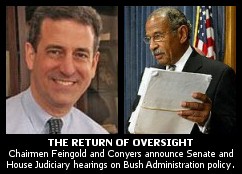 At the turn of the new year, we dubbed 2007 "The Year of Accountability." So, let it begin.
Two announcements were released today concerning upcoming oversight and investigative hearings in Congress on Bush Administration policy. If you can imagine such a thing.
In the House, Rep. John Conyers (D-MI), chairman of the House Judiciary Committee --- the one which would lead the way concerning any Articles of Impeachment for a sitting U.S. President or Vice-President --- announced today that hearings would be held next Wednesday in the committee on "Presidential Signing Statements under the Bush Administration: A Threat to Checks and Balances and the Rule of Law?" (Complete media release, with details, scheduled witnesses, etc. at end of this article.)
In the Senate, Russ Feingold (D-WI) will chair Judiciary Committee hearings on "Congress's Power to End a War." In a media advisory just released, (posted in full below) Feingold refers to Congress's "power of the purse to redeploy our troops safely from Iraq so that we can refocus on the global terrorist networks that threaten our national security."
"This hearing will help inform my colleagues and the public about Congress’s power to end a war and how that power has been used in the past," Feingold is quoted in the release. As well, he promises to to introduce new legislation to do exactly that in the Senate. "I will soon be introducing legislation to use the power of the purse to end what is clearly one of the greatest mistakes in the history of our nation’s foreign policy," the senator said.
Neither of the Constitutionally mandated oversight hearings will be held in a basement broom closet, but rather in proper Congressional Hearing Rooms.
UPDATE 8:22pm PT White House says they "will cooperate." Of course they will.
The complete media releases from Conyers and Feingold, with dates, times, locations, and expected witnesses, follow below...
Contact: Jonathan Godfrey (202) XXX-XXXX
NOTICE OF OVERSIGHT HEARING
"Presidential Signing Statements under the Bush Administration: A Threat to Checks and Balances and the Rule of Law?"
TIME
10:15am
DATE
Wednesday, January 31, 2007
PLACE
2141 Rayburn
Confirmed Witnesses:
Karen Mathis, ABA President
Mickey Edwards, Former Republican Congressman
Professor Charles Ogletree, Harvard Law School
John Elwood, Deputy Assistant Attorney General in the Office of Legal Counsel of DOJ
Nicholas Rozenkranz, Georgetown University
##110-JUD-012507##
Contact: Zach Lowe - (202) XXX-XXXX
Washington, D.C. – On Tuesday, January 30th, U.S. Senator Russ Feingold will chair a Senate Judiciary Committee hearing entitled, “Exercising Congress’s Constitutional Power to End a War.” Earlier this month, Feingold, Chairman of the Judiciary Subcommittee on the Constitution, became the first Senator to call on Congress to use its power of the purse to redeploy our troops safely from Iraq so that we can refocus on the global terrorist networks that threaten our national security. Feingold proposed this action after President George Bush announced plans to escalate our military involvement in Iraq despite the objections of members of both parties, military and foreign policy experts, and the American people.
“Congress holds the power of the purse and if the President continues to advance his failed Iraq policy, we have the responsibility to use that power to safely redeploy our troops from Iraq,” Feingold said. “This hearing will help inform my colleagues and the public about Congress’s power to end a war and how that power has been used in the past. I will soon be introducing legislation to use the power of the purse to end what is clearly one of the greatest mistakes in the history of our nation’s foreign policy.”
Witnesses at the hearing will include:
- Louis Fisher, Library of Congress
- Prof. Walter Dellinger, Duke University School of Law, former Solicitor General of the United States
- Prof. David Barron, Harvard Law School
- Prof. Robert Turner, University of Virginia Law School
Who:
U.S. Senator Russ Feingold, Chairman, Senate Judiciary Committee, Subcommittee on the Constitution
What:
Senate Judiciary Committee Hearing --- “Exercising Congress’s Constitutional Power to End a War.” Feingold will chair the full committee hearing.
Where: SD - 226
When: Tuesday, January 30th – 10:00 am ET
Senator Feingold’s remarks from yesterday’s Senate Foreign Relations Committee meeting regarding the need to end our involvement in Iraq can be viewed and heard here: http://feingold.senate.gov/~feingold/statements/07/01/20070124.htm.