Showing posts with label food. Show all posts

Friday, May 4, 2007

Hunger in Eden

Rashid.jpg
Rashid, a West Bank villager, explains that an Israeli settler took over his olive grove. "I said to him, 'This tree is fifty years old. Did your grandfather plant it, or did mine?'"

The most surprising part of the West Bank -- to me anyway -- is how beautiful it is. For some reason I though the whole place would be as dry and bleak as the Judean desert between Jerusalem and the Jordan Valley. But the suburbs north of the capital quickly give way to panoramic countryside that seems southern Italian, with terraced olive groves, red hills, and flowering fruit trees.

Of course, not all is idyllic in this rural idyll. The first clue that something was amiss in Yanoun -- a Palestinian farming village near Nablus that I visited yesterday with an official from the World Food Program -- was the skittish behavior of the local children. They ran and hid from us, or cried when we tired to say hello. The watchtower on the ridge overlooking the village was another giveaway that this place is a conflict zone. Yanoun is surrounded by three Israeli settlements, the inhabitants of which which have made clear that they want their Palestinian neighbors to clear out. The settlers make armed patrols through Yanoun -- by car or horseback -- destroy farming equipment, and last month they kidnapped, tortured and killed a local shepherd, according to residents. The scared children thought we were settlers.

But that's not all that's happening. Though it's hard to believe that food could be scarce in this land of milk and honey, the 24 families who live in Yanoun are being slowly starved. The settlements now control access to about 96 percent of the village's land making commercial agriculture nearly impossible. And though Yanoun could possibly support itself with some kind of highly cultivated garden in the bowl shaped valley beneath, they don't have enough water to do so because the settlements have taken over their rain catching ground cisterns. And even if they could grow produce, the villagers would have trouble getting it to market. The reliable roads to the region are for Israelis only. The rest are clogged with checkpoints. So the people of Yanoun -- like some 400,000 other people in the West Bank -- scrape by with the help from the WFP.

The WFP brought me here to see an example of what they called "food insecurity" -- a condition not of outright starvation but of scarcity that occurs when people don't have reliable access to enough food to have productive lives. At first I was suspicious of the term -- sounds like a way of justifying NGO operations in places where there isn't famine. And in fact, the inhabitants of Yanoun don't look hungry. But the Israeli-Palestinian conflict has so dislocated the rural West Bank's population that they have become dependent on foreign aid. And several years of living on the five basic food stuffs given by aid organizations -- wheat, salt, sugar, chickpeas and oil -- has taken a toll on public health, which you can see by the rotting teeth on the kids of Yanoun. Of course, international donors could end this culture of dependence in a second by cutting aid. In which case, Israeli settlers could have these pretty hills pretty much to themselves.

Kirstie.jpg
Kirstie Campbell of WFP comforts a scared village girl.

--Andrew Lee Butters/Jerusalem

Wednesday, May 2, 2007

Feds: Millions have eaten chickens fed tainted pet food

•Chickens in possibly hundreds of farms may have been fed tainted food
• Likelihood of human illness after eating such chicken is "very low"
• No human illness linked to the tainted feed reported to FDA, USDA

NEW YORK (CNN) -- People have eaten millions of chickens that were given feed tainted with recalled pet food, federal officials said Tuesday, though they said the threat to human health is minimal.

The announcement came after an investigation of chicken farms in Indiana found that 38 of the facilities had given contaminated feed to poultry raised for human consumption, and that 2.5 million to 3 million people ate them.

The officials added that they expect to discover that chickens on possibly hundreds of farms in other states were also given tainted feed.

In a teleconference with reporters, an official with the Food and Drug Administration said no recall has been issued because "the likelihood of illness after eating chicken fed the contaminated product is very low." (Blog: Melamine 'dilution' means human risk is probably lower )

No human illnesses have been reported related to the feed, officials with the FDA and the U.S. Department of Agriculture said.

Last week, as part of its investigation into the nationwide pet food recall, the FDA ordered that all vegetable protein imports from China used in human and animal food be detained.

The products include wheat gluten, rice gluten, rice protein, rice protein concentrate, corn gluten, corn gluten meal, corn byproducts, soy protein, soy gluten proteins and mung bean protein.

FDA officials said Tuesday that they have found no evidence that tainted wheat gluten was added directly to any food products sold in the United States.

Two FDA investigators are in China and a third was en route working with the Chinese government's General Administration for Quality Supervision, Inspection and Quarantine to investigate the sources of the contaminated products. (Watch more on concerns about China's food safetyVideo)

It was unclear how long tainted food additives from China have been entering the United States.

"Clearly that is a concern if that has been going on for a long period of time," said Dr. David Acheson, who had been appointed earlier in the day to the newly created position of FDA assistant commissioner for food protection.

The FDA's investigation began in March after at least 17 cats and dogs died of kidney failure linked to the tainted pet food. The urine of cats that ate the food tested positive for melamine, an industrial chemical used in the manufacturing of plastic utensils and fertilizer.

Investigators suspect that melamine, in combination with a rice protein additive imported from China and found to contain cyanuric acid, may cause crystals to form in the kidneys, shutting them down. Cyanuric acid is used as a stabilizer in outdoor swimming pools and hot tubs.

"We had one case recently where the cat's kidneys were completely obstructed and when we went to surgery to relieve the obstruction there was no normal stone, instead the ureters were completely full of these melamine-type crystals," said Dr. Louise Murray, director of medicine at New York's Bergh Memorial Animal Hospital.

The National Chicken Council, which represents U.S. poultry producers, marketers and processors, said Tuesday in a written statement: "We are confident that any poultry producers involved will work expeditiously with the government to resolve this matter to the satisfaction of the government agencies."

Leftovers link possible

NCC spokesman Richard Lobb said Chinese producers appear to have been spiking their feed with the contaminants to make it appear that it contains more protein than it does. Some tests for protein content measure nitrogen content, an ingredient of melamine and cyanuric acid.

Lobb said the chicken feed may have been contaminated as a result of a practice common among pet food manufacturers -- they sometimes sell their leftover material to manufacturers of chicken and pig feed.

"It's like cooking cupcakes -- you get some of the dough on the pan, you scrape it off and throw it away. What they're saying is that somebody bought that material and it got mixed in corn and soybean that gets manufactured in poultry feed," he said.

"The dilution factor is enormous. You have a relatively small amount of pet food byproducts used," Lobb said. "It's a safe and wholesome product to use."

Representatives of Perdue and Tyson Foods -- two of the largest U.S. chicken producers -- said Tuesday in letters to supermarkets that they do not use protein ingredients from China in their feeds.

Last week, FDA officials said 6,000 hogs that may have ingested tainted pet food entered the human food supply. Pork producers in seven states -- California, Kansas, North Carolina, New York, South Carolina and Utah -- are being investigated for buying adulterated feed.

The agency also reported last week that it has received more than 17,000 consumer complaints related to the recall, including reports of approximately 4,150 dog and cat pet deaths.

More than 150 brands and 5,300 pet food products have been recalled. Companies that produced affected items include Menu Foods, Hill's Pet Nutrition, P&G Pet Care, Nestle Purina PetCare, Del Monte Pet Products and Sunshine Mills have been recalled in cooperation with the FDA. The first recall was initiated March 16 by Menu Foods.

CNN's Katy Byron, Joe Johns, Miriam Falco and Elizabeth Cohen contributed to this report.

Millions Of Chickens Fed Tainted Pet Food

Related
Do you want fries with that? - EMERGENCY UPDATE
---
Risk to Consumers Minimal, FDA Says

By Rick Weiss
Washington Post Staff Writer
Wednesday, May 2, 2007; A01

At least 2.5 million broiler chickens from an Indiana producer were fed pet food scraps contaminated with the chemical melamine and subsequently sold for human consumption, federal health officials reported yesterday.

Hundreds of other producers may have similarly sold an unknown amount of contaminated poultry in recent months, they added, painting a picture of much broader consumption of contaminated feed and food than had previously been acknowledged in the widening pet food scandal.

Officials emphasized that they do not believe the tainted chickens -- or the smaller number of contaminated pigs that were reported to have entered the human food supply -- pose risks to people who ate them.

"We do not believe there is any significant threat of human illness from this," said David Acheson, the Food and Drug Administration's chief medical officer. FDA Commissioner Andrew von Eschenbach named Acheson yesterday the agency's new "food czar" -- officially, assistant commissioner for food protection.

None of the farm animals is known to have become sick from the food, and very little of the contaminant is suspected of having accumulated in their tissue. Thus, no recall of any products that may still be on store shelves or in people's freezers is planned, officials said.

Nonetheless, 100,000 Indiana chickens that ate the melamine-laced food and are still alive have been quarantined and will be destroyed as a precautionary measure -- as will any other animals that turn up as the investigation continues to expand.

The revelations are the latest in a rapidly widening scandal that started out with reports of a few deaths of pets. It has mushroomed into a major debacle that, even if no human injuries emerge, has exposed significant gaps in the nation's food-safety system.

In the first volley of what Hill watchers expect to be a series of proposed fixes, Sen. Richard J. Durbin (D-Ill.) and Rep. Rosa DeLauro (D-Conn.) yesterday introduced legislation that would give the FDA the power to order mandatory recalls of adulterated foods, establish an early warning and notification system for tainted human or pet food, and allow fines for companies that do not promptly report contaminated products.

Meanwhile, the FDA expanded the number of plant-based protein products from China on its "do not import" list, pending the completion of further tests on various kinds of glutens, protein concentrates and other products.

At the center of the problem are pet foods spiked with melamine, a mildly toxic chemical that can make food appear to have more protein than it does. Most of the food went to pets, but scraps were sold in February to the Indiana poultry producer, officials said. The contaminated material may have made up about 5 percent of the chickens' total food supply.

That small fraction, and the fact that people, unlike pets, do not eat the same thing day after day, suggests that consumers who ate contaminated pork or chicken would probably have ingested extremely small doses of melamine, well below the threshold for causing health effects, officials said. Experts conceded, however, that they know little about how the toxin interacts with other compounds in food.

Investigators are tracking streams of the contaminated food through several states.

"Our sense is that the investigation will lead to additional farms where contaminated feed may have been fed to either animals or poultry," said Kenneth Petersen of the Agriculture Department Food Safety and Inspection Service.

Officials said the FDA has received 17,000 reports of pets that owners believe were sickened or killed by contaminated food. About 8,000 reports, roughly half of them involving animals that died, have been formally entered into the FDA's tracking system for further analysis.

U.S. investigators have arrived in China, officials said, but inspections of production facilities there have been hampered by the start yesterday of a week-long national vacation.

"Essentially, all the officials are on holiday," said Walter Batts, part of the FDA's China team, adding that one Chinese official had stayed behind to help.

Tuesday, May 1, 2007

FDA says thousands of pets dead

IA #99-29, 4/27/07, IMPORT ALERT #99-29, "DETENTION WITHOUT PHYSICAL EXAMINATION OF ALL VEGETABLE PROTEIN PRODUCTS FROM CHINA FOR ANIMAL OR HUMAN FOOD USE DUE TO THE PRESENCE OF MELAMINE AND/OR MELAMINE ANALOGS"

Excerpt

As of April 26, 2007, FDA had received over 17,000 consumer complaints relating to this outbreak, and those complaints included reports of approximately 1950 deaths of cats and 2200 deaths of dogs.

Monday, April 23, 2007

UN Official Says Humanitarian Crisis in Palestine

22 April 2007

By Sonia Nettnin

Chicago- Director of the Representative Office of UNRWA, Andrew Whitley spoke about the humanitarian crisis in Gaza and the West Bank.

This week a number of governments, led by the Canadians, will meet in Berlin where they will discuss political futures and options for refugees. Whitley talked about the living conditions of Palestinian refugees.

Who is Andrew Whitley? He works for UNRWA, the United Nations Relief and Works Agency for Palestinian Refugees in the Near East, located in New York. For over three years Whitley lived in Gaza, and he has worked on the subject of the Occupied Palestinian Territories for over 25 years. In Tehran and New York he worked as an academic; as a foreign correspondent specializing in Middle East, South Asia and Latin America, with the BBC and the Financial Times; and in human rights. He was the founding director of Middle East Watch – now Human Rights Watch/Middle East and North Africa.

The theme for his lecture, “Humanitarian Crisis in Palestine: A Gathering Storm,” focused on Gaza, which is one of the 59 officially-recognized refugee camps.

“We have become very alarmed by the fragmentation of Palestinian society particularly in the West Bank,” Whitley said.

With at least 530 barriers and checkpoints in place, peoples’ lives are completely disrupted. Moreover, Palestinian villages have been torn asunder by movement restrictions because they do not have normal economic life. He compared the size of the West Bank to the state of Connecticut, and with words he painted a picture of people living in atomized areas. Israel’s construction of a wall that is projected to be 700 km is 60 per cent complete. There is a degree of permanence to the sectioning because the Jordan Valley has been carved off for Israeli settlements and the West Bank has been divided into a northern and a southern area. As a result, the West Bank is now a trisection containing enclaves of Palestinian cities and villages.

Although the Israeli Army established checkpoints in the name of security, “I would argue the means to tackle these threats…leads to a sense of nihilism, pent up anger that …brings about the results they are trying to avoid,” Whitley explained.

Palestinians are Hungry – Weak Blood and Eyes Hurting

For the Palestinians, the situation is grave. In Gaza there are an estimated 1.4 million Palestinians and approximately 80 per cent of the population lives below the official poverty line at US $2.05 per day per capita. The Palestinian Gross Domestic Product collapsed by 23 per cent in the last year. One million, or 70 per cent of these people, are registered as refugees and 1.05 million people depend on international assistance.

“We keep (including the World Food Program) these people alive these days and the degree they have become dependent on the international community for lack of resources is troubling indeed,” Whitley said.

Since the parliamentary elections in January 2006, the Palestinians have been placed under economic siege. The strategy is to inflict political defeat on Hamas by inflicting the Palestinian population.

On February 16, 2006 it was Israeli Prime Ministerial Advisor Dov Weisglass who said: “The idea is to put the Palestinians on a diet, but not to make them die of hunger.”

According to Whitley, an estimated 40 per cent of Gaza’s population does not get an adequate supply of food, even with international assistance. The hospitals are approximately 20 per cent short of the necessary drugs and supplies needed for medical treatment. Although malnutrition has been a long-term problem with women and children, growth stunting and a worsening diet means “…children are not growing normally in all of their faculties…we will see long-term results within a decade but evidence is quite clear,” Whitley added.

In a video shot in Gaza recently, the UN conducted interviews with the people.

“Most children have bad health kids have weak blood they are weak and their eyes are hurting,” one man says.

Within the last year an estimated 450 business owners closed down. People try to trade their gold for cash, but they are turned away because there is no cash.

“People don’t have food. Life is difficult. People need food but they are hungry,” another person said.

One girl explained that she can see her father cannot bring home food.

Another boy said: “I feel all this but no one cares about us.”

In March 2006, Erez border crossing was closed to Palestinian laborers who work in Israel. The Israeli Government has imposed a gradual policy of zero Palestinian laborers in Israel.

The Karni border crossing closures have caused the delay of goods and cargo from moving in and out of Gaza. In 2006, Israel closed Karni 50 per cent of the working days. This means the thrust of the Palestinian economy in Gaza - agricultural products such as fruits, vegetables and flowers – rotted at the border crossing. In 2006 the UN paid one million in fees to Israeli companies because of the Karni crossing closures. Most of this one million came from European and US taxpayers.

Why did the UN have to pay these fees? Hundreds of full and empty shipping containers move in and out of Gaza. If the border crossing closes, cargo and goods are stored at Israeli ports and terminals. Therefore, trucks sit in park.

When the UN was trying to move their goods, they experienced the same situation and paid fees for crossing closures out of their control.

The overall impression is that the UN faces an acute moral dilemma. They want to help the refugees, but there are many political, social and economic factors preventing them from doing so. Perhaps the organization is being used. Although the humanitarian organization works in highly-politicized environments, one of their challenges is to preserve political neutrality.

When asked what he would say if he had the chance to talk with world leaders, Whitley made several statements. One of them was: “I would tell them that their policies are counterproductive.”

Recent Report on the Situation:

Oxfam survey: Financial boycott pushes Palestinians into poverty, April 13, 2007

FDA Was Aware of Dangers To Food

Outbreaks Were Not Preventable, Officials Say

By Elizabeth Williamson
Washington Post Staff Writer
Monday, April 23, 2007; A01

The Food and Drug Administration has known for years about contamination problems at a Georgia peanut butter plant and on California spinach farms that led to disease outbreaks that killed three people, sickened hundreds, and forced one of the biggest product recalls in U.S. history, documents and interviews show.

Overwhelmed by huge growth in the number of food processors and imports, however, the agency took only limited steps to address the problems and relied on producers to police themselves, according to agency documents.

Congressional critics and consumer advocates said both episodes show that the agency is incapable of adequately protecting the safety of the food supply.

FDA officials conceded that the agency's system needs to be overhauled to meet today's demands, but contended that the agency could not have done anything to prevent either contamination episode.

Last week, the FDA notified California state health officials that hogs on a farm in the state had likely eaten feed laced with melamine, an industrial chemical blamed for the deaths of dozens of pets in recent weeks. Officials are trying to determine whether the chemical's presence in the hogs represents a threat to humans.

Pork from animals raised on the farm has been recalled. The FDA has said its inspectors probably would not have found the contaminated food before problems arose. The tainted additive caused a recall of more than 100 different brands of pet food.

The outbreaks point to a need to change the way the agency does business, said Robert E. Brackett, director of the FDA's food-safety arm, which is responsible for safeguarding 80 percent of the nation's food supply.

"We have 60,000 to 80,000 facilities that we're responsible for in any given year," Brackett said. Explosive growth in the number of processors and the amount of imported foods means that manufacturers "have to build safety into their products rather than us chasing after them," Brackett said. "We have to get out of the 1950s paradigm."

Tomorrow, a House Energy and Commerce subcommittee will hold a hearing on the unprecedented spate of recalls.

"This administration does not like regulation, this administration does not like spending money, and it has a hostility toward government. The poisonous result is that a program like the FDA is going to suffer at every turn of the road," said Rep. John D. Dingell (D-Mich.), chairman of the full House committee. Dingell is considering introducing legislation to boost the agency's accountability, regulatory authority and budget.

In the peanut butter case, an agency report shows that FDA inspectors checked into complaints about salmonella contamination in a ConAgra Foods factory in Georgia in 2005. But when company managers refused to provide documents the inspectors requested, the inspectors left and did not follow up.

A salmonella outbreak that began last August and was traced to the plant's Peter Pan and Great Value peanut butter brands sickened more than 400 people in 44 states. The likely cause, ConAgra said, was moisture from a roof leak and a malfunctioning sprinkler system that activated dormant salmonella. The plant has since been closed.

The 2005 report shows that FDA inspectors were looking into "an alleged episode of positive findings of salmonella in peanut butter in October of 2004 that was related to new equipment and that the firm didn't react to, . . . insects in some equipment, water leaking onto product, and inability to track some product."

During the inspection, the report says, ConAgra admitted it had destroyed some product in October 2004 but would not say why.

"They asked for some of our documentation and we made the request to them that they put it in writing due to concerns about proprietary information," ConAgra spokeswoman Stephanie Childs said last week. "We did not receive a written request, . . . they filed the report and that was that."

Until February of this year. That's when the Centers for Disease Control and Prevention notified the FDA of a spike in salmonella cases in states near the ConAgra plant. The agencies contacted the company, which initiated a recall and shut the plant for upgrades.

Brackett said that if the FDA inspector had seen anything truly dangerous the agency would have taken further action. But, he said, the agency cannot force a disclosure, a recall or a plant closure except in extreme circumstances, such as finding a hazardous batch of product.

The problem in 2005, he added, "doesn't necessarily connect to the salmonella outbreak right now. It's not unusual to have it in raw agricultural commodities."

The FDA has known even longer about illnesses among people who ate spinach and other greens from California's Salinas Valley, the source of outbreaks over the past six months that have killed three people and sickened more than 200 in 26 states. The subsequent recall was the largest ever for leafy vegetables.

In a letter sent to California growers in late 2005, Brackett wrote, "FDA is aware of 18 outbreaks of foodborne illness since 1995 caused by [E. coli bacteria] for which fresh or fresh-cut lettuce was implicated. . . . In one additional case, fresh-cut spinach was implicated. These 19 outbreaks account for approximately 409 reported cases of illness and two deaths."

"We know that there are still problems out in those fields," Brackett said in an interview last week. "We knew there had been a problem, but we never and probably still could not pinpoint where the problem was. We could have that capability, but not at this point."

According to Caroline Smith DeWaal, who heads the Center for Science in the Public Interest, a consumer-advocacy group, "When budgets are tight . . . the food program at FDA gets hit the hardest."

In next year's budget, passed amid discovery of contamination problems in spinach, tomatoes and lettuce, Congress has voted the FDA a $10 million increase to improve food safety, DeWaal said. The Agriculture Department, which monitors meat, poultry and eggs and keeps inspectors in every processing plant, got an increase 10 times that amount to help pay for its inspection programs. The FDA visits problem food plants about once a year and the rest far less frequently, Brackett said.

William Hubbard, who retired as associate commissioner of the FDA in 2005 and founded the advocacy group Coalition for a Stronger FDA, said that when he joined the agency in the 1970s, its food safety arm claimed half its budget and personnel.

"Now it's about a quarter . . . at a time in which the problems have grown, the size of the industry has grown and imports of food have skyrocketed," Hubbard said.

Saturday, April 21, 2007

CRIMINAL Probe Opened in Pet Food Scare: YOUR Food Affected

Friday, 20 April 2007

Keep An Eye on Pet Food Recall Stories

UPDATE: "Criminal Probe Opened in Pet Food Scare: FDA Says Charges Possible; Tainted Pork Confirmed in Calif.," Washington Post, April 22: "The Food and Drug Administration has opened a criminal investigation in the widening pet food contamination scandal, officials said yesterday, as it was confirmed that tainted pork might have made its way onto human dinner plates in California." (I'm feeling prescient. This is just the TIP of the iceberg since labs still haven't gotten to the bottom of what's sickening pets and could sicken people. I suspect the Chinese add melamine (and more?) to cheaply boost protein numbers in glutens, and also that their factories are filthy cesspools of cross-contamination.)

ORIGINAL: Even if you don't have a pet, you'll be concerned by growing evidence that human foods could be contaminated. Further, the FDA is being barred by the Chinese government from investigating the Chinese plants that produced the tainted wheat gluten. This is KEY because the same Chinese plant that sold tainted wheat gluten (an additive in countless processed foods) also exports "carrots, garlic, ginger, corn protein powder, vegetables and feed." And now we've learned that rice and corn glutens are contaminated. Here's more new information:

Federal officials confirmed Thursday they are investigating whether pork products intended for humans are contaminated with the same industrial chemical that prompted a massive pet food recall and sickened cats and dogs nationwide. Researchers also have identified three other contaminants in the urine and kidneys of animals sickened or killed after eating the recalled foods, including cyanuric acid, a chemical commonly used in pool chlorination, three researchers told the Pittsburgh Tribune-Review. Cyanuric acid is what most likely sickened pets, one researcher said.

Melamine previously was found in the recalled pet food and two ingredients -- wheat gluten and rice protein concentrate -- as well as in the urine, blood, kidneys and tissues of infected animals. [...]

The Trib learned yesterday that melamine-contaminated feed was fed to hogs.The FDA, U.S. Department of Agriculture and the California Department of Food and Agriculture are investigating. [...]

[Some hogs] were slaughtered and sold as food before authorities learned their feed had been contaminated. ...

[T]he urine of some pigs at the 1,500-animal American Hog Farm in Ceres, Calif., tested positive for melamine, ...

The contaminated feed was bought April 3 and 13 as salvage pet food from Diamond Pet Foods Inc., which received contaminated rice protein concentrate. ...

Diamond Pet Foods Inc. is a large mass-producer of pet foods like Menu Foods. Diamond makes the Kirkland family of pet foods sold to Costco.

Melamine has been "found in South African Royal Canin products containing corn gluten from Chinese source." Via Itchmo blog, from SouthAfrica.com about the 30 pet deaths reported so far in South Africa:

An independent pathologist, Professor Fred Reyers said the outbreak may not be an isolated incident. He believed there was sufficient evidence to suggest a link between this outbreak and a similar one in Cape Town as well as one in the United States.

Itchmo blog's Ben adds:


We were tracking cases of the South African pet deaths before and have heard rumors of corn gluten contamination.

At this point, we believe that all corn gluten should be considered at risk for contamination and should be tested by every pet food manufacturer and the FDA.

The FDA "has yet to test corn gluten after South Africa’s findings of melamine in corn gluten from China," agency representatives conceded at yesterday's press conference.

The specific product recalls -- with more daily -- are too numerous to list here. The best thing to do is check Itchmo's site frequently because Ben has reliably and quickly posted all significant news. You can also sign up for Ben's safety alerts.

Howl911 is also doing a great job tracking recall news, and its staff has created a list of recalled products that is more accurate, and easier to follow, than the FDA's.

The Pittsburgh Tribune Review also has this report on the recalcitrance of the Chinese, "Chinese criticized in pet food probe."

The Chinese government and the company that supplied a contaminated ingredient are slowing the federal investigation into the nationwide recall of pet food, a U.S. Food and Drug Administration official said Tuesday.

[...]

Michael Rogers, director of the FDA's field investigations division, told the Pittsburgh Tribune-Review the agency has asked the Chinese government for help investigating the gluten and the supplier, Xuzhou Anying Biologic Technology Development Co. Ltd., based in Jiangsu province.

The FDA is disappointed with slow and incomplete Chinese responses, Rogers said.

"I usually don't speak in terms of cooperative or not cooperative," he said.

Federal investigators haven't determined whether Xuzhou Anying shipped other food products to the United States, or what other Chinese companies it sold wheat gluten to that, in turn, might have been shipped here, Rogers said.

Xuzhou Anying's Web site said it also exports carrots, garlic, ginger, corn protein powder, vegetables and feed. Rogers said Chinese officials have not responded to the U.S. government's question about whether any products other than wheat gluten were shipped here.

"We're certainly reviewing all products from this source," he said. Since the recall, the company has shipped only wheat gluten to the United States, but U.S. officials still are unsure what might have been shipped prior to the recall, Rogers said.

"From an operational standpoint, we still have questions about this company," he said.

The FDA is screening all wheat gluten imported from China and the Netherlands at U.S. ports and seizing all wheat gluten from Xuzhou Anying.

[...]

The FDA, Cornell and other researchers found melamine in high concentrations in the gluten -- up to 6.6 percent of the product.

Even so, they do not believe the melamine made the animals sick, although they said it is a marker for tracking the outbreak, because the crystal found in the melamine and in animals' urine and tissue is distinctive to this outbreak.

In other words, nobody knows yet what is killing cats and dogs, or may be harming humans.

The best advice I've seen, from reading many articles and blog posts, is to buy locally and organically.

Even reading labels isn't a guarantee because there is little oversight over what companies list in their labels.

Sen. Dick Durbin has been a leader in calling for greater oversight by the FDA over imported foods. From his Web site:

U.S. Senator Dick Durbin (D-IL) and Congresswoman Rosa DeLauro (D-CT) met with U.S. Food and Drug Administration (FDA) Commissioner Andrew von Eschenbach on Wednesday, April 18, 2007 in Durbin's Capitol office to discuss the latest recall of pet food, this time caused by contaminated rice protein imported from China.

In his press release on the meeting, Durbin says:

In the meeting, Durbin and DeLauro learned that the Chinese Government has blocked requests from the FDA to send personnel to China to inspect the facilities suspected of producing the contaminated products. The FDA first contacted the Chinese Government on April 4, 2007, but have not been granted permission to send food inspectors into the country. In response, Durbin and DeLauro sent a letter to the Chinese Ambassador to the United States, Zhou Wenzong, urging the Chinese Government to issue visas to U.S. food inspectors as quickly as possible.

"It is unacceptable that the Chinese government is blocking our food safety inspectors from entering their country and examining facilities that are suspected of providing contaminated pet food to American consumers," said Durbin. "We have asked for two things in our letter today -- that the Chinese government allow our inspectors in and that the Chinese ambassador to the United States meet with Congresswoman DeLauro and me to discuss the larger issue of contaminated food being sent to the U.S. These are reasonable requests and we hope that we can find a level of cooperation with the Chinese."

"At time when China is exporting more foods into the U.S., the Chinese are refusing to allow our inspectors in to the country to investigate the source of the pet food contamination. The FDA needs to be allowed to investigate this so we can better protect our pets and identify the source of the source of the problem. While we have a significant trade relationship with the Chinese, the investigation of the contaminated product comes first," said DeLauro.

Durbin calls for a single agency to oversee food safety:

Durbin and DeLauro have been actively engaged on food safety issues for over a decade. This Congress they introduced legislation that calls for the development of a single food safety agency and the implementation of a food safety program to standardize American food safety activities (The Safe Food Act - S. 654 and H.R. 1148 in the Senate and House respectively). The Illinois senator said legislation he has introduced to consolidate all federal food safety responsibilities into a single, independent agency has taken on new urgency because of a possibly heightened need to respond quickly and effectively to any acts of bioterrorism or agroterrorism. Currently, there are at least 12 different federal agencies and 35 different laws governing food safety. With overlapping jurisdictions, federal agencies often lack accountability on food safety-related issues.

The non-partisan U.S. General Accounting Office (GAO) has been unequivocal in its recommendation for consolidation of federal food safety programs. In February of this year, the GAO deemed federal oversight of food safety as "high risk" to the economy and public health and safety. Over the past two decades, GAO has also issued numerous reports on topics such as food recalls, food safety inspections and the transport of animal feeds. Each of these reports highlights the current fragmentation and inconsistent organization of the various agencies involved in food safety oversight.

Thursday, April 19, 2007

8 Million Iraqis Need Urgent Aid: UN

Wednesday, 18 April 2007

The United Nations warned on Tuesday, April 17, that nearly eight million Iraqis were in dire need of aid, while international relief groups urged world countries, particularly war allies Washington and London, to accommodate millions of Iraqis fleeing their violence-ravaged country.
---
"Up to eight million Iraqi civilians are in urgent need of humanitarian relief," UN humanitarian chief John Holmes told a conference on Iraq's displacement crisis in Geneva, reported Agence France Presse (AFP).
---
"That is around four million more than those who are internally or externally displaced."

There are also four million Iraqi refugees and displaced people, about 2 million in Syria and Jordan and 1.9 million inside the war-torn country.

Holmes asserted that millions of people are facing "a basic survival crisis" in oil-rich Iraq, urging the world to shoulder its responsibility towards traumatized Iraqis.

"Iraq is not just a deeply controversial political and security issue, but a profound and no doubt lasting humanitarian crisis affecting millions of civilians."

A poll conducted jointly by ABC News, the BBC, and German TV network ARD showed on Monday, March 19 that four year after the invasion, two-thirds of Iraqis see a gloomy picture for their future and have lost all confidence in their "liberators".

It found that basic necessities were lacking in Iraq, with 88 percent of respondents saying the availability of electricity was either "quite bad" or "very bad".

About 69 percent gave similar responses for the availability of clean water, and 88 percent for the availability of driving or cooking fuel.

The UN Development Program (UNDP) and an Iraqi government agency said on Sunday, February 18, that a third of Iraq's 26 million people live in poverty.

It added that the living standards of Iraqis have been deteriorating after a thriving economy in the 1970s and 80s.

Open Borders

In a related development, UN Secretary General Ban Ki-moon urged world countries Tuesday to keep their borders open to the growing flood of Iraqi refugees.

"I hope this conference will galvanize international support to provide them with more protection and assistance and I hope it will mobilize resources in establishing much needed protection space," Ban said in a video message.

"For neighboring countries this means keeping borders open and upholding the principle of no forced return," he elaborated.

Some 800,000 Iraqis have fled their homes since February 2006, according to the UN High Commission for Refugees (UNHCR). Up to 50,000 Iraqis their country every month.

The International Federation of Red Cross and Red Crescent Societies, the World's largest relief agency, praised Syria and Jordan for generous reception to Iraqis refugees.

But it warned that infrastructures in those countries have reached their limits.

The Human Rights Watch (HRW) warned Tuesday that some of Iraq's neighbors were "closing off escape routes" for refugees by introducing restrictions, including a seven-billion-dollar high-tech barrier Saudi Arabian was building on the border.

About 95 percent of fleeing Iraqis remain in the Middle East, but the number of Iraqis reaching industrialized countries, mainly Europe, surged by 77 percent (22,200) in 2006, according to UNHCR data.

The US-based HRW singled out the US and Britain for harsher criticism.

"The United States and the United Kingdom bear a particular responsibility to help people displaced in and out of Iraq," said Bill Frelick, refugee director at HRW.

"They undertook a war that has directly caused thousands of deaths, widespread fear and suffering, and forced displacement."

AMSI Net- Agencies

Saturday, April 7, 2007

Even as Africa Hungers, Policy Slows Delivery of U.S. Food Aid

April 7, 2007

MULONDO, Zambia — Traveling to school in wobbly dugout canoes, Munalula Muhau and her three cousins, 7- and 8-year-olds whose parents had died from AIDS, held onto just one possession: battered tin bowls to receive their daily ration of gruel.

Within weeks, those rations, provided by the United Nations World Food Program, are at risk of running out for them and 500,000 other paupers, including thousands of people wasted by AIDS who are being treated with American-financed drugs that make them hungrier as they grow healthy.

“Not to put too fine a point on it,” said Jeffrey Stringer, an American doctor who runs a nonprofit group treating more than 50,000 Zambians with AIDS, “but it will result in the death of some patients.”

By CELIA W. DUGGER

--MORE--

Wednesday, April 4, 2007

Pet Food Recall-US Wheat Gluten Supplier Identified

CHEMNUTRA ANNOUNCES NATIONWIDE WHEAT GLUTEN RECALL

Las Vegas, NV... April 3, 2007... ChemNutra Inc., of Las Vegas, Nevada, yesterday recalled all wheat gluten it had imported from one of its three Chinese wheat gluten suppliers – Xuzhou Anying Biologic Technology Development Co. Ltd.

The wheat gluten ChemNutra recalled was shipped from China in 25 kg. paper bags, and distributed to customers in the same unopened bags.

[snip]

ChemNutra’s shipments commenced November 9, 2006 and ended March 8, 2007. [snip] ChemNutra shipped to supplies wheat gluten only to pet food manufacturers. The total quantity of Xuzhou Anying wheat gluten shipped was 792 metric tons.

PDF

Wednesday, March 21, 2007

Why Are Food Prices Spiking? Pt. II : Bonddad

Mar 20, 2007

By Bonddad
bonddad@prodigey.net

On Saturday I wrote an article titled Why Are Food Prices Spiking? In that article, I noted that agricultural prices are spiking and noted a basic drop in supply and increase in demand. This article follows up on that, especially in regards to how the development of the ethanol market is playing agricultural prices spikes.

I would also like to point out that I am not the only person who has written on this. Many other writers have pointed this out. Simply do a search under ethanol and you will find many well-written and informed articles.

From the blog, Financial Sense

Thanks to Federal mandates and subsidies, corn used for the production of corn ethanol is expected to increase from ~ 700 M Bushels in 2000/2001, to 3.2 B bushels in 2007/2008 – an increase of 357 percent. On December 11, 2006, the USDA estimated 2006-2007 U.S. ending stocks would be 935 million bushels, down from 1.97 billion bushels in 2005-2006. That decreases the ending stocks by more than 50 percent and puts the ending stocks to use ratio at 8%, - the lowest in 11 years. It should be obvious to all, we are going to need a lot more acreage and big yield improvements if corn production is going to keep up to demand. Prices could exceed $4.50 per Bu by the end of 2008. That’s a price increase of 125% over 2005/2006 season prices.

Let's take this one point at a time.

corn used for the production of corn ethanol is expected to increase from ~ 700 M Bushels in 2000/2001, to 3.2 B bushels in 2007/2008 – an increase of 357 percent.

In other words, demand hasn't just increased; it has spiked off the map. Econ 101: increased demand equals increased price.

On December 11, 2006, the USDA estimated 2006-2007 U.S. ending stocks would be 935 million bushels, down from 1.97 billion bushels in 2005-2006. That decreases the ending stocks by more than 50 percent

Supply is contracting as well, and not by a little. By a lot. Econ 101: decreased supply = increased price.

It should be obvious to all, we are going to need a lot more acreage and big yield improvements if corn production is going to keep up to demand. Prices could exceed $4.50 per Bu by the end of 2008. That’s a price increase of 125% over 2005/2006 season prices.

Yes we are. The problem is the total amount a acreage devoted to corn farming is decreased. Accordiing to the Department of Agriculture the US produced 299.91 million metric tons n 2004 and is projected to produce 267.60 million metric tons as of March 2007. That's a drop of 11%. Also remember that demand has increased by 357%. That explains why corn futures have soared.

Photo Sharing and Video Hosting at Photobucket

And it's not just corn that's increasing in price. Remember corn is a basic ingredient in a ton of food.

If corn prices increase by ~ 55 percent, year over year, then will the corn used for hog, cattle, chicken, turkey and fish feed go up 55 %? Doesn’t that increase the price of meat, poultry, fish, milk and eggs? If corn is used in corn meal, corn flakes, corn oil, and hundreds of other food items goes up 55%, doesn’t that increase the price of all these foods? Maybe. Since 2000, the price of beef is up 31%, eggs up 50%, corn sweeteners up 33%, wet corn milling up 39%, and corn flakes are up 10%. Chicken prices haven’t changed very much. Yet. Food producers are predicting higher prices.

There's a ripple effect through the entire food production change because of increased corn demand.

The author goes on to discuss the political situation with the corn industry and offers better solutions. I'm not scientifically qualified to say yeah or nay on any of these ideas (Damn it, Jim! I'm an economist, not a scientist).

However, I can say with certainty that if the current situation holds we have some really big possible problems coming up. These are the observations I made before and they still hold true:

1.) Inflationary pressures. Last year oil was the big inflation boogie-man. Now food prices may take their place. The charts above show the food prices are spiking. With overall production down over the last three years and a projected lower production level this year supply won't pick-up until next year. That means food based inflationary pressures may be with us for at least another year.

Also remember that agricultural prices in CPI and PPI have increased over the past three months at very high rates. I am sure the Fed will be discussing these increases at their meeting today.

2.) Higher inflationary pressures means the Fed will be less inclined to lower interest rates. If the economy continues to slow, the Fed won't be able to provide monetary stimulus. That could exacerbate an economic slowdown.

3.) The economy has been growing for the 2004-2007 time period, yet food production is down. There may be a bigger problem lurking here.

The short version is out dependence on corn may wind up creating a really big problem in the future.

One final note. I am not endorsing nor condoning the ethanol program. I'm not qualified to make a recommendation one its veracity on way or the other.

For economic commentary and analysis, go to the Bonddad Blog

Sunday, March 18, 2007

Third of Iraqi children now malnourished four years after US invasion

16 Mar 2007 15:10:23 GMT
Source: Caritas Internationalis

Vatican City – Caritas Internationalis and Caritas Iraq say that malnutrition rates have risen in Iraq from 19 percent before the US-led invasion to a national average of 28 percent four years later.

Caritas says that rising hunger has been caused by high levels of insecurity, collapsed healthcare and other infrastructure, increased polarisation between different sects and tribes, and rising poverty.

Over 11 percent of newborn babies are born underweight in Iraq today, compared with a figure of 4 percent in 2003. Before March 2003, Iraq already had significant infant mortality due to malnutrition because of the international sanctions regime.

Caritas Iraq has been running a series of Well Baby Clinics throughout the country. Currently it provides supplementary food for 8000 children up to 8 years and new mothers.

The Caritas clinics help the most vulnerable, and the health crisis they face is much worse than the national average.

Caritas works in an environment of high risk insecurity. Claudette Habesch, President of Caritas Middle East North Africa works closely with Caritas Iraq: "Sectarian and tribal conflict infects daily life in Iraq. Primary and secondary schools, hospitals, police, government are all divided along these lines. You cannot even go to the supermarket without fear that you will not return.

"Caritas Iraq is working against this difficult background providing vital food to the most vulnerable children and newborn mothers. Staff face great risks but still managing to provide medical care in a country where the national healthcare system has collapsed in some areas.

"Iraq has the second largest oil supplies in the world, but it has levels of poverty, hunger and underdevelopment comparable to sub-Saharan Africa.

"The last four years, but in particular 2006, we have seen life get worse rather than better for the ordinary Iraqi. And people are voting with their feet. Everyday 5000 people leave Iraq. In 2007, one in ten Iraqis is expected to leave the country.

"We are seeing minority groups such as Christians completely disappear from the country or leave their homes for safer areas. I have hope for Iraq that things will improve but that is because things can surely get no worse."

Caritas Internationalis is a confederation of 162 Catholic relief, development, and social service organisations present in over 200 countries and territories.

For more information, contact: Nancy McNally, CI Media Officer
Tel: +39 06 69879752, Email: mcnally@caritas.va

[ Any views expressed in this article are those of the writer and not of Reuters. ]

Saturday, March 17, 2007

Why Are Food Prices Spiking?

Mar 17, 2007

By Bonddad
bonddad@prodigy.net

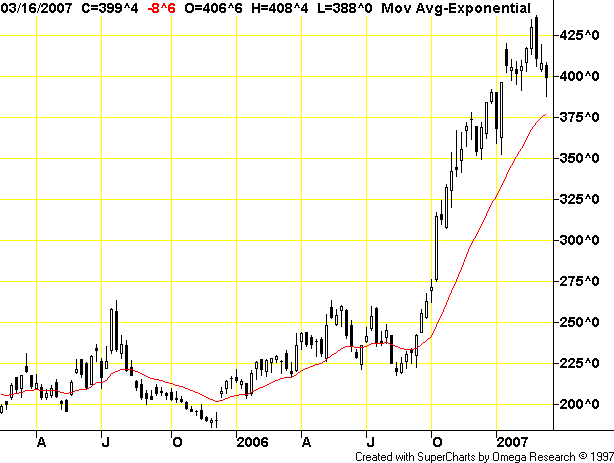
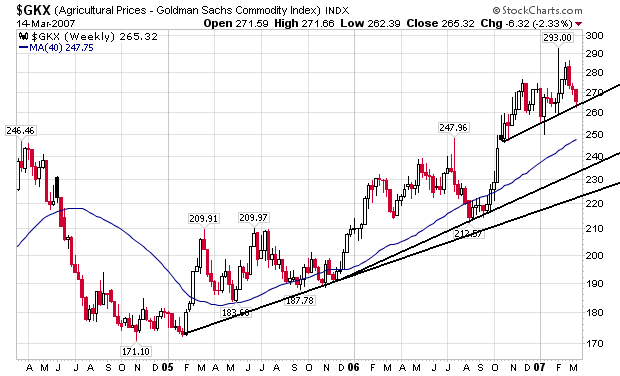
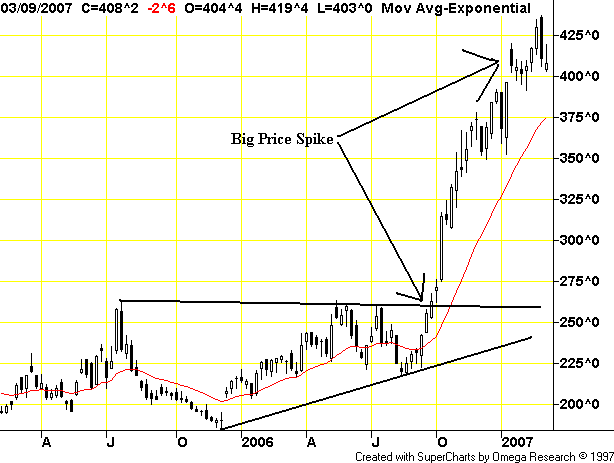
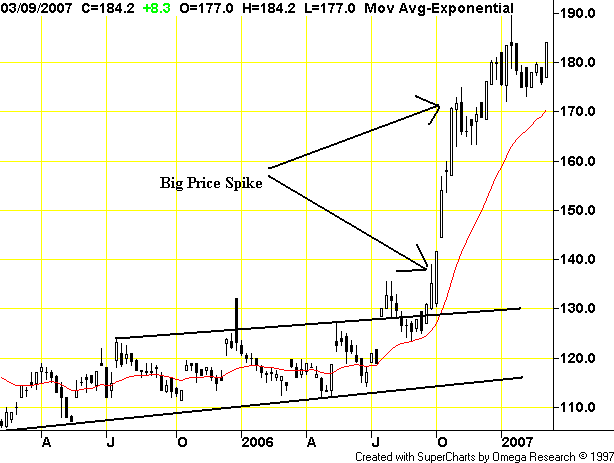
Last week the government released two inflation reports: the Producer Price Index and the Consumer Price Index. The PPI was released first. For the last three months, food prices at the producer level have increased 1.5%, 1.1% and 1.3% respectively. In the CPI report we learn that for the last three months food prices have increased .0%, .7% and .8%. These numbers are way above the trend so I looked at the CRB Agricultural Prices Chart. Here it is:

Photo Sharing and Video Hosting at Photobucket

Here are the individual price charts for various grain commodities:

Wheat:

Photo Sharing and Video Hosting at Photobucket

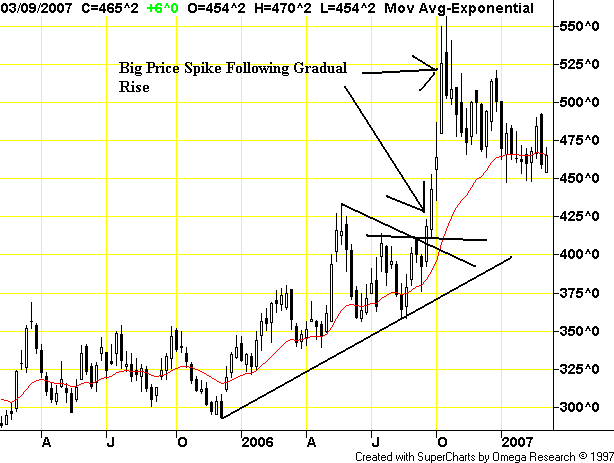
Feed Wheat:

Photo Sharing and Video Hosting at Photobucket

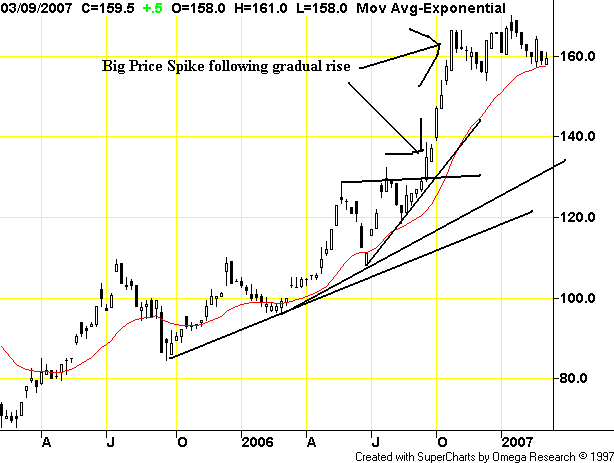
Corn:

Photo Sharing and Video Hosting at Photobucket

Barley:

Photo Sharing and Video Hosting at Photobucket

All of these charts are at least 1 year in duration or longer. This indicates we aren't seeing seasonal fluctuations (which futures are suppose to prevent in the first place). So, what's happening with these prices?

The information below is from the the Department of Agriculture's World Agricultural Production Report

Total US wheat production has dropped from 58.74 million metric tons in 2004 to a projected 49.32 in March of 2007. That's a drop of 16%. Over the same period (2004 to Match 2007's yearly projection) all European countries have decreased wheat production as well. Australia -- which has been hit by a drought -- has seen production drop from 22.60 to 10.5 million metric tons. Overall world production has dropped from 628.59 million metric tons in 2004 to 593.11 million metric tons -- a decrease of 5.62%.

US and world production of course grains is also down. US production has dropped from 319 million metric tons in 2004 to a projected 280 million metric tons in 2007. That's a decrease of 12.2%. Overall world production has dropped from 1,014 million metric tons in 2004 to a projected 966 million metric tons in March 2007. That's a decrease of 4.73%.

And corn production is also down in the US and the world. Over the 2004 to the projection 2007 yield, US production has dropped from 300 million metric tons to a projected 2007 yield of 267 million metric tons (or 11%) while world production has dropped from 712 million metric tons in 2004 to a 2007 projected yield of 693 million metric tons (or 2.66%).

Simple economics states that declining supply = increasing price.

In addition, we have demand increasing from two areas. The first is simple population growth. As more people are born they will naturally want to eat. This obviously increases demand. In addition, there is a new element to demand: synthetic fuels. As the US adopts policies that promote ethanol and other food based fuels, demand increases which pulls prices higher.

Simple economics states that increasing demand = increasing prices.

In other words, we have two basic economic events (decreasing supply and increasing demand) pulling prices higher.

So what does all of this mean? Economically we have several issues:

1.) Inflationary pressures. Last year oil was the big inflation boogie-man. Now food prices may take their place. The charts above show the food prices are spiking. With overall production down over the last three years and a projected lower production level this year supply won't pick-up until next year. That means food based inflationary pressures may be with us for at least another year.

2.) Higher inflationary pressures means the Fed will be less inclined to lower interest rates. If the economy continues to slow, the Fed won't be able to provide monetary stimulus. That could exacerbate an economic slowdown.

3.) The economy has been growing for the 2004-2007 time period, yet food production is down. There may be a bigger problem lurking here.

Anyone who has any insight, please provide it.

Friday, December 22, 2006

Powerful Interests Ally to Restructure Agriculture Subsidies

By Dan Morgan, Sarah Cohen and Gilbert M. Gaul
Washington Post Staff Writers
Friday, December 22, 2006; A01

There may be no better sign of the changing debate over the nation's farm subsidies: A Midwestern governor running for president calls for cuts in a system that has steered hundreds of millions of dollars a year to his state.

"I didn't get much of a reaction from farmers," said Iowa Gov. Tom Vilsack (D), "because deep down most of them know the system needs to be changed."

Politicians such as Vilsack have joined a host of interest groups from across the political spectrum that are pressing for changes in government assistance to agriculture. They want the money moved from large farmers to conservation, nutrition, rural development and energy research. Vilsack, for example, favors programs that improve environmental practices on farms.

Bread for the World, an anti-hunger organization, has brought religious leaders to Washington to lobby for cuts in subsidies, which they argue can lead to a glut on world markets that hurts poor farmers abroad. The Republican-leaning Club for Growth says subsidies stand in the way of a global trade deal that would help U.S. business. A politically potent coalition of unsubsidized fruit and vegetable growers from California and Florida want their share of the pie. Even the National Corn Growers Association, with 33,000 members, advocates an overhaul.

But these groups will be going up against one of Washington's most effective lobbies as Congress takes up a new farm bill next year.

The farm bloc is an efficient, tightknit club of farmers, rural banks, insurance companies, real estate operators and tractor dealers. Many of its Washington lobbyists are former lawmakers or congressional aides. Harnessed to dozens of grass-roots groups, such as the American Farm Bureau Federation, the National Cotton Council and the USA Rice Federation, farm-state lawmakers -- the "aggies," as they call themselves -- fight with the fervor of the embattled.

About 1.2 million farmers and farmland owners got $15 billion in income support or price guarantees in 2005, according to a Washington Post analysis of Agriculture Department payment records. The benefits are heavily tilted to large commercial farmers growing a few row crops in a handful of states. But the money also is widely distributed to a middle group of more than 130,000 farms, each receiving $25,000 to $100,000. The federal dollars ripple through local economies, adding to purchasing power at stores and businesses -- and creating a political constituency for the programs.

The farm bloc, says former congressman Cal M. Dooley (D-Calif.), now an executive with a food industry trade group, is "committed and focused."

Opening Loopholes

Ever since subsidies began in the New Deal, Farm Belt politicians from the Dakotas to the Gulf of Mexico have worked to expand the payments. They have repeatedly thwarted efforts to scale subsidies back by trading political favors, manipulating the USDA or strong-arming opponents.

In 1987, for example, Congress tried to close loopholes that allowed larger farms to exceed the limit on how much each could receive in annual federal payments. Some set up complex legal structures, such as dividing a single farm into many paper corporations, each eligible for the maximum payment. Congress decided that to get the money, a farmer or partner would have to be "actively engaged" in farming.

Lawmakers left it to the USDA to define active engagement. It proposed a standard of 1,000 hours a year spent managing the farm. But the language was drastically watered down after an objection from Rep. Thomas J. "Jerry" Huckaby (D-La.), then head of the subcommittee overseeing the rice program.

"We got direction from the author of the bill that what we were putting in the regulations was not what they intended," said former USDA official William Penn, referring to Huckaby. At the USDA, Penn drafted rules for complying with the legislation.

Huckaby, now president of a McLean real-estate company, explained his 1988 action in a recent e-mail: "The thinking was probably that you could make all the management decisions of a farming operation in significantly less time" than 1,000 hours.

The softer language meant that the structured corporate farms could continue almost unabated. In 2004, the most recent year available, at least 1,900 of these organizations collected $312 million more than they would have if their farms were held to strict limits, the Washington Post analysis shows.

Republicans critical of big government frequently tried to pare back the subsidies, with little success until the GOP gained control of the House and Senate. In 1996, Congress passed a landmark bill, nicknamed "Freedom to Farm." It was intended to wean growers off some traditional subsidies. But a couple of years later, when crop prices dropped, farm-bloc lawmakers earmarked billions of dollars for supplemental payments to farmers.

Then in 1999, Congress and the USDA, lobbied by Southern cotton interests, opened another loophole enabling farmers to keep unlimited proceeds under the government's main price-support program. An analysis of payment records shows that cost taxpayers more than $500 million for the 2004 crop, the most recent full crop year for which data are available.

Combest's Bill

One of the most remarkable examples of the farm lobby's power came in 2001 and 2002, when the existing farm bill was written, expanding payments again over the opposition of the White House and key lawmakers. Reformers see it as a cautionary tale.

The architect of the legislation was Rep. Larry Combest, an aggie through and through, a West Texas Republican who came from three generations of cotton farmers and who took control of the House Agriculture Committee in 1999.

Others on Combest's committee included a cattle rancher and tobacco farmer from Tennessee, a Missouri corn and hog farmer, and a government-subsidized rice farmer from Arkansas. The ranking Democrat, Charles W. Stenholm of Texas, had an ownership interest in cotton farms that got more than $300,000 in subsidies between 2001 and 2005, USDA records show.

With help from a generous mandate from the House Budget Committee -- chaired by Jim Nussle (R-Iowa) -- Combest produced a new farm bill in 2001 authorizing an eye-popping $50 billion, 10-year increase in price supports and income supports for farmers. He boasted that the measure was "a major step away from Freedom to Farm."

For one thing, the bill restored a key pillar of the pre-1996 program: cash payments that compensate for low crop prices. Thousands of farms were eligible even if they never grew crops. Budget officials estimated that change alone would cost $37 billion over a decade.

The Bush White House disliked Combest's bill. Chief political adviser Karl Rove saw it as the antithesis of fiscal responsibility. "We're Republicans," aides remember Rove grumbling. The White House budget office issued a stinging critique, saying the bill was too costly and failed to help farmers most in need.

Combest also faced strong opposition from a disgruntled group of Eastern and Midwestern lawmakers, and from senators who wanted tighter limits on what a farm could collect each year.

But Combest had a strong hand. "He hijacked the process," said a former USDA official who spoke on the condition of anonymity because he still deals with Congress.

At a meeting in Rove's office soon after the Sept. 11, 2001, attacks, Combest delivered a warning, according to several people with knowledge of the session. Unless the administration backed off, Combest warned, he and his farm-bloc allies would sink a top priority of President Bush's: legislation giving the president a free hand to negotiate a global trade treaty strongly favored by big corporations. "You have to ease up," one participant remembers Combest saying.

Over the next several months, the administration laid off its public criticism of Combest's farm bill. Combest withdrew his opposition to trade-promotion authority, and it squeaked through the House by a single vote. He declined to comment for this article.

'$275,000 Is Enough'

In the House, Reps. Ron Kind (D-Wis.) and Sherwood L. Boehlert (R-N.Y.) had 145 signatures for an amendment that would tear up Combest's handiwork and force him to start over. It proposed shifting billions of federal dollars from large farms to conservation programs that could help livestock operations and small farmers.

Among Kind's allies were "green Republicans" such as Rep. Wayne T. Gilchrist (R-Md.) and hunting and fishing groups championed by Rep. John D. Dingell (D-Mich.). But Combest's forces also had big guns behind them: more than 100 groups, such as the U.S. Canola Association and the American Bankers Association.

The Agriculture Committee's control over food-stamp funding -- a top priority for the black and Hispanic caucuses -- provided additional leverage. Combest's supporters "made it known that nutrition would be the victim" if the bill was rewritten, said Rep. Eva Clayton (D-N.C.), a member of the Congressional Black Caucus and the Agriculture Committee. "I encouraged members of the black caucus to vote against" the amendment, she said, "because of the nutrition impact."

Kind's amendment was defeated 226 to 200, with the black caucus providing 10 critical "no" votes. The next day the House overwhelmingly approved Combest's farm bill.

The farm bill passed the Senate, too. But not before an amendment sponsored by Sens. Charles E. Grassley (R-Iowa) and Byron L. Dorgan (D-N.D.) was approved 2 to 1. It aimed to close loopholes, including the 1999 provision that enabled Southern cotton planters to escape price-support limits. The same legislation set a hard ceiling of $275,000 annually for a farmer and spouse.

"$275,000 is enough," Grassley, a corn and soybean farmer who never collected more than $35,000 a year, told the Senate.

As House and Senate negotiators met to reconcile the two versions of the farm bill, Combest chaired the meetings. When the final bill emerged, the Grassley-Dorgan changes had all but vanished.

The bill did add a requirement that the USDA begin tracking payments more carefully so that in the future lawmakers could see the effects of changes in payment limits. A review of that data, released this week for the first time, suggests that Grassley's proposed limit would have saved taxpayers about $390 million for the 2004 crop.

"The simple fact of the matter is our Senate leaders let themselves be outmaneuvered," said Grassley, who voted against the final compromise version of the farm bill. "They were run over by Southern forces in the House, and they ended up with what the House wanted."

Grassley was not quite finished. He called the White House to lobby for a veto. "My reason was that the Senate had been sold out on everything," he said.

But White House aides, aware of the importance of the farm-bill money to red states with midterm elections nearing, did not recommend a veto. Before signing the legislation, Bush praised Combest for a "job well done."

Combest's legislative victory turned out to be his last big farm battle. He resigned from the House for personal reasons in 2003. Shortly before he left, the National Cotton Council paid for him and his wife to travel to its annual meeting in Tampa. There Combest was awarded the Harry S. Baker Distinguished Service Award for Cotton for his "invaluable assistance to the U.S. cotton industry."

The New Battle

Combest, now a lobbyist for the USA Rice Federation, has called on Congress to extend the bill he helped write -- which expires Sept. 30, 2007 -- rather than draft new legislation. That is also the position of the American Farm Bureau Federation, which has 5.2 million members. "You have programs that have been in place for 60 years," said the group's president, Bob Stallman, a Texas rice grower. "You have to be careful or you can have very destructive effects in farm country."

The farm groups are counting on the new Democratic chairmen of the Senate and House agriculture committees, Sen. Tom Harkin (Iowa) and Rep. Collin C. Peterson (Minn.), who have long supported the subsidy system.

But a number of political and economic forces have changed since the last farm bill, and those seeking reform think the tide is flowing in their direction.

Corn farmers are making record profits because of their sales to ethanol plants across the Midwest. That calls into question whether it is politically sustainable for them to continue receiving billions of dollars a year in automatic federal allowances.

International pressure also has been building against U.S. subsidies. The World Trade Organization, the Geneva-based supreme court of the global economy, ruled last year that key U.S. cotton subsidies are illegal. The United States must remove the subsidies, or Brazil, which filed the complaint, can retaliate. Other foreign challenges to other subsidies are possible.

Another difference is that money for a new farm bill will be tighter than in 2001 because the government is facing big budget deficits. "Expect a smaller pie," the House Agriculture Committee's chief economist recently told members in a briefing paper.

Vilsack, the Iowa governor, said emerging markets for crops, such as corn-based ethanol, make it more likely there will be sustained demand and good prices "without the necessity of subsidizing crops to the extent we have."

Vilsack, who once represented farmers in his law practice, said many farmers are uneasy about the subsidy system and how it can distort the market for crops and land. "They'll take the checks," he said, "but most would prefer a system where the market sets prices."

Kind and Grassley plan to renew their efforts to cut some subsidies and redistribute others. Kind's new bill would offer incentives to farmers to expand conservation efforts and bring U.S. policy in line with WTO rules.

"It ain't an easy fight," said Rick Swartz, a Washington lawyer who works with the Alliance for Sensible Agriculture Policies, an informal grouping of diverse organizations lobbying for change. "There's a lot of inertia, and you've got ag committee members whose states get the bulk of the money."

Swartz has said the alliance participants, which include the well-heeled Club for Growth, plan to spend about $10 million over the next 18 months lobbying for changes in the farm bill.

The involvement of groups such as Oxfam America and Bread for the World "enables lawmakers who oppose subsidies to use the moral argument" against farm-state members who trot out images of struggling American family farmers, said a senior congressional aide.

Oxfam America President Raymond C. Offenheiser said the group will step up its lobbying. "We think there is a vision for American agriculture that doesn't just deliver benefits to a small group of people," he said.

Offenheiser said Oxfam already has brought farmers from Africa to meet U.S. farmers in the Midwest.

"We wanted to show," he said, "how they're both victims of the last farm bill."

Research editor Alice Crites contributed to this report.

Friday, December 8, 2006

UN plea for millions in Palestinian aid amid fears of economic collapse

· Half of population going short of food, agencies say

· Senior officials warn of breakdown of government

Rory McCarthy in Jerusalem
Friday December 8, 2006
The Guardian


Food aid in Khan Yunis refugee camp
A Palestinian man receives food aid in Khan Yunis refugee camp. Photograph: Ibraheem Abu Mustafa/Reuters
UN aid agencies launched their biggest appeal for funding to tackle the humanitarian crisis in the Palestinian territories yesterday, asking for $453m (£231m) for next year and warning of a weakening in the Palestinians' ability to govern.

Senior UN aid officials in Jerusalem said there were clear signs of a worsening economic crisis. Around two thirds of the 4 million Palestinian population were living below the poverty line and half the population were "food-insecure", meaning they could not afford the basic foods to meet dietary needs. Unemployment was running as high as 40% in the Gaza strip and at around 25% in the West Bank.

Most of the money will be spent on emergency food aid and economic recovery, including job programmes. Kevin Kennedy, the UN humanitarian coordinator, said the crisis was not only an economic collapse but was also tied to an increase in closures and access restrictions imposed on the occupied territories by the Israeli government and to continued conflict, internal political fighting and a breakdown of law and order.

The UN has warned there has been a gradual weakening of the Palestinian Authority. The crisis results from an international boycott imposed in March after the Hamas militant movement won elections and formed a government. Israel has since withheld $60m a month of tax revenues that should go to the Palestinians.

Although some of that money has been spent paying the Palestinian bills of Israeli electricity and water companies, the Israelis have now withheld nearly $600m.

The international community, under the Quartet of the US, the UN, the EU and Russia, has also halted direct funding to the Palestinian government, saying it must recognise Israel, halt violence and accept past peace agreements. The freeze means salaries for 160,000 government workers have largely gone unpaid.

Mr Kennedy said the UN programme was not trying to replace the Palestinian Authority, but he added: "Obviously the longer the current situation continues, with further deterioration, a lack of salaries, people on strike, continued military conflict on both sides, [the] further [the] weakening of the Palestinian Authority and its institutions."

The Quartet has proposed that Israel begin passing on the tax revenues it owes via a system called the temporary international mechanism, which channels money to the office of the Palestinian president, Mahmoud Abbas, a leader of the more moderate Fatah party, and not directly to the rival Hamas government. But so far Israel is withholding the revenues.

In the past year the UN said there had been a 40% increase in the number of barriers and checkpoints across the West Bank. In addition, there have been continued closures of the crossing points for people and goods out of Gaza. Under an agreement negotiated last November, Israel was to open up the main crossing points to relieve the economic crisis. But the crossings have in effect been closed, with Israel citing security concerns.

On top of the economic crisis and the restrictions on movement, in recent weeks talks between Mr Abbas and Hamas to form a coalition government appear to have entirely broken down.