Showing posts with label loans. Show all posts

Thursday, March 22, 2007

Toxic Waste in the Sub-Prime Market: Waiting for the Bodies to Float Up

March 22, 2007

By ROBIN BLACKBURN

In recent times high-profile Wall Street investment banks have brought slick financial reasoning to the base art of loan-sharking. The most vulnerable Americans have been targeted for loans they can ill afford. Those with poor credit histories can be charged at double or treble the interest of a customer in good standing with the rating agencies. By the end of last year housing loans to six million unrated customers ­ 'sub-prime' mortgages ­ totalled $600 billion.

Three or four years ago Citigroup, Bear Stearns, Goldman Sachs, Lehman Brothers and HSBC acquired 'sub-prime' lenders ('loan sharks') which they historically regarded with disdain. Citigroup acquired Associates First Capital, and HSBC bought Household Finance, blazing a trail others were to follow. Finance houses have long teamed up with retailers to shower so-called gold and platinum cards on all and sundry with the hope of ratchetin up consumer debt - rising from 110 per cent of personal disposable income in 2002 to 130 per cent in 2006 - and subsequently charging an annual 18 or 20 per cent on money for which the banks are paying four or five per cent. Such hot rates of return gave the banks a taste for seamy lending. They discovered how to limit their own exposure, while raking in the charges, by re-packaging the debts as CDOs (Collateralised Debt Obligations) in which they capture the risk premium while sloughing off the risk.

With direct access to sub-prime mortgages, the banks and hedge funds bundle together and divide up the debt into ten tranches, each of which represents a claim over the underlying securities but with the lowest trench representing the first tenth to default, the next tranche the second poorest-paying tranche and so on up to the top tenth. Borrowers who can only negotiate a sub-prime mortgage have either poor collateral or poor income prospects, or both, and that is why they must pay over the odds. Of course the bottom tranche of the CDO ­ euphemistically designated the 'equity' ­ is very vulnerable but can still be sold cheaply to someone as a bargain. The purchaser will also be assured by those assembling the CDO that they can hedge the possibility of defaults in the 'equity tranche' by taking out insurance against it. The bank will ­for an extra fee ­ also arrange this insurance, making the entire 'credit derivative' product very complex and difficult to value.

The top tranches, and even many of the medium tranches, will be more secure yet will pay a good return. The chief executive of a mortgage broker explains: 'Sub-prime mortgages are the ideal sector for the investment banks, as their wider margins provide a strong protected cash-flow and the risk history has been favourable. If the investment bank packages the securities bonds for sale, including the deeply subordinated risk tranches, it can, in effect, lock in a guaranteed return with little or no capital exposureGenerally investment banks do not like lending money but they are good at measuring risk, parcelling this up and optimising its value.' For such reasons Morgan Stanley purchased Advantage Home Loans, Merrill Lynch bought Mortgages PLC and Lehman Brothers acquired Southern Pacific Mortgages and Preferred Mortgages.

The investment banks are playing a rapidly-moving game of 'pass the parcel'. Ideally the loans are bought one day, packaged over-night in India, and then sold on to institutional investors the next day. In recent months 'sub-prime' defaults have jumped. A Lehman Brothers analyst warns that some $225 billion worth of sub-prime loans will be in default by the end of 2007 but others say the figure will be nearer $300 billion. The 'equity tranch' is now dubbed 'toxic waste' by the insiders and analysts are waiting to see which bodies float to the surface. In early March the New York Stock Exchange suspended New Century Financial, a company which had taken on insurance obligations for submerged tranches of mortgage debt for most of the big banks.

The vulnerable in today's America certainly include the aged and unemployed who risk their one possession by re-mortgaging their home to an investment bank. But many of the middle class find themselves vulnerable too. In recent years they have lost health care and pension benefits and have been tempted by easy credit into purchases they discover they can ill-afford. The Wall Street Journal reports:

Last week, HCBCs chief executive officer, Michael Geoghegan, sought to dispel the notion that the bank had lowered its lending requirements. The typical customer of HSBC Finance Corp., which oversees the bank's U.S. consumer finance business, has an average household income of $83,000, is 41 years old, has two children and a home worth $190,000. Mr Geoghegan told investors: "This is Main Street America", he said'.

Helped by their role in packaging and selling such 'credit derivatives' as mortage-backed CDOs the banks achieved remarkably good profits right through the post-bubble trough and well into the subsequent recovery. However indebted consumers were not so good for non-financial corporations in the post-bubble era since demand was dampened - by 2003 18 per cent of the disposable income of US consumers was required to service debt and only a housing price boom and re-mortgaging maintained consumer purchasing power. Neither the Fed nor the SEC were keen to crack down on the mortgage bonanza because it helped to maintain consumer demand and market buoyancy. The default crunch will not only cause great unhappiness to the victims ­ who stand to lose their homes - it hurts the housing market and increases the chances of a downturn.


Robin Blackburn is the author of Age Shock: How Finance Is Failing Us (2007), a comprehensive account of risk and social insecurity in the age of financialization. See also Blackburn's, 'Financialization and the Fourth Dimension', New Left Review, May-June 2006. He can be reached at robinblackburn68@hotmail.com

Wednesday, March 21, 2007

Mortgage demand falls despite low rates

Home loan demand drops for 1st time in 4 weeks

By Julie Haviv 1 hour, 15 minutes ago

U.S. mortgage applications fell last week for the first time in four weeks, reflecting a drop in demand for home refinancing even as interest rates hovered near recent lows, an industry trade group said on Wednesday.

The Mortgage Bankers Association said its seasonally adjusted index of mortgage application activity for the week ended March 16, which includes both refinancing and purchasing loans, decreased 2.7 percent to 672.1.

Applications, however, were 19.0 percent above their year-ago level. The four-week moving average of mortgage applications, which smooths the volatile weekly figures, was up 2.5 percent to 665.1.

Phillip Neuhart, an economic analyst at Wachovia Corp. in Charlotte, North Carolina, said the U.S. housing market has become increasingly pivotal to Federal Reserve monetary policy and right now they are taking a "wait-and-see" attitude.

"I don't think the Fed is going to drop rates in the near-term since core inflation is above their comfort zone," he said. "They are not going to cut off their nose to spite their face."

Market participants will be looking for any hints from Federal Reserve policy-makers at the conclusion of a two-day meeting Wednesday afternoon that they may be concerned about the level of subprime loan defaults and the potential impact on the U.S. economy.

"I don't see the Fed getting caught up in headline and headline risk," Neuhart said.

Rapidly rising defaults in the subprime mortgage market, which caters to borrowers with poor credit histories, and collapsing lenders may be taking a toll on home sales.

The MBA's seasonally adjusted purchase index, considered a timely gauge of U.S. home sales, fell 0.9 percent to 410.6. The index, however, was above its year-ago level of 393.6, a rise of 4.3 percent.

"With regulators looking to tighten up lending standards, it will be a supply constraint on mortgage issuance," said Neuhart. "If the supply of loans is limited, there are going to be fewer homebuyers since they can't get a mortgage."

REFINANCING SKIDS BUT ABOVE YEAR-AGO

Borrowing costs on 30-year fixed-rate mortgages, excluding fees, averaged 6.06 percent, up 0.03 percentage point from the previous week when it reached its lowest level since early December.

Interest rates were also significantly below year-ago levels of 6.31 percent.

While demand for home loan refinancing lost its luster last week, it was sharply above its year-ago level.

The group's seasonally adjusted index of refinancing applications slipped 4.5 percent to 2,208.6, up 40.3 percent from a year ago when the index stood at 1,574.5.

The refinance share of applications fell to 45.3 percent from 46.2 percent the previous week.

Fixed 15-year mortgage rates averaged 5.79 percent, slightly up from 5.78 percent. Rates on one-year adjustable-rate mortgages increased to 5.88 percent from 5.86.

The ARM share of activity slipped to 20.9 percent from 21.9 percent the previous week.

U.S. housing industry indexes, in general, tend to be volatile and have recently painted a mixed picture, with some pointing to weakening and others to stabilization in the hard-hit sector.

The Mortgage Bankers Association's survey covers about 50 percent of all U.S. retail residential loans. Respondents include mortgage banks, commercial banks and thrifts.

Mortgage Meltdown: Wall Street Journal indicts Greenspan

Mortgage Meltdown

By Andy Laperriere

Stock markets world-wide have sold off the past few weeks over concerns the collapse of the subprime mortgage industry could prolong and deepen the housing slump and threaten the health of the U.S. economy. Federal Reserve officials and most economists believe the problems in the subprime mortgage market will remain relatively contained, but there is compelling evidence that the failure of subprime loans may be the start of a painful unwinding of a housing bubble that was fueled by easy money and loose lending practices.

***

The fact that Congress is now holding hearings on the fallout from the second major asset price bubble in the last decade should prompt some broader questions. For example, what role did the Fed's loose monetary policy from 2002-2004 play in fueling the housing bubble? Should the Federal Reserve reexamine its policy of ignoring asset bubbles?

Asset bubbles are harmful for the same reason high inflation is: Both create misleading price signals that lead to a misallocation of economic resources and sow the seeds for an inevitable bust. The unwinding of today's housing bubble is not merely an academic question; it is likely to inflict real hardship on millions of Americans. To reduce the risk of a similar outcome in the future, it is important that policy makers, economists, and policy analysts properly diagnose the root causes of the current housing bust, not just its symptoms.

***

Federal Reserve officials and most economists believe the problems in the subprime mortgage market will remain relatively contained, but there is compelling evidence that the failure of subprime loans may be the start of a painful unwinding of a housing bubble that was fueled by easy money and loose lending practices.

Whether measured in absolute terms or time-tested metrics such as price-to-income or price-to-rent ratios, the rise in U.S. home prices during the past six years is unprecedented. What's more, not only has mortgage debt doubled during this time, but loans have been offered on imprudent terms (for instance, a no down payment, no income verification loan to a borrower with a checkered credit history).

***

Far from being limited to the subprime market, the data show these risky loan features have become widespread. According to Credit Suisse, the number of no or low documentation loans -- so-called "liar loans" -- has increased to 49% last year from 18% of purchase loans in 2001, a nearly three-fold increase. The investment bank also found that borrowers put up less than a 5% down payment in 46% of all home purchases last year. Inside Mortgage Finance estimates that nontraditional mortgages -- mostly interest-only and pay-option ARMs that allow the borrower to defer paying back principal or even increase the loan balance each month -- which barely existed five years ago, grew to close to a third of all mortgages last year.

***

Foreclosure losses as a share of the economy will be small and most homeowners have a comfortable amount of equity in their homes. In fact, about one-third of homeowners have no mortgage and own their homes outright, but they are not the reason home prices have been driven to the stratosphere. Home prices -- like all prices -- are set at the margin.

It was the marginal buyer, particularly the subprime borrower and housing speculator, who drove prices higher. The easing of lending terms increased the demand for homes, and since the supply of homes is relatively fixed (or inelastic), this increase in demand quickly translated into higher prices. As the loose lending practices are inevitably reversed -- and there is a wide chasm between current lending practices and prudent lending terms -- fewer people will be able to afford to buy a house, which will reduce demand and push home prices lower.

***

It's not the size of foreclosure losses as a share of the economy that matters, it is the effect those losses have on the availability of credit. When banks (and investors in mortgage-backed securities) begin suffering losses, they inevitably pull back. This is why so many subprime companies have gone bankrupt virtually overnight; investors balked at buying subprime loans except at a steep discount, which produced immediate losses. In effect, their ability to profitably finance new loans was eliminated.

***

Asset bubbles are harmful for the same reason high inflation is: Both create misleading price signals that lead to a misallocation of economic resources and sow the seeds for an inevitable bust. The unwinding of today's housing bubble is not merely an academic question; it is likely to inflict real hardship on millions of Americans. To reduce the risk of a similar outcome in the future, it is important that policy makers, economists, and policy analysts properly diagnose the root causes of the current housing bust, not just its symptoms.

Monday, March 19, 2007

States Tried to Stop Subprime Bubble- but Bush Shut them Down

Rewarding Work

by J. Mijin Cha


The Predatory Lending Bubble and How the Feds Made it Worse

The trouble in the subprime lending market is sending ripples through Wall Street. One of the biggest subprime lenders, New Century, has been de-listed from the New York Stock Exchange.
As this Dispatch will detail, the current mortgage and foreclosure crisis is the result of years of irresponsible lending and federal policies that shut down efforts by state and local governments to restrain the predatory lending practices that set the country up for this crisis. Despite these roadblocks by the federal government, many states are still finding solutions to help prevent these abusive lending practices.

More Resources

Rewarding Work

The Crisis in Subprime Lending

At the end of last year, late mortgage payments reached the highest level in over three years and new foreclosures reached record levels. The cause? Subprime loans, that is loans for people with bad or limited credit which carry a higher interest rate, and often unfavorable terms. A report released in December 2006 shows that as many as 2.2 million subprime borrowers face foreclosure on their home loans.

Abusive Mortgage Lending: The subprime lending market is aimed at families who have bad credit or trouble getting credit. While on the surface, it seems like these loans help families with bad credit purchase homes, deceptive marketing practices and lack of information for customers create an environment of abusive lending. The Center for Responsible Lending lists seven signs of predatory lending. Among some of the more striking:

  • Excessive Fees- costs that are not directly reflected in interest rates that can reach over 5 percent of the loan amount.
  • Abusive Prepayment Penalties- Up to 80 percent of subprime loans carry a prepayment penalty in order to discourage refinancing at less abusive terms-- penalties that can cost more than six months' interest.
  • Kickback to Brokers- when brokers deliver a loan with an inflated interest rate, the mortgage broker gets a cash bonus.

What made the problem most acute for these subprime borrowers is that when the Federal reserveBusiness Week wrote just a week ago, "About $265 billion worth of subprime loans are scheduled to have their rates adjusted upward in 2007...Many stretched homeowners may soon be paying 11% or 12% on their mortgages, while everyone else can get 30-year fixed-rate loans at a little over 6%...In effect, monetary policy is turning into a regressive tax." hiked interest rates, most borrowers could refinance to long-term loans whose rates have barely moved in the past three years. People with poor credit, however, absorbed the brunt of the shift, since their contracts usually hiked their mortgage rates in tandem with the Federal Reserve rate hikes-- and either their contracts or their bad credit prevented them from escaping these mortgages as their monthly payments skyrocketed. As

Other Predatory Practices: Subprime mortgage lending is one example of the larger problem of predatory lending imposing unfair and abusive loan terms on vulnerable buyers. One additional disturbing form of predatory lending is payday lending -where a postdated check is exchanged for a smaller amount of cash. If the check bounces for any reason, such as a health emergency or an unforeseen layoff, the borrower gets stuck in a near-impossible debt trap as the interest rate for payday lending can be as high as 911 percent for one week, 456 percent for a two week loan and 212 percent for a one-month loan. This form of lending has been particularly detrimental for military servicepeople. 20 percent of service men and women use payday loans. Predatory payday lending costs military families over $80 million a year in abusive fees.

More Resources

Rewarding Work

How the Feds Pre-Empted State Law

With millions of families facing these exploitive lending practices, the question is why the government didn't act to stop it? The answer is that the states did act-- but the federal government, backed by campaign contributions from predatory lenders, shut them down and helped create this mortgage crisis.

Back in 1994, Congress did pass the Home Ownership and Equity Protection Act to protect homeowners. The law was meant to be the floor for protection: states could go above and beyond the protections offered in the Act and since then, over 30 states have passed laws offering more protection than the federal Act.

Bush Administration Preempts State Laws: However, state and local efforts have been pre-empted by the Office of Thrift Supervision (OTS) and the Office of the Comptroller of the Currency (OCC). The OCC, in particular, has promoted a theory of "field preemption" that would preempt all state laws and insulate national banks and their operating subsidiaries from virtually all state regulation. This effectively destroys any state's ability to regulate the business activities of all banks. The OCC preempted Georgia's Fair Lending Act, which had offered protection against predatory lending, including outlawing extreme prepayment fees or penalties, unreasonable monthly payments, and increased interest rates after default. This was followed by the OCC preempting the New Jersey Home Ownership Security Act, which prohibited abusive lending practices and challenges to other state laws have followed. Adding to the attack on state authority, some in Congress proposed laws to further preempt state authority over mortgage lending. One of the chief sponsors of the preemption bill was Congressman Bob Ney, who was convicted of bribery for his role in the Abramoff scandal.

Courts and Preemption: The courts have largely backed this federal preemption of state authority, with federal courts striking down predatory lending laws in a number of states. After the Sixth Circuit Court of Appeals struck down state banking laws in Michigan, the Supreme Court agreed to hear the case and will be making a ruling soon on whether some parts of state regulation will survive preemption.

Yet whatever the courts decide now, the damage has been done. During the critical period of the recent housing bubble, as speculation and predatory lending ran riot, state regulators were so involved in defending their laws in court that their effectiveness was undermined and the costs are being borne by some of the most vulnerable borrowers in the market.

More Resources

Rewarding Work

States Rally to Increase Protection

In examining the predatory lending crisis, the Carsey Institute at the University of New Hampshire released a report that included several simple steps government can take to protect their citizens against predatory lending:

  • Reduce excessive points and fees that strip equity from borrowers
  • Provide consumers with additional protection for high cost loans, such as prohibiting pre-payment penalties or prohibiting financing of fees
  • Require interest rates to reflect the risk of the loan rather than upfront points and fees that strip equity from borrowers
  • Protect consumers in disputes with lenders, such as prohibiting mandatory arbitration, which tends to favor lenders
  • Require a net tangible benefit to the borrower in any refinance loan

The bottom-line is that we need common-sense rules that prevent consumers from ending up with loans costing far higher than they thought they were signing up for initially.

State Mortgage Laws: While state laws are under challenge, there is hope that the Supreme Court will restore more authority to state regulators. Some laws and administrative actions worth highlighting:

  • The Center for Responsible Lending and ACORN each track past and present predatory lending laws from around the states. As one example, Wisconsin passed a bill that prohibits balloon payments, a payment that is more than twice as large as the average of all earlier scheduled payments, limits the amount of interest that a lender can receive on a loan, and other protections for borrowers, including a full disclosure of loan terms to borrowers. There was a clarification issued by the Wisconsin Director of Legal Affairs, but the Act was not preempted.
  • Connecticut introduced a bill to regulate predatory lending. SB 1039 would cap the interest charged at 12 percent per annum for loans that are less than $15,000. The text of the bill also specifically states that the provisions of the bill are to be applied to payday loans. Unfortunately, the bill died in committee.
  • The Illinois House introduced HB 1478, the Predatory Lending Protection Act. The Act prohibits the imposition of prepayment penalties, flipping of loans and lend financing of credit insurance. The Act also imposes limitations on high-cost loans and prohibits lending unless the lender reasonably believes that the borrower is able to make the payments to repay the loan.

  • Minnesota HF 387 requires lenders to ensure that borrowers are able to make the principal and interest payments on the loans before the loan is granted and prohibits the flipping of loans.

  • The recent slew of subprime lenders going bankrupt has spurred state action to protect their constituents. New Hampshire's state Banking Department ordered New Century Financial Corp. to stop accepting new loan applications on Wednesday and six weeks ago charged Mortgage Lenders Network USA, INC.. with failing to fund mortgages on which it had closed. Massachusetts Secretary of State William F. Galvin has demanded documents from two Wall Street firms over their recommendations on subprime lenders.
  • States are also taking action against the related abuse of payday loans: Eleven states have interest rate limits on payday lenders and proposals are being debated in ten other states. Virginia has just capped payday loan interest rates at 72 percent, still high but a vast improvement over the 400 percent payday lenders had been charging. Going even further, New Hampshire is debating a bill that would close the doors on payday loan shops. The New Hampshire bill would prevent any person from making a loan with an interest rate higher than 30 percent.

More Resources

Rewarding Work

Conclusion

The new Congress seems more willing to grapple with the predatory lending problem, with Congressman Barney Frank from Massachusetts saying he would introduce legislation to restrict subprime lending. But while the Federal government may be trying to help the situation now, the debacle of recent years is a lesson in why federal preemption of state laws is often a recipe for disaster. While minimum federal standards are often needed, states are usually aware more quickly of problems appearing locally that need additional regulation, such as the explosion of predatory lending. We should remember in coming years that by tying the hands of state governments, federal regulators made a bad problem far, far worse.

More Resources

---
URL

Sunday, March 18, 2007

Borrowers, Beware

By James Grant

Sunday, March 18, 2007; B01

The top man at the Treasury Department urged calm last week in the face of losses on Wall Street brought on by fears of defaults on the riskier kinds of mortgages. Really, he said, the damage is easily containable.

But of all people, Henry M. Paulson Jr., former head of the New York investment banking house of Goldman Sachs, should know just how reasonable this near-panic was. Easy credit has long been the American financial lifeblood. Anything resembling stringency on the part of our formerly carefree lenders would tend to set the economy on its ear.

Easy credit financed the bull market in houses and the flood of home refinancings. Americans felt richer and spent as though they were. It stands to reason that the withdrawal of this manna will lead them to spend less -- with substantial collateral damage to the housing-centered U.S. consumer economy, and, perhaps, well beyond. Our captains of industry owe as much to their lenders' leniency as does any subprime, or high-risk, home buyer. They, too, have been able to raise money on terms unimaginable only four years ago.

All this sounds scary enough, and it is. But financial history offers some solace. The U.S. economy excels in the art of facing up to error -- of identifying it, reappraising it and then repricing it. Loans, especially the risky kind, have been mispriced. They were, and are, too cheap. They will be repriced -- as they were, for example, in the aftermath of the junk-bond and real-estate troubles of the late 1980s and early 1990s. Borrowing costs will go up, and the value of the things that debt financed will tend to go down. In an attempt to ease the pain, the Federal Reserve will print more money.

A sign of the times was the announcement the other day by the top U.S. mortgage lender, Countrywide Financial, that it will no longer help the average Joe or Jane buy a house with not one dollar down. The era of lending home buyers 100 percent of the purchase price is over, it said. The other surviving mortgage originators have been forced to adopt similar policies -- not as stringent as in Grandfather's day, but a radical departure from the free-and-easy ways of the recent past.

It wouldn't matter so much if the new sobriety affected only a narrow segment of the home-buying population. But no less than 40 percent of the residential real estate market faces a much higher borrowing bar, according to a new report from Credit Suisse. About one in five of last year's mortgage originations could not have been booked if 2007 standards had applied, the banking firm estimates.

But the ripples from this cold bath go even further than the $8 trillion mortgage market. The truth is that the no-down-payment, no-documentation, interest-only mortgage loan has its counterparts in most branches of American finance.

The date of the last ceremonial burning of an American mortgage is lost in the mists of time. Outright, unencumbered ownership of a house, a building or a corporation is no longer an ideal that most Americans embrace. The new goal is to borrow as much as possible, as soon as possible, against any asset that could be financed. And these days -- thanks to Wall Street's ingenuity --all manner of assets pass as good collateral for a loan.

Up until just the other day, nearly every home buyer could qualify for a little more house than he or she could decently afford. The same holds true, with no interruption to date, for the billionaire buyers of businesses. On Wall Street, as on Main Street, borrowers have had to beat the lenders away with a stick. The question before the house is whether Wall Street's lenders will catch Main Street's jitters.

Many are the wellsprings of credit in this age of financial invention. The Federal Reserve, for example, pushed down the interest rate it alone controls to just 1 percent in 2003 (and held it there for 12 months). But the Fed is only one central bank. Interest rates are low the world over. You can borrow in Japan for about 1 percent today -- and many hedge funds do.

Lenders are herding creatures. They tend to think the same thoughts at the same time. In consequence, credit ebbs and flows in cycles. Imagine a bankers' migration between point A, which we may call "No way," and point B, which we will designate "Come and get it." Just such a movement got underway in 2002-03. At the start of this journey, risky credit instruments -- junk bonds, for example -- were virtually unmarketable. Lenders feared the fallout from the burst stock-market bubble. Before long, however, lenders and borrowers regained their courage. But now, having long tarried at "Come and get it," they are reversing course for "No way." The migration has only just begun.

Free-and-easy lending not only financed the run-up in house prices (and the attendant massive drawdown of homeowners' equity). It also spawned the upsurge in corporate-acquisition activity. Business borrowing costs in relation to the Treasury's borrowing costs are at near-record lows. Exotic borrowing terms designed to enable investors to pay higher and higher prices for businesses are still freely available. The standard fine print once demanded by lenders in loan documents to protect against wayward borrowers is increasingly being waived. Last week, Stephen A. Schwarzman, chairman and chief executive of the Blackstone Group, a leader in the private-equity field, informed a New York audience that he could raise $20 billion with only a few phone calls -- and without the inhibiting fine print, of course.

Lenders read the newspapers, too. All but the greenest understand the risks of overdoing it. What, then, could they possibly be thinking about? For many, it is the serenity of the recent past. It seemed that nothing could go wrong in American finance. Stocks went up (or, at least, not down). Inflation was contained. Defaults were few and far between. Until the tiny Metropolitan Savings Bank of Pittsburgh bit the dust last month, no federally insured bank had failed for 2 1/2 years, the longest such streak since the Federal Deposit Insurance Corp. opened its doors in 1934. And when a company did file for bankruptcy protection, more lenders rushed to its aid.

Last Tuesday brought word that delinquencies among subprime mortgage borrowers had hit a four-year high. Few had expected it. Housing will be fine as long as the economy is upright, standard Wall Street thinking had it. But the optimists failed to reckon with the lenders. The sheer recklessness of recent mortgage underwriting practices has done the kind of damage to the creditworthiness of the American homeowner that only recessions used to inflict.

Always, the knee bone is connected to the thigh bone. Especially in this age of global markets, the two are tightly joined. Nowadays, loans rarely rest on the balance sheets of the lenders who make them. Rather, they are scooped up and fashioned into securities -- "asset-backed securities." And these are gathered up and refashioned into still other securities -- "collateralized debt obligations." And the CDOs, many of them dizzyingly complex, are sold to investors the world over. No bank regulator watches over these financial sausage-making operations. As the Federal Reserve has receded in importance in this worldwide financial system of ours, so has the U.S. banking system. A parallel kind of banking system has come into existence. Wall Street calls it the "CDO machine."

The CDO machine is a component of the infernal engine of international finance. This nation is privileged to be able to consume much more than it produces. We buy foreign goods, paying with dollars. The foreigners most generously consent to invest these dollars in U.S. stocks, bonds, CDOs and the like. Many of these CDOs are packed with mortgages, including the subprime, or low-grade, variety.

In a speech two years ago, Federal Reserve Chairman Ben S. Bernanke pointed to a curious coincidence: Growth in U.S. mortgage debt tracks closely with the growth in the trade deficit -- that is, the difference between what we consume and what we produce. "Over the past two decades," he said, "major innovations in the United States have improved the availability and lowered the costs of home mortgages. These developments likely spurred homeowners to tap increasing home equity to finance consumer expenditures beyond home purchase. In contrast, mortgage debt is not so readily available among our trading partners as a vehicle to finance consumption expenditures."

If I were the head of state of one of our trading partners, I would be asking myself if these "major innovations" were as wholesome as they used to seem. Deciding not, I would command my minister of investments to unload U.S. mortgage holdings. And I would imagine that I would not be the only head of state to whom this thought had occurred.

Naturally, Congress will want to know whom to blame for this reckless lending and borrowing. The usual suspects come to mind: the Fed for pushing interest rates down to half-century lows, the bond-rating agencies for sugarcoating the risk on mortgage-backed securities and the lenders who competed with one another to see who could operate in defiance of the greatest number of canons of prudent credit practice. It was Congress itself that eliminated tax deductions on interest for nearly all consumer debt -- but let them stand for residential mortgages.

But our lawmakers should not forget to call human nature to account. In 1886, 40 years before the birth of former Fed chief Alan Greenspan, the Great Plains was the scene of a terrific real-estate boom, financed by the most reckless kind of lending. There was no Fed, and there were no rating agencies, just lenders and borrowers taking leave of their senses. They returned to them, eventually. They always do.

editor@grantspub.com

James Grant is the editor of Grant's Interest Rate Observer.

Friday, March 16, 2007

Subprime spiral poses biggest investor risk: Lehman (See this one)

Related
Mortgage lenders get a lifeline, troubles linger
Sub-prime mortgage crisis could torpedo 2007 economy
Top investor sees U.S. property crash
---


Fri Mar 16, 2:51 AM ET

A Wall Street fixed income strategist warned on Thursday that the greatest risk investors face is for the troubled U.S. subprime lending sector to trigger a spiral of falling home prices and mortgage defaults.

There is not enough evidence to indicate such a scenario is taking place, but the risk of a broader market impact is "very real," Adam Topalian, fixed income strategist at Lehman Brothers, said at a dinner for investment professionals.

The test will be whether lenders tighten up when $900 billion in adjustable rate mortgages -- including $650 billion from high-risk borrowers -- reset in the next two years, Topalian said at the CFA Society of Seattle's annual forecast dinner.

"Any kind of sharp pullback in lending could lead to a vicious spiral of continued housing price depreciation and defaults," said Topalian. "This does have the potential to feed on itself and it's a real concern."

Topalian believed, however, it was unlikely that defaults in subprime loans would derail the U.S. economy.

At least 20 companies in subprime mortgage lending have gone out of business in recent months as defaults and foreclosures have risen in the wake of rising interest rates and falling U.S. house prices in the past year.

The strategist dismissed the notion that high-risk home loans were limited to only certain areas and neighborhoods and cited data that 60 percent of U.S. zip codes have between 25 percent and 75 percent subprime home borrowers.

---

[OMyGAWD]

---

"Suburbia is not being protected; it is being saved for dessert.

It is this sector with its fragile, technological, disembodied living standard that will now come under attack. In the short term, that is already happening through financial manipulation and the further disappearance of living-wage jobs. The tremendous personal debt burden that is mounting in the American “middle class,” fueled by past low interest rates and cash-out equity loans, was the latest maneuver to prop up this sector’s role as global consumer—a time bomb that will explode directly under Suburbia’s feet.

Meanwhile, the liquidation of the commons—from Medicare to Social Security to public services—constitutes a massive transfer of wealth saved by these working people directly into the speculative money pit that is Wall Street. Suburbanites are workers in the truest sense, even though they seldom stand on the factory floor now. They don’t know it, but they are weak, dependent, high-maintenance workers in a consumer mill.

The bill for the United States from Treasury loans to other nations—already impossible to pay—grows exponentially to support the cost of the military now conducting the war, those we see as the guardians of civilization. Our children are inheriting this impasse. We have witnessed what happens when the suburbanites are fleeced; with the taxpayer bailout of the savings and loan criminals, the Long Term Capital Management hedge fund, these burdens will invoke the “too big to fail” principle. From Chrysler to Enron, the so-called middle class will pick up the tab.

The real threat will not appear as an Arab with a bomb or a 16-year-old with brown skin and a Glock. It is already present. It has appeared as pension funds disappearing in strategic bankruptcies. It has appeared as sub-prime lending and subsequent foreclosures.

“Thank you for buying all these houses,” the banks are already saying. “Now we can take them back and rent them to you.”"

Why the subprime bust will spread

Years ago when the US debt bubble spread to the housing sector, warnings from many quarters - including Henry C K Liu - about the systemic danger of subprime mortgages were dismissed by Wall Street cheerleaders as "sky is falling" hysteria. Now, belatedly, financial wizards are slowly realizing that their earlier departure from reason has fueled a phenomenon that is poised to cause severe damage to the global finance system.


Tuesday, March 13, 2007

Late mortgage payments surge in U.S.

Related

Stocks slip on subprime, economy worries AP

Accredited, New Century lead subprime meltdown Reuters

Subprime loans boost late payments, foreclosures
---
Late mortgage payments reach high

By JEANNINE AVERSA, AP Economics Writer 12 minutes ago

Late mortgage payments shot up to a 3 1/2-year high in the final quarter of last year and new foreclosures surged to a record high as borrowers with tarnished credit histories had trouble keeping up with their monthly payments.

The Mortgage Bankers Association, in its quarterly snapshot of the mortgage market released Tuesday, reported that the percentage of payments that were 30 or more days past due for all loans tracked jumped to 4.95 percent in the October-to-December quarter.

That marked a sharp rise from the third-quarter's delinquency rate of 4.67 percent and was the worst showing since the spring of 2003, when the late-payment rate climbed to 4.97 percent.

The association's survey covers 43.5 million loans.

The latest snapshot of the mortgage market comes amid mounting concern on Wall Street about troubles facing subprime lenders who make loans to people with poor credit.

The percentage of mortgages that started the foreclosure process in the final quarter of last year rose to 0.54 percent, a record high. The previous high, 0.50 percent, occurred in the second quarter of 2002 as the economy was recovering from the blows of the 2001 recession.

Delinquency and foreclosure rates were considerably higher for higher-risk "subprime" borrowers, especially those with adjustable-rate mortgages.

Lenders to subprime borrowers — people with blemished credit histories — have been battered. Rising interest rates and weak home prices have made it increasingly difficult for these borrowers — especially those with adjustable-rate mortgages — to keep up with their mortgage payments. Delinquencies and foreclosures in the subprime mortgage market are spiking.

The late-payment rate for all subprime loans jumped to 13.33 percent in the fourth quarter, up from 12.56 percent in the prior period and the highest in four years. The delinquency rate for subprime borrowers with adjustable-rate mortgages was even higher — 14.44 percent, also the highest in four years.

The rate of all subprime loans starting the foreclosure process at the end of last year was 2 percent, the highest in three years. The percentage of subprime adjustable-rate mortgages entering foreclosure was 2.70 percent.

Doug Duncan, the mortgage association's chief economist, suggested that borrowers having difficulties making payments contact their lenders as soon as possible to work together on the problem. "It is in everyone's interest to keep the homeowner in their home paying their bills on time," he said.

Concerns about risky mortgages are making investors jittery. Those fears also contributed to a worldwide stock meltdown on Feb. 27, where the Dow Jones industrials suffered a 416-point plunge.

Worried about defaults on high-risk mortgages, federal bank regulators earlier this month called on lenders to use caution in making subprime loans and strictly evaluate borrowers' ability to repay them.

New Century Financial Corp., which was the nation's second-largest subprime mortgage maker, is scrambling to stay afloat after all its bank lenders cut off funding or informed the company of their intent to do so because of its failure to make payments. The Irvine, Calif.-based company already has stopped accepting all new loan applications.

___

On the Net:

Mortgage Bankers Association: http://www.mortgagebankers.org/

New Century Gets Default Claims, Says It Lacks Cash; Fed warns of more subprime problems

Related
Fed warns of more subprime problems
---
(Update8)

By Bradley Keoun and Yalman Onaran

March 12 (Bloomberg) -- New Century Financial Corp., the nation's second-biggest subprime mortgage lender, said it doesn't have the cash to pay creditors who are demanding their money, increasing speculation that the company will go bankrupt.

The New York Stock Exchange, citing the credit crisis, halted trading of New Century this morning until it decides whether to keep listing the company's securities. Shares of the Irvine, California-based company, already down 90 percent in 2007, lost half their remaining value in pre-market trading, and rivals fell as much as 25 percent today.

``They're one step closer to bankruptcy,'' said Bose George, an analyst at Keefe Bruyette & Woods in New York who rates the shares ``market perform.'' ``The only possibility for survival now is for someone, potentially an investment bank, to step in.''

New Century may be insolvent because too many of its own customers -- most of whom have poor credit histories or heavy debt burdens -- aren't repaying their loans. Bad U.S. subprime mortgages are at a seven-year high, forcing more than two dozen lenders to close or sell operations. Their woes may contribute to more than 1.5 million Americans losing their homes and 100,000 people losing their jobs, according to real estate executives, economists, analysts and a Federal Reserve governor.

New Century said in a federal filing it doesn't have funds to repay lenders including Morgan Stanley, Citigroup Inc. and Goldman Sachs Group Inc. The creditors want New Century to repurchase all outstanding mortgage loans they financed.

Shares Plunge

The company's shares traded for as little as $1.36 in pre- market trading, compared with $3.21 on Friday, a day when the stock hit an eight-year low. The company said March 2 that U.S. prosecutors in Los Angeles are investigating trading in New Century's securities before a Feb. 7 announcement that it planned to restate earnings. Investigators also are examining New Century's failure to properly account for the cost of bad loans.

``It's kind of the perfect storm,'' said Vince Arscott, an analyst in the financial institutions group at Fitch Ratings. ``You throw in accounting issues and delayed filings, you throw in a criminal inquiry, and then the whole secondary market is really sour on subprime.''

Rival lenders including Fremont General Corp., Accredited Home Lenders Holding Co., and NovaStar Financial Inc. have shed more than half their value this year, and Countrywide Financial Corp., the nation's biggest mortgage company, has tumbled 17 percent.

Ripple Effects

Accredited, which fell 28 percent today, was ``considered a better player in the space,'' said Matt Howlett, an analyst at Fox-Pitt Kelton in New York. ``But they're not immune to the deplorable conditions in the subprime space. You can't create any value in this market, and the likelihood of a sale, which we thought was really the only exit, just seems more unlikely every day.''

Fremont, which shut its subprime lending operations last week under pressure from U.S. regulators, lost 16 percent today. NovaStar shed 19 percent and Countrywide declined 2.7 percent.

Analysts including Merrill Lynch & Co.'s Kenneth Bruce predicted last week New Century will go bankrupt. New Century has used up cash as rising default rates forced it to buy back loans it sold to investors when borrowers didn't make their payments. The company said last week it's in talks with lenders and potential partners about refinancing or ``other alternatives.''

`No Assurance'

New Century's financing agreements have so-called cross- default provisions that trigger accelerated payments. Should all of its creditors force it to repurchase their loans, the total obligation would be about $8.4 billion, New Century said today.

``Medium, small-size players who were addicted to Wall Street financing are at most risk,'' said David Hendler, an analyst at CreditSights Inc. in New York.

Talks with lenders are continuing, and New Century can give ``no assurance'' that efforts to refinance the debt will succeed, the company said.

Standard & Poor's cut New Century's counterparty credit rating today to D, for companies that are in payment default, from CC.

New Century has received about $975 million of financing from Morgan Stanley. Part of the money from the New York-based securities firm was used to pay Citigroup Inc. about $717 million on March 8, after Citigroup demanded repurchase of its loans, New Century said in today's filing.

Subprime Loans

Subprime loans, a term applied to some of the riskiest home mortgages, are made to borrowers unable to qualify under traditional, more stringent criteria. The loans often carry interest rates 2 to 3 percentage points higher than regular mortgages and sometimes have low initial ``teaser'' rates that adjust higher in later years. Some lenders also lowered their standards last year to bolster revenue because slumping home sales had hurt demand.

The combination made the loans more prone to default, with delinquencies at more than 12 percent in the third quarter, according to the Mortgage Bankers Association. The Washington- based trade group is scheduled to release updated numbers for the fourth quarter tomorrow. Investors are increasingly shunning bonds backed by subprime loans.

``It's like a hot potato with these loans, no one wants them,'' Fitch's Arscott said.

OceanFirst Financial Corp., the holding company for OceanFirst Bank, said today it will revise 2006 earnings because buyers of some of its subprime loans are forcing the company to take them back. Borrowers of the loans -- which the bank offered starting last year through the Columbia Home Loans unit -- are already defaulting, the Toms River, New Jersey-based lender said. The loans offered to cover 100 percent of a home's value.

Countrywide's Report

Countrywide said late payments on home loans that it manages for others held steady last month. Loans at least 30 days past due remained at 4.71 percent of total loans serviced, the same as in January, the Calabasas, California-based company disclosed in monthly data released on its Web site. A year earlier, 4.29 percent of those loans were late.

Jim Shanahan, a senior analyst at Wachovia Capital Markets, cut his rating today on Countrywide to ``underperform'' from ``market perform.''

``While the origination and sale of subprime mortgages represents only a small part of the Countrywide story, we are more concerned that the weakness has spread to other sectors of the residential mortgage market,'' Shanahan wrote.

To contact the reporter on this story: Yalman Onaran in New York at yonaran@bloomberg.net ; Bradley Keoun in New York at bkeoun@bloomberg.net .

Last Updated: March 12, 2007 17:28 EDT

Saturday, March 10, 2007

Fed warned of foreclosure crisis as loan growth slows

business

By Craig Torres and Carlos Torres
Bloomberg News
Denver Post
Article Last Updated:03/08/2007 10:00:37 PM MST

Federal Reserve Chairman Ben Bernanke and other policymakers were warned that rising mortgage foreclosures are likely to get worse, as the central bank on Thursday reported the slowest pace of loan growth in four years.

The Federal Reserve Board's Consumer Advisory Council, including consumer advocates and banks, met in Washington, with Bernanke and Fed Governors Susan Bies, Randall Kroszner and Frederic Mishkin in attendance. Home-mortgage foreclosures were the first agenda item, and the officials heard anecdotes of default and families at risk.

"We have found neighborhoods with abandoned homes, 200 at a shot," said Louise Gissendaner, senior vice president and director of community development in Cleveland at Fifth Third Bancorp, the 10th-biggest U.S. bank by assets. She said abandoned housing has "devastated our city to a great degree."

Mortgage borrowing rose by $792.5 billion last year, the smallest gain since 2002, according to the Fed's quarterly Flow of Funds report. The increase last quarter was the smallest since 1998, as two years of Fed interest-rate increases depressed loan demand and slowed the housing industry.

The Fed raised its benchmark rate to 5.25 percent in June, compared with an average target of 3.2 percent in 2005, a year when net new mortgage borrowing soared by a record $1 trillion. Economists surveyed by Bloomberg News expect the Fed will hold the rate through the third quarter, the median estimate shows.

Fed officials heard stories from Denver, Cleveland, Philadelphia and New York, where neighborhoods are deteriorating as borrowers struggle to pay loans or abandon their homes in foreclosure, a process where lenders take possession of property.

Bernanke and the other governors didn't comment on interest rates, the economy or the direction of regulatory policy. They listened to comments from advocates and bankers, who indicated that foreclosures are likely to increase further.

"We feel like a canary in a coal mine," said Stella Adams, executive director of the North Carolina Fair Housing Center in Durham. "It is sad for us to know that there are 1.2 million families at risk from foreclosure."

Some 1.2 million foreclosures were reported nationwide last year, up 42 percent from 2005, according to Irvine, Calif.-based RealtyTrac, which has a database on foreclosed properties.

Delinquency rates on real-estate loans rose to 2.11 percent for all banks last quarter, the highest in four years, according to Fed data unadjusted for seasonal patterns.

Much of the deterioration in mortgage quality was the result of subprime loans, or credits to borrowers with little or poor credit history. Banking regulators on March 2 issued proposed guidance on subprime mortgages.

Consumer advocates at Thursday's meeting said poor underwriting standards in the subprime market were behind the rising foreclosure rates.

"We are facing a foreclosure crisis in this country," said Adams. "There is a distinct problem in the subprime market that is contributing to the foreclosures."

Monday, March 5, 2007

Mortgage Crisis Spirals, and Casualties Mount

March 5, 2007

Even in affluent Orange County, Calif., the growing wealth of executives and brokers in the booming mortgage industry was hard to miss.

For Kal Elsayed, a former executive at New Century Financial, a large lender based in Irvine, driving a red convertible Ferrari to work at a company that provided home loans to people with low incomes and weak credit might have appeared ostentatious, he now acknowledges. But, he says, that was nothing compared with the private jets that executives at other companies had.

“You just lost touch with reality after a while because that’s just how people were living,” said Mr. Elsayed, 42, who spent nine years at New Century before leaving to start his own mortgage firm in 2005. “We made so much money you couldn’t believe it. And you didn’t have to do anything. You just had to show up.”

Just as the technology boom of the late 1990s turned twenty-something programmers into dot-com billionaires, and leveraged buyouts a decade earlier turned Wall Street bankers into Masters of the Universe, the explosive growth in subprime lending turned mortgage bankers and brokers into multimillionaires seemingly overnight.

Now an escalating crisis in the market, which seemed to reach a new crescendo late last week, is threatening a wide band of people. Foremost are the poor and minority homeowners who used easy credit to buy houses that are turning out to be too expensive for them now that mortgage rates are going up, but the pain is also being felt widely throughout the business world.

By JULIE CRESWELL and VIKAS BAJAJ

--MORE--

Wednesday, February 21, 2007

Fed's says high potential for housing correction

Related

Bies Speech - News - CNBC.com

Housing `Hangover' Kills U.S. Jobs After Spending Wanes; More Cuts Loom

American Mortgages - Bleak Houses

An illustrated guide to the coming real estate collapse

Are the good times over for property prices?
---


Fed's Bies says high potential for housing correction

Tue Feb 20, 2007 11:11AM EST

DURHAM, N.C., Feb 20 (Reuters) - Federal Reserve Board Governor Susan Bies said on Tuesday that there still was a high potential for a correction to occur in the housing market and said that made it hard for the Fed to assess conditions.

"There's a lot of vacant housing out there right now,' Bies said during an address at the Duke University Fuqua School of Business.

"The potential for inventory correction is still very high," she added.

While supply is hard to judge, Bies said that a downturn in demand for housing may be nearly over.

"We may be near the floor in terms of demand," Bies said.

Tuesday, February 20, 2007

An Overview of the Sub-Prime Mortgage Market

Editor's note: I am moving over to post at the other blog(also see new articles below).
---
Feb 20,2007

By Bonddad
bonddad@prodigy.net

I finally broke down and violated my "I refuse to pay for anything on the internet" policy. OK -- I bought a subscription to the Online version of the Wall Street Journal and Barron's (not exactly the most exciting material). But, outside of the editorial page the WSJ does some great economic writing. Below is an excerpt from this story (subscription required) that provides an excellent overview of the sup-prime real estate market.

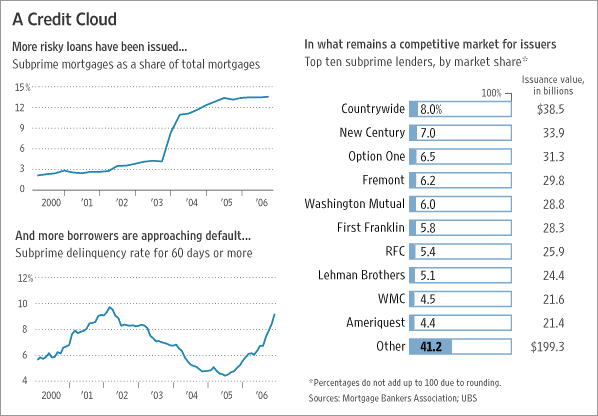
Why did subprime loans get so popular? Subprime loans made up 12.75% of the $10.2 trillion mortgage market in 2006, up from 8.5% in 2001, according to Inside Mortgage Finance. The homeownership rate has grown to 69% from 65% over the past decade, about half of which came from subprime lending, according to a study by the Federal Reserve Bank of Chicago.

First, note the big increase in sub-prime loans. Over $1 trillion in sub-prime loans are out on the market right now. That's 7.6% of total US GDP.

Let's stop right there because these points raise a really interesting and difficult policy issue. I think everyone believes home ownership is a good thing. However, about half of the increase over the last few years came from sub-prime mortgage lending. Were these borrowers really able to purchase a home?

As this chart indicates, the later sub-prime loans (starting in say mid 2005) may not have been the most prudent.

Photobucket - Video and Image Hosting

Seeking new clients at a time when home values were soaring in many markets, emboldened lenders raced to offer easy credit with exotic loans, such as "piggyback" loans requiring no down payment and "no-doc" loans that let borrowers state their incomes without supporting documentation.

The increased sophistication of loan products also raises very tricky policy issues. Were consumers aware of all the important details? Did lenders provide all the relevant facts? The answer is probably somewhere in between the consumer's and the lender's areas.

Recent Senate hearings on Predatory lending indicates there are some problems within the industry.

Subprime lenders charge higher interest rates -- sometimes four percentage points more than on loans to more credit-worthy borrowers. Investors, eager for bigger returns, have fueled demand by purchasing securities that are backed by these mortgages. That has enabled many mortgage originators to turn around and sell their loans after making them, enabling more loans and reducing their risk.

Here's a short version of how this works. After a lender makes a loan, be sells the loan to another finance company. that company then packages the loan with similar loans (loans that have the same maturity, interest rate etc..) in a pool. That pool is then sold to investment concerns -- mutual funds, insurance companies etc.... Because the sub-prime mortgages have a higher interest rate, investors demanded more. As demand increased, lenders make more loans, and the cycle continued.

Now this pooling of mortgages -- if done properly -- does help to diversify risk. For example, if there is one bad loan grouped with 10 good loans, the bad loan will have a smaller impact on the pool. However, if there are 10 loans in a pool and 7 are bad, then the whole pool is in trouble. In other words, the spreading of risk only works if the risk is actually spread.

But once home prices started dropping, some borrowers began defaulting on their mortgages. One study by the Center for Responsible Lending predicts that as many as one out of every five subprime borrowers who took out reduced payment or low-documentation loans between 1998 and mid-2006 could lose their homes.

As the chart above illustrates, foreclosures for ARMs are increasing at high rates. The WSJ article noted:

Foreclosure rates on "subprime" loans -- those made to borrowers with poor credit records -- more than doubled last year from 2005, according to a UBS report. Some firms that specialized in those loans now face large losses or even bankruptcy.

According to the Implode-o-meter website, 23 lenders have now gone "kaput".

There are a few other interesting facts at the end of the article:

• Nearly 1.2 million foreclosure filings were reported last year, a 42% rise from 2005. That is a rate of one in every 92 U.S. households.

• Colorado, Georgia and Nevada had the nation's highest foreclosure rates last year, according to RealtyTrac. Among the top 100 metropolitan areas, Detroit, Atlanta and Indianapolis topped the list.

About 80% of subprime mortgages today are adjustable-rate mortgages, or ARMs, that have been nicknamed "exploding ARMs" because they have low fixed-interest payments in their first few years but then usually adjust to higher interest payments.

• Creative new subprime loans -- "piggyback," "interest-only," and "no-doc" loans, among others -- accounted for 47% of total loans issued last year. At the start of the decade, they were less than 2% of total mortgage loans.

Borrowers have never been more leveraged. Loan-to-value ratios, the loan amount expressed as a percent of the property value, have grown to 86.5% last year from 78% in 2000.

The facts -- as we know them now -- indicate later made sub-prime loans probably shouldn't have been made. The underwriting standards simply weren't strong enough and the borrowers simply didn't have the credit quality for those loans to be a considered good. Hopefully the spreading of default risk will minimize the problems these defaults may cause. But we'll have to wait and see for that to play out.

For economic and market commentary and analysis, go to the Bonddad Blog

Monday, February 19, 2007

The housing ATM rot is just the beginning

Contrarian Chronicles2/19/2007 12:00 AM ET

Lenders New Century and HSBC finally admit problems, but the bulls still don't want to see the obvious: A negative economic reaction is inevitable.

--MORE--

Monday, January 29, 2007

Worst performing loans - ever

Sunday, January 28, 2007

Subprime's grip slips

O.C. lenders pay a price as more homeowners miss payments on risky loans.

By MATHEW PADILLA

The Orange County Register

Many of Orange County's boldest lenders are struggling to stay in the black – and in some cases to stay in business – as their customers miss mortgage payments in record numbers.

These lenders, experts say, exercised poor judgment in a bid to maintain loan volume last year. They lent money to borrowers with spotty credit, known as the subprime market, without proper regard to their ability to repay, experts say.

"What's become clear is a whole bunch of people signed up for loans or were sold a loan they really couldn't afford," said Richard Eckert, an analyst with Roth Capital Partners in Newport Beach.

Sluggish home prices, rising interest rates and lax underwriting spurred defaults on subprime loans made just last year to the highest level in six years.

Perhaps most troubling, loans made by Orange County companies in 2006 were among the quickest to see defaults, data show.

And many of those subprime companies – which tend to cluster here in Orange County – are in trouble.

H&R Block's Option One in Irvine is up for sale. So is Ameriquest Mortgage in Orange. ECC Capital of Irvine is selling its loan-making operations to New York's Bear Stearns Cos., although the sale has been delayed.

UBS Investment Bank, the London-based unit of Switzerland's largest bank, UBS AG, analyzed subprime mortgages made in 2006 and found that borrowers were missing payments on loans made that same year at the highest rate since 2000.

In fact, UBS found subprime loans made in 2006 are on track to be the worst-performing loans ever issued.

Brea-based Fremont Investment & Loan, a unit of Santa Monica's Fremont General Corp.,topped UBS' list of poor performing loans. By late last year, 7.26 percent of Fremont's subprime loans made that same year were 60 days or more delinquent.

Argent, a unit of ACC Capital in Orange, which also owns Ameriquest, scored high on the list with a delinquency rate of 5.86 percent.

Option One landed closer to the middle with a 4.54 percent delinquency rate, and Irvine's New Century Financial Corp. had a 4.33 percent default rate.

So what went wrong, exactly?

Lenders made two mistakes, according to UBS and other analysts.

They didn't scrutinize borrowers' incomes, and they allowed subprime borrowers, who by definition have had past problems with their credit, to take on lots of risk.

Borrowers took advantage of "stated income" loan programs, where they simply tell lenders what they earn, said David Liu, director of UBS' mortgage strategy group.

And many first-time homebuyers made a small down payment or none at all. Often they took out simultaneous second mortgages to avoid paying mortgage insurance.

Borrowers gambled on rising home prices to bail them out of trouble, analysts said. Consumers thought home prices would keep climbing, which would enable them to sell or refinance if they got into a jam, analysts said.

But stalling or falling home prices last year changed all that, UBS' Liu said. Borrowers quickly began to miss payments.

"They lost the motivation or incentive to send in the checks," Liu said.

Because of the way loans are ultimately funded, it's very costly for lenders when a borrower misses one of the first payments on a loan.

Lenders package loans in big pools and sell them as bonds to investors. If a borrower misses the first payment, an investment bank putting the whole deal together can compel the lender to buy back the loan.

Lenders typically lose a lot of money when they must buy back delinquent loans. They lose transaction costs and may sell the loan again at a loss. Often when a borrower has defaulted, there is little or no equity in the home, so a foreclosure sale will not cover costs.

And there's another issue for subprime lenders who make newer, more exotic loan types.

Government pressure is building against the widespread use of loans in which a borrower pays only interest for a time or has the option of making a minimum payment that results in added debt.

Five federal agencies proposed guidelines on such loans in September, saying lenders need to better consider a borrower's ability to repay. The agencies said lenders are layering too much risk onto borrowers, especially consumers getting subprime loans.

And perhaps worst of all for lenders, investors and bond-rating agencies are closely watching loan performance. If loans start going bad, rating agencies will downgrade bonds and, thus, investors will pay less for them.

Fremont, whose loan delinquencies have spiked, recently adopted stricter guidelines for the second time in a year, according to Bloomberg News, which obtained a company memo on the topic.

Trude Tsujimoto, general counsel for Fremont, declined to comment on the memo or the Bloomberg story, which said the company will stop loaning to consumers who can't prove their income when buying a home with no money down.

"Our process is we are always looking at market conditions," Tsujimoto said in a telephone interview. "We are always tweaking our underwriting guidelines. This is another round of changes that we make periodically."

Tsujimoto, however, acknowledged the industrywide spike in defaults. Given the market environment today, it's prudent to have more restrictive guidelines, she said.

New Century Financial has been more public about changing its underwriting and ensuring that consumers know the risks of certain loan types.

In October, the company said it would look at a borrower's ability to repay after the end of low initial terms on adjustable-rate mortgages.

It stopped shy of saying it would consider a borrower's ability to repay the loan at its fully indexed rate, which is the maximum rate a borrower is likely to pay based on a moving index. The company said it would look at the fully indexed rate minus 1 percent.

Like Fremont, New Century has taken further steps to make its underwriting more restrictive, according to the company.

Several of the new rules affect first-time buyers. New Century won't lend them money if they don't plan to live in the property they're buying.

And if first-time buyers are putting less than 10 percent down with a "stated income" loan, they need to have savings equal to six months worth of mortgage payments.

Tony Meola, executive vice president with loan production at New Century, said the company is acting more from a sense of prudent lending than from pressure by government agencies or investors in its mortgages.

"We have no interest in putting people in homes that they can't afford," Meola said. "We have the responsibility to lend appropriately."

Contact the writer: 714-796-6726 or mapadilla@ocregister.com

Tuesday, January 9, 2007

Freddie Mac Reports 3rd-Quarter Loss of $550 Million

(Update9)

By James Tyson

Jan. 5 (Bloomberg) -- Freddie Mac, the second-largest source of money for U.S. home loans, reported a $550 million net loss for the third quarter and had an undetermined loss in the fourth quarter as lower bond yields reduced investment returns.

The loss compares with net income of $880 million in the year-ago third quarter, the McLean, Virginia-based company said in a statement today. The results, which don't include per-share figures, are preliminary estimates as the government-chartered company continues a three-year overhaul of its accounting.

Freddie Mac, which owns or guarantees about 20 percent of the $10.5 trillion U.S. residential mortgage market, hasn't released timely financial reports since revealing in 2003 that it understated net income by $5 billion to minimize earnings volatility. The irregular earnings and a federal limit on the company's mortgage portfolio have discouraged investors.

``It's hard for us to buy stocks without solid financials,'' said Michael Mullaney, who manages $10 billion at Fiduciary Trust Co. in Boston, including 76,000 Freddie Mac shares. ``The delay in the reporting really hurts us from a fiduciary standpoint.''

Freddie Mac shares fell $1.02, or 1.5 percent, to $66.91 in New York Stock Exchange composite trading. The percentage drop is the biggest for the stock since Nov. 9.

The company won't provide results for the first quarter of 2007 until the second half of the year, Freddie Mac President and Chief Operating Officer Eugene McQuade said in an interview.

``Sometime in the second half of this year, we expect we would be able to get back to quarterly reporting,'' McQuade said. ``This is exactly what investors are anticipating.'' The company intends to provide 2006 results by the end of March.

Asset Losses

Fannie Mae, the larger rival to Freddie Mac, said last month it overstated earnings for 2001 through mid-2004 by $6.3 billion. The Washington-based company, which plans to file 2005 financial results by the end of September, hasn't said when it will restore timely reporting.

Both companies profit by guaranteeing mortgage securities and by holding home loans and mortgage securities in their portfolios. As interest rates fall, homeowners increasingly pre- pay their mortgages or refinance their loans, disrupting income from the companies' guarantee business.

Freddie Mac's third-quarter performance stemmed from $1.5 billion in pretax losses on derivatives and other assets and obligations, the company said.

The fair value of net assets attributable to shareholders failed to grow from the end of the second quarter because of the interest rate declines and a reduction in the difference between the company's borrowing costs and the yield on its investments, Freddie Mac said.

Reflection of Volatility

The results ``reflect the volatility we see quarter-to- quarter in response to movements in interest rates,'' Freddie Mac Chief Executive Richard Syron said in the statement. ``We face a challenging market environment.''

Freddie Mac's estimated net income for the first nine months of last year was $2.5 billion compared with $1.4 billion in the same period of 2005. The projected loss for the fourth- quarter of 2006 compares with net income of $684 million in the year-earlier period.

Derivatives are financial instruments derived from stocks, bonds, loans, currencies and other assets, or linked to specific events like changes in the weather or interest rates. Freddie Mac typically never realizes gains or losses from derivatives because it holds the instruments to maturity.

Accounting Costs

Freddie Mac spent $1.2 billion in the first nine months of last year fixing accounting and other administrative expenses, compared with $1.1 billion during the same period of 2005.

Fees related to personnel and the use of new technology primarily drove the increase in expenses, McQuade said. Such costs should stabilize ``in the next couple of years.''

The company plans by mid-2007 to finish installing new accounting systems for its mortgage portfolio and the management of its debt and derivatives, Chief Financial Officer Anthony Piszel told analysts on a conference call today.

``When they get installed, it dramatically reduces the overall risk environment that we operate in,'' he said. ``This is a little later than we initially planned.''

Freddie Mac also has reduced employee turnover to 8.5 percent in recent months compared with about 15 percent the previous year, McQuade said.

Mortgage Portfolio

Freddie Mac's portfolio of loans, which generates about two-thirds of profit, fell at a 0.2 percent annual rate in November to $704.3 billion. The assets declined at an annual rate of 0.9 percent from January until November. The portfolio rose 8.7 percent in 2005.

The Office of Federal Housing Enterprise Oversight in July required Freddie Mac to constrain quarterly growth of its mortgage portfolio to 0.5 percent beyond the June 30 level of $722.2 billion pending completion of improvements in accounting and corporate governance. Freddie Mac also must hold 30 percent more reserve capital than normal to ensure safety and soundness.

``Operational, accounting and systems weaknesses remain'' at Freddie Mac, Ofheo said in a Dec. 28 statement. ``Significant work remains before Freddie Mac becomes a timely financial filer and corrects the evident operational weaknesses.''

To contact the reporter on this story: James Tyson in Washington at at jtyson@bloomberg.net

Last Updated: January 5, 2007 16:16 EST

Wednesday, January 3, 2007

Sub-Prime Mortgage Market Deteriorating Rapidly: Bonddad

Jan 3, 2006

By Bonddad
bonddad@prodigy.net

From Bloomberg

Mortgage Lenders Network USA Inc. became the third company in a month to stop issuing some loans as U.S. housing sales slowed and defaults by borrowers rose.

The company, known as MLN, said today in a statement it will ``temporarily discontinue'' wholesale lending operations. The Middletown, Connecticut-based company is ``involved in strategic negotiations with several Wall Street firms'' about the wholesale unit, which consists of a network of independent mortgage brokers that bring in loan requests.

MLN was the 15th largest issuer of sub-prime mortgages.

``The economics of the wholesale mortgage market have deteriorated dramatically over the past two months industrywide,'' MLN Chief Executive Officer Mitchell Heffernan said in the statement, which added that retail operations and the mortgage-servicing unit remain open. ``Until we see credit quality and margins return to acceptable levels, we have determined that MLN needs to pause from wholesale broker originations.''

This is the third sub-prime mortgage lender to either stop taking applications or close its doors in the last month.

The first was Sebring Capital:

Sebring Capital Partners LP has shut down, according to the company's Web site, which said the Carrollton-based wholesale mortgage lender employed 325 people.

"Sebring Capital will cease operations and no longer accept new submissions," according to a statement on the site's front page. "We apologize for any inconvenience this may cause you or your borrowers. It has truly been a pleasure doing business with you."

...

Sebring posted strong growth after it was launched in 1996. It was named several times as a winner of the Dallas 100 Awards, a list of the fastest-growing private companies in North Texas presented by Southern Methodist University's Cox School of Business and the CEO Institute.

The second also occurred in early December:

Ownit Mortgage Solutions Inc., a California-based home lender part-owned by Merrill Lynch & Co., closed this week and told more than 800 workers not to return, a former employee said.

The company informed its staff of the closure on Tuesday, Kevin Panet, who was a training manager for the Agoura Hills- based lender, said in a telephone interview today. Chief Executive Officer William Dallas didn't return messages left on his voicemail and with an assistant.

...

Nonprime News, an industry newsletter, ranked Ownit as the 11th-largest U.S. issuer of so-called subprime mortgages, or home loans made to borrowers with low incomes, untested credit or a track record of default or delinquency. The company issued $5.46 billion of loans during the first half of the year, 44 percent more than a year earlier, according to the newsletter.

Ownit has filed for bankruptcy.

Other, larger sub-prime lenders have started to have problems as well:

Atlanta-based NetBank last month closed its subprime lending unit and transferred most of its employees to another company. H&R Block is seeking a buyer for its Option One Mortgage Corp., a subprime lender. Key Corp. is selling its subprime Champion Mortgage business.

The basic problem is the sub-prime mortgage market isn't doing very well:

In a conference call titled "How Bad is Subprime Collateral?" Tom Zimmerman, head of ABS research for UBS, and David Liu, head of mortgage credit, discussed how much higher loan delinquencies and foreclosures are for 2006 subprime loans compared with similar subprime loans from earlier years -- the result of deteriorating underwriting quality from lenders combined with a slower housing market.

Still, despite the adverse conditions, "I guess we are a bit surprised at how fast this has unraveled," said Zimmerman. While it's "not a secret that subprime collateral has performed pretty disastrously so far," he said, "I must say we were a bit surprised by the magnitude with which" the loans "deteriorated this year."

The rate of subprime loan delinquencies of 60 days or more -- meaning borrowers are that far behind in their payments -- has climbed to about 8 percent, up from about 4.5 percent a year ago.

These 60-day plus delinquencies jumped up fairly sharply in the past few months, to 3.63 percent for the 2006 loans in October, up from 2.95 percent in September and 1.62 percent in July, according to UBS research.

Comparing loans of similar age, 2006 loans are performing worse than 2005, which are worse than 2004. In fact, given where delinquencies are now, loans from 2006 are on track to be among the worst-performing ever, along with the 2000 to 2001 years, according to UBS research.

And not only have delinquencies risen faster in 2006 than in earlier years, Liu noted in the presentation, but 2006 loans have entered the foreclosure process faster. In October 2006, the foreclosure rate was about 2 percent, while a year earlier it was 1 percent.

So, we have the following problems.

1.) Large, sub-prime lenders are closing their doors, not taking any more mortgage applications.

2.) The larger issuers have already gotten out of the market.

3.) More recent sub-prime loans (2006 vintage) are performing poorly right out of the gate. Performance has continually worsened over the last three years.

4.) 60-day sub-prime delinquencies have doubled since July.

More importantly, this is the third sub-prime lender to stop doing business in a month. That's a terrible sign for the coming year.

For market and economic analysis, go to the Bonddad blog