Showing posts with label PNAC. Show all posts

Monday, April 23, 2007

Is George W. Bush Planning To Trigger Apocalyptic War ?

April 23, 2007

By Bruce Wilson
talk2action@earthlink.net

Given that neoconservatives close to the Bush Administration have articulated visions for the Middle East that involve the replacement of numerous existing governments in the regions, not to mention the replacement of the atrocious North Korean regime, how could we distinguish, in practice, that plan in action from moves to bring on the apocalypse ? The two projects would tend to look quite similar. Both would involve increasingly expanded theaters of war : maximal mayhem.

IN fact, some prominent neoconservatives have stated their desire for maximal mayhem, maximal war:


"One can only hope that we turn the region [the Middle East] into a cauldron [of war], and faster, please. If ever there were a region that richly deserved being cauldronized, it is the Middle East today."
-Michael Ledeen

Is George W. Bush a real Christian ? Is it just a manipulative act ? This post considers evidence that George W. Bush has genuine religious belief and, in fact, believes that the Apocalypse is immanent... even that he might have a divine mission to bring it on.

Yesterday I did a story on the heavy Evangelical penetration of the US military. The concern wasn't about Evangelicals but, rather, religious coercion in the military and troubling questions Weinstein has raised about possible compromises in the US military's chain of command.

Reading this post, please bear in mind that belief, or the absence of belief, is extremely difficult to demonstrate although modern MRI brain imaging techniques can demonstrate activity, or the lack of that, in areas of the brain associated with religious belief. But it is unlikely George W. Bush would submit to such scrutiny, and so we must consider proxy evidence.

If you're concerned about possible war with Iran, Wes Clark is too - you can sign his petition and get a free button ]

"The classical pattern of apocalypse, comprising in its active form, an initial phase of savage destruction followed by a phase of messianic rebirth, can be recognized in individual psychosis and in the Nazi type of destruction, persecution and virtual suicide." - Mortimer Ostow, "The Psychodynamics of Apocalyptic: Discussion of Papers on Identification and the Nazi Phenomenon," International Journal of Psycho-Analysis, 1986

"God wants me to be President." - George W. Bush, 19 January 1999

[UPDATE: Some critics of this post have objected that there are few, if any, apocalyptic Christian Zionists within the Bush Administration. That point, even if correct, does not negate the impact of beliefs George W. Bush might hold. Further, neoconservatives widely held to have had considerable influence, within the Bush administration and in propelling the US towards war with Iraq, talk in terms eerily similar to those of apocalyptic Christian Zionism. Much neoconservative rhetoric is in fact indistinguishable from the rhetoric of apocalyptic Christian Zionists:

Neoconservatives For Maximal War

"[Richard] Perle told journalist John Pilger in 2002 that "if we just let our vision of the world go forth, and we embrace it entirely and we don't try to piece together clever diplomacy, but just wage a total war ... our children will sing great songs about us years from now."

"Israel is part of a global war, the war of radical Islam against civilization. Right now Israel is doing the work of the rest of the civilized world by taking on the terrorists. It is not only for Israel's sake that we must get the facts out -- it is for ourselves, America, for every free country in the world, and for civilization itself." - David Horowitz


"One can only hope that we turn the region [the Middle East] into a cauldron [of war], and faster, please. If ever there were a region that richly deserved being cauldronized, it is the Middle East today."
-Michael Ledeen

"I think an explosion is long overdue and turning the whole region into a cauldron [of war] is a necessary step toward reforming it." - Mark Steyn

"Norm Podhoretz ranks among the most prominent American editors of the 20th century. And he's doing pretty well in the 21st. (Laughter.) Never a man to tailor his opinions to please others, Mr. Podhoretz has always written and spoken with directness and honesty. Sometimes speaking the truth has carried a cost. Yet, over the years, he has only gained in stature among his fellow writers and thinkers. Today we pay tribute to this fierce intellectual man [sic] and his fine writing and his great love for our country." - George W. Bush, presenting the Presidential Medal of Freedom to Podhoretz in June of 2004

"God willing, Judgment Day is coming to the Middle East." -Michael Ledeen

"Prof Ledeen is...believed to have the ear of the White House's current Chief of Staff Karl Rove, and has regular conversations with him. ...His view on the war on terror is clear, he said: 'Iraq is just one battle in a larger war, bringing down the regime in Iran is the central act...' "
-BBC News

"Whether or not the White House listens, it seems that they’ve listened to a lot of things about Iran, that I will say. I mean, some of the language and some of the speech is very familiar to me, and really reflects the sort of thing that I’ve been pushing for." - Ledeen, April 2003

"The regime must go." - [Richard] Perle and [David] Frum, on Iran

"All of Korea will be united in liberty." - Perle and Frum, on North Korea

"We should force European governments to choose between Paris and Washington." - Perle and Frum, on Europe

This post concerns the possibility that George W. Bush holds apocalyptic religious views and believes God has commanded him to attack Iran in order to bring on the Apocalypse.

"It was in his first campaign for governor that George W. began to preach the gospel according to Bush. He literally gave sermons in Houston's mega-churches, laying the blame for America's "failed culture" on the excesses of his generation in the 60s. "The culture of my generation, our generation, has clearly said, ‘If it feels good, do it, and be sure to blame somebody else if you have a problem.'" " - Gail Sheehey, Vanity Fair story on George W. Bush's religious beliefs.

When I woke this morning and made a pot of coffee, the sun was already up, cresting the hill behind my house amidst a din of birds and a riotous explosion, sudden and exuberant, of Spring. It was beautiful, and I think that's why I chose to wrote this now ; so that, in the words of Richard Brautigan's final book, ...The Wind Won't Blow It All Away.

***

About a month ago, a team of Japanese journalists visited Mikey Weinstein of the Military Religious Freedom Foundation, to do a story on Weinstein and his fight against religious coercion in the US military. The journalists told Weinstein they saw a pattern, now in the US, of religious militarism very similar to that which had arisen in Japan prior to World war Two.

"...a short video on faith and diplomacy made in the aftermath of September 11,2001, by Christian Embassy, a behind-the-scenes ministry for government and military elites. It almost seems to endorse deliberate negligence of duty, Dan Cooper, an undersecretary of veterans' affairs, announces that his weekly prayer sessions are "more important than doing the job." Major General Jack Catton says that he sees his position as an adviser to the Joint Chiefs of Staff as a "wonderful opportunity" to evangelize men and women setting defense policy. "My first priority is my faith," he says. "I think it's a huge impact.... You have many men and women who are seeking God's counsel and wisdom as they advise the Chairman [of the Joint Chiefs] and the Secretary of Defense." Brigadier General Bob Caslen puts it in sensual terms: "We're the aroma of Jesus Christ." There's a joyous disregard for democracy in these sentiments, for its demands and its compromises, that in its darkest manifestation becomes the overlooked piety at the heart of the old logic of Vietnam, lately applied to Iraq: In order to save the village, we must destroy it.
Weinstein, a former Air Force lawyer and Reagan White House counsel, saw not just some disturbing theology, but a potential violation of military regulations regarding separation of church and state." - Jeff Sharlet, Jeff Sharlet - Ten Things I Learned from the Pentagon's Prayer Team ( emphases mine )

War, especially religious war, is not a glorious affair. Images in this story are of the outcomes of real war on real humans. Please be advised.

drawing of HiroshimaAlso, a few days ago, as you've probably heard, US Senator John McCain sang "Bomb Iran, Bomb Bomb Bomb" to the tune of the Beach Boys' hit "Barbara Ann", before an audience of hundreds at a VFW hall.

Back in April 2006, John McCain said, on "Meet The Press", to Tim Russert, that war with Iran could lead to "Armageddon". Now, McCain's singing about bombing that country as if it were some sort of joke. GOP House Minority Whip Roy Blunt Jr. flew out to Texas, early in 2007, to meet privately with John Hagee as well. The Apocalypse seems to be a popular subject these days in the GOP.

To the right is a picture, by a survivor of the bombing, of victims of the Hiroshima nuclear blast.

***

( image, right: skulls of Hiroshima victims )

Over the course of the last few months, I've been studying what George W. Bush may believe, and what people who are accorded as having been major religious influences on Bush say they believe.

Almost to a man, and they have all been men, those who are held to have shaped George W. Bush's religious beliefs have been apocalyptic Christian Zionists. George Bush speaks in the idiom of Christian apocalyptic premillenial dispensationalism, in common parlance the language of the end-times, of the coming Apocalypse, Rapture, and Armageddon. "Madman" theory does not suffice, from all that I can tell, to explain George W. Bush's numerous statements, that he speaks to God, is on a mission from God, that he is part of a divine plan.

By most evidence, George W. Bush appears to hold a personal, messianic belief that he, personally, must usher in the Apocalypse. And, he might just be able, as the last gasp of his dying presidency, to pull it off. In 2004, David Domke and Kevin Coe did a study of presidential language and come to the troubling conclusion - George W. Bush's language is very different from language used by past presidents:

( image - from archival footage of "The Rape Of Nanking" )

"The religious outlook of George W. Bush has been the focus of recent stories by several major news media. In these pieces White House officials and allies consistently have made the case that Bush’s faith and language are no different from past presidents. In the words of the Rev. Richard Neuhaus in The Washington Post, "This is so conventionally Christian piety and Christian faith" that Bush’s faith is "as American as apple pie."

That simply is not so. Bush’s fusion of faith and politics is anything but conventional for the presidency.

The key difference is this: Presidents since Franklin Roosevelt have spoken as petitioners of God, seeking blessing and guidance; this president positions himself as a prophet, issuing declarations of divine desires for the nation and world. Most fundamentally, Bush’s language suggests that he speaks not only of God and to God, but also for God. Among modern presidents, only Ronald Reagan has spoken in a similar manner -- and he did so far less frequently than has Bush." - Published in The Revealer October 11, 2004. ( David Domke is an associate professor in the Department of Communication at the University of Washington. He is the author of God Willing? Political Fundamentalism in the White House, the "War on Terror," and the Echoing Press (Pluto Press, 2004). Kevin Coe is a doctoral student in the Department of Speech Communication at the University of Illinois. )

George W. Bush, at a public appearance Thursday, laid it out for all to see and this should come as no surprise:

As the Republican National Committee reports on its website, President Bush has declared this April 19, 2007, that his "faith" and his family come first, while George W. Bush's loyalty to the United States comes last. ( thanks to Universal Health for the tip )

I wish I was traveling here with Laura. The best thing about my family is my wife. (Applause.) She is a great First Lady. I know that sounds not very objective, but that's how I feel. And she's also patient. Putting up with me requires a lot of patience. But she sends her best; she's in New Orleans today.


And I will tell you, one reason -- this may sound counterintuitive, but a good marriage is really good after serving together in Washington, D.C. It's been an amazing experience to be a husband and then a dad as President of the United States. I emphasize, that is the priority for me as the President. It's my faith, my family, and my country"

Faith, Family, then Country ?

Bush's declaration of presidential loyalty seems to run directly counter to the oath Bush, and all US presidents, have taken upon entering presidential office:

"I do solemnly swear (or affirm) that I will faithfully execute the office of President of the United States, and will to the best of my ability, preserve, protect and defend the Constitution of the United States."

Am I making too much of this ?

Let's look at a recent flap concerning US Representative Keith Ellison's Islamic religious. Critics claimed that Ellison could not be trusted to honor his oath of office because some Islamicists say things like this:

Secularists in the West will agree with this, then they will point out that under Islamic law, people are not all equal. No non-Muslim, for example, could become the president. Well, in response to that fact, in turn, secularism is no different. No Muslim could become president in a secular regime, for in order to pledge loyalty to the constitution, a Muslim would have to abandon part of his belief and embrace the belief of secularism — which is practically another religion. For Muslims, the word 'religion' does not only refer to a collection of beliefs and rituals, it refers to a way of life which includes all values, behaviors, and details of living. ( Dr. Jaafar Sheikh Idris )

Indications are good that, for George W. Bush, religious belief trumps Bush's responsibility to American people who hold religious and philosophical beliefs that differ from his. Signs are strong that Bush wants Apocalypse and that, even though a large percent of American does not wish for Apocalypse, George W. Bush just doesn't care. If he has the power to bring it on, that's that ; he'll do it and damn us all to the hell on Earth he feels God wants him to set in motion.

Let me turn to Jeff Sharlet, to frame the backdrop to all of this:

John Hagee is likely one of religious leaders who helped shape Goerge W. Bush's religious beliefs. Until last Wednesday, John Hagee's "Apocalypse Lobby" website featured an image, of Jerusalem's Wailing wall and the Temple Mount, from which the 3rd Holiest Site in Islam had been airbrushed out. As a result of my blogging, it seems, CUFI last Wednesday replaced its website logo image with another image in which the Haram el-Sharif was visible. A number of observers considered the original, airbrushed CUFI logo image to be wildly provocative to the Islamic world.

Texas Megachurch Pastor John HageeIn a recent Charisma Magazine issue John Hagee, in a piece entitled "The Coming Holy War", wrote : "Israel and America must confront Iran's nuclear ability and willingness to destroy Israel with nuclear weapons."


On July 19, 2006, at a CUFI sponsored Washington DC event called "A Night to Honor Israel", with GOP Party head Ken Mehlman and US GOP Senators Sam Brownback and Rick Santorum ( President George W. Bush sent recorded greetings to the event ) , Pastor John Hagee declared :


"The United States must join Israel in a pre-emptive military strike against Iran to fulfill God's plan for both Israel and the West... a biblically prophesied end-time confrontation with Iran, which will lead to the Rapture, Tribulation [...] and [the] Second Coming of Christ."


Hagee's beliefs are actually part of mainstream Christian Zionist thought, which tends to hold that, after Christians are "Raptured" bodily up to heaven, most Jews ( 2/3 to be precise ) will die in a subsequent terrible conflict centered around Israel.

Fundamentalism is here, and even provided we can squeak by the Apocalypse we're going to have to learn to deal with it. As Jeff Sharlet writes:

"We keep trying to explain away American fundamentalism. Those of us not engaged personally or emotionally in the biggest political and cultural movement of our times—those on the sidelines of history—keep trying to come up with theories with which to discredit the evident allure of this punishing yet oddly comforting idea of a deity, this strange god. His invisible hand is everywhere, say His citizen-theologians, caressing and fixing every outcome: Little League games, job searches, test scores, the spread of sexually transmitted diseases, the success or failure of terrorist attacks (also known as "signs"), victory or defeat in battle, at the ballot box, in bed.... A divine love that speaks through hurricanes. Who would worship such a god? His followers must be dupes, or saps, or fools, their faith illiterate, insane, or misinformed, their strength fleeting, hollow, an aberration. A burp in American history. An unpleasant odor that will pass.

We don’t like to consider the possibility that they are not newcomers to power but returnees, that the revivals that have been sweeping America with generational regularity since its inception are not flare-ups but the natural temperature of the nation...

The Christian nation of which the movement dreams, a government of those chosen by God but democratically elected by a people who freely accept His will as their own, is a far country. The nation they seek does not, at the moment, exist; perhaps it could in the future. More important to fundamentalism is the belief that it did exist in the American past, not in the history we learn in public school and from PBS and in newsmagazine cover stories on the Founders but in another story, one more biblical, one more mythic and more true. Secularism hides this story, killed the Christian nation, and tried to dispose of the body. Fundamentalism wants to resurrect it, and doing so requires revision: fundamentalists, looking backward, see a different history, remade in the image of the seductive but strict logic of a prime mover that sets things in motion. The cause behind every effect, says fundamentalist science, is God. Even the inexorable facts of math are subject to His decree, as explained in homeschooling texts such as Mathematics: Is God Silent? Two plus two is four because God says so. If He chose, it could just as easily be five. ( Jeff Sharlet, from Through a Glass Darkly, Harpers Magazine, December 2006 )

What does George W. Bush Believe ?

What does George W. Bush believe ? And, given the embattled nature of the Bush Administration, does it even matter ? Isn't Bush a lame duck president ? Hasn't the tide of political cronyism and religious zealotry that swept in as the presidency of George W. Bush crested at last ? With the return of the Democrats in force to Congress, to control the House of Representatives and the Senate, haven't we witnessed, at long last, the crest of the wave, the high water mark of the Bush Administration's proclivity for packing the federal bureaucacy with religious ideologues ?

"While it is well-known that George W. Bush presents himself as devoutly Christian, and he is widely considered beholden to the fundamentalists who are at least a third of the U.S. population and the GOP’s core voting base, whether or not he is a dispensationalist has emerged as one the administration’s most closely held secrets. The White House even refuses to say if the president has read the Left Behind books.

Among evangelicals, though, there is a widespread conviction that Bush shares the End Times vision and has been divinely appointed to lead the nation. ( from Glenn Weiser's What Does The President Believe ? )


(video clip: George W. Bush is known to have frequented, as Governor of Texas, John Hagee's Cornerstone Baptist Church. The video clip is set to a sermon, by Hagee, alleging a conspiracy of "international banking" interests to create a sinister, satanic "New World Order" through the United Nations)

Why have we seen, in the last year and in the face of rationality and amidst the failure of the Bush Administration's Iraq gambit, to the ruin of that nation, the same sort of PR buildup, aimed apparently at building a case for war with Iran, we witnessed prior to the invasion of Iraq ?

The administration of George W. Bush may be unraveling, coming apart at the seams, or imploding. But, Bush himself holds one trump card to overrule all trump cards ; war is its own logic, and US forces once committed to an attack on Iran will not be easily withdrawn. Once that Pandora's Box gets opened, whatever demons shriek out at the world will not go away but will be with us for decades or, in human terms, forever.
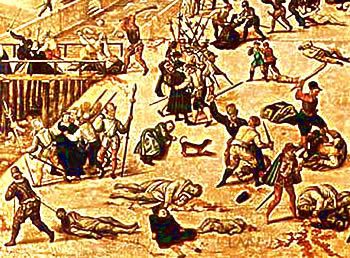
( image: detail from painting depicting the "St. Bartholomew's Day Massacre" )

The overwhelming bulk of available evidence points towards the likelihood that George W. Bush is a Christian Zionist who believes, really believes, in the need for maximal, catastrophic war in the Mideast. Over the past several months I have been conducting, by myself with the help of a few concerned friends, an exhaustive study of George W. Bush's likely religious beliefs, or his lack thereof. Gail Sheehey, at the onset of George W. Bush's presidential tenure, covered Bush's beliefs. But no one, as far as I can tell, who is familiar with Christian apocalyptic dispensationalism and with the intersection of religion and politics has made concerted effort to gather all available data bits on George Bush's religious belief.

Until now.

Evidence I have gleaned points in one troubling direction, and therefore towards a monumental bifurcation point in world history resting now in the hands, more than any human, of a man who appears to believe, in his heart, in the coming Apocalypse, in immanent, unavoidable Armageddon, in the "Rapture" of "Bible believing" Christians to heaven where they will, in safety, look down upon a world convulsing in hideous military conflict and the slaughter of hundreds of millions, billions of people even, by fire and sword, bullets and bombs, by nuclear incineration.

The Apocalypse, understood in either religious terms of merely viewed in secular terms, as catastrophic world war, would preclude meaningful action to address the penultimate world challenge of our time, Global Warming. Apocalypse would preclude meaningful action on AIDS and poverty, on preserving biodiversity, forests and ocean ecosystems. To significant action across a vast swath of imaginable world problems, even problems unrecognized as of yet, the Apocalypse would shut the door, perhaps forever.

At this moment in time, George W. Bush holds the keys to two radically different kingdoms ; two fates, one leading towards a constructive future and one leading towards catastrophe, towards terrible, destructive unraveling in the fabric of human and biological systems on Earth.

***

Hasn't George W. Bush Been Defanged ?

But, hasn't George W. Bush been rendered toothless and fangless ? Hasn't the charging Texas cowboy been knocked from his horse ?

That seems to be the common consensus :

Recently, I was discussing, with an editor at a national magazine who I'll leave unnamed, a curious issue : the apparent airbrushing of the logo image for a new national Christian lobbying group that lobbies for the Apocalypse, for catastrophic war in the Mideast. The 3rd Holiest site in Islamic had been wiped from the logo image and, intentional or not, the symbolism could have been wildly inflammatory to the Islamic world. Talk of the logo led, of course, to Mideast, and the editor agreed with me that Bush probably wanted maximal Mideast conflict but believed that wiser heads would prevail ; there was fightback, in Republican ranks even, against the Bush Administration's lust to expand the theater of Mideast conflict, to "fail forward" and attack Iran. Wiser heads, he reassured me, would prevail.

I'm not convinced though, and perhaps that's an artifact of what I've been studying lately ; the hot zone of religion and politics, especially when the religious beliefs in question are apocalyptic and the political realm in question concerns the loyalty, or lack thereof, of United States armed services members to religious pluralism, American Constitutional Democracy, and simply to not provoke catastrophic war, can be a troubling realm to pay attention to. Once, at an national environmental activist conference, I happened to overhear the staff of the facility hosting the event quip, about the environmentalists present, "they're worse than people with eating disorders" and I think the realm I gesturing at elicits a similar manic intensity... but for good reason. Sober heads, even advocates for a new Pax Americana such as "The Grand Chessboard" author Zbigniew Brzezinsky, have warned that a US attack on Iran could open a gateway to catastrophe.

As I covered yesterday, the US military has been penetrated to an unknown extent but, arguably, extensively by American Evangelicals with apocalyptic dispensationalist beliefs. Wars are comparatively easy to provoke, and an influential faction in American politics, a coalition perhaps including George W Bush, many evangelicals in the US military, many in Bush's core fundamentalist base, the lobbying blocks of CUFI and to some extent AIPAC, and busy cadres of writers, publicists, and PR specialists, are concertedly pushing for war with Iran.

Such a possibility would have seemed insane six or seven years ago at the onset of the Bush Administration, but here are and the most likely reason we have come to this grim possibility can be expressed in two words:

Christian Zionism.

"Bush addressed the CNP ( Council On National Policy ) in 1999 (there is, of course, no public record of what he said) and begins every day poring over Bible commentary. Do he and Laura read themselves to sleep with LaHaye? That he is sympathetic to what LaHaye stands for, religiously and politically (assuming they can be separated), is a legitimate conclusion. In 1993, Bush unguardedly divulged that only Christians can get to heaven. He secured his base, at the beginning of his presidential campaign, by speaking at Bob Jones University - which he refused to criticise for its ban on interracial dating. At his inauguration, he chose Franklin Graham to deliver the ceremonial prayer - the son of the venerable Billy (the evangelist who saved Bush from the demon drink), who has become notorious for telling the world that Islam "is a very evil and wicked religion". " ( UK Guardian, June 12, 2003 )

"Bush's first real encounter with Jesus came about with the Evangelical Reverend Billy Graham. No problem there. Reverend Graham, though once a registered Democrat, has made a point of staying non-partisan. Since then, Bush has kept the company of some odd pastors, such as James Robison, the anti-abortion fanatic who likes to quote both sides of his conversations with God. Robison prayed with Bush in the Oval Office before the invasion of Iraq. Another is one of Texas' foremost fundamentalist preachers, the Reverend James [sic] Hagee of the Cornerstone Church in San Antonio. Hagee is part of a more off-center form of Christianity tracing back to an Anglian priest who abandoned his church in 1820 to form his own sect. The beliefs Hagee brings from this, known as Dispensationalism, are too complicated to cover here, but basically revolve around Armegeddon and a literal reading of the Book of Revelation. This "end-times" theology can be seen in Bush's foreign policy.
In November of 2002, Hagee addressed his congregation of four thousand people, outlining a foreign policy strangely similar to Bush's policy set forth later. With then-House Majority Leader Tom Delay at his side, Hagee preached about regime change in Syria as well as Iraq, and about destroying the regime of Yasir Arafat. These were policies written six years earlier by Richard Perle, Douglas Feith, Charles Fairbanks, Jr., and others who are now part of the Project for a New American Century (PNAC). Hagee stated, "Listen, Saddam, there's a Texan in the White House, and he's going to take you down."
On more than one occasion, Bush has claimed he takes his orders from God ... literally. Mahmoud Abbas, Palestinian Prime Minister, and Nabil Shaath, his Foreign Minister, describe their first meeting with President Bush in June 2003. Nabil Shaath relates the meeting: "President Bush said to all of us, 'I'm driven with a mission from God. God would tell me, "George, go and fight those terrorists in Afghanistan." And I did, and then God would tell me, "George, go and end the tyranny in Iraq ..." And I did. And now, again, I feel God's words coming to me, "Go get the Palestinians their state and get the Israelis their security, and get peace in the Middle East." And by God I'm gonna do it.'"
Israel's most reputable newspaper, Ha'aretz, related a similar story from the same time. At the cease-fire negotiations between Abbas and faction leaders from the Hamas, Islamic Jihad and the Popular and Democratic Fronts, Bush said, "God told me to strike at al Qaida and I struck them, and then He instructed me to strike at Saddam, which I did, and now I am determined to solve the problem in the Middle East. If you help me I will act, and if not, the elections will come and I will have to focus on them."

"What [Rev. Billy Graham] said sparked a change in my heart. We walked and talked at Walker's Point, and I knew I was in the presence of a great man... Reverend Graham planted a mustard seed in my soul... He led me to the path, and I began walking. It was the beginning of a change in my life." - Bush, A Charge to Keep, 1999

"...What are some of those signs we should be watching for?"

"Political unrest... Although Russia no longer is a threat as a superpower, many other nations have access to nuclear weapons and instantly could plunge the world into chaos with the push of a button..."

"Natural disasters... There have always been earthquakes, famines and other natural disasters in the world, but this century [the 20th] has witnessed more of them -- disasters with greater intensity."
"Social unrest... Jesus also said there would be an increase of wickedness and the love of many would grow cold (Matthew 24:12). Read the papers, we're already there."

"Religious apostasy... The 'faith which was once delivered unto the saints' (Jude 3) slowly has been eroded throughout this century to the point where the Word of God no longer has any authority in the minds of people."

"Economic instability... Many areas of the globe are experiencing this..."

"The rebirth of Israel. ...God has assimilated into one nation Jews of many cultures and languages and preserved them through five wars with their Arab neighbors. The people have reclaimed and rebuilt the old wastes of ancient cities, towns, and villages. All of this is a major miracle that points unmistakably to Israel's strategic role in the Lord's scenario for the last days."

"Evangelistic permeation... Never in history has there been such a concentrated effort to fulfill the Great Commission as in the days leading up to the start of the new millennium."

"The rise of the Antichrist... Antichrist is an apocalyptic figure that will rise to world power in the last days. He will control the world's economy and religion and will wage war against the church and Israel. Many have sought to identify him through the years with some contemporary figure, as some undoubtedly have resembled his qualities to some degree. Nevertheless, he may be alive right now and just waiting for the right moment to seize power." - Billy Graham, from Graham's last book, "The Beginning Of The End", 1999

"The Reverend Billy Graham taught Bush to live in anticipation of the Second Coming but it was his friendship with Dr. Tony Evans that shaped Bush's political understanding of how to deport himself in an apocalyptic era. Dr. Evans, the pastor of a large Dallas church and a founder of the Promise Keepers movement taught Bush about "how the world should be seen from a divine viewpoint," according to Dr. Martin Hawkins, Evans assistant pastor.

S.R. Shearer of Antipas Ministries writes, "Most of the leaders of the Promise Keepers embrace a doctrine of 'end time' (eschatology), known as 'dominionim.' Dominionism pictures the seizure of earthly (temporal) power by the 'people of God' as the only means through which the world can be rescued.... It is the eschatology that Bush has imbibed; an eschatology through which he has gradually (and easily) come to see himself as an agent of God who has been called by him to 'restore the earth to God's control', a 'chosen vessel', so to speak, to bring in the Restoration of All Thingss." Shearer calls this delusion, "Messianic leadership"-- that is to say usurping the role usually ascribed to the Messiah.

In Bush at War Bob Woodward writes, "Most presidents have high hopes. Some have grandiose visions of what they will achieve, and he was firmly in that camp."

To answer these attacks and rid the world of evil," says Bush. And again, "We will export death and violence to the four corners of the earth in defense of this great nation." Grandiose visions. Woodward comments, "The president was casting his mission and that of the country in the grand vision of Gods Master Plan."

"The lessons of the Bible were a reason for his decision to run for president. He feels that God speaks to him." - Texas megachurch preacher and personal friend to George W. Bush, Dr. Tony Evans

"As Texan preacher Tony Evans, one of his spiritual advisors, recalls: "The lessons of the Bible were a reason for his decision to run for president. He feels that God speaks to him." From then on, Bush defined his work as a mission: "I am convinced that we must fundamentally and permanently change our entire culture. We need spiritual renewal in America."

The occasional churchgoer had become a pious man, a man who continues to practice rigorous discipline in the White House and incorporates the appropriate passage from the Bible into his daily agenda. The insecure drinker has become a president with whom mainstream Americans can identify, precisely because of his mediocrity, fallibility and devoutness."


"Dr. Martin Hawkins, Evans’ assistant pastor, Evans taught Bush "how the world should be seen from a divine viewpoint." And Bush says in his book, A Charge to Keep, that he has been "spellbound" listening to Evans’ sermons'

"Bush learned from Evans a whole new approach—cultural rather than economic—to winning political adherents. "On July 4, 1998, Governor Bush listened to Dr. Evans lay out a whole philosophy about how the world should be seen from a divine viewpoint and adjusted politically," says Evans's assistant pastor Dr. Martin Hawkins. Evans, who is said to be a confidant of the man he helped to become governor—they have prayed over the phone together—was one of the builders of the new Christian men's movement known as the Promise Keepers. He has urged men to "take back" authority from their wives, and women to "let your man be a man."

Bush did seem to find direction and develop discipline in his habits through his personal religious revival. "For some people, when they discover a faith in their religion, in God . . . it is a prescription for self-respect," says Lacey Neuhaus. But religion is also an important political tool for him. His evangelical Christianity gives him solid standing as a social conservative. It is also useful in dismissing questions about his character. All he has to say is that his life has changed dramatically since he accepted Christ. He is a new person, and his earlier, irresponsible conduct is irrelevant.

In his political sermons he began calling religious people to become involved in politics, and described the Bible as "a pretty good political handbook." He championed religious groups as the best instrument to change social policy, in place of government or in partnership with it. Not only was that music to the ears of the Christian right, it meant money in their coffers. Here was a politician who would channel government money not into social programs such as welfare but into church partnerships with the state.

Dr. Hawkins says, "There is a strong possibility that we would be one of the faith-based organizations that partner with the federal government, under President Bush, to reach out in the community to take care of housing and jobs."

Unabashedly fired up by the rhetoric of the Christian men's movement, Bush forgot that not everyone accepts Christ as his or her savior. He told a reporter in 1994 that the New Testament teaches that only those who accept Jesus Christ will go to Heaven."

Franklin Graham is more than a long-standing friend of Bush. He is a significant theological mentor. Bush has written in Christian magazines that Reverend Franklin and his father were pivotal in renewing his faith and religious committment as a Christian after his bout with alcoholism. The American public choose to be blithley unaware of Graham’s hatred of Islam. After the 9-11 attacks, and around the same time Bush declared his war on Islamist terrorists a "crusade," Franklin Graham made a highly publicized blanket condemnation of Islam on the Christian TV show 700 Club calling it "a very evil and wicked religion." He has often written that Islam and Christianity will fight each other before the second coming of Christ. Franklin Graham, like his father, who has been the confessor of several American presidents, believes Christ’s coming is imminent.

Given the indelicate words of this prominent Islamaphobe, one might expect the president to distance himself, but no. Gumbel reports that the president invited Franklin Graham to preach at the Good Friday 2003 prayer service held in the Pentagon. I would add that he participated in the Holy Service just as the American invasion of an Islamic country was at its peak.


WOLF BLITZER: So what's your bottom line? Do you believe, based on the reporting you did for this article, that the president of the United States is now aggressively plotting military action, a pre-emptive strike against Iran?

SEYMOUR HERSH: The word I hear is "messianic." He thinks, as I wrote, that he's the only one now who will have the courage to do it. He's politically free. I don't think he's overwhelmingly concerned about the '06 elections, congressional elections. I think he really thinks he has a chance, and this is going to be his mission.

"Again, the White House Web site records that on March 3, Bush told a Los Angeles audience, "God loves you, and I love you. And you can count on both of us as a powerful message that people who wonder about their future can hear." After mentioning himself in the same breath with God, Bush then topped himself when the Lancaster New Era reported on July 16 that in a private meeting with an Amish group in Lancaster County, he told them, "I trust God speaks through me. Without that, I couldn’t do my job." The White House has denied the statement."


"Five months later, in August of 2003, MSNBC reported claims by televangelist Jack van Impe that the White House had contacted him seeking an outline of apocalyptic events. Van Impe wrote on his website, "I am not sure whether he (Bush) knows all of the prophecies and how deep of a student he has been in God's Word, but I was contacted a few weeks ago by the Office of Public Liaison for the White House and by the National Security Advisor Condoleezza Rice to make an outline. And I’ve spent hours preparing it. .. it’s in his (Bush’s) hands. He will know exactly what is going to happen in the Middle East and what part he will have under the leading of the Holy Spirit of God."... The White House has denied having made this request."

Mr Bush's Christian fervour only confirms suspicions that the looming war with Iraq is indeed a "crusade" against Muslims, exactly as Osama bin Laden suggests. For world-weary Europe the presidential language evokes mirth and queasiness in equal measure. A European leader who spoke in such terms would be laughed off the stage. An American one who speaks this way only increases the fear that simplicities of faith, and a habit of seeing a hideously complicated world in a black-and-white, good or evil fashion, are a recipe for disaster.

Chapter and Verse: Bush and the Bible

"Our prayer tonight is that God will see us through and keep us worthy. Hope still lights our way, and the light shines in the darkness and the darkness will not overcome it."

Speech on the anniversary of the terrorist attacks, 11 September 2002

"We do not claim to know all the ways of Providence. Yet we can trust in them, placing our confidence in the loving God behind all of life, and all of history. May he guide us now."

State of the Union address, 28 January 2003

"In the words of the prophet Isaiah, 'Lift your eyes and look to the heavens.'"

Address to the nation after the shuttle 'Columbia' disaster, 1 February 2003

"It is the greatest gift you can give anybody, to pray on their behalf."

At National Prayer Breakfast, 7 February 2003

"I welcome faith to solve the nation's deepest problems ... We're being challenged. We're meeting those challenges because of our faith ... We carried our grief to the Lord Almighty in prayer."

Speech to National Convention of Religious Broadcasters, 10 February 2003, referring to the 11 September terrorist attacks

"The Archive of Bush's Evil

I asked them the other day, would it be okay if I cut a 30-minute tape, a piece of propaganda, no questions, just here -- here it is, here's 30 minutes of me talking; please run it, not only across your airwaves but run it internationally, if you don't mind; I've got something to say about the conflict and our fight against evil.
President George W. Bush - 11/13

It is also a reminder of the great purpose of our great land, and that is to rid this world of evil and terror. The evil ones have roused a might nation, a mighty land. And for however long it takes, I am determined that we will prevail.
President George W. Bush - 11/12

Our nations share an urgent mission, which is to stop and defeat terrorism wherever it may exist. That mission is not directed against those who practice Islam. That mission is directed against evil people.
President George W. Bush - 11/10

The only thing I know certain about him is that he's evil. And I don't know what to believe about him, except that he wants to hurt Americans.
President George W. Bush - 11/10

In a second world war, we learned there is no isolation from evil. We affirmed that some crimes are so terrible they offend humanity, itself. And we resolved that the aggressions and ambitions of the wicked must be opposed early, decisively, and collectively, before they threaten us all. That evil has returned, and that cause is renewed.
President George W. Bush - 11/10

We're confident, too, that history has an author who fills time and eternity with his purpose. We know that evil is real, but good will prevail against it. This is the teaching of many faiths, and in that assurance we gain strength for a long journey.
President George W. Bush - 11/10

I think there is one universal law, and that's terrorism is evil, and all of us must work to reject evil. Murder is evil, and we must reject murder.
President George W. Bush - 11/9

America faces an evil and a determined enemy.
President George W. Bush - 11/9

None of us would ever wish the evil that has been done to our country, yet we have learned that out of evil can come great good.
President George W. Bush - 11/8

We know that we're fighting evil. And the American people are patient. They've heard the call.
President George W. Bush - 11/8

This is an evil man that we're dealing with. And I wouldn't put it past him to develop evil weapons to try to harm civilization as we know it.
President George W. Bush - 11/6

Given the means, our enemies would be a threat to every nation and, eventually, to civilization itself. So we're determined to fight this evil, and fight until we're rid of it. We will not wait for the authors of mass murder to gain the weapons of mass destruction. We act now, because we must lift this dark threat from our age and save generations to come.
President George W. Bush - 11/6

Our war that we now fight is against terror and evil... Our struggle is going to be long and difficult. But we will prevail. We will win. Good will overcome evil."

PARTIAL EXCERPT from archive of George W. Bush public statements on "evil"


*********

RESOURCES

Here are a number of stories on apocalyptic Christian Zionism

An Editorial Note:

That leading US politicians now happily appear at public events with, cheer on, and consent to share the stage with a man who advocates a fringe conspiracy theory some would call anti-Semitic and urges a "preemptive" use of nuclear weapons in order to cause widespread nuclear war indicates the extent to which US political and religious culture has lurched far right, towards what some call an "apocalyptic death cult", over the past four decades since the era in which Lyndon Johnson's 1964 presidential campaign devastated Barry Goldwater's presidential hopes by airing just one time a 30 second TV commercial, the "Daisy" ad, that effectively tarred Goldwater as eager for nuclear war. Now, for Republican politicians wooing a key bloc of evangelical GOP voters, public expressions of nuclear blood lust are no longer stigmatized or politically toxic ; they are an asset.

Friends Of Israel and AIPAC Envision "Israel's Final Holocaust" and "Jew Toast"

TTA contributor Chip Berlet, Senior Analyst for Political Research Associates, provides some background on the recent history of "New World Order" conspiracism among John Hagee's fellow Christian Zionists such as Tim LaHaye and Pat Robertson in The Age Old Conspiracy


Previous installments in an ongoing series, by Bruce Wilson, on John Hagee and Christian Zionism:


"Pro Israel" Christian Leader Blames Jews For The Holocaust


"Be Jewish In Five Easy Days", The Twelve Tribes Of Hagee

AIPAC Event Helps Mainstream Allegations Of "Satanic Liberal Jewish Conspiracy"


Holocaust For Zion : CUFI's Christian Zionism Made Simple


GOP House Minority Whip Roy Blunt To Help Nuclear War Advocate


What Secret "Other Matters" Did McCain Discuss With "Apocalypse Now" Hagee ?


Dick Armey Denies Bush Administration Trying To Provoke "End Times"

recent stories from other authors:

Frank Cocozzelli: Donohue Softpeddles Hagee's Catholic Bashing


Max Blumenthal : AIPAC Cheers an Anti-Semitic Holocaust Revisionist (and Abe Foxman Approves)

Sarah Posner: The Goy Who Cried Wolf: The Israel lobby gives America's leading Christian right warmonger a warm welcome

Max Blumenthal : Israel, the US, and the Christian Right: The Menage a Trois From Hell

Bill Berkowitz:Holy Warriors Set Sights on Iran

Esther Kaplan : Christian Zionism all juiced up

Richard Bartholomew : Armey: Bush Believes in Tribulation, but not Trying to Make it Happen

URL

Saturday, April 21, 2007

9-11, PNAC, and Iraq - LISTEN LIVE

THE 'WHAT REALLY HAPPENED' SHOW
on GCN Every Saturday, 11AM Central Time! LISTEN LIVE AT www.gcnlive.com/listenlive.htm April 21th show: 9-11, PNAC, and Iraq, with guest Ryan Dawson. Second Hour: The Ernst Zundel Case, with guest Mark Weber.
CALL IN PHONE NUMBER IS 1-800-259-9231. For callers outside the US & Canada 651-289-4333, punch in ext 125 at the prompt.

Program directors email affiliaterelations@gcnlive.com
Ad inquiries ads@whatreallyhappened.com

Monday, February 12, 2007

Scary Movie 2: PAUL KRUGMAN - Attacking Iran

THE COMPLETE ARTICLE
The New York Times
OP-ED COLUMNIST

Scary Movie 2

By PAUL KRUGMAN
Published: February 12, 2007

Attacking Iran wouldn’t be the first catastrophic mistake this administration has made, and there are indications that, at the very least, a powerful faction in the administration is spoiling for a fight.


Attacking Iran would be a catastrophic mistake, even if all the allegations now being made about Iranian actions in Iraq are true.

But it wouldn’t be the first catastrophic mistake this administration has made, and there are indications that, at the very least, a powerful faction in the administration is spoiling for a fight.

Before we get to the apparent war-mongering, let’s talk about the basics. Are there people in Iran providing aid to factions in Iraq, factions that sometimes kill Americans as well as other Iraqis? Yes, probably. But you can say the same about Saudi Arabia, which is believed to be a major source of financial support for Sunni insurgents — and Sunnis, not Iranian-backed Shiites, are still responsible for most American combat deaths.

The Bush administration, however, with its close personal and financial ties to the Saudis, has always downplayed Saudi connections to America’s enemies. Iran, on the other hand, which had no connection to 9/11, and was actually quite helpful to the United States in the months after the terrorist attack, somehow found itself linked with its bitter enemy Saddam Hussein as part of the “axis of evil.”

So the administration has always had it in for the Iranian regime. Now, let’s do an O. J. Simpson: if you were determined to start a war with Iran, how would you do it?

***

"... last year Donald Rumsfeld set up a new “Iranian directorate” inside the Pentagon’s policy shop. And last September Warren Strobel and John Walcott of McClatchy Newspapers — who were among the few journalists to warn that the administration was hyping evidence on Iraqi W.M.D. — reported that “current and former officials said the Pentagon’s Iranian directorate has been headed by Abram Shulsky.”"

--MORE--

Related

US Sending Third Carrier Strike Group to Persian Gulf

Right Web | Profile | Abram Shulsky

Right Web | Analysis | Leo Strauss and Intelligence Strategy

Abram N. Shulsky - SourceWatch

Office of Special Plans - SourceWatch

EXPORTING DEATH AND VIOLENCE TO THE FOUR CORNERS OF THE EARTH: See Comments

Friday, February 9, 2007

Wolfowitz Warns of 'Surprise like Pearl Harbor' Months Before 9/11 Attacks

Aaron Dykes / Jones Report | February 9, 2007

Video posted recently on Live Leak shows now World Bank President Paul Wolfowitz delivering a June 2001 West Point commencement speech wherein he focused on surprise attacks-- making heavy reference to Pearl Harbor.

Wolfowitz illustrated, just months before the infamous 9/11 attacks, that Pearl Harbor is interesting in that it was "preceded by an astonishing number of unheeded warnings and missed signals."

This surfacing video only reinforces the pre-meditation established by the Project for a New American Century (PNAC). Wolfowitz helped to pen the think tank's September 2000 document 'Rebuilding America's Defenses' which stated on pg. 51, amidst a larger call for dramatic military build-up, that:

"Further, the process of transformation, even if it brings revolutionary change, is likely to be a long one, absent some catastrophic and catalyzing event – like a new Pearl Harbor."

Pearl Harbor is mentioned again later in the document in arguing for not only accelerated military spending, but for updated, state-of-the-art equipment, vehicles and Navy vessels.

"Absent a rigorous program of experimentation to investigate the nature of the revolution in military affairs as it applies to war at sea, the Navy might face a future Pearl Harbor – as unprepared for war in the post-carrier era as it was unprepared for war at the dawn of the carrier age."

This veiled threat evokes memories of a long-line of iconic false-flag attacks on U.S. ships-- including the Maine and the Gulf of Tonkin-- which, like Pearl Harbor, also launched profitable wars.

During his June 2001 speech, Wolfowitz commented on the role of such unanticipated events:

"Military history is full of surprises, even if few are as dramatic or memorable as Pearl Harbor. Surprises happen so often, that is is surprising that we're still surprised by it."

At least since his 1992 'Wolfowitz Doctrine' under George H.W. Bush, he has called for a sharp transformation of military capabilities into an unilateral and pre-emptive security arm for world conflicts-- solidifying U.S. primacy in the world order and ensuring control over mid-east oil.

One year after the goal of military escalation was reaffirmed in the PNAC documents-- written largely by members of the Bush administration-- the 9/11 'surprise' attack happened and Wolfowitz saw his dream of military build-up come to fruition-- including massive increases in budget, far beyond even the $100 billion increase Wolfowitz called for a decade earlier.

Remember, President Bush had the orders to launch war in Afghanistan on his desk two days prior to 9/11, but didn't sign them until after the attacks.

Wolfowitz seemed to expect an unexpected war could be just around the corner during his June 2001 speech. He went into some detail about the tendency of governments to get into a "routine of obsession with familiar dangers"-- explaining why a multitude of threats and signals can be overlooked and fail to prevent surprise attacks like that on Pearl Harbor.

He illustrates the rather ironic story of David Starr Jordan, who predicted-- just before the start of World War I-- that nations would not go to war in the future because banks would not find them to be profitable.

Nearly a century later, Wolfowitz warns us that we should:

"use hindsight to replace the poverty of expectations with anticipation of the unfamiliar and the unlikely."

He reiterated those words in the closing remarks of his address to West Point graduates:

"Be prepared to be surprised. Have courage."

Now in the comfort of hindsight, it is chilling to realize that such an unexpected war was just beyond Wolfowitz's warning-- the unlikely 9/11 attack was just around the corner and indeed, there was a heavy atmosphere of unheeded warnings in the intelligence community leading up to the surprise attack.

Fortunately for Wolfowitz, he was not embarrassing wrong as Jordan had been before World War I. He was, in fact, surprisingly dead on-- so much so, that one would swear he had prior knowledge.

(Wolfowitz, like fellow PNAC member William Kristol, is seen as an heir apparent to Leo Strauss, who believes openly in deceiving the public-- that it is not only acceptable, but necessary. Paul Wolfowitz chose the University of Chicago over Harvard in order to study under Strauss, who held a professorship there.)

Monday, February 5, 2007

The Project for the New American Disaster: The neocon crime plan

by Tom Chartier

"By what process," asks Mr. Churchill, "could the slaughter of ten million men and the destruction of one-third of the entire savings of the greatest nations of the world have ushered in a Golden Age?"

~ Sir Bernard Mallet and C. Oswald George, BRITISH BUDGETS, Second Series,
1913–14 to 1920–21, London: Macmillan and Co., Limited, 1929, p. 175

During the summer of 1924 a former German Army corporal languished in relative luxury in Landsberg Prison. With time on his hands he dictated a turgid book of twisted thoughts to one of his loyal cronies. With a gift for oratory, the prisoner had risen to leader of a fledgling political party. An idealistically naïve and inept attempt to overthrow the struggling government by force had failed, landing the leader behind bars.

Volume One of the book was first printed in the autumn of 1925 and initially sold a meager 9,473 copies. Sales dropped further to only 3,015 by 1928. Even when sales did increase, the book was not often read by those who bought it. It was a prerequisite display of "political correctness" to be placed in view on the mantle. The book laid out very specifically a plan for the forceful expansion towards more "living space" into Eastern Europe coupled with rabid racism so severe it called for the extermination of an entire race of people. The book was titled Mein Kampf – My Struggle in English.

One wonders, had German citizens bothered to read the book and give it serious thought, would Germany and the world have been spared unparalleled disaster?

WW II, its cause and its carnage, is now alive only in the pages of history books. Offering accounts that are unimaginable to and thus misunderstood by new generations, such works of history are selectively remembered by governments with their own modern agendas. For most people today, the complex causes of WW II have been reduced to the most simplistic terms of good versus evil. It is never that simple.

The world is six years into a new century. Unfortunately, the new century has not handed the world a clean slate with which to start civilization over again. Sadly, old men do not forget. Last century’s grudges and feuds are alive and well in this century. With angry intolerance and dreams of conquest, mankind continues to grab at empire.

Enter the Project For The New American Century.

Well known to those who actively follow national and world developments, PNAC along with other think tanks governing national policy such as The American Enterprise Institute, operate beyond the view of the average American who listens to talk-radio on the way to work. And yet such think tanks exert an enormous influence and power over the future of the United States and with it mankind. Woe to those who do not see through the rationale and revisionist history used by these think tanks to justify their agenda.

In its Statement of Principles, dated June 3, 1997, The Project for the New American Century spelled out its philosophy and agenda. For those who bothered to read it, little doubt was left concerning what was in store for the 21st century. The PNAC Statement is reprinted in its entirety below with comments.

"American foreign and defense policy is adrift. Conservatives have criticized the incoherent policies of the Clinton Administration. They have also resisted isolationist impulses from within their own ranks. But conservatives have not confidently advanced a strategic vision of America's role in the world. They have not set forth guiding principles for American foreign policy. They have allowed differences over tactics to obscure potential agreement on strategic objectives. And they have not fought for a defense budget that would maintain American security and advance American interests in the new century.

We aim to change this. We aim to make the case and rally support for American global leadership."

Although touting itself as a voice of "conservatism," PNAC evidences little genuine conservative philosophy. Lord Salisbury warned of this very thing. Paul Smith writes: "Salisbury had little taste for colonization: he could see that all too often it was a convenient pretext for the robbery of the weak, and he was doubtful whether the advantages it brought offset the heavy expense and commitment incurred."

"Radical" would be a more apt description for PNAC policies. In the military jargon of "strategy" and "tactics," a call is made for "American global leadership." What exactly are these "American interests" that PNAC wants to "advance"?

The Statement of Principles continues:

"As the 20th century draws to a close, the United States stands as the world's preeminent power. Having led the West to victory in the Cold War, America faces an opportunity and a challenge: Does the United States have the vision to build upon the achievements of past decades? Does the United States have the resolve to shape a new century favorable to American principles and interests?

In short, with the break up of the U.S.S.R. there is no country strong enough to stop the U.S., therefore we must strike now… while the iron is hot.

We are in danger of squandering the opportunity and failing the challenge. We are living off the capital – both the military investments and the foreign policy achievements – built up by past administrations. Cuts in foreign affairs and defense spending, inattention to the tools of statecraft, and inconstant leadership are making it increasingly difficult to sustain American influence around the world. And the promise of short-term commercial benefits threatens to override strategic considerations. As a consequence, we are jeopardizing the nation's ability to meet present threats and to deal with potentially greater challenges that lie ahead. We seem to have forgotten the essential elements of the Reagan Administration's success: a military that is strong and ready to meet both present and future challenges; a foreign policy that boldly and purposefully promotes American principles abroad; and national leadership that accepts the United States' global responsibilities."

Did the United States under president Reagan actually lead the West to victory in the Cold War? Or did Reagan’s forceful policies and rearmament combine with the implosion of the U.S.S.R.’s failed economy as the Russians lost their ill-advised war in Afghanistan?

Does the U.S. have decades of international achievements on which to build and of which to boast? WW I was fought to a standstill with the U.S. participating in the final year, 1918. In WW II, Nazi Germany suffered greatly by the perpetual British and U.S. aerial bombardment; however, it was the onslaught of the Russian Red Army that dealt National Socialism the deathblow. Through attrition of resources, tiny Imperial Japan’s 1941 aggression against the U.S. never had a chance against the expanse of America.

How about Korea? Vietnam? Are these achievements of past decades to build upon in a quest for a New American Century? And don’t forget America’s achievements in the little third world. The U.S. has been busy inside countries of no threat to, and with no possibility of defense against the mighty U.S. war machine. As stated by AEI Neocon Michael Ledeen: "Every ten years or so, the United States needs to pick up some small crappy little country and throw it against the wall, just to show the world we mean business."

Are these policies something to boast of and build upon as "successes?"

While feeding their own paranoia, the "thinkers" at PNAC are rationalizing their own delusions of grandeur.

"Of course, the United States must be prudent in how it exercises its power. But we cannot safely avoid the responsibilities of global leadership or the costs that are associated with its exercise. America has a vital role in maintaining peace and security in Europe, Asia, and the Middle East. If we shirk our responsibilities, we invite challenges to our fundamental interests. The history of the 20th century should have taught us that it is important to shape circumstances before crises emerge, and to meet threats before they become dire. The history of this century should have taught us to embrace the cause of American leadership."

"Prudent" in the exercise of power? Since when? How can any sentient being consider Michael Ledeen’s statement "prudent?" "Peace?" "Security?" Where? In the Middle East? This is merely a smoke screen of "morality."

What is important in this passage is the carefully worded hint of preventive war. To hell with "intelligence" and concrete proof, we’ll make that up as we go along. The ends justify the means. It is America’s "fundamental interests," and claims to the world’s remaining oil supplies, which must be protected. Morality does not enter into it.

"Our aim is to remind Americans of these lessons and to draw their consequences for today. Here are four consequences:

  • we need to increase defense spending significantly if we are to carry out our global responsibilities today and modernize our armed forces for the future;
  • we need to strengthen our ties to democratic allies and to challenge regimes hostile to our interests and values;
  • we need to promote the cause of political and economic freedom abroad;
  • we need to accept responsibility for America's unique role in preserving and extending an international order friendly to our security, our prosperity, and our principles."

These are not "consequences." These are statements rationalizing conquest through force.

Increase defense spending? The United States spends billions more on "defense" than is needed to defend her borders. The United States is protected both to the east and west by vast oceans and has non-hostile neighbors to the north and south. No nation in the world could seriously contemplate an invasion of U.S. borders as a matter of foreign policy. The terrorist attacks of September 11, 2001 were not a militaristic act of a hostile state but a brutal terrorist attack of a privately funded, fringe group of radicals scorned and feared by many of the Middle Eastern nations. It was not an invasion. It was not a state-sponsored act of war.

What PNAC actually means is: increase "military spending for offense" and for the benefit of the military industrial complex in order to serve aggressive pursuit of a bigger empire.

Challenge hostile regimes? In other words, destroy nations that do not kowtow to our demands. The mighty U.S. will threaten to bomb them back into the Stone Age to show we mean business.

Promote political and economic freedom abroad? Is this best accomplished at the point of a gun? What about political and economic freedom at home? Must America’s Constitution and civil liberties be discarded in the New American Century? Evidently so.

Accept responsibility for what? Creating a Militaristic Empire for the power hungry neoconservatives? The United States is responsible for the United States, not for the world. The U.S. is not the global guardian. Last I heard, the United Nations was supposed to fill that role.

"Such a Reaganite policy of military strength and moral clarity may not be fashionable today. But it is necessary if the United States is to build on the successes of this past century and to ensure our security and our greatness in the next."

No doubt, PNAC’s Statement of Principles is attractive to those Americans who love to be number one and care little how they get there.

The Greatness of America is a delusional falsehood which has been fostered by our schools, movies, television and newspapers. America and the PNAC have bloated egos claiming to be the saviors of the world. Was 9/11 evidence that the world may not share this view? To the eyes of the world community, we are the bullies to be feared… and hated. "Such a Reaganite policy of military strength and moral clarity" may have become fashionable with PNAC thugs but it lacks not simply "moral clarity" but morals entirely. It is nothing more than Empire building madness. America’s white hat is splattered in blood.

Note the signatories. Many are familiar names within the current Democratic Dictatorship of secrecy and privilege. And this list is only a fraction of the Neocons driving towards the disaster of the New American Century.

Elliott Abrams, Gary Bauer, William J. Bennett, Jeb Bush, Dick Cheney, Eliot A. Cohen, Midge Decter, Paula Dobriansky, Steve Forbes, Aaron Friedberg, Francis Fukuyama, Frank Gaffney, Fred C. Ikle, Donald Kagan, Zalmay Khalilzad, I. Lewis Libby, Norman Podhoretz, Dan Quayle, Peter W. Rodman, Stephen P. Rosen, Henry S. Rowen, Donald Rumsfeld, Vin Weber, George Weigel, Paul Wolfowitz

One member of PNAC, whose name is not shown on this list, is PNAC chairman and co-founder William Kristol. Kristol has just joined Time magazine as a columnist. About Kristol one might quote Ayn Rand’s description of: "a journalist who wrote that it is proper and moral to use compulsion 'for a good cause,' who believed that he had the right to unleash physical force upon others – to wreck lives, throttle ambitions, strangle desires, violate convictions, to imprison, to despoil, to murder – for the sake of whatever he chose to consider as his idea of 'a good cause,' …since he …relied solely on his own 'good intentions' and on the power of a gun." [Ayn Rand, ATLAS SHRUGGED, Part II "Either-Or," Chapter VII "The Moratorium on Brains," p 605]

In late August of 1939, with Austria annexed to Germany and Czechoslovakia occupied by the Third Reich, one "only had to look at a map to see who was next, Poland." An attack by fake Polish soldiers on a German radio station in Gleiwitz was staged by the German S.S. In retaliation, Germany’s blitzkrieg poured across the border into Poland on September 1st, 1939. It was the opening day of WW II.

Early victories were impressive. Six years later, Germany lay in ruins.

Vigilance could have prevented WW II. Germany failed to understand the message of Mein Kampf. Germany could have taken action to prevent its own destruction. Today, the most aggressive nation in the world, the United States of America, is building up military forces around another "crappy little country," Iran. Under the guise of spreading peace, security, freedom and democracy the U.S. blitzkrieg of Iran is almost certain.

The policies of PNAC threaten endless war in a savage re-shaping of a fearful world.

The Project for the New American Century issued a warning to America and the world on June 3, 1997. All one had to do was read it and to look at the map. God help us all.

The Rise and Fall of the Third Reich by William L. Shirer served as reference for historical information.

Elizabeth Gyllensvard contributed to and edited this story.

February 5, 2007

Tom Chartier [send him mail] played lead guitar in legendary Los Angeles punk band The Rotters for 26 years until their final appearance in January of 2004. He has lived in Tokyo and Los Angeles. Currently he resides somewhere in the Caribbean.

Copyright © 2007 LewRockwell.com

Saturday, December 9, 2006

Beware of gringos bearing ‘gifts’

by William Bowles • Saturday, 9 December, 2006

Have the new centurians been hyped by their own propaganda?

“Staying the course”, the battle cry of the republic. Then comes the Iraq Study Group and predictably all the headlines parrot the news bites about a war ‘lost’ and a ‘change of course’. But is it a change of course or the same wolf dressed up as a dove creeping in through the back door of the biggest embassy on the planet? --MORE--

Tuesday, December 5, 2006

The Surreal Politics of Premeditated War

Dec 5, 2006

By R.W. Behan

George W. Bush, who proudly claimed the mantle of “war president,” was keenly rebuked in the recent mid-term election. The event was notable, but it merely continued the surreal politics of premeditated war—a politics that has dominated the last six bizarre, hideous years of our nation’s history.

Two elements of the repudiation seem unreal, indeed. Not the fact of it, but the amazing length of its gestation period—those six years—and how tepid it was. Given the documented record of the Bush Administration—lying us into war, torturing prisoners, rewarding cronies with no-bid contracts, spying secretly on the nation’s citizens, selling public policy to Jack Abramoff’s clients, stating even their intent to ignore laws with dozens of “signing statements”—one would expect the political about-face to have occurred far sooner, and the protest to have been a firestorm. Bush loyalists in Congress (and George Bush) should have been turned out angrily and en masse two years ago.

The victorious Democrats’ response was even more surprising, and also unreal. “Impeachment is off the table” quickly became the mantra: let us instead proceed with raising the minimum wage. Apparently the Bush Administration’s record is flawless, showing nothing remotely approaching a high crime or a misdemeanor. Impeachment would be a “waste of time.”

There is a good reason for these strange results: we practice a politics of surrealism, and have done so since George Bush was first put in office.

Ron Suskind of the New York Times learned how the Bush Administration works, from a “senior advisor to Bush” (Karl Rove is a suspect): “We’re an empire now, and when we act, we create our own reality.” They have done that, incessantly, and it is the source of the surrealism. Spins, evasions, omissions, jingoisms, distortions, “perception management” (i.e., propaganda), and deliberate lying all contribute to a political discourse adrift from what is honest, true, and reliable.

The Clear Skies Act allowed more pollution, the Healthy Forests Act caused more trees to be cut down, the Patriot Act scarred the Bill of Rights, No Child Left Behind was a step toward privatizing public education, the Medicare Prescription Drug, Improvement, and Modernization Act was a bonanza for the pharmaceutical industry and began the process of dismantling Medicare, the Military Commissions Act fostered torture and suspended habeas corpus.

But no such manufactured reality is more misleading, fraudulent, and damaging than the “global war on terror.”

It took six years for a tardy and mild electoral protest of the Iraq war to surface, because the trusting American people believed the “war on terror” was the just and moral response of an innocent nation to a brutal terrorist attack. They handily reelected the President who was prosecuting it, proudly supported the troops, and accepted as necessary evils the Bush Administration excesses. But gradually that acceptance weakened, and on November 7, 2006 it was withdrawn.

The recent electoral turnaround was generated largely by the horrific conditions in Iraq today, the savage bloodletting of insurgency and civil war suffered by Americans and Iraqis alike. These conditions finally exceeded public tolerance. But the rationale for the war, its purpose, went unquestioned, because the Bush Administration obscurantism has been so successful.

We need to strip away the created reality of the “war on terror” to see the true nature of it instead, or our weird, unreal politics will continue.

The wars in both Afghanistan and Iraq were not simply justified and honorable retaliations to the terrorist attacks in New York and Washington. They couldn’t possibly have been that, because both of them were premeditated—conceived, planned, and prepared long before September 11, 2001.

(Yes, there have been premeditated military incursions in the past—Panama, Grenada, and Kosovo come to mind—but none was of the magnitude and duration of the Afghan and Iraqi wars. Never before have we unleashed full scale combat, unprovoked, on sovereign foreign nations and then installed permanent military bases to occupy them.)

Though it has not been addressed in the mass media, the factual story of the President’s premeditated wars is clearly visible, and when the story is read at one sitting, the dreamlike quality of our politics is apparent.

The story to follow will not be a great revelation to anyone who has read, perhaps a bit more than casually, about our recent political, military, and diplomatic past, and has spent some time searching the Internet for corroboration and details. On the other hand, it is far from common knowledge, because in the manufactured reality crafted by the Bush Administration, it does not exist.

Two strands of history converged in the Bush years. One led to the invasion of Afghanistan, the other to the invasion of Iraq, and the strands came together on September 11, 2001.

The opening chapter of the story reveals a photograph dating to the Reagan years of Donald Rumsfeld cordially shaking hands with Saddam Hussein. We supported Saddam in his war with Iran. But history convulses: on January 26, 1998, Mr. Rumsfeld and 17 others, members of the Project for a New American Century, wrote a letter to President Clinton, urging the military overthrow of Saddam Hussein’s regime. If we fail to do so, they were candid in asserting, “a significant portion of the world’s supply of oil will be put at hazard.”

This could be considered the fountainhead of our surreal politics. The PNAC proposed premeditated war explicitly, in a bizarre retrogression to the centuries of unapologetic European imperialism. Since World War II and the birth of the United Nations, however, the world has been seeking to surpass imperialism, struggling to settle international difficulties peaceably—and here was an open, sad, and radical rebuff.

(In addition to Mr. Rumsfeld, 10 others of the signatories would serve in the Bush Administration: Elliott Abrams, Richard Armitage, John Bolton, Paula Dobriansky, Robert Kagan, Zalmay Khalilzad, Richard Perle, William Schneider, Jr., Robert Zoellick, and Paul Wolfowitz.)

When George W. Bush took office, a concern for the “significant portion of the world’s oil supply” was never far from view, because the Administration’s personal linkages to the oil industry were intimate, historic, and numerous. The president and vice president were just the first examples: eight cabinet secretaries and the national security advisor were recruited directly from the oil industry, and so were 32 others in the secretariats of Defense, State, Energy, Agriculture, Interior, and the Office of Management and Budget.

The Bush Administration came to power anxious, we know from published sources, to fulfill the PNAC’s vision of regime change in Iraq.

In his second week in office, President Bush appointed Vice President Cheney to chair a National Energy Policy Development Group. The supersecret “Energy Task Force,” as it came to known, was composed of officials from the relevant federal agencies and beyond question heavily attended by energy industry executives and lobbyists. (The full membership has yet to be revealed, but Enron’s Kenneth Lay was conspicuously present.)

One brute fact had to be apparent to the Task Force: in the Caspian Basin, and beneath the Iraqi deserts there are 125 billion barrels of proven oil reserves, and the potential for 433 billion barrels more. Anyone controlling that much oil could break OPEC’s stranglehold overnight.

By early March, 2001, the Task Force was poring over maps of the Iraqi oilfields, pipelines, tanker terminals, and oil exploration blocks. It studied an inventory of “Foreign Suitors for Iraqi Oilfield Contracts”—dozens of oil companies from 30 different countries, in various stages of exploring and developing Iraqi crude. (These documents were forced into view several years later by a citizen group, Judicial Watch, with a Freedom of Information Act proceeding. It wasn’t easy—the Bush Administration appealed the lawsuit all the way to the Supreme Court—but the maps and documents can now be seen and downloaded at : http://www.judicialwatch.org/iraqi-oil-maps.shtml.)

Not a single U.S. oil company, however, was among the “suitors,” and that was intolerable. Mr. Cheney’s task force concluded, “By any estimation, Middle East oil producers will remain central to world security. The Gulf will be a primary focus of U.S. international energy policy.”

Condoleezza Rice’s National Security Council, meanwhile, was directed by a top secret memo to “cooperate fully with the Energy Task Force as it considered melding two seemingly unrelated areas of policy.” The NSC was ordered to support “the review of operational policies towards rogue states such as Iraq and actions regarding the capture of new and existing oil and gas fields.”

The Bush Administration seemed clearly to be drawing a bead on Iraqi oil—long before the “global war on terror” was envisioned and marketed. But how could the “capture of new and existing oil fields” be made to seem less aggressive, less baldly in violation of international law?

At the State Department, a policy-development initiative called “The Future of Iraq” was undertaken which would accomplish this. The date was April, 2002, almost a full year before the invasion. The “Oil and Energy Working Group” provided the cover. Iraq, it said in its final report:, “should be opened to international oil companies as quickly as possible after the war…the country should establish a conducive business environment to attract investment in oil and gas resources.”

“Capture” would take the form of “investment,” and the vehicle for doing so would be the “production sharing agreement.” In exchange for investing in development costs, oil companies would “share” in the subsequent production. What would happen, though, if the companies’ investments were only minimal, but their shares of the production were disproportionately, obscenely large?

That’s the way it will work out. Production sharing agreements (PSA’s) are in place covering 75% of the undeveloped Iraqi fields, and the oil companies, soon to sign the contracts, will earn as much 162% on their “investments.” The “foreign suitors” are not quite so foreign now: the players on the inside tracks are Exxon-Mobil, Chevron, Conoco-Phillips, BP-Amoco and Royal Dutch-Shell.

The use of PSA’s, instead of alternative methods of financing infrastructure, however, will cost the Iraqi people hundreds of billions of dollars in just the first few years of the “investment” program.

PSA’s are favored by the oil companies because the term “production sharing agreement” is a euphemism for legalized theft. PSA’s were not adopted voluntarily by the Iraqis, however: their use was specified by the U.S. State Department and institutionalized by Paul Bremer’s Coalition Provisional Authority.

So a line of dots begins to point at Iraq, though nothing illegal or unconstitutional has yet taken place. We are still in the policy-formulation stage, but two “seemingly unrelated areas of policy”—national security policy and international energy policy—have become indistinguishable.

Another line of dots begins with the Carter Administration encouraging and arming the Taliban and Osama Bin Laden, in Afghanistan, to fend off the Russian invasion there.

And so the next chapter in the story of George Bush’s wars is underway.

The strategic location of Afghanistan can scarcely be overstated. The Caspian Basin contains some $16 trillion worth of oil and gas resources, and the most direct pipeline route to the richest markets is through Afghanistan.

After the fall of the Soviet Union, the first western oil company to express interest and take action in the Basin was the Bridas Corporation of Argentina. It acquired production leases and exploration contracts in the region, and by November of 1997 had signed an agreement with General Dostum of the Northern Alliance and with the Taliban to build a pipeline across Afghanistan.

Not to be outdone, the American company Unocal fought Bridas at every turn, even spurning an invitation from Bridas to join an international consortium in the Basin. Unocal wanted exclusive control of the trans-Afghan pipeline, and hired a number of consultants in its conflict with Bridas: Henry Kissinger, Richard Armitage (now Deputy Secretary of State in the Bush Administration), Zalmay Khalilzad (a signer of the PNAC letter to President Clinton) and Hamid Karzai. (Eventually Bridas sued Unocal in the U.S. courts, and won.)

Unocal stayed on the attack until 1999, frequently wooing Taliban leaders at its headquarters in Texas, and hosting them in meetings with federal officials in Washington, D.C.

Unocal and the Clinton Administration hoped to have the Taliban cancel the Bridas contract, but were getting nowhere. Mr. John J. Maresca, a Unocal Vice President, testified to a House Committee of International Relations on February 12, 1998, asking politely to have the Taliban removed and a stable government inserted. His discomfort was well placed.

Six months later terrorists linked to Osama bin Laden bombed the US embassies in Kenya and Tanzania, and two weeks after that President Clinton launched a cruise missile attack into Afghanistan. Clinton issued an executive order on July 4, 1999, freezing the US held assets and prohibiting further trade transactions with the Taliban.

Mr. Maresca could count that as progress. More would follow.

Immediately on taking office, the new Bush Administration actively took up negotiating with the Taliban once more, seeking still to have the Bridas contract vacated in favor of Unocal. The parties met three times, in Washington, Berlin, and Islamablad, but the Taliban wouldn’t budge.

Behind the negotiations, however, planning was underway to take military action against the Taliban. The State Department sought and gained concurrence from both India and Pakistan to do so, and in July of 2001 three American officials met with Pakistani and Russian intelligence people to inform them of planned military strikes against Afghanistan the following October.

State Department official Christina Rocca told the Taliban, at their last pipeline negotiation in August of 2001, just five weeks before 9/11, “Accept our offer of a carpet of gold, or we bury you under a carpet of bombs.”

Common to both the Afghan and Iraqi lines of dots are energy resources, both oil and gas. It is true our country depends on oil and gas, but it is not the American people who need to corner Mid East oil and gas by force. Dozens of oil companies around the world—the “foreign suitors,” for example—can supply us with Iraqi oil or Caspian Basin gas, and would be pleased to do so. There is no reason not to rely on them: we are buying more and more Toyotas and Volvos, and fewer Chevrolets and Fords, with no apparent damage to our national security. Why not do the same with gasoline, diesel, and LNG, and avoid armed conflict?

Why not? Because the bottom lines of Exxon-Mobil, Unocal and other domestic oil companies, in the eyes of the Bush Administration, are sacrosanct. It is not the American consumers, then, but only the American oil companies who benefit from George Bush’s premeditated wars.

Also common to both lines of dots, and integral to the overall story, is the historic, intimate, and profitable relationship across several generations between the Bush family and the royal family of Saudi Arabia. It can be seen today in the Carlyle Group, a Washington-based investment company focused primarily in the arms, security, and energy industries. Both George H.W. and George W. Bush have been deeply involved in Carlyle, and so have a number of the Saudi royalty. (And so, incidentally, has the family of Osama Bin Laden.)

Carlyle has profited immensely from the Afghanistan and Iraqi wars. Its legal matters are handled by Baker, Botts—James Baker’s law firm in Texas. Mr. Baker also has a personal interest in Carlyle, amounting to some $180 million. (Baker, Botts defended Prince Sultan bin Abdul Aziz, the Defense Minister of Saudi Arabia, who was sued by the families of Trade Tower victims for alleged complicity in the attacks.) Another client of Baker, Botts is Exxon-Mobil.

In September of 2000, with the Presidential election approaching, the Project for a New American Century published a report, “Rebuilding America’s Defenses.” The PNAC once more advocated pre-emptive war, i.e., premeditated war, something unprecedented in the U.S. history, but it realized what a radical departure that would represent. Moving to such a mindset would be long and difficult, in the absence of “some catastrophic and catalyzing event, like a new Pearl Harbor.”

When President Bush assumed office three other members of the Project for a New American Century joined his administration: Richard Cheney, Douglas Feith, and Lewis Libby. Pre-emptive, premeditated war was formally adopted when the President signed the National Security Strategy early in his tenure.

So the twists and turns, convulsions, and complexity of people and ideas continued, and so did the jockeying for the world’s oil wealth, but still nothing illegal or unconstitutional had been done.

The rationale, the urge, and the planning, however, for attacking both Afghanistan and Iraq were in place. But to attack a sovereign nation unprovoked would enrage the American people—and much of the world, as well. The Bush Administration bided its time.

The preparations had all been done secretly, wholly within the executive branch. The Congress was not informed until the endgame of the premeditation, when President Bush, making his dishonest case for the “war on terror” asked for and was granted the discretion to use military force. The American people were equally denied information of critical public importance. Probably never before in our history was such a drastic and momentous action undertaken with so little knowledge or oversight: the dispatch of America’s armed forces into five years of violence.

The story of George Bush’s premeditated wars now enters its final chapter.

The catastrophic event takes place. A hijacked airliner probably en route to the White House crashes in Pennsylvania, the Pentagon is afire, and the Twin Towers of the World Trade Center are rubble.

In the first hours of frenetic response, fully aware of al Qaeda’s culpability, both President Bush and Secretary Rumsfeld seek frantically to link Saddam Hussein to the attacks, we know from on site-witnesses. They are anxious to proceed with their planned invasion. And less than a week later, at a meeting of the National Security Council, President Bush ordered the Defense Department to be ready to handle Iraq, “possibly occupying Iraqi oil fields.”

The controversies rage on yet today about the events of September 11, 2001. No steel building has ever collapsed from fire alone. Buildings falling precisely into their footprints are the marks of deliberate (and expert) demolition. The faulty construction/foreshortened lifespan/insurance angle. The collapse of a third building that was not hit at all. The short-selling of airline stock in previous days. The Pentagon hit by a missile, not a civilian airliner. Michael Rupert’s book “Crossing the Rubicon” lays the blame for 9/11 directly at Dick Cheney’s feet. Senator Robert Dole’s former chief of staff, Mr. Stanley Hilton, claims he can prove George Bush signed an order authorizing the attacks. Half the people polled in New York city believed the Bush Administration had prior knowledge of the attack, and “consciously failed” to act. Et cetera.

(Conspiracy is forever easier to see than to find, but that does not obviate the need to seek thoroughly the whole truth about 9/11, and that has yet to be done.)

Involving the Bush Administration in the execution of 9/11, or even accommodating their informed inaction, is almost too appalling to contemplate. But if they needed a reason to proceed with their planned invasions, they could not have been handed a more fortuitous and spectacular excuse.

9/11 was a criminal act of terrorism, not a violation of our entire nation’s security. Comparing it, as the Bush Administration immediately did, to Pearl Harbor was ludicrous: the hijacked airliners were not the vanguard of a formidable naval armada, an air force, and a standing army ready to engage in all out war, as the Japanese were prepared to do and did in 1941. 9/11 was a shocking event of unprecedented scale, but to characterize it as an invasion of national security was criminal. It was creating reality. It was also, and in the extreme, surreal, because the Bush Administration chose consciously to frighten the American people beyond any conceivable necessity. It adopted fear mongering as a mode of governance.

As not a few disinterested observers noted at the time, international criminal terrorism is best countered by international police action, which Israel and other nations have proven many times over to be effective.

Then why was a “war” declared on “terrorists and states that harbor terrorists?”

The pre-planned attack on Afghanistan, as we have seen, was meant to nullify the contract between the Taliban and the Bridas Corporation, to assure access to the Caspian Basin riches for American oil companies. It was a pure play of international energy policy. It had nothing to do, as designed, with apprehending Osama bin Laden—a pure play of security policy.

But the two “seemingly unrelated areas of policy” had been “melded,” so here was an epic opportunity to bait-and-switch--and the opportunity was not missed for a moment. Conjoining the terrorist and the state that harbored him made a “war” plausible: it would be necessary to overthrow the Taliban as well as to bring Osama bin Laden to justice. (As it turned out, of course, the Taliban was overthrown instead of bringing Osama bin Laden to justice, but the energy policy goal was achieved, at least. And years later President Bush was astonishing in his candor, when he admitted “Osama bin Laden isn’t important.”)

The first monstrous and intentional deception—the declaration of a “war on terror”—took place. There was no talk of contracts, pipelines, or Argentinian oil companies. Osama bin Laden and the Taliban were cleverly, ingeniously conflated, and there was only talk of war.

On October 7, 2001 the carpet of bombs is unleashed over Afghanistan. Hamid Karzai, the former Unocal consultant, is installed as head of an interim government. Subsequently he is elected President of Afghanistan, and welcomes the first U.S. envoy—Mr. John J. Maresca, Vice President for International Relations of the Unocal Corporation, who had implored Congress three years previously to have the Taliban overthrown. Mr. Maresca was succeeded by Mr. Zalmay Khalilzad—also a former Unocal consultant. (Mr. Khalilzad has since become Ambassador to Iraq.)

With the Taliban banished and the Bridas contract moot, Presidents Karzai of Afghanistan and Musharraf of Pakistan meet on February 8, 2002, sign an agreement for a new pipeline, and the way forward is open for Unocal once more.

The Bridas contract was breached by US military force, but behind the combat was Unocal. Bridas sued Unocal in the US courts for contract interference, and in 2004 it won, overcoming Richard Ben Veniste’s law firm. That firm had multibillion dollar interests in the Caspian Basin, and shared an office in Uzbekistan with the Enron Corporation. In 2004, Mr. Ben Veniste was serving as a 9/11 Commissioner.

About a year after the Karzai/Musharraf agreement was signed, an article appeared in “Alexander’s Gas and Oil Connections,” an obscure trade publication. It described the readiness of three US federal agencies to finance the prospective pipeline, and how “…the United States was willing to police the pipeline infrastructure through permanent stationing of it troops in the region.” The article appeared on February 23, 2003.

The objective of the first premeditated war was now achieved. The Bush Administration stood ready with financing to build the pipeline across Afghanistan, and with a permanent military presence to protect it.

Within two months President Bush sent the military might of America sweeping into Iraq.

The second round of deliberate deception was more egregious by far.

Alleging a relationship between bin Laden’s al Qaeda and the Taliban in Afghanistan had at least some basis in fact. Alleging a link between al Qaeda and Saddam Hussein simply did not. And the weapons-of-mass-destruction argument was equally fraudulent, we know now. But the bait-and-switch “war on terrorism” would continue. “Cakewalk.” The staging of the Jessica Lynch rescue. The toppling of the statue in Baghdad. Mission accomplished. The orchestrated capture of Saddam Hussein. And the barrage of managed perception continues to this day.

The smokescreen includes the coverup of the 9/11 attacks on the Trade Towers and the Pentagon. Initially and fiercely resisting any inquiry at all, President Bush finally appoints a 10-person “9/11 Commission.” Its report places the blame on “faulty intelligence.” President Bush and Vice President Cheney are accorded breathtaking courtesies in the inquiry: they are not required to testify under oath, and they need not even testify separately. At the insistence of the White House, they are “interviewed” together in the Oval Office, with no transcription permitted.

The apparent manipulation of pre-war intelligence is not addressed by the 9/11 Commission, the veracity President Bush’s many statements is assumed without question, and the troubling incongruities of 9/11 are ignored.

Many of the 10 commissioners, however, were burdened with stunning conflicts of interest—Mr. Ben Veniste, for example— mostly by their connections to the oil and defense industries, both of which were benefited beyond measure (and doubt) by the Mid East conflicts.

Then the Abu Ghraib horrors came to the surface. Then the spectacular cronyism of the no-bid contracts, with Mr. Cheney and his former company, Halliburton, becoming the icons of corruption. Then the domestic spying issue. Torrents of exposés were published, while Iraq descended into the hellish quagmire of insurgency and civil war—with Afghanistan belatedly following suit.

On November 7, 2006 the American people said, “Enough!” By any measure—by public acclaim—the last six years have been a national tragedy and a national disgrace.

In spite of the Democrats’ united message rejecting it, many citizens are calling actively for the impeachment of President Bush, Vice President Cheney, Secretary of State Condoleezza Rice, and perhaps others. (Secretary Rumsfeld has left the Administration, but faces prosecution under German law.)

The story told here has to be considered “circumstantial.” None of it results from testimony under oath, none of it has been admitted as legal evidence in a jurisprudential undertaking, and the presumption of innocence until guilt is proven remains axiomatic. And we might well reiterate the humane and civil plea, heard frequently after 9/11: what we need is justice, not vengeance.

We should not proceed directly to impeachment. At the very least, however, the story of George Bush’s premeditated wars raises questions of presidential dereliction as grave as any in our history.

We need to know the truth and all the truth. The time has come, as well as the opportunity, for formal, Congressional investigations, based on subpoenas, sworn testimony, and direct evidence about 9/11 and about the created reality of the “war on terror.”

The new Congress has no greater Constitutional duty than to find this truth and display it, if our nightmarish politics is to end. If such inquiries clearly exonerate the Bush Administration, the nation can breathe deeply and go on. If they do not, then but only then should impeachment be undertaken.

To fail in this responsibility is to condone the surreal political discourse the Bush Administration has imposed. That could render it the permanent condition of American governance.


Richard W. Behan's last book was Plundered Promise: Capitalism, Politics, and the Fate of the Federal Lands (Island Press, 2001). He is currently working on a more broadly rendered critique, To Provide Against Invasions: Corporate Dominion and America’s Derelict Democracy. He can be reached by email at rwbehan@rockisland.com.