Saturday, January 6, 2007

Perceptive analysis contrasts with White House rhetoric

Patrick Cockburn

Published: 05 January 2007

Ali A Allawi, until recently an Iraqi minister, is one of Iraq's most respected Shia politicians of the post-Saddam era. His study of the crisis in Iraq is by far the most perceptive analysis of the extent of the disaster in his country, and how it might best be resolved. It is in sharp contrast to the ill-thought-out maunderings of experts and officials devising fresh policies in the White House and Downing Street.

At the centre of Mr Allawi's ideas on how "to pull the Middle East from its death spiral" is finding a means to meet the fears generated inside and outside Iraq by the tectonic changes within the country.

This means recognition of the gains of the Shia and the Kurds, but also restraint on their part so the Sunni do not see themselves as being marginalised. It requires that the anxieties of Iraq's neighbours be allayed and the regional powers "Saudi Arabia, Syria and Iran" be involved in a final settlement.

It may be too late. Mr Allawi speaks of finding a way "to save America's face" while the US exits Iraq, but this will be difficult while George Bush still has dreams of victory and is sending reinforcements.

But Mr Allawi's study, which is based on familiarity with all the main players gained during his years in government, is the first real attempt to suggest the Middle East might pull out of its death spiral. Born into a Baghdad family in 1947, Mr Allawi acquired most of his higher education abroad, at Massachusetts Institute of Technology, LSE and Harvard, then working for financial companies and merchant banks.

He is closely related to prominent Iraqi politicians and joined joined the anti-Baathist opposition in 1968 as a member of Iraq's exile community in London where much of the early opposition to Saddam was based.

Mr Allawi fears that the Shia ascendancy in Iraq will lead to the persecution of Shia in countries where they are a minority, such as Saudi Arabia.

There is already a rekindling of anti-Shia rhetoric in a remarkably similar rerun of the pattern that accompanied the Saudi-led campaign to contain the Iranian revolution in the 1980s.

After the invasion in 2003, Mr Allawi was plucked from his post as a Middle East specialist at St Anthony's College, Oxford, and was appointed Trade Minister in the first post-Saddam government. In 2004, he was made Minister of Defence, and served as Finance Minister.

He is widely viewed by Western governments as one of the more capable of Iraq's post-Saddam politicians.

Although a member of a prominent Shia family, he has largely managed to avoid the sectarian divides of Iraqi politics and he has taken a strong stance against the Shia militias responsible for much of the inter-ethnic violence that has blighted Iraq over the past year. At present, he is a senior adviser to the Prime Minister, Nouri al-Maliki and divides his time between London and Baghdad.

A problem is that whatever President Bush and Tony Blair thought they were doing when they invaded Iraq in 2003, the outcome has been very different. The limits of US military and political power have been exposed by its failure to overcome the resistance of the five million-strong Sunni community.

Sluggish services sector growth points to economic slowdown

Sluggish services sector growth points to economic slowdown

The Boston Globe, 05-Jan-2007

"Growth has slowed, but it hasn't collapsed," said Jim O'Sullivan, senior economist at UBS Securities LLC in Stamford, Conn.

The nonmanufacturing index was expected to fall to 57, the median forecast in a Bloomberg News survey of 61 economists. Estimates ranged from 54 to 60.

The Treasury's benchmark 10-year note rose almost a half point, pushing the yield down to 4.60 percent at 5:05 p.m. yesterday in New York.

The National Association of Realtors reported yesterday that contracts to buy previously owned homes fell 0.5 percent in November after a 1.5 percent decline the prior month. Economists had forecast a 0.7 percent increase, according to the median estimate in a Bloomberg survey.

Somalia: A State Restored? Not So Fast

January 6, 2007

By William S. Lind

For more than a decade, Somalia has been Exhibit A in the Hall of Statelessness, a place where the state had not merely weakened into irrelevance but disappeared. Somalia's statelessness had defeated even the world's only hyperpower, the United States, when it had intervened militarily to restore order. Fourth Generation war theorists, myself included, frequently pointed to Somalia as an example of the direction in which other places were headed.

Then, over the past several weeks, a Blitzkrieg-like campaign by the Ethiopian army seemed to change everything. A Fourth Generation entity, the Islamic Courts, which had taken control of most of Somalia, was brushed aside with ease by Ethiopian tanks and jets. A makeshift state, the Transitional Federal Government, which had been created years ago by other states but was almost invisible within Somalia, was installed in Mogadishu. The Somali state was restored – or so it seems.

This direct clash between the international order of states and anti-state, Fourth Generation forces is a potentially instructive test case. If the Ethiopians and their sponsors succeed in re-creating a self-sustaining Somali state, it may put Fourth Generation elements elsewhere on the defensive. Conversely, if the Somali state again fails, it will suggest that outside efforts to restore states are unlikely to succeed and the future belongs to the Fourth Generation.

It is too soon to know what the outcome will be. However, we might want to ask the question, what does each side need to accomplish in order to succeed?

The first thing the Transitional Federal Government and its Ethiopian and other foreign backers must accomplish is to restore order. Many Somalis welcomed the Islamic Courts because they did bring order. They shut down the local militias, made the streets safe again and began the revival of commerce, which depends on order.

Can the Transitional Federal Government do the same? Its problem is that its main instrument is the Ethiopian army, which is hated by many Somalis. Its own forces are largely warlord militias. If the TFG fails to bring order, not only will it have failed to perform the first task of any state, it will make the Islamic Courts look good in retrospect. Precisely this dynamic is now playing itself out in Afghanistan.

The pro-state forces' second task is in tension with the first: the Ethiopian Army must go home soon. "Soon" here means weeks at most. If the Ethiopian invasion turns into an Ethiopian occupation, a nationalist resistance movement is likely to emerge quickly. Such a nationalist resistance would have to ally with the Islamic Courts, just as the nationalist resistance in Iraq has been pushed into alliance with Islamic 4GW forces, including al-Qaeda. Non-state forces are usually too weak physically to be picky about allies.

The third task facing the TFG is to split the Islamic Courts and incorporate a substantial part of them into the new Somali state. In the end, political co-option is likely to do more to end a 4GW insurgency than any action a military can take.

What about the Islamic Courts? What do they need to do to defeat the state?

They have already accomplished their first task: avoid the Ethiopian army and go to ground, preserving their forces and weapons for a guerrilla war. Had they stood and fought, not only would they have lost, they would have risked annihilation. Mao's rule, "When the enemy advances, we retreat," is of vital importance to most 4GW forces.

The next task is harder: they must now regroup, keep most of their forces loyal, supplied, paid and motivated, and begin a two-fold campaign, one against the Ethiopians or any other foreign forces and the second against the Transitional Federal Government. This will be a test of their organizational skills, and it is by no means clear they have those skills. Time will tell, time probably measured in weeks or months, not years.

Against occupying foreign forces, the Islamic Courts will need to wrap themselves in nationalism as well as religion, so that they rather than the TFG are seen as the legitimate Somali authorities. The fact that the TFG has to be propped up by foreign troops makes this task relatively easy.

Against the TFG itself, the Islamic Courts' objective is the opposite of the government's: it must make sure order is not re-established. Here, terror tactics come into if play, and if car bombs, suicide attacks and the like spread in Somalia, it will be a sign the Islamic Courts are organizing.

The Islamic Courts may have an unlikely ally here in the old war lords and clan militias. The Islamic Courts suppressed these elements, but their comeback will help, not hurt them. They were and may again become the main source of disorder, and all disorder works to the Islamic Courts' advantage.

The new government in turn needs to suppress these forces just as the Islamic Courts did, but it may be unable to do so, not only because it has no real army of its own but also because it has warlords and militias as key constituents. This mirrors the situation in Iraq, where the Shi'ite-dominated government cannot act against Shiite militias because it is largely their creature.

How will it all turn out? My guess is that in Somalia as elsewhere, the dependence of the wanna-be state on foreign troops will prove fatal. In the end, Fourth Generation wars are contests for legitimacy, and no regime established by foreign intervention can gain much legitimacy. On the other hand, if the Islamic Courts cannot organize effectively, the new government could win by default. Either way, it is safe to say that the outcome in Somalia will have an impact far beyond that small, sad country's borders.

Euro Key to US$ Decline

Euro Key to US$ Decline

Goldseek, Jim Willie CB

Blather from the USFed to cite an inflation threat and their vigilance to fight it speaks not to rising wages and rising prices from cost push. It addresses, nay screams, to their fear of a falling USDollar and the associated systemic rise in prices. Why? Because the United States has become fatally dependent on foreign finished products, foreign energy supply, and foreign credit, reminiscent of a Third World nation. All that is missing is the goose step among marching military columns. The gold price and silver price and oil price all will rise with a falling USDollar. And let’s not forget the mind numbing destructive failed policy in the entire Middle East, from each and every corner. Iraq is the quicksand. Iran is the powderkeg. Israel is the friction. Europe stands in the crossfire. Russia lies in wait, in far more control than the sleepy lapdog US press & media choose to report. For that would be to proclaim a return to the Cold War.

That icy belligerence of conflict is surely here, but on the energy front, which has earned the title the Global Energy War by me since 2003, ignited by the Shock & Awe of the Iraqi War. The only thing shocking is the degree of failure. The only thing of awe is the stubbornness to continue the course. The words mindnumbing fit more and more with each passing day. Ironically, the decisions not to bomb Iran have kept the USDollar up, and the crude oil price down. The decisions not to resume bombardment of Beirut have kept the USDollar up, and the crude oil price down. In the meantime, the USDollar remains fatally wounded, yet Uncle Sam, who leaks bills from his wallet, continues to walk upright. He is a hollow replica of his former robust self. Numerous friends and foes alike prop him up. One must actually check his pulse to see if he is alive. It might just be a skull & crossbones under the royal robes worn thin by the years. The price of gold, silver, and oil will benefit from the inevitable repeated USDollar declines, which will occur less often than expected for practical reaons.

Is Copper Signaling a Recession?

Jan 6, 2006

By Bonddad
bonddad@prodigy.net


From CBS MarketWatch

A sell-off in commodities -- from copper to crude oil -- over the past few sessions is telling some veteran market watchers that a slowdown in economic growth, likely one of considerable magnitude, is already underway.

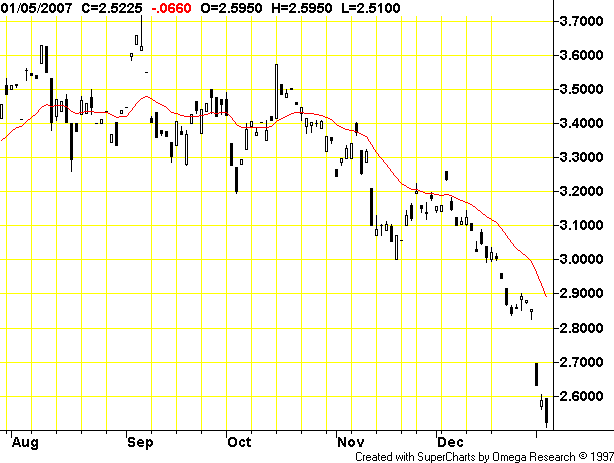
In the last two days alone, commodity prices seem to have fallen off a cliff. Copper futures, which tumbled 7.7% on Wednesday, fell another 1.8% on Thursday -- and have dropped 27% from their December highs.

Crude-oil prices fell nearly 5%, following a 4% drop in the previous session. The front-month futures contract was trading at its lowest level since June 2005. See Futures Movers.

Here's a daily copper chart. The price has gapped down and continued downward last week:

Photobucket - Video and Image Hosting

The reason copper is predictive?

Most commodities are used in the production of industrial goods. When producers start demanding fewer raw materials, it becomes noticeable in commodities prices much earlier than in official economic statistics, explained Barry Ritholtz, chief market strategist at Ritholtz Research & Analytics.

Copper, in particular, is often used as a reliable economic indicator because of its widespread use in production.

"Copper is the metal with a Ph. D. in economics," Ritholtz said. "It's used in the wiring of homes and offices, in plumbing in construction, and it's also a key component in electronic goods.

High stockpiles are one of the reason for the drop in copper prices:

Stockpiles of copper monitored by the LME have doubled since the start of last year. The exchange said earlier today copper stocks held in its warehouses had risen another 1,700 tonnes to total 194,875 tonnes

However it also reported that cancelled warrants, which represent warehouse stocks booked and due for delivery, have climbed to just over 17,000 tonnes, suggesting copper might soon start leaving LME warehouses

"With the large inflows of metal believed to be nearing an end, net falls in LME stocks could start to resume, which would support prices," said UBS Investment Bank analyst Robin Bhar

Simple supply and demand comes into play here. Higher supply = lower price.

Bloomberg has a bit more to flesh out the story:

Copper prices in New York had the biggest weekly decline in 10 years as slower U.S. economic growth and a building slump reduced demand for the metal used in homes, appliances and cars.

Global stockpiles are at the highest since June 2004. The U.S. economy grew at the slowest pace of 2006 in the third quarter, led by a decline in homebuilding. Builders are the biggest consumers of copper. Prices tumbled 12 percent this week, touching a nine-month low.

``I don't think anybody has predicted it would go this low,'' said Karen Poniachik, Chile's mining and energy minister and chairwoman of state-owned Codelco, the world's biggest copper producer.

According to Bloomberg, the slowdown in the US housing market is a prime reason for the drop:

Construction spending fell for a third month in November as homebuilding fell by 1.6 percent, the eighth-straight drop, the Commerce Department said this week. Fewer Americans signed contracts to buy previously owned homes in November, suggesting continuing weakness in the real estate, an industry group said yesterday.

``If overall housing sales stay slow, you could easily pare another 30 or 40 cents off of copper,'' Frank McGhee, head metals trader at Intergrated Brokerage Services Inc., said yesterday. ``Copper is a leading indicator. It's very sensitive to perceived economic conditions.''

Something to keep in mind is the futures markets have become the high tech market of the late 1990s. A ton of money flooded into the futures markets over the last 6 years. This is one of the reasons for the huge price run-ups over the same period. Increased demand = higher prices. Some of this selling may simply be people taking profits. In other words -- this could be speculators leaving the market.

However, the fundamentals indicates there may simply be weaker demand. Housing construction in the US is down. Overall stockpiles are up. This indicates copper production may be too high right now, anticipating a level of demand not warranted by the underlying economic fundamentals.

For market and economic commentary, go to the Bonddad Blog

American Enterprise Institute Is Setting Policy for Iraq

January 06, 2007

Bush is Following The American Enterprise Institute - hook, line and sinker

As I predicted in my post of January 1, 2007, it is becoming very clear that President Bush has dismissed the work of the Iraq Study Group and has embraced the work of The American Enterprise Group. No need to wait until next week, just go to the American Enterprise website and download the report titled "Choosing Victory: A Plan for Success in Iraq". Just about everything that the President will propose next week is sitting right there.

In the Executive Summary Portion, they outline the basics of the plan. Here they are (I summarize and those items in parens are my comments):

  1. Ground forces must accept longer tours of duty for several years. National Guard units will have to accept increased deployments during this period.
  2. Equipment shortages must be overcome by transferring equipment from non-deploying units. The military industry must be mobilized to provide replacement equipment sets urgently (Investment opportunities?? - My comment in the parens)
  3. The President must request a dramatic increase in reconstruction aid for Iraq (How about New Orleans first?)
  4. The President must request a substantial increase in ground forces end-strength. The President must issue a personal call for young Americans to volunteer to fight in the decisive conflict of this generation (How about his daughters first?)
  5. The President and his Representatives in Iraq must forge unity of effort with the Iraqi government.

Deep in the proposal, they basically support what Thomas Ricks said in the book Fiasco. In this book, he showed how the US Military totally blew the identification of the insurgency then blew the actual fighting of the insurgency. These recommendations call for:

  1. Secure Baghdad first - The US Military will be playing "policeman" in the Country's capital.
  2. "Live Among the People" - This means "bye bye green zone". All the "warriors" who have been talking about the big war from the security of the Green zone and the internet cafes, gyms etc. are going to learn what real war is like. They are going to move to tents, foxholes and 24 hour vigilance because they will be out among the people.
  3. Huge amounts of money going to reconstruction. Imagine, we cannot reconstruct New Orleans but we are now going to fix Baghdad.

Overall, this is nothing more than an escalation plan. A surge implies a quick hit and run type thing but even in the AI study, they call for this to be many years long. That is an escalation not a surge.

My predictions:

  1. If you are an active reservist - see ya later. Good luck, you are going to Iraq for at least two years.
  2. If you are active duty - move your family home because you are gone for a long time.
  3. If you are IRR (Individual ready reservist) - Get your finances and family care in order. You are either going to Iraq or you are going to backfill current active troops on bases in the US and Germany.
  4. There will be a "surge" in US deaths and combat injuries.
  5. The only way a true escalation would work is to send in at least 100,000 troops. 10,000 to 20,000 are what we call "speed bumps"

No need to wait. Go read it now!!

--cptkevin@mac.com

Technorati Tags: , , , , , ,

Holding Intelligence Liars Accountable

Editor’s Note: From both the White House and Congress, there's lots of talk about how important it is to look to the future, not dwell on the past. But one of the painful lessons from the Iraq debacle is that Official Washington's failure to understand the past -- and the real histories of key players -- contributed to the present catastrophe.

In this guest essay, two former U.S. intelligence analysts -- Ray McGovern and W. Patrick Lang -- argue that the United States can ill afford letting the Iraq War-era liars off lightly, even if that means taking a hard look back over the past several years:

Lies have consequences.

All those who helped President George W. Bush launch a war of aggression—termed by Nuremberg “the supreme international crime”—have blood on their hands and must be held accountable. This includes corrupt intelligence officials. Otherwise, look for them to perform the same service in facilitating war on Iran.

“They should have been shot,” said former State Department intelligence director, Carl Ford, referring to ex-CIA director George Tenet and his deputy John McLaughlin, for their “fundamentally dishonest” cooking of intelligence to please the White House. Ford was alluding to “intelligence” on the menacing but non-existent mobile biological weapons laboratories in Iraq.

Ford was angry that Tenet and McLaughlin persisted in portraying the labs as real several months after they had been duly warned that they existed only in the imagination of intelligence analysts who, in their own eagerness to please, had glommed onto second-hand tales told by a con-man appropriately dubbed “Curveball.”

In fact, Tenet and McLaughlin had been warned about Curveball long before they let then-Secretary of State Colin Powell shame himself, and the rest of us, by peddling Curveball’s wares at the U.N. Security Council on Feb. 5, 2003.

After the war began, those same analysts, still “leaning forward,” misrepresented a tractor-trailer found in Iraq outfitted with industrial equipment as one of the mobile bio-labs. Former U.N. weapons inspector David Kay, then working for NBC News, obliged by pointing out the equipment “where the biological process took place... Literally, there is nothing else for which it could be used.”

George Tenet knows a good man when he sees him. A few weeks later he hired Kay to lead the Pentagon-created Iraq Survey Group in the famous search to find other (equally non-existent, it turned out) “weapons of mass destruction.”

(Eventually Kay, a scientist given to empirical evidence more than faith-based intelligence, became the skunk at the picnic when, in January 2004, he insisted on telling senators the truth: “We were almost all wrong—and I certainly include myself here.” But that came later.)

On May 28, 2003, CIA’s intrepid analysts cooked up a fraudulent six-page report claiming that the trailer discovered earlier in May was proof they had been right about Iraq’s “bio-weapons labs.” They then performed what could be called a “night-time requisition,” getting the only Defense Intelligence Agency analyst sympathetic to their position to provide DIA “coordination,” (which was subsequently withdrawn by DIA).

On May 29, President George W. Bush, visiting Poland, proudly announced on Polish TV, “We have found the weapons of mass destruction.” [For Consortiumnews.com's contemporaneous challenge to the mobile-lab report, see "America's Matrix."]

When the State Department's Intelligence and Research (INR) analysts realized that this was not some kind of Polish joke, they “went ballistic,” according to Ford, who immediately warned Colin Powell that there was a problem.

Tenet must have learned of this quickly, for he called Ford on the carpet, literally, the following day. No shrinking violet, Ford held his ground. He told Tenet and McLaughlin, “That report is one of the worst intelligence assessments I’ve ever read.”

This vignette—and several like it—are found in Hubris: The Inside Story of Spin, Scandal, and the Selling of the Iraq War by Michael Isikoff and David Corn, who say Ford is still angry over the fraudulent paper. Ford told the authors:

It was clear that they [Tenet and McLaughlin] had been personally involved in the preparation of the report... It wasn’t just that it was wrong. They lied.
This, of course, was just one episode in the long drama of deliberate perversion of intelligence to grease the skids for justifying the invasion of Iraq—the most serious foreign policy blunder in our nation’s 230-year history.
“Hubris,” the overweening arrogance that brought down many a protagonist of the Greek tragedies, is an aptly-chosen title for the revealing Isikoff/Corn study.

Some of the ground they cover is familiar to us Veteran Intelligence Professionals for Sanity (VIPS), who well before the war started chronicling the Bush administration’s lies. What makes the book different is its cumulative impact—the detailed, first-hand accounts of lie and cover-up, lie and cover-up, ad nauseam .

Protagonists need a supporting cast. And many of the dramatis personae were intelligence analysts—former colleagues of mine.

The question lingers: How could they allow themselves to be seduced into enlisting in the meretricious march to mayhem in Iraq? Much of the answer (and much of the reason this misguided war is allowed to continue) lies in the fact that those planning and facilitating the war in Iraq are not fighting it.

Unlike Vietnam, no one “important” is being asked to put life and limb at risk; nor, generally speaking, are their children. Interestingly, most of our troops come from towns with populations of less than 10,000.

Theirs Not To Reason Why

Into the valley of death rode the 3,000.

“U.S. Toll in Iraq Reaches 3,000” screamed The Washington Post ’s lead story on New Year’s Day, which included the Pentagon’s count of more than 22,000 troops injured. As is known, the Pentagon does not count dead Iraqis, but reputable estimates put that number at about 650,000.

As we pass this sad milestone, it behooves us to pause and consider the enormity of what has been allowed to happen—and how to prevent it from happening again. The House and Senate Intelligence committees in the new Congress need to reinstitute genuine oversight, including a close look at why so many intelligence officers cooperated in the dishonesty leading to war. We owe that to the 25,000, not to mention the 650,000.

Start with Tenet and McLaughlin and include Alan Foley, the retired chief of CIA’s Center for Weapons Intelligence, Nonproliferation and Arms Control (WINPAC) and devotee of imaginative intelligence on bio-labs, uranium from Niger, aluminum tubes and other artifices to justify an unnecessary war.

Most of the suspects owe their meteoric careers in large measure to Defense Secretary Robert Gates who, as head of CIA analysis and later as CIA director, institutionalized the politicization of CIA analysis more than 20 years ago, mostly by moving malleable managers up the pay scale.

Another beneficiary of Gates is George Tenet who, as staff director of the Senate Intelligence committee in 1991, helped Gates overcome strong opposition to his confirmation as director. It is a safe bet that Gates returned the favor by recommending that Tenet be kept on as director when George W. Bush became President in 2001.

Gates learned well at the knee of his original mentor, William Casey, President Ronald Reagan’s CIA director. They and those that followed had remarkable success in perpetrating the dual crime of which, long ago, Socrates was accused: making the worse case appear the better and corrupting the youth.

Thus, in September 2002 when Senate Intelligence committee Democrats Dick Durban and Bob Graham insisted on a National Intelligence Estimate on “weapons of mass destruction” before Congress voted for war, George Tenet found himself the ultimate beneficiary of Robert Gates’ finely tuned Geiger counter for corruptibility.

The pliant managers promoted originally by Gates were happy to conjure up a formal estimate written to the specifications of their frequent visitor, Vice President Dick Cheney. [For more on Gates's record, see Consortiumnews.com's "The Secret World of Robert Gates."]

Those who tell consequential lies need to be held accountable. That includes, of course, Colin Powell. Congress needs to ask the former Secretary of State why he decided to disregard the objections of his own intelligence analysts and turned instead to faith-based intelligence for war.

He has expressed regret for his scandalous performance at the U.N., but only because it put “a blot on my record.” We would like to see him try that out on Cindy Sheehan and 3,000 other bereaved mothers.

Powell and I [McGovern] grew up a mile from each other in the Bronx. There we had a word for his forte, which remains a ubiquitous scourge in Washington. It was both noun and verb: “brownnose.” And it has nothing to do with skin color.

It was a familiar word before I [McGovern] learned “sycophant.” Webster’s provides this meaning: “To ingratiate oneself with, to curry favor with; from the implication that servility is equivalent to kissing the hinder parts of the person from whom advancement is sought.”

Rep. Lloyd Doggett, D-Texas, put the effects of all this most succinctly in a floor speech last year:

This war was launched without an immediate threat to our families... Radical "know-it-all" ideologues here in Washington bent facts, distorted intelligence and perpetrated lies designed to mislead the American people into believing a third-rate thug had a hand in the 9/11 tragedy and was soon to unleash a mushroom cloud.

Much is being said today about honoring the sacrifices of our fallen soldiers. Perhaps the best way to do that is to find out who did the misleading and hold them to account before they do it again.

Ray McGovern was an Army infantry/intelligence officer before his 27-year career as a CIA analyst. W. Patrick Lang, a retired Army colonel, served with Special Forces in Vietnam, as a professor at West Point and as Defense Intelligence Officer for the Middle East (DIA). Both are with Veteran Intelligence Professionals for Sanity. (This story originally appeared at TomPaine.com.)