Showing posts with label markets. Show all posts

Monday, April 16, 2007

Reform unlikely to dent rating agencies' armour

FT REPORT - FT FUND MANAGEMENT

By John Dizard, Financial Times
Published: Apr 16, 2007

In the middle of one of their more impressive disasters, the rapid meltdown of "investment grade" paper made of chopped-up subprime mortgages, the credit rating agencies are within a few weeks of having their monopoly formally blessed by the SEC.

The agencies - Moody's, S&P and Fitch, along with their counterparts in Canada and Japan - are always good for a mocking aside among Wall Streeters, as if they're an ethnic group stereotyped as mentally inferior. The agencies are famous for missing disasters-in-the-making, such as Enron, Worldcom, and now the subprime mortgage mess.

Yet we should all be as stupid as they are. Hereditary peerages have been nudged out of the House of Lords, the Big Three American auto companies may bumble on only at Toyota's sufferance, but the ratings agencies have survived what might have been a serious attack on their monopoly. In fact, their position is stronger than ever.

The Credit Rating Agency Reform Act of 2006, which was signed by President Bush in September, is now being implemented through the SEC's rule making process. The rating agencies kicked and screamed and testified throughout the "reform" process as if they were actually threatened by it. They may even have believed they were.

No, forget that thought. They aren't really that stupid.

Their monopoly status has been protected up to now by the SEC's designation of them as Nationally Recognised Statistical Ratings Organisations. There wasn't a formal proceeding to be "recognised", just a long, long, series of "no-action" letters that meant that their ratings counted, and those of others did not. Others could apply to be NRSROs, but somehow, nothing would be done with the applications.

The effect of the "reform", codified in the new law, is to formalise the position of the rating agencies. The idea of the law was to increase competition. The way it's written, and the way it's being implemented by the SEC, will be to admit one or two small, new entrants, and then to slam the door shut.

The SEC's proposed rules (196 pages of spritely government prose) is to say: yes, we will consider letting you compete with Moody's and S&P. But you must replicate their entire structure, balance sheet, and staffing. You must have this in place, without being recognised by us, for at least three years, all the while somehow charging for this un-"recognised" service.

It's as if Apple were to be permitted to compete with IBM only if it first replicated IBM's bureaucracy. Even defence contractors face more of a competitive threat.

The oddest proposed requirement is a non-specific one for "financial resources". Either rating agencies should have no capital requirement, since they have no liability for their ratings, or a requirement for hundreds of billions of dollars of capital, in case they are legally liable. Anything in between is just a gratuitous barrier to entry.

This is particularly ludicrous given that the ratings agencies assert that they are are immune from legal liability for their work, since as "First Amendment" people, the ratings opinions are protected speech under the Constitution.

Sean Egan, the chief executive of the Egan-Jones rating agency in suburban Philadelphia, expects his company's application for NRSRO status to be approved shortly after the rules are published. It's been at the SEC for nine years, but what with one thing and another, the SEC didn't get around to formally considering it until now. Unlike Moody's, S&P, and Fitch, all of Egan-Jones' revenues come from investors who subscribe for its service, not the issuers.

"There was a lot of pressure to reform the system as a result of Enron and Worldcom," Mr Egan says. "At the beginning of the discussions about the new law, there was talk about disallowing compensation from issuers, but that went by the wayside. That is the core conflict, which will continue to exist."

The agencies reply by pointing to their ever-lengthening codes of conduct. Anthony Miranda, at Moody's, says its code "is very specific in detailing how we do business. We model it to mitigate any conflict of interest. We are very attentive to reputational risk".

There's no reason to doubt the sincerity of Moody's, or the other NRSROs. However, human nature being what it is, as Mr Egan says, "People do respond to incentives." And one big incentive is to keep the issuer-customer happy.

However, while the agencies have dodged any slow-moving bullets that could have come from the SEC, there's another threat on the horizon. I understand that there are US states' attorneys-general who are looking over losses to state investment funds from what had been considered "investment grade", subprime housing based paper. As one person familiar with the lawyers' thinking says, "you could argue that the rating agencies voided their First Amendment protection when they got too involved in the underwriting process this cycle. They weren't placing the securities, but they could have gotten too involved in structuring these deals behind closed doors".

This would only be determined to be the case, if it were, after long, long rounds of litigation. But the attorneys-general have a lot of time, a hunger for headlines, and staffs with nothing really better to do than litigate against rich Wall Street institutions.

johndizard@hotmail.com

Thursday, April 5, 2007

Average gold price to hit record high in 2007

Wed Apr 4, 2007 12:09 PM BST

By Atul Prakash

LONDON (Reuters) - Gold prices will set a record high this year in terms of their annual average and may scale new absolute peaks on a weaker dollar outlook, a slowdown in the U.S. economy and geopolitical tensions, a report said on Wednesday.

Precious metals consultant GFMS said in its Gold Survey 2007, which marks the 40th anniversary of its annual report, that worries over high oil prices and inflation might resurface should the United States decide to ratchet up the pressure on Iran.

"It's looking pretty certain that the record in terms of the annual average, $614.50 (an ounce) back in 1980, is going to fall this year," GFMS Chairman Philip Klapwijk said in a statement.

The average gold price was $603.77 an ounce last year.

"I would also be far from surprised if this year we saw the market moving above the 2006 high of $725. Quite whether we would then get close to the all time high of $850 is more doubtful, but I would certainly expect the upward price trend to continue on into 2008."

Firm gold prices so far this year, the acceptance of higher floor prices by physical buyers and a further, albeit smaller, decline in gold supply were also expected to boost investor confidence in the metal, the report said.

Spot gold was around $665.50 on Wednesday, up five percent from the end of 2006. Prices hit a nine-month high of $689 in late February, near a 26-year peak for the spot price of $730 in May last year.

GFMS expected a drop in scrap supply in the first half of 2007 and subdued selling by central banks, which was likely to offset a modest rise in mine output this year.

Global mine production fell 3 percent to a 10-year low of 2,471 tonnes in 2006, with the maximum fall recorded in Asia despite China lifting output by 8 percent. GFMS forecast world production rising between one and two percent in 2007.

Central bank sales fell by 51 percent to 328 tonnes in 2006, resulting in a five percent drop in total gold supply to 3,906 tonnes. GFMS said net sales had continued in 2007 and might persist.

JEWELLERY DEMAND AT 15-YEAR LOWS

World gold demand fell by five percent to 3,906 tonnes in 2006 from a year earlier, mainly because of a 428-tonne slump in jewellery offtake to a 15-year low of 2,280 tonnes. Jewellery accounted for 58 percent of global gold demand last year.

"The chief architect of the decline was developments in the gold price, not only in terms of the absolute level but also the degree of price volatility," GFMS said.

Just three countries -- India, Turkey and Italy -- accounted for half the gross decline in total jewellery demand in 2006.

"Looking ahead to this year, price developments will remain a key factor in determining jewellery fabrication ... However, the decline this year, in percentage terms, is unlikely to match the 16 percent fall seen in 2006," the report said.

The report noted that gold dehedging accelerated last year, with a cut of 373 tonnes from the global hedge book. Total outstanding forward sales, loans and the delta hedge against options positions at the end of 2006 was at 1,364 tonnes.

Hedging allows producers to lock in prices for future output but can backfire if the market rises above the hedged price.

GFMS said gold dehedging might exceed 300 tonnes this year as producers were bullish.

Interest in gold exchange-traded funds and over-the-counter market also grew last year, but speculative activity in the main commodity exchanges declined. The gold market was dominated by institutional players and high net worth individuals, it said.

Wednesday, March 14, 2007

AIPAC launches attack on state pension funds

AIPAC has demanded that all governments and organizations remove investments from any company in the world that does business with Iran.

Yesterday AIPAC especially threatened state pension funds that that have money invested in such companies.

Howard Kohr, Aipac executive director, singled out CalPERS – California’s state pension fund.

Records for 2006 show that CalPERS held over $468m in stock in Total, a French energy company with investments in Iran, plus $330m of stock in Eni, an Italian company that is also active in Iran. These foreign companies help to develop Iran's energy sector. AIPAC wants to hurt them, and hurt any organization in the world that invests in them.

Kohr said AIPAC will work with other Jewish organisations to attack pension funds in 10 states, demanding that funds pull all investments from companies that do business with Iran.

AIPAC has already forced several states to comply. These states instruct their pension funds not to invest in any company that does business with Iran, plus Syria, Sudan, Cuba and North Korea.

Source:
http://www.ft.com/cms/s/7f229cba-d0c7-11db-836a-000b5df10621.html

Posted in Submitted by against zionism on Tue, 2007-03-13 17:42. against zionism's blog

URL

Tuesday, March 13, 2007

Iran 'euro-based' oil bourse underway

Mar 11, 2007

An official said that the managing director of Iran's first petroleum exchange "Iran Oil Bourse" is expected to be appointed soon, bringing the oil-rich nation a step closer to opening its first 'oil bourse'. Majid Shayesteh, managing director of Kish Free Trade Zone Organization, said that President Mahmud Ahmadinejad has directed Iran's ministers of oil, economic affairs and finance to appoint the board of directors of the oil exchange and its managing director. He did not specify when exactly the exchange would open.

He also said the building which will house Iran's first oil exchange has been constructed on the Persian Gulf island of Kish and that the required technical equipment has been installed.

Shayesteh added that three major organizations are involved in the groundbreaking project, saying that coordinating efforts between the various groups initially delayed the project.

According to the official, the articles of association for the oil exchange have since been approved. Last month, a separate official announced that the petroleum exchange would begin operation "in the near future."

Mahmud Salahi, secretary of the High Council for Free Trade and Industrial Zones, had said that Iran decided to establish the euro-based oil exchange on Kish because "there was no such oil trading body in the region." The oil exchange will transact petroleum, petrochemicals and gas in various non-dollar currencies, primarily the euro. It would also establish a euro-based pricing mechanism for oil trading, or 'oil marker' as it is commonly called by traders.

Oil Minister Kazem Vaziri Hamaneh said earlier that a stock market for trade in shares of oil companies will be established in Iran's southern of Kish in the near future. While touring of a local gas transfer operation, the minister said the stock market will be set up in cooperation with the oil and finance ministries.

The stock market will be open to the public soon after the appointment of a managing director and members of a board of directors.

Last month, after a year of speculation, Iran changed its oil bourse from petrodollars to petroeuros.

Thursday, March 8, 2007

Drowning in cheap money

Jubak's Journal
3/6/2007 12:00 AM ET

If there is a major stock market tumble, it won't be the fault of the overall U.S. economy. Instead, point the finger at too much risk-taking in the debt market.

By Jim Jubak

After Federal Reserve Chairman Ben Bernanke's Feb. 28 testimony, one member of the House Budget Committee asked him whether the sell-off in global stock markets a day earlier -- and in particular the 416-point drop in the Dow Jones Industrial Average ($INDU) -- had changed the Fed's thinking.

--MORE--

Do you think the Plunge Protection Team was working its magic this week?

FUNDAMENTALS, NOT HYBRID, CAUSED THE PLUNGE

March 4, 2007 -- Dear John: What happened with the stock market last Tuesday? My thought is, someone pushed the sell button and guess what? There was no human there to stem the slide. R.P.

Dear John: Do you think the Plunge Protection Team was working its magic this week? Dave

Dear R.P. and Dave: You two are asking two sides of the same question: Is there human intervention that can prevent the kind of market meltdown we saw last Tuesday when the Dow Jones industrial average fell 416 points?

First I'll deal with R.P., who is obviously asking whether the changeover to an electronic "hybrid" trading system at the New York Stock Exchange from one that relied on the tried and true but sometimes corrupt specialist system might have caused the near catastrophe.


Yes, having a human being pairing off orders might have reduced the confusion. Or it might not have - previous market plunges all occurred when the specialist system was fully intact.


But what also caused the drop of hundreds of points in a matter of seconds was an old failsafe measure established by the NYSE: the so-called collars, or trading curbs.

Certain program trading is halted whenever the NYSE Composite Index is down (or up) 180 or more points. But what typically happens is that sellers just pile up and wait for the curbs to end.

The hybrid system at the Exchange never handled anything like this before and it simply became overwhelmed.

But don't confuse that 300-point drop, which was probably exacerbated by technical glitches, with the real reason the stock market has been weak recently: the U.S. economy is slowing.

Now, for Dave's question about the Plunge Protection Team, which is formally called the Working Group on Capital Markets.

Treasury Secretary Henry Paulson last week said a number of times - as others did - that they were "watching developments carefully." Well, what exactly does that mean?

If the stock market should happen to collapse, does anyone think that Paulson - who heads the Plunge Protection Team - is just going to sit idly by and marvel at the catastrophe.

Or will he contact the others on the team, including several notable Wall St. figures, and (wink, wink) mention that it would be nice if stock prices didn't collapse and create a national nightmare?

There's no doubt about the existence of the Plunge Protection Team.

In the past this group has intervened in the stock market - of that I'm certain. Last week? The government was probably more of a cheerleader, encouraging firms not to panic and (perhaps) indemnifying them against loss.

Send your questions to Dear John, The N.Y. Post, 1211 Ave. of the Americas, N.Y., N.Y., 10036, or john.crudele@nypost.com.

Tuesday, March 6, 2007

Goldman Sachs warns of 'dead bodies' after market turmoil

By Ambrose Evans-Pritchard, International Business Editor

Last Updated: 2:19am GMT 06/03/2007

  • Ian Cowie: Q&A on investing in shares

    The global currency storm of the past week is starting to infect the corporate bond markets and may prove harder to contain than last year's May sell-off, Goldman Sachs has warned.

    Jim O'Neill, the bank's chief global economist, said investment firms playing the "carry trade" had been caught on the wrong side of huge leveraged bets against the Japanese yen.


    "There has been an amazing amount of leverage on currency markets that has nothing to do with real economic activity. I think there are going to be dead bodies around when this is over," he said. "The yen carry trade has reached 5pc of Japan's GDP. This is enormous and highly risky, as we are now seeing."

    Stock markets around the world continued to slide as investors scrambled to liquidate bonds, equities and weaker currencies across the board. Japan's stock market slumped 3.3pc, with falls of 3.7pc in India, 4.6pc in Malaysia and 4.7pc in Moscow, where oil and commodity shares tumbled on fears of a global slowdown.

    London closed down 57.5 points at 6058.7 and America's Dow Jones was down 66 points in afternoon trading. Copper prices are down 9pc in a week. Base metal inventories are rising fast.

    "The unwind of the carry trade has had an impact across emerging markets," said Kingsmill Bond, a strategist at Deutsche Bank. "The capital exporters in Asia and the Middle East have been relative safe havens: the worst hit are Latin America, South Africa, Turkey and eastern Europe."

    advertisement

    The yen has rocketed in a move known as a "short-covering squeeze", rising almost 6pc against the euro and the dollar in a week. Many funds that borrowed at near-zero rates in Japan to chase higher yields abroad are able to close bets at a profit, but some may be forced to liquidate positions - starting a chain reaction through other asset markets, such as gold.

    Mr O'Neill said the danger was contagion to low-tier bonds, driving up the cost of borrowing for business.

    "Our concern is that the repricing of risk we are seeing could spread to the credit markets. This is potentially more difficult to deal with, and needs watching," he said.

    The Itraxx Crossover index used to take the pulse of corporate bonds shows that spreads have widened 43 basis points in a week.

    Stephen King, chief economist for HSBC, said it would take two or three weeks to gauge the severity of this shake-out. "The world economy is fundamentally strong, but this reversal of one-way bets built up over years creates great uncertainty. The key worry is that this could reveal a weakness in the architecture of financial markets. We just don't know who is trying to liquidate positions," he said.

    Bernard Connolly, chief strategist for Banque AIG, said conditions now are more threatening than they were in the six-week sell-off last spring.

    "The carry trade was bound to end with a bang rather than a whimper but this doesn't look to me like forced liquidation yet. However, the yen is going up against all currencies this time and not just the dollar, and stocks are looking more panicky.

    "This is going to go on for longer because there has unquestionably been a global financial bubble. Eventually, central banks will reflate but it will have to get worse first. "

    Steve Pearson, currency strategist at HBOS, said global markets were waking up to the reality that perma-growth with low inflation was not on the cards. "We're seeing a creeping reassessment of the trade-off between growth and inflation. This is going to weigh on asset prices and threaten risky assets all through the first half of this year."

  • Monday, March 5, 2007

    Correction: this could become a crash after all

    As traders brace for fresh turmoil, soothing words may simply be hiding reality

    Larry Elliott, economics editor
    Monday March 5, 2007
    The Guardian


    With his low opinion poll ratings, George Bush needs a crash on Wall Street like a hole in the head. The days are ticking away towards the end of his presidency and the Pentagon is warning that unless the "surge" in Iraq works the United States could be heading for another Vietnam.

    Little wonder, then, that Washington did its best to rubbish any suggestion that last week's turbulence on the financial markets amounted to anything more than a little temporary difficulty. In this, the Bush administration was ably supported by the great and good of New York - or at least that part of the financial elite that wasn't banged up for alleged insider trading last week by the securities and exchange commission. As ever, the same reassuring story was spun. Like a hypnotist faced with a sceptical member of the audience, the words were repeated over and over again. Listen, this is a correction not a crash. Relax, the fundamentals of the global economy are strong. Are you listening to me? There will be no recession in the US. Did you hear what I said? There will be no recession in the US.


    By the end of the week, the trick seemed to have paid off. Ben Bernanke, the chairman of the Fed, had downplayed the risks of recession brought to the public's attention by his predecessor, Alan Greenspan. And the markets were gagging for reassurance. After all, if you've spent the past couple of years persuading yourself and clients that investing in the current climate is risk-free, the last thing you want to hear is that the glittering edifice of the global economy is a Potemkin village - the fake Crimean settlements set up to impress Catherine II. The dozen charged by the SEC are not the only ones guilty of rigging markets; they were just a bit more self-serving about it, that's all.

    Naturally, the consensus may be right. The consensus tends to be right more often than it is wrong, which is why real crashes of the sort seen in October 1929 and October 1987 tend to be a rarity. Indeed, the big sell-off of 20 years ago did prove to be far less of a threat than was initially feared.

    Even so, there are reasons for concern. One is that the soothing words were at odds with what happened in the markets. Wall Street suffered its biggest weekly fall in four years with the Dow Jones industrial average down 4.2%.

    Banks raised the cost of the dodgy loans in the sub-prime market, and the contagion affected other markets. The cost of insurance against credit defaults rose sharply and there was a flight to quality assets. This may prove temporary; if the self-hypnotism works the financial markets may soon again be seeking out all sorts of rococo investments, amplified by derivatives, in the belief that they are risk-free.

    This, in some ways, would be more worrying than a flight to quality or rising spreads on junk bonds, because the riskiest of all markets is the one where the players can see no risk.

    A second concern is that the US may be in a lot worse shape than Wall Street - cocooned by its sky-high salaries and lucrative bonuses - realises. One view of the US economy since the early 1990s is a glorious renaissance built on the coming industries of the hi-tech revolution; another is that an unsustainable stock market was followed by a bust, and that in turn was followed by an unsustainable boom in the housing market that has also now gone bust. Sure, the Fed could respond to the threat of recession by cutting interest rates, but the traction gained by cheap money is going to be a lot less this time. Why? For one thing, the two debt-driven bubbles have left consumers enormously over-extended. For another, inflation in the asset markets has spilled over into general inflation. Cutting the cost of borrowing might have more of an impact on prices than it would on activity.

    As Stephen Lewis of Insinger de Beaufort puts it, the real surprise, given what has been happening in the US housing market, is that consumer spending has held up so well. But there is a sense that the consumer is starting to run out of road, with spending propped up by the one-off impact of lower energy prices.

    Charles Dumas at Lombard Street Research agrees, and says the increase in borrowing on credit cards rather than the rising value of real estate, is a sign that US consumers are drinking in the last-chance saloon. The vast majority of Americans don't have a yacht and a summer home in the Hamptons; they don't have stock options and they have not seen their salaries rise at 10, 50 or 100 times the current inflation rate.

    Given Asia's export-dominated growth is heavily weighted towards the US, investors should be prepared for the 9% fall in Shanghai last Tuesday to be the first of many bad days.

    "Household borrowing is the centre of the storm," says Dumas. "When economies fluctuate, services fluctuate gently, construction and manufacturing more violently. Construction we know about: the housing slump is now beginning to be reinforced by a business construction collapse. The US manufacturing sector is now called China, or Pacific-developing Asia more generally. The current US downswing must take the gloss off growth in that region, where asset markets are priced for perfection." A different perspective comes from Stephen King at HSBC. His view is that the global economy is now more than the United States and its satellites. Even if America does slide into recession, there is no reason to assume the rest of the world will follow.

    This requires a radical re-think, since we have become accustomed, particularly since the collapse of the Soviet Union to assume the world is unipolar with the US the hegemonic power. King says the weaker domestic demand growth in the US last year did not seem to have knock-on effects elsewhere. Far from catching a cold when the US sneezed, the rest of the world went shopping. "Relative to our own forecasts, the big surprise last year was the strength of domestic demand growth, notably in Canada, Mexico, China, the Middle East, Germany and the UK."

    On the face of it, this is a relatively reassuring interpretation of events. If there really has been a de-coupling going on under our noses, it is possible that a US recession could be isolated. Scratch beneath the surface, though, and King's thesis has some potentially serious long-term geo-political - and hence economic - consequences. What could be happening is that we are seeing the very gradual waning of US economic supremacy, with years of budget and trade deficits and two decades of excessive consumption chipping away at what is still a phenomenally powerful economy. Britain suffered from just this process in the final quarter of the 19th century; other nations were growing in strength and Britain was in the early stages of relative decline.

    Paul Kennedy argued in the late 1980s that political power derives from economic power. The first doubts crept in for Britain when winning the Boer War in the face of determined resistance and guerrilla attacks proved a lot more difficult than London had blithely imagined. History may show that South Africa between 1899 and 1902 is a better parallel for America under Bush than is Vietnam.

    larry.elliott@guardian.co.uk

    Markets across Asia plunge

    ---
    By YURI KAGEYAMA, AP Business Writer1 hour, 9 minutes ago

    Markets in Asia and Europe fell again Monday, extending their slide into a second week as investors worried about a possible global slowdown dumped stocks that had surged in recent weeks.

    Also sparking jitters was the yen's jump to a three-month high against the dollar as investors reversed so-called yen-carry trades. A decline in this trading practice, which involves borrowing money at Japan's ultra-low interest rates to invest in higher-yielding assets elsewhere, could hurt global liquidity.

    In Tokyo, the Nikkei 225 index fell for a fifth day, tumbling 575.68 points, or 3.34 percent, to 16,642.25 points, dragged down by major exporters such as Canon Inc., Sony Corp (NYSE:SNE - news). and Toyota Motor Corp., whose earnings are eroded by a stronger yen. Since reaching a nearly seven-year high last Monday, the Nikkei index has slid 8.64 percent.

    Markets in Hong Kong, Australia, the Philippines, Malaysia, India and South Korea all fell sharply Monday, continuing their declines from last week, when a 9 percent plunge in Chinese stocks on Tuesday triggered cascading selloffs on Wall Street and other global markets.

    European markets also opened lower Monday, with Britain's benchmark FTSE 100 down 1.5 percent in early trading, France's CAC 40 sliding 1.8 percent and Germany's DAX sinking 2.1 percent.

    "I don't know where the domino effect will stop," said Jose Vistan, research director at AB Capital Securities in Manila, Philippines, where the benchmark index sank 4.5 percent. "Emotions are the ones driving share prices right now."

    "Everything takes a back seat relative to the sell-off that we are seeing. It's emotions," Vistan said. "You throw away technicals and fundamentals out the window. Emotions are the ones driving share prices right now."

    Hong Kong's Hang Seng index tumbled 4 percent to its lowest since mid-December. Australia's stock market — which had hit records last month — fell for a fifth day, sinking 2.3 percent. South Korea's benchmark index dropped 2.7 percent and Indian stocks fell 4.2 percent.

    Investors still seemed risk-averse after the previous week's turmoil.

    "When there's such a big market move in such a short period of time, there's that element of surprise and confusion," said Teruhisa Ishikawa, section chief for investors information at Mizuho Investors Securities Co.

    Funds and institutional investors tend to go on a selling binge to trim losses in reaction to such market moves, he said, adding that what was ahead was still unclear.

    In China, the Shanghai Composite index fell a more modest 1.6 percent, but foreign-currency denominated "B shares" tumbled after officials denied rumors those stocks might be merged with the mainstream Chinese-currency "A shares."

    Comments by China's central bank governor and premier suggesting authorities might tighten credit and raise interest rates and bank reserve requirements to combat rising inflation also cast a pall on markets already shaken by last week's volatility.

    Signals so far suggest that China is determined to prevent a speculative bubble in share prices, which more than doubled last year and rose to a record high a week ago, investment house Morgan Stanley's chief economist Stephen Roach said in a report issued last week.

    "A stock market correction could well be an unavoidable outgrowth of actions aimed at cooling off China's overheated investment sector," Roach said. "More administrative actions can be expected."

    Indeed, many analysts see the market selloff as a healthy correction for markets that had risen too far, too fast. China's market had doubled in value last year, for example. In Malaysia, stocks had surged 17 percent since the start of the year before last week's sell-off.

    There were also signs that the recent turmoil had caused some international investors to unwind yen-carry trades.

    For years, investors have borrowed yen at Japan's near-zero interest rates to buy higher-yield assets elsewhere. But as the yen appreciates, the profits from these carry trades are eroded, prompting some investors to return yen loans, strengthening the Japanese currency.

    The yen's appreciation accelerated as its gains triggered stop-loss buy orders early Monday, sending the dollar as low as 115.47 yen, its lowest level since Dec. 8.

    "Yes, there was some unwinding of yen-carry trades among short-term players, but basically traders in Tokyo were selling the yen because foreign players wanted to buy it," said Tohru Sasaki, Chief FX Strategist with JP Morgan Chase Bank.

    Still, while the Bank of Japan raised interest rates last month to 0.5 percent, they are still far lower than rates in the U.S. or Europe, making the yen-carry trade still an attractive strategy, analysts said.

    ____

    Associated Press writers Carl Freire in Tokyo, Teresa Cerojano in Manila, Elaine Kurtenbach in Shanghai and Toby Anderson in London contributed to this report.

    Saturday, March 3, 2007

    Last Week's Financial Markets: What the Hell Happened?

    March 3, 2007

    By Bonddad
    bonddad@prodigy.net


    Below is a compilation of several posts on my blog. I've put these together in one mega-market post. I hope this helps to explain and assuage some fears out there.

    The markets on Friday

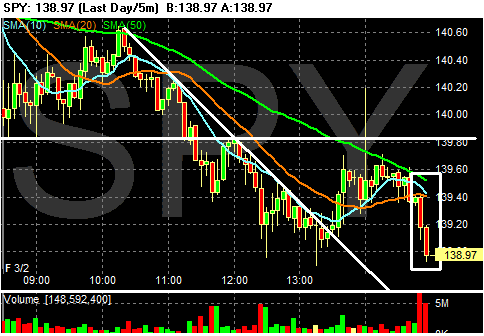
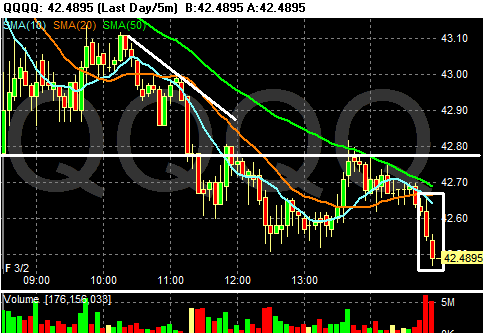
    Traders don't want to hold anything over the weekend in this market. Take a look at the last two bars of both the SPYs and QQQQs -- there's a ton of volume and a strong downtrend. In addition, the markets closed near their lowest point of the day. This indicates there is some pretty strong bearishness in the market right now.

    SPY:

    Photobucket - Video and Image Hosting

    QQQQ:

    Photobucket - Video and Image Hosting

    A review of the week and daily charts

    From Bloomberg:

    U.S. stocks dropped to a three-month low, completing their worst week since January 2003, after a decline in consumer confidence magnified the risk profit growth will be wiped out by a recession.

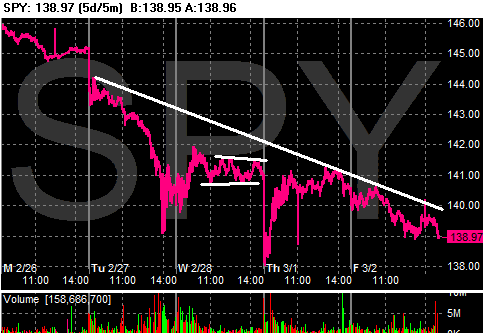
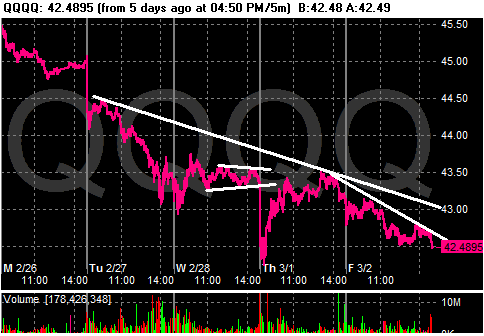
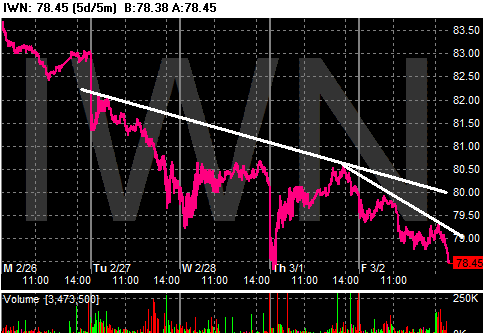
    Let's go to the charts in the following order: SPY, QQQQ, IWN

    Photobucket - Video and Image Hosting

    Photobucket - Video and Image Hosting

    Photobucket - Video and Image Hosting

    These charts highlight four points.

    1.) Tuesday was the big day of losses with a sudden drop at the open and continued weakness throughout the day.

    2.) Friday we drifted downward and closed on a low-point.

    3.) The overall trend for the week is down.

    4.) You can literally draw a line from the upper left to the lower right of each chart and have the line represent the week's trend.

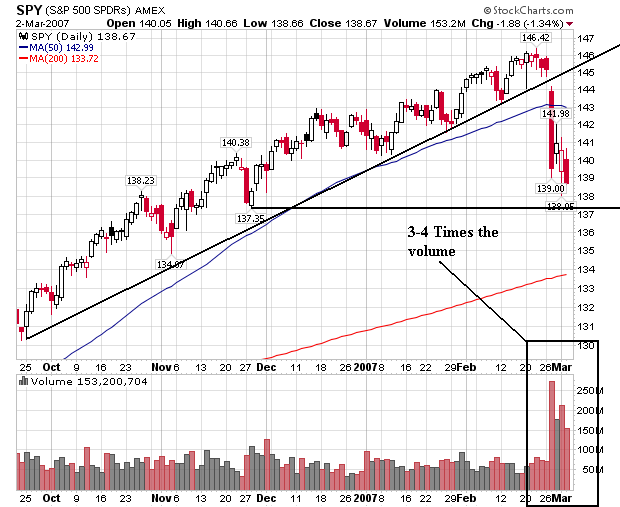
    Let's go the the daily charts, courtesy of stockcharts.

    Here's the SPY:

    Photobucket - Video and Image Hosting

    1.) There is a big jump in volume above the preceding 3-4 months. This indicates sellers were looking to get out.

    2.) The index closed below the 50-day SMA.

    3.) The index clearly broke the 6-month uptrend and broke through previous support levels.

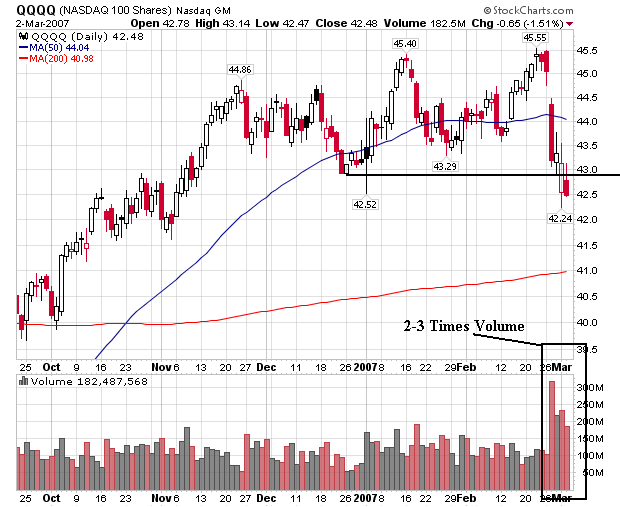
    Here's a chart for the QQQQs

    Photobucket - Video and Image Hosting

    1.) There are 4 days of heavy selling on between 2-3 times the normal volume for the preceding 3-4 months.

    2.) The index closed below the 50 day SMA.

    3.) The QQQQs have traded in a range between (roughly) 42.50 and 45.50 for the last three months. We closed below that range on Friday.

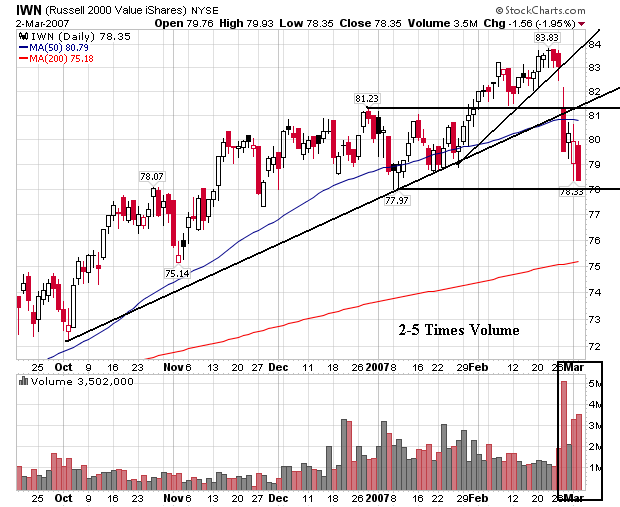
    Here's a chart for the IWNs

    Photobucket - Video and Image Hosting

    1.) We had the heaviest selling of the indexes here -- up to 5 times the norm for the last 3-4 months.

    2.) The index closed below the 50-day SMA.

    3.) The index broke through two uptrends -- one that started at the beginning of October and one that started at the end of January.

    All of these indexes had long red bars with large volume. This means sellers are in control and looking to book profits.

    Fundamental Reasons for the Sell-off

    1.) The BEA lowered GDP estimates from 3.5% to 2.2%. First, this is a large revision. People will make entirely different economic assumptions about an economy growing at a 3.5% growth rate than an economy at a 2.2% growth rate. Secondly, this is the third quarter of sub-par growth, indicating we are definitely in the cooling off stages.

    2.) New Home sales dropped 16%. There is a high margin of error with this number, so it can be revised upwards. However, the initial reading put the "the housing market has bottomed" people out to pasture.

    3.) Durable goods orders dropped 7.1%. Even without transportation, this number dropped 3.1%.

    4.) Weekly unemployment claims are ticking up. The 4-week moving average increased from 327,000 on February 10 to 335,000 in the latest report. However, bear in mind this is a noisy report and is subject to revisions etc...

    5.)While personal income increased (a net positive) the core PCE inflation level increased .2%. This takes away fuel to the "Fed will lower interest rates soon" argument.

    6.) Construction spending dropped .8% in January. This adds further fuel to the slowing housing market story.

    7.) While existing home sales increase last month they did so because of a 5% December to January price decrease, a 3.1% year-over-year price decrease, a 3% increase in the month-to-month inventory and a 23% increase in year-over-year inventory. In other words, the high inventory figures are starting to hit prices and we still have a ton of homes to sell.

    8.) Countrywide Financial announced 20% of the subprime loans they service are late with payments. This indicates there is probably more trouble ahead for an already troubled part of the economy.

    The Bullish Argument Going Forward

    This is the Barron's cover story this week (subscription required). The article makes some good points.

    Before Tuesday, every major stock market in the world -- and nearly all the smaller markets -- were near 52-week highs. Most markets also were near record levels, with the notable exceptions of the Nasdaq Composite and Standard & Poor's 500, a reflection of the absurd valuations they had reached in the tech boom of 2000.

    .....

    A bullish Wien thinks the S&P 500 could hit 1,600 by year end, a 15% gain. He says U.S. stocks look attractive with the S&P valued at 15 times projected 2007 operating earnings. The Dow Jones Industrial Average trades at 14.4 times estimated "07 profits. Both the Dow and the S&P 500 are in negative territory for the year, with the industrials off 2.8% and the S&P 500 down 2.2%. The so-called earnings yield on both the S&P 500 and the Dow is close to 7%, which compares favorably with the 4.5% yield on 10-year Treasuries. The earnings yield is the inverse of the market's price-earnings ratio.

    Companies continue to lift dividends and repurchase record amounts of stock in order to reward shareholders -- and stay out of the sights of private-equity shops on the prowl for new leveraged buyouts.

    .....

    HISTORY SUGGESTS THAT STOCKS MAY DO WELL in the next two months. There have been 38 days since 1979 when the S&P 500 has suffered a single-session loss of 3% or more. The average gain in the ensuing 60 days has been 6.9%, with the index rising in 31 of the 38 cases, according to Citigroup research.

    There are some very solid technical arguments here. First, the market isn't cheap but certainly not expensive by historical standards. While corporate profit growth is expected to slow, it is still pretty healthy. And traders are conditioned to buy on dips, meaning there could be some buying nibbles at attractive technical levels over the next few weeks.

    The article does state overall slowing economic growth is the primary reason the markets may not advance. This is a strong counter-argument. As I wrote above, there was a ton of bad economic news last week that provided the fundamental reason for the continued market weakness throughout the week. I think the market is starting to price in the slower growth scenario going forward.

    I still think housing is the main wild card going forward. There is still a ton of inventory to clear and last week's numbers indicate it will take lower priced to do it. Housing starts are slowing, which means we will probably have a large amount of construction lay-offs in the coming months. However, the business construction sector may absorb some of these displaced workers if non-residential construction levels continue at current levels.

    I wouldn't be surprised to see the market far more sensitive to bad economic news over the next few weeks. Up until last week, the market was able to shrug off some bad news, basically arguing that problems were contained within specific market sectors -- especially housing problems. However, I think we'll start to see some of housing issues -- especially in the mortgage area -- start to spread-out to other market sectors like financials (mortgage related issues) and consumer durables (furniture/appliances).

    Food for thought

    Friday, March 2, 2007

    China Squeeze: Stephen Roach

    Global

    February 28, 2007

    By Stephen S. Roach | New York

    Like nearly everything else in the world these days, it now appears that global stock market corrections are made in China. I have no idea if the rout that began in China was just a brief flash or the start of something big. But I have long felt that something has to give in China. This may well be the beginning of an important venting process.

    The basic premise of this story is that China — despite its remarkable successes on the economic development front — now has a seriously unbalanced economy. The main problem is a runaway investment boom. By our estimates, in 2006, fixed asset investment exceeded 45% of Chinese GDP — a record for China and, in fact, a record for any major economy in the world (see accompanying chart). By comparison, Japan’s investment ratio in the 1960s — the period of maximum rebuilding from the destruction of World War II — never exceeded 34% of GDP. China’s annual growth in fixed asset investment has averaged 26% over the past four years. Should the investment boom continue at this pace, the odds of capacity excesses and a deflationary endgame will only increase. That’s the very last thing China wants or needs.

    The Chinese government recognizes the perils of just such a possibility. For nearly three years, it has conducted an on-and-off tightening campaign aimed at cooling down its overheated investment sector. Following relatively limited actions first implemented in the spring of 2004, Chinese authorities have upped the ante in the past eight months. The People’s Bank of China has raised its short-term policy rate twice by a total of slightly more than 50 basis points, and beginning in mid-2006 the central bank boosted bank reserve requirements five times in increments of 50 bps from 7.5% to 10% — the last such action taking effect on 25 February.

    The problem for China is that it is still very much a blended economy —both state and market driven. As such, market-based policy actions — especially interest rate adjustments — have had only limited success, at best. Two additional factors compound this problem: First, Chinese banks run chronic excess reserve positions; reserves amounted to 14% of total deposits by year-end 2006 — well above the mandated 10% requirement set by the latest policy action. That means, of course, that recent increases in bank reserve ratios are not a binding constraint on the banking system. Second, much of China’s bank lending remains outside the scope of the central control of its monetary authorities; dominated by a vast and highly fragmented system of autonomous local banks, there is only limited traction between monetary policy adjustments and broad trends in Chinese bank lending. In light of that disconnect, together with only limited development of a domestic corporate bond market, Chinese macro officials have had to rely largely on “administrative controls” — namely, a case-by-case project approval mechanism — to rein in the excesses of a runaway investment boom.

    The results of this effort have been mixed. Courtesy of the administrative edicts issued by the National Development and Reform Commission — the modern-day counterpart of China’s old central planning bureau — investment growth slowed from near 30% at the start of 2006 to around 14% at the end of the year. Unfortunately, bank lending went the other way — actually accelerating from 13% y-o-y growth in mid-2006, when the latest tightening campaign began in earnest, to 16% by December. That, in a nutshell, could well be the key to this story: China’s central bank has been unable to get traction on bank credit expansion at the same the central planners have succeeded in achieving traction in prompting the investment slowdown. This has resulted in an excess of bank-induced liquidity creation that is undoubtedly spilling over into the financial system. As a doubling of the Shanghai A-share index over the past six months suggests, the Chinese stock market appears to have been a major beneficiary of this mismatch.

    Here’s where the story gets especially interesting — and, admittedly, somewhat conjectural. In China, stability is everything. The Chinese leadership believes it cannot afford to lose control of either its real economy or its financial markets. Pure market-based systems can rely on interest rates, currencies, fiscal policies, and other macro stabilization instruments to contain the excesses. A blended Chinese economy does not have that option. The quasi-fixed currency regime compounds the macro control problem — making it difficult for China manage its currency in a tight range without fostering excess liquidity creation. That puts the onus on Chinese policymakers to opt for non-market control tactics. Just as China has moved to bring its central planners into the business of containing the excesses in the real economy through administrative measures, I suspect it now feels compelled to rely on a similar approach in order to deal with excesses in its financial system.

    All this puts the onus on China’s financial regulators to face up to the risks inherent in any asset bubble — in the current instance, an equity bubble. That’s especially the case in the weeks just before the annual early March meeting of the National People’s Congress — always a critical and delicate point in the Chinese policy cycle. In that context, there were countless rumors of government intervention in the markets on 27 February. The only such action our China team has been able to verify — and it’s an important one — pertains to State-directed sales of its massive holdings of so-called reformed shares. Apparently, yesterday (27 February) it became public information that various local affiliate holding entities under the SASAC (State-owned Assets and Supervision Administration Commission) have been reducing government stakes in about 15 listed Chinese companies by close to the annual limit of 5% of total outstanding shares. Following the equity market reforms of 2005, these previously unlisted shares have since been classified as market tradable shares — thereby opening the door for actions such as those which became evident on 27 February. The 9% one-day plunge in Chinese A-shares could certainly be interpreted as a sign that “inside sellers” played a key role in sparking the decline — either acting at the explicit request of the government or out of fiduciary conviction that the end was close at hand.

    Inside selling or not, the bottom line is that China’s macro control imperatives are a critical ingredient of its overall stability objectives. And in recent years, risks have been multiplying on the control front. Just as China cannot afford an overhang of excess capacity, it cannot afford a major equity bubble. Lacking in market-based mechanisms to address these problems, the administrative option remains a very important tool in the Chinese policy arsenal. So far, that’s mainly been true on the real side of the economy. The near-parabolic increase in the Chinese equity market over the past six months is good reason to believe this strategy is about to be tested on the financial side of the economy.

    In the last five years, China has emerged as a major engine on the supply side of the global economy. But with that achievement has come a new set of risks — especially an overheated investment sector and an equity bubble. These two problems are related in that they are both very visible manifestations of China’s control problem. The sharp break of share prices on 27 February may well be symptomatic of China’s increased determination on the macro control front. Ultimately, this is good news for China and the broader global economy — it sets the stage for balanced and sustainable growth. But for those counting on open-ended Chinese growth, any such slowdown could come as a rude awakening. The China squeeze now appears to be on in earnest.

    The Iraq War Crash: Stock market takes a dive – along with the prospects for peace in the Middle East

    Related
    The Words None Dare Say: Nuclear War
    ---
    March 2, 2007

    by Justin Raimondo

    It's the Chinese Year of the Boar, not very propitious if you're looking to have an easy time of it. Chinese astrologer Raymond Lo predicts:

    "The Year of the Boar will not be very peaceful. Boar years can be turbulent because they are dominated by fire and water, conflicting elements that tend to cause havoc."

    China's booming stock market – a monument to the victory of China's "capitalist-roaders" over the last remnants of Maoism – doubled last year, and the speculators were drawn to it like … well, like this, or this. The Shanghai Exchange was about due for a big correction when it dropped by 9 percent the other day, an event which many blame for the 500 point drop in the Dow Jones – and the advent of what seems like a new era of economic turmoil, as the slide continues into Thursday. Which raises the whole question of – why now?

    The Chinese spark that set off a global prairie fire fell on some pretty dried up terrain. According to the estimates of economic experts, the Iraq war drained off one trillion dollars from the U.S. stock market before the first shot was fired. After the war was "won," however, the real costs began to kick in, which economists Linda Bilmes and Joseph Stiglitz estimate at another trillion bucks (in direct costs), and possibly two trillion when all the other variables are factored in. The Bilmes-Stiglitz study shows that one of the costs of the Iraq war has been that stock prices have been tamped down considerably:

    "The surge in corporate profits in the last couple of years has not been accompanied by an increase in stock prices of the magnitude that would have been expected. Robert Wescott estimates that the value of the stock market is some $4 trillion less than would have been predicted on the basis of past performance. Assuming that the major factor contributing to that is the increase in oil prices, and that 20% of that increase in oil prices is due to Iraq leads to a cost of some $800 billion. This is several times the increase in the direct energy costs over the next few years."

    The prosperity we lost is not as great as it might have been: this is due entirely to the war. Resources that might otherwise be engaged in the peaceful production of consumer goods are diverted and frozen in the form of fighter jets, aircraft carriers, and cluster bombs, whose only product is death. What characterizes war, aside from the mass death and horror, is sheer waste. We have seen the body-bags come home, and their increasing number has made us sit up and take notice. Once the economic consequences begin to kick in, however, we're likely to hear some real howling.

    There are two ways to finance a war: one is by directly increasing taxes. This is never popular, either with the people or the politicians, and so the latter have hit upon a successful subterfuge: inflation. They simply set the government printing presses to running at high speed, sell more government securities overseas, and impose a "hidden" tax – one that falls disproportionately on those least able to afford it. But then again, don't the downtrodden masses always suffer the most in wartime? Isn't it always the elites – in government and in the think-tanks, with their soft white hands and social distance from the battlefield – who dream up the wars, and the hoi polloi who fight them?

    The Chinese panic is being diagnosed as the "cause" of our own apparent meltdown, but this mistakes the symptoms for the underlying disease. The name of our affliction is debt, and that burden has increased by over 30 percent since our venture into empire-building was launched. The Chinese are – or, have been – buying that debt, but the bursting of the Shanghai bubble could soon cut off that supply of income – and then where would we get the money to pay for the biggest military build-up in world history?

    Bush is demanding $716 billion for his "defense" budget, which, as one news report described it, is "greater than the annual gross domestic product of all but 14 countries." He'll get that, and more: the Democrats, for all their "antiwar" pretensions, fault this administration for not having a large enough military. Which brings to mind Madeleine Albright's infamous scolding of Colin Powell, which had her saying:

    "What's the point of having this superb military that you're always talking about if we can't use it?"

    Well, I hope Madame Albright is satisfied: these days, our formerly superb military is getting a lot of use, and there are growing indications that the Bush administration is preparing to use it against Iran. What may have spooked the Chinese, and set off a global chain reaction, is a case of the Iranian war jitters.

    China is hugely dependent on Iran for its energy needs, or else the rapid industrialization and modernization envisioned by the Chinese elite will come to a sputtering halt. U.S. war moves against Iran threaten China's lifeblood. Stock markets, being very future-oriented, pick up on rumors of war very quickly and the Shanghai Stock Exchange acted accordingly.

    The Chinese didn't cause markets to fall: the main factor is U.S. economic and foreign policy. The elements of a global recession – or worse – have been in place for some time now. As one commentator presciently put it:

    "A US housing market in sharp decline; rampant speculation in a bubble-like mania in China; growing clouds of war over Iran. These are the elements of the gathering 'perfect storm.'"

    Years of living beyond our means, combined with our imperial delusions and the prospect of a war that would send oil prices skyrocketing, triggering a global economic meltdown – that is what has sent the markets spinning, and threatens to destroy our economic system.

    Capitalism, contrary to the popular leftist myth, doesn't cause wars: indeed, capitalism is the antithesis of war. Yes, some profit from war – the war industries, and their economic satellites. If the American Enterprise Institute sold stock, they'd be right up there with Google. It doesn't matter that their intellectual stock – as predictors and policymakers – is at an all-time low, what with the Iraq war disaster and growing public opposition to our crazed foreign policy. What matters is that those in power – in the White House, and Congress – are buying it.

    Markets fell precipitously in the run-up to war with Iraq, and they are doing the same as war clouds gather on the Iranian horizon. As the U.S. colossus goes lumbering after its latest victim, and world markets are shaken, we can expect more of the same. The Iraq War Crash is coming down on our heads – but hey, if you own Halliburton stock, or perhaps Lockheed, you don't have a lot to worry about.

    Fears of recession spark further turmoil in markets

    By David Usborne in New York

    Published: 02 March 2007

    Fresh anxiety erupted about the health of the world's major economies yesterday after investors in stock markets across Asia, Europe and the United States once again staged significant retreats two days after Tuesday's unexpected global equity sell-off.

    In New York, the Dow Jones Industrial Average plunged more than 200 points in the first minutes of trading, seeding fears of a repeat of Tuesday's massacre that saw a 416-point collapse on the index.

    With slowdowns emerging, notably in the housing market and car manufacturing in the United States, signs are building that it economy may be at a pivot point, with some observers worrying about decelerating expansion and possibly a recession looming.

    The fearful mood was exacerbated by comments from Alan Greenspan, the influential former chairman of the US Federal Reserve, about the possibility of the US entering recession before year's end. He told a conference in Tokyo yesterday: "By the end of the year, there is the possibility but not the probability of the US moving into recession." He has argued this week that corporate profit margins appear to be narrowing, indicating that a recent economic expansion has reached a "mature phase".

    Market watchers warned of several more bumpy days to come, pointing to the renewed erosions in stock markets globally yesterday. The Shanghai stock market slippedan additional 2.9 per cent. The London FTSE index closed down 55.5 points or 1.5 per cent. The Dow later recouped most of its early losses as some more encouraging economic data was released and closed down 34.29 points. But fears remain that there may be worse to come. All the markets have fallen significantly during the course of the week.

    Senator Hillary Clinton, a candidate for the US presidency, last night called events of recent days a "real wake-up call" for the United States, saying it was "increasingly losing control" of its economic sovereignty because of the globalisation of economies and policy-making, including in China.

    "We are in a different environment," she said, noting the $2.2 trillion (£1.1trillion) foreign debt held by the US. "Obviously, the level of public debt that is held by central banks and foreign government is a problem and I don't want our government to ignore this wake-up call."

    A degree of calm was restored to the New York market after indicators were released showing better-than-expected manufacturing numbers for the US. The Institute for Supply Management's index of manufacturing activity registered 52.3 for January, stronger than the 50.0 reading analysts had expected. By convention, a recession is considered to be in the offing if that number falls below the 50-point mark.

    The US Commerce Department revealed that seasonally adjusted personal income in the US rose by 1.5 per cent in January, which was also a better result than had been anticipated.

    Investors have been spooked by this week's gyrations after enjoying 12 months of almost unbroken growth in stocks. No one was more shocked than the new Chinese investors who watched in dismay on Tuesday as the Shanghai index tumbled almost 9 per cent.

    US economists are contemplating a change in the balance of power between world markets, where New York can nowadays find itself hostage to foreign market performances.

    "It's kind of the tail wagging the dog," said Arthur Hogan, chief market analyst at Jefferies & Co in New York. "There's no stability in Asian markets, and no stability in European markets. We're trading the market as the rest of the globe is."

    After the "Shanghai Sneeze", as some called it, officials tried to soothe investors. There was a brief claw-back on Wednesday in New York after Mr Greenspan's successor at the Federal Reserve, Ben Bernanke, said in congressional testimony that "there's a reasonable possibility that we'll see some strengthening of the economy sometime during the middle of the year". He played down a report that showed that a 2006 fourth-quarter expansion of the US economy was slower than previously estimated.

    There was no saying how the week would end for world markets today. "The aftermath of Tuesday's major sell-off will linger for the next couple of days," said Peter Cardillo, chief market economist at brokerage house Avalon Partners. He added, however, that "fear of recession is overblown".

    That Mr Greenspan is still able to move world markets even in retirement is certain to raise questions about whether he would do better to keep his counsel.

    Monday, January 15, 2007

    ING Bank: 'Attacking Iran: The market impact of a surprise Israeli strike on its nuclear facilities'

    Posted On: Friday, January 12, 2007, 2:17:00 PM EST

    Gold Performing On Its own In Excess Of Small Inverse Relationship To The Dollar

    Author: Jim Sinclair

    Jim Sinclair’s Commentary

    Below is a balanced good read from a universally respected non-gold source.

    It is important to note that gold is performing on its own in excess of the small inverse relationship to the dollar. There is more than meets the eye in yesterday and today's events.

    Here is a balanced appraisal of the market impact of a surprise attack by Israel on Iran's nuclear facilities by a highly respected international banking and finance group. Although ING sees it possible but not probable, the read is clearly from a conservative standpoint.

    My reaction is that should such an event take place it would NOT STOP right there and that is what would make it a SIGMA 10 event.

    It is important to note that gold is performing on its own in excess of the small inverse relationship to the dollar. There is more than meets the eye in yesterday and today's events. I do not accept other points of motivation.


    Attacking Iran
    The market impact of a surprise Israeli strike on its nuclear facilities

    The financial markets are assuming that an Israeli and/or US attack on Iran is unlikely. However, bellicose rhetoric from Israel and an imminent build-up of US forces in the Gulf suggest that they could be in for a shock.

    An imminent attack would seem unlikely, given the weakness of the Israeli and US administrations, and hopes for regime change in Iran. However, Iran’s threats to Israel’s existence, and fears that it will acquire nuclear weapons within two years, suggest that President Bush may sanction action before he leaves office at the end of 2008.

    However, within a month the US will have two aircraft carrier battle groups and a new expeditionary Marine strike force in the Persian Gulf, which might provide a shield for an Israeli bombing of Iran’s facilities. Israel reportedly has the weaponry to at least delay the nuclear programme.

    A key imponderable is the extent of Iranian retaliation. Although missile and terrorist attacks on Israel and US interests would be likely, the threat of massive US retaliation, regional conflict and long-term damage to its political and commercial interests might limit Iran’s response.

    More - PDF

    Euro displaces dollar in bond markets

    By David Oakley and Gillian Tett in London

    Published: January 14 2007 22:08 | Last updated: January 14 2007 22:08

    The euro has displaced the US dollar as the world’s pre-eminent currency in international bond markets, having outstripped the dollar-denominated market for the second year in a row.

    The data consolidate news last month that the value of euro notes in circulation had overtaken the dollar for the first time. Outstanding debt issued in the euro was worth the equivalent of $4,836bn at the end of 2006 compared with $3,892bn for the dollar, according to International Capital Market Association data.

    Outstanding euro-denominated debt accounts for 45 per cent of the global market, compared with 37 per cent for the dollar. New issuance last year accounted for 49 per cent of the global total.

    That represents a startling turnabout from the pattern seen in recent decades, when the US bond market dwarfed its European rival: as recently as 2002, outstanding euro-denominated issuance represented just 27 per cent of the global pie, compared with 51 per cent for the dollar.

    The rising role of the euro comes amid growing issuance by debt-laden European governments. However, the main factor is a rise in euro-denominated issuance by companies and financial institutions.

    One factor driving this is that European companies are moving away from their traditional reliance on bank loans – and embracing the capital markets to a greater degree.

    Another is that the creation of the single currency in 1999 has permitted development of a deeper and more liquid market, consolidated by a growing eurozone.

    This has made it more attractive for issuers around the world to raise funds in the euro market. And, more recently, the trend among some Asian and Middle Eastern countries to diversify their assets away from the dollar has further boosted this trend.

    René Karsenti, executive president of ICMA, said: “It is the stable interest rates in Europe that have helped and the fact that [the euro] has strengthened and shown resilience.”

    Since the start of 2003, the European Central Bank’s main interest rate has fluctuated only 1.5 percentage points, ranging from a low of 2 per cent in the middle of that year to 3.5 per cent, its rate today.

    In comparison, the Fed funds rate, the main US interest rate, has fluctuated 4.25 percentage points, ranging from 1 per cent in the middle of 2003 to 5.25 per cent, its level today. The euro has also risen to trade around $1.30 against the dollar, from around parity three years ago. Sterling issuance has grown in the past three years, reinforcing its attraction as a niche currency among some investors. The yen, in comparison, has fallen out of favour.

    Overall, international capital markets have doubled in size in terms of bond issuance during the past six years.

    Thursday, December 14, 2006

    Barclays: Investors Shift to Commodities

    Related

    Commodities Bull Run to Last Until 2014 - 2022
    ---
    Markets

    Dec. 12, 2006, 12:43PM
    Barclays: Investors Shift to Commodities


    NEW YORK — Investors are
    increasingly turning to commodities to diversify their portfolios as the methods available to gain exposure to the market get more creative, according to an investor survey by Barclays Capital released Tuesday.

    Barclays' second-annual commodities investor survey showed marked changes, over the course of one year, in the way investors view the commodities market and its role in their portfolios.

    The survey of the investment bank's clients took place at two conferences each year in 2005 and 2006, one in Barcelona, Spain, and another in New York. Survey participants included large pension funds, retail distributors and _ carrying particular weight in New York _ hedge funds.

    Investors are making "a very clear shift into having at least some commodities," said Kamal Naqvi, Barclays Capital director of commodities sales.

    About 50 percent of survey respondents in Europe said their portfolios contained no commodities exposure in 2004 and 2005. When asked what percentage of their portfolio would be made up of commodities over the next three years, the number saying "zero" dropped to just 7 percent.

    New York respondents indicated a significant shift into commodities, with more than 50 percent saying they'd seek to make commodities more than a tenth of their total portfolio.

    The term "commodities" covers most raw materials, including precious metals such as gold, crude oil, industrial metals like copper, agricultural products and others. Aside from actual trading of physical commodities, investors often get exposure to the sector through index funds, which track the movement of a given basket of commodities without purchasing the physical asset.

    However, investors are increasingly shifting their funds from passive, long-only indexes into a mixture of passive and active management and into structured commodity products, according to the survey. Those products could include one that follows Chinese demand for industrial metals or others structured more like equity investments, with a fixed-income payout.

    There has been a "broadening out in the way investors can get exposure to commodities," said Barclays research analyst Kevin Norrish.

    S&P sees bumpier 2007 for financial markets

    Wed Dec 13, 2006 4:09 PM ET

    By Quentin Webb

    LONDON (Reuters) - Financial markets are set for a rougher ride in 2007 and risk a re-run of this May's turmoil, as more dollar weakness helps spur a rise in volatility, Standard & Poor's chief European economist warned on Wednesday.

    "We see 2007 as a year of temporary re-adjustment as far as real growth is concerned, but we also see financial markets experiencing much higher volatility in general, with more bumps along the way," Jean-Michel Six told a news conference.

    "Those bumps could be specifically created by developments on two areas: foreign exchange markets and real estate."

    After spiking earlier this year, measures of equity volatility have since fallen to their lowest levels in years. The Chicago Board Options Exchange Volatility Index, or VIX <.VIX>, dubbed Wall Street's fear gauge, hit a 12-year low in November.

    S&P forecasts U.S. gross domestic product (GDP) growth will slow to 2.3 percent next year and the dollar will drop to an average of $1.37 against the euro -- which would be a record low and some 5 cents lower than current levels.

    A combination of a high number of housing starts and slowing demand could cause housing market problems in European countries such as Spain, mirroring the housing slowdown in the United States, Six said.

    "I would see increased volatility on the long end of the curve, as far as interest rates are concerned," Six said. "That is partly to do with how far the dollar is going to go down, and what will be the reactions in the U.S. to this situation.

    Six said global financial markets were "still exposed" to a situation like the "emerging markets crisis" of early 2006. "That is something that could very easily repeat itself," he said.

    Worries that U.S. policy-makers would have to raise borrowing costs sharply to quash rising inflation spurred a steep correction in stock and bond markets in May and June.

    Emerging markets were among the hardest hit, as investors unwound "carry trades" that are based on borrowing in low-yielding currencies such as Japanese yen and investing in higher-yielding arenas like Iceland.

    The MSCI index <.MSCIEF> of emerging market stocks shed 25 percent between May 10 and a low on June 14, although it has since regained almost all that ground.

    In a report released simultaneously, S&P warned European credit quality would suffer in 2007 as companies continued to reward shareholders with buybacks, dividends and acquisitions.

    Debt and leverage levels would rise, credit rating downgrades would again outstrip upgrades and defaults would tick up from very low levels, the rating agency warned.

    "Abundant liquidities have led markets not to price credit risk in the same way they did in previous cycles," Six said.

    Eaton Vance manager: Markets poised for upset

    Tue Dec 12, 2006 12:51 PM ET

    NEW YORK (Reuters) - Financial markets are vulnerable to a significant correction in the next 12 months that might be triggered by an event in the derivatives markets, a well-known municipal bond manager said on Tuesday.

    "I will be very surprised if we don't get an accident in the next months," Thomas Metzold, who invests roughly $4.5 billion in the Eaton Vance National Municipals Fund, told the Reuters Investment Outlook Summit in New York.

    "Whether it is in the credit default swap market or a leveraged buyout scenario, there is going to be a major default and all this liquidity that is out there can dry up pretty quickly," Metzold said.

    Looking back to 1998 when hedge fund Long Term Capital Management collapsed, Metzold said the biggest problem was that LTCM had so much exposure to counterparties that none of them knew how much the others had. "And it all came tumbling," he said.

    Even though lenders have become stricter since the LTCM debacle, Metzold said trillions of dollars of counterparty risk still exist "that no one really has their hands around."

    In the swaps market, positions are often traded so frequently that the party that is ultimately responsible for the underlying risk is not always immediately known.

    Although the fixed-income market may look "perfect on the surface," Metzold worried that "underneath it is boiling." Metzold, who has been investing in fixed-income securities for more than two decades, said he has a more bearish outlook than many of his competitors as he worries in particular that the dollar will continue to fall, foreign buyers will lose their taste for U.S. fixed-income securities, and eventually the situation will become a "snowball rolling down hill."

    One of the biggest problems may be that investors no longer worry about risk, Metzold said. "I can't believe I haven't seen an editorial cartoon that shows a tombstone with the name 'risk,' rest in peace, because risk is dead," Metzold said.

    "People don't believe they can lose money anymore," he added.

    Monday, December 11, 2006

    Expect 20 hedge funds to collapse each year, warns FSA

    The Times December 09, 2006

    Patrick Hosking, Banking and Finance Editor

    Call for more information on fees
    Promise to look at relaxing rules

    Day of the locust

    More than 20 hedge funds are likely to collapse each year, the chairman of the Financial Services Authority predicted, as he called for more transparency from the industry.

    Sir Callum McCarthy said that the failure rate of hedge funds was relatively small at 0.3 per cent, but, with 8,000 funds worldwide, “we might expect slightly over 20 to come to collapse this year”.

    The chief City regulator called on the industry to provide more information on fees, redemption penalties and other opaque areas before plans to open it up to small investors.

    It was “increasingly anomalous” that UK retail investors were prevented from investing in funds of hedge funds, he said, promising a consultation early in 2007 to relax the rules.

    Referring to the implosion of Amaranth Advisors, the American hedge fund that lost its investors about $7 billion (£3.6 billion) in September after being wrongfooted by naturual gas prices, Sir Callum said that investors had been undaunted by its failure. He said that the FSA was relaxed about hedge fund failures as long as there was no danger to the stability of the financial system. Addressing fellow regulators in Germany, Sir Callum tried to diffuse German hostility to hedge funds, arguing that demonising the industry was to miss the point.

    Hedge funds were converging with so-called traditional fund managers and many banks, brokers and insurers were already carrying out trades indistinguishable from hedge funds.

    In an oblique reference to one senior German politician’s famous attack on hedge funds as “locusts” two years ago, Sir Callum said: “Luckily. . . I am a regulator and not an entomologist.”

    Sir Callum called for hedge fund managers to spell out details of their fee structures. Typically they charge 2 per cent of funds under management plus 20 per cent of profits. Yet the true cost to investors is often buried in complex conditions governing hurdle rates of return and allowable expenses.

    “Any hedge fund manager, like other asset managers, should disclose these clearly to potential investors,” Sir Callum said.

    They should also fully disclose redemption arrangements, including the existence of so-called side letters, documents conferring favourable terms on some investors. There also needed to be more detail on valuation procedures, a controversial area for hedge funds that often own illiquid assets for which there is no market price. Sir Callum said there was “potential for dishonesty” in valuing complex instruments like collateralised debt obligations and catastrophe bonds.

    Thursday, December 7, 2006

    Dr Doom

    Ask the expert

    Published: November 30 2006 17:03 | Last updated: December 5 2006 16:23

    Q&A Marc Faber

    Marc Faber is one of the great contrariarn investors of our times. Nicknamed Dr Doom, Mr Faber has often stood against a tide of bullish sentiment, forecasting difficult times ahead. He also has long been a champion of the potential of Asia and a critic of the structural economic problems facing the US and Europe.

    A follower of long-term cycles, he believes the world is seeing such a marked seismic shift in the in the global centre of gravity eastwards that even relatively short-term investors must appreciate its import or lose out.

    Through his Gloom, Boom, Doom subscriber newsletter, the Thailand-based Mr Faber also has been a long bull on gold as investment, drawing on trends stretching as far back as Napoleonic era.

    Mr Faber answers questions on the outlook for financial markets, which countries he prefers for investment, the prospects for the dollar, how high gold prices will rise and whether the commodity cycle has peaked.

    ............................................................................................................................................

    Does history offer any guides as to how US stocks would react to a sudden and severe drop of the US dollar? How would their prices react in real terms, given that they are denominated in dollars?
    Mike Kruger

    Marc Faber: I suggest you look at Latin America in the 1980s. We then saw weak currencies, rising inflation, rising equities in nominal terms and a collapse in gold and dollar terms.

    You should read The Economics of Inflation by Bresciano Turroni.

    ............................................................................................................................................

    If asset prices have been inflated due to lax monetary policy and debt levels have ballooned then how will this translate into goods inflation if the economy in the US slows down?
    Jelena Jovetic, London

    Marc Faber: Consumer spending will eventually slow down a lot in real terms, however, if there is eventually money printing, goods inflation will pick up via the weaker dollar and rising import prices and wages.

    ............................................................................................................................................

    Could you share your thoughts about recent large scale IPOs of large Chinese state banks including ICBC and CCB. Do you see an investment opportunity in them for the long term investor.
    Mesut Ellialtioglu, Istanbul

    Marc Faber: Banking potential is huge in China, Vietnam and India. Prices are already high but banks look attractive long term.

    ............................................................................................................................................

    This time last year you were recommending investors should buy Volkswagen shares and gold. What are you recommending today?
    Charlie Jeffries, Paris

    Marc Faber: I still like precious metals and farmland.

    ............................................................................................................................................

    In your previous market commentary you mention that the most likely next bubble candidate is Asian property. Can you run through your ideas on Asian property? What is your view on rubber?
    Clara Lee, US

    Marc Faber: Rubber should recover. Asian asset prices, stocks and property could be the next big bubble, but in the case of property this may be years away - except property in financial centres, which are vulnerable to financial market downturns.

    ............................................................................................................................................

    Will Asian governments do anything about continued environmental degradation, or is the sacrifice in terms of GDP simply unacceptable,despite the increasingly obvious longer term negative implications of ignoring the problem. Thailand is implementing new controls to try to stem the rise of the THB. This follows on almost a decade after the imposition of controls, to prevent the THB from weakening during the Asian crises. Capital controls then did not work and it seems unlikely they will work now. Can the THB and other Asian currencies return to levels last seen prior to the Asian crises?
    Chris Moser

    Marc Faber: Asian currencies can rise against the dollar to pre-crisis levels if the US prints too much money and Asian central banks pursue tight money policies, which I doubt they will.

    The environment has been destroyed by the US and the west - not by Asia.

    ............................................................................................................................................

    With all the world’s stock markets breaking out to new highs, should we not be happy and confident that the good times are going to continue?
    John Little, Pembroke Pines, FL USA

    Marc Faber: Not necessarily - remember 1929. Also, in gold terms most markets are way below previous peaks.

    ............................................................................................................................................

    Going forward, do you expect that agricultural commodities may be the only asset class that are not positively correlated with the financial markets? What weighting of agricultural are you recommending?
    Theo Zhang, Sydney

    Marc Faber: Everything is now correlated, but agricultural land is less so than other assets. Weighting really depends on an individual’s financial position.

    ............................................................................................................................................

    After the coup in Thailand, you were still lukewarm about the performance of stock market. How do you foresee the SET performance in 2007. I would also appreciate your views on Taiwan if the US economy slumps.
    Lionel Desjardins, Canada

    Marc Faber: I think Thailand offers some value but it isn’t an outstanding investment opportunity. Taiwan should for now perform. Further into the future I am less sure about it.

    ............................................................................................................................................

    With the probability of recession in US increasing, how do you think it will pan out for indian equity markets? Also, where do you see Indian markets heading three to five years down the line?
    Ajay Mattoo, Bangalore, India

    Marc Faber: India is closely correlated to international financial markets. When markets peak out, the Indian market will be very vulnerable. In three to five, who knows?

    ............................................................................................................................................

    Do you believe in technical analysis for stocks?
    Lise Anderson, Stockholm

    Marc Faber: It is a tool, which I use, but it has little forecasting ability.

    ............................................................................................................................................

    How low will oil prices go during the coming recession?
    Don Martin, California

    Marc Faber: If Mr Bernanke prints money - and he will - then energy prices may not decline but rise. But they could rise less than say precious metals. It would be wrong to assume that a weak economy implies automatically lower inflation - see Latin America in the 1980s.

    ............................................................................................................................................

    What is your outlook for the UK and US housing sector? What forces besides interest rates drove the overheating of these markets - how might they play out from here? Also, will the utility sector retrace its gains? Will the US economy go into a slump?
    Alex Limion, Toronto, Ontario

    Marc Faber: In real terms, housing prices will decline. Most likely also in nominal terms for a while until money printing starts in earnest.

    Utilities will correct, but with rate increases they should be OK. The US economy and global economy will eventually slump but amidst money printing markets they may still rise - even in a slump.

    ............................................................................................................................................

    Do you believe the yen carry trade is a big deal? Might a strengthening yen become self-propelled as shorts get squeezed out like dominoes? What assets might be affected? Could we see a perverse market action like a declining dollar, but longs in silver and gold being squeezed out by the yen movement? Or is the current run-up, especially in silver, perhaps on better foundations on this go-around?
    Anon

    Marc Faber: I suppose that the yen carry trade will unwind one day when global liquidity becomes tight. Since all asset prices rose between 2002 and the present day, all asset prices will then suffer. Then money printing by the Fed comes in and leads to high inflation and a weak global economy. Precious metals will then perform “relatively” well.

    ............................................................................................................................................

    Even if inflation does not pick up, does not the continued proliferation of excess currency reserves (and the accompanying unwillingness of most countries to let their currencies appreciate) imply that precious metals will continue to be a ‘safe’ haven against all this excess world-wide liquidity?
    Don Benson, Johannesburg, South Africa

    Marc Faber: Correct. The only “currency with integrity” are precious metals.

    ............................................................................................................................................

    I am looking to make a major commitment towards the raw material sector, both career-wise as well as an investor. Would you be kind enough to share your view on the raw material cycle in general and the cycles of the sub-sectors being energy, industrial and precious metals and finally soft commodities.
    Ralph E. Guyot, Zurich

    Marc Faber: Energy is likely to continue to rise for a long time, especially with the US or Israel likely to bomb Iran in the future and rising geopolitical tensions.

    I also like precious metals as the US has no other option but to print money.

    I suppose that commodities have an inverse correlation with the intelligence of US presidents - this will assure a very LT bull market!

    ............................................................................................................................................

    What are your predictions for the dollar/euro exchange rate and the dollar/gold price by the year end 2007?
    Peter Seilern, London

    Marc Faber: I am not so sure dollar will collapse against Euro. However, I suppose dollar is in a well entrenched bear market against gold that will last a long time under Mr. Bernanke!

    ............................................................................................................................................

    I have been an IFA in Latin America and my girlfriend now a currency and commodity broker here. What do you think she should advise her clients as far as weightings between foreign currency and commodities and share trading? Should I advise my clients to look seriously at the shorter term market opportunities or go long haul in gold and Asia. My instinct tells me renewable energies look a good bet. Do you agree?
    Chris Green, Cyprus

    Marc Faber: This all depends on client’s objectives and their personal financial position, risk appetite and so on. I suggest she focuses on Asia and on precious metals. All energy related investments look attractive again right now.

    ............................................................................................................................................

    How do think the potential gains for gold compare with the potential gains for silver for US investors?
    Wayne Holloway, Lenoir City, TN

    Marc Faber: Silver is likely to out-perform gold both up and down. It is easier to store a ton of gold than a ton of silver.

    ............................................................................................................................................

    What do you think is behind the current re-acceleration of the major falls (more than 50 per cent) in most Middle Eastern stock markets this year, and what are their wider implications?
    Paul Hodges, London

    Marc Faber: It shows that markets can decline even amidst excessive liquidity.

    Of course Middle Eastern markets were hugely over-valued a year ago. They may bottom out soon, but new highs are out of the question.

    ............................................................................................................................................

    If the US goes into recession and both the dollar and base metals go down, will base metals drag gold down with them or will gold go up because of the weak dollar?

    Marc Faber: I suppose that when the recession is underway, there will be massive interest rate cuts and that inflation will actually accelerate. Weak dollar, recession but rising gold prices.

    ............................................................................................................................................

    The US government is running an annual budget deficit of approximately $700bn. At what point would investors look as the accumulation of debt and demand additional yield?
    Jack Brown, UK

    Marc Faber: The budget deficit is less the issue than the weak dollar. It is difficult for me to see a weak dollar and still declining yields! I think one of these days interest rates in the US will start to rise and then continue to rise massively over time. The US government is a threat to world peace and to the world’s economy.

    ............................................................................................................................................

    With the vast amounts of capital sloshing around in the market place and how quickly it (and information) can move around global markets, have some of the traditional cyclical rules of thumb changed? For instance, do commodity bull markets still last for 20 year periods? Or are the boom-bust cycles more susceptible to shorter time periods?
    Marty Sartin, Nottingham, NH

    Marc Faber: Good question. I suppose that with excess liquidity and money printing by central banks, everything needs to be measured in “real terms” or gold terms. As such the LT cycles may still be in place but they are obscured by money printing in nominal terms.

    ............................................................................................................................................

    You have said that an investor have to read newspapers for four hours a day. Do you have other good investment advice?
    Janne Karlsen, Copenhagen

    Marc Faber: It is important to know one’s limitations and decide on a strategy. For example, I prefer to buy depressed value stocks rather than chase every story that is the flavour of the month. However, I concede that by following a strict strategy some opportunities are lost.

    ............................................................................................................................................

    Which market in the world do you think is the most unstable and overpriced currently? What is your view on the impact of a rapidly falling dollar on the world stock market? Lastly, your view on the world economy and stock market in 2007?
    Siong Ket, Malaysia

    Marc Faber: Real estate in financial centres and art seems to be very over-priced.

    Dollar declines - US assets rise. European stocks will become pricey as a result of the strong euro.

    In a world where we do not know how much money central banks, especially the Fed, will print it, is impossible to make predictions. Expect stock markets to peak out soon, then decline, with aggressive interest cuts in the US to follow.

    This will lead to a weaker dollar but possibly a strong stock market recovery. Eventually the money printing game will no longer work, but when?

    ............................................................................................................................................

    How long will it take the real estate bubble (residential) in the US to deflate? In addition, will the commercial real estate sector suffer as well?
    Patricio Morat, Charlotte, NC

    Marc Faber: In real terms it may take several years. Commercial will also be affected

    ............................................................................................................................................

    The minutes of the Bank of England monthly meetings and quarterly inflation reports consistently refer to the growth in the money supply in abstract terms - in a way that implies that it is not under their control. I am sure that my economics A-level course taught that central banks explicitly control the money supply. Which is correct? Are the BoE simply implying that the rampant money supply growth of recent years is not their doing?
    Stephen Peacock, St Neots, UK

    Marc Faber: I am not sure central bankers know any longer what “money” is. However, they should be able to define tight and easy money. Tight money is when credit growth begins to decelerate meaningfully. And this has not yet happened.

    ............................................................................................................................................

    You say Asia is good for investment . As a potential investor in property -apart from doing due diligence on what marketers of new developments enthuse about - do you have any preferences on overall country opportunities between say Philippines, Thailand, Vietnam and Cambodia? I have been reading up a little on the WTO and Cambodia, imagine it is similar in the other places and would appreciate any insights you have in general.
    Ian MacDonald, London

    Marc Faber: I like Vietnam the best, but I am sure there are also excellent opportunities in the other countries you mentioned.

    ............................................................................................................................................

    Background

    “I go to lots of conferences where I still hear how we Americans and Europeans will do the smart jobs and the Chinese will assemble Nike shoes and the Indians will do call centres,” Mr Faber told the FT earlier this year.

    The Swiss-German Mr Faber, who runs the eponymous fund management firm, believes this is misreading of history and the extreme complacency of Western elites astounds him.

    “I can’t understand why so many investors are still grossly underweight in Asia. You can have a rich family with a billion dollar portfolio and they might have nothing in India,” he said.

    GloomBoomDoom.com