Wednesday, March 21, 2007

Ramzy Baroud Interviewed about the Israeli-Palestinian Conflic

By Munish Nagar

Q. What is the importance of Hezbollah’s last year victory and how will it influence future events in the region?

Hezbollah’s victory is important for more than one reason; one aspect is pertinent to the timing of that victory, which comes at a time that the US had just discovered the limitation of its military capabilities in Iraq. Israel was trying to achieve a military victory for itself and others: US, those who were set to benefit from the elimination of Hezbollah in Lebanon and for the region’s traditional US allies (corrupt regime, traditional elites and business elites, etc). Following its Lebanon adventure, which was weighed in at least one year in advance, Israel has also learned that its military power as well had its own limits and was taught a hard lesson, and the results of that lesson continue to reverberate throughout Israel’s political scene.

Another factor is that Hezbollah emerged as a formidable foe in Lebanon, and is now trying to translate its popularity and military strength into political strength, stirring a battle (mostly a political one that had recently spilled into violent confrontations following the debilitating strike) whose outcome is yet to be determined.

Moreover, the US hoped that a quick Hezbollah defeat would both intimidate Iran before the sheer might of the Israeli military, which also served an American purpose. The opposite transpired, as Iran emerged more powerful and confident, further exasperating American’s woes in the region, but also compounding fears of a regional Shiite-Sunni clash.

Q. Is it in the hands of Israel to end the violence against the Palestinian people or is Israel being played like a puppet in American Hands?

Israel is by no means a puppet in American hands. The relationship between the two is rather unique. Israel is not exactly a ‘client regime’ per se, yet it doesn’t necessarily ‘control’ American foreign policy in the region. What is taking place is rather an exchange, equitable or otherwise, where both parties are hoping to advance their own interests in the region, while mutually benefiting from each other’s unique advantages. Traditionally, Israel served as an American proxy and ally, whereby the US uses Israel’s strategic positioning to further its own designs in the region, warranted or otherwise. Israel, on the other hand, has benefited tremendously from American financial and military aid, in addition to political backing that has shielded it rather successfully from any accountability to international law.

To guarantee its interests in America, Israel had relied heavily on several lobbying bodies, notwithstanding The American Israeli Public Relations Committee (AIPAC), whose degree of success in fortifying Israel’s position is hardly debatable. However, during the George W. Bush years, that relationship began tilting more in Israel’s favor than in favor of the traditional American foreign policy view; this was due to the ability of the neoconservatives - a group of influential pro Israeli ideologues, purporting as patriotic Americans – to sway US policy in the Middle East to fit Israel’s regional agenda, thus getting the US to achieve what Israel couldn’t do alone, hence the regime change in Iraq, containing Iran and Syria, etc. The neoconservatives shrewdly convinced the US administration that what is good for Israel is good for America. 3068 dead and 40,000 wounded American soldiers later, the US is beginning to realize this fatal mistake, despite the stubbornness of the President.

Q. Is this assertion, made by many Middle East analysts, accurate: the US and Israel’s ultimate objective is dominating the Arabs? Was the US invasion of Iraq’s and the execution of Saddam a step towards that goal?

In many ways America had often determined its relationship to Arab states based on these states’ perception and/or relationship with Israel and the so-called peace process. Most Arab states are more or less dominated by the US and even ‘rogue’ states had at times good relations with Washington and were very willing to become client regimes at a whim. But while some either agreed to normalize with Israel openly (Jordan, Egypt, Mauritania), others did so in more subtle ways (some Gulf countries, Morocco, etc). Those who rejected Israel’s terms of peace or exhibited hostility toward the Zionist state were branded as ‘rogue’, and there sins were augmented beyond reason. (The submissive camp was dubbed moderate and friendly, despite the fact that some were brutal and utterly despotic).

So what has happened following the murder of Saddam and the intimidation of Syria is not exactly an overhauling of the relationship between Washington and Arabs, but rather a redefining of that relationship. America is realizing that it has to change the rules of the game to guarantee that ‘rogue’ states become a thing of the past. It wants to deny even its allies in the region the most basic bargaining power so that the relationship shifts from that of superpower-client state to a super-power and mere proxies. This is what Washington is currently concocting. There are many obstacles standing in the way of course, including the resurgence of Islamic forces, Hamas and Hezbollah and the resistance in Iraq.

Q. Has the United Nations, specially the UNHRC played a significant role in quelling or lessening the suffering of the Palestinian people at the hands of Israel?

The United Nations Human Rights Commission is to a large degree free of US influence in the UN. The US uses various control mechanisms to influence the proceedings of various UN bodies, including the use of veto at the Security Council, political pressure in the General Assembly and withholding of funds from various UN arms. UNHRC however, despite occasional failures has held its ground and on many occasions called Israel on its brutality. The commission however has little or no executive power. It can embarrass Israel at times, and has repeatedly called on the international community to interfere on behalf of Palestinians. The commission’s position however, was hardly ever translated to an actual work plan at the UN for the US’ control mechanisms were much greater than the commission’s limited powers and ability to withstand pressure.

Q. Article 3 of UN Declaration clearly states: “Everyone has the right to life, liberty and security of persons”. Have there been any serious attempts to apply such an article on the Palestinians who are murdered with impunity by the Israeli army?

The UN founding principles and original declaration are very noble as they clearly spoke out against the cruelty of WWII where human dignity and the sanctity of life sunk to their lowest levels in recent memory. However, aside from the theoretical aspect of this, since its founding nearly six decades ago, the UN is yet to become an equally representative organization that is capable of translating its principles into action, guiding and guarding its Human Rights Declaration in a serious enough manner that is capable of challenging the arrogance of both super powers like the US or smaller entities that violate international law such as Israel and Ethiopia. To answer your question more directly, while the spirit of the UN declaration shall endure, it is yet to be substantiated with concerted and meaningful action; at least as far as the Palestinian-Israeli conflict is concerned.

Q. What is your view on Israel’s definition of “Ceasefire”?

Israel doesn’t believe in ceasefire as a step toward calm, thus peace. Israel is a state that still believes that military supremacy must be maintained and exercised at all times to ensure the submission of its enemies, and it does so disproportionately and frequently. Israel would resort or use the term “ceasefire” in the three following occasions: as a farce, meaning using the term but not implementing its conditions to evade criticism; two, when its forced to do so, as was the case in Lebanon following the July-August war with Hezbollah. Even in this occasion, this was a tactical ceasefire. Third, as a political strategy, such as strengthening Palestinian Authority President Mahmoud Abbas’ position against his rivals in Hamas. As a concept in itself that aims at establishing meaningful peace, ceasefire is yet to exist in Israel’s lexicon.

Q. Considering all that has been discussed thus far, where you think Palestine will stand 10 years from now?

It’s unlikely that there will be any truly sovereign Palestine in the next 10 years. Indeed, all signs are pointing to the contrary. Even if one wishes to circumvent the question, for now, regarding the viability of a Palestinian state over parts of the West Bank and Gaza, one cannot expect that the current balance of power, the dishonesty of the US, the absence of a strong third party, the fragmentation of the Arabs politically and the regional upheaval that was engendered by the US chaotic Middle East policy, and notwithstanding the Palestinian eternal strife, could possibly create a situation that would convince or force Israel to heed to the calls for peace and respect international law, thus withdrawing from the Occupied Territories.

-Ramzy Baroud is a veteran Palestinian-American Journalist and is Editor-in-Chief of the Palestine Chronicle. His latest book: The Second Palestinian Intifada: A Chronicle of a People’s Struggle is available everywhere; his last volume: Searching Jenin: Eyewitness Accounts of the Israeli Invasion sold thousands of copies and is also available. Baroud worked at Aljazeera Satellite Television for two years and taught media at Australia’s Curtin University of Technology, Malaysia Campus. He is a syndicated columnist for many years and his articles have been published or reviewed in the world’s largest newspapers; he has also been a guest on numerous television and radio programs. He can be contacted at editor@palestinechronicle.com.

-Munish Nagar is an Indian Journalist. He has a Master’s degree in Journalism and currently is pursuing PG diploma in Human Rights.

Wednesday 21st of February 2007 01:07:07 PM

Four years later, the annihilation of Iraq is still on course

By Firas Al-Atraqchi
First Published: March 20, 2007

Four years ago, US-led forces began a vicious aerial bombardment of the oil-rich country of Iraq. Referred to as Operation Iraqi Freedom, the opening salvo ushered the vital Arab nation into an era of darkness, dread and destruction.

The first signs that Iraqis were in for a bloody and inhumane occupation were felt in the “precision bombing” of Baghdad and other cities. Arab media clamored viciously to broadcast the freshest images of civilian dead which were coming in to news bureaus every hour.

In the 1,461 days that have since passed, Iraq as a nation is in decay; its people are displaced — refugees in neighboring countries. Nearly 700,000 Iraqis of all religions and sects have died. Public order is in disarray; gunshots and explosions in schools, marketplaces, and parks have replaced the chirp and chatter of everyday life.

Mosques and churches have been leveled. Towns and villages have been cleansed. Cities have been occupied and systematically destroyed. Sectarian hatred has become civil law as thousands of families escape persecution and death.

Nearly five million Iraqis have escaped the carnage that is their once-loved country and now rely on the kindness — and patience — of Egypt, Jordan, Syria and others.

I have met many of these refugees in said countries; all are worn out. A sadness … a heaviness is to be found in their countenances, their eyes are sleepless and empty. They tell tales of horror, describing Iraq as a country fallen to zealotry, terrorism, and religious fanaticism.

They used to grimace when hearing of a 10-year-old neighbor kidnapped, raped, and beheaded. They used to gasp when hearing of a young Christian woman garroted because she refused to don the veil. They used to cry out in anger upon hearing a 14-year-old girl was raped by four US soldiers.

They do these things no longer. Iraqis are the waking dead. Zombies, if Hollywood analogies are permitted here.

Iraq, an oil exporter, is now an importer of basic fuels. There is no electricity, no gas, no heating oil, no clean water.

Prior to the invasion, Iraq, pounded by punitive UN sanctions and occasional US and UK air strikes, managed to generate on average 3,958 mega watts of electricity.

In December 2005, the average generated electricity was 3,500 mega watts. The stated goal of US occupation authorities had been to reach generation of 6,000 mega watts by July 1, 2004. That has not yet been met.

Oil production, which was meant to partly fund reconstruction in Iraq, has been another abysmal failure. Iraq's oil output has been unable to match or surpass pre-invasion levels forcing US officials to revise their earlier state goal of producing 3 million barrels a day by 2005. Today, Iraq's oil production ranges from 200,000 barrels of oil a day to just over 2 million. Pre-war production had topped 2.5 million.

Some $18 billion in reconstruction funds, comprising both US and Iraqi monies, are unaccounted for. Raw sewage is pumped into Iraq’s rivers and streams, streets and neighborhoods.

And in these neighborhoods, one now finds torture havens, homes converted into dungeons, mosques converted into arms warehouses, ministries converted into modern-day gulags. No, there aren’t any concentration camps in Iraq — there are concentration facilities. Jails are overcrowded with men and women waiting to be “disappeared”.

Estimates today indicate some 40,000 Iraqis are languishing in US-run facilities — the equivalent of 100 Guantanamo prisons. In 2004, some 5,000 Iraqis were incarcerated. Is progress measured by the increase in the numbers of those detained and jailed?

Of course, the above numbers are not reflective of the numbers of Iraqis held in Interior Ministry detention and torture dungeons.

Iraqis flee all this while world powers debate whether to call the carnage in Iraq a civil war.

Civil war or not, Iraqis are dying by the busload. The use of that metaphor is not inappropriate given that buses carrying ordinary Iraqis to and from their jobs are coming under routine attack. They are stopped, the occupants lined up, questioned, names checked. Then the occupants are separated into two groups, Sunnis on one side, Shias on the other. One day, it is the Shias who are executed, on other days the Sunnis.

In more troubling cases, dozens of government employees are kidnapped en masse as are members of the national chess, ping pong, and tennis teams. Those of particular sects are released while the corpses of those not are found later dotting Baghdad's streets and alleys with visible drill holes and other signs of torture.

In addition to the usual specter of decapitated corpses, Baghdad morgue officials are now reporting the loss of other body parts, such as ears and fingers.

And there are countless other stories. One man I know returned from a “breather” trip to find his nephew had been kidnapped and his head delivered in a package to their front gate.

No one is spared in Iraq. Iranian-trained death squads roam the countryside killing for politics, terror or fanfare.

Despite the above, we continue to hear that Iraq is better off now than under the “dictator” Saddam Hussein, who was ceremoniously paraded and executed on the first day of Eid Al-Adha last year.

But, nationwide referenda and elections, set as milestones by the US authorities, and packaged as the dynamo to move the country forward, have backfired. Security operations, with the bemusing titles and labels, have backfired.

Despite the pompous security sweeps, devastating attacks on the civilian population and infrastructure have not abated, instead showing a new ferocity in quickly stamping out any hope that some semblance of order would return to Baghdad or any other Iraqi city.

And the volume of attacks and civilian toll indicate that not only is Iraq leagues away from being called a fledgling democracy but has became an anarchic state hosting multiple killing fields.

Four years ago, I watched as “Shock and awe” went into full effect. The Hollywood title applied to one of the most barbaric assaults in recent history was designed to describe the bombings which the US Air Force unleashed on Iraqis.

They were meant to be shocked by the ferocity of US weaponry. Then they were expected to be in awe of the might of US willpower.

Iraqis are shocked that their country is utterly destroyed. There is nothing that holds their awe.

Four years ago, the breaking of Iraq and its people began. Some 1,461 days later, the world community is still bickering over the words to describe the situation.

The Dead-Enders: The Dead-Enders Being a neocon means never having to say you're sorry

March 21, 2007

by Justin Raimondo

Christopher Hitchens isn't sorry. Not about being a Commie all those years ago; after all, he was a Trotskyite, not one of those icky Stalinists, which merits a "Get Out of Jail Free" card. Not about being frequently drunk in public: after all, it's part of his image as the Courtney Love of punditry. And, most of all, he's not sorry about doing his bit to gin up the Iraq war:

"Four years after the first coalition soldiers crossed the Iraqi border, one can attract pitying looks (at best) if one does not take the view that the whole engagement could have been and should have been avoided. Those who were opposed to the operation from the beginning now claim vindication, and many of those who supported it say that if they had known then what they know now, they would have spoken or voted differently.

"What exactly does it mean to take the latter position? At what point, in other words, ought the putative supporter to have stepped off the train?"

Instead of stepping off the train, the neocons – and Hitchens most of all – have stepped in front of it. In terms of their own credibility, what they did was the equivalent of lying down on the tracks and letting the train run over them. By staking their reputations as serious commentators on the success of a war that Gen. William E. Odom trenchantly and accurately described as the greatest strategic disaster in American military history, they have ensured their place in the pantheon of mistaken prognosticators, along with the inventors of phrenology and the makers of the Edsel.

Oh, a few have recanted, most notably and sincerely Francis Fukuyama. The rest, particularly Kenneth "Cakewalk" Adelman and, most obnoxiously, Andrew Sullivan, have taken to blaming President Bush's supposedly inconsistent and even halfhearted effort to implement their grand theories – much like Trotsky's disciples blamed Stalin's "counter-revolutionary" shortcomings for the inconsistent implementation of the Marxist-Leninist grand design. Hitchens, who has been both a Trot and a warmonger, is a particularly hard case: a dead-ender, in short, who stubbornly sticks to the Revealed Truth even as reality rudely intrudes.

Hitchens sets up a phony dialogue between himself and his interlocutors and lobs himself a lot of softball questions, which he disposes of with his characteristic disdain for facts. It's as if Scooter Libby had cross-examined himself. How pathetic that a writer who used to be so interesting and fun to read, even if one disagreed with him, has descended to this very threadbare bag of tricks.

Hitchens first raises a fundamentally phony question: Oh, but didn't Saddam violate a whole bunch of UN resolutions? Wasn't the credibility of the UN at stake? Why Americans should care about the UN, or why the U.S. military should be put at the disposal of the Security Council, is never made clear. Besides which, if we set up a mechanism whereby an invasion is automatically launched against any country that violates a given number of UN resolutions, we'd have bombed Tel Aviv long ago. At any rate, I don't recall Hitchens being much of a UN fan to begin with, but I guess when your back's against the wall any maneuver will do.

It was "correct," insists Hitchens, to send U.S. forces to the Gulf, because only the threat of force caused the Iraqis to cave on the inspections issue. So Hitchens admits the Iraqis were ready to comply with the UN demand to admit inspectors without conditions – what he doesn't admit is that the U.S. thwarted Saddam's pathetic attempts to effectively surrender, and instead launched a series of provocations designed to torpedo a negotiated settlement. Aside from that, however, the very act of sending military forces to the Gulf made war a foregone conclusion: by that time, the president had invested so much of his own political capital – and America's prestige – in this misadventure that the administration could argue that backing down now, even a little bit, would do irreparable damage to our credibility. Such an argument was, of course, completely unreasonable, but in the Bizarro World we had fallen into post-9/11 – and are only now showing signs of climbing out of – such illogic is perversely "logical."

Hitchens throws himself a few more underhand pitches, all centered on the question of Iraq's degree of cooperation with the UN inspectors, but he never addresses the overarching reality, which is that there weren't any "weapons of mass destruction" in Iraq. Period. As Scott Ritter pointed out long ago in an article in Arms Control, the Iraqis had been disarmed by the stringent UN inspections regime and would not be able to reconstitute it. Whether Saddam tried to wriggle out of the straightjacket imposed by the IAEA is irrelevant: what matters is that – contrary to what Bush, Cheney, Rumsfeld, and Hitchens were telling us at the time – he didn't succeed.

But we couldn't afford to wait for the smoking gun to arrive in the form of a mushroom cloud: Condi Rice's infamous formulation of the "imminent threat" talking point was just one dark note in the administration's Doomsday Symphony, which deliberately evoked the horrors of a nuclear attack on the U.S. The president even conjured visions of Iraqi drones dropping WMD on the continental United States. Those "drones" turned out to be rickety little gliders that could barely have gotten off the ground. It would be funny if the consequences of the president's delusions hadn't led to such tragic results. Cheney went on television and said flat out we know Iraq has reconstituted its nuclear weapons program. Every bit of misinformation put out there by the Office of Special Plans and the private-sector division of the War Party, including Hitchens, proved to be dead wrong – including all that malarkey about "links" between al-Qaeda and the Ba'athist regime. Saddam's supposed "training camp" for Islamist terrorists (a hoax), the "Prague connection" (a fable), the Niger uranium story (based on a forgery) – it was all of it a pack of lies, from beginning to end, and the American people know it.

Yet Hitchens doesn't concede an inch. "Was the terror connection not exaggerated?" he asks, and, like some crazed homeless guy wandering down the street muttering imprecations at invisible demons, he answers himself:

"Not by much. The Bush administration never claimed that Iraq had any hand in the events of Sept. 11, 2001. But it did point out, at different times, that Saddam had acted as a host and patron to every other terrorist gang in the region."

I have to say I agree with him on this point, if only to a limited degree. While Hitchens has absolutely no evidence to show links between the Iraqi government and Islamists of the al-Qaeda type – the author is, as usual, linkless as well as clueless – he is right that Saddam did harbor one terrorist group. The Mujahedin-e-Khalq, or MeK, is a weird neo-Marxist cult made up largely of Iranian women – at least in the top leadership – who are followers of Maryam Rajavi, the self-proclaimed president of "liberated" Iran. The MeK participated in the 1979 revolution that overthrew the shah and installed the Khomeini regime, but fell out of favor and went into violent opposition, launching terrorist attacks (including against U.S. interests and personnel) in Iran from Iraqi soil. Saddam gave them Camp Ashraf, where they remain to this day – under the protection of the U.S. military, which is reportedly using them for expeditions into Iran, the scene of several recent terrorist attacks.

The exact extent of U.S. aid to and cooperation with the MeK is unknown at present. However, they have their advocates in the U.S. Congress and the administration, as well as among neoconservative groups. The recent trial of Scooter Libby was the occasion for a huge document dump, and one interesting find is a memo [.pdf] from John Hannah to Libby regarding the activities and status of the MeK – and there must be a reason why the entire document was blanked out except for the authors' and recipients' names and the subject lines.

Hitchens claims that no one could have predicted the Iraqi civil war, yet I don't believe for a minute I'm the only one who likened the invasion of Iraq to the opening of Pandora's Box, and you shouldn't either.

Hitchens ends with his usual flamboyant flourish:

"So, you seriously mean to say that we would not be living in a better or safer world if the coalition forces had turned around and sailed or flown home in the spring of 2003?

"That's exactly what I mean to say."

If the Bourbons of Talleyrand's day learned nothing and forgot nothing, the "democratic" imperialists of our own day have learned nothing and forgotten everything – including their own bright prognoses for the postwar era in Iraq and throughout the region. War advocates recalled the Allied liberation of Paris when envisioning the likely outcome of Iraq's "liberation." It never happened. Remember how the invasion and especially the Iraqi elections were supposed to augur an era of democratic reform and even revolution in the Middle East? That, too, never happened.

Every word the War Party rattled off before the invasion – the reasons for the invasion, the "evidence" of WMD, the alleged connection between the Iraqi regime and 9/11 – was either a lie or a half-truth intended to obscure the full truth. Hitchens was one of the main disseminators of these lies, yet he has the temerity to stand there and tell us he's not sorry. He and his palAhmed Chalabi belong to the legion of "heroes in error": they're proud of their deceit. It has proved, after all, the key to their postwar success. I hear Chalabi is in line for minister of oil resources, and our laptop bombardiers have done quite well for themselves, as one wag recently pointed out in Radar magazine. The journalistic price to pay for being so wrong has been less than nil. Bill "New American Century" Kristol has been rewarded for being wrong about Iraq with a column in Time magazine. Hitchens became a media star in the run-up to war, when he was all over television charming those gullible Americans who are suckers for any snake oil salesman with a British accent. No doubt his lecture fees are at an all-time high.

He isn't sorry because the war has been good for him, but it's not just about careerism. For the War Party, the world is a better place now that the U.S. has invaded Iraq and occupied it for four years: we have the "surge" to look forward to – and now the glad tidings of yet another war, an even bigger and "better" one, with Iran. As far as Hitchens and his fellow neocons are concerned, happy days are here again.

When the Soviet Union fell and the Cold War abruptly ended, the professional warmongers and Sovietologists were out of their jobs, and it was a long stretch of lean times between the Berlin Wall's fall and the fall of the twin towers. Sept. 11, however, did more than merely revive the War Party's fortunes – it enabled the neocons to effectively pull off a coup d'etat at the very top levels of U.S. government. In Colin Powell's characterization, they set up a "separate government."

Centered in the office of the vice president, the neocons did an end run around the mainstream intelligence agencies to manufacture the lies that lured us into war, and Christopher Hitchens did more than his part to spread these lies. But in the minds of the neocons, all their lies are noble ones – besides , this whole obsession with such outdated concepts as truth and falsehood is just a superstition dreamed up by the "reality-based community," as one White House official put it to Ron Suskind. Watch us while we make history: in the triumphal atmosphere of the War Party's heyday, a fatal hubris was in the air, and the pro-war intellectuals breathed this in so deeply that the effects have yet to wear off. Hitchens is drunk on a lot more than booze.

Alcoholics often suffer from delusions, and their recalcitrance is part and parcel of their strenuous denial. The reality on the ground has proved the drunken warriors utterly wrong, yet they still go on pretending that all is well, if only the "surge" would be given time to work, if only the media would stop subverting the war effort, if only…

When the neoconservative version of this war's history is written, each chapter will elaborate on a different "if only" scenario that deftly ignores what actually happened and instead focuses on the imperfect implementation of their wonderful scheme.

Hitchens at least tries to defend the indefensible, which is a brave thing to even attempt, but his fellow neocon Richard Perle is clearly uninterested in making the effort. Here he is chatting with Tim Russert:

"RUSSERT: Mr. Perle, is the war, war in Iraq worth the price we've paid?

"PERLE: Forgive me for saying it, but I think it's the wrong question. It's a bit academic for one thing. But the question is what is in our national interest now, what is going to make Americans safer. I disagree with what we've just heard. A defeat in Iraq brought about in the worst instance by precipitous withdrawal would have terrorists around the world celebrating. It is the idea that the United States can be defeated that motivates terrorists. And we have Osama bin Laden himself saying that and saying it repeatedly. So the question the country faces now is not is this a reason – is this a bargain, is it a reasonable price. The question is what do we do. And I think we have to win this war, and I hope that the new strategy that's been adopted will enable us to do that."

The most basic question, whether it was right to have sacrificed so many lives in pursuit of Perle's policy, is "a bit academic" to one of this war's chief intellectual architects and public advocates. His answer to his critics is simple: I got you into this mess, and only I can get you safely out of it, so listen up ….

The problem for Perle and Hitchens is that few are listening. Even in Washington, where both parties collaborated in bringing this disastrous war about, the ranks of the War Party are noticeably thinning. In the country at large, the war is wildly unpopular. The electorate longs for an antiwar presidential candidate like evangelicals pining for the Messiah's return. Deliver us from evil! appears to be the general sentiment, although what sort of evil the American public is just beginning to learn.

DOJ Concocted "Reasons" For US Attorneys's Firings Just This Month!

March 21, 2007

Two newspaper articles today summarize why the U.S Attorneys firing scandal is so important. First, from the incomparable McClatchy Newspapers:

Internal Justice Department e-mails written before the firings of eight U.S. attorneys and during the turmoil that followed continue to raise questions about the real reasons for their ousters.

The Justice Department initially said that the firings were for "performance-related" problems. Officials have since backed away from that characterization, and e-mails and documents released in connection with a congressional inquiry into the firings point to differing and sometimes conflicting causes for the terminations.

Pretty succinct. The evidence has already clearly proved that highly respected U.S. Attorneys were fired for solely political purposes. The Bush Administration, in a manner that would have made the Soviets proud, has politicized our system of justice. When caught, they tried to justify these political purges by dishonestly blaming the Attorneys for performance problems we now know were completely concocted. The Los Angeles Times has the kicker:

Senior Justice Department officials began drafting memos this month listing specific reasons why they had fired eight U.S. attorneys, intending to cite performance problems such as insubordination, leadership failures and other missteps if needed to convince angry congressional Democrats that the terminations were justified.

The memos, organized as charts with entries for each of the federal prosecutors and labeled "for internal DOJ use only," offer new details about disputes over policy, priorities and management styles between the department and several of its U.S. attorneys.

The prosecutors' shortcomings also were listed in a talking-points memo, indicating the willingness of the Justice Department to make public what are normally confidential personnel matters in order to counter its critics.

The McClatchy article makes clear that the evidence shows the firings were first planned in the spring of 2005, and were given higher priority on election day, last November; but the Times article says the supposed specific reasons for the firings were only concocted this month- a blatantly political attempt to obfuscate the blatantly political nature of the firings! If these firings had been for valid reasons, there would have been plenty of memos outlining those reasons, dating from the months when the firings were being considered. That the Justice Department scrambled to put some together just this month says everything.

Meanwhile, Melinda Henneberger, of the Huffington Post reports that:

Four prominent conservative thinkers are set to launch a campaign "to restore checks and balances and civil liberties protections under assault by the Executive Branch," arguing that, "since 9/11, the President has acquired too much power."

Former Georgia Congressman Bob Barr, who led the effort to impeach President Clinton, is one of the organizers of the effort, called the American Freedom Agenda. Others are David Keene of the American Conservative Union, writer and conservative direct mail pioneer Richard Viguerie, and constitutional scholar Bruce Fein, who served in the Reagan administration as associate deputy attorney general....

"We are conservative scholars, activists and writers. We do not favor a crippled executive or enfeebled government. In a time of danger, checks and balances make for stronger government because the people will more readily accept a muscular authority if barriers against abuses are strong. If at some future time Congress, in turn, aggrandizes power and invades the executive or judicial domains, we will be equally alert to sound the alarm. But today, the clear and present danger to conservative philosophy is the White House."

Bush has lost true conservatives. He'll still have sycophantic hypocrites like Faux News and comedian Rush Limbaugh, but that shouldn't be enough to save him. The time has come!

Comments | Trackback

Danny Glover for Mayor: "AIPAC forces are out from New York to San Francisco to smother this baby in its crib"

"Danny Glover for Mayor

Jesus Christ, does this one have legs!?! The unapologetic AIPAC forces are out from New York to San Francisco to smother this baby in its crib before it even gets its first bottle. Go Danny go."
---

COURT JESTERINGS

With h brown


Photo(s) by Luke Thomas

Court Jester seeks Amnesty International
intervention in Wolf case

By h. brown

March 20, 2007

Does Josh need Amnesty International?

(will they move him to Guantanomo?)

Josh Wolf is a political prisoner within his own country. That is a fact. He is held because of his political beliefs. No other reason.

So, what do you do when there can be no justice from your own government? You seek it through the World Court. But first, through publicity from Amnesty International.

The Bush administration locked him up. Bush's Attorney General, Alberto Gonzales personally signed the order to arrest Josh. This is the same Alberto Gonzales who wrote a legal rationalization supporting the right of the Bush administration to move anyone they want from country to country and torture them in secret prisons.

This is the same Alberto Gonzales who just fired 8 federal district attorneys generals for political purposes. What are you gonna do? Appeal to the Supreme Court, perhaps? It's stacked and votes along party lines. There is, in fact, no ultimate justice in today's continuum of American jurisprudence.

Are you listening? Your president is doing this and no one is calling for his impeachment? Certainly not Nancy Pelosi. Or, Harry Reid. Where does one turn?


Speaker Nancy Pelosi

Peaceful protest

Starting today, Josh's mom and dad will welcome fellow well-wishers to their vigil in front of the Federal building on Larkin at Golden Gate. The 24/7 demonstration will evolve into a mother's hunger strike if Josh is not released. We may need, as mentioned, Amnesty International on this one and it could end up with the Attorney General of the United States indicted by the World Court. These people make Nixon look like a bleeding-heart liberal.

I'm dusting off my 'Free Josh' sign and heading over there and if you value freedom of the press and have a few minutes, it is your duty as an American to come by and hang out. Realize what you're up against.

You will be photographed and catalogued by the FBI. Homeland Security probably already has a file on you. This is not your father's America. This is Bushland. They'd kill you if they could. The last demonstration I attended in front of that building featured a security force with only half of the guards wearing ID's. Look for the ones without ID's. They'll be the first to snap a visor down and start whacking grandmothers with billy clubs.

If you have a camera, take pics of the cops. Particularly the ones who don't have any identification. It's illegal for them to not have any identifying numbers. Some of them will put tape on their badge numbers. Watch out for these pricks. They have decided in advance that they are going to bust some skulls and they are too cowardly to do it with their family names over their breast pocket.

Danny Glover for Mayor

Jesus Christ, does this one have legs!?! The unapologetic AIPAC forces are out from New York to San Francisco to smother this babyin its crib before it even gets its first bottle. Go Danny go.


Danny Glover

The Gonzalez forces hate the idea. The Newsom people must have run a poll because they are approaching apoplexy. Let me say a few words about this subject.

Idea came from 'Wish you were dead'

Political junkies in town are divided upon the idea of Glover running for Mayor. Half of them are Downtwon hacks terrified of the prospect. The other half are trying to take credit for the idea.

We'll deal with the first half of the mob later. As regards the origination of the idea (listen up, Danny) … it came from an anonymous poster who titles himself: 'Wish you were dead'. He began pushing your name for public office last year when Sarah Lipson announced she wouldn't run for re-election to the School Board. Clearly, that wouldn't have been a position from which you can have maximum impact. 'Wish' prefers to remain anonymous.

Mirkarimi to call Press hearing?

The Josh Wolf Vigil began an hour or so ago in front of the Federal Building at Larkin and Golden Gate. I brought the subject up with D-5's Supervisor, Ross Mirkarimi at his monthly art opening in his office last Friday. I noted that with the entire argument of Josh's imprisonment revolving around the definition of 'journalist' in today's America, that it might be a good idea to have another hearing on the topic.

Ross agreed but noted that the last hearing was before the Rules Committee and that Rules Chair, Tom Ammiano would have to call up the item. So, Tom, how about it?

I intend to bring up the topic of the federal shield law at the hearing, should it occur. My concern is that, as presently defined, the law does not cover unpaid online journalists who could still be locked up by the likes of Judge William Alsup. Federal law should not enshrine the idea that the likes of Ken Garcia and Pat Murphy - paid by Downtown interests and are totally biased - are legitimate journalists who can keep their sources private, … but that writers such as myself who are unpaid (and, admittedly, nevertheless of a totally biased point of view) … should have to give up Eileen Left's real name.

At any rate, I call upon the good Supervisor Mirkarimi to make note of the Wolf family's continuing vigil for Josh's release when he makes his 'Roll Call for Introductions' presentation before the Full Board at Tuesday's meeting.

Odds and ends and odd ends

Salon on Friday was alive with ideas growing like fungi in the warm sun. An 'associate' ("I used to work for Kamala, but I don't now.") of D.A., Kamala Harris, showed up for the 2nd time in 3 weeks and sat next to our roiling group to listen. She'd been pointed out to me a couple of weeks ago but I didn't say anything to her. I mean, shit, you don't have to spy on us. Just show up and sit at the table with us. I'll out her by name if she shows up again.

Gonzo roomie, Jimmy Dorenkott showed up at the Mirkarimi event, soused, angry, threatening and unkempt. Christ, it was like looking in the mirror.

So, Dorenkott threatened Marc Salomon (which he's done before) and trembled with rage until calmed by the 'Persian Colossus' himself. Email contacts with Gonzalez requesting he rein in this present-day, Luca Brazzi heard Matt reply that: "Jim is his own man.". Sure, and Jennifer Siebel didn't get her ideas about Ruby Tourk from Gavin. Poor form. Kind of fun, though. Look for a repeat side-show at noon today when all sides of the conflict (has to do with feminism and equal billing for women) will gather in front of the aforementioned Federal Building to either implore the new House Speaker to push for the withdrawal of U.S. troops from Iraq, … or, perhaps, the Greens will just roll on the ground and fight with each other.

Glover for Mayor.

h. brown is a 62 year-old keeper of sfbulldog.com, an eclectic site featuring a half dozen City Hall denizens. h is a former sailor, firefighter, teacher, nightclub owner,and a hard-living satirical muckraker. Email h at h@ludd.net.

URL

The U.S. Attorney document gap.

“In DOJ documents that were publicly posted by the House Judiciary Committee, there is a gap from mid-November to early December in e-mails and other memos, which was a critical period as the White House and Justice Department reviewed, then approved, which U.S. attorneys would be fired while also developing a political and communications strategy for countering any fallout from the firings.”

UPDATE: McClatchy and the AP reprint some noteworthy emails from the documents. March 20, 2007 9:58 pm | Comment (72)

Filed under:

Posted by Nico March 20, 2007 9:58 pm

Why Are Food Prices Spiking? Pt. II : Bonddad

Mar 20, 2007

By Bonddad
bonddad@prodigey.net

On Saturday I wrote an article titled Why Are Food Prices Spiking? In that article, I noted that agricultural prices are spiking and noted a basic drop in supply and increase in demand. This article follows up on that, especially in regards to how the development of the ethanol market is playing agricultural prices spikes.

I would also like to point out that I am not the only person who has written on this. Many other writers have pointed this out. Simply do a search under ethanol and you will find many well-written and informed articles.

From the blog, Financial Sense

Thanks to Federal mandates and subsidies, corn used for the production of corn ethanol is expected to increase from ~ 700 M Bushels in 2000/2001, to 3.2 B bushels in 2007/2008 – an increase of 357 percent. On December 11, 2006, the USDA estimated 2006-2007 U.S. ending stocks would be 935 million bushels, down from 1.97 billion bushels in 2005-2006. That decreases the ending stocks by more than 50 percent and puts the ending stocks to use ratio at 8%, - the lowest in 11 years. It should be obvious to all, we are going to need a lot more acreage and big yield improvements if corn production is going to keep up to demand. Prices could exceed $4.50 per Bu by the end of 2008. That’s a price increase of 125% over 2005/2006 season prices.

Let's take this one point at a time.

corn used for the production of corn ethanol is expected to increase from ~ 700 M Bushels in 2000/2001, to 3.2 B bushels in 2007/2008 – an increase of 357 percent.

In other words, demand hasn't just increased; it has spiked off the map. Econ 101: increased demand equals increased price.

On December 11, 2006, the USDA estimated 2006-2007 U.S. ending stocks would be 935 million bushels, down from 1.97 billion bushels in 2005-2006. That decreases the ending stocks by more than 50 percent

Supply is contracting as well, and not by a little. By a lot. Econ 101: decreased supply = increased price.

It should be obvious to all, we are going to need a lot more acreage and big yield improvements if corn production is going to keep up to demand. Prices could exceed $4.50 per Bu by the end of 2008. That’s a price increase of 125% over 2005/2006 season prices.

Yes we are. The problem is the total amount a acreage devoted to corn farming is decreased. Accordiing to the Department of Agriculture the US produced 299.91 million metric tons n 2004 and is projected to produce 267.60 million metric tons as of March 2007. That's a drop of 11%. Also remember that demand has increased by 357%. That explains why corn futures have soared.
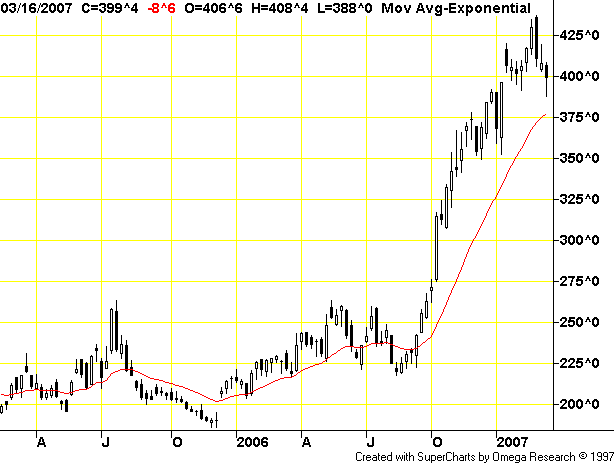
Photo Sharing and Video Hosting at Photobucket

And it's not just corn that's increasing in price. Remember corn is a basic ingredient in a ton of food.

If corn prices increase by ~ 55 percent, year over year, then will the corn used for hog, cattle, chicken, turkey and fish feed go up 55 %? Doesn’t that increase the price of meat, poultry, fish, milk and eggs? If corn is used in corn meal, corn flakes, corn oil, and hundreds of other food items goes up 55%, doesn’t that increase the price of all these foods? Maybe. Since 2000, the price of beef is up 31%, eggs up 50%, corn sweeteners up 33%, wet corn milling up 39%, and corn flakes are up 10%. Chicken prices haven’t changed very much. Yet. Food producers are predicting higher prices.

There's a ripple effect through the entire food production change because of increased corn demand.

The author goes on to discuss the political situation with the corn industry and offers better solutions. I'm not scientifically qualified to say yeah or nay on any of these ideas (Damn it, Jim! I'm an economist, not a scientist).

However, I can say with certainty that if the current situation holds we have some really big possible problems coming up. These are the observations I made before and they still hold true:

1.) Inflationary pressures. Last year oil was the big inflation boogie-man. Now food prices may take their place. The charts above show the food prices are spiking. With overall production down over the last three years and a projected lower production level this year supply won't pick-up until next year. That means food based inflationary pressures may be with us for at least another year.

Also remember that agricultural prices in CPI and PPI have increased over the past three months at very high rates. I am sure the Fed will be discussing these increases at their meeting today.

2.) Higher inflationary pressures means the Fed will be less inclined to lower interest rates. If the economy continues to slow, the Fed won't be able to provide monetary stimulus. That could exacerbate an economic slowdown.

3.) The economy has been growing for the 2004-2007 time period, yet food production is down. There may be a bigger problem lurking here.

The short version is out dependence on corn may wind up creating a really big problem in the future.

One final note. I am not endorsing nor condoning the ethanol program. I'm not qualified to make a recommendation one its veracity on way or the other.

For economic commentary and analysis, go to the Bonddad Blog