Showing posts with label stock. Show all posts

Tuesday, December 5, 2006

Speculation gets even loonier!

Contrarian Chronicles12/4/2006 12:00 AM ET

By Bill Fleckenstein

The evidence grows that the unwinding of the asset bubble is liable to be rapid -- and brutal.

While out of the country recently, I did something I haven't done in 20 years. I ignored the markets. I did not read a newspaper. I did not check my e-mail. I did not check my voice mail. I left instructions for my office to call me only if something dramatic transpired. (I wasn't contacted.)

In praise of being unplugged

Why do I bring this up? To make the point that being removed from all information granted me the perspective that's often denied to those in the trenches. Upon my return, it was more clear to me than ever that we are at a speculative zenith of major proportions.

It is truly remarkable how reminiscent the current mindset is of the 1998-2000 stock mania, when every week would see hundreds of upward price-target revisions. Having said that, in my opinion the current psychology amongst so-called professionals is even loonier.

In the previous mania, the bulk of the madness was concentrated in technology concepts, especially Internet-oriented ideas, where a company that boasted a handful of eyeballs viewing its Web site could be worth tens of billions. Today, the insanity is spread out in various different places.

A little freefall for Freescale

Leveraged-buyout madness, for example -- where airlines and semiconductor-equipment fabricators are being leveraged up to go private (prompting dead fish to recommend other companies in those industries, out of the belief that they should be LBO'd as well). Meanwhile, it's worth noting that the bonds of Freescale Semiconductor (FSL, news, msgs) have broken par -- and that after having been lustily sought after when they were originally issued.

Of course, the pinnacle of the lunacy resides in the financial-dark-matter arena, where all forms of financial exotica exist. The latest specimen? A leveraged-up version of the CDO (collateralized debt obligation) known as the CPDO (constant proportion debt obligation). Without going into all the details, this new product supposedly allows for people to get their money back (plus a bit of interest), if its architects are adept at selling more and more premium in the form of credit default insurance (swaps) as the prices go against them. If you think this sounds like a drunken version of portfolio insurance, you would be right. For those who'd like to read more about CPDOs, there is a brilliant primer on the subject in the Nov. 17 issue of Grant's Interest Rate Observer (subscription required).

Long-Term Capital, short-term memory

Turning to another example of folks having lost their minds, a willing crowd now apparently wants to lend $2 billion to hedge fund Citadel Investment Group. I have to ask myself, why would anybody lend money to a hedge fund when it has no assets to claim and its structure thwarts the processes of due diligence and monitoring of one's collateral? Doesn't anyone remember Long-Term Capital Management, which melted down in 1998 and had to be rescued by the Federal Reserve?

When discussing the madness of crowds, it's never possible to predict the outer limits of that madness. Nor is it ever possible to say that the psychology can't get crazier. But in my opinion, the psychology today is about as wild as it can get.

Regrettably, there is no "timing" in that statement. Inflection points -- like tops -- are hard to position oneself around. Change seems to take forever to occur, then happens, seemingly out of the blue. That certainly describes the dollar's serious break, on Nov. 24, for no proximate cause. In all likelihood, it finally sank under the cumulative weight of preceding events, which will be familiar to longtime readers of the Contrarian Chronicles.

Piercing shards 'neath a house of cards

But, whatever "turns" this asset-bubble structure -- and whenever it turns -- the unwinding is going to be brutal, and likely to occur at a rapid clip, given the degree of lunacy on the credit (versus equity) side of the ledger.

And to think that all of this is backed by a thin piece of paper called the dollar, printed at warp speed by the central planners at the Federal Reserve, who brought us the mindless misallocation of capital that created these asset bubbles.

At the time of publication, Bill Fleckenstein did not own or control shares of companies mentioned in this column.

Monday, December 4, 2006

Investment Outlook: Reality Check

Bill Gross | December 2006

Things are seldom what they seem

Skim milk masquerades as cream


“H.M.S. Pinafore”

Gilbert & Sullivan


Reality is a delicate fabric. “You can’t handle the truth” was a famous Jack Nicholson courtroom one-liner, suggesting that even in the face of hard facts, people resort to self-deception in order to protect treasured illusions. How else to explain a recent poll by CNN that 54% of the respondents believed that OJ did not murder his wife and Ron Goldman? How else to explain that 77 of 100 U.S. Senators authorized Bush to invade Iraq under the pretense of Saddam’s potential use of weapons of mass destruction against the American public? I can only conclude that if reality is so delicate, subject to distortion even by a clear majority, then the lesson is that you should handle it carefully or at the least be prepared for the taste of skim milk instead of cream as we are warned in the caption above.
--MORE--

Thursday, November 30, 2006

Bonds Say Recession; Stocks Say Soft-Landing. Who's Right? : Bonddad

Schiff: Worse Than Holding Dollars Is Holding Bonds
http://www.safehaven.com/article-6367.htm
---
Nov 30, 2006

The bond market and the stock market are sending contradictory signals about the next 12 months. The stock market is essentially buying into the Goldilocks scenario – that the economy will slow gradually but will not fall into a recession. The bond market is saying a recession has a higher probability of occurring. There is enough information for both markets to maintain their respective viewpoints for now. Only time will tell which outlook is fundamentally correct.

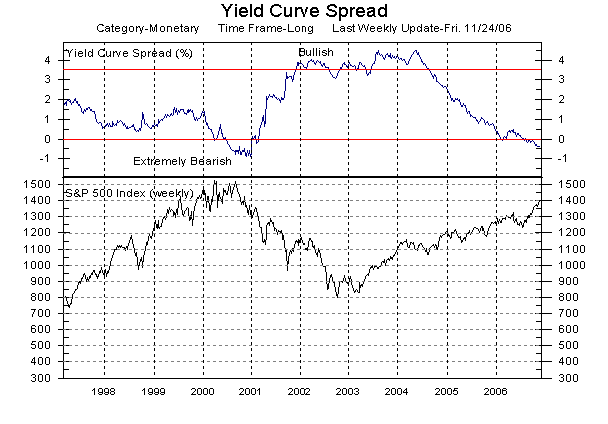
First, here is a chart from the MarketGuage website – which is a great site for basic market information.

Photobucket - Video and Image Hosting

The top line outlines the difference between the ten-year Treasury bond and the 3-month treasury bone. This is called the "spread". Before we get into what this spread says, let’s go over some yield curve basics.

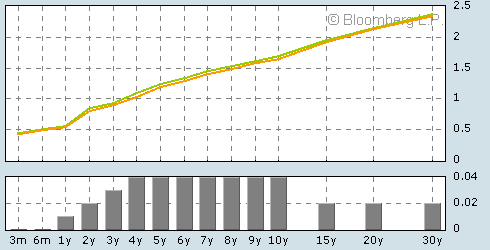
A "normal" yield curve (if there really is such a thing) slops from the lower left to the upper right of a bond yield chart. Here is an example from yesterday’s chart of the Japanese bond market from Bloomberg.

Photobucket - Video and Image Hosting

This graph says a couple of things to an economist. First, the risk associated with longer-term investments is greater than shorter-term investments. This is the natural state of yield curves because there are more things that could go wrong in the long-term in the short-term. Suppose you lent someone money for 6-months and assume they are a good credit risk. There are fewer bad things that can happen to that person to prevent them from paying you back your money. However, if you lent them money for 30-years, there is higher chance that something will happen to prevent them from paying you back. The time horizon is simply too long to calculate all of the negative possibilities. Therefore, you charge a higher interest rate to compensate for the increased risk.

Secondly, this graph says that inflation expectations are higher. It’s important to remember the real rate of return on a bond is the bond’s interest rate minus the prevailing rate of inflation. If traders think inflation is headed higher, they will demand a higher interest rate so they can make more money. Here it’s important to remember that a bond’s price and yield are inversely related: as prices decrease, the interest rate increases and visa verse. So, on the Japanese chart investors are selling the long bond (or at least not buying it), driving longer-term interest rates higher.

Finally, this graph says bond market traders are expecting an increase in interest rates – or, more generally, that the probability of interest rate increases is higher than interest rate decreases. Here’s the reason. If interest rates increase in this environment, people who hold longer-debt will lose money because interest rates across the board will probably increase in one degree or another.

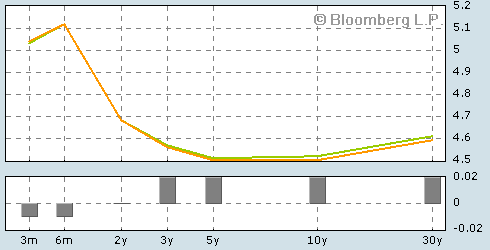
Now, let’s literally reverse everything that’s been said above, with a few changes. First, let’s make the possibility of a rate decrease the most important factor when buying a bond, followed closely by decreased inflation expectations (or reverse them). That would describe the current US yield chart which looked like this at about 3PM EST.

Photobucket - Video and Image Hosting

The above mentioned factors – a decrease in inflation and a decrease in interest rates – are two important factors that happen in an economic slowdown. The central bank lowers interest rates to stimulate borrowing and thereby increase economic activity. Inflation decreases (usually) because there is less demand for products, which lowers the possibility of demand-pull inflation. The general decrease in economic activity lowers the amount of goods business produces, which lowers the purchase of raw materials, which lowers cost-push inflation pressures. Anyway, that is the basic line of thinking involved with the current US yield chart.

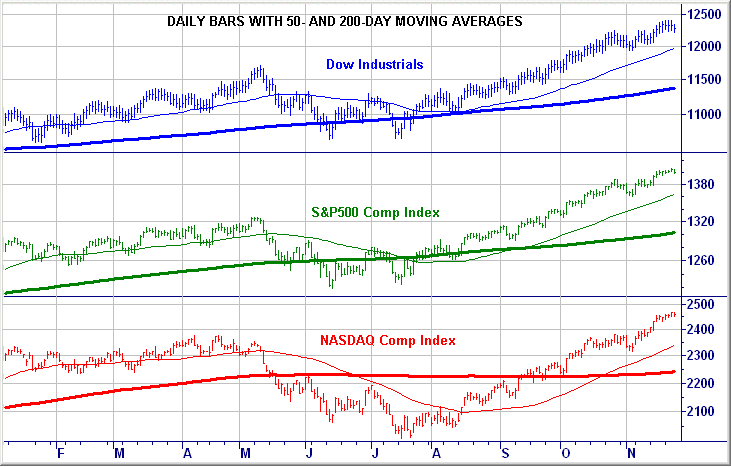
Now, let’s turn to the stock markets, which have all enjoyed a rally starting in July of this year (this chart is from the Martindale Capital Website which has some great charts.)

Photobucket - Video and Image Hosting

All three averages have increased since July. Stocks increase when business conditions are good and stocks decrease when business conditions are bad. The latest earnings season was good for stocks. While GDP has slowed it has not gone negative. The latest inflation gauges have shown a decrease in inflation, meaning the Fed doesn’t have to increase interest rates (at least right now). Basically, traders think the economy will have a soft-landing. This means that growth will slow, inflation will slow, but the economy will not contract. In the words of most Federal Reserve bankers, the US economy will not operate at full capacity, but operate below full capacity.

So – who is right? We won’t know until the economy gives a firm set of signals in either direction. However, it’s important to note there is enough evidence for both markets to take their respective positions.

Tuesday, November 28, 2006

Wall Street has worst day in 4 months

By TIM PARADIS, AP Business Writer
Mon Nov 27, 6:33 PM ET


Wall Street had its worst day in more than four months Monday as the dollar weakened and concerns about the strength of the retail industry arose following a rare sales decline at Wal-Mart Stores Inc. The Dow Jones industrials fell 158 points.

Investors were uneasy after the dollar fell for the fifth straight day and after Wal-Mart, the world's largest retailer, reported a 0.1 percent drop in same-store sales, those from stores open at least a year. Same-store sales are the industry standard for assessing a retailer's strength, and while overall retail sales appeared strong last weekend, Wal-Mart's first deficit in a decade raised concerns about the strength of consumer spending during the holiday season.

"There is now significant concern that the holiday retail season is going to underperform," said Gregory Miller, chief economist at SunTrust Banks. "Traffic doesn't necessarily translate into profits," he said, referring to reports of crowded stores over the weekend.

As the dollar's slide continued, it hit a 20-month low against the euro though it did for a time move higher against the Japanese yen. The dollar's fall raised concerns that foreign investors were sensing weakness in the U.S. economy and would pull some of their investments from U.S. markets.

Beyond the weak dollar and news from Wal-Mart, some retrenchment was to be expected as investors seek to preserve their profits after stocks have soared the past two months.

The Dow fell 158.46, or 1.29 percent, to 12,121.71, as 27 of the index's 30 stocks fell. It was the Dow's biggest slide since a string of triple-digit declines in mid-July that followed disappointing profit reports and a spike in oil prices amid tensions with Iran and North Korea.

Broader stock indicators also dropped sharply Monday. The Standard & Poor's 500 index fell 19.05, or 1.36 percent, to 1,381.90, and the Nasdaq composite index slid 54.34, or 2.21 percent, to 2,405.92.

Bonds rose, with the yield on the benchmark 10-year Treasury note falling to 4.53 percent, from 4.55 percent late Friday. Gold prices rose.

Light, sweet crude settled up $1.08 at $60.32 a barrel on the New York Mercantile Exchange. Crude prices gained ground after an attack on an oil facility in Iraq and comments by Saudi Arabia's oil minister that OPEC could consider further production cuts next month.

Wall Street appeared little moved by a report from the Federal Reserve Bank of Dallas that showed an index of manufacturing activity in Texas was essentially unchanged in November.

Investors examining retail reports tried to determine whether an increase in traffic at stores would translate to higher profits for retailers. Consumer spending accounts for two-third of all economic activity, and Wall Street is concerned that weak spending would prevent the slowing economy from achieving a soft landing.

ShopperTrak RTC, which compiles sales data, estimates sales rose 6 percent on Black Friday from a year earlier.

Regardless of the pace of retail sales, however, stocks have posted strong gains in October and November, making Monday's retreat unsurprising.

"A little bit of profit-taking is healthy at this point, said Jim Russell, director of core equity strategy for Fifth-Third Asset Management. "The market went up a little bit too far, too fast. Folks have made big money just in the past two or three months and are perhaps looking to lock in gains before the end of the year."

He contends that while the weak dollar and the Wal-Mart news caught Wall Street by surprise, investors shouldn't have fundamental concerns about the health of the market.

"Certainly a little bit of cold water has been thrown on the market with the results from Wal-Mart over the weekend," he said.

Miller remains concerned that the overall economy might be weaker than some investors had believed when they sent stocks higher in recent months. The Dow has closed at record levels 18 times since the beginning of October.

He also questioned whether retailers have run the risk of hurting profit margins by offering steep discounts to lure shoppers during an increasingly competitive Black Friday.

"The American consumer now expects that the holiday season isn't just a time to spend a lot of money but a time to get some bargains."

Wal-Mart fell $1.29, or 2.7 percent, to $46.61 following its report, while some retailers moved higher following reports of strong traffic in stores over the weekend. Lowe's Cos. rose 40 cents to $1.33.

J. Crew Group Inc. fell $3.07, or 7.1 percent, to $40.21 after a CIBC analyst lowered her rating on the clothing retailer based on valuation; the stock rose 27 percent last week following a strong profit report.

In other corporate news, Ford Motor Co. fell 36 cents, or 4.2 percent, to $8.16 after announcing it plans to obtain about $18 billion in financing to shore up its balance sheet and fund its restructuring.

Swift Transportation Co. rose 75 cents, or 2.7 percent, to $28.36 after the trucking company rejected an offer from its largest shareholder to acquire the company for $29 per share, or about $2.2 billion.

Several hotel companies lost ground after an AG Edwards & Sons Inc. analyst lowered his rating on the stocks to "Hold" from "Buy." Hilton Hotels Corp. fell $1.70, or 5 percent, to $32.10, while Marriott International Inc. fell $1.54, or 3.3 percent, to $44.91. Starwood Hotels & Resorts Worldwide Inc. was down $1.92, or 2.9 percent, to $63.46.

The Russell 2000 index of smaller companies was down 20.18, or 2.55 percent, to 772.10.

Declining issues outnumbered advancers by about 4 to 1 on the New York Stock Exchange, where consolidated volume came to 2.72 billion shares.

Overseas, Japan's Nikkei stock average closed up 0.96 percent. Britain's FTSE 100 closed down 1.18 percent, Germany's DAX index fell 1.77 percent, and France's CAC-40 was down 1.50 percent.

___

On the Net:

New York Stock Exchange: http://www.nyse.com

Nasdaq Stock Market: http://www.nasdaq.com

http://news.yahoo.com/s/ap/20061127/ap_on_bi_st_ma_re/wall_street

Monday, November 27, 2006

European Stocks Drop on Dollar


European Stocks Drop on Dollar, Led by DaimlerChrysler, Hanson

By Alexis Xydias


Nov. 27 (Bloomberg) -- European stocks dropped for a fourth day, led by DaimlerChrysler AG and Hanson Plc, after the dollar's retreat against the euro and pound raised concern exporters' profits may fall.

``A weakening dollar is a problem for European earnings,'' said Guillaume Duchesne, equity strategist at Fortis Private Banking in Luxembourg, which manages $76 billion. ``The earnings momentum was very strong, and a break in that would be a problem for stocks.''

The Dow Jones Stoxx 600 Index slipped 0.7 percent to a three-week low of 353.46 at 2:10 p.m. in London. Almost five stocks fell for each that rose. The Stoxx 50 also lost 0.7 percent, while the Euro Stoxx 50, a measure for the 12 nations sharing the euro, decreased 0.8 percent.

Bayer AG rose after profit at Germany's largest drug company fell last quarter less than analysts had forecast. RWE AG, Germany's No. 2 utility, jumped on takeover speculation and after Morgan Stanley advised investors to buy the stock.

A slump in the dollar against the euro last week sent the Stoxx 600 to its worst weekly decline since the five days ended Sept. 8. A weaker dollar erodes the value of exports to the U.S., Europe's biggest export market accounting for a fifth of all the region's sales.

Through last week, the Stoxx 600 gained 15 percent in 2006 as companies beat earnings estimates and a record year in takeovers lifted share prices.

National benchmarks retreated in all 18 western European markets today, except for Portugal and Luxembourg. Germany's DAX Index lost 1 percent, the U.K.'s FTSE 100 Index slipped 0.5 percent and France's CAC 40 also fell 0.5 percent.

Daimler, Hanson

The dollar retreated for a fifth day against the euro on speculation the Federal Reserve will reduce interest rates in the first quarter. The U.S. currency slid to $1.3123 euros in London, its lowest since March 2005, from $1.3094 in New York on Nov. 24. It also slipped against the pound and the Swiss franc.

DaimlerChrysler, maker of the Jeep and Dodge cars, fell 2.9 percent to 44.23 euros. The carmaker gets about 45 percent of its sales from the U.S. Bayerische Motoren Werke AG, the biggest luxury carmaker, dropped 2.2 percent to 41.86 euros. The company made a quarter of its sales in North America last year.

Automakers were the worst performers today among 18 industry groups in the Stoxx 600.

Hanson the world's largest supplier of sand and gravel for building, declined 1.7 percent to 728.5 pence. The U.S. is the largest market for the U.K. company.

Nokia Oyj, the world's biggest mobile phone maker, decreased 1.8 percent to 15.71 euros. Espoo-based Nokia gets about eight percent of its revenue from the U.S. Siemens AG, Europe's biggest engineering company, fell 2.4 percent to 72.81 euros. The U.S. is the source of about a fifth of Siemens' revenue.

Bayer, RWE Gain

The dollar's drop ``will lead to analysts adjusting their numbers in the euro zone down for earnings forecasts for the fourth quarter,'' said Gary Dugan, the head of research and investment strategy at Barclays Wealth Management in London, which oversees $100 billion.

Bayer gained 2.3 percent to 39.90 euros. Third-quarter profit fell 35 percent to 320 million euros ($420 million) on the cost of integrating Schering AG, the rival German drugmaker it bought earlier this year. That beat the median estimate of 195 million euros in a Bloomberg survey of nine analysts.

Leverkusen, Germany-based Bayer also raised the forecast for its pharmaceuticals unit.

Record High

RWE rose 3.9 percent to a record 89.95 euros on continued speculation that it may get a takeover bid and after Morgan Stanley said investors should buy the stock because of the company's earnings outlook. RWE stock surged 3.3 percent Nov. 24 after the Rheinische Post reported the company may receive a bid.

``Although no buyer has been named, RWE shares still benefit from takeover speculation,'' said Thomas Nagel, a trader at Equinet Securities AG in Frankfurt. Morgan Stanley recommended the stock as ``overweight.''

BAE Systems Plc dropped 3.8 percent to 388 pence. Europe's largest defense company fell the most in more than five months after the U.K.'s Serious Fraud Office said yesterday a probe into the firm's contracts with Saudi Arabia is ``ongoing.''

MyTravel Group Plc, a U.K. tourism company, gained 6.6 percent to 213 pence after saying it approached First Choice Holidays Plc about buying the company's short-haul package-travel division. First Choice surged 15 percent to 261 pence.

Wilson Bowden Plc jumped 14 percent to 2,081 pence. The U.K. homebuilder said it's in talks with a ``number of parties'' about a possible takeover offer for the company. Negotiations are at an early stage, the company said.

Premier Oil, LVMH

Premier Oil Plc increased 1.5 percent to 1,333 pence. The U.K. company exploring for crude oil in the North Sea, Asia and Africa, rose after reports Kuwait Petroleum Corp. and Oil & Natural Gas Corp. may bid for the company.

India's Oil & Natural Gas may offer to buy Premier to add assets, the Economic Times reported on Nov. 25, citing the company's chairman. Kuwait Petroleum, the Middle East's biggest fuels exporter, may also be interested in Premier, the U.K.'s Sunday Times said yesterday, without saying where it got the information.

Banco Bilbao Vizcaya Argentaria SA fell 3.4 percent to 18.41 euros. Spain's second-biggest bank said it plans to raise 3 billion euros in a stock sale after acquisitions in Asia and the Americas depleted its capital.

LVMH Moet Hennessy Louis Vuitton SA, the world's largest luxury-goods maker, lost 1.8 percent to 80.4 euros. Deutsche Bank AG analysts rated LVMH shares as ``sell'' in new coverage. The German brokerage said a recovery in Japanese consumption has stalled, while slowing growth in the U.S. and China will hurt the company's cognac business.

To contact the reporter on this story: Alexis Xydias in London at axydias@bloomberg.net .

Last Updated: November 27, 2006 09:25 EST

http://www.bloomberg.com/apps/news?pid=20601087&sid=aErI8O.CTJfw&refer=home

U.S. Stock Futures Retreat After Wal-Mart's Sales Decline Most in Decade

U.S. Stock-Index Futures Drop After Wal-Mart's Sales Decline

By Nick Baker


Nov. 27 (Bloomberg) -- U.S. stock-index futures fell after Wal-Mart Stores Inc., the world's biggest retailer, said monthly U.S. same-store sales dropped for the first time in more than a decade.

Other retailers may slide along with Wal-Mart, whose sales decline comes during a quarter in which merchants last year made about one-third of their annual profit, according to the International Council of Shopping Centers. Nokia Oyj, the biggest mobile phone maker, slid as a decline in the dollar made its products more expensive for U.S. consumers.

Exxon Mobil Corp., the world's largest oil company, gained after crude oil topped $60 a barrel. Apple Computer Inc. advanced after ThinkEquity Partners LLC raised its share-price estimate for the iPod maker by 10 percent to $110.

Standard & Poor's 500 Index futures expiring in December fell 1.20 to 1401.70 at 9:10 a.m. in New York. Dow Jones Industrial Average futures lost 9 to 12,292. Nasdaq-100 Index futures slipped 4.25 to 1816.

Stocks dropped on Nov. 24, snapping the Dow average's two- week winning streak, after higher oil prices and a weaker dollar sparked concern holiday sales and economic growth may falter.

The euro today rose against the U.S. currency, reaching $1.3114, the highest since March 2005.

Wal-Mart slipped 50 cents to $47.40. The company on Nov. 25 said November sales at U.S. stores open at least a year fell 0.1 percent, lower than the company's forecast of unchanged sales.

`Long Shadow'

The slowdown at Wal-Mart may ``cast a long shadow over earnings,'' Merrill Lynch & Co. analysts wrote in a note.

Nokia fell 43 cents to $20.50 in New York. The Finland-based company gets about eight percent of its revenue from the U.S.

Exxon gained 16 cents to $72.54. Oil rose after Saudi Arabia's oil minister said his country may support a second cut in OPEC's output this year to prop up prices, which have fallen about a quarter since July.

Crude oil for January delivery climbed as much as 1.6 percent to $60.20 a barrel in New York.

Apple rose 65 cents to $92.28. ``Apple Retail Stores will deliver plenty of holiday cheer during the December quarter,'' wrote ThinkEquity analyst Jonathan Hoopes.

General Motors Corp. rose 2 cents to $31.25. U.S. sales of cars and trucks in 2007 are forecast to fall to their lowest level since 1998, the Wall Street Journal reported, citing market researcher IRN Inc.

Indian Railways

General Electric Co., the world's second-biggest company by market value, lost 9 cents to $35.60 in Germany. GE, Alstom SA, Siemens AG, Mitsubishi Corp., Itochu Corp. and Bombardier Inc. are in talks with the Indian Railways to develop 220 billion rupees of ($4.9 billion) rail freight corridors in India, the Business Standard reported.

Lowe's Cos., the second-largest U.S. home-improvement retail company, gained 74 cents to $30.74. The shares were raised to ``buy'' from ``neutral'' at Banc of America Securities.

Vertex Pharmaceuticals Inc. fell $1.57 to $43.33. The drugmaker's shares may fall to $33 if its Hepatitis C medicine faces competition from other antiviral treatments, Barron's said, citing analysts from Susquehanna Financial Group and Wachovia Capital Markets.

To contact the reporter on this story: Nick Baker in New York at nbaker7@bloomberg.net .

Last Updated: November 27, 2006 09:11 EST

http://www.bloomberg.com/apps/news?pid=20601087&sid=aGIUeiO8cOkI&refer=home