Wednesday, March 21, 2007

The Dead-Enders: The Dead-Enders Being a neocon means never having to say you're sorry

March 21, 2007

by Justin Raimondo

Christopher Hitchens isn't sorry. Not about being a Commie all those years ago; after all, he was a Trotskyite, not one of those icky Stalinists, which merits a "Get Out of Jail Free" card. Not about being frequently drunk in public: after all, it's part of his image as the Courtney Love of punditry. And, most of all, he's not sorry about doing his bit to gin up the Iraq war:

"Four years after the first coalition soldiers crossed the Iraqi border, one can attract pitying looks (at best) if one does not take the view that the whole engagement could have been and should have been avoided. Those who were opposed to the operation from the beginning now claim vindication, and many of those who supported it say that if they had known then what they know now, they would have spoken or voted differently.

"What exactly does it mean to take the latter position? At what point, in other words, ought the putative supporter to have stepped off the train?"

Instead of stepping off the train, the neocons – and Hitchens most of all – have stepped in front of it. In terms of their own credibility, what they did was the equivalent of lying down on the tracks and letting the train run over them. By staking their reputations as serious commentators on the success of a war that Gen. William E. Odom trenchantly and accurately described as the greatest strategic disaster in American military history, they have ensured their place in the pantheon of mistaken prognosticators, along with the inventors of phrenology and the makers of the Edsel.

Oh, a few have recanted, most notably and sincerely Francis Fukuyama. The rest, particularly Kenneth "Cakewalk" Adelman and, most obnoxiously, Andrew Sullivan, have taken to blaming President Bush's supposedly inconsistent and even halfhearted effort to implement their grand theories – much like Trotsky's disciples blamed Stalin's "counter-revolutionary" shortcomings for the inconsistent implementation of the Marxist-Leninist grand design. Hitchens, who has been both a Trot and a warmonger, is a particularly hard case: a dead-ender, in short, who stubbornly sticks to the Revealed Truth even as reality rudely intrudes.

Hitchens sets up a phony dialogue between himself and his interlocutors and lobs himself a lot of softball questions, which he disposes of with his characteristic disdain for facts. It's as if Scooter Libby had cross-examined himself. How pathetic that a writer who used to be so interesting and fun to read, even if one disagreed with him, has descended to this very threadbare bag of tricks.

Hitchens first raises a fundamentally phony question: Oh, but didn't Saddam violate a whole bunch of UN resolutions? Wasn't the credibility of the UN at stake? Why Americans should care about the UN, or why the U.S. military should be put at the disposal of the Security Council, is never made clear. Besides which, if we set up a mechanism whereby an invasion is automatically launched against any country that violates a given number of UN resolutions, we'd have bombed Tel Aviv long ago. At any rate, I don't recall Hitchens being much of a UN fan to begin with, but I guess when your back's against the wall any maneuver will do.

It was "correct," insists Hitchens, to send U.S. forces to the Gulf, because only the threat of force caused the Iraqis to cave on the inspections issue. So Hitchens admits the Iraqis were ready to comply with the UN demand to admit inspectors without conditions – what he doesn't admit is that the U.S. thwarted Saddam's pathetic attempts to effectively surrender, and instead launched a series of provocations designed to torpedo a negotiated settlement. Aside from that, however, the very act of sending military forces to the Gulf made war a foregone conclusion: by that time, the president had invested so much of his own political capital – and America's prestige – in this misadventure that the administration could argue that backing down now, even a little bit, would do irreparable damage to our credibility. Such an argument was, of course, completely unreasonable, but in the Bizarro World we had fallen into post-9/11 – and are only now showing signs of climbing out of – such illogic is perversely "logical."

Hitchens throws himself a few more underhand pitches, all centered on the question of Iraq's degree of cooperation with the UN inspectors, but he never addresses the overarching reality, which is that there weren't any "weapons of mass destruction" in Iraq. Period. As Scott Ritter pointed out long ago in an article in Arms Control, the Iraqis had been disarmed by the stringent UN inspections regime and would not be able to reconstitute it. Whether Saddam tried to wriggle out of the straightjacket imposed by the IAEA is irrelevant: what matters is that – contrary to what Bush, Cheney, Rumsfeld, and Hitchens were telling us at the time – he didn't succeed.

But we couldn't afford to wait for the smoking gun to arrive in the form of a mushroom cloud: Condi Rice's infamous formulation of the "imminent threat" talking point was just one dark note in the administration's Doomsday Symphony, which deliberately evoked the horrors of a nuclear attack on the U.S. The president even conjured visions of Iraqi drones dropping WMD on the continental United States. Those "drones" turned out to be rickety little gliders that could barely have gotten off the ground. It would be funny if the consequences of the president's delusions hadn't led to such tragic results. Cheney went on television and said flat out we know Iraq has reconstituted its nuclear weapons program. Every bit of misinformation put out there by the Office of Special Plans and the private-sector division of the War Party, including Hitchens, proved to be dead wrong – including all that malarkey about "links" between al-Qaeda and the Ba'athist regime. Saddam's supposed "training camp" for Islamist terrorists (a hoax), the "Prague connection" (a fable), the Niger uranium story (based on a forgery) – it was all of it a pack of lies, from beginning to end, and the American people know it.

Yet Hitchens doesn't concede an inch. "Was the terror connection not exaggerated?" he asks, and, like some crazed homeless guy wandering down the street muttering imprecations at invisible demons, he answers himself:

"Not by much. The Bush administration never claimed that Iraq had any hand in the events of Sept. 11, 2001. But it did point out, at different times, that Saddam had acted as a host and patron to every other terrorist gang in the region."

I have to say I agree with him on this point, if only to a limited degree. While Hitchens has absolutely no evidence to show links between the Iraqi government and Islamists of the al-Qaeda type – the author is, as usual, linkless as well as clueless – he is right that Saddam did harbor one terrorist group. The Mujahedin-e-Khalq, or MeK, is a weird neo-Marxist cult made up largely of Iranian women – at least in the top leadership – who are followers of Maryam Rajavi, the self-proclaimed president of "liberated" Iran. The MeK participated in the 1979 revolution that overthrew the shah and installed the Khomeini regime, but fell out of favor and went into violent opposition, launching terrorist attacks (including against U.S. interests and personnel) in Iran from Iraqi soil. Saddam gave them Camp Ashraf, where they remain to this day – under the protection of the U.S. military, which is reportedly using them for expeditions into Iran, the scene of several recent terrorist attacks.

The exact extent of U.S. aid to and cooperation with the MeK is unknown at present. However, they have their advocates in the U.S. Congress and the administration, as well as among neoconservative groups. The recent trial of Scooter Libby was the occasion for a huge document dump, and one interesting find is a memo [.pdf] from John Hannah to Libby regarding the activities and status of the MeK – and there must be a reason why the entire document was blanked out except for the authors' and recipients' names and the subject lines.

Hitchens claims that no one could have predicted the Iraqi civil war, yet I don't believe for a minute I'm the only one who likened the invasion of Iraq to the opening of Pandora's Box, and you shouldn't either.

Hitchens ends with his usual flamboyant flourish:

"So, you seriously mean to say that we would not be living in a better or safer world if the coalition forces had turned around and sailed or flown home in the spring of 2003?

"That's exactly what I mean to say."

If the Bourbons of Talleyrand's day learned nothing and forgot nothing, the "democratic" imperialists of our own day have learned nothing and forgotten everything – including their own bright prognoses for the postwar era in Iraq and throughout the region. War advocates recalled the Allied liberation of Paris when envisioning the likely outcome of Iraq's "liberation." It never happened. Remember how the invasion and especially the Iraqi elections were supposed to augur an era of democratic reform and even revolution in the Middle East? That, too, never happened.

Every word the War Party rattled off before the invasion – the reasons for the invasion, the "evidence" of WMD, the alleged connection between the Iraqi regime and 9/11 – was either a lie or a half-truth intended to obscure the full truth. Hitchens was one of the main disseminators of these lies, yet he has the temerity to stand there and tell us he's not sorry. He and his palAhmed Chalabi belong to the legion of "heroes in error": they're proud of their deceit. It has proved, after all, the key to their postwar success. I hear Chalabi is in line for minister of oil resources, and our laptop bombardiers have done quite well for themselves, as one wag recently pointed out in Radar magazine. The journalistic price to pay for being so wrong has been less than nil. Bill "New American Century" Kristol has been rewarded for being wrong about Iraq with a column in Time magazine. Hitchens became a media star in the run-up to war, when he was all over television charming those gullible Americans who are suckers for any snake oil salesman with a British accent. No doubt his lecture fees are at an all-time high.

He isn't sorry because the war has been good for him, but it's not just about careerism. For the War Party, the world is a better place now that the U.S. has invaded Iraq and occupied it for four years: we have the "surge" to look forward to – and now the glad tidings of yet another war, an even bigger and "better" one, with Iran. As far as Hitchens and his fellow neocons are concerned, happy days are here again.

When the Soviet Union fell and the Cold War abruptly ended, the professional warmongers and Sovietologists were out of their jobs, and it was a long stretch of lean times between the Berlin Wall's fall and the fall of the twin towers. Sept. 11, however, did more than merely revive the War Party's fortunes – it enabled the neocons to effectively pull off a coup d'etat at the very top levels of U.S. government. In Colin Powell's characterization, they set up a "separate government."

Centered in the office of the vice president, the neocons did an end run around the mainstream intelligence agencies to manufacture the lies that lured us into war, and Christopher Hitchens did more than his part to spread these lies. But in the minds of the neocons, all their lies are noble ones – besides , this whole obsession with such outdated concepts as truth and falsehood is just a superstition dreamed up by the "reality-based community," as one White House official put it to Ron Suskind. Watch us while we make history: in the triumphal atmosphere of the War Party's heyday, a fatal hubris was in the air, and the pro-war intellectuals breathed this in so deeply that the effects have yet to wear off. Hitchens is drunk on a lot more than booze.

Alcoholics often suffer from delusions, and their recalcitrance is part and parcel of their strenuous denial. The reality on the ground has proved the drunken warriors utterly wrong, yet they still go on pretending that all is well, if only the "surge" would be given time to work, if only the media would stop subverting the war effort, if only…

When the neoconservative version of this war's history is written, each chapter will elaborate on a different "if only" scenario that deftly ignores what actually happened and instead focuses on the imperfect implementation of their wonderful scheme.

Hitchens at least tries to defend the indefensible, which is a brave thing to even attempt, but his fellow neocon Richard Perle is clearly uninterested in making the effort. Here he is chatting with Tim Russert:

"RUSSERT: Mr. Perle, is the war, war in Iraq worth the price we've paid?

"PERLE: Forgive me for saying it, but I think it's the wrong question. It's a bit academic for one thing. But the question is what is in our national interest now, what is going to make Americans safer. I disagree with what we've just heard. A defeat in Iraq brought about in the worst instance by precipitous withdrawal would have terrorists around the world celebrating. It is the idea that the United States can be defeated that motivates terrorists. And we have Osama bin Laden himself saying that and saying it repeatedly. So the question the country faces now is not is this a reason – is this a bargain, is it a reasonable price. The question is what do we do. And I think we have to win this war, and I hope that the new strategy that's been adopted will enable us to do that."

The most basic question, whether it was right to have sacrificed so many lives in pursuit of Perle's policy, is "a bit academic" to one of this war's chief intellectual architects and public advocates. His answer to his critics is simple: I got you into this mess, and only I can get you safely out of it, so listen up ….

The problem for Perle and Hitchens is that few are listening. Even in Washington, where both parties collaborated in bringing this disastrous war about, the ranks of the War Party are noticeably thinning. In the country at large, the war is wildly unpopular. The electorate longs for an antiwar presidential candidate like evangelicals pining for the Messiah's return. Deliver us from evil! appears to be the general sentiment, although what sort of evil the American public is just beginning to learn.

DOJ Concocted "Reasons" For US Attorneys's Firings Just This Month!

March 21, 2007

Two newspaper articles today summarize why the U.S Attorneys firing scandal is so important. First, from the incomparable McClatchy Newspapers:

Internal Justice Department e-mails written before the firings of eight U.S. attorneys and during the turmoil that followed continue to raise questions about the real reasons for their ousters.

The Justice Department initially said that the firings were for "performance-related" problems. Officials have since backed away from that characterization, and e-mails and documents released in connection with a congressional inquiry into the firings point to differing and sometimes conflicting causes for the terminations.

Pretty succinct. The evidence has already clearly proved that highly respected U.S. Attorneys were fired for solely political purposes. The Bush Administration, in a manner that would have made the Soviets proud, has politicized our system of justice. When caught, they tried to justify these political purges by dishonestly blaming the Attorneys for performance problems we now know were completely concocted. The Los Angeles Times has the kicker:

Senior Justice Department officials began drafting memos this month listing specific reasons why they had fired eight U.S. attorneys, intending to cite performance problems such as insubordination, leadership failures and other missteps if needed to convince angry congressional Democrats that the terminations were justified.

The memos, organized as charts with entries for each of the federal prosecutors and labeled "for internal DOJ use only," offer new details about disputes over policy, priorities and management styles between the department and several of its U.S. attorneys.

The prosecutors' shortcomings also were listed in a talking-points memo, indicating the willingness of the Justice Department to make public what are normally confidential personnel matters in order to counter its critics.

The McClatchy article makes clear that the evidence shows the firings were first planned in the spring of 2005, and were given higher priority on election day, last November; but the Times article says the supposed specific reasons for the firings were only concocted this month- a blatantly political attempt to obfuscate the blatantly political nature of the firings! If these firings had been for valid reasons, there would have been plenty of memos outlining those reasons, dating from the months when the firings were being considered. That the Justice Department scrambled to put some together just this month says everything.

Meanwhile, Melinda Henneberger, of the Huffington Post reports that:

Four prominent conservative thinkers are set to launch a campaign "to restore checks and balances and civil liberties protections under assault by the Executive Branch," arguing that, "since 9/11, the President has acquired too much power."

Former Georgia Congressman Bob Barr, who led the effort to impeach President Clinton, is one of the organizers of the effort, called the American Freedom Agenda. Others are David Keene of the American Conservative Union, writer and conservative direct mail pioneer Richard Viguerie, and constitutional scholar Bruce Fein, who served in the Reagan administration as associate deputy attorney general....

"We are conservative scholars, activists and writers. We do not favor a crippled executive or enfeebled government. In a time of danger, checks and balances make for stronger government because the people will more readily accept a muscular authority if barriers against abuses are strong. If at some future time Congress, in turn, aggrandizes power and invades the executive or judicial domains, we will be equally alert to sound the alarm. But today, the clear and present danger to conservative philosophy is the White House."

Bush has lost true conservatives. He'll still have sycophantic hypocrites like Faux News and comedian Rush Limbaugh, but that shouldn't be enough to save him. The time has come!

Comments | Trackback

Danny Glover for Mayor: "AIPAC forces are out from New York to San Francisco to smother this baby in its crib"

"Danny Glover for Mayor

Jesus Christ, does this one have legs!?! The unapologetic AIPAC forces are out from New York to San Francisco to smother this baby in its crib before it even gets its first bottle. Go Danny go."
---

COURT JESTERINGS

With h brown


Photo(s) by Luke Thomas

Court Jester seeks Amnesty International
intervention in Wolf case

By h. brown

March 20, 2007

Does Josh need Amnesty International?

(will they move him to Guantanomo?)

Josh Wolf is a political prisoner within his own country. That is a fact. He is held because of his political beliefs. No other reason.

So, what do you do when there can be no justice from your own government? You seek it through the World Court. But first, through publicity from Amnesty International.

The Bush administration locked him up. Bush's Attorney General, Alberto Gonzales personally signed the order to arrest Josh. This is the same Alberto Gonzales who wrote a legal rationalization supporting the right of the Bush administration to move anyone they want from country to country and torture them in secret prisons.

This is the same Alberto Gonzales who just fired 8 federal district attorneys generals for political purposes. What are you gonna do? Appeal to the Supreme Court, perhaps? It's stacked and votes along party lines. There is, in fact, no ultimate justice in today's continuum of American jurisprudence.

Are you listening? Your president is doing this and no one is calling for his impeachment? Certainly not Nancy Pelosi. Or, Harry Reid. Where does one turn?


Speaker Nancy Pelosi

Peaceful protest

Starting today, Josh's mom and dad will welcome fellow well-wishers to their vigil in front of the Federal building on Larkin at Golden Gate. The 24/7 demonstration will evolve into a mother's hunger strike if Josh is not released. We may need, as mentioned, Amnesty International on this one and it could end up with the Attorney General of the United States indicted by the World Court. These people make Nixon look like a bleeding-heart liberal.

I'm dusting off my 'Free Josh' sign and heading over there and if you value freedom of the press and have a few minutes, it is your duty as an American to come by and hang out. Realize what you're up against.

You will be photographed and catalogued by the FBI. Homeland Security probably already has a file on you. This is not your father's America. This is Bushland. They'd kill you if they could. The last demonstration I attended in front of that building featured a security force with only half of the guards wearing ID's. Look for the ones without ID's. They'll be the first to snap a visor down and start whacking grandmothers with billy clubs.

If you have a camera, take pics of the cops. Particularly the ones who don't have any identification. It's illegal for them to not have any identifying numbers. Some of them will put tape on their badge numbers. Watch out for these pricks. They have decided in advance that they are going to bust some skulls and they are too cowardly to do it with their family names over their breast pocket.

Danny Glover for Mayor

Jesus Christ, does this one have legs!?! The unapologetic AIPAC forces are out from New York to San Francisco to smother this babyin its crib before it even gets its first bottle. Go Danny go.


Danny Glover

The Gonzalez forces hate the idea. The Newsom people must have run a poll because they are approaching apoplexy. Let me say a few words about this subject.

Idea came from 'Wish you were dead'

Political junkies in town are divided upon the idea of Glover running for Mayor. Half of them are Downtwon hacks terrified of the prospect. The other half are trying to take credit for the idea.

We'll deal with the first half of the mob later. As regards the origination of the idea (listen up, Danny) … it came from an anonymous poster who titles himself: 'Wish you were dead'. He began pushing your name for public office last year when Sarah Lipson announced she wouldn't run for re-election to the School Board. Clearly, that wouldn't have been a position from which you can have maximum impact. 'Wish' prefers to remain anonymous.

Mirkarimi to call Press hearing?

The Josh Wolf Vigil began an hour or so ago in front of the Federal Building at Larkin and Golden Gate. I brought the subject up with D-5's Supervisor, Ross Mirkarimi at his monthly art opening in his office last Friday. I noted that with the entire argument of Josh's imprisonment revolving around the definition of 'journalist' in today's America, that it might be a good idea to have another hearing on the topic.

Ross agreed but noted that the last hearing was before the Rules Committee and that Rules Chair, Tom Ammiano would have to call up the item. So, Tom, how about it?

I intend to bring up the topic of the federal shield law at the hearing, should it occur. My concern is that, as presently defined, the law does not cover unpaid online journalists who could still be locked up by the likes of Judge William Alsup. Federal law should not enshrine the idea that the likes of Ken Garcia and Pat Murphy - paid by Downtown interests and are totally biased - are legitimate journalists who can keep their sources private, … but that writers such as myself who are unpaid (and, admittedly, nevertheless of a totally biased point of view) … should have to give up Eileen Left's real name.

At any rate, I call upon the good Supervisor Mirkarimi to make note of the Wolf family's continuing vigil for Josh's release when he makes his 'Roll Call for Introductions' presentation before the Full Board at Tuesday's meeting.

Odds and ends and odd ends

Salon on Friday was alive with ideas growing like fungi in the warm sun. An 'associate' ("I used to work for Kamala, but I don't now.") of D.A., Kamala Harris, showed up for the 2nd time in 3 weeks and sat next to our roiling group to listen. She'd been pointed out to me a couple of weeks ago but I didn't say anything to her. I mean, shit, you don't have to spy on us. Just show up and sit at the table with us. I'll out her by name if she shows up again.

Gonzo roomie, Jimmy Dorenkott showed up at the Mirkarimi event, soused, angry, threatening and unkempt. Christ, it was like looking in the mirror.

So, Dorenkott threatened Marc Salomon (which he's done before) and trembled with rage until calmed by the 'Persian Colossus' himself. Email contacts with Gonzalez requesting he rein in this present-day, Luca Brazzi heard Matt reply that: "Jim is his own man.". Sure, and Jennifer Siebel didn't get her ideas about Ruby Tourk from Gavin. Poor form. Kind of fun, though. Look for a repeat side-show at noon today when all sides of the conflict (has to do with feminism and equal billing for women) will gather in front of the aforementioned Federal Building to either implore the new House Speaker to push for the withdrawal of U.S. troops from Iraq, … or, perhaps, the Greens will just roll on the ground and fight with each other.

Glover for Mayor.

h. brown is a 62 year-old keeper of sfbulldog.com, an eclectic site featuring a half dozen City Hall denizens. h is a former sailor, firefighter, teacher, nightclub owner,and a hard-living satirical muckraker. Email h at h@ludd.net.

URL

The U.S. Attorney document gap.

“In DOJ documents that were publicly posted by the House Judiciary Committee, there is a gap from mid-November to early December in e-mails and other memos, which was a critical period as the White House and Justice Department reviewed, then approved, which U.S. attorneys would be fired while also developing a political and communications strategy for countering any fallout from the firings.”

UPDATE: McClatchy and the AP reprint some noteworthy emails from the documents. March 20, 2007 9:58 pm | Comment (72)

Filed under:

Posted by Nico March 20, 2007 9:58 pm

Why Are Food Prices Spiking? Pt. II : Bonddad

Mar 20, 2007

By Bonddad
bonddad@prodigey.net

On Saturday I wrote an article titled Why Are Food Prices Spiking? In that article, I noted that agricultural prices are spiking and noted a basic drop in supply and increase in demand. This article follows up on that, especially in regards to how the development of the ethanol market is playing agricultural prices spikes.

I would also like to point out that I am not the only person who has written on this. Many other writers have pointed this out. Simply do a search under ethanol and you will find many well-written and informed articles.

From the blog, Financial Sense

Thanks to Federal mandates and subsidies, corn used for the production of corn ethanol is expected to increase from ~ 700 M Bushels in 2000/2001, to 3.2 B bushels in 2007/2008 – an increase of 357 percent. On December 11, 2006, the USDA estimated 2006-2007 U.S. ending stocks would be 935 million bushels, down from 1.97 billion bushels in 2005-2006. That decreases the ending stocks by more than 50 percent and puts the ending stocks to use ratio at 8%, - the lowest in 11 years. It should be obvious to all, we are going to need a lot more acreage and big yield improvements if corn production is going to keep up to demand. Prices could exceed $4.50 per Bu by the end of 2008. That’s a price increase of 125% over 2005/2006 season prices.

Let's take this one point at a time.

corn used for the production of corn ethanol is expected to increase from ~ 700 M Bushels in 2000/2001, to 3.2 B bushels in 2007/2008 – an increase of 357 percent.

In other words, demand hasn't just increased; it has spiked off the map. Econ 101: increased demand equals increased price.

On December 11, 2006, the USDA estimated 2006-2007 U.S. ending stocks would be 935 million bushels, down from 1.97 billion bushels in 2005-2006. That decreases the ending stocks by more than 50 percent

Supply is contracting as well, and not by a little. By a lot. Econ 101: decreased supply = increased price.

It should be obvious to all, we are going to need a lot more acreage and big yield improvements if corn production is going to keep up to demand. Prices could exceed $4.50 per Bu by the end of 2008. That’s a price increase of 125% over 2005/2006 season prices.

Yes we are. The problem is the total amount a acreage devoted to corn farming is decreased. Accordiing to the Department of Agriculture the US produced 299.91 million metric tons n 2004 and is projected to produce 267.60 million metric tons as of March 2007. That's a drop of 11%. Also remember that demand has increased by 357%. That explains why corn futures have soared.
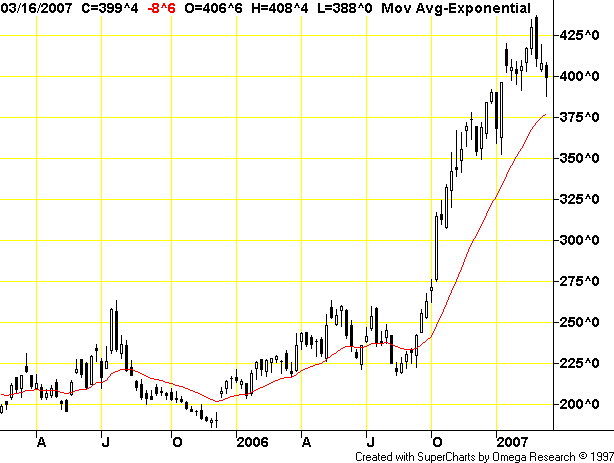
Photo Sharing and Video Hosting at Photobucket

And it's not just corn that's increasing in price. Remember corn is a basic ingredient in a ton of food.

If corn prices increase by ~ 55 percent, year over year, then will the corn used for hog, cattle, chicken, turkey and fish feed go up 55 %? Doesn’t that increase the price of meat, poultry, fish, milk and eggs? If corn is used in corn meal, corn flakes, corn oil, and hundreds of other food items goes up 55%, doesn’t that increase the price of all these foods? Maybe. Since 2000, the price of beef is up 31%, eggs up 50%, corn sweeteners up 33%, wet corn milling up 39%, and corn flakes are up 10%. Chicken prices haven’t changed very much. Yet. Food producers are predicting higher prices.

There's a ripple effect through the entire food production change because of increased corn demand.

The author goes on to discuss the political situation with the corn industry and offers better solutions. I'm not scientifically qualified to say yeah or nay on any of these ideas (Damn it, Jim! I'm an economist, not a scientist).

However, I can say with certainty that if the current situation holds we have some really big possible problems coming up. These are the observations I made before and they still hold true:

1.) Inflationary pressures. Last year oil was the big inflation boogie-man. Now food prices may take their place. The charts above show the food prices are spiking. With overall production down over the last three years and a projected lower production level this year supply won't pick-up until next year. That means food based inflationary pressures may be with us for at least another year.

Also remember that agricultural prices in CPI and PPI have increased over the past three months at very high rates. I am sure the Fed will be discussing these increases at their meeting today.

2.) Higher inflationary pressures means the Fed will be less inclined to lower interest rates. If the economy continues to slow, the Fed won't be able to provide monetary stimulus. That could exacerbate an economic slowdown.

3.) The economy has been growing for the 2004-2007 time period, yet food production is down. There may be a bigger problem lurking here.

The short version is out dependence on corn may wind up creating a really big problem in the future.

One final note. I am not endorsing nor condoning the ethanol program. I'm not qualified to make a recommendation one its veracity on way or the other.

For economic commentary and analysis, go to the Bonddad Blog

Why I Was Fired: DAVID GLESIAS -Former Prosecutor

March 21, 2007
Op-Ed Contributor

Why I Was Fired

Albuquerque

WITH this week’s release of more than 3,000 Justice Department e-mail messages about the dismissal of eight federal prosecutors, it seems clear that politics played a role in the ousters.

Of course, as one of the eight, I’ve felt this way for some time. But now that the record is out there in black and white for the rest of the country to see, the argument that we were fired for “performance related” reasons (in the words of Deputy Attorney General Paul McNulty) is starting to look more than a little wobbly.

United States attorneys have a long history of being insulated from politics. Although we receive our appointments through the political process (I am a Republican who was recommended by Senator Pete Domenici), we are expected to be apolitical once we are in office. I will never forget John Ashcroft, then the attorney general, telling me during the summer of 2001 that politics should play no role during my tenure. I took that message to heart. Little did I know that I could be fired for not being political.

Politics entered my life with two phone calls that I received last fall, just before the November election. One came from Representative Heather Wilson and the other from Senator Domenici, both Republicans from my state, New Mexico.

Ms. Wilson asked me about sealed indictments pertaining to a politically charged corruption case widely reported in the news media involving local Democrats. Her question instantly put me on guard. Prosecutors may not legally talk about indictments, so I was evasive. Shortly after speaking to Ms. Wilson, I received a call from Senator Domenici at my home. The senator wanted to know whether I was going to file corruption charges — the cases Ms. Wilson had been asking about — before November. When I told him that I didn’t think so, he said, “I am very sorry to hear that,” and the line went dead.

--MORE--

'Silent victims': What will become of Iraq's children?

Story Highlights• Health officials say the war is taking an increasing toll on Iraqi children

• One boy: "They killed my father and uncle in front of my eyes"
• Hundreds of thousands of children no longer attend school
• Hospitals too strapped with casualties to deal with mental toll on children
From Jennifer Eccleston
CNN

BAGHDAD, Iraq (CNN) -- Mustafa Karim, a fourth-grader, now lives with family members in a squalid camp in eastern Baghdad where displaced Shias go after fleeing their homes, often after relatives have been killed.

The young boy's eyes fill with tears when he recalls the circumstances that led to his exile.

"They killed my father and uncle in front of my eyes," he says.

He then breaks down sobbing. He can no longer speak. The anguish is unbearable.

Such stories are not uncommon in Iraq four years after the U.S.-led invasion. Health officials say the daily hardships -- bomb blasts, gunfire, killings of family members and sectarian violence -- are taking an increasing toll on Iraq's children.

Hundreds of thousands of children no longer attend school. Others have been forced from their homes to camps, while others have fled the nation with family. (Audio slide show: 'All they've ever known is conflict')

For those that remain behind, there is the constant fear of being killed and the mental toll that warfare takes on its most vulnerable victims.

"Our children are surrounded by violence," said Dr. Saied al Hashimi, a professor of psychiatry at Baghdad's Mustansriya University. "Most of them are traumatized."

He says mass displacement, the death and murder of family members and the constant presence of heavily armed troops, militias and death squads have a long-term impact on the children, especially those in and around Baghdad where violence is most intense. (Watch boy feign death, carried away like martyr)

"I call them the silent victims. Our Iraqi children are the silent victims," he told CNN.

Children face post-traumatic stress disorder

It is nearly impossible to quantify exactly how much the war and violence has impacted these children or just how many are affected.

The humanitarian organization Save the Children, in a report last year about children in conflict zones, estimated that 818,000 Iraqi children, ranging in age from 6 to 11, were not in school. That's roughly one in every five children in that age group.

"Conflict disrupts normal life, forces millions of families to flee their homes, separates children from their families and reduces schools to rubble," the report said. "Every day, these children wake up to a life characterized by hardship and work, and a bleak outlook for their future."

From January to March of last year, the World Health Organization worked with Iraqi psychiatrists on a series of studies on the mental health of children in the cities of Baghdad, Mosul and Dohuk. (Watch the effects of war on childrenVideo)

One of the studies on primary-school-age children in Baghdad found that nearly half of the 600 children surveyed had experienced a major traumatic event since the war began. Just over one in every 10 suffered from post-traumatic stress disorder, the study found.

Another of the studies found that older children in Mosul suffered even worse. Thirty percent of the 1,090 children surveyed showed signs of post-traumatic stress disorder. Nearly all of those with PTSD symptoms, 92 percent, had not received any treatment, according to the study.

In fact, the doctors aren't immune to the dangers of the conflict. Fifty percent of Iraq's psychiatrists have fled the country or been killed since the war began, said Dr. Naeema Al-Gasseer, the WHO's representative for Iraq.

"That's something that's really worrying," she said.

Among those killed was Harith Hassan, one of Iraq's most prominent psychiatrists who often talked to the Iraqi media about the effects of the war -- shot to death as he drove to work last December.

Girl has seizures at sound of warfare

Such attacks have contributed to the atmosphere of fear that has created a shortage of professional help in Iraq. Most major aid organizations no longer have a presence in the country after being forced to leave due to the violence and lack of security.

Save the Children UK, which had been in Iraq for 15 years, was among the last major groups to leave, closing its Iraq office earlier this month.

Iraq's health care infrastructure is reeling from victims of the physical brutality of war, too overwhelmed to properly deal with victims of psychological trauma. In addition, many of the nation's best and brightest doctors have fled the country or have been murdered.

That has left caring for the psychological welfare of children up to a small team of local doctors, like Dr. Hashimi. He trains pediatricians and teachers -- those who have the most contact with children -- to recognize signs of mental distress.

Dr. Ali Hussein, a general practitioner, is among those trying to help.

"A little girl came to my office. She was screaming all the time," he said. "Her mother said they heard bombs every day but just recently she started to panic. It finally got to her. She couldn't take it anymore."

Such effects were evident in one young girl at a psychiatric clinic run by Dr. Haidar Abdul Mohsen, who operates the only psychiatric outpatient clinic in Iraq.

Eight-year-old Zahrah was dressed in a pink track suit and matching sneakers, her boundless energy matched only by her infectious sweetness.

But Zahrah's mother told Dr. Mohsen this calm demeanor vanishes as soon as bombs explode in their neighborhood. The young girl suffers from seizures when the blasts go off.

Another patient, 13-year-old Khitam, has a different reaction to the sound of explosions: She strikes her mother.

"Our children became very violent, became very aggressive. They talk badly. They behave in a bad manner. And we think this is one of the effects of war," said Mohsen.

Girl forced to sleep next to dead body

Mohsen says he hears similar stories every day. He treats up to 15 patients a day. Despite meager resources, he says, he doesn't get any government financing.

One of his patients is 16-year-old Zaman. She was kidnapped outside her school in the Sunni neighborhood of Al Mansour. She says she was held for nine days in a windowless room with 20 other girls.

When one girl's family didn't pay for her release, the abductors raped and killed her. Zaman says she was beaten and forced to sleep next to the girl's dead body. Zaman's family says it paid $20,000 for her release.

The 16-year-old now suffers from deep depression. She screams and cries in the middle of the night. Her nightmares are so intense she's too afraid to sleep.

Her mother begs Dr. Mohsen to help her daughter.

"It's OK. It's OK," he said. "Calm down."

But away from her, he confides that he believes this is a lost generation.

"They live in real tragedy. They have many psychological problems," he said. "What we can do to them is just try to help them by simple things. And so I think our children have big problems."

What does he make of it all for Iraq's youngest generation?

"I don't know what their future is," he said.