| March 21, 2007 |
| by Justin Raimondo |
Christopher Hitchens isn't sorry. Not about being a Commie all those years ago; after all, he was a Trotskyite, not one of those icky Stalinists, which merits a "Get Out of Jail Free" card. Not about being frequently drunk in public: after all, it's part of his image as the Courtney Love of punditry. And, most of all, he's not sorry about doing his bit to gin up the Iraq war: "Four years after the first coalition soldiers crossed the Iraqi border, one can attract pitying looks (at best) if one does not take the view that the whole engagement could have been and should have been avoided. Those who were opposed to the operation from the beginning now claim vindication, and many of those who supported it say that if they had known then what they know now, they would have spoken or voted differently. "What exactly does it mean to take the latter position? At what point, in other words, ought the putative supporter to have stepped off the train?" Instead of stepping off the train, the neocons – and Hitchens most of all – have stepped in front of it. In terms of their own credibility, what they did was the equivalent of lying down on the tracks and letting the train run over them. By staking their reputations as serious commentators on the success of a war that Gen. William E. Odom trenchantly and accurately described as the greatest strategic disaster in American military history, they have ensured their place in the pantheon of mistaken prognosticators, along with the inventors of phrenology and the makers of the Edsel. Oh, a few have recanted, most notably and sincerely Francis Fukuyama. The rest, particularly Kenneth "Cakewalk" Adelman and, most obnoxiously, Andrew Sullivan, have taken to blaming President Bush's supposedly inconsistent and even halfhearted effort to implement their grand theories – much like Trotsky's disciples blamed Stalin's "counter-revolutionary" shortcomings for the inconsistent implementation of the Marxist-Leninist grand design. Hitchens, who has been both a Trot and a warmonger, is a particularly hard case: a dead-ender, in short, who stubbornly sticks to the Revealed Truth even as reality rudely intrudes. Hitchens sets up a phony dialogue between himself and his interlocutors and lobs himself a lot of softball questions, which he disposes of with his characteristic disdain for facts. It's as if Scooter Libby had cross-examined himself. How pathetic that a writer who used to be so interesting and fun to read, even if one disagreed with him, has descended to this very threadbare bag of tricks. Hitchens first raises a fundamentally phony question: Oh, but didn't Saddam violate a whole bunch of UN resolutions? Wasn't the credibility of the UN at stake? Why Americans should care about the UN, or why the U.S. military should be put at the disposal of the Security Council, is never made clear. Besides which, if we set up a mechanism whereby an invasion is automatically launched against any country that violates a given number of UN resolutions, we'd have bombed Tel Aviv long ago. At any rate, I don't recall Hitchens being much of a UN fan to begin with, but I guess when your back's against the wall any maneuver will do. It was "correct," insists Hitchens, to send U.S. forces to the Gulf, because only the threat of force caused the Iraqis to cave on the inspections issue. So Hitchens admits the Iraqis were ready to comply with the UN demand to admit inspectors without conditions – what he doesn't admit is that the U.S. thwarted Saddam's pathetic attempts to effectively surrender, and instead launched a series of provocations designed to torpedo a negotiated settlement. Aside from that, however, the very act of sending military forces to the Gulf made war a foregone conclusion: by that time, the president had invested so much of his own political capital – and America's prestige – in this misadventure that the administration could argue that backing down now, even a little bit, would do irreparable damage to our credibility. Such an argument was, of course, completely unreasonable, but in the Bizarro World we had fallen into post-9/11 – and are only now showing signs of climbing out of – such illogic is perversely "logical." Hitchens throws himself a few more underhand pitches, all centered on the question of Iraq's degree of cooperation with the UN inspectors, but he never addresses the overarching reality, which is that there weren't any "weapons of mass destruction" in Iraq. Period. As Scott Ritter pointed out long ago in an article in Arms Control, the Iraqis had been disarmed by the stringent UN inspections regime and would not be able to reconstitute it. Whether Saddam tried to wriggle out of the straightjacket imposed by the IAEA is irrelevant: what matters is that – contrary to what Bush, Cheney, Rumsfeld, and Hitchens were telling us at the time – he didn't succeed. But we couldn't afford to wait for the smoking gun to arrive in the form of a mushroom cloud: Condi Rice's infamous formulation of the "imminent threat" talking point was just one dark note in the administration's Doomsday Symphony, which deliberately evoked the horrors of a nuclear attack on the U.S. The president even conjured visions of Iraqi drones dropping WMD on the continental United States. Those "drones" turned out to be rickety little gliders that could barely have gotten off the ground. It would be funny if the consequences of the president's delusions hadn't led to such tragic results. Cheney went on television and said flat out we know Iraq has reconstituted its nuclear weapons program. Every bit of misinformation put out there by the Office of Special Plans and the private-sector division of the War Party, including Hitchens, proved to be dead wrong – including all that malarkey about "links" between al-Qaeda and the Ba'athist regime. Saddam's supposed "training camp" for Islamist terrorists (a hoax), the "Prague connection" (a fable), the Niger uranium story (based on a forgery) – it was all of it a pack of lies, from beginning to end, and the American people know it. Yet Hitchens doesn't concede an inch. "Was the terror connection not exaggerated?" he asks, and, like some crazed homeless guy wandering down the street muttering imprecations at invisible demons, he answers himself: "Not by much. The Bush administration never claimed that Iraq had any hand in the events of Sept. 11, 2001. But it did point out, at different times, that Saddam had acted as a host and patron to every other terrorist gang in the region." I have to say I agree with him on this point, if only to a limited degree. While Hitchens has absolutely no evidence to show links between the Iraqi government and Islamists of the al-Qaeda type – the author is, as usual, linkless as well as clueless – he is right that Saddam did harbor one terrorist group. The Mujahedin-e-Khalq, or MeK, is a weird neo-Marxist cult made up largely of Iranian women – at least in the top leadership – who are followers of Maryam Rajavi, the self-proclaimed president of "liberated" Iran. The MeK participated in the 1979 revolution that overthrew the shah and installed the Khomeini regime, but fell out of favor and went into violent opposition, launching terrorist attacks (including against U.S. interests and personnel) in Iran from Iraqi soil. Saddam gave them Camp Ashraf, where they remain to this day – under the protection of the U.S. military, which is reportedly using them for expeditions into Iran, the scene of several recent terrorist attacks. The exact extent of U.S. aid to and cooperation with the MeK is unknown at present. However, they have their advocates in the U.S. Congress and the administration, as well as among neoconservative groups. The recent trial of Scooter Libby was the occasion for a huge document dump, and one interesting find is a memo [.pdf] from John Hannah to Libby regarding the activities and status of the MeK – and there must be a reason why the entire document was blanked out except for the authors' and recipients' names and the subject lines. Hitchens claims that no one could have predicted the Iraqi civil war, yet I don't believe for a minute I'm the only one who likened the invasion of Iraq to the opening of Pandora's Box, and you shouldn't either. Hitchens ends with his usual flamboyant flourish: "So, you seriously mean to say that we would not be living in a better or safer world if the coalition forces had turned around and sailed or flown home in the spring of 2003? "That's exactly what I mean to say." If the Bourbons of Talleyrand's day learned nothing and forgot nothing, the "democratic" imperialists of our own day have learned nothing and forgotten everything – including their own bright prognoses for the postwar era in Iraq and throughout the region. War advocates recalled the Allied liberation of Paris when envisioning the likely outcome of Iraq's "liberation." It never happened. Remember how the invasion and especially the Iraqi elections were supposed to augur an era of democratic reform and even revolution in the Middle East? That, too, never happened. Every word the War Party rattled off before the invasion – the reasons for the invasion, the "evidence" of WMD, the alleged connection between the Iraqi regime and 9/11 – was either a lie or a half-truth intended to obscure the full truth. Hitchens was one of the main disseminators of these lies, yet he has the temerity to stand there and tell us he's not sorry. He and his palAhmed Chalabi belong to the legion of "heroes in error": they're proud of their deceit. It has proved, after all, the key to their postwar success. I hear Chalabi is in line for minister of oil resources, and our laptop bombardiers have done quite well for themselves, as one wag recently pointed out in Radar magazine. The journalistic price to pay for being so wrong has been less than nil. Bill "New American Century" Kristol has been rewarded for being wrong about Iraq with a column in Time magazine. Hitchens became a media star in the run-up to war, when he was all over television charming those gullible Americans who are suckers for any snake oil salesman with a British accent. No doubt his lecture fees are at an all-time high. He isn't sorry because the war has been good for him, but it's not just about careerism. For the War Party, the world is a better place now that the U.S. has invaded Iraq and occupied it for four years: we have the "surge" to look forward to – and now the glad tidings of yet another war, an even bigger and "better" one, with Iran. As far as Hitchens and his fellow neocons are concerned, happy days are here again. When the Soviet Union fell and the Cold War abruptly ended, the professional warmongers and Sovietologists were out of their jobs, and it was a long stretch of lean times between the Berlin Wall's fall and the fall of the twin towers. Sept. 11, however, did more than merely revive the War Party's fortunes – it enabled the neocons to effectively pull off a coup d'etat at the very top levels of U.S. government. In Colin Powell's characterization, they set up a "separate government." Centered in the office of the vice president, the neocons did an end run around the mainstream intelligence agencies to manufacture the lies that lured us into war, and Christopher Hitchens did more than his part to spread these lies. But in the minds of the neocons, all their lies are noble ones – besides , this whole obsession with such outdated concepts as truth and falsehood is just a superstition dreamed up by the "reality-based community," as one White House official put it to Ron Suskind. Watch us while we make history: in the triumphal atmosphere of the War Party's heyday, a fatal hubris was in the air, and the pro-war intellectuals breathed this in so deeply that the effects have yet to wear off. Hitchens is drunk on a lot more than booze. Alcoholics often suffer from delusions, and their recalcitrance is part and parcel of their strenuous denial. The reality on the ground has proved the drunken warriors utterly wrong, yet they still go on pretending that all is well, if only the "surge" would be given time to work, if only the media would stop subverting the war effort, if only… When the neoconservative version of this war's history is written, each chapter will elaborate on a different "if only" scenario that deftly ignores what actually happened and instead focuses on the imperfect implementation of their wonderful scheme. Hitchens at least tries to defend the indefensible, which is a brave thing to even attempt, but his fellow neocon Richard Perle is clearly uninterested in making the effort. Here he is chatting with Tim Russert: "RUSSERT: Mr. Perle, is the war, war in Iraq worth the price we've paid? "PERLE: Forgive me for saying it, but I think it's the wrong question. It's a bit academic for one thing. But the question is what is in our national interest now, what is going to make Americans safer. I disagree with what we've just heard. A defeat in Iraq brought about in the worst instance by precipitous withdrawal would have terrorists around the world celebrating. It is the idea that the United States can be defeated that motivates terrorists. And we have Osama bin Laden himself saying that and saying it repeatedly. So the question the country faces now is not is this a reason – is this a bargain, is it a reasonable price. The question is what do we do. And I think we have to win this war, and I hope that the new strategy that's been adopted will enable us to do that." The most basic question, whether it was right to have sacrificed so many lives in pursuit of Perle's policy, is "a bit academic" to one of this war's chief intellectual architects and public advocates. His answer to his critics is simple: I got you into this mess, and only I can get you safely out of it, so listen up …. The problem for Perle and Hitchens is that few are listening. Even in Washington, where both parties collaborated in bringing this disastrous war about, the ranks of the War Party are noticeably thinning. In the country at large, the war is wildly unpopular. The electorate longs for an antiwar presidential candidate like evangelicals pining for the Messiah's return. Deliver us from evil! appears to be the general sentiment, although what sort of evil the American public is just beginning to learn. |


By Bonddad
bonddad@prodigey.net
On Saturday I wrote an article titled Why Are Food Prices Spiking? In that article, I noted that agricultural prices are spiking and noted a basic drop in supply and increase in demand. This article follows up on that, especially in regards to how the development of the ethanol market is playing agricultural prices spikes.
I would also like to point out that I am not the only person who has written on this. Many other writers have pointed this out. Simply do a search under ethanol and you will find many well-written and informed articles.
From the blog, Financial Sense
Thanks to Federal mandates and subsidies, corn used for the production of corn ethanol is expected to increase from ~ 700 M Bushels in 2000/2001, to 3.2 B bushels in 2007/2008 – an increase of 357 percent. On December 11, 2006, the USDA estimated 2006-2007 U.S. ending stocks would be 935 million bushels, down from 1.97 billion bushels in 2005-2006. That decreases the ending stocks by more than 50 percent and puts the ending stocks to use ratio at 8%, - the lowest in 11 years. It should be obvious to all, we are going to need a lot more acreage and big yield improvements if corn production is going to keep up to demand. Prices could exceed $4.50 per Bu by the end of 2008. That’s a price increase of 125% over 2005/2006 season prices.
Let's take this one point at a time.
corn used for the production of corn ethanol is expected to increase from ~ 700 M Bushels in 2000/2001, to 3.2 B bushels in 2007/2008 – an increase of 357 percent.
In other words, demand hasn't just increased; it has spiked off the map. Econ 101: increased demand equals increased price.
On December 11, 2006, the USDA estimated 2006-2007 U.S. ending stocks would be 935 million bushels, down from 1.97 billion bushels in 2005-2006. That decreases the ending stocks by more than 50 percent
Supply is contracting as well, and not by a little. By a lot. Econ 101: decreased supply = increased price.
It should be obvious to all, we are going to need a lot more acreage and big yield improvements if corn production is going to keep up to demand. Prices could exceed $4.50 per Bu by the end of 2008. That’s a price increase of 125% over 2005/2006 season prices.
Yes we are. The problem is the total amount a acreage devoted to corn farming is decreased. Accordiing to the Department of Agriculture the US produced 299.91 million metric tons n 2004 and is projected to produce 267.60 million metric tons as of March 2007. That's a drop of 11%. Also remember that demand has increased by 357%. That explains why corn futures have soared.
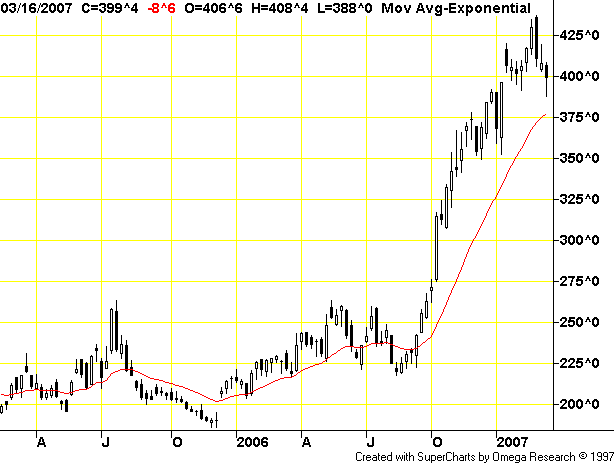
And it's not just corn that's increasing in price. Remember corn is a basic ingredient in a ton of food.
If corn prices increase by ~ 55 percent, year over year, then will the corn used for hog, cattle, chicken, turkey and fish feed go up 55 %? Doesn’t that increase the price of meat, poultry, fish, milk and eggs? If corn is used in corn meal, corn flakes, corn oil, and hundreds of other food items goes up 55%, doesn’t that increase the price of all these foods? Maybe. Since 2000, the price of beef is up 31%, eggs up 50%, corn sweeteners up 33%, wet corn milling up 39%, and corn flakes are up 10%. Chicken prices haven’t changed very much. Yet. Food producers are predicting higher prices.
There's a ripple effect through the entire food production change because of increased corn demand.
The author goes on to discuss the political situation with the corn industry and offers better solutions. I'm not scientifically qualified to say yeah or nay on any of these ideas (Damn it, Jim! I'm an economist, not a scientist).
However, I can say with certainty that if the current situation holds we have some really big possible problems coming up. These are the observations I made before and they still hold true:
1.) Inflationary pressures. Last year oil was the big inflation boogie-man. Now food prices may take their place. The charts above show the food prices are spiking. With overall production down over the last three years and a projected lower production level this year supply won't pick-up until next year. That means food based inflationary pressures may be with us for at least another year.
Also remember that agricultural prices in CPI and PPI have increased over the past three months at very high rates. I am sure the Fed will be discussing these increases at their meeting today.
2.) Higher inflationary pressures means the Fed will be less inclined to lower interest rates. If the economy continues to slow, the Fed won't be able to provide monetary stimulus. That could exacerbate an economic slowdown.
3.) The economy has been growing for the 2004-2007 time period, yet food production is down. There may be a bigger problem lurking here.
The short version is out dependence on corn may wind up creating a really big problem in the future.
One final note. I am not endorsing nor condoning the ethanol program. I'm not qualified to make a recommendation one its veracity on way or the other.
For economic commentary and analysis, go to the Bonddad Blog
