Showing posts with label fraud. Show all posts

Tuesday, April 10, 2007

The student-loan scam

Related
Insider aid at universities
Colleges shouldn't share the wealth with lenders providing student loans.
---
Under a Republican Congress, for-profit lenders pursued their own interests -- often with the help of colleges.

By Stephen Burd, STEPHEN BURD, a fellow at the New America Foundation, was a reporter for the Chronicle of Higher Education.

April 10, 2007

AFTER 15 YEARS of reporting on the student-loan industry, I didn't think much could surprise me. But even I was shocked last week when I discovered Securities and Exchange Commission documents revealing that financial aid directors at three prominent universities — as well as a senior official at the U.S. Education Department — each had significant personal investments in a private student-loan company

What possibly could have motivated these officials to take tens of thousands of dollars in stock options from Student Loan Xpress? Has the whole student-loan business become so corrupt that they failed to see the conflict of interest?

If so, Washington is most to blame. For the last seven years, federal officials have turned a blind eye to problems with the companies that participate in the government's student-loan programs.

When it came to power, the Bush administration — with its reverence for the private sector — rewarded loan industry officials and lobbyists with prominent positions throughout the Education Department. Meanwhile, lenders such as Sallie Mae have showered Republican congressional leaders with hundreds of thousands of dollars in contributions each campaign cycle. "Know that I have all of you in my two trusted hands," Rep. John A. Boehner (R-Ohio), a top recipient of that campaign cash, once famously told a gathering of student-loan providers.

The cozy relations that developed among the Bush administration, the Republican-led Congress and the lenders have left the loan industry essentially unregulated. Some observers liken it to the Wild West: Lenders and colleges pursue their own self-interest with little regard for students or taxpayers.

Every company wants to be a college's "preferred lender," competing fiercely to get on such lists. But the dirty little secret of the guaranteed student-loan market is how concentrated it is: Only 32 lenders hold 90% of the loan volume. What's more, the Education Department has found that at about 300 colleges, one lender controls 99% of the loan volume — essentially holding a monopoly on those campuses.

Any company trying to break into the market has to rely on unconventional means. Some upstarts have promoted revenue-sharing arrangements, in which colleges get a cut of each loan that their students take out. Established lenders, worried about losing market share, have taken up similar kickback practices. One of the most egregious schemes is called an "opportunity pool," which was pioneered by loan giant Sallie Mae. Here's how it works: A lender hands a college a fixed amount of private loan money that the institution then can lend to students who otherwise wouldn't qualify for loans because of credit problems. These are private loans — ones that typically come with higher interest rates and fewer consumer protections. In return for the "opportunity pool," the college makes that company its exclusive provider of federally backed loans.

Soon after Sallie Mae started its Opportunity Loan Program in 2000, some of its competitors questioned whether it violated the provision of the Higher Education Act that bars lenders from offering inducements to colleges "to secure applicants" for federal loans. They brought their complaints to the Education Department's inspector general, who wrote a memo to department leaders urging them to examine "opportunity pools." Department officials, however, refused to take action, insisting that the loan industry should regulate itself. Many lenders took that to be tacit approval of the deals. As a result, other companies, such as Citibank, started offering similar arrangements.

Giving credit-unworthy students high-interest private loans is a recipe for disaster — a disaster that the department could have stopped. Loan industry officials acknowledge that these deals are "loss leaders," meaning the companies are willing to absorb some defaults in exchange for a greater presence on a campus.

Recently, as outrage over these types of deals has grown and the Democrats have gained control of Congress, the Education Department has had a change of heart. Officials are considering more heavily regulating how colleges choose lenders to recommend to their students. For example, the agency may require financial aid administrators to include at least three choices on their "preferred lender" lists.

The department's proposals, which are being contested by lenders and aid administrators, are welcome but unlikely to go far enough. Instead, policymakers should consider a complete overhaul of the federal student-loan programs so that college aid administrators are no longer in the business of recommending favored lenders.

If there can be a lendingtree.com for home mortgages, there can be one for student loans too. Lenders should bid for student-loan business. Students would get cheaper loans. And there would be fewer incentives for the kind of unseemly activity that has been coming to light.

Housing Boom Tied To Sham Mortgages: Lax Lending Aided Real Estate Fraud

By David Cho

Washington Post Staff Writer
Tuesday, April 10, 2007; A01

ATLANTA -- The man was one slick fraud artist.

Phillip Hill lured people to fancy cocktail parties in a $1.9 million mansion. He asked to use their names and credit histories in real estate deals, promising to make them rich. Most got $10,000 checks on the spot for signing up.

By the time the scam unraveled, the credit of those participants had been ruined, hundreds of upscale properties had fallen into foreclosure and real estate prices had plummeted in some of this city's most exclusive neighborhoods. Hill is about to go to federal prison.

Many experts have concluded that the nation's real estate boom of recent years was fueled in part by weakened lending standards that sparked excessive demand and drove up prices. Now, some are worried that the looser standards may have permitted a boom of another kind -- a big expansion of mortgage fraud.

No one knows exactly how extensive the crime has become, but new data from the federal government suggest that it has jumped tenfold since 2000. Prosecutors are finding cases all over the country in which sham transactions, based on fraudulent appraisals, led to homes changing hands at far above their real value. Mortgage lenders failed to carry out the most elementary safeguards.

In some neighborhoods, mortgage fraud became so extensive that it drove up overall home prices. That is what happened in Atlanta. Hill, 50, was convicted last month in what authorities call one of the biggest mortgage-fraud cases in U.S. history. It involved 400 fraudulent loan applications; nearly $100 million in mortgages; and 120 closing attorneys, appraisers, mortgage brokers and others who prosecutors say were in on the scam.

Federal prosecutors say this kind of fraud is hardly unique to Atlanta -- the lax lending standards that Hill exploited have existed throughout the country in recent years.

In Broomfield, Colo., Gerald Small pocketed $21.5 million and bought two jets after he got bogus home loans using personal information from people who responded to a help-wanted ad; he was convicted. In Kansas City last year, Brent Michael Barber was sentenced to 12 years in prison for paying residents of a low-income neighborhood $2,000 each to use their names in 300 fraudulent loan applications. In Jacksonville, mortgage broker J.R. Parker and closing attorney Dale Beardsley were convicted in 2005 for a fraud scheme in which they netted $14 million in cash, six luxury cars and two $1 million homes.

Federal law enforcement officers say that with heavy demands on them from homeland security, they have had the resources to shut down only the worst offenders.

"By the time we prosecute, the damage has been done, the neighborhoods are already destroyed and the money is gone," said David E. Nahmias, the U.S. attorney who oversaw the Hill case.

In Atlanta, entire neighborhoods and condominium developments, especially those in affluent areas, were hit by organized fraud rings. Initially, these schemes pumped up housing values for everyone as artificially high appraisals helped the swindlers get inflated loans. Legitimate home buyers rushed in to get a piece of what they thought was a soaring real estate market. Now as the fraud is being exposed, their home values are taking a hit.

As more of these cases come to light around the nation, the question is: How much did an epidemic of fraud contribute to the frenzied housing market of recent years?

Liar Loans and Straw Buyers

Thirty years ago, most Americans got their mortgages at a savings-and-loan association from bankers who obeyed conservative lending rules. But sweeping changes in the finance world have created a far different system. It has helped raise homeownership to record levels, but many real-estate professionals say it also has led to far looser lending standards.

Nowadays, instead of poring over paperwork for weeks, lenders often verify loans through electronic underwriting programs in which numbers can easily be tweaked. About 70 percent of Americans get their home loans from independent mortgage brokers, many of whom are paid bonuses for pushing higher-interest loans.

Close to 90,000 brokers have joined the profession since 2000, according to Wholesale Access, a research firm in Columbia. The field is lightly regulated. Eighteen states do not require criminal checks, the Conference of State Bank Supervisors reports. Undoubtedly, most mortgage brokers are honest, but some have played central roles in recent fraud cases.

The housing boom brought another change. Mortgages are no longer held for long by banks but are packaged together as massive bonds and sold on Wall Street. Propelled in part by demand for these bonds, companies began offering loans that required little or no documentation of borrowers' income.

These "stated income" loans were designed for a limited purpose: giving self-employed people a crack at homeownership. But during the boom, the number of such loans exploded to the point that they became a running joke in the industry, earning the nickname "liar loans." Estimates vary widely, but research suggests that they made up a significant portion of all mortgages during the boom -- 58 percent in a study by First American LoanPerformance.

Mortgage lenders in theory have a right to compare loan documents to a buyer's tax returns, but they rarely do. In the few cases where it has been done, results were startling. In a study published by the Mortgage Asset Research Institute, one lender sampled 100 stated-income loan applicants and found that 90 had exaggerated take-home pay by 5 percent or more and that nearly 60 inflated their pay by more than 50 percent.

Mortgage originators often neglected extensive document verification because it slowed loan approvals. "Everyone in the mortgage industry is trying to approve loans faster than their competitors," said James Croft, founder of MARI in Reston. "They all offer the same basic rates and the same basic mortgage products. But if I can get the loan faster, that gives me a competitive advantage."

Many industry experts say stated-income loans became an invitation to fraud, while mortgage brokers -- paid commissions to put loans through, not slow them down -- often looked the other way.

In this climate, industry people say, fraud of two types became easier.

In the first type, known to law enforcement as "fraud for housing," people lied on their mortgage applications to get into homes they otherwise could not afford. Even on a loan where the buyer is asked to provide no proof of income, lying about it on the application is a federal crime.

A more insidious type -- "fraud for profit" -- also spread. Involving scam artists taking advantage of the looser standards, many of these schemes drew in corrupt appraisers willing to overstate the value of properties, "straw buyers" who were paid to lend their names and credit histories to a transaction, and closing attorneys who kept banks in the dark.

The growth of mortgage fraud has outpaced other types of financial crimes, the Treasury Department reports. From 2002 to 2004, mortgage fraud reports nearly doubled each year. Over that period, mortgage fraud convictions by federal prosecutors fell.

The Treasury Department received a record 37,313 mortgage fraud reports in 2006, 10 times more than in 2000. But the true incidence is almost certainly higher because the government gets reports only from regulated institutions, not including the nation's 53,000 mortgage-broker firms.

"Nobody wants to go in there and expose how big this is," said Chris Klein, a finance manager at Howard Hanna Mortgage Services, a Pittsburgh mortgage broker, echoing the comments of several brokers around the country. "In the industry as a whole, it's a running joke. If you want to get a loan done, any loan, you can get it done."

Hill's 'Business Model'

Phillip Hill allegedly ran small-scale frauds in Florida and elsewhere for years, and he was caught and convicted in one case. But when he arrived in Atlanta in the late 1990s, that past was invisible. It is now apparent that he came to town with big plans.

Described as soft-spoken but charismatic, Hill broke into the city's elite circles by throwing lavish parties at an estate a few blocks from the Georgia governor's mansion. Influential people began coming to him for their housing needs. Hill rented homes to several prominent Atlanta figures, including Robert L. Nardelli, the former chief executive of Home Depot.

Prosecutors said Hill and his accomplices sought short-term loans from friends and associates, including business leaders and professional athletes. The ring bought homes, then transferred them to straw buyers Hill had recruited. Using inflated appraisals and other doctored papers, the group took out big mortgages that allowed it to repay the short-term loans and pocket hefty sums.

Some home prices were inflated by 100 percent or more. One estate was pumped from $1.9 million to $5.5 million in two weeks, according to court documents. Hill's personal take from the scheme is estimated at $14.5 million, prosecutors said.

Prosecutors think most of the straw buyers, some just college students, did not know what Hill was doing with their names and credit histories. Several later testified that Hill's attorney flipped through loan documents so fast at closing that they hardly read what they were signing. Most apparently thought they were becoming the owners of homes Hill would maintain and rent out to make the monthly payments.

In truth, neither happened. Most homes fell into disrepair. Others were stripped of their appliances and fixtures, including the mansion where Hill hosted his cocktail parties. As the scam unraveled, more than 300 homes fell into foreclosure.

Mortgage lenders later acknowledged that they failed to perform basic checks into hundreds of Hill loans. They estimated their losses at $41 million. Some of that will be absorbed by Fannie Mae and Freddie Mac, the huge government-created housing corporations in Washington that help package home loans into bonds for sale on Wall Street.

At trial, defense attorneys argued that Hill was unaware that his "business model" was against the law and that his underlings doctored loan applications without his knowledge. The jury did not buy it. On March 14, Hill was convicted of 166 counts of fraud and money laundering. He has not been sentenced, but after the verdict, Judge Thomas W. Thrash said Hill "is looking at spending the rest of his life in prison."

Hill's attorney, Bruce H. Morris, said his client maintains his innocence and plans to appeal.

Nine accomplices, including appraisers, real estate agents and closing attorneys, were convicted. Thirteen others pleaded guilty. Many straw buyers saw their credit ruined.

Hardest-hit by the scheme were honest homebuyers. Mortgage fraud experts estimate that Hill's scam, and others like it, have put several thousand homes into foreclosure, driving down values.

Bill Cleary was one of the first to buy a condo in Deere Lofts, in a bustling area in downtown Atlanta. He was lured by the amenities -- hardwood floors, high ceilings -- as well as advertisements glamorizing the area. In 2001, he paid $213,000 for a two-bedroom unit.

Then Hill bought 40 units at a discount from the builder and started flipping them for about $400,000. The non-Hill condos left on the market were quickly snatched up.

But all of Hill's units ended up in foreclosure. Because Hill stopped paying homeowner dues, the condo association nearly went bankrupt and the building went downhill. Three years after Cleary bought his place, comparable two-bedroom units were selling for $130,000. "All of the promises they made went up in smoke," Cleary said of the developers.

Anne Fulmer's neighborhood, in Atlanta's affluent northern suburbs, has been hit by four mortgage fraud rings since the late 1990s.

The scams motivated Fulmer and others to form a coalition of prosecutors, police, homeowners and real estate agents to fight back. The Georgia Real Estate Fraud Prevention and Awareness Coalition got a tough mortgage-fraud law through the state assembly.

In national surveys, Georgia has been identified as a fraud hot spot. But Fulmer says that is because people there have become so aggressive about identifying the problem. She says she wonders how many homeowners across the country bought in neighborhoods where values were driven up by fraud but don't know it yet.

"It happens everywhere and anywhere," said Fulmer, who is now vice president of Interthinx, an anti-mortgage-fraud company. "If the true scope was discovered, I think it would cause a major crisis."

Tuesday, March 13, 2007

The Democrats' Fraudulent Iraq Exit Plan

Marc 13, 2007

By Kevin Zeese

The Democrats took the majority of both the House and Senate on January 4th, 2007 since then 192 members of the Armed Services have died as have countless Iraqi civilians. With power comes responsibility, so voters should know that this is now the Democrats War and every death and casualty is their responsibility.

When they came to power their leadership said they would not use the "power of the purse" to end the war. But pressure from voters opposed to the Iraq quagmire has changed their tune. Last week an obviously frustrated Rep. David Obey told Marine Mom, Tina Richardsin a Capitol Hill hallway encounter that his appropriations bill would de-authorize the war.

I went to Capitol Hill as part of a support delegation for Tina Richards this Monday to return to Rep. Obey's office to seek clarification of his hallway comments. There has been a lot of deal making by Congressional leaders to line up support for the Iraq War supplemental. They are adding billions in goodies for constituents, for Midwest farmers, avocado growers, communities that have lost bases, Katrina relief, Veterans and other goodies to gather votes.

The headline that the Democratic leadership would like voters to hear is "troops out of Iraq by August 2008." But the headline is more a wolf in sheep's clothing than a reality. After hearing details of the bill from Obey's appropriations staff person the loopholes may define the law more than the headline.

For most in the peace movement an August 2008 deadline for withdrawal is already way too slow. Why the delay? On November 17, 2005 Rep. Jack Murtha called for redeployment within six months. Here we are sixteen months later and the Democratic leadership is talking about redeployment in seventeen months! Six months has turned into 33 months ­ and in fact the August deadline is illusory. How many lives ­ U.S. and Iraqi ­ will have been lost in this quagmire over this time period?

But, that is not the worst of it. As Rep. Maxine Waters, the Chair of the Out of Iraq Caucus point out, a few weeks ago the Congress passed a non-binding resolution against the so-called "surge" but this appropriation will actually pay for the surge ­ which has grown since their vote by more than 8,200 troops. Indeed, the Democrats are poised to give Bush up to $20 billion more than he asked for!

The appropriation initially was going to require that only combat ready troops could be sent to Iraq. But in order to please "Blue Dog Democrats" and some Republicans the bill is now merely a requirement that Bush report to Congress if non-combat ready troops are used in Iraq. Since when do conservatives want us sending troops to wars who are not fully trained or equipped for combat? Combat readiness has become a symbolic requirement that will at best embarrass the commander in chief but it will not stop deployment of troops unprepared for battle.

And, it keeps getting worse. Regarding the August 2008 deadline not all troops are being redeployed (the bill does not say to where). The bill leaves four categories of soldiers who can remain in Iraq. These include troops to guard the U.S. Embassy in Iraq. This is the largest Embassy in the world ­ a city within a city ­ so who knows how many troops that will take. Also, troops involved in diplomatic and consular affairs will remain in Iraq.

But, the two big categories allow troops to remain in Iraq to fight Al Qaeda and to train the Iraqi military and police. President Bush has called Iraq one front in the war on terror, where the main target in the war on terror is Al Qaeda. Indeed, "we're in Iraq to fight them over there rather than over here," according to the president. Further, he claimed that Saddam and Osama were working together ­ and Vice President Cheney still makes that claim. And, throughout the Iraq War the resistance in Iraq has been defined as terrorists and there have been no solid numbers regarding how many Al Qaeda fighters are in Iraq. And, can you imagine the intelligence-leak drumbeat as that deadline approaches. There will be story after story planted in the establishment media about Al Qaeda coming to Iraq in preparation for the U.S. exit. This hole is so large by itself to make the Democratic exit strategy a virtual mirage.

And, then there is the training of Iraqi military and police. How many trainers will the U.S. have for an Iraqi military and police that will be in the very high hundreds of thousands, perhaps over a million? Will training include U.S. soldiers being embedded in the Iraq military or police as part of training them? This is another gigantic loophole that makes the withdrawal more a "stay the course" plan then a real withdrawal.

But, the thing that makes this supplemental appropriation particularly dangerous is the Democratic leadership decision not to raise the question of forbidding military force against Iran. The Bush administration has been beating the war drums for a military attack on Iran for months. It had been reported that the spending bill would have required congressional approval, with some exceptions, before using military force against Iran.

The Congressional Quarterly reported on March 8, 2007 that "The influential American Israel Public Affairs Committee also is working to keep the language out, said an aide to a pro-Israel lawmaker." Rep. Rahm Emanuel, the consigliore for the hard right Israeli lobby in the House of Representatives ­ a congressman who was a civilian volunteer with the Israeli army during the first Gulf War, is quoted as predicting "that the language would ultimately not be included in the supplemental on the House side."

On the 8th CQ reported "a Democratic leadership aide said there are no plans to remove
the provision. 'There's heat,' the leadership aide acknowledged. 'We've heard
their concerns, but we think it's likely to remain on the bill.'" Less than a week later it seems the hard right Israeli lobby, which is often the puppet master of U.S. foreign policy, has gotten the provision removed.

Thus, the Congress has decided to put up no barriers to a Bush attack on Iran. In hearings before Sen. Russell Feingold this January legal experts said that the original use of force resolution, the power of the president to act to defend U.S. national security and the authority of the president to introduce troops into "hostilities, but not into a war" may be sufficient to allow military action against Iran absent congressional action. If Congress put up barriers requiring Congressional approval or restricting the use of funds appropriated than that would limit the president's authority. But without Congressional action, Bush could act militarily against Iran.

So, the slow exit of the Democratic leadership will in the best case scenario be a partial exit that could keep tens of thousands (or more) troops in the Iraq quagmire. And, their failure to curtail the president's authority regarding Iran will give him the unbridled path he needs to go forward with military action against that country. This supplemental may result in a bigger Mid-East war in 2007, rather than a real exit from Iraq.

Is this what the November 2006 anti-war mandate was for?


Kevin Zeese is director of www.DemocracyRising.US and co-founder of www.VotersForPeace.US

Friday, February 16, 2007

Rawstory runs CCNWON Correction! "Terror Free Oil"?

My following note is now in the comments section to the RS article," Filler up with freedom! Activist opens 'terror-free' gas station.
---
I am pleased to see Rawstory cover this issue.

This venue is ideal for getting the story out about 'possible'(lawyer code word to avoid legal hassles) deception by this 'activist'.

I offer two articles for your consideration that may convince you we've been had.

On first seeing the company's television commercial, I felt disgusted that all Middle Easterners were being painted with the same brush as terrorists.

I first came across this story, "Media fall for pro-Israel hate group's "Terror Free Oil""
http://tinyurl.com/2vpcek

The second story,"Is "Terror-Free Oil" Really Snake Oil?", clearly indicates a scam may be taking place.
http://tinyurl.com/2wak8x

A comprehensive investigation of this company is called for.

Best.

---

Now that I am at it ,Josh at TalkingPointsMemo ran an incorrect story yesterday and has refused to fix it after I notified him. I may provide the story on this later. Time to move on to the daily news. Enjoy.

Friday, February 9, 2007

'Floodgates of Fraud' at Spy Satellite Agency

February 06, 2007

The "floodgates of fraud reporting" have opened at the National Reconnaissance Office, the nation's top-secret builder and operator of spy satellites. This bit of news comes from no less a source than the NRO's inspector general, Eric Feldman. Yet Feldman and other NRO officials are mum about just how big the flood is over there.

This might not be such a big deal were the stakes at hand not so high. The NRO and its many contractors have grown notorious for massive cost overruns and quality control failures so serious they threaten the U.S. edge in high-tech reconnaissance satellites. Whether they're eavesdropping on al Qaeda communications or photographing Iranian nuclear facilities, these are the crown jewels of the U.S. intelligence community. But the current generation of spy satellites is burning out–and replacements are years away.

Feldman suggested something was amiss in the Journal of Public Inquiry, an obscure publication put out twice a year by the nation's inspectors general. With Alan Larsen, his general counsel, he described how contractors have systematically delayed and brushed off IG requests for information. When his office pushed through a revision to all contracts, explicitly stating the need to cooperate, some contractors "were hysterical, accusing NRO of violating four different amendments to the U.S. Constitution," they wrote. But since then, "the floodgates of fraud reporting mysteriously opened from companies that had previously had little interest in talking to us. . . . We believe that we have barely scratched the surface in identifying possible fraudulent activity on our contracts."

What kind of fraud is he talking about? Hard to say, but there are huge sums in play. The NRO grabs some $7.5 billion of the $44 billion annual intelligence budget–and most of that amount is shelled out to contractors large and small. The agency's troubled next-generation satellite, a $25 billion boondoggle called Future Imagery Architecture, has been so dogged by cost overruns and technical trouble that the director of national intelligence cut the project in half last year. Back in 1995, revelations surfaced that the NRO ran what some in Congress called a slush fund of over $1 billion, which the agency used to build a lavish new headquarters. The NRO director and his deputy were subsequently fired, and Congress stopped the agency from squirreling away unspent funds year after year.

The last NRO fraud case we found on the public record is six years old and involved a mere $160,000 in payoffs–a pittance in the world of defense contracts. The culprit was a Los Angeles-area contractor trying to corner routine maintenance and repair work on buildings run by TRW, an NRO contractor that no longer even exists.

The NRO says it has had no cases since then–at least that it can talk about. That seems hard to believe. More likely at work is the kind of knee-jerk, pervasive secrecy that infects so much of the U.S. intelligence community–the kind of needless secrecy that fosters the very lack of accountability the IGs should be fighting against.

NRO Inspector General Feldman declined repeated requests to comment. A pity. Even in the world of spy satellites, Americans have a right to know if billions of their tax dollars are being stolen.

Photo caption: An NRO satellite is launched from Vanderberg Air Force Base in 1996.

Credit: National Reconnaissance Office

Thursday, February 8, 2007

Is George's Bush's Secretary Of Labor A Crook Too?

Did Elaine Chao Let An Influential Right Wing Group Steal Taxpayer Money?

phpimen@comcast.net

Feb 08, 2007

Elaine Chao, wife of Senate Minority Leader Mitch McConnell and George's Bush's Secretary of Labor has been ignoring requests to investigate 19 chapters of the Associated Builders and Contractors for tax fraud.

Of course, this same group, the Associated Builders and Contractors just happens to be a major donor not only to Republican campaigns but also to Chao's husband, Mitch McConnell. This group quite possibly used taxpayer money from state apprenticeship and training grants to help finance local chapter activities which include lobbying for its conservative, anti-worker free market causes.

(This research was not collected by me. it is the result of a two year crusade by Allen Smith, a researcher formerly with the Building and Construction Trades Department. Though it was released earlier to the press, it never really was widely covered by the "liberal media.")

Before beginning, it might be a good idea to get some background on just who this group is and what they represent.

Just Who Is The Associated Builders and Contractors?
The Associated Builders and Contractors (ABC) is a virulently anti-worker business group whose mission statement leaves little to the imagination:

ABC's mission is the advancement of the merit shop construction philosophy, which encourages open competition and a free-enterprise approach that awards contracts based solely on merit, regardless of labor affiliation.

From the Associated Builders and Contractors website

You probably never heard of it, but the group's influence in the halls of Washington is powerful. Bolstered by members such as Halliburton's Kellog Brown and Root, this group of free market enthusiasts is ranked by Fortune Magazine as one of the 50 most influential groups in the nation.

This group currently stands as one of the leading opponents of the minimum wage increase, Employee Free Choice Act, Project Labor Agreements, Best Value Construction Contracting, and overtime pay, amongst other things.

Fraud With Taxpayer Dollars
While the Associated Builders and Contractors tout their free market philosophy, they seem to have no problem with relying upon taxpayer dollars to fund their "so-called" training programs which have come to serves as nothing but a means of perpetuating a potentially illegal bait and switch scheme.

The fraud stems from an examination made of the annual financial reports filed by the ABC's individual chapters and their local apprenticeship and training entities. Each of these reports, known as a Form 990, is required by the IRS of almost all non-profit organizations.

These 990 forms require the disclosure of all compensation payments to officers, key staff and board members of these groups - even if the payments are made indirectly through a third party firm. Groups operating as non-profits under these guidelines must also report all transactions made with other related non-profit groups.

The related non-profits in this case are each chapter's Apprenticeship Trust which are a separate training organization administered under seaparate funds to provide training for workers looking to train for a career in the construction industry.

Originally developed by early craft unions, every modern construction union has one, paid for by a mix of employer and employee donations that pay for training equipment, instructors, and a battery of refresher courses to assist union members in updating their training to meet new technological demands. These have worked successfully over the years resulting in a high retention rate without the reliance on taxpayer funds.

The ABC, through its local programs, however, reveals a different story that is being ignored by the very people appointed to oversea fraud in the construction industry and in training.

The report written by Allen Smith from the AFL-CIO's Building and Construction Trades Department details a history of potential fraud which the Department of Labor has failed to investigate. This fraud has been running rampant within individual chapters across the country:

Where Did Payments From the ABC's Alabama Training Arm Go To?

Between 1998 and 2002, the ABC of Alabama Apprenticeship Trust paid $304,984 to the Chapter for "reimbursement of expenses." However, the Chapter failed to report receiving any such money as income between 1999 and 2002
Source: Building And Construction Trades Department

Which insider received a loan from the Southern California Chapter and what were the terms?

In 2001, the Chapter listed a $54,102 receivable from an officer, director, trustee, orkey employee. In 2002, the amount had increased to $57,870. The terms of anyinsider loan must be disclosed in a schedule, but no schedule was included in theforms provided by the IRS for either year.Source: Building and Construction Trades department

Why did the Indiana Apprenticeship Trust make false statements about its salaries and contractor payments?

All five reports filed by the Trust for the period between 7/1/97 and 6/30/02 claimedthat the Trust made no payments to any key employees. All five stated that no staffmade over $50,000 a year. All five stated there were no payments of over $50,000 toany contractors for professional services. All five stated the Trust made no paymentsto any related non-profit. All five stated that no related non-profits even existed.In the five years, the Trust made the following payments without disclosing whoreceived the money, even when they were above the $50,000 IRS disclosure limit.• $889,465 for "purchased staff time."• $376,542 in "rent" with increases from $12,466 in 1997 to $146,795 in 2001.• $261,268 to a "training facility."

Disappearing Funds In Michigan
According to the Department of Labor, the Michigan ABC's Training Trust received state funding for training 294 students in 2002. Trust filings show that the group only trained 155 students between 1995 and 2002 - with 102 dropping out. So where did all the state funding for this program go? Perhaps to the local ABC Chapter for lobbying and political activities?

In 2002, the Chapter spent $87,457 on salaries and wages. In the same year, theTrust spent $265,909 on salaries and wages. The large difference in salary and smallnumber of apprentices reported by the Department of Labor raises the question ofwhat the staff paid for by the Trust were actually doing. In addition, bothorganizations failed to provide required information on the compensation provided tokey employees. Among the people whose names, titles, and salaries should havebeen disclosed are the Chapter’s Executive Director and the Trust’s Director of Education.
Source: Building and Construction Trades Department

Funneling State Work Training Money Back To A Black Hole or Maybe to the GOP?
An August 8, 2003 issue of the National ABC's Newsline boasts that the Nevada apprenticeship program received a $202,403 grant under the Workforce Investment Act to train plumbers. However, the program only enrolled only 380 apprentices and graduated 92 while in 2000, the apprenticeship training program sent $130,141 for expenses while the chapter reported on only $48,000. Where did the other $82,000 go?

Did the Ohio Valley Apprenticeship Trust Private Foundation Funnel Tax Exempt Donations to the Group's Lobbying Arm?
It seems so. Between 1999 and 2002, the Apprenticeship Trust's Foundation raised $441,820 in public donations. Because the apprenticeship program's charity foundation is a 501(c)(3), contributors can take a tax deduction for their contributions.

During that same time, $779,650 in "administration fees" were sent to a series of undisclosed outside contractors. At the same time, the local ABC Chapter, which lobbies on political issues, recieved contributions similar to that amount in the total of $695,000 listed as "educational trust fees." And you though the mafia was good at money laundering.

The cold, plain hard truth is that the ABC apprenticeship programs seem to operate as a sham to divert taxpayer money into political, lobbying, and organization-building efforts.

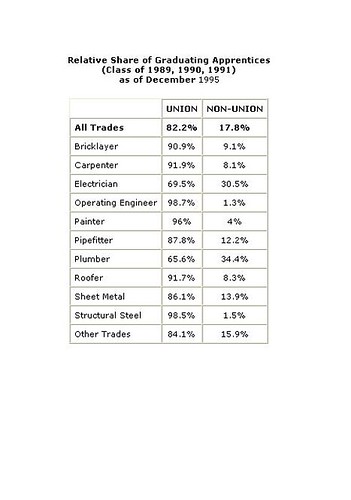
The graduation rates for those apprentices unlucky enough to have been ennrolled is these programs is miserable, as noted in the chart below.
graduation rates

What are the chances of a response from Elaine Chao? Probably not good, but who knows with the rise a new Democratic Congress.

When searching for a response from, Elaine Chao, the best I could find was this article about it from a union electrical contractors' website:

A DOL spokesman April 20 said the petition has been received by the department where it "is being reviewed to see if it has any merit."

The Building Trades petition was filed one month after U.S. Senators Edward M. Kennedy (D-MA) and Patricia Murray (D-WA) asked the General Accounting Office to investigate the performance of the nation’s construction apprenticeship programs, including graduation rates, the duration of training, and wage levels for apprentices during their training and upon their graduations.

DOL and GAO have remained silent on that request, as well.

From the National Electrical Contractor's Association

It is sad that the people charged with enforcing our labor and tax laws remain silent over an apparant rip-off of taxpayer funds. Even worst, they do this in support of a group that has virulently opposed worker protections in the workplace, including the freedom of an employee to choose a union of their own.

Somebody needs to make them accountable.

View Comments | 14 comments| 14 comments

Army Says It Will Withhold $19.6 Million From Halliburton, Citing Potential Contract Breach

February 8, 2007

WASHINGTON, Feb. 7 — The Army announced during a House oversight committee hearing on Wednesday that it would withhold $19.6 million from the Halliburton Company after recently discovering that the contractor had hired the company Blackwater USA to provide armed security guards in Iraq, a potential breach of its government contract.

The Army has said that its contracts with Halliburton, which has a five-year, $16 billion deal to support American military operations in Iraq, generally barred the company and its subcontractors from using private armed guards. But in a statement, Halliburton disagreed with the Army’s interpretation and suggested that there was nothing to prohibit Halliburton’s subcontractors from hiring such guards.

The announcement came during a hearing of the House Government Oversight Committee that included emotional testimony about the killing of four Blackwater employees in Falluja, Iraq, in 2004.

In an e-mail message made public in the hearing and written only hours before the four were killed, another Blackwater worker told the company to end the “smoke and mirror show” and provide its employees in the war zone with adequate weapons and armored vehicles.

“I need ammo,” the worker, Tom Powell, said in an e-mail message dated March 30, 2004, to supervisors at Blackwater, which is based in North Carolina. “I need Glocks and M4s — all the client body armor you got,” he wrote. “Guys are in the field with borrowed stuff and in harm’s way.”

Mr. Powell said he had requested heavily armored vehicles “from the beginning, and from my understanding, an order is still pending.”

“Why? I ask,” he added.

--MORE--

Tuesday, January 30, 2007

Waste, Fraud, and Abuse: Another Day at the Pentagon

by Chris Townsend

When I was a teenager apprenticing at being a trade unionist and a left winger both, two of my favorite books were Labor's Untold Story and History of the Great American Fortunes. I recommend them to any readers desiring a review of our own history as working people here in the United States. Both are monuments to working-class scholarship as well. Way back then, I was introduced to dog-eared copies by union old-timers who figured that a young militant like me might benefit from their contents. I sure did.

It was in the pages of these two volumes where I first discovered that -- over the course of U.S. history -- countless unscrupulous businessmen made instant and often massive fortunes by bilking and defrauding our government. More often than not, this meant our armed forces. Back in the 1800s, millions were made selling inedible foodstuffs to the Army, providing ships to the Navy that were not seaworthy, and selling arms and munitions at top-dollar prices that were so poor in quality as to be useless, even dangerous to soldiers in the field. Every imaginable kind of fraud was perpetrated by these incipient Robber Barons, who all systematically took advantage of whatever conflict was underway or looming as a means to get rich quick at taxpayers' expense.

The last 100 years has seen this criminal phenomenon grow exponentially. The overcharging and stealing is often done more professionally than in the past, but the price paid by our government is larger than ever. But, that said, nothing could have prepared any of us for the kleptomaniacal bonanza that has followed on the heels of September 11th and the Iraq invasion. For the sheer size and scope of the fraud and looting, no moment in human history can compare to what is happening today. The schemers and stealers of past years were small-time operators by today's standards. Every expensive restaurant around the Pentagon is jammed on a daily basis with operators in the pay of today's Robber Barons, all looking to coax lucrative and do-nothing contracts out of their armed forces procurement staff lunch guests.

Working here in Washington, D.C. has provided me with a front-row seat to the crime of robbing the Pentagon. In addition to our uniformed armed forces service members -- now quite visible as their enlarged numbers go to-and-from their daily duties here in the D.C area -- one can see the steady growth of every conceivable kind of military contractor, service provider, vendor, hardware or software salesman, equipment peddler, consultant, etc. Never in the history of the world has a military agency -- our Pentagon -- had so much money to spend in so short a time. This is what a "money for nothing" moment looks like, I am sure.

My observations and disgust in this regard multiplied when I opened the pages of the defense industry publication Defense News back in November of last year. Their November 6th issue contained an editorial entitled "U.S. Defense Funding -- Budget? What Budget?" This gem went on to lambaste Republicans for their reckless defense spending, and to skewer the armed forces for going before Congress proposing big increases in funding requests that were nothing but "WAGs." That's military speak for "Wild Ass Guesses." The publishers of this military business magazine seemed to understand that, if the stealing and robbing and just plain sloppiness of Pentagon spending got any more out of hand, the gravy train would someday soon come to a crashing end. The sober business elements get nervous when their good thing gets a little too good for too many and begins to make headlines and draw the attention of the politicians.

That editorial in Defense News was but the tip of an iceberg, however. When acting Pentagon Inspector General (IG) Thomas Gimble testified before the Readiness and Management Support Subcommittee of the Senate Armed Services Committee on January 17th, the lid blew off. Gimble is the "acting" IG because his predecessor bailed out to go to work for the Prince Group, which has as one of its subsidiaries Blackwater USA, a private security contractor doing big business with the Pentagon in Iraq and elsewhere. Acting IG Gimble unloaded an astonishing report on the Senate panel. The average Senate hearing is pretty boring, but I can assure you that no one slept during this one. And remember; the IG is the in-house guy who is supposed to -- or at least try -- to safeguard the integrity and honesty of the agency, its staff, and its processes.

Here are just some of the nuggets revealed at the hearing by acting IG Gimble, in no particular order: the Pentagon has so much money pouring in that it cannot spend it fast enough. In fact, the Defense Department has set up a scheme where other federal agencies are now spending vast sums of monies appropriated to the Pentagon. Billions of dollars under tens of thousands of contracts, in fact. Laws governing the procurement process are routinely ignored. Competition, price limits, and oversight have been "abandoned." Auditing of contracts and contractors is either non-existent or so slow and superficial as to be ineffective. The Pentagon has so much money left over at the end of the year that it has concocted yet another scheme to hide billions of dollars at other federal agencies. I think my favorite was the case of a rookie Navy contracting staffer who was allowed as a beginner to let contracts with a maximum combined value of $5 million dollars. He spent $135 million. Get the picture?

Our friends at Defense News did a story on this hearing and its bombshell testimony by acting IG Gimble: William Matthews, "Pentagon IG: Procurement Laws Are Routinely Broken: Blames DoD for Hiring Other Agencies To Help Spend Funds" (January 22, 2006). See it at the Defense News Web site. If you want to review the full report by IG Gimble, see it online at <www.dodig.osd.mil/Audit/reports/FY07/07-044.pdf>.

This out-of-control shenanigans is transpiring at the Pentagon, right here in Northern Virginia, and within sight of the U.S. Capitol. I think we are all fully aware of the equally bad -- or even worse -- situation regarding the waste, fraud, and theft which have been rampant since the first boot hit the ground in Iraq four years ago. The "legitimate" cost of maintaining the world's most massive military machine is staggering. The exorbitant costs of an illegal adventure like Iraq adds to this expense exponentially. Last, when profit-driven companies milk the corrupt and broken procurement and contracting system to the extent that is apparent, then the military budget grows into the malignant and parasitic growth on the national body that it has become. No nation in the history of the world has ever endured for long under such pressures.

Such colossal fraud and theft should add to our resolve to bring the Iraq war to an end as fast as possible. It should serve as notice to our new Democratic Party Congressional majority that its work is cut out for them in this regard. Vast budget cuts at the Pentagon are in order, in fact required. A complete top-to-bottom audit of expenditures and those doing the spending and those cashing the checks is next. Third, it is obvious that a special federal court will need to be improvised in order to prosecute what is likely several tens of thousands of criminals -- both Pentagon and private-sector -- who have engineered this massive disregard of the law and subsequent robbery of U.S. government funds. This must go all the way up the command chart, to the ousted Defense Secretary Donald Rumsfeld, to Vice President Dick Cheney, and to President George W. Bush.

Don't expect any of this to happen, however. But so as to add something practical to my advice, try downloading this article for starters. Then whip it out the next time you are talking to a Republican or Democrat politician who starts on the "We Can't Afford National Health Care" or "Everyone Has to Sacrifice a Little" Baloney. We have plenty of money to fix our problems. What we lack are civilized and sane priorities, the political will to implement them, and the motivation to prosecute those white-collar hoodlums who are carting away public money by the truckload. You'll feel better if you do this, even if we are headed to the poorhouse because of the Pentagon.


Chris Townsend is the Political Action Director of the United Electrical Workers Union (UE).

Monday, January 22, 2007

US farming watchdog accuses Wal-Mart of mis-selling

By Stephen Foley in New York

Published: 21 January 2007

Wal-Mart, the controversial retailing giant, is under investigation in the US over allegations it is trying to pass off non-organic foods as organic.

It has been accused of using misleading labelling that is "tantamount to consumer fraud" by an organic farming watchdog, the Cornucopia Institute. The body has handed its complaints to the US Department of Agriculture (Usda).

The Wisconsin Department of Agriculture, Trade and Consumer Protection is also conducting an investigation into whether Wal-Mart is placing "natural" produce on shelf space labelled as containing organic items.

The Cornucopia Institute claimed to have found dozens of examples of Wal-Mart's mislabelling products - from "all- natural yogurt" to soya milk "made from organic soybeans".

Usda is examining the watchdog's claims, while the Wisconsin authorities are examining Wal-Mart's practices and those of other supermarkets within the state.

Wal-Mart said it had written to store managers to ask them to be careful, but added that consumers could tell whether a product was organic by looking for the Usda label.

The Cornucopia Institute first raised the issue with Wal-Mart last autumn, but found fresh examples of mislabelling on return visits to stores this month.

"The vast majority of organic farmers and food marketers operate with a high degree of organic integrity," said Tom Willey of T&D Willey Farms of California, an organic producer of fresh market vegetables. "These abuses endanger the credibility of the organic label for all of us."

Wal-Mart, which owns Asda in the UK, is trying to build a green reputation and attract more affluent consumers.

A year ago the retailer announced that it would stock new ranges of organic food.

Thursday, December 21, 2006

Facing foreclosure: Casey Serin not in jail (yet), just hiding out as his life unravels

Thursday, December 21, 2006
UPDATE

Poor kid, it's all falling apart now. Maybe jail would be an improvement? But where are the Feds? Just too busy to care about mortgage fraud I guess..

Anyone want to guess the over/under for when Casey does get the big knock on the door? My guess: April 2007. I guess the banks have to file a complaint first?

My advice for Casey: file bankruptcy, turn yourself in, go States Evidence, write your bestseller book, and live the American Dream - Ring Up Massive Debt and Don't Pay It Back!

Here's his update:Avoiding Stress = More StressI’ve been a little out of it last couple of days.After coming back home to Sacramento on Monday I was feeling very overwhelmed by the “reality” that was/is waiting for me:…* still facing foreclosure on 4 houses…* well over $150K of unsecured debt…* decision to file bankruptcy or not to file bankruptcy…* uncertain job situation… utah mortgage issues…* lack of discipline and lack of progress on December goals…* being too distracted to do any more real estate deals…* serious marriage issues…* oh and on top of all that my laptop died!So I kind of hid from the world for a couple of days. No cell phone, no email, no blogging, no comments.

posted by keith at 7:55 AM

---

From Casey:

December 20th, 2006
Avoiding Stress = More Stress

I’ve been a little out of it last couple of days.

After coming back home to Sacramento on Monday I was feeling very overwhelmed by the “reality” that was/is waiting for me:… still facing foreclosure on 4 houses… well over $150K of unsecured debt… decision to file bankruptcy or not to file bankruptcy… uncertain job situation… utah mortgage issues… lack of discipline and lack of progress on December goals… being too distracted to do any more real estate deals… serious marriage issues… oh and on top of all that my laptop died!

So I kind of hid from the world for a couple of days. No cell phone, no email, no blogging, no comments.

The problem is that I can’t take a guilt-free break. The fires are are ranging all around me. I can’t just pretend everything is OK and hide from my responsibilities.

Now I have over 250 email to answer, over 200 comments to moderate, 25 voice mails to return and a huge pile of mail to sort. I hope there are no emergencies that I ignored by staying unplugged. The unknown dangers eat at me every minute and sabotage any hope for any down time.

Avoiding the stress of dealing with problems causes even more stress and more problems.
(It’s time to face reality…)

19 Interesting CommentsFiled under other


Casey Serin: I'm a 24 yr old real estate investor from Sacramento CA. After going to a few seminars I bought 8 houses in 8 months in 4 states with no money down looking to fix 'n flip. I made some mistakes and fell flat on my face with millions in debt and facing foreclosure. Trying to avoid foreclosure, sell quickly, repay everyone, and blog my lessons to help others in trouble. Comments welcome!

Email CaseyView All Entries

Friday, December 15, 2006

Let's say 'Enough!'

12/15/2006 12:07:00 PM
Comment on this article
Letter

In his essay, "Iraq: The War of the Imagination," posted by The New York Review of Books at www.nybooks.com, Mark Danner asks a fundamental question that Americans should have been asking themselves.

"If confronted with that simple question the smiling President Ahmadinejad of Iran put to Mike Wallace last August - 'I ask you, sir, what is the American Army doing inside of Iraq?' - how many Americans could offer a clear and convincing answer?"

The problem is that Iraq had nothing whatsoever to do with Sept. 11, and had no "weapons of mass destruction." Those realities were known to the Bush administration, and yet were misrepresented by that administration. The entire premise for the American invasion of Iraq was fraudulent.

Former federal prosecutor, Elizabeth de la Vega, in her book United States v. George W. Bush et al, has documented in detail the crime committed by the Bush administration. "The crime," writes de la Vega, "is tricking the nation into war - in legal terms, conspiracy to defraud the United States."

"Money talks," as they say, and that is how oil and Israeli interests took control of our government. Nuclear-armed Israel can look out for itself, and we can buy oil; we don't need to steal it. Yet our supine Congress allowed oil and Israeli special interests, operating within the Bush administration, to usurp powers rightfully exercised only by Congress. Congressmen who dodged their responsibilities have given us the best Congress that money can buy.

Because the fraudulent war on Iraq has taken the lives of thousands of innocent people, the Bush administration has placed an indelible stain of shame on the history of America. How long must we allow it to continue? Is there no leader in America with guts enough to stand up, to look beyond oil and Israeli money, and to declare "enough?"

JACK DENNON
Warrenton

Monday, December 11, 2006

I Smell a Rat!

by Tom Chartier.

"I died for freedom, this I know,
For those who bade me fight have told me so."

~ Lines from a poem published in England during the early months of WW1

Can you smell it too? For a moment I thought it was the mangrove swamp.

Time to find out what’s polluting the shades of America. It’s been stinking up the U.S…. and the world… for six years now. How could anybody miss it? It’s reeking to high Heaven. Behold: a monstrous Rodentia Giganticus that chews glass and eats its young.

Folks, what we have here is a massive scam that’s just like all the others our government has been pulling on the taxpayers since… well, let’s just go back as far as 2000 when our Dear Leader, Bush 43 (George W. Bush), was handed the presidency by Bush 41’s (that would be Bush The First, George H.W.) supreme court.

We have been – and are still being – scammed.

It’s the oldest Federal game in the book. Convene a war, rally the plebes to their "patriotic duty," and then sit back and watch the Fat Cats’ profits soar. The U.S. government has been engaged in this dodge since… oh who’s counting?

Major General Smedley D. Butler of the Marines, twice decorated with the Congressional Medal of Honor, dedicated his life to defend democracy abroad. One day he woke up to smell the afore-mentioned Rodentia Giganticus. Written in the wake of World War One, his book’s title says it all: War Is A Racket.

Indeed.

Who pays? The same helpless, naïve, conned taxpayer: You. Who profits? The profits go to the same place from which the propaganda derives: those slimy bloodsuckers in league with the devil: the Industrial-Military Complex.

Former British Prime Minister Stanley Baldwin referred to these people when he described the 1918 House of Commons as "a lot of hard-faced men who look as if they had done very well out of the war." Baldwin is also famous for saying that: "War would end if the dead could return."

But I digress.

I’m not even going to mention the dead, mutilated and mentally ruined soldiers and their families who have paid with heartache. I shall forgo discussing the meagre wages, the post-traumatic stress, the broken down equipment with which they fight and the dearth of graves back home in which to bury them.

I’m talking about those who get off easy by only having their pockets picked to death and about those who pick the pockets.

The wars in Iraq and Afghanistan are no different from the ones in which Major General Butler served, except that the causes of George’s wars are more blurred, shadowy and secret, in short, devious, than any past U.S. wars. Still, there is cause for joy in Mudville: for some the outcome has been more profitable… if you are a mercenary or other war profiteer, that is.

Not counting subcontractors, there are today in Iraq and Afghanistan an "army" of 100,000 private contractors hired to serve the U.S. military. Where do they come from? One account states that the US is furthering its pursuit of offshore outsourcing by drumming up these soldiers of fortune in Chile and South Africa. What do they do? They provide security for our multi-million dollar army. Say what?!

The DOD must think war is like a computer game.

Why does the professional mercenary company Blackwater USA provide security, which is really the military’s job. What security? Last I heard, our beloved leader could not get into Iraq to meet Prime Minister Maliki. Due to insurgency activity, the Baghdad airport was closed.

One wonders if mercenaries buy innocent civilians from warlords and then turn them in to the military, for a reward, as "terrorists"? As it is, we do know that hapless Iraqi and Afghani civilians are whisked away to Gitmo for permanent vacations. Gee, that sounds like a good racket to me. The mercenary would get paid twice for the same job! Bounty hunting has never been so good. Who cares if the captured are innocent or guilty?

What else do contractors do in Iraq? Some peel potatoes for the troops. Whatever happened to that time-honored military tradition? Many of these contractors are "rebuilding Iraq." Rebuilding Iraq?! What the hell! What a load of codswallop! We haven’t finished destroying it yet! Isn’t that a little bit like putting the Howitzer before Der Kublewagen? You bet it is. And it’s not by accident either. It’s by design.

How many of those private contracting companies are actually doing honest work?

Let’s see, Parsons Corp. have robbed congressionally approved borrowed money to build such edifices as the fabulous open-sewer Baghdad Police College. Offshore outsourcing at work! Providing microbe-infested water in support of the troops, Halliburton is the most famous for tax-dollar travesty.

How about all that oil that was supposed to pay for the war? Ignore for a moment the fact that stealing, smuggling and selling oil across the border has turned out to be a cash cow for the insurgents. Just how was this oil money supposed to pay for anything anyway? It wasn’t. The "Holy Grail" of the oil industry was always slated, and still is, if they can find a way to get their hands on it, to be the sole property of Big U.S. Oil.

Did any of those Iraq war money bills passed by Congress state that the money would come from Iraqi oil? Or was that funding to be conjured out of thin air? In other words, conjured out of your taxes, present and mostly future. That means your children and grandchildren will carry the brunt of paying for George’s war.

This seems an awfully shabby trade off for a war created by lies and deceptions. And we’re not even winning it! Of course "winning" isn’t really the idea. The profits come to an end if we "win." "Maintaining" the war is the idea. Let the good times roll.

And what’s this? The Pentagon wants what… more money? What a surprise! Well, why not? We have to "support our contractors," er "troops." The Pentagon wants at least another $100 billion. Now that’s staying the course! But God forbid we should consider spending less of the taxpayer’s money. We may be getting ripped off to a tune of at least $4 billion a year through corruption. Seems like a rather low figure to me. I’d say "corruption" is ripping us off by at least $348 billion and counting so far.

Oh well. All that tax money going into the pockets of the Bush Dynasty, Cheney Family "Trust" and the other slimy bottom feeders is all for a good cause. We’re paying to defend a slogan – The Global War on Terror!

Major General Smedley D. Butler must be turning over in his grave. Considering the circumstances, he must be glad he’s six feet under and not fighting George’s war "over there."

Elizabeth Gyllensvard edited and contributed to this story.

December 11, 2006

Tom Chartier [send him mail] played lead guitar in legendary Los Angeles punk band The Rotters for 26 years until their final appearance in January of 2004. He has lived in Tokyo and Los Angeles. Currently he resides somewhere in the Caribbean.

Copyright © 2006 LewRockwell.com

Friday, December 1, 2006

The Grand Jury Testimony: United States v. George W. Bush et al.

Tomgram: De la Vega, A Predisposition to Invade

[Note: For those in the Santa Barbara area in California, Elizabeth de la Vega will be speaking on December 10th at a rally, one of many events being organized around the country for Human Rights (and Impeachment) Day. She'll be on stage with Ann Wright, Dennis Loo, and David Swanson (who also writes for Tomdispatch.com) among others. For more on this event and others that day visit Swanson's AfterDowningStreet.org website.]

With the presentation of the first day of grand jury testimony from former federal prosecutor Elizabeth de la Vega's new book, United States v. George W. Bush et al., the case against the top officials of the Bush administration for defrauding the American people into war in Iraq comes to a provisional end at Tomdispatch. What the Bush administration did, De la Vega argued in "A Fraud Worse than Enron", Part 1 of her series at this site, was a crime, conceptually similar to the Enron case and should be treated as such. It was, in fact, nothing less than the Enronization of American foreign policy. It was also a crime for which there should be actual legal culpability and so, in part 2 of her series, she produced a hypothetical indictment for fraud against the main actors in the case, just as she had, over her career, presented numerous fraud indictments to grand juries.

Today, "FBI Special Agent Linda Campbell" begins to lay out that case for fraud by discussing the administration's "predisposition to invade Iraq." Those of you who want to read De la Vega's brilliantly argued full case against George W. Bush, Dick Cheney, Donald Rumsfeld, Condoleezza Rice, and Colin Powell should promptly purchase a copy of her book either at Amazon, at the website of the independent publisher, Seven Stories Press, or at your local independent bookstore.

De la Vega's superb book, like the testimony of "FBI Special Agent Linda Campbell" below, is fiction of a high order, based on a deep knowledge of exactly what the Bush administration did to us and how they did it. What happens next is, in truth, in the hands of the same American people who were scammed by this administration. Only history will tell us the results. Tom

The Grand Jury Testimony

United States v. George W. Bush et al.
By Elizabeth de la Vega

Testimony of FBI Special Agent Linda Campbell

Assistant U.S. Attorney: Good morning everyone. We're back here in the case of United States v. George W. Bush et al. Let's start by looking at Exhibit 1 in your packets. It's a chart that lists the main points we're going to cover in the grand jury.

Ex. 1
Evolution of the Fraud

* Bush, Cheney, et al. were predisposed to invade Iraq even before they were elected.
* They secretly began to plan the invasion immediately after September 11. Bush requested an Iraq war plan in November 2001 and began escalating military activity.
* They enlisted biased political appointees to find evidence to justify a war beginning in October 2001.
* They began, without a reasonable basis, to imply that Iraq was linked to the September 11 attacks and posed an urgent threat in the fall of 2001.
* They began a massive fraud campaign in September 2002 to overcome weak public support for an invasion and manipulate Congress into passing an authorization allowing the President to use force against Iraq.
* They invaded Iraq in March 2003, knowing that their stated grounds for war were false, fraudulent, and without reasonable basis.

Today, we'll talk about the administration's predisposition to invade Iraq.

Now, why is that relevant? Remember I told you that many fraud conspiracies begin as legitimate enterprises? They evolve into criminal activity when people begin to deceive others in response to problems or obstacles to achieving their goals. So, in any fraud case we need to know what the defendants' original objectives were.

Would somebody go get our witness? Thanks. [Whereupon the witness enters the room and is sworn]

Q. Could you please tell us your full name and what you do?

A. My name is Linda Marie Campbell and I'm a Special Agent with the FBI -- have been for sixteen years.

Q. What is your current assignment?

A. I'm one of eight agents on the task force that's investigating whether the President and his senior advisers defrauded Americans about prewar intelligence. But normally my office is in Boston. Home of Tom Brady -- the Patriot -- and of course, Sam Adams -- the beer and the patriot -- with a small "p." I do fraud cases, mainly.

Q. Could you tell us about your background? Sort of a Reader's Digest version?

A. Sure. I was an Air Force brat, so we lived all over--Georgia, Germany, Hawaii--until I was about twelve, when we landed at Otis Air Force Base on Cape Cod. After Boston College, I started teaching English at Catholic Memorial. I was going to coach softball, go down the Cape in the summer, eat fried clams. But one day I just thought, you know, I really can't stand talking about Hester Prynne for one more minute, and it seemed as if it would be wicked cool to become an FBI agent. So I applied.

Q. Has it been wicked cool?

A. Yes and no. One thing about the FBI is that they always send you somewhere that's not where you want to be, even if no one else does want to be where you want to be. Does that make any sense? So I asked to go to Boston after Quantico . . .

Q. And where'd they send you?

A. Tulsa, Oklahoma. But only for two years, because I took a language aptitude test and, next thing I knew, I was at the Monterey Defense Language Institute, learning Russian. I worked in DC for a few years and finally got back to Boston last summer. Although, now I'm in DC again working on this case. I'm also on the Emergency Response and Disaster Recovery Team.

Not exactly condensed was it?

Q. No, but that's ok. You were, in fact, part of the team at the Pentagon after 9/11, weren't you?

A. Yes, I was. I will never forget it.

Q. Jurors, you recall that you may only consider evidence your hear from the witnesses? That means we occasionally present testimony about things people already know.

Like, in this case, September 11, 2001. What happened on that day?

A. On September 11, nineteen men hijacked four commercial airplanes -- United Flight 175 and American Airlines 11 out of Logan, United Flight 93 out of Newark, and American Airlines 77 out of Washington/Dulles. They crashed two planes into the World Trade Towers in New York and one into the Pentagon. The fourth plane, United Flight 93, crashed in Pennsylvania after the passengers stormed the cockpit. In all, nearly 3,000 people were killed. It was a nightmare.

Q. Were you working at the time?

A. I was at firearms training, but I called my supervisor and told him I'd go wherever they needed me for disaster response. By 5:00 p.m., I'm headed to DC on the Mass Pike, with my Dunkin' Donuts iced coffee. One of the four essential food groups, by the way.

Q. Did you already know who committed the attacks?

A. Basically, yes. By late morning, really, everyone was talking about it having been al Qaeda and, of course, Osama Bin Laden. It was even on the radio. No specifics, but it was only a day or so before we heard those. The main hijacker was Mohamed Atta, who, along with 14 others, was from Saudi Arabia. Two were from Yemen and two were from Lebanon.

Q. We'll have more about this later, but -- bottom line -- was there ever any evidence that Saddam Hussein was involved in the September 11 hijackings?

A. No, not a bit.

Q. But your investigation has shown, has it not, that before the war, a majority of Americans believed that Saddam Hussein was somehow involved?

A. Yes.

Q. Danny Crain -- Special Agent Crain -- will be testifying about that in more detail, but in the meantime, have you determined how people came to believe that?

A. Unfortunately, yes. President Bush -- and Cheney and Rice and Rumsfeld and Powell -- deliberately gave people that impression, or allowed them to have it. That's Danny's area of testimony, I know, but let me say this: In fraud cases, we don't have to prove that people were actually deceived, but the case is stronger when you can prove they were. And here we know that many people came to believe many things about Iraq that were just false--including that there was some 9/11 connection.

Q. Well, let's turn to --

A. May I just add something?

Q. Of course.

A. Sometimes, the best way to understand the impact of fraud is not so much the number of victims, but the stories of the victims. Like in the movie Why We Fight, Wilton Sekzer. He was a retired cop whose son died in the World Trade Center. He strongly supported the war against Iraq, but only because he thought it was related to 9/11.

So, in 2004, when the President said not only that he had no evidence linking Saddam to the 9/11 attacks, but also "I don't know where people got the idea that I connected Iraq to 9/11," Mr. Sekzer was devastated. I'll read what he said:

What did he [Bush] just say? I mean, I almost jumped out of the chair. I don't know where people got the idea that I connected Iraq to 9/11. What is he, nuts or what? What the hell did we go in there for? We're getting back for 9/11. Well, if he didn't have anything to do with 9/11, why did we go in there? I was mad. I was mad. My first thought is: you know, you're a liar.

Q. And he felt betrayed?

A. Absolutely.

Q. Was he the only one?

A. No. As of July 2003, approximately 71 percent of the people in the United States believed that the President had deliberately implied that there was a link between 9/11 and Saddam Hussein.

•••

11:00 A.M.

Assistant U.S. Attorney: How's the temperature? I got GSA to turn off the air conditioning.

Grand Juror: No kidding. Now it's way too hot.

Second Grand Juror: Are we allowed to vote someone off the Grand Jury?

Q. It's tempting.

Agent Campbell, what evidence shows that Bush et al. were predisposed to invade Iraq before January 2001?

A. Well, we have to start back in 1992, after the first Gulf War.

Q. Ok. We're not going anywhere.

A. As some jurors may know, the ground-assault phase of the first Gulf War had ended after a hundred hours, because George H. W. Bush decided not to send troops on into Baghdad. Afterward, there was a bloodbath as Saddam Hussein put down a Shiite rebellion in southern Iraq.

At the time, at least publicly, Cheney, who was Secretary of Defense, supported Bush Sr.'s decision. He said if we'd gone into Baghdad, we'd still have forces there and we would be running the country. Cheney didn't think Saddam Hussein was worth "that damned many" casualties, meaning more than the 146 American soldiers who had already died.

Q. Does it appear that Cheney later changed his mind?

A. Yes. But Libby and Wolfowitz disagreed from the beginning.

Q. Who are Libby and Wolfowitz?

A. Libby is I. Lewis Libby, Cheney's aide in 1992. In 2001 he became a top adviser, mainly on foreign-policy issues, for Cheney and also for Bush. Until he got indicted. Paul Wolfowitz was also Cheney's aide in 1992 and in 2001 became Rumsfeld's Deputy Secretary of Defense.

Libby, Wolfowitz, and Cheney had a foreign-policy philosophy that's been described as neoconservative. They first wrote about it, as far as we know, in a 1992 paper called "Defense Planning Guidance." It was never published, but the draft was leaked to the press, so we know its main points. They wanted the United States to "assert world dominance" and to "to punish" or "threaten to punish" possible future aggressors to protect U.S. access to Persian Gulf oil or stop the proliferation of WMD -- weapons of mass destruction. They also recommended that the United States ignore the UN Security Council and act alone if it chose to do so.

Q. How were those ideas received at the time?

A. About as well as Stephen Colbert at the White House Correspondents' dinner.

Q. Not a warm reception, I take it. So what happened to "Defense Policy Guidance"?

A. Cheney, Wolfowitz, and Libby published a watered-down version of it in 1993 called "Defense Strategy for the 1990s."

Q. Did other future Bush-Cheney administration members publicly state their positions about the Middle East and/or Iraq in the 1990s?

A. Yes, they did. In 1996 Richard Perle, Douglas Feith, and David Wurmser wrote a paper for the Israeli government, called "A Clean Break: A New Strategy for Securing the Realm," that advocated invading Iraq to remove Saddam Hussein.

Q. And how did those three figure in the Bush-Cheney administration?

A. From 2001 to 2003, Perle was Chairman of Bush's Defense Policy Board. Feith was Bush's Undersecretary of Defense for Policy and Wurmser was brought in after 9/11 as part of the Counter Terrorism Evaluation Group that reviewed raw intelligence looking for evidence of links between Iraq and al Qaeda or Osama Bin Laden.

Q. In 1997, there was --

A. Also, oh, sorry --

Q. No, go ahead. But if we both talk at the same time, the court reporter might quit.

A. What I was going to say was that David Wurmser also publicly advocated a United States invasion of Iraq. Twice, actually. Once in a 1997 Wall Street Journal editorial and then in a November 2000 Washington Times op-ed, where he argued that the United States and Israel should "strike fatally, not merely disarm, the centers of radicalism in the region -- the regimes of Damascus, Baghdad, Tripoli, Tehran, and Gaza."

Grand Juror: Someone who had publicly advocated using military force to remove Saddam Hussein and attacking Syria, Libya, Iran, and Gaza was assigned to look for evidence to justify invading Iraq?

A. Yes. He is now Vice President Cheney's adviser on the Middle East.

Q. All right. In 1997, a group called Project for a New American Century, or PNAC, was formed. What was that?

A. According to its website, PNAC is a think tank dedicated to "American global leadership." Its stated principles were: (1) promoting a bold foreign policy; (2) significantly increasing defense spending; and (3) meeting threats "before they become dire."

Cheney, Rumsfeld, Libby, and Wolfowitz were founding members, as was Jeb Bush, President Bush's brother.

Q. Did the founding statement mention Iraq?

A. No, but a letter the members of PNAC wrote to Clinton in 1998 did.

Q. Before we get to that, were there other public statements advocating forcible removal of Saddam Hussein made by future Bush-Cheney people in 1997?

A. Yes, in a December 1997 issue of the Weekly Standard magazine called "Saddam Must Go: A How-to Guide," Wolfowitz and the current U.S. ambassador to Iraq, Zalmay Khalilzad, called for "sustained attacks" on Hussein's military and security forces to get rid of him.

Q. Early in 1998, the Project for a New American Century wrote the letter you just mentioned, right?

A. Right. Yes, most of it is excerpted in Exhibit 2:

Ex. 2
Excerpts from January 26, 1998 Letter from PNAC
to President William J. Clinton

We are writing you because we are convinced that current American policy toward Iraq is not succeeding and that we may soon face a threat in the Middle East more serious than any we have known since the end of the Cold War. . . . We urge you to . . . enunciate a new strategy . . . [that] should aim, above all, at the removal of Saddam Hussein's regime from power...

The policy of "containment" of Saddam Hussein has been steadily eroding over the past several months...

It hardly needs to be added that if Saddam does acquire the capability to deliver weapons of mass destruction, as he is almost certain to do if we continue along the present course, the safety of American troops in the region, of our friends and allies like Israel and the moderate Arab states, and a significant portion of the world's supply of oil will all be put at hazard. As you have rightly declared, Mr. President, the security of the world in the first part of the 21st century will be determined largely by how we handle this threat.

Given the magnitude of the threat, the current policy, which depends for its success upon the steadfastness of our coalition partners and upon the cooperation of Saddam Hussein, is dangerously inadequate. The only acceptable strategy is one that eliminates the possibility that Iraq will be able to use or threaten to use weapons of mass destruction. In the near term, this means a willingness to undertake military action as diplomacy is clearly failing. In the long term, it means removing Saddam Hussein and his regime from power.

In any case, American policy cannot continue to be crippled by a misguided insistence on unanimity in the UN Security Council.

Q. Any familiar names in the signature block?

A. Twelve of the eighteen signers became Bush-Cheney advisers or appointees: Rumsfeld, Wolfowitz, John Bolton, Khalilzad, Perle, as well as Elliot Abrams, Richard Armitage, Paula Dobriansky, Peter Rodman, R. James Woolsey, and Robert Zoellick.

Q. Well, it's 12:30 and I'm "stahvin," as Agent Campbell would say. So let's go eat.

•••

1:30 P.M.

Assistant U.S. Attorney: Did everyone make it back? Good.

Grand Juror: Agent Campbell, doesn't this 1998 letter contain the same arguments that the Bush administration made in 2002?

A. Yes it does: (1) containment wasn't working; (2) inspections wouldn't work; (3) Saddam would definitely have WMD if we didn't act immediately; and (4) we didn't need to work with the UN.

Grand Juror: What does "containment" mean?

A. In the context of Iraq, it referred mainly to the use of UN sanctions and restrictions to prevent Saddam Hussein from acquiring WMD and from threatening his neighbors.

Q. We're going to switch gears and turn to the 2000 election campaign. Before that, any questions?

Grand Juror: Was Bush in PNAC?

A. No. But in 1999, he hired Condoleezza Rice and her future Deputy National Security Adviser, Stephen Hadley, along with five PNAC people -- Perle, Wolfowitz, Armitage, Zoellick, and Dov Zakheim -- to be campaign foreign policy advisers. Four of those five had previously advocated forcibly removing Saddam Hussein.

Q.> During the 2000 campaign, did Bush and Cheney talk about U.S. global preeminence and taking preventive military action against possible threats from WMD or to our oil interests in the Middle East?

A. No. Well, yes and no.

Q. Oh, okay. Everybody got that, then?

A. Well, behind the scenes, with the neoconservative crowd, Bush and Cheney conveyed a very strong message. In fact, in September 2000 Libby, Wolfowitz, and ten other future Bush-Cheney appointees signed a policy statement, called "Rebuilding America's Defenses," that was posted on the PNAC website. The paper, which described itself as a "blueprint for maintaining global U.S. preeminence" that grew out of Cheney's 1992 "Defense Policy Guidance" paper, advocated substantially increased defense spending. Regarding the Middle East, it said the "need for a substantial American force presence in the Gulf transcends the issue of the regime of Saddam Hussein."

In plain English: We should have permanent military bases in the Middle East.

Q. Did the statement indicate whether PNAC thought the public would agree with this strategy?

A. Yes. PNAC acknowledged that its goals would likely take a long time to achieve, "absent some catastrophic and catalyzing event -- like a new Pearl Harbor."

Q. Anyone could look at this website, couldn't they?

A. Yes. But it was not well known outside of DC and certain conservative circles, and publicly, especially in the general election, Bush and Cheney said nothing whatsoever about a "bold" foreign policy or any other PNAC principles.

Q. Can you give us some examples?

A. Sure. On August 27, 2000, on Meet the Press, Cheney said that the U.S. should not act as "an imperialist power, willy-nilly moving into capitals in that part of the world, taking down governments." He was talking about the Middle East.

Also, in the presidential debate against Al Gore at UMass on October 3, Bush said he would "take the use of force very seriously" and "be guarded" in his approach. He also said he disagreed with Vice President Gore about the use of troops: "He [Gore] believes in nation building. I would be very careful about using our troops as nation-builders."

Then, in the October 11 debate, Bush was asked how the world should view us and he said they would welcome us "if we're a humble nation, but strong." He also said we needed to "project strength in a way that promotes freedom."

Q. What did Bush say about the need for building coalitions?

A. One of Bush's main themes was that he was a leader and that leaders build coalitions. On December 2, 1999, for example, he said he would "keep the peace" by "strengthening alliances, which says [sic] America cannot go alone, we must be peacemakers not peacekeepers." In the October 11 debate, he said, "It's important to have credibility and credibility is formed by being strong with your friends and resoluting [sic] your determination." It was especially important to have strong ties in the Middle East, he said, because of the oil there.

Q. Did Bush or Cheney talk about forcibly removing Saddam Hussein during the 2000 campaign?

A. Cheney never did, but early on, Bush seemed to say just that, perhaps inadvertently. In the December 2, 1999, New Hampshire Republican primary debate, the Fox News reporter Brit Hume asked him what he would do differently from Clinton regarding Saddam Hussein. And Bush said:

I wouldn't ease the [U.N.] sanctions, and I wouldn't try to negotiate with him. I'd make darn sure that he lived up to the agreements that he signed back in the early '90s. I'd be helping the opposition groups. And if I found in any way, shape or form that he was developing weapons of mass destruction, I'd take 'em out. I'm surprised he's still there. I think a lot of other people are as well.

Now, it's odd. The transcript says "'em" -- and I have no idea who's responsible for that. But, at the time, Hume clearly thought Bush was referring to "him," as in Saddam Hussein. And he -- Hume, I mean -- said, "Take him out?" And Bush responded, "To out [sic] the weapons of mass destruction." Which did not follow from saying "I'm surprised he's still there."

Q. Did Bush ever say "take 'em out" relating to Iraq or Saddam Hussein again during the campaign?

A. No. Although, in February 2000, he said, "There won't be any weapons of mass destruction left in Iraq if I'm the Commander-in-Chief." Usually, though, when Bush talked about Iraq, he'd say something like achieving world peace would require "firmness with regimes like North Korea and Iraq."

Actually, when you look carefully at what he said, he conveyed almost no information whatsoever.

Q. Have you come across a notable instance where Bush used the term "Commander-in-Chief"?

A. Yes. In May 1999, during an interview with a family friend and reporter named Mickey Herskovitz for a campaign book that someone else ended up writing, Bush said, "One of the keys to being seen as a great leader is to be seen as a Commander-in-Chief." He also said:

My father had all this political capital built up when he drove the Iraqis out of Kuwait and he wasted it. If I have a chance to invade -- if I had that much capital, I'm not going to waste it. I'm going to get everything passed that I want to get passed and I'm going to have a successful presidency.

Grand Juror: In other words, Bush was saying that the way to be seen as a great leader was to start a war?

A. It appears so.

Q. Let's take our afternoon break.

•••

3:15 P.M.

Assistant U.S. Attorney: Special Agent Campbell, you mentioned that numerous advocates of the Project for a New American Century principles relating to U.S. global dominance and preventive attacks ended up in the Bush-Cheney administration in 2001.

How many of the people brought in by Bush, Cheney, and Rumsfeld were public proponents of the PNAC principles?

A. Public proponents of the PNAC principles?

Q. Precisely.

A. At least twenty-eight, including advisers and consultants, as well as officials, appointees, and staff. They're all listed in Exhibit 3.

Q. Does everyone have Exhibit 3?

Ex. 3
Public Proponents of PNAC Principles

1. Paul Wolfowitz: Deputy Secretary of Defense;
2. I. Lewis Libby: Assistant to the President/ Vice President's Chief of Staff;
3. Eliot Abrams: Assistant to the President/ Deputy National Security Adviser for Global Security;
4. Stephen Cambone: Former Deputy Undersecretary of Defense for Policy/current Undersecretary of Defense for Intelligence [newly created position];
5. Richard Armitage: Deputy Secretary of State;
6. Christopher Williams: Special Assistant to the Secretary of Defense;
7. John Bolton: UN Ambassador/Former Undersecretary of Defense for Arms Control and International Security;
8. Peter Rodman: Assistant Director of Defense for National Security Affairs;
9. Paula Dobriansky: Undersecretary of Defense for Democracy and Global Affairs;
10. Douglas Feith: Former Undersecretary of Defense for Policy;
11. David Wurmser: Middle East Adviser to the VP/Former Special Adviser to the Undersecretary of State for Arms Control and International Security;
12. Abram Shulsky: Director of Defense Department's Office of Special Plans;
13. Zalmay Khalilzad: Ambassador to Iraq/Former Special Assistant to the President for Persian Gulf Affairs;
14. Barry Watts: Office of the Secretary of Defense/Director of Program Analysis & Evaluation;
15. Dov Zakheim: Undersecretary and Chief Financial for Defense Department;
16. Mark Lagon: Deputy Assistant Secretary of State;
17. Robert B. Zoellick: Former U.S. Trade Rep-resentative/Former Deputy National Security Adviser;
18. David Epstein: Staff, Secretary of Defense;
19. Richard Perle: Former Chairman, Defense Policy Board;
20. Eliot Cohen: Defense Policy Board;
21. Devon Gaffney-Cross: Defense Policy Board;
22. Henry S. Rowen: Defense Policy Board;
23. R. James Woolsey: Defense Policy Board;
24. Richard V. Allen: Defense Policy Board;
25. Daniel Goure: Consultant to Secretary of Defense;
26. Gary Shmitt: Consultant to Secretary of Defense;
27. Randy Scheuneman: Consultant to Secretary of Defense;
28. William Schneider, Jr.: Chairman, Defense Science Board

Q. Out of those, how many had specifically and publicly called for the use of United States military force to depose Saddam Hussein?

A. Seventeen had already called for the forcible removal of Saddam Hussein.

Q. Those would include the Deputy Secretaries of Defense and State, as well as seven additional high-level appointees in the State and Defense Departments, correct?

A. Yes. Also, of course, Defense Secretary Rumsfeld. Including Rumsfeld, eighteen of the Bush-Cheney administration appointees had publicly called for the removal of Saddam Hussein before 2001, including Rumsfeld.

Grand Juror: The evidence about Project for a New American Century, and Bush talking about being a Commander-in-Chief?

Q. Yes?

Grand Juror: Are you saying that Bush and Cheney were definitely planning to invade Iraq from the beginning?

Q. No, and that is not something you have to decide in this case. The predisposition evidence shows the genesis and some of the motivation for the fraud, but it's not intended to be proof of the fraud itself. You could decide they were not predisposed to invade Iraq and still find probable cause to believe that they conspired to defraud the United States beginning on or before September 2002.

So, let's call it a day. Thank you for your testimony, Agent Campbell. Have a good evening, everyone.

[Note: For Part 1 of Elizabeth de la Vega, "A Fraud Worse than Enron" click here; for Part 2, "The Indictment," click here. For the final five days of grand jury testimony, be sure to pick up a copy of United States v. George W. Bush.]

Elizabeth de la Vega is a former federal prosecutor with more than 20 years of experience. During her tenure, she was a member of the Organized Crime Strike Force and Chief of the San Jose Branch of the U.S. Attorney's Office for the Northern District of California. Her pieces have appeared in the Nation Magazine, the Los Angeles Times, and Salon. She writes regularly for Tomdispatch.com. This day of grand jury testimony is part of her new book, United States v. George W. Bush et al. She may be contacted at ElizabethdelaVega@Verizon.net.

Excerpted from United States v. George W. Bush et al. by Elizabeth de la Vega, published December 1, 2006 by Seven Stories Press and Tomdispatch.com.

Copyright 2006 Elizabeth de la Vega