Showing posts with label euro. Show all posts

Friday, April 13, 2007

Dollar slide accelerates

By Richard Blackden

Last Updated: 8:31pm BST 13/04/2007

  • Super-euro may spark a currency war while French battle the ECB
  • Audio: Barclays' currency expert on why sterling will hit $2

    The dollar's slide against most of the world's currencies gained pace today as dealers worried over the outlook for the US economy.

    Sterling and the euro are leading the charge against the embattled dollar, as interest rates are still expected to head higher in both Europe and the UK.

    advertisement

    After a string of rate increases in the US in the past two years, the Federal Reserve has recently indicated it may pause or even cut borrowing costs. The Bank of England and the European Central Bank, on the other hand, are still widely expected to raise interest rates.

    Many analysts reckon that global currencies are set for a major realignment as Europe takes over as the engine of world growth and the US starts to trip, prompting investors to sell dollar-denominated assets.

    Ian Stannard, a currency analyst at BNP Paribas, said: "Dollar weakness has been building over the last few days.


    "There is a growing recognition among policymakers that things are starting to slowdown in the US." Mr Stannard expects sterling to breach the $2 mark.

    Sterling soared almost a cent against the dollar to $1.9864, the euro strengthened to $1.3543 and the Japanese yen was also higher, at 118.26.

    With many believing the dollar has to weaken further to ease its trade and current account deficits, free-floating currencies such as sterling, the euro, the Australian dollar and the Canadian dollar are taking the brunt of the currency's slide.

    Asia's major currencies, including the Japanese yen and the Chinese yuan, are either managed or fixed against the dollar.

  • CHART
  • Tuesday, March 13, 2007

    Iran 'euro-based' oil bourse underway

    Mar 11, 2007

    An official said that the managing director of Iran's first petroleum exchange "Iran Oil Bourse" is expected to be appointed soon, bringing the oil-rich nation a step closer to opening its first 'oil bourse'. Majid Shayesteh, managing director of Kish Free Trade Zone Organization, said that President Mahmud Ahmadinejad has directed Iran's ministers of oil, economic affairs and finance to appoint the board of directors of the oil exchange and its managing director. He did not specify when exactly the exchange would open.

    He also said the building which will house Iran's first oil exchange has been constructed on the Persian Gulf island of Kish and that the required technical equipment has been installed.

    Shayesteh added that three major organizations are involved in the groundbreaking project, saying that coordinating efforts between the various groups initially delayed the project.

    According to the official, the articles of association for the oil exchange have since been approved. Last month, a separate official announced that the petroleum exchange would begin operation "in the near future."

    Mahmud Salahi, secretary of the High Council for Free Trade and Industrial Zones, had said that Iran decided to establish the euro-based oil exchange on Kish because "there was no such oil trading body in the region." The oil exchange will transact petroleum, petrochemicals and gas in various non-dollar currencies, primarily the euro. It would also establish a euro-based pricing mechanism for oil trading, or 'oil marker' as it is commonly called by traders.

    Oil Minister Kazem Vaziri Hamaneh said earlier that a stock market for trade in shares of oil companies will be established in Iran's southern of Kish in the near future. While touring of a local gas transfer operation, the minister said the stock market will be set up in cooperation with the oil and finance ministries.

    The stock market will be open to the public soon after the appointment of a managing director and members of a board of directors.

    Last month, after a year of speculation, Iran changed its oil bourse from petrodollars to petroeuros.

    Monday, February 26, 2007

    Every time Cheney opens his twisted lip the dollar takes a powder

    Related
    Bush Snr's major involvement in the gold business
    ---
    Feb 26, 2007

    That's Just My Opinion

    By Mike Whitney

    Gold traders love Dick Cheney. Every time he opens his twisted lip and barks out another threat to Iran, the dollar takes a powder while gold futures shoot to the moon. Maybe that’s the way Cheney likes it. After all, he dumped about $25 million in euro-bonds before he took office. Judging by the way he and brother-Bush have flogged dollar, he must have doubled his investment by now.

    The old greenback has dropped nearly 35% in the last 6 years while gold has just about tripled. In 2000 the dollar was a trim, sinewy pillar of strength. It entered the ring like a young Mohammed Ali; darting to and fro while pummeling ihis prey with quick laser-like blows that were barely visible. Now, the greenback plods along like a 60 year old Rocky Balboa, wheezing heavily and reeling with every punch; waiting for the one roundhouse that will leave him staring up from the canvas, spitting up broken teeth and blood.

    Ooooh; that hurts.

    The dollar’s in a heap o’ trouble and Cheney is doing his level-best to make sure that it hits the skids before he leaves office. Just yesterday the snappish Vice President said, "It would be a serious mistake if a nation like Iran were to become a nuclear power. Then he added ominously, "All options are still on the table."

    That oughta put the dollar on life support, eh?

    At present, the rest of the world is really wondering if dollar’s going to pull through. Central banks in Europe, Japan, and China have increased money supply and kept rates low in order to prop up the droopy greenback. But that won’t last. Eventually, they’ll all have to raise rates to slow inflation and stop equity bubbles from going haywire. (The Chinese stock market increased by a whopping 140% in one year. They probably don’t want a Dot.com-type meltdown like we had in the US.) Regrettably, once interest rates start to rise, the dollar slip quickly from view leaving only fetid trail of vapor behind.

    It’s astonishing how cavalier Cheney and the gaggle of racketeers at the Federal Reserve have been regarding the dollar. After all, why kill the goose that lays the golden egg?

    As the world’s “reserve currency” the fed can simply print out a couple trillion whenever it comes up short and bring back boatloads of sleek, Chinese manufactured goods or tankers weighed down with petroleum to power our boxcar-sized SUVs. Or, maybe, Bernanke would rather crank-out another $12 billion in crisp $100 bills, shrink-wrapped and loaded onto pallets and sent off to Iraq where they can vanish in the black hole of corporate malfeasance.

    No prob-Bob.

    But what happens when the rest of the world sees that the “stewards of the global economic system” (that’s us) are nothing but a bunch of Texas yahoos, religious zealots, and war-mongering boneheads?

    See, the funny thing about money is that it requires confidence in the provider that he will honor his part of the deal and operate in good faith. Otherwise, no one would dream of exchanging valuable resources and manufactured goods for silly, green tokens of credit-based fiat money with squiggly writing and funny looking men in powdered wigs on it.

    We all expect money to have value, and yet, the Bush team continue to sabotage the currency with their unfunded tax cuts, their $9 per month war in Iraq, and their 35% expansion of the federal government. (Remember when Clinton said the “era of big government is over”?) The result of this craziness was thoroughly predictable; central banks are running for the exits.

    Last Firday, the government reported that net capital inflows reversed from the requisite $70 billion to AN OUTFLOW OF $11 BILLION!

    The current account deficit (which includes the trade deficit) is running at roughly $800 billion per year, which means that the US must attract about $70 billion per month of foreign investment (US Treasuries or securities) to compensate for America's extravagant spending. When foreign investment stumbles, as it did in December, it puts downward pressure on the dollar.

    So what does it all mean?

    It means they don’t want our stinking greenbacks. And, if they don’t resume purchasing our debt (US Treasuries or securities) the dollar will join Rocky Balboa on the canvas peering up blankly at the klieg lights.

    “The full faith and credit” of the USA does not mean what it did 6 years ago. That’s a fact.

    The Bush-Cheney-Federal Reserve axis believe they can keep this ponzi-scheme going by cornering the oil market (attacking Iran) and forcing the oil-thirsty world to accept our feeble banknotes. But that’s just nuts. The Chinese are already killing us by buying up oil and natural gas leasing rights around the world WITH OUR OWN DOLLARS!

    It wasn’t supposed to work that way. We thought we were being clever by destroying the American labor movement and shipping our industry to China. We figured we could vanquish the middle class at home while we put the “fear o’ god” in the Chinese with our “shock and awe military” that was supposed to be out of Iraq in 3 years at the most.

    How’d that work out?

    Now the housing-bubble millstone is pulling millions of home owners beneath the waves while the maxed American consumer is down to his last credit card. In other words, the $11 trillion of new debt that was cleverly engineered through Greenspan’s low interest rate bonanza is about to detonate and bring the whole, wretched tower of American debt crashing to earth.

    The US economy hasn’t depended on productivity for years, even though the American people work harder and longer than their better-paid counterparts in Europe. This entire mess was brought on by stagnant wages, the wealth gap, and a system that rewards the villaso-raptures at the top of the economic food-chain. Like Cheney, they believe they can keep this scam going on forever; forcing the world to take worthless sheets green scrip that’s backed up by $8.7 trillion of debt and wouldn’t even make good bird-cage liner.

    But, then, that’s just my opinion.


    Mike Whitney lives in Washington state. He can be reached at: fergiewhitney@msn.com

    Central Banks Raise Euro, Cut Dollar Share Of Reserves - CBP Survey

    Central Banks Raise Euro, Cut Dollar Share Of Reserves - CBP Survey

    Mon, Feb 26 2007, 00:01 GMT

    http://www.djnewswires.com/eu

    Ctrl Bks Raise Euro, Cut Dollar Share Of Reserves -CBP Survey

    LONDON (Dow Jones)--The euro made small gains as a reserve currency at the expense of the U.S. dollar in the final months of 2006, while gold is set to make a comeback as a reserve asset, a survey by Central Banking Publications showed Monday.

    Although respondents to the confidential survey don't appear to have included the People's Bank of China or the Bank of Japan - which hold the world's largest foreign exchange reserves - they do account for 30% of total reserves held worldwide, or $1.5 trillion, CBP said. Of the 47 central banks that responded by December to the survey, 21 of them, managing reservesof $630 billion, said they had increased the share of their reserves held as euros, and 15 of thosesaid they had done so at the expense of the dollar.

    The survey by CBP, a publishing company specializing in reporting on central banks and other aspects of international finance, showed that seven central banks said they had cut the share of reserves held in euros.

    Nineteen central banks said they had cut the share of reserves held as dollars, while only 10 had increased the share of reserves held in the U.S. currency. Only five of the latter group, with reserves totaling $70 billion, said they had done so at the expense of the euro.

    "Many respondents raised the proportion of their portfolios held in euros, in most cases at the expense of the dollar," Central Banking Publications said.

    Nine central banks raised the pound's allocation, while four cut its share of reserves. Four central banks reported cutting their allocations of the Swiss franc, and none reported increasing its share.

    Six central banks said they had raised their yen allocations, while four cut their allocations to the Japanese currency.

    The shift into euros on the scale suggested by the survey would still leave the dollar as the dominant reserve currency by a large margin.

    The International Monetary Fund has said that in the third quarter of 2006 the dollar accounted for 66% of foreign currency reserves, while the euro accounted for 25%. In the second quarter, the dollar accounted for 65% of reserves, and the euro 25.5%.

    The survey also indicates that the pound continues to be the third most important reserve currency, with the Japanese yen remaining in fourth place.

    After a long decline as a reserve asset, the survey indicates that gold may be about to make a comeback. Some 63% of central banks said gold had become more attractive following recent price rises and an increase in market liquidity.

    But gold's role as a safe haven in the wake of natural or man-made disasters is also part of its attraction for central bankers.

    "Ongoing geopolitical risks involving the U.S. and its war on terrorism make U.S. Treasurys less attractive and gold more attractive," the survey quoted a reserve manager at a developing country's central bank as saying.

    Central banks have been diversifying their investment portfolios away from holdings of U.S. Treasury bonds and other low-yielding assets in recent years.

    The survey found many would like to be able to invest in equities, something only three of the central banks in the survey are allowed to do at present.

    Some 56% of respondents said there is a case for allowing central banks to invest in equities, although few of those came from developing economies.

    However, a move into equities is unlikely to happen soon, since central banks continue to be conservative in their investment decisions.

    The survey showed that in 2006, 70% didn't raise the proportion of their portfolio that is invested in "new asset classes" - essentially, anything that isn't a triple-A rated government bond - while 5% had cut their allocation to new assets.

    Central banks were in agreement that the sharp rise in official foreign exchange reserves that has taken place in the last three years is likely to continue.

    One central bank expects reserves to double over the next three to four years, but most respondents expected reserves to increase by between 20% and 59%, on top of the 70% increase since 2004.

    Central banks said the greatest threat to the value of their reserves over the coming 12 months is the risk of a slowdown in a major economy - particularly the U.S. - and global imbalances. That contrasts with 2006 and 2005, when their greatest concern was rising interest rates.

    Reserve managers are also increasingly worried by the threat posed by heightened geopolitical risks, while some also expressed concern about the growing role played by hedge funds in global financial markets.

    "Hedge funds have been growing rapidly and taking huge positions in different markets, and it seems that lessons from the past are not being taken into account," said one reserve manager. "When they come to unwind their positions, the impact on the markets may be severely destabilizing."

    -By Paul Hannon, Dow Jones Newswires; +44 20 7842 9491; paul.hannon@dowjones.com

    (END) Dow Jones Newswires

    February 25, 2007 19:01 ET (00:01 GMT)


    Copyright 2007 Dow Jones & Company, Inc.

    Dow Jones

    Monday, January 15, 2007

    Euro displaces dollar in bond markets

    By David Oakley and Gillian Tett in London

    Published: January 14 2007 22:08 | Last updated: January 14 2007 22:08

    The euro has displaced the US dollar as the world’s pre-eminent currency in international bond markets, having outstripped the dollar-denominated market for the second year in a row.

    The data consolidate news last month that the value of euro notes in circulation had overtaken the dollar for the first time. Outstanding debt issued in the euro was worth the equivalent of $4,836bn at the end of 2006 compared with $3,892bn for the dollar, according to International Capital Market Association data.

    Outstanding euro-denominated debt accounts for 45 per cent of the global market, compared with 37 per cent for the dollar. New issuance last year accounted for 49 per cent of the global total.

    That represents a startling turnabout from the pattern seen in recent decades, when the US bond market dwarfed its European rival: as recently as 2002, outstanding euro-denominated issuance represented just 27 per cent of the global pie, compared with 51 per cent for the dollar.

    The rising role of the euro comes amid growing issuance by debt-laden European governments. However, the main factor is a rise in euro-denominated issuance by companies and financial institutions.

    One factor driving this is that European companies are moving away from their traditional reliance on bank loans – and embracing the capital markets to a greater degree.

    Another is that the creation of the single currency in 1999 has permitted development of a deeper and more liquid market, consolidated by a growing eurozone.

    This has made it more attractive for issuers around the world to raise funds in the euro market. And, more recently, the trend among some Asian and Middle Eastern countries to diversify their assets away from the dollar has further boosted this trend.

    RenĂ© Karsenti, executive president of ICMA, said: “It is the stable interest rates in Europe that have helped and the fact that [the euro] has strengthened and shown resilience.”

    Since the start of 2003, the European Central Bank’s main interest rate has fluctuated only 1.5 percentage points, ranging from a low of 2 per cent in the middle of that year to 3.5 per cent, its rate today.

    In comparison, the Fed funds rate, the main US interest rate, has fluctuated 4.25 percentage points, ranging from 1 per cent in the middle of 2003 to 5.25 per cent, its level today. The euro has also risen to trade around $1.30 against the dollar, from around parity three years ago. Sterling issuance has grown in the past three years, reinforcing its attraction as a niche currency among some investors. The yen, in comparison, has fallen out of favour.

    Overall, international capital markets have doubled in size in terms of bond issuance during the past six years.

    Tuesday, January 9, 2007

    A Frightening Worldwide Currency Crisis


    January 02, 2007

    06:29

    Economist and Author, David Morgan reenatcs a dramatic scene from the Movie "Rollover" (1981), a frightening worldwide currency crisis he says we should be prepared for in our lifetimes.

    Tuesday, January 2, 2007

    Euro Officially Surpasses Dollar : Bonddad

    Jan 2, 2006
    By Bonddad
    bonddad@prodigy.net

    The financial press reported last week that the euro, the new currency created only five years ago and used by most European nations, has supplanted the U.S. dollar as the most widely used form of cash internationally. There are now more Euros in circulation worldwide than dollars.

    This alone is not necessarily troubling, as the dollar remains the world’s most important reserve currency. About 65% of foreign central bank exchange reserves are still held in dollars, versus only about 25% in euros. And the European Central Bank faces the same inflationary pressures that our own Federal Reserve Bank Governors face, including a growing entitlement burden that threatens economic ruin as both societies age. European politicians want to spend money just as badly as American politicians, and undoubtedly will clamor to inflate-- and thus devalue-- the euro to fund their creaky social welfare systems.

    Still, the rise of the Euro internationally is another sign that the U.S. dollar is not what it used to be. There is increasing pressure on nations to buy and sell oil in euros, and anecdotal evidence suggests that drug dealers and money launderers now prefer euros to dollars. Historically, the underground cash economy has always sought the most stable and valuable paper currency to conduct business.

    This is what happens when supply-side economics and rampant "shop 'til you drop" consumerism is the dominant economic policy of a nation.

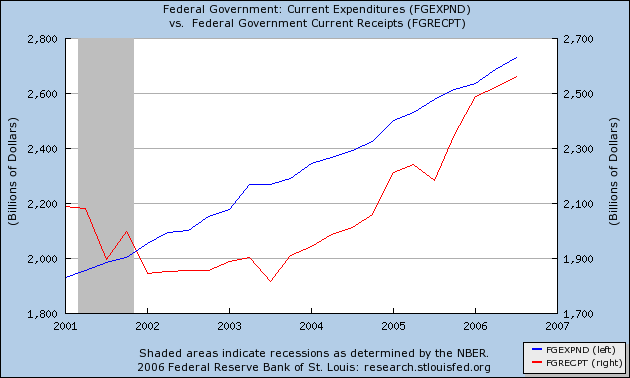
    The US government has run massive fiscal deficits for the last 6 years. Despite the accounting tricks used to mask the deficit's true size, the Bureau of Public Debt reports that total outstanding debt on September 30 2001 was $5,807,463,412,200.06 and currently stands at $8,593,076,179,156.67 -- an increase of 48% in six years. At the same time, the US government has cut taxes and gone to war, which has increased discretionary expenditures over 30%. Here's a graphic representation of the "MBA President's" fiscal policy (the top line represents expenditures):

    Photobucket - Video and Image Hosting

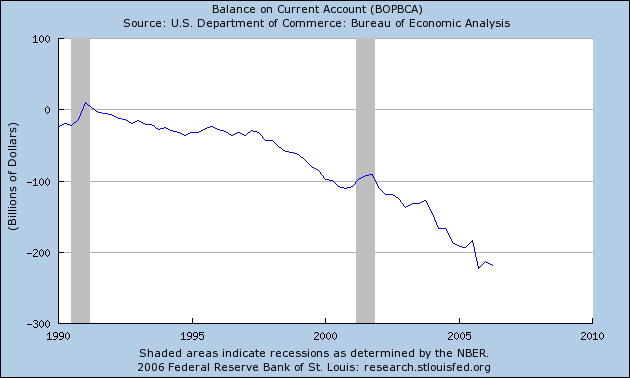
    The US consumer has continually increased individual purchasing for some time. This has resulted in a mammoth trade deficit:

    Photobucket - Video and Image Hosting

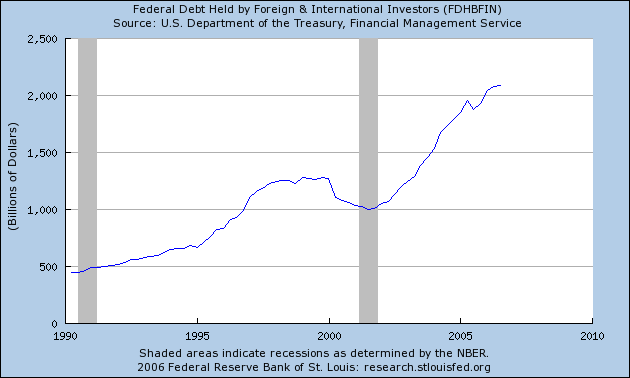
    To finance this deficit, foreign governments have doubled their purchases of US Treasuries over the last 6 years:

    Photobucket - Video and Image Hosting

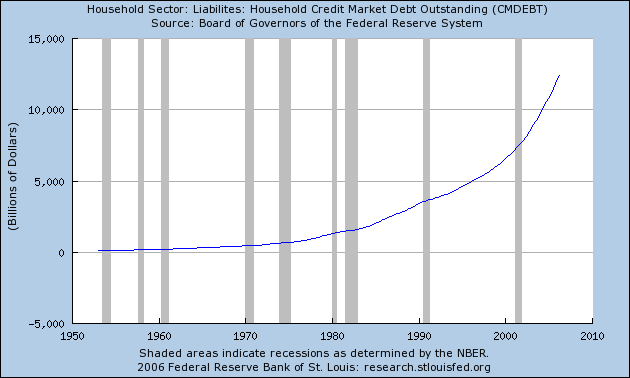
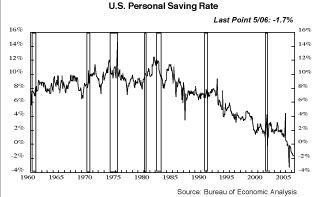
    Instead of savings, the US consumer has gone into debt to finance US growth.

    Photobucket - Video and Image Hosting

    US Savings:

    Photobucket - Video and Image Hosting

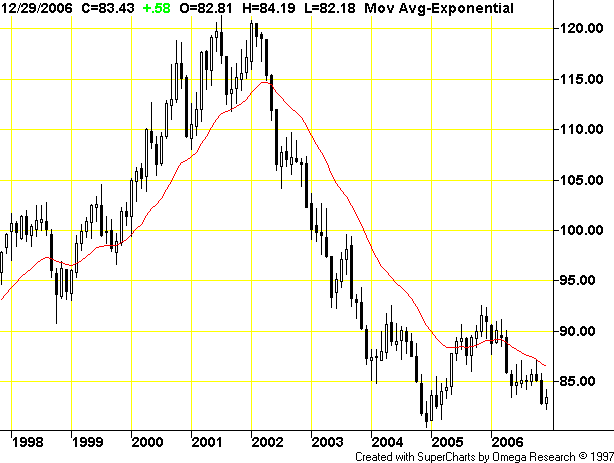
    The end result of these policies is simple: Despite the many protestations of a "strong dollar policy" has come under continued assault in the currency markets. Here's an 8-year chart of the dollar.

    Photobucket - Video and Image Hosting

    A devalued dollar leads to several basic economic problems.

    1.) The US Federal Reserve's ability to lower interest rates in the event of an economic slowdown is hemmed in. A devalued dollar means the US has a higher probability of importing inflation. The Federal Reserve is charged with price stability. If it lowers interest rates and the dollar is decreasing in value, it may import inflation.

    2.) The possibility of the dollar being shocked be a random economic event are higher. Consider that over the last few weeks Thailand implemented draconian currency controls that sent its markets down 10% in a day. While the government reversed policy within 24 hours, if they hadn't have done so, it is possible the effects would have eventually bled over into the dollar.

    3.) Right now foreign central banks are playing a giant international game of chicken. No one want to see their official reserves decrease in value. So, they all want to slowly sell dollars and buy more euros. However, by selling dollars they may create a selling panic that further decreases their respective currency reserves. In the current environment the possibility of one government making the wrong move is higher simply because of the dollar's precarious valuation.

    For market and economic analysis, go to the Bonddad Blog

    Appeal of euro strengthens against U.S. dollar

    Countries that hold large amounts of the dollar are showing a new willingness to dump the dollar in favor of the rising euro.

    Last week, the United Arab Emirates announced that it would shift more of its currency reserves away from the dollar, joining countries like Russia, Switzerland and Venezuela.

    Those moves come amid ambiguous recent signals from China about possibly pulling back from the dollar, and word last week from Iran, one of the largest oil producers, that it would prefer euro payments for oil, which typically is priced in dollars.

    But currency experts said that, for a number of reasons, these turns away from the dollar were not likely to inflict long-term damage on the currency's value.

    First, the motives of central banks that are adding other currencies to their reserves do not appear to be driven by the belief that the euro eventually will supplant the dollar as the world's currency. Rather, these central banks are doing what investors typically do to minimize risk: diversifying portfolios.

    By Jeremy W. Peters

    --MORE--

    Thursday, December 28, 2006

    Dollar Slides Most In A Week Versus Euro

    Related
    Europe will not escape the impact of dollar depreciation
    Dollar May Drop Versus Yen Before U.S. Consumer, Housing Data
    ---
    Dollar Slides; U.A.E. Says Selling U.S. Currency, Buying Euros

    By Kabir Chibber

    Dec. 27 (Bloomberg) -- The dollar dropped the most in a week against the euro as the United Arab Emirates said it will convert some of its reserves of U.S. assets into the European currency.

    The dollar also had its biggest decline versus the yen this month before a U.S. report that may show consumer confidence fell for a third straight month, fueling bets the Federal Reserve will lower interest rates next year. The U.S. currency has slipped 9.9 percent versus the euro this year, its first slide since 2004.

    ``The U.A.E.'s decision to relocate its reserves is part of a theme that means that U.S. dollar holdings in global currency reserves are decreasing,'' said Hans Guenter Redeker, head of currency strategy in London at BNP Paribas SA. ``The dollar is going to lose support as we see Fed rate cuts next year.''

    The dollar fell to 118.63 yen at 7:17 a.m. in New York, from 119.15 late yesterday. The currency slid to $1.3158 versus the euro, from $1.3098. The euro traded at 156.09 yen, from 156.04, after touching a record 156.43 on Dec. 21. The dollar has risen 0.8 percent against the Japanese currency this year.

    The U.A.E. will switch 8 percent of its reserves from dollars into euros before September, Sultan Bin Nasser al-Suwaidi said in a Dec. 24 interview in Abu Dhabi. The U.A.E. has started ``in a limited way'' to sell its dollar reserves, he said.

    The Gulf state is among oil exporters including Iran, Venezuela and Indonesia that are looking to shift their currency reserves into euros or price their oil products in the 12-nation currency.

    U.S. Slowdown

    The U.S. Conference Board's index of sentiment due tomorrow will probably drop to 102 this month from 102.9 in November, according to the median forecast of 48 economists surveyed by Bloomberg News. MasterCard Advisors also said holiday retail sales this year grew at a slower pace this year than in 2005.

    ``The data are likely to add to an economic slowdown scenario that may prompt a rate cut in the first quarter,'' said Masashi Kurabe, a currency manager in Tokyo at Bank of Tokyo- Mitsubishi UFJ Ltd., a unit of Japan's largest lender by assets. ``The bias is to sell the dollar.''

    The Fed has left borrowing costs at 5.25 percent for the past four policy meetings, after a two-year cycle of rate increases. The European Central Bank has raised rates six times in a year, to 3.5 percent. The Bank of Japan lifted its benchmark in July for the first time in almost six years, to 0.25 percent.

    Interest-rate futures show traders see a 28 percent chance the Fed will lower its overnight target lending rate between banks by a quarter point to 5 percent in March, up from a 17 percent likelihood a week ago.

    Japanese Rates

    The yen's gains accelerated against the dollar after a Jiji Press report suggested the BOJ will push rates higher at its January meeting because of better-than-expected data yesterday.

    Japan's government bonds fell the most in three weeks after the Jiji article. Reports yesterday showed an unexpected fall in the unemployment rate and a smaller-than-expected decline in household spending.

    ``The Jiji report is spurring yen buying,'' said Nobuo Ibaraki, deputy general manager of foreign exchange at Nomura Trust & Banking Co. Ltd., a unit of Japan's largest brokerage. ``Expectations for an interest-rate hike had receded. So the Jiji report will have a big impact on the yen.'' Japan's currency may strengthen to 118 per dollar today, he said.

    Jiji correctly predicted 10 days before the BOJ's meeting last week that policy makers would keep rates unchanged. The central bank will consider lifting the benchmark to 0.5 percent from 0.25 percent when it announces its next decision on Jan. 18, Jiji Press reported, citing unnamed sources.

    Retail Sales

    Governor Toshihiko Fukui told business leaders on Dec. 25 that the central bank will adjust policy if prices and the economy perform in line with forecasts.

    Gains in the yen may be limited after a government report showed retail sales rose less than expected last month.

    The currency is set for a second straight annual decline as interest rates in Japan, which are the lowest among major economies, prompt investors to seek higher returns offshore.

    Traders have still cut bets that the Japanese central bank will raise borrowing costs in January. The household spending report showed an 11th month of declines and gains in consumer prices failed to beat forecasts.

    ``It's hard to find a reason to buy the yen,'' said Stephen Halmarick, co-head of economic and market analysis at Citigroup Australia in Sydney. ``This is yet another set of disappointing numbers out of Japan.''

    The dollar may extend declines after MasterCard Advisors said retail sales in the holiday season rose 3 percent, a slower pace than last year's 5.2 percent increase, as a cooling housing market and higher energy costs cut into spending.

    The National Association of Manufacturers in the U.S. predicts slower economic growth will prompt the Fed to lower rates by a half-percentage point by the middle of 2007, the Wall Street Journal reported yesterday on its Web site, citing the Associated Press.

    To contact the reporters on this story: Kabir Chibber in London at kchibber@bloomberg.net .

    Last Updated: December 27, 2006 07:23 EST

    Tuesday, December 19, 2006

    Record Current Account Deficit = Countries Selling Dollars: Bonddad

    Dec 19, 2006

    By Bonddad
    bonddad@prodigy.net


    The U.S. current-account deficit widened to a record $225.6 billion last quarter as the trade gap grew and the country paid more interest to overseas investors.

    The shortfall in the current account, the broadest measure of trade because it includes transfer payments and investment income, followed a revised $217.1 billion second-quarter gap, the Commerce Department said today in Washington.

    Stronger economies abroad and a weakening dollar have trimmed the trade deficit in recent months, raising the prospect the current-account gap won't deteriorate much more. A smaller deficit reduces the sum the U.S. needs to attract from overseas, diminishing the dollar's vulnerability to an extended decline.

    The BEA reported that:

    Goods exports increased to $262.1 billion from $252.8 billion. The increase resulted from increases in all major commodity categories.

    Goods imports increased to $480.7 billion from $463.4 billion. The increase resulted from increases in petroleum and products and in most major categories of nonpetroleum products.
    In other words, the US can’t export its way out of this problem. In addition, so long as the US is oil dependent the current account will be difficult to cure.

    Sometime over the last year the general refrain from the Right Wing Noise, economics division was the current account didn’t matter. Their central argument had two prongs, neither of which had any weight. The first was the US was essentially too big to fail. The second was the current account had been around so long with nothing bad happening that it was something we shouldn’t worry about. But the US dollar has taken a hit recently, and is currently trading at yearly lows and is approaching multi-year lows.

    US interest rates – which were noticeably higher than other countries for the last several years – protected the dollar’s value for the last year and a half. However, European interest rates are increasing. In addition, the US economy is slowing which makes the dollar less attractive.

    Compounding this development is accelerating European growth which makes the euro more attractive. As a result of all these events – the narrowing interest rate differential, the mammoth US current account and accelerating growth elsewhere – various countries are moving away from the dollar. Iran is the latest country to announce a move to euros:
    Iran is to shift its foreign currency reserves from dollars to euros and use the euro for oil deals in response to US-led pressure on its economy.

    In a widely expected move, Tehran said it would use the euro for all future commercial transactions overseas.

    Analysts said Tehran had been steadily shifting its foreign-held assets out of dollars since 2003 and that Monday's announcement was unlikely to affect the value of the dollar, which has weakened significantly in recent months.

    And Iran is not alone.

    Venezuelan leader Hugo Chavez is directing a growing share of the country's oil profits into euros as the dollar and crude prices fall.

    The dollar, down 9.5 percent against the euro this year, may face more pressure in 2007 because Venezuela and oil producers from the United Arab Emirates to Indonesia plan to funnel more money into the single European currency.

    Banco Central de Venezuela has slashed the percentage of its $35.9 billion worth of reserves invested in dollars and gold to 80 percent from 95 percent a year ago, said Maza Zavala. The country, the world's fifth-largest oil supplier, has boosted its euro holdings to 15 percent, from less than 5 percent in the same period.

    And they are not the only one:

    Bank Indonesia is boosting euro holdings, said Senior Deputy Governor Miranda S Goeltom in a Dec. 13 interview in Jakarta. Indonesia has $39.9 billion in reserves. Sultan Bin Nasser al- Suwaidi, the governor of the Central Bank of the UAE, last month said he was considering when to shift as much as 8 percent of the nation's $24.9 billion in reserves into euros.

    The central banks are changing policy ``because the oil price has come down a long way and the U.S. dollar has been declining,'' said Michael Derks, chief markets strategist at Arch Financial Products LLP, a London-based hedge fund. ``The euro stands to benefit.''

    They are certainly not alone

    Oil producing countries have reduced their exposure to the dollar to the lowest level in two years and shifted oil income into euros, yen and sterling, according to new data from the Bank for International Settlements.

    The revelation in the latest BIS quarterly review, published on Monday, confirms market speculation about a move out of dollars and could put new pressure on the ailing US currency.
    The dollar is not in a good place. The US economy is slowing and there is a massive trade deficit further weakening its value. Global interest rates are closing in on US rates, taking away the carry trade. And the US’ popularity in some regions is at an all-time low.

    For Commentary on the Markets and Current Economic Numbers, go to the Bonddad Blog

    Monday, December 18, 2006

    Venezuela, Oil Producers Buy Euro as Dollar, Oil Fall

    (Update1)

    By Agnes Lovasz and Daniel Kruger

    Dec. 18 (Bloomberg) -- Venezuelan leader Hugo Chavez is directing a growing share of the country's oil profits into euros as the dollar and crude prices fall.

    The dollar, down 9.5 percent against the euro this year, may face more pressure in 2007 because Venezuela and oil producers from the United Arab Emirates to Indonesia plan to funnel more money into the single European currency.

    ``The U.S. dollar has suffered a long process of deterioration,'' Domingo Maza Zavala, one of seven board members at the central bank of Venezuela, said in a Dec. 14 interview. ``The diversification strategy started this year.''

    Banco Central de Venezuela has slashed the percentage of its $35.9 billion worth of reserves invested in dollars and gold to 80 percent from 95 percent a year ago, said Maza Zavala. The country, the world's fifth-largest oil supplier, has boosted its euro holdings to 15 percent, from less than 5 percent in the same period.

    The dollar has slumped against the European currency in 2006 as growth in the euro region outpaced the U.S. for the first time in five years. The dollar today fell against the euro to $1.3094 as of 6:55 a.m. in New York. The U.S. currency is little changed versus the yen this year, and currently trading at 117.81 yen.

    Indonesia Buys Euros

    Bank Indonesia is boosting euro holdings, said Senior Deputy Governor Miranda S Goeltom in a Dec. 13 interview in Jakarta. Indonesia has $39.9 billion in reserves. Sultan Bin Nasser al- Suwaidi, the governor of the Central Bank of the UAE, last month said he was considering when to shift as much as 8 percent of the nation's $24.9 billion in reserves into euros.

    The central banks are changing policy ``because the oil price has come down a long way and the U.S. dollar has been declining,'' said Michael Derks, chief markets strategist at Arch Financial Products LLP, a London-based hedge fund. ``The euro stands to benefit.''

    The Organization of Petroleum Exporting Countries, which produces 40 percent of the world's crude oil, said at a Dec. 14 meeting in Abuja, Nigeria, that it would cut output by 500,000 barrels a day to boost prices. Crude oil for January delivery fell 36 cents, or 0.6 percent, to $63.07 a barrel in after-hours electronic trading on the New York Mercantile Exchange. Prices have fallen from a high of $78.40 in mid-July.

    Crude is priced in dollars and the U.S. is the biggest consumer, importing around $400 million worth of the fuel a day in 2005, according to data from BP Plc, Europe's second-biggest oil company.

    Political Opposition

    The share of foreign-exchange deposits held in dollars by OPEC members and Russia, the largest non-OPEC oil exporter, fell to a two-year low of 65 percent during the second quarter, from 67 percent during the previous three months, Bank for International Settlements figures released last week show.

    Venezuela may also be motivated by animosity toward the U.S., said Rick Arney, chief currency strategist in San Francisco at Barclays Global Investors, which manages $1.7 trillion in assets.

    ``There is a political overlay to all of this,'' said Arney. ``Buying the dollar is not politically popular for some of these folks.''

    Chavez, re-elected as President for six years on Dec. 3, told the UN General Assembly on Sept. 20 that the U.S. is ``the greatest threat'' to the planet, and has repeatedly described U.S. President George W. Bush as ``the devil.'' He also says Bush's administration is trying to have him killed.

    Greenspan Comments

    Chavez called on OPEC to sell oil denominated in euros rather than dollars at a meeting of the group in Caracas on June 1, supporting a proposal made by Iran.

    Some analysts said the shift by oil-producing nations into euros is unlikely to weaken the dollar. OPEC nations reduced their dollar deposits by $5.3 billion in the second quarter, compared with holdings of $632 billion overall, according to data compiled by the BIS.

    ``It seems to be inconsequential in the large scheme of things,'' said Marc Chandler, global head of foreign-exchange strategy at Brown Brothers Harriman & Co. in New York. ``If anything, we should be surprised how small the outflow is.''

    The euro climbed as much as 0.5 percent on Dec. 11, the most in a more than a week, when former Federal Reserve Chairman Alan Greenspan said there are signs OPEC nations are switching their reserves out of dollars.

    `At the Start'

    ``A rising euro is a source of capital gain for central banks and a source for offsetting the capital loss created by the dollar'' decline, said Bankim Chadha, Deutsche Bank AG's head of macro foreign-exchange in New York and a former International Monetary Fund official. This gives ``an incentive to buy euros.''

    OPEC members and Russia increased the percentage of their foreign-exchange deposits held in euros to 22 percent in the second quarter from 20 percent, the BIS said. By contrast, the global average is about a third, according to the Basel, Switzerland-based bank.

    Oil states will probably buy the European currency at a faster rate to bring their reserves closer in line with other nations, according to David Durrant at Julius Baer Investment Management in New York.

    ``They've done very little diversification in the past,'' said Durrant, an investment strategist at Julius Baer, which oversees about $40 billion. ``We're at the start.''

    To contact the reporters on this story: Agnes Lovasz in London at alovasz@bloomberg.net ; Daniel Kruger in New York at dkruger1@bloomberg.net .

    Last Updated: December 18, 2006 06:59 EST

    Monday, December 11, 2006

    Oil producers shun dollar

    By Haig Simonian in Zurich and Javier Blas and Carola Hoyos in London

    Published: December 10 2006 20:11 | Last updated: December 10 2006 20:11

    Oil producing countries have reduced their exposure to the dollar to the lowest level in two years and shifted oil income into euros, yen and sterling, according to new data from the Bank for International Settlements.

    The revelation in the latest BIS quarterly review, published on Monday, confirms market speculation about a move out of dollars and could put new pressure on the ailing US currency.

    Market liquidity is traditionally low in December, and many traders have locked in profits, potentially reinforcing volatility.

    Russia and the members of the Organisation of the Petroleum Exporting Countries, the oil cartel, cut their dollar holdings from 67 per cent in the first quarter to 65 per cent in the second.

    Meanwhile, they increased their holdings of euros from 20 to 22 per cent, the BIS said. The speed of the shift may help to explain the weakness of the dollar, which recently fell to a 20-month low against the euro and a 14-year low against sterling.

    The BIS, the central bank for the developed world’s central banks, is customarily cautious in its language. However, it noted: “While the data are not comprehensive, they do appear to indicate a modest shift over the quarter in the US dollar share of reporting banks’ liabilities to oil exporting countries.”

    The review shows that Qatar and Iran, whose foreign exchange policy has sparked widespread market speculation, cut their dollar holdings by $2.4bn and $4bn respectively.

    Such shifts may be modest compared with the total assets held, but they provide a crucial indication on future thinking.

    Currency switches are likely to be progressive, subtle and discreet, as untoward attention could hit the dollar, lowering the value of depositors’ remaining dollar-denominated assets.

    The last time oil-exporting countries cut their exposure to the dollar – in late 2003 – it pushed the euro to an all-time high against the dollar. Eighteen months ago, the exposure to the dollar of oil producing countries was above 70 per cent.

    BIS data is the best guide financial markets have to the currency investment trends of oil producers, which otherwise do not provide figures. The rise in oil prices since 2002 means oil producing countries have amassed a current account surplus of about $500bn, according to the IMF. This is 2½ times the current account surplus of China.

    Overall, Opec’s dollar deposits fell by $5.3bn, while euro and yen-denominated deposits rose $2.8bn and $3.8bn, respectively. Placements of dollars by Russians rose by $5bn, but most of their $16bn additional deposits were denominated in euros.

    The dollar has suffered weakness because of concerns about global imbalances and the future course of the Federal Reserve’s interest rate policy.

    Additional reporting by Peter Garnham in London

    Friday, November 24, 2006

    Dollar hits 19-month low against euro

    Last Updated: Friday, 24 November 2006, 14:50 GMT

    Dollar loses ground against euro

    Recent economic news has favoured the euro
    The dollar has plunged to its lowest level against the euro since April 2005 amid concerns for the US economy.
    The euro surged to $1.3086 against the dollar, with many other currencies following suit.

    Sterling rose almost 1% to $1.93, the yen hit a two-month high and Russia's rouble rose to a seven-year high.

    Analysts have voiced concerns about the US economy after the White House downgraded its growth forecasts amid a sharp slowdown in the housing market.

    Meanwhile, expectations that the European Central Bank is once again about to raise interest rates gave a lift to the euro.

    Recent figures showing an unexpected rise in German business sentiment - its seventh quarterly rise in a row - also helped. So did French data showing that business confidence held at five-year highs in November.

    However, traders added that thin trade as a result of the US Thanksgiving holiday might have benefited the euro.

    "For the time being, the news flow is favouring the euro. If we close above $1.30 today, the key will be if we reject all of this as a Thanksgiving phenomenon or not," said Ian Gunner, head of foreign exchange research at Mellon Bank.

    http://news.bbc.co.uk/2/hi/business/6179552.stm